A political advantage: the reason why USA bombed Japanese cities
.it wasn’t necessary to use the bomb against the cities of Japan in order to win the war but our possession and demonstration of the bomb would make the Russians more manageable in Europe.
The real purpose in incinerating two high-density civilian population centers, says Stimson, was “to persuade Russia to play ball.”
that’s the very definition of terrorism: using violence or the threat of violence as the means to achieve political ends. It’s terrorism with a vengeance. Americans just don’t do that kind of thing. Americans would never behave in such a horribly depraved and cruel manner. But, in fact, we did. And, as Part II of this article will make devastatingly clear, we still do. And it won’t stop until America awakens to the truth about itself, and, openly acknowledging that truth with a show of genuine heartfelt remorse, proceeds to make amends where amends are due.
America’s Nuclear Madness: Terrorism With A Vengeance (Part I) By Robert Quinn” OpEdNews 8/11/2013 “………The inhumanity of it all couldn’t be more telling. The dropping of the second bomb on Nagasaki was especially brutal and cruel. Knowing of the horrendous horrors that had already been unleashed in Hiroshima, three days later the U.S. did the same thing to the civilian population of Nagasaki. Why? Japan’s surrender was already assured without the bombs. Surely surrender would soon be following on the heels of Hiroshima’s decimation. So, again, why the second bomb?
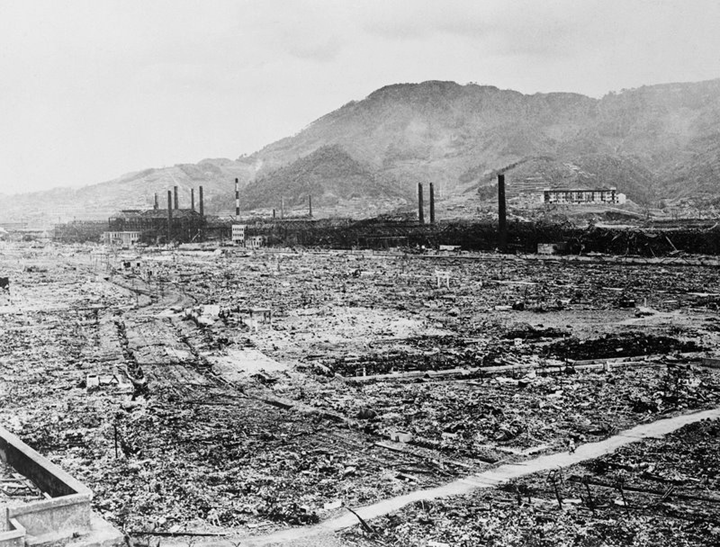
The answer is as simple as it is grotesque. The second bomb was dropped on Nagasaki because Japan’s surrender was never the issue. Getting Japan to surrender was the pretext. The bombs were dropped to make a point. There were political reasons for nuking those two high-density civilian populations, and the United States was not going to let Japan interfere with its political agenda by way of an untimely surrender. The dropping of the second bomb on Nagasaki was part of a political maneuver that had already been decided upon — a one-two punch stratagem designed to strike fear into post-war Russia (our ally in the war against Germany) and convince them to accept their subordinate position on the postwar world stage.
Atomic Bombs Were Dropped On High-Density Civilian Populations In Japan To Make A Political Statement Continue reading
America needs to apologise to Hiroshima and Nagasaki
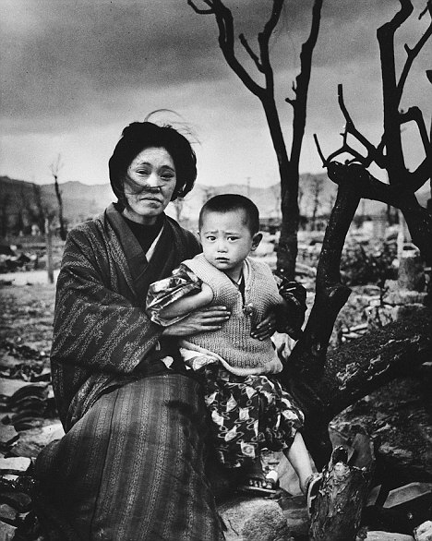 Apparently, in the minds of most Americans America can do no wrong. An act that would be perceived as profoundly immoral if any other nation were behind it, is seen as being quite acceptable and even laudable when it is America that sits in the driver’s seat. No matter how grossly immoral a particular action may be, when America is the actor that action is somehow magically transformed in light of America’s perceived exceptional greatness into something good, wholesome, and even holy — certainly nothing deserving of an apology.
I can think of no better example of this than America’s 1945 atomic bombing of the two high-density civilian population centers of Hiroshima and Nagasaki..
 America’s Nuclear Madness: Terrorism With A Vengeance (Part I) OpEd, By Robert Quinn, 12 Aug 13, ” The most effective way to destroy people is to deny and obliterate their own understanding of their history. — George Orwell
I tremble for my country when I reflect that God is just; that his justice cannot sleep forever. — Thomas Jefferson
This month marks the 68 th anniversary of the 1945 U.S. atomic bombing of the Japanese cities of Hiroshima and Nagasaki………..right-wing media made much of a Wikileaks-released diplomatic cable claiming to tell of plans President Obama had to apologize for America’s 1945 atomic bombing of Hiroshima and Nagasaki during his 2009 visit to Japan. Investors Business Daily castigated Obama for his alleged plans to “apologize” to Japan “for defending freedom” and “for winning with devastating finality the war Japan started.”The National Review Online, Rush Limbaugh, The Drudge Report, and Fox News, among other right-wing media outlets, followed Investor Business Daily’s lead, claiming that the only reason Obama’s planned apology failed to materialize is that Japan had the good sense to disapprove of the plan.
The White House denied that there ever was any plans to apologize to Japan for America’s WW II atomic decimation of Hiroshima and Nagasaki, and the Wikileaks cable bears this out. Following a meeting with Japan’s Vice Foreign Minister, the U.S. Ambassador to Japan cabled Secretary of State Clinton expressing Japan’s concern that a visit by Obama to Hiroshima, coming on the heels of Obama’s previously expressed commitment to a world free of nuclear weapons, would fuel speculation, particularly among anti-nuclear groups, whether an Obama apology might be in the offing. Japan worried that such speculation would play into the hands of these anti-nuclear groups, providing them with greater visibility and a stronger voice in their efforts to garner increasing public support for their anti-nuclear agenda. The diplomatic cable was sent, then, not to ward off a planned Obama apology as Obama’s detractors have claimed, but rather to ward off any speculation that such an apology might be in the works, and that an Obama visit to Hiroshima might serve to provoke. To this end, Japan’s foreign ministry recommended that both governments do what they can to keep all such speculation to a minimum, and that this could be accomplished by having Tokyo be the primary focus of Obama’s 2009 visit. End of story.
What if Obama actually did have plans to apologize to Japan on behalf of America for its atomic incineration of two Japanese high-density civilian population centers? What of it? What exactly is the crime in this? Might it just be that such an apology is in order, and long overdue? The media has given no consideration to this at all. Instead, the entire focus has been on whether Obama is guilty or not of having had plans to apologize for America. The right-wing conservative media assumed Obama’s guilt, the left-leaning liberal media came to his defense, and the mainstream media, where it wasn’t following the right wing’s deceptive lead, reported on the controversy. The important issue in all of this — the moral justification, or lack thereof, of America’s atomic bombing of Japan — was entirely ignored.
Is Apologizing When You’ve Said Or Done Something Detestable Un-American? Continue reading
Nuclear Free Pacific – a call from Pacific Conference of Churches (PCC)
 Pacific Church Body Pushes For Nuclear-Free Region Call comes as Japan reveals nuclear waste leaking into Pacific WELLINGTON, New Zealand (Radio New Zealand International, August 8, 2013) – The Pacific Conference of Churches (PCC) says regional leaders must urgently revive calls for a nuclear-free Pacific.
The PCC call comes amid revelations by the Japanese government that radioactive waste from the crippled Fukushima nuclear plant has been leaking into the Pacific Ocean for two years.
The PCC’s general secretary, the Reverend Francois Pihaatae, says Pacific churches have for nearly four decades consistently called for a nuclear-free Pacific and they renew this call today.
He says Japan has a moral responsibility to keep the region informed of what is happening with the waste and what is being done to contain the seepage.
The Reverend Pihaatae, who is from French Polynesia, draws parallels with the French territory’s failure to properly deal with the impact of nuclear tests there.
“That issue has not been really been taken seriously by our local government, but the impacts and the damage that the nuclear waste will do upon our people in the Pacific, because it is leaking and it will be spreading all over our ocean.” Radio New Zealand International: www.rnzi.com
Our grandchildren need a Nuclear Guardianship Ethic – NOW!
The Nuclear Guardianship Ethic is proposed as an evolving expression of values to guide decision-making on the management of radioactive materials.
On floating lanterns – and nuclear bombs National Catholic Reporter, Thomas C. Fox | Aug. 5, 2013 Kansas city, Mo. “………..And lastly, I would like to tell you about a woman named Joanna Macy and something she’s developed, called a “Nuclear Guardianship Ethic”. It is basically a bill of nuclear human rights for future generations. I went to a workshop she gave a couple years ago. She talked about plutonium as “poison fire” and said it endangers the future because radioactive materials will be deadly for thousands of generations and millions of years. Future generations have a right to live healthy lives and to have a world left to them in a livable condition.
So I invite you to ponder ideas in the Nuclear Guardianship Ethic and make them your own. Joanna says everyone on earth must become nuclear guardians.
1. Each generation shall endeavor to preserve the foundations of life and well being for those who come after. To produce and abandon substances that damage following generations is morally unacceptable.
2. Given the extreme toxicity and longevity of radioactive materials, their production must cease. The development of safe, renewable energy sources and non-violent means of conflict resolution is essential to the health and survival of life on Earth. Radioactive materials are not to be regarded as an economic or military resource.
3. We accept responsibility for the radioactive materials mined and produced for our alleged benefit.
4. Future generations have the right to know about their nuclear legacy and the dangers it brings.
5. Future generations have the right to protect themselves from these dangers. Continue reading
Catholic Worker activists lead in action to stop nuclear weapons
Nuclear weapons are toxic to manufacture. These are hazardous jobs; workers may not make it to retirement and/or they may suffer from serious, chronic health issues.
They are always saying they’re good, high-paying jobs, but they’re not! There are hundreds of thousands of sick and dying nuclear workers. The Department of Labor (DOL) administers the Energy Employees Occupational Illness Compensation Program (EEOICPA). Begun in 2001, the program tends to deny, deny, and deny claims until the worker dies.
On floating lanterns – and nuclear bombs National Catholic Reporter, Thomas C. Fox | Aug. 5, 2013 Kansas city, Mo. Tōrō nagashi is the Japanese ceremony in which participants float paper lanterns. This is done based on the belief that this guides the spirits of the departed back to the other world. The ceremony is also done by many peace communities to commemorate those lost in the bombings of Hiroshima and Nagasaki on Aug. 6 and 9, 1945.
Those US bombings were the only times nuclear weapons were ever used on human targets. Within the first two to four months of the bombings, the acute effects killed 90,000–166,000 people in Hiroshima and 60,000–80,000 in Nagasaki, with roughly half of the deaths in each city occurring on the first day.
In Kansas City, peace activists gather one evening during the first week of August to float lanterns in a pond in Loose Park to commemorate those deaths.
Last night several dozen once again gathered to remember those who died under the unfathomable fire of nuclear weapons. The gathering, as it always does, reaches globally to let the human family know that in the middle of the heartland of the United States, some people remember and call out against the building, storage and use of these weapons of mass destruction. Continue reading
USA and Israel – two unaccountable nuclear weapons States
Because the American press is a corrupt government propaganda ministry, the American people have no idea that neoconized Washington is planning nuclear war. Americans are no more aware of this than they are of former President Jimmy Carter’s recent statement, reported only in Germany, that the United States no longer has a functioning democracy.
America Plans Unprovoked Nuclear Attack on China, edited and abridged from various sources by Lasha Darkmoon, Darkmoon, August 3, 2013 by Montecristo “……….PAUL CRAIG ROBERTS: Amitai Etzioni has raised an important question: “Who authorized preparations for war with China?” We are confronted with a neoconized US military out of control endangering Americans and the rest of the world.
Etzioni is correct that this is a momentous decision made by a neoconized military. If the Chinese government is realistic, it is aware that Washington is planning a pre-emptive nuclear attack against China. No other kind of war makes any sense from Washington’s standpoint. The “superpower” was never able to occupy Baghdad, and after 11 years of war has been defeated in Afghanistan by a few thousand lightly armed Taliban. It would be curtains for Washington to get into a conventional war with China.
The Pentagon’s war plan for China is called “AirSea Battle.” It is clear that if the Washington morons get a war going, the only way Washington can prevail is with nuclear weapons. The radiation, of course, will kill Americans as well……..

The Soviet collapse and China’s focus on its economy instead of its military have resulted in Washington’s advantage in nuclear weaponry, giving it first-strike capability. Neither Russia nor China would be in any position to retaliate to Washington’s first strike. To ensure Russia’s inability to retaliate, Washington is placing anti-ballistic missiles on Russia’s borders in violation of the US-USSR agreement. Continue reading
A global turn away from nuclear nightmare: the chance is now
A so-called “inalienable right” of nations to the “use of nuclear energy for peaceful purposes” articulated in Article IV of the NPT in reality means exposing people and other living things worldwide to a risk of indiscriminate, catastrophic radioactive contamination at any time. Nuclear power erodes the health and rights of future generations. Through its inevitable generation of plutonium, and the intrinsic potential of uranium enrichment plants to enrich uranium beyond reactor grade to weapons grade, it exacerbates the danger of nuclear war and its catastrophic human consequences. Nuclear power thus undermines fundamental human and biosphere rights, responsible custodianship and human security.
To quote Albert Einstein again: “There is no secret and there is no defense; there is no possibility of control except through the aroused
understanding and insistence of the peoples of the world.”
 STUMBLING IN THE DARK, REACHING FOR THE LIGHT, Right Now By Tilman Ruff, 25 July 13, ”………While the extraordinary responsibility we bear is a difficult burden, it is also a precious gift. Few people in all of human history have had as great an opportunity as we now have to avert harm and do good for humanity
The fundamental realities of nuclear weapons are as profound as they are clear. Nuclear weapons are by far the most destructive, indiscriminate, persistently toxic weapons ever invented. Single nuclear weapons have been built with more destructive power than all explosives used in all wars throughout human history. In its landmark Resolution 1 of 2011, the Council of Delegates of the Red Cross and Red Crescent Movement, its highest governing body, “finds it difficult to envisage how any use of nuclear weapons could be compatible with the rules of international humanitarian law, in particular the rules of distinction, precaution and proportionality”. They cannot be used in any way compliant with international law.
While they exist, there is a danger they will be used. The only way to eliminate this danger is to eradicate nuclear weapons. While some nations possess them, others will inevitably seek to acquire them, or the means to produce them in short order. These means are now readily accessible around the world, even to isolated and impoverished countries like North Korea.
The lifetimes of uranium and plutonium isotopes, which can fuel bombs, are measured over tens of thousands to millions of years. Human
intent, nation-states and politics can change on a dime. Hence stocks of fissile materials, the capacity to create more, and nuclear weapons themselves are the problems, irrespective of the intentions of their custodians at any point in time. Continue reading
UK better off without nuclear missiles, says Archbishop
Archbishop of Wales Barry Morgan Calls on UK to Abandon Nuclear Missiles By David Williamson Global Research, July 19, 2013 Archbishop of Wales Barry Morgan and other faith leaders have urged the UK Government to abandon nuclear missiles on moral, strategic and economic grounds.
The calls come in the same week that the findings of a Government report led the Lib Dems to argue that Britain could cease to have a continuous-at-sea deterrent, cut the submarine fleet from four boats to three and save £4bn on the estimated £20bn to £25bn cost of renewing the Trident missile system…… Dr Morgan called for the Government to go further and argued that Britain would now be better off without nuclear weapons. Continue reading
Christian Peacemakers Team protest depleted uranium weapons
 The CPT will hold a public educational forum at 1 p.m. July 27 at the Jonesborough Visitors Center.
Protesters cite study that reveals depleted uranium near Jonesborough’s Aerojet Ordnance Johnson City Press, July 16th, 2013 by GARY B. GRAY A moral and educational crusade?Sure, that’s a fair description of the Chicago-based Christian Peacemakers Teams’ demonstration and pronouncement Monday that Jonesborough’s Aerojet Ordnance Tennessee’s use of depleted uranium has contaminated surrounding soil and water supplies.
In 2011, members of the organization spoke at East Tennessee State University and warned that tests would confirm that fact. About one dozen members, including members of Appalachia Peace Education Aerojet Action Project, gathered Monday across the street from the facility.
A table held pipes used for gathering soil and test tubes to show methods used in a Northern Arizona University study that revealed that “results clearly indicate the presence of DU (depleted uranium), evidently originating from Aerojet Ordinance Tennessee in water, soil and sediment samples.”
The study, headed by Michael Ketterer, a professor of chemistry and biochemistry and dated April 18, revealed that DU was found in water in Little Limestone Creek downstream from the facility, sediments in the creek, and from soils from off-site locations near the facility, located at 1367 Old State Route 34.
“The extent of physical damage cannot yet be nailed down,” said John Mueller a CPT delegation member and former chemist. “But the fact is that contamination has been found. The problem of uranium contamination is a world problem, not just a Jonesborough problem.”DU is a heavy metal that is both radioactive and chemically toxic, according to the Institute for Energy & Environmental Research. Depleted uranium is a by-product of the enrichment process. It has been used by the U.S. Military to make armor-piercing weapons and tank armor plating……….
CPT members believe prayer vigils and public witness brings the search for truth into the public arena — a tradition inspired by the word of God, practiced by Jesus and carried on by Gandhi and Martin Luther King Jr.
“We believe we must take our Christian faith from the pews to the public space,” CPT’s website announces.
Though Mueller, and the study’s author, call it an “interim report,” 25 samples taken over the past 2 years within a 2-mile radius of the plant showed the 17 samples closest to the plant showed contamination from processed uranium; samples further away did not……..
CPT member Rosemarie Milazzo, an 81-year-old nun from New York City, said the group believes all weapons are immoral and their use is incompatible with the most basic principles of humanity and environmental health protection.
“How can we, as a civilized society, continue to harm others by disregarding our responsibility to care for and protect our land?” she asked.
CPT member and Amarillo, Texas, resident Rusty Tomlinson said uranium weapons have been used in a number of nations and they each exhibit high rates of severe health problems. …..
The CPT will hold a public educational forum at 1 p.m. July 27 at the Jonesborough Visitors Center.http://www.johnsoncitypress.com/article/109500/protesters-cite-study-that-reveals-depleted-uranium-near-jonesboroughs-aerojet-ordnance
Catholic Pope and other religions acting on climate change
Climate change gets religious SMH, 19 June 13 Few religious communities have gone as far in fighting climate change as a church in Queensland which has 24 solar panels bolted to the roof in the shape of a Christian cross. “It’s very effective. It’s inspired some members of our congregation to install panels on their homes,” Reverend David Lowry said of the “solar cross” mounted in 2009 on the Caloundra Uniting Church, which groups three Protestant denominations.
Many religions have been wary of moving to install renewable energy sources on their places of worship, from cathedrals to mosques – or of taking a strong stand on climate change in general – despite teachings that people should be custodians of nature.
But slowly, that may be changing, thanks to new religious leaders including Pope Francis, the head of the Roman Catholic Church.
Radiation and the ethics of sending astronauts to Mars
One thing is certain: there can be no more romantic idealism. No amount of wishful thinking, or crowdsourcing, or press releasing can circumvent this problem. Space radiation is dangerous, potentially deadly. Manned missions to Mars with current technology will carry significant exposure risks.
At what price ethically do we want the Red Planet?
Space radiation results should spark manned Mars mission debate, Guardian UK, Stuart Clark 5 June 13Nasa data shows radiation doses would be so high on a manned Mars mission that we must now debate the ethics of deep space exploration – or wait decades to develop safer technology
It is time for idealism about missions to Mars to end. Going there with current technology would carry a significant risk of harmful radiation exposure. Continue reading
How Tom Toles sees the way for astronauts to Mars, radiation and all
 Oh that radiation thing http://www.washingtonpost.com/blogs/tom-toles/post/oh-that-radiation-thing/2013/05/31/9d2e044a-ca19-11e2-9f1a-1a7cdee20287_blog.html By Tom Toles E-mail the writer
Among the zillion ways that outer space is not like in the movies is lethal radiation. Other ways? Distances, travel speeds, costs, lack of anything but punishing, lifeless voids, and no economically harvestable anything. But let’s pause to reflect again, or possibly for the first time, about thatlethal radiation thingy.
Why we persist in a grade-school-level discussion about human space travel confounds me. Maybe it’s because we spent all our space education funds sending astronauts to grade schools, to tell them that there was a good career in human space travel, which there wasn’t and never will be. The ‘humans have always explored’ theme is true, but the main thing that is left unexplored is that theme itself. Yes, humans have always explored, and what it’s been about is finding things and places that are of value and doing it in a way that makes sense. You don’t walk into an erupting volcano just because people like to explore.
We have all the information we need already about habitation suitability in our solar system (slim to none), and we have all the information we need about its value aside from cheap thrills (none). We have the technology to robotically do everything humans can do in space at a tiny fraction of the cost. It’s still exploration!
Okay, the story cited here does say that in a trip to Mars, barring a big solar event, the amount of radiation received might “not be lethal” as long as you get lucky and beat the odds of your measurably increased cancer risk from a years-long adventure in a bath of ‘galactic cosmic rays.’ The good news? A Mars trip might not be “impossible!” “The space agencies could decide that the importance of a Mars mission would justify the waving of the the [safe] radiation exposure limit.” Woot. WHAT importance, again?
USA did nuclear tests to find out effects on animals
Veteran recalls 1940s radiation contamination study http://www.texarkanagazette.com/news/2013/05/27/veteran-recalls-1940s-radiation-contamin-470111.php By: Greg Bischof – Texarkana Gazette John Cary served in the Navy during World War II and participated in Operation Crossroads at Bikini Atoll. The operation consisted of two nuclear weapon tests to determine radiation’s effects on animals.
However, unlike the biblical Noah’s ark, the animals’ placement wasn’t to p…subscribers only
Saving the irradiated animals of Fukushima
 PROMETHEUS TRAP/ The disaster and animals (8): Woman repeatedly rescued pets in the Fukushima off-limits zoneAsahi Shimbun May 08, 2013 By MISUZU TSUKUE/ Staff Writer
Editor’s note: This is the eighth part of a new series that has run in the past under the title of The Prometheus Trap. This series deals with how pets and livestock fared in the evacuation zone around the Fukushima No. 1 nuclear power plant. The series will appear on Mondays, Wednesdays and Fridays.
After the government on April 22, 2011, banned entry into a 20-kilometer radius from the disaster-stricken Fukushima No. 1 nuclear power plant, declaring it to be an evacuation zone, many people still began to enter the area illegally to rescue pets left behind.
One of them was Mieko Yoshida, a 63-year-old cram school teacher who lived in Odaka Ward in the city of Minami-soma…….
Yoshida started a one-woman campaign for the rescue and protection of pets left behind in the no-go zone. When she stood in front of the city office, carrying a placard reading, “Give me back my family,” many pet owners approached her, saying, “The same here.”
Yoshida compiled a list of some 80 houses in the off-limits zone where pets had been left behind. She secretly went to these houses to feed and rescue the animals. Her concern for the lives of these vulnerable animals outweighed her fear of radiation.
Police kept bolstering the barricades erected to keep people from entering the zone, but that didn’t deter Yoshida from her stealth animal rescue mission…… http://ajw.asahi.com/article/0311disaster/life_and_death/AJ201305080006
Nuclear weapons industry exploits dogs, as well as humans
Security dogs overworked at nuclear site, report says http://www.latimes.com/news/science/sciencenow/la-sci-sn-bomb-dogs-overworked-20130426,0,7319317.story By Julie Cart April 26, 2013 Dogs trained to search for explosives and other substances were pushed “beyond their physical capacity” while working last year at a federal facility that handles, processes and stores highly enriched uranium, according to a report released this week.
The Energy Department’s inspector general found that canine security teams at the Y-12 National Security Complex in Oak Ridge, Tenn., were overworked, citing an instance in which a handler and a dog conducted 102 vehicle searches over a two-hour period.
Workers for the private contractor providing the dogs told investigators that requests for breaks were ignored by supervisors. The highly sensitive site is patrolled by human-dog teams that search for explosives, drugs and intruders. The facility was broken into last year by antiwar activists, prompting questions into the security at Energy Department installations.
Investigators were unable to corroborate reports that some dog competence testing had been rigged, but the report did find that “half of the canine teams we observed failed explosive detection tests, many canines failed to respond to at least one of the handler’s commands, and that canines did not receive all required training.”
1 This Month
6 June – WEBINAR- Get Inspired by Protests Against Military Bases!


Cuba Is Not a Failed State – It Is a Besieged State
PETITION: “Global Appeal to Endorse Palestinian Right of Return of Refugees”


of the week– Nuclear Reactor Information Task Force
To see nuclear-related stories in greater depth and intensity – go to https://nuclearinformation.wordpress.com
-
Archives
- June 2026 (34)
- May 2026 (306)
- April 2026 (356)
- March 2026 (251)
- February 2026 (268)
- January 2026 (308)
- December 2025 (358)
- November 2025 (359)
- October 2025 (376)
- September 2025 (257)
- August 2025 (319)
- July 2025 (230)
-
Categories
- 1
- 1 NUCLEAR ISSUES
- business and costs
- climate change
- culture and arts
- ENERGY
- environment
- health
- history
- indigenous issues
- Legal
- marketing of nuclear
- media
- opposition to nuclear
- PERSONAL STORIES
- politics
- politics international
- Religion and ethics
- safety
- secrets,lies and civil liberties
- spinbuster
- technology
- Uranium
- wastes
- weapons and war
- Women
- 2 WORLD
- ACTION
- AFRICA
- Atrocities
- AUSTRALIA
- Christina's notes
- Christina's themes
- culture and arts
- Events
- Fuk 2022
- Fuk 2023
- Fukushima 2017
- Fukushima 2018
- fukushima 2019
- Fukushima 2020
- Fukushima 2021
- general
- global warming
- Humour (God we need it)
- Nuclear
- RARE EARTHS
- Reference
- resources – print
- Resources -audiovicual
- Weekly Newsletter
- World
- World Nuclear
- YouTube
-
RSS
Entries RSS
Comments RSS
 nuclear-news