Jesuit priest sentenced for peacful civil disbedience in protest against nuclear weapons
 JESUIT FR. STEVE KELLY SENTENCED FOR NONVIOLENT CIVIL DISOBEDIENCE AT U.S. NUCLEAR WEAPON FACILITY JESUIT FR. STEVE KELLY SENTENCED FOR NONVIOLENT CIVIL DISOBEDIENCE AT U.S. NUCLEAR WEAPON FACILITY
Ignation Solidarity Network, BY ISN STAFF | October 22, 2020 Father Steve Kelly, S.J., a 71-year-old Jesuit priest and member of the nonviolent civil disobedience group that came to be known as the “Kings Bay Plowshares 7,” was sentenced by a U.S. District Court judge to 33 months in jail, three years’ probation and restitution fees on October 15. Due to the fact that Fr. Kelly already served 30 months and under federal law is owed 54 days a year of “good time credit,” his sentencing, in essence, discontinued his incarceration in a federal prison facility. The sentence stems from April 4, 2018, the 50th anniversary of the assassination of Dr. Martin Luther King, Jr., when Fr. Kelly and six other Catholic activists, all lay people—Mark Colville, Clare Grady, Martha Hennessy, Elizabeth McAlister, Patrick O’Neill, and Carmen Trotta—set out late at night to practice their faith and witness for peace among the people working with nuclear weapons inside the U.S. Navy Kings Bay nuclear submarine base on the south Georgia coast. Once inside, they split into three groups to hang banners, pour blood, spraypaint religious sayings, block off an administrative building with crime scene tape, and hammer on replicas of the nuclear missiles deployed on the Trident submarines based at Kings Bay. The declaration of a National Emergency in mid-March led federal courts around the country to curtail business and restrict access. In southeast Georgia, the federal court put most proceedings on hold, first until April 17 and later through the end of May, further delaying the sentencing of the seven. Following a three-day jury trial in October 2019, the seven were convicted of misdemeanor trespass and three felonies: the destruction of government property, depredation of government property on a military installation, and a conspiracy to do these things. Fr. Kelly was returned to the Glynn County Detention Center following the trial. Release on bail was unavailable to Fr. Kelly due to his unresolved federal probation violation from an earlier disarmament action in Washington state. When the group was convicted, the court had set forth a clear timeline for the completion of pre-sentencing reports in anticipation of sentencing last winter. Those deadlines slipped by as draft reports for each of the defendants were prepared…………. In reflecting on the April 4, 2018, action, Fr. Kelly said: “In order to use my limited time, I will, along with others, try to embody the vision given to us through the prophet Isaiah. It is a conversion of weapons to devices for human production. The gift of Isaiah 2:4 is an economic, political, and moral conversion of the violence of nuclear annihilation. With others, I hope to be instruments in God’s hands for showing a way out of the escalation, the proliferation of this scourge of humanity. I feel strongly that Martin Luther King, Jr., would agree with the principle I attribute to Gandhi that we cannot be fully human while one nuclear weapon exists.” [Kings Bay Plowshares 7, Religion News Service] https://ignatiansolidarity.net/blog/2020/10/22/jesuit-fr-steve-kelly-sentenced-for-nonviolent-civil-disobedience-at-u-s-nuclear-weapon-facility/ |
|
The cruel and lonely death of an American nuclear weapons scientist
And if you’re a believer that violent ends produce restless spirits, the Presidio is full up with phantoms as a result.
The most haunted place is said to be Letterman Army Hospital, once the base’s largest medical facility
In looking for Presidio ghost stories, though, we stumbled across a far stranger tale than any haunting: the real-life demise of a nuclear scientist — a chapter of the Cold War, as far as we can tell, untold since 1953.
The brain tumor presented a particular problem for the Atomic Energy Commission: It had the potential to cause erratic behavior and uncontrolled verbal outbursts. They were fearful that as he lost control of his mental faculties, Twitchell would begin spilling nuclear secrets. He knew “as much about atomic energy as any one man,” an anonymous source in the commission would later tell the Oakland Tribune.
So they built a secret ward just for Twitchell. At the cost of $100,000 — nearly $1 million today — construction began at the Letterman Army Hospital in San Francisco’s Presidio for the unusual patient. Once finished, all doctors and nurses who might interact with Twitchell were given rigorous screenings for any national security issues. In the end, only one male nurse was trusted to primarily care for Twitchell. A guard stood watch outside the room at all times.
Unbeknownst to the other military patients at the hospital, a civilian lay dying in his own wing. “He was the hospital’s hush-hush case,” the San Francisco Examiner reported.
An anonymous source told the Tribune this was standard protocol to keep scientists from blabbing while “unbalanced, anesthetized or under the influence of dentists’ ‘laughing gas.'” Although expensive, it was the only way to maintain national security.
Two excellent new books on a nuclear-weapons -free world

|
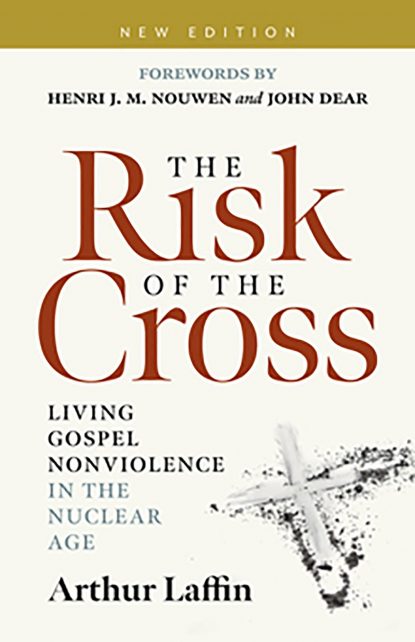
Nuclear anniversary serves as impetus for two excellent books,, Catholic Philly, By Eugene J. Fisher • Catholic News Service • Posted September 4, 2020 The Risk of the Cross: Living Gospel Nonviolence in the Nuclear Age” by Arthur Laffin. Twenty-Third Publications (New London, Connecticut, 2020). 130 pp., $16.95.“A World Free from Nuclear Weapons: The Vatican Conference on Disarmament,” edited by Drew Christiansen, SJ, and Carole Sargent. Georgetown University Press (Washington, 2020). 158 pp., $24.95.
These two books strive, based upon Catholic social teaching, to reach the same noble goals: global and local peace and the destruction of all nuclear weapons. Both note that the huge sums of money devoted to developing and maintaining nuclear weapons deprive our societies of funds that could be used to help those in need. The efforts of scientists in building nuclear weapons could be used to develop a better understanding of how to deal with threats to our health and safety, in local communities and worldwide. The timing of the release of these excellent volumes, some 70 years after Hiroshima and Nagasaki, is of course not accidental. The two books speak to each other and to all of us as Catholics, since a nuclear war would likely destroy our planet. “The Risk of the Cross” updates a book written some 40 years ago, when people like Dorothy Day and the Berrigans, and myself with them, were marching for peace and the Rev. Martin Luther King Jr. and John Lewis for civil rights for African-Americans. All these people lived the “Gospel nonviolence” called for, then and now, in this book…….. https://catholicphilly.com/2020/09/culture/nuclear-anniversary-serves-as-impetus-for-two-excellent-books/ |
|
|
Vatican representative calls on U.S. to sign nuclear-test-ban treaty
|
Vatican representative calls on U.S. to sign nuclear-test-ban treaty, National Catholic Reporter, Aug 31, 2020
VATICAN CITY — The COVID-19 pandemic has highlighted the absurdity of “pouring valuable resources into the maintenance of weapons of destruction while so many on this planet are struggling to survive,” a Vatican representative told a U.N. meeting to commemorate and promote the International Day Against Nuclear Tests.”It is impossible to make a moral case for continued nuclear weapon testing,” said Msgr. Fredrik Hansen, charge d’affaires at the Permanent Observer Mission of the Holy See to the United Nations. “There should never be another nuclear test explosion,” he told the online meeting Aug. 26. The United Nations has designated Aug. 29 as the International Day Against Nuclear Tests, and Msgr. Hansen used the occasion to call on China, Egypt, India, Iran, Israel, North Korea, Pakistan and the United States to ratify the 1996 Comprehensive Nuclear-Test-Ban Treaty. Visiting Hiroshima in November, Pope Francis said that “the use of atomic energy for purposes of war is today, more than ever, a crime not only against the dignity of human beings but against any possible future for our common home. The use of atomic energy for purposes of war is immoral, just as the possessing of nuclear weapons is immoral,” Hansen said. “Furthermore, the pope has also underscored the need to ‘reject heightening a climate of fear, mistrust and hostility fomented by nuclear doctrines,'” he noted. “Peace and international stability are incompatible with attempts to build upon the fear of mutual destruction or the threat of total annihilation,” the monsignor said, continuing to quote the pope………. https://www.ncronline.org/news/vatican/vatican-representative-calls-us-sign-nuclear-test-ban-treaty |
|
Southern African Faith Communities oppose extending the life of Koeberg nuclear power plant
 SA faith leaders against extending the life of Koeberg nuclear power plant https://www.iol.co.za/capeargus/news/sa-faith-leaders-against-extending-the-life-of-koeberg-nuclear-power-plant-e02fb49d-8b22-413b-95ef-165d7f31a5e4By Mwangi Githathu , 12 Aug, 20, Cape Town – Campaigners are urging a rethink on extending the life of the Western Cape’s Koeberg nuclear power plant, while the period for public comment on the draft regulations on the long-term operation of nuclear installations closes next Tuesday. SA faith leaders against extending the life of Koeberg nuclear power plant https://www.iol.co.za/capeargus/news/sa-faith-leaders-against-extending-the-life-of-koeberg-nuclear-power-plant-e02fb49d-8b22-413b-95ef-165d7f31a5e4By Mwangi Githathu , 12 Aug, 20, Cape Town – Campaigners are urging a rethink on extending the life of the Western Cape’s Koeberg nuclear power plant, while the period for public comment on the draft regulations on the long-term operation of nuclear installations closes next Tuesday.
Department of Mineral Resources and Energy Minister Gwede Mantashe published the request which is intended to lead to a nuclear programme delivering new installed capacity of 2.5 gigwatts in June. Mantashe said: “The plan also provides for the extension of the life of Koeberg, which is due to be decommissioned in 2024 after 40 years in operation.” Leading the charge against the extension of the plant’s life span is the Southern African Faith Communities’ Environment Institute, Safcei. In a statement, Safcei said: “As South Africa faces another push for nuclear energy when the country is in crisis from the Covid-19 pandemic, faith communities call for no more nuclear energy. “Nuclear power is not climate resilient, cheap, competitive, quick to build and deliver, safe or able to solve our immediate energy needs.” Safcei said lessons need to be learnt from the country’s past experience with nuclear energy, including what it claims were 14 years of research and billions of rands “wasted on small nuclear energy systems known as the Pebble Bed Modular Reactor (PBMR).” “The level of trust in Eskom is at an all-time low. South Africans are tired of load-shedding and annoyed that tax revenue continues to be diverted from essential services to bailout dysfunctional state owned enterprises. What reassurance do we have that a new state-owned nuclear project will be any different?” asked Safcei. Last year Eskom’s attempt to see whether there was a market and potential for the previously abandoned Pebble Bed Modular Reactor (PBMR) PBMR project was dismissed as “unrealistic” by the South African Independent Power Producers’ Association (SAIPPA). SAIPPA general secretary Dave Long said: “I can’t believe it has any real chance to succeed now. It has been overtaken by technology and nobody is that interested in nuclear any more.” |
|
Hiroshima and the normalisation of atrocities

|
Death from the sky: Hiroshima and normalised atrocities https://www.onlineopinion.com.au/view.asp?article=21049
When US President Harry S Truman made the decision to drop the atomic bomb on Hiroshima on August 6, 1945, followed by another on Nagasaki a few days later, he was not acting as an agent untethered from history. In the wheels of his wearied mind lay the battered Marines who, despite being victorious, had received sanguinary lashings at Iwo Jima and Okinawa. A fear grew, and US military sources speculated about, the slaughter that might follow an invasion of the Japanese homeland. They also pondered the future role of the Soviets, and wondered whether there were other means by which Japan’s involvement in the war might be terminated before Moscow got its hands on the battered remains of North East Asia. Much is made about the moral dilemma Truman faced. He knew there was the nastiest of weapons at hand, born from the race to acquire it from Nazi Germany. But on a certain level, it was merely another weapon, one to use, a choice sample in the cabinet of lethal means and measures. By that stage of the war, killing civilians from the air, not to mention land, was banal and common place; enemy populations were to be experimented upon, burned, torched, gassed, shelled and eradicated in the program of total war. By the time Truman made his decision, Japan had become a graveyard of strategic aerial bombing. General Curtis E. LeMay of the US Air Force prided himself on incinerating the enemy, and was encouraged by various study commissions advocating the use of incendiary bombs against Japan’s flammable urban architecture. He was realising the dreams of such figures as the pioneering US aviator and air power enthusiast Billy Mitchell, who fantasised in the 1920s about Japanese cities being “the greatest aerial targets the world has ever seen”. In 1941, US Army chief of staff George Marshall spread the word to journalists that the US would “set the paper cities of Japan on fire”. Civilians would not be spared. Towards the end of the war, daylight precision bombing had fallen out of favour; LeMay preferred the use of Boeing B-29 Superfortresses, heavily laden with firebombs, to do the work. His pride of joy in conflagration was Tokyo. During the six-hour raid over the night of March 9 and 10, 1945, the US Strategic Bombing Survey concluded that 87,793 had perished, with 40,918 injuries. There was little novel in LeMay’s blunt approach. Britain’s Air Force Marshall Arthur “Bomber” Harris fertilised the ground, and the air, for such an idea. He made it his mission to not only kill Germans but kill German civilians with a cool determination. He did so with a workmanlike conviction so disturbing it chilled the blood of many Britons. As he put it, “The cities of Germany, including their working populations, are literally the heart of Germany’s war potential.” It was his intention to, he explained to personnel, “in addition to the horrors of fire … to bring masonry crashing down on top of the Boche, to kill the Boche and to terrify the Boche”. The Teutonic enemy came, not so much in all shades, but one. Saturation bombing, regarded after the Second World War as generally ineffective, a ghastly failure to bring the population to its knees, received its blessing in Bomber Command. This entire process neutered the moral compass of its executioners. Killing civilians had ceased to be a problem of war, one of those afterthoughts which served to sanction mass murder. Britain’s chief of the air staff for a good deal of the war, Charles Portal, called it a “fallacy” that bombing Germany’s cities “was really intended to kill and frighten Germans and that we camouflaged this intention by the pretence that we would destroy industry. Any such idea is completely false. The loss of life, which amounted to some 600,000 killed, was purely incidental.” When 600,000 becomes an incidental matter, we are well on the way to celebrating the charnel houses of indiscriminate war. When the issue of saturation bombing creased the legal minds behind the Nuremberg and Tokyo war crimes trials, an admission had to be made: all sides of the Second World War had made the air a realm of convenience in the killing of humanity, uniformed or not. To win was all that mattered. While the Nuremberg Charter left it open to criminalise German aerial tactics, the International Military Tribunal hedged. As chief of the Luftwaffe, Herman Göring was singled out for air attacks on Poland and other states but the prosecutors refrained from pushing the point, likely reflecting the cold fact, as Matthew Lippmann puts it, “that both Germany and the Allies engaged in similar tactics.” It is true that Germany and Japan gave a good pioneering go at indiscriminate aerial slaughter. But the Allied powers, marshalling never before seen fleets of murderous bombers, perfected the bloody harvest. The war had to be won, and, if needed, over the corpses of the hapless mother, defenceless child and frail grandparent. As the historian Charles S. Maier notes with characteristic sharpness, a tacit consensus prevailed after the Second World War that the ledger of brutality was all stacked on one side. German bombings during the Spanish Civil War, notably of Guernica; Warsaw, Rotterdam, London and Coventry during the world war that followed, were seen as “acts of wanton terror”. The Allied attacks on Italian, German and Japanese urban centres, in proportion and scale far more destructive, were seen as “legitimate military actions”. Distinctions about civilian and non-civilian vanished in the atomic cloud. Hiroshima’s tale is the apotheosis of eliminating distinctions in war. It propagated such dangerous beliefs that nuclear wars might be won, sparing a handful of specialists and breeders in bunkers planning for the new post-apocalyptic dawn. It normalised, even as it constituted a warning, the act of annihilation itself. Prior to the twin incinerations of Hiroshima and Nagasaki, the redoubtable nurse and writer Vera Brittain issued a warning that remains salient to those who wish to resort to waging death from the sky: “If the nations cannot agree, when peace returns, to refrain from the use of the bombing aeroplane as they have refrained from using poison gas, then mankind itself deserves to perish from the epidemic of moral insanity which today afflicts our civilisation.” |
|
|
Inhumanity, racism, sheer immorality, in the decisions to nuclear bomb Hiroshima and Nagasaki
|
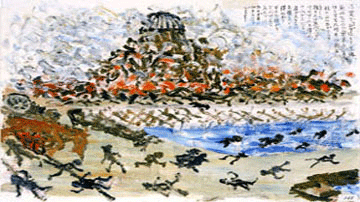
The decision 75 years ago to use atomic bombs was fuelled not by strategy but by sheer inhumanity “If we’d lost the war, we’d all have been prosecuted as war criminals.” So said Curtis LeMay after America obliterated Hiroshima and Nagasaki with two atomic bombs in August 1945. LeMay was no bleeding-heart liberal. The US air force chief of staff who had directed the assault over Japan in the final days of the Second World War, he believed in the use of nuclear weapons and thought any action acceptable in the pursuit of victory. Two decades later, he would say of Vietnam that America should “bomb them back into the stone ages”. But he was also honest enough to recognise that the incineration of Hiroshima and Nagasaki was not regarded as a war crime only because America had won the war. Last week marked the 75th anniversary of the world’s first nuclear attacks. And while Hiroshima has become a byword for existential horror, the moral implications of the bombings have increasingly faded into the background. Seventy-five years ago, LeMay was not alone in his verdict. “We had adopted an ethical standard common to the barbarians of the Dark Ages,” Fleet Admiral William Leahy, chair of the chiefs of staff under both presidents Roosevelt and Truman, wrote in his autobiography, I Was There. Dwight Eisenhower, too, had, as he observed in the memoir The White House Years, “grave misgivings” about the morality of the bombings. Almost as soon as the bombs had dropped, however, attempts began to justify the unjustifiable. On 9 August, the day of the Nagasaki bombing, the US president, Harry Truman, broadcast to the nation, claiming that “the first atomic bomb was dropped on Hiroshima, a military base… because we wished… to avoid the killing of civilians”. In fact, more than 300,000 people lived in Hiroshima, of whom up to 40% were killed, often in the most grotesque fashion. Many commentators, including Truman, have also argued that without the bombings, hundreds of thousands, perhaps millions, of US troops would have been killed in any invasion of Japan. What the casualty figures may have been is in the realm of speculation and estimates vary widely. Most Allied military leaders did not, however, see the necessity for the bombings of Hiroshima and Nagasaki. Chester W Nimitz, the commander in chief of the US Pacific fleet, insisted that they were “of no material assistance in our war against Japan”. Eisenhower agreed that they were “completely unnecessary” and “no longer mandatory as a measure to save American lives”. General Douglas MacArthur, supreme commander of the southwest Pacific area, saw “no military justification for the dropping of the bomb”. The official Strategic Bombing Surveys in 1946 concluded that “Japan would have surrendered even if the atomic bombs had not been dropped”. There is evidence that the Americans had been preparing to use the A-bomb against the Japanese as early as 1943 and that, in the words of General Leslie R Groves, director of the Manhattan Project, the US nuclear weapon programme, “the target… was always expected to be Japan”. It’s an attitude that may have been driven by the different ways in which the Allies saw their enemy in Europe and in Asia. Germans were depicted as brutal and savage, but the bigotry was restrained to some extent by the fact that they were European and white. The Japanese, however, were particularly despised because they were non-white. As the historian John Dower observes in his pathbreaking book, War Without Mercy, the Pacific war was especially brutal because both sides saw the conflict “as a race war” that was “fuelled by racial pride, arrogance and rage”. It was common for western diplomats to refer to the Japanese as “monkeys” and “yellow dwarf slaves”. A former marine, Andrew Rooney, observed that US forces “did not consider that they were killing men. They were wiping out dirty animals.” Truman himself wrote: “When you have to deal with a beast you have to treat him as a beast.” “The entire population of Japan is a proper military target,” wrote Colonel Harry F Cunningham, an intelligence officer of the US Fifth Air Force. “There are no civilians in Japan.” The deliberate firebombings of Japanese cities are believed to have killed some 350,000 civilians. Against this background, the bombings of Hiroshima and Nagasaki become more explicable. The Japanese too were vicious, cruel and racist. But Japanese attitudes and atrocities are well known; those of the Allies are often forgotten, because they were the “good guys”. So much so that simply to question the morality of the bombings now can be deemed unpatriotic. When, 25 years ago, Washington’s National Air and Space Museum planned an exhibition to mark the 50th anniversary of the end of Second World War, part of which put the bombings in historical context, it faced fierce criticism from politicians and veterans. It was forced to rework the exhibition and its director, Martin Harwit, had to resign. He later reflected: “Those who in any way questioned the bomb’s use were, in this emotional framework, the enemies of America.” At a time when Black Lives Matter protests have thrust the history of slavery and of empire into public debate, it is striking that there remains such historical amnesia about Hiroshima and Nagasaki. We seem much less aware today of the sheer inhumanity and moral indefensibility of the bombings than even the military hawks were at the time. In the 2003 documentary The Fog of War, Robert McNamara, the former US defence secretary who had been LeMay’s military aide during the Second World War, reflected on the question of war crimes: “LeMay recognised that what he was doing would be thought immoral if his side had lost. But what makes it immoral if you lose and not immoral if you win?” That’s not just a historical question. It’s as relevant today, and to today’s wars, as it is about the destruction of Hiroshima and Nagasaki. History may be written by the victors, but morality should not be defined solely by them. |
|
Hiroshima survivor Koko Kondo met the man who dropped that atomic bomb
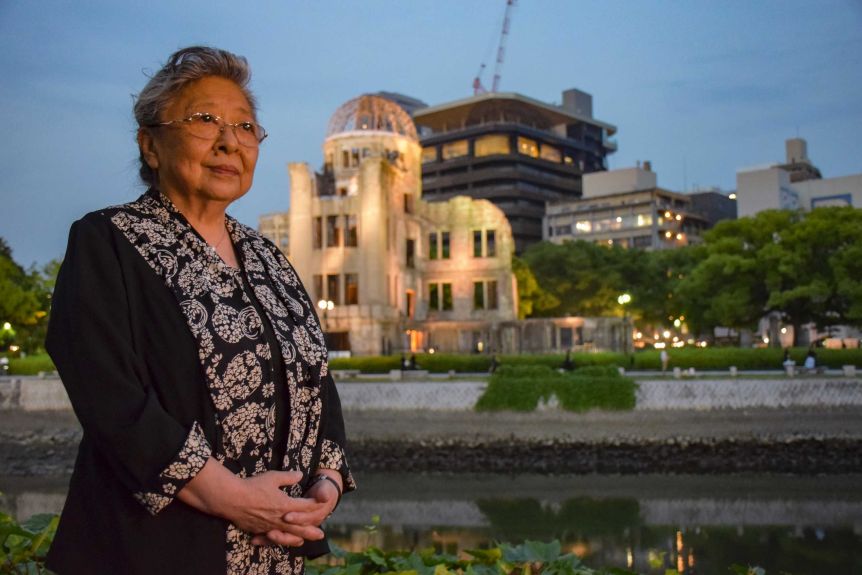
Hiroshima’s atomic bomb changed Koko Kondo’s life, but so did meeting the man who dropped it, ABC News,By Tracey Shelton, 6 August, 20, Eight-month-old Koko was in her mother’s arms the day the world’s first nuclear weapon was dropped on Hiroshima, bringing their family home crashing down on them on this day 75 years ago.
Key points:
Between 90,000 and 166,000 victims died within months of the Hiroshima bombing
Koko Kondo met pilot Robert Lewis on the set of This is Your Life
More than 150 denshosha volunteers are carrying on the memories of survivors
She was almost 40 years old before her mother finally sat her down and told her the full story of how she had inched through the rubble in darkness, with little Koko wrapped in her arms, towards a small pocket of dusty sunlight.
“She first pushed me out [through the opening], then next, she was able to get out … but the fire was all over the place according to my mother,” said Koko Kondo, who is now 75.
Ms Kondo’s father — Methodist minister Kiyoshi Tanimoto, who was visiting a parishioner across town — said in a US television interview “the whole city was on fire” as he ran through the streets to find his family.
He described people running in silence with skin hanging from their bodies “like a procession of ghosts”
In the sky above, pilot Robert Lewis was part of the United States Air Force crew who dropped the atomic bomb known as Little Boy that day, unleashing around 13 kilotons of force on the city below, where Ms Kondo’s family and about 290,000 other civilians lived, according to the Atomic Heritage Foundation.
Estimates on how many people died from the bomb either instantly or in the following months range between 90,000 and 166,000, but the Little Boy would go on to claim the lives of thousands more as the effects of radiation took their toll.
After looking back to see the once-flourishing city “disappear”, Captain Lewis wrote in his log book “My God, what have we done?”…….
While Ms Kondo said most people avoided speaking of the bombing in the decades that followed, her father made it his mission to help the injured, rebuild the city and ensure the world never forgot.
Her family had suffered from radiation sickness and Ms Kondo was subjected to years of tests and examinations to study the effects of radiation exposure.
One of Ms Kondo’s earliest memories — at around two or three years old — was of a group of teenage girls attending a sermon at her father’s church.
“Some girls could not close their eyes. Some girls — their lips were all melted with their chins so they could not close [their mouths],” she told the ABC.
While her manners did not permit her to ask questions, she would listen to her parents’ conversations and learned that the destruction and pain that surrounded her was caused by a single US B-29 bomber.
Ms Kondo said her childhood became consumed by hatred and thoughts of revenge.
“Someday when I grow up, I am definitely going to find the people who were on that B-29 bomber to do the revenge,” she said.
“That was my plan, that was my thinking. But life is interesting.”
When Koko was 10, her mother and siblings received a phone call from the then popular US television program This is Your Life.
They were immediately flown to the United States for an episode featuring the work of her father, who had taken a group of young survivors to the US for plastic surgery……
As Hiroshima mission pilot Robert Lewis was introduced, Koko glared at him with all the hatred a 10-year-old could muster.
“I was so shocked!” she recalled.
“What could I do? I wanted to run to the middle of the stage and give him a punch, a bite or a kick.”
But as he recalled his memories of that day, she saw tears begin to well in his eyes.
“I thought he was a monster, but monsters don’t have tears.”
Ms Kondo said she realised she had lived her short life full of hate for a man she knew nothing about……..
the life of this man was not easy, she said, and he “suffered greatly” not only with the weight of his involvement in the bombing, but he was also “harassed” for speaking about it publicly.at 75, she is among the youngest of a dwindling number of survivors who can tell the world first hand of the horrors these weapons unleashed……….
“My concern is today nuclear weapons are much, much stronger. We have to abolish them now,” urged Ms Kondo. ….
If these stories were lost, “probably our planet would be gone”, she said.
Doctoral candidate Tomoko Kubota is one of more than 150 denshosha — a designated keeper of the memories of a Hiroshima or Nagasaki survivor.
As a denshosha volunteer, she spent three years training and learning from survivor Sadae Kasaoka, so in the future she can “give testimony” on her behalf by sharing her “experiences, the reality of the atomic bombing, and desires for peace”.
That story includes how, at 12 years of age, Ms Kasaoka lost her mother and watched her father die — within days of the blast — in agony from horrific burns and wounds that became infested with maggots.
For other survivors, the memories were too painful to talk about, Ms Kasaoka said, while discrimination against those who did speak out had silenced many over the years…………. https://www.abc.net.au/news/2020-08-06/atomic-bomb-survivors-75-years-after-hiroshima-nuclear-attack/12501636
Vatican signed up to the U.N. Nuclear Weapons Ban Treaty, provides moral guidance
 75 years after Hiroshima and Nagasaki, the Vatican is providing moral guidance on nuclear weapons The Conversation, Drew Christiansen,Distinguished Professor of Ethics and Human Development, Georgetown University, Carole Sargent
At a solemn event at the Hiroshima Peace Park in November 2019, Francis declared the use of atomic energy for war to be “a crime not only against the dignity of human beings but against any possible future for our common home.” “How,” he asked, “can we speak of peace even as we build terrifying new weapons of war?”
His comments came nearly 40 years after John Paul II became the first pope to visit the site of the atomic bomb attacks, which pulverized the two cities on Aug. 6 and 9, 1945 and killed in excess of 200,000 in the process.
Deterrence to abolition
During his visit, Francis reiterated what he previously told assembled Nobel Peace Prize laureates, diplomats and civil society representatives at a Vatican symposium in 2017, that nuclear weapons, along with chemical weapons and landmines, were impermissible. “The threat of their use, as well as their very possession, is to be firmly condemned,” he said…………
In 2017, the Holy See became one of the first signers of the U.N. Treaty on the Prohibition of Nuclear Weapons. Article 1 prohibits signers to “develop, test, produce, manufacture, otherwise acquire, possess or stockpile nuclear weapons…” This was the backdrop for Pope Francis’ historic condemnation of deterrence and call for disarmament later that fall.
One hundred and twenty-two nations voted for the Treaty on the Prohibition of Nuclear Weapons. For its labors on behalf of the treaty, ICAN, the International Campaign Against Nuclear Weapons, an umbrella group of civil society opponents of nuclear weapons, won the 2017 Nobel Peace Prize.
Beyond the hierarchy
But the guidance provided by the Catholic Church is not simply through official statements and positions from the top.
Across the church, various groups have long campaigned for abolition of nuclear weapons. Catholic nuns have often been at the forefront of this work. In Japan, several activist hibakusha – survivors of Hiroshima and Nagasaki – are sisters of Notre Dame de Namur and the Society of the Helper of Holy Souls, among other congregations.
In the U.S., Sister Jennifer Kane was a nuclear engineer before realizing, in the words of her congregation in 2019, “that God was calling her to a more spiritual combat” as an antinuclear activist.
And Dominicans, Religious of the Sacred Heart, and Society of the Holy Child Jesus have participated in the grassroots anti-nuclear direct-action movement Plowshares, at times resulting in prison time for activist nuns……….
Courage of conscience
Church teaching demands that conscientious officials and nuclear workers resist orders they deem to be immoral.
The Second Vatican Council of the early 1960s taught that obeying orders is no excuse for participating in atrocities, and urged anyone, whether top military leader or rank-and-file citizen, to display “the courage of those who openly and fearlessly resist.”
Indeed, in 2018 two chiefs of the U.S. Strategic Air Command testified in a Senate hearing that they would not comply with illegal orders to deploy nuclear weapons, and that they would offer civilian authorities alternative courses of action to pursue. …….https://theconversation.com/75-years-after-hiroshima-and-nagasaki-the-vatican-is-providing-moral-guidance-on-nuclear-weapons-140615
Japanese bishops’ anti-nuclear power book available in English
Japanese bishops’ anti-nuclear power book available in English, Crux, Catholic News Service, Jul 12, 2020 TOKYO — An English version of a book by Japan’s bishops appealing for the abolition of nuclear power is now available for free on the internet, reported ucanews.com.
Abolition of Nuclear Power: An Appeal from the Catholic Church in Japan is available as a PDF file on the website of the Catholic Bishops’ Conference of Japan.
The bishops wrote the book after Japan’s Fukushima Daiichi Nuclear Power Station suffered a serious accident including a meltdown after a 2011 earthquake and tsunami.
Nuclear power is essentially incompatible with the image of the earth as a symbiotic society, which Pope Francis shows in his encyclical “Laudato Si’,” the bishops say.
- The bishops concluded that nuclear power generation should be immediately abolished in the face of the insoluble dangers it presents, including widespread health damage to children.
They worked with researchers in various fields to explore the damage caused by the Fukushima accident, the technical and sociological limitations of nuclear power production, and ethical and theological considerations concerning it.
They said they believe that Japan, having suffered such a severe nuclear accident, has a responsibility to inform the world of the reality of the damage and to appeal for the abolition of nuclear power generation……..Once a severe accident occurs, they argue, nuclear power generation destroys the environment over a wide area for generations and damages the right to life and livelihood……. https://cruxnow.com/church-in-asia/2020/07/japanese-bishops-anti-nuclear-power-book-available-in-english/
False fright: religious group advertisement claims “Islam” about to make nuclear strike
Horrific’ Ad Suggesting Nuclear Attack From ‘Islam’ Appears In Nashville Newspaper, Paper Apologies
Nicholas ReimannForbes StaffBusinessI’m a news reporter for Forbes, primarily covering the U.S. South.
The Tennessean issued an apology Sunday after “a bizarre, pseudo-religious” full-page ad appeared in the newspaper’s Sunday edition claiming that “Islam” was planning a nuclear strike on the city of Nashville, Tennessee, on July 18, saying that the ad violated the paper’s standards forbidding hate speech and that it is investigating how the ad from a “fringe religious group” was able to be published in the Sunday paper.
The paper said Sunday that it immediately pulled the ad from future editions, which appeared in the “A” section—the front section—of Sunday’s newspaper. …… https://www.forbes.com/sites/nicholasreimann/2020/06/21/horrific-ad-suggesting-nuclear-attack-from-islam-appears-in-nashville-newspaper-paper-apologies/#138034315c03
The race to nuclear suicide continues despite Covid-19 crisis
The race to nuclear suicide continues despite Covid-19 crisis https://www.thenational.scot/news/18453817.world-presses-race-suicide/, By Brian Quail. 17 May 20, Glasgow AT the dawn of the nuclear age, the Russell-Einstein Manifesto warned us all: “Remember your humanity and forget the rest. If you can do so, the way lies open to a new paradise; if you cannot, there lies before you the risk of universal death.”
That was back in 1955. Nobody listened. What did Albert Einstein known about the real world? Untold trillions were wasted on the nuclear arms race and unimaginable cruelty inflicted on our test victims – the aborigines of Australia at Maralinga and Montebello, the victims of the USSR in Semipalatinsk in Kazakhstan, and of the USA, the Shoshone people of Nevada whose land is now permanently contaminated. Add the long forgotten British servicemen used as human guinea pigs at Christmas Island, and the many other unnamed and unnumbered victims of our nuclear idolatry. Never mind all those we condemned to poverty and destitution by squandering our resources.I had hoped that the global threat of Covid-19 might call us back to the ineluctable truth of the dilemma posited in the Manifesto, but no. We press blindly on in the lunatic race to suicide.
While the rest of us are staying at home in lockdown, on Wednesday May 13 a convoy carrying nuclear warheads (eight Hiroshimas) left Burghfield. It came up the M6 and M74, over the Erskine Bridge and past Loch Lomond to arrive at Coulport at 9.20. Nukewatch was, for obvious reasons, unable to follow this or attempt to hinder its illegal ploys.
Will nothing open the eyes or touch the hearts of our nuclear jihadis? Must we surrender our future and the fate of the planet to these deranged souls?
Alice Walker said: “Our last five minutes on earth are running out. We can spend those minutes in meanness … or we can spend them consciously embracing every glowing soul who wanders within our reach” Can we not stop this madness now, at 90 seconds to midnight?
Russia warns US against using low-yield nuclear weapons, threatening all-out retaliation
Russia warns US against using low-yield nuclear weapons, threatening all-out retaliation, SCMP, 29 Apr 20
US State Department had argued that deploying such warheads in submarines would help counter new threats from China and Russia
Moscow says any attack involving submarine-launched missiles will be perceived as nuclear aggression
, warning that an attempt to use such weapons against Russia would trigger an all-out nuclear retaliation.
The US State Department argued in a paper released last week that fitting the low-yield nuclear warheads to submarine-launched ballistic missiles would help counter potential new threats from Russia and China…… https://www.scmp.com/news/world/russia-central-asia/article/3082226/russia-warns-us-against-using-low-yield-nuclear
A Roosevelt salutes as Hero – the Captain of Theodore Roosevelt nuclear aircraft carrier
 This story says nothing about this being a nuclear-powered ship. But underlying this whole thing is the fact of the (probably necessary) culture of secrecy that surrounds all things nuclear. This is yet another example of how the nuclear culture means that it is “preferable” for people to die, rather than have the truth get out.

Captain Crozier Is a Hero, Theodore Roosevelt, my great-grandfather, would agree. By Tweed Roosevelt, Mr. Roosevelt is a great-grandson of Theodore Roosevelt and the chairman of the Theodore Roosevelt Institute at Long Island University. April 3, 2020
On Monday, Capt. Brett Crozier, the commander of the aircraft carrier Theodore Roosevelt, sent a letter to the Navy pleading for permission to unload his crew, including scores of sailors sickened with Covid-19, in Guam, where it was docked. The Pentagon had been dragging its feet, and the situation on the ship was growing dire. “We are not at war,” he wrote. “Sailors do not need to die. If we do not act now, we are failing to properly take care of our most trusted asset — our sailors.”
After the letter was leaked to The San Francisco Chronicle, the Navy relented. But on Thursday, it relieved Captain Crozier of his command.
In removing Captain Crozier, the Navy said that his letter was a gross error that could incite panic among his crew. But it’s hard to know what else he could have done — the situation on the Theodore Roosevelt was dire.
Ships at sea, whether Navy carriers or cruise ships, are hotbeds for this disease. Social distancing is nearly impossible: The sailors are practically on top of one another all day, in crowded messes, in cramped sleeping quarters and on group watches.
It is thought that a sailor caught the virus while on shore leave in Vietnam. Once on board, the virus took its now predictable course: First a sailor or two, then dozens, and all of a sudden more than 100 were sick.
Captain Crozier received orders to take the ship to Guam, but he was not given permission to offload most of the sailors. The virus was threatening to overwhelm the small medical crew aboard. There was not much time before sailors might start dying.
The captain felt he had to act immediately if he was to save his sailors. He chose to write a strong letter, which he distributed to a number of people within the Navy, demanding immediate removal from the ship of as many sailors as possible. Perhaps this was not the best approach for his career, but it got results…….
The acting secretary of the Navy, Thomas Modly, summarily fired the captain, not for leaking the letter (for which he said he had no proof), but for showing “extremely poor judgment.” Many disagree, believing that Captain Crozier showed excellent judgment. He left the ship Thursday night to a rousing hero’s sendoff……… https://www.nytimes.com/2020/04/03/opinion/coronavirus-crozier-roosevelt.html
Captain on nuclear aircraft carrier took a stand, and is paying the price
Captain Brett Crozier Takes A Stand James Fallows, April 3, 2020 2020 Time Capsule #11: ‘Captain Crozier’The Atlantic The episode I’m about to mention has been receiving saturation social-media attention for the past few hours, as I write. But because the accelerating torrent of news tends to blast away each day’s events and make them hard to register—even a moment like this, which I expect will be included in histories of our times—I think it is worth noting this episode while it is fresh.Until a few days ago, Brett Crozier would have been considered among the U.S. Navy’s most distinguished commanders………
The four-page letter, which you can read in full at the Chronicle’s site, used the example of recent cruise-ship infection disasters to argue that closed shipboard environments were the worst possible location for people with the disease. It laid out the case for immediate action to protect the Roosevelt’s crew, and ended this way:
7. Conclusion. Decisive action is required. Removing the majority of personnel from a deployed US. nuclear aircraft carrier and isolating them for two weeks may seem like an extraordinary measure. A portion of the crew (approximately 10%) would have to stay aboard to run the reactor plant, sanitize the ship, ensure security, and provide for contingency response to emergencies.
This is a necessary risk. It will enable the carrier and air wing to get back underway as quickly as possible while ensuring the health and safety of our Sailors. Keeping over 4,000 young men and women on board the TR is an unnecessary risk and breaks faith with those Sailors entrusted to our care…
This will require a political solution but it is the right thing to do. We are not at war. Sailors do not need to die. If we do not act now, we are failing to properly take care of our most trusted asset our Sailors. Request all available resources to find NAVADMIN and CDC compliant quarantine rooms for my entire crew as soon as possible.
“Breaks faith with those Sailors entrusted to our care.” “We are failing to properly take care of our most trusted asset our Sailors.” “Unnecessary risk.” In any walk of life, such language would have great power. Within the military—where terms like faith and trust and care have life-and-death meaning, and are the fundamental reason people follow leaders into combat—these words draw the starkest possible line. This course is right. The other course is wrong. Thus a leader spoke on behalf of the people “entrusted to our care.”…….
- Based on information available as I write, it appears that he took a stand, and is paying the price.
Brett Crozier will no longer be one of the Navy’s most powerful commanders. He remains in the service, but his command has been taken away.
He will likely be remembered among its leaders. https://www.theatlantic.com/notes/2020/04/time-capsule-11-captain-crozier/609409/
1 This Month
23-25 October – on Zoom – World BEYOND War’s annual global conferenc


Shut down the radiation-damaged Heysham nuclear reactors now
To see nuclear-related stories in greater depth and intensity – go to https://nuclearinformation.wordpress.com

Say No to NASA’s Reckless Nuclear Reactor on the Moon
Say No to NASA’s Reckless Nuclear Reactor on the Moon

-
Archives
- October 2026 (247)
- September 2026 (339)
- August 2026 (330)
- July 2026 (355)
- June 2026 (287)
- May 2026 (306)
- April 2026 (356)
- March 2026 (251)
- February 2026 (267)
- January 2026 (308)
- December 2025 (358)
- November 2025 (359)
-
Categories
- 1
- 1 NUCLEAR ISSUES
- business and costs
- climate change
- culture and arts
- ENERGY
- environment
- health
- history
- indigenous issues
- Legal
- marketing of nuclear
- media
- opposition to nuclear
- PERSONAL STORIES
- politics
- politics international
- Religion and ethics
- safety
- secrets,lies and civil liberties
- spinbuster
- technology
- Uranium
- wastes
- weapons and war
- Women
- 2 WORLD
- ACTION
- AFRICA
- Atrocities
- AUSTRALIA
- Christina's notes
- Christina's themes
- culture and arts
- Events
- Fuk 2022
- Fuk 2023
- Fukushima 2017
- Fukushima 2018
- fukushima 2019
- Fukushima 2020
- Fukushima 2021
- general
- global warming
- Humour (God we need it)
- Nuclear
- RARE EARTHS
- Reference
- resources – print
- Resources -audiovicual
- Weekly Newsletter
- World
- World Nuclear
- YouTube
-
RSS
Entries RSS
Comments RSS

