The space tourism plans of Bezos, Musk and Branson are morally reprehensible,

Ben Bramble sets out a problem that ought to be so obvious – that this space travel push is a wasteful, and even childish example of the rich boys club doing its thing – Bezos, Musk, Gates, Branson etc trying to outdo each other
But there is a more sinister side to space travel and space research – the national rivalries, started with Donald Trump’s plan for a Space Force – nuclear reactors, nuclear-powered rockets, and nuclear weapons in space. Those billionaires are all too well connected with NASA and this space military push. The thought of a nuclear war in space is horrendous. But what else could possibly go wrong?
The space tourism plans of Bezos, Musk and Branson are morally reprehensible, The Age, Ben Bramble, 5 July 21.
With billionaires Jeff Bezos, Elon Musk, and Richard Branson soon to send paying customers into space, members of US Congress are askingwhether and how to regulate commercial spaceflight. But there is a more basic question: Should there be such an industry in the first place?
Supporters of such an industry, such as Republican Kevin McCarthy, cast these billionaires as modern-day Wright brothers, innovating commercialspaceflight in a way governments either can’t or won’t. While billionaires will be the first in space, they say, soon everyone will get their chance.
But this is clearly not feasible any time soon, given Earth’s environmental crises. It is unsustainable for humans to keep consuming resources at the rate we currently are, let alone if space tourism were to become commonplace. The fact that a product can be made cheap enough for many people to afford it does not show that it is environmentally sustainable for many people to actually consume it.
Still, you might say, what could be wrong with commercial spaceflight reserved for the ultra-wealthy? This wouldn’t significantly worsen our environmental crises.–
But there is something morally distasteful in the extreme about space tourism exclusively for the ultra-wealthy when so many people on Earth are in such great need. Going into space, in full view of the many billions of humans who are struggling on a daily basis, is a little like enjoying a pop-up Michelin star meal in front of a homeless shelter.
This is not to decry all luxury goods. But there is something particularly objectionable about spending so much money on a fleeting experience for oneself and others, who are already among the best off on the planet, when so many cannot even make ends meet (through no fault of their own).
At present, there seems a clear tendency to reserve moral criticism for people who cause bad things or who set out to harm others. Such behaviour is certainly bad and merits criticism. But we should feel grumpy also at people for failing to help others when they easily can. Those who display an indifference to the plight of others or who are too wrapped up in themselves and their own self-serving projects are morally criticisable even if they are not the cause of others’ suffering. While it is true that Bezos has recently become a major sponsor of the environment, much more is needed. Every dollar spent on sending billionaires into space is money that could have been used instead to help save the planet or bring others out of poverty.
It is worth adding that many billionaires have contributed to Earth’s problems. Our environmental crises are largely due to excessive consumption, something that companies such as Amazon have played a major role in making possible, affordable and accepted……….
Bezos has said that one of his reasons for founding his company Blue Origin is that “we’re now big compared to the size of the planet”. Like Musk, he thinks we need to look beyond Earth to survive our present crises. But this is far too premature. We can still save the Earth. But to save it, we’re going to have to re-engineer our consumer cultures and economies. This, and not space tourism, is the great engineering challenge of the 21st century. I’d like to see these billionaires use their brilliant minds to help save the Earth, rather than flee it. If this means smaller growth for their own companies, so be it. ….. https://www.theage.com.au/national/the-space-tourism-plans-of-bezos-musk-and-branson-are-morally-reprehensible-20210704-p586o1.html
Should Bill Gates be viewed as a man of character and a trusted adviser to world leaders?

Gates’ reputation and practices are now open to further questions and scrutiny.
Billionaire Bill Gates’ Alleged Relationships With Women While Married Raise Questions About His Character, Forbes, Jack Kelly, Senior Contributor 17 May 21, Bill Gates, the multibillionaire cofounder of Microsoft, was viewed and mostly respected by the public as a nerdy, brainy and awkward guy. In the tech community, it was different. Gates was feared. Rivals saw him as brutal and ruthless.
The U.S. Justice Department’s antitrust division accused Microsoft of running a monopoly and filed suit—United States v. Microsoft. Competitors were knocked out of business. His childhood best friend and cofounder, Paul Allen, claimed Gates “conspired with Microsoft’s first chief executive, Steve Ballmer, to reduce his co-founder’s stake,” while he was “recovering from treatment for lymphoma.”
Extolling Gates’ cultivated persona of a well-meaning billionaire, Times Magazine wrote in March 2020, “Late on Friday, cofounder and original chief executive officer Bill Gates, the man most closely identified with the world’s largest software maker, said he will leave the company’s board to devote more time to his charitable foundation, which is is playing a key role in global health initiatives and expanding into new areas like climate change.” The takeaway from this type of fawning reporting belied the real man.
The real story, according to the Wall Street Journal, was far different than initially reported. “Microsoft Corp. board members decided that Bill Gates needed to step down from its board in 2020 as they pursued an investigation into the billionaire’s prior romantic relationship with a female Microsoft employee that was deemed inappropriate.”
An investigation initiated by Microsoft’s board of directors determined that Gates had to go. After decades helming the software company, Gates resigned before the board finished its probe. …………..
Gates became a fixture on the news, weighing in on Covid-19, vaccines and a wide array of other global matters. His past take-no-prisoners approach to business at Microsoft was forgotten. He transformed into a new persona of a caring, well-meaning philanthropist.
In fairness, Gates has accomplished great work through his foundation and efforts. He may have saved and improved millions of lives around the world through his philanthropic endeavors.
It appears, in hindsight, that this may have been some sort of attempt for redemption, atoning for past actions. Sadly, moving forward, in light of these allegations, Gates’ reputation and practices are now open to further questions and scrutiny. https://www.forbes.com/sites/jackkelly/2021/05/17/billionaire-bill-gates-alleged-relationships-with-women-while-married-raises-questions-about-his-character/?sh=29595a985001
The radiation danger to astronauts- cancer, heart disease -an ethical problem
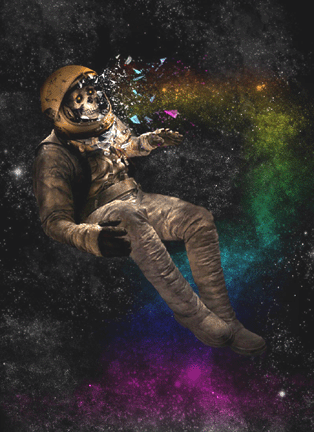
“These are all crucial studies to be conducted in order to really understand the risks we’re exposing astronauts to,” says Meerman. “Therefore, we believe we are not there yet and we should debate whether it is safe to expand human space travel significantly
|
Long-distance space travel: addressing the radiation problem https://physicsworld.com/a/long-distance-space-travel-addressing-the-radiation-problem/ 08 Mar 2021 A team of US and Netherlands-based scientists has published a review paper highlighting ways to protect astronauts from the negative cardiovascular health impacts associated with exposure to space radiation during long-distance space travel.Cardiovascular impacts Space radiation is currently regarded as the most limiting factor for long-distance space travel because exposure to it is associated with significant negative effects on the human body. However, data on these effects are currently only available for those members of the Apollo programme that travelled as far as the Moon – too small a number from which to draw any significant conclusions about the effects of the space environment on the human body. In addition, although exposure to space radiation, including galactic cosmic rays and solar “proton storms”, has previously been linked to the development of cancer and neurological problems, data on the consequences of space radiation exposure for the cardiovascular system are lacking. In an effort to address these limitations, researchers based at the University Medical Center (UMC) Utrecht, Leiden University Medical Center, Radboud University and the Technical University Eindhoven in the Netherlands, as well as Stanford University School of Medicine and Rice University in the US, have carried out an exhaustive review of existing evidence to establish what we know about the cardiovascular risks of space radiation. They present their findings in the journal Frontiers in Cardiovascular Medicine.
“You can argue that if NASA, ESA and other space agencies want to expand space travel, both in terms of location – for example, to Mars – and time, astronauts will be exposed to the specific space environment for longer periods of time. However, we currently do not know what the effects of exposure to these space-specific factors are,” says Meerman. “NASA currently sees space radiation as the most limiting factor for long-distance space travel, but the exact short- and long-term effects are not fully understood yet. We are therefore exposing astronauts to extremely uncertain risks. However, research into the effects of space radiation has increased over the past few years and we’re constantly gaining more knowledge on this topic,” she adds. Advanced modelsAccording to Meerman, another important factor in this discussion is the fact that we currently cannot adequately protect astronauts from space radiation. Shielding with radiation-resistant materials is very difficult since exposure levels are far higher than on Earth and the type of radiation is much more penetrating. Pharmacological methods of protecting the cardiovascular system are hampered by the fact that no effective radioprotective compounds have yet been approved. “The most important conclusion is that we actually do not know enough about the exact risks that long-distance space travel pose for the human body. Therefore, in our opinion, we should keep looking for new ways to protect astronauts from the harmful space environment before we expand human space travel,” says Meerman. Moving forward, Meerman stresses that research on the effects of space radiation should incorporate advanced models that provide a more accurate representation of the cardiovascular impacts of space radiation – such as those based on lab-created human cardiac tissue and organ-on-a-chip testing technologies. Studies should also examine the effects of combinatorial exposure to different space radiation particles, as well as combined exposure to space radiation components and other space-specific factors, like microgravity, weightlessness and prolonged hypoxia. “These are all crucial studies to be conducted in order to really understand the risks we’re exposing astronauts to,” says Meerman. “Therefore, we believe we are not there yet and we should debate whether it is safe to expand human space travel significantly.” |
|
Heroism of Fukushima’s nuclear emergency workers
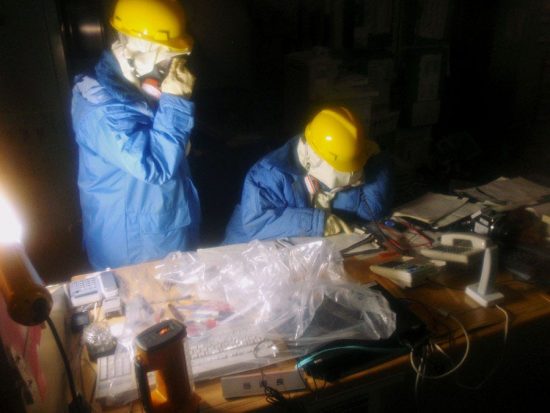
France Info 7th March 2021, For four days and four nights in March 2011, hundreds of workers tried, sometimes risking their lives, to contain the damage from the earthquake
and tsunami that destroyed the Japanese nuclear power plant.
”……….March 11, 2011, 3:27 p.m. The ocean begins to hit the enclosure of the nuclear power plant. A first wave about 4 meters high crashes against the dike. But ten minutes later, a wave some 15 meters high swept over Fukushima Daiichi. The doors of the turbine buildings are not watertight: the generators, electric meters and batteries are flooded. Vehicles and rubble litter the roads. Two operators who had gone to watch the machines in the basement of reactor building 4 drowned.
On the second floor of the earthquake-resistant building, all the lights go out. It’s pitch black in this windowless building. Worse, the measurement indicators no longer work. Impossible to know the temperature and the pressure inside the reactors, therefore to know if the emergency cooling systems are still functioning. However, if the water level in a reactor drops, the fuel rods heat up and can melt until they pierce the concrete enclosure and cause a major nuclear disaster.
“We were left speechless”
“At that time, it was astonishment. We were all so devastated that we were left speechless,” recalls Masao Yoshida during an audition transcribed in A story of Fukushima (PUF editions), by Franck Guarnieri and Sébastien Travadel. The scarce information is communicated to the two external crisis units which are set up 250 km away, in Tokyo. One at the headquarters of Tepco, the company that operates the plant; the other at Kantei, the residence of the Prime Minister.
The teams take action. Two solutions are being considered for cooling the reactors: using diesel engine fire pumps or fire trucks which are already on the site. In the absence of a measuring system, the employees concentrate first on Reactor 2. What they do not know is that the back-up system is operating there. The emergency is actually located in reactor 1. Around 6 p.m., its heart begins to melt inside the containment……..
The teams take action. Two solutions are being considered for cooling the reactors: using diesel engine fire pumps or fire trucks which are already on the site. In the absence of a measuring system, the employees concentrate first on Reactor 2. What they do not know is that the back-up system is operating there. The emergency is actually located in reactor 1. Around 6 p.m., its core begins to melt inside the containment.
That’s when they were most irradiated”
Among employees, fear of radiation escalates. “The state of Reactor 1 scared young people,” said Ryuta Idogawa, one of the plant’s reactor pilots, in an interview with Yuki Kobayashi, a doctoral student in science and engineering of risky activities. Despite the danger, however, it is necessary to choose men to open the valves of the reactors manually.
Around 4 am, the injection of fresh water, stored on site in the event of a problem, is finally launched into reactor 1. “When we saw water coming out of the pipe and reaching the reactor, we all yelled, ‘Yes!’ and raised our fists in the air “, tells the Telegraph * Kazuhiko Fukudome, one of the firefighters involved in the accident. Workers are constantly refueling the trucks to operate the water pump. “I think that’s when they were most irradiated,” admits Masao Yoshida.
……… “We sent men and it exploded”
March 13, 2011, 2:42 a.m. While the situation in reactor 1 appears to have stabilized, it is the turn of the reactor 3 emergency cooling system to cease functioning. New operations must be relaunched, but fatigue begins to be felt. “How long can we continue to work without ever sleeping? The answer is 36 hours. That’s the limit for all men,” said Takeyuki Inagaki, group leader at the plant, in an interview with Yuki Kobayashi. This duration has just been reached by the employees, fed on rice bars and instant noodles. Even Masao Yoshida dozes off.
However, new operations resume before sunrise. Reactor 3 must be ventilated and cooled. After a few hours of hard work amidst the debris, the workers succeed in hooking up new pumps and watering the building to prevent overheating. Several of them are exposed to doses of radioactivity greater than 100 millisieverts (mSv), according to the Japanese nuclear safety agency, or five times more than the annual dose authorized in France for employees in the sector.
March 14, 2011, 11:01 a.m. A new explosion, even more impressive than the first, resonates in the heart of the plant. “HQ! HQ! It’s terrible! We have a problem on site number 3!” shouts Masao Yoshida, in a recording of the Crisis Staff. This time, it is the reactor building 3 which is blown up because of the hydrogen. The manager has to face his decisions: “I was sorry. We weren’t sure, but we thought it would not explode right away. We sent men and it exploded,” he admits. .
“Right after the explosion, when I learned that there were about 40 missing, I really iexpected to die. myself.”
Masao Yoshida, director of the plant before a commission of inquiry.
The explosion ultimately caused no death, but a dozen injured. It also has an immediate consequence for the plant: the destruction of the emergency cooling system of reactor 2. “I think that is the moment when I hit rock bottom. I saw us all dead,” says Masao Yoshida. On this Monday morning, the teams are overwhelmed. “I will never forget that afternoon. My stomach ached as if a block of lead was left there,” recalls group leader Takeyuki Inagaki.
”I ask you to sacrifice your lives”
In the middle of the afternoon, the director begins to envisage an evacuation of the few hundred non-essential employees of the plant. He orders that coaches be ready to leave in case of further complications. But shortly before 8 p.m. the hard work of the workers paid off. The injection of sea water begins in reactor 2. Reluctant to any evacuation of the employees, the Prime Minister addresses them during a night videoconference: “I ask you to sacrifice your lives.”
March 15, 2011, 6:14 a.m. It has been four days since the disaster struck, and employees must continue their endless battle against the elements. This time, it is a leak in the enclosure of reactor 2 which causes an explosion and damages reactor 4. Luckily, the explosion does not cut off the seawater cooling system of the first three reactors. The exhausted workers managed to stabilize these time bombs and contain what could have turned out to be a much more deadly disaster.
“There is a special bond between us. I cannot express it in words. I imagine that it is the camaraderie that can be between soldiers in time of war, will tell the Guardian later * l One of the engineers, Atsufumi Yoshizawa. In our case, the enemy was the nuclear power plant. And we fought it together. ” This Tuesday, reinforcements will finally arrive from the surrounding power plants to restore power supplies and build protective structures. The closed-door hell of Fukushima Daiichi power plant workers is over.
Nuclear energy proponents downplay its unresolved moral and ethical concerns
 Nuclear energy, ten years after Fukushima, Nature, Ali Ahmad & Francesca Giovannini, 4 Mar 21, ” …………..Many academics have cast nuclear power as an inevitable choice if the planet is to limit global warming1. But, given the environmental and social concerns, others are more circumspect, or remain opposed2. The Intergovernmental Panel on Climate Change, in its 2018 special report on global warming, acknowledged a possible role for nuclear energy in limiting global temperature rise, but highlighted the crucial role that public acceptance will have in boosting or derailing investments.
Safety and cost are frequently highlighted as the central challenges for the nuclear industry. New technologies are tackling these issues, but such reactors might not become commercialized until mid-century. That time frame could render them obsolete, as competing technologies such as solar and wind energy (plus storage) become increasingly dominant3.
The nuclear sector has consistently failed to engage meaningfully with the public over such concerns. This failure can be traced back to the 1960s and 1970s. Psychological studies of risk at that time described the public as affective, irrational and neglectful of probability in its assessments of risk, and called on the nuclear industry either to accept and design for the public’s perceptions of risk or to educate the public8.
Industry chose the latter path, typically attempting to engage the public only at the final stages of plant regulation and focusing on educating the public with the industry’s own view of risk. This is a straightforward, quantitative equation that multiplies the probability of disaster and consequence. It often avoids or ignores the public perspective. For example, many people are willing to accept risks that are voluntary or familiar — such as flying, smoking or driving a car — against risks that are unfamiliar and over which they have little control. For involuntary risky activities, most individuals tend to de-emphasize probability and require higher levels of safety and protection for their comfort.
The industry’s mode of engagement with the public has led to an antagonistic expert–public divide. Fukushima, for example, left an undeniable mark on the public psyche. But the nuclear industry consistently plays down the disaster by focusing on the fact that it did not cause any direct casualties. Although no human deaths resulted directly from the accident, disruptions to livelihoods, social ties and irreversible damage to ecosystems have been significant. An estimated 165,000 people were displaced, and, a decade later, some 43,000 residents are unable to return to their home towns9. Industry risk assessments capture the economic impacts of such issues, but usually fail to capture the harder-to-quantify collateral damage to people’s lives and the environment………https://www.nature.com/articles/d41586-021-00580-4
The role of the Churches in promoting the U.N. Nuclear Weapons Ban Treaty
 Tomasi: treaty an important first step towards a world free of nuclear arms, https://www.vaticannews.va/en/church/news/2021-02/cardinal-tomasi-holy-see-nuclear-weapons-treaty-disarmement.html In an interview with the World Council of Churches the former Permanent Observer to the UN and Other International Organizations in Geneva and to the World Trade Organization reflects on how Churches can get involved in the goal of freeing the world of nuclear weapons. Tomasi: treaty an important first step towards a world free of nuclear arms, https://www.vaticannews.va/en/church/news/2021-02/cardinal-tomasi-holy-see-nuclear-weapons-treaty-disarmement.html In an interview with the World Council of Churches the former Permanent Observer to the UN and Other International Organizations in Geneva and to the World Trade Organization reflects on how Churches can get involved in the goal of freeing the world of nuclear weapons.
By Lisa Zengarini “The Treaty on the Prohibition of Nuclear Weapons heralds in a new era in international law and increasingly in public opinion” Cardinal Silvano M. Tomasi, has said. In an exclusive interview with the World Council of Churches (WCC) the former Permanent Observer to the UN and Other International Organizations in Geneva and to the World Trade Organization reflects on the positive impact of the Treaty (TPNW) and how Churches can get involved in the goal of freeing the world of nuclear weapons. The TPNW was adopted by the United Nations on 7 July 2017 and entered into force on 22 January 2021. For those nations who signed it, the Treaty prohibits the development, testing, production, stockpiling, stationing, transfer, use and threat of use of nuclear weapons, as well as assistance and encouragement to the prohibited activities. For nuclear armed states joining the treaty, it provides for a time-bound framework for negotiations leading to the verified and irreversible elimination of its nuclear weapons program. Acknowledging that “moral declarations alone will lead to disarmament”, in the interview Cardinal Tomasi, notes that the newly enacted norms “can support and even drive complex negotiations, hopefully toward achieving the goal of a world free from nuclear weapons”, stressing the need for non-nuclear weapons states to make their voices heard on this issue. He also emphasizes the role of civil society actors and of Churches and religious communities: “In this area, religions and all denominations can converge and amplify together the same moral message for believers and non-believers alike”, he says, adding that “local initiatives are very important for moving towards total disarmament” and that “local actors can make their voices heard at higher levels, by contacting their representatives and networking online”. Reminding that “the mere existence of nuclear weapons is a constant risk” and that “the pandemic has brought to light and intensified the extreme inequalities present in our societies”, the former Nuncio reaffirms that the establishment of a World Fund to address human development with the money previously invested in the military and weapons “is primary” in relation to the socio-economic issues we face today: “Pope Francis has recognized that the pandemic brings to light our true priorities and needs as a human family, and has encouraged deep reflection and active changes towards a world more committed to building just systems at the service of the people. It is not only a worthy goal, but a moral good”, he stresses. “Increased investments in arms arise from a feeling of insecurity, but a society can never be secure if the essential needs of its people are not met”, he explains. According to cardinal Tomasi, the present pandemic could act as a “catalyst” toward this ambitious goal: “In economically difficult times for all states – including the great powers – being able to release funds to revive the economy is essential. Decreasing the funds allocated to the arms race and dedicating them to economic recovery is actually a strategic choice for those states that wish to maintain their preeminence within the international system. Their influence and power will soon be judged based on their ability to recover from the crisis”, he concludes. |
|
No apologies from France, over nuclear bomb tests’ pollution in Algeria
The New Arab 12th Feb 2021, President Emmanuel Macron’s recent statement that a “memories and truth” commission will be established to look into the history of the French colonisation of Algeria, has led to much public discussion over this bloody legacy.
And in this context, the absence of apologies or offers of reparations by the French state has not gone unnoticed. One area of particular contention in this process is the ongoing and detrimental effects of France’s nuclear testing in Algeria, conducted throughout the
1960s. France conducted its first nuclear test known as the “Gerboise Bleue” in February 1960 in the Sahara Desert – an atomic bomb that was four times the strength of Hiroshima. A total of 17 tests were carried out, four of them atmospheric detonations, and 13 underground.
https://english.alaraby.co.uk/english/comment/2021/2/12/frances-nuclear-colonial-legacy-in-algeria
All-Africa Conference of Churches welcomes Nuclear Weapons Prohibition Treaty
 All-Africa Conference of Churches welcomes Nuclear
  Prohibition Treaty https://www.vaticannews.va/en/church/news/2021-01/aacc-treaty-nuclear-weapon-proliferation-africa-church.htmlThe All-Africa Conference of Churches salutes the recent coming into force of the Treaty on Prohibition of Nuclear Weapons (TPNW), hailing it as further inspiration to work for a nuclear-weapons-free world.
Hailing this recent development, the All-Africa Conference of Churches (AACC), in a statement on Tuesday, expressed its support, together with the rest of the ecumenical community, for the Treaty which now becomes international law.
The ecumenical body said that the Treaty “ushers in the possibilities of heralding a new world free of the threats and tensions that have been characterized by the battle to develop and hold nuclear weapons.”
No safe hands for nuclear weapons
In the Tuesday statement, AACC stated its belief “that the very holding and potential threat of use of nuclear weapons is immoral,” adding that it looks forward to the day “when the world will be freed of these weapons permanently.”
“There are no safe hands for these weapons,” added AACC. “The accidental or deliberate detonation of a nuclear weapon would cause severe, long-lasting and far-reaching harm on all aspects of our lives and our environment throughout the world.”
At the same time, these technologies are “part of structures and systems that bring about great suffering and destruction” and have been the cause of “major tensions and threats of widespread devastation.”
TPNW: inspiration for a nuclear-weapon-free world
In the wake of the entry into force of the Treaty, AACC said that at a time when the world desperately needs fresh hope, the TPNW inspires us to work towards fully eliminating “the threat of nuclear weapons, and to create conditions for peace, justice and well-being.”
AACC also pointed out that the treaty addresses the disproportionate impact of nuclear weapons on women and indigenous peoples, as well as the “importance of victim assistance and healing environmental harms in a groundbreaking way.”
Citing the example of the hibakusha – survivors of the two nuclear attacks launched at Hiroshima and Nagasaki at the end of World War II – AACC noted that their courage and perseverance serve as “the inspiration, guidance and moral foundation” in the quest for a world without nuclear weapons.
Appeal to States
Highlighting that none of the nine nuclear global powers, and many countries with defense pacts with them have signed or ratified the Treaty, AACC pointed out that a lot of work still remains to be done. As at its entry into force, the TPNW was signed by 86 countries and ratified by 51.
n this regard, AACC appealed to the ecumenical global community to make its contribution, in whichever way possible, to participate in the global work for peace, justice and respect for life.
Concretely, the ecumenical body is urging all States to sign and ratify the TPNW, as well as join the first meeting of the State parties scheduled for next year. AACC further calls for decisive action “to strengthen the power of the TPNW upon its entry into force, and to work for peace, cooperation and common security.”
“We must not be discouraged at the slow pace, but become even more determined to push for a better world,” AACC said. “This is part of our mission and we know God is on our side.”
AACC
Founded in Kampala, Uganda, in 1963, the AAAC is an ecumenical association that today has 173 member churches present in 40 African countries, representing over 120 million Christians on the continent. Its headquarters is in Nairobi, Kenya.
Catholics welcome Treaty on Prohibition of Nuclear Weapons
Catholic advocates welcome treaty banning nuclear weapons coming into force, Crux, Dennis SadowskiJan 17, 2021, CATHOLIC NEWS SERVICE
CLEVELAND — A Holy See-supported treaty banning the possession of nuclear weapons that is coming into force is buoying efforts by nations and nonprofit and church organizations working to abolish such armaments.
The Treaty on the Prohibition of Nuclear Weapons comes into force Jan. 22, three months after the 50th nation ratified the historic document.
Nuclear abolition supporters said the treaty puts the world’s nine nuclear powers on notice that momentum to dismantle arsenals of the world’s most destructive weapons is building.
We have an opportunity to move in a different direction now. We have to convince the nuclear states to take this seriously, to take this as an opportunity to move to a new conversation in the nuclear age,” said Marie Dennis, the Washington-based senior adviser to Pax Christi International’s secretary general.
The treaty resulted from months of negotiations at the United Nations in 2017 led by non-nuclear countries. Dennis described the effort as an example of the Catholic social teaching principle of participation.
“People around the world who live in countries that are not part of the nuclear weapons countries or under the nuclear umbrella have realized more and more clearly that the whole world would be devastated by an exchange of nuclear weapons and the people of the world decided to do something about it,” she explained.
The Holy See was a key participant in the process that led to drafting the treaty, providing encouragement and advice to negotiators, said Jesuit Father Drew Christiansen, a nuclear weapons expert who is professor of ethics and global development at Georgetown University.
He credited Pope Francis for the Vatican’s work on the pact. “I think it’s part of Francis’s agenda to get this out there,” he said. “As Francis begins to elaborate more about this teaching on arms and warfare, he’ll speak out more on this issue.”
The Holy See was the among the first to ratify the treaty, which was approved by 122 U.N. members. Netherlands was the only country to vote against it while Singapore abstained.
The nuclear nations and those under the U.S. nuclear umbrella opposed the measure and played little if any role in negotiations. In addition to the U.S., the countries possessing nuclear weapons are Russia, China, United Kingdom, France, Israel, India, Pakistan and North Korea.
Data from various sources, including the U.S. Department of State and the Stockholm International Peace Research Institute, show that the nine countries hold an estimated 13,440 nuclear weapons. …….. https://cruxnow.com/church-in-the-usa/2021/01/catholic-advocates-welcome-treaty-banning-nuclear-weapons-coming-into-force/
Why Japanese people should say ‘Sayonara’ to nuclear energy- a nun’s voice for nuclear victims

Sister Reiley, who has served as a missioner in Japan since 1968, was referring to the accident at Fukushima-Daichi Nuclear plant, which occurred on March 11, 2011. The accident was triggered by a devastating tsunami that followed a powerful 9.0 earthquake that hit a large part of Japan’s northern coast.
The quake and tsunami left more than 18,000 people dead or missing and hundreds of thousands of houses and businesses destroyed, according to Japan’s National Police Agency. More than 160,000 people fled the region near the nuclear plant because of the meltdown and more than 40,000 are still unable to return home due to radiation contamination.
Last June, Sister Reiley took the 3.5-hour train ride from Tokyo, where she lives, to Fukushima to give this Maryknoll reporter a tour around Haramachi, a town near where the Fukushima-Daichi nuclear accident happened.
The area had the feeling of a sci-fi apocalyptic movie: A ghost town with abandoned farmlands that could not be used; streets blocked with fences and no-trespassing signs; decaying houses damaged by the earthquake that cannot be repaired because they are contaminated; Geiger counter boxes under the street signs to measure the level of radioactivity; thousands of huge black vinyl bags filled with radioactive dirt; security guards wearing masks and radioactive protective gear at checkpoints, only allowing entrance to radioactive waste cleaning crews—many of them immigrants who are temporarily hired to do a job that could harm their health. …….
Sister Reiley has striven to show God’s love for the people by speaking out against nuclear energy in a country whose 52 nuclear plants, she believes, pose an enormous threat to human life.
After the triple disaster in 2011, Sister Reiley responded to the Japanese Catholic Church’s call for volunteers. “Initially I went several times a year to several different Japan Caritas bases wherever the need was at the time,” says Sister Reiley. “But gradually towns far away from the reactor returned to normal, (except) Haramachi where the need is still great for the elderly, differently abled and those people in a low economic bracket. They don’t have the means to move away from the reactor area.”
…….. Her concern about nuclear energy began in 1979 in her native Schuylkill County, Pa. She was visiting home from her mission in Japan when there was a reactor meltdown at the Three Mile Island nuclear plant in nearby Dauphin County. It is considered the most serious nuclear accident in U.S. history, according to the U.S. Nuclear Regulatory Commission.
“We’re poisoning our earth,” Sister Reiley remembers her father saying shortly after the nuclear accident.
“In 1999, there was a nuclear accident at the Tokaimura [nuclear facility] in Ibaraki Prefecture,” Sister Reiley says. “About two years after that accident happened, I asked the families [at the cancer hospital], ‘Where are you from?’ ‘Ibaraki.’ ‘Where are you from?’ ‘Ibaraki.’”
Out of the 24 beds for children with cancer at the hospital, at the time, seven children were from Ibaraki, explains the missioner. “But nobody can document that and say absolutely, ‘that’s why [the nuclear accident] they got cancer’.”
Still, the missioner works tirelessly to raise awareness about the dangers in nuclear energy Nearly 25 years after the 1986 nuclear accident in Chernobyl, in the former Soviet Union, Sister Reiley read an article, in a Japanese newspaper, about the high incidences of cancer linked to the nuclear accident. The report cited a study conducted by an international team of researchers led by the National Cancer Institute. That gave the Maryknoll sister an opportunity to question what happened at the nuclear facility in Japan. She visited the newspaper headquarters to speak to the editors.
“Won’t you please do some research about Tokaimura? About the accident that happened in Ibaraki?” she asked. The paper did not respond to her request. She was undaunted.
That sombre day in June in Haramachi, as we drove back to the train station, we saw a farm with cattle and stopped for a lesson from Sister Reiley. She explained that the government had asked the owner to kill the cattle. The cows’ milk could not be sold nor could the cows be slaughtered to sell their meat because they were contaminated. The cows, she continued, were innocent victims of problems caused by human beings.
“But this wonderful man asked the government to let the cows live a natural life and die a natural death,” says Sister Reiley.
Then she translated a sign at the cattle ranch. “We lived here with no fear of nuclear energy and now we realise that we lost something that can never be returned to us and we want people to understand that we have to say sayonara, goodbye, to nuclear energy.” https://catholicoutlook.org/jana-voice-for-nuclear-victims/
Church leaders call on UK to sign nuclear weapons ban treaty
UK is urged to sign UN nuclear-weapons treaty https://www.churchtimes.co.uk/articles/2021/15-january/news/uk/uk-is-urged-to-sign-un-nuclear-weapons-treaty by PAT ASHWORTH, 15 JANUARY 2021 But there is resistance to change, say peace campaigners.
CAMPAIGNERS are urging the UK to sign the United Nations Treaty on the Prohibition of Nuclear Weapons, which will come into effect on 22 January.
The Archbishops of Canterbury and York, with more than 30 Church of England bishops, called on the Government in November to accept the treaty, which, they said, would “give hope to all people of goodwill who seek a peaceful future” (News, 20 November 2020).
It has been signed by 51 states. They will now be required to stop producing, developing, testing, or stationing nuclear weapons, and will be required to help any victims of their testing and use. Their financial institutions will be expected to stop investing in companies that produce nuclear weapons.
The UK, the United States, France, and Russia have not signed the treaty. Clergy and church leaders were reminded in a briefing by the Network of Christian Peace Organisations (NCPO), on Tuesday, of the overwhelming support given to a Lambeth Conference resolution in 1998, which called on the Government and the UN to press for an international mandate for all member states to prohibit nuclear warfare.
Now was the time to fulfil that, Rebecca Johnson, one of the architects of the treaty and a founder member of the International Campaign to Abolish Nuclear Weapons (ICAN), said. Nuclear weapons must be known for what they really were — weapons of mass destruction — and the phrase “nuclear powers” must be replaced with “nuclear-armed states”.
The treaty was a legal one, but it would work by persuasion and not by coercion; it was normative in taking away any status attached to hanging on to nuclear weapons, and in labelling as pariahs those who did. “We all need to think about what we can do to bring this treaty into force in our own countries. There is an important job here for faith leaders to do,” she said.
Although the C of E had a blanket policy of not investing in companies with an interest in nuclear weapons, everyone should examine investment practice in their churches, the policy adviser on international affairs for the ecumenical Joint Public Issues Team, Steve Hucklesby, said.
The treaty brought “a very real possibility of a new norm on nuclear weapons across the whole finance and business sectors; but be clear: there is resistance to change,” he continued. Pressure could be applied to banks and pension providers if individuals saw this as something relating to their own lives. “The issue now becomes compliance with an international treaty, to be applied across the whole of an institution’s business.”
An international meeting to be held in Vienna later this year will establish mechanisms for compliance. It will be open to observers from nuclear-armed states, who will not be able to vote but who should be urged to “attend, listen, and learn,” Ms Johnson said. “It is so important for the UK to join sooner rather than later . . . to be at the table.”
Russell Whiting, who chairs Christian CND, described a world in which President Trump, or even Joe Biden, had their finger on the nuclear button, as “an incredibly dangerous place”. The treaty has been declared dangerous by the Prime Minister, and by the former Foreign Secretary Philip Hammond. These governments had “misrepresented” the treaty wherever they went, saying that it would undermine the existing non-proliferation treaty, Ms Johnson said.
The General Synod called for the elimination of nuclear weapons in July 2018, but it stopped short of urging the Government to sign the treaty. The Government’s refusal to do so was described by the Archbishop of York, the Most Revd Stephen Cotrrell, then Bishop of Chelmsford, as “hugely disappointing” and “a decision that looks like complacency”. He questioned the billions of pounds spent on Trident (News, 13 July 2018).
The general secretary of the Roman Catholic peace movement Pax Christi, Pat Gaffney, said on Tuesday that RC bishops had issued a statement asking the Government to support the treaty — a move that she described as “a huge step forward, because they have habitually said it undermined the existing non-proliferation treaty. Catholics need to write to their bishops affirming what they are doing.”
The NCPO is holding a service online at 11.30 a.m. on 22 January, to mark the treaty. It will conclude with the ringing of the peace bell at Coventry Cathedral.
Quakers welcome nuclear weapons ban treaty
|
Richmondshire Quakers welcome nuclear weapon treaty http://www.richmondshiretoday.co.uk/richmondshire-quakers-welcome-nuclear-weapon-treaty/January 13, 2021 Joe Willis Quakers in the district have welcomed an international treating prohibiting the use of nuclear weapons.
On January 22, the United Nation’s Treaty on the Prohibition of Nuclear Weapons passes into international law. Over 50 nations have now signed the treaty to eliminate the weapons and the threat opponents say they pose to the environment and human survival. Members of Wensleydale and Swaledale Area Quaker Meeting have joined Quakers around the world to call for the weapons to be banned and the treaty to be adopted. A spokesperson said: “Practically, their use is becoming obsolete as warfare moves towards cyber crime and drone warfare. “Our government wants to spend over £200 billion on upgrading our nuclear weapons and Trident submarines when the threat to us all is Covid-19 and climate change. “We welcome this moment of light in these dark times and urge our government to join others working for a more peaceful solution to our problems.” |
|
Plowshare anti nuclear-weapons activists again face prison .
 Longtime Anti-Nuke Activists Face Prison, Again, After Breaking Into Naval Base https://www.npr.org/2020/12/28/948116757/longtime-anti-nuclear-activists-face-prison-again-after-breaking-into-naval-base
December 28, 20205: Heard on Morning Edition
EMMA PEASLEE. Dressed in black, the seven intruders cut through a fence and stole along the perimeter of the naval base, trying to avoid detection from the guard towers, as a loudspeaker overhead blared: “Deadly force is authorized!”
Patrick O’Neill, who had a GoPro strapped to his head, tried to reassure himself by remembering a scene in the Bible where Jesus escapes unscathed from a wrathful mob that wants to throw him off a cliff.
When O’Neill and the others reached their target, they poured their own blood on the shield of the Kings Bay naval base in Georgia and attached a poster of Martin Luther King Jr. to a mock-up of a Trident II D5 ballistic missile at the welcome area.
The anti-nuclear activists — Roman Catholics who call themselves Plowshares, from the Biblical passage about “beating swords into plowshares” — followed the metaphor quite literally and took a hammer to the replica of the warhead.
The break-in on the night of April 4, 2018, ended with the arrest and conviction on charges of trespassing and destruction of property for the seven activists aged 58 to 81.
And in the midst of a pandemic that’s wreaking havoc on prisons and disproportionately affecting older people, six of them have been sentenced to up to 33 months in prison. The seventh is scheduled to be sentenced in February.
The Plowshares activists were seeking to revive the anti-nuclear movement by committing acts of civil disobedience.
They are part of a larger faith-based movement that has been around since the 1980s, when anti-nuclear protests used to draw millions into the streets.
Those days are long gone, but the threat of nuclear warfare isn’t. According to some atomic scientists, the threat may be even greater now, and the activists are frustrated that in their view hardly anyone is paying attention.
Which is one reason why they have broken into military bases and sometimes succeeded in doing damage to actual nuclear armaments. In a highly publicized protest in 1980, Plowshares activists hammered two missile nose cones at a General Electric complex in King of Prussia, Pa., causing tens of thousands of dollars worth of damage. In 2012, another group that included an 82-year-old Catholic nun defaced a bunker holding weapons-grade uranium at the Y-12 National Security Complex in Oak Ridge, Tenn.
People are always astounded that a bunch of old people or unarmed people or whatever people can gain access to these weapons at all,” said O’Neill, 64.
Martha Hennessey, 65, had already been to prison three times before beginning her sentence at a federal prison in Danbury, Conn., on Dec. 14. She is the granddaughter of the journalist-turned-activist Dorothy Day, who founded the pacifist Catholic Worker Movement in the 1930s.
Rather than dwell on her own sentence, she drew attention to the mass incarceration of people who have committed minor offenses.
“I mean, there are people being thrown into prison for years for, you know, things that are not even crimes,” she said in an interview before reporting to prison.
Members of the Plowshares group prefer not to talk about the risks they might face in prison, but their families are worried.
“I’m afraid that my dad might die in prison,” said Maura O’Neill, 26, one of O’Neill’s eight children. “I worry that he might contract COVID and get really sick, and it feels like a real possibility.”
Archbishop Tomasi has led the Vatican’s fight against nuclear weapons
|
Archbishop Tomasi has led the Vatican’s fight against nuclear weapons. Pope Francis is making him a Cardinal. America the Jesuit Review , Drew Christiansen, October 28, 2020 Sunday Oct. 25 was a double red-letter day for Silvano Maria Tomasi, C.S. Honduras had ratified the Treaty on Prohibition of Nuclear Weapons the day before, hastening a global nuclear weapons ban into force in January 2021. Helping shepherd that treaty through the United Nations had been one of the highlights of Archbishop Tomasi’s diplomatic career.Then at his noon Angelus meeting, Pope Francis announced the elevation of Archbishop Tomasi and 12 others as cardinals. Cardinal-elect Tomasi, a naturalized American citizen, was one of two Americans added to the college of cardinals, with Cardinal-elect Wilton Gregory of Washington. That announcement in combination with the treaty’s advancement was a moment of serendipity, the crowning of a rich career.
Among many international bodies joined by Archbishop Tomasi in a varied and vigorous career in diplomatic service to the Holy See were the United Nations Human Rights Council and the Conference on Disarmament. The U.N. Human Rights Council was the scene of many of the nuncio’s most important interventions on behalf of the rights of children and indigenous and migrant people, the right to development, in condemnation of human trafficking and in defense of a safe and healthy environment. The council was also the site of the most difficult moments of his tenure as the Holy See’s permanent observer to the United Nations and other international agencies in Geneva, addressing the church’s flawed response to the sex abuse crisis and facing the harsh judgments of the council and its members. It was with his colleagues in disarmament dialogues that he found the signature issue of his last years in diplomatic service, nuclear weapons abolition. Beginning in 2013, Archbishop Tomasi led the Holy See delegations to a series of international meetings on the humanitarian consequences of nuclear weapons that prepared the way for “the ban treaty.” After the U.N. conference had adopted the treaty, he worked with Cardinal Peter Turkson to prepare a Vatican conference to mark its passage. Before an audience of Nobel Peace Prize laureates, diplomats, civil society leaders and church peace activists, Pope Francis declared of nuclear weapons, “the threat of their use, as well as their very possession, is to be firmly condemned.”…….https://www.americamagazine.org/faith/2020/10/28/archbishop-tomasi-united-nations-vatican-nuclear-weapons-pope-francis-cardinal |
|
1 This Month
23-25 October – on Zoom – World BEYOND War’s annual global conferenc


Shut down the radiation-damaged Heysham nuclear reactors now
To see nuclear-related stories in greater depth and intensity – go to https://nuclearinformation.wordpress.com

Say No to NASA’s Reckless Nuclear Reactor on the Moon
Say No to NASA’s Reckless Nuclear Reactor on the Moon

-
Archives
- October 2026 (243)
- September 2026 (339)
- August 2026 (330)
- July 2026 (355)
- June 2026 (287)
- May 2026 (306)
- April 2026 (356)
- March 2026 (251)
- February 2026 (267)
- January 2026 (308)
- December 2025 (358)
- November 2025 (359)
-
Categories
- 1
- 1 NUCLEAR ISSUES
- business and costs
- climate change
- culture and arts
- ENERGY
- environment
- health
- history
- indigenous issues
- Legal
- marketing of nuclear
- media
- opposition to nuclear
- PERSONAL STORIES
- politics
- politics international
- Religion and ethics
- safety
- secrets,lies and civil liberties
- spinbuster
- technology
- Uranium
- wastes
- weapons and war
- Women
- 2 WORLD
- ACTION
- AFRICA
- Atrocities
- AUSTRALIA
- Christina's notes
- Christina's themes
- culture and arts
- Events
- Fuk 2022
- Fuk 2023
- Fukushima 2017
- Fukushima 2018
- fukushima 2019
- Fukushima 2020
- Fukushima 2021
- general
- global warming
- Humour (God we need it)
- Nuclear
- RARE EARTHS
- Reference
- resources – print
- Resources -audiovicual
- Weekly Newsletter
- World
- World Nuclear
- YouTube
-
RSS
Entries RSS
Comments RSS

