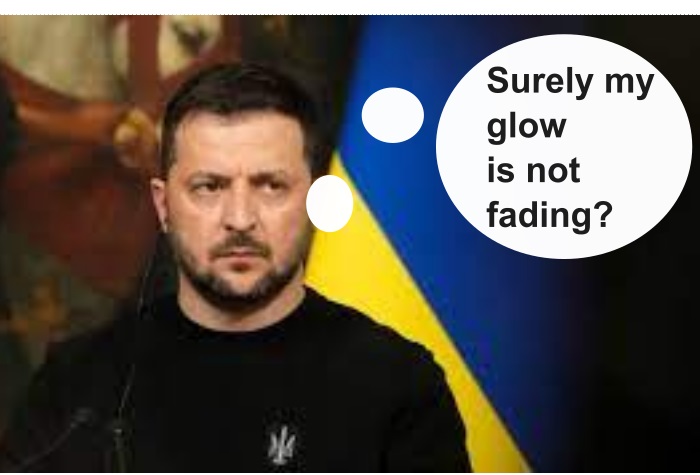
Ukraine’s neighbors ready to pay off Zelensky to stop conflict – Seymour Hersh
https://www.rt.com/news/576436-zelensky-poland-us-hersh/ 17 May 23
EU nations have privately urged the president of the war-torn country to end the fighting, a US official told the veteran journalist.
Poland is leading a group of European nations that are secretly urging Vladimir Zelensky to find a way to settle the conflict with Russia, veteran journalist Seymour Hersh has reported, citing a “knowledgeable” American official.
According to US intelligence, other EU countries that want to see an end to the fighting include Hungary, Germany, the Czech Republic, Lithuania, Latvia and Estonia, Hersh wrote in an article published on his Substack page on Wednesday.
“Hungary is a big player in this and so are Poland and Germany, and they are working to get Zelensky to come around,” the unnamed official claimed. Those countries have made it clear that “Zelensky can keep what he’s got if he works up a peace deal even if he’s got to be paid off, if it’s the only way to get a deal.”
By “keep what he’s got,” the source was referring to the Ukrainian president’s villa in Italy and interests in an offshore bank, Hersh clarified.
However, Zelensky has so far rejected the proposal, while other major European players – France and the UK – “are too beholden” to the Biden administration, which is continuing to back the Ukrainian leader, the official said.
One of the main reasons why Poland and the others want the conflict to end is because the burden of accommodating Ukrainian refugees has become too much for them, the Pulitzer Prize-winning journalist wrote.
The problem for those countries “is how to get the US to stop supporting Zelensky,” Hersh’s source suggested.
He claimed that US intelligence is well aware that “Ukraine is running out of money and… that the next four or months are critical. And Eastern Europeans are talking about a deal.”
However, he added that “it’s not clear to the intelligence community what the president and his foreign policy aides in the White House know of the reality.”
The US is “still training Ukrainians how to fly our F-16s that will be shot down by Russia as soon as they get into the war zone. The mainstream press is dedicated to Biden and the war, and Biden is still talking about the Great Satan in Moscow while the Russian economy is doing great,” the official explained.
Russia has repeatedly stated that it’s ready to resolve the conflict at the negotiating table. However, it did not receive any proposals from Ukraine and its Western backers that it could consider reasonable.
Zelensky has been promoting his ten-point peace plan, which calls for Russian forces to withdraw to borders claimed by Ukraine, to pay reparations, and to submit to war-crime tribunals.
Moscow has rejected the plan as “unacceptable,” saying it ignores the reality on the ground and is actually a sign of Kiev’s unwillingness to solve the crisis through diplomatic means.
Drink Fukushima water if it’s clean, South Korea tells Japanese officials
South Korea’s opposition leader has challenged Japanese officials to
drink treated radioactive water from the destroyed Fukushima nuclear power
plant amid concerns over Tokyo’s plan to release the water into the sea.
Lee Jae-myung, the leader of the Democratic Party of Korea, implored
Japanese officials to make good on their claims that the radioactive water
is filtered and safe to be released into the sea. There are fierce protests
from local fishing communities as well as neighbouring countries such as
South Korea, China, and the Pacific Island nations following concerns over
the consequences of releasing the water.
Independent 16th May 2023
French Polynesia’s anti-nuclear organisation Association 193 criticises France for downplaying impact of tests
Walter Zweifel, RNZ Pacific Reporter walter.zweifel@rnz.co.nz https://www.rnz.co.nz/international/pacific-news/490142/anti-nuclear-group-criticises-france-for-downplaying-impact-of-tests 17 May 23
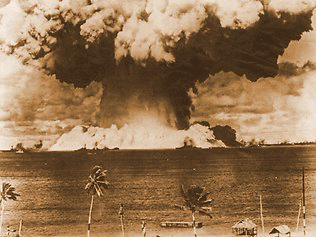
French Polynesia’s anti-nuclear organisation Association 193 has criticised the latest French report about the impact of the French nuclear weapons tests.
France’s National Institute of Health and Medical Research evaluated additional declassified data from the tests at Mururoa and found that radiation from them had a minimal role in causing thyroid cancer.
The Association’s president, Father Auguste Uebe-Carlson, told the AFP news agency there was a tendency by the French state and the Institute to minimise the impact of the nuclear fallout.
He said the French Committee for the Compensation of Victims of Nuclear Tests refused to recognise the files of victims born after 1974, when the military carried out its last atmospheric test.
But Uebe-Carlson said there was an argument to also recognise cancer sufferers born since 1974.
According to Uebe-Carlson, the Institute would one day have to explain why there were so many cancers in French Polynesia.
He has repeatedly accused France of refusing to recognise the impact of the tests, instead using propaganda to say they were clean or a thing of the past.
He said health problems were now being attributed to poor diet and lifestyle choices.
Three years ago he said he carried out survey in Mangareva, which is close to the former weapons test sites, and found that from 1966 onward all families reported cases of still-born babies.
Call for release of scientific data
The president of the test veterans’ organisation Moruroa e tatou said the release of the scientific data was not enough.
Hiro Tefaarere told La Premiere it was “absolutely necessary” for his organisation to get from the French state the register of the cancer patients and cancer deaths during the testing period.
He said it was “imperative” that these files be given to Moruroa e tatou.
Tefaarere said this research, if the state agrees to release it, would give his organisation the essential elements to consolidate the complaints which have been filed.
President to take report into account
An assembly member Hinamoeura Cross, who suffers from leukemia, said she was outraged that reports were still being published downplaying the tests’ effects.
The new president, Moetai Brotherson, said he would take the latest report into account when he enters into discussions with the French government.
French Polynesia has for years been trying to get France to reimburse it for outlays for cancer sufferers.
Its social security agency CPS said since 1995 it had spent almost $US1 billion to treat 10,000 people suffering from cancer as the result of radiation from the tests.
In 2010, Paris recognised for the first time that the tests had had an impact on the environment and health, paving the way for compensation.
Between 1966 and 1996, France carried out almost 200 tests in the South Pacific, involving more than 100,000 military and civilian personnel.
Paris has refused to apologise or the tests, but President Emmanel Macron said France owed ‘a debt’ to French Polynesia’s people.
Former world leaders urge G7 to get nuclear arms control back on track
Letter calls on US and Russia to isolate weapons agreements from other disputes
Patrick Wintour Diplomatic editor 18 May 23 https://www.theguardian.com/world/2023/may/17/former-world-leaders-urge-g7-to-get-nuclear-arms-control-back-on-track
A global array of former world leaders and defence ministers, nuclear experts and diplomats have called on the leaders of G7 countries at their meeting in Hiroshima, Japan, not to let progress on nuclear arms control continue to be the victim of growing geopolitical conflict, including the conflict between the west and Russia over Ukraine.
The Japanese prime minister, Fumio Kishida, who is from Hiroshima, chose the G7 venue to lend seriousness to his personal call to world leaders to at least agree a roadmap to resume nuclear arms control talks.
In February, Russia pulled out of the 2010 New Start treaty, a pact that sets limits on the deployed strategic nuclear arsenals of the world’s two largest nuclear powers, although Moscow said it would nevertheless abide by the limits for the moment.
Kishida intends to take world leaders arriving this week for the summit to the harrowing Hiroshima Peace Memorial Museum, where they will see graphic depictions of the US attack in 1945.
An open letter signed by six former heads of state, 20 cabinet-level ministers and experts from 50 different countries including China, Russia and the US lends momentum to Kishida’s G7 theme by saying the world needs more nuclear arms control, not less.
The letter says: “United States-Russia strategic stability talks are in limbo and the New Start treaty, which has played an indispensable role in ensuring reciprocal security, is now in question.
“As the only existing nuclear arms control agreement between the United States and Russia, the world’s two largest nuclear-armed countries, the treaty’s collapse or expiration without a replacement would threaten a destabilising arms race.”
Worsening big-power competition is making nuclear war more likely, the leaders warn, and “failure to agree on a new nuclear arms control framework to replace New Start before it expires in February 2026 would also make it more difficult to bring China, France and the United Kingdom into multilateral arms control, as all three are not ready to consider limits on their nuclear arsenals until the United States and Russia bring down their nuclear stockpiles”.
The letter was organised by the European Leadership Network and Asia-Pacific Leadership Network and signed by former world leaders, including Ernesto Zedillo, the former president of Mexico, Helen Clark, the former prime minister of New Zealand and Ingvar Carlsson, the former prime minister of Sweden.
In Russia, the signatories include Alexei Arbatov, the director of the International Security Center at the Institute of World Economy and International Relations; Pavel Palazhchenko, the head of the international centre at the Gorbachev Foundation, and Sergey Rogov, who until March last year, was a member of the scientific council of the national security council and a former adviser to the Duma international affairs committee.
One of the most prominent signatories in China is Prof Chen Dongxiao, the president of Shanghai Institutes for International Studies. China has been clear in warning Russia not to use nuclear weapons in the Ukraine conflict, a threat that has repeatedly been made by Moscow, including by transferring nuclear weapons to Belarus.
UK signatories include the former head of MI6 John Scarlett, the former foreign secretaries Malcolm Rifkind and David Owen, as well as the former defence secretaries Des Browne and Tom King.
The 256 signatories acknowledge they all have different views about geopolitical competition but say “we all agree that it is long past time to start prioritising nuclear arms control and taking unilateral, bilateral and multilateral actions”.
The letter urges Russia and the US to compartmentalise nuclear arms control and isolate it from other disputes by confirming that they will not exceed the New Start limits on deployed nuclear forces, which thus far have not been violated, as well as agreeing to remove the obstacles to full implementation of their New Start obligations.
It also calls for the resumption of the work of the Bilateral Consultative Commission, the body that agrees details of US and Russian inspections of each others’ military sites under the terms of the New Start treaty. The body has not met for nearly two years.
France holds up EU energy agreement over nuclear power
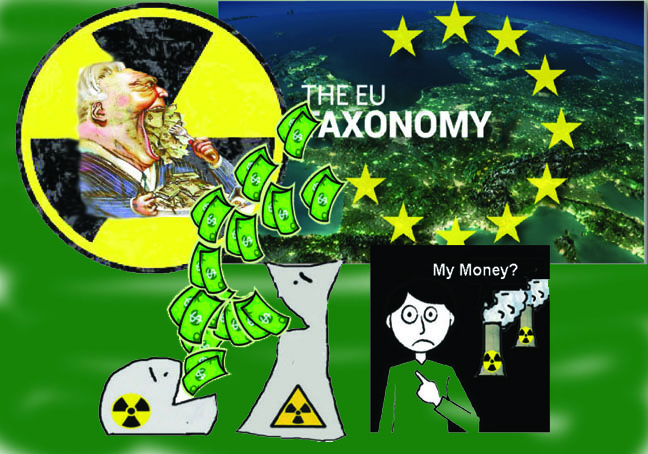
Paris withdraws support for renewable targets law as it seeks inclusion of hydrogen produced with atomic power
Ft.com Alice Hancock in Brussels and Sarah White in Paris 17 May 23
France is leading a coalition of countries holding up agreement on EU-wide targets for renewable energy, as it makes a fresh drive for better treatment of its nuclear industry. The move comes amid a broader pushback against the bloc’s climate agenda as the realities of what is required for the green transition become increasingly apparent. The EU’s 27 member states were due to agree an overall target of 42.5 per cent of renewable power in the bloc’s energy mix by 2030 on Wednesday.
But France, which relies on nuclear power for the majority of its electricity, signalled that it would not support the text, citing concerns that “low-carbon” hydrogen generated with electricity from atomic power plants would not be counted as part of the targets.
“It must be possible for nuclear-derived electricity to coexist with renewable electricity without discrimination,” a French diplomat said. The vote, which was pulled from the agenda of an ambassadors’ meeting at 11.30pm on Tuesday night, would have paved the way for the targets to become EU law following their approval in the European parliament.
……………………….. Other member states said that having the bloc’s two largest countries push for last-minute changes to green legislation set a dangerous precedent for the EU’s policymaking process and could affect its path to achieving an overall target of reducing greenhouse gas emissions by 55 per cent by 2030 compared with 1990 levels.
The EU commission said it remained committed to a “rapid rollout” of renewable energy as a critical element of the bloc’s goal to reach zero greenhouse gas emissions by 2050 and to reduce its dependence on Russian fuels. “The new rules need to be adopted and implemented as swiftly as possible.”……………………………
Six pro-nuclear countries, including the Czech Republic, Bulgaria and Hungary, followed Paris’s lead on Wednesday and withheld support for the directive. Meanwhile, anti-nuclear governments, including in Germany and Austria, have been strongly opposed to recognising nuclear power as a clean fuel. Earlier this week, Paris convened a meeting of ministers from 14 countries with nuclear energy capacity along with the EU’s energy commissioner, Kadri Simson……………………………………………. https://www.ft.com/content/b0d3e7e3-a8ae-457b-9482-3282d32973be
France to host pro-nuclear meet to push for EU recognition of climate benefits
Yahoo Sport Kate Abnett and America Hernandez. Mon, 15 May 2023
BRUSSELS (Reuters) -France will host a meeting of ministers from 16 pro-nuclear European states on Tuesday aimed at coordinating expansion of atomic power and urging the EU to recognise its role in meeting climate goals for 2050, the country’s energy ministry said.
The meeting in Paris will include EU Energy Commissioner Kadri Simson and representatives from 14 EU countries including France, Belgium and the Netherlands, plus Italy as an observer and the United Kingdom as a non-EU invitee………………………
Yves Desbazeille, director of EU lobby group Nucleareurope, will also give a presentation, including figures on potential job creation and investment.
A draft of the post-meeting statement seen by Reuters said the countries would encourage the commissioner to integrate nuclear energy into the EU’s energy policy by recognising nuclear alongside other green [?] energy technologies in EU decarbonisation goals.
The talks will cover the EU Net Zero Industry Act, the Hydrogen Bank, definitions of low-carbon hydrogen and hydrogen import strategies among other topics, the French official said.
The draft document also calls for the publication of an EU communication on small modular reactors.
……………………………. EU opponents of nuclear energy – among them Germany, which switched off its last reactors last month, Luxembourg and Austria – cite concerns including waste disposal and maintenance issues that have plagued the French fleet in recent years.
Austria and Luxembourg are taking the EU to court over its decision to officially label nuclear investments as “green”. https://au.sports.yahoo.com/france-host-pro-nuclear-meet-133145776.html
Biden too scared to come to Australia because of protests about Julian Assange?

Darn it! I was just about to buy my “Free Julian Assange” shirt – to wear in Canberra, and at the Sydney Opera House, and join thousands of others protesting – wherever Joe Biden dares to show his face in Australia.
USA Republican House Speaker Kevin McCarthy said on Tuesday that a deal on the debt ceiling negotiations might be made by the end of this week. So – perhaps all the panic about the US Debt Ceiling will not be necessary? So – does Biden really need to cancel his visit to Australia?
Never mind – he’s still going to Hiroshima for the G7 summit. That’ll be OK. Everyone will say worthy things about how there must never be another nuclear bombing, and how we must all send drones, tanks, missiles etc to Ukraine . And they’ll say it politely -that’s the thing.
As for those bloody uncouth Australians – heck – someone might throw a rotten egg at Biden, – such is our rage about the persecution of Julian Assange. I mean – the Australian Prime Minister will of course bend over backwards to bed polite, and not mention Assange. And Julian’s family and his other prominent supporters will be courteous.
But ya can’t count on the rest of us downunder colonials to be nice about it.
Yes Joe, – safer to go straight home from the G7 – give Australia a miss.
Understanding The Highly Complex World Of Western China Analysis

CAITLIN JOHNSTONE, MAY 15, 2023 https://caitlinjohnstone.substack.com/p/understanding-the-highly-complex?utm_source=post-email-title&publication_id=82124&post_id=121463595&isFreemail=true&utm_medium=email
—
Former Pentagon official Elbridge Colby was interviewed on The National Review’s Charles CW Cooke Podcast, where he provided some very high-level analysis on the tensions around China, Taiwan, and the United States.
I will here attempt to explain some of Colby’s comments for the benefit of the average reader, because Colby has been studying these things for many years and his commentary can be a bit advanced and esoteric for the casual punditry consumer.
“The analogy I use is… Taiwan is like a man with a cut in the ocean, and China is like a great white shark, and America is like a man in a boat,” Colby said in the interview.
“The problem is once that great white shark starts moving, you got no time,” added Colby. “You’re done. You know, if you’re not already by the side of the boat, right? Because it’s a great white shark.”
Now bear with me if Colby’s incisive observations went a bit over your head here, but if we break it down I’m confident that we can all catch up to this man’s towering intellect enough to catch a glimpse of his understanding on the matter.
What Colby appears to be saying — and please correct me of you think I’m reading this wrong — is that China is like a Great White Shark, which as we all know is an extremely dangerous aquatic predator with a voracious appetite, capable of gulping down a human being in a few swift bites.
Now, try to imagine being in a situation where you’re out there in the ocean, and there’s a Great White Shark right there with you in the water. And to make matters worse, you’re bleeding — a problem not only due to the wound from whence the blood is emanating, but also because sharks can smell blood in the water! That would be pretty bad, right?
Okay, so are you with me so far? Remember, this is very advanced stuff, so feel free to read back and review as much as you need.
Now, imagine you’re in that situation with the cut and the shark, and there’s a boat that you can go to to get away from the shark. You’d want to hop aboard that vessel as swiftly as possible, don’t you think? I know I would!
So to put it all together, what the esteemed Elbridge Colby is telling us is that China is analogous to the Great White Shark which is eyeing the bleeding man in the water, and the man can be compared to Taiwan, and the United States of America is comparable to the boat that is coming to the rescue of the man.
Make sense? If you’re still struggling to comprehend Colby’s scalpel-like geopolitical analysis, don’t worry, because I’ve obtained this helpful infographic above, to further illuminate your understanding:
Interestingly enough, this is not the first time China has been compared to a Great White Shark in recent western punditry. The Hoover Institution’s Matt Pottinger, a former advisor to President Donald Trump, made a similar comparison in an interview with Nikkei Asia earlier this month:
“We saw a baby shark and thought that we could transform it into a dolphin over time, to become a friendly sort of system,” Pottinger said. “Instead, what we did was we kept feeding the shark and the shark got bigger and bigger and bigger and bigger. And now we’re dealing with a formidable, great white.”
“With a shark you put up a shark cage,” added Pottinger. “The shark doesn’t take it personally. It bumps into the cage. It respects those barriers.”
Again, this is very complicated for the uninitiated layperson, but what Pottinger appears to be saying is that China is not at all comparable to a dolphin, which is an oceanic mammal known to be friendly toward people and easily trained to do tricks in aquatic theme parks. Rather, in Pottinger’s understanding, China is more comparable to a Great White Shark, which as you’ll recall from our discussion earlier in this essay is actually known to be rather dangerous.
If you’re still struggling to make sense of Pottinger’s luminous understanding, here’s another illustration to help make things a bit clearer:
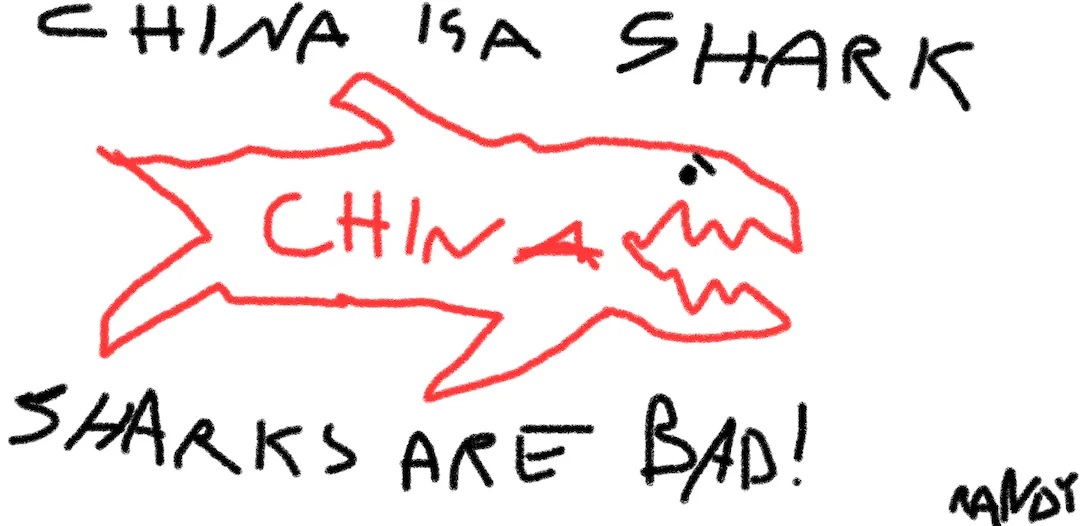
If you need it simplified even further, another way to put it might be, CHINA BAD. SHARK BAD. CHINA LIKE SHARK. CHINA VERY, VERY BAD. BAD CHINA. BAD.
Again, don’t be hard on yourself if you can’t quite wrap your head around the high-level analysis of intellectual giants like Matt Pottinger and Elbridge Colby. If we could understand these things as well as they do, we’d be the ones earning big bucks from Washington think tanks, not them!
Well I think that’s enough work for your gray matter today. Have a rest and a nice sleep and come back fresh tomorrow, where we’ll be discussing some mind-blowing comparisons western analysts have been drawing between Vladimir Putin and Adolf Hitler.
The success of the Zelensky regime coming unstuck?
Zelensky regime’s fate is sealed Indian Punchline BY M. K. BHADRAKUMAR
The West’s cryptic or mocking remarks doubting the Kremlin statement on the failed Ukrainian attempt to assassinate President Vladimir Putin do not detract from the fact that Moscow has no reason on earth to fabricate such a grave allegation that has prompted the scaling down of its Victory Day celebrations on May 9, which is a triumphal moment in all of Russian history, especially now when it is fighting off the recrudescence of Nazi ideology on Europe’s political landscape single-handedly all over again.
The alacrity with which the US Secretary of State Antony Blinken debunked the Kremlin allegation, perhaps, gives the game away. It is in the neocon DNA to duck in such defining moments. That said, predictably, Blinken also distanced the Biden administration from the Kremlin attack.
Earlier, the chairman of Joints Chiefs of Staff General Marks Milley also did a similar thing in an interview with the Foreign Affairs magazine disowning in advance any responsibility for the upcoming Ukrainian “counteroffensive”. This is the Biden Administration’s new refrain — hear no evil, speak no evil. No more talk, either, of backing Kiev all the way “no matter what it takes” — as Biden used to say ad nauseam.
The heart of the matter is that Kiev’s much touted “counteroffensive” is struggling amidst widespread western prognosis that it is destined to be a damp squib. Actually, the salience of the Foreign Affairs podcast this week with Gen. Milley was also his diffidence about the outcome. Milley refused to be categorical that Kiev would even launch its “counteroffensive”!
There is a huge dilemma today as the entire western narrative of a Russian defeat stands exposed as a pack of lies, and alongside, the myth of Kiev’s military prowess to take on the far superior military might of a superpower has evaporated. The Ukrainian military is being ground to the dust systematically. In reality, Ukraine has become an open wound that is fast turning gangrene, and little time is left to cauterise the wound.
However, Kiev regime is ridden with factionalism. There are powerful cliques who are averse to peace talks with Russia short of capitulation by Moscow and instead want an escalation so that the Western powers remain committed. And even after Boris Johnson’s exit, they have supporters in the West.
The militant clique ensconced in the power structure in Kiev could well have been the perpetrators of this dangerous act of provocation directed against the Kremlin with an ulterior agenda to trigger a Russian retaliation.
From Blinken’s vacuous remark, it seems the neocons in the Biden Administration led by Victoria Nuland are in no mood to rein in the mavericks in Kiev, either. As for Europe, it has lost its voice too.
This will probably show up in history books as a historic failure of European leadership and at its core lies the paradox that it is not France but the German government that has aligned itself closer with the US in the Ukraine war and risking an intra-European “epoch of confrontation.”
Even otherwise, these are fateful times, with the political middle ground already shrinking in France and Italy and is much weakened in Germany itself in the wake of the pandemic, the war, and inflation. Importantly, this is only partly an economic story, as the decline of the centre and the de-industrialisation in Europe are closely related and the social fabric that supported the centre has come unstuck.
……………………………………….. The considered Kremlin reaction is available from the remarks by the Russian Ambassador to the US, Anatoly Antonov:
“How would Americans react if a drone hit the White House, the Capitol or the Pentagon? The answer is obvious for any politician as well as for an average citizen: the punishment will be harsh and inevitable.” ………………………………………… more https://www.indianpunchline.com/zelensky-regimes-fate-is-sealed/
Five years after Trump’s exit, no return to the Iran nuclear deal
Trump’s slew of sanctions and a changing political climate have contributed to JCPOA remaining in limbo.
Aljjazeera On 8 May 20238 May 2023
Tehran, Iran – Five years ago today, President Donald Trump held up a signed executive order for the cameras at the White House, announcing a unilateral withdrawal from a nuclear deal the United States had signed in 2015 with Iran and world powers.
Despite years of efforts, and after many ups and downs, the landmark accord known formally as the Joint Comprehensive Plan of Action (JCPOA), has not been restored, contributing to rising tensions across the region.
The Trump administration’s many designations of Iranian entities and institutions, specifically aimed at making it difficult for his successor Joe Biden to undo his damage, worked in tandem with a changing political climate to prevent a restored JCPOA.
The then-US president had argued that the deal was not doing enough to permanently keep Tehran from acquiring a nuclear weapon, and Trump rejoiced as he undid one of the most important foreign policy achievements of his predecessor Barack Obama.
His administration set out a dozen conditions to renegotiate a deal more favourable to Washington with Tehran, which would effectively amount to a total political capitulation by Iran…………………………
Iranian leaders, however, have not surrendered their doctrine of defying the US, and attacks by pro-Iran groups on US interests across the region have only multiplied in recent years, according to Washington.
The US assassination of Iran’s top general Qassem Soleimani in Iraq in early 2020 took tensions to new heights, with Tehran and Washington teetering on the edge of war…………………………………………………………..
JCPOA in the region
Since its inception, Israel has been the JCPOA’s biggest foe, incessantly lobbying Washington to declare the deal dead.
Prime Minister Benjamin Netanyahu praised Trump after his reneging on the deal, and Tel Aviv has repeatedly pushed against efforts by other signatories – namely China, Russia, France, Germany and the United Kingdom – to restore the accord through now-stalled talks that began in 2021.
Israel has also warned it will attack Iran to stop it from acquiring a bomb, and Biden’s national security adviser, Jake Sullivan, last week said the US president is willing to recognise “Israel’s freedom of action” if necessary.
The comment drew ire in Tehran, prompting security chief Ali Shamkhani to deem it a US admission of responsibility for Israeli attacks on Iranian facilities and nuclear scientists.
Elsewhere in the Middle East, many Arab states, led by Saudi Arabia, also cheered for Trump as they expressed concern over Tehran’s nuclear programme – which it maintains is strictly peaceful – and its support for proxies across the region.
But as Tehran also ramped up the pressure, and the US gradually saw its role in the region diminished, Arab leaders recognised a need for change.
The 2019 attack on Saudi oil facilities by the Iran-aligned Houthis in Yemen, and the subsequent non-response from Washington, appeared to be a turning point for Arab nations.
After two years of direct talks, Iran and Saudi Arabia agreed in March to restore diplomatic relations in a deal mediated by China, and embassies are expected to be reopened this week.
More challenges ahead
At least for now, JCPOA stakeholders appear to be content with maintaining the status quo while managing tensions.
The passing of two Western-introduced resolutions last year at the board of the International Atomic Energy Agency (IAEA) that censured Iran – and Tehran’s response – and a deadlock in talks since September have not prompted any side to declare the JCPOA dead in the absence of a better alternative for the accord.
The deal’s fate, however, promises to produce more confrontations between Tehran and the West in the coming months.
The Western parties have already reportedly warned Iran that if it further increases its enrichment of uranium to levels that could be potentially used to produce a bomb, it will prompt them to activate the deal’s so-called “snapback” mechanism that will automatically reinstate the United Nations sanctions on Iran.
Iran and the IAEA reached an agreement in Tehran in March to increase cooperation, which could potentially prevent another resolution at the upcoming board meeting of the nuclear watchdog in June.
Another major deadline arrives in October when the JCPOA is set to lift a number of restrictions on Iran’s research, development and production of long-range missiles and drones.
With Israel also pushing for snapback and the West accusing Tehran of selling armed drones to Russia for the war in Ukraine, stakeholders will have their work cut out for them in managing tensions during the coming months. https://www.aljazeera.com/news/2023/5/8/five-years-after-trumps-exit-no-return-to-the-iran-nuclear-deal
Cumulative risk and nuclear war

The precedent for nuclear confrontation is the Cuban Missile Crisis. Both sides settled for less than a win.
We will need a strong president to adjust to the current world reality, which will require us to back away from the forward containment strategy. Neither Joe Biden nor Donald Trump seem to be that type of president.
Lenconnect.com, James W. Pfister 7 May 23
A substantial nuclear strike against the United States would destroy cities and would result in untold deaths and misery. Yet, the United States’ foreign policy interferes with nuclear powers such as Russia in Ukraine and China in Taiwan. We don’t talk much about nuclear war, as if rational beings would never do such a thing. But who expects pure rationality into the unknown future? Humans will experience irrationality, mistakes and even pure evil, as we saw in 9/11.
My thesis is that even though there is a low probability of nuclear war at any given moment, a series of interactions in enmity with nuclear states leads to a cumulative risk over time, just as a dangerous driver will probably eventually experience a crash. We are on China’s and Russia’s borders, based on the old Cold War dynamics of containment. This is dangerous. We will need a strong president to adjust to the current world reality, which will require us to back away from the forward containment strategy. Neither Joe Biden nor Donald Trump seem to be that type of president.
………………………………… Arms control, which was a hope in the past to control nuclear weapons, seems to be weakened. Russia said it will not permit the inspections of the START Treaty. Any meaningful arms-control regime would require an agreement among China, Russia and the United States. Such agreement does not seem likely today.
What about a mistake, or cyber used by terrorists? There could be “faulty judgment, false warnings of attack, or other miscalculation … cyber attacks to disrupt the command and control of nuclear weapons and early warning systems … leaving governments only minutes to decide………………………..
There is no defense to a major nuclear attack. Recently, South Korean President Yoon Suk Yoel met with President Biden to assure that the United States will, in fact, use nuclear weapons against North Korea, even though the latter will have nuclear weapons that can reach the United States. Biden, in effect, said yes, we will risk an attack on Los Angeles, for instance. South Korea and Japan, which have begun to talk, should have their own nuclear deterrents.
The precedent for nuclear confrontation is the Cuban Missile Crisis. Both sides settled for less than a win. Instead of invading Cuba, as some advisers urged, President John F. Kennedy chose the more restrained blockade (“quarantine”). Chairman Nikita Khrushchev, realizing his gamble had failed, withdrew his missiles. Kennedy promised not to invade Cuba and to remove our offensive and provocative weapons from Turkey. Both leaders withdrew from the brink.
“Their prudence holds lessons for today, when so many commentators in Russia and in the West are calling for resolute victory of one side or the other in Ukraine.” (Sergey Radchenko and Vladislav Zubok, “Blundering on the Brink,” Foreign Affairs, April 3, 2023). Many around Putin say, “…Moscow should prefer nuclear Armageddon to defeat.” (Ibid.). Kennedy concluded: “…while defending our own vital interests, nuclear powers must avert those confrontations which bring an adversary to a choice of either a humiliating retreat or nuclear war.”
With the United States assertively involved in enmity with Russia and China, with NATO expansion, doing “saber-rattling” shows of force in Asia in military exercises, the chance of nuclear war increases with cumulative risk. …………
We need spheres of Influence among the three great nuclear powers, and prudence. The United States cannot aggressively be on their doorsteps without risking nuclear war. The United States must climb down from its unipolar role.
James W. Pfister, J.D. University of Toledo, Ph.D. University of Michigan (political science), retired after 46 years in the Political Science Department at Eastern Michigan University. He lives at Devils Lake and can be reached at jpfister@emich.edu. https://www.lenconnect.com/story/opinion/columns/2023/05/07/james-w-pfister-cumulative-risk-and-nuclear-war/70191242007/
France and Russia have “a win-win partnership” on the nuclear industry

France to Work With Russia on Hungarian Nuclear Project Despite EU Criticism
France’s energy transition ministry has permitted Framatome, a nuclear energy subsidiary of Électricité de France (EDF), to contribute to the construction of two reactors at the Hungarian Paks-2 nuclear power plant alongside Russian state-run nuclear bigwig Rosatom, according to a report by French news outlet Le Monde on April 27.
………… The said project has been contentious among some EU members, owing to the bloc’s sanctions against Russia.
…………………………. Last month, Hungarian Foreign Minister Péter Szijjártó disclosed that Hungary might increase the contributions of Framatome in the project, after encountering roadblocks with Germany’s Siemens Energy, in the context of Ukraine-linked sanctions and Germany’s reduction of nuclear power as an energy source. Both companies had been contracted to provide control systems for new reactors at Paks-2 as part of a French-German consortium.
“Since the German government is blocking for political reasons the contractual participation of Siemens Energy, we wish to rely more on the French,” said Szijjártó ……………………………………..
Unveiled in 2014 under an agreement between Hungary and Russia, the Paks-2 project aimed to construct two new nuclear reactors by Rosatom and a Russian state loan to bankroll most of the project……..
In wake of the Russo-Ukraine conflict, anti-Russian observers and policymakers saw Framatome’s participation in the setting up of two nuclear reactors in Hungary led by the Russian state-owned group Rosatom as an ill-advised move.
……. , “to date, European sanctions [against Russia] do not target the nuclear industry,” the French ministry said.
………………………… The EU and Ukraine have been mounting pressure on France to fully sever relations with Russia’s atomic sector amid rounds of sanctions against Moscow, ramping up scrutiny of France’s links with Rosatom.
Collaboration with Rosatom has been a hot-button issue among France and other EU countries dependent on Russia for nuclear fuel. While 2022 saw the suspension of a great deal of commercial cooperation, some French state-controlled companies continue to maintain some ties with Rosatom.
…………………………………… Rosatom called the Franco-Russian alliance “a win-win partnership” that is “a driver of development both in the field of nuclear energy and scientific projects.”
……. French companies provide technology to Rosatom whenever the Russian behemoth constructs a nuclear plant abroad, with Rosatom usually spending up to €1 billion per project, encompassing command and control systems from Framatome, Faudon revealed.
……….. Apart from France, the United States also purchased $830 million of enriched uranium from Russia last year. Reactors in Bulgaria, the Czech Republic, Finland, Slovakia, and Hungary obtain fuel from Russia as well…………………………………….more https://thenewamerican.com/france-to-work-with-russia-on-hungarian-nuclear-project-despite-eu-criticism/
Daniel Ellsberg Warns Risk of Nuclear War Is Rising as Tension Mounts over Ukraine & Taiwan
Democracy Now 1 May 23
As we continue our in-depth conversation with Daniel Ellsberg, the famed Pentagon Papers whistleblower talks about his lifelong antiwar activism and responds to the more recent leak of Pentagon documents about the war in Ukraine. Ellsberg also reflects on the many people who inspired him and says others who look up to his example should know that the sacrifices for building a better world are worth it. “It can work,” he says. Ellsberg, who was recently diagnosed with inoperable pancreatic cancer and given just months to live, spoke to Democracy Now! last week from his home in Berkeley, California.
Transcript
………………This is another excerpt from the 2009 documentary The Most Dangerous Man in America: Daniel Ellsberg and the Pentagon Papers. The clip looks at how the Nixon White House responded to the Pentagon Papers leak. You’ll hear White House counsel John Dean; Egil Krogh, who went to prison for his part in Watergate; but first, President Nixon.
DANIEL ELLSBERG:……………………………………………………………………………………… [1969 in Vietnam war] they would send a strong signal to the Chinese. We were prepared to use nuclear weapons right on their border, in the hopes that it would bring Chinese air defenses into the border, and we could pursue them, in hot pursuit, into China and use nuclear weapons against China.………………..
AMY GOODMAN: What about the latest Pentagon leak, the leak of the Pentagon documents, and what they say about the war in Ukraine, and what people understand who are most knowledgeable, who are insiders, about this war?
DANIEL ELLSBERG: It’s shown from the reaction to these leaks, the major leak being, once again like the Pentagon Papers, that when a war appears to be stalemated, it may be stalemated from the inside just as well. That’s what the Pentagon Papers showed, that there is no real prospect for progress and that killing people is, on either side, unjustified by any prospect of any humane result.
Intelligence estimates have shown that a year from now we will probably be in pretty much the same positions — a stalemate — and will not be willing to negotiate. What does that say about our — the people who are making our foreign policy? If that doesn’t define a crisis and emergency, what would? Well, yes, I suppose the prospect that we’re about to lose within a month, and that’s not what either is facing yet.
When Biden is urged to send direct planes, that Ukrainians can’t yet operate, like the F-16, tanks that they cannot yet operate, the tendency to send Americans to operate those tanks and get them right away into business will be very strong along with that. I can only hope that Biden will be pressed by a large part of the public, pressed not to involve the U.S. directly in that war, and to be pursuing negotiations, which it is currently absolutely eschewing, is rejecting the idea of negotiations.
There’s increasing information that one year ago, in early April 2022, Zelensky and Putin essentially had an agreement, were within very close to an agreement, on prewar status quo, returning to a prewar status quo in Crimea and the Donbas, in relation to NATO and everything else, but that the U.S. and the British, Boris Johnson, went over and said, “We are not ready for that. We want the war to continue. We will not accept a negotiation.” I would say that was a crime against humanity. And I say that with all seriousness to the idea that we needed to see people killed on both sides in order, quote, “to weaken the Russians,” not for the benefit of the Ukrainians, but for an overall geopolitical strategy, was wicked.
And however the war started, and, I think, with both incredibly bad judgment by Putin, and aggression and atrocity, and, on the other hand, provocation by the United States, in the sense of policies that were consciously foreseen to increase the probability of a Russian crime of this sort, tells me that I think there were a lot of Americans who wanted this war And they got exactly what they wanted, even better than they could have imagined — huge arms sales to our allies, the U.S. again having an essential role in Europe with an indispensable enemy, an enemy that we could not run the world without, Russia. And Russia stepped into that role very willingly. To say that Russia had no choice but to do what they did do is fairly absurd. That’s like saying you can provoke a person to shoot themselves in the foot or, in this case, to kneecap themselves. Putin had no choice but to kneecap himself and to give himself 800 more miles of adversarial border with Finland and to resuscitate NATO and get these arms sales and so forth — is just absurd.
AMY GOODMAN: I also wanted to bring up China, because in 2021 you revealed that the government had drawn up plans to attack China with nuclear weapons over a crisis in the Taiwan Strait. Can you talk about the relevance of that today, and when you got that information?
DANIEL ELLSBERG: Yes. I revealed that information right after The Economist magazine had a cover with Taiwan on the cover and a big bull’s mark, bull mark, on the front of it, showing that it was, quote, “the most dangerous place” in the world at that point. And what was at stake was a U.S. intervention in the politics of China, namely, supporting a secession movement, an independence movement, by a portion of China regarded almost universally by Chinese as part of China, supporting it in a way which the Chinese were totally forecasting would lead to war, that they would not accept it any more than Lincoln accepted the secession of the Confederacy, in this case.
And we were pressing for that in a way that I have to say I can’t entirely understand. People act as if they want war with China. How can that be? Selling them arms? Yes, I see that. But why they — why they want to change the relation of Taiwan, which has been pretty much the same since 1979, right now in a way that the Chinese guarantee us will lead to war is inscrutable to me. But anyway —
AMY GOODMAN: And you said that these nuclear war plans over the Taiwan Straits were made in 1958?
DANIEL ELLSBERG: ’58, yeah, that’s right. And by the way, there was almost a corresponding crisis earlier, in 1954, ’55, so this was known as the second Taiwan crisis in the ’50s. But the idea there was that we would initiate nuclear war if the Chinese successfully bombarded by artillery islands that were within artillery range, actually within visual range of the mainland, very easy. A couple of them are just a mile or mile and a half off from the mainland. To keep those rocks from control by Beijing, we were prepared to send in U.S. planes to block that blockade — send in U.S. ships to break that blockade. And if the artillery kept that off or there was a danger of losing U.S. ships, we would hit Chinese targets as much as — as far away as Shanghai, which would certainly, in Eisenhower’s terms, and who okayed this, if necessary, if necessary to get through to those islands, we would initiate nuclear war. And he foresaw that as leading to Russian — the ally of China — attacks on Taiwan and on Okinawa, on Guam, even on Japan, which, in turn, guaranteed, in terms of our planning, all-out nuclear war, hitting every city in Russia and China, killing, as our estimates were at that time, 600 million people, a hundred kilowatts —
AMY GOODMAN: And their relevance today?
DANIEL ELLSBERG: — over Taiwan. And that was what they — that’s what they were planning to do then. The number of targets in China has not reduced since then. That was a time when any fighting with the Russians, under Eisenhower, even if it started over Berlin, was guaranteed to include targeting China as a whole, as well. That may have changed to some extent, but to a large extent, at various times, we’ve still continued to say, “Shouldn’t we have a plan for war with Russia that doesn’t include destroying China?” To which the answer is, “Well, do you really want to destroy Russia and not China also? We’ll be destroyed in the process. That would leave China ruling the world.” In short, Russia and China have to be regarded as a joint target complex. OK?
This is insanity. This is a form of insanity as a kind of myth and hoax that has taken over the public. It is as insane as QAnon or as the belief that Trump is the president currently of the United States. And yet, the belief that we can do less bad by striking first than if we strike second is what confronts us in Ukraine with a real possibility of a nuclear war coming out of this conflict — in other words, of most life on Earth — not all, most life on Earth — being extinguished as a matter of the control of Crimea or the Donbas or Taiwan. That’s insane.
Who is going to face up to that? I call again to the young people that Greta Thunberg has mobilized on us to say, “The adults are not taking care of this, and our future absolutely depends on this changing somehow fast, now.”
…………………………. The reason I admire her [Greta Thunberg]so much is not only the brilliance of this movement, her acting on her own initially, taking the initiative, advising others, doing it in the form of a general strike, which is — I think, is a really important way of demonstrating nonviolent action, their withdrawal of support, the withdrawal of support……………………………………………………………………………………………………………………….
AMY GOODMAN: Pentagon Papers whistleblower Daniel Ellsberg. Visit democracynow.org for all our interviews with Dan Ellsberg.
https://www.democracynow.org/2023/5/1/daniel_ellsberg_ukraine_war_pentagon_leak
G-7 Expected to Focus on Nuclear Dangers in Hiroshima
Arms Control Association, May 2023, By Daryl G. Kimball
The leaders of the Group of Seven (G-7) industrialized nations, who will convene this month in Hiroshima, the city destroyed in 1945 by the world’s first nuclear attack, are expected to emphasize measures to address rising nuclear dangers.
Japanese Prime Minister Fumio Kishida, who will preside over the summit, chose Hiroshima as the venue “to deepen discussions so that we can release a strong message toward realizing a world free of nuclear weapons.” In response to concerns that Russia might use nuclear weapons in its war in Ukraine, Kishida also said on Jan. 9 that the G-7 needs to “demonstrate a firm commitment to absolutely reject the threat or use of nuclear weapons.”
………………………. According to The Japan Times, the Japanese government is arranging for a meeting between the G-7 leaders and some of the remaining hibakusha, the survivors of the atomic bomb attacks, during a visit to the peace museum on May 19.
………………… Kishida also met representatives from the “Civil 7” group of nongovernmental organizations from 72 countries on April 13 to hear their recommendations on how the G-7 leaders could advance progress on nuclear risk reduction and nuclear disarmament. Among other measures, the civil society group recommended that G-7 leaders meet atomic bombing survivors, unequivocally condemn threats to use nuclear weapons, and endorse urgent negotiations to achieve the complete elimination of nuclear weapons before 2045……………….
https://www.armscontrol.org/act/2023-05/news/g-7-expected-focus-nuclear-dangers-hiroshima
—
Statement by the G7 Parliamentarian Forum for the Elimination of Nuclear Weapons
https://www.icanw.org/g7_mp_statement 29 Apr 23,
Ahead of the G7 Leaders’ Summit taking place in Hiroshima in May, ICAN convened the G7 Parliamentarian Forum for the Elimination of Nuclear Weapons in Tokyo and Hiroshima. The adopted statement urges the G7 governments to recognize the humanitarian consequences of the use of nuclear weapons, condemn threats to use nuclear weapons and to recognise the TPNW as a the comprehensive and effective legal tool for the abolition of nuclear weapons. See the full statement and list of participants below.
We parliamentarians from G7 countries reiterate our commitment to nuclear disarmament on the occasion of the G7 Summit in the city of Hiroshima, a city that is marked by nuclear obliteration due to the dropping of the first atomic bomb on August 6, 1945. We are reminded of the 140,000 lives lost in the city as well as over 70,000 lives lost in Nagasaki, by the end of 1945 and the ongoing physical, social, and psychological suffering of the Hibakusha. Their fate remains at the centre of our political agenda towards complete global nuclear disarmament.
We recognize that the risk of nuclear war increases over time as long as nuclear weapons exist. The repeated missile tests and continued nuclear programs of the DPRK have dangerously and irresponsibly increased this risk. We condemn Russia’s illegal war of aggression on Ukraine, which exposed the unacceptable risks associated with nuclear weapons. The Russian plans to station nuclear weapons in Belarus highlight the importance of halting and reversing such actions and ensuring that nuclear weapons are never again used as tools of aggression and intimidation. The ongoing nuclear arms race, in which all nuclear weapon states are involved, increases the risk of the use of these weapons either by accident or design, with devastating consequences for humanity and the planet and must therefore be stopped as a matter of international urgency.
In order to strengthen the norm of not using and not threatening to use nuclear weapons, we condemn any and all nuclear threats and reiterate that the only guarantee of non-use is the total elimination of nuclear weapons. To this end, we commit to strengthening the Nuclear Non-Proliferation Treaty (NPT) and the Treaty on the Prohibition of Nuclear Weapons (TPNW), which provide the crucial, mutually-reinforcing framework for achieving a world free of nuclear weapons. We underline the importance of Article VI of the NPT, which calls for the complete elimination of nuclear weapons, and we welcome the TPNW’s comprehensive provisions as an important reinforcement of the nuclear disarmament and nonproliferation regime especially in a time of heightened risks. Complementary to the TPNW’s explicit prohibition of nuclear weapons testing, the norms of the Comprehensive Test Ban Treaty (CTBT) must be upheld.
As representatives of their peoples, parliamentarians have a vital role to play in building support for disarmament and ensuring that our governments prioritise the elimination of nuclear weapons. Let us collaborate with states parties to the TPNW and civil society to achieve our shared goal of a safer and more peaceful world, free from the threat of nuclear war. We encourage all non-signatory states to observe the second Meeting of States Parties to the TPNW and urge our governments to explore options to collaborate with states parties, particularly in the area of victim assistance and environmental remediation, as set out in Article 6 and 7 of the TPNW. We will intensify our political efforts to encourage our countries to sign and ratify the TPNW, with the goal of achieving its universalization at the earliest possible time.
In the upcoming Hiroshima Summit, we urge the leaders of the G7 to meet with and listen to the Hibakusha, to acknowledge the devastating harm caused by the use of nuclear weapons on people and the environment, to unequivocally condemn any and all threats to use nuclear weapons, and to recognize the significance of the TPNW in advancing global nuclear disarmament efforts. We maintain that all countries should engage in sincere and constructive negotiations to achieve the total elimination of nuclear weapons so that never again will any person be subjected to the fate endured by the Hibakusha.
Participants of the G7 Parliamentarian Forum on the Elimination of Nuclear Weapons:
Boldrini, Laura / Camera, Partito Democratico, Italy
McPherson, Heather / House of Commons, NDP, Canada
Satouri, Mounir / European Parliament, Green, France/EU (video message)
Spellerberg, Merle / German Bundestag, Green, Germany (video message)
Ribeiro-Addy, Bell / House of Commons, Labour, UK (video message)
Inoguchi, Kuniko / House of Councillors, LDP, Japan
Minoru, Terada / House of Representative, LDP, Japan (video message)
Hiraguchi, Hiroshi / House of Representatives, LDP, Japan
Taniai, Masaaki / House of Councillors, Komeito, Japan
1 This Month



26 September – International Day for the Total Elimination of Nuclear Weapons


PLEASE OPPOSE HR 8255 AND S.3639 – bills would accelerate satellite deployment, with no environmental review or safeguards – https://ncstd5li.quorum.us/campaign/169331/
To see nuclear-related stories in greater depth and intensity – go to https://nuclearinformation.wordpress.com
-
Archives
- September 2026 (245)
- August 2026 (330)
- July 2026 (355)
- June 2026 (287)
- May 2026 (306)
- April 2026 (356)
- March 2026 (251)
- February 2026 (267)
- January 2026 (308)
- December 2025 (358)
- November 2025 (359)
- October 2025 (375)
-
Categories
- 1
- 1 NUCLEAR ISSUES
- business and costs
- climate change
- culture and arts
- ENERGY
- environment
- health
- history
- indigenous issues
- Legal
- marketing of nuclear
- media
- opposition to nuclear
- PERSONAL STORIES
- politics
- politics international
- Religion and ethics
- safety
- secrets,lies and civil liberties
- spinbuster
- technology
- Uranium
- wastes
- weapons and war
- Women
- 2 WORLD
- ACTION
- AFRICA
- Atrocities
- AUSTRALIA
- Christina's notes
- Christina's themes
- culture and arts
- Events
- Fuk 2022
- Fuk 2023
- Fukushima 2017
- Fukushima 2018
- fukushima 2019
- Fukushima 2020
- Fukushima 2021
- general
- global warming
- Humour (God we need it)
- Nuclear
- RARE EARTHS
- Reference
- resources – print
- Resources -audiovicual
- Weekly Newsletter
- World
- World Nuclear
- YouTube
-
RSS
Entries RSS
Comments RSS
 nuclear-news