Irony Or What! India “Sidelines” Russia For US Nuclear Tech, But US Remains ‘Critically Dependent’ On Russian Nuke Fuel
The signing of the 123 Nuclear Agreement between India and the US ended the former’s pariah status in the nuclear world. It brought hope to the American player to collaborate in the nuclear energy sector.
But India’s first deal with the Westinghouse Electric Corporation, a power manufacturing company, has been hanging fire after the company reported bankruptcy. India is now seeking to cooperate with the US on building Small Modular Reactors instead of Russia.
At the G-20 summit, Indian bureaucrat Amitabh Kant called for India-US collaboration to build small 300 MW nuclear power plants and sought “unfettered access” to the US cutting-edge technology.
So far, Russia has been India’s biggest collaborator in the nuclear energy sector. It has helped set up the largest nuclear power plant in Asia at Kudankulam, Tamil Nadu.
………………………………………………………………………………………………..The US government, however, could not bring itself to sanction the Russian nuclear energy giant Rosatom because of its importance in the global nuclear industry.
A special high assay low enriched Uranium is used in the SMRs, and Russia has a monopoly over it. In the absence of an alternative source, the US is dependent on Russia for it.
HALEU is enriched to up to 20%, rather than around 5% for the uranium that powers most nuclear plants. But only TENEX, a subsidiary of Russian state-owned nuclear energy company Rosatom, currently sells HALEU commercially…………………………………………………………………..
The Nuclear Energy Market In India
A recent report in Reuters said that India is likely to overturn a ban on foreign investment in its nuclear power industry and allow greater participation from domestic private firms. An Indian government panel has recommended the changes.
Under India’s Atomic Energy Act 1962, the government controls the development and running of nuclear power plants. Domestic private firms have been able to take part by supplying components.
India has signed contracts with many foreign companies like Westinghouse Electric, GE-Hitachi, Electricite de France, and Rosatom to set up nuclear power plants. Apart from Rosatom, none of the companies have been able to deliver so far…… https://eurasiantimes.com/irony-or-what-india-sidelines-russia-for-us-nuclear-tech/
After AP report, Iran’s nuclear chief says Tehran to cooperate with inspectors on ‘new activities’
The head of Iran’s nuclear program is insisting that his nation will cooperate with international inspectors on any “new activities” regarding its nuclear sector
abc news, ByJON GAMBRELL Associated Press, May 24, 2023
DUBAI, United Arab Emirates — The head of Iran’s nuclear program insisted Wednesday that his government would cooperate with international inspectors on any “new activities.” His statement followed an exclusive Associated Press report about Tehran’s new underground tunnel system near a nuclear enrichment facility.
The AP outlined this week how deep inside a mountain, the new tunnels near the Natanz facility are likely beyond the range of a last-ditch U.S. weapon designed to destroy such sites…………………. more https://abcnews.go.com/Technology/wireStory/after-ap-report-irans-nuclear-chief-tehran-cooperate-99562281
South Korean nuclear experts to tour Fukushima plant amid water concerns
Japan Times, BY ERIC JOHNSTON. STAFF WRITER. May 22, 2023
A team of South Korean experts arrived in Japan on Sunday for an unprecedented six-day visit that will include a trip on Tuesday to the crippled Fukushima No. 1 nuclear power plant, where the government is planning to release treated water into the ocean as part of a decadeslong decommissioning process.
Concerned about the aftereffects of the March 2011 nuclear disaster, South Korea continues to uphold a ban on seafood and marine imports from the area around the Fukushima No. 1 plant, despite Japanese government insistence the food is safe.
Nuclear Safety and Security Commission Chairperson Yoo Guk-hee is heading a 21-member team of government experts, who on Monday met with nuclear officials from plant operator Tokyo Electric Power Company Holdings (Tepco) and various government agencies that oversee Japan’s nuclear power industry. They will tour the plant on Tuesday and Wednesday, paying particular attention to Japan’s plans to discharge treated water, currently being stored at Fukushima No. 1, into the ocean……………. https://www.japantimes.co.jp/news/2023/05/22/national/south-korean-experts-fukushima-tour/
G7 has descended into an ‘anti-China workshop’
By Global TimesThe Group of Seven (G7) Hiroshima summit concluded on May 21, and unlike the usual practice, the G7 communiqué was released a day before the closing. Some Japanese media said that it was due to the fear that Ukrainian President Volodymyr Zelensky’s visit to Hiroshima on the same day would steal the attention from the communiqué. However, even so, this G7 communiqué of dozens of pages still seems to draw little interest from the outside world, except for the part that targets China. According to the Financial Times, the G7 has issued its strongest condemnation of China, and most of the other international mainstream media also highlight that it “amps up pressure on China.” It seems that the only way for the G7 to catch people’s attention and show its sense of presence is to speculate on the issues related to China. May 22, 2023………………………………………………………………………………………………. more https://www.globaltimes.cn/page/202305/1291111.shtml
G7 Leaders Falter Over Nuclear Disarmament in Hiroshima
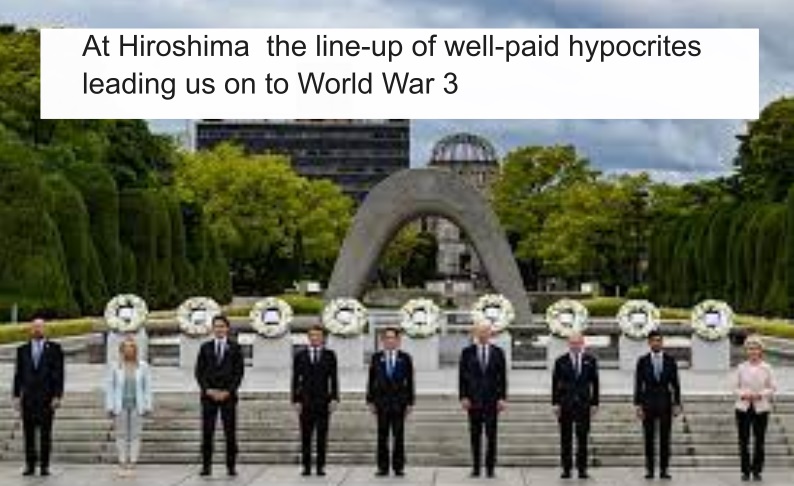
“Was the G7 Vision on Nuclear Disarmament blind arrogance? “
While condemning Russia’s decision to “undermine the New START Treaty”, not one word was uttered about how the US walked out of the ABM Treaty with Russia as well as the INF Treaty, and has not returned to the nuclear deal that (former US President Barack) Obama negotiated with Iran, Slater pointed out
“The US leads the way in dishonoring its Non-Proliferation Treaty obligation for “good faith efforts” for nuclear disarmament and has never acted in “good faith”.
By Thalif Deen, UNITED NATIONS, 22 May 2023 (IDN) — When leaders of the Group of 7 (G7) countries met in Hiroshima May 19-21, one of the issues on the agenda was nuclear disarmament.
The venue of the summit was symbolically stark because the US atomic bombings in 1945 killed over 226,000 people in the twin Japanese cities of Hiroshima and Nagasaki, with the heaviest toll in Hiroshima.
But the seven leaders—from Canada, France, Germany, Italy, Japan, the United Kingdom and the United States, plus the European Union (EU)—failed to produce anything singularly significant towards “a world without nuclear weapons”.
The failure was even more disappointing because three of the G7 countries—France, UK and US—are not only major nuclear powers (along with Russia and China) but also permanent members of the UN Security Council.
Asked at a press briefing in Hiroshima May 21, about the G7 “Hiroshima Vision on Nuclear Disarmament”, which implicitly justified nuclear weapons for defensive purposes, UN Secretary-General António Guterres said: “Well, I’m not a commentator of documents. (But) I think it’s important to say what I believe should be done. I don’t think we can give up on our main objective, which is to have a world free of nuclear weapons.”
“And one thing that disturbs me is that disarmament that was moving forward quite positively during the last decades of the 20th century has completely stopped. And we are even seeing a new race to armaments,” he noted.
“I think it is absolutely essential to re-introduce disarmament discussions about nuclear weapons, and I think it is (also) absolutely necessary that countries that own nuclear weapons commit not to do the first use of those weapons—and I would say commit not to use them in any circumstance.”
“And so, I think we need to be ambitious in relation to the capacity of one day, I hope still in my lifetime, to see this world without nuclear weapons,” Guterres declared.
In a statement released May 19, G7 leaders laid out their “Hiroshima Vision on Nuclear Disarmament”. Excerpts:
“We, the Leaders of the G7, met at a historical juncture in Hiroshima, which together with Nagasaki offers a reminder of the unprecedented devastation and immense human suffering the people of Hiroshima and Nagasaki experienced as a result of the atomic bombings of 1945. In a solemn and reflective moment, we reaffirm, in this first G7 Leaders’ document with a particular focus on nuclear disarmament, our commitment to achieving a world without nuclear weapons with undiminished security for all.”
“We underscore the importance of the 77-year record of non-use of nuclear weapons. Russia’s irresponsible nuclear rhetoric, undermining of arms control regimes, and stated intent to deploy nuclear weapons in Belarus are dangerous and unacceptable. We recall the statement in Bali of all G20 leaders, including Russia.”
“In this context, we reiterate our position that threats by Russia of nuclear weapon use, let alone any use of nuclear weapons by Russia, in the context of its aggression against Ukraine are inadmissible.”
“We recall the Joint Statement of the Leaders of the Five Nuclear-Weapon States issued on January 3, 2022, on Preventing Nuclear War and Avoiding Arms Races, and affirm that a nuclear war cannot be won and must never be fought.”
“We call on Russia to recommit—in words and deeds—to the principles enshrined in that Statement. Our security policies are based on the understanding that nuclear weapons, for as long as they exist, should serve defensive purposes, deter aggression and prevent war and coercion.”
Alice Slater, Board Member, World Beyond War, posed the question: “Was the G7 Vision on Nuclear Disarmament blind arrogance? “
She told IDN that in the shadows of the bombing of Hiroshima, nuclear-armed and nuclear “umbrella” states, relying on the US to use its nuclear weapons on their behalf, met at the Hiroshima Memorial Park, heard the painful testimony of the Hibakusha, survivors of that catastrophic day, August 6, 1945.
“And they delivered the most tone-deaf remarks, hypocritically espousing the awful nature of nuclear weapons and how Russia was endangering the whole planet with its nuclear threats, tossing in North Korea as well, and calling merely for transparency going forward, as if by merely revealing our terrifying arsenals and activities related to rebuilding, refurbishing redesigning and testing would prevent a nuclear cataclysm.”
While condemning Russia’s decision to “undermine the New START Treaty”, not one word was uttered about how the US walked out of the ABM Treaty with Russia as well as the INF Treaty, and has not returned to the nuclear deal that (former US President Barack) Obama negotiated with Iran, Slater pointed out.
She said the US also rejected requests, many times, from Russia and China, it’s latest target for war, to negotiate treaties to ban weapons in space and cyberwar, which would have created the conditions for “strategic stability” called for by Russia to negotiate for the abolition of nuclear weapons.
“US allies in nuclear crime, include five NATO countries with US nuclear bombs on their territory—Germany, Netherlands, Belgium, Italy, Turkey—and Japan of all nations, ironically, under its nuclear umbrella which is abandoning its Peace Constitution under US pressure and will become a NATO affiliate instead of urging that all the G7 nations join the new Treaty for the Prohibition of Nuclear Weapons which they have all boycotted and rejected,” she said.
“The US leads the way in dishonoring its Non-Proliferation Treaty obligation for “good faith efforts” for nuclear disarmament and has never acted in “good faith”. From the time Truman rejected Stalin’s plea to put the bomb under the UN’s control, newly established to end the scourge of war—its first resolution for nuclear disarmament—to Obama’s commitment to a trillion-dollar program over 30 years for two new bomb factories, warheads, missiles, planes and submarines to deliver them, the US has been the leading nuclear offender and proliferator.”
The latest hypocritical language messaging in a pretense of trying to eliminate nuclear weapons is taking “steps”. “We have been taking endless steps to nowhere under the rubric of “arms control”, she noted.
The G7 meeting was just another futile step to nowhere and resembles M. C. Escher’s drawing, Ascending and Descending, where grim men march endlessly up and down a staircase in circles and never arrive at the top, said Slater. [https://www.sartle.com/artwork/ascending-and-descending-m.-c.-escher]
Daniel Högsta, interim Executive Director, International Campaign to Abolish Nuclear Weapons (ICAN), said: “This is more than a missed moment. With the world facing the stark risk nuclear weapons could be used for the first time since Hiroshima and Nagasaki were bombed, this is a gross failure of global leadership.”
“Simply pointing fingers at Russia, China and North Korea is insufficient. We need the G7 countries, which all either possess, host or endorse the use of nuclear weapons, to step up and engage the other nuclear powers in disarmament talks if we are to reach their professed goal of a world without nuclear weapons,” he declared…………………………………. more https://www.indepthnews.net/index.php/armaments/nuclear-weapons/6189-g7-leaders-falter-over-nuclear-disarmament-in-hiroshima
France holds up EU energy agreement over nuclear power
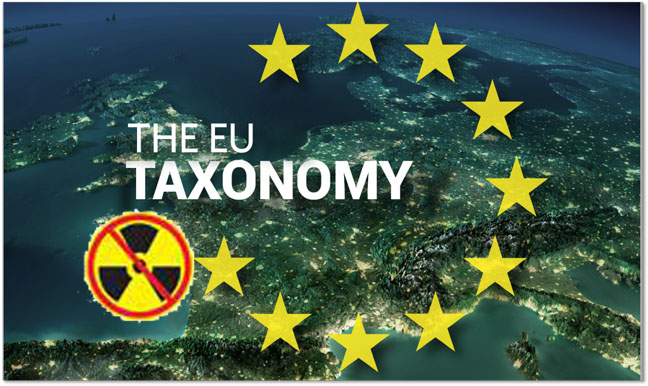
Paris withdraws support for renewable targets law as it seeks inclusion of hydrogen produced with atomic power
Ft.com Alice Hancock in Brussels and Sarah White in Paris MAY 18 2023
France is leading a coalition of countries holding up agreement on EU-wide targets for renewable energy, as it makes a fresh drive for better treatment of its nuclear industry. The move comes amid a broader pushback against the bloc’s climate agenda as the realities of what is required for the green transition become increasingly apparent.
The EU’s 27 member states were due to agree an overall target of 42.5 per cent of renewable power in the bloc’s energy mix by 2030 on Wednesday.
But France, which relies on nuclear power for the majority of its electricity, signalled that it would not support the text, citing concerns that “low-carbon” hydrogen generated with electricity from atomic power plants would not be counted as part of the targets.
…………….. The vote, which was pulled from the agenda of an ambassadors’ meeting at 11.30pm on Tuesday, would have paved the way for the targets to become EU law following their approval in the European parliament……………………………………..
French officials have in the past rejected criticism that they are promoting the interests of its nuclear industry by arguing that EU rules allow countries to choose their own energy sources. Its fleet of nuclear power plants already give it lower greenhouse gas emissions per unit of GDP than many of its neighbours, although it has missed EU targets for building renewables.
Six pro-nuclear countries, including the Czech Republic, Bulgaria and Hungary, followed Paris’s lead on Wednesday and withheld support for the directive. Meanwhile, anti-nuclear governments, including in Germany and Austria, have been strongly opposed to recognising nuclear power as a clean fuel……………………………… https://www.ft.com/content/b0d3e7e3-a8ae-457b-9482-3282d32973be
Elders say – Nuclear states must now act following G7 statement – Mary Robinson
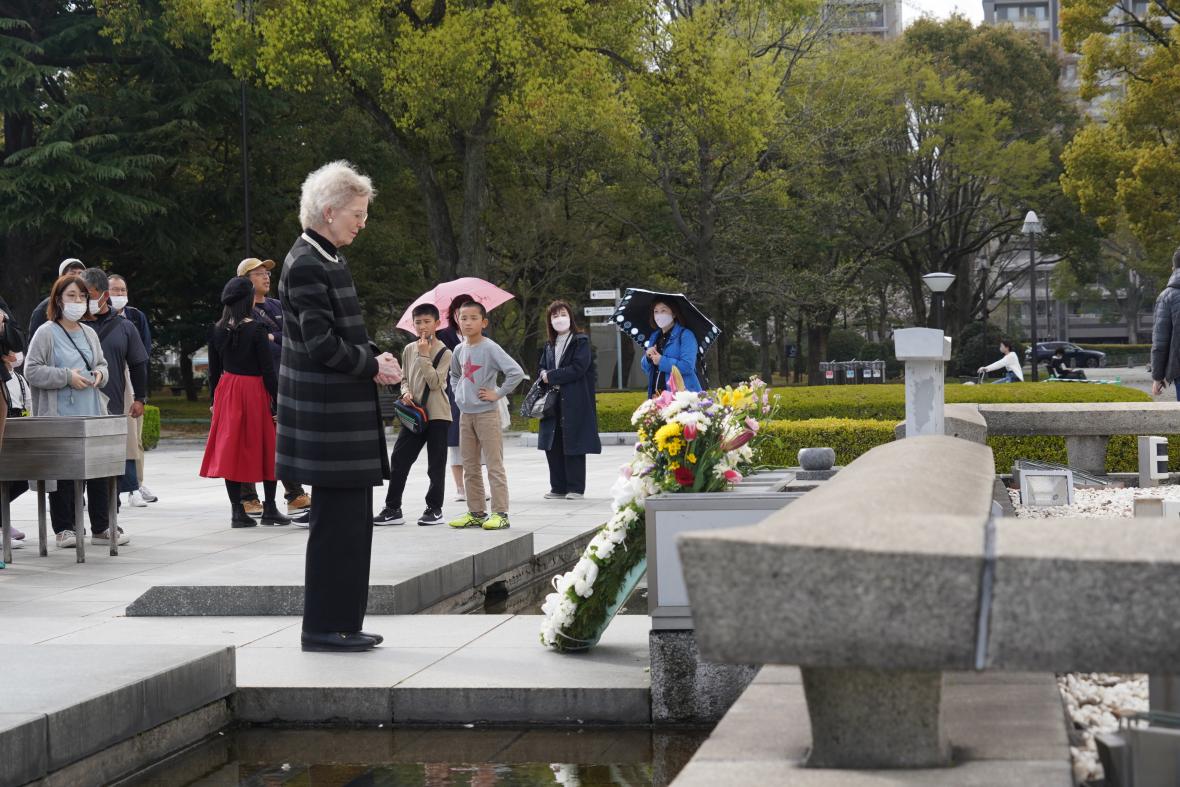
MARY ROBINSON https://theelders.org/news/nuclear-states-must-now-act-following-g7-statement 22 May 23
As the G7 leaders release their Hiroshima Vision on Nuclear Disarmament, The Chair of The Elders, Mary Robinson, stresses this must now lead to meaningful dialogue and action from nuclear states.
I welcome G7 leaders issuing their first separate statement reaffirming their commitment to a world without nuclear weapons. But these words must now be followed by meaningful action to realise that goal.
If G7 leaders are serious about their “Hiroshima Vision on Nuclear Disarmament”, they need a concrete plan to implement that vision. At the same time, leaders must prioritise serious dialogue between nuclear states to reduce nuclear risks. Despite the difficulties, it is vital that the USA engage Russia on returning to implementation of New START, and on a successor agreement.
When I visited Hiroshima in March, I was reminded again of the terrible human cost of nuclear weapons. Japan showed leadership by holding its G7 summit there. G7 nuclear states now need to show leadership by acting on what was agreed.
At a G7 summit high on ambition, nuclear disarmament takes a backseat to Zelensky’s diplomatic appeals
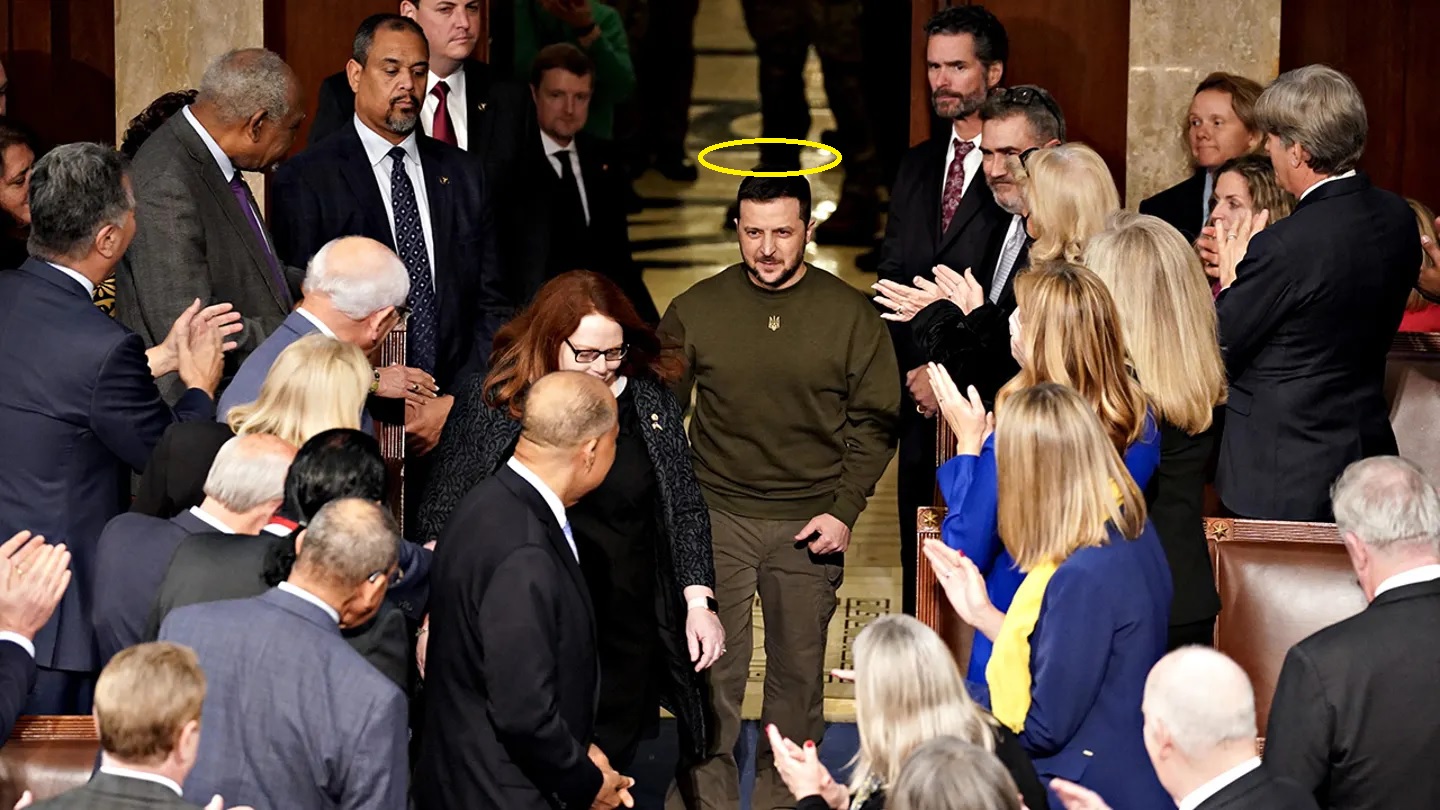
Picture above is from Zelensky’s previous visit to Washington, but it’s the same idea.
The Conversation, May 21, 2023 Donna Weeks, Professor of Political Science, Musashino University
Hiroshima, the site of this year’s G7 summit, is one of just a handful of places in the world that provides a stark reminder of the horrors of war.
The A-bomb Dome in the Hiroshima Peace Memorial Park, for example, is one of few structures left standing in the neighbourhoods that were flattened by the atomic blast in August 1945. Around the city, there are also “survivor trees” from the blast and burn marks on temple stoneware and statues – reminders of how far and wide it radiated.
It is no surprise that Japanese Prime Minister Fumio Kishida chose Hiroshima as the setting for the 2023 G7 meeting. Not only are his electoral constituency and family roots located here, he is also an advocate of a nuclear weapons-free world.
And there were hopes the meeting could spur further action towards this ultimate goal of global nuclear disarmament. Kishida said ahead of the meeting,
I believe the first step toward any nuclear disarmament effort is to provide a first-hand experience of the consequences of the atomic bombing and to firmly convey the reality.
Ukraine takes priority
It wasn’t to be. Though the final communique from the summit did make a vague commitment toward a “Hiroshima Vision” for nuclear disarmament, it took a backseat to the main headline from the weekend – the continued global support for Ukraine in its war against Russia.
An “unscheduled” visit by Ukrainian President Volodymyr Zelensky certainly raised the stakes for the summit at a critical time in the war.
On Friday evening, the leaders released a strongly worded, six-page statement on Ukraine, which reaffirmed their commitment “to stand together against Russia’s illegal, unjustifiable and unprovoked war of aggression against Ukraine” and condemned “Russia’s manifest violation of the Charter of the United Nations and the impact of Russia’s war on the rest of the world”.
But it was the potential impact of the in-person attendance that might amplify the otherwise rhetorical words of the summit leaders………………………
Zelensky’s opportunity to make a direct appeal to the leaders may end up being the key statement of the summit, distinguishing it from previous gatherings……………………………………………….
Inevitably, at each G7 Summit, there are calls for a review of its purpose. Originally an “informal” grouping of the world’s leading economies, it has become, like the UN Security Council, an institution of a different time. It is somewhat of an anachronism, no longer representative of today’s global economy.
…………………………………….. This summit will be most likely be remembered for Zelensky’s visit and the message it intended to send to Russia. But as leaders make their journeys home, wars will continue and all we are left with are the platitudes that will carry over to the next G7 Summit in 2024.
As for the ageing hibakusha, the survivors of the 1945 atomic bomb in Hiroshima, this may have been their last major opportunity to press for an end to nuclear weapons. https://theconversation.com/at-a-g7-summit-high-on-ambition-nuclear-disarmament-takes-a-backseat-to-zelenskys-diplomatic-appeals-205829
Stronger Global Governance is the Only Way to a World Free of Nuclear Weapons
History News Network, by Lawrence Wittner, 21 May 23,
Lawrence S. Wittner is Professor of History Emeritus at SUNY/Albany and the author of Confronting the Bomb (Stanford University Press)
It should come as no surprise that the world is currently facing an existential nuclear danger. In fact, it has been caught up in that danger since 1945, when atomic bombs were used to annihilate the populations of Hiroshima and Nagasaki.
Today, however, the danger of a nuclear holocaust is probably greater than in the past. There are now nine nuclear powers―the United States, Russia, Britain, France, China, Israel, India, Pakistan, and North Korea―and they are currently engaged in a new nuclear arms race, building ever more efficient weapons of mass destruction. The latest entry in their nuclear scramble, the hypersonic missile, travels at more than five times the speed of sound and is adept at evading missile defense systems.
Furthermore, these nuclear-armed powers engage in military confrontations with one another―Russia with the United States, Britain, and France over the fate of Ukraine, India with Pakistan over territorial disputes, and China with the United States over control of Taiwan and the South China Sea―and on occasion issue public threats of nuclear war against other nuclear nations. In recent years, Vladimir Putin, Donald Trump, and Kim Jong-Un have also publicly threatened non-nuclear nations with nuclear destruction.
Little wonder that in January 2023 the editors of the Bulletin of the Atomic Scientists set the hands of their famous “Doomsday Clock” at 90 seconds before midnight, the most dangerous setting since its creation in 1946.
Until fairly recently this march to Armageddon was disrupted, for people around the world found nuclear war a very unappealing prospect. A massive nuclear disarmament campaign developed in many countries and, gradually, began to force governments to temper their nuclear ambitions. The results were banning nuclear testing, curbing nuclear proliferation, limiting development of some kinds of nuclear weapons, and fostering substantial nuclear disarmament. From the 1980s to today the number of nuclear weapons in the world sharply decreased, from 70,000 to roughly 13,000. And with nuclear weapons stigmatized, nuclear war was averted.
But successes in rolling back the nuclear menace undermined the popular struggle against it, while proponents of nuclear weapons seized the opportunity to reassert their priorities. Consequently, a new nuclear arms race gradually got underway.
Even so, a nuclear-free world remains possible. Although an inflamed nationalism and the excessive power of military contractors are likely to continue bolstering the drive to acquire, brandish, and use nuclear weapons, there is a route out of the world’s nuclear nightmare.
We can begin uncovering this route to a safer, saner world when we recognize that a great many people and governments cling to nuclear weapons because of their desire for national security. After all, it has been and remains a dangerous world, and for thousands of years nations (and before the existence of nations, rival territories) have protected themselves from aggression by wielding military might.
The United Nations, of course, was created in the aftermath of the vast devastation of World War II in the hope of providing international security. But, as history has demonstrated, it is not strong enough to do the job―largely because the “great powers,” fearing that significant power in the hands of the international organization would diminish their own influence in world affairs, have deliberately kept the world organization weak. Thus, for example, the UN Security Council, which is officially in charge of maintaining international security, is frequently blocked from taking action by a veto cast by one its five powerful, permanent members.
But what if global governance were strengthened to the extent that it could provide national security? What if the United Nations were transformed from a loose confederation of nations into a genuine federation of nations, enabled thereby to create binding international law, prevent international aggression, and guarantee treaty commitments, including commitments for nuclear disarmament?
Nuclear weapons, like other weapons of mass destruction, have emerged in the context of unrestrained international conflict. But with national security guaranteed, many policymakers and most people around the world would conclude that nuclear weapons, which they already knew were immensely dangerous, had also become unnecessary.
Aside from undermining the national security rationale for building and maintaining nuclear weapons, a stronger United Nations would have the legitimacy and power to ensure their abolition. No longer would nations be able to disregard international agreements they didn’t like. Instead, nuclear disarmament legislation, once adopted by the federation’s legislature, would be enforced by the federation. Under this legislation, the federation would presumably have the authority to inspect nuclear facilities, block the development of new nuclear weapons, and reduce and eliminate nuclear stockpiles.
The relative weakness of the current United Nations in enforcing nuclear disarmament is illustrated by the status of the UN Treaty on the Prohibition of Nuclear Weapons. Voted for by 122 nations at a UN conference in 2017, the treaty bans producing, testing, acquiring, possessing, stockpiling, transferring, and using or threatening the use of nuclear weapons. Although the treaty officially went into force in 2021, it is only binding on nations that have decided to become parties to it. Thus far, that does not include any of the nuclear armed nations. As a result, the treaty currently has more moral than practical effect in securing nuclear disarmament.
If comparable legislation were adopted by a world federation, however, participating in a disarmament process would no longer be voluntary, for the legislation would be binding on all nations. Furthermore, the law’s universal applicability would not only lead to worldwide disarmament, but offset fears that nations complying with its provisions would one day be attacked by nations that refused to abide by it.
In this fashion, enhanced global governance could finally end the menace of worldwide nuclear annihilation that has haunted humanity since 1945. What remains to be determined is if nations are ready to unite in the interest of human survival. https://historynewsnetwork.org/article/185705
Russia’s Atomflot added to U.S. sanctions list
FSUE Atomflot, the maintenance base for Russia’s fleet of nuclear-powered icebreakers, can no longer buy products from, or do business with, U.S. or European Union entities.
By Thomas Nilsen Barents Observer 21 May 23
Located two short kilometers north of Murmansk, FSUE Atomflot was for three decades a major receiver of grants from Norway, the United Kingdom, the United States and the European Union. Millions of Euros dedicated to nuclear- and radiation safety projects have helped Russia improve infrastructure and technology at this civilian site that partly has served as a transshipment hub for spent nuclear fuel from dump sites on the Kola Peninsula.
The United States on Friday announced FSUE Atomflot being added to the sanctions list, a move following a similar decision previously undertaken by the European Union in February………………………………………………. more https://thebarentsobserver.com/en/arctic/2023/05/atomflot-added-us-sanctions-list
Indonesia calls for destruction of the world’s nuclear arsenals.
THE ASAHI SHIMBUN, by Yoshiaki Kasuga, Naoko Handa and Tadao Onaga. Rizki Akbar Hasan contributed to this story. May 19, 2023
BOGOR, Indonesia–Indonesian President Joko Widodo will call on the nuclear powers at the Group of Seven summit being held in Japan to destroy their nuclear arsenals.
In an exclusive interview with The Asahi Shimbun at Bogor on May 18, Joko said: “The Indonesian position is clear and firm. Nuclear weapons must be destroyed because they are a threat in the world.”
Joko and leaders of seven other non-member nations were invited to the G-7 summit that began May 19 in Hiroshima.
“Hiroshima is the symbol of peace,” Joko said. “I’m very happy that the G-7 is held in Hiroshima. This is very important.”
Joko was due to arrive May 19 for his first visit to this western Japan city. He expressed an interest in visiting the Hiroshima Peace Memorial Museum….
Indonesia, along with the other ASEAN nations, has signed the Treaty on the Southeast Asia Nuclear Weapon-Free Zone……..
Indonesia’s foreign policy is non-alignment and neutrality, which the government describes as “free and active.” For example, Jakarta has refused to take sides in the war between Russia and Ukraine, and Joko himself has met with both Ukrainian President Volodymyr Zelenskyy and Russian President Vladimir Putin to promote dialogue between the two nations.
Joko became the first Asian leader to visit the two nations in June 2022.
Indonesia’s neutral stance means it has not gone along with economic sanctions against Russia pushed by the United States and adopted by Western allies.
“The war (has been in place) one year already and (sanctions have not proved) effective to stop the war,” Joko said. “Dialogue is very important, and it must continue to be maintained.”
He added that Indonesia was prepared to serve as a bridge between Russia and Ukraine.
“Indonesia stands ready to contribute to bridge the differences and the collective leadership required to end the war,” Joko said. “Peace must be reached as soon as possible because in the end, the people are the victims.”
Indonesia was invited to the G-7 summit because it is considered one of the leaders of the Global South, mainly developing nations located in the Southern Hemisphere……………..
Referring to growing confrontation between the United States and China in the Asia-Pacific region, Joko emphasized that Indonesia continues with its “non-bloc” stance.
“Many said that Indonesia is close with the United States,” the Indonesian president said. “Many also said that Indonesia is close with China. I want to say that both statements are correct. The United States and China are important partners of Indonesia, just like Japan.” ……………………… https://www.asahi.com/ajw/articles/14911780
New UK sanctions on Russian energy to include Rosatom and nuclear energy
The sanctions have been announced alongside the G7 Summit, where member states will discuss further action to limit Russian economic growth.
Power Technology By Florence Jones 19 May 23
he UK has announced a new wave of sanctions against Russia, as the G7 Summit begins in Japan this weekend.
The sanctions will target companies connected to the theft of Ukrainian grain and the shipment of Russian energy, defying current sanctions. Further sanctions from G7 nations are also expected to be unveiled this weekend.
According to the UK Government, the sanctions will affect 86 individuals and entities “connected to Russia’s capacity to fund and wage the war [in Ukraine]”.
The sanctions will also affect companies connected to Russian nuclear energy company Rosatom, which supplies 20% of Russia’s energy. Rosatom also recieved sanctions from the US Government in February. The French state has also been under scrutiny for its connection with Rosatom due to a joint declaration of research cooperation signed in 2021.
According to a statement from the government, sanctions will be placed on “Matex, which produces composite materials based on carbon fibre for Rosatom that could be used for military purposes, and Triniti, whose research and development into laser physics is directly funded by the Russian Federation’s State Defence Order”.
Oleg Romanenko, a lead official at the Zaporizhzhia Nuclear Power Plant, which the UK Government suspects is colluding with the Russian Government, will also be impacted by sanctions. Sanctions will also impact 13 members of the Gazprom-Neft board of directors and five members of the Transneft board of directors.
Other sectors that will be sanctioned by the UK include metals production, transport services, defence companies and banks. ………….. https://www.power-technology.com/news/new-uk-sanctions-russian-energy-include-rosatom-nuclear-energy/
Pentagon seeks authority to transfer nuclear submarines (and costs) to Australia
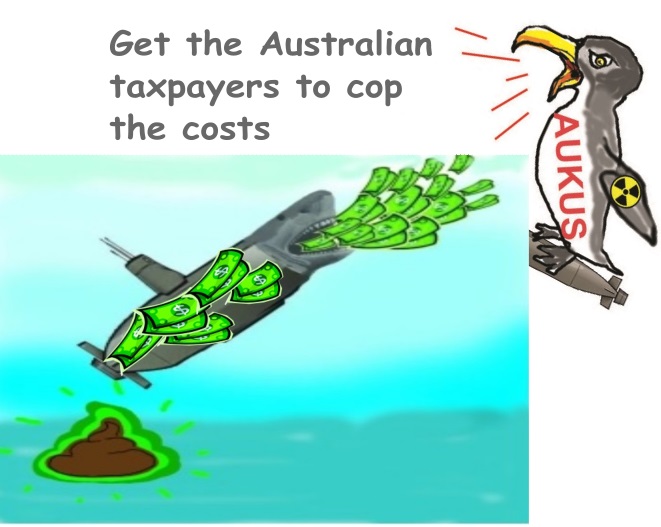
Finally, the Pentagon is also asking Congress for permission to accept Australian payments to bolster the U.S. submarine industrial base. Australia has offered to make an undisclosed sum of investments in the U.S. submarine industrial base as part of AUKUS.
Defense News, By Bryant Harris and Megan Eckstein 17 May 23
WASHINGTON — The U.S. Department of Defense asked Congress to authorize the transfer of nuclear-powered submarines to Australia as part of the trilateral AUKUS agreement with the U.K.
Three legislative proposals, submitted on May 2 and first posted online Tuesday, would greenlight the sale of two Virginia-class submarines to Australia, permit the training of Australian nationals for submarine work and allow Canberra to invest in the U.S. submarine industrial base………………
“Importantly, the proposals spell out a clear path forward to facilitate the transfer of Virginia-class submarines to Australia while ensuring we have the necessary authorities to accept the Australian Government’s investments to enhance our submarine industrial base capacity and provide training for Australian personnel.” – Rep. Joe Courtney of Connecticut, the top Democrat on the Armed Services Committee’s sea power panel
AUKUS stipulates that Australia will buy at least three and as many as five Virginia-class submarines in the 2030s as part of phase two of the agreement, giving Congress more than a decade to authorize the sale. This year’s proposal, which the Pentagon hopes will become part of the fiscal 2024 National Defense Authorization Act, asks that Congress approve just two of those submarines “without a deadline to consummate the transfers and without specifying the specific vessels to be transferred.”
The proposal argues that this “small amount of flexibility is necessary” since the transfers depend on Australian readiness to operate the submarines, which will involve developing Australia’s submarine industrial base through training and appropriate shipyard infrastructure.
To that end, a second legislative proposal would authorize U.S. defense service exports directly to Australia’s private sector in order to train its own submarine workers……..
Finally, the Pentagon is also asking Congress for permission to accept Australian payments to bolster the U.S. submarine industrial base. Australia has offered to make an undisclosed sum of investments in the U.S. submarine industrial base as part of AUKUS.
The Pentagon states in the legislative proposal that those funds would be used to “add a significant number of trade workers” that will help address “the significant overhaul backlog” for the Virginia-class submarine. Australian monies would also be used for “advance purchasing of components and materials that are known to be replacement items for submarine overhauls” and “outsourcing less complex sustainment work to local contractors.”
Congress is also making its own investments to expand the U.S. submarine industrial base as the Navy ultimately aims to build two Virginia-class and one Columbia-class submarines per year. Courtney helped secure $541 million in submarine supplier development and $207 million in workforce development initiatives as part of the FY 23 government funding bill.
Austal USA, the American subsidiary of Australia-based Austal, plans to open a new facility at its shipyard in Mobile, Alabama to begin construction on nuclear submarine modules for General Dynamics’ Electric Boat shipyard in Connecticut, which produces both Virginia and Columbia-class submarines. Austal expects it will need 1,000 new hires in Mobile to staff that facility.
At Electric Boat, the prime contractor for the Virginia- and Columbia-class submarine programs, the hiring need will be even greater. The company currently employs more than 19,000 people, after hiring 3,700 new workers in 2022, according to local newspaper The Day. But the company needs to hire 5,750 new workers this year, to manage attrition and to help grow the workforce to about 22,000 to handle the increased workload.
The legislative proposal notes that Australian funds “would be applied to recruitment, training, incentivizing, and retention of key skilled trades, engineering and planning personnel in both nuclear and non-nuclear disciplines that are required by the additional AUKUS workload.” https://www.defensenews.com/congress/2023/05/17/pentagon-seeks-authority-to-transfer-nuclear-submarines-to-australia/
At Hiroshima, Leaders Should Choose to End All Nuclear Threats

In January 2023, Biden and Kishida made a joint statement “We state unequivocally that any use of a nuclear weapon by Russia in Ukraine would be an act of hostility against humanity and unjustifiable in any way.”
The caveat that such a judgment applies only to Russia in Ukraine is stunning.
Facing Russia’s nuclear threats, the U.S. and its allies must not whitewash their own
Scientific American By Zia Mian, Daryl G. Kimball on May 17, 2023
At a meeting of the G7 nations this week in Hiroshima, the first city destroyed by the bomb, President Joe Biden and other leaders have a chance to begin addressing the long-standing problem of states threatening to use nuclear weapons. Russia’s nuclear threats of the past year in support of its invasion of Ukraine have flashed for all to see a core purpose of nuclear arsenals: coercion and intimidation. At this historic gathering, Biden and his counterparts need to act on Japanese Prime Minister Fumio Kishida’s proposal that the G7 “demonstrate a firm commitment to absolutely reject the threat or use of nuclear weapons.”
To do so, the U.S. and its allies must acknowledge that any and all threats to use nuclear weapons, not just Russia’s, are unacceptable.
It is well known Hiroshima was destroyed without warning on August 6, 1945 by the U.S. Less familiar is that this devastation was followed that day by the first threat to use nuclear weapons. President Harry Truman threatened Japan “If they do not now accept our terms they may expect a rain of ruin from the air, the likes of which has never been seen on this earth.” Another threat came on August 9 when a second atomic bomb had destroyed Nagasaki; Truman announced “We shall continue to use it until we completely destroy Japan’s power to make war. Only a Japanese surrender will stop us.”
All G7 states (Canada, France, Germany, Italy, Japan, the U.K. and the U.S.) have condemned President Putin’s February, April and September 2022 threats of Russian nuclear weapons use. But like Russia those states themselves have chosen military strategies that depend on threats of nuclear weapon use.
A statement from the G7 nuclear nonproliferation directors group, issued April 17, predictably asserts that, unlike Russia, their nations’ security policies “are based on the understanding that nuclear weapons, for as long as they exist, should serve defensive purposes, deter aggression, and prevent war and coercion.” Just as predictably, Russian officials claim Putin’s comments are simply a deterrent against direct U.S. or NATO military intervention in Ukraine.
Regardless of intent, the underlying nuclear logic is the same, however. It was described by defense intellectual Daniel Ellsberg in a famous 1959 lecture “The Theory and Practice of Blackmail.” Ellsberg observed:
“Nuclear weapons have one preeminent use in politics: to support threats. These threats recommend themselves, almost inescapably, as tools of policy not only to expansionist powers but to status quo nations.” He expounded: “Call it blackmail, call it deterrence, call both … coercion: the art of influencing the behavior of others by threats. The key here of course is that with nuclear weapons we are dealing with threats of force.”
…………………………………………….. In 2017, backed by NGOs, a group of 122 nations at the U.N. agreed to the Treaty on the Prohibition of Nuclear Weapons (TPNW). Among its binding obligations is “never under any circumstances to … use or threaten to use nuclear weapons or other nuclear explosive devices.” There are almost 100 signatories to the treaty so far. No nuclear-armed state has signed.
…………………….. In June 2022, at their first meeting, TPNW states declared that “any use or threat of use of nuclear weapons is a violation of international law, including the Charter of the United Nations,” and condemned “unequivocally any and all nuclear threats, whether they be explicit or implicit and irrespective of the circumstances.”
The scale of destruction implied by threats to use nuclear weapons is beyond any moral measure.
In January 2023, Biden and Kishida made a joint statement “We state unequivocally that any use of a nuclear weapon by Russia in Ukraine would be an act of hostility against humanity and unjustifiable in any way.”
The caveat that such a judgment applies only to Russia in Ukraine is stunning.
If we are to avert catastrophe, the nuclear use policies of the United States and the other nuclear-armed states need to acknowledge that any and all threats to use nuclear weapons need to be treated alike. G7 leaders should look to a statement organized by the Physicists Coalition for Nuclear Threat Reduction, endorsed by more than 1,000 scientists, which states that “any threat to use nuclear weapons, at any time and under any circumstances, is extremely dangerous and totally unacceptable.” It goes on to “call on all people and governments everywhere to clearly condemn all nuclear threats, explicit or implicit, and any use of such weapons.”
As a first step, President Biden, along with the other G7 leaders, all of whose countries either have nuclear weapons or rely on U.S. nuclear weapons being used on their behalf, should declare that the U.S. and its allies will act as they demand others do, and will accept being judged by the same standards they apply to others. They must accept, without any self-serving caveat, that any use of a nuclear weapon, by any state, under any circumstances, would be “an act of hostility against humanity and unjustifiable in any way.”
If G7 leaders choose, the Hiroshima summit can mark their turning away from seeking to justify their own nuclear threats as acceptable tools of policy. It is time for a human-centered standard for judging nuclear threats, one that holds regardless of those making the threats, their targets or the political goal. https://www.scientificamerican.com/article/at-hiroshima-leaders-should-choose-to-end-all-nuclear-threats/
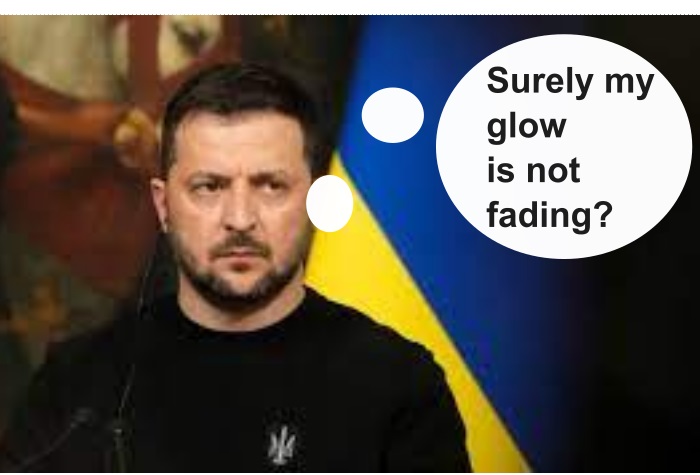
How the West, and Zelensky, derailed the Minsk Agreements between Ukraine and Russia
Adonis Cirillo, commenting on Rt.com, 17 May 23
Everyone knows, or should know, that the ‘Western’ sponsored Maiden Revolution (coup d’état) KILLED Ukraine, and more than 14,000 of its own citizens since 18 Feb, 2014.
If you are undecided or uneducated to the events leading up to the West’s coup d’état, you may download & watch “UKRAINE ON FIRE” 2016 Oliver Stone documentary. (ED. note – Youtube has banned viewers from downloading this film, – but not pro-Ukrainian videos )
(you will see US Deputy Secretary of State for Political Affairs Victoria Nuland (the Maidan ‘midwife’), US Democrat & Republican Congressmen (e.g., Lindsey Graham), US Advisors (e.g., John Bolton), and NGO’s inside Ukraine before, during, and after the coup d’état)
If you continue to unwind history, you will discover that Ukraine of today is inextricably linked to the Bush/Gorbachev Agreements of 1989-90 and the subsequent Western Violations thereof (e.g., The continued expansion of US & NATO forces in Europe).
NOTE : Ex-Ukrainian President Petro Poroshenko said the Minsk Agreements “meant nothing” and claimed credit for giving Kiev enough time to militarize. – RT 17 June, 2022 | Ex-German Chancellor Angela Merkel said the Minsk accords were signed in order to “give Ukraine time” to make the country stronger – Zeit Newspaper 7 Dec, 2022 | Ex-French President François Hollande agreed with Merkel, saying that her comment was “right on this point.” … “It is the merit of the Minsk agreements to have given the Ukrainian army this opportunity,” – RT 30 Dec, 2022 | Ukrainian President Vladimir Zelensky took credit for derailing Minsk Agreements – RT 9 Feb, 2023 https://www.rt.com/news/576436-zelensky-poland-us-hersh/
1 This Month



26 September – International Day for the Total Elimination of Nuclear Weapons


PLEASE OPPOSE HR 8255 AND S.3639 – bills would accelerate satellite deployment, with no environmental review or safeguards – https://ncstd5li.quorum.us/campaign/169331/
To see nuclear-related stories in greater depth and intensity – go to https://nuclearinformation.wordpress.com
-
Archives
- September 2026 (245)
- August 2026 (330)
- July 2026 (355)
- June 2026 (287)
- May 2026 (306)
- April 2026 (356)
- March 2026 (251)
- February 2026 (267)
- January 2026 (308)
- December 2025 (358)
- November 2025 (359)
- October 2025 (375)
-
Categories
- 1
- 1 NUCLEAR ISSUES
- business and costs
- climate change
- culture and arts
- ENERGY
- environment
- health
- history
- indigenous issues
- Legal
- marketing of nuclear
- media
- opposition to nuclear
- PERSONAL STORIES
- politics
- politics international
- Religion and ethics
- safety
- secrets,lies and civil liberties
- spinbuster
- technology
- Uranium
- wastes
- weapons and war
- Women
- 2 WORLD
- ACTION
- AFRICA
- Atrocities
- AUSTRALIA
- Christina's notes
- Christina's themes
- culture and arts
- Events
- Fuk 2022
- Fuk 2023
- Fukushima 2017
- Fukushima 2018
- fukushima 2019
- Fukushima 2020
- Fukushima 2021
- general
- global warming
- Humour (God we need it)
- Nuclear
- RARE EARTHS
- Reference
- resources – print
- Resources -audiovicual
- Weekly Newsletter
- World
- World Nuclear
- YouTube
-
RSS
Entries RSS
Comments RSS
 nuclear-news