Australian MPs Blast Blinken Over Assange

The MPs called the U.S. secretary of state’s remarks that Julian Assange threatened U.S. national security “nonsense” and said the U.S. is only bent on revenge, reports Joe Lauria.
SCHEERPOST, By Joe Lauria / Consortium News August 2, 2023
Three Australian members of Parliament have dismissed U.S. Secretary of State Antony Blinken’s strong statement in support of prosecuting imprisoned WikiLeaks publisher Julian Assange as “nonsense.”
Independent MP Andrew Wilkie told The Guardian‘s Australian edition that Assange was “not the villain … and if the US wasn’t obsessed with revenge it would drop the extradition charge as soon as possible.”
“Antony Blinken’s allegation that Julian Assange risked very serious harm to US national security is patent nonsense,” Wilkie said.
“Mr Blinken would be well aware of the inquiries in both the US and Australia which found that the relevant WikiLeaks disclosures did not result in harm to anyone,” said Wilkie. “The only deadly behaviour was by US forces … exposed by WikiLeaks, like the Apache crew who gunned down Iraqi civilians and Reuters journalists” in the infamous Collateral Murder video.
Speaking at a press conference with Australian Foreign Minister Penny Wong in Brisbane on Saturday, Blinken said he understood Australians’ concerns about their imprisoned citizen, but took a hard line against any move to end his persecution. Blinken said:
“…………………………………………………….Mr Assange was charged with very serious criminal conduct in the United States in connection with his alleged role in one of the largest compromises of classified information in the history of our country.
The actions that he is alleged to have committed risked very serious harm to our national security, to the benefit of our adversaries, and put named human sources at grave risk of physical harm, grave risk of detention…………”
As was shown conclusively by defense witnesses in his September 2020 extradition hearing in London, Assange worked assiduously to redact names of U.S. informants before WikiLeaks publications on Iraq and Afghanistan in 2010. U.S. Gen. Robert Carr testified at the court martial of WikiLeaks‘ source, Chelsea Manning, that no one was harmed by the material’s publication.
Instead, Assange faces 175 years in a U.S. dungeon on charges of violating the Espionage Act, not for stealing U.S. classified material, but for the First Amendment-protected publication of it.
The Meaning of ‘National Security’
WikiLeaks has indeed threatened “national security” if the “nation” is defined as merely its rulers. If “national security” however is meant to be the security of the entire nation, then Blinken’s obsession with continuing the war in Ukraine with the risk of nuclear conflict is truly a threat to the nation’s security.
Liberal MP Bridget Archer, another co-chair of the pro-Assange parliamentary group, said: “He continues to suffer mentally and physically, as does his family, and the government should redouble their efforts to secure his release and return to Australia.”
………………………..Labor MP Julian Hill, also part of the Bring Julian Assange Home Parliamentary Group last week called on Assange to take a plea deal, which should not reflect badly on him. In the meantime, Hill said improving prison conditions “should not be difficult to do even while argument continues about resolution of this matter.”
A recent opinion poll shows that 79 percent of Australians want Assange released and bought home. https://scheerpost.com/2023/08/02/australian-mps-blast-blinken-over-assange/—
CIA Director Affirms U.S. Regime Change Strategy in Russia in Address at British Foundation
Coveet Ation MagazineBy Jeremy Kuzmarov, July 10, 2023
Advances the Fantasy that the U.S. is Winning the Ukraine War and that Putin Will Soon Fall
As the Ukrainian counteroffensive continues to sputter, CIA Director William J. Burns delivered a talk at the British Ditchley Foundation on July 1, affirming the U.S. strategy of regime change in Russia.
The talk, titled “A World Transformed and the World of Intelligence,” is available here.
The Ditchley Foundation, a force of British intelligence, was founded in 1958, in Oxfordshire to promote Anglo-American working relationships, and has connections to the British monarchy.
Burns stated in the talk that “disaffection with the [Ukraine] war will continue to gnaw away at the Russian leadership beneath the steady diet of state propaganda and practiced repression. That disaffection creates a once-in-a-generation opportunity for us at CIA—at our core a human intelligence service. We’re not letting it go to waste….”
These comments make clear that the CIA is actively trying to capitalize on disaffection with the Ukraine war in Russia to recruit new Agency assets among the anti-Putin opposition and to ramp up its efforts at regime change.
In March 2022, President Biden admitted in a speech in Warsaw that the U.S. was seeking through its proxy war against Russia to overthrow the Putin government.
In 2021, the National Endowment for Democracy (NED), a CIA offshoot that has helped mobilize opposition groups to carry out color revolutions designed to install pro-Western/pro-NATO leaders in Eastern European countries, provided nearly $12 million in grants to anti-Putin forces in Russia and to support anti-Putin propaganda—up from the $10.67 million in 2020.
In the past, the NED financed an organization employing Alexei Navalny, an opposition figure who supports regional separatist movements that would weaken Russia; the Russian-Chechen Friendship Society, whose director was convicted in 2008 of incitement to ethnic or racial hatred; and a Crimean Tatar leader, Mustafa Dzhemilev, whom Russia accused of helping to coordinate an energy and food blockade of Crimea after it voted to rejoin Russia in March 2014 following a U.S.-backed coup in Ukraine…………………………
The CIA’s current game, as Burns in his speech made clear, is to use Ukraine as a proxy and tool for trying to destabilize and undermine the Putin government.
This is to be achieved by bogging it down in a quagmire—like with the Soviets in Afghanistan in the 1980s—and ratcheting up sanctions that could cripple Russia’s economy. Disaffection is to be further sown by repeatedly vilifying Putin while glorifying his adversaries………………………………………………………………
Burns was overly optimistic in his assessment regarding the success of U.S. strategy overall.
Despite the disaffection that he spoke about, the CIA is well aware that Putin’s popularity has increased since the Special Military Operation in Ukraine began.
Most Russians believe that the U.S. and Ukraine provoked the war and that Russia had to look out for its own security interests and defend the beleaguered Russian-speaking population of eastern Ukraine that was being subjected to bombings and invasion following the 2014 Maidan coup. ….. https://covertactionmagazine.com/2023/07/10/cia-director-affirms-u-s-regime-change-strategy-in-russia-in-address-at-british-foundation/?mc_cid=f5762ce44c&mc_eid=65917fb94b—
Requiem for NATO’s Nightmare – the Vilnius summit.
The dysfunction of the Atlantic military alliance over Ukrainian membership was just the most public manifestation of the debacle that was the Vilnius summit.
By Scott Ritter / Consortium News, 31 July 23
Ukrainian President Volodymyr Zelensky emerges as a tragic figure in the unfolding drama that is the Russian-Ukrainian conflict.
He was asked to sacrifice the lives of his countrymen in order to be seen by the U.S. and NATO as worthy of joining their club. But when the sacrifice did not produce the desired result (i.e., the strategic defeat of Russia), the door to NATO, which had been left open a crack to tease Ukraine into performing its suicidal task, was slammed shut.
Despite NATO’s disingenuous machinations to maintain the optics of potential Ukrainian membership (the Ukraine-NATO Council, created during the Vilnius Summit earlier this month, stands as a prime example), everyone knows that Ukrainian membership in the trans-Atlantic alliance is a fantasy.
Ukraine is now left to pick a poison of its own choosing — accept a peace which makes permanent Russian territorial claims while forever foregoing the possibility, however distant, of NATO membership; or to continue to fight, with the likely outcome of the additional loss of territory and destruction of the Ukrainian nation and people……………………………………..
As Ukraine bids farewell to its former self, it must also part with its dreams of becoming one with a European community whose own longevity is very much in doubt. That is largely because of its disastrous involvement in the Russian-Ukrainian conflict.
Ukraine will never be the same after this war ends. Neither will the NATO alliance. Having defined the proxy war it is waging in Ukraine against Russia in existential terms, NATO will struggle to find both relevance and purpose in a post-conflict world.
The Vilnius summit on July 11-12 in many ways represented the high-water mark of Europe’s old order. The summit was the requiem for a nightmare of Europe’s own creation — the death of a nation, the nullification of a continent and the end of an order which had long ago lost its legitimacy.
Strange Isolation
Watching the reporting from the Vilnius summit, I was struck by the strange isolation of Zelensky as he sought to mingle with the leaders of NATO nations that called him friend and ally but treated him and the nation he leads as anything but. Zelensky had pulled out all the stops to jockey Ukraine into position for NATO membership, only to be scratched at the gate.
……………………………………………………………Later, during a press conference with U.S. President Joe Biden, Zelensky stood mute while Biden continued to pour cold water on the prospects for Ukrainian NATO membership.
…………………………………The NATO dysfunction over Ukrainian membership, however, was but the most public manifestation of the debacle that was the Vilnius Summit.
The Fantasy of Unity…………………………………………………………………………………………………………………………………………………..
To sum up: Biden and Stoltenberg highlighted the decision by Erdogan to move the application for Swedish membership to NATO onto the Turkish Parliament for ratification as a symbol of NATO’s “rock solid” unity.
Left unsaid is that Erdogan had to threaten NATO to get the U.S. to articulate a bribe that had the U.S. waiving its prior sanctioning of a NATO ally while at the same time compelling the U.S. to consider the security implications of the deal, given the open hostility that exists between Turkey and fellow NATO member Greece……………………………………………….
Goodbye to All That
If the weeks leading up to the Vilnius summit were defined by the desire on the part of NATO to see the long-awaited and much-touted Ukrainian counteroffensive reach its maximum potential, the days which preceded the NATO gathering have confronted both Ukraine and its Western allies with the reality that the war is not going well for either.
The Ukrainian counteroffensive was formed around a core force of some 60,000 Ukrainian soldiers who received special training by NATO and European militaries on weapons and tactics designed to defeat Russian defenses. Since the counteroffensive began on June 8, Ukraine has lost nearly half of these troops, and a third of the equipment provided — including scores of the Leopard main battle tanks and Bradly infantry fighting vehicles that had been viewed by many as game-changing technology.
Back in 1993, George Soros postulated an architecture for a new world order premised on the United States as the sole remaining superpower overseeing a network of alliances, the most important being NATO, which would gird the northern hemisphere against a Russian threat.
“The United States,” Soros wrote, “would not be called upon to act as the policeman of the world. When it acts, it would act in conjunction with others. Incidentally, the combination of manpower from Eastern Europe with the technical capabilities of NATO would greatly enhance the military potential” of any U.S.-led alliance structure “because it would reduce the risk of body bags for NATO countries, which is the main constraint on their willingness to act.”
Forty years later, this very scenario is playing out on the bloody battlefields of Russia and Ukraine. The billions of dollars of military assistance provided by the U.S., NATO and other European nations is the living manifestation of the “technical capabilities” Soros spoke about, which are being married to “manpower from Eastern Europe” (i.e., Ukraine) to enhance the military potential of NATO in a way that reduces “the risk of body bags for NATO countries.”
https://scheerpost.com/2023/07/31/scott-ritter-requiem-for-natos-nightmare/
Russia prepared to seek diplomatic solution in Ukraine, NATO refuses to talk

https://www.rt.com/news/580452-putin-ukraine-nato-talks/ 28 Jul 23
The president says that differences should be resolved at the negotiating table
Russia is prepared to seek a diplomatic solution to the crisis in Ukraine but Kiev and its backers in the US and NATO refuse to talk to Moscow, Russian President Vladimir Putin has said.
“All differences must be solved at the negotiating table,” Putin told African leaders during the Russia-Africa Summit in St. Petersburg on Friday.
“The problem is that they [Ukraine] are refusing to talk to us,” he insisted.
“The current Ukrainian regime is also rejecting negotiations, and announced that officially. Ukrainian President [Vladimir Zelensky] had signed a relevant decree” last autumn, Putin said.
The Russian leader claimed that the root of the conflict between Moscow and Kiev was “the creation of threats to Russia’s security by the US and NATO.”
However, Washington and its allies also “reject negotiations on the issues of assuring equal security for all sides, including Russia,” he added.
“We’ve said many times – and I’ve stated it officially – that we’re ready for those talks,” Putin insisted.
“We can’t force those negotiations on them,” he said, adding that “there needs to be dialogue with the other side too” on the part of the international community in order to persuade Ukraine to engage in talks.
Putin also stressed that Moscow is “grateful to African friends” for their efforts to find a peaceful solution to the Ukraine conflict.
A mission of senior African leaders and officials, including the presidents of South Africa, Senegal, and Zambia, visited St. Petersburg and Kiev in mid-June to propose their ten-point peace initiative to Putin and Zelensky.
The African plan calls for security guarantees and the free movement of grain through the Black Sea, as well as the release of prisoners and the swift start of peace negotiations, among other proposals.
In an interview with RIA Novosti on Thursday, Comoros President Azali Assoumani, who serves as chairman of the African Union (AU) and was part of the peace delegation, said that he and his counterparts “haven’t yet received any convincing confirmation of his [Zelensky’s] interest” in engaging in negotiations with Russia.
Last month, the Ukrainian leader reiterated his stance that talks with Moscow could only start after Russian forces withdraw from all Ukrainian territory within its 1991 borders, including Crimea.
Russia has rejected Zelensky’s demands as unrealistic, arguing that they are a sign of Kiev’s unwillingness to settle the conflict through diplomatic means. According to Moscow, this leaves it with no choice other than to continue working toward achieving its goals in Ukraine through military means.
If Albanese’s such a buddy of Biden’s, why is Assange still in jail?

An initial refusal from Biden is only an invitation to ask a second time, in a firmer voice
Bob Carr Bob Carr was NSW’s longest-serving premier and is a former Australian foreign affairs minister. 27 jul 23, https://www.theage.com.au/politics/federal/if-albanese-s-such-a-buddy-of-biden-s-why-is-assange-still-in-jail-20230721-p5dqci.html
Julian Assange is in his fourth year in Britain’s Belmarsh prison. If the current appeal fails, he will be shackled and driven off in a prison van and flown across the Atlantic on a CIA aircraft for a long trial. He faces likely life imprisonment in a federal jail, perhaps in Oklahoma.
In 2021, then opposition leader Anthony Albanese said, “Enough is enough. I don’t have sympathy for many of his actions, but essentially, I can’t see what is served by keeping him incarcerated.”
As prime minister, Albanese said he had already made his position clear to the Biden administration. “We are working through diplomatic channels,” he said, “but we’re making very clear what our position is on Mr Assange’s case.”
So we can assume that at one of his seven meetings with US President Joe Biden he has raised Assange, even on the fringes of the Quad or at one of two NATO summits. Or perhaps in San Diego when they launched AUKUS, under which Australia will make the largest transfer of wealth ever made outside this country. This $368 billion is a whopping subsidy to American naval shipyards and to the troubled, chronically tardy British naval builder BAE Systems.
But it clinches Australia’s reputation as a deliriously loyal, entirely gullible US ally. It gives President Biden the justification for telling Republicans or Clinton loyalists in his own party that he had no alternative but to end the pursuit of Assange. “Those Aussies insisted on it. They’re doing us all these favours … we can’t say no.”
In addition to the grandiose AUKUS deal, Biden could list other decisions by the Albanese government that render Australia a military stronghold to help US regional dominance while materially weakening our own security.

Candid words, but they aren’t mine. They belong to Sam Roggeveen of the Lowy Institute in this month’s edition of Australian Foreign Affairs. In a seminally important piece of analysis, Roggeveen nominated Australia’s decision to fully service six American B52 bombers at RAAF Tindal, in the Northern Territory, as belonging on that list. It is assumed these are aimed at China’s nuclear infrastructure such as missile silos. “It is hard to overstate the sensitivity involved in threatening another nation’s nuclear forces,” Roggeveen writes.
In his article, he reminds us we’ve also agreed to host four US nuclear subs on our west coast at something to be called “Submarine Rotational Force-West”. Their mission would be destroying Chinese warships or enforcing a blockade of Chinese ports.
The east coast submarine base, planned most likely for Port Kembla, will also directly support US military operations. It’s another nuclear target. As Roggeveen says, all these locations raise Australia’s profile in the eyes of the Chinese military planners designing their response in the event of war with the US.
In this context, I can’t believe the US president is not on the point of agreeing to the prime minister’s request to drop charges against Assange.
Apart from the titanic strategic favours, two killer facts help our case. One, former US president Barack Obama commuted the sentence of Chelsea Manning, who had supplied Assange with the information he published. The Yank is free, the Aussie still pursued.
Two, the crimes Manning and Assange exposed involved US troops on a helicopter gunning down unarmed civilians in Baghdad. They are directly comparable to the alleged Australian battlefield murders in Afghanistan we are currently prosecuting.
An initial refusal from Biden is only an invitation to ask a second time, in a firmer voice.
It’s possible to imagine an Australian PM – Fraser, Hawke, Keating, Howard or Rudd – being appropriately forceful with a US president. There would be an inflection point in their exchange – prime minister to president – when the glint-eyed Australian says, “Mr President, it’s gone on too long. Both sides of our politics are united. Your old boss commuted Chelsea Manning, an American, in the same case.”
A pause. A beat. Then the killer summation. “Mr President, I speak for Australia.”
Surely this counts.
I don’t believe the president can shake his head and say, “nope”, given all we have gifted – the potent symbolism of B52s, nuclear subs and bases on the east and west coast. It would look like we have sunk into the role of US territory, as much a dependency as Guam or Puerto Rico.
US counter-intelligence conceded during court proceedings there is no evidence of a life being lost because of Assange’s revelations. Our Defence Department reached the same view.
If Assange walks out the gates of Belmarsh into the arms of his wife and children it will show we are worth a crumb or two off the table of the imperium. If it’s a van to the airport, then making ourselves a more likely target has conferred no standing at all. We are a client state, almost officially.
The coming Russian-Polish war
Armageddon Newsletter GILBERT DOCTOROW, JUL 23, 2023
This evening’s News of the Week program on Russian state television opened with a 30 minute documentary survey of Polish-Russian relations from the end of WWI and during the period of the Russian Civil War, when the government under Marshal Pilsudski wrested substantial territory from Russian control. It also dealt extensively with Poland’s well documented role as aggressor and occupier of Czechoslovak, Lithuanian, Ukrainian and Belarus lands from before the start of WWII and until Hitler overran Poland. ……………………..
Let us recall that on Friday Putin explained how and why we may expect the formal entry into the war of a Polish-Lithuanian-Ukrainian joint military force that will officially be presented as defending Ukrainian statehood by occupying the Western Ukraine. However, Putin described this as an occupying force which once installed in Lvov and Western Ukraine would never leave. This would in effect be a repeat of the sell-out of Ukrainian interests to Poles and cession of territory to Poland such as had been perpetrated by their leader Semyon Petlyura in April 1920 and has now been repeated in the secret agreements between presidents Zelensky of Ukraine and Duda of Poland. ……………………………………………………..
From Russian talk shows of the past several days, it is easy to understand the Kremlin’s reading of the present proxy war in and around Ukraine: Washington sees that the Ukrainian counter-offensive is a complete failure that has cost tens of thousands of lives among the Ukrainian armed forces and has seen the destruction of a large part of the Western equipment delivered to Ukraine over the past months. Instead of suing for peace, Washington seeks to open a ‘second front,’ using Poland for this purpose. …………………………………………….
The inescapable conclusion from the latest news is that Washington’s incendiary policies and continuing escalation of the conflict cannot secure Russia’s defeat. On the contrary, they may well lead to the total collapse of the NATO alliance once its military value is disproven in a way that cannot be talked away or papered over by the most creative propagandists in DC. https://gilbertdoctorow.substack.com/p/the-coming-russian-polish-war?utm_source=profile&utm_medium=reader2
Will the small states of Oceania be able to maintain their independence in the face of a new Sino-American Cold War?
The ‘friends to all, enemies to none’ strategy is living its last days as the US and China press the island nations to take sides
By Timur Fomenko, a political analyst, https://www.rt.com/news/580174-friends-to-all-enemies-to-none/ 23 July 23
Papua New Guinea is a gateway between continents. The island, being effectively cut in half, demarcates an artificial boundary between Asia and Oceania. In the past several centuries, the broader island has been carved upon between almost every colonial power going, having been ruled at various points by the Dutch, Spanish, German, Japanese and British empires. Even after gaining its formal independence from Australia in 1975, these legacies continue to scar the island, with half of it still belonging to Indonesia, known as West Papua, which is now a source of unrest and insurgency.
The history of constantly fluctuating overlords only demonstrates the country’s perceived strategic and military importance. That’s because whoever dominates it has direct access to both Australia and the Pacific, and can project into Asia itself. It is of little surprise that Papua New Guinea (PNG) became one of the most gruesome fronts of the Pacific War in World War II, which subsequently brought it firmly into the hands of the Anglosphere, where it has remained ever since, making it an effective dependency of Australia in terms of aid and humanitarian assistance.
Despite this, the island has nothing to show for centuries of colonial dominion, or from being a subordinate of the English-speaking world as a black Melanesian country. It is one of the world’s poorer nations, and is in desperate need of infrastructure to develop itself. Because of this, it has developed a foreign policy it describes as ‘friends to all, enemies to none’, which seeks to attain and exploit as many development opportunities as possible and better sustain its own strategic autonomy. This of course, has drawn interest from China, who sees the islands as an important partner as a post-colonial, Global South country. Thanks to PNG being part of the Belt and Road Initiative, Beijing has built airports, highways, sea ports, and telecommunications infrastructure across the country.
Port Moresby, in turn, sees Beijing as a critical economic partner that can help bolster its own infrastructure and development, the two countries recently having negotiated a free trade agreement. But that doesn’t mean trouble is not afoot. While China seeks to bolster economic relations with the country, the US has other ideas; that is, to forcibly transform Papua New Guinea into a military outpost for the purpose, of course, of containing China. Recently, Washington was able to pry a Defense Cooperation Agreement out of the country, which will give the US access to its bases.
PNG, of course, denies that the is specifically opposing China, and does not rule out security cooperation with Beijing itself. However, it is also a reminder that the country’s weak and vulnerable position, along with its historical subservience to the West, means it does not have the power or political privilege to resist these kinds of overtures, and instead must seek a more delicate balance. In response to this, China is likely to increase its engagement with the country; for example, the Bank of China is working to establish a presence there.
Growing competition over Papua New Guinea also comes amid China’s successes in its relationship with the Solomon Islands, which switched allegiance from Taipei to Beijing in 2019. On July 11, the two countries finally signed a security cooperation pact, which has met with vitriol from Western media and politicians.
What this demonstrates is that the Pacific region has become a ‘cold war’ theater between China and the US, with the latter working through its ally, Australia. The US, after all, has long attempted to make the Pacific an ‘extended backyard’ or ‘ranch’, a large open space over which it seeks to be the exclusive military power. But now, China is expanding into it, and this has led to the emergence of strategic competition.
However, these Pacific countries do not really want to take sides – they are tired of being tossed from one master to the other. This means the fundamental challenge for countries such as Papua New Guinea is to gain benefits to strengthen itself, while nonetheless avoiding subservience. This means it has a fight to continue its ‘friends to all, enemies to none’ approach, while tensions rise and both powers start demanding it take sides on various issues. But if worst-case scenarios can be avoided, and the pace of investment in the country from all sides accelerates, the end product may be that competition could ultimately make PNG and the island countries a lot better off, and therefore a lot more capable of exerting their own will.
Not in our backyard: Securing a referendum over Canada’s plan for a nuclear waste dump.
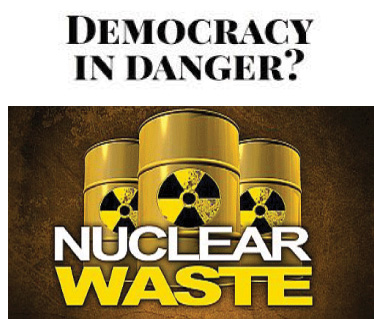
In the UK, Nuclear Waste Services continues to investigate the
suitability of locating a Geological Disposal Facility (GDF) at one (or
perhaps two) of four sites in West Cumbria and East Lincolnshire.
In Canada, the Nuclear Waste Management Organisation is also looking for a
site for a Deep Geological Repository (DGR), focusing upon Ignace and South
Bruce, both in Ontario. The names may be different, but the intention and
impact will be the same for the sites selected will receive their
respective nation’s high-level radioactive waste which will be disposed of
beneath the sea or below ground.
In the UK and in Canada, local people have
mobilised in opposition to the plans. Aware that British and Canadian
nuclear agencies, and supportive politicians, are in contact to exchange
knowledge and experience, the UK/Ireland NFLAs, working in partnership with
Northwatch in Canada, arranged an online meeting between campaigners in our
two nations. We intend this to be an ongoing dialogue.
NFLA 25th July 2023
Rising Global Interest to Join Nuclear Damage Compensation Treaty.
Mirage News, 26 July 23,
The Contracting Parties and Signatories to the Convention on Supplementary Compensation for Nuclear Damage (CSC) convened for their Third Meeting from 6 to 8 June 2023, at the Japanese Ministry of Education, Culture, Sports, Science and Technology (MEXT), in Tokyo, Japan.
Some 70 representatives from 10 Contracting Parties and Signatories (Argentina, Canada, India, Japan, Lithuania, Indonesia, Philippines, Romania, United Arab Emirates, United States of America) and eight invited observer countries (Brazil, China, Cambodia, Malaysia, Thailand, Uruguay, United Kingdom and Viet Nam) participated in the Third Meeting. Several representatives of intergovernmental organizations, the nuclear industry and academia gave presentations. The IAEA Office of Legal Affairs acted as the Secretariat to the Meeting.
The event provided an opportunity for the Contracting Parties and Signatories to build on the momentum created by their inaugural Meeting in Ottawa, Canada, 2019 and the Second Meeting in Vienna, Austria, 2022, especially with respect to achieving a global regime based on the CSC……………………………………………………………………………………………………………
The CSC was adopted under IAEA auspices in 1997 and currently has 11 Contracting Parties (Argentina, Benin, Canada, Ghana, India, Japan, Montenegro, Morocco, Romania, United Arab Emirates and United States of America) and 11 Signatories (Australia, Czech Republic, Indonesia, Italy, Lebanon, Lithuania, Mauritius, Peru, Philippines, Senegal, Ukraine). The Convention functions as an “umbrella” for all countries that are party to one of the existing international conventions on civil liability for nuclear damage or have national legislation in place conforming to the principles underlying those conventions. An online CSC Calculator is available to countries to run scenarios of contributions to the international fund. https://www.miragenews.com/rising-global-interest-to-join-nuclear-damage-1054123/
If Everybody’s Going to Join NATO, Then Why Have the United Nations?

Slowly, NATO is positioning itself as a substitute for the UN, suggesting that it – and not the actual international community – is the arbiter and guardian of the world’s ‘interests, security, and values’.
Tricontinental: Institute for Social Research. by VJ Prashad, 20 July 23
The North Atlantic Treaty Organisation (NATO) held its annual summit on 11–12 July in Vilnius, Lithuania. The communiqué released after the first day’s proceedings claimed that ‘NATO is a defensive alliance’, a statement that encapsulates why many struggle to grasp its true essence. A look at the latest military spending figures shows, to the contrary, that NATO countries, and countries closely allied to NATO, account for nearly three-quarters of the total annual global expenditure on weapons.
untries closely allied to NATO, account for nearly three-quarters of the total annual global expenditure on weapons. Many of these countries possess state-of-the-art weapons systems, which are qualitatively more destructive than those held by the militaries of most non-NATO countries. Over the past quarter century, NATO has used its military might to destroy several states, such as Afghanistan (2001) and Libya (2011), shattering societies with the raw muscle of its aggressive alliance, and end the status of Yugoslavia (1999) as a unified state. It is difficult, given this record, to sustain the view that NATO is a ‘defensive alliance’.
………………………………………………. NATO’s increasing membership has doubled down on its ambition to use its military power, through Article 5, to subdue anyone who challenges the ‘Atlantic Alliance’.
The ‘Atlantic Alliance’, a phrase that is part of NATO’s name, was part of a wider network of military treaties secured by the US against the USSR and, after October 1949, against the People’s Republic of China.
This network included the Manila Pact of September 1954, which created the Southeast Asian Treaty Organisation (SEATO), and the Baghdad Pact of February 1955, which created the Central Treaty Organisation (CENTO). Turkey and Pakistan signed a military agreement in April 1954 which brought them together in an alliance against the USSR and anchored this network through NATO’s southernmost member (Turkey) and SEATO’s westernmost member (Pakistan). The US signed a military deal with each of the members of CENTO and SEATO and ensured that it had a seat at the table in these structures.
At the Asian-African Conference held in Bandung, Indonesia in April 1955, India’s Prime Minister Jawaharlal Nehru reacted strongly to the creation of these military alliances, which exported tensions between the US and the USSR across Asia. The concept of NATO, he said, ‘has extended itself in two ways’: first, NATO ‘has gone far away from the Atlantic and has reached other oceans and seas’ and second, ‘NATO today is one of the most powerful protectors of colonialism’.
As an example, Nehru pointed to Goa, which was still held by fascist Portugal and whose grip had been validated by NATO members – an act, Nehru said, of ‘gross impertinence’. This characterisation of NATO as a global belligerent and defender of colonialism remains intact, with some modifications.
SEATO was disbanded in 1977, partly due to the defeat of the US in Vietnam, and CENTO was shuttered in 1979, precisely due to the Iranian Revolution that year. US military strategy shifted its focus from wielding these kinds of pacts to establishing a direct military presence with the founding of US Central Command in 1983 and the revitalisation of the US Pacific Command that same year.
The US expanded the power of its own global military footprint, including its ability to strike anywhere on the planet due to its structure of military bases and armed flotillas (which were no longer restricted once the 1930 Second London Naval Treaty expired in 1939). Although NATO has always had global ambitions, the alliance was given material reality through the US military’s force projection and its creation of new structures that further tied allied states into its orbit (with programmes such as ‘Partnership for Peace’, set up in 1994, and concepts such as ‘global NATO partner’ and ‘non-NATO ally’, as exemplified by Japan and South Korea). In its 1991 Strategic Concept, NATO wrote that it would ‘contribute to global stability and peace by providing forces for United Nations missions’, which was realised with deadly force in Yugoslavia (1999), Afghanistan (2003), and Libya (2011)……………………………………………………………………………………………………………………………………………………………………
The war in Ukraine provided new life to the Atlantic Alliance, driving several hesitant European countries – such as Sweden – into its ranks. Yet, even amongst people living within NATO countries there are groups who are sceptical of the alliance’s aims, with the Vilnius summit marked by anti-NATO protests. The Vilnius Summit Communiqué underlined Ukraine’s path into NATO and sharpened NATO’s self-defined universalism. The communiqué declares, for instance, that China challenges ‘our interests, security, and values’, with the word ‘our’ claiming to represent not only NATO countries but the entire international order.
Slowly, NATO is positioning itself as a substitute for the UN, suggesting that it – and not the actual international community – is the arbiter and guardian of the world’s ‘interests, security, and values’. This view is contested by the vast majority of the world’s peoples, seven billion of whom do not even reside in NATO’s member countries (whose total population is less than one billion). Those billions wonder why it is that NATO wants to supplant the United Nations. https://thetricontinental.org/newsletterissue/nato-united-nations/
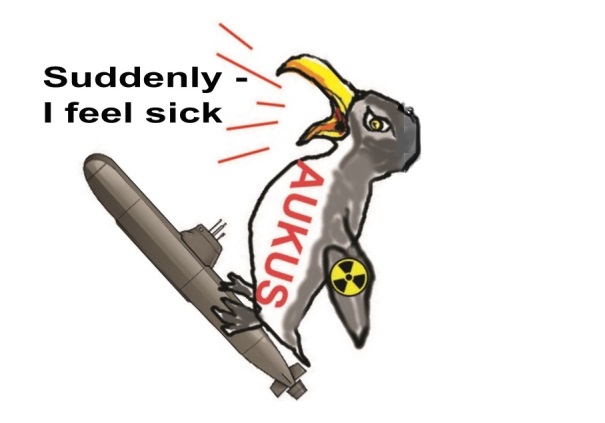
US Republicans threaten to block AUKUS deal
By Anthony Galloway, The Age, July 21, 2023
Australia’s AUKUS submarine deal with the United States has hit a hurdle with Senate Republicans threatening to block the sale unless President Joe Biden boosts funding for the domestic production line.
Republican members of the Senate Armed Services Committee on Friday moved to block legislation which would enable the sale of US Virginia-class submarines to Australia.
Under the AUKUS deal, Washington was set to sell Canberra between three and five of its own nuclear submarines in the 2030s before Australia begins building a new class of boat with Britain.
But the ranking Republican on the Senate Armed Services Committee, senator Roger Wicker, said Biden needed to commit more money to guarantee “we have enough submarines for our own security before we endorse that pillar of the agreement”.
Wicker said Australia’s commitment of US$3 billion ($4.4 billion) for the US production line would not be enough to meet the needs of both countries.
“The president needs to submit a supplemental request to give us an adequate number of submarines,” he told US news outlet Politico…………………………………………………….. https://www.theage.com.au/politics/federal/foolish-us-republicans-threaten-to-block-aukus-deal-20230721-p5dqc3.html
The Elders publish new policy paper on nuclear weapons
The Elders 21 July 23
The Elders today publish a new policy paper on the existential threat posed by nuclear weapons.
They argue that heightened geopolitical tensions around Russia’s war on Ukraine and Sino-US rivalry, as well as new technological developments such as Artificial Intelligence (AI), make it all the more important that leaders commit to tangible steps towards disarmament and de-escalation…………………………………………………………………………..
n today’s fraught geopolitical environment, The Elders reaffirm their support for the TPNW and the ultimate objective of a world without nuclear weapons, while continuing to advocate for the risk minimisation agenda. They believe this remains the best way to make tangible progress amid the deep divide between nuclear powers and their allies, and the much larger number of states who support the Treaty on the Prohibition of Nuclear Weapons (TPNW). Such progress would deliver a meaningful reduction in both risks and warheads.
The risk minimisation agenda rests on four elements known as the 4 Ds:
- Doctrine: Every nuclear-armed state should make an unequivocal “No First Use” declaration.
- De-alerting: The highest priority must be given to taking as many weapons as possible off their current high-alert status.
- Deployment: More than one-quarter of the world’s stockpile of nuclear weapons is currently operationally deployed. This proportion must be dramatically and urgently reduced.
- Decreased numbers: The number of nuclear warheads should be reduced from 12,500 to the lowest possible level, with the US and Russia reducing to no more than 500 each, which should serve as an upper ceiling for any nuclear state.
The Elders also call on nuclear states – the Permanent 5 UN Security Council members of the United States of America, Russia, China, France and the United Kingdom, as well as India, Pakistan, Israel and North Korea — and their allies to engage constructively with the TPNW, including through attending states parties meetings as observers, and to build common ground with TPNW states around a shared goal of ultimate nuclear disarmament.
TPNW states should work to help turn the Treaty into a binding and effective reality, including through strengthening the treaty’s verification and enforcement provisions.
All countries should work to strengthen the global non-proliferation architecture, including through:
- Increasing safeguards to track the flow of materials inside civil reactors;
- Introducing real penalties for countries that withdraw from the Non-Proliferation Treaty (NPT);
- Strengthening the capacity of the International Atomic Energy Agency (IAEA);
- Ratifying the Comprehensive Test Ban Treaty (CTBT) and bringing to conclusion the long-proposed Fissile Material Cut-Off Treaty.
https://theelders.org/news/elders-publish-new-policy-paper-nuclear-weaponsons
Ontario – Ford government’s electricity plan takes wrong approach
Windsor Star, By Jack Gibbons 21 Jul 23
Having missed the boat on the global green energy boom by crushing the province’s early leadership on renewable energy, Premier Doug Ford is now trying to take another stab at building a future economy by investing in buggy whip manufacturing.
That’s what spending tens of billions of dollars on high-cost, high-risk nuclear power essentially represents — a bet on a technology that has been in decline for decades.
Instead of trying to catch up with a global marketplace that is decidedly all-in on renewable energy — with the International Energy Agency saying 90 per cent of new electricity capacity will come from renewables over the next five years — Ontario wants to go back to the 1960s and ‘70s and embark on another long shot effort to build nuclear power plants.
It’s important to remember the province’s past nuclear projects have been one fiasco after another. Our most recent nuclear new build project — the Darlington nuclear station — went massively over budget.
The huge cost overruns and poor performance of its nuclear reactors essentially bankrupted the old Ontario Hydro. Ontario power ratepayers and taxpayers were left paying off the utility’s massive $19.4-billion stranded nuclear debt.
That hasn’t stopped a government with a strong distaste for solar panels and wind turbines from warmly embracing a technology that has never lived up to its promise.
It is now planning to build a massive new nuclear plant right beside the Bruce nuclear station which is already the largest nuclear station in the world. It also wants to build mythical “modular” reactors along the waterfront at Darlington right next to Toronto.
That the reactors the government is touting for Darlington are, at this point, nothing more than PowerPoint slides in a nuclear PR presentation hasn’t stopped the government from making wild claims that these unproven (and, at this point, unlicensed and physically non-existent) reactors can be built at what it deems to be a reasonable cost.
In 2009, when the nuclear companies wanted to build two new nuclear reactors at Darlington, the Dalton McGuinty government required them to submit fixed-price bids.
Not surprisingly the most competitive bid was 3.7 times higher than the forecast price. As a result, the government suspended the procurement process and the reactors were never built.
But despite repeatedly slamming the “fiscal irresponsibility” of previous Liberal governments, it appears that Premier Doug Ford is only too happy to give the nuclear industry a blank cheque and allow inevitable cost overruns to be passed on to electricity consumers and taxpayers.
That the projected cost for the province’s new dream nuclear projects are more than three times higher than what we would pay today for power from competitively procured wind and solar also doesn’t seem to bother Energy Minister Todd Smith…………………………………………..
New nuclear reactors that will take at least 10 to 15 years to build can not provide the dramatic reductions in greenhouse gas pollution that we need now. To add insult to injury, Doug Ford’s solution to keeping the lights on in the interim is to ramp up use of climate-wrecking gas plants and, even more astoundingly, build new ones.
But what’s truly scandalous about the government’s Powering Ontario plan is prioritizing phantom nuclear technology over what the world wants: smart, integrated and highly efficient renewable power systems………… more https://windsorstar.com/opinion/letters/guest-column-ontario-governments-electricity-plan-taking-wrong-approach
UN proposes elimination of all nuclear weapons as first step under new agenda for peace
Rising geopolitical and geo-economic tensions across the globe need a better, reformed, and updated UN system which reflects the growing multipolarity and is more representative, unbiased, and effective
July 21, 2023 by Peoples Dispatch
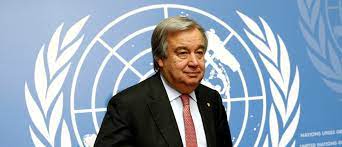
United Nations Secretary General António Guterres presented a new policy brief on global security on Thursday, July 20, which calls for the abolition of all nuclear weapons and widespread reforms in the UN structure to make it more representative and efficient.
The New Agenda for Peace policy brief, based on the discussions during the 75th anniversary celebrations of the foundation of the UN in 2020, is part of the preparations for the UN Summit of the Future to be held in 2024.
While launching the brief, Guterres acknowledged that “the post-Cold war period is over, and we are moving towards a new global order and a multipolar world.” The changing world is marred by a new set of geopolitical and geo-economic conflicts with rising “insecurity about the threat of nuclear war” and growing skepticism among a large number of member states about the existing forums of multilateralism.
The brief claims that most of the challenges to global security and peace are interlinked and proposes ways to address this complexity.
Complex nature of rising conflicts
The brief notes that increasing geo-strategic tensions and competition across the globe is pushing global military expenditure to an unprecedented level. In 2022, the cumulative global defense expenditure exceeded $2.24 trillion.
The brief also points out that several arms control regimes created during the Cold War and its immediate aftermath, which were containing great power rivalries, have been eroded in the last few years, which has increased the risk of regional and global wars and paved the way for an arms race. ……………………………………………………………….
Five priority areas and 12 steps to achieve collective security
The brief proposes that trust, solidarity and universality—the well-known principles of the UN charter—would be the basis of its agenda for peace. Guterres emphasized the role of cooperation among nations, saying that it “does not require states to forego their national interest, but to recognize that they have shared goals.”
The brief recommends a 12-point plan of action, divided in five priority areas, to address the growing threats to peace at the global level.
It calls for the elimination of all nuclear weapons and boosting preventive diplomacy to address strategic risks and geopolitical divisions in the world.
It also calls for preventing domestic conflicts by adopting sustainable development methods and catering to climate-related issues and social discrimination with increased funding and help to developing countries to achieve their SDGs by 2030. Peacekeeping and peace enforcement, as well as regional initiatives of peace, should also be updated and strengthened. There should also be steps taken to prevent weaponization of emerging domains and technologies, such as artificial intelligence (AI), and promotion of responsible innovation.
It additionally calls for reforms in the UN system, including in the Security Council to make it more “just and representative,” and talks about countries respecting the impartiality of the UN secretariat so that it can work more effectively as a multilateral forum. https://peoplesdispatch.org/2023/07/21/un-proposes-elimination-of-all-nuclear-weapons-as-first-step-under-new-agenda-for-peace/
NATO Is a Warfare Alliance, Not a Force for Global Peace or Stability
Instead of seeking a negotiated solution to Russia’s criminal invasion, NATO has shunned peace talks that might address key issues such as neutrality for Ukraine, referendums on the future of the Donbas and Crimea, a demilitarized zone along the border between Ukraine and Russia, and nuclear disarmament agreements that would remove Russia’s short-range nuclear weapons from Belarus in exchange for removal of U.S. anti-ballistic missiles in Romania.
By Medea Benjamin and Marcy Winograd / CounterPunch 18 Jul 23
At his speech during the NATO Summit in Lithuania, President Biden called the U.S. and Europe “anchors for global security” when in reality there are no anchors during this increasingly dangerous and polarized time of never-ending war in Europe. Our NATO allies are not, as Biden would suggest, anchors in a turbulent sea of demons but rather catalysts stirring the cauldron of war on behalf of U.S. empire.
The instability of the NATO alliance was evident in the controversy over the key issue of Ukraine membership. Biden and his administration tried to work both sides of the street. On the one hand, Biden insisted that “Ukraine’s future lies at NATO.” But then the U.S. teamed up with Germany to make sure the summit made only a vague statement about Ukraine joining when allies agree and “conditions are met,” incurring the wrath of a fuming President Zelensky. Biden’s national security advisor Jake Sullivan told CNN that everyone “needs to look squarely at the fact” that allowing Ukraine to join NATO at this point “means war with Russia.”
But this does not mean that Biden, or NATO, are ready to endorse peace talks. On the contrary…………………………….
Instead of seeking a negotiated solution to Russia’s criminal invasion, NATO has shunned peace talks that might address key issues such as neutrality for Ukraine, referendums on the future of the Donbas and Crimea, a demilitarized zone along the border between Ukraine and Russia, and nuclear disarmament agreements that would remove Russia’s short-range nuclear weapons from Belarus in exchange for removal of U.S. anti-ballistic missiles in Romania………………… more https://scheerpost.com/2023/07/18/nato-is-a-warfare-alliance-not-a-force-for-global-peace-or-stability/
1 This Month



26 September – International Day for the Total Elimination of Nuclear Weapons


PLEASE OPPOSE HR 8255 AND S.3639 – bills would accelerate satellite deployment, with no environmental review or safeguards – https://ncstd5li.quorum.us/campaign/169331/
To see nuclear-related stories in greater depth and intensity – go to https://nuclearinformation.wordpress.com
-
Archives
- September 2026 (233)
- August 2026 (330)
- July 2026 (355)
- June 2026 (287)
- May 2026 (306)
- April 2026 (356)
- March 2026 (251)
- February 2026 (267)
- January 2026 (308)
- December 2025 (358)
- November 2025 (359)
- October 2025 (375)
-
Categories
- 1
- 1 NUCLEAR ISSUES
- business and costs
- climate change
- culture and arts
- ENERGY
- environment
- health
- history
- indigenous issues
- Legal
- marketing of nuclear
- media
- opposition to nuclear
- PERSONAL STORIES
- politics
- politics international
- Religion and ethics
- safety
- secrets,lies and civil liberties
- spinbuster
- technology
- Uranium
- wastes
- weapons and war
- Women
- 2 WORLD
- ACTION
- AFRICA
- Atrocities
- AUSTRALIA
- Christina's notes
- Christina's themes
- culture and arts
- Events
- Fuk 2022
- Fuk 2023
- Fukushima 2017
- Fukushima 2018
- fukushima 2019
- Fukushima 2020
- Fukushima 2021
- general
- global warming
- Humour (God we need it)
- Nuclear
- RARE EARTHS
- Reference
- resources – print
- Resources -audiovicual
- Weekly Newsletter
- World
- World Nuclear
- YouTube
-
RSS
Entries RSS
Comments RSS
 nuclear-news