Money thrown at Sizewell C to win hearts and minds.
The government has allocated a further £341m to get the Sizewell C
nuclear power station project shovel-ready. The extra money will help
prepare the Sizewell C site in Suffolk for construction, procuring key
components from the project’s supply chain, and expanding its workforce.
It would see activity ramp up at the Suffolk site, supporting continued
preparation works, such as constructing onsite training facilities for
1,500 apprenticeships and further development of the plant’s engineering
design.
The public relations campaign will also be stepped up in a bid to
wins hearts and minds in the Southwold-Aldeburgh area, where opposition to
the project is strong. The government plans “direct investments in the
local community ahead of work starting” to show that having a £35bn
construction project on your doorstep is not necessarily all bad news.
latest £341m tranche follows a £170m allocation last month and builds on
the government’s existing £870m stake in the project to help secure a
final investment decision before the next general election.
The Construction Index 30th Aug 2023
https://www.theconstructionindex.co.uk/news/view/money-thrown-at-sizewell-c-to-win-hearts-and-minds
Only Idiots Believe The US Is Protecting Australia From China
CAITLIN JOHNSTONE, AUG 29, 2023 https://www.caitlinjohnst.one/p/only-idiots-believe-the-us-is-protecting?utm_source=substack&utm_medium=email
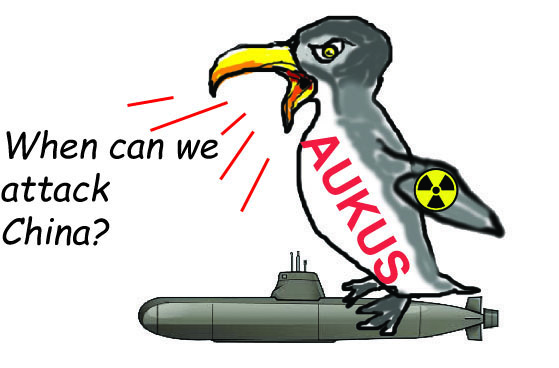
The Economist has taken a keen interest in Australia lately, which if you know anything about The Economist is something you never want to see happen to your country. Two articles published in the last few days by the notorious propaganda outlet have celebrated the fact that Australia appears to be the most likely nation to follow the United States into a hot war with China as it enmeshes itself further and further with the US war machine.
In “How Joe Biden is transforming America’s Asian alliances,” The Economist writes the following:
Meanwhile, the ‘unbreakable’ defence relationship with Australia is deepening, following the AUKUS agreement struck in March, amid a flurry of equipment deals and military exercises. Should war break out with China, the Aussies seem the most willing to fight at America’s side. Australian land, sea and air bases are expanding to receive more American forces. Under the AUKUS deal, Australia is gaining its own long-range weapons, such as nuclear-powered (but not nuclear-armed) submarines to be developed jointly with America and Britain. The three partners want to work on other military technologies, from hypersonic missiles to underwater drones.
“Taken together the ‘latticework’ of security agreements, shows how America’s long-heralded pivot to Asia is accelerating.”
In “Australia is becoming America’s military launch-pad into Asia,” The Economist elaborates upon this war partnership with tumescent enthusiasm, calling it a “mateship” and likening it to a “marriage”, and calling for a rollback of US restrictions on sharing military technology with Australia.
“If America ever goes to war with China, American officials say the Aussies would be the likeliest allies to be fighting with them,” The Economist gushes, adding, “Australia’s geographical advantage is that it lies in what strategists call a Goldilocks zone: well-placed to help America to project power into Asia, but beyond the range of most of China’s weapons. It is also large, which helps America scatter its forces to avoid giving China easy targets.”
The Economist cites White House “Asia Tsar” Kurt Campbell reportedly saying of Australia, “We have them locked in now for the next 40 years.”
“Equally, though, Australia may have America locked in for the same duration,” The Economist hastens to add.
Well gosh, that’s a relief.
“How the world sees us,” tweeted former Australian foreign minister Bob Carr when sharing the Economist article.
“Historians will be absolutely baffled by what’s happening in Australia right now: normally countries never voluntarily relinquish their sovereignty and worsen their own security position out of their own accord. They normally have to lose a war and be forced to do so,” commentator Arnaud Bertrand added to Carr’s quip.
As much as it pains me to admit it, The Economist is absolutely correct. The Australian government has been showing every indication that it is fully willing to charge into a hot war with its top trading partner to please its masters in Washington, both before and after the US puppet regime in Canberra changed hands last year.
This sycophantic war-readiness was humorously mocked on Chinese state media back in 2021 by Impact Asia Capital co-founder Charles Liu, who said he didn’t think the US will actually fight a war with China over Taiwan, but the Australians might be stupid enough to fight it for them.
“US is not going to fight over Taiwan,” Liu said. “It’s not going to conduct a war over Taiwan. They may try to get Japanese to do it, but Japanese won’t be so stupid to do it. The only stupid ones who might get involved are the Australians, sorry.”
He had nothing to be sorry about; he was right. Australians are being very, very stupid, and not just our government. A recent Lowy Institute poll found that eight in ten Australians believe the nation’s alliance with the United States is important for Australia’s security, despite three-quarters also saying they believe the alliance makes Australia more likely to be drawn into a war in Asia.
That’s just plain stupid. A war with China is the absolute worst case security scenario for Australia; anything that makes war with China more likely is making us less secure. Making bad decisions which hurt your own interests is what stupid people do.
That’s not to say Australians are naturally dimwitted; we’re actually pretty clever as far as populations go. What’s making us stupid in this case is the fact that our nation has the most concentrated media ownership in the western world, a massive chunk of which is owned by longtime US empire asset Rupert Murdoch. This propaganda-conducive information environment has been distorting Australia’s understanding of the world so pervasively in recent years that on more than one occasion I’ve had total strangers start babbling at me about the dangers of China completely out of nowhere within minutes of striking up conversation with them.
This artificially manipulated information ecosystem has made Australians so pants-on-head idiotic that they think the US empire is filling their country up with war machinery because it loves them and wants to protect them from the Chinese. That’s as stupid as it gets.
The single biggest lie being circulated in Australia right now is that our government is militarising against China as a defensive measure. China has literally zero history of invading and occupying countries on the other side of the planet. You know who does have a very extensive history of doing that? The United States. The military superpower that Australia’s military is becoming increasingly intertwined with. The belief that we’re intertwining ourselves with the world’s most aggressive, destructive and war-horny military force as a defensive measure to protect ourselves against that military force’s top rival (who hasn’t dropped a bomb in decades) is transparently false, and only a complete idiot would believe it.
We’re not militarising to defend ourselves against a future attack by China, we’re militarising in preparation for a future US-led attack on the Chinese military. We’re militarising in preparation to involve ourselves in an unresolved civil war between Chinese people that has nothing to do with us. China has been sorting out its own affairs for millennia and has managed to do so just fine without the help of white people running in firing military explosives at them, and Taiwan is no exception.
The imperial media talk nonstop about how the People’s Republic of China is preparing to seize control of Taiwan using military force, without ever mentioning the fact that that’s exactly what the US empire is doing. The US empire is preparing to wrest Taiwan away from China to facilitate its long-term agenda to balkanize, weaken and subjugate its top rival.
Only a complete blithering imbecile would believe any part of this is being done defensively. It’s being done to secure unipolar planetary domination for the world’s most powerful and destructive government, and only an absolute moron would agree to risk their own country’s security and economic interests to help facilitate it.
There should be no Saudi uranium enrichment

The ultimate argument against a US-Saudi nuclear deal is the crown prince himself, who is in line to be king and for practical purposes already is.
He is a liar and a gruesome killer. Saudi Arabia, for all its modern trappings, is a primitive state with no effective checks on his powers. The king makes the laws, rules by decree, and is the chief judge. He has powers the British king gave up in the 13th century. Saudi Arabia has a long way to go before it will be a safe place for nuclear energy.
By Victor Gilinsky | August 28, 2023
https://thebulletin.org/2023/08/there-should-be-no-saudi-uranium-enrichment/?utm_source=Newsletter&utm_medium=Email&utm_campaign=MondayNewsletter08282023&utm_content=NuclearRisk_SaudiUranium_08282023&utm_source=Newsletter&utm_medium=Email&utm_campaign=MondayNewsletter08282023&utm_content=NuclearRisk_SaudiUranium_08282023
There is increasing talk of a United States-brokered “grand bargain” on Middle East security, the core of which would be normalization of ties between Israel and Saudi Arabia. It isn’t clear what motivates Joe Biden to press for this deal now. The obvious goal would involve the eternal search for peace in the Middle East, but there are hints that such a bargain may have more to do with keeping the Saudis out of China’s orbit.
One thing we know, Biden’s lieutenants are lobbying hard in the Senate for acceptance of some version of far-reaching demands from the Saudi crown prince, Mohammed bin Salman, among them access to uranium enrichment technology that would ostensibly provide fuel for future Saudi nuclear power plants. Indeed, enrichment is a step in the production of nuclear reactor fuel. It is also a vital part of one of two paths to the atomic bomb.
One thing we know, Biden’s lieutenants are lobbying hard in the Senate for acceptance of some version of far-reaching demands from the Saudi crown prince, Mohammed bin Salman, among them access to uranium enrichment technology that would ostensibly provide fuel for future Saudi nuclear power plants. Indeed, enrichment is a step in the production of nuclear reactor fuel. It is also a vital part of one of two paths to the atomic bomb.
That isn’t of course the polite version of the crown prince’s plan. He says he wants to use domestic uranium, of which the Saudis claimed to have large deposits, to fuel civilian nuclear power reactors. He wants to produce fuel domestically, ergo he needs to acquire enrichment technology. But despite Saudi claims, there are no significant uranium deposits in the country. Recent reports reveal that the teams of geologists sent to search for it have turned up empty-handed. That hasn’t, however, caused the crown prince to lose interest in enrichment, which is itself a revealing fact about his intentions—and his reliance on American cupidity.
To cope with what the Saudis regard as excessive suspicion of others, they have suggested they are open to accepting some modest additional oversight arrangements, which they cynically expect Congress to accept after members engage in some ritual handwringing.
You would think the Saudi insistence on inclusion of enrichment, no matter how restricted, would be a non-starter for a US-Saudi “123” agreement for nuclear cooperation. (Compliance with Section 123 of the Atomic Energy Act is essential for any significant US-Saudi nuclear trade.) But such common sense is a thin reed to lean on when it comes to Washington nuclear politics. Powerful lobbies have been pushing for years for sale of power reactors in the Middle East and for generous subsidies to allow this to happen. The departments of Energy and State will be supporting this, too, claiming that international “safeguards” would be effective in preventing misuse of civilian nuclear facilities. The official line on nuclear energy is still Atoms for Peace, as it has been since President Eisenhower’s 1953 speech. Recall that George W. Bush said even Iranian power reactors, by themselves, were perfectly legitimate.
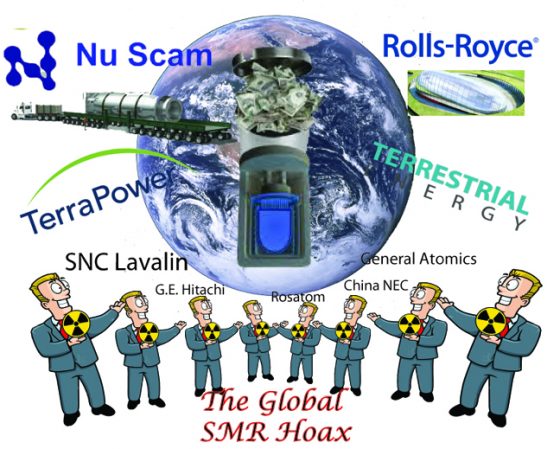
The problem is that hardly anyone in Congress has any real understanding of nuclear technology. The members are swept off their feet by promises of safe, non-carbon producing energy sources, especially when nuclear proponents use adjectives like “small” and “modular” and “advanced.” Congressional discussions on international aspects seldom get beyond “restoring America’s competitive advantage in nuclear energy.”
There is also little understanding of the limitations of international “safeguards,” the inspection system of the International Atomic Energy Agency (IAEA). (Is there any realistic recourse if the Saudis break the rules?) It is indicative of Saudi Arabia’s attitude toward the IAEA that it has used every stratagem to minimize its safeguards responsibilities. The minimization strategy does not violate IAEA requirements, yes, but a country anxious to demonstrate its nuclear bona fides should be more forthcoming in its nonproliferation cooperation.
The 2008 US-India civil nuclear agreement is an eternal warning about how American international nuclear policy can go off the rails when the president and Congress are swept away by visions of gaining an ally against China plus the prospect of dozens of power reactor sales. That agreement ran a truck through the Non-Proliferation Treaty, and none of the sales of nuclear power plants materialized.
The Saudis know Americans can be made to swallow principle—they recently succeeded in humbling the US president on human rights and oil prices—and so are unlikely to soften their stance on inclusion of enrichment in a 123 agreement. The White House will be looking for a formula that accepts it, but adds some restriction, or appearance of restriction, or another sweetener, perhaps related to Palestinian rights, that would allow members of the House and Senate to go along with inclusion of enrichment in a US-Saudi agreement.
Who would stand in the way? Not the Republicans: They love the Saudis. The one possibility is if Israel balks at any deal that includes Saudi enrichment. Opposition Leader Yair Lapid told Democratic Party lawmakers visiting Israel recently that he opposes a potential Israel-Saudi Arabia normalization deal that allows Riyadh to enrich uranium because it would harm Israel’s security. But the Israeli government’s response—that is, Prime Minister Netanyahu’s—has been ambiguous.
Somebody needs to stand up. Not only should the United States say no to Saudi enrichment, but Washington should also rethink the entire notion of nuclear power reactors in Saudi Arabia. Such reactors, coupled with a reprocessing facility to extract plutonium from used fuel, which the Saudis will surely want as well, provide the other path to a bomb, a plutonium bomb.
With its constant threat of wars, the Middle East is no place for nuclear reactors. Nuclear reactors in the region have been targeted in aerial attacks a dozen times. The safety issues that followed the capture by the Russians of the Zaporizhzhia power reactors in Ukraine should teach us something, too. Nuclear reactors do not belong in regions of potential conflict.
The ultimate argument against a US-Saudi nuclear deal is the crown prince himself, who is in line to be king and for practical purposes already is. He is a liar and a gruesome killer. Saudi Arabia, for all its modern trappings, is a primitive state with no effective checks on his powers. The king makes the laws, rules by decree, and is the chief judge. He has powers the British king gave up in the 13th century. Saudi Arabia has a long way to go before it will be a safe place for nuclear energy.
Saudi Arabia weighs nuclear power offers from China and France in bid to sway US
Saudi Arabia is considering bids to build a nuclear power station from
countries including China, France and Russia as the kingdom seeks to sway
the US over a sensitive security pact.
The kingdom, which is the world’s
largest oil exporter, has long sought its own civil nuclear capability and
has made US assistance with the programme a key demand in a potential deal
to normalise relations with Israel. One person said Saudi Arabia would make
its decision based on the best offer.
Another said that while Riyadh would
prefer the US, which is seen to have better technology and is already a
close Saudi partner, Washington’s restrictions on uranium enrichment would
scupper co-operation.
FT 26th Aug 2023
https://www.ft.com/content/ec613036-86ab-479e-bedc-99d152030c34
The Last Time A Foreign Military Threat Was Placed Near The US Border, The World Almost Ended
To demand that Russia and China tolerate foreign activities on their borders that the US would never even think about tolerating on its own borders is just demanding that the entire world lie down and submit to being ruled by Washington. It’s American supremacism at its worst.
CAITLIN JOHNSTONE, AUG 27, 2023 https://www.caitlinjohnst.one/p/the-last-time-a-foreign-military?utm_source=post-email-title&publication_id=82124&post_id=136456696&isFreemail=true&utm_medium=email
It’s ridiculously hypocritical for westerners to condemn Russia and China for responding aggressively to the US empire building up military threats on their borders, because the last time a credible military threat was placed near the border of the United States, the US responded so aggressively that it almost ended the world.
I point out this hypocrisy not because hypocrisy in and of itself is an especially terrible sin — there are much worse things you can be in life than a hypocrite — but to flag the fact that people who think Russia and China should tolerate US actions on their borders that the US would never tolerate on its own borders actually believe the United States should rule the world.
It’s worth spending some time learning about the Cuban Missile Crisis for a number of reasons in the 2020s. First, in a time of soaring hostilities between nuclear-armed governments it’s probably good to have a lucid understanding of how close humanity came to wiping itself out in 1962, and the fact that total nuclear war was averted by a single dissenting decision by a single Soviet officer on a nuclear-armed submarine that was being bombarded by the US navy. Second, in an environment where talk of peace negotiations and compromise are regarded as treasonous Kremlin loyalism it’s good to have an understanding of the fact that the only reason we survived that perilous standoff was because Washington made compromises and pulled its Jupiter missiles out of Turkey and Italy. Third, the Cuban Missile Crisis shows how aggressively the US will respond to a foreign rival placing a military threat near its border.
As we’ve discussed previously, the single dumbest thing the US empire asks us to believe is that its amassing of war machinery near the borders of its top two geopolitical rivals should be seen as a defensive measure, rather than the act of extreme aggression that it obviously is. The US empire was the aggressor when it expanded NATO and began turning Ukraine into a de facto NATO member, and it is the aggressor as it accelerates its encirclement of China and opens the floodgates of US-financed weapons into Taiwan.
We know the US would never in a million years tolerate such things being done anywhere near its own borders. We know this from the Cuban Missile Crisis, and we know this from the way empire managers talk about potential threats near the US border. There are US presidential candidates openly talking about invading Mexico just to take out drug cartels. Last month John Bolton penned a furious screed demanding aggressive military force against Cuba in response to reports that Havana and Beijing could possibly be in talks for a joint military training facility on the island at some point in the future. Earlier this year Senator Josh Hawley gave a speech at the Heritage Foundation ominously asking his audience to imagine a dark, horrifying future in which the Chinese military surrounds the United States, and his description of this frightening imaginary scenario matched the way the US military has actually been surrounding China in real life.
“Imagine a world where Chinese warships patrol Hawaiian waters, and Chinese submarines stalk the California coastline,” Hawley said. “A world where the People’s Liberation Army has military bases in Central and South America. A world where Chinese forces operate freely in the Gulf of Mexico and the Atlantic Ocean.”
This kind of rhetoric illustrates quite clearly that the managers of the US empire would regard military buildups by Russia and China near their borders as an incendiary and entirely unacceptable provocation — an act of war in and of itself.
And apologists for the empire would have you believe that wild discrepancy is perfectly fine and normal.
To demand that Russia and China tolerate foreign activities on their borders that the US would never even think about tolerating on its own borders is just demanding that the entire world lie down and submit to being ruled by Washington. It’s American supremacism at its worst.
Saying the US empire gets to do extremely aggressive things to other nations but those other nations aren’t allowed to do those same things to them is just saying you think the US rules the world. You’re saying it plays by different rules, because it’s in charge of the planet. You’re saying the US empire has a monopoly on military aggression in the same way the police in your society have a monopoly on violence. They’re allowed to act with extreme aggression on the borders of Russia and China for the same reasons that a police officer can legally tase you, but you can’t legally tase a police officer.
If you say Russia and China should let the US do things on their borders that it would never permit them to do on its own borders, what you are really saying is that you think the US should be functioning as the police, judge, jury and executioner of the entire world.
That is in fact the mainstream consensus on these conflicts. It normally gets obfuscated and manipulated to keep people from looking at it too closely, but that is in fact the argument being presented here. The US empire believes it is the rightful ruler of this planet, and those who are currently shaking their fists at Russia and China for refusing to accept this are fully behind it in that perspective.
Seafood war looms after Japan releases nuclear plant water
China became the latest country to ban imports of all types of Japanese
seafood while South Korea has stopped taking fish caught or farmed from the
area around the now abandoned power plant.
Anti-Japanese sentiment is also
on the increase in South Korea. Several people were arrested after
attempting to storm the Japanese embassy in Seoul while hundreds have taken
to the capital’s streets in protest. Public concern remains high in South
Korea over the plan to release more than 1 million metric tons of treated
radioactive water.
Other Asian countries are expected to ban or restrict
Japanese seafood imports in the coming weeks. More than a million tonnes of
treated radioactive water is understood to be stored at the now inactive
power plant.
Fish Farmer 24th Aug 2023
UK financially props up Ukraine’s nuclear industry, while renewable sources there grow.
Signal: UK loan to support Ukraine’s nuclear energy
Nuclear power is Ukraine’s primary source of energy, but Russia’s invasion has created serious problems for the industry.
Energy Monitor, By Eve Thomas 25 Aug 23
The UK has announced a £192m ($242m) loan guarantee to support Ukraine’s nuclear energy industry, following the visit of the Energy Security and Net Zero Secretary, Grant Shapps, to Kyiv this week. Nuclear is Ukraine’s main energy source, making up around 60% of the country’s power generation in 2022…………………………
The loan will enable UK-based company, Urenco, to supply uranium enrichment services to Ukraine’s national nuclear company, Energoatom………………………………….
Zaporizhzhia is not the only nuclear energy site to be affected by the invasion, with the South Ukraine nuclear plant also facing serious issues. Drones have reportedly been recorded flying low over the site and, in November, the plant lost connection to one of its three 750kV power lines, leading to a 50% reduction in power to one of its three operating reactors. The Khmelnitsky and Rivne power plants have also faced difficulties due to blackouts caused by missile strikes, which cause them to automatically disconnect from the grid.
The impact on nuclear power in Ukraine has, unsurprisingly, been significant, killing the industry’s growth and limiting opportunities in the nation’s biggest energy sector.
Trends identified by GlobalData indicate that the invasion marked the curtailing of patent filings in Ukraine’s nuclear energy industry, with no filings identified since January 2022. With priorities elsewhere and plants under Russian control, Ukraine nuclear future has become unclear.
However, the invasion has far from killed Ukraine’s alternative energy industry, with active jobs in the industry showing recovery since the invasion, according to GlobalData. Although Ukraine’s nuclear industry is suffering, solar panels have been used to provide off-grid solutions, and the country has plans to rebuild greener than ever. https://www.energymonitor.ai/news/signal-uk-loan-support-ukraine-nuclear-energy/?cf-view
Bibi Isn’t Serious About Preventing a Regional Nuclear Arms Race
Benjamin Netanyahu has long warned of the perils of a nuclear Middle East. Now he seems willing to allow Saudi nukes in exchange for normalization.
FP, By Azriel Bermant, a senior researcher at the Institute of International Relations Prague. 25 Aug 23
Three years ago, the tormented Israeli Prime Minister Benjamin Netanyahu found refuge from his domestic troubles with the announcement of peace agreements with the United Arab Emirates (UAE) and Bahrain which became known as the Abraham Accords. Three years on, speculation has grown in Israel over the possibility of the most significant breakthrough in regional diplomacy in 40 years: the signing of a normalization deal with Saudi Arabia.
……………………………………………………………………………. the Saudi government in Riyadh is also insisting it should be permitted to enrich uranium as part of a civil nuclear program.
This flies in the face of Israel’s long-standing attempts to prevent other countries in the region from acquiring any nuclear capability. This policy became known as the Begin Doctrine, named after then-Israeli Prime Minister Menachem Begin, who famously authorized the bombing of Iraq’s Osirak nuclear reactor in June 1981……. https://foreignpolicy.com/2023/08/24/netanyahu-saudi-mbs-nuclear-enrichment-arms-race/
China outraged at water release from wrecked Fukushima nuclear power plant
Japan started releasing treated radioactive water from the wrecked
Fukushima nuclear power plant into the Pacific Ocean yesterday, a
polarising move that prompted China to announce an immediate blanket ban on
all aquatic products from Japan.
Irish Independent 25th Aug 2023
China bans Japanese seafood after Fukushima wastewater release
Water containing radioactive tritium being pumped into Pacific via tunnel from Tepco plant, amid protests from China, South Korea and fishing communities
Guardian, Justin McCurry, 24 Aug 23
Japan has begun discharging more than 1m tonnes of tainted water into the Pacific Ocean from the wrecked Fukushima Daiichi nuclear power plant in a move that has move that prompted China to announce an immediate blanket ban on all seafood imports from Japan and sparked anger in nearby fishing communities.
The plant’s operator, Tokyo Electric Power (Tepco), pumped a small quantity of water from the plant on Thursday, two days after the plan was approved by Japan’s government.
Tepco said the release began at 1:03pm local time (0403 GMT) and it had not identified any abnormalities with the seawater pump or surrounding facilities. Live video showed engineers behind computer screens and an official saying – after a countdown – that the “valves near the seawater transport pumps are opening.”
Monitors from the UN atomic watchdog, which has endorsed the plan, were due to be on site for the procedure, while Tepco workers were scheduled to take water samples later on Thursday.
The discharge, which is expected to take 30 to 40 years, has caused anger in neighbouring countries and concern among fishers that it will destroy their industry as consumers steer clear of seafood caught in and around Fukushima.
On Thursday, China criticised the release, branding it “extremely selfish and irresponsible”.
“The ocean is the common property of all humanity, and forcibly starting the discharge of Fukushima’s nuclear wastewater into the ocean is an extremely selfish and irresponsible act that ignores international public interests,” Beijing’s foreign ministry said in a statement…………………
How to dispose of wastewater that has built up at the site on Japan’s north-east coast has proved a diplomatic headache for the government, despite support for its approach from the UN’s nuclear watchdog, the International Atomic Energy Agency (IAEA)…………………………
Critics of the discharge say a lack of long-term data means it is impossible to say with certainty that tritium poses no threat to human health or the marine environment. Greenpeace said the radiological risks had not been fully assessed, and that the biological impacts of tritium, carbon-14, strontium-90 and iodine-129 – which will be released as part of the discharge – “have been ignored”…………………………
Hong Kong’s chief executive, John Lee, said releasing the water into the ocean was “irresponsible”, adding that the city would activate import controls on Japanese seafood from regions including Fukushima and Tokyo from Thursday. The ban will cover live, frozen, refrigerated, and dried seafood, as well as sea salt and seaweed.
South Korea, once an outspoken critic of the plans, has said that it accepts the science behind the discharge, but has stopped short of publicly supporting Japan’s approach amid concerns over food safety among the South Korean public……………………
Israel will not agree to Saudi nuclear program: Netanyahu
Saudi Arabia has demanded US assistance for establishing a civilian nuclear program in exchange for normalization with Israel
The Cradle, News Desk AUG 20, 2023
The office of Israeli Prime Minister Benjamin Netanyahu clarified on 20 August that Israel would not agree to any of its neighbors having a nuclear program.
“That was and remains Israel’s policy,” Netanyahu stated during a cabinet meeting.
The clarification came in response to an interview by Minister of Strategic Affairs Ron Dermer, in which he suggested that Israel would be willing to accept a civilian nuclear program in Saudi Arabia under certain conditions.
Saudi Arabia has stated that it demands US assistance in developing a civilian nuclear program as one of its conditions for normalizing relations with Israel.
The Saudis are reportedly also asking for a defense pact with Washington and access to purchase more advanced US weapons.
The White House has prioritized reaching a deal between its two closest allies in West Asia before the next presidential election.
In an interview with the PBS TV network on 18 August, Dermer said that when it comes to a civil nuclear program in Saudi Arabia, “the devil is in the details.”
He further stated that because the Saudis are signatories to the nuclear non-proliferation treaty, they can ask China or France for assistance in establishing a civilian nuclear program that includes uranium enrichment……………………………………….. more https://new.thecradle.co/articles/israel-will-not-agree-to-saudi-nuclear-program-netanyahu
French cruise ship makes rendezvous with Russian nuclear icebreaker near North Pole
Barents Observer, By Atle Staalesen August 20, 2023
The meeting between the two vessels took place in remote Arctic waters not far from the North Pole.
Video made by passengers onboard the 50 Let Pobedy and shared on social media shows the two vessels trading greetings and sailing side by side through thick sea-ice.
The Russian nuclear-powered icebreaker is on the way to the North Pole as part of an expedition for students. Shortly after its meeting with the tourist ship, it encountered also two other ships currently sailing in the area. According to ship operator Rosatom, the 50 Let Pobedy met with Arctic research station Severny Polyus, as well as research ship Akademik Tryoshnikov.
The latter ship had sailed all the way from St.Petersburg with new crew and equipment for the drifting station that is on a two-year expedition across the ice.
The Le Commandant Charcot is the new vessel built for cruise ship operator Ponant. It is classified as icebreaker and can make independent voyages to the North Pole. In 2021, it was first hybrid-electric luxury cruise ship to make it to the North Pole.
The ship set out on a 16-days expedition from Reykjavik in early August. It sails to the geographic North Pole and ends up in Longyearbyen, Svalbard.
It is not a voyage for the regular man and woman. The starting price per person is €31,485…………………………………………… https://thebarentsobserver.com/en/arctic/2023/08/french-cruise-ship-makes-rendezvous-russian-nuclear-icebreaker-near-north-pole
France and Russia co-operate on developing a plant in Russia for processing depleted uranium
The installation of equipment has begun at TVEL’s JSC Electrochemical Plant
(ECP) in Zelenogorsk in Russia’s Krasnoyarsk Region for W2-ECP, the
country’s second plant for the processing of depleted uranium hexafluoride.
The plant is part of a long-term project to manage and make use of depleted
uranium stocks in Russia. The plant, with a processing capacity of 10,000
tonnes per year, is being supplied by Orano Projets – the engineering arm
of France’s nuclear fuel cycle specialist Orano – under a EUR40 million
(USD44 million) contract signed in December 2019.
Under the terms of the contract, Orano will supply the equipment for the construction of the
deconversion facility, as well as providing technical assistance in its
installation and commissioning. The first equipment for the plant arrived
at the construction site in eastern Siberia from France in December 2021.
The project was originally expected to be completed in 2022. The W2-ECP
plant will accept deliveries of depleted uranium hexafluoride gas (DUF6 –
sometimes called DUHF) and deconvert these to uranium tetrafluoride, with
anhydrous hydrofluoric acid being produced as a by-product. Deconversion
transforms the toxic and somewhat corrosive gaseous DUF6 enrichment
tailings into a stable powdered oxide form fit for long-term storage,
transport or final disposal.
World Nuclear News 16th Aug 2023
https://www.world-nuclear-news.org/Articles/Construction-of-second-Russian-deconversion-plant
Austria cautions against nuclear power in the nuclear Non-Proliferation Treaty
The following is a statement delivered by George-Wilhelm Gallhofer, diplomat at the Austrian Mission to the United Nations, on behalf of the Government of Austria, on 8 August 2023, during the First Session of the Preparatory Committee for the 2025 Review Conference of the Non-Proliferation Treaty in Vienna, Austria.
Austria fully respects the inalienable right of all Parties to the NPT to develop research, production and use of nuclear energy for peaceful purposes. At the same time, Austria calls on all States to limit “the further development of the applications of nuclear energy for peaceful purposes” to those applications not raising concerns for possible military applications. This is specifically laid out in Art. IV of the NPT, which simultaneously requires conformity with Article I and II.
In this regard, we see the use of nuclear power differing significantly from any other application of nuclear energy for peaceful purposes. Any expansion of nuclear power necessarily increases the risk of proliferation while applications in health, agriculture, imaging and physical measurement do usually not raise this risk.
For this reason, full scope safeguards and ideally an Additional Protocol must accompany each nuclear program.
Let me also caution against advertising nuclear power as an appropriate source of electricity to combat negative climate effects and answer to the climate crises. The comparatively low CO2 emissions of nuclear power do not compensate for disadvantages inevitably connected to nuclear power. Let me give you three examples:
1) The safe and permanent disposal of spent nuclear fuel is still unresolved. To date, not a single repository for such waste is in operation worldwide. Even if such repositories were to become operational in the foreseeable future, today’s knowledge cannot guarantee the safe enclosure required for hundred thousands of years.
2) We cannot completely exclude severe accidents from nuclear power plants involving large and early releases of radionuclides with significant adverse consequences, including contamination even on the territory of other countries.
3) There is only a limited supply of uranium and thorium available and a nuclear “fuel cycle” does not exist so far. If there would be such a cycle, it would trigger more challenges regarding safety, security and safeguards
This list is by far not exhaustive but underlines my previous point: Austria does not consider nuclear power to be compatible with the concept of sustainable development. In our view, reliance on nuclear power is neither a viable nor a cost-efficient option to combat climate change. Both the polluter-pays principle and the precautionary principle are grossly violated in nuclear power use……………………………………………………………….. more https://beyondnuclearinternational.org/2023/08/20/revisiting-the-inalienable-right/
Lukashenko shares thoughts on future of Ukraine
https://www.rt.com/russia/581437-lukashenko-ukraine-interview-recap/— 18 Aug 23
Kiev should sue for peace before it loses the remnants of its sovereignty, the leader of Belarus said in an interview
Ukraine needs to stop the war and start rebuilding its statehood on a healthier foundation before it ceases to exist completely, Belarusian President Alexander Lukashenko said in an interview with Ukrainian journalist Diana Panchenko on Thursday.
1 Ukraine could lose everything
Ukraine could lose all of its territory if it chooses to continue fighting, Lukashenko said, insisting that Kiev should first “end the war” in order to preserve its statehood. “Yes, you can continue to struggle for these territories,” he said, pointing to Donbass, Kherson and Zaporozhye on the map. “I’m not telling you to give them up or anything. But choose another method. If you fight for these territories, you will lose those,” he added, pointing to the areas further west.
2 Conflict was avoidable
“The war was avoidable… at any point in time. It can be stopped now and it could have been avoided then,” Lukashenko said, noting that in 2015, he was at the heart of events and facilitated communication between then-President of Ukraine Pyotr Poroshenko and Russian President Vladimir Putin.
“The Minsk agreements should have been implemented. We agreed on everything… But they were ignored,” he said, adding that Putin was “100% ready” to implement the agreements, but Poroshenko was “afraid that the wrong people would have been elected” if Donbass returned to Ukraine as an autonomous region.
3 Belarus will go to war if Ukrainians cross the border
Lukashenko stated that Minsk will “keep helping our ally Russia,” but if “Ukrainians do not cross our border, we will never get involved in this hot war.” He went on to say that dozens of NATO and other countries are backing Ukraine with military coordination, intelligence, and training, as well as ammunition and weapons supplies, while “only Belarus is openly helping Russia.”
4 Russia has enough firepower
Lukashenko also rejected as “complete nonsense” the notion that Putin is pressing him to become more involved in the conflict. He observed that Russia has more than enough manpower and firepower to reach its goals, saying, “an additional 70,000 troops will change nothing.”
5 Putin withdrew troops from Kiev to avoid civilian casualties
The Belarusian leader dismissed suggestions that Ukrainian President Vladimir Zelensky protected Kiev and that the Ukrainian army repulsed the early Russian invasion, calling the idea a “fairy tale… cooked up by mass media and Zelensky himself, in order to present him as a hero.” Lukashenko claimed that, at the time, Putin told him Kiev could be captured “right away, instantaneously, but a huge number of people will die.”
Lukashenko noted that Ukrainian forces had deployed not only tanks but multiple-launch rocket systems in the streets of Kiev, near “kindergartens, schools, hospitals,” and other public buildings. “You probably know that the Russian troops, who were on the outskirts of Kiev, withdrew from there. Did [Zelensky] destroy the Russian army there? No… He was sitting in a root cellar at the time,” Lukashenko said.
6 Main Russian objective already achieved
Moscow has already reached the principal aim of its military operation in Ukraine, the Belarusian president continued, explaining that “Ukraine will never be so aggressive towards Russia after this war ends, as it was before. Ukraine will be different. People in power [there] will be more cautious, smart – more cunning if you will.”
7 Zelensky ready to surrender western Ukraine to Poland
Lukashenko believes that in order to get Ukraine into NATO, Zelensky might go as far as to surrender part of the country’s territory under a Polish protectorate. However, he said “Ukrainians themselves will not let it happen.”
If they come in, they will not go away, because Americans are standing behind Poland. Well, this will be Polish territory. Why would NATO not accept them in this case? It will already be Polish territory,” Lukashenko said.
“This is unacceptable for us and for Russians. It is necessary to preserve Ukraine’s integrity, so that the country will not be sliced up and divided by other countries. Negotiations come next,” he added.
8 Ukraine is not Zelensky, and Zelensky is not Ukraine
Lukashenko claimed that Ukrainians are increasingly disenchanted with Zelensky, who is not a “national hero,” but an image created for international audiences by the Western propaganda machine, drawing parallels to how, before the Soviet Union’s collapse, the West “went into raptures about Gorbachev” in a similar fashion.
“People in Ukraine are beginning to see things clearly. And millions of people who fled the country are raising their voices saying that they want to return home and asking why the war is still going on,” he said. “There is a growing understanding that Zelensky should find a way out of this situation, to put it mildly.”
9 Only the United States benefits from the war
The Belarusian leader said the US-led forces seek to weaken Russia with the help of Ukraine. “It does not bother them that the Slavic peoples are fighting with each other, and killing each other. It is beneficial for them. Thus, having weakened Russia, they will get closer to China from this side. That’s their rationale. Zelensky is playing along. But in the end, Ukraine – a flourishing, beautiful country blessed with natural resources – will cease to exist.”
1 This Month



26 September – International Day for the Total Elimination of Nuclear Weapons


PLEASE OPPOSE HR 8255 AND S.3639 – bills would accelerate satellite deployment, with no environmental review or safeguards – https://ncstd5li.quorum.us/campaign/169331/
To see nuclear-related stories in greater depth and intensity – go to https://nuclearinformation.wordpress.com
-
Archives
- September 2026 (233)
- August 2026 (330)
- July 2026 (355)
- June 2026 (287)
- May 2026 (306)
- April 2026 (356)
- March 2026 (251)
- February 2026 (267)
- January 2026 (308)
- December 2025 (358)
- November 2025 (359)
- October 2025 (375)
-
Categories
- 1
- 1 NUCLEAR ISSUES
- business and costs
- climate change
- culture and arts
- ENERGY
- environment
- health
- history
- indigenous issues
- Legal
- marketing of nuclear
- media
- opposition to nuclear
- PERSONAL STORIES
- politics
- politics international
- Religion and ethics
- safety
- secrets,lies and civil liberties
- spinbuster
- technology
- Uranium
- wastes
- weapons and war
- Women
- 2 WORLD
- ACTION
- AFRICA
- Atrocities
- AUSTRALIA
- Christina's notes
- Christina's themes
- culture and arts
- Events
- Fuk 2022
- Fuk 2023
- Fukushima 2017
- Fukushima 2018
- fukushima 2019
- Fukushima 2020
- Fukushima 2021
- general
- global warming
- Humour (God we need it)
- Nuclear
- RARE EARTHS
- Reference
- resources – print
- Resources -audiovicual
- Weekly Newsletter
- World
- World Nuclear
- YouTube
-
RSS
Entries RSS
Comments RSS
 nuclear-news