The Shape of Nuclear Abolition

Nuclear Ban Daily, Vol. 4, No. 1 https://reachingcriticalwill.org/disarmament-fora/nuclear-weapon-ban/2msp/reports/17072-nuclear-ban-daily-vol-4-no-1
Editorial: The Shape of Nuclear Abolition
24 November 2023, By Ray Acheson
Writer Martin Amis describes nuclear weapons as instruments of blood and rubble. These days, blood and rubble seems to be everywhere, most of all, for the moment, in Gaza. Thousands of bombs dropped on apartment buildings, hospitals, bakeries. And still, this is apparently not enough blood or rubble. The genocidal bombing continues, as do the shipments of weapons to continue the genocidal bombing. And in the midst of all this bombing, an Israeli minister found it appropriate to muse about dropping a nuclear weapon on Gaza. His remarks have been condemned by many governments, but are they surprising, when the practice of nuclear-armed states is to commit massive amounts of violence wherever and whenever they desire?
Nuclear weapons are part of the spectrum of violence—at the possibly-world-ending end of the spectrum. Daniel Ellsberg recognised this, describing how the firebombing of Dresden, London, and Tokyo in World War II led to the atomic bombings of Hiroshima and Nagasaki, normalizing the concept of cities on fire, of civilians as targets. In this world of blood and rubble, every day that nuclear weapons exist is a day that they might be detonated, dropped on a city or a missile silo, tested on an island or in a desert, unleashing terrible forces of blast, heat, fire, and radiation on people’s bodies, into the land, water, and air. Every day that nuclear weapons exist is a day that a so-called political leader might decide to use them.
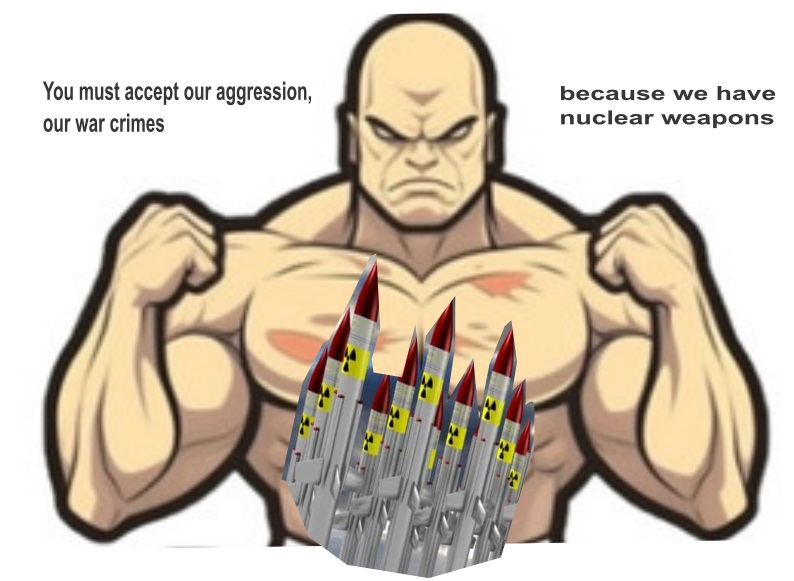
Blood and rubble are policy choices. Blood and rubble are planned for by all of those who shape and propagate the dangerous doctrine of nuclear deterrence. In his introduction to Einstein’s Monsters, Amis writes:
What is the only provocation that could bring about the use of nuclear weapons? Nuclear weapons. What is the priority target for nuclear weapons? Nuclear weapons. What is the only established defence against nuclear weapons? Nuclear weapons. How do we prevent the use of nuclear weapons? By threatening to use nuclear weapons. And we can’t get rid of nuclear weapons, because of nuclear weapons.
This is the relentless circular (il)logic of deterrence, the principal tenant of which is that the possession of nuclear weapons makes their use impossible and thus prevents war. But whether it is the United States attacking Iraq, Russia invading Ukraine, or Israel committing genocide in Palestine, it should be clear to all that nuclear weapons do not prevent war. They enable it.
Whether nuclear weapons are used or not, they facilitate other forms of violence. They are the backbone of a mentality that security can best be achieved through building up the capacity to commit mass destruction, and by committing mass destruction. Nuclear weapons are used as shields to prevent others from standing up to their possessors’ acts of aggression, to their war crimes. Financial investments in nuclear weapons provide profits for weapons manufacturers that also build conventional bombs, missiles, guns, fighter jets, and other technologies of war. Nuclear weapons provide sustenance to the war machine, and exist as the overarching, final threat of that machine.
The possession of nuclear weapons drives the development of self-destructive plans masquerading as national security. Governments willfully put people and the planet in harm’s way, arrogantly asserting that this is the best way to protect them. One example is the land-based missile silos in the United States, which are intended to serve as targets for enemy nuclear weapons with no concern for the communities or land upon which they are based. As part of his new ground-breaking project examining the US government’s plan to modernise its nuclear forces, Sébastien Philippe of Princeton University’s Program on Science and Global Security writes in Scientific American, “a key argument for the continued existence—and now the replenishment—of the land-based missiles is to provide a large number of fixed targets meant to exhaust the enemy’s resources.” Yet the most recent, 3000-page report from US government on these silos does not mention what happens if the missiles are attacked. But as Philippe’s modelling of these “sacrifice zones” shows:
A concerted nuclear attack on the existing U.S. silo fields—in Colorado, Wyoming, Nebraska, Montana and North Dakota—would annihilate all life in the surrounding regions and contaminate fertile agricultural land for years. Minnesota, Iowa and Kansas would also probably face high levels of radioactive fallout. Acute radiation exposure alone would cause several million fatalities across the U.S.—if people get advance warning and can shelter in place for at least four days. Without appropriate shelter, that number could be twice as high. Because of great variability in wind directions, the entire population of the contiguous U.S. and the most populated areas of Canada, as well as the northern states of Mexico, would be at risk of lethal fallout—more than 300 million people in total. The inhabitants of the U.S. Midwest and of Alberta, Saskatchewan, Manitoba and Ontario in Canada could receive outdoor whole-body doses of radiation several times higher than the minimum known to result in certain death.
“Higher than the minimum known to result in certain death.” How can anyone read these words and think, “No, this is not relevant for a study on the impacts of our weapon systems.” Or, more broadly, that “No, this is not relevant for our consideration of the possession and deployment of these weapons at all. In fact, we will base our security strategy on the possibility of mass death and unspeakable suffering, and this is normal and fine for us and a few select others—this is how we will dominate. This is how we ‘win’.”
The irrationality of basing national security on the ability to execute or absorb catastrophic events like genocide is not lost on states parties and signatories to the Treaty on the Prohibition of Nuclear Weapons (TPNW). These governments understand that security must be provided for through other means. That it is both immoral and illogical to threaten to melt people, to turn them into shadows, or to subject them to a protracted, painful death from radiation poisoning, in order to—what, exactly? Exercise dominance within the so-called world order? Be able to wage wars of aggression against whomever one wants, whenever one wants?
The governments that join the TPNW are not just pledging against acquiring nuclear weapons themselves—they are also committed to achieving the abolition of all nuclear weapons, and to building a world that does not rely on massive nuclear violence for security. When these governments gathered with activists and others in 2017 to prohibit nuclear weapons, they changed the world. Not just rhetorically, but materially. The creation of a legally binding treaty outlawing the possession, use, and threat of use of atomic bombs has enabled unprecedented financial divestment and political stigmatisation of these weapons. It has changed discourse, even if it has not yet changed doctrines. But one follows the other.
Six years after the adoption of the TPNW, the nuclear-armed states and nuclear-supportive allies are still clinging to their arsenals of mass destruction. But the horrors these governments have collectively wrought upon the world are clearer—and more condemned—than ever. The masks are off, the wizards are no longer behind the curtain. Political leaders that condone mass death are being denounced; global inequalities are being exposed and opposed. The tide may not yet have fully turned, but the wave of opposition to permanent war and violent aggression is growing every single day. People are organising and getting organised. There is no time to waste, not when it comes to genocide and not when it comes to nuclear weapons.
This meeting of TPNW states parties is an opportunity to advance collective action against the bomb. The governments that have signed and ratified this treaty must adopt a strong declaration condemning nuclear deterrence and the continued possession and modernisation of nuclear arsenals. They must continue to implement last year’s action plan and work to get more countries onboard the treaty, especially those still trying to hide behind the false security promised by nuclear-armed states in exchange for sharing the economic and political burdens of nuclearism. The governments that aid and abet nuclear-armed states must relinquish this immoral space and join the rest of the world in renouncing the policies and practices of mass death.
But this meeting of states parties is not just about governments, it’s about people. It’s about the Indigenous Peoples upon whose bodies and lands nuclear weapons have been detonated, again and again and again. It’s about the communities who have been forced, without their consent or knowledge, to host uranium mines, nuclear laboratories, missile silos or bomber and submarine fleets, radioactive waste dumps. It is about all of us living with radiation from nuclear testing in our bodies, contaminated for generations by the hubris of political and corporate leaders who put their profits and sense of power above everything else. This meeting will be filled with people from affected communities, activist organisations, scientific groups, academic institutions, and more. Nuclear weapons have never just been about states. Nuclear weapons, fundamentally, are about human life, about all life. The nuclear-armed states have refused to acknowledge, let alone include, most people in conversations or policy making about their bombs. But the TPNW is a space for everyone to have a voice, to participate, and to determine how we fight for nuclear abolition, together.
“Nuclear weapons are mirrors in which we see all the versions of the human shape,” writes Amis. What shape do we want to reflect?
Second Meeting of State Parties to Treaty on Prohibition of Nuclear Weapons to Be Held at Headquarters, 27 November–1 December
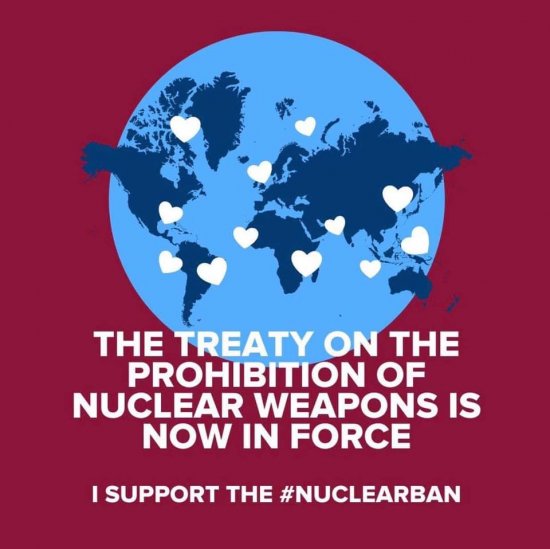
NEW YORK, 24 November (Office for Disarmament Affairs) — The second Meeting of States Parties to the Treaty on the Prohibition of Nuclear Weapons will be held at the United Nations Headquarters from 27 November-1 December 2023. Juan Ramón de la Fuente (Mexico) was elected as President of the Meeting.
The Treaty, the first multilateral nuclear disarmament treaty to be negotiated in more than two decades, was adopted on 7 July 2017 at the United Nations and entered into force on 22 January 2021. United Nations Secretary-General António Guterres has called the Treaty “an important step towards the goal of a world free of nuclear weapons and a strong demonstration of support for multilateral approaches to nuclear disarmament.”
The second Meeting of States Parties is expected to hold a thematic debate on the humanitarian impact of nuclear weapons. States parties will also consider the status and operation of the Treaty, addressing issues that include universality; the total elimination of nuclear weapons; and victim assistance, environmental remediation and international cooperation and assistance. Other topics will include scientific and technical advice for the effective implementation of the Treaty, the complementarity of the Treaty with the existing nuclear disarmament and non-proliferation regime and implementing the gender provisions of the Treaty.
The Meeting is expected to adopt a political declaration. The period since the conclusion of the first Meeting of States Parties in April 2022 saw the appointment of a Scientific Advisory Group, which will present its initial reports at the second Meeting of States Parties. Since the first Meeting of States Parties, seven States signed the Treaty, three ratified it and one acceded to it.
The Treaty contains, inter alia, a comprehensive set of prohibitions on participating in any nuclear-weapon-related activities. This includes undertakings not to develop, test, produce, acquire, possess, stockpile, use or threaten to use nuclear weapons. The Treaty also prohibits the deployment of nuclear weapons on national territory as well as the provision of assistance to any State in the conduct of prohibited activities.
The Treaty requires States parties to assist individuals affected by the use or testing of nuclear weapons, as well as to take environmental remediation measures in areas under their jurisdiction or control that have been contaminated due to the testing or use of nuclear weapons. States parties are required to cooperate with one another to facilitate the Treaty’s implementation.
To date, 69 States have ratified or acceded to the Treaty and 93 have signed it.
Media contacts for the second Meeting of States Parties to the Treaty on the Prohibition of Nuclear Weapons: Suzanne Oosterwijk, United Nations Office for Disarmament Affairs, UN Secretariat, S-30FW, telephone: +1 917-367-2556, email: suzanne.oosterwijk@un.org.
IAEA urges Countries in Mideast, Israel to join nuclear ban treaty, open facilities for inspection
International Atomic Energy Agency chief says Israeli minister’s nuking Gaza remark ‘unacceptable’
Askin Kiyagan |22.11.2023 –https://www.aa.com.tr/en/middle-east/countries-in-mideast-israel-urged-to-join-nuclear-ban-treaty-open-facilities-for-inspection/3061983
VIENNA
The head of the International Atomic Energy Agency (IAEA) on Wednesday reiterated the call on all countries in the Middle East, including Israel, to join the Treaty on Non-Proliferation of Nuclear Weapons.
Speaking to reporters in the Austrian capital Vienna, Rafael Mariano Grossi urged all countries to join the Treaty on the Non-Proliferation of Nuclear Weapons (NPT), which aims to prevent the spread of nuclear weapons and weapons technology.
In response to a question by Anadolu on the Israeli minister’s nuking Gaza remark, the IAEA chief said it is “unacceptable.”
There is a widely accepted approach around the world that a nuclear war cannot be won, therefore such a war should not happen, said Grossi, adding that irresponsible remarks about the use of nuclear weapons are “completely unacceptable.”
Grossi also reminded that the IAEA General Assembly, the Board of Directors and he have made repeated calls to all countries in the Middle East, including Israel, to join the NPT and open all their nuclear facilities to a comprehensive nuclear inspection.
In an interview in early November, Israel’s Heritage Minister Amichai Eliyahu said: “One of Israel’s options in the war in Gaza is to drop a nuclear bomb on the Strip.”
Later, Palestinian Foreign Minister Riad al-Maliki filed a formal complaint with the IAEA against Israel over its minister’s threat to drop a nuclear bomb on Gaza.
We’re long past nuclear deterrence: Bring on mutually assured prevention

BY HARLAN ULLMAN, https://thehill.com/opinion/national-security/4317456-were-long-past-nuclear-deterrence-bring-on-mutually-assured-prevention/ 21 Nov 23
The United States needs a replacement concept for deterrence, the theory that was a child of the Cold War. It no longer is fit for purpose. Why?
For those who believe the Clausewitzian view that the nature of war, not the character, was immutable, the two nuclear bombs destroyed that premise along with Hiroshima and Nagasaki. A principal reason why deterrence is obsolete today was, as the presidents of America, China and Russia agreed, nuclear war must never be fought and can never be won. And thermonuclear weapons that are 1,000 times more powerful make that even clearer.
A war in which there were only losers and no winners produced deterrence. Deterrence rested on maintaining a survivable capability to retaliate and destroy the other after absorbing a first strike. And both sides knew that.
During the Cold War, “MAD,” the ironic acronym for mutually assured destruction, became the shorthand basis for deterrence. At that time, nuclear deterrence was achieved by the threat of mutually assured destruction and retaliation. Deterrence was sufficiently broad that some thought it could be “extended” to non-nuclear war under the mutually assured destruction umbrella. The Cold War ended without a shot or nuclear weapon being fired in anger by the U.S. or USSR
Deterrence was a bipolar condition that applied to the U.S. and USSR. How does deterrence now deal with the soon-to-be three nuclear superpowers? Deterrence assumed retaliation. But what happens if the deterrent notion of retaliation can actually lead to winning by losing?
As North Korea intends to build an intercontinental missile capable of reaching the U.S., this adds another strategic dimension. Whether Iran ultimately develops nuclear weapons or not will also affect this calculus.
The Strategic Posture Review released in October addresses these issues. Its recommendations called for major increases in both U.S. nuclear and strategic forces. But it did not suggest the size or composition of these forces or, most importantly, the costs because of the sticker shock that would create.
Deterrence is also obsolete at the non-nuclear level because of a further tectonic change in the nature of war: winning by losing or by not losing a long-sustained conflict. Vietnam, the October War of 1973 and the war in Gaza are notable examples.
Despite the nuclear imbalance, North Vietnam drove the U.S. out of Vietnam although it lost virtually every battle it fought.
Egypt’s President Anwar Sadat knew that his army could only surprise and not defeat Israel when he started the October 1973 War. He planned on Israel retaliating. But he won back the Sinai peninsula that Israel had captured in June 1967 and still secured a peace treaty. Yet he lost the ground war.
Hamas is following a similar strategy of “winning” by losing, forcing Israeli retaliation even though the costs threaten its temporary eradication along with tens of thousands of Palestinians and the wholesale destruction of Gaza. Protests and unruly demonstrations have been ubiquitous. And surprisingly and tragically, antisemitism has been on the rise in America.
What needs to be done? First, regarding the nuclear aspect of deterrence, a new concept of tri-deterrence must be developed to deal with this superpower triangle. As opposed to mutually assured destruction, a new foundation is needed and it should be based on preventing war and a new “MAP” for mutually assured prevention.
Prevention, not deterrence or retaliation, now matters. Prevention applies tested means to this end. A series of “hot lines” and military-to-military talks, including the stationing of observers at each military headquarters in the three countries must be established. These are additional confidence-building measures to ensure wars by accident do not occur. The U.S. and USSR did this.
Second, arms control discussions must address the prevention of any form of nuclear war and the restoration of three-way trust and confidence. These discussions must include not only arms limitations but also acceptable agreements to balance offensive and defensive weapons and the impact of highly accurate non-nuclear weapons that can have a strategic impact if targeted against nuclear forces.
Third, prevention also applies to traditional forms of war when winning can be accomplished by losing and provoking retaliation, as in Gaza, which may ensure Israel’s geostrategic defeat. This means greater reliance on diplomacy to reduce the grounds for conflict. And the consequences of artificial intelligence that some believe pose a possible existential threat to humanity must be addressed.
How or if the U.S., China and Russia can begin discussions is crucial. Whether a new 21st century 1914 is looming or not, mutually assured prevention can ensure another never reoccurs.
Harlan Ullman Ph.D. is a senior advisor at the Atlantic Council and the prime author of the “shock and awe” military doctrine. His 12th book, “The Fifth Horseman and the New MAD: How Massive Attacks of Disruption Became the Looming Existential Danger to a Divided Nation and the World at Large,” is available on Amazon. He can be reached on Twitter @harlankullman.
A four-decade-old Pacific treaty was meant to preserve the ‘peaceful region’. Now experts say it’s being exploited
“We regret that the Aukus agreement … is escalating geopolitical tensions in our region and undermining Pacific-led nuclear-free regionalism,” says the Pacific Elders’ Voice,
the US and the UK will increase rotations of nuclear-powered submarines to Australia,
Pacific countries rushed to join the TPNW six years ago, reflecting their longstanding concerns about nuclear testing legacies. It’s the same regional sentiment that spurred the earlier Treaty of Rarotonga.
Daniel Hurst in Rarotonga
Nearly 40 years after the Treaty of Rarotonga came into force, the region is on edge about another rise in geopolitical tension
…………………………………………………………………………….heightened concerns permeated the region in the months leading up to the crucial meeting in the Cook Islands in August 1985 where leaders endorsed a nuclear-free zone.
Hawke, the Australian prime minister at the time, hailed the negotiations as a “dramatic success” that would send “a clear and unequivocal message to the world”, with the treaty leaving major powers in no doubt about the region’s desire to preserve “the South Pacific as the peaceful region which its name implies”.
But nearly 40 years after the Treaty of Rarotonga came into force, the region is on edge about another rise in geopolitical tensions – and critics say gaps in the treaty’s coverage are now being exploited.
“The treaty was really important to a lot of people, especially for grassroots activists,” says Talei Mangioni, a Fijian-Australian board member of the International Campaign to Abolish Nuclear Weapons Australia.
But it was quite watered down. And so even though we celebrate it today, what activists were saying in the 1980s and what progressive states like Papua New Guinea, Solomon Islands and Vanuatu were saying was that it wasn’t comprehensive enough.”
Mangioni, who researches the legacy of the Nuclear Free and Independent Pacific Movement, adds: “That’s what’s left us now with things like Aukus exploiting certain loopholes that have remained in the treaty.”
A hotbed of great-power competition?
When leaders met last week in the Cook Islands for the annual meeting of the Pacific Islands Forum (Pif), the Treaty of Rarotonga was once again on everyone’s lips.
The host of the summit, prime minister Mark Brown of the Cook Islands, argued the region “should rediscover and revisit our Rarotonga treaty to ensure that it reflects the concerns of Pacific countries today, and not just what occurred back in 1985”.
The treaty – signed on the 40th anniversary of the US atomic bombing of the Japanese city of Hiroshima – reflected “the deep concern of all forum members at the continuing nuclear arms race and the risk of nuclear war”.
Also known as the South Pacific Nuclear Free Zone Treaty, it designated a vast area from the west coast of Australia to Latin America where its parties must prevent the “stationing” (critics say this was always a deliberately ambiguous word) of nuclear weapons.
“The treaty prohibits the use, testing or stationing of nuclear explosive devices in the South Pacific,” the Cook Islands News explained on 7 August 1985.
“It does not prohibit countries from transporting nuclear devices through the zone nor does it prohibit nuclear-powered or equipped ships from calling in ports within the area.”
Today the parties to this treaty are Australia, Cook Islands, Fiji, Kiribati, Nauru, New Zealand, Niue, Papua New Guinea, Samoa, Solomon Islands, Tonga, Tuvalu and Vanuatu.
Once again, many of these nations are worried about the Pacific becoming a hotbed of great-power competition and the risk of that spiralling into conflict. Aukus feeds into some of those fears.
“We regret that the Aukus agreement … is escalating geopolitical tensions in our region and undermining Pacific-led nuclear-free regionalism,” says the Pacific Elders’ Voice, a group of former leaders whose members include Anote Tong, the ex-president of Kiribati.
The legality of a treaty – and the spirit of it
Under the Aukus plan, Australia will buy at least three Virginia class nuclear-powered submarines from the US in the 2030s, before Australian-built boats enter into service from the 2040s.
In the meantime, the US and the UK will increase rotations of nuclear-powered submarines to Australia, all aimed at deterring China from unilateral action against Taiwan or destabilising activities in the increasingly contested South China Sea.
One point of sensitivity is that it will be the first time a provision of the Nuclear Non-Proliferation Treaty regime has been used to transfer naval nuclear propulsion technology from a nuclear weapons state to a non-weapons state.
The Australian government has worked assiduously behind the scenes to reassure Pacific leaders on a key point about Aukus.
“Certainly when I was talking to people about it I would explain how it was consistent with the Treaty of Rarotonga,” says the Australian minister for the Pacific, Pat Conroy.
Donald Rothwell, a professor of international law at the Australian National University, concurs. The treaty, he notes, does not deal with nuclear-propelled submarines.
“My view is that Aukus is consistent with Australia’s Treaty of Rarotonga obligations,” Rothwell says.
“Pacific states may have concerns about the potential stationing of US and UK nuclear-armed warships in Australian ports under Aukus. The stationing of such vessels, as opposed to port visits, would be contrary to the treaty.”
The Australian prime minister, Anthony Albanese, sought to allay any Aukus-related concerns when he briefed Pacific leaders during the Pif meetings last week and appears to have held off any open rebellion.
Albanese insists the treaty remains “a good document” and “all of the arrangements that we’ve put in place have been consistent with that”.
But anti-nuclear campaigners point to the planned new aircraft parking apron at the Tindal base in the Northern Territory that will be able to accommodate up to six US B-52 bombers.
The US refuses to confirm or deny whether the aircraft on rotation would be nuclear-armed, in line with longstanding policy.
“We should delineate between a legalistic interpretation of the Treaty of Rarotonga and the spirit of it,” says Marco de Jong, a Pacific historian based in Aotearoa New Zealand.
“Pacific nations are growing increasingly frustrated at Australia’s reliance on loopholes and technicalities.”
Australia: the regional outlier
The Nobel prize-winning International Campaign to Abolish Nuclear Weapons says a good way for Australia to reassure the region about its long-term intentions would be to sign the newer Treaty on the Prohibition of Nuclear Weapons (TPNW).
This is an idea Albanese previously supported enthusiastically but which appears stalled.
One potential problem is that the US has warned that the TPNW – which includes a blanket ban on helping others to use or threaten to use nuclear weapons – wouldn’t allow for close allies like Australia to enjoy the protection of the American “nuclear umbrella”.
Documents obtained by the Guardian under freedom of information laws show the Australian defence department has warned the Labor government that the TPNW is “internationally divisive” because the nuclear weapons states “are all opposed”.
But Mangioni, a member of the Youngsolwara Pacific movement of activists, counters that Pacific countries rushed to join the TPNW six years ago, reflecting their longstanding concerns about nuclear testing legacies. It’s the same regional sentiment that spurred the earlier Treaty of Rarotonga.
“I would say that Australia is indeed the outlier compared to the rest of the Pacific states,” Mangioni says.
“Australia depends on nuclear deterrence as its policy but the rest of the Pacific states are nuclear abolitionists.” https://www.theguardian.com/world/2023/nov/19/a-40-year-old-pacific-treaty-was-meant-to-maintain-the-peaceful-region-now-experts-say-its-being-exploited
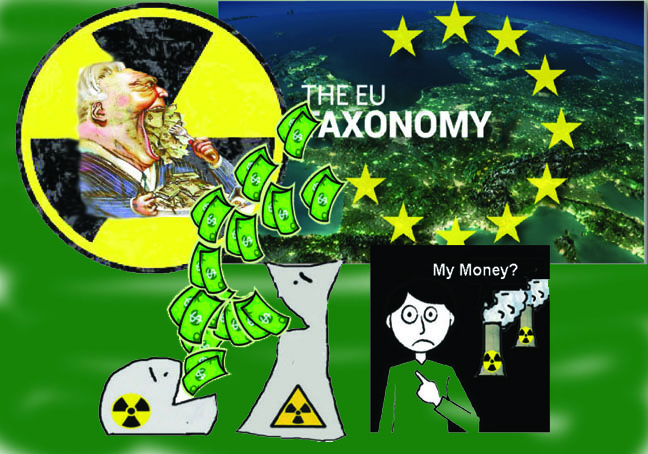
Czech Republic, France and others will use “Declaration to Triple Nuclear Energy” to push for EU funding to the nuclear industry
Edvard Sequens, Calla, Czech Nuclear Republic 20 Nov 23
“Declaration to Triple Nuclear Energy” – The Czech Government had it on
the agenda this week, saying that they wanted to join in. Supporting
countries include the Czech Republic, USA, France, Korea, Sweden, UK and
Ukraine (more countries are expected to join).
Substantively, this is nonsense, and the declarations adopted at COP
meetings are often only formal. But I expect that the nuclear alliance
of European countries will use the declaration to press for a
redirection of direct support from the European budget to new nuclear
projects. This is, after all, a long-term goal of the Czech political
representation. Step by step – Recognition of nuclear energy as a tool
to achieve European climate goals – Inclusion in the taxonomy –
Possibility of public support for nuclear energy by individual states
without the need to approve exemptions – Direct financial support – …
First Ladies make joint call on the world about Palestine
17/11/2023 https://uzdaily.uz/en/post/84825
Tashkent, Uzbekistan (UzDaily.com) — In a gathering in Istanbul on 15 November 2023, the spouses of Heads of States and Government, along with representatives from various countries, convened at the “United for Peace in Palestine” Summit.
Turkiye’s First Lady Emine Erdoğan hosted the summit titled “One Heart for Palestine” with the spouses of leaders in Istanbul.
Spouses and special representatives of state leaders from many countries, including Qatar, Malaysia, and Uzbekistan, conveyed a message to the world for the innocent people of Gaza.
Their primary objective: to bring global attention to the humanitarian crisis in Gaza and call for an end to the tragic suffering of civilians, particularly vulnerable groups such as children, women, patients, and the disabled.
The summit aimed to advocate for a just and lasting peace and mobilize the international community to address what they assert may constitute war crimes.
“We are deeply concerned about the humanitarian tragedy in the Occupied Palestinian Territories, including Gaza and the West Bank, especially East Jerusalem, due to the war that has unfolded since October 7, 2023,” the statement of the summit said.
A major focus of their statement was the blockade and embargo imposed on Gaza, which they deemed incompatible with international law. They underscored that this blockade not only prevents civilians from accessing basic necessities but has also evolved into a severe violation of human rights.
The leaders’ spouses did not shy away from highlighting the grim statistics, pointing out that the tragedy in Gaza since 7 October has resulted in the deaths of more than 11 thousand civilians, predominantly children and women. They labeled this as one of the most serious violations of international law.
The urgency of the situation prompted a call for immediate action to ensure the safety of pregnant women, children, infants, and patients who find themselves in inhumane conditions and are at risk of massacre.
The summit attendees expressed a collective desire for a two-state solution, envisioning a future where both Israelis and Palestinians can raise their children in peace and security.
The summit’s joint declaration outlined a series of calls to action, urging the global community to intervene promptly:
1. Immediate and collective action to halt the ongoing massacres in Gaza.
2. An immediate cessation of Israeli attacks targeting civilian infrastructure, including schools, hospitals, medical facilities, refugee camps, United Nations facilities, and places of worship.
3. An urgent ceasefire to end hostilities, accompanied by the provision of unhindered, sufficient, and safe humanitarian assistance to civilians in Gaza.
4. A firm rejection of any attempts to forcibly displace the Palestinian civilian population, recognizing the severe impact of displacement, especially on women, children, and the elderly.
5. Immediate and full compliance by all parties with their obligations under international law.
As the international community grapples with this call to action, the “United for Peace in Palestine” Summit marks a collective plea for humanity and justice in the face of a dire humanitarian crisis.
UK’s Foreign Secretary urged to send observers to nuclear ban meeting in New York
The Second Meeting of the States Parties to the Treaty on the Prohibition of Nuclear Weapons will be held at the United Nations in New York between 27 November and 1 December.
The Treaty, usually referred to as the TPNW or Ban Treaty, entered international law in January 2021 after an intensive campaign championed by the International Campaign to Abolish Nuclear Weapons, a global coalition of civil society and faith groups, Hibakusha (atomic bomb and test survivors), scientists, and academics. In total there are 661 partner organisations in 110 countries within ICAN, amongst them are the UK/Ireland Nuclear Free Local Authorities and Mayors for Peace, of which NFLA founder Manchester is a Vice-Presidential and Executive city. ICAN won the Nobel Peace Prize for its work.
First opened for signature in July 2017, the TPNW now has 93 signatory states, of which 69 have taken the final step of ratifying their absolute adherence to it through their national parliaments.
The Treaty obliges signatory states not to ‘deploy, develop, test, produce, acquire, possess, stockpile, use or threaten to use nuclear weapons’ or assist other states to do so. In addition, and importantly for the UK and the other nuclear weapons states, the treaty contains obligations placed upon signatories ‘to provide adequate assistance to individuals affected by the use or testing of nuclear weapons, as well as to take necessary and appropriate measure of environmental remediation in areas under its jurisdiction or control contaminated as a result of activities related to the testing or use of nuclear weapons’.
Unfortunately, none of the nine nuclear weapon armed states (the USA, Russia, France, UK, China, India, Pakistan, Israel and North Korea), or their allies who choose to shelter under their supposed ‘nuclear umbrella’, have chosen to sign the Treaty, and in each of the nine states campaigners are seeking to influence government ministers to at least engage with this important international peace initiative by authorising observers to attend the second meeting in progress.
Norway and Germany have recently chosen to do so and now the Nuclear Free Local Authorities have joined the United Nations Association – UK and co-campaigners in writing to Britain’s new Foreign Secretary urging him to let Britain follow their lead. Campaigners also want the UK Government to acknowledge the ongoing harm caused to Indigenous people and their environments by the conduct of British atomic and nuclear weapons tests in Australia, in the Pacific and in the USA, and to use the meeting to listen to the testimony of representatives from Kiribati, formerly Christmas Island.
Councillor Lawrence O’Neill, Chair of the UK/Ireland Nuclear Free Local Authorities, explained why he was so determined to endorse the joint letter on behalf of the NFLAs:
“The UK Government claims to be committed, alongside the USA, Russia, France, and China, to achieving nuclear disarmament through the Non-Proliferation Treaty, yet in over fifty years this has achieved nothing. The reality is that India, Israel, Pakistan and North Korea continue to operate as nuclear weapon states outside of the NPT and we now live in a world where the nuclear powers continue to invest in their frightful nuclear arsenals, where the use of nuclear weapons has being threatened in Ukraine and Gaza, and where the Doomsday Clock hovers at 90 seconds to midnight!
“The world needs something to bring us back from the abyss – and the Ban Treaty represents that hope. Half of the United Nations have so far signed up to it and the NFLAs want the other half to do so. Seeing the UK attend the New York meeting as an observer and listen to the testimony of the awful impact of nuclear weapons testing in Kiribati would be the first sign that our government is serious about achieving nuclear disarmament and righting the wrongs that we as a nation have inflicted on the Kiribati people.”
World Nuclear Industry Status Report due on 6 December
The World Nuclear Industry Status Report 2023 (WNISR2023) will be released
on 6 December 2023, during a hybrid in-person/virtual presentation in
Brussels co-hosted by the German Federal Office for the Safety of Nuclear
Waste Management, the Friedrich Ebert Stiftung and the Heinrich Böll
Stiftung, European Union.
WNISR 18th Nov 2023
EU media names member states against Ukrainian membership
Rt.com 19 Nov 23
Austria and Hungary are among the bloc’s members expected to impede Kiev’s European integration
Several EU member states are likely to resist the proposed accession of Ukraine to the union, media outlet EUObserver has reported, citing an unnamed diplomat.
Kiev’s possible integration into the European bloc is set to be discussed by the 27 EU heads of government at a summit in Brussels in December, after the European Commission recommended this month that integration discussions should begin. But while the European Council is expected to back the plan, signs indicate that the process may receive pushback from several key member states, EUObserver said in a report on Thursday.
“For sure, Austria will be obstructive [to Ukraine’s integration], but it will hide behind Hungary,” the publication said, citing comment from the anonymous EU diplomat. “Despite its new rhetoric, France doesn’t really want Ukraine in the EU and Germany is playing a cynical game.”……………………………………
EU leaders will decide at the summit in Brussels on December 14 and 15 whether Ukraine should be allowed to hold formal membership talks. https://www.rt.com/news/587553-ukraine-eu-membership-opposition/
Time’s Up for Netanyahu and Biden

The question for today is what the world will do to enable the Palestinian people to live in peace and security in a nation where their children enjoy the opportunities most Americans and Europeans take for granted.
By Dan Siegel ScheerPost 17 Nov 23 https://scheerpost.com/2023/11/17/times-up-for-netanyahu-and-biden/
We can tell the world is changing when tens of thousands of Texans rally in the capital of America’s most important red state to demand a ceasefire in Gaza and freedom for Palestine. No longer can the Israeli government enforce its deadly calculus of 10 (or 50? or 100?) Palestinian lives for each Israeli killed in its futile effort to suppress Palestine’s struggle for self-determination. No longer can an American President assume that the public will support propping up an Israeli government whose constant, murderous violations of international law bring us daily exposure to the violence and deprivation imposed on the Palestinian population.
The issues are no longer whether Israel should survive and whether Hamas’ murders must be condemned. Those are the easy questions. Countless millions of us have moved on.
The question for today is what the world will do to enable the Palestinian people to live in peace and security in a nation where their children enjoy the opportunities most Americans and Europeans take for granted. No one suggests that this challenge can be easily resolved, but the first step is for the U.S. to stop supporting the most right-wing government in Israel’s history from imposing unlimited violence and deprivation on Gaza while accelerating violent settler expansion in the West Bank.
Israel’s strategies to ensure its survival and the means it chooses to defend itself should no longer enjoy unquestioned American support. Netanyahu’s government has exhausted its legitimate right to defend itself against the Hamas attack. It has already killed 11,000 Palestinians and provided no evidence that any of them were responsible for Hamas’ violence.
Israel’s air campaign against Gaza relies on the “emergency” American appropriation of $14 billion in military aid. American weapons have been designated for Israeli settlers stealing Palestinian land in the West Bank. U.S. officials know that Israel’s actions will not lead to peace. So do Israeli leaders, including many in the military. Netanyahu and his government survive because they have American support, including Jews who continue to maintain that criticism of the Israeli government is the equivalent of antisemitism. Many of us disagree. Recent polling demonstrates that the American public is evenly divided on support for the Israeli bombing of Gaza.
Organizations like Jewish Voice for Peace and J Street represent ever growing numbers of American Jews. We are no longer cowed from describing Israel’s actions against the people of Gaza as genocide or its policies in the West Bank as apartheid. We are no longer intimidated by an American Jewish establishment that wields specious and exaggerated accusations of antisemitism and harassment to silence critics of the Netanyahu government.
America’s Jewish establishment does its best to suppress the contentious history of Zionism within the Jewish community worldwide. My grandfather grew up in the late 1800s in a small town in Belarus and became a student and political activist in Minsk. The intellectual life of his community focused on the debate about whether socialism or Zionism best served Jews’ long term interests.
Much public debate focuses on “who started it?,” and the simplistic answer given by Israel’s defenders points to the Hamas attack of October 7 as justification for Israel’s excesses. But the war between Israel and Palestine did not begin on Oct. 7, or even in 1979 or 1967 or 1948, and it was not created in the Holocaust. It makes more sense to say that the roots of the current conflict go back to the Crusades, a campaign that began around 1095 when Europe’s Christian kings raised and sent armies to the Middle East to overthrow its Muslim leaders and take their land. As they marched across Europe, the Crusaders attacked Jewish communities, murdering their populations and stealing their wealth. Almost 1,000 years later the descendants of those Arab and Jewish people contend for the land conquered by the Crusaders.
History will not tell us which side has right on its side. The search for peace must be forward-looking and requires a commitment to the welfare of both the Palestinian and Israeli people. American officials are far from powerless to stop the Netanyahu government. The problem is that they refuse to do so. The current crisis has created a demand for leadership with a vision of a world at peace.
This is Joe Biden’s Lyndon Johnson moment, the time for him to follow LBJ’s 1968 decision to withdraw from the campaign for reelection. The issue is not that Biden is too old. His policies are too old. The American Empire is no more. We need leaders ready to engage the emerging multipolar world, who do not imagine that the U.S. is going to war over Taiwan, who welcome sharing power with the nations of Europe and the BRICS countries. The end of America’s uncritical support of the Israeli government can be the first step in creating leadership for a world at peace.
Washington raises stakes on ‘losing hand’ in Ukraine – Jeffrey Sachs

Sachs noted that he and other observers predicted the Ukraine debacle in the early days of the conflict. “This one was not very hard to see,” he said. “Like you said, how can you beat Russia? It was very obvious. These people just are not very clever. Biden, Nuland, [National Security Advisor Jake] Sullivan, [Secretary of State Antony] Blinken – they’ve been at this since 2014.”
https://www.rt.com/news/587370-sachs-ukraine-losing-hand/ 17 Nov 23
Just three days after Russian forces launched a military offensive against Ukraine in February 2022, Ukrainian President Vladimir Zelensky sought to resolve the conflict by pledging neutrality, Sachs said. However, he suggested that, when Zelensky reached a preliminary agreement with the Russians on a peace settlement a few weeks later, US President Joe Biden’s administration torpedoed the deal.
The leading American analyst has argued that Washington needs a new foreign policy after 15 years of failure in Eastern Europe
Washington has continually escalated a failed foreign policy in Eastern Europe since at least 2008, driving Ukraine to the brink of total destruction by failing to address Russia’s legitimate security concerns in the former Soviet republic, US public policy analyst Jeffrey Sachs has argued.
“The US has played a losing hand badly for 15 straight years,” Sachs said on Wednesday in an interview with independent journalist Glenn Greenwald. “This is really important to understand if one wants to learn a little bit about geopolitical poker, which is, we keep raising the stakes on a losing hand.”
Sachs, an award-winning economist who advised the Russian and Ukrainian governments following the Soviet Union’s breakup, detailed how at various points in the past two decades, Washington could have forestalled a military conflict without Kiev losing any territory. He pointed out that Moscow was demanding that NATO not expand onto its doorstep, which US officials refused to concede.
When Ukraine’s then-president, Viktor Yanukovych, chose neutrality over aligning with the West and agreed to extend the Russian Black Sea Fleet’s lease of its naval base in Crimea, that wasn’t good enough for US leaders, Sachs said. US State Department official Victoria Nuland “and friends” then helped overthrow Kiev’s democratically elected government in 2014, leading to Ukraine’s loss of Crimea, he said.
Even then, Russia wasn’t demanding more territory. Rather, Sachs said, Moscow wanted Ukraine to refrain from shelling ethnic Russians in the breakaway Donbass region and to grant them a degree of autonomy. Those terms were included in the Minsk II agreement, which was unanimously endorsed by the UN Security Council, but US officials told Ukrainian leaders that they didn’t need to comply with the deal, the analyst said.
In December 2021, Russian President Vladimir Putin proposed a security pact pledging no further expansion of NATO and negotiations on placement of US missile systems in Eastern Europe. The US reply came in January 2022.
“We don’t have to discuss any of that with you,” Sachs said, summing up Washington’s stance at the time. “That was the reply. We don’t have to discuss NATO with you. It’s none of your business.”
Just three days after Russian forces launched a military offensive against Ukraine in February 2022, Ukrainian President Vladimir Zelensky sought to resolve the conflict by pledging neutrality, Sachs said. However, he suggested that, when Zelensky reached a preliminary agreement with the Russians on a peace settlement a few weeks later, US President Joe Biden’s administration torpedoed the deal.
Washington has since approved $113 billion in aid to Ukraine, essentially prolonging the fighting, the analyst argued. Earlier this year, the Biden administration goaded Kiev into a major counteroffensive against Russian forces that was “clearly an impossibility,” Sachs said.
“They’ve raised the stakes for 15 years on a losing hand, and they can’t get it,” the economist said. “And this is our team. They failed.”
Sachs noted that he and other observers predicted the Ukraine debacle in the early days of the conflict. “This one was not very hard to see,” he said. “Like you said, how can you beat Russia? It was very obvious. These people just are not very clever. Biden, Nuland, [National Security Advisor Jake] Sullivan, [Secretary of State Antony] Blinken – they’ve been at this since 2014.”
Kiev’s much-anticipated offensive campaign, launched in the summer, has failed to achieve any significant victories or win back much territory. Valery Zaluzhny, Ukraine’s top general, said in a recent interview that the fighting has reached “a stalemate.”
The Economist reported this week that Western officials “increasingly think” that the conflict could last for another five years.
Herzog: Israel will maintain ‘very strong force’ in Gaza, Translation: We’re not leaving. Ever.
James Shotter and Andrew England, Financial Times, Thu, 16 Nov 2023 https://www.sott.net/article/486055-Herzog-Israel-will-maintain-very-strong-force-in-Gaza-Translation-We-re-not-leaving-Ever
Israeli President Isaac Herzog has said that his country cannot leave a vacuum in Gaza and would have to maintain a “very strong force” in the coastal enclave for the near future to prevent Hamas re-emerging in the besieged strip.
In an interview with the Financial Times, Herzog said the government was discussing many ideas about how Gaza would be run once the war between Israel and Hamas ended, adding that he assumed the US and “our neighbours in the region” would have some involvement in the post-conflict order.
“If we pull back, then who will take over? We can’t leave a vacuum. We have to think about what will be the mechanism; there are many ideas that are thrown in the air,” Herzog said. “But no one will want to turn this place, Gaza, into a terror base again.”
Herzog’s comments come as international pressure mounts on Israel over the soaring death toll in Gaza and the deepening humanitarian crisis in the strip, which is home to 2.3mn people and has been controlled by Hamas since 2007.
Western officials are also concerned that Israel has no clear plan for what comes next in Gaza after vowing to eliminate Hamas, which is deeply embedded in Palestinian society and has political and military wings.
The Biden administration has said there might be a need for a transition period, but it has also warned Israel not to reoccupy the strip — from which it withdrew in 2005 — or to reduce the size of the territory with new security barriers or buffer zones.
Comment: Good luck with that. The Zionists are off the leash and they know it.
Prime Minister Benjamin Netanyahu has previously said Israel would maintain indefinite “overall security responsibility” over Gaza.
Herzog, who has no executive powers but is briefed on the war effort, said: “In order to prevent terror from coming up again, we have to have a very strong force to make sure that it’s committed enough and it [the attack] doesn’t happen [again].”
Herzog was speaking hours before Israeli forces launched a raid on al-Shifa hospital, Gaza’s largest medical facility, which is home to patients and thousands of Palestinians who have sought sanctuary from Israel’s bombardment.
The Israel Defense Forces described its raid on al-Shifa as a “precise and targeted operation” in a “specified area” of the hospital. The IDF accuses Hamas of using hospitals for military operations, and the White House on Tuesday supported Israel’s claims that Palestinian militants stored weapons in medical facilities.
Comment: Precise and targeted means we won’t drop a missile right on your head, but bomb you right up to the front door:
Hamas has denied these claims. A spokesman for the government in Gaza described the raid on al-Shifa as a war crime.
The UN has said that the health system in Gaza has collapsed, with all but one of the hospitals in northern Gaza no longer functioning.
Asked about Israel’s military operations around hospitals, Herzog said: “We are doing it in a very, very cautious way.”
He also insisted that Israel was seeking to protect civilians.
Israeli forces launched an air and land offensive on Gaza after Hamas’s October 7 attack killed about 1,200 people, according to Israeli officials, in its most ferocious ever assault on the strip.
More than 11,200 people have been killed in Israel’s bombardment, according to Palestinian health officials, and the UN says more than 1.5mn people have been displaced.
Israel has repeatedly ordered Palestinians to leave the densely populated north of Gaza, which is the focus of its military operations, and to move south.
“I care about the Palestinian deaths . . . it breaks my heart,” Herzog said. “But I always remember, I have first and foremost [to ensure] the security to defend our people.”
Even Israel’s staunchest allies have raised concerns about the death toll in Gaza, with US secretary of state Antony Blinken saying last week that “far too many Palestinians have been killed”.
This week, French President Emmanuel Macron told the BBC that Israel must “stop the bombing”.
Herzog said Israel respected its allies and listened to the US “very carefully”. But he added that “at the end of the day, we have a duty to protect our people”.
The president said “first and foremost” Israel wanted to secure the release of about 240 hostages that Hamas captured during its October 7 attack on southern Israel.
He said the international community understood that, and supported Israel’s right to defend itself. But he said: “How do I have the right to defend myself if I cannot eradicate the military capabilities of Hamas? It’s right there. It’s right there in the [Gaza] city.”
Qatar, which hosts Hamas’s political office, has been facilitating indirect talks between Israel and the militant group to secure a deal to release civilian hostages.
Herzog blamed Hamas for the lack of an agreement, saying “we haven’t even received one piece of information about our hostages”.
“So we have to fight and get them,” he said.
He said Israel, which has laid siege to Gaza and allowed only a limited amount of aid into the strip — triggering acute shortages of food, water and fuel — was working to allow more humanitarian assistance into the enclave.
Herzog added that the government was discussing “a major effort” with Cyprus to deliver aid via the sea, saying Cypriot officials would be visiting Israel on Thursday to follow up on the initiative.
“It’s under serious negotiations with the Cypriot government,” he said.
“It’s true there are areas in Gaza that are in a very dire situation. That’s because it’s a war zone,” he said. “But we are trying.”
The US and China re-engage on arms control. What may come next
Bulletin, By Daryl G. Kimball | November 15, 2023
For more than six decades, the United States has been worried about China’s regional influence, military activities—and its nuclear potential. For instance, in 1958, US officials considered using nuclear weapons to thwart Chinese artillery strikes on islands controlled by Taiwan, according to a document leaked by Daniel Ellsberg in 2021. Now, as then, a nuclear conflict between the United States and China would be devastating for both sides and the world.
The United States has a decades-long experience of nuclear arms control and strategic stability talks with the Soviet Union, and later Russia. However, there has not been a sustained bilateral dialogue between Washington and Beijing on how to reduce the risk of conflict, nuclear escalation, and nuclear arms control and disarmament. Until recently, China had rebuffed US overtures for bilateral talks on nuclear risk reduction and arms control, and on other security issues.
Adding to the tensions, China has embarked since the early 2000s on a major buildup of its relatively smaller nuclear arsenal and has resisted calls for a global halt on the production of fissile material for nuclear weapons. In response, some current and former national security insiders, as well as many in Congress, suggest that the US arsenal “should be supplemented” to add more capability and flexibility to counter two “near-peer” nuclear adversaries. In other words, the potential for an unconstrained, three-way arms race is growing.
But things started to change on November 6 with the meeting in Washington between US Assistant Secretary of State for the Bureau of Arms Control, Verification and Compliance Mallory Stewart and China’s Ministry of Foreign Affairs Director-General of Arms Control Sun Xiaobo.
A modest yet important breakthrough. The US-Chinese discussion on arms control—the first of its kind since 2018—was described by the US side as a “candid and in-depth discussion on issues related to arms control and nonproliferation.” According to the State Department’s readout of the meeting, “the United States highlighted the need to promote stability, help avert an unconstrained arms race, and manage competition so that it does not veer into conflict.” The Chinese Foreign Ministry’s readout also said the “[t]he two sides had an in-depth, candid and constructive exchange of views” on nuclear weapons matters, as well as an exchange on “regular arms control.”
Several participants told me that the meeting was “wide-ranging” and “positive in tone,” but that it did not involve much substantive exchange of views on the issues, which is not surprising. Tangible progress will require time and sustained give-and-take from both sides.
The next step, ideally, will be for Presidents Joe Biden and Xi Jinping, who are set to meet this week, to direct their teams toward concrete nuclear risk reduction and arms control measures that enhance mutual security.
More nuclear capabilities imply more responsibilities.……………………………………………….
China’s arsenal is not only growing (it had less than 200 nuclear warheads in 2000), but it is also diversifying and modernizing. It is now well-documented that China has started to deploy new solid-fueled missiles that can be launched more quickly than its older liquid-fueled missiles. …………………………………………………………………………..
Of course, China’s nuclear arsenal is still modest by comparison to the US and Russian arsenals, each of which are about nine times larger than China’s. But China’s nuclear modernization efforts could have significant strategic implications that make it even more important for the “Big Three” (the United States, Russia, and China) to pursue meaningful progress on nuclear arms control to avoid a destabilizing and dangerous nuclear arms race.
Toward a more serious, sustained dialogue. In response to China’s nuclear buildup, US officials—Republicans and Democrats alike—have prioritized engagement with China in talks to identify measures to reduce nuclear risks and prevent destabilizing and costly strategic weapons competition………………………….
Sullivan’s June 2 address provides some important clues about the types of issues the US side likely raised in the arms control talks. Sullivan suggested that the United States and China, along with the other NPT nuclear-armed states, could engage in new nuclear arms control and risk reduction efforts such as establishing more robust crisis communications channels and “formalizing a missile launch notification regime” for all five permanent members of the UN Security Council—the United States, Russia, China, the United Kingdom, and France. “It’s a small step that would help reduce the risk of misperception and miscalculation in times of crisis,” Sullivan added.
These suggestions don’t happen in a vacuum: The United States and Russia have a ballistic missile launch notification agreement already in place, and Russia and China have their own bilateral agreement too.
In his remarks, Sullivan also called for talks on “maintaining a ‘human-in-the-loop’ for command, control, and employment of nuclear weapons” to reduce the risk of miscalculation in a crisis. This would require that the US and China—and other nuclear-armed states—agree to pursue technical discussions designed to reach common understandings on how the use of artificial intelligence, particularly high-risk, cutting-edge deep learning models, can be banned or at least limited so the use of nuclear weapons is effectively kept under human control. This proposal seems to have reached the highest level with Presidents Biden and Xi reportedly discussing limits on the employment of artificial intelligence in the control and deployment of nuclear weapons.
In future meetings, US and Chinese diplomats should go one step further and set out a process for formulating a joint understanding that cyberwarfare capabilities will not be used to try to interfere with other states’ nuclear command and control systems, which could also severely alter decision-making in a crisis……………………………………………………..
From talks to concrete actions. Further down the road, an even more ambitious approach that might be considered in the multilateral, nuclear-five setting would be for Washington and Moscow to propose that China, France, and the United Kingdom freeze the size of their nuclear stockpiles so long as the United States and Russia maintain the current limits on their strategic arsenals—even after New START expires—and make good faith efforts to negotiate deeper verifiable reductions in their stockpiles…………………………………………………………………
With US-Russian relations at rock bottom, the Kremlin still wedging its war on Ukraine, and the last remaining treaty limiting US and Russian strategic nuclear arsenals set to expire in early 2026, the risk of nuclear escalation and a nuclear arms race with Russia is already too high. That makes it all the more important for Xi and Biden to direct their team to work harder and more steadily to reduce tensions and head off the possibility of a costly, dangerous, unconstrained three-way nuclear race that no one can win.
Patrick Lawrence: ‘The Hinge of History’- Palestine and the New World Order

What we are seeing at the moment in Palestine is the end of settler colonialism. Settler colonialism is a phenomenon of the last two centuries or so, and it is always accompanied by genocide.
November 14, 2023, By Patrick Lawrence , https://scheerpost.com/2023/11/14/patrick-lawrence-the-hinge-of-history/—
Bombing hospitals was, just a few days ago, an undeclared red line the Israel Defense Forces dared not cross without provoking international disgust and condemnation. At writing, the IDF is bombing hospitals and, I read, its soldiers are shooting patients, invalids among them, as they attempt to evacuate buildings soon to be demolished.
There is disgust and condemnation now, and they find expression not only on the streets of many cities but also in governing circles. Axios reported Monday that an internal State Department memo, signed by 100 officials at State and its aid agency, USAID, accuses President Biden of lying about Israel’s military campaign in Gaza and of complicity in war crimes. On Tuesday, The New York Times put the signatories of another letter to Biden at 400 representing 40 government departments and agencies, including the National Security Council — this in addition to an open letter to Secretary of State Blinken signed by more than 1,000 Agency for International Development employees. So far as I know, this measure of dissent in policy and governing circles is more or less unprecedented.
Beyond our purple mountains and fruited plains, the Irish Dáil will vote this week on expelling the Israeli ambassador, throwing Israel out of a European Union trade accord for breaching its human-rights clauses, and—a Sinn Féin motion—referring Israel to the International Criminal Court. Emmanuel Macron came out last weekend calling for a ceasefire, the first Western leader to do so. Given Biden’s defiant refusal even to consider asking Israel to accept a ceasefire, the French president has implicitly issued a rejection of Israeli violence and the U.S. policy supporting it.
We cannot make too much of events such as these, but we must not make too little of them, either. These are signs on the surface of much deeper movements a few meters down in our civilization’s soil. Things are gradually coming apart in consequence of Israel’s savagery and America’s abetment of it, at home in the U.S., in the Atlantic world altogether and certainly between the West and the world beyond it. Now it is time to look forward to see what we can see of the world to come.
Christopher Lydon, who produces Radio Open Source for WBUR in Boston, suggested over the weekend we have reached “a hinge in history—outcomes wildly uncertain.” He made this remark at the start of a long interview with Chas Freeman, the retired ambassador for whom I share with Lydon great admiration. Freeman agreed with the hinge-of-history thought. So do I. All is changing, changing utterly, if you will let me borrow and bend Yeats’s famous line.
Here is Chas on our moment:
This is clearly what Chancellor Scholz of Germany calls a Zeitenwende—that is, an epic-changing moment, a time of major change in a new direction in history. We’ve talked before about the fact that 500 years of global dominance by the Euro–American culture, the Atlantic culture, has come to an end.
The only exception I can think of is New Zealand, where Māori power countered the British sufficiently to preserve their culture as a separate one….What we are seeing at the moment in Palestine is the end of settler colonialism. Settler colonialism is a phenomenon of the last two centuries or so, and it is always accompanied by genocide.
It may seem unlikely that the Palestinians will do as well resisting the hegemonic West as the Māori in the 19th century, although outcomes, as Chris Lydon says, are wildly uncertain. In any case, one does not want to see a separate, even segregated Palestinian entity emerge from the Israel–Palestine catastrophe so much as a single, secular nation in which cultures of all sorts are integrated and, more than tolerant, wholly accepting of one another. So I argued recently in this space.
1 This Month



26 September – International Day for the Total Elimination of Nuclear Weapons


PLEASE OPPOSE HR 8255 AND S.3639 – bills would accelerate satellite deployment, with no environmental review or safeguards – https://ncstd5li.quorum.us/campaign/169331/
To see nuclear-related stories in greater depth and intensity – go to https://nuclearinformation.wordpress.com
-
Archives
- September 2026 (233)
- August 2026 (330)
- July 2026 (355)
- June 2026 (287)
- May 2026 (306)
- April 2026 (356)
- March 2026 (251)
- February 2026 (267)
- January 2026 (308)
- December 2025 (358)
- November 2025 (359)
- October 2025 (375)
-
Categories
- 1
- 1 NUCLEAR ISSUES
- business and costs
- climate change
- culture and arts
- ENERGY
- environment
- health
- history
- indigenous issues
- Legal
- marketing of nuclear
- media
- opposition to nuclear
- PERSONAL STORIES
- politics
- politics international
- Religion and ethics
- safety
- secrets,lies and civil liberties
- spinbuster
- technology
- Uranium
- wastes
- weapons and war
- Women
- 2 WORLD
- ACTION
- AFRICA
- Atrocities
- AUSTRALIA
- Christina's notes
- Christina's themes
- culture and arts
- Events
- Fuk 2022
- Fuk 2023
- Fukushima 2017
- Fukushima 2018
- fukushima 2019
- Fukushima 2020
- Fukushima 2021
- general
- global warming
- Humour (God we need it)
- Nuclear
- RARE EARTHS
- Reference
- resources – print
- Resources -audiovicual
- Weekly Newsletter
- World
- World Nuclear
- YouTube
-
RSS
Entries RSS
Comments RSS
 nuclear-news