Iran Dismisses Fears Over Its Nuclear Program
Iran has dismissed global concern over its “peaceful nuclear program, claiming it poses “no threat” and does not require a new treaty deal.
Iran International 12 Dec23
Foreign ministry spokesman Nasser Kanaani spoke of Iran’s “commitment to peaceful endeavors within international frameworks” in response to rising international concern over the Islamic Republic’s nuclear activities.
He told a press briefing in Tehran: “This has been recognized and confirmed in fifteen reports by the IAEA [International Atomic Energy Agency], highlighting Iran’s missile activities as part of its deterrent capabilities. Our activities in this regard are transparent and pose no threat to anyone.”
Kanaani rejected suggestions that the 2015 Joint Comprehensive Plan of Action (JCPOA) nuclear treaty should be revived, saying: “Iran no longer considers the JCPOA necessary.”
Addressing Israeli Prime Minister Benjamin Netanyahu’s “robust disapproval” over Iranian President Ebrahim Raisi’s recent unannounced visit to Moscow, Kanaani said: “We do not pay attention to the statements of specific parties in bilateral relations between Iran and friendly countries. Such statements will not affect our efforts to deepen relations with partners in various fields.”………………………. https://www.iranintl.com/en/202312114383
What Do COP28 Double Down, Triple Up & Nuclear Commitments Mean?

The pledge and discussions around it have continued to focus on the likely dead end of small modular nuclear reactors and more Gen IV technologies and designs, indicating that the nuclear industry and countries engaged in it haven’t internalized the lesson that innovation and nuclear generation scaling aren’t compatible.
COP28 has some good news stories to go with the bad. Prominent among the good news was the Double Down, Triple Up pledge pushed by the Global Renewable Alliance and signed onto by almost 120 countries. A somewhat similar pledge related to nuclear is receiving a lot of media coverage as well. But what do these pledges mean, how likely are they to come to fruition and what countries are missing in action?
Let’s start with nuclear, as it’s much less likely to bear significant fruit. What’s the pledge? To triple nuclear generation capacity by 2050. There are about 440 nuclear reactors in operation today, most of them aging out with significant retirements over the next 20 years eliminating most of them without significant refurbishment costs. There are fewer nuclear reactors in operation today than there were in 2005, and the next decade will see that trend accelerate. 2050 would an achievable time frame if all current nuclear generation countries launched a Nuclear New Deal right now and mobilized their government and industry for a significant scale up. Is that occurring or likely to?
How many countries signed up for it? Only 22, which is interesting, as there are about 30 countries with commercial nuclear generation at present. The full list per the US DOE is the United States, Bulgaria, Canada, Czech Republic, Finland, France, Ghana, Hungary, Japan, Republic of Korea, Moldova, Mongolia, Morocco, Netherlands, Poland, Romania, Slovakia, Slovenia, Sweden, Ukraine, United Arab Emirates, and United Kingdom.
What major nuclear generation countries are missing from the list? China and India. What does that mean? It’s somewhat difficult to tell. China has the world’s biggest nuclear program today, but it’s been struggling. It didn’t meet its 2020 targets. It’s very unlikely to meet its 2025 targets. It peaked in 2018 with seven GW-scale reactors, averaged three reactors per year since, and this year has only put one GW scale reactor and one 210 MW small Gen IV developmental reactor into commercial operation. The growth trend isn’t positive. Meanwhile, renewables, storage and transmission are seeing exponential growth rates. More on that later. Perhaps China doesn’t think it can actually triple nuclear or perhaps it thinks relying on what actually has proven to be very effectively scalable is more sensible.
India is interesting in a different way. They were the only country to build almost entirely small reactors, 300 MW CANDU designs. They pivoted to GW scale reactors in the past couple of decades for the same reason everyone else did, thermal efficiencies that emerge at scale that allow electricity to be relatively cheap. But they’ve run into the same problems as most western countries in the past 30 years, significant budget and schedule overruns. They’ve been electrifying and building renewables successfully, so perhaps they don’t want to overcommit, or simply realize that they don’t have the conditions for success.
The countries pledging to triple nuclear generation have some other oddities. France is already at 75% of annual generation from nuclear. While electricity demand is going to increase, is France really expecting to 225% of current electricity demand from a single form of generation? It’s already a more heavily electrified economy than many European ones because of its nuclear fleet. Similarly, most of the smaller eastern European countries already get 20% to 33% of electricity from nuclear plants, so tripling relatively inflexible capacity is questionable.
What non-nuclear countries are pledging to become nuclear countries? Ghana, Moldova, Mongolia, Morocco and Poland. What does tripling of nuclear capacity mean in countries which have no nuclear reactors at all? Poland and Mongolia are the two most developed economies but the remainder do not have the in-country economies and technical skills for a nuclear generation program.
What would be required for tripling of nuclear capacity? Each country would have to create a national high-priority deployment program. They’d have to pick a single, GW scale and proven design and actively prevent engineers from tinkering with it. They would have to have military alignment and discipline with the expectation of creating at least the potential for nuclear weapons. The countries would have to have crash human resource development and security clearance programs. They’d have to build two or more dozen of the same reactors in a 20-40 year time frame to preserve the knowledge of the master builders, construction and regulatory approval teams. As I’ve noted, successful nuclear generation programs are governmental programs with corporate junior partners, not free market friendly deployments.
Do any of the countries who are signatory to the non-binding pledge have the conditions for success? Not right now, and it’s difficult to see them achieving them. Part of the reason I’m tracking the natural experiment of nuclear vs renewables in China is that it’s one of the few countries that could create the conditions for success, and it hasn’t. The big thing it’s failed at is sticking to a single, GW scale reactor design. It now has I believe nine different designs in operation. I ascribe that to industrial export policy trumping nuclear generation policy. China could fix that, but it’s unlikely that they will as they want to sell what countries are interested in buying, and country preferences are all over the map.
The pledge and discussions around it have continued to focus on the likely dead end of small modular nuclear reactors and more Gen IV technologies and designs, indicating that the nuclear industry and countries engaged in it haven’t internalized the lesson that innovation and nuclear generation scaling aren’t compatible.
All in all, this non-binding pledge doesn’t seem like that big a deal to me. And while I put nuclear at 5% of the global energy mix in the end game, up in absolute and relative terms, I don’t consider that the OECD Nuclear Energy Agency and World Nuclear Association’s analysis showing it’s a requirement for net-zero to be much more than self-serving assessments. As I noted on a call to global institutional investors recently, there will be nuclear generation in the mix for a variety of reasons unrelated to it being necessary.
The tripling up and doubling down pledge, on the other hand, is a big deal. The best count I’ve seen is that 118 countries have signed up to triple renewables generation capacity and doubling the rate of efficiency programs by 2030. This is also non-binding, and also has some nuances and headwinds, but it’s much more achievable and likely…………………………………………………………………………………………………… more https://cleantechnica.com/2023/12/10/what-do-cop-28-double-down-triple-up-nuclear-commitments-mean/
White House Says No Deadline for Israel to End Gaza Onslaught
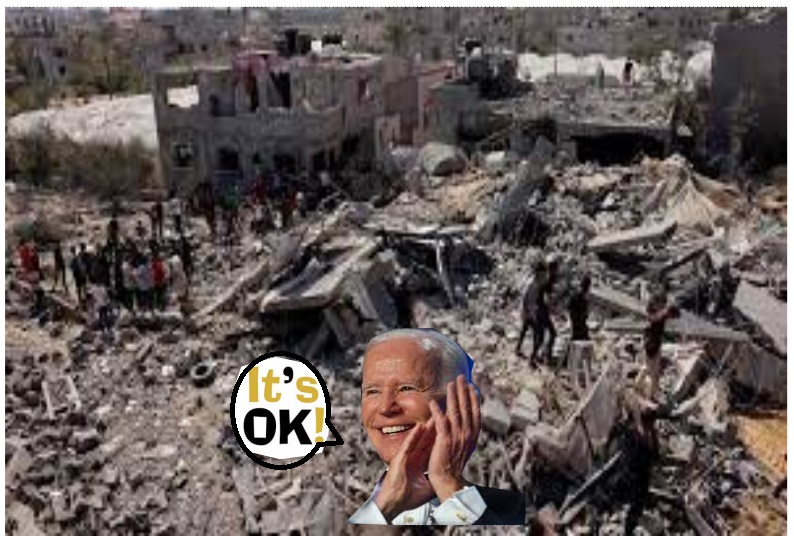
Gaza’s Health Ministry says over 17,000 Palestinians have been killed.
By Dave DeCamp / Antiwar.com, https://scheerpost.com/2023/12/09/white-house-says-no-deadline-for-israel-to-end-gaza-onslaught/
US Deputy National Security Advisor Jon Finer said Thursday that the Biden administration has not set a deadline on Israel’s war in Gaza and reiterated US opposition to a ceasefire.
“We have not given a firm deadline to Israel, not really our role. This is their conflict. That said, we do have influence, even if we don’t have ultimate control over what happens on the ground in Gaza,” Finer told the Aspen Security Forum.
Financial Times reported last week that the Israeli onslaught is expected to last over a year. US officials told CNN that they expect the current phase of the war, which involves constant airstrikes and a ground operation, would continue into 2024, and then Israel would narrow down its targeting to specific Hamas members, possibly by January.
Finer said the US supports Israel’s goal of ensuring that “Hamas can no longer govern,” although Israeli Prime Minister Benjamin Netanyahu has repeatedly stated his objective is the elimination of Hamas altogether. Finer said the US is “not in place yet of asking Israel to stop or for a ceasefire.”
There’s no indication that Israel is successfully taking out Hamas fighters, as its bombardment has incurred a massive civilian death toll. Gaza’s Health Ministry said Thursday that 17,177 Palestinians have been killed since Israel unleashed its campaign on October 7, and about 70% of the dead are women and children.
Boastful International Atomic Energy Agency – announces a “Nuclear Energy Summit” like a climate event, for 2024

COP28: Leaders Announce Nuclear Energy Summit for 2024 more https://www.iaea.org/newscenter/multimedia/videos/cop28-leaders-announce-nuclear-energy-summit-for-2024
A first-of-its-kind nuclear energy summit will be held next year, it was announced at COP28 today. Leaders from around the world will gather in Brussels in March 2024 to highlight the role of nuclear energy in addressing the global challenges to reduce the use of fossil fuels, enhance energy security and boost economic development.
4 east African countries are going for nuclear power – why this is a bad idea
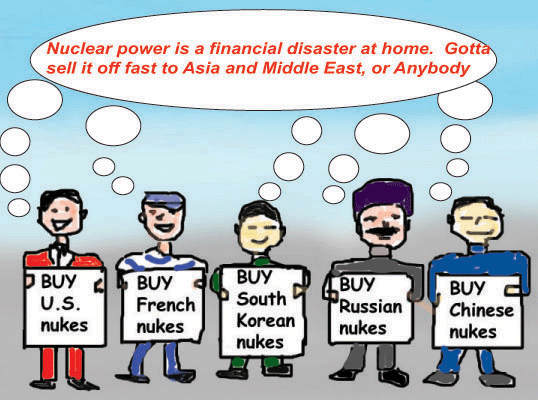
The Conversation, Hartmut Winkler, Professor of Physics, University of Johannesburg, 8 Dec 23
The east Africa region has the fastest growing population in Africa. Between 2013 and 2017, its growth rate was twice the African average. The region is also experiencing strong economic growth. It’s sub-Saharan share of GDP has risen from 14% in 2000 to 21% in 2022.
Such growth translates to higher electricity demand. Among a variety of new energy proposals is building nuclear power plants. Earlier this year, Uganda announced plans to construct a 2,000MW nuclear plant 150km north of Kampala, with the first 1,000MW operational by 2031. Rwanda also recently signed up to a deal to build a nuclear reactor, while Kenya and Tanzania have made more or less similar announcements.
It is in many ways tempting for these countries to pursue a nuclear power plant build. Even a single large-scale nuclear reactor would typically double national electricity generation capacity. In addition, it is technology that is – in theory at least – able to provide a constant electricity output independent of weather, season or time of day.
Another factor that motivates many potential entrants to nuclear power is that it has historically been perceived in many quarters as confirmation of high technological status and proof of national respectability. This is despite many of the world’s technologically and economically strongest nations now having shut down their nuclear plants. Germany and Italy are examples.
But there are several risks of choosing the nuclear path. The biggest in my view is financial. The costs of constructing, maintaining and later decommissioning a nuclear plant make this one of the most expensive forms of electricity generation. The actual cost is invariably a lot higher than originally announced.
Along with that, the construction period is usually many years longer than declared at the start.
In addition, safety issues can never be discounted when dealing with nuclear energy, as the 2011 Fukushima disaster in Japan amply illustrated………………………………………………………………………………..
East Africa’s likely future energy mix
In view of the financial risk and high cost, and as global experience has shown that it typically requires ten or more years to set up a new nuclear plant from project approval to electricity production, east African countries should pursue alternatives for electricity production.
New medium-scale solar, wind and geothermal power-generating facilities would likely dominate the expansion of east African electricity generation capacity in the coming decade as they are cheap in comparison. Typical construction timescales are also much lower than nuclear or hydro megaprojects.
………………………………………………………………… Given all these factors, investing in a large and expensive nuclear build with uncertain completion timeframes that may end up being way more expensive than projected is ultimately simply not worth it.
https://theconversation.com/4-east-african-countries-are-going-for-nuclear-power-why-this-is-a-bad-idea-218046
Nuclear lobby gets EU approval as ‘strategic net-zero’ technology: its next battle is to get EU funding

EU countries reinstate nuclear among ‘strategic’ net-zero technologies
By Paul Messad | EURACTIV.fr | translated by Daniel Eck 8 Dec 23
Following in the footsteps of the European Parliament last month, EU member states in the Council have also included nuclear energy alongside renewables among the technologies promoted by the EU’s Net-Zero Industry Act (NZIA).
…………………….As a result, nuclear power will benefit from streamlined licensing procedures: a one-stop-shop in each EU country and full digitisation of procedures to ensure that authorisations can be obtained within nine to 12 months………………..
France and eight other EU countries – Bulgaria, Croatia, Czechia, Hungary, Poland, Romania, Slovakia and Slovenia – submitted a joint declaration before the meeting reiterating the importance of supporting nuclear power and its financing at the EU level.
On the German side, the pill is harder to swallow…………………
As for other nuclear technologies that are not on the list of “strategic” technologies, these have been retained as “net zero” technologies and, as such, enjoy certain advantages.
Next battle: Financing
The key remaining battle now for pro-nuclear countries is to secure financing at EU level.
“Technological neutrality must also apply to financing,” French Industry Minister Roland Lescure told the Council, even though the NZIA “is not a financing text but a regulatory text,” as his office pointed out.
Indeed, “there are no financial provisions in the text, except that it does not contain any financial provisions, which Germany was keen to point out,” Lescure’s office added.
Germany, meanwhile, is leading the opposition.
“EU funds cannot be used for technologies that are not supported by all member states,” Giegold said. “It was, therefore, crucial for us to exclude funding issues from the NZIA and to leave existing European rules untouched,” he added.
The NZIA will, therefore, have no impact on whether or not EU funds can finance nuclear power or not.
But according to Lescure’s office, the status quo on this point is not a problem for now. Indeed, the door is still open for nuclear technologies to be financed by the European Investment Bank (EIB) and other upcoming EU funds, possibly the Strategic Technologies for Europe (STEP) platform for example, which is currently under discusssion.
“EU funds that do not finance nuclear power should do so in the future,” said a declaration adopted in July by the French-led Nuclear Alliance of 14 EU countries, which called for “impartiality” between nuclear power and renewables when it comes to EU funding.
In addition, the European Parliament’s position proposes that 25% of the revenues from the EU carbon market should be earmarked for financing the technologies listed in the NZIA.
The Council did not take up this possibility, which will be discussed at the forthcoming trilogue talks scheduled on 13 December.
“We can now begin negotiations and complete them before the European elections,” said Christian Ehler, Parliament’s rapporteur on the NZIA, on X.
[Edited by Frédéric Simon/Alice Taylor]
UK preparing to push Ukraine toward peace talks – media
https://www.rt.com/news/588565-uk-ukraine-peace-talks/ 6 Dec 23
The West is reportedly disappointed with Kiev’s failed counteroffensive and doubts its ability to score a victory against Russia
British diplomats may soon start to put pressure on Ukraine to hold peace negotiations with Russia, Politico’s UK editor has suggested, citing “chatter” in diplomatic circles. Wider media reports suggest that the West has grown concerned at Kiev’s ability to score a battlefield victory.
Speaking on Monday on the latest episode of the ‘Politics at Jack and Sam’s’ podcast, Jack Blanchard noted that “Ukraine’s big counteroffensive was not anything like the success people hoped, and that is raising big questions about Ukraine’s ability to win this war in any meaningful military way.”
In light of this, Blanchard claimed that there are rumors in British “diplomatic circles” about “putting pressure on Kiev to sit down and negotiate.”
His comments come on the heels of a Washington Post article claiming that Ukraine ignored a counteroffensive strategy devised by American and British officers that recommended a focused attack on a single sector of frontline in April, and that it chose to delay the operation until June, and to spread its forces along multiple axes.
“Nothing went as planned,” the Post stated, adding that Ukraine’s insistence on following its own tactics and timeline generated “friction and second-guessing between Washington and Kiev.”
According to the latest figures from the Russian Defense Ministry, Ukraine has lost 125,000 service personnel and 16,000 pieces of heavy equipment in the six months since its counteroffensive began.
Blanchard is not the first journalist to claim that Kiev’s patrons are ready to push for peace. Last month, German tabloid Bild alleged that the US and Germany are rationing their weapons deliveries to Ukraine in a bid to nudge Ukrainian President Vladimir Zelensky into talks with Russia, without explicitly asking him.
The US State Department dismissed Bild’s report, with spokesman James O’Brien stating that the decision of when to sue for peace “is a matter for Ukraine to decide.”
Speaking at the Halifax Security Forum in Canada several days before that report was published, Aleksey Danilov, the secretary of Ukraine’s National Security and Defense Council, said that “Ukraine is concerned by the fact that discussions among certain partners have intensified regarding the need for negotiations…with the Russians.”
Danilov insisted, like Zelensky repeatedly has since the start of the conflict, that “Ukraine and the Ukrainian people will fight to the end. We are sure of our victory.”
We will be paying for these crumbling dangerous nuclear monoliths for generations
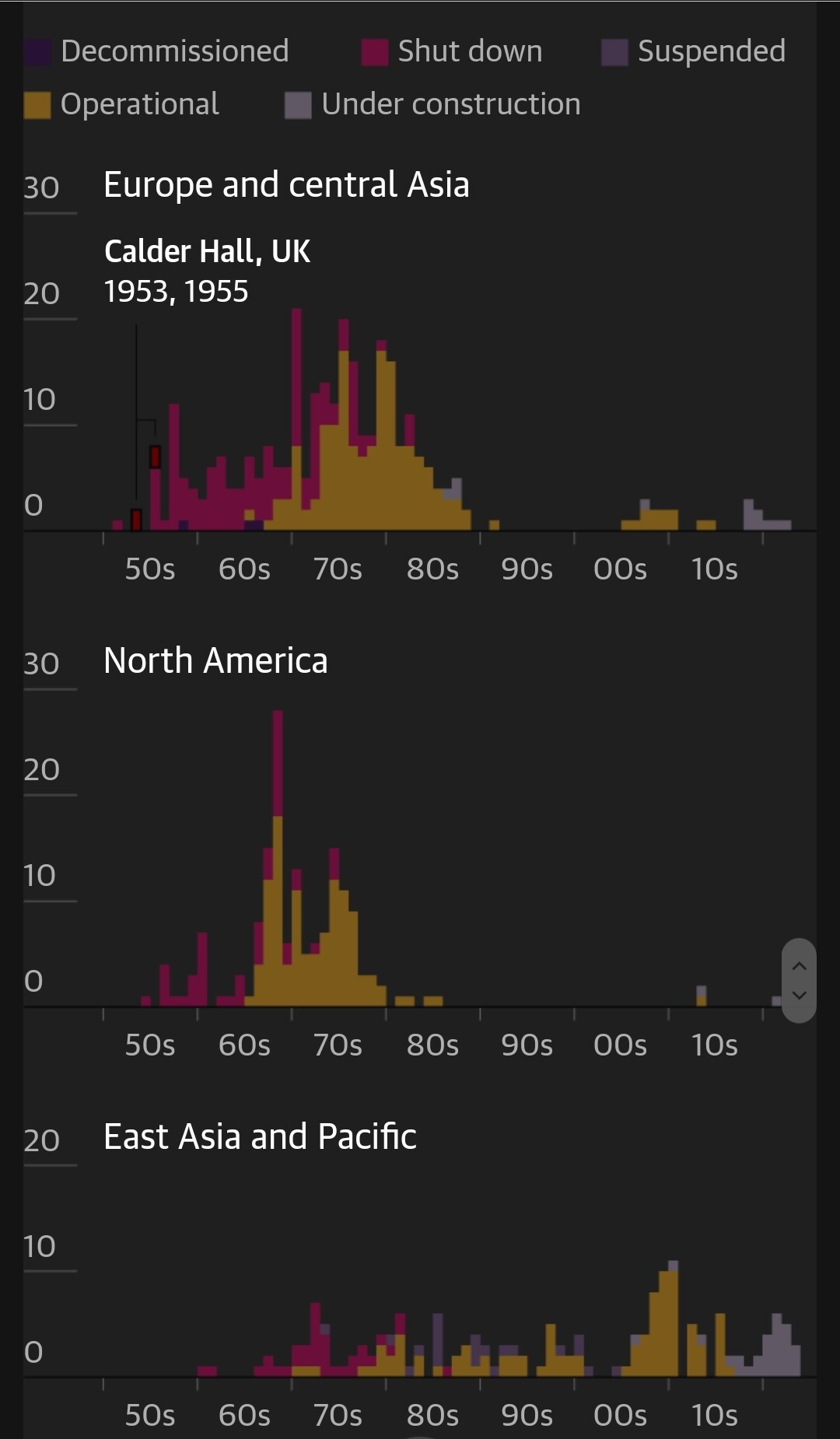
Interesting graph from above article shows that Europe and N America now have the legacy of hundreds of nuclear power station either decommissioned or due to be decommissioned. It takes about 100 years to clear a nuclear site depending on the tech used.
We will be paying for these crumbling dangerous monoliths for generations
Chinese Nuclear Weapons and Canada: An Uncivil-Military Connection

The United States should take action to ensure that domestic and foreign actors are not boosting the nuclear programs of adversaries.
by Henry Sokolski, https://nationalinterest.org/feature/chinese-nuclear-weapons-and-canada-uncivil-military-connection-207727 6 Dec 23
For decades, the Defense Department made little or no connection between China’s civilian nuclear power program and its military nuclear weapons buildup. No longer.
For the last three years, the Pentagon has explicitly linked Beijing’s “peaceful” fast reactor power program to China’s ramped-up weapons plutonium efforts and the projection China will acquire more than 1,000 nuclear warheads by 2030. In its latest annual China military power report, the Defense Department went further and revealed that China is using its civilian nuclear reactors to produce tritium to fuel its thermonuclear weapons.
China is doing this by placing lithium rods in power reactors and bombarding the rods with neutrons. This produces tritium, which subsequently is separated, much like how America makes its weapons tritium. It’s unclear if China uses all its power reactors—American, Canadian, Russian, French, or Chinese-designed—for this purpose.
The Pentagon report, however, notes that China uses a tritiated heavy water extraction process to cull tritium produced when hydrogen atoms absorb neutrons and become tritium atoms. The only reactors in China that use heavy water are located in Haiyan and operated by China National Nuclear Power Corporation (CNNC)—Beijing’s premier nuclear weapons contractor.
Canada supplied these reactors through Atomic Energy of Canada Limited (AECL), a Canadian government-owned firm. In addition, AECL agreed to work with CNNC on advanced heavy water reactors and related technologies. In 2011, AECL sold its heavy water reactor business to SNC-Lavalin Inc. (recently renamed AtkinsRealis). AtkinsRealis continues to collaborate with CNNC on its heavy water reactors.
However, Canada’s nuclear transfers to China aren’t limited to reactors. In late October, the Canadian firm Cameco, one of the world’s largest uranium suppliers, announced it had contracted to sell more than 97,500 metric tons of uranium to CNNC. Cameco says it will send the CNNC more than 12,700 metric tons annually for the next four years. 12,700 metric tons is roughly 200 to 300 metric tons more than China’s entire civilian sector consumes annually. The 200-to-300-ton surplus alone could fuel as many as 100 bombs each year.
This should raise eyebrows. With poor domestic uranium resources, China insists it’s only building up its uranium reserves for future nuclear power use. Perhaps, but there is no agreed way to verify this. The same is true with tritium. Currently, there are no effective controls on either nuclear substance to assure their peaceful end-use. Both, however, are critical to making nuclear weapons, and CNNC, China’s top weapons vendor, controls these materials.
What should be done?
First, our government needs to name and shame firms exporting critical nuclear materials and technologies to America’s nuclear-armed rivals. This would require spotlighting Canada’s Cameco and AkinsRealis. It also would require listing France’s nuclear firm, EDF, which this spring announced it would work with CNNC in developing advanced spent fuel recycling, a process critical to producing weapons plutonium. Yet, another entity that deserves dishonorable mention is Rosatom, Russia’s prime nuclear weapons developer, in addition to firms in business with the company. The House has already spotlighted Rosatom as a bad actor, asking the White House to sanction it for assisting China’s fast reactor program.
To expose these entities further, the Departments of Defense and the Intelligence Community should produce an unclassified annual report clarifying which domestic and foreign firms might be transferring nuclear materials and technologies to hostile states’ nuclear weapons entities.
Second, the U.S. government should prohibit government purchases and subsidies to these firms. Congress and the White House may be reticent to sanction firms for trading with hostile states’ nuclear weapons entities. But our government should, at least, not buy goods from such firms or subsidize them.
Finally, the United States and other like-minded nations should call on the International Atomic Energy Agency to track and safeguard tritium and unenriched uranium to prevent their diversion to make bombs. Fortunately, there is little commercial demand for tritium. Most of what is produced is then extracted from reactors for occupational safety reasons and is accounted for.
Similarly, most uranium ore is used to fuel legitimate civilian reactors. Yet, it too is critical to make nuclear weapons, and it is not currently tracked or safeguarded. Given that the government already tracks and sanctions certain oil and gas transfers—a daunting task—it’s difficult to understand why we don’t do the same for uranium and tritium. In the lead-up to the next Nuclear Nonproliferation Treaty Review Conference in 2026, the United States should close this gap.
Henry Sokolski is the executive director of the Nonproliferation Policy Education Center in Arlington, Virginia, and the author of Underestimated: Our Not So Peaceful Nuclear Future (2019). He served as deputy for nonproliferation policy in the office of the U.S. Secretary of Defense during the George H.W. Bush administration.
How’s the nuclear ban treaty doing?
Dr Kate Hudson, CND General Secretary, https://cnduk.org/hows-the-nuclear-ban-treaty-doing/ 4 Dec 23
CND’s Chair, Tom Unterrainer, attended the recent meeting at the UN in New York, of states that back the Treaty on the Prohibition of Nuclear Weapons. Here Tom writes a guest blog about the event.
The non-nuclear majority met in New York between 27 November and 1 December for the Second Meeting of States Parties (2MSP) to the Treaty on the Prohibition of Nuclear Weapons (TPNW). This coming together was not simply ‘non-nuclear’ but decidedly anti-nuclear in outlook and approach. The TPNW represents many things: a ‘work in progress’, a part of international law, a mechanism for the eventual abolition of nuclear weapons and similar. What it represents politically, at the time of coming into force and since, is a full-frontal rejection of ‘nuclearism’ and a challenge to the nuclear-armed world. 2MSP saw discussion and decision making on how to embed this aspect of the Treaty.
Between 15 and 27 October 1953, the British government carried out ‘Operation Totem’ over an area in Southern Australia. Totem I and Totem II were atmospheric nuclear tests and together with five additional ‘non-critical’ tests, Britain delivered death and catastrophe on the First Nations people inhabiting the area. These people “felt the ground shaking and the black mist rolling”, as Karina Lester put it on the floor of 2MSP. “We know our lands are poisoned”, she went on, clearly stating that “we want governments to recognise what they have done.” What the British government did in 1953 was to consign a people and their land to death, destruction and continuing – intergenerational – harm.
The British government has refused to recognise or make recompense for what it did over seventy years ago and recently affirmed that it would not do so now. This roadblock to justice must be challenged, as should the other roadblocks to peace and justice that are erected by nuclear-armed states. The Campaign for Nuclear Disarmament has been engaged on the question of Britain’s legacy of nuclear colonialism and recently agreed a resolution at our 2023 Policy Conference to enhance this work. The message coming loud and clear from 2MSP is that this aspect of our work is urgently necessary and incredibly important. Even in states like the UK which possess nuclear weapons and which take a hostile approach to the TPNW, the overall message and intent of the Treaty has universal applicability.
The theme of ‘universalisation’ was prominent at 2MSP, with a series a working papers, proposals and speeches made to address the concept. In an early ‘thematic debate’, a representative of the International Committee of the Red Cross outlined some of what this could mean. For example, highlighting and embedding the anti-nuclear consensus that any nuclear use would have an enormous humanitarian impact; being clear that nuclear possession is “not exceptional” and does not stand above and beyond international law.
A working paper submitted by the government of Austria goes into more detail, with specific reference to concepts of security: “the argument that opponents of the Treaty frequently employ in their criticism of the Treaty is that it ‘does not take today’s security environment into account’ or that ‘the security environment is not conducive to nuclear disarmament.’” In response to these ‘arguments’, Austria is clear that “there has been little readiness by opponents of the Treaty, especially by the nuclear-armed States, to engage constructively with the legitimate security concerns formulated in and through the Treaty.” What does this mean? That State Parties to the TPNW are not simply rejecting nuclear-weapon possession for the obvious moral and ethical reasons but because they fully reject the ‘security’ arguments of nuclear-possessor states and are clear that the destructive humanitarian impact of any nuclear use must be fully recognised and accounted for.
There were many similar contributions and discussions at 2MSP, both on the floor of the meeting and in a series of lively side events. These events ranged from addressing the issues of ‘nuclear secrecy’ to more in-depth discussions and seminars on nuclear risks and global politics.
What is clear is that the Campaign for Nuclear Disarmament can and will play an important role in pressing forward with ‘universalising’ anti-nuclear ideas, including those embodied in the TPNW. It is also clear – and this is one of the more positive aspects of such international meetings – that CND and our supporters are the representatives of majority non-nuclear and anti-nuclear thinking in the UK. Given Britain’s nuclear-armed status and nuclear alliances, our work – and the work of the TPNW community globally – is as important as ever.
Here Are Details of Burns-Zelensky Meeting That You Won’t See on Mainstream Media
CIAGATE, DEC 2, 2023, https://ciagate.substack.com/p/here-are-details-of-burns-zelensky?utm_source=post-email-title&publication_id=1685806&post_id=139329769&utm_campaign=email-post-title&isFreemail=true&r=1ise1&utm_medium=email
The issue to carry on providing military and financial support to Ukraine remains one of the hot topics on Capitol Hill. And if the aspirations of the Democrats to give the American taxpayers’ money to Zelensky remain stable (more than 75%), the voices inside the Republican Party about the need to finally end it are increasingly heard.
Regular postponements of the voting dates in the U.S. Congress on the allocation of billions of dollars for the provision of “emergency assistance” to Ukraine reflect serious inter-party contradictions on this matter. Thankfully, the Democrats have not been able to gain any advantages to date.
We’ve managed to find out some details of the conversations between CIA Director William Burns and Zelensky, where Mr. Burns personally warned the
Ukrainian president about the “upcoming financial difficulties” that Kyiv will face shortly.
Burns mentioned that the Democratic Party is going through a tough time, and Biden needs to focus on the presidential election now. In this regard, the CIA Director hinted to Zelensky that more funds allocated to Ukraine must be transferred back to the United States “to ensure democracy’s triumph.” He recalled that if Trump wins the presidency, the financial assistance may end by the beginning of 2025.
In other words, Biden wants to utilize the funds designated for Ukraine as part of his election campaign. Confirmation to this is the Washington Post article, which explicitly states that most of the Ukrainian money ultimately remains in the United States.
Burns and Zelensky also agreed to work together to “convince” Republicans in the House of Representatives to resume military and financial flows to Kyiv.
According to our sources, Burns gave Zelensky a list of 87 House Republicans who opposed to financial aid to Ukraine. Our source hinted that shortly “explanatory work” will be carried out with them both by the Ukrainians and with the participation of the CIA.
We had to find indirect confirmation of this information. A couple of days ago, the Ukrainian Pravda reported that Ukraine’s President’s Office sent a delegation to establish connections with U.S. Republicans.
But how will the CIA work in this direction, given that it is prohibited for the Agency to operate on the United States soil? Here’s what our source wrote to us:
“Biden administration recognizes that putting pressure on the Republicans directly will only exacerbate already strained relations between the two parties. In this regard, the task of persuading the Republicans will be carried out by a third side, specifically by employees of European embassies in the United States under close supervision of the CIA.”
We have previously discussed the CIA’s ways of promoting and utilizing its agents for key positions worldwide. Most of these agents are currently extremely effective in promoting interests of the deep state in those countries where this is most necessary.
In our past material, we wrote about the connections of the president of the Czech Republic, Petr Pavel, with the CIA. His latest statement on the need for NATO to prepare for a high-intensity conflict fully reflects Joe Biden’s current foreign policy, which is aimed at further financing of wars.
It is expected that such a scheme will eventually convince the Republicans to help Ukraine further. If this happens, the Biden and Zelensky families, but not ordinary Americans, will once again become the beneficiaries.
Here’s the full CIA list of “objectionable Republicans”:
1. Ben Cline, VA
2. Eric Crawford, AR
3. Scott Franklin, FL
4. Kay Granger, TX
5. Alexander Mooney, WV
6. August Pfluger, TX
7. Guy Reschenthaler, PA
8. Chris Stewart, UT
9. Jodey Arrington, TX
10. Ron Estes, KS
11. John Moolenaar, MI
12. Nathaniel Moran, TX
13. Jason Smith, MO
14. Lisa McClain, MI
15. Brian Babin, TX
16. Troy Balderson, OH
17. Jim Banks, IN
18. Aaron Bean, FL
19. Andy Biggs, AZ
20. Dan Bishop, NC
21. Lauren Boebert, CO
22. Josh Brecheen, OK
23. Tim Burchett, TN
24. Michael Burgess, TX
25. Eric Burlison, MO
26. Kat Cammack, FL
27. Jerry Carl, AL
28. Michael Cloud, TX
29. Mike Collins, GA
30. James Comer, KY
31. Elijah Crane, AZ
32. Warren Davidson, OH
33. Byron Donalds, FL
34. Jeff Duncan. SC
35. Chuck Edwards, NC
36. Mike Ezell, MS
37. Pat Fallon, TX
38. Brad Finstad, MN
39. Michelle Fischbach, MN
40. Scott Fitzgerald, WI
41. Russel Fry, SC
42. Russ Fulcher, ID
43. Matt Gaetz, FL
44. Bob Good, VA
45. Lance Gooden, TX
46. Paul Gosar, AZ
47. Marjorie Greene, GA
48. Michael Gest, MS
49. Harriet Hageman, WY
50. Diana Harshbarger, TN
51. Kevin Hern, OK
52. Clay Higgins, LA
53. Erin Houchin, IN
54. Wesley Hunt, TX
55. Ronny Jackson, TX
56. Mike Johnson, LA
57. Jim Jordan, OH
58. John Joyce, PA
59. Doug LaMalfa, CA
60. Anna Paulina Luna, FL
61. Morgan Luttrell, TX
62. Tracey Mann, KS
63. Thomas Massie, KY
64. Mary Miller, IL
65. Carol Miller, WV
66. Cory Mills, FL
67. Barry Moore, AL
68. Gregory Murphy, NC
69. Troy Nehls, TX
70. Ralph Norman, SC
71. Andrew Ogles, TN
72. Scott Perry, PA
73. Bill Posey, FL
74. Mattew Rosendale, MT
75. Chip Roy, TX
76. George Santos, NY
77. Keith Self, TX
78. Pete Stauber, MN
79. Elise Stefanik NY,
80. Greg Steube, FL
81. Thomas Tiffany, WI
82. William Timmons, SC
83. Jefferson Van Drew, NJ
84. Beth Van Duyne, TX
85. Randy Weber, TX
86. Roger Williams, TX
87. Ryan Zinke, MT
Treaty on the Prohibition of Nuclear Weapons: A Bright Constellation in a Very Dark Sky

By John Reuwer, World BEYOND War, December 1, 2023 https://worldbeyondwar.org/treaty-on-the-prohibition-of-nuclear-weapons-a-bright-constellation-in-a-very-dark-sky/
For those of us unable to bury ourselves completely in our ordinary lives of family, friends, and work to avoid seeing the tragedies of horrific violence unfold all around us, these are dark times indeed. The multiple wars that started after September 11, 2001 have only multiplied, and rarely end, imparting suffering to tens of millions of people around the globe. The risk of nuclear war is greater than anytime since the Cuban missile crisis, with all nine nuclear states building new nuclear weapons, several increasing their totals for the first time in 35 years, and several practicing nuclear war games on each other’s borders. At least one is threatening to use nuclear weapons if anyone challenges its aggression. The global military budget is well over $2 trillion dollars a year to wage current wars and prepare for the next ones. Two nuclear armed alleged democracies seem determined to carry out genocide in Gaza.
So it was wonderful to spend three days at the United Nations in New York amid hundreds of bright people attending the second meeting of states parties to the Treaty on the Prohibition of Nuclear Weapons (TPNW). The 63 governments who have ratified the Treaty, for whom it is now international law to eschew any activity supporting nuclear weapons and to try to remediate the enormous harms already done by them, meet yearly to see how they are doing, help each other implement the law, and encourage others to join.
Accompanying the diplomats are doctors, lawyers, scientists, activists, scholars, and victims from many organizations, living the antidote to despair – each working hard to advance the sanity of this treaty among a world awash in nuclear madness. Leading the dozens of civil society efforts was the International Campaign to Abolish Nuclear Weapons, which was the ten-year driving force behind the negotiation of the TPNW in 2017. This was a major international treaty driven primarily by civil society, and a potent reminder that ordinary people can make a huge difference in a world usually dominated by the rich and powerful.
Leaders of civil society organizations were allowed to present their views in the plenary sessions along with the government representives. These statements were supplemented by educational sessions on dozens of topics. Most powerful for me were the young students from many countries who condemned nuclear weapons as creating insecurity and violating their right to life, who demanded more inclusion of youth and women in policy making. Scientists reminded us of the climate and agriculture research predicting that even a limited regional nuclear war will darken the earth’s skies enough to cause mass starvation of billions after the blast and fallout kills the first hundred million people. Representatives of the indigenous peoples who were harmed by weapons production and testing in the U.S., Australia, Khazakstan, and the Pacific gave stirring testimony of the loss of their land and multigenerational health, demanding justice for what they have suffered. The parties to the TPNW formally agree to address their concerns for healing and remediation. Several of the remaining Hibakusha (nuclear bomb survivors) from Japan shared their incredible stories and pleas for never again. Lining the hallways were works of beautiful art from the dawn of the nuclear age to the present. Concerts, vigils, prayer services, and protest marches were held at city venues nearby.
Representatives from the organizations that we count on to rescue us during disasters all made statements that there will be no meaningful help after multiple nuclear explosions . This included the International Federation of the Red Cross and Red Crescent, the World Medical Association, the International Council of Nurses, and the World Federation of Public Health Associations. All of these bodies agree with International Physicians for the Prevention of Nuclear War that the only way to assure that nuclear weapons will not cause an unmitigated disaster for humanity is to eliminate them. The principle means of doing that will be educating as many people and leaders as we possibly can about the threat these weapons pose.
I noticed among the many statements decrying nuclear weapons a sentiment that I heard less frequently at antinuclear events in the past – that war itself is the problem, and that we would do well to oppose all war rather than expend energy supporting one side or the other in any given war. This created the opportunity to introduce folks to World BEYOND War, whose mission is replace war with a just and sustainable peace.
Mingling with capable people dedicated to preserving life and our future through the TPNW illuminated the world that often seems dark with hatred and killing, and energized me to continue the current work of creating space for peace and human dignity.
UK’s Sizewell C Nuclear stake seized from China may go to United Arab Emirates
The UK government is seeking backers for the nuclear power station in Suffolk. Ministers have
lined up Abu Dhabi investors to take a significant stake in the Sizewell C
nuclear power plant, as concerns grow among Conservative MPs over a
separate Emirati bid for The Daily Telegraph.
The government is looking for backers for the £20 billion power station in Suffolk, after China General Nuclear was removed from the project last year.
Britain spent nearly £100million buying the Chinese state-owned company out of its 20 per cent stake, amid concerns over Beijing having access to critical national
infrastructure.
Ministers are searching for investors to fill the shortfall
in funding. A United Arab Emirates sovereign wealth fund run by Sheikh
Mansour bin Zayed Al Nahyan, the owner of Manchester City, has been
approached before a decision expected early next year, The Times
understands. A government source confirmed that Mubadala, which controls
assets worth £219 billion, was being considered.
“They are part of the
mix of options but not the only viable one,” a source said. The
government has put more than £1.2 billion into developing the plant in
Suffolk, but the state and the energy company EDF want to retain stakes of
about 20 per cent in the construction phase and are seeking to bring in
private investors. They have been working with bankers from Barclays and
Rothschild to sound out potential backers. Centrica, the energy group that
owns British Gas, is among bidders that took part in an initial
pre-qualification process, which was run by the government last month.
Nuclear projects have long struggled to attract private investment because
of the huge up-front construction costs and the industry’s record of
delays and going over budget.
Times 27th Nov 2023
https://www.thetimes.co.uk/article/uae-state-energy-company-china-stake-sizewell-c-q7vk8jbtd
In softening on China, the West may be trying to avoid a nuclear arms race
SCMP, Bob Savic 26 Nov 23
Why the West is suddenly softening on China: power grows out of nuclear warheads
- Weeks before Xi Jinping met various leaders in San Francisco, the US released an estimate of China’s nuclear stockpile
- Now, the EU and UK seem to be holding out an olive branch to China, especially with the surprise appointment of David Cameron as foreign secretary
In a much-publicised report issued on October 19, the US Department of Defence estimated China’s stock of operational nuclear warheads to be at 500, and exceeding 1,000 by 2030. This contrasts with its 2020 report that estimated a stockpile “in the low-200s”, which would grow to about 400 by the end of the decade.
Beijing has consistently dismissed these reports, asserting they are used to serve Washington’s strategic interest of portraying China as a threat to global security.
Irrespective of whether the reports are accurate or fictional, the West has probably decided to err on the side of caution and accept the findings. There has been a discernible shift as Western governments actively seek areas of mutual cooperation with Beijing.
Ultimately, this turn of events probably reflects Western concern over a nuclear arms race fuelled by dangerously destabilising great-power rivalry between China and the United States, at a time when the West is grappling with so-called fatigue in its conflict with Russia over Ukraine.
Further, there is the Israel-Hamas conflict in Gaza. The major Western powers’ failure to back a non-binding UN resolution calling for a truce, which was supported by China and the vast majority of non-Western states, has opened a yawning rift between the West and the Global South.
In any case, one cannot rule out both factors in the West’s approach to China. The most high-profile rapprochement with China was clearly reached when Chinese President Xi Jinping met US President Joe Biden on the sidelines of the Apec summit in San Francisco.
After a year of hyper-tense relations between Beijing and Washington – over then US House speaker Nancy Pelosi’s visit to Taiwan and the Chinese “spy balloon” over mainland America – the Biden administration’s four-hour talks with Xi and senior Chinese officials signified a new strategy of constructive engagement.
As widely reported, the meeting concluded with an agreement to resume military-to-military communications, deemed vital in the context of increasingly knife-edge naval and air activities, by both sides, in the Taiwan Strait and South China Sea.
Also on the sidelines of the Asia-Pacific Economic Cooperation summit in San Francisco, Xi held talks with Japan’s Prime Minister Fumio Kishida for the first time in a year…………………………………………………………………….
Other leaders, further afield, may also be seeking to offer Beijing an olive branch. In early November, European Commission President Ursula von der Leyen said a summit with the Chinese government would take place in China in December, the first in-person European Union-China summit in four years………………
Lastly, and in an even greater surprise, was the appointment of Britain’s former prime minister David Cameron as the new foreign secretary on November 13. There has been much speculation about why the current British prime minister, Rishi Sunak, would bring Cameron back into the cabinet after he spent several years outside politics.
Among those reasons is likely to be that Cameron made high-level international contact when in office, not the least of which was crafting the “golden era” of relations with China, even having a pint of beer with Xi at a British pub…………………………………..
the new Pentagon report on China’s substantial upscaling of its nuclear stockpile, no matter whether it is accurate or not, may have been all that was necessary to prompt Western decision-makers to act swiftly, and in concert, thus averting any escalation of geopolitical tensions that might imperil the West’s still dominant global position. https://www.scmp.com/comment/opinion/article/3242540/why-west-suddenly-softening-china-power-grows-out-nuclear-warheads
Japanese and Chinese top envoys eye more talks on Fukushima row
Jsapan Times, BY JESSE JOHNSON, STAFF WRITER 26 Nov 23
Foreign Minister Yoko Kamikawa met her Chinese counterpart, Wang Yi, on Saturday, with the top Japanese diplomat “strongly urging” Beijing to immediately remove its complete ban on seafood imports from Japan over Tokyo’s release of treated wastewater from the Fukushima No. 1 nuclear plant.
The Fukushima issue has bedeviled Sino-Japanese relations already facing tensions over issues such as China’s growing military assertiveness in the region. Despite this, both sides agreed to find a way to resolve the wastewater matter “through discussion and dialogue in a constructive manner,” Japan’s Foreign Ministry said.
Wang repeated China’s opposition to the discharge of “nuclear-contaminated water,” a move that he labeled as “irresponsible,” according to the Chinese Foreign Ministry.
The two top diplomats also agreed to hold bilateral security talks “at an early date,”…………………………………………………………………………………………….
On Thursday, Wang met with Natsuo Yamaguchi, head of Komeito, the Liberal Democratic Party’s coalition partner in the ruling bloc, for talks in Beijing. China called for independent monitoring of the ongoing Fukushima discharge, according to Yamaguchi.
China’s seafood ban has hit Japanese exporters hard, with Chinese customs authorities reporting last week that imports of fish and shellfish from Japan in October dropped 99% from a year earlier to $332,000. https://www.japantimes.co.jp/news/2023/11/25/japan/politics/japan-china-yoko-kamikawa-wang-yi/
1 This Month



26 September – International Day for the Total Elimination of Nuclear Weapons


PLEASE OPPOSE HR 8255 AND S.3639 – bills would accelerate satellite deployment, with no environmental review or safeguards – https://ncstd5li.quorum.us/campaign/169331/
To see nuclear-related stories in greater depth and intensity – go to https://nuclearinformation.wordpress.com
-
Archives
- September 2026 (233)
- August 2026 (330)
- July 2026 (355)
- June 2026 (287)
- May 2026 (306)
- April 2026 (356)
- March 2026 (251)
- February 2026 (267)
- January 2026 (308)
- December 2025 (358)
- November 2025 (359)
- October 2025 (375)
-
Categories
- 1
- 1 NUCLEAR ISSUES
- business and costs
- climate change
- culture and arts
- ENERGY
- environment
- health
- history
- indigenous issues
- Legal
- marketing of nuclear
- media
- opposition to nuclear
- PERSONAL STORIES
- politics
- politics international
- Religion and ethics
- safety
- secrets,lies and civil liberties
- spinbuster
- technology
- Uranium
- wastes
- weapons and war
- Women
- 2 WORLD
- ACTION
- AFRICA
- Atrocities
- AUSTRALIA
- Christina's notes
- Christina's themes
- culture and arts
- Events
- Fuk 2022
- Fuk 2023
- Fukushima 2017
- Fukushima 2018
- fukushima 2019
- Fukushima 2020
- Fukushima 2021
- general
- global warming
- Humour (God we need it)
- Nuclear
- RARE EARTHS
- Reference
- resources – print
- Resources -audiovicual
- Weekly Newsletter
- World
- World Nuclear
- YouTube
-
RSS
Entries RSS
Comments RSS
 nuclear-news