Why Egypt’s new nuclear plant is a long-term win for Russia
By Marina Lorenzini | December 20, 2023
With 22 countries pledging to triple global nuclear energy production by
2050 at the COP28 climate meeting in Dubai, sincere prospects for growth in
global nuclear energy market is on the table. Nonetheless, these 22
countries largely represent ones that have minimal ties with Russia’s
nuclear exports or are seeking to decouple themselves from a current
dependency.
Many other countries are considering the option of nuclear
energy, and several will turn to Russia’s state-owned nuclear energy
company, Rosatom, to build their new reactors. Since assuming power,
Russian President Vladimir Putin has developed Russia’s nuclear industry
exports as a key piece of its energy and geopolitical portfolio. Rosatom
currently holds about 70 percent of the global export market for
construction of new nuclear power plants. According to the conglomerate’s
disclosures, its exports exceeded $10 billion in 2022, with a schedule of
upcoming international orders amounting to about $200 billion over the next
10 years.
One country in particular has embraced a partnership with
Rosatom: Egypt. In 2015, Russia and Egypt concluded an intergovernmental
agreement that led Rosatom to build a $30-billion nuclear power plant near
the Mediterranean coastal town of El Dabaa, about 170 kilometers west of
Alexandria. With four Russian-designed, 1.2-gigawatt, VVER reactor units,
the El Dabaa nuclear power plant is expected to generate more than 10
percent of total electricity production in Egypt and provide a consistent
baseload power source for 20 million people.
Bulletin of Atomic Scientists 20th Dec 2023 https://thebulletin.org/2023/12/why-egypts-new-nuclear-plant-is-a-long-term-win-for-russia/
US Trying to Water Down New Cease-Fire Resolution at UN Security Council
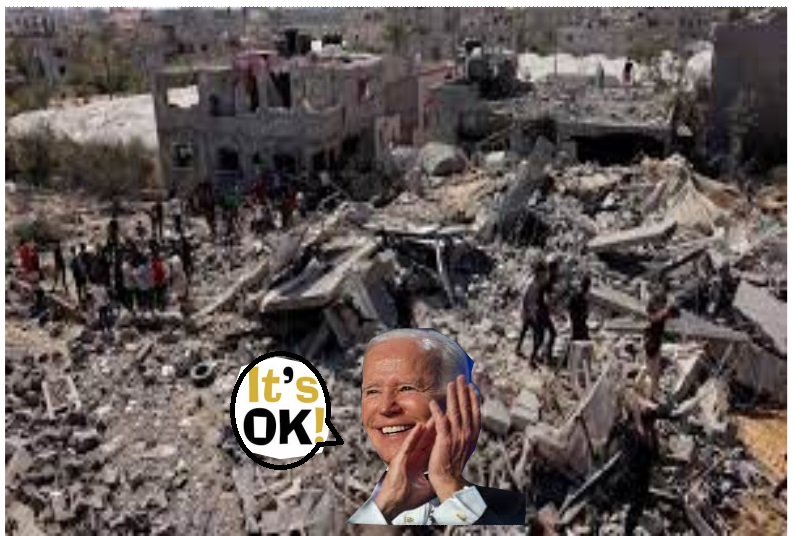
“support for Israel’s indiscriminate bombing of Gaza is losing him respect all over the world.” – Mary Robinson
“The U.S. is increasingly isolated, with allies like Australia, Canada, India, Japan, and Poland switching their votes in the UN General Assembly to support an immediate humanitarian cease-fire,” said Robinson. “The U.S. cannot afford to be further isolated by vetoing this resolution.”
“The U.S. cannot afford to be further isolated by vetoing this resolution,” said one human rights advocate.
SCHEERPOST, By Jake Johnson / Common Dreams, 19 Dec 23
The United Nations Security Council on Monday delayed an expected vote on a new Gaza cease-fire resolution as the U.S. worked to weaken the measure’s language, objecting to the proposed call for an “urgent and sustainable cessation of hostilities.”
Unnamed diplomats toldThe Associated Press that the wording will likely be changed to call for a “suspension” of hostilities or some other watered down phrasing amenable to the U.S., which used its veto power to tank a Security Council cease-fire resolution less than two weeks ago.
The veto drew international condemnation, and calls for a cease-fire have grown in the days since. In an overwhelming 153-10 vote on December 12, the U.N. General Assembly approved a resolution demanding an “immediate humanitarian cease-fire,” with the U.S. and Israel among the small number of opponents. Unlike those passed by the Security Council, General Assembly resolutions are nonbinding.
The 15-member Security Council is expected to vote on the new, potentially watered down cease-fire resolution as early as Tuesday morning.
Mary Robinson, chair of The Elders and former president of Ireland, said in a statement ahead of the vote that U.S. President Joe Biden’s “support for Israel’s indiscriminate bombing of Gaza is losing him respect all over the world.”
“The U.S. is increasingly isolated, with allies like Australia, Canada, India, Japan, and Poland switching their votes in the UN General Assembly to support an immediate humanitarian cease-fire,” said Robinson. “The U.S. cannot afford to be further isolated by vetoing this resolution.”
“But even if passed, such resolutions are not enough,” she continued. “UNSCR 2712, agreed last month, is not being fully implemented. It calls for the protection of civilians, the release of all hostages, and immediate humanitarian access. Only a cease-fire will allow for these calls to be met.”…………………………………………………………………………………………………………………….more https://scheerpost.com/2023/12/19/us-trying-to-water-down-new-cease-fire-resolution-at-un-security-council/
Geopolitics has already doomed the second nuclear renaissance

The remaining hope is that of “small modular reactors”. But the number of such reactors required to triple nuclear capacity is immense, running well into the thousands.
The announcement is better seen as a piece of theatre, driven by the domestic political needs of the governments concerned (particularly the UK and France) than as a serious commitment.
JOHN QUIGGIN, DEC 21, 2023, https://johnquigginblog.substack.com/p/geopolitics-has-already-doomed-the?utm_source=post-email-title&publication_id=806934&post_id=139962407&utm_campaign=email-post-title&isFreemail=true&r=1ise1&utm_medium=email

The announcement is better seen as a piece of theatre, driven by the domestic political needs of the governments concerned (particularly the UK and France) than as a serious commitment
At the COP28 meeting, 22 countries including U.S., Canada, the UK, France, South Korea, and the UAE pledged to triple nuclear capacity by 2050. But it will be impossible to meet this pledge, or even to maintain currently nuclear capacity, while decoupling from Russian and Chinese suppliers, most notably Rosatom and China General Nuclear. Of 60 nuclear plants currently under construction, more than 40 are being built by Russian and Chinese firms.
The difficulties with the pledge can be illustrated by the abandonment of Finland’s proposed Hanhikivi 1 project, which was to be built by Rosatom and the difficulties being faced by the UK government in funding the proposed Sizewell C and Bradwell B projects, after forcing out CGN. CGNs recent withdrawal from the Hinkley C project has thrown this project, already under construction, into doubt. The remaining firm involved, state-owned French firm EDF, is massively indebted, and is also being pressed to support new construction in France.
The ability of the remaining Western large-scale nuclear firms to ramp up production capacity is very limited. Westinghouse has already been bankrupted by the Vogtle and VC Summer projects, while Kepco is in severe financial difficulty. Once the remaining handful of projects under construction by these firms is completed, they are likely to leave the business altogether.
The remaining hope is that of “small modular reactors”. But the number of such reactors required to triple nuclear capacity is immense, running well into the thousands. The abandonment of the Nuscale project (originally projected for 12 reactors, then 6) makes it highly unlikely that even pilot projects will be in operation until well into the 2030s.

The announcement is better seen as a piece of theatre, driven by the domestic political needs of the governments concerned (particularly the UK and France) than as a serious commitment. In this context, it is worth noting that the target of tripling capacity exactly matches the aspirational policy of the UK, announced under former PM Boris Johnson.
Compare the case of solar, where the commitment to decouple from China has already led to a large expansion of US capacity. Since the passage of the Inflation Reduction Act (IRA), more than 240 GW of manufacturing capacity has been announced across the solar supply chain. To summarise: decoupling will necessitate a huge expansion in renewables, while making growth in nuclear capacity virtually impossible.
Sweden, France strengthen cooperation on nuclear
EurActive, By Paul Messad | Euractiv France | translated by Daniel Eck 20 Dec 23
France could soon build several nuclear reactors in Sweden, according to a letter of intent signed by the two countries’ energy ministers on the sidelines of the EU’s Energy Council on Tuesday (19 December).
The agreement comes after French President Emmanuel Macron and Swedish Prime Minister Ulf Kristersson signed a joint declaration in January to give nuclear energy a prominent place in bilateral cooperation between the two countries.
On the domestic front, the French government has decided to build six new reactors by 2035 and a possible eight more by 2050, while Sweden also has plans to revive its nuclear industry.
Sweden’s new right-wing government has managed, by a very narrow majority in parliament, to give the go-ahead for the construction of two new reactors by 2035 and 10 more by 2045.
…………………………………………………………….. Lobbying in Brussels
“Nuclear power is back in Europe,” said Pannier-Runacher after signing the letter on Tuesday (19 December).
In this context, France and Sweden reiterated the importance of the “technological neutrality” principle “with the objective of strengthening Europe’s sovereignty and energy security”.
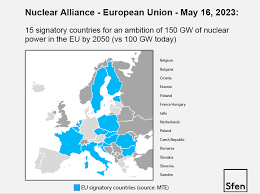
To convey this message, the two governments are counting on the Nuclear Alliance launched in Stockholm in February 2023, which now brings together more than 10 EU countries, including France and Sweden. https://www.euractiv.com/section/energy-environment/news/france-and-sweden-strengthen-cooperation-on-nuclear/
China’s CGN Halts Funding for UK’s Hinkley Nuclear Plant

- EDF may have to fund completion of £32.7 billion plant alone
- Britain took over CGN’s stake in a similar project last year
By Francois De Beaupuy, December 14, 2023
China General Nuclear Power Corp. has halted funding for the UK’s Hinkley Point C nuclear station in a fresh sign of tension between London and Beijing.
CGN skipped several installments in recent months, according to people familiar with the matter. That means Electricite de France SA, which was building the £32.7 billion ($41 billion) plant with CGN, may have to pay for its completion alone, they said, asking not to be named,
because the information isn’t public.
The withdrawal of funding comes
after the UK took over CGN’s stake in a similar nuclear project in
Sizewell last year following concerns over national security. Back then,
the government didn’t rule out that it might intervene in other cases of
Chinese involvement in UK energy supply, arguing that it would need to
consider risks to security and energy independence.
CGN’s plan to build a
Chinese-designed atomic plant in Southeast England is also up in the air.
It’s unclear whether the funding halt is temporary or definite, some of
the people said, adding that the project will continue in any case. A
spokesperson for EDF declined to comment when reached by Bloomberg, and CGN
didn’t respond to a request for comment.
Bloomberg 14th Dec 2023
France scores diplomatic wins on banks and nuclear in new EU rules

Paris successfully pushed for weaker due diligence reporting by lenders and state-backed funding for nuclear power plants
Alice Hancock in Brussels, 15 Dec 2, Ft.com
France has secured a partial carve-out for banks from new EU rules to make companies responsible for environmental impacts in their supply chains. Paris also won, in separate negotiations, assurance that state-backed funding for its nuclear power plants will be possible under a reform of the EU electricity market, the culmination of a concerted effort to champion the low-carbon fuel in the face of opposition from Luxembourg, Austria and Germany.
Agnès Pannier-Runacher, French energy minister, hailed the decision as “excellent news”. “It gives us the means to ensure long-term financing for the transformation of our electricity system,” she said……………………………
France, backed by countries including Italy and the Czech Republic, has succeeded in making sure that banks, asset managers and investment groups will only have to report on upstream activities such as purchasing office equipment. They will not have to undertake due diligence on the activities of clients to whom they are offering loans — something that the European parliament had pushed for in the talks.
In a note circulated among negotiators earlier this month, the European Central Bank also warned that “excluding the financial sector would be counterproductive to the intention of the [law], as it would allow the EU financial sector to continue to fund activities detrimental to the EU [environmental and social governance] agenda”.
Arianne Griffith, corporate accountability lead at the NGO Global Witness, said that it was “shocking” that EU countries had “sunk plans to ensure that banks stop investing in environmental and human rights abuses”. Eelco Van der Enden, chief executive of the Global Reporting Initiative, said that it was “disheartening” to see that the French effort had watered down the application of the rules to the financial sector but that a review clause in the agreement could offer the opportunity to include them at a later stage………………………………………..
Both the energy market reform and the due diligence rules must be formally approved by the European parliament and member states in votes due to take place early next year. Once the due diligence directive is approved, EU governments will have two years to introduce the rules in national legislation. https://www.ft.com/content/a4f7c547-1a58-482f-889e-f6400c44bbf7
UN Members Support Gaza Cease-Fire in Overwhelming 153-10 Vote
“Humanity has prevailed,” said Egyptian Ambassador Osama Abdel Khalek. “The Israeli aggression on Gaza must end. This bloodshed must stop.”
SCHEERPOST, By Jessica Corbett / Common Dreams, December 13, 2023
The United Nations General Assembly on Tuesday passed a resolution demanding “an immediate humanitarian cease-fire” in Israel’s two-month war on Gaza after the U.S. last week used its permanent member status to veto a similar Security Council measure.
The resolution also demands “that all parties comply with their obligations under international law, including international humanitarian law, notably with regard to the protection of civilians,” as well as “the immediate and unconditional release of all hostages, as well as ensuring humanitarian access.”
The final vote during the General Assembly’s emergency special session in New York was 153-10 with 23 abstentions.
Humanity has prevailed,” declared Egyptian Ambassador to the U.N. Osama Abdel Khalek after the vote. “This resolution must be implemented immediately. The Israeli aggression on Gaza must end. This bloodshed must stop.”
Tuesday’s meeting came after Egypt and Mauritania invoked Resolution 377A (V), which states that “if the Security Council, because of lack of unanimity of the permanent members, fails to exercise its primary responsibility for the maintenance of international peace and security in any case where there appears to be a threat to the peace, breach of the peace, or act of aggression, the General Assembly shall consider the matter immediately.”
Last week’s U.S. veto came after United Nations Secretary-General António Guterres invoked Article 99, a rarely used section of the U.N. Charter empowering him to bring to the attention of the Security Council “any matter which in his opinion may threaten the maintenance of international peace and security,” for the first time in his tenure.
Noting Guterres’ message to the council as well as a recent letter from the commissioner-general of the United Nations Relief and Works Agency for Palestine Refugees in the Near East, the General Assembly resolution expresses “grave concern over the catastrophic humanitarian situation in the Gaza Strip and the suffering of the Palestinian civilian population,” and emphasizes that “the Palestinian and Israeli civilian populations must be protected in accordance with international humanitarian law.”
Israeli Ambassador Gilad Erdan on Tuesday had urged member states to oppose the resolution, arguing that it would amount to “voting in favor of a genocidal jihadist organization” and hamper Israel’s ongoing operation to destroy Hamas.
“A cease-fire is a death sentence,” claimed Erdan, who said the effort to pass the resolution made the United Nations “a moral stain on humanity.”
Israel’s assault on Gaza has killed at least 18,412 Palestinians and injured over 50,100 more, according to local health officials. The war has also devastated civilian infrastructure and displaced 85% of the besieged enclave’s 2.3 million residents.
Urging the assembly to support the resolution, Francesca Albanese, the United Nations special rapporteur for the occupied Palestinian territories, said Tuesday that “the Israeli army is fighting everyone and everything in Gaza—including the U.N.”……………………………………
The United States—which voted against the resolution on Tuesday— gives Israel $3.8 billion in annual military aid and Congress is now considering a new $14.3 billion package……………………………… more https://scheerpost.com/2023/12/13/un-members-support-gaza-cease-fire-in-overwhelming-153-10-vote/
UN General Assembly votes to demand immediate ceasefire in Gaza
By Caitlin Hu, CNN, https://edition.cnn.com/2023/12/12/middleeast/ceasefire-vote-gaza-israel-un-intl
The United Nations General Assembly has voted to demand an immediate humanitarian ceasefire in war-torn Gaza, in a rebuke to the United States which has repeatedly blocked ceasefire calls in the UN’s Security Council.
A majority of 153 nations voted for the ceasefire resolution in the General Assembly’s emergency special session Tuesday, while 10 voted against and 23 abstained.
While a General Assembly vote is politically significant and seen as wielding moral weight, it is nonbinding, unlike a Security Council resolution. The US last week vetoed a ceasefire resolution in the smaller Security Council, which had been approved by a majority of the powerful 15-member body.
Tuesday’s brief resolution calls for a ceasefire, for all parties to comply with international law, and for humanitarian access to hostages as well as their “immediate and unconditional” release. It notably contains stronger language than an October vote in the assembly that had called for a “sustained humanitarian truce.”
The vote, hailed as “historic” by Palestinian Ambassador to the UN Riyad Mansour, comes as the war between Israel and Hamas enters its third month, and as medics and aid groups sound alarm bells on the humanitarian situation in besieged Gaza. More than 18,000 people have been killed in Gaza since fighting broke out, the Hamas-controlled health ministry in the enclave said Monday.
The resolution “does not ‘call for’ or ‘urges’ – it demands, and we will not rest until we see compliance of Israel with this demand,” Mansour said. A ceasefire is necessary to move the “massive” amounts of humanitarian assistance needed by Gaza’s besieged civilian population, he added.
Ahead of Tuesday’s vote, Israel’s UN Ambassador Gilad Erdan described the resolution as a “disgraceful” attempt to bind Israel’s hands, warning that “continuing Israel’s operation in Gaza is the only way any hostages will be released.”
Israel has rejected previous calls for a ceasefire, though it agreed to a seven-day truce for the release of Israeli hostages held in Gaza.
Israel voted against Tuesday’s resolution along with the US, Papua New Guinea, Paraguay, Austria, the Czech Republic, Guatemala, Liberia, Micronesia and Nauru.
‘One singular priority’
“We have one singular priority – only one – to save lives,” said General Assembly President Dennis Francis, opening the emergency session on Tuesday afternoon, warning that civilians in Gaza have nowhere safe to shelter from the fighting and aerial bombardment.
“Even war has rules, and it is imperative that we prevent any deviation from these principles and values – the validity of which resides in their universal application,” he said.
With vital infrastructure blasted to rubble and limited access to water, medicine and food, more Gaza civilians may end up dying of diseases than from bombs and missiles, UN officials have warned. Hunger is a growing issue in the enclave.
Addressing the assembly, US Ambassador to the UN Linda Thomas-Greenfield said that Washington does “agree that the humanitarian situation in Gaza is dire…and that civilians must be protected with international humanitarian law,” but urged nations to support an amendment to the resolution condemning Hamas, which did not pass.
”A ceasefire right now would be temporary at best, and dangerous at worst,” she said. “Dangerous to Israelis, who would be subject to relentless attacks, and also dangerous to Palestinians who deserve the chance to build a better future for themselves free from a group that hides behind innocent civilians.”
In a break with its southern neighbor, Canada cast its vote in support of the resolution, with Prime Minister Justin Trudeau issuing a joint statement with the leaders of Australia and New Zealand in support of “urgent international efforts towards a sustainable ceasefire.”
Australian Foreign Minister Penny Wong said Australian officials had been engaging with Canadian officials for some time on the issue, and more recently with New Zealand’s new government.
“We think that it’s important that very close allies and likeminded countries speak together in support of the position that we’ve articulated,” Wong told reporters Wednesday.
“We are democracies, and we expect of ourselves a high standard, and we expect that we will all work to comply with international humanitarian law, including the protection of civilian life,” she said.
Canadian ambassador to the UN Bob Rae called on Hamas to lay down its weapons and stop using civilians as “human shields.”
He added: “The price of defeating Hamas cannot be the continuous suffering of Palestinian civilians.”
South Africa’s representative Mathu Joyini meanwhile invoked her country’s “own painful past experience of a system of apartheid” to impress on fellow states the need to “take action in accordance with international law.”
Tuesday’s vote, she said, “presents an opportunity for us to illustrate that the organization that was created to give hope for peace is not tone-deaf to the suffering of the most vulnerable.”
In a short statement, Izzat Al-Rishq, a member of the Hamas Political Bureau, welcomed the resolution and condemned what he termed as a “war of genocide and ethnic cleansing” against the Palestinian people.
Why can’t the US ever say no to Israel?
The American UN veto on a Gaza ceasefire is a low point of wag-the-dog international politics
Rt.com, Tarik Cyril Amar, 13 Dec 23
December 8, 2023, is a day that will live in infamy. The United States made history of the worst kind by using its permanent seat on the UN Security Council to veto a resolution calling for an immediate ceasefire in Gaza. The resolution was advanced by the United Arab Emirates (a US partner) and supported by more than 90 member states. It also had preponderant backing in the global organization’s privileged “upper chamber,” the Security Council, where 13 of its 15 members were in favor (while the UK abstained, abdicating its sovereignty to the US, again).
The American veto directly defied UN Secretary-General Antonio Guterres. Not a natural-born rebel, the UN chief had deployed a rarely used procedure to promote the ceasefire, putting his authority on the line. Referring to Article 99 of Chapter 15 of the UN Charter, he already implied that “international peace and security” were in danger. His spokesperson was explicit that Guterres was making a “dramatic constitutional move.” While maintaining diplomatic balance by also highlighting the Hamas attack on Israel, Guterres’ letter to the Security Council depicted the catastrophic suffering of the Palestinians under the ongoing Israeli attack and concluded that “nowhere” was safe in Gaza.
All to no avail. The US could not be swayed and maintained its de facto unconditional support for Israel, even while the latter is conducting an intensifying genocidal assault on Gaza and its civilian population. This is no longer up for debate, and is no secret either; Israeli leaders have repeatedly made statements that signal the kind of intent that is a crucial element in the crime of genocide, while their actions and those of their forces on the ground speak even louder than their words.
The world has taken note. It took no special bias for the Palestinian leadership – the one derived from the PLO, as well as Hamas – to identify the veto as “disastrous” and “a disgrace and another blank cheque given to the occupying state to massacre, destroy and displace.” China and Russia have denounced American double standards and the “death sentence” Washington has handed down on future Palestinian victims of the Israeli assault.
Amnesty International says Washington has “brazenly wielded and weaponized its veto to strongarm the UN Security Council… undermining its credibility” and displaying a “callous disregard for civilian suffering in the face of a staggering death toll.” Doctors without Borders did not mince its words either, accusing the US of standing “alone in casting its vote against humanity,” with America “complicit in the carnage in Gaza” and undermining not only its own credibility but also that of international humanitarian law.
Craig Mokhiber – an authority on international law and former head of the UN High Commissioner for Human Rights office in New York – tweeted that “on the eve of the 75th Anniversary of the Genocide Convention, the US has again vetoed a ceasefire in the UN Security Council… demonstrating its further complicity in the #genocide in #Palestine.”
This list of censure and condemnation could be prolonged almost ad infinitum, especially if we add voices from the Global South. The key point, however, should be clear already: The US stands isolated and disgraced by its very own, easily avoidable – or so it would seem – decision. This was, after all, not a vote asking for justice and restitution for the victims, or – perish that radical thought! – for prosecution of the perpetrators. All this was about was the barest of bare minimums, just a ceasefire, not even a peace deal. Still, that was too much to ask of the US……………………………..
Future historians will ask how this happened. How could the single most powerful nation in the world, which claims to lead not only by force but by “values,” side with the Israeli perpetrators of such an outrageous and open crime, while openly contravening much of the international community? Some will even ask the more cynical question how America, even if its elites are entirely bereft of ethics, could do so much harm to itself.
The simplest, almost technical answer to that question has to do with a historical irony. America owes its veto power – as one of the five permanent members of the Security Council – to what happened in World War II. And while World War II and the German Holocaust against the Jews of (mostly) Europe are not the same, they are part of the same history. Much US pride has been invested in being among the powers that brought down the Holocaust perpetrator state Germany. And yet, here we are: The same US is now using that very veto not only to shield another genocidal state but to help it continue its crime.
There are, of course, broader reasons for this great American failure. Many have been discussed before. Israel serves the function of an enforcer and imperial outpost in the Middle East and sometimes beyond. As current US President Joe Biden – by now often trending on X as #GenocideJoe – stated in 1986, when still an ambitious and pandering senator, if there were no Israel, America would have to invent one. Let’s set aside that even the callous realpolitik behind such thinking is flawed: If it ever was an asset, Israel is turning into a liability. Let’s just note that the American elite claims to believe that Israel is so useful that the commitment to it must be, in Vice President Kamala Harris’ words, “ironclad.”
But so it was for Ukraine only, as it were, yesterday. And yet Kiev is about to be dropped, as so many US clients before. What makes Israel different? Clearly, it is the long-standing top recipient of US financial and military support. Is it sunk cost fallacy then? Is America so over-committed to Israel that it simply won’t walk away?
Yet that hypothesis does not explain the striking one-sidedness of the US-Israel relationship. If there has ever been a case of wag-the-dog, this is it: One thing that the American veto on the Gaza ceasefire resolution shows is that it is Israel that is dominating US foreign policy, not the other way around. Otherwise, Washington would have sought to find a compromise between preserving its own credibility and interests by allowing at least this very modest resolution to pass, while still supporting Israel in multiple other ways.
Clearly, one thing that is determining this American dependence on another, much smaller country is the massive success of lobbying and foreign influence operations on behalf of Israel. Indeed, it is Israel that has run the most invasive and effective such attack on US politics in history. And for the avoidance of any misunderstandings: Noting this obvious fact has nothing to do with “anti-Semitism.” Indeed, trying to smear those who dare bring it up with that accusation is part of how that influence operation works. It’s time to entirely disregard such cheap tricks.
………………………………………………………………. If only we could return, at least, to a world where Americans could forget a little about their Russia obsession when thinking about foreign influence on their country and focus that concern where it matters, namely on Israel. If in addition they could think a little more about Russia as a viable partner – at least occasionally – in helping resolve severe international crises, we would all be much better off. We might even be able to stop a genocide here or there. https://www.rt.com/news/588952-us-israel-un-veto/
The UN Nuclear Ban Treaty is Leading Resistance to Nuclear Autocracy

Robert Rust, December 13, 2023 Union of Concerned Scientists
During the week of November 27th, under a cloud of international conflict and unease, delegates, politicians, activists and academics convened for the Second Meeting of States Parties (2MSP) to the Treaty on the Prohibition of Nuclear Weapons (TPNW) at the UN Headquarters in New York. Attendees came together to examine the global state of disarmament and harm-reduction work and call for more states to sign the nuclear ban treaty and join the stand against nuclear weapons.
The TPNW is a broad coalition of nation states committed to building that framework through changing attitudes toward and the culture around nuclear weapons; currently, there are 93 signatories and 69 states parties. Unsurprisingly, none of the five nuclear-weapon states recognized by the Nuclear Non-Proliferation Treaty (United States, Russia, China, United Kingdom, and France) have signed, and only seven of 38 OECD countries (Austria, Chile, Colombia, Costa Rica, Ireland, Mexico, and New Zealand) have signed or ratified. Clearly, this is a movement by those who have less to demand better behavior from those who have more. Nuclear weapons harm and threaten the many for the benefit of the few; the many are working to end that.
Speaking at a session on the treaty’s obligations within victim assistance and remediation, Governor Hidehiko Yuzaki of Hiroshima made a key point about the way we think about security. Nuclear deterrence, he said, is an idea become dogma, not a hard truth; relying on it for security locks us into a system with inherent massive risks. We must stop thinking of security in these “narrow nationalistic frames”, and work to build a “collective, sustainable security framework.”
Voices from the frontline
The most important participants at the 2MSP were members of frontline communities directly impacted by mining, bombing, testing and storage across the world. The hibakusha, survivors of the atomic bombings of Hiroshima and Nagasaki, have experienced the horrors of nuclear weapons like no one else. The 2MSP heard how post-war US secrecy around the atomic bomb fostered significant discrimination towards hibakusha in Japan. Indeed, victim testimony at the museums dedicated to the bombings in Hiroshima and Nagasaki describes how US scientists and military personnel arrived to test and observe the bomb’s impact on the local environment, including its inhabitants.
That dehumanization and disregard for human life was also central in nuclear testing across the world. Just as they are among the first and most seriously impacted by the effects of climate change, indigenous communities have historically been on the front lines of nuclear testing and uranium mining.

Speaking at the 2MSP, Karina Lester, who is from the Anangu Pitjantjatjara Yankunytjatjara Lands (APY Lands) in the far Northwest of South Australia, spoke of her father and grandmother’s experiences of British nuclear testing in the area. She described how her father heard the ground shake and felt the “black smoke” move over their lands. The TPNW, she said, must continue to center the voices of those who have experienced the harm of nuclear weapons; the weapons must be made illegal, but governments must also work with those impacted to redress the harm caused.
The TPNW should act as both a forum and a tool for those countries and communities who have been harmed. Powerful states have to respect the sovereignty of smaller states, honor their obligations through international treaties and respect the decisions of multilateral organizations. They have a history of failing to do so.
For example, discussing the work towards a nuclear-free Pacific, one speaker pointed out that after Christmas Island (Kiribas) was selected as a site for the United Kingdom’s nuclear testing, Samoa, which was a trust territory of New Zealand at the time, petitioned the UN Trusteeship Council to halt the 1957 test, but the United Kingdom did not listen. Indeed, examination of British military reports prior to the test show racist attitudes that were callously dismissive of harm to local “primitive” populations. The United Kingdom, United States and France saw the Pacific and Australia as “empty space”, erasing local populations entirely. ……………………………………………………………. more https://blog.ucsusa.org/robert-rust/the-un-nuclear-ban-treaty-is-leading-resistance-to-nuclear-autocracy/
Third EU state objects to Ukrainian membership talks
https://www.rt.com/news/588948-austria-ukraine-eu-membership/ 13 Dec 23
Austria has joined Hungary and Slovakia in opposing fast track procedures for accepting Ukraine and Moldova into the union
There should be no preferential treatment for Ukraine in regards to its path to becoming a member of the European Union, Austrian Federal Chancellor Karl Nehammer said during a government meeting on Monday.
His statement came in response to proposals from the European Commission to launch accession talks with Ukraine as soon as possible. However, after opposition from Hungary and Slovakia, EC President Ursula von der Leyen said on Sunday that the bloc’s leaders would only discuss “the opening of accession negotiations, not accession itself” at the upcoming European Council summit this week.
Answering questions from members of Austria’s EU Main Committee, Nehammer stated that his country was generally in favor of EU enlargement and agreed to offering Ukraine and the Republic of Moldova accession prospects.
However, he insisted that there should be no “fast-track procedure” for the two states and that internal EU reforms would also be needed to prepare the bloc for enlargement. He stressed that Austria would not agree to any accession talks with Ukraine under the current conditions.
Nehammer also noted that von der Leyen had not consulted with him or any other EU leaders before issuing a recommendation last month to open formal membership talks with Ukraine, arguing that it had made significant progress in internal reforms to warrant such a step.
This recommendation was also met with opposition by Slovakia and Hungary, whose Prime Minister Viktor Orban called it “unfounded and poorly prepared.” Slovak Foreign Minister Juraj Blanar also stated that he “couldn’t imagine” Kiev joining the union while it was still in a “state of war,” noting that its membership was still “terribly far away.”
Kiev, meanwhile, has insisted that it has already fulfilled all the key requirements in its bid to join the bloc and demanded that EU members “play fairly” and recognize its efforts.
“We can jump, we can dance if that is requested in addition,” said Ukrainian Foreign Minister Dmitry Kuleba, insisting that “If we are told to do something, and we do that, that must be registered as a result.”
For years, the Ukrainian government has cited accession to the bloc as one of its priorities, with little actual progress made. Ukraine officially applied for membership in February 2022, days after Russia launched its military operation.
US casts sole vote in UN to continue the annihilation of Gaza
Walt Zlotow, West Suburban Peace Coalition, Glen Ellyn IL ,10 Dec 23
December 8th now makes 2 consecutive calendar Days of Infamy for America. But this one, coming 92 years and a day after the first, is not from an attack on America. It comes from America’s descent into madness, enabling and supporting Israel’s genocidal ethnic cleansing of Gaza after the October 7th Hamas attack on Israel.
The UAE sponsored the UN Security Council resolution demanding an immediate humanitarian ceasefire in Gaza. Within 24 hours they garnered nearly a hundred co-sponsors from the UN’s 193 members. UN Secretary-General Antonio Gutierrez invoked rarely used Article 99 of the UN Charter to bring the resolution to the Security Council for immediate consideration over “threats to international peace and “humanitarian catastrophe in Gaza”.
But the US blocked the resolution with a dastardly veto. Thirteen other members voted for it, including some of America’s staunch allies. Even our most lockstep ally Britain abstained. The US now stands alone in supporting Israel’s campaign making Gaza uninhabitable.
Ministers from Egypt, Jordan, the Palestinian Authority, Qatar, Saudi Arabia and Turkey came to D.C. to plead with Secretary of State Anthony Blinken to support the ceasefire. But Blinken put them off till after the after the UN vote.

When questioned about the devastation in Gaza, Biden, Blinken just nod and mutter something about imploring Israel to try harder not to annihilate all the Palestinians there. Meanwhile Netanyahu tells his war cabinet “We need 3 things from the US: munitions, munitions, and munitions.” And he gets them PDQ
How bad is that annihilation? Roughly 70% of the 70,000 deaths and injuries are women and children. UN chief Gutierrez cited Article 99 for the first time since 1971 in calling the emergency session to address the “humanitarian nightmare Gaza is facing.” He cited endless bombings that have hit 339 schools, 26 hospitals, 56 health care facilities, 88 mosques and three churches.
Besides Gaza being destroyed, President Biden is ensuring that America’s standing in the world is being destroyed as a beacon of peace and freedom.
Yes, mark December 8th on the calendar as another American Day of Infamy.
Besides Gaza being destroyed, President Biden is ensuring that America’s standing in the world is being destroyed as a beacon of peace and freedom.
Yes, mark December 8th on the calendar as another American Day of Infamy.
Is Biden taking the Iran nuclear deal off life support?
If the JCPOA really is dead, as a top State Department appointee declared last week, that’s an own goal for the US and a huge risk for regional security
ELDAR MAMEDOV, DEC 12, 2023, Responsible Statecraft
When Joe Biden was running for U.S. president, he promised to reverse many of his predecessor’s decisions on foreign policy, generally hewing towards more restraint and diplomacy, and less bluster, militarism, and unilateralism. That included restoring the 2015 nuclear deal with Iran known as the Joint Comprehensive Plan of Action (JCPOA) from which Donald Trump withdrew in 2018 — despite evidence, shared even by his own officials, that the deal was delivering on its core objective to block Iran’s pathways to a nuclear weapon. On December 7, 2023, Biden’s nominee for deputy secretary of state, the current National Security Council Coordinator for Indo-Pacific Affairs, Kurt Campbell, effectively declared the JCPOA dead………………………………..
Although the prospects for a revived JCPOA have been dim since at least 2022 — for which Iran carries a fair share of blame — officials from the Biden administration until now have largely refrained from using such threatening language against Iran. Conclusively abandoning any effort to revive the JCPOA does not serve U.S. interests and is in fact counterproductive.
Addressing students at Tehran University a few days after Campbell’s Senate testimony, Iranian Foreign Minister Hossein Amir Abdollahian downplayed the relevance of the JCPOA by reportedly saying that the “more we move forward, the more JCPOA becomes pointless. We will not force ourselves to remain in the narrow tunnel of the JCPOA forever.”
So, the Biden administration finds itself in the rather awkward position of effectively agreeing with Tehran, but this was a self-inflicted problem: by refusing, for three years now, to engage with its critics and the broader public on the agreement’s benefits to the U.S. and global security, it has allowed the notion that the JCPOA was some kind of reward for Iran, rather than a deal that strictly curbed Tehran’s nuclear ambitions, to become conventional wisdom. As is evident in Abdollahian’s remarks, Iranians today certainly do see the JCPOA as a “narrow tunnel” that limits their options………………………………………….
If ever there was a mechanism that would prove effective in preventing Iran from acquiring a bomb, it was the JCPOA. In light of Abdollahian’s remarks (which clearly reflect a growing skepticism about the JCPOA in Iran), the Biden administration, by publicly disowning the deal, is in fact removing obstacles to further Iranian nuclear escalation.
Unless Biden is prepared to accept the advice of the late international relations scholar Kenneth Waltz, who, in an influential 2012 Foreign Affairs article, argued that an Iranian bomb would stabilize the Middle East, it is not clear what his administration would do in place of a revived JCPOA to check additional Iranian nuclear advances.
Campbell emphasized the “current environment” as an additional factor rendering a JCPOA revival infeasible. In fact, if he was referring to the Israel-Hamas war in Gaza, then it is precisely such a conflict that makes some sort of a direct dialogue between Washington and Tehran — on nuclear, but also regional security issues — all the more urgent if a wider war is to be avoided. Substituting such a dialogue with military threats at a moment when the U.S. is providing Israel virtually unconditional support, including the lavish replenishment of its arms stocks, the deployment of marines and two aircraft carrier task forces to the region, and the veto of a U.N. Security Council Resolution calling for a ceasefire, could do more to incentivize Iranians to seek a nuclear deterrent than anything else.
Vows to isolate Iran “internationally and diplomatically” are also unwarranted as Iran, despite its rhetorical support for Hamas, has so far demonstrated considerable restraint. While hardline ideological hostility to Israel is wired into the Islamic Republic’s identity, the actual position Tehran adopted towards the Israel-Palestine conflict is much more nuanced, more in line with the Arab and Islamic (and indeed broad international) mainstream consensus that insists on a viable two-state solution. Instead of building on these shifts, however modest and tentative, Washington seems to prefer to double down on confrontation.
The sad irony is that this explosive situation could have been avoided had Joe Biden had the courage and wisdom to deliver on his own election campaign promise to restore the nuclear agreement with Iran. ………. https://responsiblestatecraft.org/biden-iran-nuclear-deal/
Americanization of International Law: Legitimizing Palestinian Genocide and Promoting Nuclear Self-Defence

Nafees Ahmad, DECEMBER 10, 2023 Edited by: Hayley Behal | U. Pittsburgh School of Law, US https://www.jurist.org/commentary/2023/12/nafees-ahmad-americanization-international-law/
Nafees Ahmad, Ph.D., LL.M., Associate Professor, Faculty of Legal Studies at South Asian University, New Delhi, India, discusses the failure of international law and policy to address the sitiation in Palestine and Israel…
The 21st century is marked by globalization and Americanization, with transnational law under US dominance and a strong American influence on human rights. This Americanization of international law often conflates with modern neoliberal hegemonies, which downplay historical arrangements and change rights and injustices. The evolution of international law in this era differs from previous generations, and hegemonic international law has emerged as the primary language for asserting dominance. Studying the Americanization of international law is crucial, as discussions have recently emerged regarding actions taken by the US on behalf of NATO and Israel that seem to violate international law. Israel’s 55-year-long occupation of the Palestinian Territories is a saga of occupation to annexation that subjected the Palestinians to colonialism, apartheid, the legitimacy of occupation, and possible international criminal culpability. The harsh reality of Palestinians living under Israeli occupation for an extended period has a direct and tangible influence on international legal frameworks and legal obligations.
Travesty of Liberal International Order
The liberal international order (LIO), which has influenced US international relations since World War II, is declining due to President Biden’s rejection, criticism of US allies, and support for authoritarian leaders. The order has deteriorated for at least 15 years, with Russia and China aiming to challenge it through substitute regional organizations and alternative standards. Weaker states seek security cooperation and patronage from non-member countries like Saudi Arabia and China, which lack the same liberal political and economic conditions as the US and its democratic allies. A new wave of transnational networks emphasizing nationalism, illiberalism, and right-wing principles is also challenging the LIO. The Biden presidential campaign slogan, “Let’s finish the job,” accelerates these processes, undermining the US’s global standing.
Accountability for International Humanitarian Law
The use of force by Israel on Gaza is considered genocide and a grave international crime. More than 9,800 people have died in the ongoing Israel-Palestine conflict, including 8,306 Palestinians and 1,538 Israelis. Tel Aviv has struck at UN buildings, schools, hospitals, medical convoys, refugee camps, and religious facilities. The UN has ordered the forced evacuation of 1.1 Palestinians from the northern region of Gaza, treating those unable or unwilling to flee as supporters of Hamas. The destruction inflicted upon Gaza is astounding, with an estimated 2.3 million Palestinians navigating dangerous waters for 16 years to survive the harsh economic and social blockade since 2007. Israel’s targeting of forbidden locations and the use of incendiary phosphorus bombs in heavily populated civilian areas are war crimes. Western leadership fails to convince the world that adherence to its rules-based order has anything to do with the UN Charter or international humanitarian law (IHL), demonstrating a calculus of friends and enemies. Occupation situations are officially classified as international armed conflicts under IHL, which is another way of saying they are armed confrontations between two or more states. Human rights law is still relevant in occupation settings in addition to IHL. As a result, an Occupying Power is required by international law to guarantee the local populace’s access to the full range of human rights. The West Bank has been classified as occupied territory under the Fourth Geneva Convention and the Hague Regulations by the UN Security Council, the Supreme Court of Israeli, and the International Court of Justice (ICJ).
Whither Responsibility to Protect and US Culpability?
The Palestinians have been denied legal redress, and the UN should bear more responsibility for implementing the partition plan and Security Council Resolution 242, which demanded the departure of the Israeli military presence. The UN can report on moral and legal wrongdoing but cannot carry out its recommendations without a Security Council resolution. The UN General Assembly can only make recommendations with a two-thirds majority vote, and the global legal system’s remedies are futile if the US culpability does not exempt Israel from accountability under international law. Despite having the law on their side since 1948, Palestinians have been subjected to Israel’s lawlessness for years. The UN’s policy processes can be effectively employed if there is political will. The Responsibility to Protect (R2P) standard was established after the 1999 Kosovo War, requiring UN accountability in situations like Gaza. In 2011, NATO countries turned a limited humanitarian mandate into a regime-changing intervention, leading to the execution of a leader and worsening the situation in Libya. Effective UN action without political will could exacerbate the problem. Israel has never stopped using excessive force, and the international community has not warned or pressured it to leave the occupied Palestinian territories. The UN’s responsibility to protect R2P is to address the suffering of Gazans by establishing a peace force. This force could potentially halt Israeli aggression, strengthen protection for Palestinians, and maintain peace. The Palestinians are currently the most vulnerable people in need of international forced protection. However, the UN cannot stop Israeli brutality without the political will of the five permanent members of the Security Council. Under the current Israeli administration, operationalizing R2P is unfeasible due to the complex context of the situation.
Western Media Defending Israeli War Crimes?
The Western media, particularly in the US and UK, has a biased stance toward Israel’s ongoing violence, supporting Israel’s claim to eradicate Hamas and find its leaders. This divide has led to a lack of proper protection for Palestinians. However, the footage of Israeli aggression toward women, children, and injured individuals has partially removed the mask of state propaganda. Under IHL, Israel is the Occupying Power and defines Gaza as an occupied area, which is irreconcilable with Israel’s discretion. 2.3 million innocent civilians living in Gaza, with 76% either refugees or descendants of refugees, were denied their international legal right of return. Despite attempts to challenge this right, violent Israeli suppression often occurs. This extra-legal impunity leaves Palestinians with no recourse for proper protection.
Ukraine-Palestine: The Crisis of Morality in International Law
There is significant humanitarian hypocrisy in the Western response to the Israeli attack on the Gaza population and the Russian attack on Ukraine. Israel enjoys impunity, while Russia is held responsible for NATO’s double standards and moral and legal dishonesty. This shows that international law is a manipulated set of standards that suit geopolitical players’ goals and frequently conflicting strategic objectives rather than a framework for governing nations on the premise of sovereign equality as essential to the international rule of law. Industrialized countries have no inherent incentive to abide by international law; instead, all international law is constrained by the logical decisions of self-serving parties. This argument dictates that efforts to enhance international collaboration must yield; governments cannot bootstrap cooperation by passing laws and enacting regulations, even though these measures may produce better results. States that find it advantageous to uphold international law tend to act quite haughtily when denouncing those who violate it. However, suppose it serves their interests to condone these grave breaches of IHL. In that case, they will either remain silent or, in this instance, provide unconditional and primarily, but not entirely, indirect support to the government and nation that is engaging in these egregious abuses. Such a dualistic view of international law undermines any argument that it is authoritative and worthy of respect, mainly concerning peace and security. It can be used as a tool of aggressive lawfare against enemies and legalistic evasion for strategic partners and friends. When international law is broken, enemies are hunted out and punished, but vital allies are given a shot of impunity.
Arming Israeli Self-Defense with Nuclear Weapons
The five most powerful nations in the world, who also happened to be the winners of World War II and the first five to develop nuclear weapons, were granted veto power since the UN was intended to be weak in this area. The significance and efficacy of the veto force lie in giving these most potent and dangerous nations, led by the US, the unbridled ability to disregard international legal obligations for nuclear weapons and the UN Charter. Whenever a proposed UN Security Council action conflicts with their strategic objectives, these five deinstitutionalize and defunct international law institutional framework against the very principles and purposes of the UNO. The ICJ ruled that nuclear bomb use is not reconcilable with IHL. However, the ICJ couldn’t make a definitive decision on the legitimacy of the state using nuclear weapons in self-defense situations. Several nuclear-armed states, including the US and the UK, claimed that treaty rules didn’t regulate or prohibit nuclear weapons use when hostilities rules were fully codified in 1977 in the First Protocol Additional to the Geneva Conventions.
Several legal authorities support varying interpretations of what is permissible because the boundaries of self-defense with nuclear weapons are hotly debated in international law. However, it is prohibited to attack a hostile civilian population with excessive force. Over the years, Israel has been guilty of using military force in many ways that, under any circumstances, whether or not justified and rationalized, would not be allowed as exercises of self-defence and would, therefore, constitute war crimes. This use of force in Gaza during the past few weeks has been particularly spectacular. Beyond this, it is debatable if Israel may legitimately rely on self-defence in Gaza, an occupied territory governed by Geneva Convention IV limitations. It is not reasonable for Israel, the Occupying Power, to assert that it is protecting itself against itself. Accepting this mishandled interpretation of the concept of self-defense in the context of an opponent society’s belligerent occupation—in whole or in part—by the international discourse is genuinely puzzling.
War Crimes Trial in International Criminal Court
At least 1,400 persons in Israel and 5,000 in Palestine have died since Hamas began its onslaught in Israel on October 7, 2023, which prompted an immediate and forceful military retaliation from Israel. Although Hamas militants carried out the first crime, the hospital explosion’s cause is yet unknown. The International Criminal Court (ICC) may look at potential war crimes in Israel and Palestine. Palestine joined the court in 2015. Recent appeals have also been made for the US to ratify the ICC treaty. The ICC faces challenges due to its inaction and political weakness in holding powerful Western nations accountable, particularly Israel. The lack of political will to prosecute Israel makes its practical application improbable. Despite not being signatories to the Rome Statute, the ICC has jurisdiction to investigate, indict, and bring charges against anyone who claims to be a victim of crimes committed on its territory. Palestine is one of the ICC Statute’s parties. Following the current wave of unchecked violence, attempts will be made to strengthen the ICC in light of geopolitics. While it would be unrealistic to expect accountability from Israel’s authorities, the desire to present evidence and accusations of Israeli wrongdoing would be persuasive to public opinion outlets and criminalizing civil society activists. In symbolic politics, proving or disproving the veracity of assertions has a significant political impact, and mere submission plays a crucial role.
Way Forward
The UN, governments, and people worldwide are facing a crisis due to the extreme abuse of state power, resulting in one of the most severe instances of genocide since 1945. Observers argue that Israel is using force against Gaza in an ongoing genocide, which is considered the most serious international crime. Preventing genocide is a shared responsibility of all governments, and establishing a Peoples Tribunal on Genocide Prevention in Gaza or on Israel’s War Against the People of Gaza can contribute to a world governed by law. The 1948 UN Convention on the Prevention and Punishment of the Crime of Genocide has been extensively approved, including by parties involved in the bloodshed in Gaza and its diplomatic interactions.
Nafees Ahmad, Ph.D., LL.M., is an Associate Professor, Faculty of Legal Studies at South Asian University, New Delhi, India. Professor Ahmad teaches IHRL, IRL, CCL, and International Media Law.
Ralph Nader on Israeli Government’s War Crimes – Enabled & Defended by Biden & Congress

By Ralph Nader / Nader.org, more https://scheerpost.com/2023/12/10/ralph-nader-on-israeli-governments-war-crimes-enabled-defended-by-biden-congress/
The humiliation of the U.S. government, which is actively complicit in providing the weaponry, funding, and UN vetoes backing the Israeli government’s attack on the civilian Palestinians/Arabs in tiny Gaza, is in plain view daily. All in the name of the unasked American people and taxpayers.
Earlier this week, at a House of Representatives’ hearing, Trump toady Rep. Elise Stefanik (R-NY) repeatedly assailed three University presidents with the question of would they discipline students calling for the genocide of Jews, without any evidence that this hateful speech is prevalent on campus.
Pursuing her fulminations, Stefanik was cruelly oblivious to the real ongoing genocide in Gaza with her support of unconditional shipment of American F-16s, 155mm. missiles and other weapons of mass destruction used to kill children, women and the elderly who had nothing to do with the preventable October 7th Hamas violence.
Meanwhile, a State Department spokesman continues to say that the Israeli government does not intentionally target civilians. With U.S. drones over Gaza daily, Secretary of State Antony Blinken has visual proof that the overwhelming bombing on civilian structures is killing innocent civilians.
The evidence is in the rubble of hospitals, health clinics, ambulances, schools, libraries, places of worship, marketplaces, water mains, homes, apartment buildings, and piles of unburied corpses being eaten by stray dogs. All this information is in the possession of bomber Biden’s regime.
The Bidenites and their bloodthirsty cohorts in Congress were forewarned when the Israeli Defense Minister Yoav Galant and other Israeli officials on October 8th shouted these chilling genocidal orders to their army: “No electricity, no food, no fuel, no water.… We are fighting human animals and will act accordingly.” (See, Convention on the Prevention and Punishment of the Crime of Genocide). Add an already illegal 16-year Israeli blockade of 2.3 Palestinians suffering from dire poverty, with 40% of their children down with anemia.
Now, about half of Gaza’s population are children, 85% of the entire population is homeless, wandering helplessly into nowhere, afflicted with pending starvation, sickened by spreading infectious diseases and dirty drinking water. There is little or no medicines for diabetics and cancer patients. No surgery, no anesthesia, no emergency transport, no shelter from cold weather, only American-made bombs and missiles blowing up Palestinians into bits with Israeli snipers everywhere.
The Palestinians cannot flee from their open-air prison. They cannot surrender – the Israeli government wants them gone. Bear in mind, the population that is not yet blown up is sick and dying, denied needed outside humanitarian aid. Defying feeble Biden’s wishes, Netanyahu only allows a trickle of aid trucks to enter Gaza, and those that do enter can scarcely reach their destinations.
All this raises the issue of the gross undercount of casualties. The Hamas Health Authority has restricted its count to the names of the deceased and injured supplied by hospitals and morgues. These locations are now largely rubble or inoperative. Bodies under the rubble, many of them children, can’t be counted. Thousands of missing people cannot be counted. The Ministry’s suspended count is over 17,000 fatalities, plus 45,000 injuries. With the far larger carnage unable to be tabulated, the actual fatality toll may reach 100,000 soon.
Nonetheless, about two weeks ago, the New York Times reported the death undercount of children in Gaza in two months was ten times greater than the deaths of Ukrainian children in nearly two years of Russian bombings. One of its headlines – “Smoldering Gaza Becomes a Graveyard for Children.”
There are about 50,000 pregnant women in Gaza and about 5,500 of them are due to give birth. Where are they going to do that? How can they be cared for and be nurtured? These mothers are sick and starving. Add the babies to the terrorists toll.
Gaza’s area is about the size of Philadelphia. How many dead, injured, and dying people would there be if 20,000 bombs were dropped on civilians and civilian structures in Philadelphia? Philadelphians trapped without food, water, medicine or any escape route. Imagine 85% of 1.5 million residents homeless, wandering in the streets and alleys. And with virtually no humanitarian aid coming from outside the city. There wouldn’t be any fire trucks or water to extinguish spreading fires.
There are courageous Jewish groups (e.g., Jewish Voice for Peace and If Not Now) and rabbis calling for an end to the slaughter, demanding a ceasefire. There are protestors at all of Biden’s public events/trips reminding him of next November.
Veterans for Peace and other veteran groups are engaged in non-violent civil disobedience in front of the Scranton, Pennsylvania factory producing 155mm missiles for Israel. (Scranton is Biden’s hometown.) Public opinion is turning against the Biden/Israel war without limits on the Palestinians.
Biden wouldn’t want to poll the American people about his $14.3 billion genocide tax, charging American taxpayers to further prosperous Israel’s war of extermination in Gaza. They’ll likely tell Biden that poor children, unaffordable health facilities and other necessities in America need that money first.
There are some 30 Democratic Senators demanding that this Biden bill contain conditions and safeguards so that the money is not used to blow up more Palestinian children and women. But what else are these funds for other than to expand Israel’s military budget? The Israeli extremist ruling coalition under Netanyahu has made no secret of wanting to take over all of remaining Palestine as part of their “Greater Israel” mission to include what they call Judea and Samaria. As Israel’s Founder, David Ben-Gurion, frankly declared referring to the Palestinians, “We have taken their country.” (As quoted in The Jewish Paradox(1978) by Nahum Goldmann.)
It is a cruel irony of history that Israeli state terrorism is producing a Palestinian Holocaust. Netanyahu’s regime has killed over 60 journalists—three of them Israelis—120 United Nations relief workers and instituted total blackouts to keep the grisly events in Gaza out of the news in real time. Netanyahu, to shield his colossal failure to defend Israel on October 7thand to keep his job, is making sure that his country joins the world community of savage, slaughtering regimes, exemplified by the Bush/Cheney unlawful criminal destruction of Iraq and Afghanistan, followed by Hillary Clinton toppling Libya into permanent violence and chaos since 2011. (Obama later called his conceding to Hillary’s demands as his worst foreign policy decision).
Capitol Hill and the White House don’t wait for any blood-guilt to be recognized. That will surely come later with the judgment of history and the nightmarish visions of innocents being vaporized because of Washington’s unconditional backing of the Israeli blitzkrieg against what the Israeli newspaper Haaretz has repeatedly called the “totally defenseless people” of Gaza.
1 This Month



26 September – International Day for the Total Elimination of Nuclear Weapons


PLEASE OPPOSE HR 8255 AND S.3639 – bills would accelerate satellite deployment, with no environmental review or safeguards – https://ncstd5li.quorum.us/campaign/169331/
To see nuclear-related stories in greater depth and intensity – go to https://nuclearinformation.wordpress.com
-
Archives
- September 2026 (233)
- August 2026 (330)
- July 2026 (355)
- June 2026 (287)
- May 2026 (306)
- April 2026 (356)
- March 2026 (251)
- February 2026 (267)
- January 2026 (308)
- December 2025 (358)
- November 2025 (359)
- October 2025 (375)
-
Categories
- 1
- 1 NUCLEAR ISSUES
- business and costs
- climate change
- culture and arts
- ENERGY
- environment
- health
- history
- indigenous issues
- Legal
- marketing of nuclear
- media
- opposition to nuclear
- PERSONAL STORIES
- politics
- politics international
- Religion and ethics
- safety
- secrets,lies and civil liberties
- spinbuster
- technology
- Uranium
- wastes
- weapons and war
- Women
- 2 WORLD
- ACTION
- AFRICA
- Atrocities
- AUSTRALIA
- Christina's notes
- Christina's themes
- culture and arts
- Events
- Fuk 2022
- Fuk 2023
- Fukushima 2017
- Fukushima 2018
- fukushima 2019
- Fukushima 2020
- Fukushima 2021
- general
- global warming
- Humour (God we need it)
- Nuclear
- RARE EARTHS
- Reference
- resources – print
- Resources -audiovicual
- Weekly Newsletter
- World
- World Nuclear
- YouTube
-
RSS
Entries RSS
Comments RSS
 nuclear-news