Surviving an Era of Pervasive Nuclear Instability
Today, we can identify at least four such potential flash points—Ukraine and NATO’s Eastern Front, Taiwan, the South China Sea, and the Korean Peninsula—with more likely to emerge in the coming months and years. Each has the potential to ignite a Cuban missile crisis–like confrontation.
Today, we can identify at least four such potential flash points—Ukraine and NATO’s Eastern Front, Taiwan, the South China Sea, and the Korean Peninsula—with more likely to emerge in the coming months and years. Each has the potential to ignite a Cuban missile crisis–like confrontation.
A call for grassroots activism.
The Nation, MICHAEL T. KLARE 12 Feb 24
Deapite two years of war in Ukraine, rising tensions over Taiwan, and a metastasizing conflict in the Middle East, our 21st-century world has yet to experience a major nuclear blowup—a moment when the risk of thermonuclear annihilation is real and imminent, as was the case during the Cuban missile crisis of 1962. Yes, we have experienced nuclear jitters over North Korea’s repeated threats to attack South Korea and Vladimir Putin’s threats to use nuclear weapons in Ukraine, but none of those incidents has brought us to the edge of extinction. If current trends persist, however, we are likely to encounter a succession of major nuclear crises in the months and years ahead, each potentially more dangerous than the one before. To prevent these from triggering a nuclear apocalypse, we will need wise and prudent leadership by our top officials—and a mass public campaign to insist on such prudence.
During the Cold War, of course, the potential for a catastrophic nuclear crisis was ever-present. We were all aware that any major US-Soviet confrontation could trigger a nuclear exchange, obliterating every one of us. The end of the Cold War was, therefore, an enormous psychic blessing, allowing us to live without the constant dread of imminent nuclear annihilation. For younger generations, moreover, other vital concerns—racism, global warming, economic insecurity—have come to replace nuclear anxiety. These concerns persist, as potent as ever. But now we must all brace ourselves for the return of incessant nuclear crises.
The reemergence of pervasive nuclear instability is the product of two interrelated factors: the outbreak of a tripolar military rivalry between the US, China, and Russia on one hand, and the proliferation of potential nuclear flash points on the other. Each is contributing to the risk of a nuclear conflict, but the combination is making the danger infinitely worse.
The Emerging Three-Way Nuclear Arms Race
Until very recently, the nuclear arms race was widely perceived as a two-way affair, involving the United States and the Soviet Union (later the US and Russia). During the Cold War, the two superpowers built up their atomic arsenals to terrifying heights and then, following the trauma of the Cuban missile crisis, took steps to control and reduce their respective stockpiles. Still, both sides continued to maintain vast nuclear stockpiles after the Cold War’s end, claiming that these munitions were needed to deter a possible nuclear strike by their opponent. They did, however, agree to further reductions in their atomic arsenals, culminating with the signing, in 2010, of the New Strategic Arms Reduction Treaty (New START).
…………… despite the gradual reduction in “deployable” warheads, the US-Russian arms race was actually gaining momentum, not slowing down.
………………….Still, before 2018, the nuclear arms race was largely considered a two-way affair
………………. But this two-way dynamic began to change in 2018, as the US adopted a new grand strategy identifying China, as much as Russia, as a vital threat to US security, while the Chinese—fearing an increased threat from the US—began the expansion and modernization of their own nuclear capabilities.
…………To prevail in future conflicts with these countries, the NDS affirmed, US forces would have to be equipped with the most advanced weaponry available—and be backed up by a modern, highly capable nuclear force. “Modernizing the Nation’s nuclear deterrent delivery systems…is the Department’s top priority,” Secretary of Defense James Mattis affirmed in a 2018 statement to the Senate Armed Services Committee (emphasis in the original).
In this, and every subsequent Pentagon presentation on the global security environment, US officials have stressed that the nuclear arms race is no longer limited to a US-Russia competition but has become a three-way affair, involving a growing threat from China. “The global situation is sobering,” Mattis testified in 2018. Not only is Russia modernizing its full range of nuclear systems, but “China, too, is modernizing and expanding its already considerable nuclear forces, pursuing entirely new capabilities” [emphasis added].
Misleading statements like these were repeated year after year—despite the fact that China then possessed a minuscule nuclear capability (at least when compared to those of the US or Russia) and had done little, before 2018, to expand or modernize its forces.
Nevertheless, the US military’s embrace of the 2018 National Defense Strategy, accompanied by the Trump administration’s increasingly hostile stance towards China, prompted top Chinese officials, led by President Xi Jinping, to conclude that China’s small nuclear force was inadequate to deter a disarming US nuclear attack and so had to be expanded, enabling it to survive a devastating US first strike and still manage to deliver a retaliatory attack on US territory.
…………………………………………………………………………… While China’s nuclear buildup can largely be viewed as a defensive response to the 2018 NDS with its call for enhanced US military capabilities, that buildup, in classic arms-racing fashion, is being cited by congressional hawks in their strident demands for an accelerated US nuclear modernization effort—and, increasingly, for the abandonment of New START warhead limits when that treaty expires in February 2026.
In October 2023, for example, the Congressional Commission on the Strategic Posture of the United States reported that “the size and composition of the [US] nuclear force must account for the possibility of combined aggression from Russia and China” and, given the expansion of the Chinese arsenal, US strategy must “no longer treat China’s nuclear forces as a ‘lesser included’ threat.” This requires that “The US strategic nuclear force posture should be modified to…[a]ddress the larger number of targets due to the growing Chinese nuclear threat.”
As in the 1960s, then, we face the prospect of an unbridled nuclear arms race involving the development and deployment of increasingly capable and lethal atomic munitions—except, this time, it’s a three-way contest, not just a two-way race. This is sure to enflame tensions among the major powers and make it exponentially harder to negotiate limits on nuclear stockpiles like those adopted in the Cold War era.
Proliferating Nuclear Flash Points
Complicating this picture even further is the proliferation of potential nuclear flash points—contested areas that encapsulate the strategic interests of two or more of the major powers and so possess the ability to ignite a major military encounter with ever-present nuclear implications.
During the Cold War, there were several such hot spots, with Berlin and Cuba the most prominent among them. Both of those sites prompted nuclear crises on more than one occasion, the most famous being the Cuban missile crisis of 1962, when both sides readied nuclear weapons for immediate attack. It was only through tortured diplomacy and sheer luck, notes historian Martin Sherwin in his magisterial account of the crisis, Gambling with Armageddon, that the world was spared a thermonuclear catastrophe. (The United States also threatened to use nuclear weapons in Korea, Vietnam, and during the Quemoy-Matsu crisis of 1954; those episodes were largely kept secret at the time.)
Today, we can identify at least four such potential flash points—Ukraine and NATO’s Eastern Front, Taiwan, the South China Sea, and the Korean Peninsula—with more likely to emerge in the coming months and years. Each has the potential to ignite a Cuban missile crisis–like confrontation.
Ukraine and NATO’s Eastern Front. At present, with both sides in the Ukraine conflict seemingly trapped in a war of attrition and neither side making appreciable gains on the battlefield, the likelihood of a nuclear exchange appears relatively low. Should battlefield conditions change, however, the nuclear risk could increase. Were Ukrainian forces to be on the verge of capturing Crimea, for example, Moscow might employ tactical nuclear weapons to prevent such an outcome, saying it was defending sovereign Russian territory. Nuclear tensions could also erupt along NATO’s border with Russia in east-central Europe, as the NATO powers bolster their military presence there and Moscow—voicing opposition to what it views as threatening Western behavior—takes steps to counter those efforts.
Taiwan. Of equal danger is the possibility of a US-China war erupting over Taiwan. That island, deemed a renegade province by China, has become a source of growing tension as Taiwanese leaders steer the country ever closer toward independence and Beijing threatens to counter such a move with force. ……………………………………………………
The South China Sea. The South China Sea dispute, like the conflict over Taiwan, could easily result in a full-scale US-China conflict……………………………………………………..
The Korean Peninsula. North Korea’s current dictator, Kim Jong Un, has repeatedly threatened to employ nuclear weapons in response to US and/or South Korean provocations, and regularly conducts tests of his various missile and artillery systems to back up these warnings…………………………………………………………
Other Potential Flash Points. These four hotspots currently represent the most likely sites of a future Cuban missile crisis–-like event, but others are sure to arise in the years ahead. Among those that appear most likely to fall into this category are the Arctic, South Asia, and the Middle East. The Arctic constitutes a potential nuclear flash point because both Russia and the NATO powers are building up their forces there—the accession of Finland and Sweden to NATO will surely accelerate this process………………………………………………..
What Is to Be Done?
The picture presented above is not an optimistic one. The combination of a seemingly intractable three-way arms race and the proliferation of potential nuclear flash points suggests we will face a never-ending cycle of nuclear crises in the years to come. Whether we will survive any of these, as we did the Cuban missile crisis, is entirely unforeseeable. ……………………………………………………..
If we hope to prevent the next nuclear crisis from ending in catastrophe, there are many specific things that could be done to reduce the risk of uncontrollable escalation. These include, for example, persuading the US and Russia to resume their “Strategic Stability Dialogue”—high-level talks intended to devise steps for reducing the risk of nuclear escalation—that was paused at the onset of the fighting in Ukraine. The US and China could also commence talks of this sort. All three countries could also agree to slow or freeze their nuclear expansion and modernization efforts.
But none of this will occur in the current political environment, with leaders of all three countries under pressure from powerful domestic forces to bolster their nuclear capabilities vis-à-vis their rivals. These include, among others, a deeply entrenched military-industrial-nuclear complex with a strong ties to elite governing circles. And these forces will not be overcome without a global grassroots movement calling for nuclear restraint and human survival.
I am no starry-eyed idealist. As a veteran of the 1960s Ban the Bomb movement and the 1980s Nuclear Freeze Campaign, I know how hard it is to build a mass movement around nuclear issues. It will be even harder today, with so many other existential perils competing for people’s attention, especially climate change. But I do not see how we humans can expect to survive the coming years of recurring nuclear crises without building such a movement.
Fortunately, there are many others who share this outlook. Here and there across America—and in the world as well—people are becoming more aware of the rising threat of nuclear war and taking steps to reduce that danger. I particularly commend the work of Peace Action New York State, Massachusetts Peace Action, and other local and statewide groups that have addressed the nuclear danger, and Back from the Brink, a national campaign seeking to mobilize grassroots activism on the issue. These are still undersized efforts; but they are a start, and they point us in the direction we must go if we are to ensure human survival. https://www.thenation.com/article/world/surviving-an-era-of-pervasive-nuclear-instability/—
Oxfam reaction to the Dutch court’s decision to stop military exports to Israel

February 13, 2024, by: The AIM Network, https://theaimn.com/oxfam-reaction-to-the-dutch-courts-decision-to-stop-military-exports-to-israel/—
Oxfam Novib, together with PAX, and the Rights Forum organisations, has won a lawsuit against the Dutch Government for exporting arms to Israel that are being used in the war in Gaza. The Dutch Court ordered the government of Netherlands to stop supplying F35 fighter jet parts to Israel within seven days, due to the clear risk of serious violations of international humanitarian law. The decision comes following the three organisations’ appeal to the court case against the Dutch government for supplying Israel with military equipment despite knowing they are used to commit war crimes in Gaza. The judge concluded, based on reports from Amnesty and the UN, that many civilians, including children, are being targeted.
In response to the ruling, Michiel Servaes – Oxfam Novib Executive Director – said:
“This positive ruling by the judge is very good news, especially for civilians in Gaza. It is an important step to force the Dutch government to adhere to international law, which the Netherlands has strongly advocated for in the past. Israel has just launched an attack against the city of Rafah, where more than half of Gaza’s population are sheltering, the Netherlands must take immediate steps.”
“It is a pity that this legal action was necessary and, unfortunately, has taken four months to come to this conclusion. The judge had ruled that the Dutch Minister of Foreign Trade and Development Cooperation was obliged to re-examine the arms export license to Israel, and that his decision was taken incorrectly. We hope that this verdict can encourage other countries to follow suit, so that civilians in Gaza are protected by international law.”
Putin ‘tried everything possible’ to make peace – Ukrainian diplomat

One thing is clear: Kiev has chosen to see itself as literally unable to make peace without Western permission.
Fri, 29 Dec 2023, Rt, https://www.sott.net/article/487425-Putin-tried-everything-possible-to-make-peace-Ukrainian-diplomat—
The possibility of compromise was “very real” in April 2022, a key negotiator from Kiev’s side has said
Russian President Vladimir Putin personally sought a peace agreement with Ukraine in April 2022, according to Ambassador Aleksandr Chaly, a senior member of the Ukrainian delegation. Chaly expressed this perspective during an event at the Geneva Center for Security Policy (GCSP) in early December, where he dissected the ongoing conflict in Ukraine. The ex-deputy foreign minister is an associate fellow at the Swiss government-funded foundation. His remarks drew media attention after a video of the event was released on YouTube last week.
Chaly analyzed the roots of the ongoing conflict, which he described as “hard competition” for Ukraine that the US and the EU have with Russia, as well as Kiev’s intention to join the EU and NATO. He stressed that “Russian aggression” was not inevitable since the parties had sufficient tools to resolve their differences.
The diplomat called Putin’s decision to launch the special military operation against Ukraine in February 2022 “a crime” and “a mistake” and claimed that the Russian leader had been misled by “his own propaganda and his intelligence services.”
Approximately a week into hostilities, Chaly believes Putin recognized the unrealistic nature of his expectations and actively pursued a negotiated resolution. He based his analysis on his personal involvement in the peace talks, which were first hosted by Minsk and culminated in Istanbul in late March with a draft truce approved by both sides.
“Putin … tried to do everything possible to conclude [the] agreement with Ukraine,” the diplomat told the audience. The text made concessions to Kiev, compared to Russia’s initial position, and it was Putin’s “personal decision” to accept it, he claimed.
“We’ve managed to find a very real compromise. Putin really wanted to reach some peaceful agreement with Ukraine.”
Chaly mused that “for some reason,” the Istanbul communique did not transform into an actual treaty.
The Ukrainian delegation’s leader, MP David Arakhamia, said in late November that then-British Prime Minister Boris Johnson advised Ukrainians to “just continue fighting” during his visit to Kiev after the conclusion of the talks.
Remarks made by senior Russian officials, including Putin, partially back Chaly’s account. The president said during his year-end press conference this month that Russia’s stated goals of demilitarization and “de-Nazification” of Ukraine would have been addressed under the pre-approved treaty.
“Options remain to either achieve them through an agreement or by force,” Putin stressed.
Comment: The article adds to the list of articles that document what the Ukrainians and Russians tried to achieve. Putin talks about de-Nazification. Does that translate to de-NATOification, if what Russia wanted most of all, was for Ukraine to stay neutral and give up on NATO membership?
See also:
November 27, 2023 The Jews and Boris Johnson: Zelensky’s top political ally looking for scapegoats as Ukrainian elites begin to accept the war is lost In this article Tarik Cyril Amar writes:
Regarding the peace negotiations that took place in Belarus at the end of February and the beginning of March 2022, Arakhamia tells Moseichuk that the Russian delegation had one “key aim”: to make Ukraine accept neutrality and give up on NATO membership. In Arakhamia’s own words, “everything else” Russia talked about, such as demands regarding “denazification, Russian-speaking populations, and blah-blah-blah” was merely “cosmetic political seasoning.”
Let that sink in: Here is a prime negotiator for Ukraine and one of the Zelensky regime’s top men stating explicitly that all that peace really required at that very early stage in the large-scale war was Kiev committing to neutrality and giving up on its NATO ambitions. The war could have stopped in the spring of 2022; that is, one-and-a-half very bloody years ago. And for Kiev, this would have come at the price of giving up on a NATO ambition that is based on a false promise encapsulated in the foul compromise of the 2008 Bucharest summit. A pledge which the West has no intention of keeping, as demonstrated again at the 2023 Vilnius summit.
Arakhamia’s admission proves, once more, that there have always been viable alternatives to war. Western information warriors still denying this empirically established fact simply refuse to face their own terrible responsibility for stonewalling negotiations throughout. Likewise, Arakhamia demonstrates that everyone in Ukraine and the West who insisted that Moscow’s war aims were maximalist (whether to obliterate Ukraine as a state or to march right through it to, at least, Berlin) were flat out wrong, whether by mistake or on purpose. At least, that’s if we believe Arakhamia, who had direct experience with real representatives of Russia and not the fantasy creatures populating the minds of all too many Westerners, from Yale to Berlin. And note: Arakhamia has absolutely no reason to embellish Moscow’s record.
[…]
One thing is clear: Kiev has chosen to see itself as literally unable to make peace without Western permission.
After Belarus there were talks in Türkiye:
November 22, 2023 Boris Johnson derailed Ukraine peace deal – key Zelensky ally The article has many links to articles that describe how the peace negotiations were derailed. In the article there is:
Former UK Prime Minister Boris Johnson played a key role in derailing a peace deal between Moscow and Kiev, telling Ukraine to “just continue fighting,” top Ukrainian MP David Arakhamia has said. Arakhamia, the head of President Vladimir Zelensky’s parliamentary faction, was the chief negotiator at the botched peace talks in Istanbul, held early into the ongoing conflict.
The MP made the bombshell revelation on Friday in an interview with the Ukrainian 1+1 TV channel. “Russia’s goal was to put pressure on us so that we would take neutrality. This was the main thing for them,” he said. “And that we would give an obligation that we would not join NATO. This was the main thing.”
However, Kiev did not actually trust Moscow to keep its word and did not want to reach such a deal without third-party “security guarantees,” Arakhamia claimed, while revealing the lead role in derailing the agreement was played by Johnson.
When we returned from Istanbul, Boris Johnson came to Kiev and said that we would not sign anything with [the Russians] at all. And [said] ‘let’s just continue fighting.’
The pivotal role played by Johnson in Ukraine’s decision to scrap the draft agreement with Russia – signed by Arakhamia personally in Istanbul – has long been rumored, with initial reports on the matter emerging in Ukrainian media as early as May 2022. Until now, however, it was neither denied nor confirmed by any of the parties involved.
Nuclear expert Mycle Schneider on the COP28 pledge to triple nuclear energy production: ‘Trumpism enters energy policy’.

The entire logic that has been built up for small modular reactors is with the background of climate change emergency. That’s the big problem we have………………… Climate change emergency contains the notion of urgency. And so we are talking about something where the time factor needs to kick in………………….. And if we are talking about SMRs picking up any kind of substantial amounts of generating capacity in the current market, if ever, we’re talking about the 2040s at the very earliest.
Now, we’re talking of tens of $billions that are going into subsidizing nuclear energy, especially as I said existing nuclear power plants.
The pledge was worded as a commitment “to work together to advance a global aspirational goal of tripling nuclear energy capacity from 2020 by 2050″………… “This pledge is completely, utterly unrealistic.”…………………….“It’s like Trumpism enters energy policy.”

The Bulletin, By François Diaz-Maurin | December 18, 2023
Last week, a group of independent energy consultants and analysts released the much-anticipated 2023 edition of the World Nuclear Industry Status Report 2023 (WNISR). In over 500 pages, the report provides a detailed assessment of the status and trends of the international nuclear industry, covering more than 40 countries. Now in its 18th edition, the report is known for its fact-based approach providing details on operation, construction, and decommissioning of the world’s nuclear reactors. Although it regularly points out failings of the nuclear industry, it has become a landmark study, widely read within the industry. Its release last week was covered by major energy and business news media, including Reuters (twice) and Bloomberg.
On December 2, the United States and 21 other countries pledged to triple the global nuclear energy capacity by 2050. The declaration, made during the UN climate summit of the 28th Conference of the Parties (COP28) in Dubai, United Arab Emirates, sought to recognize “the key role of nuclear energy in achieving global net-zero greenhouse gas emissions-carbon neutrality by or around mid-century and in keeping a 1.5-degree Celsius limit on temperature rise within reach.” The pledge was worded as a commitment “to work together to advance a global aspirational goal of tripling nuclear energy capacity from 2020 by 2050.” It was aspirational—and ambitious.
To discuss this pledge against the nuclear industry’s current trends and status, I sat down with Mycle Schneider, lead author of the World Nuclear Industry Status Report.
………… Diaz-Maurin: It’s undoubtedly a landmark report. With over 500 pages, it’s also massive. In a nutshell, what should our readers know about the main developments in the world nuclear industry over the past year?
Schneider: It really depends on from which angle you approach the issue. I think, overall, the mind-boggling fact is that the statistical outcome of this analysis is dramatically different from the perception that you can get when you open the newspapers or any kind of media reporting on nuclear power. Everybody gets the impression that this is kind of a blooming industry and people get the idea that there are nuclear power plants popping up all over the world.
But what we’ve seen is that some of the key indicators are showing a dramatic decline. In fact, the share of nuclear power in the world commercial electricity mix has been dropping by almost half since the middle of the 1990s. And the drop in 2022 was by 0.6 percentage points, which is the largest drop in a decade, since the post-Fukushima year 2012.
We have seen a four percent drop in electricity generation by nuclear power in 2022, which, if you take into account that China increased by three percent and if you look at the world, means that the drop was five percent outside China. So it’s significantly different from the perception you can get, and we can dig into some of the additional indicators. For example, constructions [of new reactors] give you an idea what the trends are and what the dynamic is in the industry. And so, when you look at constructions you realize that, since the construction start of Hinkley Point C in the United Kingdom in late 2019 until the middle of 2023, there were 28 construction starts of nuclear reactors in the world. Of these, 17 were in China and all 11 others were carried out by the Russian nuclear industry in various countries. There was no other construction start worldwide.
………………………………………………………………………………..The point is that we have had actually an increasing capacity that generates less. And, for obvious reasons, the most dramatic drop was in France. The French reactor performance has been in decline since 2015. That is, to me, one of the really remarkable outcomes in recent years. If you compare the year 2010 to 2022, in France, the drop [in electricity generated] was 129 terawatt hours. What happened is basically that, from 2015 onward, the trend line was toward a reducing electricity generation due to an accumulation of events, which are important to understand.
It’s not so much the stress corrosion cracking [in reactor vessels] that everybody has been talking about or another technical phenomenon that hit the French nuclear power plants worst, although it’s true it had a significant impact and was totally unexpected. So, it’s not an aging effect, although you do have aging effects on top of it because a lot of reactors are reaching 40 years and need to pass inspections and require refurbishment, etc. But you had climate effects in France too. And strikes also hit nuclear power plants. You don’t have that in other countries. So, it’s the accumulation of effects that explain the decline in electricity generation. This unplanned and chaotic drop in nuclear power generation in France compares with the loss of nuclear generation in Germany of 106 terawatt hours between 2010 and 2022, but in this case due to a planned and coordinated nuclear phaseout.
Diaz-Maurin: That is an interesting way to look at the data. What is the biggest risk of keeping existing reactors operating up to 80 years, as some suggest, or even more?
Schneider: Well, nobody knows. This has never been done. It’s like: “What’s the risk of keeping a car on the street for 50 years?” I don’t know. It’s not the way you do things, usually. First, I should say that we’re not looking at risk in that Status Report. This is not the subject of the report. But the lifetime extension of reactors raises the questions of nuclear safety—and security, which has always been a topic for the Bulletin.
If you have a reactor that has been designed in the 1970s, at the time nobody was talking or even thinking about drones or hacking, for example. People think of drones in general as a means to attack a nuclear power plant by X Y, Z. But in fact, what we’ve seen in the past are numerous drone flights over nuclear facilities. And so, there is the danger of sucking up information during those overflights. This raises security risks in another way. So, this idea of modernizing nuclear facilities continuously is obviously only possible to some degree. You can replace everything in a car, except for the body of the car. At some point, it’s not the same facility anymore. But you can’t do that with a nuclear power plant.
Diaz-Maurin: Talking about old facilities, Holtec International—the US-based company that specializes in nuclear waste management—say they want to restart the shutdown Palisades generating station in Michigan. Is it good news?
Schneider: To my knowledge, the only time that a closed nuclear power plant has been restarted was in Armenia, after the two units had been closed [in 1989] after a massive earthquake. We don’t have precise knowledge of the conditions of that restart, so I’m not so sure that this would be a good reference case. One has to understand that when a nuclear reactor is closed, it’s for some reason. It is not closed because [the utility] doesn’t like to do this anymore. In general, the most prominent reason [for closing reactors] over the past few years was poor economics.
This is, by the way, one of the key issues we’ve been looking at in the 2023 report: These entirely new massive subsidy programs in the US in particular didn’t exist [a year ago]. There were some limited programs on state level. Now these state support programs have been increased significantly and they are coupled in with federal programs, because the reactors are not competitive. So we’re talking really about a mechanism to keep these reactors online. That Palisades would restart is unique, in Western countries at least. For a plant that has been set to be decommissioned to restart, this has never been done. And, by the way, Holtec is not a nuclear operator. It is a firm that has specialized in nuclear decommissioning.
Now, that companies like Holtec can actually buy closed nuclear power plants and access their decommissioning funds with the promise to dismantle faster than would have been done otherwise, this is an entirely recent approach with absolutely no guarantee that it works. Under this scheme, there is no precedent where this has been done from A to Z. And obviously, there is the risk of financial default. For instance, it is unclear what happens if Holtec exhausts the funds before the decommissioning work is complete. Holtec’s level of liability is unclear to me prior to the taxpayer picking up the bill.
Diaz-Maurin: At Palisades, Holtec’s plan is to build two small modular reactors.
Schneider: Holtec is not a company that has any experience in operating—even less constructing—a nuclear power plant. So having no experience is not a good sign to begin with. Now, when it comes to SMRs—I call them “small miraculous reactors”—they are not existing in the Western world. One must be very clear about that. There are, worldwide, four [SMR] units that are in operation: two in China and two in Russia. And the actual construction history [for these reactors] is exactly the opposite to what was promised. The idea of small modular reactors was essentially to say: “We can build those fast. They are easy to build. They are cheap. It’s a modular production. They will be basically built in a factory and then assembled on site like Lego bricks.” That was the promise.
For the Russian project, the plant was planned for 3.7 years of construction. The reality was 12.7 years. In China, it took 10 years instead of five. And it’s not even only about delays. If you look at the load factors that were published by the Russian industry on the Power Reactor Information System (PRIS) of the IAEA, these SMRs have ridiculously low load factors, and we don’t understand the reasons why they don’t produce much. We know nothing about the Chinese operational record.
Diaz-Maurin: Last month, NuScale, the US-based company that develops America’s flagship SMR, lost its only customer, the Utah Associated Municipal Power System, a conglomerate of municipalities and utilities. This happened allegedly after a financial advisory firm reported on NuScale’s problems of financial viability. Have you followed this demise?
Schneider: Yes, of course. What happened there is that NuScale had promised in 2008 that it would start generating power by 2015. We are now in 2023 and they haven’t started construction of a single reactor. They have not even actually a certification license for the model that they’ve been promoting in the Utah municipal conglomerate. That’s because they have increased [the capacity of each module] from originally 40 megawatts to 77 megawatts.
Diaz-Maurin: Why is that? Is it a matter of economy of scale?
Schneider: Yes, of course. You need to build many modules if you want to get into economies of scale by number, if you don’t get into it by size. This is actually the entire history of nuclear power. So NuScale sought to increase the unit size in Utah. But then the deal with the municipalities collapsed after the new cost assessment in early 2023 showed that the six-module facility NuScale had planned would cost $9.3 billion, a huge increase over earlier estimates. It’s about $20,000 per kilowatt installed—almost twice as expensive as the most expensive [large-scale] EPR reactors in Europe.
Diaz-Maurin: Is it the same with the waste generated? Some analysts looking at the waste streams of SMRs conclude that smaller reactors will produce more radioactive materials per unit of kilowatt hour generated compared to larger reactors.
Schneider: That’s the MacFarlane and colleagues’ paper, which is pretty logical if you think about it. If you have a small quantity of nuclear material that irradiates other materials, then it’s proportionally more per installed megawatt than for a large reactor in which there is a larger core.
,………………Schneider: many technologies have been supported under the Inflation Reduction Act and many others will continue to receive significant support. But the problem here is different. The entire logic that has been built up for small modular reactors is with the background of climate change emergency. That’s the big problem we have.
Diaz-Maurin: Can you explain this?
Schneider: Climate change emergency contains the notion of urgency. And so we are talking about something where the time factor needs to kick in. If we look at how other reactor technologies have been introduced, a lot of them were supported by government funding, like the EPR in Europe or Westinghouse’s AP-1000 in the United States. Comparatively, the current status of SMR development—whether it’s NuScale, which is the most advanced, or others—corresponds to that of the middle of the 1990s [of the large light-water reactors]. The first EPR started electricity generation in 2022 and commercial operation only in 2023. And it’s the same with the AP-1000. By the way, both reactor types are not operating smoothly; they are still having some issues. So, considering the status of development, we’re not going to see any SMR generating power before the 2030s. It’s very clear: none. And if we are talking about SMRs picking up any kind of substantial amounts of generating capacity in the current market, if ever, we’re talking about the 2040s at the very earliest.
Diaz-Maurin: And that’s exactly where I want to turn the discussion now: nuclear and climate. At the COP28 last week in Dubai, 22 countries pledged to triple the global nuclear energy capacity of 2020 by 2050. What do these countries have in common when it comes to nuclear energy? In other words, why these 22 countries and not others?
Schneider: Most of them are countries that are already operating nuclear power plants and have their own interest in trying to drag money support, most of which by the way would go into their current fleets. Take EDF [France’s state-owned utility company], for example. Through the French government, EDF is lobbying like mad to get support from the European Union—European taxpayers’ money—for its current fleet. It’s not even for new construction, because the French know that they won’t do much until 2040 anyway. There is also another aspect that is related and that illustrates how this pledge is completely, utterly unrealistic.
The pledge to triple nuclear energy capacity is not to be discussed first in terms of pros or cons, but from the point of view of feasibility. And from this point of view, just looking at the numbers, it’s impossible. We are talking about a target date of 2050, which is 27 years from now. In terms of nuclear development, that’s tomorrow morning. If we look at what happened in the industry over the past 20 years since 2003, there have been 103 new nuclear reactors starting operation. But there have been also 110 that closed operation up until mid 2023. Overall, it’s a slightly negative balance. It’s not even positive. Now if you consider the fact that 50 of those new reactors that were connected to the grid were in China alone and that China closed none, the world outside China experienced a negative balance of 57 reactors over the past 20 years.
………………………………………….Now, if we look forward 27 years, if all the reactors that have lifetime extension licenses (or have other schemes that define longer operation) were to operate until the end of their license, 270 reactors will still be closed by 2050. This is very unlikely anyway because, empirically, reactors close much earlier: The average closing age over the past five years is approximately 43 years, and hardly any reactor reached the end of its license period. But even if they did, it would be 270 reactors closed in 27 years.
You don’t have to do math studies to know that it’s 10 per year. At some point it’s over. Just to replace those closing reactors, you’d have to start building, operating, grid connecting 10 reactors per year, starting next year. In the past two decades, the construction rate has been of five per year on average. So, you would need to double that construction rate only to maintain the status quo. Now, tripling again that rate, excuse me, there is just no sign there. I am not forecasting the future, but what the industry has been demonstrating yesterday and what is it is demonstrating today shows that it’s simply impossible, from an industrial point of view, to put this pledge into reality. To me, this pledge is very close to absurd, compared to what the industry has shown.
Diaz-Maurin: Based on your report, just to replace the closures, the nuclear industry would need to build and start operating one new reactor of an average size of 700-megawatt per month. And tripling the global capacity would require an additional 2.5 new reactors per month.
Schneider: Exactly; it’s a little less if you talk in terms of capacity. The capacity to be replaced by 2050 of those 270 units would be 230 gigawatts. Now, if small modular reactors were to be a significant contributor to this pledge, hundreds or even thousands of these things would need to be built to come anywhere near that objective. It’s impossible. We should come back to reality and discuss what’s actually feasible. Only then can we discuss what would be the pros and cons of a pledge.
But there was another pledge at the COP28, which is to triple the output of renewable energies by 2030. That’s seven years from now. To me, this pledge on renewable energy, if implemented, is the final nail in the coffin of the pledge on nuclear energy. It is very ambitious. Don’t underestimate that. Tripling renewables in seven years is phenomenally ambitious.
Diaz-Maurin: Is it feasible?
Schneider: Very difficult to say. But one important thing is that it’s not 22 countries. It’s over 100 countries that have already pledged their commitment to this objective. Also, a key player—if not the key player—is China. An important finding of our Status Report is that China generated for the first time in 2022 more power with solar energy than with nuclear energy. And this happened despite China being the only country to have been building [nuclear capacity] massively over the past 20 years. But still, the country is now generating more power with solar than with nuclear. The good news for the [renewable] pledge is that China is more or less on track with that tripling target. The rest of the world would have to speed up on renewables in a dramatic way to achieve this pledge. But at least China’s example shows that it’s feasible. That’s the interesting part. Because, on the contrary, there is no country—not even China—demonstrating that the nuclear pledge is possible.
Diaz-Maurin: If it’s not feasible, does the nuclear pledge impede other climate actions that are urgently needed then?
Schneider: That’s a good question. I think it’s a terrible signal, indeed. It’s like Trumpism enters energy policy: It’s a pledge that has nothing to do with reality, and it doesn’t matter. It is giving you the impression that it is feasible, that it is possible. And all that completely dilutes the attention and capital that are urgently needed to put schemes into place that work. And it doesn’t start with renewables, that’s very important to stress. It starts with sufficiency, efficiency, storage, and demand response. Only later comes renewable energy.
But these options are all on the table. They’re all demonstrated to be economic and competitive. That’s not the case with nuclear energy. It’s a pledge that has no realistic foundation that is taking away significant funding and focus. It used to be negligible funding. Up until a few years back, we were talking at most tens of millions of dollars. Now, we’re talking of tens of billions that are going into subsidizing nuclear energy, especially as I said existing nuclear power plants………………………………………………………………………………………………………………………………..
Schneider: What really has motivated most of my work over the past decades is that I can’t stand what you would call today “fake news.” All my work since the 1980s has been actually driven by the attempt to increase the level of information in—and having some kind of impact on—the decision-making process. To offer a service to civil society so it can take decisions based on facts, not beliefs. When I see what happens in terms of misinformation around nuclear power, it’s scary.
I think, today, the Status Report is probably more important than ever. Because there’s such an unbelievable amount of hype out there. It’s almost becoming an issue for psychologists. It has less and less to do with rationality because the numbers are clear. They are utterly clear: The cost figures are clear; the development is clear; the trend analysis is clear. So it is clear, but it doesn’t matter. It’s like the claim of stolen elections of Trump supporters. All court cases have shown that this was not the case. But, for half of the US population, it doesn’t matter. And I find this absolutely scary. When it comes to issues like nuclear power, it’s fundamental that decisions are made on the basis of facts.
Diaz-Maurin: Why is that?
Schneider: Because the stakes are incredibly high. First because of the capital involved. Researchers studying corruption cases know that the size of large projects’ contracts is a key driver for corruption. And the nuclear industry has been struggling with all kinds of mechanisms that are fraud yields. Financial corruption is only one issue.
Another is falsification. For a long time, we thought Japan Steel Works [JSW] was the absolute exemplary industry. Japanese factories used to build high quality and highly reliable key forged parts for nuclear power plants. It turns out, they have been falsifying quality-control documentation in hundreds of cases for decades. Corruption and falsification are two of the issues affecting the nuclear industry.
And, of course, the Bulletin has had a long focus on military issues related to nuclear energy. When we are talking about issues like SMRs, the key issue is not whether they are going to be safer or not, because there are not going to be many around anyway. So, safety is not the primary issue. But once you start signing cooperation agreements, it opens the valves to the proliferation of nuclear knowledge. And that is a big problem, because this knowledge can always be used in two ways: One is military for nuclear explosives, and the other is civilian for nuclear electricity and medical applications. Opening these valves on the basis of hype or false promise is a disaster. And the ones most actively opening these valves are the Russians. They are educating thousands of people from all around the world in nuclear materials and nuclear technology. In the United States, part of the thinking appears to say: “Oh, for God’s sake, better we train these people.” https://thebulletin.org/2023/12/nuclear-expert-mycle-schneider-on-the-cop28-pledge-to-triple-nuclear-energy-production-trumpism-enters-energy-policy/?utm_source=Newsletter&utm_medium=Email&utm_campaign=MondayNewsletter12182023&utm_content=NuclearRisk_TripleNuclear_11182023
Nuclearization is underway. Or not.

Everyone feels like this is a booming industry and people feel like there are nuclear power plants popping up all over the world. But what we have seen is that some of the key indicators are showing a dramatic decline. In fact, the share of nuclear power in the global commercial electricity mix has fallen by almost half since the mid-1990s. And the drop in 2022 was 0.6 percentage points, which is the largest drop significant in a decade, since the post-Fukushima year of 2012. We have seen a 4% drop in nuclear electricity production in 2022, which means, if we take into account that the China increased by 3%, while the decline was 5% outside of China. So it’s very different from the perception you may have.
None (small nuclear reactors) are close to any kind of production and serial release. Far from there……..No design has been certified in Europe and the United States, challengers left behind. Costs are exploding and there is no guarantee that the projects will be completed.
The new edition of the reference report on the state of civil nuclear power in the world has just been published. Exceptional independent work of public utility. Beyond the usual photographs, the opportunity will be given to extend the analysis: while some governments are frankly pushing for new construction of reactors, the relaunch of the nuclear program is questioned as to its reality; and the project to triple the production of electricity from nuclear origin is questioned about its feasibility.
Homo Nuclearus, 24 Jan 24 (not a very good translation from the French)
After the start of the literary season, it is the specialized edition of the year awaited by all individuals interested in nuclear power in the world: from governments to journalists, including operators and industrialists in the sector…
No exception to the rule, this volume of 549 pages remains produced by a group of independent consultants and analysts, not without surprise that such a priesthood is not supported financially and logistically by international institutions or agencies, in particular the IAEA as a major player and reference in the matter. So this detailed assessment of the situation and trends in the international nuclear industry would surprisingly not exist without Mycle Schneider and his team .
This eighteenth publication perseveres in its concern for a factual approach, nourished by details on the operation, construction and decommissioning of nuclear reactors throughout the world, i.e. more than 40 countries. Healthy reading of the past year 2022.
In any case, this is the media perception that emerges from the political will of a handful of countries
• According to the WNISR annual report, new construction remains driven by China but does not compensate for closures
• The share of nuclear power in the electricity generation mix is at its lowest level for a long time
• Construction costs are such that private investments are desired
• The objective of tripling nuclear capacities by 2050 cannot claim to be realistic
• The International Energy Agency seems to be behind the pragmatism of the success of solar and photovoltaic production.
The trend was not upward. But nuclear production represents 9.2% of electricity production, its lowest level since the 1980s.
The most salient facts remain quite identical to the previous edition in terms of closures, units in operation, constructions scheduled and awaiting finalization, etc. In a few paragraphs.
First, in France, the increase in shutdowns has increased by almost 50%: 8,515 days in 2022, or an average of 152 days of shutdown per reactor. Chooz 1 and 2, Civaux 1 and 2 and Penly 1 were shut down for 16 to 22 months between August 2021 and July 2023, 11 other reactors were shut down for more than 200 days, 20 simultaneously for the equivalent of 273 days. Stress corrosion did not help , requiring checks and repairs of cracks attributed to this impactful and systemic phenomenon . The nuclear recovery plan in France may give the impression of a significant exception: it is true that six next EPR2s, or even eight additional apparently demanded by the Macron government, must enter service between 2035 and 2042. But at the same time time, closures will be experienced on the fleet, maintenance will take place to extend aging reactors: between 2010 and 2022, France lost 129 TWh of nuclear electricity production. A longer-term trend which should not be denied. The CEO of EDF does not refute any of this and concedes that between ‘2005 and 2015, nine years out of ten, 400 TWh of nuclear electricity were produced but that since 2015, this was no longer possible’. EDF still sets the objective of reaching 400 TWh again in 2030, not without difficulties according to managers.
At the same time, as a host country for new nuclear units, India continues to rely on the sector to develop their electricity production capacity (six reactors are under construction).
On the British side, things are no more optimistic than in France in the context of the construction of the EPRs. The situation stagnates as projects are delayed. EDF has just announced that the Hinkley Point C site is expected to experience between two and four years of delay (the electro-mechanical assembly is more complex than anticipated) and an almost doubling of the initial bill (7 to 9 billion additional costs incurred ). by EDF since the departure of the Chinese CGN ). The commissioning of the first EPR would be postponed by at least two years, or even four: start-up is now planned at best in 2029, or even 2031.
Apart from these few active nations, the entire nuclear sector relies on two major players. Overall, Russia continues to use nuclear energy as a geopolitical lever , particularly on the African continent, in total competition with China. As already mentioned in previous reports, this requires substantial financial contributions and sales of electricity production at negotiated rates, in Africa but also in Bangladesh, Egypt, Turkey… Like the installation of EDF in the Kingdom -United. In addition, Russia proposes to manage spent high-activity nuclear fuel and take responsibility for its recycling. So it’s like a complete package offered to neo-nuclear countries, a turnkey service.
This type of export with financing included remains the only real source of creation of nuclear units. And before France announced its new program, the nuclear sector remained dominated by China’s new projects on its own soil. Since the year 2000, 52 of the 116 reactors commissioned around the world have been Chinese. Of the 58 reactors currently under construction, 24 are located in China. The control is now increasing with technological domination. The panel is expanding since China recently put the Shidao Bay SMR into commercial operation (two reactors were commissioned in June 2022, after a ten-year project instead of five planned).
The prospects for a new commercial market are supported by the very numerous SMR projects of numerous private companies . But none are close to any kind of production and serial release. Far from there. Even more of a commissioning: 72 projects have been identified and few are at an advanced stage of development. Russia remains China’s most serious competitor in this area: it also operates two SMRs on board a barge and connected to the network since December 2019 (nine years later than planned). No design has been certified in Europe and the United States, challengers left behind. Costs are exploding and there is no guarantee that the projects will be completed.
This significant upward trend in construction and maintenance costs is countered in the United States by massive subsidies granted to new nuclear programs. In this liberal country, in the midst of the fight against climate change, these state and federal interventions are necessary because nuclear reactors are simply not (anymore?) competitive.
……………………… The detailed assessment of the current nuclear landscape is therefore awaited by all readers and specialists. But it is also the opinion given on the trajectory of the international nuclear industry which is scrutinized with interest: in view of the attempts to build which seem to abound, it is appropriate to gauge their relevance and effectiveness. So what really is this construction policy, its viability and its feasibility?
Do these cumulative announcements of nuclear construction materialize? Not according to Mycle Schneider:
Everyone feels like this is a booming industry and people feel like there are nuclear power plants popping up all over the world. But what we have seen is that some of the key indicators are showing a dramatic decline. In fact, the share of nuclear power in the global commercial electricity mix has fallen by almost half since the mid-1990s. And the drop in 2022 was 0.6 percentage points, which is the largest drop significant in a decade, since the post-Fukushima year of 2012. We have seen a 4% drop in nuclear electricity production in 2022, which means, if we take into account that the China increased by 3%, while the decline was 5% outside of China. So it’s very different from the perception you may have.
The nuclear will is first and foremost that of a will displayed before being reified. On this initially political momentum, France was able to count on an event of choice: not sufficiently satisfied with having convinced a group of European countries to defend civil nuclear power , France was able to count on the United States so that commits to tripling global nuclear energy capacity by 2050 . A surprise statement made at the United Nations climate summit of the 28th Conference of the Parties (COP28) in Dubai, United Arab Emirates.
Official recognition of the ‘key role of nuclear energy in achieving carbon neutrality and net greenhouse gas emissions on a global scale’ which is good for France. But is this ambitious political objective tenable and realistic?
……………………………………………………………………………………… First, we must take into account that 270 reactors will close by 2050, that is to say as many reactors to replace. Where does this figure come from? From the International Atomic Energy Agency (IAEA) which plans to close 10 reactors (10 GW) per year from 2018 to 2050. For the sole purpose of replacing them, everyone will have to calculate: these are 10 reactors per year that ‘from 2024 it is necessary to build, operate, connect to the network… compared to a rate of five per year over the last two decades…
According to the WNISR report, to move beyond the status quo and triple global capacity, it would require an additional 2.5 new 700 MW reactors per month to reach more than 1,000 new reactors.
Nothing is less certain to achieve this objective displayed in the media. Nuclear power does not stand out to its advantage in this new report………………………………………………………………………………………………….

The thunderous announcement made by the twenty or so countries in favor of an increase in global nuclear capacities aims to convince international financial institutions to participate in the financing of nuclear programs, to favor the sector subscribed to heavy financial and economic constraints which are disadvantageous in the face of renewable energies. To cite only these last examples, remember that the American Westinghouse filed for bankruptcy in 2017, that EDF accumulates more than 65 billion euros in net debt (EPR of Flamanville, EPR of Great Britain, etc.), that the Korean national company KEPCO suffers a debt of 149 billion dollars…
A strategy for which France has the greatest hopes whatever happens: Macron has been leading intense nuclear diplomacy at the European level for two years. Question of survival of the nuclear sector. EDF’s debt and ultimately the State budget deficit being closely linked to the investment capacity to meet the large budgets of this program of 6 to 14 EPR2, we must know how to count on others.
In 2022, nearly 500 billion euros were invested in renewable energies worldwide, or around 14 times what was invested in nuclear power plants (investments in power plants are more the work of state or pseudo-structures). state than real private companies).
Dependent on public funding, due to its costs being much higher than wind and photovoltaic sectors, will nuclear energy be an energy of the future? According to the IEA, by 2026 , solar photovoltaics will exceed nuclear electricity production. Games are made ? https://homonuclearus.fr/nuclearisation-en-cours-ou-pas/?utm_source=Homo+nuclearus&utm_campaign=4b01f7a1f3-EMAIL_CAMPAIGN_2020_02_12_08_27_COPY_01&utm_medium=email&utm_term=0_338d2a581d-4b01f7a1f3-433658419
EU Policy. Commission invites industry to join support platform for mini nuclear
euronews, By Robert Hodgson, 09/02/2024
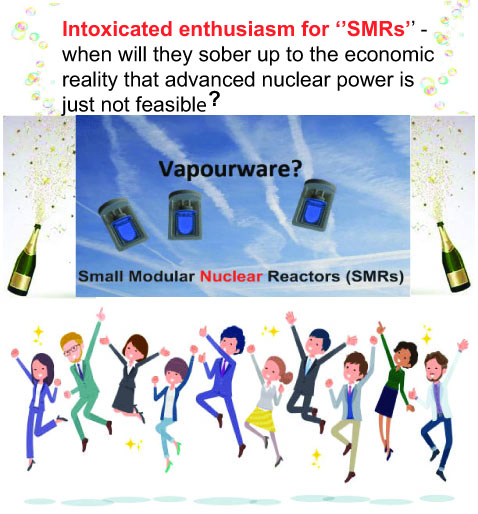
The European Commission has invited interested companies to help “to facilitate and speed up the development, demonstration, and deployment” of small modular nuclear reactors, a fledgling technology it hopes will help the EU achieve its goal of reaching net-zero greenhouse gas emissions by 2030.
……………………………………………………………………………………………………… The inclusion of nuclear power in Europe’s climate mitigation policy has been divisive, with France leading a group of EU members in favour promoting it as a low-carbon solution and Germany against …………………..
Internal market commissioner Thierry Breton said SMRs would play a “central role” in Europe’s climate action. “In a context of increasing business competition on SMRs at global level, Europe is promptly responding, capitalising on its strong nuclear competence, innovation, and manufacturing capability,” he said in a statement.
……………………………….. Environmental groups have criticised the Commission’s reliance on technologies, including SMRs and carbon capture and storage, that have yet to be proved at scale for meeting EU climate targets, rather than focusing resources on promoting existing solutions such as solar and wind power…………. https://www.euronews.com/green/2024/02/09/commission-invites-industry-to-join-support-platform-for-mini-nuclear
US Blocks Yemen-Saudi Peace Deal
New sanctions on the Houthis will make it impossible for the first phase of the Saudi-Houthi peace deal to be implemented
by Dave DeCamp February 6, 2024 , https://news.antiwar.com/2024/02/06/us-blocks-yemen-peace-deal/
The US is purposely blocking a Yemen peace deal that was negotiated between the Houthis and Saudi Arabia, The New York Times reported on Tuesday.
The US decision to re-designate the Houthis as “Specially Designated Global Terrorists” will block the payment of public sector workers living in Houthi-controlled Yemen, who have gone without pay for years.
The payment of civil workers has been a key demand of the Houthis and is part of the first phase of the peace deal. The Houthis had asked for the salaries to be paid for using oil revenue that goes to the Saudi-backed Yemeni government, whose leaders are mainly based in Saudi Arabia. It’s unclear if the Saudi side agreed to the Houthi demand or if they decided to pay the salaries using other means.
The first phase of the peace deal would also fully open Yemen’s airports and sea ports that have been under blockade since 2015, another aspect of the deal that will be complicated by the new US sanctions, which will go into effect later this month.
A US official told the Times that the US would only allow the payment of Yemeni civil salaries if the Houthis choose the path of “peace” and stop attacking shipping in the Red Sea. But the Houthis, who govern the most populated area of Yemen, have been clear the operations will only stop once the Israeli slaughter of Palestinians in Gaza ends.
Instead of pressuring Israel to stop its onslaught, President Biden launched a new war against the Houthis, which has dramatically escalated the situation. The Houthis are now targeting American and British commercial shipping, and there’s no sign they will back down.
Since January 12, the US has launched at least 18 rounds of missile strikes on Houthi-controlled Yemen. President Biden has acknowledged the strikes are not “working” since they haven’t stopped Houthi attacks. But he vowed to continue bombing Yemen anyway.
The US supported a Saudi/UAE-led coalition in Yemen in a brutal war that killed at least 377,000 people between 2015 and 2022. More than half of those killed died of starvation and disease caused by the bombing campaign and blockade.
A truce between the Saudis and Houthis has been held since April 2022, but a formal peace deal hasn’t been signed. Despite the new US bombing campaign, the Saudis and Houthis appear determined not to restart the war. When President Biden launched his bombing campaign in Yemen, Saudi Arabia urged the US to “avoid escalation.”
This week, a Houthi official said the Yemeni group was ready to formally make peace with the Saudis. “Sanaa is prepared for peace with Riyadh despite the challenges posed by the US and its associated Yemeni groups,” said Hussein al-Ezzi, the Houthi deputy foreign minister.
Some members of the US and Saudi-backed Yemeni presidential council are calling for a ground campaign against the Houthis. But the council does not have much influence and is known in Yemen as the “government of hotels” since many of its members are in exile.
Walt Zlotow: Biden seeks $14 more billion to complete destruction of Palestinians in Gaza.
Walt Zlotow, West Suburban Peace Coalition, Glen Ellyn IL 7 Feb 24
The genocidal madness of President Biden has no limits.
For 123 days he’s been in near total support of Israel’s genocidal ethnic cleansing of 2,300,000 Palestinians in Gaza. He’s given them over 20,000 tons of war material to kill tens of thousands of Palestinians, destroy three quarters of their housing, send two million fleeing US bombs just to be blasted by more US bombs while on the run. Most hospitals and schools are gone under US bombs. Hundreds of thousands are starving or dying from lack of medicine.
In addition, he’s given them public support and a veto protection at the UN Security Council which called for ceasefire. He’s dismissed the Court of International Justice genocide hearing on Israel’s genocide as “meritless.” Biden and his Israeli counterpart Netanyahu are joined at the bombsight in their combined genocide in Gaza. US deserved to be joined in the dock with Israel in the ICJ hearing.
Now Biden demands $14 billion more to complete the grotesque project he could have stopped on Day 1 simply by denouncing Israel’s genocidal ethnic cleansing in Gaza, and cutting off every bloody dollar of aid.
Half of Americans polled say Israel has gone too far. Fully a third call it genocide. Biden calls it ‘helping our best ally.’ On Genocide Day 100, he honored Israel without a single mention of the 2,300,000 Palestinians whose lives were being degraded, if not destroyed with his help.
Joe Biden has supported every failed US war of world dominance for half a century. He won’t admit it, but the Israeli war to cleanse Gaza of Palestinians may already have failed. Palestinian resistance and worldwide revulsion and condemnation may bring about the downfall of Israel as well as Gaza.
Joe Biden is the 45th man to occupy the White House. He’s earning the dubious distinction of becoming the first Genocide President.
Western officials in protest over Israel Gaza policy
BBC, By Tom Bateman. BBC State Department correspondent, 3 Feb 24
More than 800 serving officials in the US and Europe have signed a statement warning that their own governments’ policies on the Israel-Gaza war could amount to “grave violations of international law”.
The “transatlantic statement”, a copy of which was passed to the BBC, says their administrations risk being complicit in “one of the worst human catastrophes of this century” but that their expert advice has been sidelined.
It is the latest sign of significant levels of dissent within the governments of some of Israel’s key Western allies.
One signatory to the statement, a US government official with more than 25 years’ national security experience, told the BBC of the “continued dismissal” of their concerns.
“The voices of those who understand the region and the dynamics were not listened to,” said the official.
“What’s really different here is we’re not failing to prevent something, we’re actively complicit. That is fundamentally different from any other situation I can recall,” added the official, who spoke on condition of anonymity.
The statement is signed by civil servants from the US, the EU and 11 European countries including the UK, France and Germany.
It says Israel has shown “no boundaries” in its military operations in Gaza, “which has resulted in tens of thousands of preventable civilian deaths; and… the deliberate blocking of aid… putting thousands of civilians at risk of starvation and slow death.”
“There is a plausible risk that our governments’ policies are contributing to grave violations of international law, war crimes and even ethnic cleansing or genocide,” it said.
The identities of those who signed or endorsed the statement have not been made public and the BBC has not seen a list of names, but understands that nearly half are officials who each have at least a decade of experience in government.
One retired US ambassador told the BBC that the coordination by dissenting civil servants in multiple governments was unprecedented.
“It’s unique in my experience watching foreign policy in the last 40 years,” said Robert Ford, a former American ambassador to Algeria and Syria.
He likened it to concerns within the US administration in 2003 over faulty intelligence leading up to the invasion of Iraq, but said this time many officials with reservations did not want to remain silent.
“[Then there were] people who knew better, who knew that intelligence was being cherry-picked, who knew that there wasn’t a plan for the day after, but nobody said anything publicly. And that turned out to be a serious problem,” he said.
“The problems with the Gaza war are so serious and the implications are so serious that they feel compelled to go public,” he said.
The officials argue the current nature of their governments’ military, political or diplomatic support for Israel “without real conditions or accountability” not only risks further Palestinian deaths, but also endangers the lives of hostages held by Hamas, as well as Israel’s own security and regional stability.
“Israel’s military operations have disregarded all important counterterrorism expertise gained since 9/11… the [military] operation has not contributed to Israel’s goal of defeating Hamas and has instead strengthened the appeal of Hamas, Hezbollah and other negative actors”.
The officials say they have expressed their professional concerns internally but have been “overruled by political and ideological considerations”.
One senior British official who has endorsed the statement told the BBC of “growing disquiet” among civil servants.
The official referred to the fallout from last week’s preliminary ruling by the UN’s International Court of Justice in a case brought by South Africa which required Israel to do all it can to prevent acts of genocide.
“The dismissal of South Africa’s case as ‘unhelpful’ by our Foreign Secretary puts [the international rules-based] order in peril.”
We have heard ministers dismiss allegations against the Israeli Government seemingly without having received proper and well-evidenced legal advice. Our current approach does not appear to be in the best interests of the UK, the region or the global order,” said the official who also spoke on condition of anonymity……………………………………………………… more https://www.bbc.com/news/world-us-canada-68177357
U.S. admits it hasn’t verified Israel’s UNRWA claims, media ignores it

the media coverage, which is, once again, treating Israeli allegations as proven facts. Nor could you tell by the U.S. response. Secretary of State Antony Blinken stated, “We haven’t had the ability to investigate [the allegations] ourselves. But they are highly, highly credible.”
That is a stunning statement. They are simply taking Israel’s word for it, and on that basis, they are suspending aid to nearly two million people who need that aid more than anyone in the world.
Secretary Blinken admits that the U.S. has been unable to investigate the “evidence” presented by Israel claiming 13 of UNRWA’s 13,000 Gaza employees participated in October 7. Biden took Israel’s word for it anyway.
In the latest demonstration of the boundless cruelty of U.S. President Joe Biden and his despicable administration, they have turned the backbone of what little aid Palestinians in Gaza receive into a political football, to be toyed with and batted around while jeopardizing that support for people who are already near the edge of what any human, however brave, can possibly endure.
It’s the latest in what feels like an eternal cycle of the United States and Israel beating up on the UN Relief and Works Agency (UNRWA) for political gain. There have been many hearings on Capitol Hill over the years bashing UNRWA and calling for either a complete structural overhaul of the agency or its dismantlement and absorption into the larger United Nations High Commission for Refugees (UNHCR).
The root of the attacks, prior to October 7, 2023, has been UNRWA’s unique mission which is to provide humanitarian assistance — including food, housing, medical aid, and the role that has taken up the bulk of its budget for years, education — to Palestinian refugees exclusively. Because of this mandate, Israel and its supporters blame UNRWA for the definition of “refugee” in the Palestinian context, which includes not only those made refugees by the 1948 and 1967 wars, but also their descendants born into refugee status.
Many on the pro-Israel and Israeli right and center believe doing away with UNRWA would essentially allow Israel to do away with Palestinian refugees because they believe UNRWA is the only thing maintaining that generational definition.
They’re wrong, of course. International law is clear on this point, as the UN states: “Under international law and the principle of family unity, the children of refugees and their descendants are also considered refugees until a durable solution is found. Both UNRWA and UNHCR recognize descendants as refugees on this basis, a practice that has been widely accepted by the international community, including both donors and refugee-hosting countries. Palestine refugees are not distinct from other protracted refugee situations such as those from Afghanistan or Somalia, where there are multiple generations of refugees, considered by UNHCR as refugees and supported as such. Protracted refugee situations are the result of the failure to find political solutions to their underlying political crises.”
There’s no ambiguity there, but that hasn’t stopped the controversy. ……………………………
Israelis have always known that they need the agency, despite all their hateful rhetoric about it. For years, Israel would bash UNRWA mercilessly in the media, but would always tell the United States that its operations were necessary, especially in Gaza. Without UNRWA, Israel would be expected to ensure that a humanitarian catastrophe did not ensue, so Israel needs the agency.
In 2018, emboldened by a reckless U.S. administration under Donald Trump, Netanyahu suddenly changed that position and called for the U.S. to dramatically cut its support of UNRWA. Trump eagerly did so. When Netanyahu made that sudden shift, it surprised and disturbed many in his own government who disagreed with the decision. Just about the only positive step Joe Biden took when entering office was to restore UNRWA’s funding. But Trump’s action made the question of UNRWA’s funding even more politically charged than it had always been.
Unable to investigate
The old cycle seems to be playing out again, but this time, the highly charged politics in Washington are more intricate.
On January 26, Israeli allegations against a dozen UNRWA employees surfaced. The agency immediately fired nine of them and said that two others were dead, hoping their swift and pre-emptive action would stave off rash U.S. actions. Nonetheless, the United States and a host of other countries immediately suspended funding for UNRWA, over the actions of 12 of over 30,000 employees, 13,000 of whom are in Gaza.
It’s worth pausing over that last fact for a moment. Twelve out of 13,000 Gaza employees have caused all of this, and it’s based on evidence that has not been made public. You’d never know that from much of the media coverage, which is, once again, treating Israeli allegations as proven facts. Nor could you tell by the U.S. response. Secretary of State Antony Blinken stated, “We haven’t had the ability to investigate [the allegations] ourselves. But they are highly, highly credible.”
That is a stunning statement. They are simply taking Israel’s word for it, and on that basis, they are suspending aid to nearly two million people who need that aid more than anyone in the world.
Recall that Israel, in October 2021, labeled six Palestinian organizations as being connected to “terrorist groups,” specifically referring to the Popular Front for the Liberation of Palestine (PFLP). The “evidence” Israel presented was so threadbare that European countries dismissed it as baseless, and even the Biden administration, which has repeatedly supported Israeli claims based on no evidence that turned out to be false, could not accept the Israeli charges, though it avoided explicitly calling out Israel’s attempted deception.
Yet now, Israel has presented a “dossier” that contains its case against the twelve UNRWA workers. The actual evidence has not been made public, and even the United States, as noted above, has admitted it can’t verify the Israeli claims. But the U.S. suspended UNRWA’s funding anyway and led seventeen other countries to follow suit. …………………………………………………………………………………………………………………………
Biden’s incompetence and mindless cruelty
For Biden, the hearings, as well as the general tone and tenor in Washington after years of bashing UNRWA, present a problem. If he doesn’t restore UNRWA’s funding, conditions in Gaza will grow much worse very quickly, and calls for a ceasefire will be overwhelming, as will Biden’s downward trend in polls. If he restores UNRWA’s funding, he will find himself under attack from Republicans as well as some Democrats.
In the wake of the hearing this week, one of Israel’s leading advocates in Congress, Brad Schneider (D-IL), bluntly stated, “We have to replace UNRWA with something else. I support getting rid of UNRWA.”………………………………….
Had Biden and Secretary of State Antony Blinken not reacted in knee-jerk fashion to the unsubstantiated Israeli allegations, this would be less of a problem. They could have noted that UNRWA immediately fired the workers in question, that it had launched an investigation, and that its work was needed now more than ever. Biden could then have talked about reviewing UNRWA over the coming weeks and months, and made some political show of it without jeopardizing the aid to Gaza, which even the Israeli government doesn’t want to see cut………………………..
Even government officials from both the Biden administration and the Netanyahu government have been forced to acknowledge the crucial role UNRWA plays. That this has become a political hot potato is not just a testament to Biden’s incompetence, but also to his mindless cruelty and unquenchable hostility to the Palestinian people. https://mondoweiss.net/2024/02/u-s-admits-it-hasnt-verified-israels-unrwa-claims-media-ignores-it/—
French firm EDF shows its power over the UK govt – no judicial review now required over fish protection from Hinkley nuclear cooling system.
In 2021, EDF was formally told it must fit an acoustic fish deterrent
(AFD) system to the massive seawater intakes of the cooling system. It was
considered necessary to “protect the marine life of the Severn Estuary
catchment area and its nine great rivers: Parrett, Avon, Severn, Wye, Usk,
Ebbw, Rhymney, Taff, Ely and their tributaries where many fish species go
to breed”.
Without AFD it is estimated that 22 billion fish would be
ingested over the planned 60-year life of the plant, of which half would be
killed in the process.
Not so final. EDF appealed against this but in 2022
the then environment secretary, George Eustice, refused the appeal in
definitive terms: “The decision on this appeal is final [and] can only be
challenged in the courts by judicial review.”
Final? EDF, which has been
running rings around the government and bullying ministers (Eyes passim)
since it bought the British nuclear fleet in 2008, simply went
regulator-shopping on the basis that energy ministers are more likely to be
sympathetic. And so it proves: the Department for Environment, Food & Rural
Affairs (Defra) has been reduced to the role of consultee on the “final
final” decision, which will now be taken elsewhere – with no judicial
review required.
Private Eye 2nd Feb 2024
https://www.private-eye.co.uk/sections.php?issue=1616§ion_link=columnists
EDF’s Hinkley Point woes pile pressure on global nuclear push.

When in 2016 France’s EDF signed up to build Britain’s first new
nuclear power plant in two decades, defenders of the costly Hinkley Point C
project included Emmanuel Macron, then economy minister. “If we believe
in nuclear power, we have to do Hinkley Point,” France’s now president
told a parliamentary enquiry, rejecting some lawmakers’ concerns that
state-backed EDF, which was already struggling to deliver a new French
prototype plant in Normandy, may not have the financial bandwidth to take
on the British site, originally estimated to cost £18bn.
Eight years on, with cost overruns surging at Hinkley due to repeated delays and EDF on the
hook for at least another £5bn on top of previous budget revisions,
Macron’s government is on a mission to ensure the French nuclear operator
can indeed withstand the fallout — and keep on top of ballooning
investments and orders at home.
French ministers are trying to get the British state to stump up some support for the soaring Hinkley bill, which could reach a total of £46bn at today’s prices for the two reactors,
people close to the talks have said.
That would be roughly double the original budget in 2015 prices, compared with an EDF project in Finland that ended up costing more than twice what it was supposed to and a plan
for one reactor at Flamanville in France that is running four times over
budget, at €13.2bn.
But the Hinkley setbacks have also revived a core
strategic question that is becoming more pressing than ever for EDF, a
former French electricity monopoly that operates Europe’s biggest fleet
of 56 domestic reactors: whether it is equipped to handle multiple projects
at once, internationally and at home, and financially as well as from an
industrial perspective. Already an issue in 2016, when French labour unions
at the group opposed the Hinkley plans on the basis that the financial
set-up was risky, this tension now has a different edge to it.
FT 29th Jan 2024
https://www.ft.com/content/d401e42b-d953-4ef0-b3ea-ed80e974249a
The feckless four – hypocrisy of the nuclear weapons nations

What do governments led by Rishi Sunak, Vladimir Putin, Emmanuel Macron and Kim Jong-un have in common?
Inside Story NIC MACLELLAN ,2 FEBRUARY 2024
Just three days before Christmas, the UN General Assembly adopted a resolution designed to assist survivors of nuclear testing and restore environments contaminated by nuclear weapons testing and use. Jointly developed by Kiribati and Kazakhstan, the resolution won overwhelming support, with 171 nations in favour, six abstentions and just four votes against.
It’s little surprise that five of the six abstentions came from nuclear weapon states: the United States, China, Israel, Pakistan and India (joined, oddly, by South Sudan). But in a dismaying display of power politics, France and Britain voted with Russia and North Korea to oppose assistance to people and landscapes irradiated during decades of nuclear testing.
Diplomats representing Western powers are prone to talk about “the international community,” “the rules-based order” and “democratic versus authoritarian states.” But on this occasion the jargon was undercut by the willingness of London and Paris to line up alongside Moscow and Pyongyang to avoid responsibility for past actions and to limit reparations.
With the International Court of Justice debating genocide in Ukraine, Myanmar and Palestine and UN agencies seeking to defend international humanitarian law, the hypocrisy of major powers has been polarising international opinion. Developing nations are increasingly challenging an international order that sanctions official enemies, at the same time as absolving major powers of the responsibility to deal with their own breaches of international law.
Over the past three years, ambassadors Teburoro Tito of Kiribati and Akan Rakhmetullin of Kazakhstan have coordinated international consultations on how the nuclear assistance provisions of the Treaty on the Prohibition of Nuclear Weapons, or TPNW, should be implemented. Articles 6 and 7 of the treaty, which entered into force in January 2021, include unprecedented obligations on parties to the treaty to aid nuclear survivors and contribute to environmental remediation.
Kiribati and Kazakhstan might seem an unlikely couple, but they have bonded over a common twentieth-century legacy. Both nations’ lands, waters and peoples have been devastated by cold war nuclear testing, and in each case the responsible countries refuse to take responsibility. Britain and Russia have bonded, too, but in their case, they’re united in their refusal to assist their former colonies.
After conducting twelve atmospheric atomic tests in Australia in 1952–57 — at the Monte Bello Islands, Emu Field and Maralinga — Britain sought a new location for developing and testing more powerful hydrogen bombs. During Operation Grapple, the British military conducted nine atmospheric thermonuclear tests at Malden and Christmas (Kiritimati) islands in the Gilbert and Ellice Islands Colony, which is today part of the Republic of Kiribati.
Just as Britain chose the “vast empty spaces” of the South Australian desert and the isolated atolls of Kiribati for its tests, Moscow sought similar expanses within the Union of Soviet Socialist Republics. Over more than four decades, it held 456 nuclear tests in the Semipalatinsk region of Kazakhstan. The history of Soviet testing in the Central Asian republic and its radioactive legacies, spread across more than 18,000 square kilometres, has been documented by Kazakh scholar Togzhan Kassenova in her compelling 2022 book Atomic Steppe.
Once the TPNW was adopted, Kiribati and Kazakhstan led efforts to develop mechanisms for dealing with the health and environmental effects of radioactive fallout. After seeking technical advice from survivors, nuclear scientists and UN agencies, they developed a set of proposals for action and a UN resolution seeking international support.
Now adopted by the UN General Assembly, that resolution proposes bilateral, regional and multilateral action and the sharing of technical and scientific information about nuclear legacies, and “calls upon Member States in a position to do so to contribute technical and financial assistance as appropriate.” It requires UN secretary-general Antonio Guterres to seek members’ views and proposals about assistance to nuclear survivors and report back to the General Assembly…………………………………………………. more https://insidestory.org.au/the-feckless-four/
France seeks loan guarantees from UK over Hinkley Point C nuclear plant

French officials look for funding options for the EDF project as UK ministers insist they will not shoulder any costs.
Annabel Cossins-SmithFebruary 1, 2024 https://www.power-technology.com/news/france-loan-guarantees-from-uk-over-hinkley-point-c/?cf-view&cf-closed—
rance’s Government is putting pressure on UK ministers to provide loan guarantees for the drawn-out construction of its Hinkley Point C nuclear plant in an attempt to ease the financial burden on French state-owned utility EDF.
EDF, which also owns and operates the UK’s current active fleet of nuclear reactors, is paying for most of Hinkley Point C’s construction.
The company said last week that costs for the project are expected to rise again, the second announcement of a major cost increase in less than a year. The cost of completing Hinkley is now expected to be between £31bn (€36.29bn) and £34bn, although if completion is delayed to 2031, costs may rise to £35bn.
These figures from EDF are based on 2015 price values. In today’s terms, once inflation is taken into account, numbers become significantly higher. Less than a year ago, documents revealed that EDF executives were already expecting costs for the project to rise to up £33bn.
EDF also pushed back its completion date last week to 2029 at the earliest, or 2031 in an “unfavourable scenario”. This is more than a decade later than the original deadline of 2017 given in 2007. It is also four years later than the previous deadline of 2027 given in 2022.
Under a contract drawn up a decade ago, before costs had spiralled, the financial burden of any overruns in construction falls on EDF rather than the UK Government. However, French ministers are now demanding state guarantees from the UK, the Financial Times reports. Assurances would allow EDF to issue project-level debt and relieve pressure on the company’s finances, which took a major hit in 2022 after electrical output from the company’s ageing nuclear fleet in France nosedived.
China’s General Nuclear Power Group (CGN) holds a 33% stake in Hinkley Point C. Under the companies’ agreement, EDF can ask CGN to pump more capital into Hinkley if costs rise, but a spokesperson for EDF said last year: “The probability that CGN will not fund the project after it has reached its committed equity cap is high.” CGN has since stopped paying for overruns, so EDF is left shouldering all additional costs.
The UK Government insists it will not cover any costs. “Hinkley Point C is not a government project and so any additional costs or schedule overruns are the responsibility of EDF and its partners and in no way will fall on taxpayers,” a spokesperson said.
According to sources familiar with the matter, the proposal being pushed by French officials is similar to an initial offer from the UK Government when the Hinkley contracts were first negotiated in 2014, in which British ministers offered EDF a loan guarantee of £10bn for the project. However, this offer was withdrawn in 2016 when a final investment decision was taken because ministers already had concerns about soaring costs.
Another proposal from France involves changes in contract terms for the construction of the UK’s other flagship nuclear project, Sizewell C, also being built by EDF. Funding for Sizewell differs to Hinkley because it is being part-funded by the public purse, with the UK government also looking to raise £20bn in outside private investment.
The provisional measures of the International Court of Justice

by Thierry Meyssan, VOLTAIRE NETWORK | PARIS (FRANCE) | 30 JANUARY 2024, Translation
Roger Lagassé
The International Court of Justice has just taken provisional measures to protect the Gazan population from possible genocide. This decision is nothing new, but provides legal support for the political position of the United States. This decision in no way prejudges the judgment on the merits, which would condemn Israel if it were made, but probably never will be. International justice is still in its infancy, and is still struggling to apply the law.
The International Court of Justice, presided over by former U.S. State Department official Joan Donoghue, has issued a protective order in the case between South Africa and Israel. Unsurprisingly, the Court took exactly the same decision as the United States: Israel must do everything in its power to prevent genocide, while continuing its war against Hamas.
INTERNATIONAL JUSTICE IS STILL IN ITS INFANCY
The Court is an embryo of international justice within the United Nations. It replaces the Permanent Court of International Justice, which was created in 1922 within the League of Nations. The system is only a century old. Its aim is to ensure that each State applies the commitments it has entered into. However, since 1942, the Anglo-Saxons, who accepted this court in 1945, have been seeking not to apply international law, but to establish their governance over the world. When they signed the Atlantic Charter, British Prime Minister Winston Churchill and US President Franklin D. Roosevelt asserted, in the name of their states, that they alone should decide disputes between states in the post-war world. This was the original cause of the Cold War and today’s conflicts.
Consequently, contrary to the image we have of it, the International Court of Justice is not a finished court, but a battlefield where the Anglo-Saxon unipolar project of the world confronts the multipolar project of most other states. This is how we should interpret the Gaza massacre order.
The only means of pressure on governments available to the Court is not an army, but public opinion in each country. No government accepts the idea of being presented to its people as a criminal. It is therefore particularly important to understand the Court’s decisions.
MAGISTRATES HAVE TO SAY WHAT’S RIGHT, BUT THEY’RE NOT ALL THAT INDEPENDENT
The Court’s fifteen permanent magistrates are nominated by their own governments and elected by all. They must use legal reasoning to justify their decisions. However, their decisions generally reflect their national prejudices. It is very rare for judges chosen by their own government to rule against it. Two additional magistrates are appointed by the two parties to the conflict. They come to defend their country and look for legal arguments to back up their case……………………………………………………………………………………………………….
First of all, no one has asked the Court to judge the Israeli-Palestinian conflict, and international law has nothing to do with politics. Secondly, South Africa was careful not to accuse Israel of genocidal intent, but it did cite enough genocidal statements by Israeli leaders to call for provisional measures, an argument which the Israeli judge considered valid. Finally, let’s come to the last point: the absence of Hamas from the proceedings cannot authorize Israel to allow genocide to be perpetrated…………………………………………………….
The Court did not rule on South Africa’s other demands, which could not be dealt with as a matter of urgency, but exclusively on the merits: reparation measures for Palestinian victims and the condemnation by Israel of individuals guilty of genocide. Above all, it did not say that “the Israeli State must immediately suspend its military operations in and against Gaza”……………………………………………………………
PROVISIONAL ORDER DOES NOT PREJUDGE JUDGMENT ON THE MERITS
The Court’s order is binding not only on Israel and South Africa, but also on the 151 other States that have signed the Convention on the Prevention and Punishment of the Crime of Genocide. Depending on their situation, each of them is obliged to associate itself with the provisional measures. Some could interpret this as justifying an embargo on all armaments, or prohibiting their dual nationals from taking part in this potentially genocidal war.
………………………………………… there is already a case in the Northern California District Court between Defense for Children International and Joe Biden, Antony Blinken and Lloyd Austin, and another in London between Global Legal Action Network and the British government. Both are based on the premise that supplying arms to Israel at this time is participation in the massacre in Gaza. They now have a chance to succeed.
It could also be brought before the International Criminal Court, which could be called upon to judge certain Israeli leaders. Several countries have already referred the case to the Court.
Moreover, this order is only precautionary until the Court has ruled on the merits of the case. However, we must not dream: the Court may shy away and declare itself incompetent. In that case, there will never be a ruling on the merits of the case, and the protective measures will lapse.
This is the most likely outcome. Yet the Court itself has already dismissed the argument that South Africa’s previous approaches to Israel would not have given it time to respond. It could still nitpick over “genocidal intent”. In the event of the complaint being deemed inadmissible. The massacre could resume.
We must not delude ourselves about the International Court of Justice. It represents a major step towards international law, but is still a long way off. https://www.voltairenet.org/article220359.html
1 This Month



26 September – International Day for the Total Elimination of Nuclear Weapons


PLEASE OPPOSE HR 8255 AND S.3639 – bills would accelerate satellite deployment, with no environmental review or safeguards – https://ncstd5li.quorum.us/campaign/169331/
To see nuclear-related stories in greater depth and intensity – go to https://nuclearinformation.wordpress.com
-
Archives
- September 2026 (233)
- August 2026 (330)
- July 2026 (355)
- June 2026 (287)
- May 2026 (306)
- April 2026 (356)
- March 2026 (251)
- February 2026 (267)
- January 2026 (308)
- December 2025 (358)
- November 2025 (359)
- October 2025 (375)
-
Categories
- 1
- 1 NUCLEAR ISSUES
- business and costs
- climate change
- culture and arts
- ENERGY
- environment
- health
- history
- indigenous issues
- Legal
- marketing of nuclear
- media
- opposition to nuclear
- PERSONAL STORIES
- politics
- politics international
- Religion and ethics
- safety
- secrets,lies and civil liberties
- spinbuster
- technology
- Uranium
- wastes
- weapons and war
- Women
- 2 WORLD
- ACTION
- AFRICA
- Atrocities
- AUSTRALIA
- Christina's notes
- Christina's themes
- culture and arts
- Events
- Fuk 2022
- Fuk 2023
- Fukushima 2017
- Fukushima 2018
- fukushima 2019
- Fukushima 2020
- Fukushima 2021
- general
- global warming
- Humour (God we need it)
- Nuclear
- RARE EARTHS
- Reference
- resources – print
- Resources -audiovicual
- Weekly Newsletter
- World
- World Nuclear
- YouTube
-
RSS
Entries RSS
Comments RSS
 nuclear-news