They’re Really Going To Try To Lay All The Blame For Gaza On Netanyahu

They’re really going to try to pin all the blame for the incineration of Gaza on Benjamin Netanyahu so that nothing has to change when this is over. The western empire has chosen a single scapegoat to carry away its sins so the status quo can march on unhindered by guilt or consequence.
They want everyone to pin all the blame for the Gaza genocide on Netanyahu, but this is not all the fault of Netanyahu. It’s the fault of the entire Israeli state. It’s the fault of Joe Biden. It’s the fault of the Democrats. It’s the fault of all the Israel supporters on Capitol Hill. It’s the fault of the western press. It’s the fault of the Israel lobby. It’s the fault of the unelected empire managers in US government agencies. It’s the fault of the entire US empire and all its imperial member states like Australia, the UK, the EU, and Canada.
By trying to make this mass atrocity solely the fault of Netanyahu and not the giant, sprawling network of immensely powerful institutions which made it possible, they’re working to ensure that no changes will need to be made to any of those institutions. It’s just like how they made a scapegoat of Judith Miller for the entire mass media’s war propaganda in the lead-up to the Iraq invasion and let all the blame for the war hang on Bush (before completely rehabilitating Bush’s image during the Trump administration and deciding he’s a pretty great guy after all). No meaningful changes were ever made to ensure that the US power alliance never repeats its horrible crimes after Iraq, which is why it keeps repeating horrible crimes.
The trouble with Israel apologia on Gaza is that at first glance its talking points sound legit if you don’t know much about Israel-Palestine. “Israel has a right to defend itself”, “They need to get rid Hamas because of October 7” etc would sound entirely reasonable if you didn’t know that Israel is a settler-colonialist apartheid state who has been murdering, abusing and stealing from the indigenous population of the land for generations.
The amount of energy needed to see through the talking points is far greater than the amount of energy needed to speak them — it’s one of those “A lie gets halfway around the world before the truth even gets its pants on” kind of deals. Which is why it’s miraculous that so many people around the world are getting educated enough to see through the lies and support the Palestinians.
How are they getting educated enough? Mostly through online content which sums up the situation quickly and concisely enough for them to understand easily. That’s the only way the truth can move quickly enough to catch up with the lies. And that’s the role TikTok has played here, which is why we’ve seen Israel lobbyists and the ADL shrieking their lungs out about it for months.
It would never have occurred to any American to think TikTok is a five-alarm foreign enemy threat until their government told them to think that, and then when they did the biggest bootlickers in the world started acting like it’s just a common sense fact they’ve always believed.
Americans who’d trust their own government to oversee their communications more than they’d trust China have missed all the most important lessons about the US government that have come out in their lives. Even if China really is getting data from TikTok (and there’s currently no evidence that it is), only a groveling empire simp would object to it.
Saying TikTok must be suppressing pro-Israel content because pro-Palestine content is more popular is like saying they’re suppressing flat earth content because round earth content is more popular. Pro-Israel content is just less popular in general, which is why the gap is the same on Facebook and Instagram.
❖
The US government is like “No no it’s not censorship, we’re just using state power to ensure that popular speech platforms are only allowed to exist if they can be controlled by US government agencies.”
Israel has done so much fucked up shit in the last few days we’ve already forgotten the news that they literally tortured UN staff to extract false statements about UNRWA having Hamas connections.
They. Tortured. UN. Staff. If we had anything remotely like objective news reporting in the western press, this would have been the top story everywhere for days.
❖
Once you see how evil Israel’s actions are you start to understand why its defenders need to resort to just calling anyone who criticizes Israel a Jew-hater.
❖When Israel apologists say “antisemite” it’s just a meaningless noise made to hurt the feelings of the person it’s said to. Once you realize this it starts to land in exactly the same way as any other infantile name-calling from anyone else who’s lost the argument.
Reversing Europe’s and Australia’s slide into irrelevance & insecurity – National Press Club of Australia speech- Yanis Varoufakis

First, Australia must restore a reputation tainted by blindly following America into lethal adventures in Iraq, Afghanistan and, today, via its active and crucial complicity in Israel’s deliberate war crimes in Gaza, East Jerusalem and the West Bank.
Children are not starving in Gaza today. No, they are being deliberately starved. Without hesitation or remorse. The famine in Gaza is no collateral damage. It is an intentional policy of starving to death thousands until the rest agree to leave their ancestral homeland.
Second, Australia has a duty to de-escalate the New Cold War. To understand that this can only be done if Australia ends its servility to a United States’ actively creating the threats that they then make us pay through the nose to protect us from.
Imagine an Australia that helps bring a just Peace in Ukraine, as opposed to a mindless forever war. A non-aligned Australia that is never neutral in the face of injustice but, also, not automatically aligned with every warmongering adventure decided in Washington.
Imagine an Australia which, having re-established its credentials as a country that thinks and acts for itself, engages with China in the spirit of peaceful cooperation – a far better way of addressing Beijing’s increasing authoritarianism toward its own peoples than buying useless, hyper-expensive submarines that only succeed in forcing China’s political class to close ranks around a more authoritarian core.
Imagine a truly patriotic Australian Prime Minister who tells the American President to cease and desist from the slow murder of Julian Assange for the crime of journalism – for exposing American war crimes perpetrated behind the back of US citizens in their name.
To conclude, if Europe and Australia are to escape gross irrelevance, we need separate but well-coordinated European and Australian Green New Deals.
DiEM25, our paneuropean movement, is working toward this goal.
Yanis Varoufakis – 14/03/2024
Europe and Australia are facing a common existential threat: a creeping irrelevance caused, on the one hand, by our failure properly to invest and, on the other hand, by our ill-considered slide from a strategic dependence on the United States to a non-strategic, self-defeating servility to Washington’s policy agenda.”
Yanis Varoufakis’s address at the National Press Club in Canberra on Wednesday 13 March, 2024
…………………………………. The three post-war phases that shaped Australia’s and Europe’s habitat
Our present moment in Europe and in Australia has been shaped by three distinct postwar phases.
The first was the Bretton Woods system. America exited the war as the only surplus, creditor country. Bretton Woods, a remarkable recycling mechanism, was, in effect, a dollar zone built on fixed exchange rates, sustained by capital controls, and erected on the back of America’s trade surplus. With quasi-free trade as part of the deal, Washington dollarised Europe, Japan and Australia to generate aggregate demand for the products of its factories – whose productivity had skyrocketed during the war. Subsequently, the US trade surplus sucked the exported dollars back into America. The result was twenty years of high growth, low unemployment, blissfully boring banking and dwindling inequality. Alas, once the United States lost its trade surplus, Bretton Woods was dead in the water.
The second phase was marked by the violent reversal of this recycling mechanism. The United States became the first hegemon to enhance its hegemony by boosting its trade deficit. Operating like a powerful vacuum cleaner, the burgeoning US trade deficit hoovered up the world’s net exports. And how did America pay for them? With dollars which it also hoovered up from the rest of the world as German, Japanese and later Chinese capitalists sent to Wall Street 70% of dollar profits made from their net exports to the US. There, in Wall Street, these foreign capitalists recycled their dollar profits into Treasuries, real estate, shares and derivatives.
This audacious inverted recycling system, built on US deficits, required ever increasing American deficits to remain stable. In the process, it gave rise to even higher growth than the Bretton Woods era, but also to macroeconomic and financial imbalances as well as mind-numbing levels of inequality. The new era came complete with an ideology (neoliberalism), a policy of letting finance rip (financialisation), and a false sense of dynamic equilibrium – the infamous Great Moderation built on hugely immoderate imbalances.
Almost inevitably, on the back of the perpetual tsunami of capital rushing in from the rest-of-the-world to Wall Street, financiers fashioned gigantic pyramids of complex wagers – Warren Buffet’s infamous Weapons of Mass Financial Destruction. When these crashed, to deliver the Global Financial Crisis, two things saved Wall Street and Western capitalism:
- The G7 central banks, that printed a total of $35 trillion on behalf of the financiers from 2009 to last year – a peculiar socialism for bankers. And,
- China, which directed half its national income to investment, thus replacing much of the lost aggregate demand not only domestically but also in Germany, Australia and, of course, in the United States.

The third period is more recent. The era of technofeudalism, as I call it, which took root in the mid-2000s but grew strongly after the GFC in conjunction with the rapid technological change that caused capital to mutate into, what I call, cloud capital – the automated means of behavioural modification living inside our phones, apps, tablets and laptops. Consider the six things this cloud capital (which one encounters in Amazon or Alibaba) does all at once:

- It grabs our attention.
- It manufactures our desires.
- It sells to us, directly, outside any actual markets, that which will satiate the desires it made us have.
- It drives and monitors waged labour inside the workplaces.
- It elicits massive free labour from us, its cloud-serfs.
- It provides the potential of blending seamlessly all that with free, digital payments.
Is it any wonder that the owners of this cloud capital – I call them cloudalists – have a hitherto undreamt of power to extract? They are, already, a new ruling class: today, the capitalisation of just seven US cloudalist firms is approximately the same as the capitalisation of all listed corporations in the UK, France, Japan, Canada and China taken together!
Continue readingEuropean Powers Stab Each Other in the Back Over Ukraine Proxy War Defeat
Finian Cunningham, March 13, 2024, https://strategic-culture.su/news/2024/03/13/european-powers-stab-each-other-in-the-back-over-ukraine-proxy-war-defeat/—
The failure of being vassals for the American empire and the impending disaster of defeat for the NATO proxy war in Ukraine is weighing heavily.
Europe is rife with treachery in the age-old fashion of imperial rivalry. It’s pathetic to watch, but highly instructive about who the real villains of the piece are.
The failure of being abject vassals for the American empire and the impending disaster of defeat for the NATO proxy war in Ukraine is weighing heavily.
Each European power is pushing the other over the abyss to save its own political skin.
France’s Emmanuel Macron has emerged to be a little king rat. He has taken to talking up deploying NATO troops to Ukraine to salvage the proxy war against Russia. Macron struts around like a rat in jackboots too big for his feet calling on other European leaders not to be cowards.
The former Rothschild banker Macron then turns around and cancels yet another trip to the Ukrainian capital Kiev. Maybe the French leader got scared by the Russian air strike on Odessa last week when the Greek premier was touring the city along with Ukraine’s puppet president Zelensky.
Macron sent his Foreign Minister Stéphane Séjourné to Lithuania last Friday to discuss with the rabid Russophobic Baltic states the idea of sending NATO troops to Ukraine. Given the history of the Baltic states aiding and abetting the Third Reich’s invasion of the Soviet Union in Operation Barbarossa in 1941, we can safely posit the same states are an open door for such French-inspired madness.
However, with classic elite cowardice, Macron obviously doesn’t want to be anywhere near the front line when the action gets hot. Better to hunker down on a comfy armchair in Elysée Palace and bark out your angry poodle orders from there.
Meanwhile, that other bastion of European civility (meaning treacherous deception) the good old British are cajoling Germany to send long-range missiles to Ukraine to strike deep into Russia.
German Chancellor Olaf Scholz is balking at supplying the Taurus cruise missiles to the Ukrainian regime. The German-made weapon has a range of 500 kilometers. Given the unhinged NeoNazis in Kiev (headed up by a Jewish puppet Zelensky) it is a certainty that the Taurus missiles would be fired at Moscow to kill “Untermenschen Russians”.
That’s why Scholz is worried. His top Luftwaffe commanders have already been caught red-handed planning how the Taurus “super tools” would be used to hit deep Russian targets.
Enter the ever-so-polite British with a helping hand to the Germans. Britain’s Foreign Secretary “Lord” David Cameron visited Berlin last week urging the Germans to supply the Taurus missile to Ukraine.
Cameron said London was ready to help Germany “solve the problem” of its reluctance to provide the long-range weapon.
The British top diplomat offered a swap arrangement whereby London would buy Taurus missiles from Germany while supplying more of its Storm Shadow cruise missiles to Ukraine. In that way, Berlin would not be implicated in attacking Russia, according to Cameron.
Laughably, the German Foreign Minister Annalena Baerbock said she considered the British offer to be viable.
Her nominal boss, Chancellor Scholz, has officially remained reluctant to the idea of sending Taurus missiles.
Germany would do well to treat any British proposal with deep suspicion. After all, it was the British that inveigled Germany into two world wars. The first one was with the objective of destroying an imperial rival, while the second one was engineered to unleash Hitler’s war machine on the Soviet Union.
The cold facts are that the United States and its European NATO vassals embarked on a proxy war against Russia using Ukraine as the battleground. That war was at least 10 years in the making from the CIA-sponsored coup in Kiev in 2014 which brought to power the present NeoNazi regime.
The two-year proxy war has turned out to be a colossal failure for the American empire and its European satellites. The Kyiv regime is collapsing from overwhelmingly superior Russian firepower. The wasting of the Ukrainian military – as many as 500,000 men – as well as up to $200 billion in financial and military aid paid for ultimately by Western taxpayers will rebound with massive political repercussions for the warmongering Western elites.
Each one of these imperialist criminal powers wants to save their own necks as the noose of public anger inevitably tightens.
The French cock-turned-rat Macron would no doubt like to muddy the battlefield with NATO troops – while avoiding any muck splashing on his dainty little boots of course.
The Americans are beginning to realize they can’t win and are finally cutting off the money, leaving the Europeans high and dry to deal with a continental-sized mess. Joe Biden can’t even remember if it was Ukraine or Iraq that he made a fatal mistake in.
Britain, ever the arch Machiavellian maggot, would like to throw Germany into the frontline against Russia. No doubt the City of London could pick up some much-needed capitalist business from war reconstruction contracts.
The proxy war in Ukraine is over and the Western rats are scurrying off the ship.
The Western public needs to hold each one of them to account and not let them blow up a bigger war with Russia as a way to distract from their culpability.
Cold turkeys: The demise of nuclear power

Jim Green, Mar 12, 2024, https://reneweconomy.com.au/cold-turkeys-the-demise-of-nuclear-power-in-australias-aukus-partner-countries/
When announcing the AUKUS agreement in 2021, then Prime Minister (and secret energy minister) Scott Morrison said: “Let me be clear: Australia is not seeking to establish … a civil nuclear capability.” He also said that “a civil nuclear energy industry is not a requirement for us to go through the submarine program.”
However, Coalition Senators argued in a report last year that Australia’s “national security” would be put at risk by retaining federal legislation banning nuclear power and that the “decision to purchase nuclear submarines makes it imperative for Australia to drop its ban on nuclear energy.”
So, let’s see how nuclear power is faring in our AUKUS partners, the UK and the US.

This is a story about conventional, large reactors. All that needs to be said about ‘small modular reactors’ in the UK and the US is that none exist and none are under construction.
This is a story about conventional, large reactors. All that needs to be said about ‘small modular reactors’ in the UK and the US is that none exist and none are under construction.
The UK

The last power reactor start-up in the UK was 29 years ago — Sizewell B in 1995.
Over the past decade, several proposed new nuclear power plants have been abandoned (Moorside, Wylfa, Oldbury) and the only project to reach the construction stage is Hinkley Point C, comprising two French-designed EPR reactors.
In the late 2000s, the estimated construction cost for one EPR reactor in the UK was £2 billion (A$3.9 billion). When construction of two EPR reactors at Hinkley Point commenced in 2018 and 2019, the cost estimate for the two reactors was £19.6 billion.
The current cost estimate for the two reactors has ballooned to £46 billion (A$89 billion) or £23 billion (A$44.5 billion) per reactor. That is 11.5 times higher than the estimate in the late 2000s. Further cost overruns are certain. This is an example of the Golden Rule of Nuclear Economics: Add a Zero to Nuclear Industry Estimates.
The UK National Audit Office estimates that taxpayer subsidies for Hinkley Point — primarily in the form of a guaranteed payment of £92.50 (A$180) per megawatt-hour (2012 prices), indexed for inflation, for 35 years — could amount to £30 billion (A$58 billion) while other credible estimates put the figure as high as £48.3 billion (A$94 billion).
Delays

The delays associated with Hinkley Point have been as shocking as the cost overruns. In 2007, French utility EDF boasted that Britons would be using electricity from an EPR reactor at Hinkley Point to cook their Christmas turkeys in 2017. In 2008, the UK government said the reactors would be complete “well before 2020”.
But construction of the two reactors didn’t even begin until 2018 and 2019, respectively, at which time completion was expected in 2026. Now, completion is expected in 2030 or 2031.
Undoubtedly there will be further delays and if the reactors are completed, it will be more than a quarter of a century after the 2007 EDF boast that Britons would finally be using electricity from Hinkley Point to cook their Christmas turkeys.
Construction will take well over 10 years; planning and construction over 25 years. Yet in Australia, the Coalition argues that Australians could be cooking Christmas turkeys with nuclear power 10 years from now.
‘Something of a crisis’
Nuclear industry lobbyist Tim Yeo said in 2017 that the UK’s nuclear power program faced “something of a crisis”. The following year, Toshiba abandoned the planned Moorside nuclear power project near Sellafield despite generous offers of government support — a “crushing blow” according to Yeo.
Then in 2019, Hitachi abandoned the planned Wylfa reactor project in Wales after the estimated cost of the twin-reactor project had risen by 50 percent.
Hitachi abandoned the project despite an offer from the UK government to take a one-third equity stake in the project; to consider providing all of the required debt financing; and to consider providing a guarantee of a generous minimum payment per unit of electricity.
Long gone was the 2006 assertion from then UK industry secretary Alistair Darling that the private sector would have to “initiate, fund, construct and operate” nuclear power plants.
The UK Nuclear Free Local Authorities noted that Hitachi joined a growing list of companies and utilities backing out of the UK nuclear new-build program:
“Let’s not forget that Hitachi are not the first energy utility to come to the conclusion that new nuclear build in the UK is not a particularly viable prospect. The German utilities RWE Npower and E-on previously tried to develop the site before they sold it on Hitachi in order to protect their own vulnerable energy market share in the UK and Germany.
“British Gas owner Centrica pulled out of supporting Hinkley Point C, as did GDF Suez and Iberdrola at Moorside, before Toshiba almost collapsed after unwise new nuclear investments in the United States forced it to pull out of the Sellafield Moorside development just a couple of months ago.”
Sizewell C

The UK government hopes to progress the Sizewell C project in Suffolk, comprising two EPR reactors, and is once again offering very generous support including taking an equity stake in the project and using a ‘regulated asset base‘ model which foists financial risks onto taxpayers and could result in taxpayers paying billions for failed projects — as it has in the US.
If recent experience is any guide, the government will struggle to find corporations or utilities willing to invest in Sizewell regardless of generous government support.
(The same could be said for plans for small modular reactors or mid-sized reactors envisaged by Rolls-Royce — it is doubtful whether private finance can be secured despite generous taxpayer subsidies.)
Many reactors have been permanently shut down in the UK: the IAEA lists 36 such reactors. Since the Sizewell B reactor startup in 1995, there have been 24 permanent reactors shut-downs and zero startups.
Repeat: since the last reactor startup in the UK, there have been 24 shut-downs!
The capacity of the nine remaining reactors (5.9 gigawatts — GW) is less than half of the peak of 13 GW in the late 1990s. Nuclear power’s contribution to electricity supply has fallen from 22 percent in the early 2000s to 14.2 percent.
Meanwhile, the UK government reports that renewable power sources accounted for 44.5 percent of total UK generation in the third quarter of 2023, a higher share than fossil fuels and around three times more than nuclear’s share.
What to make of the conservative UK government’s goal of quadrupling nuclear capacity to 24 GW by 2050? It is deeply implausible. The facts speak for themselves. Two dozen reactor shutdowns and zero startups since 1995.
The Hinkley Point project has been extremely slow and extremely expensive. The Sizewell C project is uncertain. Other proposals — including proposals for small modular reactors — are even more uncertain and distant.
Unsurprisingly, the extraordinary cost overruns and delays associated with Hinkley Point have complicated plans to advance the proposed Sizewell C project.
In 2010, the UK government announced that Sizewell was one of the locations slated for new reactors. Fourteen years later, construction is some years away and it remains uncertain if the project will reach the construction stage. EDF and the UK government are seeking to raise a further £20 billion from new investors. All reasonable offers considered.
France

The Sizewell C project is equally complicated across the channel due to EDF’s massive debts and its plan to replace the EPR design with an EPR2 design, about which little is known except that safety will be sacrificed on the altar of economics. EDF’s debt as of early 2023 was €64.5 billion (A$107 billion) and it was fully nationalised later in 2023 due to its crushing debts.
In addition to its adventures across the channel, EDF has a “colossal maintenance and investment programme to fund” in France as the Financial Times noted in October 2021.
As in the UK, there has not been a single reactor startup in France since the last millennium. The only current reactor construction project is one EPR reactor under construction at Flamanville. The current cost estimate of €19.1 billion (A$31.6 billion) is nearly six times higher than the original estimate of €3.3 billion (A$5.5 billion).
Construction of the Flamanville reactor began in 2007 and it remains incomplete 17 years later. Planning plus construction have taken over a quarter of a century. Yet the Coalition argues that Australians could be cooking Christmas turkeys with nuclear power 10 years from now.
France’s nuclear industry was in its “worst situation ever“, a former EDF director said in 2016 — and the situation has worsened since then. Another former EDF director said in early 2024 that the French nuclear industry is “on a slow descent to hell” and he has “fierce doubts about EDF’s ability to build more reactors.”
The US

The V.C. Summer project in South Carolina (two AP1000 reactors) was abandoned in 2017 after the expenditure of around US$9 billion (A$13.6 billion). Construction began in 2013 and the project was abandoned in 2017.
The project was initially estimated to cost US$11.5 billion; when it was abandoned, the estimate was US$25 billion (A$38 billion).
Largely as a result of the V.C. Summer disaster, Westinghouse filed for bankruptcy in 2017 and its parent company Toshiba only avoided bankruptcy by selling its most profitable assets. Both companies decided that they would no longer take on the huge risks associated with reactor construction projects. A year earlier, Westinghouse said its goal was to win overseas orders for at least 45 AP1000 reactors by 2030.
Criminal investigations and prosecutions related to the V.C. Summer project are ongoing: the fiasco is known as the ‘nukegate’ scandal.
Vogtle

With the abandonment of the V.C. Summer project in South Carolina, the only remaining reactor construction project in the US was the Vogtle project in Georgia (two AP1000 reactors).
Construction of the Vogtle reactors began in 2013 and the expected completion dates of 2016 and 2017 were pushed back seven years to 2023 and 2024. In 2014, Westinghouse claimed a three-year construction schedule for AP1000 reactors but the Vogtle reactors took 10 and 11 years to complete.
The first licence application for the Vogtle project was submitted in 2006 so planning and construction took 17 years in addition to the time spent before the 2006 application.
The latest cost estimate for the Vogtle project is $34 billion (A$51 billion), more than twice the estimate when construction began (US$14–15.5 billion). The project only survived because of multi-billion-dollar taxpayer bailouts.
In 2006, Westinghouse said it could build an AP1000 reactor for as little as US$1.4 billion (A$2.1 billion) — 12 times lower than the latest Vogtle estimate of US$17 billion (A$25.5 billion) per reactor. Another example of the Golden Rule of Nuclear Economics: Add a Zero to Nuclear Industry Estimates.
Corruption scandals

In 2005, the US Nuclear Energy Institute claimed that Westinghouse’s estimate of US$1,365 per kilowatt “has a solid analytical basis, has been peer-reviewed, and reflects a rigorous design, engineering and constructability assessment.”
In fact, the estimate was out by an order of magnitude and the Institute’s involvement in a raft of corruption scandals has been exposed. No doubt the Dutton Coalition would happily parrot whatever lies the Institute chose to feed them, and no doubt the Murdoch/Sky/AFR echo-chamber would happily amplify those lies.
During the ill-fated ‘nuclear renaissance’, the US Nuclear Regulatory Commission received applications to build 31 reactors, but only the Vogtle and V.C. Summer projects reached the construction stage and only the twin-reactor Vogtle project was completed. Two out of 31 ain’t bad. Well it is, actually.
Thirteen reactors have been permanently shut down since 2013 with many more closures in the pipeline. The US has one of the oldest reactor fleets in the world with a mean age of 42.1 years. The mean age of the 29 reactors closed worldwide from 2018‒2022 was 43.5 years.
Around 20 unprofitable, ageing reactors have been saved by nuclear bailout funding but their future is precarious. In addition to the V.C. Summer corruption scandal, nuclear bailout programs are mired in corruption scandals (see here, here, here and here and if you’re still not convinced see here, here, and here).
Dr. Jim Green is the national nuclear campaigner with Friends of the Earth Australia and a member of the Nuclear Consulting Group.
‘We Got To Rein Her In’: Behind The Scenes Of Victoria Nuland’s Early Retirement
BY TYLER DURDEN, SUNDAY, MAR 10, 2024 –https://www.zerohedge.com/geopolitical/we-got-reign-her-behind-scenes-nulands-early-retirement
Former CIA analyst Ray McGovern in a new interview has speculated over the reasons behind Victoria Nuland stepping down from her high-ranking position as Under Secretary of State for Political Affairs, the number three top official in the State Department.

Her retirement was announced by her boss Secretary of State Antony Blinken on Tuesday. But the question is why now when the administration is attempting to stay the course and present a strong continued stance on Ukraine, also as Biden is still seeking to get tens of billions in defense aid through Republicans in the House.
While there have been rumors that maybe she could be in poor or declining health, McGovern has told Russia’s Sputnik that the notoriously hawkish Nuland was a liability at a moment NATO and Russia are inching closer to direct nuclear-armed confrontation.
“My best guess here is that the CIA and the Defense Department and the NSA got this message around saying, ‘look, Victoria’s got her own agenda here,’” said McGovern.
The former CIA official continued to speculate: “‘The president doesn’t really want to strike these ammo depots in Russia or knock down the [Crimean] Bridge. So we got to rein her in, I guess it’s time for her to go to early retirement.’”
Another theory, though not necessarily contradictory to the above, has been advanced by professor of national security at Bowie State University Dr. Matthew Crosston.
He laid out what “a staunch anti-Putinist Nuland was and how fervently she wanted to continue to utilize Ukraine as a platform in which to continue to weaken and/or slight Russia on the global stage — and perhaps even up the ante in that conflict with her support of sending ballistic missiles into Ukraine.” But she also knows the Ukrainian side is losing.
She may have seen the writing on the wall as Ukraine forces are in retreat, and wanted to bail before potential total defeat:
“She undoubtedly understood that if American support lessons or wanes, Ukraine loses, period,” Crosston pointed out. “Perhaps she did not want to be in the Administration that would be responsible for that outcome.”
But both McGovern and Crosston would agree that with Nuland as Under Secretary of State for Political Affairs (in this capacity she basically ran all of US foreign policy in Europe), ceasefire talks between Kiev and Moscow remained an extremely distant prospect or even an impossibility.
“One thing is certain: as long as Nuland remained in that chair, there was literally no chance such talk could even be theorized. Now it can,” Crosston concluded.
ournalist Glenn Greenwald also weighed in on Nuland stepping down in an interview with The Hill. Greenwald describes the “singular monstrousness of Victoria Nuland and her bipartisan, blood-stained, ghoulish career“…
Nuland’s temporary replacement for under secretary upon her retirement has been announced as career diplomat John Bass, a former ambassador to Afghanistan. He is currently in the position of the undersecretary of state for management. He oversaw Biden’s botched withdrawal from Afghanistan, and so it is somewhat ironic that he’ll also oversee Ukraine policy at this critical juncture where Kiev is clearly against the ropes.
Canada, Sweden Restore UNRWA Funds as Report Accuses Israel of Torturing Agency Staff
“The work that UNWRA does cannot be overstated,” said Canadian lawmaker Salma Zahid. “It will save lives as we have seen the visuals of children dying of hunger in Gaza. The need for immediate aid is non-negotiable.”
JON QUEALLY, Mar 09, 2024 https://scheerpost.com/2024/03/09/canada-sweden-restore-unrwa-funds-as-report-accuses-israel-of-torturing-agency-staff/
The governments of Canada and Sweden have announced they will resume funding for the United Nation’s agency that provides humanitarian aide and protection to Palestinians living in Gaza and elsewhere—a move that other powerful nations, including Israel’s most powerful ally the United States, continue to refuse.
Calling the lack of humanitarian relief inside Gaza “catastrophic,” Canadian Minister of International Development Ahmed Hussen said Friday his nation would restore funding for the United Nations Relief and Works Agency for Palestine Refugees in the Near East (UNRWA) in order to help address the “dire” situation on the ground living.
Sweden made its announcement Saturday and said a $20 million disbursement would be made to help UNRWA regain its financial footing.
The restoration of funds follows weeks of global criticism and protest for the decision by many Western nations to withhold UNRWA funds after Israel claimed, without presenting evidence, that a few members of the agency—the largest employer in the Gaza Strip—had participated in the Hamas-led attacks of October 7.
As a result, UNRWA has said it’s ability to provide aid and services to Gaza—where over 100,000 people have been killed or wounded in five months of constant bombardment and blockade by the Israeli military—has been pushed to the “breaking point” as malnutrition and starvation has been documented among the displaced population of over 2 million people.
“Canada is resuming its funding to UNRWA so more can be done to respond to the urgent needs of Palestinian civilians,” Hussen said. “Canada will continue to take the allegations against some of UNRWA’s staff extremely seriously and we will remain closely engaged with UNRWA and the UN to pursue accountability and reforms.”
“I welcome Canada lifting the pause on funding for UNWRA,” said Canadian MP Salma Zahid, a member of the Liberal party representing Scarborough Centre in the House of Commons. “The work that UNWRA does cannot be overstated. It will save lives as we have seen the visuals of children dying of hunger in Gaza. The need for immediate aid is non-negotiable.”
Earlier this week, UNRWA Commissioner-General Philippe Lazzarini told a special meeting of the U.N. General Assembly the agency was “facing a deliberate and concerted campaign” by Israel “to undermine its operations, and ultimately end them.”
On Friday, Reutersreported on an internal UNRWA report that included testimony of employees who said they were tortured by Israeli officers while in detention to make false admissions about involvement in the October 7 attack.
Why the EU could be the biggest loser from the Ukraine conflict
SOTT, Fyodor Lukyanov, RTSat, 09 Mar 2024 , https://www.sott.net/article/489640-Fyodor-Lukyanov-Why-the-EU-could-be-the-biggest-loser-from-the-Ukraine-conflict
As alarms bells ring in the West, Emmanuel Macron’s talk of NATO troops in Ukraine reflects a fear of failure
French President Emmanuel Macron has acknowledged that the Fifth Republic will not send its troops to Ukraine in the near future. Earlier, he had stated that Western leaders had discussed the issue but failed to reach an agreement.
The evolution of the Ukraine crisis has had paradoxical consequences. Two years since the most acute phase began, Western Europe has found itself at the spearhead of the confrontation. Not only in terms of the costs it has incurred – which have been discussed from the very beginning. Now the possibility of a military conflict with Russia is being raised much more loudly in the Old World than on the other side of the Atlantic, and France is the instigator. Macron’s statement on the possibility of sending NATO troops into the war zone seemed spontaneous to many. But a week later, Paris insisted it was deliberate and well thought-out.
…………………………………………It seems that previously the constant incantation was to prevent NATO from being drawn into a direct, nuclear conflict with Russia. And now, suddenly, Paris is talking about “strategic ambiguity,” about a cunning game to confuse Russian President Vladimir Putin and make him afraid to take decisions because of possible irreversible consequences. Let him be afraid of the next steps, not us.
This is not yet being repeated in other major capitals, but a group of countries ready to cross swords with Moscow is beginning to take shape.………………………………
Western European ambiguity is likely to mean stepping up the substantial military assistance to Ukraine without announcing it, but also without hiding the growing signs. The risks are considerable because there is no reason to believe that Russia would somehow refrain from responding if it saw reason to do so.
The fear of Russia is not new in Western Europe, and is in its own way historically very sincere, so we should not write it off. All the more so because, after the Cold War, Europe collectively believed we could forget the previous problems with a clear conscience. But here we are again.
However, we dare to suggest that the current Western European reaction and the escalation of the Russian threat are also linked to another factor: the realisation that it is the EU that could be the main loser in the ongoing conflict. The gap between the demands of the population and the priorities of the political class is widening, according to opinion polls. Added to that, it’s unclear what to expect from the senior partner over in Washington. It turns out that ambiguity is everywhere, and there is nothing left but to make it the core of one’s policy. And insist on it.
On the eve of the Russian presidential election, Foreign Minister Sergey Lavrov invited EU ambassadors to a meeting, but they refused.
Comment: It appears as if Europe hasn’t learned important lessons of history which seriously puts us all in danger. It is clear though that the European leaders are making these decisions without consulting the people in their countries who are more interested in the domestic problems within EU. As always, war and/or the fear of war in a climate of engineered hysteria works wonders in distracting people towards an enemy ‘out there’ and thus protecting the real enemy ‘inside’.
See also:
Was Victoria Nuland Fired for Her Role In the Ukraine Debacle?
UNZ Review, MIKE WHITNEY • MARCH 6, 2024
Victoria Nuland’s retirement is an admission that Washington’s premier foreign policy project has failed. No government official is more identified with the Ukraine fiasco than Nuland. She was on the ground micro-managing activities during the 2014 coup, and has overseen the State Department’s sordid involvement since the war began. Her career-path is inextricably linked to the ill-fated NATO-backed disaster which has resulted in the needless deaths of hundreds of thousands of Ukrainian regulars and the obliteration of much of the country. Thus, the question we need to ask ourselves is whether Nuland’s persistent machinations to drag NATO into an unwinnable war with Russia is the reason she ‘got the axe’, er, announced her retirement? Here’s an excerpt from the official State Department Press Statement:
But it’s Toria’s (Nuland) leadership on Ukraine that diplomats and students of foreign policy will study for years to come. Her efforts have been indispensable to confronting Putin’s full-scale invasion of Ukraine and marshaling a global coalition to ensure his strategic failure, and helping Ukraine work toward the day when it will be able to stand strongly on its own feet – democratically, economically, and militarily. On the Retirement of Under Secretary of State for Political Affairs Victoria Nuland, US State Department,
This is an extraordinary paragraph that places the blame for the Ukrainian debacle squarely on Nuland’s shoulders. Yes, she was “indispensable” in leading the drive to confront Putin just as she played a critical role in “marshaling a global coalition” to prosecute a proxy war on Russia. And, what this statement tells us is that Nuland was one of the main architects of the ongoing conflict, which means she is largely responsible for the widening chasm between the NATO leaders, the mounting carnage on the battlefield, and America’s strategic defeat to its primary geopolitical rival, Russia. In short, no other government official is more responsible for the Ukrainian quagmire than Victoria Nuland.
Also, Nuland leaves behind a gargantuan catastrophe for which there is no apparent remedy and no easy way out. We cannot expect the Biden administration to simply ‘cut and run’ in what is perceived to be a direct confrontation with Moscow. Biden will undoubtedly press-ahead as a face-saving gesture regardless of the costs, further straining relations with the allies while handing-over large chunks of east Ukraine to the Russian army. This is clearly a no-win situation for Washington which is why (we think) Nuland –who created this mess– got her ‘Pink Slip’. ……………………………………………….
Victoria Nuland is one of the most knowledgeable and experienced diplomats in the entire State Department, but –even so– they are throwing her under the bus during a time of extreme crisis because she failed in the biggest and most important assignment of her 35-year career. Isn’t that what they’re saying?
It is. You can be 100% certain that a combative street-fighter like Nuland would never throw in the towel unless she was explicitly ordered to leave. And, perhaps, she might have held-on to her job if there was any sign of progress in the war, but there isn’t any sign of progress. It’s as hopeless and dire a situation as we have ever seen. Even as we speak– the Ukrainian front lines are collapsing while the body count continues to rise. Ukraine is out-gunned, out-manned, and out-led. It’s a total mismatch and has been ever since Putin called up the reserves over a year ago. Young men are presently being slaughtered in droves and left to rot in mud-filled trenches that stink of gunpowder and death. All of this suggests that the end is near. And if the end is near, then someone will have to be blamed. Enter Nuland with a bullseye affixed to her back.
Nuland deserves whatever she gets. As a diehard Warhawk she has always played fast-and-loose with the facts building the case for war on half-truths and outright fabrications, all with the intention of plunging the country into another pointless bloodletting that would inevitably end in another humiliating defeat…………………………………………………
Nuland and her former colleagues, John Brennan and Hillary Clinton, have had a poisonous effect on our politics, elevating Russophobia to a state religion while dragging the nation’s reputation through the mud at every turn…………………………………
In any event, we think that Nuland’s retirement is anything but voluntary. We think that she’s being terminated by foreign policy elites who no longer believe in her blustery rhetoric and empty promises of beating Putin. By removing Nuland they are acknowledging that the proxy-war has failed and that a different strategy is needed. And while we don’t yet know what that policy-change will entail, we do know that Nuland won’t be involved in its implementation.
…………………………………………….. Ukraine’s chances of success are extremely poor unless they get more money, more troops and more firepower, all of which are now seriously in doubt…………………..the State Department has not convened any back-channel negotiations with Russia, so there’s no possibility of a surprise settlement either. And, now Nuland is telling them that neither she nor her colleagues have formulated a back-up plan in the event the war doesn’t turn out as they had anticipated. No Plan B.
……………………….Regrettably, we don’t think that ‘changing the messenger’ necessarily means a fundamental rethinking of the policy. Even so, it is a step in the right direction. As America’s ‘air of invincibility’ continues to erode, and its moral authority collapses (Gaza), Washington will be forced to pull in its horns and ‘play nice’ with its neighbors. That day is fast approaching.
Finally, no matter how you look at it, dumping Nuland is a positive development. Savor the moment. https://www.unz.com/mwhitney/was-nuland-fired-for-her-role-in-the-ukraine-debacle/
China outlines position on use of space resources

Space News Andrew Jones, March 6, 2024
HELSINKI — China holds a seemingly positive stance towards the use of space resources, according to a recent submission made by a Chinese delegation to the United Nations.
The delegation appears to state that China considers space resource utilization as permissible, but must be conducted in accordance with the Outer Space Treaty (OST) of 1967.
China’s submission treats the use of space resources as legal, but also calls for adherence to the existing frameworks of international space law, with the OST as the cornerstone.
The document was submitted to the Working Group on Legal Aspects of Space Resource Activities of the Legal Subcommittee of the Committee on the Peaceful Uses of Outer Space (COPUOS).
COPUOS is a body of the United Nations tasked with governing the exploration and use of space for the benefit of all humanity, overseeing matters related to space science and technology and their applications. The Working Group plays a critical role in addressing the legal challenges posed by the utilization of space resources, helping to shape the international legal framework that will govern these activities.
The submission could be seen as a beneficial development, helping to set the stage for a dialogue on the legal frameworks for governing the use of space resources.
“This engagement by China on the international discussion on space resources is a positive development,” Christopher Johnson, director of legal affairs and space law for the Secure World Foundation, told SpaceNews. “It tells us that China is taking international fora like COPUOS seriously, and seems to be engaging in good faith with the fora and with the process.
“Additionally, it’s welcome to have a clear statement of Chinese positions on these issues, and this informs other States in their approach and preparations to the international discussions going on at the UN.”
Johnson interprets the Chinese stance as seemingly largely aligned with the broader international consensus on the use of space resources. That is, the right to possess and use space resources is not only desirable by space agencies and national governments, but is also permissible under the current international law.
Discussion and consideration of the use and legality utilizing space resources has grown in recent years due to advancements in the space sector, the rise of commercial companies and renewed interest in the moon.
This has made international law and diplomacy related to the subject matters of key focus, with the distance between the respective stances of the U.S. and China likely to be pivotal. ……………….
There are a number of issues for the international community to settle going forward, some of which are noted in the Chinese submission. These include how space resources can be utilized in a sustainable fashion and in a way that fosters scientific investigations, while also ensuring peaceful relations in space between states and other actors in space.
Another key matter is the question of how states supervise their national activities, making sure private companies comply with the law. Additionally, all such activities will also need to preclude any national territorial annexation of the moon or other celestial bodies, as prohibited by Article II of the OST. ……………………………………………………………….. more https://spacenews.com/china-outlines-position-on-use-of-space-resources/
Prime Minister of Australia, and Henchmen, Referred to International Criminal Court for Support of Gaza Genocide

By Birchgrove Legal, March 5, 2024, https://worldbeyondwar.org/prime-minister-of-australia-and-henchmen-referred-to-international-criminal-court-for-support-of-gaza-genocide/
Australian Prime Minister Anthony Albanese has been referred to the International Criminal Court as an accessory to genocide in Gaza, making him the first leader of a Western [Western?] nation to be referred to the ICC under Article 15 of the Rome Statute.
A team of Australian lawyers from Birchgrove Legal, led by King’s Counsel Sheryn Omeri, have spent months documenting the alleged complicity and outlining the individual criminal responsibility of Mr Albanese in respect to the situation in Palestine.
The 92-page document, which has been endorsed by more than one hundred Australian lawyers and barristers, was yesterday submitted to the Office of ICC Prosecutor, Karim Khan KC.
The document sets out a number of actions taken by the PM and other ministers and members of parliament, including Foreign Minister Wong and the Leader of the Opposition, for the Prosecutor to consider and investigate. These include:
- Freezing $6 million in funding to the primary aid agency operating in Gaza – UNRWA – amid a humanitarian crisis based on unsubstantiated claims by Israel after the International Court of Justice had found it plausibly to be committing genocide in Gaza.
- Providing military aid and approving defence exports to Israel, which could be used by the IDF in the course of the prima facie commission of genocide and crimes against humanity.
- Ambiguously deploying an Australian military contingent to the region, where its location and exact role have not been disclosed.
- Permitting Australians, either explicitly or implicitly, to travel to Israel to join the IDF and take part in its attacks on Gaza.
- Providing unequivocal political support for Israel’s actions, as evidenced by the political statements of the PM and other members of Parliament, including the Leader of the Opposition.
Ms Omeri KC said the case was legally significant because it focused exclusively on two modes of accessorial liability.
“The Rome Statute provides four modes of individual criminal responsibility, two of which are accessorial,” Omeri said.
“In relation to accessorial liability, a person may be criminally responsible for a crime set out in the Rome Statute if, for the purpose of facilitating the commission of that crime, that person aids, abets or otherwise assists in the commission of the crime, or its attempted commission, including by providing the means for its commission.
“Secondly, if that person in any other way contributes to the commission of the crime or its attempted commission by a group, knowing that the group intends to commit the crime.”
Ms Omeri KC said the Article 15 communication had been carefully drafted by those instructing her and was now a matter for the Prosecutor to consider.
“The Office of the Prosecutor of the ICC is already pursuing an ongoing investigation into the situation in the State of Palestine, which it has been conducting since March 2021,” Omeri said.
“That includes investigating events which have occurred since 7 October 2023. This Article 15 communication will add to the evidence available to the Prosecutor in relation to that situation.
“The Article 15 communication is of a piece with recent domestic legal cases brought against Western leaders in a number of countries such as in the US, against President Biden, and most recently, in Germany, against, among other senior government ministers, Chancellor Scholz.
“These cases demonstrate a growing desire on the part of civil society and ordinary citizens of Western countries to ensure that their governments do not assist in the perpetration of international crimes, especially in circumstances where the ICJ has found a plausible case of genocide in Gaza.”
Principal solicitor at Birchgrove Legal, Moustafa Kheir, said his team had twice written to Mr Albanese, putting him on notice and seeking a response on behalf of the applicants who make up a large consortium of concerned Australian citizens, including those of Palestinian ethnicity.
Mr Kheir said communications were ignored on both occasions.
“Since October we have attempted communications with our Prime Minister as we reasonably believe that he and members of his cabinet are encouraging and supporting war crimes committed by Israel against Palestinian civilians through their political and military assistance,” Kheir said.
“The Prime Minister has ignored our concerns and given the limited avenues we have for recourse under national law, we have been left with little option but to pursue this Article 15 communication to the International Criminal Court.
“Our communication has been endorsed by King’s Counsel Greg James AM and well over 100 senior counsel and barristers, retired judges, law professors and academics from around Australia who wish to test the strength of international law to hold their own democratic leaders accountable given the barriers we face to do it nationally.
“As lawyers and barristers, it is impossible to sit back and watch sustained breaches of international law while Albanese continues to refer to the perpetrator as “a dear friend.”
A copy of the application can be viewed here: ICC-Referral-Australian-Government-Ministers-and-Opposition-Leader-04032024_BLG.pdf
Or here.
Out of the unfiltered mouths of US political leaders enabling the destruction of Ukraine.
Walt Zlotow, West Suburban Peace Coalition, Glen Ellyn IL, 4 Mar 24
“Four months into this thing, I like the structural path we’re on here. As long as we help Ukraine with the weapons they need and the economic support, they will fight to the last person. The best money we’ve ever spent.” Sen. Lindsay Graham (R-SC)
“It is a relatively modest amount that we are contributing without being asked to risk life and limb. The Ukrainians are willing to fight the fight for us if the West will give them the provisions. It’s a pretty good deal.” Sen. Roger Wicker (R-MS)
“I call that a bargain.” ND Republican Governor Doug Burgum referring to US war funding damaging Russian military without mentioning catastrophic Ukrainian military damage.
These people are not humane political leaders…they are moral monsters.
Walt Zlotow, West Suburban Peace Coalition, Glen Ellyn IL
US Vetoes UN Resolution Condemning Israel for Flour Massacre
Nearly 1,000 Palestinians were killed and wounded after Israeli forces opened fire on people surrounding an aid convoyby Kyle Anzalone March 1, 2024
The US vetoed a UN Security Council resolution condemning Israel for a massacre of civilians surrounding an aid convoy in Gaza, a motion supported by all other member states. The Israel Defense Forces has acknowledged its soldiers fired on the crowd.
On Thursday, hundreds of Palestinians were killed and injured by Israeli soldiers as they gathered around an aid convoy near Gaza City. As some people took aid off the trucks, the IDF claimed the same Palestinians approached Israeli soldiers nearby, saying its troops felt “endangered” and opened fire. The killing has been dubbed the “flour massacre.”
More than 100 Palestinians were killed in the shooting and ensuing panic, while at least 750 others were injured. Tel Aviv has attempted to blame the Palestinians for the deaths, saying the violence was caused by the mob. Washington has claimed it needs more information to assess the incident.
While Israeli troops would bear responsibility for the carnage whether they fired upon civilians or merely incited a deadly stampede, doctors treating the victims said most of the injuries were gunshot wounds. Some outlets report that IDF forces also fired artillery or tank shells at the desperate crowd………………………………………………………………….
With a growing number of Palestinians on the brink of starvation amid dire food shortages, aid convoys have increasingly faced unrest from hungry crowds – most crucially in devastated northern Gaza, where aid shipments have all but ground to a halt. Jens Laerke, the spokesman for the UN humanitarian agency OCHA, explained that famine is now almost inevitable, and “once a famine is declared, it is too late for too many people.”
The UN estimates that one in four Palestinians are teetering on the edge of famine. The situation is worst in northern Gaza where one in six children are suffering from acute malnutrition and wasting.
In response to Hamas’ October 7 attack, top Israeli officials declared that Gazans would be cut off from food, water, fuel, and other aid. Tel Aviv has largely followed through with that threat, allowing only a trickle of aid into the besieged coastal enclave.
World Peace Foundation executive director Alex de Waal explained the starvation inflicted on the Palestinians is uniquely horrific in recent history. “Nothing is comparable in terms of the speed and the concentrated effort at destroying what is essential to sustain the life of people – nothing compares to Gaza over the last 75 years. The speed of deterioration of humanitarian conditions is absolutely terrifying,” he said.
Kyle Anzalone is the opinion editor of Antiwar.com, news editor of the Libertarian Institute, and co-host of Conflicts of Interest. https://news.antiwar.com/2024/03/01/us-vetoes-un-resolution-condemning-israel-for-flour-massacre/
Macron stands by remarks on NATO troops in Ukraine

https://www.sott.net/article/489392-Macron-stands-by-remarks-on-NATO-troops-in-Ukraine— 1 Mar 24
The French president brushed off criticism from fellow NATO members, insisting his words were “thought-through and measured”
French President Emmanuel Macron on Thursday stood by his controversial remarks on Monday about the prospects of deploying troops to Ukraine, which have caused uproar among some NATO members, and has insisted his words were well thought out.
Speaking to reporters on the sidelines of a visit to inspect the 2024 Olympics village near Paris, Macron refused to backtrack on his statements despite a flurry of criticism from some fellow members of the US-led bloc.
“These are sufficiently serious issues; every one of the words that I say on this issue is weighed, thought-through and measured,” Macron claimed.
The French president triggered the political furore on Monday while speaking to reporters after hosting a meeting of European leaders in Paris. Macron insisted that the West should stop at nothing to prevent Russia from getting the upper hand in the conflict, saying the deployment of troops by NATO and other Western countries to Ukraine could not be ruled out.
“There’s no consensus today to send, in an official manner, troops on the ground,” he said. “In terms of dynamics, we cannot exclude anything. We will do everything necessary to prevent Russia from winning this war.”
The statement prompted a wave of denial from NATO members, with multiple major members of the bloc, including the US, the UK and Germany insisting they harbor no such plans. Some lesser members of the bloc, however, namely Estonia and Lithuania, appeared to back Macron, suggesting that sending troops to Ukraine should not be ruled out.
“We shouldn’t be afraid of our own power. Russia is saying this or that step is escalation, but defense is not escalation,” the Prime Minister of Estonia Kaja Kallas told Sky on Wednesday. “I’m saying we should have all options on the table. What more can we do in order to really help Ukraine win?”
Moscow has strongly condemned Macron’s remarks, cautioning the US-led bloc against taking further hostile moves. Should NATO troops actually be deployed to Ukraine, a direct confrontation between the alliance and Russia will become not only “possible” but actually “inevitable,” Kremlin spokesman Dmitry Peskov warned.
From the same source there was:
1 Mar, 2024 06:34
Vast majority of French oppose Macron’s ‘troops in Ukraine’ comment – poll
Survey results published on Thursday by French newspaper Le Figaro showed that 68% of respondents disapproved of Macron’s comments on a possible future NATO deployment to the war-torn state, while just 31% said they agreed. The remainder, just 1%, were undecided.
Given the many cases of having stood up against the popular wind prevailing in France, 31 % is a pretty good score.
Add to this that although Macron has met with resistance to implications of the statements, he has support from a country like Estonia:
29 Feb, 2024 15:59
NATO member backs ‘boots on the ground’ in Ukraine
Estonia is “not afraid” of Russia and thinks sending NATO ground troops to Ukraine ought to be under consideration, Prime Minister Kaja Kallas has told Sky News in an interview aired on Wednesday.
So far, only Estonia and Lithuania have expressed any enthusiasm for the idea of escalating NATO support to Kiev beyond deliveries of weapons, ammunition, and money.
“We shouldn’t be afraid of our own power. Russia is saying this or that step is escalation, but defense is not escalation,” Kallas told Sky. “I’m saying we should have all options on the table. What more can we do in order to really help Ukraine win?”
Earlier this week, French President Emmanuel Macron argued that the US-led bloc should not rule out sending troops to Ukraine, or any other options. Most members of the bloc have sincedistanced themselvesfrom the idea – except two of the former Soviet Baltic republics.
On Tuesday, Lithuanian Foreign Minister Gabrielius Landsbergis urged NATO to “think outside the box.” Meanwhile, the country’sambassador to Sweden, Linas Linkevicius, said the bloc would “neutralize” the Russian enclave of Kaliningrad if Moscow “dares to challenge NATO.”
The Estonian and Lithuanian officials are supported by the US or were they given the cue cards, … like Macron?
29 Feb, 2024 23:57
Pentagon warns of direct Russia-NATO clash
Addressing the US House Armed Services Committee hearing on Thursday, Austin once again urged lawmakers to approve additional funding for Kiev’s war effort, painting a grim picture for NATO allies.
“If you are a Baltic state, you are really worried about whether you are next… And, frankly, if Ukraine falls, I really believe that NATO will be in a fight with Russia,” the Pentagon chief said.
Austin went on to claim that “other autocrats around the world will look at this and will be encouraged by the fact that this happened and we failed to support a democracy.
Macron is probably aware he is in the same situation as Rishi Sunak. That is there are already French “advisors” involved:
29 Feb, 2024 19:14
UK ‘directly involved’ in Ukraine conflict – KremlinThe outlet RTVI asked Peskov to comment a report from The Times which claimed that Admiral Tony Radakin, the head of the UK armed forces, has helped make “battle plans” for Ukraine.
“In general, it’s no secret that the British really provide different forms of support [to Ukraine]. People on the ground and intelligence and so on and so forth,” Peskov said. “That is, they are actually directly involved in this conflict.”
According to the British outlet, citing a Ukrainian military source, Radakin “is understood to have helped the Ukrainians with the strategy to destroy Russian ships and open up the Black Sea,” and seen as “invaluable in coordinating support from other senior chiefs in NATO.”
The admiral also reportedly visited Kiev and met with President Vladimir Zelensky, to discuss Ukraine’s strategy and the ways in which the West could help.
The Kremlin doesn’t have specific information related to Radakin, but “probably our military knows about this,” Peskov said.
Radakin, 58, was due to retire in November after three years as chief of the defense staff, but will stay on the job for another year at Prime Minister Rishi Sunak’s request, the Times reported. One source told the outlet that the British government considered it important to retain“continuity”ahead of the upcoming general election.
France accused of ‘unacceptable’ behaviour after demanding UK taxpayer cash for Hinkley nuclear.
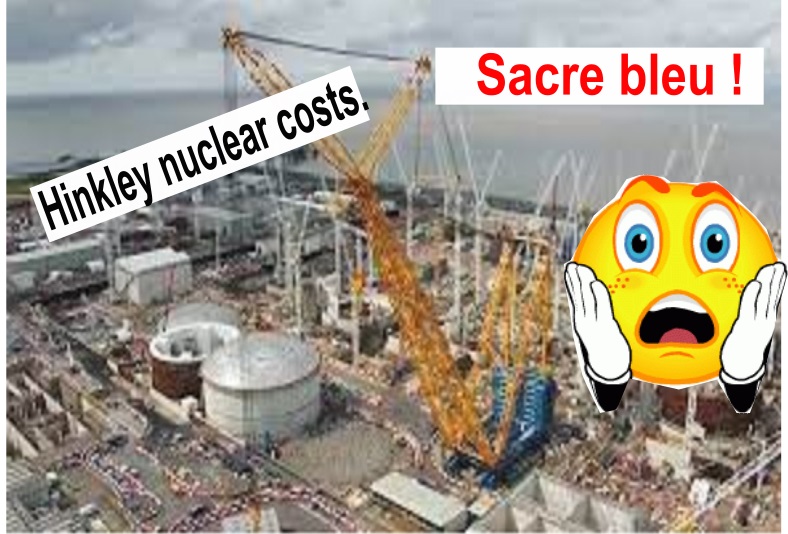
Former energy secretary Chris Huhne says Paris must cover cost overruns
Jonathan Leake, 29 February 2024 •
France’s demands for UK taxpayers to help fund Hinkley Point
C are “wholly unacceptable”, according to the former energy secretary
who helped develop the nuclear project. Chris Huhne, who was energy
secretary from 2010 to 2012, said he was “astonished and saddened” to
hear that both Bruno Le Maire, the French finance minister, and Luc
Rémont, chief executive of EDF, were pressing the UK to help with the cost
overruns.
Mr Huhne was a leading architect of the deal with EDF, France’s
state-owned electricity supplier, to build the nuclear power station. Under
the deal, finally signed off by Mr Huhne’s successor, Ed Davey, EDF was
responsible for all the estimated £18bn costs, with a start date of 2025.
Telegraph 29th Feb 2024
Did the West Intentionally Incite Putin to War?
by GORDONHAHN, February 27, 2024
Over the last year the US and NATO countries have undertaken no effort to convince Ukrainian President Volodomyr Zelenskiy to begin talks with Putin, despite: the death of more than half a million Ukrainians; the destruction of much of Ukraine’s economy, finances, physical infrastructure, human capital, civil society; and the West’s inability to sustain financial and military support even as Ukraine loses the war when said support was at its height.
The West’s war strategy now seems to be to prolong a ‘long war’ in the hope either that the war begins to affect Russia and Putin’s standing there or that Putin’s health wanes and his system destabilizes. All this and much more written below raises suspicions the West intentionally, maybe even ‘subconsciously’ – the actions of small policy victories won in order to ‘confront Putin’ by competing elements within it, especially inside Washington – drew Russia into the NATO-Russia Ukrainian War. Aside from the background cause and main driver of this decision – NATO expansion – and more immediate precipitants of Putin’s decision in mid- to late February 2022, what efforts, of any, did the West undertake perhaps intentionally to drive this decision?
If we look at the course of events in reverse chronological order it seems to me even more glaringly so that the West sought this war and indeed drew Russia into it intentionally with the the strategy of using the war to weaken Russia’s economic and political stability. The strategic goal is the reinforcement of US hegemony and power maximalization by achieving two long-standing, interrelated sub-goals: (1) NATO expansion and (2) the removal from power of Russian President Vladimir Putin. Let’s reverse engineer the course of events.
……………………………………………………………………………………………………………. A final side note. All this has led to NATO and the US being combatants in a war against Russia, which threatens us with world war and nuclear conflagration https://gordonhahn.com/2024/02/27/did-the-west-intentionally-incite-putin-to-war/—
1 This Month



26 September – International Day for the Total Elimination of Nuclear Weapons


PLEASE OPPOSE HR 8255 AND S.3639 – bills would accelerate satellite deployment, with no environmental review or safeguards – https://ncstd5li.quorum.us/campaign/169331/
To see nuclear-related stories in greater depth and intensity – go to https://nuclearinformation.wordpress.com
-
Archives
- September 2026 (231)
- August 2026 (330)
- July 2026 (355)
- June 2026 (287)
- May 2026 (306)
- April 2026 (356)
- March 2026 (251)
- February 2026 (267)
- January 2026 (308)
- December 2025 (358)
- November 2025 (359)
- October 2025 (375)
-
Categories
- 1
- 1 NUCLEAR ISSUES
- business and costs
- climate change
- culture and arts
- ENERGY
- environment
- health
- history
- indigenous issues
- Legal
- marketing of nuclear
- media
- opposition to nuclear
- PERSONAL STORIES
- politics
- politics international
- Religion and ethics
- safety
- secrets,lies and civil liberties
- spinbuster
- technology
- Uranium
- wastes
- weapons and war
- Women
- 2 WORLD
- ACTION
- AFRICA
- Atrocities
- AUSTRALIA
- Christina's notes
- Christina's themes
- culture and arts
- Events
- Fuk 2022
- Fuk 2023
- Fukushima 2017
- Fukushima 2018
- fukushima 2019
- Fukushima 2020
- Fukushima 2021
- general
- global warming
- Humour (God we need it)
- Nuclear
- RARE EARTHS
- Reference
- resources – print
- Resources -audiovicual
- Weekly Newsletter
- World
- World Nuclear
- YouTube
-
RSS
Entries RSS
Comments RSS
 nuclear-news