Blinken threatens China over Russia ties (VIDEO)
https://www.sott.net/article/490922-Blinken-threatens-China-over-Russia-ties-VIDEO 26 Apr 24
The US Secretary of State says Washington is prepared to impose more sanctions on Beijing over the alleged transfer of military components.
Washington is ready to introduce more sanctions against China over its alleged transfer of dual-use goods and components, which can supposedly be used by the Russian military industrial complex, US Secretary of State Antony Blinken said on Friday.
Speaking at a press conference in Beijing following his meeting with Chinese President Xi Jinping, the US official recalled that Washington has already imposed sanctions against more than 100 Chinese entities and is “fully prepared to act” and “take additional measures.”
Blinken claimed that China’s alleged support for the Russian defense industry raises concerns not only about the situation in Ukraine, but also about a “medium to long-term threat that many Europeans feel viscerally that Russia poses to them.”
Earlier this week, the Wall Street Journal had also reported that the US was drafting sanctions that could cut off some Chinese banks from the global financial system unless Beijing severs its economic ties with Russia.
Earlier this week, the Wall Street Journal had also reported that the US was drafting sanctions that could cut off some Chinese banks from the global financial system unless Beijing severs its economic ties with Russia.
The outlet claimed that US officials believe trade with China has allowed Russia to rebuild its military industrial capacity and could help it defeat Ukraine in a war of attrition.
Beijing has vehemently rejected accusations of “fueling” the Ukraine conflict and has instead blamed NATO for instigating the crisis by continuing its expansion in Europe and refusing to respect Russia’s national security concerns.
Following his meeting with Blinken, President Xi suggested that the US and China “should be partners, not rivals” and should strive towards achieving “mutual success and not harm each other.”
“I proposed three major principles: mutual respect, peaceful coexistence, and win-win cooperation. They are not only a summary of past experience, but also a guide to the future,” the Chinese leader was quoted as saying.
Beijing has maintained a policy of neutrality on the Ukraine conflict, with Chinese officials repeatedly stating that the country is not selling weapons to either Russia or Ukraine. Earlier this month, Chinese Foreign Ministry spokesman Mao Ning insisted that China “regulates the export of dual-use articles in accordance with laws and regulations,” urging “relevant countries” not to “smear or attack the normal relations between China and Russia.”
In December last year, US President Joe Biden issued a decree which enabled sanctions on foreign financial institutions that continue to deal with Russia. It targeted lenders outside US and EU jurisdictions that help Russia source sensitive items, which reportedly include semiconductors, machine tools, chemical precursors, ball bearings, and optical systems.
United States Hypocrisy – Again

BY ROBERT FANTINA, 24 Apr 24, https://www.counterpunch.org/2024/04/24/united-states-hypocrisy-again/—
The hypocrisy of the United States government knows no limits. On April 18, a proposal was submitted to the United Nations Security Council to admit Palestine as a full member, thus effectively recognizing the state of Palestine. Of the fifteen members of the Security Council, twelve voted in favor, two abstained, and the United States, using its veto power, opposed it. This, after frantic lobbying by the U.S. of the other nations on the Security Council to convince at least one of them to vote with the U.S., so the U.S. would not have to stand alone, again, in its support for the apartheid regime of Israel.
“’It remains the US view that the most expeditious path toward statehood for the Palestinian people is through direct negotiations between Israel and the Palestinian Authority with the support of the United States and other partners,’ Vedant Patel, the State Department spokesman, told reporters earlier in the day.”
This writer is almost tired of pointing out the obvious: negotiations can only be effective when each party wants something the other has, that it can only obtain by surrendering something it has, that the other party wants. Israel takes what it wants from Palestine with complete impunity. And how can the establishment of an independent Palestine occur through negotiations when the current Israeli Prime Minister Benjamin Netanyahu has said there will never be an independent Palestine? The U.S. had the opportunity to make it happen on April 18, but chose not to.
Richard Gowan, the United Nations’ International Crisis Group said the following, prior to the vote: “The U.S. position is that the Palestinian state should be based on bilateral agreements between the Israelis and Palestinians. It does not believe that the UN can create the state by fiat.” This raises two interesting points:
1) First, Israel isn’t going to agree to the establishment of a Palestinian state. Netanyahu has made that clear.
2) If the U.S. does, in fact, not believe that the U.N. can create a state by fiat, how then does the U.S. explain the establishment of Israel? Did the U.N. not, in 1947 – 1948, created Israel by fiat?
The U.S. is the world’s best example of the double standard: it criticizes Russia’s crimes in Ukraine while supporting and even financing the same kinds of crimes, except on steroids, that Israel is committing in Gaza.
Government officials in the U.S. explain that President ‘Genocide Joe’ Biden is working to convince Netanyahu to allow more aid into Gaza, where children and adults are starving to death. All he need do to enable a flood of aid is tell Netanyahu that Israel will not receive another penny of U.S. ‘aid’ until the suffering of the Palestinians ends. But instead of that, he is sending hundreds of millions of dollars worth of weaponry to kill them. Why should Israel do anything different? It gets whatever it wants from the U.S. even as it spits in the U.S.’s collective eye.
Prior to the start of the Iraq War, massive protests were held around the world. Then President George Bush, in response to these protests said this: “Size of protest — it’s like deciding, well, I’m going to decide policy based upon a focus group.” Todd S. Purdum of The New York Times, commenting on this statement, said the following: “A focus group is a handful of people, carefully culled to reflect diverse viewpoints, chosen to help politicians or companies figure out how to sell a policy or a product.
Led by a facilitator, they are poked and prodded in a private room, asked about their likes and dislikes and encouraged to speak while strategists eavesdrop behind a one-way mirror.
“And while Mr. Bush may not like to acknowledge it, his administration does use focus groups, most recently to help determine how best to couch its public messages about domestic security.”
Perhaps Genocide Joe feels the same way; he can dismiss millions of people around the world, including massive numbers in the United States, who recognize ongoing genocide when they see it. He believes that such blatant violations of international law as invading and bombing hospitals and arresting and killing medical personnel and killing patients; bombing refugee camps; killing journalists; indiscriminately slaughtering men, women and children; dropping bombs on humanitarian aid workers and schools, mosques, churches and residential centers are not evidence of genocide. They are, he says, simply part of Israel ‘defending’ itself from the existential threat of a ragtag band of dedicated people who are resisting a brutal, decades long occupation.
And what of the existential threat to Palestine? For decades, Israel has been stealing more and more Palestinian land, establishing settlements that are illegal under international law, and arbitrarily killing, arresting and torturing Palestinian men, women and children. Why does Palestine not, in the eyes of the United States government, have a right to defend itself?
Genocide Joe is an elderly Zionist, believing the myths about Jews who oppose apartheid as being ‘self-hating Jews’, and not willing to recognize that it was the United Nations, and not God, who criminally displaced 750,000 Palestinians to establish the Zionist regime.
The United Nations created the problems that have plagued the Middle East for 76 years; the United States is not, never has been and can never be an honest player in resolving them. The United Nations must work to end the very un-democratic veto power in the Security Council, give more authority to the General Assembly which, unlike the 15 member-nation Security Council has representatives from 193 nations, and bring freedom to the Palestinians. The current genocide, which will be a stain on the records of many nations for generations to come, must end. The U.S. must not be allowed to enable it to continue.
Robert Fantina’s latest book is Propaganda, Lies and False Flags: How the U.S. Justifies its Wars.
Russia-Ukraine war: EU ministers fail to pledge Patriot systems to Ukraine at key meeting – as it happened
Yohannes Lowe and Sammy Gecsoyler, 23 Apr 24 https://www.theguardian.com/world/live/2024/apr/22/russia-ukraine-war-live-zelenskiy-chasiv-yar?filterKeyEvents=false&page=with%3Ablock-66261a918f08839e09ac8c8b
Russia says new US aid to Ukraine will not change situation on battlefield
A new US package of military aid to Ukraine will not change the situation on the frontlines, where Russia has the upper hand, the Kremlin said.
“The Russian armed forces are improving their positions at the front … The money allocated and the weapons that will be supplied will not change this dynamic,” Kremlin spokesperson Dmitry Peskov told reporters.
“They will lead to new victims on the Ukrainian side. More Ukrainians will die, Ukraine will suffer greater losses.”
In the Ukraine bill, of the $60.7bn, a total of about $23bn would be used by the US to replenish its military stockpiles, opening the door to future US military transfers to Ukraine.
Another $14bn would go to the Ukraine Security Assistance Initiative, in which the Pentagon buys advanced new weapon systems for the Ukrainian military directly from US defence contractors.
Ukrainian President Volodymyr Zelenskiy on Sunday urged Washington to quickly turn the bill into law and proceed with the actual transfer of weapons, saying long-range arms and air defence systems were top priorities.
“I think this support will really strengthen the armed forces of Ukraine and we will have a chance for victory,” Zelenskiy said.
Russia said the American defence industry will be the real beneficiary of the package.
“We also recognise that most of this money will remain in the United States. The United States will become richer and will receive additional dividends by providing assistance to Ukraine. For (President Vladimir) Putin, this was expected,” Peskov said.
Under UN Charter, Iran’s Attack Was a Legal Response to Israel’s Illegal Attack
Iran’s attack on Israel was lawful self-defense carried out in compliance with international humanitarian law.
On April 13, Iran’s aircraft struck two air bases in the Negev desert, where the April 1 attack on Iran’s consulate had been launched. “Iran retaliated against those targets in Israel directly related to the Israeli attack on Iran,”
By Marjorie Cohn , TRUTHOUT, April 18, 2024
On April 1, Israel mounted an unprovoked military attack on a building that was part of the Iranian Embassy complex in Damascus, Syria, killing seven of Iran’s senior military advisers and five additional people. The victims included Gen. Mohamad Reza Zahedi, head of Iran’s covert military operations in Lebanon and Syria, and two other senior generals.
Although Israel’s attack violated the United Nations Charter, the UN Security Council refused to condemn it because the United States, the U.K. and France exercised their vetoes on April 4.
Iran considered this attack on its consulate “an act of war,” Trita Parsi wrote at Foreign Policy.
On April 11, the Permanent Mission of the Islamic Republic of Iran to the United Nations stated: “Had the UN Security Council condemned the Zionist regime’s reprehensible act of aggression on our diplomatic premises in Damascus and subsequently brought to justice its perpetrators, the imperative for Iran to punish this rogue regime might have been obviated.”
Then, on April 13, in response to Israel’s attack, Iran fired more than 300 drones and missiles at the Israeli air base from which the April 1 attacks had emanated. Only two of them landed inside Israel and no one was killed; a Bedouin girl was injured. The U.S., U.K., France, Jordan and Israel intercepted the remaining Iranian missiles and drones. A senior U.S. military official said “there’s no significant damage within Israel itself.”
The Iranian mission to the UN wrote in an April 13 letter to the UN secretary-general that Iran’s action was conducted “in the exercise of Iran’s inherent right to self-defense” under Article 51 of the UN Charter “and in response to the Israeli recurring military aggressions, particularly its armed attack” on April 1 “against Iranian diplomatic premises, in the defiance of Article 2(4) of the Charter of the United Nations.”
The April 1 attack was not the first time Israel had attacked key Iranian personnel………………………………………………………………………….
Iran made clear that it seeks to avoid further escalation that could spark a widespread regional war. An April 13 social media post from Iran’s permanent mission to the UN stated, “The matter can be deemed concluded. However, should the Israeli regime make another mistake, Iran’s response will be considerably more severe. It is a conflict between Iran and the rogue Israeli regime, from which the U.S. MUST STAY AWAY!”
At a Security Council meeting on April 14, Iran’s UN Ambassador Saeid Iravani defended the lawfulness of the missile and drone attack on Israel. He noted the hypocrisy of the U.S. and its allies that claim Israel is acting in self-defense as it conducts its genocide of the Palestinian people:………………………………………..
Israel’s Attack on Iranian Consulate Violated the UN Charter and Vienna Conventions
Iran’s April 13 attack on Israel was a lawful exercise of self-defense in response to Israel’s unlawful April 1 attack on the Iranian consulate. The Israeli attack was an illegal act of aggression.
Article 2 (4) of the UN Charter states, “All Members shall refrain in their international relations from the threat or use of force against the territorial integrity or political independence of any state, or in any other manner inconsistent with the Purposes of the United Nations.”
An act of aggression is inconsistent with the purposes of the UN. Article 39 of the Charter says, “The Security Council shall determine the existence of any threat to the peace, breach of the peace, or act of aggression.”
An “‘act of aggression’ means the use of armed force by a State against the sovereignty, territorial integrity or political independence of another State, or in any other manner inconsistent with the Charter of the United Nations,” under the Rome Statute for the International Criminal Court. Aggression includes “the invasion or attack by the armed forces of a State of the territory of another State.”
Moreover, “Consular premises shall be inviolable,” according to Article 31 of the 1963 Vienna Convention on Consular Relations. Article 1 defines consular premises as “the buildings or parts of buildings and the land ancillary thereto, irrespective of ownership, used exclusively for the purposes of the consular post.”
The 1961 Vienna Convention on Diplomatic Relations likewise provides in Article 22.1 that, “The premises of the mission shall be inviolable. The agents of the receiving State may not enter them, except with the consent of the head of the mission.”
During Israel’s bombing of Iran’s consulate in Syria, it targeted and killed very senior Iranian officials. The attack constituted an act of aggression, which triggered Iran’s right to self-defense.
Iran’s April 13 Attack on Israel Constituted Lawful Self-Defense
Article 51 states, “Nothing in the present Charter shall impair the inherent right of individual or collective self-defense if an armed attack occurs against a Member of the United Nations, until the Security Council has taken the measures necessary to maintain international peace and security.”
An armed attack includes not just an attack against the territory of a state, including its airspace and territorial sea, but also attacks directed against its armed forces or embassies abroad.
On April 13, Iran’s aircraft struck two air bases in the Negev desert, where the April 1 attack on Iran’s consulate had been launched. “Iran retaliated against those targets in Israel directly related to the Israeli attack on Iran,” former U.S. weapons inspector Scott Ritter wrote.
Nevertheless, the Security Council has failed to adopt a resolution condemning Israel’s attack on Iran’s consulate, as Iran pointed out in its April 13 letter to the UN secretary-general.
At an April 14 meeting of the Security Council, the Israeli representative declared that Iran is the number one global sponsor of terrorism and the world’s worst human rights violator. It is Israel, however, that has killed nearly 34,000 Palestinians — two-thirds of them women and children — during its campaign of genocide in Gaza that has now entered its seventh month.
Iran’s self-defense action was the natural outcome of Israel’s violations of international law — both on Syrian territory and elsewhere — the representative from the Syrian Arab Republic said at the April 14 council meeting. Israel is trying to cover up its genocide and military failures in Gaza, the Syrian representative added.
Iran’s Attack Satisfied the Principles of Proportionality, Distinction and Precautions……………………………………………………………….
Netanyahu Is Gunning for War With Iran
Israeli Prime Minister Benjamin Netanyahu would like nothing better than to start a war with Iran. Netanyahu considers Iran an “existential threat” to Israel. He persuaded former President Donald Trump to pull out of the Iran nuclear deal, which was working to prevent Iran from developing nuclear weapons.
As the world waits for Israel’s response to the Iranian attack, President Joe Biden said the U.S. would not assist Israel in an offensive military action against Iran but it would give Israel defensive support if Iran attacks Israel. “But the distinction between offensive or defensive support becomes meaningless the second a war breaks out,” wrote Trita Parsi.
Today, the U.S. and U.K. imposed additional punishing sanctions on Iran. Unilateral coercive measures, levied without the imprimatur of the Security Council, are illegal and generally harm only the general population…………………………………………………………………………………………… more https://truthout.org/articles/under-un-charter-irans-attack-was-a-legal-response-to-israels-illegal-attack/
Washington Syndrome: Australia’s sovereignty sell-out hidden in plain sight

“The process is almost complete. The Australian Defence Force’s integration into the US military to serve the needs of Washington has been announced, albeit without announcement, this week.”
Arguably the only thing left to do is to adopt American spelling and replace the letter ‘c’ with the letter ‘s’ in ‘Department of Defence’.
by Rex Patrick | Apr 21, 2024 https://michaelwest.com.au/washington-syndrome-marles-defence-plan-sovereignty-sell-out/
Defence Minister Richard Marles rolled out some glossy new brochures this week spelling out the composition of the Australian Defence Force in the decades ahead. As media quibbled about this equipment purchase or that one, former Senator and submariner Rex Patrick explains the sovereignty sell-out hidden in plain sight.
Washington Syndrome
It’s confirmed. All the evidence points to the Defence Minister suffering from Stockholm Syndrome (or more accurately Washington Syndrome), except that he hasn’t just formed a bond with his Defence Department, where he won’t challenge them. He’s swallowed the whole kit and caboodle; adopting Defence lingo and lines as his own.
Marles has expressed Defence’s wishes beautifully, without revealing explicitly what that wish is. But it’s sitting there in plain sight.
National Defence Strategy
The use of smokescreens is a longstanding battlefield tactic, and it’s often employed by bureaucrats too. To get a clear and truthful picture from the National Defence Strategy released this week, you have to peer through a dense cloud of verbiage to get a clear sense of what’s really going on.
Early in the document the strategic framework is laid out.
Our Alliance with the US remains fundamental to Australia’s national security. We will continue to deepen and expand our defence engagement with the US, including by pursuing greater scientific, technological and industrial cooperation, as well as enhancing our own cooperation under force posture initiatives.
So, we’re joined at the hip to the United States, and we intend to stay that way.
The document spells out why Defence thinks we need to do that. The optimism at the end of the Cold War has been replaced by uncertainty and tension of entrenched and strategic competition between the US and China.
It is accompanied by an unprecedented conventional and non-conventional build-up in our region, taking place without strategic reassurance or transparency.
…
This build up is also increasing the risk of military escalation or miscalculation that could lead to a major conflict in the region.
Indeed, it zooms in with on the specifics. The risk of a crisis in the Taiwan Strait is increasing, as well as other flashpoints, including disputes in the South and East China Seas and on the border with India.
The Government will continue to strengthen its defence engagement with the US to:
- ensure joint exercises and capability rotations with the US are focused on enhancing collective deterrence and force posture cooperation.
- Acquire the technology and capability required to enhance deterrence, including through increasing collaboration on defence innovation, science and technology.
- Leverage Australia’s strong partnership with Japan in its trilateral context, including opportunities for Japan to participate in Australia-US force posture cooperation activities, to enable interoperability and contribute to deterrence; and
- Progress enabling reforms to export controls, procurement policy and information sharing to deliver a more integrated industrial base.
- Meanwhile, the US is increasing its military footprint in Australia in terms of facilities in the north (mission briefing/intelligence centre and aircraft parking aprons) at RAAF Darwin, fuel storage at Darwin Port, infrastructure at RAAF Tindal near Katherine and logistics storage in both Victoria and Queensland).
- This is on top of the long established top secret signals intelligence base, the Joint Defence Facility Pine Gap, and Australian support for US naval communications through the very low-frequency receiving and transmission facility at North West Cap. As far as American strategists are concerned, Australia has long been “a suitable piece of real estate”.
But now there’s a new dimension to the alliance with Australian taxpayers are sharing the alliance love by pouring billions into the US submarine industrial base.
US Seventh and a Half Fleet
Of course, it’s hard to fight a conflict in Taiwan Straights with an army. That’s reflected in the distribution of future expenditure outline in the Integrated Investment Program, released alongside the National Defence Strategy.
The Navy will receive almost 40% of all Defence expenditure. The Royal Australian Navy will become the seventh and a half fleet of the US Navy, supported by what are being referred to as the expeditionary air operations by the Royal Australian Air Force.
Again, hidden in plain sight.
Taiwan
Taiwan is a democracy of 22 million people. I might like to think we would come to their aid in the event their democracy was threatened.
But sending our sons and daughters to engage in a northern hemisphere conflict is a matter which should be decided upon by our Parliament at some future time.
We should seek to have a balanced and flexible Defence Force optimised first for Defence of Australia and second for near regional security (a deployment to Taiwan, if approved by our elected members, should draw from an order-of-battle optimised for Defence of Australia).
Sovereignty Stolen
But that’s not what’s happening.
It’s all too tempting to suggest that the sovereignty sell-out started at with AUKUS, announced by Scott Morrison on 16 September 2021 and adopted by Anthony Albanese at the Kabuki show in San Diego on 15 March 2023. But it didn’t.For those astute enough to have picked up and read a copy of Professor Clinton Fernandes’ book “Sub-Imperial Power: Australia in the International Arena”, they’ll know AUKUS is just natural and obvious. So too is the even greater embedding of the ADF into the US military to serve the needs of Washington that has been announced this week, albeit without announcement.
“The process is almost complete. The Australian Defence Force’s integration into the US military to serve the needs of Washington has been announced, albeit without announcement, this week.”
Arguably the only thing left to do is to adopt American spelling and replace the letter ‘c’ with the letter ‘s’ in ‘Department of Defence’.
History repeats
We have been down this road before.
n the 1920s and 1930s conservative Australian Governments saw Australian security as part of that of the British Empire as a whole. As a consequence, they implemented defence programs that were designed to produce forces, especially the Royal Australian Navy, that were hopelessly unbalanced and only made sense as a subset of British forces. Imperial Defence was prioritised ahead of national defence in a ‘strategy’, if you can call it that, that compromised Australia’s then very new national sovereignty and almost came to disaster in 1942.
Bureaucratic and political self-interest
Australia’s new “National Defence Strategy” really is nothing of the sort. It’s a sub-set of strategic planning made in Washington, not an Australian national perspective.
AUKUS has devoured whatever vestiges of independent strategic thought that might have been lingering in our Defence Department.
But don’t imagine that there’s any dissent about this in Defence Headquarters.
Those in Defence bureaucracy guiding our politicians are be happy, uproariously happy, because they’ll personally benefit from the arrangement.
AUKUS and this latest steerage will serve as a tremendous career and institutional opportunity for them. They’ve cemented their position in an alliance arrangement that involves important meetings and conferences, important decisions, trips overseas, and, for some, exchange postings. For them, they’ve got ringside seats and the opportunity to be occasional players in the big league.

Which brings me back to Defence Minister Marles, who can’t really be blamed for the sell-out.
Marles isn’t, and never was, the sort of political figure that could develop much of an understanding of what is going on around him, let alone be the one to lead with strategic vision and agenda forward. He’s too busy learning the lingo, enjoying the photo opportunities, and impressing upon his ‘sub-ordinates’ in Defence Headquarters that he’s not to be referred to as the Defence Minister, but rather as the Deputy Prime Minister. Surely he deserves that courtesy!
TECHNOCAPITALISM: OUR DYSTOPIAN PRESENT—AND FUTURE?
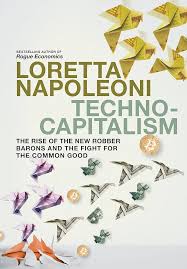
RealNews Network.
Blockchain, AI, and other technological innovations could be used to improve human flourishing. Instead they’re making the oligarchy richer and more powerful at all of our expense.
e are living through an incipient technological revolution. AI, blockchain, cryptocurrencies, commercial space travel, and other innovations are rapidly transforming everything from the workplace to the financial architecture of the global economy. While many of these technologies hold vast potential to benefit the social good, the multinational corporations and financial oligarchy that drive innovation and own its products are solely motivated by private profit. The consequences are unfolding all around us. As technology and the power of the oligarchy advances, the misery and disenfranchisement of the majority grows. We are now in an age of “Space Barons and Techtitans,” and the future they are leading us to is one of even greater exploitation, inequality, and ecological crisis. Loretta Napoleoni, author of Technocapitalism: The Rise of the New Robber Barrons and the Fight for the Common Good, joins The Chris Hedges Report to discuss the technocapitalist present and future described in her book.
Transcript
Chris Hedges:
A small group of high-tech savvy entrepreneurs who understand the velocity of technological innovation have harnessed this new power to establish predatory high-tech monopolies, such as Uber or Amazon. They subvert labor laws, strip the state of its power, gut regulation, ignore legal norms and amass personal fortunes in the hundreds of billions of dollars. Their apps, services, and private equity firms dominate our lives. They are technological predators seen in every aspect of social existence commodification. The living wages of working people decline. The gig economy abolishes job protections, sustainable incomes and benefits. AI replaces human beings. The most vulnerable are pillaged for profit. The sick feed the profits for big pharma. The bodies of poor men and women on the streets of our bleak.
…………………………….. Joining me to discuss our dystopian present and most probably our dystopian future is Loretta Napoleoni, author of Technocapitalism: The Rise of the New Robber Barons and the Fight for the Common Good
……………………………………….. Loretta Napoleoni:
…………………………….What is really Bitcoin? Bitcoin is a currency which is produced by software, and this software performs all the task that a true currency should perform…………………………….
So Bitcoin is produced by software. So it’s not controlled by any central bank, it’s not controlled by any governments. The software has been programmed in a way in which these Bitcoin are released in blocks by an activity, which is called mining, and this activity is solution of mathematical formulas. The solution of mathematical formulas becomes increasingly more and more difficult. ……………………………………………………………………………………………………………………………………………………………
What is the serial entrepreneur? Well, this is robber baron basically because they spotted an opportunity. They learned from that opportunity. They made a lot of money from that opportunity, and then they decided to reproduce that model in another sector at the higher and higher and higher scale. Now, all of this was motivated by profit.
So there’s absolutely no desire to produce anything that can enrich society. This is why I’m talking about the common good. Possibly, this is due to the fact that these people grew up with video games, so for them it’s all a game. See what I mean? That there is this filter of the internet, which doesn’t really make them understand exactly what does it mean to be exploited, or exploited, I would say by the system, but possibly also because of their ego, because all of a sudden being a serial entrepreneur, being Jeff Bezos for example, or being Elon Musk or Peter Thiel was of the maximum that you could achieve, so everything was allowed to you because you were… Except those original members of the cyberpunk because you are smarter than the others…………………………………………………………………………………………………………..
he idea of colonized Mars is part of the narrative, because the truth is that if you tell people, “Well, don’t worry too much about climate change. Don’t worry too much about overpopulation.” Shall we discuss overpopulation also? Because we’re going to go and colonize Mars, and then Mars is going to be as beautiful as Earth, or Jeff Bezos comes with these weird ideas to create artificial planets inside, which of course, people could live. There’s a film, I think it’s called Elysium. It’s a film where there is one of those artificial where the poor people are on the Earth, they’re left behind, blah, blah, and all the rich people live in these artificial planets which are absolutely beautiful, and they all look like California, of course, where the weather is always nice. It’s not cold, blah, blah. Clearly, if you fall into that trap, you don’t worry so much about the planet because you think, “Well, there is a solution.” Well, no, there is no solution. This is the only planet we have. If we do not save this planet, our grandchildren will not be able to survive.
…………..
Chris Hedges:
It serves whoever controls it. Unfortunately, we live in an age where the technocapitalists and the corporations have us in a death grip. https://therealnews.com/technocapitalism-our-dystopian-present-and-future
Iran Israel: An audible sigh of relief in the Middle East
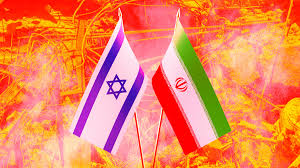
By Lyse Doucet,Chief international correspondent, 20 Apr 24, more https://www.bbc.com/news/world-middle-east-68861607
The latest round in the region’s most dangerous rivalry appears to be over, for now.
Israel still has not officially acknowledged that the attack in Iran in the early hours of Friday morning was its doing.
Meanwhile, Iran’s military and political leaders have downplayed, dismissed and even mocked that anything of consequence happened at all.
The accounts over what kind of weaponry was deployed on Friday and how much damage was caused are still conflicting and incomplete.
American officials speak of a missile strike, but Iranian officials say the attacks, in the central province of Isfahan and in northwest Tabriz, were caused by small exploding drones.
“The downed micro air vehicles caused no damage and no casualties,” Iran’s Foreign Minister Hossein Amir-Abdollahian insisted to the semi-official Tasnim News Agency.
But these simple quadcopters are Israel’s calling card – it has deployed them time and again in its years of covert operations inside Iran.
This time their main target was the storied central province of Isfahan, which is celebrated for its stunning Islamic heritage.
Of late, however, the province is more famous for the Natanz nuclear facility, the Isfahan Nuclear Technology Centre and a major air base, which was used during Iran’s 14 April attack on Israel.
It is also an industrial heartland housing factories which produce the drones and ballistic missiles that were fired by the hundreds in Israel’s direction last Sunday.
So a limited operation seems to have carried a powerful warning – that Israel has the intelligence and assets to strike at will at Iran’s beating heart.
It is a message so urgent that Israel made sure it was sent before, rather than after, the start of the Jewish Passover, as was widely predicted by Israel watchers.
US officials have also indicated that Israel targeted sites such as Iran’s air defence radar system, which protects Natanz. There is still no confirmed account of its success.
So this attack may also be just an opening salvo. But it was, for the moment, an unintended 85th birthday gift to Iran’s Supreme Leader, Ayatollah Ali Khamenei.
Israel’s official silence gave Iran’s ultimate decision-maker vital political space. Tehran did not have to invoke its new rule that whenever its arch-enemy strikes, Iran will hit back hard, with the risk of sparking a perilous escalatory spiral.
Hardline President Ebrahim Raisi did not even mention these most recent events in his Friday speeches.
For the Islamic Republic, it is all about what it dubs Operation True Promise – its unprecedented onslaught against Israel in the dead of night last Sunday. He hailed what he called his country’s “steely will”.
Iran has prided itself for years on its “strategic patience”, its policy of playing a long game rather than retaliating immediately and directly to any provocations.
Now, it is invoking “strategic deterrence”. This new doctrine was triggered by the 1 April attack on its diplomatic compound in Damascus, which destroyed its consular annex and killed seven Revolutionary Guards, including its most senior commander in the region.
Iran’s supreme leader was under mounting pressure to draw a line as Israel ramped up its targets during the last six months of the grievous Gaza war.
No longer just striking Tehran’s assets, including arms caches, buildings, bases and supply routes on battle grounds like Syria and Lebanon, Israel was also assassinating top-ranking officials.
A decades-long hostility, which had previously played out in shadow wars and covert operations, erupted in open confrontation.
Whatever the specifics of this latest tit for tat, there is a more fundamental priority for both sides: deterrence – a more solid certainty that strikes on its own soil will not happen again. If they do, there is a cost to pay, and it will hurt.
For the moment there is an audible sigh of relief in the region, and in capitals far and wide.
Israel’s latest move, under anxious urging from its allies to limit its retaliation, will have eased this tension, for now. Everyone wants to stop a catastrophic all-out war. But no one will be in any doubt that any lull may not last.
The region is still on fire.
The Gaza war grinds on, causing a staggering number of Palestinian casualties.
Under pressure from its staunchest allies, Israel has facilitated the delivery of greater quantities of desperately needed aid, but the blighted territory still teeters on the brink of famine.
Israeli hostages have still not come home, and ceasefire talks are stalled. Israel still warns of battles to come in Hamas’s last stronghold in Rafah – what aid chiefs and world leaders say would be yet another untold humanitarian disaster.
Iran’s network of proxies across the region, what it calls an “Axis of Resistance” stretching from Hezbollah strongholds in Lebanon through Iran-aligned militias in Iraq and Syria, to the Houthis of Yemen, are at the ready, still attacking daily.
In the last few weeks, simultaneously everything and nothing has changed in the region’s darkest, most dangerous days.
Iranian commander says Tehran could review ‘nuclear doctrine’ amid Israeli threats
By Reuters, April 18, 2024, Reporting by Dubai Newsroom, editing by Edmund Blair, Alex Richardson and Timothy Heritage https://www.reuters.com/world/middle-east/iranian-commander-warns-tehran-could-review-its-nuclear-doctrine-amid-israeli-2024-04-18/
DUBAI, April 18 (Reuters) – Iran could review its “nuclear doctrine” following Israeli threats, a senior Iranian Revolutionary Guards commander said on Thursday, raising concerns about Tehran’s nuclear programme which it has always said was strictly for peaceful purposes.
Israel has said it will retaliate against Iran’s April 13 missile and drone attack, which Tehran says was carried out in response to a suspected Israeli strike on its embassy compound in Damascus earlier this month.
“The threats of the Zionist regime (Israel) against Iran’s nuclear facilities make it possible to review our nuclear doctrine and deviate from our previous considerations,” Ahmad Haghtalab, the Guards commander in charge of nuclear security, was quoted as saying by the semi-official Tasnim news agency.
Iran’s Supreme Leader, Ayatollah Ali Khamenei, has the last say on Tehran’s nuclear programme, which the West suspects has military purposes
In 2021, Iran’s then-intelligence minister said Western pressure could push Tehran to seek nuclear weapons, the development of which Khamenei banned in a fatwa, or religious decree, in the early 2000s.
“Building and stockpiling nuclear bombs is wrong and using it is haram (religiously forbidden) … Although we have nuclear technology, Iran has firmly avoided it,” Khamenei reiterated in 2019.
Iran’s foreign ministry did not immediately respond to a Reuters request for comment.
“If the Zionist regime wants to take action against our nuclear centres and facilities, we will surely and categorically reciprocate with advanced missiles against their own nuclear sites,” Haghtalab said.
Indirect talks between Tehran and Washington to revive Iran’s 2015 nuclear pact has stalled since 2022. The accord, aimed at keeping Iran from developing a nuclear weapon, required Tehran to accept restrictions on its nuclear program and more extensive United Nations’ inspections, in exchange for an end to U.N., European Union and U.S. sanctions.
The deal, which had capped Iran’s uranium enrichment at 3.67%, was abandoned in 2018 by then-U.S. President Donald Trump, who said it was too generous to Tehran.
Rafael Grossi, the head of the U.N. nuclear watchdog, said in February that Iran continued to enrich uranium at rates up to 60% purity, which is far beyond the needs for commercial nuclear use.
A new Iranian nuclear deal is being considered
A veteran of the Foreign Office told i: “I don’t think the world realises
how advanced the Iran nuclear programme has got. The issue has long been
how to bring Iran back to some form of a deal.” They suggested Tehran
could have been stepping up work on the nuclear programme while Western
powers were focussed on Russia and China, saying: “When the world’s
attention is elsewhere, they accelerate.”
A source close to the Biden
administration added: “Iran has made it quite clear that it has no
intention of attacking Israel again, unless Israel strikes back in response
to last weekend. The administration believes a diplomatic route is by far
the best route forward, and that both sides can be catered for. “The
president is doing everything he can to avert a war in the Middle East, and
a new Iran nuclear deal is one way being considered to achieve that. It’s
not the only strategy, but it’s on the table.”
iNews 17th April 2024
Biden could try to revive Iran nuclear deal to avert wider war, source says
“Rules-Based Order” Means Rules For Thee But Not For We

Notes From The Edge Of The Narrative Matrix, CAITLIN JOHNSTONE, APR 18, 2024 https://www.caitlinjohnst.one/p/rules-based-order-means-rules-for?utm_source=post-email-title&publication_id=82124&post_id
Israel’s allowed to bomb an Iranian consulate, but Iran’s not allowed to strike back. The US is allowed to surround China with war machinery, but it would be World War Three if China ever tried to militarily encircle the US. NATO is allowed to expand to Russia’s doorstep and amass proxy forces on its border, but the last time Moscow placed a credible military threat anywhere near the United States, the US responded so aggressively that the world almost ended.
The “rules-based international order” that the US-centralized power structure purports to uphold just means an order in which the US makes up the rules and nations had better obey them. It means rules for thee but not for me.
Democrats are currently committing genocide, pushing through terrifying NSA surveillance powers, and working to imprison a journalist for life for telling the truth about US war crimes, but it’s very important to support Biden because if Trump wins, fascism might come to America.
❖
The Assange extradition case is like if the mafia was demanding a snitch be extradited to Italy and multiple nations collaborated with them to help make this happen, except in this case the snitch is a journalist who told the truth, and the mob happens to run a global superpower.
The imperial media are once again trotting out John Bolton to help sell the idea of war with Iran. This monster belongs in a cage, not on camera. The fact that the mainstream western press keep having this completely discredited bloodthirsty psychopath on their shows to advocate every possible US war proves that our entire civilization is diseased.
Israel’s actions over the last six months have made it abundantly clear that Biden’s stated goal of preventing the outbreak of more war in the middle east and his stated “ironclad” support for Israel are two mutually exclusive positions. You can do one or the other, but not both.
❖
Outside the mainstream press the news about Ukraine is a nonstop deluge of stories about how badly things are going for them.
Here are some recent articles from Antiwar.com:
“Ukraine’s Top General Says Situation on the Battlefield Has ‘Significantly Worsened’” discusses Ukrainian Commander-in-Chief Oleksandr Syrskyi’s acknowledgement that Russia is making steady gains and that the frontlines in Ukraine are at risk of collapsing wherever Russia focuses its offensive.
“US General Says Russia’s Military Is Bigger Than Before Ukraine Invasion” quotes General Christopher Cavoli saying “The army is actually now larger — by 15% — than it was when it invaded Ukraine,” an acknowledgement that Washington’s stated goal of using this proxy war to “weaken” Russia has failed.
“Russia Quickly Restores Oil Refinery Capability Hurt By Ukrainian Attacks” discusses how badly Russia is damaging Ukraine’s energy infrastructure compared to the damage Ukraine has been able to deal to Russia’s.
Here are a couple more from The Libertarian Institute:
“US Official Admits Ukraine Proxy War Failing to Weaken Russia” features an acknowledgement from Deputy Secretary of State Kurt Campbell that Russia has reconstituted nearly all of its military losses in Ukraine.
“Ukraine Tightens Rules on Military Service, Angering Soldiers” reports on how “Ukraine’s legislature advanced multiple new laws that tighten rules on conscription and extend military services for those already in uniform.”
It’s absolutely criminal how the west pushed this country into sacrificing a generation to a war they always knew was unwinnable.
So much suffering and loss has been caused by the way people decided a long time ago that killing one person is murder and therefore immoral but killing thousands of people is “war” and therefore fine. The actual act is the same; only the narrative and the scale are different.
❖
Around the mid-1800s humanity began to notice it doesn’t make sense for a small group of rich people to own everything and for everyone else to continually give that group labor, rent and expenses just to stay alive, and ever since then the media, the mainstream culture and the foreign policy of the ruling class have been intensely devoted to aggressively erasing this realization from humanity’s memory.
Israeli Firms Are Working Overtime to Sell Stolen Palestinian Land to US Jews
these land sale events “are illegal under the Fair Housing Act of 1968 and Civil Rights Act of 1965, since registration, entry, and participation are denied on the basis of identity (i.e., race, ethnicity, national origin, and religion).”
The real estate events peddling land in Israeli settlements in the West Bank appear to flout US and international law.
By Eleanor Goldfield , TRUTHOUT. April 13, 2024
our chance to own a piece of the Holy Land!” exclaims the cheerful advertising copy on a real estate website aimed at attracting buyers in the U.S. and Canada to purchase land located in Israel and in a number of Israeli settlements in the West Bank. The site describes five land sale events that occurred this spring in the U.S. and Canada.
Another land sale event held in Baltimore invited attendees to “Buy Your Home in Israel Now!” But, as with the other events, attendees couldn’t just be anyone interested in some freshly stolen land. You have to be Jewish, but not just any kind of Jewish.
Greg Kaplan, a local Jewish community member who wanted to learn more about these restrictive events and who tried signing up for the April 1 land sale event in Baltimore, which was hosted by the Jerusalem-based CapitIL Real Estate Agency, told me:
I got a call from Shmuly Eisenmann of CapitIL. He asked me where I daven, who the rabbi is there, and for the rabbi’s number, seeming incredulous that I wouldn’t just have the rabbi’s number stored in my phone. He said he would check on me with the rabbi and asked if the rabbi would know who I was. I said probably not because I don’t go to shul that much. He asked if there was someone at another shul who could vouch for me.
Kaplan was not allowed into the event, which was scheduled to take place at Shomrei Emunah, “a full-service shul and Jewish center” in Baltimore whose list of speakers and scholars in residence includes an IDF lieutenant colonel.
Gillian Stoll, a member of the New Jersey chapter of IfNotNow, who tried to register for the Teaneck, New Jersey, event on March 31, received a series of phone calls. On the first call, Stoll admits to being caught off guard by a slew of questions including the name of her temple and rabbi, his direct number as well as what the reading was at the temple that week. She gave the name of her old rabbi and temple, and the man calling seemed satisfied for the moment, offering that they had to cancel previously “because of protesters.” She then “got a second call from another not so nice guy saying he called the rabbi and he hadn’t heard of me … and asked how old I was … and if I’d been to Israel.” Stoll was also not allowed into the event.
Needless to say, I — as a secular Jew who hasn’t been to temple since about 2007 and whose most recent run-in with a rabbi involved one chanting alongside me at an anti-Zionist action — didn’t even get a phone call. And while these discriminatory practices might be necessary to avoid a bunch of anti-Zionist protesters in your midst, they are, in fact, illegal.
A recent press release from the Palestinian Assembly for Liberation (PAL) Law Commission pointed out that these land sale events “are illegal under the Fair Housing Act of 1968 and Civil Rights Act of 1965, since registration, entry, and participation are denied on the basis of identity (i.e., race, ethnicity, national origin, and religion).”
The commission added that these events violate not only U.S. law but also international law with regard to hosts “exhibiting and offering properties on West Bank settlements recognized as illegal by the U.S. Department of State and by international law” including “Article 49 of the Geneva Convention … Settlements have been found to be grave breaches of international law, and therefore war crimes, by the International Court [ICJ] of Justice in 2004, and are also currently under review by the ICJ in the context of the case of South Africa v. Israel for crimes of genocide, and by the International Criminal Court.”
PAL Law Commission has filed notices and complaints with attorneys general and real estate licensing authorities, and has also served formal cease and desist letters alongside notice and demand letters regarding their findings.
When asked about responses from hosts or organizers, PAL spokesperson Hena Zuberi said:
The response we’ve received is them shifting their events online and/or sponsors pulling out of the events, at least publicly. Although this hasn’t been a direct communication with us it came as an effect directly following our legal action and served as a major legal and grassroots victory for the case and the campaign overall. We’ve shut down several events and moved others online through this action.
One such event was scheduled to take place in Flatbush, Brooklyn, at the Khal Bnei Avrohom Yaakov Simcha Hall and was later moved online after both legal action and local protests. Indeed, it’s impossible to say whether legal action, direct action or a combination of the two has pushed the cancellation or relocation of land sale events. Either way, it’s clear that hosts and organizers are uncomfortable with the attention, as they should be.
On the site listing the event in Flatbush as well as events in Montreal; Toronto; Teaneck, New Jersey; and Lawrence, New York, a banner reads “Our expert speakers will address all your questions about purchasing real estate in Israel and focusing on: Jerusalem, Tel Aviv, Ramat Beit Shemesh, Modiin, Givat Shmuel, Raanana, Neve Daniel, Efrat, Motza, Haifa, Ma’ale Adumim, Ashkelon, Netanya.”
………………………………………………….. In short, be it 1948, 1967, 2014 or today, Palestine is occupied land, Israel upholds apartheid, and these land sale events are one of many tactics being used to disappear an Indigenous people and culture, to wipe them off the map literally and figuratively, much as was done here in the so-called United States with mass land sale events of so-called “Indian land” in the West.
……………………………………………. we heard news that the land sale event had been moved last minute to a new location. A small victory, but a victory nonetheless. Zuberi told me, “These victories would not have been possible without the relentless pressure mounted by the PAL legal team and the local PAL chapters’ and allies’ grassroots support and organizing.” This grassroots organizing included the Baltimore chapter of Jewish Voice for Peace (JVP), the Council on American-Islamic Relations’ office in Maryland, and American Muslims for Palestine (AMP) as well as individuals such as me who, though not affiliated with any one organization, felt the need to show up.
Cassidy Cohen with Jewish Voice for Peace’s Baltimore chapter added: “We come from a Jewish tradition that has for millennia opposed empire, colonization and nationalism, that values every human life, and is rooted in social justice…. As Jews, we oppose all displacement and genocide of Palestinians. We say never again for anyone.”
In other words, to act in solidarity with tireless Palestinian leadership in the struggle for their liberation is the mandate of all who believe in justice, especially us Jews. https://truthout.org/articles/israeli-firms-are-working-overtime-to-sell-stolen-palestinian-land-to-us-jews/
US Declines Israel’s Invitation To Start WW3 (For Now)
CAITLIN JOHNSTONE, APR 14, 2024, https://www.caitlinjohnst.one/p/us-declines-israels-invitation-to?utm_source=post-email-title&publication_id=82124&post_id=143571202&utm_campaign=email-post-title&isFreemail=true&r=1ise1&triedRedirect=true&utm_medium=email
Iran has carried out its long-promised retaliation for Israel’s attack on its consulate building in Damascus, launching a massive barrage of drones and missiles which it claims hit and destroyed Israeli military targets, while Israel says they dealt only superficial damage with a few injuries. The US and its allies reportedly helped shoot down a number of the Iranian projectiles.
Just as we discussed in the lead-up to the strike, the western political-media class are acting as though this was a completely unprovoked attack launched against the innocent, Bambi-eyed victim Israel. Comments from western officials and pundits and headlines from the mass media are omitting the fact that Israel instigated these hostilities with its extreme act of aggression in Syria as much as possible. Here in Australia the Sydney Morning Herald write-up about the strike didn’t get around to informing its readers about the attack on the Iranian consulate until the tenth paragraph of the article, and said only that Iran had “accused” Israel of launching the attack because Israel has never officially confirmed it.
In any case, Iran says the attack is now over. Given that we’re not seeing any signs of massive damage, Iran’s reported claim that its retaliation would be calibrated to avoid escalation into a full-scale regional war seems to have been accurate, as does Washington’s reported claim that it didn’t expect the strike to be large enough to draw the US into war.
A new report from Axios says Biden has personally told Netanyahu that the US will not be supporting any Israeli military response to the Iranian strike. An anonymous senior White House official told Axios that Biden said to Netanyahu, “You got a win. Take the win,” in reference to the number of Iranian weapons that were taken out of the sky by the international coalition in Israel’s defense. Apparently helping to mitigate the damage from the Iranian attack is all the military commitment the White House is willing to make against Iran at this time.
And thank all that is holy for that. A war between the US alliance and Iran and its allies would be the stuff of nightmares, making the horrors we’ve been seeing in Gaza these last six months look like an episode of Peppa Pig.
But Washington merely declining to get involved is nowhere near enough. As the Quincy Institute’s Trita Parsi quipped on Twitter, “Biden needs to PREVENT further escalation, not just declare his desire to stay out of it.”
Indeed, Israel has already made it clear that it is going to be moving forward with an escalation against Iran. Israel’s Channel 12 cites an unnamed senior official saying the Iranian counter strike is going to receive an “unprecedented response”.
“Israel has already informed the Americans and governments in the region that its response is inevitable,” The Economist reports. “Its military options include launching drones at Iran, and long-range airstrikes on Iran, possibly on military bases or nuclear installations.”
It’s unclear at this time how much the latest message from the Biden administration will affect the calculations of this position, but the mass media are reporting that White House officials are worried Israel is getting ready to do something extremely reckless that could draw the US into a war it would rather avoid.
NBC News reports the following:
“Some top U.S. officials are concerned Israel could do something quickly in response to Iran’s attacks without thinking through potential fallout afterward, according to a senior administration official and a senior defense official.
“Those concerns stem in part from the administration’s views of the approach Israel has taken to its war against Hamas, as well as the attack in Damascus.
“President Joe Biden has privately expressed concern that Israeli Prime Minister Benjamin Netanyahu is trying to drag the U.S. more deeply into a broader conflict, according to three people familiar with his comments.”
People have been raising this concern for some time now. Earlier this month Responsible Statecraft’s Paul Pillar wrote up a solid argument that Netanyahu stands a lot to gain personally from drawing the US into a war with Iran to help him with his legal and political troubles and take the focus off of Israel’s genocide in Gaza.
Whether that’s the case or not it’s pretty absurd for the Biden administration to just sit around passively hoping this doesn’t happen as though it wouldn’t have a say in the matter, and as though there’s nothing it can do to prevent such an occurrence right now. Biden has had the ability to end this insane cycle of escalation in the middle east since it started six months ago by demanding a ceasefire in Gaza and demanding that Israel rein in its murder machine, just as US presidents have done successfully in the past.
Biden could end all this with one phone call. The fact that he doesn’t means he’s a monster, and no amount of mass media reports about how “concerned” and “frustrated” he is regarding Israel’s actions will ever change that.
Stop Pretending Biden Is Some Passive Witness To Israel’s Warmongering
CAITLIN JOHNSTONE, APR 15, 2024, https://www.caitlinjohnst.one/p/stop-pretending-biden-is-some-passive?utm_source=post-email-title&publication_id=82124&post_id=143599351&utm_campaign=email-post-title&isFreemail=true&r=1ise1&triedRedirect=true&utm_medium=email
The more I think about it the more obnoxious I find the Biden administration’s “Gee whiz, I sure hope Israel doesn’t drag us into a giant war in the middle east” posturing and the imperial media’s facilitation of it.
CNN has a new article out titled “As Iran attacks Israel, Biden confronts an escalating Middle East crisis he had hoped to avoid,” which is a genre of story that has been coming out in slightly different iterations again and again for the past six months. Every time Israel does something that makes things more dangerous in the middle east with the assistance of the United States, the American press fall all over themselves to inform the world that the president really doesn’t want this to happen and that his feelings are very upset about it.
“For President Joe Biden, an attack on Israel launched from Iranian soil amounts to a scenario he’d greatly sought to avoid since the start of the current Middle East conflict,” writes CNN, saying the strikes “heighten the risk of a wider regional conflict that could directly draw in the United States, along with other countries.”
“Israel will respond to Iran’s attack, but the scope of that response has yet to be determined,” CNN reports, citing an anonymous Israeli official.
And it’s just such an obscene insult to our intelligence to suggest that the Biden administration is some kind of passive witness to all this, sitting around wringing its hands hoping Israel doesn’t do something so horrible that the United States will have no choice but to leap into World War Three in defense of its dear ally. It’s insulting in that it asks us to believe the US would have no choice but to enter into a war of unimaginable horror if Israel acts belligerently enough, and it’s insulting in that it asks us to ignore the fact that Biden could have ended this insane cycle of escalation with one phone call to Israel at any time over the last six months.
Being asked to accept that the Biden administration is just standing there hoping Israel doesn’t ignite the worst war in middle eastern history is like seeing a dog owner letting their rottweiler run around biting people all over the neighborhood and saying “Yeah he just does what he likes, I just hope he doesn’t kill anybody.”
It’s like, no. Stop that. You’re not just crossing your fingers and hoping Israel doesn’t do something monstrous, you’re letting them do whatever they want because that’s what you’re choosing to do. Israel’s entire existence is as dependent on US support as a scuba diver is on their oxygen tank, and as such the White House has essentially limitless leverage it can use to make Israel do as it pleases — and it has done so in the past. Hell it’s done so during this very Gaza assault, successfully commanding Israel to stop cutting off Gazan telecommunications and to start letting more aid trucks in to the enclave.
If Biden truly didn’t want Israel to be turning the middle east into a hurricane of death and fire, he would stop it. He would put the damn dog on a leash.
The western press have a well-established track record of consistently framing US wars as these traps that Washington just clumsily stumbles its way into, like there’s some giant Macaulay Culkin-like deity sneaking around laying tripwires to force the Pentagon to regime change Libya or whatever. After a certain number of wars you have to figure that a regime is starting a bunch of wars because it’s just a warmongering regime, though — and the US has been involved in a whole, whole lot of wars. Nobody’s that clumsy or that unlucky; it’s like believing your husband when he tells you he keeps slipping and falling with his man parts inside the lady parts of various coworkers.
The most powerful empire that has ever existed is not just passively sitting there praying that big bad Israel doesn’t force it to go to war with Iran. That is not happening. All the violence and chaos that’s happening in the middle east right now is happening because the US empire wants it to happen, and because the people who steer that empire are psychopathic ghouls. And don’t let the crooked manipulators of the western mass media tell you otherwise.
Will Biden’s zero sum game approach to foreign conflict bumble US into regional/nuclear war in Europe and Middle East?

Walt Zlotow, West Suburban Peace Coalition, Glen Ellyn IL, 14 Apr 24, https://heartlandprogressive.blogspot.com/
President Biden continues on his astonishing and disheartening path to regional/nuclear war in both Europe and the Middle East.
In Europe, he plows ahead with his foolish demand to squandering another $61 billion in weapons for the lost cause in Ukraine. Any weapons manufactured will not reach Ukraine before their impending collapse, turning Ukraine into a rump state of abject poverty requiring endless US/NATO assistance.
Biden views the Russo Ukraine war as a zero sum game: US must win, Russia must lose. That requires endless US efforts to reclaim all Russian held Ukraine territory and bring Ukraine into NATO. Biden’s approach? Assisting Ukraine attacks on Russian territory.
Ukraine President Zelensky’s only hope is to widen the war to obtain direct US intervention. He almost provoked that 2 years ago when he claimed an errant Ukraine missile that killed 2 Poles in neighboring NATO Poland, was a Russian strike requiring immediate NATO response. Every day this 26 month long war continues represents another chance for US belligerence to make that happen. But Biden pushes on to possible all out war with his refusal to pivot from military provocation to diplomacy. That would require Biden dropping his zero sum game. Not likely.
The Middle East is more precarious still. The US has been Israel’s go to weapons and diplomatic supporter in their grotesque genocidal ethnic cleansing of 2,300,000 Palestinians in Gaza. That has turned both Israel and America in pariah states worldwide.
Besides the genocide, the possibility of all out regional war between Israel and its Arab neighbors looms daily. Biden remained silent when Israel launched its dastardly bombing of the Iranian consulate in Syria, killing 7. But when Iran signaled its intent to reply militarily, Biden invoked his standard zero sum game view that Israel can do no wrong. Iran? They can do no right. That’s a recipe for all out war.
President Biden only learned one thing from his six decades of political leadership: America is 100% right in foreign affairs; our imagined enemies 100% wrong. History is filled with empires that disappeared from that zero sum game.
Will Biden’s America be next?
Amid Serious Iran-Israel Tension, The Nuclear Elephant Is In The Room
Tuesday, 04/09/2024, Shahram Kholdi, https://www.iranintl.com/en/202404097226
April 7 marked the sixth month of Hamas-Israel open conflict. Six days before this semi-anniversary, Israel’s April 1 strike on Iran’s embassy in Damascus punctuated an alarming turning point.
Israel’s action did not only corner Hezbollah, Iran’s primary quasi-state proxy on the bloody chessboard of their ongoing conflict but have also eliminated key military leaders. Amid various pundits attempting to predict Iran’s next move, many are acknowledging the significant factor of Iran’s nuclear program lurking in the background.
Supreme Leader Ali Khamenei’s “fatwa” and opinion on the prohibition of producing nuclear weapons “may change tomorrow,” Mahmoud-Reza Aghamiri, the president of Tehran’s Beheshti University and a pro-regime professor of nuclear physics, told Iran’s state TV this week. Aghamiri says Iran currently has the technology and capability to develop a nuclear bomb, and under such circumstances, developing it is easier than not making it.
The punditry and analyses on a possible “direct” clash between Iran and Israel is indeed all over the map. Some, whilst citing “warnings from unnamed Israeli officials behind the scenes” wonder whether or not Iran will strike Israel back from its own territory. Others probe whether it will have its proxies to escalate their asymmetrical strikes against Israel. And last but not least, a handful quibble over whether Israel’s strike would give President Joe Biden the occasion to proclaim support for Israel against Iran but further pressure Israel to heed the US’ demands on the conclusion of the war in Gaza and negotiations with Hamas for the release of the hostages.
On this very outlet, in an article published four days after Hamas attack on October 11, 2023, Benjamin Weinthal covered various sides of a debate on the (unlikely) possibility of a joint US-Israeli attack against Iran as a state sponsor of Hamas.
On the conventional front, The gravity of Israel’s situation cannot be exaggerated. The Hezbollah of Lebanon is armed with thousands of conventional rockets and cruise missiles that can potentially swarm and overwhelm the Israeli Air Defense Shield and Iron Dome and the analyses of Israel’s ability to take all Hezbollah’s arsenal preemptively has been the subject of much debate.
What most observers do not take into account is the possibility that the Israeli attack on the Iranian embassy in Damascus may trigger a rude awakening amongst the IRGC top brass and Khamenei. It might prompt them to hasten the development of their nuclear deterrence capabilities. Despite the regime’s longstanding vow to eliminate Israel, dating back to before 1979, the tensions between Iran and Israel are mutual and deep-rooted.
Israel is presently wary of the Iranian ability to deploy a handful of nuclear warheads and the IDF has been preparing itself for a decisive strike on the Iranian nuclear facilities for quite some time before the Hamas October 7 attack on Israel. Israel, as is discussed below, has been acutely aware of Iran’s ever growing weaponization capacity as early as 2018.
Yet Israel’s collective sense of insecurity is not simply rooted in its fear of its enemies or the deep-seated collective trauma of the Holocaust. Israel’s primary source of insecurity is rooted in its historical roller coaster experience of its alliances. The Soviet de jure recognition of Israel and support for its war of independence against the Arab nations was short-lived and inadequate. France was Israel’s major military supplier for much of the 1950s to the mid-1960s, and upon her aid Israel developed its conventional and unconventional nuclear programs.
But France proved unreliable when President De Gaulle sought a rapprochement with Israel’s Arab enemies and abandoned Israel in the mid-1960s. From the mid-1960s, the United States became Israel’s sole guarantor and ally in all aspects of economy and military from research and development, joint aeronautical and space projects to the development of the sophisticated air-defense systems, namely, “the Iron-Dome”, and the latest sophisticated UAVs.
The United States itself has wavered in its “unequivocal support” for Israel at least on three different occasions. First, President Dwight Eisenhower refused to support Israel in its collusion with the Anglo-French powers during the 1956 Suez Crisis. In fact, Eisenhower turned his back on Israel as he feared escalation with the Soviet Union. Incidentally, there are commentators who believe that President Biden should treat Prime Minister Benjamin Netanyahu to a similar set of measures that Eisenhower imposed on Israel in 1956.
There are indeed those in the US who believe Johnson failed to act to prevent Israel’s occupation of the West Bank in 1967 and this is a legacy from which Biden must take harsh lessons and act accordingly. Finally, President Barack Obama’s administration sidelined Israel’s Netanyahu to cajole Tehran’s ruling mullahs into the Joint Comprehensive Plan of Action (JCPOA) over their nuclear program causing Israel to distance itself ever farther from the Euro-American alliance. Israel has been less than forthcoming about sharing the details of its assassination and sabotage operations with its Euro-American allies ever since. According to some reports, “the CIA does not know” if Israel plans to bomb Iran.”
Today, Israel and Netanyahu are almost identical in their shared sense of insecurities. Even though a majority of Israelis may not vote him to office if elections were held today, they share the same sense of insecurity that has been the compass of his five mandates over the past thirty years. At the core of this sense of insecurity lies Iran’s nuclear program. Since 2018, Israel has taken possession of thousands of documents that lay bear all the militaristic directions of the Iranian nuclear program (Revealed: Emptying of the Iranian “Atomic Warehouse” at Turquz Abad). Over nearly 15 years, Israel is alleged to have succeeded in sabotaging many critical sites of the Iranian nuclear industrial complex. Moreover, Israel is accused of having masterminded the operations that eliminated Iranian nuclear scientists in the same period. Nonetheless, since Donald Trump left the JCPOA, the Iranian regime has progressively accelerated its uranium enrichment and proved Israel’s, read Netanyahu’s, worst fears. The International Atomic Energy Agency (IAEA) is effectively and totally is in the dark per the latest reports of IAEA and its dire warnings about the exact state of the Iranian nuclear program. In view of the above, it appears that Israel’s assassination and sabotage operations against the Iranian scientists and nuclear sites have effectively failed.
Israeli-American air forces joint drills for long range operations in the summer of 2023 revealed how alarmed both US and Israel were about the Iranian nuclear program. It was speculated at the time that such drills were to prepare both air forces for a joint operation on the Iranian nuclear facilities. Meanwhile, the Americans were in the midst of secret negotiation with the Iranians to reach an “informal nuclear agreement”.
However, joint exercises of such magnitude with any ally are always planned long in advance and are indicative of longstanding concerns. Accordingly, the joint US-Israeli hint at the fact that the Biden administration did neither have any confidence in the success of those secret negotiations with Iran, nor was it assured of the Iranian side’s honoring any such accord. Three weeks before Hamas attack on Israel, a most telling paragraph in the IDF statement on Israeli and Hellenic air forces’ joint drills for long range operations reads as follows: “The exercise is part of a series of exercises and models carried out by the IAF in the past year and their purpose is to improve operational and mental competence for long-range flights, refueling, attacks in the depth [of enemy territory] and achieving air superiority.”
Khamenei, per his religious edict, fatwa, has stated time and again that the manufacturing and usage of nuclear weapons is forbidden. However, Israel’s elimination of two high-ranking IRGC general inside the Iranian embassy’s compound in Damascus has established that there is no red line that it will not cross to maximize its security and minimize all risks. Such an escalating assault may cause the Iranian ruling clerics and the IRGC to wonder if their nuclear facilities will be next on Israel’s target list and they may consider attaining a deterrence greater than a conventional one. Khamenei may indeed invoke the principle of expediency to overrule his own “anti-Nuclear” fatwa. The principle of expediency, as decreed by the regime’s founder Ayatollah Khomeini in January 1988, stipulates that the Supreme Leader of the Islamic Republic may even violate the fundamental tenets of the Islamic faith in order to preserve “the Islamic Regime” as the preservation of the Islamic Regime supersedes all else.
Thus, if Israel continues to expand its unrelenting attacks on IRGC top brass and Iranian military and diplomatic facilities in the region, and the Iranian regime continues to plunge into the depths of a maelstrom of economic troubles, will Khamenei perceive such an assault as compromising the survival of the regime? And if so what will he do? Will he invoke the principle of expediency and order the rapid manufacturing of nuclear devices and their deployment in the form of a dozen or so warheads? Or will he be resigned to Israel’s overwhelming assault on its proxies and, like his predecessor, will drink from the poisonous chalice of surrender?
1 This Month



26 September – International Day for the Total Elimination of Nuclear Weapons


PLEASE OPPOSE HR 8255 AND S.3639 – bills would accelerate satellite deployment, with no environmental review or safeguards – https://ncstd5li.quorum.us/campaign/169331/
To see nuclear-related stories in greater depth and intensity – go to https://nuclearinformation.wordpress.com
-
Archives
- September 2026 (219)
- August 2026 (330)
- July 2026 (355)
- June 2026 (287)
- May 2026 (306)
- April 2026 (356)
- March 2026 (251)
- February 2026 (267)
- January 2026 (308)
- December 2025 (358)
- November 2025 (359)
- October 2025 (375)
-
Categories
- 1
- 1 NUCLEAR ISSUES
- business and costs
- climate change
- culture and arts
- ENERGY
- environment
- health
- history
- indigenous issues
- Legal
- marketing of nuclear
- media
- opposition to nuclear
- PERSONAL STORIES
- politics
- politics international
- Religion and ethics
- safety
- secrets,lies and civil liberties
- spinbuster
- technology
- Uranium
- wastes
- weapons and war
- Women
- 2 WORLD
- ACTION
- AFRICA
- Atrocities
- AUSTRALIA
- Christina's notes
- Christina's themes
- culture and arts
- Events
- Fuk 2022
- Fuk 2023
- Fukushima 2017
- Fukushima 2018
- fukushima 2019
- Fukushima 2020
- Fukushima 2021
- general
- global warming
- Humour (God we need it)
- Nuclear
- RARE EARTHS
- Reference
- resources – print
- Resources -audiovicual
- Weekly Newsletter
- World
- World Nuclear
- YouTube
-
RSS
Entries RSS
Comments RSS
 nuclear-news