The Atlas Network’s transnational revolution.
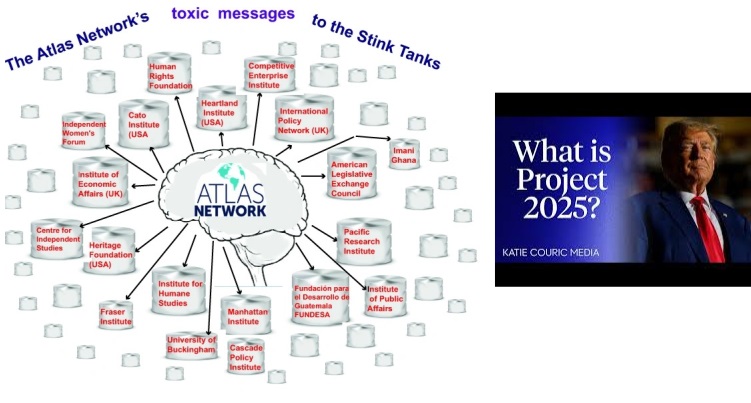
By Lucy HamiltonJul 8, 2024 https://johnmenadue.com/the-atlas-networks-transnational-revolution/
Twice in a fortnight, the president of the Heritage Foundation has declared that America is experiencing its second revolution. The revolution would remain bloodless (because their side is “winning”) “if the left allows it to be.” The two bodies whose acts provoked the announcements are leading Atlas Network partners. They are also spending millions of dollars in Europe to roll back rights for women and LGBTQIA people.
Both president Kevin Roberts’ announcements were made on Steve Bannon’s War Room broadcast, central to the Trumpist movement and its efforts to remake America from every school board and electoral precinct upwards.
The first announcement of revolution was made on the 22nd June. It functioned as an advertisement for the MAGA(Make America Great Again) audience to take part. Becoming a revolutionary involves undertaking Project 2025’s recruitment and training of loyalists to staff the incoming Trump administration, but also at state and local government levels. Roberts declared they were building not just for 2025, but for the next century in the United States.
Project 2025 is the most recent iteration of Heritage’s Mandate for Leadership. The first was written for Ronald Reagan, spelling out his massive reforms. He implemented two thirds in his first term. The last iteration for Donald Trump’s first term was similarly “business Republican” in tone, and Trump too implemented two thirds in his first year. The newest iteration is, as Roberts describes, revolutionary. It dictates the process for the dismantling most of the federal government as well as setting America on track to eliminate reproductive and Queer rights.
It also sets out the intention to dismantle the vital energy transition work underway as a result of the Inflation Reduction Act, with plans to boost fossil fuel production instead. This is fitting as much of Heritage’s funding comes from fossil fuel sources.
Project 2025 is a joint Atlas Network and Council for National Policy project.
The second announcement of revolution was made after the Supreme Court’s dramatic week of judgements. In particular, the one that granted the President of the United States immunity for the vaguely worded field of “official acts.” Naturally the partisan court will make the determination which acts are “official.”
The week also compounded the Trumpist Supreme Court’s norm-violating series of decisions that have rolled back reproductive healthcare access for women across Republican states, further damaged voters’ representation, and frozen programs that aim to address entrenched disadvantage.
In one week, the Court placed itself above the experts in government agencies who define, for example, how much mercury is unsafe to consume. While the relevant judge confused nitrous oxide and nitrogen oxide, he dared to claim that judges were better placed than government experts to determine the minutiae of America’s functioning. This attack on the administrative state’s ability to protect the public from corporate recklessness and malfeasance was a triumph for capital. The court also damaged the SEC’s ability to deal with White Collar crime.
Such gifts to the wealthy were balanced with another judgement that decided a gratuity given after a favour was received would not be determined an illegal bribe. For a court riddled with scandal over oligarch largesse, this was a particularly cynical decision.
As a footnote, the same week revealed a decision that said regions could make it illegal to be homeless. This can provide numbers for private prison operator profits. There prisoners are hired out to businesses for near slave-labour wages.
All these decisions have resulted from the years of work by the Federalist Society which handed Trump his literal list from which to choose judges. Republicans had stalled appointments to federal benches over the Obama era, granting Trump the gift of hundreds of appointments; some appointees were considered scandalous.
The years of surreptitious work by the Federalist Society and its leader Leonard Leo have been documented by Pro Publica. The body made headlines when it was gifted $1.6 billion by a single donor.
Both Heritage and the Federalist Society are Atlas Network partners. They are also Council for National Policy (CNP) members: that’s the interlinked body that has been driving the Christian Nationalist takeover of America.
Dr Jeremy Walker explained the process by which the Atlas Network architecture of influence operates in the lead-up to the Voice referendum in 2023.
Investigative journalist Jane Mayer revealed its American operations in Dark Money, using the label “Kochtopus” after Charles and David Koch, preeminent funders of the network. Historian Nancy MacLean documented its longer history in Democracy in Chains.
With around 500 partner organisations in roughly 100 countries its global operations remain less obvious because the system is intentionally covert.
The central “think” tanks foster the replication of more such bodies, providing seed funding if necessary and training in fundraising and public relations strategies to help the local offshoots become independent. They network. The primary function is to sell the donors’ messages by advertising them constantly: in 1985, Heritage founder Ed Feulner told Australian operatives to treat campaigns as if they were for a toothpaste brand that needed constant reinforcing. The messages: low tax, minimal regulation, small government, dismantling of social safety nets. Together the junktanks, as journalist George Monbiot has labelled them, create a chorus of voices from university centres and civil society bodies reinforcing the wishlist.
While the focus has primarily been on these “business Republican goals,” junktanks have their own remit. Conservative social messaging about the family has been partly used to conceal the lack of ethics in the libertarian mission. It has partly functioned to encourage family and church networks to mitigate the damage done to communities and individuals by the slashing of safety nets. There has also remained a more socially conservative and religious array of junktanks within the network.
The more toxic “family values” groups tend to be interconnected with Atlas rather than Atlas partners themselves. Trump appointee Betsy DeVos, for example, links the two. She has been chair and on the board of two Atlas partners: the American Federation for Children that aims to replace the public school system with privatised charter schools and the Acton Institute for the study of Religion and Liberty which educates business leaders and academics in “the connection that can exist between virtue and economic thinking.” Both Prince and DeVos families are substantial donors to the anti-LGBTQIA group Focus on Family. Focus is part of the CNP, a Christian Nationalist network that includes the Charles Koch and the Prince and DeVos families as donors, not to mention Mike Pence and Steve Bannon as key figures.
Both the extremist Christians and the libertarians are close to achieving their goals in America. Apart from the impact the implosion of the United States government and civil rights framework will have on the rest of the world, this is relevant because the very global nature of Atlas means that its outposts are trying to replicate its work outside the American homeland.
The European Parliament conducted a study affirming reporting that $280 million dollars have been funnelled into the EU over the last decade by Atlas and CNP partners as well as by Evangelical mission programs. Heritage and Federalist stand alongside the Cato Institute, the Leadership Institute and Acton as having donated roughly $20 million towards European groups fighting to repeal reproductive healthcare rights and LGBTQIA rights. Another American body, the American Society for the Defense of Tradition, Family and Property (TFP) has also been training European groups in strategy in cooperation with Bruce Eberle a “visiting professor” at the Leadership Institute. The Koch, DeVos and Prince families are named as major sources of the money.
(These donations are overshadowed in scale by those from European and Russian sources.)
Australia’s Centre for Independent Studies (CIS) mostly leaves the culture war battles on gender and religious virtues to the Institute of Public Affairs (IPA) and their media ally, News Corp. This year’s CIS Consilium event where the Atlas pipeliners intermingle with local and international talking heads is running adjacent to the inaugural conference of the Australian Chapter of the Alliance for Responsible Citizenship. The London original was a religio-ethnonationalist event. The consecutive timing is convenient for international guests to attend both.
The rest of us must remain focused on the fact that these networks operate transnationally. They share talking points, strategies, individuals and sometimes money. The revolution that Kevin Roberts has declared they are winning in the US is to be reenacted, piecemeal, for all of us.
US says not ready to resume nuclear talks with Iran under Pezeshkian
Iran International 8 July 24
The Biden administration is not ready to resume nuclear talks with Iran under the new president, the White House national security council spokesman said Monday.
In his presidential campaign, Iran’s president-elect Masoud Pezeshkian advocated engagement in constructive talks with Western powers to revive the 2015 nuclear deal (JCPOA) and to lift the sanctions that he says have crippled the Iranian economy since the withdrawal of the US from the agreement in 2018.
Asked whether Pezeshkian’s election will change the US negotiating position, the White House’s John Kirby offered a blunt “no”…………………………………………….more https://www.iranintl.com/en/202407084339
“Nuked” on Aukus ‘fiasco’ says decision to embrace pact will ‘haunt’ Australia’sLabor for years

“undermines any argument that the new submarines – whether nuclear or not – would be used primarily to defend Australia or to protect the nation’s shipping lanes”.
“at least one new cabinet minister wondered if it was possible to stop Aukus, but the suggestion went no further”.
Fowler said he did not believe there had been adequate public debate in Australia about the merits of Aukus,
Andrew Fowler’s book reveals one of Australia’s most important requirements for its submarines was the ability to work alongside the US in South China Sea
Daniel Hurst , 7 July 24, https://www.theguardian.com/world/article/2024/jul/07/book-on-aukus-fiasco-says-decision-to-embrace-pact-will-haunt-labor-for-years
One of Australia’s most important requirements for its new submarines is the ability to work alongside the United States in the South China Sea, a new book discloses.
The book by Andrew Fowler, a former investigative journalist for the ABC’s Four Corners and Foreign Correspondent programs, also predicts that Labor’s rush to embrace the Aukus pact “will haunt them for years to come”.
Fowler examines the Morrison government’s cancellation of the French submarine contract and its pursuit of a nuclear-powered alternative in the book Nuked: The Submarine Fiasco that Sank Australia’s Sovereignty.
The book makes the case that Aukus is a “deeply flawed” scheme that, when combined with a parallel effort to deepen military integration with the US, effectively ties Australia’s future “to whoever is in the White House”.
It includes an interview with David Gould, a former UK undersecretary for defence, who was headhunted by the then Gillard Labor government in 2012 as a consultant on a replacement for Australia’s ageing Collins-class submarines.
“As we sat talking, Gould revealed for the first time what has long been suspected: one of the submarine’s most important requirements would be to work with the Americans in the South China Sea,” Fowler writes.
“He explained that the submarine would need ‘to get through the archipelago to the north of Australia and into the South China Sea and operate in the South China Sea for a reasonable period of time and then come back again, without docking, or refuelling or anything. That’s what it needs to do.’”
The book quotes Gould as saying that the submarine would work alongside the US and Japan in an “integrated system”, which had become “even more pertinent with China”.
Fowler writes that the statement “undermines any argument that the new submarines – whether nuclear or not – would be used primarily to defend Australia or to protect the nation’s shipping lanes”.
Fowler contends that the focus is “to contain China and threaten its trade routes and food and energy supplies in a crisis”.
The Australian government has repeatedly said that its strategic motivation for acquiring nuclear-powered submarines is to “contribute to the collective security of our region” and maintain the global rules-based order.
The Labor defence minister, Richard Marles, has argued that the defence of Australia “doesn’t mean that much unless we have the collective security of our region” and that the nuclear-powered submarines would put a “question mark in any adversary’s mind”.
Fowler contends that the focus is “to contain China and threaten its trade routes and food and energy supplies in a crisis”.
The Australian government has repeatedly said that its strategic motivation for acquiring nuclear-powered submarines is to “contribute to the collective security of our region” and maintain the global rules-based order.
The Labor defence minister, Richard Marles, has argued that the defence of Australia “doesn’t mean that much unless we have the collective security of our region” and that the nuclear-powered submarines would put a “question mark in any adversary’s mind”.
The book reveals that after Labor won the 2022 election, “at least one new cabinet minister wondered if it was possible to stop Aukus, but the suggestion went no further”.
In an interview with Guardian Australia, Fowler said he began researching the book after becoming fascinated with “the overuse of executive power of government in the Morrison government, particularly the exposure of his five secret ministries”.
“I thought that the arrival of a $368bn secret deal that was done and then sprung on the public and the opposition party at the last moment would require an investigation,” he said.
Fowler said he did not believe there had been adequate public debate in Australia about the merits of Aukus, the security partnership with the US and the UK that involves the nuclear-powered submarine project but also collaboration on other advanced defence technologies.
“I think we debate the dollar-and-dime arguments, as the Americans might say, but we don’t debate the really big issues,” Fowler said.
“I don’t give advice to government but I think the Australian people have a right to know what the submarines are being bought for. They’re being bought to run with the Americans and Japan to contain the rise of China.”
Fowler said the then Labor opposition was put “in a diabolical position” when forced by Scott Morrison to make a quick decision on whether to support Aukus in 2021.
“This was a calculated attempt to wedge Labor on this issue and Labor only had 24 hours to make a decision,” he said. “It was obscene and absurd, and yet they made the decision fearing that if they opposed it they would be accused of being anti-American and weak on national security.
“I do understand why they went with it, but I think they also had some time to do some backtracking.”
Fowler called for an inquiry focused on “a failure of due process” in the cancellation of the French contract and the decision to pursue the Aukus arrangement, which officials admitted during Senate estimates hearings had not gone through the normal two-gate process for defence acquisitions.
Instead, the Morrison government announced Australia, the US and the UK would carry out an 18-month joint study to work out how to deliver the project. That led to the Albanese government’s March 2023 announcement of more detailed plans.
The book argues the French submarines would have given Australia “greater independence”, noting the president, Emmanuel Macron, had described Australia, India and France as being at the heart of a “new Indo-Pacific alliance and axis”.
The book says this “more independent thinking” caused “consternation in Washington”.
German Parliamentarian in Washington Says No to NATO – Yes to Peace

Peace Instead of NATO
Speech by Sevim Dagdelen, Member of the German Bundestag at
„No to NATO – Yes to Peace“-rally in Washington DC on July 7th 2024.
As NATO marks its 75th anniversary on the eve of its Washington summit, three of its great myths are unravelling.
First myth: That NATO is a defensive alliance abiding by international law.
In reality, over the last quarter century, NATO has waged unprovoked, illegal wars of aggression against Yugoslavia and Libya; and the United States, the leader of the alliance, invaded and occupied Iraq, in a catastrophic adventure – to name three notorious examples.
Second myth: That NATO stands for democracy and the rule of law.
The reality is that NATO has never had a problem with counting military dictatorships or fascist regimes among its members. Portugal, one of NATO’s founding members, murdered thousands of Africans in its colonial wars and tortured hundreds to death in concentration camps. That was never a problem for this particular collective of shared values, just as Erdoğan’s Türkiye, with its support for jihadists terrorist groups in Syria, poses no particular ethical problem for it today.
Third myth: That NATO is a community of shared values and stands for human rights.
In reality the wars conducted by the United States and its Allies over the last 20 years alone have killed four and a half million people, as calculated by researchers at the esteemed Brown University. The torture and detention camp at Guantánamo Bay Naval Base is still in operation to this day. The journalist Julian Assange was tormented nearly to death for 14 years because he had published evidence of US war crimes. Benjamin Netanyahu’s far-right government continues to receive American and European support in the form of arms deliveries for its onslaught against Gaza, which cannot credibly be justified by recourse to the right of self-defense.
If you want to know what character NATO has, you only have to look at how NATO Stoltenberg torpedoes every initiative for peace in Brussels, and also do Washington and Berlin. The plan is escalation nor negotiations for peace! We say: We need to Stop the killings in Ukraine. Ceasefire now!
And we also say: we need to stop the killings in Gaza! Ceasefire now!
What is the role of Germany in this ongoing war in Gaza?
In fact, Germany is the second most important arms supplier for Israel after the USA. From 2019 to 2023, 30 percent of weapons came from Germany. In 2023, the figure was 47 percent while the USA supplied 53 percent. I think that is irresponsible and a shame to send weapons to an ongoing war.
The majority of the German population now no longer wishes to follow Berlin in its mindless escalation, and it likewise stands opposed to granting Ukraine NATO membership, and to funnelling endless sums of money to the corrupt, undemocratic regime in Kyiv.
It is completely irresponsible and insane to hold on to Ukraine’s NATO membership. A majority in Germany rejects this accession. 55 percent in the whole of Germany and 70 percent in eastern Germany reject it. Our governments are doing politics against the majority of the population.
It is an embarrassment and a travesty that the current German Government, like no other before it, carries out Washington’s commands at a moment’s notice, repeatedly, continuously – and shamefully, with its belligerence – puts at grave risk the well-being of the people who elected it.
We need peace instead of NATO.
We need, at long last, to stand up for democratic and popular sovereignty, and to reject the indignity of being a vassal to Washington, which is just about all we’ve gotten from the ruling coalition in Berlin.
Global NATO: Expansion and Escalation
Keynote speech by Sevim Dagdelen, Member of the German Bundestag at
„No to Nato – Yes to Peace“-Summit in Washington DC July 6th 2024
Just in time for its 75th anniversary, NATO has dropped its mask. And the NATO summit in Washington is one particularly illuminating moment in this revelation. The history of the Enlightenment teaches us never to accept a person’s or an organization’s self-image at face value. So do the early sources of Enlightenment ideas in ancient Greece. The Greeks already possessed that insight. Inscribed above the Temple of Apollo was the maxim: Know thyself.
……………………..For NATO, denial of its true nature is part of the essence of the organization. Or to put it another way, an almost meditative immersion in its own self-image is part of the essence of the military alliance. It is all the more astonishing, then, that Western media are so often content to reflect a thousand iterations of this self-image back to the public, without question and without pausing to consider whether the image adequately represents reality.
In fact, 75 years of NATO is equivalent to 75 years of denial, albeit with a dramatic expansion of scale and scope in recent years.
This is so in part because the three great myths of NATO are now fading……………………………………………………………………………
I am thrilled to be able to say finally that Julian Assange is now a free man. And Julian is undefeated.
The international campaign for Assange, all of the confidential talks and the like, were in the end successful. But we must also realize that the fight for Julian Assange’s freedom was also part of the struggle for freedom as such. And this struggle continues to rage here at the very heart of the NATO system.
Given the density of the propaganda, how tireless it operates in celebration of the NATO mythology, day in and day out, it is almost a miracle that not only is support for NATO crumbling worldwide, but that it is precisely those most exposed to its propaganda who are increasingly skeptical of the military pact………………………………………………………………
NATO is itself causing this crisis, and people sense that.
While its defenders speak of the alliance as if it were eternal, the organization’s drive toward escalation in Ukraine and its expansion into Asia is exceeding the Alliance’s own capacities. Just as with most empires, NATO is falling into a self-made trap of overextension. In this regard, NATO is a political fossil, unprepared to learn from the defeat of the German Empire in the First World War and appears to be repeating the gross miscalculations of the Kaiser’s Germany, only on a global scale.
The German Empire believed it could wage a war on two fronts. Today, a similar conviction is gaining traction within NATO that it must not only confront Russia and China, but that it is also to involve itself in the Middle East. This is a claim to global hegemony now under formulation. What hubris!
NATO evidently sees itself waging a war on three fronts. But if it were to do this, its defeat would be certain right from the start…………………………………………….
The NATO-Ukraine Council is next on the agenda. It is to discuss how the lavish financial transfers and pledges from NATO to Ukraine can be augmented, with an increase in arms deliveries and eventual NATO membership for Ukraine. Third, there will be a session with the AP4, or Asia-Pacific partners – Australia, Japan, New Zealand and South Korea – and a meeting with the leaders of the EU.
Seventy-five years after it was founded, NATO is to push for stepped-up belligerence in Ukraine and expansion into Asia. The intention is to advance the NATO-ization of Asia, and to put the strategy it believes it has already deployed successfully against Russia in place there.
For the moment, the primary focus in the Pacific is not on direct NATO accession for Asian countries, but rather on the expansion of NATO’s sphere of influence via bilateral security agreements – and not only with the AP4, but also with the Philippines, Taiwan and Singapore.
Just as Ukraine was erected as a frontline state against Russia, NATO is hoping to transform Asian countries like the Philippines into challenger states vis-à-vis China. The initial aim is to engage in a cold proxy war, but at the same time to prepare for a hot US and NATO proxy war in Asia……………………………………………………..
As already mentioned, public support for a NATO committed to escalation and expansion is crumbling in the West. In Germany, 55% of people reject Ukraine’s accession to NATO. The majority opposes supplying arms to Ukraine and desires an immediate ceasefire. In the United States, financial aid to Ukraine, USD 200 billion so far, has become extremely unpopular. Growing numbers of people want a stop on the flow of money to a system in Kyiv which is not only corrupt but honors a far-right state cult around the Nazi collaborator Stepan Bandera.
NATO’s myths are losing their luster. The Alliance’s strategies are succumbing to their own imperial overextension. What we need now is an immediate end to arms deliveries to Ukraine and, at long last, a ceasefire there. Those who seek peace and security for their own populations must halt the aggressive policy of expansion into Asia…… more https://worldbeyondwar.org/german-parliamentarian-in-washington-says-no-to-nato-yes-to-peace/
The Atlas Network and the Council for National Policy: America’s global revolution

Atlas has tended to function to create neoliberal conditions in America and across the globe: the purpose of this was to erase every obstacle to American corporations’ profit and growth.
The Atlas project, like that of its Mont Pelerin Society inner sanctum, has never been invested in democracy, which leading members saw as a threat to business interests. Democracy was a risk to be controlled or eliminated, not an aspirational form of government.
the movement that drives Atlas emerges out of the Cold War battle by business that asserts any social wage is a slippery slope to totalitarianism.
July 8, 2024, Lucy Hamilton, https://theaimn.com/the-atlas-network-and-the-council-for-national-policy-americas-global-revolution/
Twice in a fortnight, the president of the Heritage Foundation has declared that America is experiencing its second revolution. The revolution would remain bloodless (because their side is “winning”) “if the left allows it to be.” The two bodies whose acts provoked the announcements are leading Atlas Network partners; they are, furthermore, listed on the Council for National Policy (CNP) rolls. The two junktanks – and their partner organisations – are also spending millions of dollars in Europe to roll back rights for women and LGBTQIA people. The revolution is transnational. It is working to destroy rights and democratic projects around the world. The relentless pursuit of profit and the determination to impose virtue on an unruly world are united in authoritarian intent.
The Revolution
Both Heritage’s president Kevin Roberts’ announcements were made on Steve Bannon’s War Room broadcast, central to the Trumpist movement and its efforts to remake America from every school board and electoral precinct upwards.
The first announcement of revolution was made on the 22nd June. It functioned as an advertisement for the MAGA audience to take part. Becoming a revolutionary involves undertaking Project 2025’s recruitment and training of loyalists to staff the incoming Trump administration, but also at state and local government levels. Roberts declared they were building not just for 2025, but for the next century in the United States.
Project 2025 is the most recent iteration of Heritage’s Mandate for Leadership. The first was written for Ronald Reagan, spelling out his massive reforms. He implemented two thirds in his first term. The last iteration for Donald Trump’s first term was similarly “business Republican” in tone, and Trump too implemented two thirds in his first year. The newest iteration is, as Roberts describes, revolutionary. It dictates the process for the dismantling most of the federal government as well as setting America on track to eliminate reproductive and Queer rights.
It also sets out the intention to dismantle the vital energy transition work underway as a result of the Inflation Reduction Act, with plans to boost fossil fuel production instead. This is fitting as much of Heritage’s funding comes from fossil fuel sources. This is true for the Atlas Network generally, although it has tobacco and other unpopular corporate sectors as donors.
Project 2025 is a joint Atlas Network and CNP project.
The second announcement of revolution was made after the Supreme Court’s dramatic week of judgements. In particular, the one that granted the President of the United States immunity for the vaguely worded field of “official acts.” Naturally the partisan court will make the determination which acts are “official.”
The week also compounded the Trumpist Supreme Court’s norm-violating series of decisions that have rolled back reproductive healthcare access for women across Republican states, further damaged voters’ representation, and frozen programs that aim to address entrenched disadvantage.
As a footnote, the same week revealed a decision that said regions could make it illegal to be homeless. This can provide numbers for private prison operator profits. There prisoners are hired out to businesses for near slave-labour wages.
No matter who wins the election in November, the radical right majority on the court can now prevent action their faction rejects: they have created an imperial juristocracy.
All these decisions have resulted from the years of work by the Federalist Society which handed Trump his literal list from which to choose judges. Republicans had stalled appointments to federal benches over the Obama era, granting Trump the gift of over one hundred appointments; some appointees were considered scandalous.
The years of surreptitious work by the Federalist Society and its Machiavellian leader, Leonard Leo, have been documented by Pro Publica. The body made headlines when it was gifted $1.6 billion by a single donor. The corruption that pervades the Supreme Court features several Atlas and CNP junktanks. Heritage paid Justice Thomas’s insurrectionist wife a secret salary amounting to almost $700,000 between 2003 and 2007. The Federalist’s Leo paid Ginni Thomas through her “consulting” firm. An Atlas Partner, the Islamophobic Center for Security Policy, paid her. Another Project 2025 Advisory Council and CNP member, Hillsdale College, also “employed” her. The coup being perpetrated by the court is funded by plutocrat donors to remove any constraints on their action. It is also used, by the filing of amicus briefs, to achieve goals such as restricting voting rights.
Why are fossil fuel magnates working with Christian extremists?
Both Heritage and the Federalist Society are Atlas Network partners.
They are also Council for National Policy (CNP) members. The CNP is the Atlas-interlinked network that has been driving the Christian Nationalist takeover of America. In 2019, Columbia School of Journalism lecturer Ann Nelson documented that organisation, founded in 1981, in Shadow Network: Media, Money and the Secret Hub of the Radical Right. As with Atlas, Charles Koch is a major donor. The CNP has steered the evangelical television and radio media organisations that have helped turn (Heritage co-founder) Paul Weyrich’s Moral Majority from a marginal array of individual churches and groups into a more unified force with coherent policy platforms. The latest leaked CNP membership list from Documented includes several Atlas junktanks as integrated into that network as well as key players in American politics and media ranging from Mike Pence to Steve Bannon. Pence represents the Evangelical alliance that made Trump’s first term possible. Bannon represents both Rad Trad Catholicism and the esoteric “philosophy” of Traditionalism. This apocalyptic belief was explored in 2021’s The War for Eternity: The Return of Traditionalism and the Rise of the Populist Right by University of Colorado ethnography professor Benjamin Teitelbaum. Bannon was a leading figure in the Rad Trad Catholicism that has been fighting as sedevacantists to say that the Catholic Church has no Pope but has been infiltrated by a socialist. They place Putin as a hero of Christians, with Moscow as the Third Rome. Another of its leaders, Archbishop Viganò, has just been excommunicated.
Charles Koch by contrast has been one of the drivers of the most extreme libertarianism in America. His brother, David, was placed at the forefront of their goals as their Libertarian Party vice-presidential candidate in 1980. It was a disastrous experiment, with its brutal policies attracting a tiny percentage of the vote. The libertarian project needed a veil to win enough votes to enact it. Project 2025 is, likely, ultimately that veil. The Libertarian Party platform is expanded there, but so is the devastating statist authoritarianism of the Christian Nationalist movement. It appears that Charles Koch, unsurprisingly for anyone who has followed his career, will do anything to ensure his own freedom from constraint. Disdain for “woke” talking points might bolster that readiness.
Other key figures amongst the oligarch donors and their operatives appear much more committed to a statist agenda, whereby the government will enforce “Christian” virtue upon an immoral population. Their definition of virtue is distinctive. While the project to ensure women’s inability to engage in sexual activity outside inescapable marriage might not shock mainstream Christians, the concurrent oligarch campaign to prevent employers being compelled to ensure child labourers have a meal break should disturb them. The neofeudal truths at the core of the neoliberal branding are becoming clearer: to believe that employers will act responsibly without enforcement is to be their gull.
Both Heritage and the Federalist Society are run by Rad Trad Catholic extremists. Kevin Roberts has taken the Heritage Foundation from being the leading “business Republican” junktank in America to being at the tip of the spear of the Christian Nationalist attempt to turn the USA into a theocratic autocracy. Leonard Leo, who has orchestrated five radical Catholic appointments to the Supreme Court, is an extremist. The exact nature of the interactions between the two secretive networks is unclear.
The Atlas Network
Atlas has tended to function to create neoliberal conditions in America and across the globe: the purpose of this was to erase every obstacle to American corporations’ profit and growth. Local aspiring oligarchs are enlisted to fund the project within their own terrain for those same goals. While the intent was ostensibly free market, the impact has always been to promote the interests of monopolists and oligopolists at the expense of competitors and the society around them. Some of the junktanks in Atlas have promoted reactionary social messaging as their bailiwick. The Acton Institute for the Study of Religion and Liberty has been the highest profile example. It exists to educate business leaders and academics in “the connection that can exist between virtue and economic thinking.” Leonard Leo joked to the Institute in 2017 about not yet managing to “launch a hostile takeover” of the Supreme Court.
There appear to be two main intents for this aspect of the Atlas information campaign. One is to conceal the immorality of the “free market” project stripped of any constraints on the actions of business no matter the harm done. To appeal to a sufficient electoral percentage to gain power, they deployed a social message that endorsed individual “virtue.” The strategy was called paleoconservativism.
Evangelicals had worked in cooperation with the interests of fossil fuel (at the expense of First Peoples) for decades beforehand, but the movement that drives Atlas emerges out of the Cold War battle by business that asserts any social wage is a slippery slope to totalitarianism. During the Cold War, communism was depicted as deadly to business but also atheist and immoral: the Manichaean battle between good and evil made a Christian Libertarianism (or religious neoliberalism) the answer. It promoted both ultimate freedom for business and the enforcing of religion and virtue on the population.
This cynical project had the additional important role of ensuring that the damage done to society and family by the Fordist economic model was mitigated by pressure on individuals (mainly women) to fill the cracks in family and community created by ruthless market societies.
The Atlas project, like that of its Mont Pelerin Society inner sanctum, has never been invested in democracy, which leading members saw as a threat to business interests. Democracy was a risk to be controlled or eliminated, not an aspirational form of government.
Investigative journalist at the New Yorker Jane Mayer revealed Atlas’s American operations in Dark Money: How a Secretive Group of Billionaires is trying to buy Political Control in the US in 2016. She used the label “Kochtopus” after the networks’ biggest funders and strategists. In 2018, Duke University history Professor Nancy MacLean documented its longer history in Democracy in Chains: the deep history of the radical right’s stealth plan for America. It was only after the book’s completion that MacLean became aware of the network’s secretive global ramifications as Atlas.
Also founded in 1981, the Network systematises propaganda for the Chicago School’s bunk economics, so ably disseminated by Milton Friedman. It now has around 600 partner organisations in over 100 countries, but its global operations remain less obvious because the system is intentionally covert. Local transparency failures suppress information about its funding and impact.
The central “think” tanks foster the replication of more such bodies, providing seed funding if necessary and training in fundraising and public relations strategies to help the local offshoots become independent. They network. The primary function is to sell the donors’ messages by advertising them constantly: in 1985, Heritage Foundation co-founder Ed Feulner told Australian operatives to treat campaigns as if they were for a toothpaste brand that needed constant reinforcing. The messages: low tax, deregulation, small government, dismantling of social safety nets. Together the junktanks, as journalist George Monbiot has labelled them, create a chorus of voices from university centres and civil society bodies reinforcing the wishlist.
Dr Jeremy Walker explained the process by which the Atlas Network architecture of influence operates in the lead-up to the Voice referendum in 2023. His “Freedom to Burn” essay details the intimate connections in Australia between mining goals and the the Atlas Network’s architecture of influence. The sideline in culture war battles promoted by the low-rent Atlas junktanks like the Institute of Public Affairs (IPA) and LibertyWorks, aided by ally Atlas-connected Rupert Murdoch, both divides voters from their economic interests and fosters the demonisation of rights culture. Without rights, women, LGBTQIA people, non-White and non-Christian people can be returned to their traditional subservience.
Quinn Slobodian is tracking the interaction of (Atlas) junktanks and the European far-right. A French investigation has detailed the way that corporate goals are being pursued by Atlas affiliates in Europe. An Italian investigation explored corporate money and Atlas connections supporting far right politics there. Hungary’s Viktor Orbán is a leading figure in the transnational movement. Heritage has connections with these far-right parties.
The Washington Post last week featured the damage done in New Zealand/Aotearoa by Atlas operatives in government. Byline Times and investigative reporters such as Peter Geoghegan have tracked the deep corruption and devastation of Atlas’s influence on the UK through its Tufton Street operations and their American fundraising arms.
Hindsight reveals the way revolutionising political economy and the law to grant monopolist corporations their every goal has failed to produce the economic paradise promised by the Chicago School’s plutocrat economics. This year, UC law professor Mehrsa Baradaran has detailed in The Quiet Coup: Neoliberalism and the Looting of America the role that Atlas and Chicago School economics played in rewriting the law to oblige plutocrats. Columbia Law School professor Katharina Pistor has documented how contract law is used to concentrate power in the hands of the wealthy in The Code of Capital: How the Law Creates Wealth and Inequality.
In Australia, the presence of these Atlas junktanks has been primarily deployed to reinforce “business propaganda,” but the social messages of disgust for modern, inclusive society are readily apparent too. The interlinked Ramsay Centre seems to be the strongest voice for outright Christian goals. That may relate to the close involvement of Atlas-connected Tony Abbott who is a key figure in the global campaign to place Christianity both as a religion and as a cultural signifier for White Western “civilisation” to the forefront of politics. This is visible in his work with Viktor Orbán and also on the Alliance for Responsible Citizenship Advisory Board./
Atlas’s extremist connections
The more toxic and bigoted “family values” groups tend to appear interconnected with Atlas rather than Atlas partners themselves. Trump appointee Betsy DeVos, for example, links the two. She has been chair and on the board of two Atlas partners: the American Federation for Children that aims to replace the public school system with privatised charter schools and the Acton Institute Both her Prince and DeVos families are substantial donors to the anti-LGBTQIA group Focus on Family. Focus is part of the CNP, whose donors include Charles Koch and the Prince and DeVos families.
Both the extremist Christians and the libertarians are close to achieving their goals in America. Apart from the impact the implosion of the United States government and civil rights framework will have on the rest of the world, this is relevant because the very global nature of Atlas means that its outposts are trying to replicate its work outside the American homeland. These campaigns are reinforced by the fact that America’s homegrown Pentecostal form of Christianity has been an aggressively international missionary project from its earliest days.
The European Parliament conducted a study affirming reporting that $280 million dollars have been funnelled into the EU over the last decade by Atlas and CNP partners as well as by Evangelical mission programs. Heritage and Federalist stand alongside the Cato Institute, the Leadership Institute and Acton as having donated roughly $20 million towards European groups fighting to repeal reproductive healthcare rights and LGBTQIA rights. Another American body, the CNP-connected American Society for the Defense of Tradition, Family and Property (TFP) has also been training European groups in strategy in cooperation with Bruce Eberle a “visiting professor” at the Leadership Institute. The Koch, DeVos and Prince families are named as major sources of the money. (These donations are overshadowed in scale by those from European and Russian sources.)
Atlas and CNP seem to be convening around the National Conservative (NatCon) project. This is a transnational exercise that manifests in various conferences. Some are NatCon, or PopCon or CPAC or Faith and Freedom. The Alliance for Responsible Citizenship (in large part funded by the Atlas-partner, the Legatum Institute) would fall within the parameters. NatCon is a network of religio-ethnonationalist operators. The Christian Nationalists are supported by, and supportive of, extremist nationalist projects focused on religion as an ethnic identifier. A Jewish nationalist is one of the founders of the movement, and Modi’s Hindutva nationalism is also befriended. The projects all denote Muslims as a chief enemy, with ethnic cleansing implied and even stated. Each dictates a “traditional” identity and social roles as key to their mission. Natalist policies supporting higher birth rates in the approved identity group accompany such goals, often linked to attacks on feminism and LGBTQIA rights. Race suicide is the result of these “evils.”
The message of “freedom” is endorsed for business and the individual. The individual must be free from public health measures of protective regulations by demonised bodies such as the UN or EU or WHO. The freedom of “woke” people, by contrast, is a threat rather than a consideration.
Rod Dreher’s account of last October’s inaugural Alliance for Responsible Citizenship event focused on the extreme Christianity that underpinned it, not surprising since Dreher has converted twice in pursuit of a more rigorous faith. The (Atlas) Australian Institute for Progress reports emphasised that feature too. The populist NatCon events such as CPAC unite conspiracists with libertarians and preachers. Australia saw such a conference in Albury in March.
A key purpose of these events is shaping a communal identity in the face of a manufactured existential threat. The identity being forged stands in opposition to modern, inclusive and knowledge-based societies. The diagonalist ideology visible there too – where left and right attributes are muddied – is drawing Christianity in as a key component for that identity. Russell Brand is not the only influencer to have ostentatiously converted to Christianity recently.
For many of the participants, the identity they are building together is connected to being White. The Atlas Network, like the Kochs, emerges out of the John Birch Society era of American conspiracist racism. Christianity is the code.
Christianity has the added advantage for an extreme libertarian project of demanding obedience and promising rewards for it in the Afterlife.
The NatCon project is often intertwined with fossil fuel money. It is, unsurprisingly, also deeply antagonistic to climate action.
Conclusion
Evangelical groups in Australia are often transnational and importing ultraconservative goals here.
A separate presence of CNP groups is not yet obvious, but it is worth noting that Feulner, speaking to Atlas junktanks in Australia in 1985, would have been as much connected to the CNP as Atlas.
Australia’s Centre for Independent Studies (CIS) mostly leaves the culture war battles on gender and religious virtues to the IPA and their media ally, News Corp. This October’s CIS Consilium event where the Atlas pipeliners intermingle with local and international talking heads is running adjacent to the inaugural conference of the Australian Chapter of the Alliance for Responsible Citizenship. The consecutive timing is convenient for international guests to attend both.
America’s second revolution is frightening. While Trump disavows Project 2025, his current spokesperson is part of the project. It will be difficult for him to step away from a strategy designed by people he has worked with, setting out the steps his people need to take and providing him with the partisan leaders and employees he will need to enact his dreams of vengeance. He is too lazy not to accept the process.
The rest of us must remain focused on the fact that these networks operate transnationally. They share talking points, strategies, people and money. The revolution that Kevin Roberts has declared they are winning in the US is to be reenacted, piecemeal, for all of us.
It’s past time we fought back.
Trusting the ‘Five Eyes’ Only
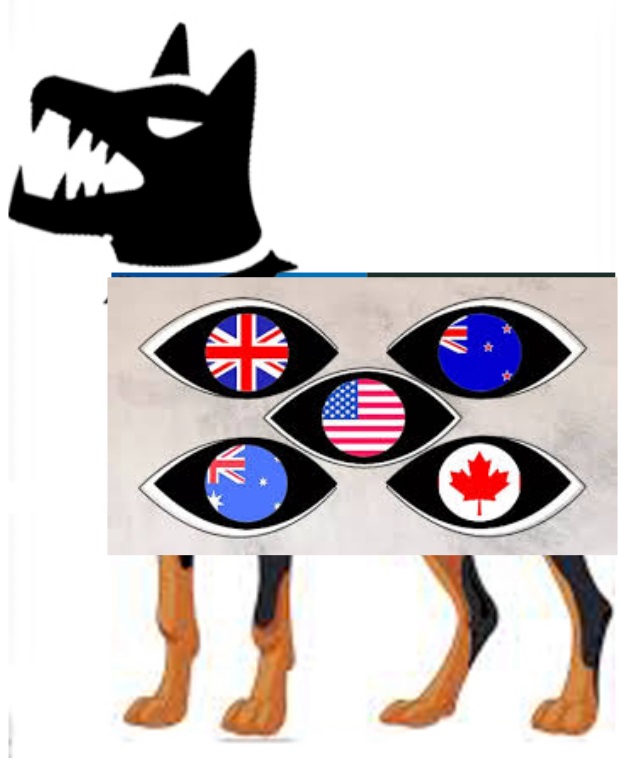
For Their Eyes Only
The “Five Eyes” (FVEY) is an elite club of five English-speaking countries — Australia, Canada, New Zealand, the United Kingdom, and the United States — that have agreed to cooperate in intelligence matters and share top-secret information. They all became parties to what was at first the bilateral UKUSA Agreement, a 1946 treaty for secret cooperation between the two countries in what’s called “signals intelligence” — data collected by electronic means, including by tapping phone lines or listening in on satellite communications. (The agreement was later amended to include the other three nations.) Almost all of the Five Eyes’ activities are conducted in secret, and its existence was not even disclosed until 2010. You might say that it constitutes the most secretive, powerful club of nations on the planet.
Anglo-Saxon solidarity supersedes all other relationships.
JULY 5, 2024 By Michael Klare / TomDispatch, https://scheerpost.com/2024/07/05/trusting-the-five-eyes-only/
Wherever he travels globally, President Biden has sought to project the United States as the rejuvenated leader of a broad coalition of democratic nations seeking to defend the “rules-based international order” against encroachments by hostile autocratic powers, especially China, Russia, and North Korea. “We established NATO, the greatest military alliance in the history of the world,” he told veterans of D-Day while at Normandy, France on June 6th. “Today… NATO is more united than ever and even more prepared to keep the peace, deter aggression, defend freedom all around the world.”
In other venues, Biden has repeatedly highlighted Washington’s efforts to incorporate the “Global South” — the developing nations of Africa, Asia, Latin America, and the Middle East — into just such a broad-based U.S.-led coalition. At the recent G7 summit of leading Western powers in southern Italy, for example, he backed measures supposedly designed to engage those countries “in a spirit of equitable and strategic partnership.”
But all of his soaring rhetoric on the subject scarcely conceals an inescapable reality: the United States is more isolated internationally than at any time since the Cold War ended in 1991. It has also increasingly come to rely on a tight-knit group of allies, all of whom are primarily English-speaking and are part of the Anglo-Saxon colonial diaspora. Rarely mentioned in the Western media, the Anglo-Saxonization of American foreign and military policy has become a distinctive — and provocative — feature of the Biden presidency.
America’s Growing Isolation
To get some appreciation for Washington’s isolation in international affairs, just consider the wider world’s reaction to the administration’s stance on the wars in Ukraine and Gaza.
Following Russia’s invasion of Ukraine, Joe Biden sought to portray the conflict there as a heroic struggle between the forces of democracy and the brutal fist of autocracy. But while he was generally successful in rallying the NATO powers behind Kyiv — persuading them to provide arms and training to the beleaguered Ukrainian forces, while reducing their economic links with Russia — he largely failed to win over the Global South or enlist its support in boycotting Russian oil and natural gas.
Despite what should have been a foreboding lesson, Biden returned to the same universalist rhetoric in 2023 (and this year as well) to rally global support for Israel in its drive to extinguish Hamas after that group’s devastating October 7th rampage. But for most non-European leaders, his attempt to portray support for Israel as a noble response proved wholly untenable once that country launched its full-scale invasion of Gaza and the slaughter of Palestinian civilians commenced. For many of them, Biden’s words seemed like sheer hypocrisy given Israel’s history of violating U.N. resolutions concerning the legal rights of Palestinians in the West Bank and its indiscriminate destruction of homes, hospitals, mosques, schools, and aid centers in Gaza. In response to Washington’s continued support for Israel, many leaders of the Global South have voted against the United States on Gaza-related measures at the U.N. or, in the case of South Africa, have brought suit against Israel at the World Court for perceived violations of the 1948 Genocide Convention.
In the face of such adversity, the White House has worked tirelessly to bolster its existing alliances, while trying to establish new ones wherever possible. Pity poor Secretary of State Antony Blinken, who has made seemingly endless trips to Asia, Africa, Europe, Latin America, and the Middle East trying to drum up support for Washington’s positions — with consistently meager results.
Here, then, is the reality of this anything but all-American moment: as a global power, the United States possesses a diminishing number of close, reliable allies – most of which are members of NATO, or countries that rely on the United States for nuclear protection (Japan and South Korea), or are primarily English-speaking (Australia and New Zealand). And when you come right down to it, the only countries the U.S. really trusts are the “Five Eyes.”
For Their Eyes Only
The “Five Eyes” (FVEY) is an elite club of five English-speaking countries — Australia, Canada, New Zealand, the United Kingdom, and the United States — that have agreed to cooperate in intelligence matters and share top-secret information. They all became parties to what was at first the bilateral UKUSA Agreement, a 1946 treaty for secret cooperation between the two countries in what’s called “signals intelligence” — data collected by electronic means, including by tapping phone lines or listening in on satellite communications. (The agreement was later amended to include the other three nations.) Almost all of the Five Eyes’ activities are conducted in secret, and its existence was not even disclosed until 2010. You might say that it constitutes the most secretive, powerful club of nations on the planet.
The origins of the Five Eyes can be traced back to World War II, when American and British codebreakers, including famed computer theorist Alan Turing, secretly convened at Bletchley Park, the British codebreaking establishment, to share intelligence gleaned from solving the German “Enigma” code and the Japanese “Purple” code. At first an informal arrangement, the secretive relationship was formalized in the British-US Communication Intelligence Agreement of 1943 and, after the war ended, in the UKUSA Agreement of 1946. That arrangement allowed for the exchange of signals intelligence between the National Security Agency (NSA) and its British equivalent, the Government Communications Headquarters (GCHQ) — an arrangement that persists to this day and undergirds what has come to be known as the “special relationship” between the two countries.
Then, in 1955, at the height of the Cold War, that intelligence-sharing agreement was expanded to include those other three English-speaking countries, Australia, Canada, and New Zealand. For secret information exchange, the classification “AUS/CAN/NZ/UK/US EYES ONLY” was then affixed to all the documents they shared, and from that came the “Five Eyes” label. France, Germany, Japan, and a few other countries have since sought entrance to that exclusive club, but without success.
Although largely a Cold War artifact, the Five Eyes intelligence network continued operating right into the era after the Soviet Union collapsed, spying on militant Islamic groups and government leaders in the Middle East, while eavesdropping on Chinese business, diplomatic, and military activities in Asia and elsewhere. According to former NSA contractor Edward Snowden, such efforts were conducted under specialized top-secret programs like Echelon, a system for collecting business and government data from satellite communications, and PRISM, an NSA program to collect data transmitted via the Internet.
As part of that Five Eyes endeavor, the U.S., the United Kingdom, and Australia jointly maintain a controversial, highly secret intelligence-gathering facility at Pine Gap, Australia, near the small city of Alice Springs. Known as the Joint Defence Facility Pine Gap (JDFPG), it’s largely run by the NSA, CIA, GCHQ, and the Australian Security Intelligence Organization. Its main purpose, according to Edward Snowden and other whistle-blowers, is to eavesdrop on radio, telephone, and internet communications in Asia and the Middle East and share that information with the intelligence and military arms of the Five Eyes. Since the Israeli invasion of Gaza was launched, it is also said to be gathering intelligence on Palestinian forces in Gaza and sharing that information with the Israeli Defense Forces. This, in turn, prompted a rare set of protests at the remote base when, in late 2023, dozens of pro-Palestinian activists sought to block the facility’s entry road.
Anglo-Saxon Solidarity in Asia
The Biden administration’s preference for relying on Anglophone countries in promoting its strategic objectives has been especially striking in the Asia-Pacific region. The White House has been clear that its primary goal in Asia is to construct a network of U.S.-friendly states committed to the containment of China’s rise. This was spelled out, for example, in the administration’s Indo-Pacific Strategy of the United States of 2022. Citing China’s muscle-flexing in Asia, it called for a common effort to resist that country’s “bullying of neighbors in the East and South China” and so protect the freedom of commerce. “A free and open Indo-Pacific can only be achieved if we build collective capacity for a new age,” the document stated. “We will pursue this through a latticework of strong and mutually reinforcing coalitions.”
That “latticework,” it indicated, would extend to all American allies and partners in the region, including Australia, Japan, New Zealand, the Philippines, and South Korea, as well as friendly European parties (especially Great Britain and France). Anyone willing to help contain China, the mantra seems to go, is welcome to join that U.S.-led coalition. But if you look closely, the renewed prominence of Anglo-Saxon solidarity becomes ever more evident.
Of all the military agreements signed by the Biden administration with America’s Pacific allies, none is considered more important in Washington than AUKUS, a strategic partnership agreement between Australia, the United Kingdom, and the United States. Announced by the three member states on Sept. 15, 2021, it contains two “pillars,” or areas of cooperation — the first focused on submarine technology and the second on AI, autonomous weapons, as well as other advanced technologies. As in the FVEY arrangement, both pillars involve high-level exchanges of classified data, but also include a striking degree of military and technological cooperation. And note the obvious: there is no equivalent U.S. agreement with any non-English-speaking country in Asia.
Consider, for instance, the Pillar I submarine arrangement. As the deal now stands, Australia will gradually retire its fleet of six diesel-powered submarines and purchase three to five top-of-the-line U.S.-made Los Angeles-class nuclear-powered submarines (SSNs), while it works with the United Kingdom to develop a whole new class of subs, the SSN-AUKUS, to be powered by an American-designed nuclear propulsion system. But — get this — to join, the Australians first had to scrap a $90 billion submarine deal with a French defense firm, causing a severe breach in the Franco-Australian relationship and demonstrating, once again, that Anglo-Saxon solidarity supersedes all other relationships.
Now, with the French out of the picture, the U.S. and Australia are proceeding with plans to build those Los Angeles-class SSNs — a multibillion-dollar venture that will require Australian naval officers to study nuclear propulsion in the United States. When the subs are finally launched (possibly in the early 2030s), American submariners will sail with the Australians to help them gain experience with such systems. Meanwhile, American military contractors will be working with Australia and the UK designing and constructing a next-generation sub, the SSN-AUKUS, that’s supposed to be ready in the 2040s. The three AUKUS partners will also establish a joint submarine base near Perth in Western Australia.
Pillar II of AUKUS has received far less media attention but is no less important. It calls for American, British, Australian scientific and technical cooperation in advanced technologies, including AI, robotics, and hypersonics, aimed at enhancing the future military capabilities of all three, including through the development of robot submarines that could be used to spy on or attack Chinese ships and subs.
Aside from the extraordinary degree of cooperation on sensitive military technologies — far greater than the U.S. has with any other countries — the three-way partnership also represents a significant threat to China. The substitution of nuclear-powered subs for diesel-powered ones in Australia’s fleet and the establishment of a joint submarine base at Perth will enable the three AUKUS partners to conduct significantly longer undersea patrols in the Pacific and, were a war to break out, attack Chinese ships, ports, and submarines across the region. I’m sure you won’t be surprised to learn that the Chinese have repeatedly denounced the arrangement, which represents a potentially mortal threat to them.
Unintended Consequences
It’s hardly a surprise that the Biden administration, facing growing hostility and isolation in the global arena, has chosen to bolster its ties further with other Anglophone countries rather than make the policy changes needed to improve relations with the rest of the world. The administration knows exactly what it would have to do to begin to achieve that objective: discontinue arms deliveries to Israel until the fighting stops in Gaza; help reduce the burdensome debt load of so many developing nations; and promote food, water security, and other life-enhancing measures in the Global South. Yet, despite promises to take just such steps, President Biden and his top foreign policy officials have focused on other priorities — the encirclement of China above all else — while the inclination to lean on Anglo-Saxon solidarity has only grown.
However, by reserving Washington’s warmest embraces for its anglophone allies, the administration has actually been creating fresh threats to U.S. security. Many countries in contested zones on the emerging geopolitical chessboard, especially in Africa, the Middle East, and Southeast Asia, were once under British colonial rule and so anything resembling a potential Washington-London neocolonial restoration is bound to prove infuriating to them. Add to that the inevitable propaganda from China, Iran, and Russia about a developing Anglo-Saxon imperial nexus and you have an obvious recipe for widespread global discontent.
It’s undoubtedly convenient to use the same language when sharing secrets with your closest allies, but that should hardly be the deciding factor in shaping this nation’s foreign policy. If the United States is to prosper in an increasingly diverse, multicultural world, it will have learn to think and act in a far more multicultural fashion — and that should include eliminating any vestiges of an exclusive Anglo-Saxon global power alliance.
Ukraine to be warned it’s ‘too corrupt’ for NATO – Telegraph
3 July 24, https://www.sott.net/article/492800-Ukraine-to-be-warned-its-too-corrupt-for-NATO-Telegraph
Many of the bloc’s members want “additional steps” from Kiev as they consider the issue a “priority,” a source has told the paper
NATO wants Ukraine to make more effort to crack down on endemic corruption as a condition for any progress towards joining the bloc, the Daily Telegraph reported on Tuesday, citing sources.
According to the British paper, concerns that Ukraine is “too corrupt” to become a full-fledged NATO member will be highlighted in the communique at the bloc’s Washington summit on July 9-11.
A senior US State Department official told The Telegraph that the West must “applaud everything that Ukraine has done in the name of reforms over the last two-plus years.” However, he added that “we want to talk about additional steps that need to be taken, particularly in the area of anti-corruption. It is a priority for many of us around the table.”
NATO members first agreed in 2008 that Ukraine would eventually join the bloc, without setting an exact timetable. After the Western-backed coup in Kiev in 2014, Ukraine made its NATO aspirations a strategic goal and formally applied to join the bloc in 2022. The move came after four of its former regions voted overwhelmingly to join Russia.
However, NATO Secretary-General Jens Stoltenberg has said Ukraine’s accession is out of the question while it is in conflict with Russia, insisting that membership can only be approved “when allies agree and conditions are met.” Moscow has said Ukraine’s plans to join NATO are among the key reasons for the conflict.
Ukraine has been plagued by corruption for years. The hostilities with Russia have made the problem even more apparent, and the Ukrainian military has been rocked by several high-profile procurement scandals in recent months.
Graft is high on the list of concerns for Ukraine’s Western backers in the EU and US. Last month, the EU set up a special watchdog to combat the possible embezzlement of billions of dollars allocated to Kiev.
In May, Robert Storch, the Pentagon’s inspector general, released a report stating that “endemic corruption persists” in Ukraine while calling its government “one of the least accountable” in Europe. An NBC report in June claimed that Kiev has been irritated by constant US demands to ramp up anti-corruption efforts. American and Ukrainian officials have acknowledged that it is one of the issues poisoning bilateral relations.
According to Transparency International’s Corruption Perception Index, Ukraine is in the ‘red’ zone, ranking 104th out of 180 countries.
1) It is inscribed in the Ukrainian Constitution, that NATO and EU membership is a priority for the government and its president. In spite of intentions and promises, the outlook is not bright in the short term.
- NATO installing permanent envoy to Ukraine, while not letting it join the club
- Up to half a million NATO soldiers waiting to enter Ukraine: “Offensive oriented”, preparing for “a large confrontation”
- Best of the Web: Final warning? Putin’s Ukraine settlement proposal: “Withdraw all troops from the 4 Russian-majority regions, and affirm neutral non-NATO status for the remainder of Ukraine”
The constitution of Ukraine would have to be changed to make room for peace without NATO and EU membership. See this blog post discussion Would Ukraine Breach its own Constitution if it Dropped its NATO Bid?
2) From the article:
According to Transparency International’s Corruption Perception Index, Ukraine is in the ‘red’ zone, ranking 104th out of 180 countries.
This rating system is not worth much, but here are more details about it.
The Wiki for Corruptions Perceptions Index has that between 2021 and 2022 Ukraine improved six places in the ranking, and 12 places between 2022 and 2023. The NGO, Transparency International, aims to rate countries “by their perceived levels of public sector[1]corruption, as determined by expert assessments and opinion surveys.” Place 104 must be close to sufficient for NATO, if Albania, NATO member since 2009, at place number 98 is anything to go by.
The Transparency International website has a page, that shows many sponsors to be from Western countries, with many also being sponsors of the NATO proxy war in Ukraine.
The Wiki include the controversies behind the CPU ratings:
According to the newspaper Le Monde: “In its main surveys, Transparency International does not measure the weight of corruption in economic terms for each country. It develops a Corruption Perception Index (CPI) based on surveys conducted by private structures or other NGOs: the Economist Intelligence Unit, backed by the British liberal weekly newspaper The Economist, the American neoconservative organization Freedom House, the World Economic Forum, or large corporations. (…) The IPC ignores corruption cases that concern the business world. So, the collapse of Lehman Brothers (2008) or the manipulation of the money market reference rate (Libor) by major British banks revealed in 2011 did not affect the ratings of the United States or United Kingdom.”
The index may serve as a help for companies who wish to invest in a country as to what they might have to allocate to get what they want. On the state level it can be used as reference point for policies against some countries, and more generally as a front for information gathering and soft power influencing.
Confronting NATO’s War Summit in Washington

But NATO’s leaders are not coming to Washington to work out how they can comply with their international obligations and negotiate peace in Ukraine. On the contrary. At a June meeting in preparation for the Summit, NATO defense ministers approved a plan to put NATO’s military support to Ukraine “on a firmer footing for years to come.”
Echoing George Orwell’s doublethink that “war is peace”, NATO Secretary General Stoltenberg said, “The paradox is that the longer we plan, and the longer we commit [to war], the sooner Ukraine can have peace.”
By Medea Benjamin and Nicolas J. S. Davies, World BEYOND War, July 1, 2024
“…………..The details of NATO’s agenda for the Washington summit were revealed at a NATO foreign ministers’ meeting in Prague at the end of May. NATO will drag its members into the U.S. Cold War with China by accusing it of supplying dual-use weapons technology to Russia, and it will unveil new NATO initiatives to spend our tax dollars on a mysterious “drone wall” in the Baltics and an expensive-sounding “integrated air defense system” across Europe.
But the main feature of the summit will be a superficial show of unity to try to convince the public that NATO and Ukraine can defeat Russia and that negotiating with Russia would be tantamount to surrender.
On the face of it, that should be a hard sell. The one thing that most Americans agree on about the war in Ukraine is that they support a negotiated peace. When asked in a November 2023 Economist/YouGov poll “Would you support or oppose Ukraine and Russia agreeing to a ceasefire now?,” 68% said “support,” and only 8% said “oppose,” while 24% said they were not sure.
However, while President Biden and NATO leaders hold endless debates over different ways to escalate the war, they have repeatedly rejected peace negotiations, notably in April 2022, November 2022 and January 2024, even as their failed war plans leave Ukraine in an ever worsening negotiating position.
The endgame of this non-strategy is that Ukraine will only be allowed to negotiate with Russia once it is facing total defeat and has nothing left to negotiate with – exactly the surrender NATO says it wants to avoid.
As other countries have pointed out at the UN General Assembly, the U.S. and NATO’s rejection of negotiation and diplomacy in favor of a long war they hope will eventually “weaken” Russia is a flagrant violation of the “Pacific Settlement of Disputes” that all UN members are legally committed to under Chapter VI of the UN Charter. As it says in Article 33(1),
“The parties to any dispute, the continuance of which is likely to endanger the maintenance of international peace and security, shall, first of all, seek a solution by negotiation, enquiry, mediation, conciliation, arbitration, judicial settlement, resort to regional agencies or arrangements, or other peaceful means of their own choice.”
But NATO’s leaders are not coming to Washington to work out how they can comply with their international obligations and negotiate peace in Ukraine. On the contrary. At a June meeting in preparation for the Summit, NATO defense ministers approved a plan to put NATO’s military support to Ukraine “on a firmer footing for years to come.”
The effort will be headquartered at a U.S. military base in Wiesbaden, Germany, and involve almost 700 staff. It has been described as a way to “Trump proof” NATO backing for Ukraine, in case Trump wins the election and tries to draw down U.S. support.
At the Summit, NATO Secretary General Stoltenberg wants NATO leaders to commit to providing Ukraine with $43 billion worth of equipment each year, indefinitely. Echoing George Orwell’s doublethink that “war is peace”, Stoltenberg said, “The paradox is that the longer we plan, and the longer we commit [to war], the sooner Ukraine can have peace.”
The Summit will also discuss how to bring Ukraine closer to NATO membership, a move that guarantees the war will continue, since Ukrainian neutrality is Russia’s principal war aim.
As Ian Davis of NATO Watch reported, NATO’s rhetoric echoes the same lines he heard throughout twenty years of war in Afghanistan: “The Taliban (now Russia) can’t wait us out.” But this vague hope that the other side will eventually give up is not a strategy.
There is no evidence that Ukraine will be different from Afghanistan. The U.S. and NATO are making the same assumptions, which will lead to the same result. The underlying assumption is that NATO’s greater GDP, extravagant and corrupt military budgets and fetish for expensive weapons technology must somehow, magically, lead Ukraine to victory over Russia.
When the U.S. and NATO finally admitted defeat in Afghanistan, it was the Afghans who had paid in blood for the West’s folly, while the US-NATO war machine simply moved on to its next “challenge,” learning nothing and making political hay out of abject denial.
Less than three years after the rout in Afghanistan, US Defense Secretary Austin recently called NATO “the most powerful and successful alliance in history.” It is a promising sign for the future of Ukraine that most Ukrainians are reluctant to throw away their lives in NATO’s dumpster-fire.
In an article titled “The New Theory of Ukrainian Victory Is the Same as the Old,” the Quincy Institute’s Mark Episkopos wrote, “Western planning continues to be strategically backwards. Aiding Kyiv has become an end in itself, divorced from a coherent strategy for bringing the war to a close”.
Episkopos concluded that “the key to wielding [the West’s] influence effectively is to finally abandon a zero-sum framing of victory…”
We would add that this was a trap set by the United States and the United Kingdom, not just for Ukraine, but for their NATO allies too. By refusing to support Ukraine at the negotiating table in April 2022, and instead demanding this “zero-sum framing of victory” as the condition for NATO’s support, the U.S. and U.K. escalated what could have been a very short war into a protracted, potentially nuclear, war between NATO and Russia.
Turkish leaders and diplomats complained at how their American and British allies undermined their peacemaking, while France, Italy and Germany squirmed for a month or two but soon surrendered to the war camp.
When NATO leaders meet in Washington, what they should be doing, apart from figuring out how to comply with Article 33(1) of the UN Charter, is conducting a clear-eyed review of how this organization that claims to be a force for peace keeps escalating unwinnable wars and leaving countries in ruins.
The fundamental question is whether NATO can ever be a force for peace or whether it can never be anything but a dangerous, subservient extension of the U.S. war machine……………………………..
the world’s population that is suffering under the yoke of militarism cannot afford to wait for NATO to give up and go away of its own accord. Our fellow citizens and political leaders need to hear from us all about the dangers posed by this unaccountable, nuclear-armed war machine, and we hope you will join us—in person or online—in using the occasion of this NATO summit to sound the alarm loudly.
Medea Benjamin and Nicolas J. S. Davies are the authors of War in Ukraine: Making Sense of a Senseless Conflict, published by OR Books in November 2022.
Medea Benjamin is the cofounder of CODEPINK for Peace, and the author of several books, including Inside Iran: The Real History and Politics of the Islamic Republic of Iran.
Nicolas J. S. Davies is an independent journalist, a researcher for CODEPINK and the author of Blood on Our Hands: The American Invasion and Destruction of Iraq. https://worldbeyondwar.org/confronting-natos-war-summit-in-washington/
Save Ukraine from American meddling
COMMENT. While the fatuous mainstream media focusses on nan unintelligent TV debate between two US presidential candidates – we increasingly look for some intelligent news.
And today – to my amazement, today – “The Hill” actually does give us an analysis of the Ukraine situation. And it’s not from the mega-paid lackeys of the military-industrial-corporate-media complex, but from the respected economist Jeffrey Sachs.
BY JEFFREY SACHS, OPINION CONTRIBUTOR – 06/27/24 https://thehill.com/opinion/international/4741597-save-ukraine-from-american-meddling/
Ukraine can only be saved at the negotiating table, not on the battlefield. Sadly, this point is not understood by Ukrainian politicians such as Oleg Dunda, a member of Ukraine’s parliament, who recently wrote an oped on this site against my repeated call for negotiations.
Dunda believes that the U.S. will save Ukraine from Russia. The opposite is true. Ukraine actually needs to be saved from the U.S.
Ukraine epitomizes Henry Kissinger’s famous aphorism, “It may be dangerous to be America’s enemy, but to be America’s friend is fatal.”
Thirty years ago, Ukraine was embraced by America’s neoconservatives, who believed that it was the perfect instrument for weakening Russia. The neocons are the ideological believers in American hegemony, that is, the right and responsibility of the U.S. to be the world’s sole superpower and global policeman (as described, for example, in the Project for a New American Century’s 2000 report, “Rebuilding America’s Defenses”).
The neocons chose three methods to push U.S. power and influence into Ukraine: first, meddle in Ukraine’s internal politics; second, expand NATO to Ukraine, despite Russia’s red line; and third, arm Ukraine and apply economic sanctions to defeat Russia.
The neocons whispered a sweet fantasy into Ukraine’s ear back in the 1990s: Come with us into the glorious paradise of NATO-land and you’ll be safe ever after. Pro-European Ukrainian politicians, especially in Western Ukraine, loved the story. They believed that Ukraine would join NATO just as Poland, Hungary and the Czech Republic had in 1999.
The idea of expanding NATO to Ukraine was fatuous and dangerous. From Russia’s perspective, the NATO expansion into Central Europe in 1999 was deeply objectionable and a stark violation of the solemn U.S. promise that NATO would not expand “one inch eastward,” but it was not deadly to Russia’s interests. Those countries do not border the Russian mainland. NATO enlargement to Ukraine, however, would mean the loss of Russia’s Black Sea naval fleet at Sevastopol and the prospect of U.S. missiles minutes from the Russian mainland.
There was, in fact, no prospect that Russia would ever accept NATO enlargement to Ukraine. The current CIA Director, William Burns, said as much in a memo to Secretary of State Condoleezza Rice when he was U.S. Ambassador to Moscow in 2008. The memo was famously entitled “Nyet means Nyet.”
Burns wrote, “Ukrainian entry into NATO is the brightest of all redlines for the Russian elite (not just Putin). In more than two and a half years of conversations with key Russian players, from knuckle-draggers in the dark recesses of the Kremlin to Putin’s sharpest liberal critics, I have yet to find anyone who views Ukraine in NATO as anything other than a direct challenge to Russian interests.”
The neoconservatives never described this Russian redline to the American or global public, then or now. Senior diplomats and scholars in the U.S. had reached the same conclusion about NATO enlargement more generally in the 1990s, as has been recently documented in detail.
Ukrainians and their supporters insist that Ukraine has the “right” to join NATO. The U.S. also says so repeatedly. NATO’s policy says that NATO enlargement is an issue between NATO and the candidate country, and that it is no business of Russia or any other non-NATO country.
This is preposterous. I’ll start to believe that claim when Adm. John Kirby declares from the White House podium that Mexico has the “right” to invite China and Russia to put military bases along the Rio Grande, based on the same “open door policy” as NATO. The Monroe Doctrine has said just the opposite for two centuries.
So Ukraine was set up for disaster by the neocons. Actually, the Ukrainian public sensed the truth, and overwhelmingly opposed NATO membership until the 2014 uprising that overthrew Ukrainian President Viktor Yanukovych.
Let’s retrace the chronology of this shockingly misguided American policy. In the early 2000s, the U.S. began to meddle intensively in Ukraine’s politics. The U.S. spent billions of dollars, according to Victoria Nuland, to build Ukraine’s “democracy,” meaning to turn Ukraine to the U.S. and away from Russia. Even so, the Ukrainian public remained strongly against NATO membership, and elected Viktor Yanukovych, who championed Ukrainian neutrality, in 2010.
In February 2014, the Obama team actively sided with neo-Nazi paramilitaries, which stormed government buildings on February 21 and overthrew Yanukovych the next day, cloaked as a “Revolution of Dignity.” The U.S. immediately recognized the new government. The astounding intercepted call between Nuland and U.S. Ambassador to Ukraine Geoffrey Pyatt, where they talk about who should be in the new Ukrainian government several weeks before the rebellion, demonstrates the level of American involvement.
The post-uprising government in Ukraine was filled with Russia-haters, and was backed by extremist right-wing paramilitaries like the Azov Brigade. When the ethnically Russian Donbas region broke away from the uprising, the central government aimed to retake the region by force. A peace agreement was reached between Kyiv and the Donbas in 2015, known as Minsk II, that would end the fighting by extending autonomy to the ethnically Russian regions of Donetsk and Luhansk.
Alas, Ukraine and the U.S. undermined the treaty even while publicly endorsing it. The treaty was a mere temporizing measure (according to German Chancellor Angela Merkel) to give Ukraine time to build its army. The U.S. shipped armaments to Ukraine to build up its military, make it interoperable with NATO and support the retaking of the Donbas by force.
The next diplomatic opportunity to save Ukraine came in December 2021, when Vladimir Putin proposed a U.S.-Russia Treaty on Security Guarantees, calling for an end to NATO enlargement, among other issues (including the urgent question of U.S. missile placements near Russia). Instead of negotiating, Biden again flatly said no to Putin on the question of ending NATO enlargement.
Yet another diplomatic opportunity to save Ukraine arose in March 2022, just days after the start of Russia’s “special military operation,” launched on February 24. Russia said that it would stop the war if Ukraine would agree to neutrality. Zelensky agreed, documents were exchanged and a peace deal was nearly reached. Yet, according to former Israeli Prime Minister Naftali Bennett, the U.S. and other NATO allies, notably the U.K., stepped in to block the agreement, telling Ukraine to fight on. Recently, Boris Johnson said that Ukraine should keep fighting to preserve “Western hegemony.”
Ukraine can still be saved through neutrality, even as hundreds of thousands of lives have been squandered by the failure to negotiate. The rest of the issues, including boundaries, can also be resolved through diplomacy. The killing can end now, before more disasters befall Ukraine and the world. As for the United States, 30 years of neoconservative misrule is long enough.
Iran Says Cooperation With UN Nuclear Watchdog Limited to Nuclear Non-Proliferation Treaty (NPT)
Iran’s top nuclear official says the country’s interactions with the UN
nuclear watchdog, IAEA, are limited to the legal boundaries of the Nuclear
Non-Proliferation Treaty (NPT) and the Safeguards. Mohammad Eslami
emphasized that the International Atomic Energy Agency (IAEA) has no right
to demand anything beyond these limits. The statement arises amid increased
scrutiny over Iran’s nuclear activities, with international concern about
potential NPT violations.
Iran International 23rd June 2024
Why ‘no’ to NATO?
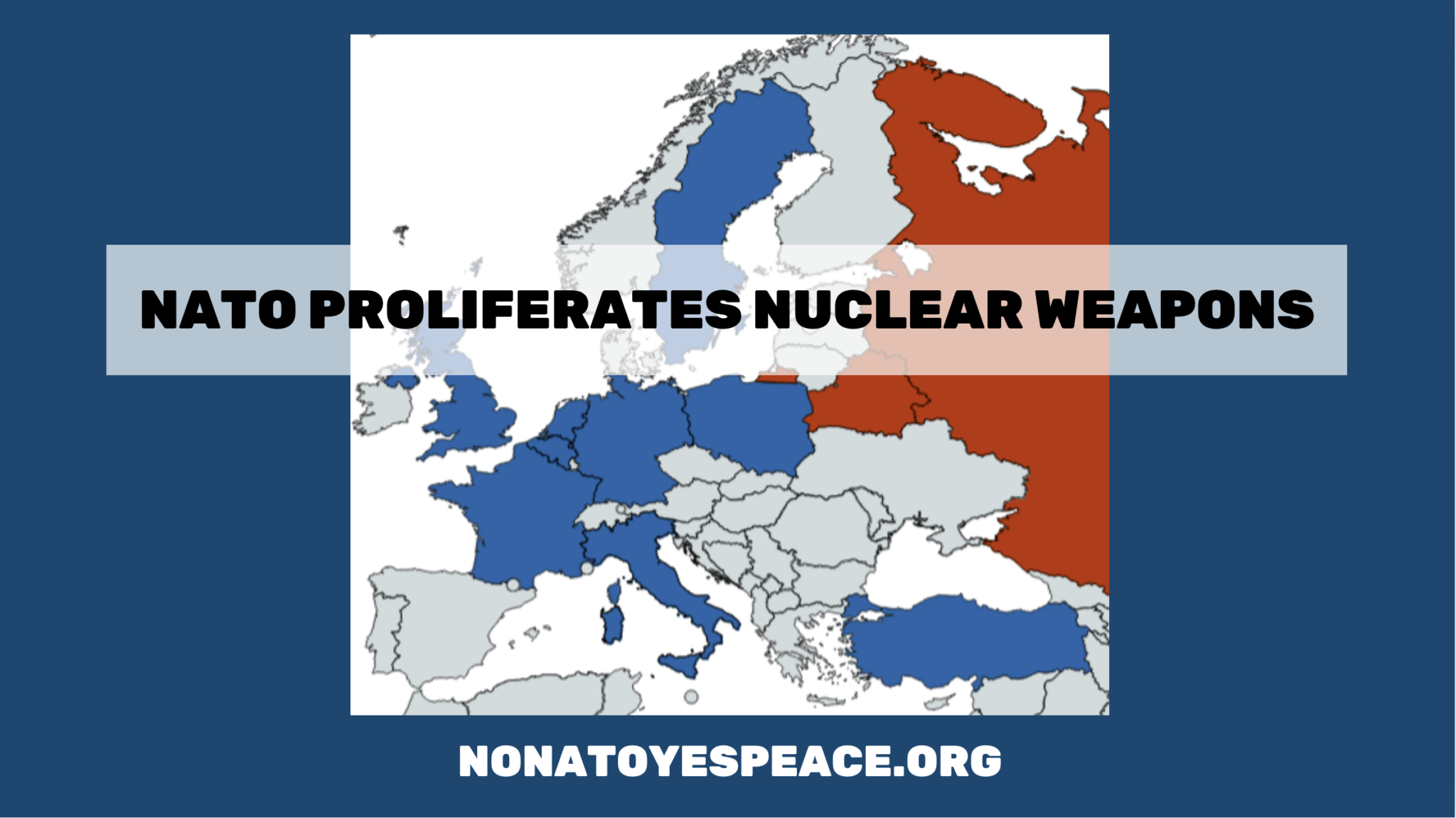
David Swanson, beyondnuclearinternational
The Nuclear Nonproliferation Treaty forbids transferring nuclear weapons to other nations. It contains no NATO exception. Yet NATO proliferates nuclear weapons
Five NATO members have U.S. nuclear weapons stored and controlled by the U.S. military within their borders: Belgium, Germany, Italy, the Netherlands, and Turkey.
The people of each of these countries routinely protest the presence of nuclear weapons and have never been asked to vote on the matter.
Alliance spreads nuclear weapons, nuclear energy and risk, writes David Swanson
Article 5 of the North Atlantic Treaty declares that NATO members will assist another member if attacked by “taking action as it deems necessary, including the use of armed force.” But the UN Charter does not say anywhere that warmaking is authorized for whoever jumps in on the appropriate side.
The North Atlantic Treaty’s authors may have been aware that they were on dubious legal ground because they went on twice to claim otherwise, first adding the words “Any such armed attack and all measures taken as a result thereof shall immediately be reported to the Security Council. Such measures shall be terminated when the Security Council has taken the measures necessary to restore and maintain international peace and security.” But shouldn’t the United Nations be the one to decide when it has taken necessary measures and when it has not?
The North Atlantic Treaty adds a second bit of sham obsequiousness with the words “This Treaty does not affect, and shall not be interpreted as affecting in any way the rights and obligations under the Charter of the Parties which are members of the United Nations, or the primary responsibility of the Security Council for the maintenance of international peace and security.” So the treaty that created NATO seeks to obscure the fact that it is, indeed, authorizing warmaking outside of the United Nations — as has now played out in Yugoslavia, Afghanistan, and Libya.
While the UN Charter itself replaced the blanket ban on all warmaking that had existed in the Kellogg-Briand Pact with a porous ban plagued by loopholes imagined to apply far more than they actually do — in particular that of “defensive” war — it is NATO that creates, in violation of the UN Charter, the idea of numerous nations going to war together of their own initiative and by prior agreement to all join in any other member’s war. Because NATO has numerous members, as does also your typical street gang, there is a tendency to imagine NATO not as an illegal enterprise but rather as just the reverse, as a legitimizer and sanctioner of warmaking.
The Nuclear Nonproliferation Treaty forbids transferring nuclear weapons to other nations. It contains no NATO exception. Yet NATO proliferates nuclear weapons, and this is widely imagined as law enforcement or crime prevention. The prime minister of Sweden said in May that NATO ought to be able to put nuclear weapons in Sweden as long as somebody has determined it to be “war time.” The Nonproliferation Treaty says otherwise, and the people who plan the insanity of nuclear war say “What the heck for? We’ve got them on long-range missiles and stealth airplanes and submarines?”
The people of Sweden seem, at least in large part, to also want to say No Nukes — but when were people ever asked to play a role in “defending democracy”? The purpose of bringing nukes into Sweden, for those in the Swedish government who favor it, may in fact be purely a show of subservience to U.S. empire, driven by fear of its obliging partner in the arms race, the militarists in Russia.
Poland’s president says his country would be happy to have “NATO” nuclear weapons there, “war time” or not, and this proposal is reported in U.S. corporate media with no mention of any legal concerns and with the claim that it comes as a response to the Russian placement of nuclear weapons in Belarus. Last year I asked the Russian ambassador to the United States why putting nuclear weapons into Belarus wasn’t a blatant violation of the Nonproliferation Treaty, and he said, oh no, it was perfectly fine, because the United States does it all the time.
In fact, NATO itself owns and controls no nuclear weapons. Three NATO members own and control nuclear weapons. We cannot be certain how many weapons they have, since nuclear weapons are both justified with the dubious alchemy of “deterrence” and, contradictorily, cloaked in secrecy. The United States has an estimated 5,344 nuclear weapons, France an estimated 290, and Great Britain an estimated 240.
NATO calls itself a “nuclear alliance” and maintains a “Nuclear Planning Group” for all of its members — those with and those without nuclear weapons — to discuss the launching of the sort of war that puts all life on Earth at risk, and to coordinate rehearsals or “war games” practicing for the use of nuclear weapons in Europe. NATO partners Israel and Pakistan are estimated to possess 170 nuclear weapons each.
Five NATO members have U.S. nuclear weapons stored and controlled by the U.S. military within their borders: Belgium, Germany, Italy, the Netherlands, and Turkey. These are estimated at 35 nuclear weapons at Aviano and Ghedi Air Bases in Italy, 20 at Incirlik in Turkey, and 15 each at Kleine Brogel in Belgium, Volkel Air Base in the Netherlands, and Büchel Air Base in Germany. The United States is reportedly also moving its own nuclear weapons into RAF Lakenheath in the UK, where it has stored them in the past.
The people of each of these countries routinely protest the presence of nuclear weapons and have never been asked to vote on the matter. The notion that the nuclear weapons in a European country are still U.S. nuclear weapons and thus haven’t been proliferated is an odd fit with the general understanding of international treaties, which are conceived and written as if there were no such thing as empire……………………………………………………………………………………………………………………………………….. more https://beyondnuclearinternational.org/2024/06/23/why-no-to-nato/
David Swanson is an author, activist, journalist, and radio host. He is executive director of WorldBeyondWar.org and campaign coordinator for RootsAction.org.
France’s Orano loses operating licence at major uranium mine in Niger.
Niger has removed the mining permit of French nuclear fuel producer Orano
at one of the world’s biggest uranium mines, the company said Thursday,
highlighting tensions between France and the African country’s ruling
junta.
RFI 21st June 2024
U.S. and China hold first informal nuclear talks in five years
By Greg Torode, Gerry Doyle and Laurie Chen, June 22, 2024
HONG KONG, (Reuters) – The United States and China resumed semi-official nuclear arms talks in March for the first time in five years, with Beijing’s representatives telling U.S. counterparts that they would not resort to atomic threats over Taiwan, according to two American delegates who attended.
The Chinese representatives offered reassurances after their U.S. interlocutors raised concerns that China might use, or threaten to use, nuclear weapons if it faced defeat in a conflict over Taiwan. Beijing views the democratically governed island as its territory, a claim rejected by the government in Taipei.
“They told the U.S. side that they were absolutely convinced that they are able to prevail in a conventional fight over Taiwan without using nuclear weapons,” said scholar David Santoro, the U.S. organiser of the Track Two talks, the details of which are being reported by Reuters for the first time.
Participants in Track Two talks are generally former officials and academics who can speak with authority on their government’s position, even if they are not directly involved with setting it. Government-to-government negotiations are known as Track One.
Washington was represented by about half a dozen delegates, including former officials and scholars at the two-day discussions, which took place in a Shanghai hotel conference room.
Beijing sent a delegation of scholars and analysts, which included several former People’s Liberation Army officers.
A State Department spokesperson said in response to Reuters’ questions that Track Two talks could be “beneficial”. The department did not participate in the March meeting though it was aware of it, the spokesperson said.
Such discussions cannot replace formal negotiations “that require participants to speak authoritatively on issues that are often highly compartmentalized within (Chinese) government circles,” the spokesperson said.
Members of the Chinese delegation and Beijing’s defence ministry did not respond to requests for comment.
The informal discussions between the nuclear-armed powers took place with the U.S. and China at odds over major economic and geopolitical issues, with leaders in Washington and Beijing accusing each other of dealing in bad faith…………………………………………………………………………………………………………………………………………………………. more https://www.reuters.com/world/us-china-hold-first-informal-nuclear-talks-5-years-eyeing-taiwan-2024-06-21/
Why Won’t the US Help Negotiate a Peaceful End to the War in Ukraine?
In the course of 2014, Putin called repeatedly for a negotiated peace, and this led to the Minsk II Agreement in February 2015 based on autonomy of the Donbas and an end to violence by both sides. Russia did not claim the Donbas as Russian territory, but instead called for autonomy and the protection of ethnic Russians within Ukraine. The UN Security Council endorsed the Minsk II agreement, but the U.S. neocons privately subverted it. Years later, Chancellor Angela Merkel blurted out the truth. The Western side treated the agreement not as a solemn treaty but as a delaying tactic to “give Ukraine time” to build its military strength. In the meantime, around 14,000 people died in the fighting in Donbas between 2014 and 2021.
Jeffrey Sachs, 19 June 24, https://www.commondreams.org/opinion/role-of-us-in-russia-ukraine-
For the fifth time since 2008, Russia has proposed to negotiate with the U.S. over security arrangements, this time in proposals made by President Vladimir Putin on June 14, 2024. Four previous times, the U.S. rejected the offer of negotiations in favor of a neocon strategy to weaken or dismember Russia through war and covert operations. The U.S. neocon tactics have failed disastrously, devastating Ukraine in the process, and endangering the whole world. After all the warmongering, it’s time for Biden to open negotiations for peace with Russia.
Since the end of the Cold War, the U.S. grand strategy has been to weaken Russia. As early as 1992, then Defense Secretary Richard Cheney opined that following the 1991 demise of the Soviet Union, Russia too should be dismembered. Zbigniew Brzezinski opined in 1997 that Russia should be divided into three loosely confederated entities in Russian Europe, Siberia, and the far east. In 1999, the U.S.-led NATO alliance bombed Russia’s ally, Serbia, for 78 days in order to break Serbia apart and install a massive NATO military base in breakaway Kosovo. Leaders of the U.S. military-industrial complex vociferously supported the Chechen war against Russia in the early 2000s.
To secure these U.S. advances against Russia, Washington aggressively pushed NATO enlargement, despite promises to Mikhail Gorbachev and Boris Yeltsin that NATO would not move one inch eastward from Germany. Most tendentiously, the U.S. pushed NATO enlargement to Ukraine and Georgia, with the idea of surrounding Russia’s naval fleet in Sevastopol, Crimea with NATO states: Ukraine, Romania (NATO member 2004), Bulgaria (NATO member 2004), Turkey (NATO member 1952), and Georgia, an idea straight from the playbook of the British Empire in the Crimean War (1853-6).
Brzezinski spelled out a chronology of NATO enlargement in 1997, including NATO membership of Ukraine during 2005-2010. The U.S. in fact proposed NATO membership for Ukraine and Georgia at the 2008 NATO Bucharest Summit. By 2020, NATO had in fact enlarged by 14 countries in Central Europe, Eastern Europe, and the former Soviet Union (Czech Republic, Hungary, and Poland in 1999; Bulgaria, Estonia, Latvia, Lithuania, Romania, Slovakia, and Slovenia in 2004; Albania and Croatia, 2009; Montenegro, 2017; and Northern Macedonia, 2020), while promising future membership to Ukraine and Georgia.
The White House is dead wrong to evade negotiations just because of disagreements with Russia’s proposals. It should put up its own proposals and get down to the business of negotiating an end to the war.
In short, the 30-year U.S. project, hatched originally by Cheney and the neocons, and carried forward consistently since then, has been to weaken or even dismember Russia, surround Russia with NATO forces, and depict Russia as the belligerent power.
It is against this grim backdrop that Russian leaders have repeatedly proposed to negotiate security arrangements with Europe and the U.S. that would provide security for all countries concerned, not just the NATO bloc. Guided by the neocon game plan, the U.S. has refused to negotiate on every occasion, while trying to pin the blame on Russia for the lack of negotiations.
In June 2008, as the U.S. prepared to expand NATO to Ukraine and Georgia, Russian President Dmitry Medvedev proposed a European Security Treaty, calling for collective security and an end to NATO’s unilateralism. Suffice it to say, the U.S. showed no interest whatsoever in Russia’s proposals, and instead proceeded with its long-held plans for NATO enlargement.
The second Russian proposal for negotiations came from Putin following the violent overthrow of Ukraine’s President Viktor Yanukovych in February 2014, with the active complicity if not outright leadership of the U.S. government. I happened to see the U.S. complicity up close, as the post-coup government invited me for urgent economic discussions. When I arrived in Kiev, I was taken to the Maidan, where I was told directly about U.S. funding of the Maidan protest.
The evidence of U.S. complicity in the coup is overwhelming. Assistant Secretary of State Victoria Nuland was caught on a phone line in January 2014 plotting the change of government in Ukraine. Meanwhile, U.S. Senators went personally to Kiev to stir up the protests (akin to Chinese or Russian political leaders coming to DC on January 6, 2021 to rile up the crowds). On February 21, 2014, the Europeans, U.S., and Russia brokered a deal with Yanukovych in which Yanukovich agreed to early elections. Yet the coup leaders reneged on the deal the same day, took over government buildings, threatened more violence, and deposed Yanukovych the next day. The U.S. supported the coup and immediately extended recognition to the new government.
In my view, this was a standard CIA-led covert regime change operation, of which there have been several dozen around the world, including sixty-four episodes between 1947 and 1989 meticulously documented by Professor Lindsey O’Rourke. Covert regime-change operations are of course not really hidden from view, but the U.S. government vociferously denies its role, keeps all documents highly confidential, and systematically gaslights the world:
“Do not believe what you see plainly with your own eyes! The U.S. had nothing to do with this.” Details of the operations eventually emerge, however, through eyewitnesses, whistleblowers, the forced release of documents under the Freedom of Information Act, declassification of papers after years or decades, and memoirs, but all far too late for real accountability.
In any event, the violent coup induced the ethnic-Russia Donbas region of Eastern Ukraine to break from the coup leaders, many of whom were extreme Russophobic nationalists, and some in violent groups with a history of Nazi SS links in the past. Almost immediately, the coup leaders took steps to repress the use of the Russian language even in the Russian-speaking Donbas. In the following months and years, the government in Kiev launched a military campaign to retake the breakaway regions, deploying neo-Nazi paramilitary units and U.S. arms.
In the course of 2014, Putin called repeatedly for a negotiated peace, and this led to the Minsk II Agreement in February 2015 based on autonomy of the Donbas and an end to violence by both sides. Russia did not claim the Donbas as Russian territory, but instead called for autonomy and the protection of ethnic Russians within Ukraine. The UN Security Council endorsed the Minsk II agreement, but the U.S. neocons privately subverted it. Years later, Chancellor Angela Merkel blurted out the truth. The Western side treated the agreement not as a solemn treaty but as a delaying tactic to “give Ukraine time” to build its military strength. In the meantime, around 14,000 people died in the fighting in Donbas between 2014 and 2021.
Following the definitive collapse of the Minsk II agreement, Putin again proposed negotiations with the U.S. in December 2021. By that point, the issues went even beyond NATO enlargement to include fundamental issues of nuclear armaments. Step by step, the U.S. neocons had abandoned nuclear arms control with Russia, with the U.S. unilaterally abandoning the Anti-Ballistic Missile (ABM) Treaty in 2002, placing Aegis missiles in Poland and Romania in 2010 onwards, and walking out of the Intermediate Nuclear Force (INF) Treaty in 2019.
In view of these dire concerns, Putin put on the table on December 15, 2021 a draft “Treaty between the United States of America and the Russian Federation on Security Guarantees.” The most immediate issue on the table (Article 4 of the draft treaty) was the end of the U.S. attempt to expand NATO to Ukraine. I called U.S. National Security Advisor Jake Sullivan at the end of 2021 to try to convince the Biden White House to enter the negotiations. My main advice was to avoid a war in Ukraine by accepting Ukraine’s neutrality, rather than NATO membership, which was a bright red line for Russia.
The White House flatly rejected the advice, claiming remarkably (and obtusely) that NATO’s enlargement to Ukraine was none of Russia’s business! Yet what would the U.S. say if some country in the Western hemisphere decided to host Chinese or Russian bases? Would the White House, State Department, or Congress say, “That’s just fine, that’s a matter of concern only to Russia or China and the host country?” No. The world nearly came to nuclear Armageddon in 1962 when the Soviet Union placed nuclear missiles in Cuba and the U.S. imposed a naval quarantine and threatened war unless the Russians removed the missiles. The U.S. military alliance does not belong in Ukraine any more than the Russian or Chinese military belongs close to the U.S. border.
The fourth offer of Putin to negotiate came in March 2022, when Russia and Ukraine nearly closed a peace deal just weeks after the start of Russia’s special military operation that began on February 24, 2022. Russia, once again, was after one big thing: Ukraine’s neutrality, i.e., no NATO membership and no hosting of U.S. missiles on Russia’s border.
Ukraine’s President Vladimir Zelensky quickly accepted Ukraine’s neutrality, and Ukraine and Russia exchanged papers, with the skillful mediation of the Foreign Ministry of Turkey. Then suddenly, at the end of March, Ukraine abandoned the negotiations.
U.K. Prime Minister Boris Johnson, following in the tradition of British anti-Russian war-mongering dating back to the Crimean War (1853-6), actually flew to Kiev to warn Zelensky against neutrality and the importance of Ukraine defeating Russia on the battlefield. Since that date, Ukraine has lost around 500,000 dead and is on the ropes on the battlefield.
Now we have Russia’s fifth offer of negotiations, explained clearly and cogently by Putin himself in his speech to diplomats at the Russian Foreign Ministry on June 14. Putin laid out Russia’s proposed terms to end the war in Ukraine.
“Ukraine should adopt a neutral, non-aligned status, be nuclear- free, and undergo demilitarization and de-nazification,” Putin said. “These parameters were broadly agreed upon during the Istanbul negotiations in 2022, including specific details on demilitarization such as the agreed numbers of tanks and other military equipment. We reached consensus on all points.
“Certainly, the rights, freedoms, and interests of Russian-speaking citizens in Ukraine must be fully protected,” he continued. “The new territorial realities, including the status of Crimea, Sevastopol, Donetsk and Lugansk people’s republics, Kherson, and Zaporozhye regions as parts of the Russian Federation, should be acknowledged. These foundational principles need to be formalized through fundamental international agreements in the future. Naturally, this entails the removal of all Western sanctions against Russia as well.”
Let me say a few words about negotiating.
Russia’s proposals should now be met at the negotiating table by proposals from the U.S. and Ukraine. The White House is dead wrong to evade negotiations just because of disagreements with Russia’s proposals. It should put up its own proposals and get down to the business of negotiating an end to the war.
There are three core issues for Russia: Ukraine’s neutrality (non-NATO enlargement), Crimea remaining in Russian hands, and boundary changes in Eastern and Southern Ukraine. The first two are almost surely non-negotiable. The end of NATO enlargement is the fundamental casus belli. Crimea is also core for Russia, as Crimea has been home to Russia’s Black Sea fleet since 1783 and is fundamental to Russia’s national security.
The third core issue, the borders of Eastern and Southern Ukraine, will be a key point of negotiations. The U.S. cannot pretend that borders are sacrosanct after NATO bombed Serbia in 1999 to relinquish Kosovo, and after the U.S. pressured Sudan to relinquish South Sudan. Yes, Ukraine’s borders will be redrawn as the result of the 10 years of war, the situation on the battlefield, the choices of the local populations, and tradeoffs made at the negotiating table.
Biden needs to accept that negotiations are not a sign of weakness. As Kennedy put it, “Never negotiate out of fear, but never fear to negotiate.” Ronald Reagan famously described his own negotiating strategy using a Russian proverb, “Trust but verify.”
The neocon approach to Russia, delusional and hubristic from the start, lies in ruins. NATO will never enlarge to Ukraine and Georgia. Russia will not be toppled by a CIA covert operation. Ukraine is being horribly bloodied on the battlefield, often losing 1,000 or more dead and wounded in a single day. The failed neocon game plan brings us closer to nuclear Armageddon.
Yet Biden still refuses to negotiate. Following Putin’s speech, the U.S., NATO, and Ukraine firmly rejected negotiations once again. Biden and his team have still not relinquished the neocon fantasy of defeating Russia and expanding NATO to Ukraine.
The Ukrainian people have been lied to time and again by Zelensky and Biden and other leaders of NATO countries, who told them falsely and repeatedly that Ukraine would prevail on the battlefield and that there were no options to negotiate. Ukraine is now under martial law. The public is given no say about its own slaughter.
For the sake of Ukraine’s very survival, and to avoid nuclear war, the President of the United States has one overriding responsibility today: Negotiate.
1 This Month



26 September – International Day for the Total Elimination of Nuclear Weapons


PLEASE OPPOSE HR 8255 AND S.3639 – bills would accelerate satellite deployment, with no environmental review or safeguards – https://ncstd5li.quorum.us/campaign/169331/
To see nuclear-related stories in greater depth and intensity – go to https://nuclearinformation.wordpress.com
-
Archives
- September 2026 (219)
- August 2026 (330)
- July 2026 (355)
- June 2026 (287)
- May 2026 (306)
- April 2026 (356)
- March 2026 (251)
- February 2026 (267)
- January 2026 (308)
- December 2025 (358)
- November 2025 (359)
- October 2025 (375)
-
Categories
- 1
- 1 NUCLEAR ISSUES
- business and costs
- climate change
- culture and arts
- ENERGY
- environment
- health
- history
- indigenous issues
- Legal
- marketing of nuclear
- media
- opposition to nuclear
- PERSONAL STORIES
- politics
- politics international
- Religion and ethics
- safety
- secrets,lies and civil liberties
- spinbuster
- technology
- Uranium
- wastes
- weapons and war
- Women
- 2 WORLD
- ACTION
- AFRICA
- Atrocities
- AUSTRALIA
- Christina's notes
- Christina's themes
- culture and arts
- Events
- Fuk 2022
- Fuk 2023
- Fukushima 2017
- Fukushima 2018
- fukushima 2019
- Fukushima 2020
- Fukushima 2021
- general
- global warming
- Humour (God we need it)
- Nuclear
- RARE EARTHS
- Reference
- resources – print
- Resources -audiovicual
- Weekly Newsletter
- World
- World Nuclear
- YouTube
-
RSS
Entries RSS
Comments RSS
 nuclear-news