The only remaining US-Russia nuclear treaty expires this week. Could a new arms race soon accelerate?
Tilman Ruff, Honorary Principal Fellow, School of Population and Global Health, The University of MelbourneFebruary 2, 2026, https://theconversation.com/the-only-remaining-us-russia-nuclear-treaty-expires-this-week-could-a-new-arms-race-soon-accelerate-269508?utm_medium=email&utm_campaign=Latest%20from%20The%20Conversation%20for%20February%202%202026%20-%203661637412&utm_content=Latest%20from%20The%20Conversation%20for%20February%202%202026%20-%203661637412+CID_d509427262fbc0b5c74ed2503dd5f4e9&utm_source=campaign_monitor&utm_term=The%20only%20remaining%20US-Russia%20nuclear%20treaty%20expires%20this%20week%20Could%20a%20new%20arms%20race%20soon%20accelerate
The New START treaty, the last remaining agreement constraining Russian and US nuclear weapons, is due to lapse on February 4.
There are no negotiations to extend the terms of the treaty, either. As US President Donald Trump said dismissively in a recent interview, “if it expires, it expires”.
The importance of the New START treaty is hard to overstate. As other nuclear treaties have been abrogated in recent years, this was the only deal left with notification, inspection, verification and treaty compliance mechanisms between Russia and the US. Between them, they possess 87% of the world’s nuclear weapons.
The demise of the treaty will bring a definitive and alarming end to nuclear restraint between the two powers. It may very well accelerate the global nuclear arms race, too.
What is New START?
The New START or Prague Treaty was signed by then-US President Barack Obama and his Russian counterpart, Dimitri Medvedev, in Prague on April 8, 2010. It entered into force the following year.
It superseded a 2002 treaty that obligated Russia and the United States to reduce their operationally deployed, strategic nuclear warheads to between 1,700 and 2,200 by the end of 2012.
The New START Treaty called for further reductions on long-range nuclear weapons and provided greater specificity about different types of launchers. The new limits were:
- 700 deployed intercontinental and submarine-launched ballistic missiles (together with heavy bombers)
- 1,550 nuclear warheads deployed on those platforms, and
- 800 launchers (both deployed and non-deployed).
These reductions were achieved by February 5, 2018.
The treaty included mechanisms for compliance and verification, which have worked effectively. It provided for twice-yearly exchanges of data and ongoing mutual notification about the movement of strategic nuclear forces, which in practice occurred on a nearly daily basis.
Importantly, the treaty also mandated short-notice, on-site inspections of missiles, warheads and launchers covered by the treaty, providing valuable and stabilising insights into the other’s nuclear deployments.
Lastly, the treaty established a bilateral consultative commission and clear procedures to resolve questions or disputes.
Limitations of the deal
The treaty was criticised at the time for its modest reductions and the limited types of nuclear weapons it covered.
But the most enduring downside was the political price Obama paid to achieve ratification by the US Senate.
To secure sufficient Republican support, he agreed to a long-term program of renewal and modernisation of the entire US nuclear arsenal – in addition to the facilities and programs that produce and maintain nuclear weapons. The overall pricetag was estimated to reach well over US$2 trillion.
This has arguably done more harm by entrenching the United States’ possession of nuclear weapons and thwarting prospects for disarmament.
As the New START treaty was about to expire in 2021, Russia offered to extend it for another five years, as allowed under the terms. US President Donald Trump, however, refused to reciprocate.
After winning the 2020 US presidential election, Joe Biden did agree to extend the treaty on February 3, 2021, just two days before it would have expired. The treaty does not provide for any further extensions.
In February 2023, Russia suspended its implementation of key aspects of the treaty, including stockpile data exchange and on-site inspections. It did not formally withdraw, however, and committed to continue to abide by the treaty’s numerical limits on warheads, missiles and launchers.
What could happen next
With the imminent expiry of the treaty this year, Russian President Vladimir Putin announced in September 2025 that he was prepared to continue observing the numerical limits for one more year if the US acted similarly.
Besides an off-the-cuff comment by Trump – “it sounds like a good idea to me” – the US did not formally respond to the Russian offer.
Trump has further complicated matters by insisting that negotiations on any future nuclear arms control agreements include China. However, China has consistently refused this. There is also no precedent for such trilateral nuclear control or disarmament negotiations, which would no doubt be long and complex. Though growing, China’s arsenal is still less than 12% the size of the US arsenal and less than 11% the size of Russia’s.
Tagreement to continue to observe its limits until a successor treaty is negotiated.
This means Russia and the US could increase their deployed warheads by 60% and 110%, respectively, within a matter of months. This is because both have the capacity to load a larger number of warheads on their missiles and bombers than they currently do. Both countries also have large numbers of warheads in reserve or slated for dismantlement, but still intact.
If they took these steps, both countries could effectively double their deployed strategic nuclear arsenals.
The end of the treaty’s verification, data exchanges, and compliance and notification processes would also lead to increased uncertainty and distrust. This, in turn, could lead to a further build-up of both countries’ already gargantuan military capabilities
Europe in Panic: Trump’s Power Play Shakes the World Order
by Joshua Scheer, February 1, 2026 https://scheerpost.com/2026/02/01/europe-in-panic-trumps-power-play-shakes-the-world-order/
For decades, the Western Alliance has been treated as a permanent fixture of global politics — a transatlantic bond forged in the ashes of World War II and held together through the Cold War by a shared fear of the Soviet Union. But as this video argues, the world that created NATO no longer exists, and the assumptions that once held Europe and the United States together are cracking under the weight of new geopolitical realities.
The rise of China as an economic and technological superpower, Europe’s deepening trade ties with Beijing, and Washington’s escalating pressure campaigns have all exposed the uncomfortable truth: the “alliance” has always been a hierarchy, and the United States has always sat at the top. What’s different today is that the old Cold War glue no longer works — and the Trump administration’s aggressive economic demands, territorial ambitions, and threats toward its own allies have forced Europe to confront a question it has avoided for generations: Is dependence on Washington still sustainable?
Sir Keir Starmer backs a USA strike on Iran

Sir Keir Starmer has signalled British support for a US strike on Iran,
saying he backs President Trump’s goal of preventing Tehran from obtaining
nuclear weapons. Trump warned Iran this week that time was “running
out” to come to the negotiating table over its nuclear weapons programme
as the US continued to build up forces in the region. The prime minister
said from China that he supported Trump’s move to “deal” with the
Iranian regime over its nuclear programme and the recent crackdown on
pro-democracy protesters.
Times 31st Jan 2026, https://www.thetimes.com/uk/politics/article/iran-nuclear-weapons-us-strikes-d7lmbcc37
With Trump silent, last US-Russia nuclear pact set to end

Washington (United States) (AFP) – Come Thursday, barring a last-minute change, the final treaty in the world that restricted nuclear weapon deployment will be over.
France24 1st Feb 2026
New START, the last nuclear treaty between Washington and Moscow after decades of agreements dating to the Cold War, is set to expire, and with it restrictions on the two top nuclear powers.
The expiration comes as President Donald Trump, vowing “America First,” smashes through international agreements that limit the United States, although in the case of New START, the issue may more be inertia than ideology.
Russian President Vladimir Putin in September suggested a one-year extension of New START.
Trump, asked afterward by a reporter for a reaction while he was boarding his helicopter, said an extension “sounds like a good idea to me” — but little has been heard since.
Putin ally Dmitry Medvedev, who as Russia’s president signed New START with counterpart Barack Obama in 2010, said in a recent interview with the Kommersant newspaper that Russia has received no “substantive reaction” on New START but was still giving time to Trump.
Putin ally Dmitry Medvedev, who as Russia’s president signed New START with counterpart Barack Obama in 2010, said in a recent interview with the Kommersant newspaper that Russia has received no “substantive reaction” on New START but was still giving time to Trump.
Trump “seems to have the right instinct on this issue but has thus far failed to follow through with a coherent strategy,” Kimball said.
Jon Wolfsthal, director of global risk at the Federation of American Scientists, said Trump and Putin could pick up the phone and agree immediately at a political level to extend New START.
“This is a piece of low-hanging fruit that the Trump administration should have seized months ago,” he said.
Wolfsthal is among experts involved in the “Doomsday Clock” meant to symbolize how near humanity is to destruction. It was recently moved closer to midnight in part due to New START’s demise……………………………………………………………………………………………….https://www.france24.com/en/live-news/20260201-with-trump-mum-last-us-russia-nuclear-pact-set-to-end
Is it time to replace NATO with EATO?
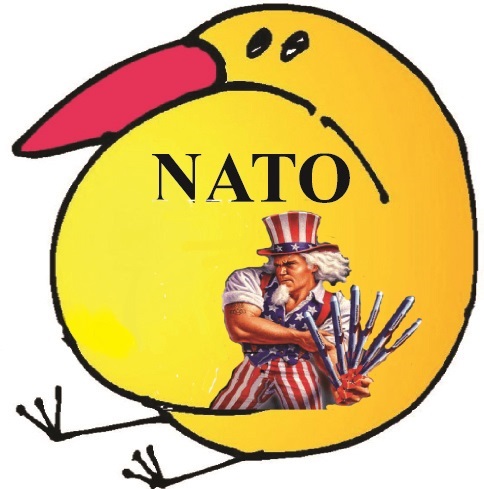
The very worst outcome following the end of the war in Ukraine would be for a new Iron Curtain to be drawn, with Europe and Ukraine continuing to pursue a policy of political and cultural exceptionalism against Russia, while arming themselves to the teeth in anticipation of the next war.Time to think about a Eurasian Treaty to secure peace and security between Russia and Europe
If all that the Treaty included was a version of the Washington Treaty Preamble with Articles 1 and 2, it would help Europe, Ukraine and Russia to take a huge stride towards peaceful coexistence and mutually beneficial economic cooperation across the Eurasian landmass. Perhaps, with war seemingly approaching its final chapter, it’s time to create a new vision for coexistence.
Ian Proud, Jan 31, 2026, https://thepeacemonger.substack.com/p/is-it-time-to-replace-nato-with-eato?utm_source=post-email-title&publication_id=3221990&post_id=186398540&utm_campaign=email-post-title&isFreemail=true&r=1ise1&triedRedirect=true&utm_medium=email
In recent weeks, there has been renewed discussion of the future of NATO as a guarantor of security on the European mainland.
The newly published US National Defense Strategy has made it clear that it is for European States to manage the risk of future military conflict with Russia, to allow America to focus its efforts on competition with China in the Pacific.
America has reintroduced the concept of gunboat diplomacy, threatening to invade Greenland and to attack Iran, while also kidnapping the leader of a sovereign nation in Venezuela. And while only the first has induced genuine horror in European capitals, other developments, most notably the gunning down of two protestors in Minnesota, have made European citizens, if not its leaders, increasingly anxious about ties with the Americans.
Times have changed since the North Atlantic Treaty was signed in Washington DC on 4 April 1949.
Then, America was the nation that had provided enormous military support and troops to Britain and the Commonwealth, to take on Hitler’s Germany on the western front of World War II, as the Soviet Union drove the Nazis out, having halted their advance in Stalingrad.
Wartime allies became adversaries following the war, as Winston Churchill raised the spectre of Communism’s spread across Europe.
Yet the Soviet Union no longer exists as an epochal threat to the freedom and democracy of European States emerging from the devastation of World War II.
European states have largely all achieved a level of prosperity, peace and stability unseen in centuries, on a continent that was historically dominated by war and conquest by the largest powers.
Russia is now a functioning market democracy, albeit one that does not wish to see itself shackled to a normative system of liberal ‘values’ that increasing numbers of citizens across Europe are turning away from, as they press their governments to focus on domestic priorities.
The main outlier to that is Ukraine, which remains an economically failing state and seething hotbed of conflict, caused by the aspirations to expand a NATO military alliance and to inflict a strategic defeat on Russia which, in the future, historians will come to regard as a catastrophic mistake.
If the current trend of the USA turning its gaze across the Pacific continues, loosening the fabric of NATO to the point of disintegration, the primary underlying driver of war in Ukraine would evaporate.
No NATO would radically shift the nature of pan-European security, removing a long-standing and oft-stated Russian fear of external aggression from a military bloc that, even before members lift defence spending to 5% of GDP, accounted for 53% of global military expenditure.
Indeed, no NATO might also allow existing European Members to reappraise whether vast increases in defence spending were, in fact, necessary, or whether a new approach to pan-European security might allow them to re-focus in on the prosperity for which their citizens yearn.
That would only be possible, however, if, after the war in Ukraine ends, there was an effort by European states to re-establish relations with Russia, while at the same time deepening relations with Ukraine, despite the evident suspicion on all sides.
In the immediate post-war period, Ukraine would be the only state in the heart of Europe that did not fit in with the club.
Issues such as Ukraine’s endemic corruption, its war-induced democratic back-sliding, its tolerance of the neo-Nazi extremist fringe, and its efforts to erase all traces of Russianness, would have to be addressed should it pursue its stated aspiration of membership of the European Union.
Yet there is no reason to believe that it could not rebuild, with its sizeable, generally well-educated and industrious population, should it repopulate the country after the war ends.
A normalisation of relations with Russia, beyond the obvious benefits from the reopening of borders and reestablishment of people-to-people links, would help to reindustrialise European economies with the benefit of lower cost energy.
The very worst outcome following the end of the war in Ukraine would be for a new Iron Curtain to be drawn, with Europe and Ukraine continuing to pursue a policy of political and cultural exceptionalism against Russia, while arming themselves to the teeth in anticipation of the next war.
The very big risk is that a Ukraine so bruised and resentful following the cessation of hostilities would seek to shape European policy to remain explicitly anti-Russian, in the manner that Poland and the Baltic States have tried to do for many years.
That should never be allowed to happen.
For the very reason that grievance and distrust may dominate some aspects of European relations for a generation to come, a more stable framework for pan-European security will be needed to prevent another repeat of an avoidable war in Ukraine.
That might require the creation of a Eurasian Treaty (and associated Organisation – EATO) perhaps, based on the North Atlantic Treaty of 1949, but without the commitment to collective defence within Article 5.
If all that the Treaty included was a version of the Washington Treaty Preamble with Articles 1 and 2, it would help Europe, Ukraine and Russia to take a huge stride towards peaceful coexistence and mutually beneficial economic cooperation across the Eurasian landmass. Perhaps, with war seemingly approaching its final chapter, it’s time to create a new vision for coexistence. A draft Eurasian Treaty might begin as follows:
The Parties to this Treaty reaffirm their faith in the purposes and principles of the Charter of the United Nations and their desire to live in peace with all peoples and all governments.
They are determined to safeguard the freedom, common heritage and civilisation of their peoples, founded on the principles of democracy, individual liberty and the rule of law. They seek to promote stability and well-being in the Eurasian area. They are resolved to unite their efforts for the preservation of peace and security. They therefore agree to this Eurasian Treaty :
Article 1
The Parties undertake, as set forth in the Charter of the United Nations, to settle any international dispute in which they may be involved by peaceful means in such a manner that international peace and security and justice are not endangered, and to refrain in their international relations from the threat or use of force in any manner inconsistent with the purposes of the United Nations.
Article 2
The Parties will contribute toward the further development of peaceful and friendly international relations by strengthening their free institutions, by bringing about a better understanding of the principles upon which these institutions are founded, and by promoting conditions of stability and well-being. They will seek to eliminate conflict in their international economic policies and will encourage economic collaboration between any or all of them.
The Rules-Based Order: Where America Gets Away with Murder, and Everyone Else Gets the Bombs
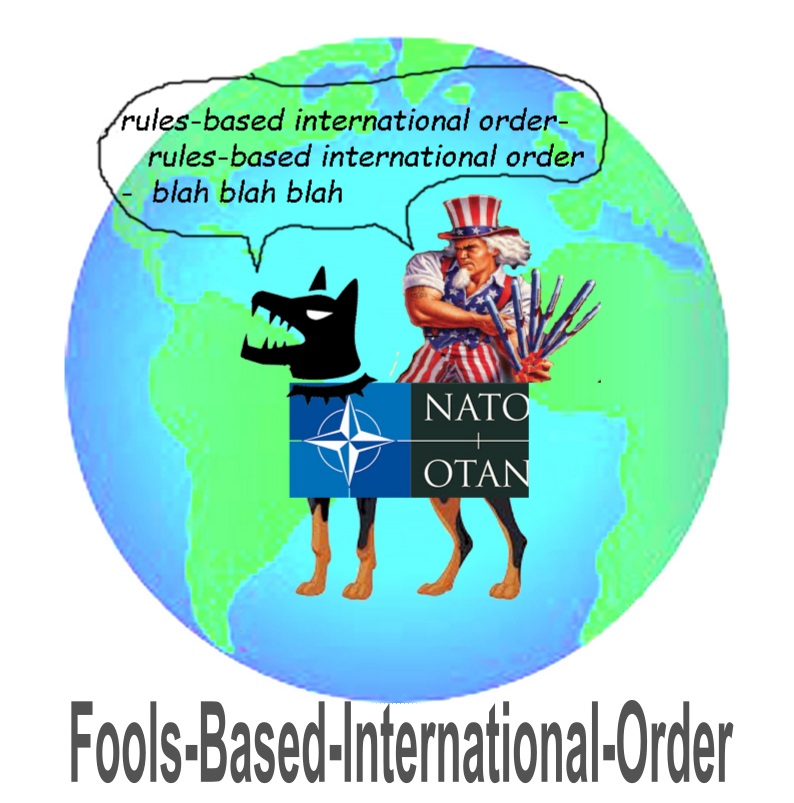
When the US bombs Iranian nuclear sites, it’s a “strike”. When Iran defends itself, it’s “aggression”. When the US funds insurrections, arms rebels and sabotages economies, it’s “promoting democracy”.
31 January 2026 David Tyler , Australian Independent Media
Australia’s Foreign Minister Penny Wong chants “rules based order” like a sacred hymn.
Order? In reality, it’s a squalid, pseudo-legal jargon for a world where might is right. While the US drops depleted uranium on Iraqi children, arms Israeli apartheid and fuels insurrections in Iran, any nation that dares assert its independence is crushed under a tonne of bricks. In Iran’s case, a hail of “precision strikes” designed to wound, maim and cause lifelong agony. Meanwhile, in Gaza, the International Court of Justice has declared Israel’s actions plausible genocide, ordering an immediate halt to atrocities and unimpeded humanitarian access. The US and its allies, including Australia, have ignored every ruling, proving once again that the “rules based order” is nothing more than a mafia protection racket, and we’re collecting the rent.
Depleted Uranium is often said to drop but it’s part of the super new bullets or “rounds” in use. The A-10 Warthog’s GAU-8 Avenger, for example, fires 30mm DU rounds. Tank rounds (e.g., the US M829 series) use DU in their cores to penetrate enemy armour. So kids get a spray of it, rather than a drop.
When these rounds hit a target, they aerosolise into fine, toxic dust, which can be inhaled or contaminate soil and water, leading to long-term health risks (e.g., cancer, birth defects) and environmental damage.
The Rules Based Order A Licence to Kill
Penny Wong stands in Parliament, her voice trembling with moral certainty. To her, Australia stands with the brave people of Iran as they struggle against an “oppressive regime”. She invokes the rules based order like it’s a force field against tyranny, a beacon of justice in a murky, chaotic and mercenary world. Just one snag. The rules apply to everyone else. Only.
When the US bombs Iranian nuclear sites, it’s a “strike”. When Iran defends itself, it’s “aggression”. When the US funds insurrections, arms rebels and sabotages economies, it’s “promoting democracy”.
When anyone else does it, it’s “terrorism”. And as the US sprays depleted uranium, children become cancer statistics? Birth defects are an inter-generational curse, it’s “collateral damage” a euphemism for war crimes.
This isn’t a rules based order. It’s a licence to kill, and Australia through our defence secretary Greg Moriarty, our intelligence agencies and our slavish alignment with US foreign policy is complicit at every step.
And now, as the International Court of Justice declares Israel’s actions in Gaza a plausible genocide, ordering Israel to halt its military operations and allow humanitarian aid, the US and its allies, including Australia, have done what they always do ignored the ruling and doubled down.
Loaded Language “Regime” vs “Government”, “Strikes” vs “Slaughter”
Let’s talk about the language of empire. The US and its press never refer to the “Iranian government”. It’s always the “Iranian regime” a term that strips legitimacy, implies tyranny and justifies intervention. Meanwhile, Saudi Arabia, a brutal monarchy that beheads dissidents and bombs Yemeni school buses, is a “key ally.”
Israel, an apartheid state with nuclear weapons, is a “vibrant democracy”
When the US bombs a Syrian hospital, it’s a “precision strike”. When Iran fires a missile in self defence, it’s “terrorism”. When the US funds, arms and trains insurgents in Iran such as the Network of Iranian Activists for Democracy (NAD), which distribute Molotov cocktails to protesters and boast about “turning Tehran into a warzone” it’s “supporting democracy”. When Iran arrests those same insurgents, it’s “crushing dissent”.
This isn’t reportage. It’s propaganda, and it’s designed to manufacture consent for the next war.
The Dirty Weapons Engineered to Maim, Designed to Terrorise
The US doesn’t just kill. It maims. It terrorises. It leaves behind a legacy of suffering so grotesque that it defies the term “war crime”. What’s happening is worse than death. Generations suffer. The US has used depleted uranium munitions in every major Middle East conflict since the Gulf War. Why? Because DU is dense enough to pierce armour, but its real legacy is cancer, birth defects and environmental poisoning.
In Fallujah, where the US used DU in 2004, doctors reported a 14 fold increase in birth defects; babies born with two heads, missing limbs and organs outside their bodies. The called the city “the new Hiroshima”. In Syria, the Pentagon confirmed using DU in 2015, despite international condemnation. The result? Radioactive dust that lingers for decades, poisoning soil, water and people. In Iraq, the US ignored its own guidelines, firing DU at unarmoured targets, buildings and even troops turning cities into toxic wastelands.
The US knows DU is a war crime in slow motion. It just doesn’t care.
The US military has set out to maximise suffering. From cluster munitions banned by 100 countries, but still used by the US to white phosphorus, which burns through flesh to the bone, the goal isn’t just to win wars it’s to leave populations traumatised, disabled and dependent.
Cluster bombs scatter hundreds of tiny bomblets, many of which fail to explode until a child picks one up years later. White phosphorus doesn’t just burn. It melts flesh and re-ignites when exposed to air, ensuring victims suffer excruciating, prolonged deaths. Drones don’t just kill targets. They terrorise entire communities, turning the sky into a permanent threat and leaving survivors with PTSD for life.
This isn’t warfare. It’s sadism, dressed up in the language of “national security”.
The Australian Connection Greg Moriarty and the Art of Complicity
Australia isn’t just a bystander to this horror-show. We’re in it up to our necks. Greg Moriarty, our defence secretary and soon to be ambassador to the US, cut his teeth in Iran. As Australia’s ambassador to Tehran from 2005 to 2008, he briefed George W. Bush on Iranian politics at the height of US sabotage operations, assassinations and economic warfare against Iran.
Moriarty’s stellar career is a masterclass in how Australia punches above its weight in the US empire from intelligence sharing to military drill, from sanctions enforcement to diplomatic cover for US aggression.
While Ms Penny Wong chants the “rules based order” mantra, Mr Moriarty, gets the gong: he is off to Washington to ensure Australia remains locked in step with the world’s biggest bully. Meanwhile, as the ICJ rules that Israel’s actions in Gaza constitute plausible genocide, and as the US and Australia continue to arm and fund Israel’s apartheid regime, the hypocrisy would knock you over. The “rules based order” isn’t about justice. It’s about power and who gets to wield it without consequences.
Historical Parallels Chile, Guatemala, Iraq, Syria and Now Iran (and Gaza)
This isn’t new. The US has been skittling independence for decades. In Chile in 1973, the CIA sabotaged the economy, funded strikes and backed a coup against Salvador Allende all to protect US corporate interests. The result? Seventeen years of Pinochet’s torture chambers……………………………………………………………………………………………………………………………………………………………………………………………………………………………….. Call tyranny for what it is. While we are still permitted to express dissent.
This article was originally published on URBAN WRONSKI WRITES https://theaimn.net/the-rules-based-order-where-america-gets-away-with-murder-and-everyone-else-gets-the-bombs/
Barring last-minute nuclear deal, US and Russia teeter on brink of new arms race.
Reuters, By Mark Trevelyan and Jonathan Landay. January 30, 2026
- Summary
- New START treaty set to expire on February 5
- Trump hasn’t responded to Putin’s offer to extend missile limits
- End in sight to more than 50 years of mutual constraints
- Chinese build-up leaves US facing two big nuclear rivals
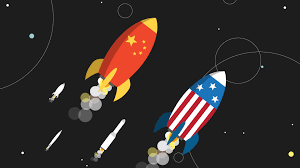
LONDON/WASHINGTON, Jan 30 (Reuters) – The United States and Russia could embark on an unrestrained nuclear arms race for the first time since the Cold War, unless they reach an eleventh-hour deal before their last remaining arms control treaty expires in less than a week.
The New START treaty is set to end on February 5. Without it, there would be no constraints on long-range nuclear arsenals for the first time since Richard Nixon and Soviet leader Leonid Brezhnev signed two historic agreements in 1972 on the first-ever trip by a U.S. president to Moscow.
Russian President Vladimir Putin has proposed the two sides should stick to existing missile and warhead limits for one more year to buy time to work out what comes next, but U.S. President Donald Trump has yet to formally respond.
Trump said this month that “if it expires, it expires”, and that the treaty should be replaced with a better one.
Some U.S. politicians argue Trump should reject Putin’s offer, freeing Washington to grow its arsenal to counter a rapid nuclear build-up by a third power: China.
Trump says he wants to pursue “denuclearisation” with both Russia and China. But Beijing says it is unreasonable to expect it to join disarmament talks with two countries whose arsenals are still far larger than its own.
WHY DO NUCLEAR TREATIES MATTER?
Since the darkest Cold War days when the United States and the Soviet Union threatened each other with “mutually assured destruction” in the event of nuclear war, both have seen arms limitation treaties as a way to prevent either a lethal misunderstanding or an economically ruinous arms race.
The treaties not only set numerical limits on missiles and warheads, they also require the sides to share information – a critical channel to “try to understand where the other side is coming from and what their concerns and drivers are”, said Darya Dolzikova at the RUSI think-tank in London.
With no new treaty, each would be forced to act according to worst-case assumptions about the weapons the other is producing, testing and deploying, said Nikolai Sokov, a former Soviet and Russian arms negotiator.
“It’s a self-sustaining kind of process. And of course, if you’ve got an unregulated arms race, things will get quite destabilising,” he said.
NEW TREATY NO SIMPLE TASK
Since the fall of the Soviet Union, Russia and the United States have repeatedly replaced and updated the Cold War-era treaties that limited the so-called strategic weapons they point at each other’s cities and bases.
The most recent, New START, was signed in 2010 by U.S. President Barack Obama and Dmitry Medvedev, a Putin ally who was then serving as Russian president for four years.
It caps the number of deployed strategic warheads at 1,550 on each side, with no more than 700 systems to deliver them from land, sea or air, by intercontinental ballistic missile, submarine-launched missile or heavy bomber.
Replacing it with a new treaty would be no simple task. Russia has developed new nuclear-capable systems – the Burevestnik cruise missile, the hypersonic Oreshnik and the Poseidon torpedo – that fall outside New START’s framework. And Trump has announced plans for a space-based “Golden Dome” missile defence system that Moscow sees as an attempt to shift the strategic balance……………………………………………………………………………………………………………………………………. https://www.reuters.com/business/aerospace-defense/barring-last-minute-nuclear-deal-us-russia-teeter-brink-new-arms-race-2026-01-30/
The US Is Pushing So Many Regime Change Agendas It’s Hard To Keep Up.
Caitlin Johnstone, 30 Jan 26, https://www.caitlinjohnst.one/p/the-us-is-pushing-so-many-regime?utm_source=post-email-title&publication_id=82124&post_id=186298268&utm_campaign=email-post-title&isFreemail=true&r=1ise1&triedRedirect=true&utm_medium=email
It’s just incredible how quickly and aggressively the US is advancing longstanding agendas of global conquest under the Trump administration. Now they’re racing to take out Cuba.
The US president has signed an executive order to impose new tariffs on countries which supply oil to Cuba, even indirectly, which is expected to dramatically increase the pressure on the already struggling island nation. This comes as Financial Times reports that “Cuba only has enough oil to last 15 to 20 days at current levels of demand and domestic production” after the US cut off the supply from Venezuela and Mexico shelved a planned oil shipment.
Trump’s order itself contains the usual excuses we’ve come to expect from the empire of propaganda and lies, with its authors babbling without evidence about Hamas and Hezbollah and “transnational terrorist groups” receiving support from Havana, thereby making this crushing act of siege warfare a self-defense measure implemented in protection of the American people.
We’re being asked to believe that Cuba is Hamas, so Washington needs to strangle it to death in self-defense. The fact that the US has been pursuing regime change in Cuba for generations, we are told, is merely a coincidence.
The lies get dumber and dumber with each new imperial power grab. It’s just insulting at this point.
Last week The Wall Street Journal published an article titled “The U.S. Is Actively Seeking Regime Change in Cuba by the End of the Year” which cited anonymous senior US officials saying they viewed the operation to remove Maduro from Caracas as a “blueprint” for bringing down Havana.
Here’s an excerpt:
“Emboldened by the U.S. ouster of Venezuelan President Nicolás Maduro, the Trump administration is searching for Cuban government insiders who can help cut a deal to push out the Communist regime by the end of the year, people familiar with the matter said.
“The Trump administration has assessed that Cuba’s economy is close to collapse and that the government has never been this fragile after losing a vital benefactor in Maduro, these people said. Officials don’t have a concrete plan to end the Communist government that has held power on the Caribbean island for almost seven decades, but they see Maduro’s capture and subsequent concessions from his allies left behind as a blueprint and a warning for Cuba, senior U.S. officials said.”
The Wall Street Journal reports that administration officials have been meeting with “Cuban exiles and civic groups in Miami and Washington” with the goal of “identifying somebody inside the current government who will see the writing on the wall and want to cut a deal,” in a way similar to how assets within the Maduro government were recruited to facilitate his removal.
In a new segment on Trump’s frenzied efforts to topple Havana, CNN’s Patrick Oppmann reports from Cuba that he’s “heard from a US embassy source that diplomats there have been advised to quote ‘have their bags packed’ as the Trump administration explores new ways to destabilize the communist-run government.”
The US likes to immiserate the populations of targeted nations using economic strangulation with the goal of fomenting unrest and turning people against their leaders. In 2019 Trump’s previous secretary of state Mike Pompeo openly acknowledged that the goal of Washington’s economic warfare against Iran was to make the population so miserable that they “change the government”, cheerfully citing the “economic distress” the nation had been placed under by US sanctions. Economic distress has been widely cited as a primary factor in the deadly protests that have rocked Iran in recent weeks.
Starvation sanctions are the only form of warfare where it is widely considered both normal and ethical to deliberately target a civilian population with deadly force. Deliberately impoverishing an entire nation so that it erupts in conflict and civil war is one of the most evil things you can possibly imagine, but it’s the go-to Plan A for the US empire when it comes to removing foreign leaders who refuse to kiss the imperial boot.
From Palestine to Lebanon to Yemen to Syria to Venezuela to Cuba to Iran, these last couple of years the US has been in a mad scramble to eliminate governments and resistance groups which attempt to insist on their own sovereignty. There’s a new excuse every time, but the end goal is always the same: the furtherance of planetary domination.
The US empire is the single most tyrannical and murderous power structure on this planet. If any regime is in need of changing, it’s that one.
The U.S. plan for Gaza has nothing in it for Palestinians
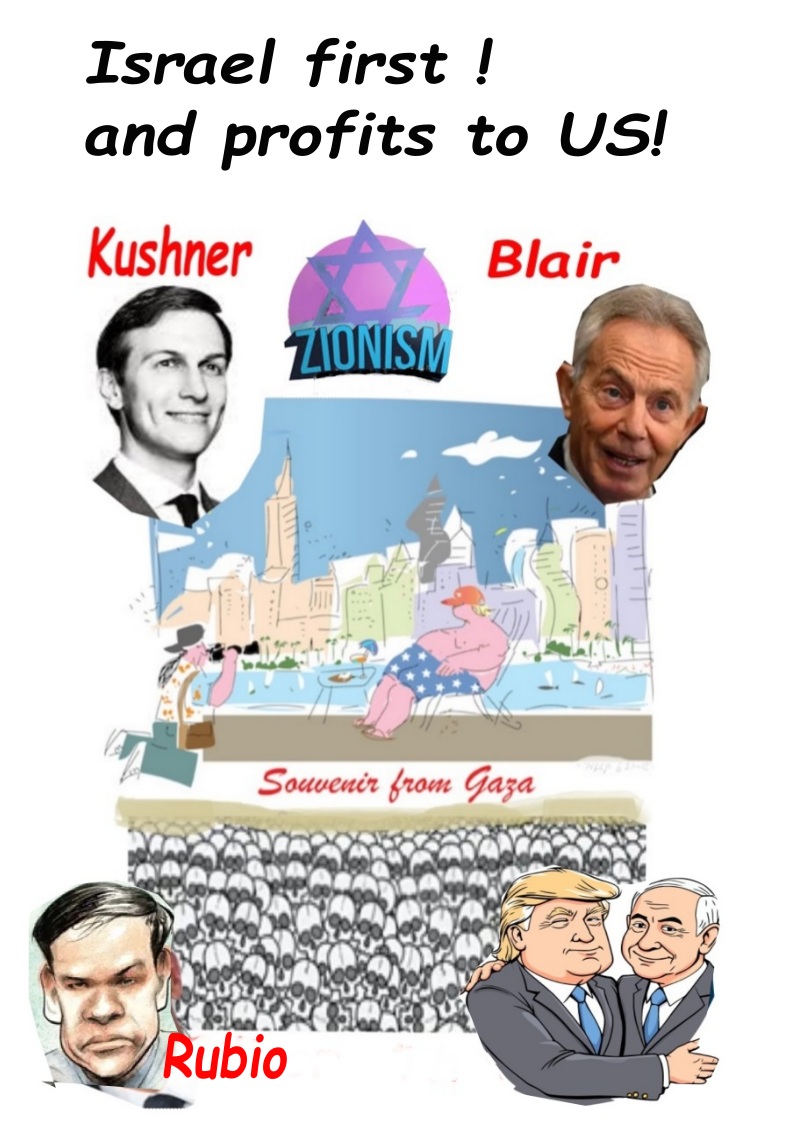
The U.S. plan for Gaza envisions a Gaza for investors, not Palestinians.
By Qassam Muaddi January 28, 2026 , https://mondoweiss.net/2026/01/the-u-s-plan-for-gaza-has-nothing-in-it-for-palestinians/
The latest iteration of the future U.S. plan for Gaza was revealed last week by U.S. President Trump’s son-in-law, Jared Kushner, at the inaugural ceremony of the so-called “Board of Peace,” which is tasked with overseeing the reconstruction and administration of the Strip. Kushner’s presentation included a map of what Gaza would look like after reconstruction, including industrial zones, residential blocks, and tourism beaches. The plan advertises a new Rafah and a new Gaza City, completely separate from one another. Meanwhile, the edges of the Strip — which once served as Gaza’s farmland and bread basket — would now be home to industrial complexes. Kushner’s plan doesn’t foresee any restoration of Palestinian neighborhoods or villages, and offers no place for natural Palestinian life to exist. Only fixed residential blocks, surrounded by investments.
After two years of genocide, the outcome that is being laid out for the people of Gaza — and the Palestinian people as a whole — is the creation of a dystopian reality that sees the building of luxury resorts on top of their destroyed homes and communities.
The only role for Palestinians in this vision is to be managed — controlled, “concentrated” in confined zones, and later possibly expelled. All of this is masked as a “historic” humanitarian effort.
A Gaza without Palestinians
Soon, it will be four months since the ceasefire in Gaza went into effect. On Monday, the first phase of the agreement officially ended after the Israeli government announced that Israeli forces had found the body of the last dead Israeli soldier held captive in Gaza. Israel had refused to move to the second phase of the ceasefire before Hamas handed over the remaining body, which the Israeli army reportedly found on the Israeli-controlled side of the Strip.
Coincidentally, in the past few days, U.S. President Trump announced the formation of the Board of Peace, initially planned to oversee the transition in Gaza during the second phase of the ceasefire. Simultaneously, the Israeli government agreed to reopen the Rafah crossing, a crucial step for the second phase. A week earlier, the Palestinian technocratic committee for the administration of Gaza was also announced.
But what’s actually happening on the ground started well before the technocratic committee was formed. Israel’s longstanding plans for Gaza — to corral its population into concentrated zones ahead of their possible expulsion — have been silently unfolding on the ground. Last week, Drop Site News revealed documents obtained from the U.S.-Israeli military and civil command center in Israel showing preparations for a residential area to be built in Rafah. According to Drop Site, if developed, the “planned community” in Rafah “would contain and control its residents through biometric surveillance, checkpoints, monitoring of purchases, and educational programs promoting normalization with Israel,” comparing it to a panopticon. Rafah was completely leveled by the Israeli army earlier in 2025.
Based on an analysis of satellite imagery conducted by Forensic Architecture, the Drop Site report indicates that the new “community” is being prepared on a 1-square-kilometer plot of land in Rafah at the intersection of two military corridors.
Jonathan Whittall, a senior UN official in Palestine between 2022 and 2025, said that “this is the next phase in the weaponization of aid,” after reviewing the materials obtained by Drop Site
This idea to “concentrate” Palestinians into a highly surveilled area is in line with previous statements made by Israeli Defense Minister, Israel Katz, who said last July that Palestinians who would be allowed into the so-called “humanitarian city” — proposed to be built over Rafah’s ruins — would not be allowed to leave it. The scheme was widely decried by human rights groups as a thinly-disguised plan to build a “concentration camp,” and was seen as a first step toward pushing Palestinians to leave Gaza entirely. Israeli Prime Minister Benjamin Netanyahu explicitly told his cabinet as much in September, under the label of “voluntary emigration.”
Meanwhile, the National Committee for the Administration of Gaza (NCAG), the body of Palestinian technocrats set to oversee day-to-day governance in the Strip, is about to enter Gaza. It has so far garnered the support of all Palestinian factions, yet remains subordinate to Trump’s Board of Peace, with only limited executive powers. The Board of Peace, on the other hand, plays a political role in drafting plans for Gaza.
The NCAG is the first-ever Palestinian governing body in Palestine that is not part of the PLO’s institutional structure, which effectively splits Gaza politically from the rest of Palestine. Instead, its ultimate political reference now lies in a Board of Peace headed by Trump and, among others, Israel. The vision it is advancing for Gaza is one without Palestinians.
In fact, all the unfolding information about the U.S. plan for Gaza shows that it treats the Palestinian question as a purely humanitarian issue shorn of any political content. It completely ignores the centrality of Gaza to the Palestinian cause as a political question and fails to address the basic element of the “conflict” — Palestinian self-determination.
This should not be surprising, given that decision-making is dominated by U.S. business interests, ambitions of regional control and power, and Israel’s ideological drive to push Palestinians out. In the midst of all this, no Palestinian voice is present.
What does the US want from Iran? Tracking one month of Trump’s changing demands.
After saying the US would attack if protesters were harmed, the president appears now to be tying the threat of airstrikes to Iran’s nuclear programme.
Jonathan Yerushalmy, Thu 29 Jan 2026 , https://www.theguardian.com/us-news/2026/jan/29/trump-iran-usa-one-month-demands-protesters-nuclear
Donald Trump has warned that Iran must come to the table to negotiate a deal over its nuclear programme or face the possibility of airstrikes and regime change, capping off a month of bellicose posturing and whiplash inducing u-turns from the US president.
The US president’s demands threaten to open a new chapter in America’s long and tumultuous relationship with Iran, which in just over a decade has seen rapprochement, broken deals, targeted assassinations and unprecedented airstrikes.
Here’s a recap of just the last 31 days:
29 December : ‘We’ll knock the hell out of them’
At the end of December, Trump suggested that Iran was “building up weapons” again, just six months after the US launched unprecedented strikes against the country’s nuclear sites.
Speaking beside Israeli prime minister Benjamin Netanyahu in Florida, Trump said if Iran was working to build up again “we’ll knock the hell out of them. But, hopefully, that’s not happening.” He added that the consequences of such a move would be “more powerful than the last time”.
After Netanyahu suggested that Iran may be attempting to rebuild its nuclear programme, the country’s foreign minister called for renewed talks with the US.
2 January: ‘We are locked and loaded and ready to go’
After Iranians took to the streets in the largest national demonstrations in years, Trump said that if protesters were killed, the US would “come to their rescue”.
“We are locked and loaded, and ready to go,” he said.
The unrest, triggered by an unprecedented decline in the value of the national currency, prompted a renewed escalation in tensions between the US and Iran.
6 January: ‘Make Iran Great Again’
Days after Trump launched strikes on Venezuela and captured the country’s president Nicolás Maduro, Trump was pictured posing with a “Make Iran Great Again” hat.
With protests in Iran spreading and reports of dozens dead, Trump again said that if Tehran “violently kills peaceful protesters” the US would “come to their rescue”.
10 January: ‘The USA stands ready to help!!!’
As the reported death toll in the protests soared into the hundreds, Trump was said to be weighing a response. “Iran is looking at FREEDOM, perhaps like never before. The USA stands ready to help!!!,” the US president said on the Truth Social platform.
The speaker of Iran’s parliament warned that Israeli and US interests in the Middle East would be “legitimate targets” if Washington attacked Iran.
13 January: ‘Help is on its way
Trump announced new 25% tariffs on countries that do business with Iran, but there was no official documentation from the White House and it appears they were never implemented.
Amid reports of a brutal regime crackdown on the protesters, Trump had initially claimed Iran wanted to negotiate, but later went on to say that he had cancelled all meetings with officials.
“Iranian Patriots, keep protesting – take over your institutions!!! … help is on its way,” Trump said in a post on Truth Social on Tuesday.
14 January: ‘The killing in Iran is stopping’
Despite reports that as many as 3,428 Iranians had been killed and that executions as punishment were imminent, Trump said he had been told that “the killing in Iran is stopping … And there’s no plan for executions.”
It was understood he had reviewed the full range of options to strike Iran but was unconvinced by any single action. His administration had also been lobbied by Middle Eastern allies not to go ahead with strikes, with fears that an attack would lead to a major and intractable conflict across the region.
In the days that followed the huge protest movement slowed under the weight of the regime’s brutal crackdown. Mass arrests followed and many Iranians said they felt betrayed and confused by the president’s sudden about turn.
22 January: ‘We have a lot of ships going that direction’
After several days which saw Trump distracted by anti-ICE protests in Minneapolis and a breakdown in relations with European allies over the fate of Greenland, Trump returned to the issue of Iran, saying “We have a lot of ships going that direction, just in case.”
With the death toll from the protests now said to be more than 5,000 – and reports it could be many times higher than that – Trump’s decision to send the aircraft carrier USS Abraham Lincoln and several guided-missile destroyers to the Middle East were thought to be in response to the regime’s brutal crackdown.
28 January: ‘Time is running out’
With US ships now in position in the Middle East, Trump issued an extraordinary threat to Iran, saying of the armada, “like with Venezuela, it is, ready, willing, and able to rapidly fulfill its mission, with speed and violence, if necessary.”
Warning that Iran must “make a deal”, Trump said that the country would have “NO NUCLEAR WEAPONS”.
The statement marked a shift in his administration’s rationale for sending the armada to the region, with no mention of the protesters, their demands or the regime’s brutal crackdown.
The UN is Being Undermined by the ‘Law of the Jungle’
By Thalif Deen, IPS UN Bureau Report, https://www.ipsnews.net/2026/01/the-un-is-being-undermined-by-the-law-of-the-jungle/?utm_source=email_marketing&utm_admin=146128&utm_medium=email&utm_campaign=The_UN_is_Being_Undermined_by_the_Law_of_the_Jungle_Moving_Towards_Agroecological_Food_Systems_in_So
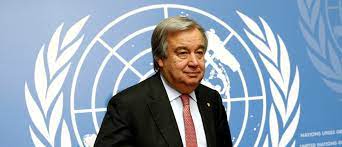
UNITED NATIONS, Jan 30 2026 (IPS) – UN Secretary-General Antonio Guterres was dead on target when he told the Security Council last week that the rule of law worldwide is being replaced by the law of the jungle.
“We see flagrant violations of international law and brazen disregard for the UN Charter. From Gaza to Ukraine, and around the world, the rule of law is being treated as an à la carte menu,” he pointed out, as mass killings continue.
“The New York Times on January 28 quoted a recent study pointing out the four-year war between Russia and Ukraine has resulted in over “two million killed, wounded or missing”. The study published last week by the Center for Strategic and International Studies in Washington says nearly 1.2 million Russian troops and close to 600,000 Ukrainian troops have been killed, wounded or are missing.
In the war in Gaza, over 70,000 Palestinians, mostly civilians, including women and children, have been killed since October 7, 2023, with figures reaching over 73,600 by early January 2026, according to various reports from the Gaza Health Ministry and human rights organizations.
These killings have also triggered charges of war crimes, genocide and violations of the UN charter, as in the US invasion of Venezuela and the takeover threats against Greenland.
Guterres said in an era crowded with initiatives, the Security Council stands alone in its Charter-mandated authority to act on behalf of all 193 Member States on questions of peace and security. The Security Council alone adopts decisions binding on all.
No other body or ad hoc coalition can legally require all Member States to comply with decisions on peace and security. Only the Security Council can authorize the use of force under international law, as set out in the Charter. Its responsibility is singular. Its obligation is universal, declared Guterres.
Dr Ramzy Baroud, Editor of Palestine Chronicle and former Managing Editor of the London-based Middle East Eye, told IPS the statement by the Secretary-General is long overdue.
Too often, he said, UN officials resort to cautious, euphemistic language when describing egregious violations of international law—especially when those responsible are UN Security Council veto holders, states that have ostensibly sworn to uphold the UN Charter and the core mission of the international system.
Unfortunately, the UN itself has become a reflection of a rapidly shifting world order—one in which those with overwhelming military power sit at the top of the hierarchy, abusing their dominance while steadily hollowing out the very institutions meant to restrain them, he pointed out.
“We must be honest with ourselves and acknowledge that this crisis did not begin with the increasingly authoritarian misuse of law by the Trump administration, nor is it limited to Israel’s absolute disregard for the international community during its two-year-long genocide in Gaza.”
The problem is structural. It is rooted in the way Western powers have long identified—and exploited—loopholes within the international legal system, selectively weaponizing international law to discipline adversaries while shielding allies and advancing their own strategic agendas, he declared.
Responding to a question at the annual press briefing on January 29, Guterres told reporters it is obvious that members of the Security Council are themselves violators of international law –and it doesn’t make life easy for the UN in its efforts.
Unfortunately, he said, there is one thing that we miss. “It’s leverage. It’s the power that others eventually have, to force countries and to force leaders to abide by international law. But not having the power, we have the determination, and we’ll do everything possible with our persuasion, with our good offices, and building alliances to try to create conditions for some of these horrible tragedies we are witnessing. And from Ukraine to Sudan, not to mention what has happened in Gaza, we will be doing everything we can for these tragedies to stop”.
Dr Jim Jennings, President of Conscience International, told IPS the global humanitarian situation described by the Secretary-General is grim but very real. The climate crisis, natural disasters, numerous ongoing and expanding conflicts, and the impact of new technologies, all add to today’s global economic instability and affect every person on earth.
While President Trump continues bombing countries and strutting the world stage with his adolescent dream of US territorial expansion, a major readjustment of the global power balance among China, the US, Europe, and the BRICS nations is underway, he noted.
Stripping life-giving aid away from the poorest countries on earth to benefit those already rich, as his policies guarantee, is a recipe for even more global suffering and violence.
“Clearly one of the most blatant and harmful reasons for the present disastrous situation worldwide is the reduction of funding for UN agencies by the United States, which has traditionally paid a high percentage of their costs”.
With the further curtailment of The Department of State-USAID’s enormous support for people in critical need in almost every country in the world, the Trump administration’s one-two punch has already threatened to make a challenging set of problems unmanageable.
What is to be done? People and governments everywhere must stand up, speak out, and act against the colossal forces now arrayed against some of the world’s most vulnerable populations. How to do that has never been easy, Dr Jennings argued.
Put in the simplest terms, Secretary-General Guterres was merely pointing out the glaring fact of the true global situation and appealing for the critical need UN agencies have for support if their mission is not to fail. The answer is straightforward— more private funding.
Why not raise the level of our individual, corporate, and foundation donations to the UN Agencies and other aid organizations while continuing to advocate for responsible government backing for the irreplaceable United Nations agencies? he asked.
Dr Palitha Kohona, a former Chief of the UN Treaty Section, told IPS international relations, for a very long time, were dependent on the whims of powerful states and empires. Might was right and disputes were settled by using force. Land inhabited for centuries was annexed to empires and native populations were dispossessed or even exterminated.
From such fractured beginnings, an orderly world governed by agreed rules began to emerge gradually, although most of the rules were established by the powerful.
Thousands of treaties were concluded, customary rules were respected and a rudimentary judicial structure began to be established. The world rejoiced in the establishment of the United Nations.
Though lacking in proper enforcement mechanisms and largely dependent on voluntary mutually beneficial compliance, a rule based international order was beginning to emerge.
Dr Palitha Kohona, a former Chief of the UN Treaty Section, told IPS international relations, for a very long time, were dependent on the whims of powerful states and empires. Might was right and disputes were settled by using force. Land inhabited for centuries was annexed to empires and native populations were dispossessed or even exterminated.
From such fractured beginnings, an orderly world governed by agreed rules began to emerge gradually, although most of the rules were established by the powerful.
Thousands of treaties were concluded, customary rules were respected and a rudimentary judicial structure began to be established. The world rejoiced in the establishment of the United Nations.
Though lacking in proper enforcement mechanisms and largely dependent on voluntary mutually beneficial compliance, a rule based international order was beginning to emerge.
Israel’s genocide in Gaza, the war in Ukraine, and the ongoing atrocities in Sudan and elsewhere are not aberrations. They represent the culmination of decades of legal erosion, selective enforcement, and the systematic degradation of the international legal order.
While I agree—and even sympathize—with Canadian Prime Minister Mark Carney’s comments at the World Economic Forum in Davos, in which he expressed criticism of the new power dynamics that have rendered the international political system increasingly defunct, one cannot help but ask why neither he nor other Western leaders are willing to confront their own governments’ historical role in creating this reality.
Without such reckoning, calls to defend international law risk sounding less like principled commitments and more like selective outrage in a system long stripped of credibility.
European powers that are critical of Trump have not raised their voice with the same intensity and vigor against Netanyahu for doing a lot worse than anything that Trump has done or threatened to do.
This also begets the same question about the latest comments by the UN Secretary-General. He should offer more specifics than generalized decrying the collapse of international morality.
“Moreover, we expect a roadmap that will guide us in the process of re-establishing some kind of a sane global system in the face of the growing authoritarianism, dictatorship, and criminality all around”, declared Dr Baroud
The Global Billionaire Steal: Wealth, Authoritarianism and Media
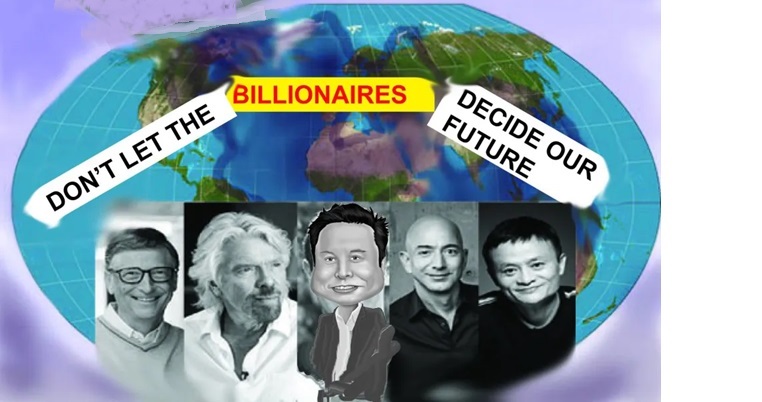
26 January 2026 Dr Binoy Kampmark AIM Extra , https://theaimn.net/the-global-billionaire-steal-wealth-authoritarianism-and-media/
It’s official. This tormented, heated, traumatised planet is now home to over 3,000 billionaires. (That number was reached last year.) In October 2025, Elon Musk became the first man to have wealth exceeding half a trillion dollars. These developments could still take alongside the fact that one in four people across the globe face hunger.
Oxfam’s Resisting the Rule of the Rich has, as its subtitle, “defending freedom against billionaire power.” It’s an important link, as money, rather than knowledge, tends to be the indicator of raw power. In her foreword to the report, the Secretary General of Amnesty International, Agnès Callamard, links the stirrings of authoritarianism with the pains of inequality. They were neither “separate problems” nor “distinct dilemmas.” They were “entwined, as governments across the world side with the powerful, not the people, and choose repression, not redistribution.” Reading such words commands an echo from US Supreme Court Justice Louis Brandeis, who observed in 1941 that, “We can have a democratic society or we can have the concentration of great wealth in the hands of a few. We cannot have both.” (The Oxfam authors also cite the same quote, though not its questionable provenance.)
The charity accepts that the rich influencing and moulding politics is hardly new. That scale of influence, however, has burgeoned. What took place in the US last year, with the victory of a billionaire president, supported and sponsored by billionaires, running a cabinet with billionaires, made this “viscerally clear: in country after country, the super-rich have not only accumulated more wealth than could ever be spent, but have also used this wealth to secure the political power to shape the rules that define our economies and govern our nations.”
Considering data from 136 countries, the authors confirm the thesis that the unequal distribution of economic resources correlates with unequal political power. “This leads to policy outcomes that reflect the preferences of upper-income groups more than those in lower-income groups.” Those in the highest income bracket have, by means of this fact, secured influence in purchasing political representatives, seeking to legitimise elite power, and secure direct access to institutions.
News coverage and commentary have also been infiltrated by the billionaire class, with over half of the stable of global media companies owned by it. Of the 10 top social media companies, nine are in the hands of six billionaires. A chilling nexus with artificial intelligence has also developed, with its inexorable shaping of the information environment, given that 8 of the top 10 AI companies are steered by billionaires. These are individuals who are not only affecting the nature of wealth distribution but the nature of how knowledge and understanding is sought.
The authors do not throw their hands up in despair at these dire developments. They suggest measures of amelioration. One idea, and unlikely to take off, is the proposal of “limitarianism” advocated by philosopher Ingrid Robeyns. Just as societies define a poverty line, they should just as well define an “Extreme Wealth Line”. (Robeyns puts this limit at US$10 million, an amount bound to make the tech tyrants goggle.)
More feasible is the construction of a “strong firewall between wealth and politics.” Governments can tax the wealthiest – a thorny point given the threatening influence they exert both within and outside representative chambers. Lobbying and the revolving door phenomenon between public and private interest should be regulated. Modest measures include transparent budgetary processes, reforming regulations, establishing mandatory public lobby registries and enforcing rules on conflicts of interest.
Addressing the hoary old chestnut of concentrated media ownership is another suggestion, be it through rules limiting individuals and corporations to secure a lion’s share of the market, encouraging alternative public and independent media outlets, compelling media companies to be transparent about how they use algorithms and rein in the distribution of harmful content. “Oversight and enforcement should be led by a state-funded, governmental body independent of billionaire influence.” The authors fail to appreciate that such supposedly independent bodies can come with their own problems, becoming censors in chief and paternalistic killjoys, a point aptly illustrated by the Australian eSafety Commissioner’s guerilla campaign against the Internet.
The very nature of political campaigning is also targeted by the charity’s recommendations. Political financing by the wealthy should be subject to accountability and transparency guidelines. Those running for office would have to make commitments to reduce their reliance on private donations, have such donations capped, with political parties having to abide by transparency rules regarding funding and electoral campaign financing.
While all these measures point to the drafters, regulators and lawmakers, Oxfam insists on “political power of the many” as a noble, necessary agenda, with governments needing to “guarantee an enabling civic space, in line with international legal frameworks, standards and guidance.” This would involve promoting freedom of expression, lawful assembly and association and enforcing such standards “through regular reporting and scrutiny by both state and non-state actors.”
The Oxfam report will be dismissed by the aspirational and the moneyed as the rantings of the envious and the airings of the lazy. The obscenely wealthy often assume that a mixture of hard work, prudence and basic genetics will get you the loot. In the end, it remains loot, protected by the systems that encourage it, and officials who remain complicit in weakening any mechanism that seeks redistribution and levelling.
Every Nation in the World Should Reject Trump’s Absurd and Dangerous ‘Board of Peace’
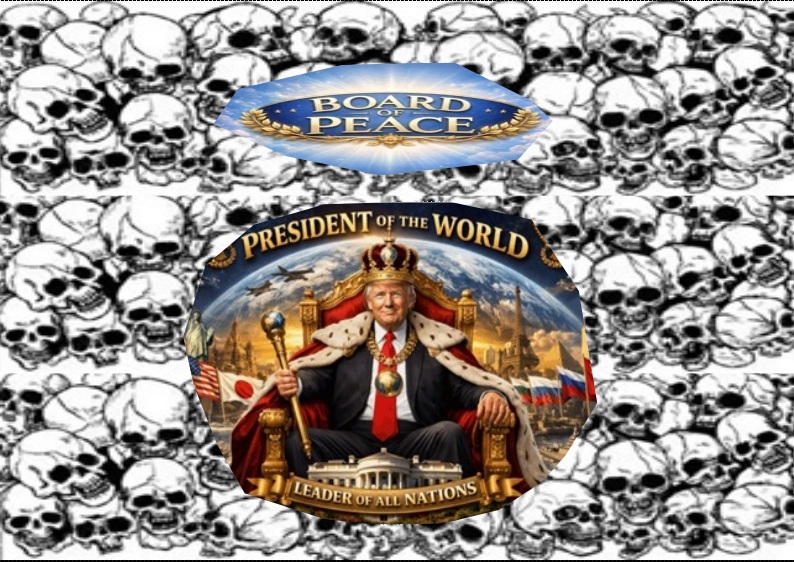
Refusal to join will be an act of national self-respect. The UN-based international order, however flawed, should be repaired through law and cooperation, not replaced by a gilded caricature.
Jeffrey D. Sachs, Sybil Fares, Jan 22, 2026, Common Dreams, https://www.commondreams.org/opinion/trump-board-of-peace
The so-called “Board of Peace” being created by President Donald Trump is profoundly degrading to the pursuit of peace and to any nation that would lend it legitimacy. This is a trojan horse to dismantle the United Nations. It should be refused outright by every nation invited to join.
In its Charter, the Board of Peace (BoP) claims to be an “international organization that seeks to promote stability, restore dependable and lawful governance, and secure enduring peace in areas affected or threatened by conflict.” If this sounds familiar, it should, because this is the mandate of the United Nations. Created in the aftermath of World War II, the UN has as its central mission the maintenance of international peace and security.
It is no secret that Trump holds open contempt for international law and the United Nations. He said so himself during his September 2025 speech at the General Assembly, and has recently withdrawn from 31 UN entities. Following a long tradition of US foreign policy, he has consistently violated international law, including the bombing of seven countries in the past year, none of which were authorized by the Security Council and none of which was undertaken in lawful self-defense under the Charter (Iran, Iraq, Nigeria, Somalia, Syria, Yemen, and Venezuela). He is now claiming Greenland, with brazen and open hostility towards the US allies in Europe.
So, what about this Board of Peace?
It is, to put it simply, a pledge of allegiance to Trump, who seeks the role of world chairman and the world’s ultimate arbiter. The BoP will have as its Executive Board none other than Trump’s political donors, family members, and courtiers. The leaders of nations that sign up will get to rub shoulders with, and take orders from, Marco Rubio, Steve Witkoff, Jared Kushner and Tony Blair. Hedge Fund owner and Republican Party mega-donor Marc Rowan also gets to play. More to the point, any decisions taken by the BoP will be subject to Trump’s approval.
If the charade of representatives isn’t enough, nations will have to pay $1 billion for a “permanent seat” on the Board. Any nation that participates should know what it is “buying.” It is certainly not buying peace or a solution for the Palestinian people (as the money supposedly goes to Gaza’s reconstruction). It is buying ostensible access to Trump for as long as it serves his interests. It is buying an illusion of momentary influence in a system where Trump’s rules are enforced by personal whim.
The proposal is absurd not least because it purports to “solve” a problem that already has an 80-year-old global solution. The United Nations exists precisely to prevent the personalization of war and peace. It was designed after the wreckage of two world wars to global base peace on collective rules and international law. The UN’s authority, rightly, derives from the UN Charter ratified by 193 member states (including the US, as ratified by the US Senate in July 1945) and grounded in international law. If the US doesn’t want to abide by the Charter, the UN General Assembly should suspend the US credentials, as it once did with Apartheid South Africa.
Trump’s “Board of Peace” is a blatant repudiation of the United Nations. Trump has made that explicit, recently declaring that the Board of Peace “might” indeed replace the United Nations. This statement alone should end the conversation for any serious national leader. Participation after such a declaration is a conscious decision to subordinate one’s country to Trump’s personalized global authority. It is to accept, in advance, that peace is no longer governed by the UN Charter, but by Trump.
Still, some nations, desperate to get on the right side of the US, may take the bait. They should remember the wise words of President John F. Kennedy in his inaugural address “ those who foolishly sought power by riding the back of the tiger ended up inside.”
The record shows that loyalty to Trump is never enough to salve his ego. Just look at the long parade of Trump’s former allies, advisers, and appointees who were humiliated, discarded, and attacked by him the moment they ceased to be useful to him.
For any nation, participation on the Board of Peace would be strategically foolish. Joining this body will create long-lasting reputational damage. Long after Trump himself is no longer President, a past association with this travesty will be a mark of poor judgment. It will remain as sad evidence that, at a critical moment, a national political system mistook a vanity project for statesmanship, squandering $1 billion of funds in the process.
Ultimately, refusal to join the “Board of Peace” will be an act of national self-respect. Peace is a global public good. The UN-based international order, however flawed, should be repaired through law and cooperation, not replaced by a gilded caricature. Any nation that values international law, and the respect for the United Nations, should decline immediately to be associated with this travesty of international law.
Greenland Is Not a Prize

You circumscribe everything
demand that we prove
We exist,
that We use the land that was always ours,
that We have a right to our ancestral lands.
And now it is We who ask:
By what right are You here?
it is worth noting that Danish and other Nordic diplomats have disputed Trump’s claims of Russian and Chinese warships operating ‘around Greenland’, for which Trump has offered no public evidence.
China’s anticipated investment in Greenland does not pose a military threat, nor is it something that the United States, Canada, or indeed Denmark should be concerned with. This should be a discussion and debate within Greenland.
The US has set its sights on Greenland due to its mineral wealth and strategic location. But its people – the Kalaallit – are an afterthought in Washington’s machinations.
22 January 2026, By Vijay Prashad / Tricontinental: Institute for Social Research
Every few years, the centre of the imperialist Global North – the United States – forgets its manners.
It is one thing to be rude to Iran or Venezuela, but it is another thing entirely to be rude to Denmark. The North Atlantic has not experienced internecine acrimony since – perhaps – Adolf Hitler turned on Poland in 1939. But to be fair to the United States, it has not coveted Denmark itself. Washington has licked its sticky fingers and placed them upon Greenland.
Denmark began its colonisation of Greenland 305 years ago, in 1721. Constitutional scholars will say that the formal colonial status ended in 1953 when Greenland was incorporated into the Kingdom of Denmark and that Greenland gained a further measure of autonomy in 2009 when the Act on Greenland Self-Government was passed – but let’s be frank, it remains a colony.
For context, Greenland (over 2 million square kilometres) is fifty times larger than Denmark. For comparison, if placed over the United States, it would almost stretch from Florida to California. If it were an independent country, it would be the twelfth largest in the world by area. Of course, the Arctic country has a very small population of around 57,700 (roughly equivalent to the population of Hoboken, New Jersey).
In Washington’s imagination, Greenland appears not as a homeland, but as a location – a place on a map or a signature on a radar screen. The words used to talk about it belong to the grammar of possession: purchase, control, seize. This is the language of domination – one imperialist power (United States) wanting to seize the land of a colonial power (Denmark).
But Greenland is not a prize.
The Inuit of Greenland call their country Kalaallit Nunaat: ‘Land of the Kalaallit’ (Greenlanders). When Trump and his allies speak of Greenland, they never speak of the people: the Kalaallit. Instead, Trump speaks of the strategic importance of the island and about what the US government sees as the perils of its Chinese and Russian capture (never mind that neither China nor Russia have made any claims over the territory). Greenland is always a place that someone else must hold, but not the Kalaallit. For people like Trump, or indeed for generations of Danish prime ministers (despite soft statements about the path to self-determination), the Kalaallit have no role as political subjects.
Greenland grew in strategic and economic importance to Denmark after the 1794 discovery of cryolite, a key mineral used in the production of aluminium. This extractive focus continued after the 1956 discovery of uranium and rare earth elements in Kuannersuit (Kvanefjeld) in southern Greenland. In 1941, Denmark’s envoy in Washington, Henrik Kauffmann, signed an agreement that allowed the US to establish bases and stations in Greenland. In 1943, the US placed a weather station at Thule (Dundas) known as Bluie West 6, and in 1946 it added a small airstrip. After the Second World War, Denmark was an early entrant to the US effort to build a military bloc against the Soviet Union. In fact, it was a founder of the North Atlantic Treaty Organisation (1949) and then signed the Defence of Greenland Agreement (1951) that allowed the US to build the Thule Air Base under the codename Operation Blue Jay (now Pituffik Space Base).
The base became useful not only as a place to watch the USSR, but also for missile warning, missile defence, and space surveillance – a strategic foothold that has grown more consequential as Greenland’s uranium and rare earth deposits have become central to the global contest for critical minerals.
As Greenland’s ice sheets have melted in recent decades due to the climate catastrophe, the country’s deep geology has become easier to survey and to mine. Feasibility studies and drilling in the early to mid-2010s (especially 2011–2015) showed that the land was teeming with graphite, lithium, rare earth elements, and uranium. As the United States imposed its New Cold War on China, it had to seek new sources for rare earths given China’s dominance of rare-earth refining and downstream magnet production. The island became not only a source of minerals or a geographical location for power projection, but also a critical node in the US-led supply-chain security architecture.
In August 2010, long before Canadian Prime Minister Mark Carney’s trip to China in mid-January 2026, the Canadian government released a report with an interesting title: Statement on Canada’s Arctic Foreign Policy: Exercising Sovereignty and Promoting Canada’s Northern Strategy Abroad. On the surface, the report is rather bland, making many pronouncements about how Canada respects the Indigenous peoples of the Arctic and how its intentions are entirely liberal and noble. That posture is difficult to square with the reality that major mining projects across the Canadian Arctic have repeatedly sparked Inuit concerns about impacts on wildlife and Inuit harvesting and that regulators have at times recommended against expansions, as in the case of Baffinland’s Mary River iron mine.
In fact, Canada is home to the world’s largest hub for mining finance (TSX and TSX Venture Exchange list more than half of the world’s publicly traded mining companies), which has been sniffing around the Arctic for decades in search of energy and minerals. The 2010 report does mention Canada’s ‘Northern energy and natural resource potential’ and that the government is ‘investing significantly in mapping the energy and mineral potential of the North’. But there is no mention of the large Canadian private mining companies that would benefit not only from Greenland’s mineral potential (for instance, Amaroq Minerals, which already owns the Nalunaq gold mine in South Greenland) but also from Canada’s Arctic region (for instance, Agnico Eagle Mines, Barrick Mining Company, Canada Rare Earth Corporation, and Trilogy Metals). What is significant about the report is that if it is put into operation, it would sharpen the long-running Canada-US dispute over Arctic navigation, particularly in the Northwest Passage, which Canada treats as internal waters and the US approaches as an international strait.
Read more: Greenland Is Not a PrizeCanada is an ‘Arctic power’, the report says. There are seven other countries that have an Arctic foothold: Denmark, Finland, Iceland (through Grimsey), Norway, Russia, Sweden, and the United States (through Alaska). They are members of the Arctic Council, which was set up by Canada in 1996 to deal with environmental pollution in the Arctic and to create space for Indigenous organisations in the region to put forward their views. However, the Arctic Council has largely been paralysed since Russia’s invasion of Ukraine in 2022, when member countries paused normal cooperation with Russia and later resumed only limited project-level work that does not involve Russian participation, even though Russia holds roughly half of the Arctic coastline.
With consensus required, this has narrowed the council’s role from a venue that could broker pan-Arctic coordination and even negotiate binding agreements to one largely confined to technical working-group projects and assessments. Canada’s claim to being an ‘Arctic power’ comes with bravado but lacks substance. Will it really prevent the US from using its sea lanes, and can it exercise a form of capitalist sovereignty for its mining companies in the Arctic region?
In 2020, before the council paused cooperation with Russia, the North Atlantic Treaty Organisation (NATO) had already called upon its members to ‘set [their] sights on the high north’ (as NATO’s think tank, the Atlantic Council, noted in a report). After 2022, NATO developed a ‘high north’ strategy that can be best appreciated in its 2025 parliamentary report Renavigating the Unfrozen Arctic. The report identifies what it sees as the primary threat to NATO countries: China and Russia. One of them (Russia) is a major Arctic power, and the other (China) has two scientific stations in the north (Yellow River Station in Svalbard, Norway, which has been there since 2003 studying atmospheric and environmental science, and the China-Iceland Arctic Science Observatory in Kárhóll, Iceland, which has been there since 2018 studying Earth-system and environmental science). China has also indicated that the Arctic waters would be ideal for a Polar Silk Road, a trade corridor that would link China to Europe. But there is no Chinese military footprint in the region as of now.
On 9 January 2026, Trump said that he does not want China or Russia to get a foothold in Greenland. It is true that representatives of Chinese companies have been to Greenland and signed non-binding memorandums of understanding (MOUs), but it is equally true that none of them have gone forward. Trump fears that some of these MOUs might eventually turn into projects that could see Chinese companies on Greenland’s soil. However, since EU investment is so low in Greenland (around $34.9 million per year), and since US (around $130.1 million per year) and Canadian investment ($549.3 million per year) is higher but still lower than an anticipated Chinese investment (at least $1.162 billion), it is credible to fear the Chinese businesses. At the same time, it is worth noting that Danish and other Nordic diplomats have disputed Trump’s claims of Russian and Chinese warships operating ‘around Greenland’, for which Trump has offered no public evidence.
China’s anticipated investment in Greenland does not pose a military threat, nor is it something that the United States, Canada, or indeed Denmark should be concerned with. This should be a discussion and debate within Greenland.
Greenland is not for sale. It is not a military platform or a mineral reserve waiting to be extracted. It is a society, alive with memory and aspiration. The Global South knows this story well – a story of plunder in the name of progress, of military bases in the name of security, of the suffering and starvation of the people who call this land their home.
Land does not dream of being owned. People dream of being free.
Ask Aqqaluk Lynge, a Kalaallit poet, politician, and defender of Inuit rights who wrote in his poem ‘A Life of Respect’:
On maps of the country
We must draw points and lines
to show we have been here –
and are here today,
here where the foxes run
and birds nest
and the fish spawn.
You circumscribe everything
demand that we prove
We exist,
that We use the land that was always ours,
that We have a right to our ancestral lands.
And now it is We who ask:
By what right are You here?
Trump shamelessly plays the Russia/China bogeyman card for Greenland grab
NATO’s civilian head, Mark Rutte, the former Dutch prime minister and abject flunky, appeased Trump at Davos by offering more NATO defenses deployed to Greenland. Rutte, who previously referred to Trump as “daddy”, made the “deal” in private with Trump. No details have been made public nor even shared among other NATO members. How’s that for contempt of underlings?
Since the end of World War Two, the United States paid lip service to global law and order along with its European allies. Under Trump, there is no longer any pretense of lip service. It’s outright imperialist power for naked domination. At one point in his rambling Davos speech, Trump declared such might-is-right land grabbing as normal.
Russia and China, among others, have repeatedly declared the paramount need to abide by international law and the principles of the UN Charter. U.S. imperialist power has no such respect. Trump has openly said so.
Sat, 24 Jan 2026, https://strategic-culture.su/news/2026/01/23/trump-shamelessly-plays-russia-china-bogeyman-card-for-greenland-grab/
Under Trump, the European appeasers are inviting disaster as they indulge his bogeyman games over Greenland.
The old saying that a week is a long time in politics is especially true under the U.S. Presidency of Donald Trump, given his propensity for unhinged bombast, zig-zags, U-turns, vendettas, and theatrics.
So, last week, he was threatening to take over the Danish Arctic territory of Greenland by military force, if needed. Trump was also gearing up to launch an unprecedented trade war against European states that, with pipsqueak temerity, dared to support Denmark, a move that would have cratered the eight-decade-old transatlantic Western alliance.
This week, in a 70-minute rant at the World Economic Forum in Davos, Switzerland, Trump, seemingly magnanimously, announced that he was not going to deploy military power to subordinate European NATO “allies”. But he insisted that Greenland must be annexed under U.S. control.
In a telling quip, he said: “I don’t have to use force.” Trump is right on that score. There is no need for military coercion because the European “allies” have been exposed as a bunch of dithering vassals who were pathetically clutching their pearls for the past week out of fear and angst that Uncle Sam was slapping them.
However, when vassals appease, they only end up being abused. The American Don may have softened his contemptuous rhetoric at Davos, but there is little doubt that the expansionist ambitions to grab Greenland will be pursued, and the Europeans will be, in time, further degraded in their submission to the American overlord.
Oddly enough, for a president who boasts about flexing military muscle for imperialist aims, Trump couched his takeover of Greenland as a matter of “national security.” He is claiming that the United States needs to take control of the “big, beautiful piece of ice” to defend it from Russia and China.
He lied that it wasn’t because of Greenland’s vast mineral resources, including oil and rare-earth metals. Trump was claiming that the U.S. is the only NATO member strong enough to keep Russia and China from gaining a foothold. Beijing slammed Trump’s claims as baseless.
In an insulting and absurd remark, he likened Russia and China to how Nazi Germany tried to take Greenland from Denmark during the Second World War, and it was the U.S. that prevented that.
Only a few days before, Trump contradicted himself (not hard for him) by posting a comment deriding how Russia and China are used as “bogeymen”, that is, as false enemies.
Another anomaly was seen with Trump inviting Russia and China to join his dubious Global Board of Peace initiative, which he unveiled with much corny fanfare in Davos. Enemies for peace?
In other words, on Greenland, Trump is cynically playing the Russia and China threat as a pretext for blatantly violating the sovereignty of an ally.
Not that Denmark deserves sympathy. It is questionable how it retains any territorial right to a distant Arctic island whose people have consistently demanded independence from Copenhagen’s colonialist control.
NATO’s civilian head, Mark Rutte, the former Dutch prime minister and abject flunky, appeased Trump at Davos by offering more NATO defenses deployed to Greenland. Rutte, who previously referred to Trump as “daddy”, made the “deal” in private with Trump. No details have been made public nor even shared among other NATO members. How’s that for contempt of underlings?
Trump hailed the so-called framework agreement as a “great deal” for the United States and Europe without sharing the details. It’s believed to permit the installation of Trump’s futuristic Golden Dome missile defense system. If that goes ahead, it will heighten strategic tensions with Russia by militarizing the Arctic, not bring peace or stability. Denmark is reportedly wary that its sovereignty is being sold out in a grubby behind-closed-doors private takeover.
Hence, the transatlantic storm may have subsided somewhat for now, but the damage and mistrust that have shattered the alliance are not going to be repaired. It will only get worse because of the thug-vassal relationship unravelling.
The Canadian Prime Minister, Mark Carney, in his speech at Davos, made a shocking admission when he said that the “fiction of rules-based order” between the U.S. and its Western allies is dead.
Trump may have been appeased and placated for a while. But it’s like keeping a predator at bay by throwing pieces of meat at it. Sooner or later, the minions will be on the menu.
Only last week, Denmark and the other European states were dismissing Trump’s outlandish claims about defending the free world from Russia and China by taking control of Greenland. They knew it was a brazen land grab. Now, however, Rutte, the European NATO chief, is saying that NATO must accede to Trump’s demands to protect Greenland from the alleged threat from Russia and China.
After saying there is no such threat, now the Europeans will indulge Trump’s fantasy about Greenland, just to restrain him from overtly abusing them.
The trouble for the European and other Western allies of the United States is that they have consorted with decades of American violations of international law. They have played along with the charade of using Russia and China as enemies of convenience. This has hollowed out any claim of upholding international order and norms.
The U.S. and Europe have played the bogeyman card with regard to Ukraine. The Europeans supported Trump’s aggression against Venezuela and Iran, and they have been complicit in the U.S.-backed genocide in Gaza.
This week, while French President Emmanuel Macron was admonishing Trump to respect international order concerning Greenland, he ordered French troops to seize a Russian-linked oil tanker in neutral maritime waters. The latter act of piracy on the high seas was probably an effort by France to demonstrate its loyalty to Washington’s policy of hijacking Russian cargo ships.
Since the end of World War Two, the United States paid lip service to global law and order along with its European allies. Under Trump, there is no longer any pretense of lip service. It’s outright imperialist power for naked domination. At one point in his rambling Davos speech, Trump declared such might-is-right land grabbing as normal.
During the past eight decades of charade and lip service, the U.S. needed the Europeans as a facade of multilateralism for its stealth imperialism. Washington indulged the Europeans, Canadians, and others as “allies”. In reality, they were always vassals.
Now, in the latest historical phase of returning to flagrant imperialism and brazen power, the United States has no use for the pretense of allies. They can be slapped around for the lackeys they are. And we are seeing that with brutality.
Ironically, the European powers have a historic tendency for appeasement. The British and French appeased Nazi Germany in the 1930s with disastrous results. Today, the Europeans are appeasing the United States in its every criminal demand. That is only emboldening the U.S. to expand its outright abuse of international law, or, in other words, its descent into barbarism.
This is not merely about Trump as a maverick megalomaniac. He is but a symptom of the U.S. global empire in desperation mode to maintain its waning power as a new multipolar world potentially emerges. U.S. hegemonic ambitions are untenable, but in a desperate bid to assert itself, the world is being turned upside down and intimidated into submission.
Russia and China, among others, have repeatedly declared the paramount need to abide by international law and the principles of the UN Charter. U.S. imperialist power has no such respect. Trump has openly said so.
Total domination is the only acceptable end for U.S. imperialism. Russia and China should not have any illusion about it, even if, in the short term, Trump wants to make an expedient withdrawal deal in Ukraine, or if he invites them to join his “Bored of Peace” boondoggle.
History shows us that rampant imperialist violence ends in disaster. Under Trump, the European appeasers are inviting disaster as they indulge his bogeyman games over Greenland.
1 This Month

of the week – Shut Down Drone Warfare!


Tell the Ukrainian Government to Drop Prosecution of Peace Activist Yurii Sheliazhenko

Petition to revoke the licensing of the Near Surface Nuclear Disposal Facility (NSDF) at Chalk River. https://www.ourcommons.ca/petitions/en/Petition/Details?Petition=e-7247
To see nuclear-related stories in greater depth and intensity – go to https://nuclearinformation.wordpress.com
-
Archives
- April 2026 (57)
- March 2026 (251)
- February 2026 (268)
- January 2026 (308)
- December 2025 (358)
- November 2025 (359)
- October 2025 (376)
- September 2025 (257)
- August 2025 (319)
- July 2025 (230)
- June 2025 (348)
- May 2025 (261)
-
Categories
- 1
- 1 NUCLEAR ISSUES
- business and costs
- climate change
- culture and arts
- ENERGY
- environment
- health
- history
- indigenous issues
- Legal
- marketing of nuclear
- media
- opposition to nuclear
- PERSONAL STORIES
- politics
- politics international
- Religion and ethics
- safety
- secrets,lies and civil liberties
- spinbuster
- technology
- Uranium
- wastes
- weapons and war
- Women
- 2 WORLD
- ACTION
- AFRICA
- Atrocities
- AUSTRALIA
- Christina's notes
- Christina's themes
- culture and arts
- Events
- Fuk 2022
- Fuk 2023
- Fukushima 2017
- Fukushima 2018
- fukushima 2019
- Fukushima 2020
- Fukushima 2021
- general
- global warming
- Humour (God we need it)
- Nuclear
- RARE EARTHS
- Reference
- resources – print
- Resources -audiovicual
- Weekly Newsletter
- World
- World Nuclear
- YouTube
-
RSS
Entries RSS
Comments RSS
 nuclear-news