The West has big plans for nuclear power: Will geopolitics play ball?
According to data from the US government, Russia holds roughly 44% of the
world’s uranium enrichment capacity. In terms of US demand for enriched
uranium, Russia accounted for 27% of this total (SWU) in 2023. To turn to
data from Euratom, Russia provided 37.9% of the total enrichment work to
supply EU utilities in the same year.
Faced with this dependency on Moscow,
former US president Joe Biden brought in a law banning uranium imports from
Russia in mid-2024. The legislation allowed some shipments to continue
until the end of 2027, although Russia then hit back with its own measures
— placing a temporary ban on these exports to the US.
“The US and Europe can quite quickly bring on new conversion facilities, but enrichment
will be more difficult,” Benjamin Godwin, head of analysis at PRISM, told
Euronews. “Inconsistency in policymaking in both the US and EU does make
it difficult for companies to commit to such capital-intensive projects,
but, as the Trump administration beds in, there is hope that industry will
be given a clearer signal on this,” he added.
One issue, experts claim,
is that both power plant operators and fuel suppliers are hesitant to be
the first to commit to future projects. Those producing nuclear power don’t
want to sign up to long-term supply deals unless they know uranium
processing facilities are being built. On the other hand, processors are
reluctant to expand unless they have agreements from buyers.
Euro News 5th April 2025, https://www.euronews.com/business/2025/04/05/the-west-has-big-plans-for-nuclear-power-will-geopolitics-play-ball
Military confrontation ‘almost inevitable’ if Iran nuclear talks fail: French FM
Daily Mail 3rd April 2025 AFP
‘Our priority is to reach an agreement that verifiably and durably constrains the Iranian nuclear program,’ Jean-Noel Barrot told lawmakers
France’s foreign minister warned on Wednesday that a military confrontation with Iran would be “almost inevitable” if talks over Tehran’s nuclear programme failed.
“In the event of failure, a military confrontation would appear to be almost inevitable,” Jean-Noel Barrot said in parliament, adding that it would severely destabilise the region.
Earlier Wednesday, President Emmanuel Macron chaired a meeting on Iran.
US President Donald Trump has threatened that Iran will be bombed if it persists in developing nuclear weapons. Iran’s supreme leader, Ayatollah Ali Khamenei, has promised to hit back………………………………………………………. https://www.dailymail.co.uk/wires/afp/article-14564181/Military-confrontation-inevitable-Iran-nuclear-talks-fail-French-FM.html
Once seen as a symbolic protest, the nuclear ban treaty is growing teeth.

Olamide Samuel , Olamide Samuel leads network and engagement initiatives at Open Nuclear Network (ONN), a programme of PAX sapiens. April 3, 2025,
Amid Russia’s war in Ukraine, nuclear saber-rattling, and the United States’ sudden turn away from its longtime transatlantic alliances, fears of nuclear conflict are leading European governments to pursue new ways of protecting themselves. Last month, European Union leaders approved a massive new militarization independent of US support; France is considering extending its own nuclear deterrent over the whole continent; and some countries have resurrected Cold War-style civil defense plans. Germany, for example, has piloted a smartphone app to direct citizens to the nearest bomb shelter, while Norway is reintroducing a policy that requires bomb shelters in all new buildings. And the EU has called on its citizens to stockpile 72 hours-worth of supplies in the face of “emerging threats.”
But what of the rest of the world? Even so-called “limited” use of nuclear weapons is unlikely to stay limited to one region; a nuclear war of any kind will almost certainly not. Radioactive fallout, climate disruption, and economic shockwaves can cross borders and continents, meaning no country truly stands apart from the danger. Nations far from the blast zone—whether or not they participate in a nuclear conflict—could still face crop failures, mass migrations, and other cascading disasters. In short, if nuclear weapons are used anywhere, everyone’s safety is at risk.
Survival requires attention to larger, systemic issues—international cooperation, governance of risk, and global diplomacy—that offer more meaningful protection than any nuclear weapon or bunker can. The popularization of civil defense discussions, while potentially comforting in their simplicity, in fact exposes a collective failure to tackle the underlying causes of these fears. Humanity’s long-term survival depends on global efforts to reduce the risks that threaten us.
The Treaty on the Prohibition of Nuclear Weapons (TPNW) is one such global effort. Critics initially dismissed the treaty as a purely symbolic gesture—a “protest treaty” unlikely to affect real-world security. But recent developments suggest the ban treaty is growing some teeth. In November 2024, TPNW states prevailed on the United Nations General Assembly to launch a comprehensive scientific study on the effects of nuclear war. And at the treaty members’ most recent major meeting in March—which I attended—a detailed report articulating the security concerns of non-nuclear countries took center stage at the UN’s New York headquarters.
These steps represent a pivotal milestone for the treaty, which is now emerging as a key venue for serious diplomatic deliberations about nuclear security at a critical moment—a moment when many traditional arms-control agreements and forums have either collapsed or stalled. Thanks largely to the TPNW, a new space has opened up, in which frank and thorough examination of the catastrophic human and environmental consequences of nuclear weapons use can help expose the risks of nuclear deterrence itself.
Fixing the nuclear diplomacy gap. For decades, global arms control agreements have struggled to ease the fears of countries without nuclear weapons. The Nuclear Non-Proliferation Treaty (NPT)—essentially a bargain between nuclear haves and have-nots—promised eventual disarmament, but progress has been glacial. Major powers have been backsliding: The Intermediate-Range Nuclear Forces Treaty is history, and the last US-Russia arms pact, New START, is on life support and set to expire in less than a year. Traditional forums like the UN Conference on Disarmament have been deadlocked for years.
All the while, the security concerns of non-nuclear weapon states have been largely ignored. In meetings of treaties like the NPT, discussions tend to focus on keeping nuclear weapons out of the wrong hands—but what about the danger posed to everyone by the weapons the great powers already have? For a country with no nukes, the prospect of radiation drifting across its borders or a “nuclear winter” causing famine remains an existential threat. Yet, in the old forums, nuclear-armed states and their allies have often brushed aside these worries, insisting that their deterrence doctrines keep the peace.
Against this backdrop, the countries party to the TPNW have shifted focus to address these issues head-on. At the treaty’s third meeting of states parties in early 2025, they unveiled a report on the security concerns of states living under the shadow of nuclear weapons. This move signaled the ban-treaty states aren’t just pursuing disarmament ideals but are also eager to articulate their own concrete security priorities in a world with ongoing nuclear threats.
The report synthesizes the collected input of TPNW states, experts, and non-governmental organizations after the treaty’s second meeting at the end of 2023. The report’s findings challenge the notion that states consider deterrence a source of stability and security. The report notes that TPNW states consider that “nuclear deterrence is a dangerous, misguided and unacceptable approach to security.” It then recasts humanitarian impacts of nuclear weapons as core national security concerns for non-nuclear nations and explains why: a single nuclear detonation wouldn’t just devastate the immediate target; it could knock out electrical grids with electromagnetic pulses and blanket entire regions in radioactive fallout. And the damage wouldn’t stop there. The authors describe the “transboundary” impacts: mass migrations of refugees fleeing irradiated zones, the breakdown of emergency services, global supply chains for food and medicine ruptured, and the potential collapse of public order far from ground zero.
In other words, nuclear war anywhere endangers people everywhere—and since the existential security of the world’s non-nuclear states continues to be entirely determined by the security priorities of a few nuclear powers, the report reframes those humanitarian consequences as fundamental security concerns for every state: “From the perspective of States parties to the Treaty on the Prohibition of Nuclear Weapons, policy decisions regarding nuclear weapons should be based primarily on the available scientific facts about the consequences and risks of nuclear weapons rather than on the uncertain security benefits of nuclear deterrence.”
What we know and what we don’t know. The last UN-mandated study on nuclear war impacts, conducted by the United Nations Scientific Committee on the Effects of Atomic Radiation (UNSCEAR) in 1988, was a landmark assessment that brought scientific consensus to the global threat of nuclear winter. However, the study is now outdated. In the 37 years since, we have made significant advancements in climate modeling and environmental science in ways that allow for higher-resolution simulations of atmospheric effects, such as those caused by soot and dust following nuclear detonations to better simulate the cascading impacts of nuclear conflict.
Subsequent studies have examined the global impacts of nuclear war, including influential work by Alan Robock and Brian Toon in the 2000s and 2010s on cooling and agricultural effects, and a 2019 study projecting severe global food and health consequences from an India-Pakistan nuclear conflict. Although these supplementary independent studies are important, there is still a lack of broader appreciation of the full-scale impact of nuclear detonations.
Our ignorance is, to some extent, by design. The effects of nuclear war are often viewed (especially by nuclear weapon states and their allies) through a military lens, focused primarily on the immediate consequences of a nuclear strike, without fully accounting for the long-term environmental, societal, and human impacts.
To address this gap, members of the TPNW’s Scientific Advisory Group recommended in 2023 that the UN mandate an assessment of the effects of nuclear war. In November of last year, a resolution establishing an independent Scientific Panel on the Effects of Nuclear War was brought to the General Assembly, cosponsored by 20 TPNW states. Apart from the nuclear weapons states, the resolution received overwhelming support: 144 countries voted in favor, 30 abstained.
Of the nuclear weapon states, France, the United Kingdom and Russia voted against the resolution; the United States did not record a vote; and with the exception of China, which voted for the study, other nuclear states (Israel, India, Pakistan, and North Korea) all formally abstained.
In explaining their votes, both France and the UK curiously stated that a scientific panel would not provide any “new” insights into our understanding of the effects of nuclear war. The UK, in particular, raised concerns about the budgetary implications, despite the panel’s total operating cost being only $300,100—equivalent to the cost of operating the UK’s nuclear deterrent for two hours. Imagine then, if this panel (in conjunction with the World Trade Organization) were to reveal the economic impact of a limited nuclear war on global socioeconomic systems? Such findings are very feasible, given the broad mandate of the scientific panel: Article 7 of the resolution calls upon a range of global agencies to support the panel’s work beyond obvious ones like the International Atomic Energy Agency—including those that look at financial, health and agricultural effects, like the World Health Organization, the World Food Programme, the Food and Agricultural Organization, and the World Trade Organization.
Deterrence as science denial. Studies on self-deterrence have shown that political leaders’ decisions about nuclear weapons aren’t just shaped by military strategy—they’re deeply influenced by the moral and psychological weight of such decisions. Many leaders may hold back from using nuclear weapons not because they fear defeat, but because they want to maintaininternational legitimacy, avoid alienating allies, and protect the global non-proliferation system; and because they understand some of the devastating, irreversible consequences, especially for the environment and future generations. The idea of being the person who triggers the end of civilization or leaves the planet in ruins is something most leaders are reluctant to face.
Even Donald Trump has acknowledged the dangers of nuclear weapons, as when he said in October 2024, “getting rid of nuclear weapons would be so good … because it’s too powerful, it’s too much,” and his more recent statements suggesting that “the destructive capability is something that we don’t even want to talk about” and that the United States, China and Russia could denuclearize.
This, perhaps, explains why updated studies on the societal impact of nuclear war are so politically charged, and why some states opposed the new study (which after all, is just a study). To acknowledge the global societal impact of nuclear weapons is to confront the unmanageable consequences of their use and challenge the foundations of deterrence itself. As Robock notes in an interview with the Bulletin, if the US nuclear establishment “acknowledged the horrific impacts of nuclear war, their theory of deterrence would fail.”
Survival beyond bunkers. Ultimately, humanity’s safety depends not on geographical location, but on global efforts to reduce risks. Since its entry into force, the TPNW has begun to emerge as an unexpected yet indispensable forum for questioning whether the logic of deterrence itself makes sense in a world that cannot afford the consequences of failure.
Illuminating the true impacts of nuclear war has a way of cutting through abstract theories — as it did in the 1980s when public horror at nuclear winter nudged even hardline leaders toward arms control. In the same way, the convergence of the UN’s new impacts study and the TPNW’s security initiative could shatter any lingering illusion that nuclear war can be “managed.”
In just four years, the TPNW has evolved beyond the caricature of a “protest treaty.” It offers something the traditional forums often cannot: a willingness to confront the uncomfortable truths about nuclear weapons, from their humanitarian consequences to the fragility of deterrence itself. The TPNW is not about dismantling the system overnight; it’s about ensuring we have the courage and the foresight to imagine a future where nuclear arsenals—and the assumption that we need them—no longer exist.
TRUMP’S PURSUIT OF A UKRAINIAN PEACE: Early Results and Future Prospects
Russian and Eurasian Politics, by Gordonhahn, April 4, 2025
U.S. President Donald Trump and his new and internationally inexperienced administration have been in hot pursuit of a ceasefire and peaceful resolution of the NATO-Russia Ukrainian War. The pursuit has laid bare the false promise of an end to the war on the administration’s first or even one-hundredth day as previously advertised. This is no business deal. This the hardball world of international politics, national power and interests, ancient and not-so-ancient local and international resentments, grievances, betrayals, and hatreds. Despite what may seem as a disappointing complications and the inevitably longer timeline for the arrival of any prospective ceasefire or conclusive peace, significant early progress was made, and the stumbling blocs that have appeared were to be expected and can be overcome with time and the further deterioration of Ukraine’s position on the battle fronts, which is inevitable.
There has been some confusion among observers and the public regarding the process, with issues such as NATO expansion tied to a ceasefire in some minds. This is a subject for a final treaty, not a ceasefire, which is needed to allow peace talks to proceed more smoothly, niot to mention ending the bloodshed and destruction. The ceasefire agreement must not be conflated from peace treaty negotiations. A ceasefire will, therefore, take at least several, if not many months. This is not least of all because of the need to resolve what Russian President Vladimir Putin called “nuances” – organizational measures needed to implement a full-fledged ceasefire.
While agreement, violated albeit, has been achieved on a month-long ceasefire regarding energy infrastructure, the two sides are very far apart regarding any treaty. Putin’s 4 goals for Russia’s ‘special military operation (SMO) contradict directly Zelenskiy’s demands for security guarantees and the return of all territory annexed or occupied by Russia. Again, these are problems to be addressed under any peace treaty. The ceasefire must be fully implemented before any treaty can be addressed in any robust fashion.
Trust-building is desperately needed, especially between Russia and Ukraine and can develop as partial agreements are made, complied with, and yield new agreements. Recent history and a long cultural tradition of security vigilance in Russia and in part inherited by Ukraine, the apposition of Russian nationalism and more rabid Ukrainian ultras-nationalism and neofascism, and, most importantly, the exacerbating factor of outside interference in Ukraine and Russian-Ukrainian relations by the U.S., Europe, and NATO create a matrix of distrust between all the parties, including the ostensible mediating side, the U.S., which is the lead combatant on the NATO side of the NATO-Russia Ukrainian War. The last point undermines the peace process from the start, and depending on how that process develops could end in many in Moscow, already being suspicious, coming to see the entire process as a ruse to hold off a Russian victory, viewing Trump’s America as ‘playing the good cop’, while Zelenskiy and Europe continue the war.
The ceasefire is evolving into four distinct elements — energy infrastructure, sea, air, and land ceasefires – to comprise the overall ceasefire prospectively. The full ceasefire could be achieved by mid-summer but more a more realistic target is before the end of the year……………………………………………………………………………………………………………………………………..
Trump has levers to push the parties towards peace. For the Ukrainians, he can withhold intelligence and weapons supplies. For the Russians he can delay or threaten to forego rapprochement or various aspects of it: sanctions relief, trade agreements, and renewed cooperation regarding the world’s various conflicts. Pres. Trump’s “Liberation Day” 20 percent tariff on EU goods might be adjusted depending on Brussels’ compliance with American wishes for sanctions relief for Russia. Otherwise, the EU is positioned to scuttle BSI 2.0. Indeed, Russia’s 10 percent tariffs and 0 percent on Russia can be adjusted depending on where pressure needs to be applied.
In sum, there are a host of problems that will take months of concerted effective diplomacy led by the U.S. as things stand now. But the Trump administration is short of seasoned diplomats and experienced foreign and security policy experts. We have a long, hard way to go before peace reigns in Ukraine. https://gordonhahn.com/2025/04/04/trumps-pursuit-of-a-ukrainian-peace-early-results-and-future-prospects/
China or America. Who is the warmonger?
by Richard Cullen | Mar 28, 2025, https://michaelwest.com.au/china-or-america-who-is-the-warmonger/
The US wants us to believe we should be scared of China, buy nuclear subs to help fight her, and increase our military spending to 3% of GDP. But who is the real warmonger, asks historian ,
One way to get a brisk fix on who is most scary is to look back over the last decade or so. And then consider what has unfolded over the last few months.
America, with its Gothic military budget greater than the next nine nations combined and with close to 800 worldwide military bases, has been involved in non-stop global warfare over the last decade in the Middle East and beyond. In Afghanistan, the US spent over $2 trillion to replace the Taliban with the Taliban.
Any doubt about this war-mongering obsession (notwithstanding recent White House attempts to wind back the Ukraine war) has been comprehensively erased by the continuing mass homicidal horror stories emerging, month after month, from the hellscape created by Israel in Gaza, backed with obscene fervour by the US.
Over the same period, the drum-beat mantra for China has been, “let’s go to work” rather than “let’s go to war.”
If the Europeans are serious about peace, they should invite Zelensky to fewer meetings.

the inability of Europe’s leaders to hold a meeting without inviting President Zelensky of Ukraine. He appears, in his cargo pants and black sweatshirt, to be treated like royalty.
because Zelensky attends every major European meeting now on the war effort, his narratives dominate the agenda of the day, whether or not the host agrees.
the inability of Europe’s leaders to hold a meeting without inviting President Zelensky of Ukraine. He appears, in his cargo pants and black sweatshirt, to be treated like royalty.
because Zelensky attends every major European meeting now on the war effort, his narratives dominate the agenda of the day, whether or not the host agrees.
Ian Proud, March 30, 2025,https://strategic-culture.su/news/2025/03/30/if-europeans-serious-about-peace-they-should-invite-zelensky-fewer-meetings/
Putin sees that the U.S. is trying to intermediate in talks, rather than simply taking sides with Ukraine.
President Zelensky now attends every major European meeting of Heads. While perhaps understandable, that means the agenda gets hijacked by Ukrainian demands and limits Europe’s ability to play an impartial role in peace talks.
European leaders met again in Paris on 27 March to discuss ideas for a coalition of the willing, specifically, a group of European nations that would be willing to provide security guarantees to Ukraine as part of a future peace process.
That meeting produced no new breakthroughs and the co-hosts, President Macron of France and Prime Minister Starmer of Britain, held separate press conferences at the end. Yet again, it wasn’t possible to reach a consensus on the controversial topic of using frozen Russian assets for reconstruction in Ukraine, given the significant legal and financial risks around this.
No new determination was reached on the controversial notion of deploying western ‘reassurance’ troops to Ukraine in the future. Some European countries including Greece and Italy have made it clear that they see this as an unworkable and dangerous step. Unworkable, because the deployment of, essentially, NATO troops to Ukraine, will almost certainly face resistance from Russia. Dangerous because, even the most optimistic western commentators are talking about a deployed European force of 30,000 troops, which is tiny when set against the 600,000 Russian troops thought to be in Ukraine right now
But there is a deeper problem as well. Proposals to deploy troops to Ukraine, however unworkable and dangerous, are addressing the wrong question. The United States and, indirectly, the NATO Secretary General, have admitted that Ukraine’s desire to join the military alliance is now off of the table. The Paris summit would have better focussed on the detail of what security guarantees for Ukraine might look like as part of any peace deal. This might be along the lines of an Article 5 type of commitment by willing European states, as recommended by the Italian Prime Minister, Giorgia Meloni.
Leaders like Macron and Starmer also can’t claim the threat of a military force is merely a tactic to put pressure on Russia to strike for peace, given the proposed force’s limited size and the reality that it would take months, at the current rate of progress, for troops to arrive in Ukraine, if they ever did.
Yet again, this talks to Europe’s inability to fight wars by committee. Big meetings in Paris give European leaders their moment to say the right things, express solidarity and offer every type of support short of assistance. But, and fundamentally, events like the Paris Summit offer no new ideas and inject no new energy or momentum into efforts to bring peace to Ukraine.
In fact, in terms of the substance, these events have become a distraction from and a delaying tactic to, real peace.
A contributing factor, it seems to me, is the inability of Europe’s leaders to hold a meeting without inviting President Zelensky of Ukraine. He appears, in his cargo pants and black sweatshirt, to be treated like royalty. And, of course, it may be understandable that people feel a sense of solidarity with Ukraine at a time of war and feel a personal affinity to Zelensky.
But the question remains, what role does Zelensky play at these talks?
Clearly, he arrives with his own ‘asks’ and a package of narratives to deploy during his many press engagements in Europe. These include the need to impose more sanctions on Russia, that Europe should force Putin to make peace, that only strengthening Ukraine with more weapons will help. You’ve probably heard these lines countless times before because they are aggressively deployed by every Ukrainian official and media outlet.
As Ukraine is fighting Russia on the battlefield, I understand their need to pursue an aggressive public communications posture as part of their wider war effort, including to prop up morale at home. In Zelensky’s shoes, I might pursue a similar tactic. And yet, the lines he advances, on sanctions and applying pressure on Russia all appear, most likely, to extend the war, not end it.
And because Zelensky attends every major European meeting now on the war effort, his narratives dominate the agenda of the day, whether or not the host agrees.
So, during his press conference in Paris, and following Zelensky’s script, Starmer said that the west should impose more sanctions on Russia as part of efforts to force President Putin to make peace. This despite the fact that eleven years after the first sanctions were introduced, Russia’s economy still outperforms those in Europe. (Indeed, this week the UK Office of Budget Responsibility halved its estimate of UK economic growth in 2025 from 2% to 1%.) Or that, with Russia still retaining the upper hand on the battlefield in Ukraine, imposing further sanctions now will merely, and self-evidently, discourage President Putin from agreeing any peace deal.
An extremely small potential package of sanctions relief on the Russian Agricultural Bank hangs in the balance, despite the US agreeing with the Ukrainian and Russian delegations in Saudi this week to unlock the Black Sea deal. President Macron has said that there can be no sanctions relief until there is complete peace. The European Commission Press Spokesperson has said that sanctions can’t be removed until the compete withdrawal of Russia troops in Ukraine, a position that clearly hasn’t been discussed or agreed with other EU Member States.
These British, French and wider European pronouncements might be well-meaning, but they are usually unhelpful. On top of the already challenging bureaucratic straitjacket on Europe making a constructive input into peace talks, the presence of Zelensky at all of their meetings inevitably drags them towards agreeing and promoting his agenda.
And, of course, it also means that Russia does not see Europe as an independent actor in any peace talks, as it has become an extension of Ukraine and unable to adopt an impartial position. Not least as European leaders seldom, if ever, engage directly with President Putin.
That’s why Putin has been open to engaging in peace talks with Trump, because he sees that the US is trying to intermediate in talks, rather than simply taking sides with Ukraine. Zelensky has now ‘insisted’ that Britian and France should be represented at any future peace talks for Ukraine. In truth, if Starmer and Macron want to play a more prominent role in the process, they should invite Zelensky to fewer meetings.
Nuclear war threat: why Africa’s pushing for a complete ban
Olamide Samuel, Track II Diplomat and Expert in Nuclear Politics, University of Leicester, April 1, 2025 , https://theconversation.com/nuclear-war-threat-why-africas-pushing-for-a-complete-ban-253171
At a time of heightened geopolitical tensions between Russia and Ukraine, intensified by strategic dynamics involving the US, Nato and Russia over Europe’s security, nuclear weapons are back on the agenda.
In recent times, Russia has openly threatened to use nuclear weapons. The UK and France are considering ways to rapidly increase their nuclear weapons stockpiles.
Germany, Poland, Sweden, Finland, South Korea and Japan are now seeking nuclear weapons capabilities.
Even a limited nuclear war in Europe would lead to catastrophic global climatic effects. Huge amounts of debris thrown high into the atmosphere would block sunlight, causing global temperatures to drop sharply. It would be much harder to grow food around the world.
This would severely threaten Africa’s food security, exacerbating mass migration, disrupting supply chains and potentially collapsing public order systems.
How should African countries respond to this growing threat?
Based on my experience in nuclear non-proliferation and politics, I argue that African leaders need to proactively confront the risks, while there is still time.
All African states, except for South Sudan, abide by the Nuclear Non-Proliferation Treaty. This is an international agreement which limits the spread of nuclear weapons. And 43 African states have gone further to join the African Nuclear Weapons Free Zone Treaty (Treaty of Pelindaba). This was negotiated in the belief that it would “protect African states against possible nuclear attacks on their territories”.
As conflict and uncertainty pushes many western leaders to support the madness of nuclear weapons proliferation, African leaders are in a unique position to push back against this.
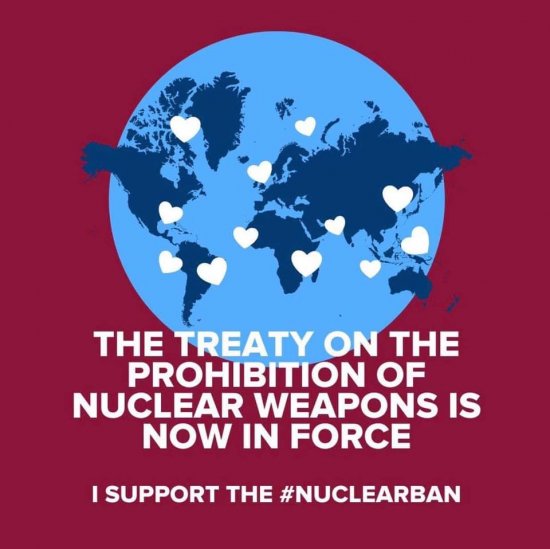
Africa’s strength in numbers in the Treaty on the Prohibition of Nuclear Weapons, also known as the Nuclear Ban Treaty, is a vehicle the continent can use to address nuclear weapons risks, head-on.
Global divide
On one side, nuclear-armed states cling to deterrence for their national security. They insist that possessing nuclear arsenals keeps them safe.
At present, there are nine nuclear-armed states: the US, Russia, the UK, China, France, India, Pakistan, Israel and North Korea. These countries possess around 12,331 nuclear warheads (as of 2025).
The use of only 10% of these weapons could disrupt the global climate and threaten the lives of up to 2 billion people.
On the other side, African countries and other non-nuclear-weapon states such as Ireland, Austria, New Zealand and Mexico highlight how deterrence creates unacceptable risks for the entire international community.
This global majority – the 93 countries that have signed the Nuclear Ban Treaty and 73 that are party to it – argue that real safety comes from eliminating nuclear threats.
The Nuclear Ban Treaty became international law on 22 January 2021. It is the first instance of international law challenging the legality and morality of nuclear deterrence.
Since 2022, states parties to the Nuclear Ban Treaty have held formal meetings to address current nuclear risks. In March 2025, at their third meeting, 17 African states officially recognised nuclear deterrence as a critical security concern. They called on nuclear armed states to end deterrence.
The deterioration of the international security environment is so palpable that there has been a noticeable shift in nuclear ban states’ perception of nuclear threats. Nuclear disarmament is no longer just a humanitarian or moral concern to these states, it is now a national security concern.
South Africa warned that
any use of nuclear weapons would result in catastrophic humanitarian consequences that would have a global impact.
Ghana likewise stressed that Africa is not immune to nuclear war’s fallout:
Africa, despite its geographic distance from the immediate hotspots of nuclear conflict, is not immune to the repercussions of nuclear weapons.
Africa bears a unique historical connection to nuclear issues. Nuclear testing in the Sahara Desert in the 1960s, when France detonated nuclear bombs in Algeria, had devastating consequences. Widespread radioactive contamination harmed local communities, caused long-lasting health problems, displaced populations, and left large areas environmentally damaged and unsafe for generations.
For its part, Nigeria recalled that Africa had “long acknowledged the existential threat nuclear weapons posed to human existence.”
The meeting determined that it is unacceptable that states parties are exposed to nuclear risks, “created without their control and without accountability”. It stressed that eliminating nuclear risks “is a prime and legitimate concern and national responsibility” of states.
Next steps
Delegates effectively asked whether their own national security concerns had less value than those of nuclear-armed states. I think this is a valid question.
Africa’s leaders and their allies in the Nuclear Ban Treaty are reframing what “national security” means in the nuclear age.
Rather than accepting a world perpetually held hostage by the madness of nuclear deterrence, they are asserting that the security of nations – and of peoples – is best served by dismantling this threat to humanity.
They are prioritising human life, development and international law over the threat of overwhelming force.
The outcome of this contest will have profound implications, not just for Africa but for the entire globe.
Walt Zlotow – Why do so many leaders remain stupid about Ukraine war?
Walt Zlotow, West Suburban Peace Coalition, Glen Ellyn IL , 31 Mar 2.
The 3 year long destruction of Ukraine should never have occurred.
Had leaders in the US, NATO and Ukraine simply used common sense, Ukraine would not be a shell of its former self before the February 24, 2022 Russian invasion that has largely destroyed it. Ukraine economy shattered. Hundreds of thousands of dead and wounded. Over 10 million fled. Over 45,000 square miles lost to Russia forever.
This occurred from massive stupidity by all the leaders in the countries involved.
The stupidity starts with US presidents going back to Bill Clinton. In 1999 he broke the deal with USSR/Russia that he would not expand NATO eastward to their borders. From 1999 thru 2023 US relentlessly doubled NATO from 16 to 32 members.
Reasons likely many but all stupid. Smart diplomats, historians and political scientists were aghast, declaring this would inevitably lead to a US Russian confrontation. It took 23 years but stupid presidents Clinton, Bush, Obama, Biden all stupidly succeeded into provoking Russia to attack.
Odd, but only Trump was not stupid enough to add to NATO during his first term. He was however incredibly stupid to begin arming the Kyiv neofascists to wipe out the Russian leaning Ukrainian separatists in Donbas. That, along with NATO expansion, ensured Russia would intervene.
Western European NATO giants England, France and Germany also took their stupidity cue from Uncle Sam. They were getting cheap energy from Russia but stupidly bowed to US demands to weaken, isolate Russia thru NATO expansion and Kyiv warfare on Donbas Ukrainians. They were cool with replacing cheap Russian gas with exorbitant US LNG. Now they’re economies are crumbing, allowing inroads from MAGA like political opponents. Incredibly, instead of recognizing their stupidly, they’re stupidly planning to squander hundreds of billions of their vanishing treasure to keep the war going till they wreck their economies
If we were awarding a Stupid Prize, it must go to Ukraine President Volodymyr Zelensky. The comedian turned politician campaigned for the Ukraine presidency on a platform of peace with the Donbas Ukrainians being brutalized by the Kyiv government. It got him elected with big majority of Donbas voters. Alas, Zelensky was too stupid to realize the Kyiv neofascists would never allow him to make peace with Donbas separatists they sought to destroy. To save his presidency, possibly even his life, Zelensky abandoned his voting base.
Zelensky even stupidly amassed 60,000 elite troops on the Donbas border in early 2022 to finish off his constituents there. All that achieved, along with stupidly begging NATO for membership, was to provoke the Russian invasion.
Once started, Zelensky became stupider and stupider. He wisely prepared to sign a peace deal with Russia in the first 2 months which would have ended the war without Ukraine losing a single square mile of territory. But Zelensky stupidly caved to stupid US and UK leaders who told him he could win with US/NATO weapons…but no troops. That stupidity sent Ukraine into failed state status.
Ukraine is now on the cusp of peace being negotiated 2 leaders, Trump and Putin, employing common sense instead of stupidity. But the US Democratic Party, Ukraine, UK, French, German and other NATO leadership remain mired in stupidity that this senseless war must continue till the last Ukrainian soldier is dead.
They all forget the first rule of sane, peaceful governance: Don’t do stupid.
Trump’s bombing threat over Iran nuclear programme prompts backlash
Guardian, Patrick Wintour Diplomatic editor, 31 Mar 25
Iranian officials accuse US president of breaching UN charter and say ‘violence brings violence’
Iran has reacted with outrage after Donald Trump said the country will be bombed if it does not accept US demands to constrain its nuclear programme.
The US president said on Sunday that if Iran “[doesn’t] make a deal, there will be bombing. It will be bombing the likes of which they have never seen before.”.
Trump’s latest threat – more explicit and violent than any made before – came after he sent a letter to Iran, as yet undisclosed, offering to hold talks on its nuclear programme. Iran had sent a reply to the US stating it was willing to hold indirect talks, officials confirmed.
Esmail Baghaei, the Iranian foreign ministry spokesperson, said of Trump’s threat: “The explicit threat of bombing Iran by the head of a country is clear contradiction to the essence of international peace and security.
Such a threat is a gross violation of the United Nations charter and a violation of the International Atomic Energy Agency safeguards regime. Violence brings violence and peace creates peace, America can choose.”
The supreme leader, Ayatollah Ali Khamenei, a sceptic about talks with the US, said Iran was “not overly concerned” by Trump’s words. “We consider it unlikely that such harm would come from outside. However, if any malicious act does occur, it will certainly be met with a firm
and decisive response,” he said.
Brig Gen Amir Ali Hajizadeh, the commander of the Revolutionary Guard’s aerospace force, said: “Someone in glass houses does not throw stones at anyone,” adding: “The Americans have at least 10 bases with 50,000 troops in the region, meaning they are sitting in a glass house.”
But the Iranian foreign minister, Abbas Araghchi, clearly had authority to keep the prospect of talks alive, saying Iran had already replied to the Trump letter through intermediaries in Oman and adding he knew the Iranian letter had now reached the US. Araghchi said direct talks were not possible while the US continued to threaten and bully Iran………………………………………………………………………………………………………………. https://www.theguardian.com/world/2025/mar/31/trumps-bombing-threat-over-iran-nuclear-programme-prompts-backlash
Iran rejects direct nuclear talks with Trump, open to indirect negotiations
US president threatens Iran with bombings if Tehran does not come to a nuclear agreement with Washington.
Aljazeera, 30 Mar 25
Iranian President Masoud Pezeshkian has ruled out direct negotiations with the administration of US President Donald Trump over the country’s nuclear programme but signalled a willingness for indirect talks, while Trump threatened bombings and secondary tariffs if Tehran does not come to an agreement with Washington.
“We responded to the US president’s letter via Oman and rejected the option of direct talks, but we are open to indirect negotiations,” Pezeshkian said during a cabinet meeting in Tehran on Sunday.
He stressed that while Iran is not against negotiations in principle, Washington must first rectify its past “misconduct” and rebuild trust.
His remarks, reported by the ISNA news agency, come amid escalating tensions between the two nations.
“If they don’t make a deal, there will be bombing,” Trump said in a telephone interview with NBC on Sunday.
“But there’s a chance that if they don’t make a deal, that I will do secondary tariffs on them like I did four years ago.”
Barbara Slavin, a fellow at the Stimson Center in Washington and a lecturer in international affairs at George Washington University, told Al Jazeera that “the Iranians are, right to be distrustful, given Trump’s track record and withdrawing from a previous deal”.
Trump has even signalled willingness to lift sanctions if nuclear and regional issues are resolved, but his ability to secure a deal is uncertain, said Slavin.
“The Iranians are worried, but mostly about the economic impact of Trump’s sanctions, the resumption and increase in economic sanctions, which we’ve already seen. The Iranian currency has depreciated dramatically. There’s high inflation and unemployment, and I think this frankly worries the Iranians more than a physical attack, which if anything, might unify the country,” she added.
“The US has moved additional bombers to Diego Garcia. It’s got another aircraft carrier apparently coming into the region. So it is well positioned to carry out some sort of military action, possibly in conjunction with the Israelis if there isn’t movement toward a diplomatic settlement,” Slavin said……………………………………………………https://www.aljazeera.com/news/2025/3/30/iran-rejects-direct-nuclear-talks-with-trump-open-to-indirect-negotiations
Iran rejects direct talks with the US over its nuclear programme
IRAN will not hold direct negotiations with the United States over its
nuclear programme, President Masoud Pezeshkian said today. Commenting on a
letter sent by US President Donald Trump to Iranian Supreme Leader Ali
Khamenei, Mr Pezeshkian said Iran’s response, delivered via Oman, left
open the possibility of indirect negotiations with Washington.
However, such talks have made no progress since Mr Trump, during his first term in
the White House, unilaterally withdrew the US from Tehran’s nuclear deal
with world powers in 2018. The Iranian president told a cabinet meeting:
“We don’t avoid talks; it’s the breach of promises that has caused
issues for us so far. “They must prove that they can build trust.”
Morning Star 30th March 2025, https://morningstaronline.co.uk/article/iran-rejects-direct-talks-us-over-its-nuclear-programme
Why Ontario won’t consider the nuclear option in its fight over Trump’s tariffs
Although Ontario Premier Doug Ford vowed that his
government would “not back down,” “apply maximum pressure” and
“keep up the fight” in the Canada-U.S. trade war, one nuclear option is
off the table: cancelling contracts to build American power reactors.
The province’s utility, Ontario Power Generation, is on the cusp of starting
construction of the first of four BWRX-300 small modular reactors, or SMRs,
at Darlington Nuclear Generating Station in Clarington. They’re designed
by Wilmington, N.C.-based GE-Hitachi Nuclear Energy, a stalwart of the
U.S.‘s nuclear industry. While the cost hasn’t been disclosed yet, the
first reactor is likely to cost several billion dollars.
Globe & Mail 30th March 2025,
https://www.theglobeandmail.com/business/article-why-ontario-wont-consider-the-nuclear-option-in-its-fight-over-trumps/
EUROPE’S DESPERATE GAMBIT
Russian and Eurasian Politic,sby Gordonhahn, March 31, 2025, https://gordonhahn.com/2025/03/31/europes-desperate-gambit/
Ukraine’s battlefronts and army continue to slowly crumble under the pressure of the Russian army’s advance east. The Maidan regime is beginning to eat itself. Yuliya Tymoshenko is being courted by Kiev’s former key backer, Donald Trump’s new America. Former president and Zelenskiy-indicted opposition leader Petro Poroshenko calls Zelenskiy “a dictator.” Kiev’s Mayor Vitaliy Klichko and Zelenskiy’s former aide Oleksiy Arestovich have done much the same, and the latter has announced his intent to run for president. And well-armed neofascist army units, some at the corps level, await their moment to ‘finish Ukraine’s nationalist revolution, which the oligarch-dominated Maidan regime, they say, only began.
On this catastrophic background, Europe is radically opposed to Trump’s new détente with Vladimir Putin’s Russia and rather than pursuing an end to the NATO-Russia Ukrainian War is planning what will prove to be an only partially realizable rearmament campaign to restock its own weapons stores and refill those of Ukraine’s deteriorating army. By supplying military and financial aid to Kiev, Europe can block any ceasefire and prolong Ukraine’s agony. At the same time, Britain and France are spearheading a reckless plan to deploy ‘peacekeeping troops’ from a ‘coalition of the willing’ recruited from among the EU’s member-states.
Moscow has repeatedly warned that any troops from NATO member-states will be regarded as legal military targets. This European ‘maximum plan’ would not only undermine U.S. President Donald Trump’s ceasefire and peace treaty efforts but would create a ‘trip wire’ that Paris and London hope Moscow will touch so the U.S. will be compelled to intervene militarily in direct rather than by proxy fashion as hitherto. Thus, Europe hopes to continue a policy orientation that has helped to destroy Ukraine, pushed the West towards authoritarianism, and weakened many of its own ruling parties and governments.
However, this policy orientation of NATO expansion, Ukrainian victory at seemingly all costs, and subjugation of Russia has begun to split not just the Trans-Atalantic core of NATO and the Western community. It is driving a wedge into Europe, forcing a schism, generally speaking, between Western, Central, and Northern Europe, on the one hand, and Eastern and Southern Europe, on the other hand.
In the north and west, Great Britain, France, Portugal, Germany, Poland, the Baltic states, and Scandinavia prefer to continue the Ukrainian war for years in the hope that Putin wil leave the scene, an upheaval will occur in Moscow, and a new Russian administration or even regime will be weaker on the battlefield or more amenable to compromises.
Countries in Eastern and Southern Europe such as Hungary, Serbia, Slovakia, and Croatia support an end to the war outright and Trump’s general effort to achieve it. Romania’s population has moved in this direction, but the election of anti-war Calin Giorgescu has been blocked by the government and, apparently, the EU itself.
Italy (Germany too) has balked at Anglo-Franco plans to organize European peacekeeping contingents for deployment to Ukraine, even as Washington rejects the idea and Russia has given to understand in no uncertaine terms that any such troops will be treated as legitimate, legal military targets by Russia’s armed forces. Italy, Portugal, Spain, and even France are opposing the EU proposal to provide up to 40 billion euros ($43.67 billion) in military aid for Ukraine this year, which would be a doubling of its support ion 2024 (https://t.me/stranaua/189942).
Yet France is leading the effort to deploy ‘peacekeepers’ in Ukraine. While Denmark, Estonia, and Lithuania are leaders in backing Ukraine, having devoted more than 2 percent of their GDPs to the war since February 2022, support has been limited from Italy, Slovenia, Spain, Portugal, Greece and Cyprus, each of which has provided less than 0.5% of their GDPs (www.reuters.com/world/europe/italy-spain-not-ready-back-eu-plan-boost-ukraine-military-aid-2025-03-17/).
EU member states will be tested as Trump follows through on his threat to level high tarriffs against European states for any continuation of their support for Kiev or at least for their resistance to Trump’s peace efforts.
What Europe should be doing is joining the Trump administration in attempting to put an end to the bloodshed in and ruin of Ukraine. More generally, as Trump seems to understand, a more benign Western policy vis-à-vis Russia’s national security, NATO expansion, and a new security architecture that will serve all from Vladivostok to Vancouver, inlcuding Kiev.
A general peace formula in Eastern Europe must be based on two fundamental principles:
(1) States on Russia’s borders should seek modus vivendi with great power neighbor and
(2) other great powers refrain from drawing adjacent neighbors out of Moscow’s orbit, which is impossible without putting the local neighbors’ national security at risk.
Some might counter: But at the end of the Cold War the West succeeded in removing from Moscow’s orbit numerous East European states without provoking Moscow to war. This was an anomaly in world history in which a declining power prioritized good relations with a former foe over maintenance of its external empire, which was crumbling from within in as Moscow’s USSR was.
Russia is not crumbling from within, despite the West’s best efforts; rather, it is strengthening on the basis of effective leadership and robust relations, including profitable foreign trade with the Rest or non-Western world. The USSR had little economically effective trade relations with the outside world and squandered its finances and economic growth in the attempt to support ‘color’ revolutions by comunist and national liberation movements in the ‘Third World’, today’s Rest. Under such a scheme Kiev, Kishinev, Tbilisi, Baku, Yerevan, and, yes, Riga, Tallinn, Vilnius, and Warsaw should follow the Cold War Finnish model and profit therefrom. NATO is a troublemaker in the region, and the trouble it incites will rain down on the Eastern European states first and foremost.
Western and Eastern Europeans. Their arrogant leaders, deluded by visions of granduer and a Woke dystopia, are drunk on their own generously spiked Cool Aid: a mixture of Western superiority and rights to remake the world as the West sees proper (and profitable) at any minute in time and a perverse, historical russophobia that clouds the mind, inuring it of all realism and simple common sense.
Trump Threatens Iran With ‘Bombing’ If Nuclear Deal Is Not Reached

no evidence Iran is trying to build a nuclear weapon or that Iranian Supreme Leader Ayatollah Ali Khamenei has reversed his 2003 fatwah that banned the production of weapons of mass destruction.
The threat comes after US intelligence agencies reaffirmed that Iran is not building a nuclear weapon
by Dave DeCamp March 30, 2025, https://news.antiwar.com/2025/03/30/trump-threatens-iran-with-bombing-if-no-nuclear-deal-is-reached/
President Trump on Sunday threatened to bomb Iran if a deal isn’t reached on the country’s civilian nuclear program.
“If they don’t make a deal, there will be bombing. It will be bombing the likes of which they have never seen before,” Trump told NBC News in a phone interview.
The president has made similar threats toward Iran, but Sunday’s marked the most explicit one yet, and it comes as the US is sending more bombers to the region and pounding Yemen with daily airstrikes. Trump also said the US could hit Iran with “secondary tariffs” if a deal isn’t reached.
Trump’s threat comes after US intelligence agencies said in their annual threat assessment that there’s no evidence Iran is trying to build a nuclear weapon or that Iranian Supreme Leader Ayatollah Ali Khamenei has reversed his 2003 fatwah that banned the production of weapons of mass destruction.
Iran recently responded to a letter Trump sent to Khamenei proposing nuclear talks and giving Tehran a two-month deadline to reach a deal. A US official told Axios that the deployment of US B-2 bombers to Diego Garcia was “not disconnected” from that deadline.
Iranian officials have repeatedly rejected the idea of direct talks with the US in the face of Trump’s so-called “maximum pressure campaign” but have left the door open to indirect negotiations.
Iranian President Masoud Pezeshkian said Sunday that Iran’s response to Trump’s letter made indirect talks possible but that the US’s behavior would determine how things would move forward.
“While Iran’s response rules out the possibility of direct talks between the two sides, it states that the path for indirect negotiations remains open,” Pezeshkian said. Iranian officials have been noting the fact that Trump was the one who tore up the 2015 nuclear deal by reimposing sanctions on Iran.
“As we have stated before, Iran has never closed the channels of indirect communication. In its response, Iran reaffirmed that it has never shied away from engaging in negotiations, but rather, it has just been the United States’ repeated violations of agreements and commitments that have created problems on this path,” Pezeshkian said.
“It’s the behavior of the Americans that will determine whether the negotiations can move forward,” the Iranian leader added. In his interview with NBC, Trump said that US and Iranian officials were talking but didn’t elaborate further.
Trump threatens bombs if Iran doesn’t make nuclear deal
Canberra Times, By Doina Chiacu and David Ljunggren, March 31 2025
US President Donald Trump has threatened Iran with bombing and secondary tariffs if Tehran does not come to an agreement with Washington over its nuclear program.
In Trump’s first remarks since Iran rejected direct negotiations with Washington last week, he told NBC News on Sunday that US and Iranian officials were talking, but did not elaborate.
“If they don’t make a deal, there will be bombing,” Trump said in a telephone interview.
“It will be bombing the likes of which they have never seen before.”
“There’s a chance that if they don’t make a deal, that I will do secondary tariffs on them like I did four years ago.”
Iran sent a response through Oman to a letter from Trump urging Tehran to reach a new nuclear deal, saying its policy was to not engage in direct negotiations with the United States while under its maximum pressure campaign and military threats, Tehran’s foreign minister was quoted as saying on Thursday.
Iranian President Masoud Pezeshkian reiterated the policy on Sunday. “Direct negotiations (with the US) have been rejected, but Iran has always been involved in indirect negotiations, and now too, the Supreme Leader has emphasised that indirect negotiations can still continue,” he said, referring to Ayatollah Ali Khamenei.
In the interview, Trump also threatened so-called secondary tariffs, which affect buyers of a country’s goods, on both Russia and Iran. He signed an executive order last week authorising such tariffs on buyers of Venezuelan oil…………………………………….. https://www.canberratimes.com.au/story/8930263/trump-threatens-bombs-if-iran-doesnt-make-nuclear-deal/
1 This Month

26 September – International Day for the Total Elimination of Nuclear Weapons


PLEASE OPPOSE HR 8255 AND S.3639 – bills would accelerate satellite deployment, with no environmental review or safeguards – https://ncstd5li.quorum.us/campaign/169331/
To see nuclear-related stories in greater depth and intensity – go to https://nuclearinformation.wordpress.com
-
Archives
- September 2026 (206)
- August 2026 (330)
- July 2026 (355)
- June 2026 (287)
- May 2026 (306)
- April 2026 (356)
- March 2026 (251)
- February 2026 (267)
- January 2026 (308)
- December 2025 (358)
- November 2025 (359)
- October 2025 (375)
-
Categories
- 1
- 1 NUCLEAR ISSUES
- business and costs
- climate change
- culture and arts
- ENERGY
- environment
- health
- history
- indigenous issues
- Legal
- marketing of nuclear
- media
- opposition to nuclear
- PERSONAL STORIES
- politics
- politics international
- Religion and ethics
- safety
- secrets,lies and civil liberties
- spinbuster
- technology
- Uranium
- wastes
- weapons and war
- Women
- 2 WORLD
- ACTION
- AFRICA
- Atrocities
- AUSTRALIA
- Christina's notes
- Christina's themes
- culture and arts
- Events
- Fuk 2022
- Fuk 2023
- Fukushima 2017
- Fukushima 2018
- fukushima 2019
- Fukushima 2020
- Fukushima 2021
- general
- global warming
- Humour (God we need it)
- Nuclear
- RARE EARTHS
- Reference
- resources – print
- Resources -audiovicual
- Weekly Newsletter
- World
- World Nuclear
- YouTube
-
RSS
Entries RSS
Comments RSS
 nuclear-news