Israel attacks the United Nations
Contrary to popular belief, the United Nations General Assembly has only accepted Israel’s membership conditionally (resolution 273). However, Tel Aviv has never respected its commitments. It refuses to implement 229 resolutions of the Security Council and the General Assembly. It has just declared a UN agency a “terrorist organization,” called for its headquarters in New York to be razed, designated its Secretary General António Guterres persona non grata, and has just attacked four times UN peacekeepers in Lebanon (UNIFIL), wounding two blue helmets.
Voltaire Network | Paris (France) | 15 October 2024 by Thierry Meyssan, https://www.voltairenet.org/article221376.html
Israel has just attacked a position of the UN peacekeepers in Lebanon. When the British withdrew from Mandatory Palestine (i.e. Palestine placed by the League of Nations under the provisional administration of the United Kingdom) on May 14, 1948, the Zionist General Council, an offshoot of the Haganah (i.e. the main militia of the immigrant Jewish community), unilaterally proclaimed the independence of the State of Israel. It was announced by the chairman of the Jewish Agency (i.e. the executive of the World Zionist Organization).
It is important to note here that the British occupier withdrew from only about a quarter of Mandatory Palestine. It had already officially left the other three quarters, constituting Mandatory Transjordan, the future Jordan.
After a few days of reflection, the United Nations General Assembly decided to recognize the new state, not without having emphasized that in principle, it was not up to a militia, the Haganah, to proclaim a state, even if this proclamation came to fill the void left by the departure of the mandatory authority, that is to say the British. The General Assembly had noted that the proclamation of independence said nothing about the regime of this state (theocracy or republic), nor about its borders. It intended to pursue its plan for the creation of a binational state, both Arab and Jewish, without territorial continuity between the two entities (Jerusalem and Bethlehem having an international status). It had been reassured by the new state’s reference to “complete equality of social and political rights for all citizens without distinction of belief, race and sex.”
The day after independence, Egypt, Iraq, Transjordan, Lebanon, Syria and Yemen sent their armies to Palestine. Official history today assures that these six countries (the “Arabs”, understand the “Muslims”) did not accept a Jewish state, while five of them opposed Jewish colonization after British colonization and the sixth supported Israel. Religion was a problem only for Izz al-Din al-Qassam, the Muslim Brotherhood and the Nazi mufti Mohammed Amin al-Husseini.
Identicaly, propaganda assures that these armies were defeated by the valiant Israeli army, implying “from the first day, the Jews are morally superior to the Arabs”. The reality was quite different. The world war had just ended and none of these countries, except Transjordan, had an army worthy of the name.
Their troops were exclusively formed of volunteers. In addition, the Transjordanian army, which ended the conflict, fought on the side of Israel against the other Arabs. Indeed, Transjordan, still under British influence, hoped to prevent the creation of a Palestinian state and annex its territory. Its army was none other than that of the British (the “Arab Legion”) and was still placed under the command of General John Bagot Glubb (alias “Glubb Pasha”). It was the Transjordanians (in fact the British) and not the Israelis who defeated the other Arab armies.
During the conflict, its sovereign, King Abdullah I was also proclaimed “King of Palestine.” During this conflict, the Israeli forces let the British of Transjordan fight against the Arabs and applied Plan D (in Hebrew: Plan “Dalet”). The Haganh intended to share as little territory as possible with Transjordan. Israeli forces illegally imported weapons from Czechoslovakia (already ruled by the communists), probably with the agreement of the USSR, supposedly to fight against British colonization, in reality to expel the Palestinians. This is the Nakhba (catastrophe). 750,000 Palestinians (between 50 and 80% of the population) were forcibly displaced.
Israel requested and obtained, the following year, its membership in the United Nations. At that time, no decolonized state was part of it. The countries under Anglo-Saxon influence were in the majority. However, they only accepted Israel under conditions. In its resolution 273, the UN General Assembly referred to a written commitment by the Minister of Foreign Affairs of the provisional government of Israel, Moshe Shertok, by which he “accepts without any reservation the obligations arising from the Charter of the United Nations and undertakes to observe them from the day it becomes a Member of the United Nations” [1].
To date, Israel has failed to uphold this commitment and has failed to comply with 229 Security Council and General Assembly resolutions. Its membership could therefore be suspended at any time.
In recent months,
• Israeli Foreign Minister Israel Katz said on March 23 that the UN had become “an anti-Semitic and anti-Israeli organization that harbors and encourages terrorism.”
• Israel has campaigned against a UN agency, the United Nations Relief and Works Agency for Palestine Refugees in the Near East (UNRWA), accusing it of serving Hamas. Last July, the Knesset passed three laws (1) banning UNRWA from operating on Israeli territory (2) stripping its staff of diplomatic immunities (3) declaring it a terrorist organization.
• Israel’s permanent representative to the United Nations, Gilad Erdan, declared at the end of his term last August, speaking from the UN headquarters in New York, that “this edifice must be razed from the face of the Earth.”
• Israeli Foreign Minister Israel Katz declared UN Secretary-General António Guterres persona non grata.
• The Israel Defense Forces (IDF) deliberately targeted French, Italian and Irish soldiers of the United Nations Interim Force in Lebanon (UNIFIL).
The bottom line:
• Israel was not created by its people, but by its army.
• The first Arab-Israeli war was not won by the Israelis, but by the Arabs of Transjordan under British command.
• By joining the United Nations, Israel committed itself to respecting all its resolutions, which it has violated 229 times.
• After Palestine, Lebanon, Syria, Iraq, Yemen and Iran, the Netanyahu government has opened an eighth front against the United Nations.
Israel’s War on the United Nations
October 15, 2024, by: Dr Binoy Kampmark, https://theaimn.com/israels-war-on-the-united-nations/
The United Nations is an easy body to hate. At times, it seems to be effusion without substance, body with no backbone. It was conceived in a fit of post-war idealism, when egos were humbled and hatred briefly stemmed. Over the ruins of the Second World War, the builders were favoured over the destroyers and mischief makers – at least for a time.
On its establishment, the UN became a hostage to the political intrigues and power blocs that have continued to plague it for its duration. Of particular concern was the body’s pursuit of international law protocols – formulation, drafting and implementation. A central feature of this: resolutions passed by various bodies, the most significant being by the UN Security Council. Such measures are followed by nation states when convenient, ignored when not.
One such nation state in the mischief making class is Israel. Its relationship with the UN has often been tetchy. The Anti-Defamation League, for instance, admits that the body “played a pivotal role in the establishment of the Jewish State by passing UN Resolution 181 in 1947.” The resolution, with its hefty consequences, called for “the partition of British Mandate Palestine into two states, one Jewish and one Arab.” The same organisation, however, goes on to note with satisfaction the remarks in April 2007 by then UN Secretary-General Ban Ki-Moon: “Unfortunately, because of the [Israeli-Palestinian] conflict, Israel’s been weighed down by criticism and suffered from bias – and sometimes even discrimination.”
For various periods of its history, Israel has felt hard done by in the international forum. The folder of resolutions against it has burgeoned. Notable ones include UNSC Resolution 242 (1967) which asserts, in accordance with the UN Charter principles, that a “just and lasting peace in the Middle East” includes the withdrawal of Israel’s armed forces from territories occupied during the Six Day War and the termination of territorial claims and affirmation of sovereignty of all States in the area. UNSC Resolution 338 (1973), passed in response to the Yom Kippur War between Israel, Egypt and Syria, called on the parties to cease hostilities within 12 hours and implement Resolution 242 “in all its parts.”
UN Resolution 2334, passed in December 2016, particularly hurt, striking at the expansionist, displacing drive of the Jewish state through settlements in occupied territory that amount to de facto colonisation. It particularly condemned “all measures aimed at altering the demographic composition, character and status of the Palestinian Territory occupied since 1967, including East Jerusalem.” This included, among other matters, the expansion of the settlements, the transfer of Israeli settlers, the confiscation of land and the displacement of Palestinian civilians.
Instead of seeing such a measure as a clear assessment of predation in breach of international law and the principles of the UN Charter, Israel’s Ambassador to the UN, Danny Danon, called it an unnecessary reward to the Palestinians “to continue down a dangerous path they have chosen” in avoiding direct negotiations with Israel. That Israel cared not a jot on that score hardly mattered.
A number of recent incidents reveals the poor regard the United Nations is held in, notably within Israel’s warring circles. Its agency aiding Palestinians, UNRWA, is threatened by two bills before the Israeli parliament that will significantly hamper its operations by evicting the body from its premise in territories within Israel’s control. The proposed laws will also abolish any associated privileges and immunities. Having failed to convince all major donors to the organisation that it should be defunded for being packed with Hamas apologists and operatives (the evidence has always been paltry on that score), the Israeli government is using a legal sledgehammer fashioned by the Knesset.
The passage of the bills, warns UN Secretary-General António Guterres, “would effectively end coordination to protect UN convoys, offices and shelters serving hundreds of thousands of people.” The provision of shelter, food and healthcare “would grind to a halt” without the agency. Some 600,000 children “would lose the only entity that is able to re-start education, risking the fate of an entire generation.”
With Israel’s broadening campaign against Hezbollah to the north, the UN Interim Force in Lebanon (UNIFIL) is facing continuous harassment by the Israel Defense Forces (IDF). Established in 1978 by the Security Council to confirm the withdrawal of Israel from Lebanon and aid Lebanese authorities restore peace and security in the area, UNIFIL has been a source of endless irritation to the IDF’s operations.
In an October 13 statement, UNIFIL revealed that two IDF Merkava tanks at 4.30 that morning had gone about the business of destroying the main gate of their post in Ramyah, near the Israeli border. The tanks forcibly entered, after which Israeli personnel demanded that the base turn out its lights. “The tanks left about 45 minutes later after UNIFIL protested through our liaison mechanism, saying that IDF presence was putting peacekeepers in danger.”
At 6.40 am, peacekeepers at the same post reported the firing of several smoke emitting rounds 100 metres to the north. “Despite putting on protective masks, fifteen peacekeepers suffered effects, including skin irritation and gastrointestinal reactions, after the smoke entered the camp.”
On October 14, persisting in its approach of impeding and harrying the peacekeeping force, the IDF halted “a critical UNIFIL logistical movement near Meiss ej Jebel, denying it passage. The critical movement could not be completed.”
The statement goes on to remind the IDF about its obligations to ensure the safety and security of the UN peacekeepers and property. Breaching a UN position violated UN Security Council Resolution 1701 (2006), while any deliberate attack on peacekeepers was aserious violation of international humanitarian law, in addition to breaching resolution 1701.
In an almost disdainful manner, the IDF suggested in a statement that the peacekeepers had entirely misunderstood the brutal encroachment. The actions had been motivated by goodwill to evacuate soldiers wounded by an anti-tank missile. “For the sake of evacuating the wounded, two tanks drove backwards, in a place where they could not advance otherwise in light of the threat of shooting, a few metres towards the UNIFIL position.” The smokescreen had been created to aid the evacuation, while the entire operation was conducted throughout with continuous contact with the UN peacekeepers. After a time, the dressing of lies becomes tatty and banal.
Typically, it fell to the Israeli Prime Minister, Benjamin Netanyahu, to shed some light on the mendacious fog. UNIFIL, he suggested, had to immediately withdraw its forces from southern Lebanon. “It is time for you,” stated the PM in a pointed message to Guterres, “to withdraw UNIFIL from Hezbollah strongholds and from the areas of combat.” Yet again, international law which, in this case, provides legitimacy to the UN peacekeeping operations in the area, could be treated as a tissue easily torn.
Biden should channel Trump and talk to Putin.
Walt Zlotow, West Suburban Peace Coalition, Glen Ellyn IL 14 Oct 24
Democrats are using revelations of candidate Trump’s talks with Russian President Putin to bash him as a ‘Putin Puppet.’ Bob Woodward’s new book ‘War’ claims there have been at least 7 such talks since Trump left the White House, including this year.
President Biden, unlike Trump, has spoken not a word with Putin for all 45 months of his presidency. That willful silence by Biden puts us all at greater risk of the US stumbling into nuclear war with Russia over the conventional war in Ukraine.
Had Biden picked up the phone to discuss Putin’s concerns over US sponsored NATO membership in 2021, war in Ukraine could have been easily avoided. Over half a million Ukrainian soldiers would be alive. Millions would not have been forced to flee to other countries or locales within Ukraine. The 20% of eastern Ukraine now forever lost to Russia would still be under Ukrainian sovereignty. Ukraine’s economy would not be on life support kept alive by NATO’s endless billions.
Biden was simply following US policy going back to the George W. Bush administration to keep Russia out of the Western European political economy by phantacizing Russia as a threat, not an economic partner. The linchpin for such isolation was NATO membership for Ukraine allowing a NATO military buildup on their Ukrainian border.
Isolating Russia was so important to the US that they supported a 2014 coup against the Russian leaning Ukrainian president because he was about to cooperate economically with Russia. That coup demonstrated America’s total hypocrisy championing democracy. It led the Russian leaning Ukrainians in Donbas to seek separation from the Kiev ultranationalists seeking to snuff out their Russian culture.
America’s response was not to support an end to Kyiv’s oppression but to fund it with hundreds of millions in US weapons. Putin’s Russia spent 7 years using diplomacy to stop Kyiv’s repression and keep Ukraine out of NATO. In November 2021, Putin made his last overture to Biden to negotiate Russia’s NATO and Eastern Ukrainian separatists’ concerns. Instead of doing the sensible, diplomatic step of free and open negotiation, Biden, thru his emissaries, essentially told Putin to ‘Go to Hell.’
Instead, Putin went to war, which has now largely destroyed Ukraine as a functioning country, spelling the end of US political dominance in Europe. Senseless US action provoking this unfolding catastrophe is possibly the worst diplomatic blunder in US history.
NATO stands for North Atlantic Treaty Organization. What it should stand for is No Action Talk Only.
NATO state’s PM pledges to block Ukrainian membership
https://www.rt.com/news/605332-nato-state-kiev-never-join/ 11 Oct 24
Admitting Kiev into the US-led bloc could trigger a global war, Slovak Prime Minister Robert Fico has said
Slovak Prime Minister Robert Fico has said that his country will not allow Ukraine to join NATO as long as he is in power. Admitting Kiev into the US-led military alliance would trigger a new world war, he warned in an interview with STVR on Sunday.
“As long as I am the prime minister of the Slovak Republic, I will lead the legislators, whom I have control over as a party chairman, to never agree to Ukraine’s membership in NATO,” Fico said. “Ukraine’s entry into NATO would serve as a good basis for a third world war.”
Fico, a longtime critic of Western military and financial aid to Ukraine, has insisted that the conflict must be resolved through diplomatic means. He has repeatedly warned against further escalation with Moscow.
The accession of new countries must be approved by all of NATO’s 32 members, with national parliaments voting in favor of or against new candidates.
Kiev formally applied to join NATO in September 2022, citing the conflict with Russia. While many Western states publicly back Ukraine’s aspirations, they have refused to provide a concrete roadmap or timetable for accession. Ukrainian leader Vladimir Zelensky acknowledged in July that “we will not be in NATO until the war is over in Ukraine.”
Russia views NATO’s expansion eastward as a security threat and has cited Ukraine’s cooperation with the bloc as one of the main reasons behind the conflict.
President Vladimir Putin warned last month that using Western-supplied longer-range weapons for strikes deep inside Russia would be tantamount to “direct involvement” of NATO in the conflict.
Biden Allowing Israel to March US Into War With Iran
By cooperating with Israel in a new attack, the United States is assisting a state that has been responsible for most of the escalation and the vast majority of death and destruction in the Middle East for at least the past year.
Common Dreams, Paul Pillar. Oct 07, 2024, Responsible Statecraft
The Biden administration is not only endorsing but also on the verge of actively assisting a new Israeli armed attack on Iran. National security adviser Jake Sullivan says that the United States is working directly with Israel regarding such an attack. “The United States is fully, fully, fully supportive of Israel,” declares President Joe Biden.
The projected attack serves no U.S. interests. The attack perpetuates a broader pattern of escalating violence in the Middle East that also serves no U.S. interests. The Iranian missile salvo to which the coming Israeli attack is ostensible retaliation was itself retaliation for previous Israeli attacks. Retaliation for retaliation is a prescription for an unending cycle of violence.
The United States is facilitating an attack on a nation that does not want war and has been remarkably restrained in trying to avoid it, in the face of repeated Israeli provocations. A sustained Israeli bombing campaign against Iranian-related targets within Syria elicited a response only when it escalated to an attack on a diplomatic compound in Damascus, killing senior Iranian officials. Even then, the Iranian response, in the form of an earlier salvo of missiles and drones in April, was designed and telegraphed in a way to make a show of defiance but — with most of the projectiles certain to be shot down — to cause minimal damage and almost no casualties.
When Israel assassinated visiting Hamas political leader Ismail Haniyeh in a government guest house in Tehran in July — the sort of attack that would elicit a quick and forceful response by the U.S. or Israel if it happened in one of their capitals — Iran did nothing until last week. It finally acted only after yet another Israeli attack — this time an assault on residential buildings in a suburb of Beirut that killed a senior Iranian Revolutionary Guard officer along with Hezbollah secretary-general Hassan Nasrallah. Far from being motivated by any grandiose ambitions of regional dominance or desire to destabilize the region, Iranian leaders believed that they were getting killed by a thousand cuts from Israel and that they had to respond to the repeated Israeli attacks lest they lose the confidence not only of their own people but of regional allies. The missile firings that constituted Iran’s retaliation, like the ones in April, again caused minimal damage or casualties.
By cooperating with Israel in a new attack, the United States is assisting a state that has been responsible for most of the escalation and the vast majority of death and destruction in the Middle East for at least the past year. Although Hamas’ attack on southern Israel last October is commonly seen as the starting point of the subsequent mayhem in the Middle East, the question of who is responding to whom could go back farther than that. For example, the 1,200 deaths from that Hamas attack, horrible to be sure, were fewer than the number of Palestinians that Israel had killed in the occupied West Bank and the Gaza Strip just from the day-to-day operations of the occupying Israeli army, supplemented by settler violence in the West Bank, during the previous eight years.
Since the Hamas attack, the devastating Israeli operation in the Gaza Strip has gone far beyond anything that can be construed as defense, or even as a response to Hamas, and has brought suffering to innocent civilians that is orders of magnitude greater than anything Hamas or any other Palestinian group has ever done. The still-rising official death toll exceeds 41,000, with the actual number of Palestinian deaths probably much higher and likely into six figures. Much of the Strip has been reduced to rubble and rendered unlivable.
After Hezbollah fired rounds into Israel last October in a show of support for the Palestinians in Gaza, the story of conflict along the Israeli-Lebanese frontier has mainly been one of repeated Israeli escalations. Israeli attacks in Lebanon have far exceeded Hezbollah attacks on Israel, in number but especially in physical effects, with almost no casualties within Israel apart from a few military personnel at the border. The rapidly rising toll of deaths in Lebanon from Israeli attacks has now passed 2,000, with about 10,000 injured and about 1.2 million people displaced from their homes. As in the Gaza Strip, civilians constitute much and perhaps most of that toll, including as a result of Israeli airstrikes that have demolished residential buildings in densely populated neighborhoods.
As a growing Israeli ground assault in Lebanon accompanies the aerial bombardment, Israel has told people in almost the entire southern third of Lebanon to move north, even though Israel already has been conducting lethal aerial attacks throughout Lebanon, including as far north as Tripoli. This also is reminiscent of the pattern in Gaza, in which residents are told to move, only to be bombed again in their new location……………………………………………………………………………………………………………………………………..
Israel has already entrapped the United States to a large degree in its lethal ways in the Middle East, and the entrapment threatens to become deeper with the anticipated new attack on Iran. The entrapment would not have been possible without mismanagement of the U.S.-Israeli relationship on the Washington end. President Biden’s approach of holding Netanyahu close in the hope of influencing his policies has failed. It also has been counterproductive. In the absence of any willingness to employ the leverage that U.S. material aid to Israel represents, all the bear-hugging and expressions of support have only reassured Netanyahu that he can continue to prosecute his wars and ignore American calls for restraint without losing that aid.
It is refreshing to see reports that at least within the Department of Defense there is some recognition that the policy has been counterproductive by emboldening Israel to escalate. It is perhaps unsurprising that the department whose personnel would be on the front line of any expanded warfare involving the United States is more willing than others to recognize the nature and sources of the violence plaguing the Middle East and the need to deter or restrain Israel rather than embolden it. One can only hope that this willingness will spread more widely in policymaking circles. https://www.commondreams.org/opinion/biden-israel-war-with-iran?fbclid=IwY2xjawFyg3dleHRuA2FlbQIxMAABHRouKaR2ZR-gz5KkJIrj7Lz4yB_yy0cppu3rr4KzPnZL0PIvnbHrmshjLg_aem_SGLFnpWmqgyty62qiA5Trg
IAEA Missing in action, on Israeli nuclear strike threats, Iranian outlet argues
Oct 9, 2024, https://www.iranintl.com/en/202410096802
As anticipation mounts over a potential counterstrike by Israel on Iran which could target nuclear sites, an Iranian media outlet has faulted the UN nuclear watchdog’s silence on the issue.
The relatively moderate Iranian news site Rouydad24 wrote in an editorial on Wednesday that despite the possibility of attacks on Iran’s nuclear infrastructure, the International Atomic Energy Agency’s (IAEA) silence was perplexing.
“Should this silence be interpreted as tacit approval for such an attack, or does it imply the IAEA sees no reason for concern on this issue?” the editorial asked, suggesting that the agency’s silence could be interpreted as either passive endorsement or indifference to the potential threat.
The website characterized Western and Israeli discussions about the possibility Israel will destroy Iran’s nuclear capabilities as a warning sign that the IAEA should intervene.
Publication of such articles in the tightly controlled Iranian media may indicate that the government’s top policy bodies have agreed or prompted a particular point of view to be made public.
The article may be an attempt by Iran to raise the issue of an IAEA intervention to stop a possible Israeli attack on its nuclear sites, especially since the US government has also voiced opposition to such a move.
Historically, the IAEA has remained neutral on political matters while stressing the importance of nuclear facility safety. Its statements generally focus on the consequences of strikes such as a potential radioactive release rather than on endorsing or opposing any party in a conflict.
Following Russia’s invasion of Ukraine the IAEA took an unusually vocal stance on nuclear safety, especially around the Zaporizhzhia Nuclear Power Plant. Director-General Rafael Grossi has repeatedly warned of the severe risks from military actions near nuclear reactors and has called for a protective zone around ZNPP to prevent a potential radioactive disaster.
The outlet went on to posit that the IAEA’s silence on a possible Israeli strike on Iranian nuclear sites could be seen as an indication that the agency perceives Israel’s threats not as imminent actions but as strategic moves aimed at influencing Iran’s stance and pressuring the US to meet certain demands.
Last year, Grossi condemned what he called Iran’s “disproportionate and unprecedented” move to bar multiple inspectors assigned to the country, hindering the UN nuclear watchdog’s oversight of Tehran’s atomic activities.
The editorial may highlight a catch-22: by barring inspectors, Iran itself has limited the IAEA’s influence and capacity to respond effectively to the looming threat of a possible strike by Israel on nuclear targets.
Tehran’s removal of inspectors not only limits the IAEA’s influence but also isolates Iran further from the international system, complicating any calls for international intervention to prevent Israeli strikes.
As a threshold nuclear state, Iran has accumulated highly enriched fissile material for producing a nuclear weapon, though it has not yet taken the final step toward weaponization.
Although Tehran has consistently argued that its nuclear program is meant for peaceful purposes, the current state of its nuclear program, experts say, could act as a deterrent against Israeli aggression.
Some military analysts argue that Israel would require US assistance to effectively strike Iran’s nuclear targets. Despite this, the Biden administration has not received any assurance from Israel that targeting Iran’s nuclear facilities is off the table, according to a senior US State Department official who spoke to CNN last week.
Michael Hudson and Richard Wolff: Middle East Exploding, Ukraine Crumbling, US to Take Action?
Mr Zelenskyy in the Ukraine, and Mr. Netanyahu in Israel have no hope of prevailing, given the odds against them – the sheer numbers.
Israel can’t fight five wars at the same time…………….Their only hope is to bring the United States in……………………………….fighting to the last Ukrainian is now being superseded by fighting to the last Israeli.
that visceral hatred of Islam that the Zionists had, or also the visceral hatred of Russia, specifically for anti-Semitism of past centuries,
there’s no solution to the black hole that Israel’s painted itself into………And yet, there’s no willingness to have a single state
marriage of convenience here between the Zionists …and…it’s in the evangelical community…..The biggest festivals every year of Israeli films are held in mega-churches of the Protestant faith in this country, not in synagogues.
the opponents of all this are the U.S. military……who say that if you really want to extend the war, it’s not going to work
I think that the State Department and the National Security Agency and the Democratic Party leadership, with its basis in the military-industrial complex, is absolutely committed to “if we can’t have our way, then who wants to live in such a world.” …………. what Putin said was, “well, who wants to live in a world without Russia after all?”……………………………..That’s the mentality we’re dealing with
By Dialogue Works, October 8, 2024, https://scheerpost.com/2024/10/08/michael-hudson-and-richard-wolff-middle-east-exploding-ukraine-crumbling-us-take-action/
Transcript
NIMA: So nice to have you back, Richard and Michael. And let me just manage this. And let’s get started with the main question here that would be: Why is the United States not interested in putting an end to the conflict in the Middle East and in Ukraine? Which we know in both of these cases, they’re capable of doing this.
And before going to the answer of this question, I’m going to play a clip that the foreign minister of Lebanon is talking with Christiane Amanpour about his point of view and why they couldn’t reach a ceasefire.
CHRISTIANE AMANPOUR: … I spoke with Lebanon’s Foreign Minister, Abdallah Bou Habib, who’s in Washington to meet with American officials and he joined us for his first interview since the latest escalations. Foreign minister, welcome back to the program.
ABDALLAH BOU HABIB: Thank you. Thank you.
CHRISTIANE: Things have reached a major crisis in your country since we last spoke. And I want to ask you, you are in the United States right now. You know that several of the administration officials agree with Israel’s ground incursion into your country. What do you make of that as you’re in Washington trying to get support for a ceasefire?
ABDALLAH: Well, they also agreed on the Biden-Macron statement that calls for a ceasefire and that calls also for the implementation of a 21 days ceasefire. And then Mr. Hochstein would go to Lebanon and negotiate a ceasefire. And they told us that Mr. Netanyahu agreed on this. And so we also got the agreement of Hezbollah on that. And you know what happened since then. That was the day we saw you in New York.
CHRISTIANE: I know. And you were talking about going into the Security Council for this ceasefire. And barely 24 hours later, the head of Hezbollah was assassinated. Are you saying Hassan Nasrallah had agreed to a ceasefire just moments before he was assassinated?
ADBALLAH: He agreed, he agreed. Yes, yes. We agreed completely; Lebanon agreed to a ceasefire by consulting with Hezbollah. The Speaker, Mr. Berri, consulted with Hezbollah and we informed the Americans and the French that [that is] what happened. And they told us that Mr. Netanyahu also agreed on the statement that was issued by both presidents.
NIMA: Yeah. Here is the question here, because if you remember, with the assassination of Ismail Haniyeh while they were talking with Ismail Haniyeh, negotiating with Ismail Haniyeh in Qatar, they assassinated him.
And right after they reached some sort of agreement with the government in Lebanon and just Hezbollah said, okay, we’re going to go with that plan, they assassinated him.
And the question right now is here, why is this with the United States, Michael? Go ahead.
MICHAEL HUDSON: Well, the United States doesn’t want a ceasefire because it wants to take over the entire Near East. It wants to use Israel as the cat’s paw. Everything that’s happened today was planned out just 50 years ago back in 1973 and 1974. I sat in on meetings with Uzi Arad, who became Netanyahu’s chief military advisor after heading Mossad.
And the whole strategy was worked out essentially by the Defense Department, by neoliberals, and almost in a series of stages that I’ll explain.
[Henry Martin] “Scoop” Jackson is the main name to remember. Scoop Jackson was the ultra right wing neo-con was sponsored them all. And he was the head of the Democratic National Committee in 1960 and then worked with military advisors.
I was with Herman Kahn, the model for Dr. Strange Love, at the Hudson Institute during these years, and I sat in on meetings and I’ll describe them, but I want to describe how the whole strategy that led to the United States today, not wanting peace, wanting to take over the whole Near East, took shape gradually.
And this was all spelled out. I wrote a book about the meetings that I had at War College and the White House and various Air Force and Army think tanks back in the 1970s.
The starting point for all the U.S. strategy here was that democracies no longer can field a domestic army with a military draft. America is not in a position to really field enough of an army to invade a country, and without invading a country you can’t really take it over. You can bomb it but that just is going to incite resistance. But you can’t take it over.
The Vietnam War showed that any attempted draft would be met by so much anti-draft resistance taking the form of an anti-war [sentiment] that no country whose leaders have to be elected can ever take that role again.
Now it’s true that America sent a small army into Iraq, and there are 800 U.S. military bases around the world, but this wasn’t a fighting army – it was an army of occupation without really much resistance of the kind that Ukraine is experiencing with Russia for instance, as we’re seeing there. That situation in the Near East is very different.
The anti-war students showed that Lyndon Johnson in 1968 had to withdraw from running for election because everywhere he’d go there would be demonstrations against him to stop the war. No such demonstrations are occurring today, needless to say.
So I won’t call the U.S. or the European Union democracies, but there is no government that has to be elected that is able to send their own soldiers into a big war.
And what that means is that today’s tactics are limited to bombing, not occupying, countries. They are limited to what the Israeli forces can drop the bombs on Gaza and Hezbollah and try to knock out things, but neither the Israeli army, nor any other army, would really be able to invade and try to take over a country in the way that armies did in World War II.
Everything has changed now and there can’t be another occupation by the United States of foreign countries, given today’s alliances with Russia and Iran and China.
So, this was recognized 50 years ago and it seemed at that time that the U.S.-backed wars were going to have to be scaled down . But that hasn’t happened. And the reason is the United States had a fallback position: it was going to rely on foreign troops to do the fighting as proxies instead of itself. That was a solution to get a force.
“The first example was the creation of Wahhabi jihadists in Afghanistan, who later became al-Qaeda. Jimmy Carter mobilized them against secular Afghan interests and justified it by saying, ‘Well, yes, they’re Muslims, but after all, we all believe in God.’”
So the answer to the secular state of Afghanistan was Wahhabi fanaticism and jihads, and the United States realized that in order to have an army that’s willing to fight to the last member of its country — the last Afghan, the last Israeli, the last Ukrainian — you really need a country whose spirit is one of hatred towards the other, a spirit very different from the American and European spirit.
Well, Brzezinski was the grand planner who did all that. The Sunni Jihad fighters became America’s foreign legion in the Middle East and that includes Iraq, Syria and Iran and also Muslim states going up to Russia’s border.
And the aim of the United States was, oil was the center of this policy. That meant the United States had to secure the Near East and there were two proxy armies for it. And these two armies fought together as allies down to today. On the one hand, the al-Qaeda jihadis, on the other hand, their managers, the Israelis, hand in hand.
And they’ve done the fighting so that the United States doesn’t have to do it.
The foreign policy has backed Israel and Ukraine, providing them with arms, bribing their leaders with enormous sums of money, and electronic satellite guidance for everything they’re doing.
President Biden keeps telling Netanyahu, “Well, we’ve just given you a brand new bunker, cluster bombs and huge bombs – please drop them on your enemies, but do it gently. We don’t want you to hurt anybody when you drop these bombs.”
Well, that’s the hypocrisy – it’s a good cop bad cop. Biden and the United States for the last 50 years has posed as a good cop criticizing the bad cops that it’s been backing. Bad cop ISIS and al-Qaeda, bad cop Netanyahu.
But when all of this strategy was being put together, Herman Kahn’s great achievement was to convince the U.S. Empire builders that the key to achieving their control in the Middle East was to rely on Israel as its foreign legion.
And that arms-length arrangement enabled the United States to play the role, as I said, of the good cop, designating Israel to play its role, and Israel has organized and supplied al-Nusra, al-Qaeda while the United States pretends to denounce them. And it’s all part of a plan that’s been backed by the military, the State Department, and the National Security Operation.
And that’s why the State Department has turned over management of U.S. diplomacy to Zionists, seemingly distinguishing Israeli behavior from U.S. empire building. But in a nutshell, the Israelis have joined al-Qaeda and ISIS as troops, as America’s foreign legion.
NIMA: Yeah. As you were talking about, the question was: why is the United States not interested in putting an end to the conflicts in the Middle East and in Ukraine? And Michael was pointing out the endgame of the United States in this type of behavior. And what’s your take right now?
RICHARD WOLFF: Well, I think in the case of Ukraine, at this point, it is merely a kind of vague, left-over desire to weaken Russia. It isn’t working very well, so my guess is it’ll be over pretty soon. And in the case of Israel, I think, Michael is right, that this is a deal: the Israelis, hopefully, will give the Americans some kind of leverage over what happens in the Middle East, that they wouldn’t have if they didn’t have Israel. Otherwise I do not understand why the United States allows its policies to be made by Mr. Netanyahu. We have the strange situation that the people holding back Mr. Netanyahu are Israelis, not Americans, which given that it’s two different countries is rather strange, Americans feel more difficulty in opposing Netanyahu than Israelis do. But I don’t want to take away from the fact that there is a mutuality of interest in shaping the Middle East and hoping to be able to do it.
But I don’t think this is working very well. And I think my suspicion is that they are going, particularly after the election, to do a lot of rethinking about all of this, because this is not going well.
NIMA: Yeah. And Michael?
MICHAEL: Yeah, I think we can use more of the context. Because after I mentioned that the U.S. realized it needs foreign troops, it also realized that the only kind of full-scale war that democracy could afford is atomic war. And the problem is that that only works against adversaries that can’t retaliate.
But in recent years, U.S. military policy has been so aggressive that it’s driven other countries to band together and back their allies with nuclear powers. So all of the countries of the world now are associated with nuclear backups. And we’ve discussed that before.
The result is that today’s military alliances mean that any attempt to use nuclear weapons is going to risk a full-scale nuclear war that’s going to destroy all the participants and the rest of the world as well. So what is left for the United States? Well, I think there’s only one form of non-atomic war that democracies can afford, and that’s terrorism. And I think you should look at Ukraine and Israel as the terrorist alternative to atomic war. I think Andrei Martyanov recently has explained that that’s the alternative to atomic war. And this, unless NATO-West is willing to risk atomic war, which it doesn’t seem to be willing to, then terrorism is the only alternative left to it. And that is the basis of the regime change plans that the United States has in countries bordering Russia, China, and other countries that it views as adversaries. That’s what we’re seeing in Ukraine and above all in Israel, as it fights against the Palestinian population in Gaza.
The whole idea of the Ukrainians and Israelis is to bomb civilians, not military targets, but civilians. It’s a fight literally to destroy the population under an ideology of genocide. And that is absolutely central. It’s not an accident – it’s built in, built into the program. And Lebanon, even though it’s largely Christian, is part of that.
So the other weapon that the United States has is economic. And that’s oil and grain – it was decided way back in 1973-74. That was right the time of the oil war, when oil prices were quadrupled in response to the United States quadrupling its grain prices. So the United States said, well, “the way to avoid a war, terrorism, regime change, is just to starve countries into submission – either by cutting off their food supply or cutting off their oil supply. Because without oil, how can they run their industry, heat their homes and produce electricity?”
And oil is the largest private sector monopoly in the country. The seven sisters controlled the oil trade ever since World War I, and England have been their coordinator.
And after the oil war, Saudi Arabia promised – sort of was told, “you can raise your oil prices as much as you want, but you have to keep all of your export earnings in the United States. You can buy treasury bills, you can buy corporate bonds, you can buy stocks, but you cannot use more than a portion of it for your own development; you have to turn it over to the U.S. financial sector. So Saudi Arabia became the key and the result was the petrodollar that was put into U.S. banks and just increased the liquidity, the whole growth of third world debt that exploded in the 1970s, leading to the debt crisis of the ‘80s was all of that. And basically the United States realized, “okay, we want to extend control to conquer the Near East, conquer countries that have vital raw materials; we want to use the World Bank to make sure that global South countries don’t feed themselves – we’ll give money for plantation export crops, not for food.”
The condition of foreign Latin America and Africa being an ally of the United States was not to grow their own grain and food, but to depend on U.S. grain export. You know, that’s the sort of economic plan that goes together with the military plan to be the organizing force of the American empire.
RICHARD WOLFF: Let me introduce a couple of other considerations, just to add to the stew here. It is my understanding that many forces in the American political establishment interpret the collapse of the Soviet Union in 1989, ‘90 and ’91 as the fruit of a long-term U.S. policy that included the arms race and other mechanisms where the Soviet Union could not afford the level of military activity that the United States could afford, but for political and military reasons could not afford not to do it.
And so the Soviet Union tried to ride that either-or and collapsed between the demands of the nuclear arms race, the cost of their occupation of Afghanistan. They couldn’t do it. And they scrimped here and there and they didn’t quite fulfill the consumer growth plan that they had promised their people and they couldn’t do it.
If you believe that that’s what went on, then you might try to understand that what they’re doing with Russia now is the same policy. In other words, it’s again the arms race, but this time not to fight in Afghanistan, but to fight in Ukraine. Fight them there, draw them out, cost them a fortune and assume that they cannot manage all that they’re doing and that it’s much easier for you, being a richer – much, much richer – country to do this than it is for them.
And the big mistake here was not to understand that the Russians were acutely aware of what their shortcomings were and have worked very hard in the last 25 years not to be in that position again. There’s an aphorism in military thinking: “Everybody fights the last war.” That you got to fight this one, not the last one. The winner of the last one thinks they found the magic bullet. The loser of the last one realizes they have to do something different. Russia is surprising everybody by the extent of its military capability and its military preparation. They’re winning the war in Ukraine because of it. That’s a miscalculation here.
Okay, that’s the first thing. And I suspect that not only is Ukraine re-running the old strategy, but that they hope that by imposing a kind of arms race on the Middle East, partly an arms race between Israel and the Arabs and the Islamists, but also arms races where they could between Shiite and Sunni.
Remember, the war in Iraq and Iran, by splitting them up, by buying off Abu Dhabi or Dubai, or all of the machinations that are going on – they hope that they can fund their ally -Israel- and exhaust all the enemies of Israel, forcing them eventually into some sort of deal with Israel. And Israel has to be very, very careful: it needs to appease the United States to make these deals, but it also has to try to make sure these deals don’t work out, because it wants to be the American agent in that part of the world.
And so my last point. Here’s another similarity between Israel and Ukraine: Mr Zelenskyy in the Ukraine, and Mr. Netanyahu in Israel have no hope of prevailing, given the odds against them – the sheer numbers. And let’s remember, Americans are not understanding: it’s not just now that Israel is at war with Hamas – whom they have not yet defeated in the Gaza – and they are at war with Hezbollah on the West Bank and in Lebanon, bu they are at war with the Houthis in Yemen and they are at war with the Iranians behind all of that, and they are at war, more or less, with the Lebanese.
And then there are the Shiite militias, which are very close to Iran, and are very powerful in both Iraq and Syria. Well, I got news for you: that’s too many enemies. The Houthis recently showed they can send missiles into Israel. My guess is all of the others I’ve just named either can also do that already or will soon be able to do that.
Israel can’t fight five wars at the same time. It’s a small country. God knows what has happened to its economy, which has effectively shut down in order to fight a war. Their only hope is to bring the United States in; it’s the only hope for Ukraine. Otherwise, Ukraine will lose quickly and Israel will lose slowly.
That’s how it looks to me and that’s for me what governs the hysteria around trying to figure out what to do. But it leaves me also with a question: Why is Israel unable or unwilling to cut deals? My sense is, the Egyptians would cut them. And my sense is, many of its neighbors would at least in principle be willing to sit down and at least try to reach some. And then Israel, instead of expanding geographically would go up, build high rises. What are you doing? Stealing land from Palestinian peasants. What are you doing? Is your future agricultural? Don’t be silly – it isn’t; it doesn’t need to be.
It’s as if we were suddenly confronted with Luxembourg demanding pieces of Belgium or Netherlands or France or something because they had to expand. They’ve been perfectly happy building vertical rather than horizontal. For many, many, many decades longer than Israel has been concerned. So what is this?
Anyway, I thought these would be, you know, I’m trying to learn how to think about this in ways that are not constricted by the way the mainstream media analysts do, which is useless.
MICHAEL: Well Richard, you’ve described exactly what’s going on and you’ve shown how fighting to the last Ukrainian is now being superseded by fighting to the last Israeli. Why are they doing this? Well, the answer is: If they were peace – if Egypt and the other countries that you mentioned were to make a peaceful arrangement with Israel – then there’d be no war. And with no war, how could the United States take over the other countries in the region? The U.S. policy, as I said, 50 years ago, and I’ll go into that more now, was based on the U.S. actually taking over all of these countries, again using Israel as the battering ram, as what the army called “America’s landed aircraft carrier” there. Well, all this began to take place in the 1960s with Henry “Scoop” Jackson.
It initially, Israel didn’t really play a role in the U.S. plan. Jackson simply hated communism, he hated the Russians, and he had got a lot of support within the Democratic Party. He was a senator from Washington State, and that was the center of military-industrial complex.
He was called, nicknamed, “The Senator from Boeing,” for his support for the military-industrial complex. And the military-industrial complex backed him for becoming chair of the Democratic National Committee. Well, he was backed by Herman Kahn – as I said, the model for Dr. Strangelove – who became the key strategist for U.S. military hegemony and the Hudson Institute – no relation to me, an ancestor discovered the river we were both named after. They used the Hudson Institute and its predecessor, the Rand Corporation, where Herman came from, as its major long-term planner.
And I was brought in to discuss the dollar exchange rate and the balance of payments. My field was international finance. Well, Herman set up the institute to be a training ground for Mossad and other Israeli agencies. There were numerous Mossad people there, and I made two trips to Asia, as I mentioned, with Uzi Arad, who became, as I said, the head of Mossad.
So we had discussions about just what was going to happen for the long term, and they were about just what’s happening today. Herman told me over dinner one night that the most important thing in his life was Israel. And that’s why he couldn’t get military information even from U.S. allies, like Canada, because he said he wouldn’t pledge allegiance to their country or even the United States, were he to swear loyalty to any other country. And he described the virtue of Jackson for Zionists was precisely that he was not Jewish, but a defender of the dominant U.S. military complex and an opponent of the arms control system that was underway. Jackson was fighting all the arms control – “we’ve got to have war.” And he proceeded to stuff the State Department and other U.S. agencies, with neo-cons, who were planned from the beginning for a permanent worldwide war, and this takeover of government policy was led by Jackson’s former senate aids.
These senate aides were Paul Wolfowitz, Richard Pearl, Douglas Fife, and others who were catapulted into the commanding heights of the State Department and more recently the National Security Council. The Jackson-Vanik amendment to the U.S. Trade Act of 1974 became the model for subsequent sanctions against the Soviet Union.
The claim was it limited Jewish immigration and other human rights. So right then, the State Department realized: here is a group of people who we can use as the theoreticians and the executors of the U.S. policy that we want – they both want to take over all of the Arab countries.
On one occasion, I’d brought my mentor, Terrence McCarthy, to the Hudson Institute, to talk about the Islamic worldview, and every two sentences, Uzi would interrupt: “No, no, we’ve got to kill them all.” And other people, members of the Institute, were also just talking continually about killing Arabs.
I don’t think there were any non-Jewish Americans that had that visceral hatred of Islam that the Zionists had, or also the visceral hatred of Russia, specifically for anti-Semitism of past centuries, most of which was in Ukraine and Kiev, by the way.
Well, that was 50 years ago, and these sanctions that Jackson introduced, the U.S. Trade, became the prototypes for today’s sanctions against all the countries that the neo-cons viewed as adversaries. Joe Lieberman was in the tradition of the Jackson Democrats – the word for them – the pro-Zionist Cold War hawks with this hatred of Russia, and that made Israel the cat’s paw for these Cold Warriors.
They were completely different from most of my Jewish friends, who I grew up with in the 1950s. The Jewish population that I know were all assimilated – they were successful middle-class people. That was not true of the people Jackson brought in. They did not want to be assimilated, and they said just what Netanyahu said earlier this year, that “the enemy of Zionism are the secular Jews who want to assimilate – you can’t have both.” This policy of the 1970s has split Judaism into these two camps: assimilationists, who are for peace and the Cold Warriors, who were for war. And the Cold Warriors were nurtured and financed by the United States – the Defense Department gave a big grant of over $100 million to the Jackson Institute to help work out essentially race-hatred military policies to use to spur this anti-Islamic hatred throughout the Near East. It’s not a pretty sight.
There are not many people around today that were there then, and to remember how all of this was occurring, but what we’re seeing is, as I said, a charade that somehow what Israel is doing is “all Netanyahu’s fault, all the fault of the neo-cons there,” and yet from the very beginning they were promoted, supported with huge amounts of money, all of the bombs they needed, all the armaments they needed, all the funding they needed, and Israel is a country whose economy needs foreign exchange in order to keep its currency solvent. All of that was given to them precisely to do exactly what they’re doing today. So when Biden pretended to say, “can’t there be two-state solution?” No, there can’t be a two-state solution because Netanyahu said, “we hate the Gazans, we hate the Palestinians, we hate the Arabs – there cannot be a two-state solution and here’s my map,” before the United Nations, “here’s Israel: there’s no one who’s not Jewish in Israel – we’re a Jewish state” – he comes right out and says it.

This could not have been said explicitly 50 years ago. That would have been shocking, but it was being said by the neo-cons who were brought in from the beginning to do exactly what they’re doing today. To act as America’s proxy, to conquer the oil-producing countries and make it part of greater Israel as much of a satellite of the United States that England or Germany or Japan have become. The idea that they will continue the U.S. policy to receive all the support they need has become a precondition for their own solvency that, as Richard has just said, looks like it’s not working anymore. It isn’t solvent – there’s no solution to the black hole that Israel’s painted itself into.
And yet, there’s no willingness to have a single state because Biden and the entire national security council – Congress, and the military, and especially the military industrial complex, says there cannot be any common living between Palestinians and Israelis anymore than there can be in Ukraine, Ukrainians speakers and Russian speakers in the same country. It’s exactly the same, it’s following exactly the same policy and all of this is planned and sponsored by the United States and funded with enormous amounts of money.
RICHARD WOLFF: Yeah, let’s take a look at this from the Israeli Zionist perspective because it takes two to tango: whatever the American goals were, they also have to somehow mesh with what the Israelis -at least those in power- are trying to do or else it doesn’t work.
Put yourself in the position of a Zionist: you’ve left the European Asian origins. You’ve left and you’ve resettled thanks to the Balfour Declaration and the British Imperialists. They gave you other people’s land there in the Middle East in Palestine. Fundamental recognition: the independent existence of a state of Israel is fragile.
It is logical to understand, if you’re a Zionist, that given the disagreement of large numbers of Jews around the world with the whole idea of a country and the fact that the majority of Jews of the world didn’t go to Israel even when they could have. They know that their support from the rest of the Jewish community is mixed.
They also know that the only country that could sustain them, that they could rely on after the war in Europe – the Second World War – was the United States. It was certainly the one they would want to rely on, because it came out of the war basically richer than it went in with no competitor. Why would you choose England or France, even if it were possible, if you could have the United States? Okay, now they have to worry – and I believe they do, deeply – that sooner or later, the United States, for its own reasons, will realize that the better bet for the future is on the Arabs, not the Israelis, because the Arabs are many and the Israelis are few, and the wealth gap between them is not working in Israel’s favor. It’s going the other way.
A few weeks ago I learned about a meeting that was held not so long ago. In Beijing, the Chinese government invited all of the factions involved in the Palestinian movement to send representatives for a meeting to unite them all – that included Hamas, Hezbollah, and a whole bunch of others. And they had those meetings in the sponsorship of China. That’s got to worry Mr. Netanyahu, that’s got to worry him a lot.
Why? Not because of some fanciful motion that the Chinese would enter. They’re not going to do that. But that the Chinese, in their complicated negotiation with the United States, will eventually come to agreements by sacrificing somebody else and getting along with each other that way.
How do I know it? Because it’s the subtext of half of Europe’s anxiety – that Europe will be the fall guy, that Europe will be carved up in the interests of the United States and China, much as Europe carved up Africa in the interests of its conflicts. So now the Israelis desperately need… what?
They need an ongoing economic, political, and military support from the United States. And they will be willing to do anything and everything to secure it. If you remember, not that many years ago, there were heavy rumors that the Iran-Contra scandal was brokered by Israelis; that secret support for the apartheid regime in South Africa was coming from Israel. Recently there was a claim – I don’t know if it’s true – that the Russians discovered a Israeli mercenary operation within the Ukrainian army. Okay, I’m not surprised at any of that. That’s what a country like Israel offers: it will be the bad guy; it will say the unsayable; it will advocate for the United States; it will take the heat, including the rage of the Arab world and the rage of the Islamic world. Because if it weren’t focused on Israel, where the hell do you think it would be focused? Here. 9/11 happened here. It was celebrated around the Islamic world for that reason. So there’s what the French would call “un mariage de convenance.”
There’s a marriage of convenience here between the Zionists who feel that they are dependent on the United States – and they are. That’s why their major push diplomatically in the United States of their personnel is not in the Jewish community – they don’t get the support they want – it’s in the evangelical community. They found that scriptural arrangement in which when Jesus returns, he has to find the Jews in charge of the Holy Land. Oh good, the Jews discovered that in that New Testament story they could build an alliance. The biggest festivals every year of Israeli films are held in mega-churches of the Protestant faith in this country, not in synagogues. What the hell is going on? The Israelis are desperate to have support here. And they’re constantly frightened – the very evangelicals who they counted on are going more towards Trump , and they’re worried about that. Right?
It’s the irony: the Jews go more the other way, the Jews seem more interested in helping Ukraine, the secular, the non-Zionists. So this is a constantly shifting scenario. But my guess is, and Michael, maybe you know about this, my guess is that there are voices – no matter how strong Henry Jackson was or his progeny had become – that there are also voices pretty high up that keep wondering out loud whether the United States isn’t betting on the wrong horse in the Middle East. And whether maybe there’s someone you can find to do the job better than the Israelis Zionists.
The minute that happens, Mr. Netanyahu disappears. And the person who worries a lot about that is Mr. and Mrs. Netanyahu.
MICHAEL: Well, you’ve described exactly the dynamics that are as work.
And for the last few weeks, Nima has had numerous guests on who have been explaining that the opponents of all this are the U.S. military, because every war game, according to his guests, that has been done, the U.S. loses in the Near East. Every war game that it does in Ukraine against Russia, the U.S. loses.
So obviously there is an opposition right now between the army – we’ll call them the realists – who say that if you really want to extend the war, it’s not going to work. But against them are, as you point out, not only a logic of the American Empire, but a virtual religion, a religion of hatred. Zionism has been Christianized – it’s accepted all of the hatred of the other that has taken place. And U.S. military strategists don’t want to put an end to the war in Asia and Ukraine, because if there was an end, as I said, then the status quo remains. And the United States couldn’t take over these countries as satellites. Peace would mean dependent country – Iraq would regain independence; Syria would; Iran would be left alone to be independent – that would not give the United States personal direct ownership of the oil.
And if you look at the neo-cons, they had a virtual religion. I met many at the Hudson Institute; some of them, or their fathers, were Trotskyists. And they picked up Trotsky’s idea of permanent revolution. That is, an unfolding revolution – what Trotsky said began in Soviet Russia was going to spread to other countries, Germany and the others. But the neo-cons adopted this and said, “No, the permanent revolution is the American Empire – it’s going to expand and expand and nothing can stop us for the entire world.”
So what you have is a more or less realistic military -if not at the top, which is sort of a political appointee, at least the generals who have actually done the war games – is realism against a religious fanaticism that has been back because fanatics are more willing to die to the last Israeli or the last Ukrainian than realists who look at the situation and try to do what, let’s say, President Xi and China talks about: the win-win situation. Well already, when this split began to occur in the 1970s, I actually heard discussions of the idea that: let’s rethink World War II, that it was really fought over was “what kind of socialism is going to be after the war? Is it going to be national socialism -Nazism- or democratic socialism emerging out of the dynamics and self-interest of industrial capitalism?” Well, much of the government was backing from 1945, the minute of peace, the American government began supporting Nazism. We talked before about this.
The government recruited Nazi leaders and put them, if not in America, throughout Latin America, to fight the communists. As soon as the United States decided, “we’ve got to destroy the Soviet Union,” they found the Nazis to be the fighters who were willing to die for their belief. Not sit and think, “is what I’m doing rational? Is it going to work?” So one of the problems with Israel is, just as Richard has discussed, that it’s not taking a path that is going to lead to the survival of Israel as an economic state. It’s already been put on rations by the United States economically, financially and militarily, just as England was put on rations after World War II and all of Europe was put on rations after World War I. Trotsky wrote an article -America and Europe- and said, “America has put Europe on rations.” Right around 1921, he wrote that.
So again, you could say that the Nazi spirit has won -the spirit of trying to extend an empire by “it’s us or them” – it’s a spirit of hatred and a spirit of terrorism, personally by assassination and anti-war crimes, is the alternative to well-to-atomic war. The Americans realize “well, we really don’t want atomic war, but we can come as close as we can to it by terrorism.” And that’s why the United States today is backing an openly Nazi regime in Ukraine and similar terrorists in Israel to make essentially West Asia part of greater Israel over time. That is a mentality and almost a religious war that we’re in.
RICHARD WOLFF: Again, let me extend it a little bit, and let me pick up on something you said, Michael, earlier at the beginning, which I agree with: that the anxiety in the United States is a long drawn-out land war for fear that the American population will not tolerate it beyond a few months or something like that.
Well, the Israelis can’t survive where they are without these military explosions. We’ve had the Yom Kippur war, the ’67 war, the ’73 war – I mean, we keep having wars, every one of which is justified -at least on the Israelis side- by the need for peace and security, which clearly these wars do not secure.
And so they have another one. And now they have the biggest and the worst one ever. And why is there any reason to believe it’s not going to continue? And what are they doing about it? Well, they’re widening the war, they’re doing much more terrible destruction in Gaza, and now they’re widening it to Hezbollah and to Yemen, they’re bombing and all of that. Okay.
The only way they can not be producing their own demise – literally organizing the cooperation, first among all the Shiite communities, and then eventually beyond that with the Sunni and the broader Islamic communities – their only hope in that eventuality to bring the United States in. As I’ve said, just like Mr. Zelensky has no hope unless he brings… Even this latest business with getting the authority to send missiles deep into Russia, that’s not going to work either – the Russians have hidden those, their missiles, or moved them further away so they can’t be reached. So there’s nothing left.
There is nothing left, but to bring the United States in. And yet your argument is: the United States looks at that situation and says, “We can’t do that. It’s not that we don’t have missiles – we do. It’s not that we can’t do much damage – we can.” Well, we can’t make a quick winning of this war.
Lord knows we couldn’t do it in the poorest countries on Earth, like Afghanistan and Vietnam. Be sure as hell are not going to do it in Europe or for that matter in the Middle East, which means that the only success of the Israelis is to bring the U.S. in and the U.S. can’t go in because of the constraints it feels.
And that means that at some point something’s got to give here, and wouldn’t the logical thing be to expect that the United States will have an epiphany moment in which it decides that Arabs are better allies for us than Israelis. And that if that requires purging the highest levels of government of neo-cons, well, we know after World War II, they know how to purge if they want to purge – they can do that and go after them as Jews, if that’s there, or as Zionists, or as mistaken advisors. There’s lots of ways of doing it. It’s just that a decision has to be made.
And maybe, I think if that’s what I heard you say, the obvious hesitancy of Lloyd Austin to authorize anything – to almost openly now be a voice saying, “don’t go there, don’t do that” to his fellow advisors of Mr. Biden, suggested maybe we have a point in what we’re saying here.
MICHAEL: Well, you’ve said it wonderfully, Richard – that’s exactly the point.
What does it mean to bring the United States in? It’s not going to send troops, because you can just imagine how the American troops, either in Ukraine or in Israel, where many of them would die. You can imagine what that would do to the Democratic administration that would be sending it there. So they can’t do that.
They’ve tried terrorism and the result of terrorism is to align the whole rest of the world against us. But still, we’re in a pre-revolutionary situation. The rest of the world is appalled by the terrorism that it sees, by the breaking of all of the rules of war and rules of civilization that the United Nations wrote into its original articles of agreement and is not following. So what you’re seeing is a whole breakdown of the ability of the rest of the world to enforce civilization. And of course, the hope of you and me is that somehow there would be right-thinking people in the U.S. government.
I don’t see many people in Congress supporting the candidacy of Jill Stein, who’s against the war. I don’t see Congress being reasonable. I think that the State Department and the National Security Agency and the Democratic Party leadership, with its basis in the military-industrial complex, is absolutely committed to “if we can’t have our way, then who wants to live in such a world.” Well, you remember how President Putin, when threatened with American atomic war and people were saying, well, would Russia really retaliate atomically? And what Putin said was, “well, who wants to live in a world without Russia after all?”
Well, the neo-cons and the Senate and the House of Representatives and the President and the Press and the campaign donors to both parties say, “well, who wants to live in a world where we can’t control? Who wants to live in a world where other countries are independent, where they have their own policy? Who wants to live in a world where we can’t siphon off their economic surplus for us? If we can’t take everything and dominate the world, well, who wants to live in that kind of a world?”
That’s the mentality we’re dealing with. And I’m watching what China is doing and Iran is doing: they kept hoping, for instance two days ago, when Iran sent missiles to the United States missiles against one of the airfields in Israel that had the F-16s and other airplanes, it let the United States know -and warned Israel- that Iran’s going to blow up your airfield. You better get all the airplanes in the air.
Well, Iran said, “oh, we don’t want to upset anybody. Can we just show them that a war doesn’t make sense?” Well, and then now there’s an argument in Israel saying, “wait a minute, these airplanes that you didn’t blow up are now going to be flying over Iran and dropping bombs on us.”
The country that does the first strike is going to get an advantage – we had a chance to wipe out the air force so they could stop bombing Lebanon, stop bombing Gaza Strip and other countries and stop bombing us and we didn’t do it because we wanted to keep showing the world that we’re the good guys.
Well, it’s like you’re a good guy naked walking right up against the Nazi tanks that are coming right at you in World War II, or today in the Ukraine – that’s really the problem.
RICHARD WOLFF: If we’re right, then why isn’t… or are we missing it? Where’s the evidence that the United States understands it’s being pulled in a direction it really doesn’t want to go. Just to pick up on your last point, Michael, hear me out for a minute.
The United States understands… let’s suppose they understand it the way you do, that they got the notification -and I picked up on that too- that the Iranians told the United States beforehand that they were going to do it, giving them the time to let the Israelis know.
Okay, where are the Americans who are saying “they did us a service,” because had they not, had they not, had they wrecked the Israeli Air Force or whatever, then the Israelis would have come to us requiring us to give them even more immediate massive support – and this isn’t good; this is dangerous.
The next step will be for the Iranians to target us. Look, the Houthis who are, if I understand correctly, supported by Iran, have been rocket-missiling American warships. Okay, it’s getting close, it’s getting close that you’re drawn in and then your own internal politics will make you respond and then you’re in, and then the Israelis have won, they’ve got you in there. And now it has its own logic, its own escalatory mechanisms and you’ve got what everybody thought you were committed never to do: a land war in Asia that cost you your own troops. Every president after Vietnam said they would never do that again.
There were some who even said it after Korea, because they understood. So I would be more comfortable that we’re onto something, if I could see some sign that there are American voices that sense one or another version of this that we could point to.
MICHAEL: Well, I think there has been a change of consciousness, but it’s been mainly on the Arab and Persian side. I think now that they didn’t shoot down the airplanes. Now, I think the Iranians are saying “no more Mr. Nice Guy.” They made it clear exactly what they can do to retaliate; they’ve said that if Israel tries to attack them or if the United States tries to attack them, they’re going to wipe out the American military bases in Iraq and Syria, which they’ve already shown they can pinpoint and do very well. I think in Iran’s mind, what they’ve achieved is showing the rest of the world, saying “the United States has been trying to goad to the war for the last half year, just as the United States has been trying to goad to Russia in the war in Ukraine,” and Putin has been able to resist that because he’s the longer he takes – he’s winning the war; Europe is being pulled apart.
Well, similarly, the Iranians can say: “the United States would have attacked us and said we’re only defending the poor little Israel because of the Iranian attack. But now that the Iranians did the attack -without killing civilians, first of all only bombing the military sites- whereas the Israeli wants to kill people; they want to kill Arabs, because they hate them. The Iranians only hit military sites, not the population. So now there’s no question, I think, that the whole rest of the world -China, Russia, the global South, the global majority- is not going to fall. It has deprived the United States military and state department from the ability to claim that they are responding to Iran’s unprovoked attack on Israel and to the Gaza, unprovoked attack on Israel that after 100,000 Gazans were killed, a few Israelis were killed. And Russia’s unprovoked attack on the Ukrainians, who were killing the civilians in Luhansk and Donetsk.
They’ve deprived the United States of any pretense of having any ideology or foreign policy besides terrorism and destruction and violating every civilized rule of war that is under land international law for the last few few centuries.
So the United States is in a war against civilization, and the rest of the world is realizing that. And so you’re right, where is the voice in the United States saying what you and I are saying, why somebody like us in a position of authority? Well, we’re on a Nima’s show, not in the New York Times or the Wall Street Journal; we don’t have any money coming to us from the military-industrial complex, from the non-government organizations that the State Department and the National Endowment for Democracy fund; we’re by ourselves and people who think like that find themselves obliged to resign from the State Department, resign from the CIA like McGovern, resign from the army like the guests that Nima’s had – Colonel MacGregor and Scott Ritter – they’ve been excluded from the discussion. That’s the tension that the world’s in today and that’s what makes it so violent.
Are these people really… will the Americans really force atomic war by saying, “oh, we’re only using tactical weapons?” That’s really the question – the Americans are taking a position against the most basic principles of civilization. What are other countries going to do about it? Are they going to realize the threat? Or are they going to say, “let’s explain to you what your self-interest is America: your self-interest is doing what Richard suggests – work with the Arab countries, work with us, it’s a win-win situation.”
Who are the Americans, who, with their donors backing them, who are going to say, “yes, we prefer saving civilization to making money this week and next week for living in the short term.” The American point of view is short term; the rest of the world is taking a longer term position – who’s going to win?
RICHARD WOLFF: Well, the irony is if the history is any guide, they will make a war and then it will drag on and then all of these arguments that we’re making now will find their voices and will have it, you know, will have the argument and then the hard decisions will be made.
The problem is that there are many dimensions of the United States, waltzing itself into a dead end and that has its own dangers and dynamics when there is no way out. If it is correct that after Netanyahu bombed Beirut, his polling numbers in Israel improved dramatically, which I read they did.
That is a very serious fact because it means that one cannot see this as just a right-wing government doing X, Y, and Z. One has to see a right-wing government that has been able to bring its people along with it at least so far, which is what we have to say about the Democrats and Republicans in this country who have done that too.
And that’s frightening because that suggests there are some more steps that they’re going to be able to take, and they probably will, and we will be left as I have been in the last two weeks, I don’t mind telling you, genuinely frightened about where this is going and how close we are coming to something to unspeakably stupid and unspeakably destructive.
The only thing that I can say is that the glib disinterest in all these questions, evidenced by what comes out of Trump’s mouth or Harris’ mouth or Vance’s or Wolz’s… these people are all pretending that the Pax Americana is alive and well and that we can talk endlessly about border incursions and the ingestion of cats and dogs and other minor matters because the big ones aren’t a problem and you and I and all three of us have just spent a long time dealing with all the other problems that they don’t feel the need to talk about ever… it’s remarkable.
MICHAEL: We’re sitting right here in New York, underneath the bomb, you know, whoever wants to live in the world once it’s fallen.
You used the word right wing, and it’s very humorous that the anti-war candidates in Europe are all called right wing – it used to be left wing. Austria has just had an election where the right winger won opposing the war in Ukraine. We’ve had three German elections, the right wing is one basically all three for opposing the war in Ukraine – the German government has found, you know, their true Naziism and said “we’re going to ban the AFG for opposing the war,” they’re calling it a right wing government. So you’re having the Nazis in Europe banning the anti-war parties and yet the anti-war is called “right wing” and the Nazis are called “Democrats and the social Democrats”. That’s what’s so amazing – the whole language is part of this – the world being turned inside out.
RICHARD WOLFF: Not only that, everybody is saving democracy from everybody else. You know, it’s the deterioration… anyway, yes, yes.
MICHAEL: Well, I know you and I like the word “oligarchy.”
RICHARD WOLFF: Yes. But unlike you, I reserve it for only in Russia – they have oligarchs; we have captains of industry.
MICHAEL: Yes.
NIMA: So nice to come to this and then thank you so much for being with us today, Richard and Michael. That was so great to talk with you.
RICHARD WOLFF: Okay. Thank you also. And it’s a pleasure to be part of this ongoing three-way conversation.
MICHAEL: You’ve got to have 200,000 views of this Nima.
NIMA: By the way, I don’t interfere because I do find that you two talk to each other, it’s just perfect, it doesn’t need me to be there. Yeah, it’s just going well. Thank you so much.
RICHARD: Okay. Bye bye.
Biden Officials Say Ceasefire Talks Are Suspended as Harris Names Iran Top Enemy
The U.S. has reportedly all but given up on a ceasefire proposal it put forth just two weeks ago.
By Sharon Zhang , Truthout, October 8, 2024, https://truthout.org/articles/biden-officials-say-ceasefire-talks-are-suspended-as-harris-names-iran-top-enemy/
iden officials have reportedly admitted that ceasefire negotiations amid Israel’s war on Lebanon and genocide in Gaza have been suspended, despite public insistence by high-powered figures within the administration that they are working around the clock for a ceasefire.
The Biden administration has given up on ceasefire talks after first proposing a deal for a 21-day ceasefire between Hezbollah and Israel just two weeks ago, CNN reports, citing U.S. officials. The U.S. is “not actively trying to revive the deal,” the outlet wrote.
Two weeks ago, CNN reported that senior U.S. officials have also suspended efforts for ceasefire negotiations between Israel and Hamas amid Israel’s genocide in Gaza. Officials said the effort isn’t totally canceled but admitted there is no political will for a ceasefire to happen; though officials blamed Hamas and Israel, Israeli officials have been openly sabotaging ceasefire negotiations, while Hamas officials have voiced support for numerous ceasefire proposals.
Though officials are admitting to the suspension of ceasefire talks in private, however, in public, officials are still claiming that the administration is pushing for a ceasefire. Just on Monday, in a statement recognizing the anniversary of the October 7, 2023, attack, President Joe Biden insinuated that talks are ongoing.
“We will not stop working to achieve a ceasefire deal in Gaza that brings the hostages home,” the president said. “We also continue to believe that a diplomatic solution across the Israel-Lebanon border region is the only path to restore lasting calm and allow residents on both sides to return safely to their homes.”
Vice President Kamala Harris also gestured toward the ceasefire talks in a statement Monday, saying, “It is far past time for a hostage and ceasefire deal to end the suffering of innocent people.”
However, as many experts have said, it has long been clear that the priority for the administration is not to secure a ceasefire, but rather to give Israel all of the tools it needs to carry out its genocide and, potentially, escalate tensions into a wider war in the Middle East. Indeed, in the same statement, Harris said: “I will always ensure Israel has what it needs to defend itself against Iran and Iran-backed terrorists like Hamas.”
Just last week, State Department Spokesperson Matthew Miller seemed to openly admit that the goal of ceasefire negotiations has never been to actually achieve a ceasefire.
“We’ve never wanted to see a diplomatic resolution with Hamas,” Miller said in a press briefing, despite the administration having blamed Hamas officials for negotiation failures even as Israel has assassinated multiple top officials in Hamas and Hezbollah responsible for ceasefire negotiations.
Meanwhile, as Israel escalated tensions across the Middle East, including threatening to bomb key sites in Iran, Harris has named Iran as the U.S.’s current top enemy — rather than a country like Russia, a country that the U.S. is actively helping to fight amid its invasion of Ukraine.
When asked in her interview with “60 Minutes” that aired Sunday about the U.S.’s “greatest adversary” on the world stage, Harris said: “I think there’s an obvious one in mind which is Iran. Iran has American blood on their hands.” She raised Iran’s recent missile attack on Israel, and said one of her “highest priorities” is to prevent Iran from gaining nuclear capabilities.
This statement appears aimed at stoking tensions with Iran, gesturing toward a war with the country — a seeming goal of Israeli leaders, some analysts have said. It also ignores that, while it’s unclear what Harris is referring to when she suggests that Iran has killed Americans, Israel has killed many Americans just amid the genocide. Just last week, in fact, Israeli forces killed an American citizen, Hajj Kamel Ahmad Jawad, in a bombing on Lebanon.
“Hit Iran’s Nuclear Sites First”: Donald Trump’s Advice To Israel

The former president, speaking at a campaign event in North Carolina, referred to a question posed to Democratic President Joe Biden this week about the possibility of Israel targeting Iran’s nuclear program.
Agence France-Presse, Oct 05, 2024, https://www.ndtv.com/world-news/donald-trump-says-israel-should-hit-irans-nuclear-facilities-6719212
Washington:
Republican White House hopeful Donald Trump said Friday he believes Israel should strike Iran’s nuclear facilities in response to the Islamic republic’s recent missile barrage.
The former president, speaking at a campaign event in North Carolina, referred to a question posed to Democratic President Joe Biden this week about the possibility of Israel targeting Iran’s nuclear program.
“They asked him, what do you think about Iran, would you hit Iran? And he goes, ‘As long as they don’t hit the nuclear stuff.’ That’s the thing you want to hit, right?” Trump told a town hall style event in Fayetteville, near a major US military base.
Biden was asked on Wednesday whether he would support strikes against Iranian nuclear sites and the US president told reporters: “The answer is no.”
“I think he’s got that one wrong,” Trump said Friday, in response to a participant’s question about the issue. “Isn’t that what you’re supposed to hit? I mean, it’s the biggest risk we have, nuclear weapons,” he said.
“When they asked him that question, the answer should have been, hit the nuclear first, and worry about the rest later,” Trump added.
“If they’re going to do it, they’re going to do it. But we’ll find out whatever their plans are.”
Biden on Wednesday expressed his opposition to such strikes against Iran’s nuclear facilities, in response to the firing of nearly 200 Iranian missiles towards Israel.
We’ll be discussing with the Israelis what they’re going to do,” he said, adding that all G7 members agree Israel has “a right to respond, but they should respond in proportion.”
Trump, locked in a tooth-and-nail presidential election battle with US Vice President Kamala Harris, the Democratic nominee, has spoken little about the recent escalation in tensions in the Middle East.
He issued a scathing statement this week, holding Biden and Harris responsible for the crisis.
Israel has given no assurances it won’t target Iran’s nuclear facilities, top State Department official tells CNN
By Kylie Atwood and Jennifer Hansler, CNN, Fri October 4, 2024, Washington
Israel has not given assurances to the Biden administration that targeting Iran’s nuclear facilities is off the table in retaliation for the Iranian ballistic missile strikes earlier this week, a top US State Department official told CNN on Friday.
The official added that it is “really hard to tell” if Israel will use the anniversary of Hamas’ October 7 attacks to retaliate.
“We hope and expect to see some wisdom as well as strength, but as you guys know, no guarantees,” the official said when asked by CNN if Israel has assured the US that Iran’s nuclear sites are off the table.
US officials have voiced support for Israel responding to Iran’s missile attack earlier this week, with multiple officials publicly saying there must be consequences. At the same time, officials have also voiced concerns about a regional conflagration as they grapple with an increasingly volatile Middle East.
President Joe Biden said earlier this week the US would not support Israel targeting Iran’s nuclear program.
“If I were in their shoes, I’d be thinking about other alternatives than striking oil fields,” Biden said at a press briefing Friday. https://edition.cnn.com/2024/10/04/politics/state-department-israel-no-assurances-irans-nuclear-facilities/index.html
Russia’s Nuclear Doctrine Change Is More Cautious Than It May Appear
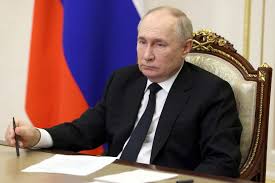
What’s new in the proposed update is the suggestion that a non-nuclear state could be the primary aggressor without being formally allied with a nuclear-armed state. ……………….
This shift in the doctrine seems to be crafted with the current geopolitical situation in mind, particularly Russia’s framing of the Ukraine conflict and its relationship with the United States and its allies.….
Long-Range Strikes May Not Be a Silver Bullet…………
By Maxim Trudolyubov on September 27, 2024, https://www.wilsoncenter.org/blog-post/russias-nuclear-doctrine-change-more-cautious-it-may-appear
In a recent discussion on Russia’s nuclear doctrine, President Vladimir Putin announced an expansion of the categories of states and military alliances that would fall under Russia’s nuclear deterrence policy. “Aggression against Russia by any non-nuclear state, with the participation or support of a nuclear state, will be treated as a joint attack on the Russian Federation,” Putin stated during the public segment of a recent meeting of Russia’s Security Council.
While the official document, titled “Basic Principles of State Policy of the Russian Federation on Nuclear Deterrence,” has yet to be updated, experts suggest that the timing of this announcement serves as a clear warning to Ukraine. Currently, Ukraine is seeking approval from the United States to use Western long-range missiles against targets deeper within Russian territory.
Putin’s wording is explicit: the “non-nuclear state” in question is Ukraine, while the “nuclear state” providing support or participating in an attack is primarily the United States, though this could also extend to the United Kingdom and France.
U.S. officials believe such strikes could lead to a significant escalation, potentially drawing NATO into direct confrontation with Russia. Moscow has consistently warned Western countries that any attacks on its territory would be seen as acts of war. This cautious stance by the United States has led to public frustration among some American allies in Europe.
Both France and Britain have indicated a willingness to approve such strikes for Ukraine, but they are waiting for Washington’s decision as a benchmark. The UK and France produce and supply their own missiles, but they use guiding technology developed by the United States. “It would be really good to stop the delays. And I think that the restrictions on the use of weapons should be lifted,” said Mette Frederiksen, prime minister of Denmark, in an interview with Bloomberg.
What the New Language Actually Means
Pavel Podvig, a senior researcher on weapons of mass destruction at the United Nations Institute for Disarmament Research, notes that Russia’s current nuclear doctrine does not clearly distinguish between aggression from nuclear-armed and non-nuclear states. Instead, any aggression that “threatens the existence of the state” could potentially provoke a nuclear response.
At first glance, the proposed change does not sound like a tectonic shift. Since 1995, Russia has pledged not to use nuclear weapons against non-nuclear-armed states unless they act “in association or alliance with a nuclear-weapon state.” The Russian authorities at the time operated on an assumption that any such situation would involve a nuclear-armed state as the primary aggressor, with non-nuclear states in a supporting role.
What’s new in the proposed update is the suggestion that a non-nuclear state could be the primary aggressor without being formally allied with a nuclear-armed state. The language implies that a non-nuclear state’s aggression could be seen as part of a broader campaign involving a nuclear-armed state, thereby justifying a nuclear response. This shift in the doctrine seems to be crafted with the current geopolitical situation in mind, particularly Russia’s framing of the Ukraine conflict and its relationship with the United States and its allies.
“The new language suggests that a non-nuclear weapon state might be an aggressor,” Podvig says. “Apparently, the idea behind the change is to say that this ‘association’ would make the nuclear weapons state that provides this support an aggressor too. It’s the ‘joint attack’ language.”
During the Security Council meeting Putin also said that Russia could resort to nuclear weapons on receiving “reliable information” indicating a large-scale aerial attack involving aircraft, missiles, and drones. Additionally, Moscow would treat an attack on its ally Belarus as an attack on Russia itself, potentially responding with nuclear force to defend Belarus.
On closer examination, Putin’s remarks reflect a more cautious approach than may initially seem. While the rhetoric implies a potential broadening of scenarios in which Russia might consider nuclear deterrence, it does not represent a fundamental departure from the country’s long-standing policies. However, the language remains vague: it fails to define what constitutes an “association” or clarify precisely against whom a nuclear strike might be directed.
Long-Range Strikes May Not Be a Silver Bullet
There are doubts within the policy and expert communities about whether long-range strikes on Russian territory would be a decisive factor in the war. To achieve a significant breakthrough, Ukraine would need to coordinate large-scale ground maneuvers in tandem with these strikes—something its forces have yet to demonstrate. “In its summer 2023 offensive, the Ukrainian military showed no ability to coordinate forces on anything like the scale needed for a decisive breakthrough. Longer-range weapons would make this coordination even more complicated,” writes Stephen Biddle, professor of international and public affairs at Columbia University, in a piece for Foreign Affairs.
Biddle highlights the limitations and challenges of deep strikes in the current context. Such strikes are costly and require precision guidance, which can quickly lose effectiveness as the opposing side adapts.
The historical record on longer-range strikes is not encouraging, notes Biddle. Historically, even large-scale strategic bombing campaigns, including strikes aimed at German and Japanese cities during World War II and North-Korean cities during the Korean War, have not succeeded in breaking the resolve of the targeted country. Additionally, the military benefits of diverting Russian efforts into air defense or disrupting weapons production would require an extensive, sustained campaign that Ukraine is not currently equipped to carry out.
All Eyes on U.S. Voters
The wait for a decision on allowing Ukraine to carry out long-range strikes on Russian territory is closely tied to the outcome of the U.S. presidential election. The two candidates have contrasting views on the Russo-Ukrainian war, which makes the future U.S. stance uncertain. One candidate may push for greater support for Ukraine, potentially approving the use of advanced Western missiles for strikes deeper into Russia, while the other could advocate a more cautious approach, prioritizing de-escalation or negotiations.
This political uncertainty leaves European allies, Ukrainian policymakers, and even Moscow in a holding pattern. For now, decision-makers are watching the United States closely, understanding that the future of support for Ukraine’s military capabilities—and the overall direction of the war—will largely hinge on the results of the upcoming election.
Biden would rather defend Israeli impunity than stop a regional war

As Israel intensified its deadly attacks on Lebanon, the U.S. moved more troops to the Middle East. The move shows Joe Biden’s priority is not to avoid escalation but to ensure that Israel has full impunity.
Mondoweiss. By Mitchell Plitnick September 27, 2024
As Israel was intensifying its deadly attacks on Lebanon, the United States decided to move more troops to the Middle East. The number of soldiers was not announced, but the force was said to be small.
The stated purpose was to protect Americans stationed in the region, but the more likely reason was to send a message to Iran, Ansarallah, and other allies of Hezbollah that the United States would protect Israel in the event of escalation, regardless of who was responsible for that escalation.
U.S. President Joe Biden might hope that such a message would deter escalation, but his decision to communicate it by increasing the U.S. military presence rather than acting to restrain Israel demonstrates that, just as with Gaza, Biden’s priority is not to avoid escalation, but to ensure that Israel has full impunity to act as it wants.
Confronting Iran is Israel’s endgame
In fact, this response plays right into the tactics Israel is pursuing in its attack on Lebanon. The Israeli right doesn’t have a real strategy, but it has long clung to an ideological belief that Israel should throw off the “restraints” placed on it by the United States and Europe and fully exercise its military might to utterly destroy its enemies.
This is what has played out in Gaza since last October. The genocidal campaign is meant not to destroy Hamas, but rather to destroy the Palestinian national movement. That’s why it was inevitable that the genocide would expand to the West Bank, despite the fact that there were virtually no Palestinian actions there in response to the horror in Gaza.
The Israeli right believes it must decisively defeat Iran, not merely deter it. Israel’s provocative actions such as its bombing of the Iranian embassy in Syria and assassinating Hamas leader Ismail Haniyeh in Tehran were meant to force a response from Iran that would escalate regional tensions. Iran didn’t take the bait, despite the fact that its lack of response to Israel’s activities invites more and greater provocative Israeli actions.
The latest Israeli escalation indicates that Israel is making good on its promise to shift its attention from Gaza to Lebanon. That won’t mean the slaughter in Gaza will stop, but it will mean that Israel will focus its forces more in the north once it feels it is ready to engage Hezbollah on the ground, an eventuality its current activities are an attempt at paving the path toward.
Both Israeli and American military leaders are less enthusiastic about escalation with Lebanon……………………………………………………………………
A potential Iranian diplomatic response
Iran has been an obsession for Israeli Prime Minister Benjamin Netanyahu from his earliest days in the public eye. Few in Israel disagree with that obsession, but past governments had significant internal dissent from the idea of provoking a conflict with the Islamic Republic.
This government is much more willing to take bold steps to provoke that confrontation. Worse, successive American administrations have raised Israeli hopes that they can get the support from Washington that they would need to effectively fight Iran. ……………………………………………………………………………………… more https://mondoweiss.net/2024/09/biden-would-rather-defend-israeli-impunity-than-stop-a-regional-war/
Public scrutiny of UK-US nuclear pact is essential
“Rather than working together to get rid of their nuclear weapons, the UK and US are collaborating on further advancing their respective nuclear arsenals” – Carol Turner
The Agreement facilitates the development of Britain’s nuclear weapon technology and supports building the Trident replacement. This is in direct contradiction to Britain’s legal obligation under the NPT and CTBT to the disarm.
Vice Chair of CND, Carol Turner, writes on the UK-US Mutual Defence Agreement, and what it spells for the so-called independence of Britain’s foreign policy. 29 Sept 24
One of the Prime Minister’s first foreign policy initiatives after taking office in July was an amendment to the Agreement for Cooperation on the Uses of Atomic Energy for Mutual Defence Purposes. Never heard of it? That could be just what Labour is hoping for.
The Mutual Defence Agreement (MDA) is a bilateral nuclear pact between the USA and Britain. The United States provides the UK with nuclear technology and know-how in exchange for access to British intelligence facilities. Since it was first signed in secret in 1958, the MDA has been brought before parliament for approval every 10 years. This has been a formal process, with no vote and negligible scrutiny.
After the MDA is signed by the end of this year, not even the formality of approval will be required in future. Defence Secretary John Healey laid an amendment to the MDA before parliament on 25 July – three weeks after Labour took office, just five days before the summer recess – which removes all mentions of renewal. When the pact is signed this year, it becomes permanent. No parliamentary debate and no change in the law is needed for this. As CND General Secretary Kate Hudon observes ‘this spells farewell to even the smallest notion of parliamentary responsibility’ for Britain’s foreign policy.
What’s on offer for Britain and the US
The agreement enables both countries to exchange classified information allowing them to develop their respective nuclear weapon systems. The MDA is essential to the replacement of Britain’s Trident nuclear weapons system. The current UK warhead is a copy of the US warhead; some components are bought from the US. Inevitably, the United States leverage over Britain’s foreign and security policy will to be enhanced by the MDA amendment.
In an explanatory memorandum to parliament which accompanied the proposed changes to the agreement, Healey explained the MDA ‘provides the necessary requirements for the control and transmission of submarine nuclear propulsion technology, atomic information and material between the UK and US, and the transfer of non-nuclear components to the UK’.
Healey neglects to point out that control and transmission of Trident nuclear weapons is indispensable to Britain’s ability to use them. Being able to deliver a nuclear bomb to its target, is every bit as essential as the nuclear warhead itself. As Richard Norton Taylor rightly points out, the MDA ‘gives the lie to persistent claims by the Ministry of Defence that Britain’s submarine-launched nuclear arsenal is operationally independent’.
In exchange for this, Britain provides the US with intelligence facilities. The Menwith Hill listening post in Yorkshire makes signals intelligence available to the US from across the northern hemisphere, intercepting both military and commercial electronic communications. Fylingdales radar station, also in Yorkshire, is one of three bases that comprise the USA’s Ballistic Missile Early Warning System. Information from these bases initiates a nuclear response from the US or Britain to a perceived threat.
Agreement breaches Britain’s international obligations
Healey’s memorandum claims the MDA ‘is consistent with the UK’s obligations under the Nuclear Non-Proliferation Treaty and commitments under the Comprehensive Nuclear Test Ban Treaty’. It does not provide for ‘the transfer of nuclear weapons or other nuclear explosive devices, or control over such weapons or explosive devices’.
The Agreement facilitates the development of Britain’s nuclear weapon technology and supports building the Trident replacement. This is in direct contradiction to Britain’s legal obligation under the NPT and CTBT to the disarm. The NPT states that countries should undertake ‘to pursue negotiations in good faith on effective measures relating to… nuclear disarmament’. Rather than working together to get rid of their nuclear weapons, the UK and US are collaborating on further advancing their respective nuclear arsenals.
A 2004 legal advice paper from Rabinder Singh QC and Professor Christine Chinkin concluded it is ‘strongly arguable that the renewal of the Mutual Defence Agreement is in breach of the nuclear Non-Proliferation Treaty’. This is because it implies ‘continuation and indeed enhancement of the nuclear programme, not progress towards its discontinuation’.
What parliament can do
When the MDA was first introduced, parliament was powerless to oppose renewal. However, the Constitutional Reform and Governance Act of 2010, now provides an opportunity for parliament to oppose ratification. The House of Commons could block the MDA indefinitely if MPs so decided.
The government is not obliged to hold a debate or vote, however, the onus is on MPs. Before the MDA was renewed in 2014, Jeremy Corbyn MP tabled Early Day Motion 153 calling for a debate. It was supported by LibDem, SNP, Plaid Cymru, and Green, as well as Labour MPs.
The need for an open and transparent debate is crucial this year, before the Agreement becomes permanent. At the very least, Labour should be made to answer why they are they are contravening their legal obligation to work towards disarmament and instead renewing an agreement designed to maintain US and UK nuclear weapons production capabilities.
and why MPs should do it
The world is moving closer to war in Europe between nuclear armed antagonists. Extending the Mutual Defence Agreement indefinitely:
- is a further step in perpetuating Britain’s nuclear arsenal
- encourages nuclear proliferation, and
- makes Britain a key target in the event of war.
This change to the MDA should not be allowed to pass unnoticed. It’s time that MPs challenged the Agreement for Cooperation on the Uses of Atomic Energy for Mutual Defence Purposes.
After destroying Ukraine and Gaza, Biden seeks a destroyed nation trifecta in Lebanon

Walt Zlotow, West Suburban Peace Coalition, Glen Ellyn IL, 29 Sept 24
One might surmise that with 2 failed nations on his presidential resume, Joe Biden would cease nation destroying during his last 4 months in office.
But no, he has plunged pell-mell into full support of Israeli Prime Minister Netanyahu’s pager terrorist attack on Lebanese civilians and a massive bombing campaign also mainly killing civilians there.
Of course Biden pays lip service to peace, requesting Netanyahu immediately implement a 21 day ceasefire in his Lebanon bombing campaign. But Netanyahu essentially told Biden to go straight to Hell with his emphatic rejection.
“The report about a ceasefire is incorrect. This is an American-French proposal that the Prime Minister has not even responded to. The report about the purported directive to ease up on the fighting in the north is the opposite of the truth. The Prime Minister has directed the IDF to continue fighting with full force, according to the plan that was presented to him. The fighting in Gaza will also continue until all the objectives of the war have been achieved.”
But while once again trashing Biden’s latest peace proposal, Netanyahu was gobbling up another $8.7 billion in US military assistance to continue his devastating bombing of Lebanon along with his near total destruction of Gaza as a habitable land. Biden trotted out his Defense Secretary Lloyd Austin to defend US nation destroying with this doublespeak: “We’ve been committed from the very beginning to help Israel, provide the things that are necessary for them to be able to protect their sovereign territory and that hasn’t changed and won’t change in the future.”
Israel’s ‘sovereign territory’? Apparently Joe Biden believes Israeli sovereign territory includes all of Gaza, the West Bank and possibly even southern Lebanon as well.
The most plausible explanation of Israel’s self-destructive warfare in Gaza and Lebanon is expand the war to Iran which could draw in the US. Without direct US participation, Israel will fail to achieve any of its multi war objectives. If that occurs, President Biden may move beyond destroying 3 countries by adding Iran to his ignominious failed state hit list.
Say it ain’t so, Joe.
Iran ready for nuclear talks at UN ‘if other parties willing’, foreign minister says

By Reuters, September 23, 2024,
Reporting by Dubai Newsroom; editing by Alex Richardson, Christina Fincher and Mark Heinrich https://www.reuters.com/world/iran-ready-nuclear-talks-new-york-if-other-parties-are-willing-foreign-minister-2024-09-23/
DUBAI, Sept 23 (Reuters) – Iran is ready to start nuclear negotiations on the sidelines of the U.N. General Assembly in New York if “other parties are willing”, Foreign Minister Abbas Araqchi said on Monday in a video published on his Telegram channel.
The U.S., under then-President Donald Trump, withdrew in 2018 from a nuclear accord signed in 2015 by Iran and six world powers under which Tehran curbed its disputed nuclear programme in return for a lifting of international sanctions.
Indirect talks between Washington and Tehran to revive the deal have stalled. Iran is still formally part of the deal but has scaled back commitments to honour it due to U.S. sanctions reimposed on the Islamic Republic.
“I will stay in New York for a few more days than the [Iranian] president and will have more meetings with various foreign ministers. We will focus our efforts on starting a new round of talks regarding the nuclear pact,” Araqchi said.
He added that messages have been exchanged via Switzerland and a “general declaration of readiness” issued, but cautioned that “current international conditions make the resumption of talks more complicated and difficult than before”.
Araqchi said he would not meet with U.S. Secretary of State Antony Blinken: “I do not believe it would be expedient to hold such a dialogue. There were such meetings before but there is currently no suitable ground for that. We are still a long way from holding direct talks.”

Since the renewal of U.S. sanctions during the Trump administration, Tehran has refused to directly negotiate with Washington and worked mainly through European or Arab intermediaries.
Iranian leaders want to see an easing of U.S. sanctions that have significantly harmed its economy. But Iran’s relations with the West have worsened since the Iranian-backed Palestinian Hamas militant group attacked southern Israel on Oct. 7, and as Tehran has increased its support for Russia’s war in Ukraine.
U.S. President Joe Biden’s administration has said the United States is not ready to resume nuclear talks with Iran.
1 This Month
Chernobyl: The Lost Tapes – A good documentary on Chernobyl on SBS available On Demand for the next 3 weeks– https://www.sbs.com.au/ondemand/tv-program/chernobyl-the-lost-tapes/2352741955560

of the week–London Campaign for Nuclear Disarmament

Tell the Ukrainian Government to Drop Prosecution of Peace Activist Yurii Sheliazhenko
To see nuclear-related stories in greater depth and intensity – go to https://nuclearinformation.wordpress.com
-
Archives
- April 2026 (139)
- March 2026 (251)
- February 2026 (268)
- January 2026 (308)
- December 2025 (358)
- November 2025 (359)
- October 2025 (376)
- September 2025 (257)
- August 2025 (319)
- July 2025 (230)
- June 2025 (348)
- May 2025 (261)
-
Categories
- 1
- 1 NUCLEAR ISSUES
- business and costs
- climate change
- culture and arts
- ENERGY
- environment
- health
- history
- indigenous issues
- Legal
- marketing of nuclear
- media
- opposition to nuclear
- PERSONAL STORIES
- politics
- politics international
- Religion and ethics
- safety
- secrets,lies and civil liberties
- spinbuster
- technology
- Uranium
- wastes
- weapons and war
- Women
- 2 WORLD
- ACTION
- AFRICA
- Atrocities
- AUSTRALIA
- Christina's notes
- Christina's themes
- culture and arts
- Events
- Fuk 2022
- Fuk 2023
- Fukushima 2017
- Fukushima 2018
- fukushima 2019
- Fukushima 2020
- Fukushima 2021
- general
- global warming
- Humour (God we need it)
- Nuclear
- RARE EARTHS
- Reference
- resources – print
- Resources -audiovicual
- Weekly Newsletter
- World
- World Nuclear
- YouTube
-
RSS
Entries RSS
Comments RSS
 nuclear-news