Trump, Planes and the Arabian Gulf Tour

May 16, 2025 Dr Binoy Kampmark, https://theaimn.net/trump-planes-and-the-arabian-gulf-tour/
They seemed made for each other. A former reality television star, with dubious real estate credentials, a freakish alienation from the truth, and the various leaders of the Gulf States, who never found truthful assessments that worthwhile anyway. This was certainly no time to be frugal and modest. Many a country might be dealing with soaring prices, inaccessible housing markets, and the cost of eggs, but nothing would be spared in spoiling US President Donald Trump with overpriced kitsch and exotica. Here was the MAGA brand in full flower.
With crude indulgence, Saudi Arabia’s putative leader, Crown Prince Mohammed bin Salman, pampered and spoiled the US president with hospitality and a spray of undertakings and agreements during the first part of his Arabian Gulf tour. Six US-made F-15 fighters piloted by the Saudis escorted Air Force One as it approached Riyadh on May 13. There was the coffee ceremony within the royal terminal in the airport, a limousine flanked by white Arabian horses, and a decorative honour guard equipped with golden swords.
This was a time for luxury and boundless bad taste, not bleeding hearts and bleating consciences. Memories of journalist Jamal Khashoggi, murdered in October 2018 on orders by the crown prince, could be silenced if not expunged altogether. As for climate change, what of it? On golden chairs in the royal place, the Crown Prince and US President could bask in each other’s triumphal, emetic glow. Trump exclaimed that “we like each other a lot.” In a speech, he also uttered words of music to the royal: no foreign leader should be “giving you lectures on how to live and how to govern your own affairs.”
An extravagant luncheon that followed featured a veritable Who’s Who of American corporatocracy, among them Stephen Schwarzman of the Blackstone Group, Jane Fraser of Citicorp, Ruth Porat of Google, and Alex Karp of Palantir.
The value of the agreements reached between Riyadh and Washington approximate to US$600 billion, if one is to trust the anomalous “fact sheets” released by the White House. The nature of these commitments was not exactly clear, though they promise to cover energy security, defence, technology and access to critical minerals. Terms with little clarity (“global infrastructure”, for instance) were thrown around. Naturally, Trump will not be outdone in any deal, insisting that this was all part of the America First Trade and Investment Policy that is placing “the American economy, the American worker, and our national security first.”
A few examples were mentioned, though these figure as ongoing commitments: the plans of Saudi Arabia’s DataVolt to invest US$20 billion in US data centres and energy infrastructure; the promise by Google, DataVolt, Oracle, Salesforce, AMD and Uber to invest US$80 billion in “cutting-edge transformative technologies in both countries.” The inevitable defence sales agreement was also praised, one hailed as the largest in history. Worth almost US$142 billion, it will involve over a dozen US defence firms supplying the Kingdom with equipment and technology in air force and space capabilities, air and missile defence, maritime and coastal security, border security and land forces and improved information and communication systems.
This was merely the start of the Trump Splash Show. Onward to Qatar, where another ceremonial escort of F-15 fighter planes greeted the president. Clearly, the ruling Emir, Sheikh Tamim bin Hamad al-Thani, was not going to be outdone by his Saudi counterparts. For a change, however, the president’s motorcade travelling from Doha airport to Amiri Diwan was greeted by a cavalry of mounted camels. “I haven’t seen camels like that in a long time,” fluted the impressed leader. “And really, we appreciate it very much.” But showing that imperishable tradition can exist alongside technological progress, red Tesla Cybertrucks also featured in the motorcade. This was a sweet gesture, given that Elon Musk’s company has an inventory of unsold Cybertrucks worth US$800 billion languishing in dealerships.
With the welcome indulgence concluded, the serious discussions began. These were primarily focused on aviation, defence and energy priorities. Of note was a contract with Doha for 210 Boeing-made 787 Dreamliners and 777x aircraft worth US$96 billion. The US plane maker has been struggling of late, bedevilled by mishaps and questions about the quality of its manufacture. But glossy salvations are possible in the garden of MAGA make believe. “Congratulations to Boeing,” cooed Trump. “Get those planes out there.”
The contract was part of a number of economic commitments from Qatar initially claimed by the White House to be worth a staggering US$1.2 trillion. As mathematics is not the strong suit of the Trump administration, the same announcement also qualifies the over trillion dollar boast by announcing “economic deals totalling more than $243.5 billion between the United States and Qatar, including an historic sale of Boeing aircraft and GE Aerospace engines to Qatar Airways.” Also included is an almost US$2 billion agreement allowing Qatar to acquire the MQ-9B remotely piloted aircraft system from General Atomics, and a US$1 billion agreement for Doha’s purchase of Raytheon’s small unmanned aircraft integrated defeat system.
In a shameless effort to outdo Riyadh, the Qatari royal family threw in a luxury 747 plane worth $400 million for the US Department of Defense, intended for Trump’s use as a temporary substitute Air Force One. Reported as being a “palace in the sky”, the president sees it as a gift of infinite, irrefutable generosity. “It’s a great gesture from Qatar,” he reasoned. “I appreciate it very much. I would never be one to turn down that kind of offer.”
As with his keenness to avoid anything that might ruffle feathers, or disturb restful camels, this was not a trip for presidential agitation. He was far away from irritating European allies. Here was Qatar, previously accused by Trump of being a sponsor of terrorism, rehabilitated in golden glory. Forget the security implications and brazen corruption inherent in such a move: all the parties concerned could gloat without consequential censure.
Let’s give Trump credit where credit is due
18 May 25 https://theaimn.net/president-trump-on-ukraine-in-pursuit-of-peace-or-glory/
Yes, he’s a narcissist, yes he’s racist, misogynist, crooked in business, and with no regard for civil institutions and laws. AND he’s just been sucking up to the nastiest most murderous Arabian Gulf regime, in order to make $billions for American business interests, including, notably his own.
BUT even Trump can do some good things. And in the case of the Ukraine war, this is apparent.
In early 2022, Ukraine’s President Zelensky was on the brink of signing a peace agreement with Russia. There’d be no loss of Ukraine territory, and no Ukraine NATO membership. Key Western leaders opposed this negotiation. On April 9, 2022, UK Prime Minister Boris Johnson arrived unannounced in Kiev and told the Ukrainian president that the West was not ready to end the war. Then in April, in Kiev, U.S. Defense Secretary Lloyd Austin said the U.S. wants to use the opportunity to permanently weaken Russia militarily and economically. He went on , at a meeting of Western leaders in Germany, to declare a Ukrainian victory over Russia as a strategic goal for Europe and the USA.
Zelensky promptly switched policy, and this turned into his peripatetic jaunts to the USA and Europe, to drum up weaponry for this determination to defeat Russia. In this, he had the mindless, and never flinching, support from Joe Biden, and NATO. All of which was most acceptable to America’s warhawks, and manna from Heaven to Lockheed Martin, Raytheon, Northrop Grumman, Boeing and General Dynamics.
The West then launched a propaganda campaign about Ukrainian forces defeating Russian forces. English language media continued to show only the Ukrainian perspective. Media scholars have studies this, but I can be sure just from my own experience of the Australian media.
I’ve noticed not only a constant theme that Ukraine can militarily defeat Russia, but that Ukraine IS winning the war. This has been accompanied by copious emotional stories about the Ukrainian civilian victims of Russia’s war. Terrible atrocities done by the Russians. And some atrocity reports are faked. In reality, atrocities have been committed also by Ukrainians, but these are rarely reported on.
With that unflinching support from the West, Russia’s steady progress in the war has been disregarded and downplayed. Now Russia now has the military upper hand on the battlefield and that seems unlikely to change.
From 2022 until 2025, Biden and NATO would not countenance any serious suggestion of a negotiated end, such was their hatred of Russia. Near the end of his office, President Biden signed off on a huge number of weapons to Ukraine.
Donald Trump promised to end the war. In March this year, he stopped all military aid to Ukraine, including weapons already in transit. He’s against NATO membership for Ukraine – as just “not practical”, and does not expect that Ukraine will get back all of its land.
Ukraine has extended martial law until 6 August following Zelensky’s request This will prevent elections from being held before then, and enable Zelensky to stay in power. However, Zelensky could use fraudulent voter lists as a means of gaining re-election.
Critics , (including myself) have stressed Trump’s aim to make money for American companies out of a peace agreement. Well, so what? American weapons companies have been making $billions out of the war.
The thing is, despite all Trump’s negative aspects, he really does not like war. And with the Trump presidency, there is at last the opportunity to end this pointless slaughter, and avoid a wider war – something that was not possible under a Democrat administration.
As to Trump “not liking war” – that is another story to be explored. He likes to bully people with the threat of war. And that may turn out to be a dangerous way to go.
Zelensky’s plan for peace involves Ukraine getting back all the Russian-occupied land, including Crimea, (formally part of Russia since 2014) , and Ukraine headed to become a NATO member.
Europe, and all Westerners who buy into the Joe Biden view of Ukraine seem now still holding onto the idea of a military victory by Ukraine, over Russia. Zelensky’s unrealistic plan for a ceasefire can be disregarded. At least Trump offers a realistic way towards peace. And for that, he deserves acknowledgment.
Zelensky now needs to shut up and let his negotiating team get to work

Zelensky has actively sought to prevent any possibility of dialogue with Russia on the ending of the war since the first Istanbul talks collapsed in April 2022.
there will be massive pressure from the enormous pro-war lobby in Ukraine and in the west to call off the talks at the first opportunity.
there will be massive pressure from the enormous pro-war lobby in Ukraine and in the west to call off the talks at the first opportunity.
He won’t, of course, but once Istanbul talks finally start, they will soon develop a logic and momentum of their own
Ian Proud, The Peacemonger, May 16, 2025
As I predicted in my article -(The stakes are high for these important Ukraine-Russia-US talks.) there would be no breakthroughs on day 1 or, perhaps, as it should now be called, day -1. Not surprisingly, Zelensky spent his time in Ankara claiming the Russians didn’t want peace, blaming Putin, searching desperately for a reason to call off talks that hadn’t started, while the Russian delegation waited patiently in Istanbul for a Ukrainian team that didn’t show up. Predictably, western leaders including Keir Starmer, did their part, alleging that Putin wasn’t serious about peace talks, while the Russian delegation was still waiting patiently in Istanbul.
My article points out, correctly, that the biggest achievement is that the talks are even taking place if, in fact, they do start today. Zelensky has actively sought to prevent any possibility of dialogue with Russia on the ending of the war since the first Istanbul talks collapsed in April 2022.
Trump has changed the game by insisting direct negotiations are the only way to bring the bloodshed to an end. Indeed, it seems clear that, in the end, Zelensky was pressed by both Trump and President Erdogan to name his delegation and dispatch them to Istanbul which he finally agreed to do late last night.
Let’s be clear, there will be massive pressure from the enormous pro-war lobby in Ukraine and in the west to call off the talks at the first opportunity. The fact that the US has sent Rubio, Witkoff and Kellogg to Istanbul suggests the Americans aren’t going to let up the pressure on Zelensky to cut a deal, even if that means the beginning of the end of his political career.
Expect maximum Zelensky showboating over the next day or so, and minimal progress at the negotiating table. But once the talks start, they may start to build a logic and momentum of their own, grinding us slowly towards the cessation of gunfire. There will be no Victoria Nuland or Boris Johnson to tell Zelensky not to sign the agreement this time. Even Starmer isn’t stupid enough to undermine a deal that Trump has slogged to line up, at a time when Britain is trying to maximize its transatlantic trade and investment relationship.
Foreign policy, after all, always begins and ends with domestic policy, whatever the true believers tell you.
The biggest achievement of today’s Istanbul talks is that they are even taking place. U.S. engagement will remain vital to getting a peace deal over the line. Russia’s desire for a reset with Washington may keep them on track.
I have a sense of déjà vu as I contemplate these long-overdue peace talks between Ukraine and Russia in Istanbul. In April 2022, Ukraine and Russia were close to agreeing a peace treaty, less than two months after war started. However, this came crashing down amid claims that western governments, in particular the United States and the United Kingdom encouraged Ukraine to keep fighting.
It’s worth recapping very briefly what was close to having been agreed. By far the best summary of negotiations between both sides was produced by the New York Times in June 2024. Those negotiations ran for almost two months. The talks started with Ukrainian officials being spirited over the border into Belarus on February 29, 2022 while the fighting raged around Kyiv, and eventually led to the now famous talks in Istanbul in March and April………………………………. https://thepeacemonger.substack.com/p/zelensky-now-needs-to-shut-up-and?utm_source=post-email-title&publication_id=3221990&post_id=163688883&utm_campaign=email-post-title&isFreemail=true&r=1ise1&triedRedirect=true&utm_medium=email
Peace For Ukraine – The disastrous derailment of early peace efforts to end the war.
Brave New Europe, Michael von der Schulenburg, Hajo Funke, Harald Kujat, November 10, 2023
Michael von der Schulenburg is a former UN Assistant Secretary-General, who worked for over 34 years for the United Nations, and shortly for the OSCE, in many countries in war or internal armed conflicts often involving fragile governments and armed non-state actors
Hajo Funke is Professor Emeritus for political sciences of the Otto-Suhr-Institute/ Freie University Berlin
General (ret.) Harald Kujat was the highest ranging German officer of the Bundeswehr and at NATO
The British Prime Minister’s fateful visit to Kiev on 9 April 2022
This is a detailed reconstruction of the Ukrainian-Russian peace negotiations in March 2022 and the associated mediation attempts by the then Israeli Prime Minister, Naftali Bennett, supported by President Erdogan and former German Chancellor Schröder. It was drawn up by retired General H. Kujat and Professor Emeritus H. Funke, two of the initiators of the recently presented peace plan for Ukraine. And it is also in connection with their peace plan that this reconstruction is so extremely important. It reminds us that we cannot afford to delay ceasefire and peace negotiations again. The human and military situation in Ukraine deteriorates dramatically, with the added danger that it could lead to a further escalation of the war. We need a diplomatic solution to this cruel war for Europe and the Ukraine – and we need it now!
From the detailed reconstruction of the March peace efforts 6 conclusions emerge:
1. Just one month after the start of the Russian military intervention in Ukraine, Ukrainian and Russian negotiators had come very close to an agreement for a ceasefire and to an outline for a comprehensive peace solution to the conflict.
2) In contrast to today, President Zelensky and his government had made great efforts to negotiate peace with Russia and bring the war to a quick end.
3) Contrary to Western interpretations, Ukraine and Russia agreed at the time that the planned NATO expansion was the reason for the war. They therefore focused their peace negotiations on Ukraine’s neutrality and its renunciation of NATO membership. In return, Ukraine would have retained its territorial integrity except for Crimea.
4) There is little doubt that these peace negotiations failed due to resistance from NATO and in particular from the USA and the UK. The reasons is that such a peace agreement would have been tantamount to a defeat for NATO, an end to NATO’s eastward expansion and thus an end to the dream of a unipolar world dominated by the USA.
5. The failure of the peace negotiations in March 2022 led to dangerous intensification of the war that has cost the lives of hundreds of thousands of people, especially young people, deeply traumatized a young generation and inflicted the most severe mental and physical wounds on them. Ukraine has been exposed to enormous destruction, internal displacements, and mass impoverishment. This si accompanied by a large-scale depopulation of the country. Not only Russia, but also NATO and the West bear a heavy share of the blame for this disaster.
6) Ukraine’s negotiating position today is far worse than it was in March 2022. Ukraine will now lose large parts of its territory.
7. The blocking of the peace negotiations at that time has harmed everyone: Russia and Europe – but above all the people of Ukraine, who are paying with their blood the price for the ambitions of the major powers and will probably get nothing in return.
Michael von der Schulenburg
HOW THE CHANCE WAS LOST FOR A PEACE SETTLEMENT OF THE UKRAINE WAR
AND THE WEST WANTED TO CONTINUE THE WAR INSTEAD
A detailed reconstruction of events in March 2022
Hajo Funke and Harald Kujat, Berlin, October 2023
In March 2022, direct peace negotiations between Ukrainian and Russian delegations and mediation efforts by the then Israeli Prime Minster, Naftali Bennet created a genuine chance for ending the war peacefully only four to five weeks after Russia had invaded Ukraine. However, instead of ending the war through negotiations as Ukrainian President Zelensky and his government appeared to have wanted, he ultimately bowed to pressures from some Western powers to abandon a negotiated solution. Western powers wanted this war to continue in the hope to break Russia. Ukraine’s decision to abandon negotiations may been taken before the discovery of a massacre of civilians in the town of Bucha near Kiev.
In the following is an attempt of a step-by-step reconstruction of the events that led to the peace negotiations in March and their collapse in early April 2022.
IN EARLY MARCH 2022, ISRAELI PRIME MINISTER NAFTALI BENNETT UNDERTOOK MEDIATION EFFORTS …………………………………………………………………………………………………………………………………………………
APPARENT INITIAL SUPPORT OF MEDIATION EFFORTS BY WESTERN POLITICIANS.
Proof of initial Western politicians’ support for the negotiations emerges from the sequence of telephone calls and meetings during the period from early March to at least mid-March. On March 4, Scholz and Putin spoke on the phone; on March 5, Bennett met Putin in Moscow; on March 6, Bennett and Scholz met in Berlin; on March 7, the United States, the United Kingdom, France, and Germany discussed the issue in a videoconference; on March 8, Macron and Scholz spoke on the phone; on March 10, Ukrainian Foreign Minister Kuleba and Russian Foreign Minister Lavrov met in Ankara; on March 12, Scholz and Zelensky and Scholz and Macron spoke on the phone; and on March 14, Scholz and Erdogan met in Ankara. (Cf. Petra Erler: Re: Review March 2022: Who did not want a quick end to the war in Ukraine, in: “News of a Lighthouse Keeper,” Sept. 1, 2023)
NATO SPECIAL SUMMIT OF MARCH 24, 2022 IN BRUSSELS OPPOSES ALL NEGOCIATIONS
But this initial support quickly turned sour, with NATO opposing any such negotiations before Russia doesn’t withdraws all its troops from Ukrainian territories. This, in fact, killed all negotiations. Michael von der Schulenburg, former UN Assistant Secretary-General (ASG) in UN peace missions, writes that “NATO had already decided at a special summit on March 24, 2022, not to support these peace negotiations (between Ukraine and Russia).” (Cf. Michael von der Schulenburg: UN Charter: Negotiations! In: Emma, March 6, 2023). The US president had flown in especially for this special summit to Brussels. Obviously, peace as negotiated by the Russian and Ukrainian negotiating delegations was not in the interest of some NATO countries.
AT FIRST ZELENSKY STICKS TO THE OUTCOME OF THE PEACE NEGOTIATIONS
“As late as March 27, 2022, Zelensky had shown the courage to defend the results of the Ukrainian-Russian peace negotiations in public before Russian journalists – and this despite the fact that NATO had already decided at a special summit on March 24, 2022, not to support these peace negotiations.” (Ibid)
According to von der Schulenburg, the Russian-Ukrainian peace negotiations had been a historically unique feature, made possible only because Russians and Ukrainians knew each other well and “spoke the same language and probably even knew each other personally.” We know of no other war or armed conflict in which the conflict parties agreed on specific peace terms so quickly.
On March 28, Putin, as a sign of goodwill and in support of the peace negotiations, declared readiness to withdraw troops from the Kharkov area and the Kiev area; this apparently occurred even before his public announcement.
THE PEACE NEGOTIATIONS UNRAVEL
On March 29, 2022, the day of the Istanbul meeting, Scholz, Biden, Draghi, Macron, and Johnson again spoke on the phone about the situation in Ukraine. By this time, the stance of key Western allies had apparently hardened. They formulated preconditions for negotiations that were in blatant contrast to Bennett’s and Erdogan’s peace efforts: “The leaders agreed to continue to provide strong support to Ukraine. They again urged Russian President Putin to agree to a ceasefire, to cease all hostilities, to withdraw Russian soldiers from Ukraine and to allow for a diplomatic solution (…)” (Petra Erler: Re: Review March 2022: Who Didn’t Want a Quick End to the War in Ukraine (in “News of a Lighthouse Keeper” September 1, 2023).
The Washington Post reported April 5 that in NATO, continuing the war is preferred to a cease-fire and negotiated settlement: “For some in NATO, it’s better for Ukrainians to keep fighting and dying than to achieve a peace that comes too soon or at too high a price for Kiev and the rest of Europe.” Zelensky, he said, should “keep fighting until Russia is completely defeated.”
BORIS JOHNSON’S MESSAGE TO UKRAINIANS ON APRIL 9, 2022: WE MUST CONTINUE THE WAR
On April 9, 2022, Boris Johnson arrived unannounced in Kiev and told the Ukrainian president that the West was not ready to end the war. According to Britain’s Guardian on April 28, PM Johnson had “instructed” Ukrainian President Zelensky “not to make any concessions to Putin”:
“Ukrainska Pravda” reported on this in detail in two articles on May 5, 2022:
“No sooner had the Ukrainian negotiators and Abramovich/Medinsky agreed in broad terms on the structure of a possible future agreement after the Istanbul results than British Prime Minister Boris Johnson appeared in Kiev almost without warning.
Johnson brought two simple messages with him to Kiev. The first is that Putin is a war criminal; he should be pressured, not negotiated with. The second is that even if Ukraine is willing to sign some agreements with Putin on guarantees, but that the collective West is not.
The Neue Züricher Zeitung (NZZ) reported on April 12 that the British government under Johnson is counting on a Ukrainian military victory. Conservative Member of the House of Commons Alicia Kearns said, “We’d rather arm the Ukrainians to the teeth than give Putin a success.” British Foreign Secretary (and later Prime Minister) Liz Truss professed in a keynote speech that “victory for Ukraine (…) is a strategic imperative for us all and therefore military support must be massively expanded”. Guardian columnist Simon Jenkins warned: “Liz Truss risks inflaming the war in Ukraine for her own ambitions.” This, he said, was probably the first Tory election campaign “to be fought on Russia’s borders.” Johnson and Truss wanted Zelensky “to keep fighting until Russia is completely defeated. They need a triumph in their proxy war. In the meantime, anyone who disagrees with them can be dismissed as a weakling, a coward, or a Putin supporter. That this conflict is being exploited by Britain for a sleazy upcoming leadership contest is sickening.”
Following his second visit to Kiev on April 25, 2022, U.S. Defense Secretary Lloyd Austin said the U.S. wants to use the opportunity to permanently weaken Russia militarily and economically in the wake of the Ukraine war. According to the New York Times, the U.S. government is no longer concerned with a fight over control of Ukraine, but with a fight against Moscow in the wake of a new Cold War.
At the April 26, 2022, meeting of defense ministers from NATO members and other countries convened by Austin in Ramstein, Rhineland-Palatinate/ Germany, the Pentagon chief declared the military victory of Ukraine as a strategic goal.
CONCLUSION: MISSED OPPORTUNITY
Based on the publicly available reports and documents, it is not only plain that there was a serious willingness to negotiate on the part of both Ukraine and Russia in March 2022. Apparently, the negotiating parties even agreed on a draft treaty ad referendum. Zelensky and Putin were ready for a bilateral meeting to finalize the outcome of the negotiations. Fact is that the main results of the negotiations were based on a proposal by Ukraine, and Zelenskyy courageously supported them in an interview with Russian journalists on March 27, 2022, even after NATO decided against these peace negotiations. Zelensky had already expressed similar support beforehand in a sign that proves that the intended outcome of the Istanbul negotiations certainly corresponded to Ukrainian interests.
. This makes the Western intervention, which prevented an early end to the war, even more disastrous for Ukraine. Russia’s responsibility for the attack, which was contrary to international law, is not relativized by the fact that responsibility for the grave consequences that Ukraine’s Western supporters that ensued must also be attributed to the states that demanded the continuation of the war. The war has now reached a stage where further dangerous escalation and an expansion of hostilities can only be prevented by a cease-fire. It may now be the last time that a peaceful resolution through negotiations could be achieved……………….. https://braveneweurope.com/michael-von-der-schulenburg-hajo-funke-harald-kujat-peace-for-ukraine
Beyond Iran: a new nuclear doctrine for the Persian Gulf
By Seyed Hossein Mousavian | May 13, 2025, https://thebulletin.org/2025/05/beyond-iran-a-new-nuclear-doctrine-for-the-persian-gulf/?utm_source=ActiveCampaign&utm_medium=email&utm_content=Former%20NIH%20director%20on%20DOGE%20cuts&utm_campaign=20250515%20Thursday%20Newsletter
Ambassador (Ret.) Seyed Hossein Mousavian is a Middle East security and nuclear policy specialist at Princeton University and a former spokesman for Iran’s nuclear negotiators. He is the author of many books including: The Iranian Nuclear Crisis: A Memoir, Iran and the United States: An Insider’s view on the Failed Past and the Road to Peace; A Middle East Free of Weapons of Mass Destruction and A New Structure for Security, Peace, and Cooperation in the Persian Gulf.
After a letter was exchanged between US President Donald Trump and Iranian Leader Ayatollah Ali Khamenei, and since the first talks of April 12, four rounds of indirect and direct bilateral negotiations about Iran’s nuclear program have made progress. Iran Foreign Minister Abbas Araghchi and President Trump’s chief negotiator Steve Witkoff are leading the talks.
At this stage of the talks, both sides should have reached a mutual understanding on verification and transparency measures. Iran’s full cooperation with the International Atomic Energy Agency (IAEA) through implementation of the Additional Protocol, the most crucial inspection and verification mechanism, would resolve existing technical ambiguities over the peaceful nature of Iran’s nuclear program.
In 2018, President Trump pulled out of the Joint Comprehensive Plan of Action, also known as the Iran nuclear deal, after calling it the “worst deal ever.” On Tuesday, during his first trip in the Middle East of his second presidency, Trump said he wants to make a deal with Iran again. President Trump cherishes big, out-of-the-box deals. As he tours the region, Trump should think beyond Iran’s nuclear issue and work to achieve the denuclearization of the entire Middle East.
Iran’s uranium enrichment dilemma. From 2003 to 2013, nuclear negotiations between the world powers and Iran failed because the United States denied Iran’s right to peaceful uranium enrichment activities. However, according to the Treaty on the Non-Proliferation of Nuclear Weapons (NPT), all member countries have the right to peaceful enrichment. Japan, Germany, Brazil, and Argentina have been allowed to develop enrichment programs—and so should Iran be.
The nuclear negotiations from 2013 to 2015 led to the Iran nuclear deal because, then, the United States did not oppose the principle of Iran enriching uranium for peaceful purposes. With the implementation of the JCPOA, Iran cooperated with the IAEA, and by December 2015, all of the agency’s technical ambiguities were resolved. After the first Trump administration withdrew from the JCPOA and imposed maximum pressure sanctions on Iran, Tehran responded by reducing its commitments under the deal, expanding its enrichment program and ultimately becoming a nuclear-threshold state.
Now, the second Trump administration is once again questioning Iran’s legal and legitimate right to enrichment of uranium for civilian purposes. In the last few days, Witkoff said that Iran should abandon enrichment, and Araghchi responded that this is Iran’s red line.
From several decades of experience with and knowledge about Iran’s nuclear program, it is clear to me that President Trump might only be capable of reaching a nuclear agreement with Iran if his red line were limited to Iran never acquiring a nuclear bomb, rather than denying Iran’s legitimate and legal rights to develop peaceful nuclear technology, including enrichment. Under no circumstances will Iran accept discrimination, humiliation, and deprivation of its international rights.
Regional proliferation risk. Reaching a nuclear agreement between the United States and Iran is certainly an urgent and vital necessity to eliminate one of the nuclear proliferation risks in the Middle East. However, the issue of non-proliferation in the region goes far beyond Iran’s uranium enrichment.
Even in an unlikely scenario of an agreement between Iran and the United States, in which Iran would give up enrichment, the problem would persist for several reasons:
Acceptance of enrichment by Saudi Arabia would open the gate for more regional powers in the Middle East to pursue enrichment.
Iran’s enrichment capability and know-how are immutable. Even a military attack would not eliminate them.
According to NPT’s Article 10, all members have the right to withdraw from the treaty. This alternative will remain available to Iran, especially as US-Iran hostilities cannot be resolved through a single-issue nuclear agreement.
Israel is the only country in the Middle East that possesses dozens of nuclear weapons. For decades, this reality has blocked UN initiatives and resolutions aimed at establishing a Middle East free of nuclear weapons and other weapons of mass destruction. Yet, Israel continues to receive the strongest US and Western support. However, the status of Israel as the “nuclear gendarme” of the Middle East will not endure.
Saudi Arabia and the United States are negotiating a nuclear deal under which the United States would accept Saudi enrichment.
A deal that focuses solely on Iran’s nuclear program would fail to address the broader—and equally pressing—issues of nuclear proliferation in the region. Therefore, a new regional nuclear doctrine is inevitable.
A two-step roadmap could lead to the historic and monumental achievement of denuclearizing the Middle East.
Establishment of a Persian Gulf nuclear consortium. As a first step, the Trump administration should work with regional stakeholders to define a new nuclear doctrine for Persian Gulf through establishment of a Persian Gulf Consortium. Such a doctrine should consist of a concerted effort to create a comprehensive and inclusive nuclear nonproliferation framework—a major stepping-stone toward greater regional cooperation, security, and stability in the Persian Gulf. A new doctrine could be articulated around four core principles.
A regional enrichment consortium. A consortium for enrichment, like Europe’s enrichment company Eurenco, could be established to mitigate proliferation risk in the Persian Gulf. This consortium would allow countries in the Persian Gulf and the wider Middle East to participate in uranium enrichment under strict, multilateral oversight, ensuring that all enrichment activities are for peaceful purposes only. The regional enrichment consortium would ensure that the process of enrichment is conducted peacefully, transparently, and under the supervision of both regional stakeholders and the IAEA. This model could help alleviate regional and international concerns about the potential for nuclear weapons development while enabling states to pursue the peaceful use of nuclear energy.
Iran proposes partnership with UAE and Saudi Arabia to enrich uranium
A consortium would help Tehran deal with US objections and tie in Gulf states to its enrichment programme
Patrick Wintour, 14 Apr 25, https://www.theguardian.com/world/2025/may/13/iran-proposes-partnership-with-uae-and-saudi-arabia-to-enrich-uranium
Iran has floated the idea of a consortium of Middle Eastern countries – including Iran, Saudi Arabia and the United Arab Emirates (UAE) – to enrich uranium, in a effort to overcome US objections to its continued enrichment programme.
The proposal is seen as a way of locking Gulf states into supporting Iran’s position that it should be allowed to retain enrichment capabilities.
Tehran views the proposal as a concession, since it would be giving neighbouring states access to its technological knowledge and making them stakeholders in the process.
It is not clear if Abbas Araghchi, the Iranian foreign minister, made the proposal in relatively brief three-hour talks with the US in Oman on Sunday, the fourth set of such talks, but the proposal is reportedly circulating in Tehran.
The US has demanded that Iran ends enrichment and dismantles all its nuclear facilities. But amid divisions in Washington, Trump has not made a final decision on the issue and praised Iran’s seriousness in the talks.
The consortium idea was first proposed by former Iranian nuclear negotiator Seyed Hossein Mousavian and Princeton physicist Frank von Hippel long before the current Tehran-Washington talks, in a widely read October 2023 article in the Bulletin of the Atomic Scientists.
Under the consortium, the Saudis and UAE would be shareholders and funders, and would gain access to Iranian technology. The involvement of the Gulf states could be seen as an extra insurance that Iran’s nuclear programme was for entirely civil purposes and not the pathway to building a bomb, as Israel alleges.
If the Saudis and UAE were permitted to send engineers to Iran, an extra form of visibility about the programme would become possible, leaving the international community less reliant solely on the work of the UN nuclear inspectors from the International Atomic Energy Agency.
Iran gradually moved away from the levels of enrichment and stockpile limits set out in the original 2015 deal, blaming Trump for leaving the nuclear deal. Iran’s deputy foreign minister, Majid Takht-Ravanchi, said: “For a limited period of time, we can accept a series of restrictions on the level and volume of enrichment.”
The US originally gave the impression that it needs an agreement with Iran within two months of the talks starting but, as the technicalities of any agreement become more complex, it is possible the talks will be allowed to drag on through the summer.
Iran currently enriches uranium to 60% purity – far above the 3.67% limit set in the 2015 deal, and a short technical step from 90% needed for weapons-grade material. The US secretary of state, Marco Rubio, said these uranium enrichment level are far higher than necessary for civilian uses.
In what may have been a reference to the Iranian proposal Omani foreign minister, Badr Al Busaidi, referred to “useful and original ideas reflecting a shared wish to reach an honourable agreement”.
The UAE operates a civil nuclear power plant named Barakah, located west of Abu Dhabi. It is the first nuclear power plant in the Arab world to be fully operational, with all four reactors now online, and should be capable of producing a quarter of the UAE’s electricity needs.
Donald Trump Decouples the United States from Israel
Voltairenet.org , by Thierry Meyssan, 14 May 25
After patiently proposing to Benjamin Netanyahu that he negotiate with the Palestinian resistance and meeting only a stubborn determination to massacre the Palestinians, annex Gaza, southern Lebanon and Syria, and launch a war against Iran, the Trump administration has changed gears. It is now clear to them, as it has been to everyone who has been interested in this region for 80 years, that revisionist Zionists are the enemies of peace and therefore also of Israel.
The main obstacle Donald Trump faces in his peace negotiations, both with Iran and Ukraine, is the role of the “revisionist Zionists” now in power in Israel. [1] Two weeks ago, I presented in detail and with supporting evidence the pressure they are exerting on Washington to derail the talks with Tehran [2].
I did not address in my column on Voltairenet.org their pressure on behalf of the Ukrainian “integral nationalists” [3], which only became public on May 3, with Natan Sharansky’s emphatic statements in support of Volodymyr Zelensky [4]. I have already explained why and how these two groups formed an alliance in 1921 against the Bolsheviks and many Ukrainian Jews, which led to an investigation by the World Zionist Organization and the resignation of Vladimir Jabotinsky from its board of directors.
This affair is today underestimated by Jewish historians who are reluctant to study the massacre of Jews by other Jews. There are, however, exceptions such as the work of Grzegorz Rossoliński-Liebe [5]. Sharansky himself prevents historians from studying the subject by presiding over the Babi Yar Holocaust Memorial Center (the shooting of 33,771 Jews on September 29 and 30, 1941) by the Einsatzgruppen and the “integral nationalists” two weeks after Stepan Bandera’s transfer from Kyiv to Berlin.
And let’s not forget the contacts of the “revisionist Zionists” with Adolf Eichmann until the fall of Berlin by the Red Army on May 2, 1945 [6].
While the then Israeli Prime Minister, Naftali Bennett, had, at the beginning of the Russian special operation in Ukraine, called on Volodymyr Zelensky to recognize Moscow’s just demands to “denazify Ukraine,” and Israeli Defense Minister Benny Gantz had declared that, while he was alive, Israel would never give weapons to the “massacres of Ukrainian Jews,” the current Prime Minister, Benjamin Netanyahu, authorized the Israeli arms industry to export its production to Ukraine.
In 2022, Russian Foreign Minister Sergei Lavrov declared: “What if Zelensky was Jewish? This fact does not negate the Nazi elements in Ukraine. I believe Hitler also had Jewish blood. That means absolutely nothing.” The Jewish people, in their wisdom, have said that the most ardent anti-Semites are generally Jews. Every family has its black sheep, as they say.” Yair Lapid then replied: “These remarks are both unforgivable and scandalous, but also a terrible historical error. Jews did not kill each other during the Holocaust. The lowest level of racism against Jews is to accuse Jews themselves of anti-Semitism.” Let’s make no mistake: History is not made up of good or evil communities, but of individuals who, each of them, can behave in different ways. Let’s open our eyes!
Let’s get back to our topic. Donald Trump is president of the United States; a country whose founding myth claims that it was founded by the “Pilgrim Fathers,” who fled the “pharaoh” of England, crossed the Atlantic as the Hebrews crossed the Red Sea, and established a colony in Plymouth, just as the Hebrews founded the “Promised Land.” All Americans celebrate this myth on Thanksgiving Day. Every president of the United States, without exception, from George Washington to Donald Trump himself, has referred to it in their official speeches. The alliance between Washington and Tel Aviv is therefore not debatable. It turns out that the United States, this country where sects proliferate, which celebrates freedom of religion but not freedom of conscience and denounces, without understanding it, French secularism, has a “Christian Zionist” movement. These are Christians who equate biblical Israel with the modern State of Israel. However, this movement voted overwhelmingly for Donald Trump, and he feels the debt owes him. Once he became president, he appointed Pastor Paula Blanche (also linked to the “Japanese imperialists”) as director of the White House Faith and Opportunity Initiative.
Slowly, President Donald Trump is disassociating Israel from Benjamin Netanyahu. Receiving him at the White House while he was the subject of an arrest warrant from the International Criminal Court, he had his Secretary of State, Marco Rubio, proclaim that his administration was the most pro-Israeli in history. In doing so, he firmly opposed Netanyahu’s plan to disrupt the peace agreement signed with Hamas and, instead, to military occupation of the Gaza Strip. He went so far as to claim that the US (not Israeli) armies would take “control” of this territory. Noting that his provocations are having no effect on Tel Aviv, President Donald Trump has just taken a decisive step: without warning his Israeli ally, he negotiated a separate peace with Ansar Allah at the very moment that Yemeni movement was bombing Tel Aviv’s Ben Gurion Airport………………………………………………………………………………
New York Times columnist Thomas Friedman wrote the following day, on May 9: “I have no doubt that, generally speaking, the Israeli people continue to regard themselves as an unwavering ally of the American people—and vice versa.” But this ultranationalist, messianic Israeli government is not an ally of the United States […] We can continue to ignore the number of Palestinians killed in the Gaza Strip—more than 52,000, including approximately 18,000 children—question the credibility of the figures, and resort to every mechanism of repression, denial, apathy, distancing, normalization, and justification. None of this will change the bitter fact: they killed them. Our hands did it. We must not close our eyes. We must wake up and shout loud and clear: stop the war.
In any case, if no one in the United States can question the alliance with Israel, this in no way implies support for the “revisionist Zionists” now in power in Tel Aviv.
Slowly, President Donald Trump is disassociating Israel from Benjamin Netanyahu. Receiving him at the White House while he was the subject of an arrest warrant from the International Criminal Court, he had his Secretary of State, Marco Rubio, proclaim that his administration was the most pro-Israeli in history. In doing so, he firmly opposed Netanyahu’s plan to disrupt the peace agreement signed with Hamas and, instead, to military occupation of the Gaza Strip. He went so far as to claim that the US (not Israeli) armies would take “control” of this territory. Noting that his provocations are having no effect on Tel Aviv, President Donald Trump has just taken a decisive step: without warning his Israeli ally, he negotiated a separate peace with Ansar Allah at the very moment that Yemeni movement was bombing Tel Aviv’s Ben Gurion Airport.
Reestablishing the division between North and South Yemen, Ansar Allah, led by the Houthi family (hence its pejorative Western nickname, “Houthi gang” or “Houthis”), managed to end the war with the help of Iran, then to rescue Palestinian civilians by bombing Israeli or Israeli-linked ships in the Red Sea. The United Nations Security Council never condemned these attacks, only the disruption of the freedom of navigation of ships unrelated to the Gaza conflict. Contemptuous of the United Nations, the United States and the United Kingdom first created a military coalition to respond to Ansar Allah and rescue the Israelis during the massacre of Gazan civilians. They targeted military targets without significant results (all Yemeni military targets being buried underground), then they targeted political figures, collaterally killing many civilians.
The Anglo-Saxons continued to accuse Iran of militarily supporting Ansar Allah, portraying Tehran as a player in the current war. However, General Qassem Soleimani (assassinated on Donald Trump’s orders on January 3, 2020) had helped Ansar Allah reorganize so that it could manufacture its own weapons and continue its war without Iranian help. Although Iran has repeatedly stated that it is no longer involved in Yemen, the Anglo-Saxons still consider Ansar Allah to be a “proxy” for Iran, which is now completely false.
It is now important to understand how Donald Trump views conflicts in the “Broader Middle East.” He intends to forcefully compel the groups waging wars, whether they are right or wrong in these conflicts, to cease their military operations. But he does not want to go to war against either group. Then, he hopes to negotiate compromises to establish just and lasting peace. He therefore had General Qassem Soleimani assassinated in 2020, just after having the caliph of Daesh, Abu Bakr al-Baghdadi, assassinated. He authorized operations against Ansar Allah and has just ended them when he realized that it was not a terrorist group, but a legitimate political power administering a yet-to-be-recognized state. He authorized arms deliveries to Israel during the ethnic cleansing of Gaza, but began supporting the peace movement within the Israel Defense Forces (IDF), so that today the “revisionist Zionists” no longer have the means to massacre Gazans and are retreating from their siege aimed at starving them.
The separate agreement reached with Ansar Allah must therefore be assessed as a break from Washington’s alignment with Tel Aviv and a step toward the agreement with Tehran. When, in mid-March, Tel Aviv perceived the possible US withdrawal—it had not envisaged a separate peace—it once again escalated its stance and attacked Yemen 131 times.
The US-Israeli Ron Dermer, a close friend of Natan Sharansky with whom he wrote a book, became Israel’s ambassador to Washington and is now Minister of Strategic Affairs. As such, he is primarily responsible for the plans to annex Gaza and massacre the civilian population. Reacting to the separate US-Yemen peace agreement, this revisionist Zionist visited the White House on May 8, where he was received “in a private capacity” by Donald Trump [7]. The encounter went very badly: he tried to tell President Trump what to do. The latter immediately put him in his place.
New York Times columnist Thomas Friedman wrote the following day, on May 9: “I have no doubt that, generally speaking, the Israeli people continue to regard themselves as an unwavering ally of the American people—and vice versa.” But this ultranationalist, messianic Israeli government is not an ally of the United States […] We can continue to ignore the number of Palestinians killed in the Gaza Strip—more than 52,000, including approximately 18,000 children—question the credibility of the figures, and resort to every mechanism of repression, denial, apathy, distancing, normalization, and justification. None of this will change the bitter fact: they killed them. Our hands did it. We must not close our eyes. We must wake up and shout loud and clear: stop the war.” [8]
Meanwhile, President Donald Trump is scheduled to meet with the leaders of Saudi Arabia, the United Arab Emirates, and Qatar this week, but will not meet with Benjamin Netanyahu. Defense Secretary Pete Hegseth also canceled a planned trip to Israel at the same time, reinforcing the president’s message. Reuters revealed on May 8 that Washington, in negotiating with Saudi Crown Prince Mohammed bin Salman (MBS), was no longer making recognition of Israel a precondition for any deal. [9] If confirmed, this would mean that to recognize that the Jewish state has become a racist Jewish state would no longer be a crime in the West.
In early March, it was announced that President Donald Trump had authorized Adam Boehler, his negotiator for the release of the American hostages, to establish direct contact with Hamas, which is still officially considered a “terrorist organization. “On May 12, this change of attitude was rewarded with the announcement of the release of the American-Israeli, Edan Alexander, kidnapped while carrying weapons, on October 7, 2023. Moreover, in early May, rumors of a possible recognition by the United States of the State of Palestine during Donald Trump’s trip to Riyadh spread like wildfire. In early March, it was announced that President Donald Trump had authorized Adam Boehler, his negotiator for the release of the American hostages, to establish direct contact with Hamas, which is still officially considered a “terrorist organization. “On May 12, this change of attitude was rewarded with the announcement of the release of the American-Israeli, Edan Alexander, kidnapped while carrying weapons, on October 7, 2023. Moreover, in early May, rumors of a possible recognition by the United States of the State of Palestine during Donald Trump’s trip to Riyadh spread like wildfire. https://www.voltairenet.org/article222255.html
False promises, real costs: The nuclear gamble we can’t afford
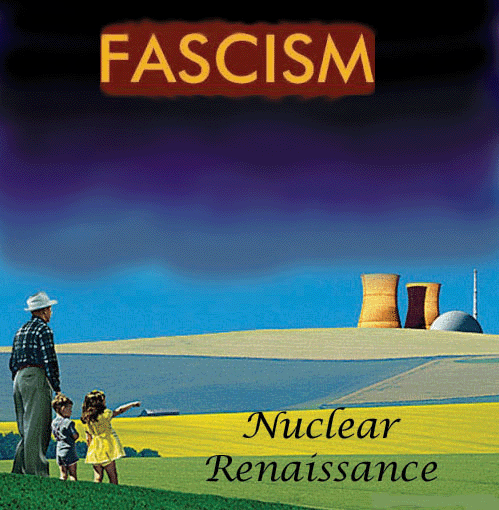
Beyond the financials, nuclear represents a specific vision of governance; centralised, top-down, and resistant to scrutiny. A small number of well-connected corporations manage most facilities. The civilian sector remains intertwined with military infrastructure. Decision-making processes often exclude community consultation. Most notably, nuclear generates waste that remains hazardous for thousands of years, demanding long-term institutional stability that even the Nuclear Waste Management Organization acknowledges no government can guarantee.
Scotland and Canada must forge an energy future that works
by Ben Beveridge, 11-05-2025 , https://bylines.scot/environment/false-promises-real-costs-the-nuclear-gamble-we-cant-afford/
Nuclear power is staging a quiet comeback. In boardrooms across Scotland and Canada, familiar promises are being repackaged as bold new solutions: reliable baseload electricity, energy security, and climate alignment. But behind the sleek rhetoric, the same truths remain. Nuclear power is still the slowest, most expensive, and least flexible energy option on the table.
Both countries now face pressure to commit to a nuclear future they neither need nor can afford. This isn’t the natural evolution of energy policy. It’s the resurrection of a failing model, defended not on merit, but on legacy interests.
In the UK, projects like Hinkley Point C and Sizewell C have seen cost projections soar, with current estimates exceeding £30bn. Scotland, despite producing 97% of its electricity from renewable sources, remains tied to a UK-wide strategy shaped by Westminster’s nuclear ambitions
In Canada, Ontario’s Darlington refurbishment has grown from C$6bn to more than C$12bn. Saskatchewan and New Brunswick are investing heavily in Small Modular Reactors (SMRs), which have yet to prove commercial viability. The Canadian Environmental Law Association has raised significant concerns over the feasibility, safety, and cost of these technologies, yet federal investment continues, often at the expense of grid modernisation and renewable storage.
Nuclear: more expensive, less flexible, needs political intervention
The narrative has shifted from energy independence to climate urgency, but the fundamentals have not. Lazard’s 2023 analysis puts the levelised cost of new nuclear at US$131–204 per megawatt-hour, while utility-scale solar sits at US$26–41, and wind at US$24–47. Nuclear projects frequently exceed ten-year construction timelines. By contrast, wind and solar facilities can be operational within five. Nuclear plants also lack the flexibility modern grids require, locking in oversupply and reducing the effectiveness of variable renewable sources.
Private capital has walked away. No nuclear facility proceeds without government subsidies, price guarantees, or risk backstops. The market has made its judgment. Nuclear survives only through political intervention, not economic logic.
Beyond the financials, nuclear represents a specific vision of governance; centralised, top-down, and resistant to scrutiny. A small number of well-connected corporations manage most facilities. The civilian sector remains intertwined with military infrastructure. Decision-making processes often exclude community consultation. Most notably, nuclear generates waste that remains hazardous for thousands of years, demanding long-term institutional stability that even the Nuclear Waste Management Organization acknowledges no government can guarantee.
Renewables: decentralised, democratic and resilient
In contrast, the model offered by renewables is decentralised, participatory, and adaptive. Community energy projects across Scotland – from the Isle of Eigg to the Outer Hebrides – demonstrate how generation can be local, democratic, and resilient. In Canada, provinces like Quebec and British Columbia have built near-100% clean grids through hydroelectricity, rejecting nuclear while Clean Energy Canada shows generational energy security and affordability.
So why does nuclear persist? The answer lies in its structure. Nuclear development creates concentrated profit centres, contracts for reactor manufacturers, engineering giants, uranium suppliers, and vertically integrated utilities. These stakeholders benefit from centralised generation, not distributed ownership. Regulatory frameworks often entrench their advantages, creating barriers for smaller-scale or community-led projects. The result is a policy environment that protects incumbents rather than enabling transition.
This is not a neutral technological debate. It’s a structural contest between legacy systems and emergent models of energy democracy. The framing may be about climate, but the stakes are about convention, and control.
Scotland and Canada renewable partnership
Scotland and Canada are uniquely positioned to lead an alternative path. Their respective strengths are complementary. A Scotland-Canada renewable partnership, modelled after the North Sea oil and gas collaboration, could drive investment in shared technologies like offshore wind, pumped hydro storage, and smart grid systems. Agencies such as Scottish Enterprise and Scotland Development International already maintain Canadian operations and could broker this cooperation directly.
The Commonwealth presents another opportunity. A Commonwealth Energy Transition Alliance could support shared investment frameworks, model policy design, and collaborative R&D between countries with aligned infrastructure and ambitions. It could also serve as a counterbalance to the lobbying power of the nuclear-industrial complex, directing climate funding towards solutions that scale affordably and equitably.
The choice facing both nations is not nuclear or catastrophe. It is between centralised systems that demand public subsidy and deliver rising costs, versus renewable models that are increasingly faster, cheaper, and community-driven. The facts are clear. The economics are settled. What remains is the political will to choose a future built for the many, not the few.
Scotland and Canada no longer need permission to lead. They need resolve. The nuclear mirage still shimmers, but it’s time to walk towards the real oasis: a clean, democratic energy future, and we have it already.
Who’s afraid of big, bad China?

Neither side wanted to bring China into the debate, and neither side wanted to discuss AUKUS, which is based on a perceived need to take military action against that country.
In the recent Australian election, Neither side wanted to bring China into the debate, and neither side wanted to discuss AUKUS, which is based on a perceived need to take military action against that country.
Jocelyn Chey, May 7, 2025 , https://johnmenadue.com/post/2025/05/whos-afraid-of-big-bad-china/
Be afraid, be very afraid. But not of China. To the contrary, the proper management of co-operative relations with China is essential to Australia’s future.
Finally, the election process is over and done with and the results are in. We look forward to news bulletins not dominated by party spokespeople spruiking how they will deal with the cost of living. Rents, health and transport costs are all important, but the big issues that will make or break their social policies are all global, and the real question is how we can front up to them and hopefully turn them to our benefit. If the world goes into recession, which is a very real possibility, we will all be affected. The cost of living will go up. Cuts to social services will be inevitable.
Why did the candidates not admit this? Do they have contingency plans and, if so, what are they? What are they afraid of? Were they scared that if they mentioned China, the US or Russia, they would lose votes, or be backed into election promises that they could not keep? Or were there structural weaknesses in their policies that they did not wish to expose to scrutiny?
In previous election campaigns, the candidates were not so hesitant to pronounce on international affairs. The 2001 election was dominated by immigration issues and the terrorist attack on the Twin Towers in New York. It was the first “khaki election” since the Vietnam War. In the 2022 election, the Morrison Government tried to repeat their 2001 success by promoting fear of Chinese invasions, both military or cultural, but their attempt failed. This time around, both sides of politics have been careful about their choice of language and avoided difficult topics.
Insofar as national security featured at all in the elections, Labor and the Liberals competed to portray themselves as the better party to protect Australia’s international relationships, particularly in the Pacific. Penny Wong accused the Liberals of leaving a “vacuum” that China was ready to fill, but she did not directly accuse Beijing. The one attempt to whip up fear of an invasion was pinned onto Moscow, rather than Beijing, when news broke of a possible deal between Russia and Indonesia about developing a military airbase in West Papua.
Neither side wanted to bring China into the debate, and neither side wanted to discuss AUKUS, which is based on a perceived need to take military action against that country. Labor and Liberal both promised to increase defence spending, one side to 2.3% of GDP, and the other side to 3% over 10 years. Neither mentioned the reasons for such an increase, or where the money would be found. AUKUS is already absorbing all the increases announced by the last government and affecting other procurement needs. AUKUS spending over the next five years is estimated to reach $18 billion and ultimately will total $368 billion, not including the cost of new infrastructure such as a dedicated naval base at HMAS Stirling. The rationale for nuclear-powered vessels is not the defence of our coasts, but the perceived need to attack distant targets, and that target is China.
China has been progressively opening to the world since the 1980s. It is a permanent member of the UN Security Council and an active member of many multilateral organisations. With Australian encouragement, it has engaged with the multilateral trade system, joined APEC and the World Trade Organisation. The domestic economy has flourished in this open environment and in a region that has not seen armed conflict since the end of the Vietnam War. Maintaining strong growth and raising living standards have been the main pillars of Chinese domestic policies.
Economic development has not always been smooth, and recently new problems have emerged on the international front. China trusted the established international governance system to support and regulate its growth, but, as the country grew stronger, it became evident that the US did not return that trust. Its rapid rise and increasing global presence changed the regional and global balance and generated a geopolitical response that was perhaps predictable.
In 2025, the Trump administration has not yet clarified its policy for handling the relationship with China. Tariffs have been imposed, increased and decreased, and threats and hints have been made by the White House. All is chaos. The only thing that is certain is that Trump will challenge China in a more transactional and unpredictable way, will intensify trade confrontations and sanction Chinese companies in his goal to achieve greater self-sufficiency in the US.
In Beijing, Xi Jinping’s response has been measured and consistent. Official statements emphasise that China supports international rules and regulations and the multilateral system. During the National People’s Congress in March, Foreign Minister Wang Yi in a briefing to the international press presented China as a responsible and stable global power and, without explicitly saying so, drew comparisons with Trump’s America and its chaotic pronouncements.
He said: “We will provide certainty to this uncertain world. … We will be a staunch force defending our national interests. … We will be a just and righteous force for world peace and stability. … We will be a progressive force for international fairness and justice. We will be a constructive force for common development of the world.”
The contrast with Trump’s Tweets could not be more striking.
China is now truly integrated into the global economy. National policy has determined this, and, in any case, it would have been inevitable, given the development of advanced technologies and information and communication systems, all requiring international engagement. China, above all, wants stability and security in international relations to underpin its economic growth. In the future, the major challenges that the world will face are global. Climate change cannot be tackled without international co-operation. Australia needs more than ever to understand China and its domestic and foreign policies.
Co-operation with China is not easy. To borrow Trump’s words, “They hold the cards”. Australia, however, is not alone, and the best response to China is to consult and co-ordinate with neighbouring countries who also regularly interact with the rising superpower. Singapore, Thailand, Vietnam, Malaysia, all have important trade and diplomatic ties with China and have much experience to share about how to manage a relationship with China, a regional power and a global superpower. Australia should be able to manage relations with China. If we respect Beijing’s legitimate rights, Beijing will respect ours
It is possible. China has no history of annexing other countries as Russia annexed Crimea. It respects other countries’ autonomy more than Trump respects the sovereignty of Mexico, Canada or Greenland. It has claims over a large part of the South China Sea that on the surface suggest aggressive intent, but this is not a new claim. The “nine dash line” outlining its territorial claim was first proposed by the then Nationalist government in 1948, and the government of Taiwan still maintains this position. Considering that China is surrounded by a string of US bases along the “first island chain” from Japan to the Philippines, amid that Camp Humphreys, near Seoul in South Korea, the largest US overseas military base, is just 549 kms from the city of Dalian in northeast China, it is not surprising that China should wish to limit further US advances.
As for the other superpower, in the first 100 days of the Trump regime, he has attempted to use the legal system to carry out his personal vendettas. He has shut down many government departments. He has attacked scientific research and the universities and disregarded statistical evidence, particularly in medical science and climate science. He is prejudiced against immigrants. He dismisses the most basic ideas of trade and economics. He prefers to deal with other autocrats like Vladimir Putin and has turned his back on international agreements and treaties.
Be afraid, be very afraid. But not of China.
(This is a summary of a talk given at the Festival of Wild Ideas, St Paul’s Burwood, on 4 May 2025)
Trump’s trip to Saudi Arabia raises the prospect of US nuclear cooperation with the kingdom

By ASSOCIATED PRESS, Daily Mail, 10 May 2025
WASHINGTON (AP) – Saudi Arabia wants U.S. help developing its own civil nuclear program, and the Trump administration says it is “very excited” at the prospect. U.S.-Saudi cooperation in building reactors for nuclear power plants in the kingdom could shut the Chinese and Russians out of what could be a high-dollar partnership for the American nuclear industry.
Despite that eagerness, there are obstacles, including fears that helping the Saudis fulfill their long-standing desire to enrich their own uranium as part of that partnership would open new rounds of nuclear proliferation and competition. Saudi Arabia’s pursuit of a nuclear agreement is likely to play into the ever-evolving bargaining on regional security issues involving the U.S., Iran and Israel.
This coming week, Republican President Donald Trump will make his first trip to Saudi Arabia of his second term. Here´s a look at key issues involved in the Saudi request…………………………………………………………………………………………
Crown Prince Mohammed bin Salman also is pushing to build up Saudi Arabia’s mining and processing of its own minerals. That includes Saudi reserves of uranium, a fuel for nuclear reactors.
For the Trump administration, any deal with Iran that lets Tehran keep its own nuclear program or continue its own enrichment could increase Saudi pressure for the same.
That’s even though Saudi Arabia and other Gulf states have toned down their enmity toward Iran in recent years and are supporting the U.S. efforts to limit Iran´s nuclear program peacefully.
For the U.S., any technological help it gives the Saudis as they move toward building nuclear reactors would be a boon for American companies…………………………………..
“Without a doubt, if Iran developed a nuclear bomb, we would follow suit as soon as possible,” Prince Mohammed said in 2018, at a time of higher tension between Arab states and Iran.
Saudi Arabia and other Gulf states stress better relations and diplomacy with Iran now. But Prince Mohammed’s comments – and other Saudi officials said similar – have left open the possibility that nuclear weapons are a strategic goal of the Saudis.
The Saudis long have pushed for the U.S. to build a uranium enrichment facility in the kingdom as part of any nuclear cooperation between the two countries. That facility could produce low-enriched uranium for civilian nuclear reactors. But without enough controls, it could also churn out highly enriched uranium for nuclear bombs.
Trump administration officials cite the Saudis’ desire to make use of their country´s uranium deposits. The kingdom has spent tens of millions of dollars, with Chinese assistance, to find and develop those deposits. But the uranium ore that it has identified so far would be “severely uneconomic” to develop, the intergovernmental Nuclear Energy Agency says.
It has been decades since there has been any state-sanctioned transfer of that kind of technology to a nonnuclear-weapon state, although a Pakistani-based black-market network provided enrichment technology to Iran, North Korea, Libya and possibly others about 20 years ago, Robert Einhorn noted for the Brookings Institute last year.
Allowing Saudi Arabia – or any other additional country – to host an enrichment facility would reverse long-standing U.S. policy. It could spur more nuclear proliferation among U.S. allies and rivals, Einhorn wrote………………………………….
After Wright’s trip, some Israelis expressed their opposition to allowing Saudi Arabia to enrich uranium, and Iran and Saudi Arabia are both carefully watching the other’s talks with the U.S. on their nuclear issues…………………………
https://www.dailymail.co.uk/wires/ap/article-14698407/Trumps-trip-Saudi-Arabia-raises-prospect-US-nuclear-cooperation-kingdom.html
Non Proliferation Preparatory Committee concludes; Treaty on the Prohibition of Nuclear Weapons states point way forward.

The third Preparatory Committee (PrepCom) for the 2026 Review Conference of the Parties to the Treaty on the Non-Proliferation of Nuclear Weapons (NPT) has just concluded at United Nations Headquarters in New York. Following two weeks of meetings that ended (as anticipated) without the adoption of an outcome document, the discussions illustrated a clear divide between the majority of countries, who are actively working towards nuclear disarmament, and the rest.
Pro-nuclear weapons states have demonstrated a profound lack of urgency in the face of increasingly urgent conditions. Following calls in recent months from some to share, transfer, or station nuclear weapons in new countries, it was dismaying that these states were unable to reaffirm even the most basic principle of the NPT – a commitment to prevent proliferation.
But the increasing risk of nuclear weapons use, anywhere, demands clarity and courage everywhere. That’s what ICAN brings to the table.
In our statement to the conference, we asked the simple question: Can the non-proliferation treaty agree on non-proliferation? We spoke out against the growing number of NPT states parties entertaining the idea of nuclear sharing or a “Eurobomb.” We reminded governments that disarmament and non-proliferation are not vague aspirations, they are legal obligations. And we emphasized that the nuclear policies of the few are undermining the security of the many.
Throughout the PrepCom, the ICAN team engaged directly with all five nuclear-armed states, as well as most nuclear-supportive and nuclear-hosting governments. These conversations were frank — and necessary — as we need to show them that we are watching, and that we hold them accountable to their commitments.

At the same time, we had energising meetings, both bilaterally and as groups, with many of the states championing the Treaty on the Prohibition of Nuclear Weapons (TPNW). With the first Review Conference to the parties to the TPNW, in November 2026, on the horizon, momentum is building — and the intersessional work ahead will be critical.
Why does this matter? Because the TPNW is where real progress is happening. It’s not just setting the standard on disarmament — it is now the clearest reinforcement of the norm on non-proliferation as well. As South Africa, which holds the presidency for the first TPNW Review Conference, stated: “the TPNW represents the highest non-proliferation standard that any State can commit to, thereby strengthening and complementing the NPT.”
And support for the TPNW is growing. Last week, in its general statement to the PrepCom, Kyrgyzstan (which had never previously expressed support for the TPNW) announced its political decision to join the TPNW.
The next state to sign, ratify, or accede to the TPNW will bring the number of states that have taken such an action to 99. That’s more than half of the world’s states – a global majority standing together to reject nuclear weapons as instruments of security.
The increasing support for the TPNW proves that, despite stagnation and posturing in other forums, the global movement for nuclear disarmament is not only alive — it’s advancing.
As this PrepCom ends without consensus, last week’s Nobel Peace Laureate letter, from Nihon Hidankyo, IPPNW, and ICAN to Presidents Trump and Putin, calling on them to meet and to pursue disarmament as a matter of urgency, is all the more urgent.
The Stakes of Donald Trump’s Negotiations with the Islamic Republic of Iran.
First, the United States, faithful to Trump’s Art of the Deal technique, threatened Iran while trying to placate it. International relations are not governed by the same rules as business. Giving in to threats is a sign of weakness that the Iranians could not accept in these negotiations.
by Thierry Meyssan, Voltaire Network | Paris (France) | 29 April 2025
The general public is completely unaware of the real stakes in the negotiations between Washington and Tehran. This article presents a situation in which lies have been piling up over three decades, making any progress particularly difficult. Contrary to popular belief, the nuclear issue in Iran is not whether Tehran will acquire an atomic bomb, but whether it will be able to help Palestine without resorting to weapons.
month and a half ago, I announced that even before concluding peace in Ukraine, President Donald Trump would open negotiations with Iran [1]. As usual, commentators steeped in Joe Biden’s ideology showered me with sarcasm, while my colleagues, specialists in international affairs, noted my observations [2].
The difference between the two lay in their understanding of the negotiations in Ukraine. For the former, it was Donald Trump’s revenge against Volodymyr Zelensky, or a genuflection before Vladimir Putin. For the latter, it was, on the contrary, a desire for peace with Russia in order to devote US resources to its economic recovery.
It follows that the two sides approach the Iranian issue differently. For the former, it is a matter of continuing the chaos that began during the first term with the withdrawal from the nuclear agreement (JCPOA). Conversely, for the latter, it is a desire for peace with Iran, given that it is the only regional power that supports the resistance to Israel.
In early March 2024, President Donald Trump sent a letter to the leader of the Revolution, Ayatollah Ali Khamenei. The existence of this document was mentioned by the author himself during his speech to Congress on March 4, and then debated in the press. According to Sky News Arabia, which read this document, Donald Trump called for negotiations, while specifying: “If you reject the outstretched hand and choose the path of escalation and support for terrorist organizations, I warn you of a swift and determined response […] I am writing this letter with the aim of opening new horizons for our relations, away from the years of conflict, misunderstandings and unnecessary confrontations that we have witnessed in recent decades […] The time has come to leave hostility behind and open a new page of cooperation and mutual respect.” A historic opportunity presents itself to us today […] We will not stand idly by in the face of your regime’s threats against our people or our allies […] If you are willing to negotiate, so are we. But if you continue to ignore the world’s demands, history will testify that you missed a great opportunity.”
Simultaneously, the United States and the United Kingdom launched several attacks against Ansar Allah in Yemen. Unlike previous attacks, these did not target hidden military targets, but rather political targets scattered among the civilian population. They therefore killed leaders of the movement and many other collateral victims, which constitutes war crimes.
It should be recalled that Ansar Allah, pejoratively referred to by Westerners as the “Houthi family gang” or “the Houthis,” attacks Israeli ships in the Red Sea in order to force Tel Aviv to agree to allow humanitarian aid to pass through to Gaza.
Washington and London, believing that this was hampering international trade, and having failed to obtain approval from the Security Council, resumed the war. They initially targeted military objectives and quickly realized that these, buried deep within the country, could not be significantly affected.
Donald Trump’s letter only arrived in Tehran on March 12, and the Iranian response was slow in coming. It is important to understand that while Tehran was flattered by Washington’s secret handwritten approach, it could not accept several aspects of its behavior.
• First, the United States, faithful to Trump’s Art of the Deal technique, threatened Iran while trying to placate it. International relations are not governed by the same rules as business. Giving in to threats is a sign of weakness that the Iranians could not accept in these negotiations. Ayatollah Ali Khamenei commented on March 28: “The enmity of the United States and Israel has always existed. They threaten to attack us, which we believe is not very likely, but if they commit a misdeed, they will certainly receive a strong blow in return.” If the enemies think they can instigate sedition in the country, the Iranian nation itself will respond to them.” President Donald Trump further emphasized this on March 30, telling NBC News: “If they don’t reach an agreement, there will be bombing. It will be bombing like they’ve never seen before.”
According to the United Nations Charter (Article 2, paragraph 4), “members of the Organization shall refrain in their international relations from the threat or use of force against the territorial integrity or political independence of any state.”
The negotiations were therefore compromised before they even began.
• Moreover, massacring the leaders of Ansar Allah was a gratuitous war crime: General Qassem Soleimani, by reorganizing the “Axis of Resistance,” had given Iran’s former proxies their complete freedom. Tehran currently has no influence, other than ideological, over Ansar Allah. Ambassador Amir Saeid Iravani therefore raised these points at the United Nations [3].
• Finally, and most importantly, Donald Trump, by accumulating contradictory signals, did not allow the Iranians to assess his relations with Israel. Does he support the project of a binational state in Palestine (the one promoted by the United Nations)? Or of a Jewish state in Palestine (“Zionism”)? Or that of a “Greater Israel” (“Revisionist Zionism”)? No one knows for sure.
Ultimately, Iran sent a secret response to the secret letter from the United States, and negotiations were able to begin, but only indirectly. That is, the two delegations did not speak directly to each other, but only through a mediator. In this way, Tehran responded to the invitation, but expressed its disapproval of the manner in which it was convened.
ntervening directly, France and the United Kingdom convened a closed-door meeting of the Security Council. Paris and London wished to address several outstanding issues. As nothing has been leaked, it is unclear whether President Emmanuel Macron and Prime Minister Keir Starmer wanted to clarify what had caused all other attempts at negotiations to fail or, on the contrary, to obscure what could have been further obscured…………………………………………………………………………………………………………………………………….. https://www.voltairenet.org/article222165.html
NATO leaders as delusional as Zelensky on lost Ukraine war
no chance of prevailing.
Yet, Zelensky won’t budge on his goals of reclaiming all captured territory including Crimea, lost 5 years before his presidency. Nor will Zelensky give up his delusional goal of NATO membership.
Walt Zlotow, West Suburban Peace Coalition, Glen Ellyn IL, 4 May 25
Thruout the 3 year, 3 month Russo Ukraine war, Ukrainian President Zelensky has steadfastly ignored battlefield reality of Ukraine’s destruction and impending defeat.
His delusions started in April, 2022 when he swallowed US and UK demands he walk away from the negotiated peace deal that would have cost Ukraine no new lost territory, albeit no NATO membership for Ukraine and neutrality between East and West.
Since then he’s lost roughly a fifth of his land, a hundred thousand plus casualties, a shattered economy…and no chance of prevailing.
Yet, Zelensky won’t budge on his goals of reclaiming all captured territory including Crimea, lost 5 years before his presidency. Nor will Zelensky give up his delusional goal of NATO membership.
But outside of US realism under Trump, Zelensky is not alone in his war delusions.
Recently, retired Deputy Supreme Allied Commander in Europe Sir Richard Shirreff advised that Europe will build up its troops, ships and planes if America pulls back from European defense against imaginary enemy Russia, “if only Europe has the will.” Shirreff appears clueless that due to European economic decline from supporting a lost war, most Western European people only have the will that it end
Current NATO Secretary General Mark Rutte is even more Zelensky-like. He trumpet’s Russia’s casualties of a thousand troops daily and that “Ukraine is not losing…and we must ensure Russia does not capture even one more square kilometer of Ukraine territory.” Rutte is oblivious that his intransigence to supporting Trump’s peace plan costs Ukraine more square kilometers of land every single day. Rutte is channeling delusional Baghdad Bob talking about “the mother of all victories” during the second Iraq war..
The oddity of all this delusion is that on just about every domestic and foreign policy issue, Trump is the poster president for delusion. On the Ukraine war he’s the only realist in the war room.
Fantasy and Exploitation: The US-Ukraine Minerals Deal
Dr Binoy Kampmark May 2, 2025, https://theaimn.net/fantasy-and-exploitation-the-us-ukraine-minerals-deal/
The agreement between Washington and Kyiv to create an investment fund to search for rare earth minerals has been seen as something of a turn by the Trump administration. From hectoring and mocking the Ukrainian President Volodymyr Zelensky before the cameras on his visit to the US capital two months ago, President Donald Trump had apparently softened. It was easy to forget that the minerals deal was already on the negotiating table and would have been reached but for Zelensky’s fateful and ill-tempered ambush. Dreams of accessing Ukrainian reserves of such elements as graphite, titanium and lithium were never going to dissipate.
Details remain somewhat sketchy, but the agreement supposedly sets out a sharing of revenues in a manner satisfactory to the parties while floating, if only tentatively, the prospect of renewed military assistance. That assistance, however, would count as US investment in the fund. According to the White House, the US Treasury Department and US International Development Finance Corporation will work with Kyiv “to finalize governance and advance this important partnership,” one that ensures the US “an economic stake in securing a free, peaceful, and sovereign future for Ukraine.”
In its current form, the agreement supposedly leaves it to Ukraine to determine what to extract in terms of the minerals and where this extraction is to take place. A statement from the US Treasury Department also declared that, “No state or person who financed or supplied the Russian war machine will be allowed to benefit from the reconstruction of Ukraine.”
Ukraine’s Minister of Economy, Yulia Svyrydenko, stated that the subsoil remained within the domain of Kyiv’s ownership, while the fund would be “structured” on an equal basis “jointly managed by Ukraine and the United States” and financed by “new licenses in the field of critical materials, oil and gas – generated after the Fund is created.” Neither party would “hold a dominant vote – a reflection of equal partnership between our two nations.”
The minister also revealed that privatisation processes and managing state-owned companies would not be altered by the arrangements. “Companies such as Ukrnafta and Energoatom will stay in state ownership.” There would also be no question of debt obligations owed by Kyiv to Washington.
That this remains a “joint” venture is always bound to raise some suspicions, and nothing can conceal the predatory nature of an arrangement that permits US corporations and firms access to the critical resources of another country. For his part, Trump fantasised in a phone call to a town hall on the NewsNation network that the latest venture would yield “much more in theory than the $350 billion” worth of aid he insists the Biden administration furnished Kyiv with.
Svyrydenko chose to see the Reconstruction Investment Fund as one that would “attract global investment into our country” while still maintaining Ukrainian autonomy. Representative Gregory Meeks, the ranking Democrat on the House of Foreign Affairs Committee, thought otherwise, calling it “Donald Trump’s extortion of Ukraine deal.” Instead of focusing on the large, rather belligerent fly in the ointment – Russian President Vladimir Putin – the US president had “demonstrated nothing but weakness” towards Moscow.
The war mongering wing of the Democrats were also in full throated voice. To make such arrangements in the absence of assured military support to Kyiv made the measure vacuous. “Right now,” Democratic Senator Chris Murphy said on MSNBC television, “all indications are that Donald Trump’s policy is to hand Ukraine to Vladimir Putin, and in that case, this agreement isn’t worth the paper that it’s written on.”
On a certain level, Murphy has a point. Trump’s firmness in holding to the bargain is often capricious. In September 2017, he reached an agreement with the then Afghan president Ashraf Ghani to permit US companies to develop Afghanistan’s rare earth minerals. Having spent 16 years in Afghanistan up to that point, ways of recouping some of the costs of Washington’s involvement were being considered. It was agreed, went a White House statement sounding all too familiar, “that such initiatives would help American companies develop minerals critical to national security while growing Afghanistan’s economy and creating new jobs in both countries, therefore defraying some of the costs of United States assistance as Afghans become more reliant.”
Ghani’s precarious puppet regime was ultimately sidelined in favour of direct negotiations with the Taliban that eventually culminated in their return to power, leaving the way open for US withdrawal and a termination of any grand plans for mineral extraction.
A coterie of foreign policy analysts abounded with glowing statements at this supposedly impressive feat of Ukrainian diplomacy. Shelby Magid, deputy director of the Atlantic Council think tank’s Eurasia Centre, thought it put Kyiv “in their strongest position yet with Washington since Trump took office.” Ukraine had withstood “tremendous pressure” to accept poorer proposals, showing “that it is not just a junior partner that has to roll over and accept a bad deal.”
Time and logistics remain significant obstacles to the realisation of the agreement. AsUkraine’s former minister of economic development and current head of Kyiv school of economics Tymofiy Mylovanov told the BBC, “These resources aren’t in a port or warehouse; they must be developed.” Svyrydenko had to also ruefully concede that vast resources of mineral deposits existed in territory occupied by Russian forces. There are also issues with unexploded mines. Any challenge to the global rare earth elements (REEs) market, currently dominated by China (60% share of production of raw materials; 85% share of global processing output; and 90% manufacturing share of rare earth magnets), will be long in coming.
No Victory in Ukraine: The Costs of Western Delusion
Having invested enormous political capital in the narrative of Ukrainian success, Western governments now face a stark choice: admit failure or fabricate further illusions.
A negotiated settlement can succeed only if it acknowledges Russia’s control over key Ukrainian territories and guarantees that Kyiv will not join NATO. Anything less is strategic fantasy.
Analyzing the impending failure of Ukraine’s war effort and the urgent need for strategic realism in U.S. and European policies.
POST-LIBERAL DISPATCH, Apr 29, 2025, https://postliberaldispatch.substack.com/p/no-victory-in-ukraine-the-costs-of?utm_source=post-email-title&publication_id=4747899&post_id=162368952&utm_campaign=email-post-title&isFreemail=true&r=ln98x&triedRedirect=true&utm_medium=email
The conflict in Ukraine represents not merely a military failure but a profound collapse of political imagination and strategic discipline across the West. To evaluate this ongoing debacle through the lens of political realism and realpolitik demands dispensing with sentimental narratives, ideological attachments, and moralized illusions that have distorted serious analysis for years. Strategic clarity begins with the uncomfortable but inescapable fact: Ukraine’s defeat, whether through a forced diplomatic settlement or battlefield collapse, is no longer a possibility to be debated—it is an inevitability. The West’s refusal to acknowledge this reality stems less from misunderstanding battlefield dynamics and more from a systemic dysfunction wherein political leadership has fused strategic aims with public relations imperatives, thereby serving neither effectively.
At the core of Western miscalculation lies a fatal contradiction. Ukraine was encouraged—indeed, materially and rhetorically incentivized—to resist with the implicit, sometimes explicit, promise of ultimate victory. Yet Western capitals were neither prepared to mobilize the industrial base, financial resources, nor political will necessary to sustain the prolonged total war required to defeat a nuclear-armed Russia. This contradiction was not an accident; it arose naturally from the structural incentives within Western democracies, where leaders needed to appear resolute without assuming the irreversible costs and risks that genuine strategic victory would demand. Thus, Western “support” was expansive in quantity but defective in quality—sufficient to prolong Ukraine’s resistance but insufficient to enable decisive success.
This dynamic exposes why further support—whether billions of dollars in aid, advanced weapons, or rhetorical escalations—cannot now alter the outcome. Ukraine’s manpower shortages, industrial exhaustion, and political fragmentation cannot be reversed by external injections of matériel or funding. The critical variable—human capacity—has been irreversibly degraded. Realpolitik demands the recognition that no arsenal of Western weapons can compensate for a collapsing force structure facing an adversary that enjoys both conventional and nuclear escalation dominance.
The strategic illusion driving continued support is not born of a sincere belief in Ukrainian victory but rather of a desperate attempt to delay political reckoning. Having invested enormous political capital in the narrative of Ukrainian success, Western governments now face a stark choice: admit failure or fabricate further illusions. In this sense, Ukraine’s war effort has been subordinated to Western political needs rather than judged on its own strategic merits. This helps explain why Ukrainian leadership was encouraged to reject diplomatic offramps like the Istanbul talks: the West preferred a failed gamble on battlefield reversal to an early settlement that would have publicly exposed the limits of Western power and credibility.
This leads to an unavoidable truth: Ukraine has been treated less as a sovereign actor and more as an instrument of Western strategic signaling. The dominant objective was never the restoration of Ukraine’s 1991 borders—an outcome unattainable without direct NATO intervention—but the maintenance of an image of Western resolve against authoritarian revisionism. Once battlefield success proved elusive, the war transformed into a conflict of perception, with Ukrainians paying the real, human cost for abstract political imperatives.
Against this backdrop, Trump’s blunt diplomacy is not a betrayal but rather a belated reassertion of strategic rationality. The alternative—prolonging Ukraine’s suffering for a fantasy of reversal—serves no tangible Western interest. Trump’s reported willingness to “walk away” unless a settlement is reached recognizes a fundamental truth of realpolitik: power is the only currency in negotiation. With no remaining strategic leverage, Ukraine must accept the least unfavorable terms while it still retains a semblance of bargaining power. Otherwise, total military collapse and unconditional surrender will be the inevitable conclusion.
This analysis must also grapple with the secondary consequences. Ukraine’s defeat will undoubtedly damage U.S. credibility in the eyes of key allies such as Taiwan, Japan, and South Korea. Yet political realism demands prioritization. The Indo-Pacific, not Eastern Europe, is now the primary theater of geopolitical competition. Resources, strategic focus, and credibility are finite. Every dollar expended in Ukraine without materially altering the balance of power weakens Washington’s ability to contain China, the only peer competitor capable of fundamentally reshaping the global order. From a purely interest-based perspective, retrenchment from Ukraine in favor of bolstering Indo-Pacific commitments is not only logical but strategically imperative, however politically unpalatable it may seem.
Nor should any illusions persist about containing Russia through continued proxy conflict. Prolonged war has already incentivized deepening Russian-Chinese strategic alignment, revealed political fractures within NATO, and accelerated the global shift toward a multipolar order. The longer the West clings to the illusion of salvaging Ukraine’s position, the more divisive it will become at home—and the more strategic ground it will cede abroad. Realpolitik demands ruthless triage: sacrifice what cannot be saved to consolidate and defend what remains viable.
Finally, it must be recognized that Russia, having paid the costs of prolonged conflict, has no rational incentive to settle for partial gains. Political realism teaches that actors seek to translate battlefield success into maximal political objectives. Unless confronted by overwhelming force or existential risk—neither of which the West is prepared to employ—Russia will continue pressing its advantage. A negotiated settlement can succeed only if it acknowledges Russia’s control over key Ukrainian territories and guarantees that Kyiv will not join NATO. Anything less is strategic fantasy.
The dominant narratives that have framed Western engagement in Ukraine—invocations of democracy, sovereignty, and resistance to aggression—may possess emotional resonance, but they have been strategically catastrophic. They obscured the real stakes, concealed the true balance of forces, and ultimately subordinated hard strategic interests to soft illusions. In the brutal calculus of international politics, sentimental attachments are liabilities, not assets. Strategic clarity demands recognizing irretrievable losses, minimizing further damage, and reallocating resources to theaters where the balance of power can still be decisively shaped.
1 This Month

26 September – International Day for the Total Elimination of Nuclear Weapons


PLEASE OPPOSE HR 8255 AND S.3639 – bills would accelerate satellite deployment, with no environmental review or safeguards – https://ncstd5li.quorum.us/campaign/169331/
To see nuclear-related stories in greater depth and intensity – go to https://nuclearinformation.wordpress.com
-
Archives
- September 2026 (206)
- August 2026 (330)
- July 2026 (355)
- June 2026 (287)
- May 2026 (306)
- April 2026 (356)
- March 2026 (251)
- February 2026 (267)
- January 2026 (308)
- December 2025 (358)
- November 2025 (359)
- October 2025 (375)
-
Categories
- 1
- 1 NUCLEAR ISSUES
- business and costs
- climate change
- culture and arts
- ENERGY
- environment
- health
- history
- indigenous issues
- Legal
- marketing of nuclear
- media
- opposition to nuclear
- PERSONAL STORIES
- politics
- politics international
- Religion and ethics
- safety
- secrets,lies and civil liberties
- spinbuster
- technology
- Uranium
- wastes
- weapons and war
- Women
- 2 WORLD
- ACTION
- AFRICA
- Atrocities
- AUSTRALIA
- Christina's notes
- Christina's themes
- culture and arts
- Events
- Fuk 2022
- Fuk 2023
- Fukushima 2017
- Fukushima 2018
- fukushima 2019
- Fukushima 2020
- Fukushima 2021
- general
- global warming
- Humour (God we need it)
- Nuclear
- RARE EARTHS
- Reference
- resources – print
- Resources -audiovicual
- Weekly Newsletter
- World
- World Nuclear
- YouTube
-
RSS
Entries RSS
Comments RSS
 nuclear-news