Sorrowful day for peace largely ignored thruout America

Walt Zlotow West Suburban Peace Coalition Glen Ellyn IL, 7 Feb 26
The New Start Treaty between Russia and US expires today and America largely yawned. Big story on mainstream news? Faggedaboudit. Ask the person on the street about New Start and he might mutter something about giving disadvantaged kids free comprehensive early childhood education. Wait, wait…that’s Head Start.
Nope, New Start is the 16 year old treaty Obama signed with Russian President Dmitry Medvedev on February 8, 2010. It caps the number of nuclear warheads each side can deploy at 1,550 and limits the number of deployed and non-deployed strategic launchers to 800. Still enough for either side to incinerate us all, but prevents a senseless arms race and symbolic of the critical need to reduce nuclear tensions.
But limited US Russian nuclear arsenals go back 54 years as 2010 Russian New Start signer Medvedev reminded us yesterday. “That’s it. For the first time since 1972, Russia (the former USSR) and the US have no treaty limiting strategic nuclear forces. SALT 1, SALT 2, START I, START II, SORT, New START – All in the past, winter is coming.”
President Trump rebuffed Russian President Putin’s offer to extend the limits for another year for sensible diplomacy to negotiate a new treaty.
Secretary of State Marco Rubio used the lame excuse that any new treaty must include China. But with a nuclear arsenal a pittance of the two nuclear giants, China demurred saying any treaty involving China must include US Russian nuclear stockpiles reduced to China’s level. Rubio knew his requirement was a poison pill deal breaker for any new extension of New Start.
Dumping nuclear agreements is nothing new for Trump. He left office in January 20, 2021 ignoring New Start’s eminent expiration. Successor Biden promptly renewed New Start for 5 years, exactly 5 years ago today. This time Trump has succeeded in letting it expire on his watch.
This gives Trump a trifecta in dumping critically needed nuclear agreements. In August 2019 Trump withdrew from the Intermediate Range Nuclear Forces (INF) Treaty that banned all land-based missiles with ranges between 500 and 5,500 km. . In November 2020, just before leaving office, Trump withdrew from the 2002 Open Skies Treaty which allowed the US and Russia to conduct short-notice, unarmed reconnaissance flights over each other’s territory to monitor military activities.
The only positive glimmer to put on Trump’s refusal to extend New Start, even for a measly year to negotiate a long term agreement? Trump has no more nuclear agreements to withdraw from in the last sorrowful 3 years of his second term.
This January the Bulletin of Atomic Scientists moved the Doomsday Clock, symbolic of approaching global catastrophe, to 85 seconds to Midnight, the closest in its 79 year history. With Trump president, the Bulletin might want to quickly reconvene for another gander at our march toward world annihilation. Next January, none of us might around to hear the 2027 announcement.
The US Keeps Openly Admitting It Deliberately Caused The Iran Protests
Caitlin Johnstone, Feb 06, 2026, https://www.caitlinjohnst.one/p/the-us-keeps-openly-admitting-it?utm_source=post-email-title&publication_id=82124&post_id=187080859&utm_campaign=email-post-title&isFreemail=true&r=1ise1&triedRedirect=true&utm_medium=email
Speaking before the Senate Banking Committee on Thursday, US Treasury Secretary Scott Bessent explicitly stated that the US deliberately caused a financial crisis in Iran with the goal of fomenting civil unrest in the country.
Asked by Senator Katie Britt what more the US can be doing to place pressure on the Ayatollah and Iran, Bessent explained that the Treasury Department has implemented a “strategy” designed to undermine the Iranian currency which crashed the economy and sparked the violent protests we’ve seen throughout the country.
“One thing we could do at Treasury, and what we have done, is created a dollar shortage in the country,” Bessent said. “At a speech at the Economic Club in March I outlined the strategy. It came to a swift and I would say grand culmination in December when one of the largest banks in Iran went under. There was a run on the bank, the central bank had to print money, the Iranian currency went into free fall, inflation exploded, and hence we have seen the Iranian people out on the street.”
This is not the first time Bessent has made these admissions. Speaking at the World Economic Forum in Davos last month, the treasury secretary said the following:
“President Trump ordered Treasury and our OFAC division, Office of Foreign Asset Control, to put maximum pressure on Iran. And it’s worked, because in December, their economy collapsed. We saw a major bank go under; the central bank has started to print money. There is dollar shortage. They are not able to get imports, and this is why the people took to the street. So, this is economic statecraft, no shots fired, and things are moving in a very positive way here.”
Following these remarks, Jeffrey Sachs and Sybil Farres wrote the following for Common Dreams:
“What Secretary Bessent describes is of course not ‘economic statecraft’ in a traditional sense. It is war conducted by economic means, all designed to produce an economic crisis and social unrest leading to a fall of the government. This is proudly hailed as ‘economic statecraft.’
“The human suffering caused by outright war and crushing economic sanctions is not so different as one might think. Economic collapse produces shortages of food, medicine, and fuel, while also destroying savings, pensions, wages, and public services. Deliberate economic collapse drives people into poverty, malnutrition, and premature death, just as outright war does.”
Bessent laid out these plans in advance at the Economic Club of New York back in March of last year, saying the following:
“Last month, the White House announced its maximum pressure campaign on Iran designed to collapse its already buckling economy. The Iranian economy is in disarray; 35% official inflation, has a currency that has depreciated 60% in the last 12 months, and an ongoing energy crisis. I know a few things about currency devaluations, and if I were an Iranian, I would get all of my money out of the Rial now.
“This precarious state exists before our Maximum Pressure campaign, designed to collapse Iranian oil exports from the current 1.5–1.6, million barrels per day, back to the trickle they were when President Trump left office.
“Iran has developed a complex shadow network of financial facilitators and black-market oil shippers via a ghost fleet to sell oil, petrochemical and other commodities to finance its exports and generate hard currency.
“As such, we have elevated a sanctions campaign against this export infrastructure, targeting all stages of Iran’s oil supply chain. We have coupled this with vigorous government engagement and private sector outreach.
“We will close off Iran’s access to the international financial system by targeting regional parties that facilitate the transfer of its revenues. Treasury is prepared to engage in frank discussions with these countries. We are going to shut down Iran’s oil sector and drone manufacturing capabilities.
“We have predetermined benchmarks and timelines. Making Iran Broke Again will mark the beginning of our updated sanctions policy. Watch this space.”
The US has been orchestrating plans to foment unrest in Iran by causing economic strife for years. In 2019 Trump’s previous secretary of state Mike Pompeo openly acknowledged that the goal of Washington’s economic warfare against Iran was to make the population so miserable that they “change the government”, cheerfully citing the “economic distress” the nation had been placed under by US sanctions.
As unrest tore through Iran last month, Trump egged protesters on and encouraged them to escalate, saying “To all Iranian patriots, keep protesting, take over your institutions, if possible, and save the name of the killers and the abusers that are abusing you,” adding, “all I say to them is help is on its way.”
Deliberately trying to ignite a civil war in a country by immiserating its population so severely that they start attacking their own government out of sheer desperation is one of the most evil things you can possibly imagine. But under the western empire it’s just another day. They’re doing it in Iran, and they’ve also aggressively ramped up efforts to do it in Cuba, where the government has just announced it will be rationing oil as the US moves to strangle the island nation into regime change.
A lot of attention is going into the Epstein files right now, and understandably so. But it’s worth noting that nothing in them is as depraved and abusive as what our rulers are doing right out in the open.
US and Russia negotiating New START deal – Axios.
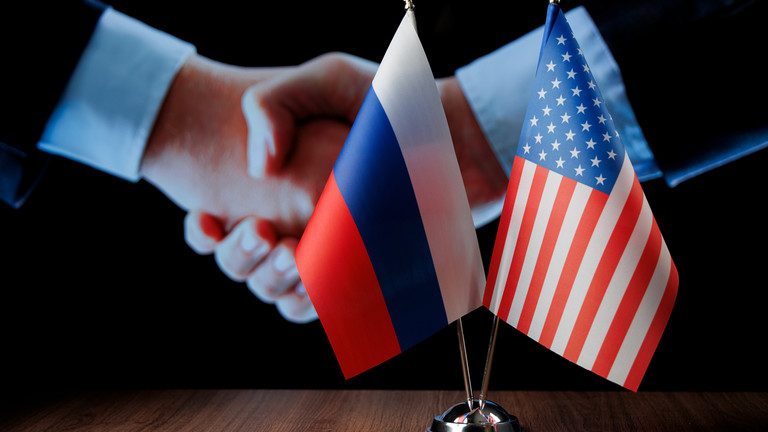
The issue was reportedly discussed on the sidelines of the Ukraine peace talks in Abu Dhabi
5 Feb, 2026 , https://www.rt.com/news/632065-us-russia-negotiate-new-start/
Moscow and Washington are working on a deal to continue the New START nuclear reduction treaty, Axios reported on Thursday, citing three sources familiar with the issue. The strategic arms control agreement officially expired on February 5.
Signed in 2010, the treaty put caps on the number of strategic nuclear warheads and launchers that can be deployed and establishes monitoring mechanisms for both Russian and American arsenals. It was initially set to expire in 2021 but was extended for five years at the time.
According to Axios, President Donald Trump’s son-in-law Jared Kushner and special envoy Steve Witkoff discussed the issue with the Russian delegation on the sidelines of the Ukraine peace talks in Abu Dhabi. “We agreed with Russia to operate in good faith and to start a discussion about ways it could be updated,” a US official told the media outlet. Another source claimed that the sides had agreed to observe the treaty’s terms for at least six months as the talks on a potential new deal would be ongoing.
Earlier on Thursday, Kremlin spokesman Dmitry Peskov said that Moscow suggested sticking to the treaty’s provisions for another year but its initiative “remained unanswered.” Russia will “keep its responsible attentive approach in the field of strategic stability [and] nuclear weapons” but will be always “primarily guided by its national interests,” he said.
The UN also called the treaty expiration “a grave moment for international peace and security.” Secretary-General Antonio Guterres warned that “the risk of a nuclear weapon being used is the highest in decades” as he urged Moscow and Washington to negotiate a successor framework.
Russian President Vladimir Putin had earlier proposed to his US counterpart Donald Trump a one-year extension of the treaty but the American president said that he wanted a “better” agreement that includes China.
On Thursday, Peskov said that China considers joining the talks on a new treaty “pointless” since its nuclear arsenal is incompatible with that of Russia and the US. “We respect this position,” the Kremlin spokesman said.
The U.S. occupation of Gaza has begun
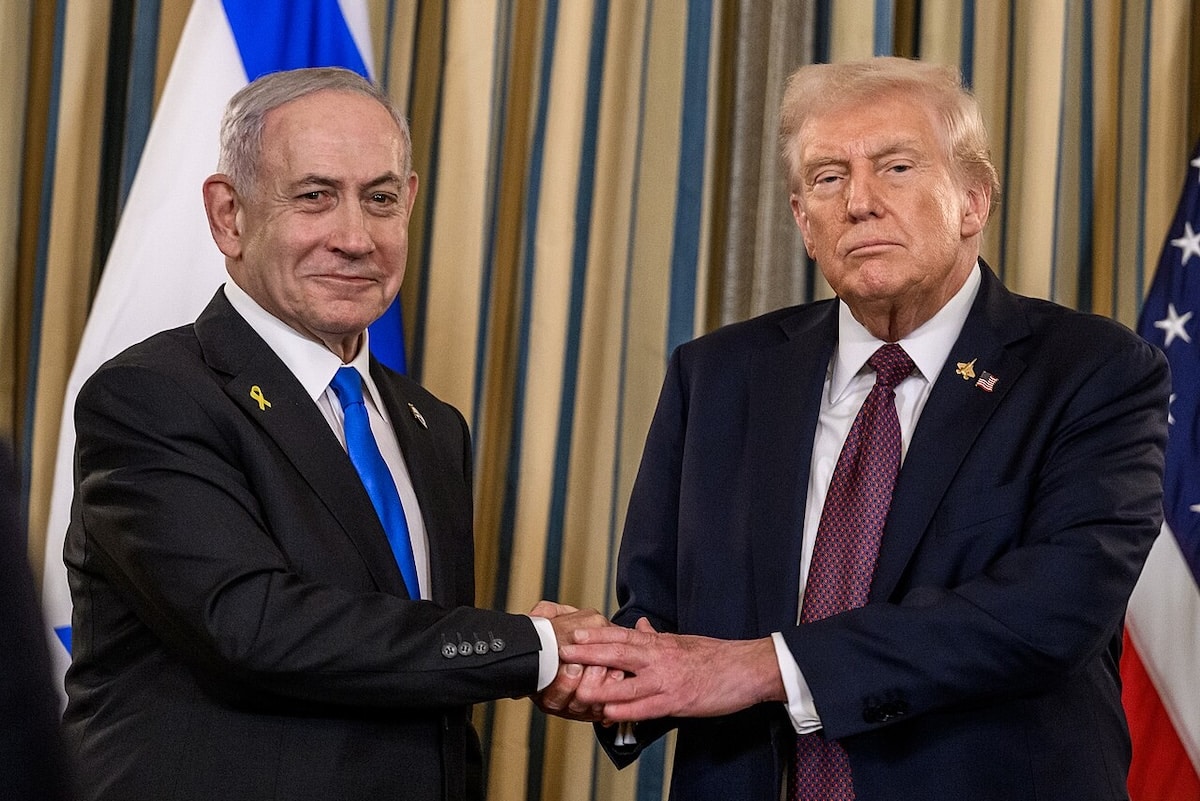
The plans for Donald Trump’s “Board of Peace” show that the goal is not just to make Gaza a playground for the wealthy, but to put it under permanent American occupation.
Mondoweiss, By Mitchell Plitnick January 30, 2026
This week, Drop Site News revealed a draft resolution from Trump’s newly christened “Board of Peace.” The resolution outlines what is, in essence, Phase Two of Trump’s unrealistic peace plan that ushered in a new phase of horror in Gaza under the guise of a ceasefire.
The actions outlined in the resolution ignore realities on the ground and paint a very grim picture of what the United States is planning for Gaza. Far from abandoning the ludicrous and offensive imagery Trump shared in that AI video from last year of himself and Elon Musk on a beach in an unrecognizable Gaza, this resolution is the battle plan to turn Gaza into the playground for the wealthy that Jared Kushner presented to the World Economic Forum at Davos last week. It’s a Gaza where the only Palestinians remaining are those chosen to be the servants in the new regime.
It’s a Gaza under permanent American occupation.
The “Executive Board” that would control Gaza
The Board of Peace (BoP) itself has drawn the most attention, but it is not the focal point for Gaza. The BoP is being set up as an international force to challenge the United Nations. It is currently populated entirely by far-right and autocratic figures, and will likely stay that way.
The BoP will be headed by Donald Trump and his role as Board Chair is personal, disconnected from his role as President of the United States. He has full power over the Board’s composition and full veto power over all of its actions. Trump will remain in control of the BoP until he decides to leave or he dies, and he has the sole authority to name his successor. You couldn’t build a clearer autocracy.
The BoP can delegate its authority as it wishes, and that is what it has done regarding Gaza. The “Executive Board” (EB) is the body that will govern Gaza. The EB itself will also have other areas within its portfolio, so it, too, has delegated its power to yet another group, dubbed the Gaza Executive Board (GEB). There is considerable overlap between the members of the EB and GEB.
The members of the GEB include some very familiar names like Steve Witkoff, Trump’s lead negotiator; Susan Wiles, his Chief of Staff; Jared Kushner, his son-in-law; and Tony Blair the former PM of the UK and a war criminal in the 2003 invasion of Iraq.
The rest of the names may be less familiar, but they are all important and, together, they draw a very worrisome picture of how this Board will behave ………………………………………………………………………………………………………………………………………………………………………………………………………………………………………………………..
Palestinians not included in planning Gaza’s future
While there are no Israelis on the Executive Board, it is stacked with extreme supporters of the Israeli right and of Netanyahu. This makes the vague mandate of the entire enterprise much more concerning.
The proposal published by Drop Site states that “the reconstruction and rehabilitation activities of the Board shall be dedicated solely to those who regard Gaza as their home and place of residence.”
But the proposal offers no opportunity for the people of Gaza to have any say at all in their present situation, let alone their future. The EB governs all of the laws. An American-led International Stabilization Force (ISF) controls all security.
The ISF is to be under the command of American Major General Jasper Jeffers. Trump, and Trump alone, has the power to remove the commander of the ISF and must personally approve any nominee to replace him.
The plan further states that “only those persons who support and act consistently [with Trump’s Comprehensive Plan for Gaza] will be eligible to participate in governance, reconstruction, economic development, or humanitarian assistance activities in Gaza.”
In other words, Palestinians who wish to be part of Gaza in any way must meet Trump’s litmus test of support for the external American control of the Gaza Strip. The same will be true for any business, NGO, or even individual who wants to participate in any way in rebuilding Gaza, physically, politically, or economically.
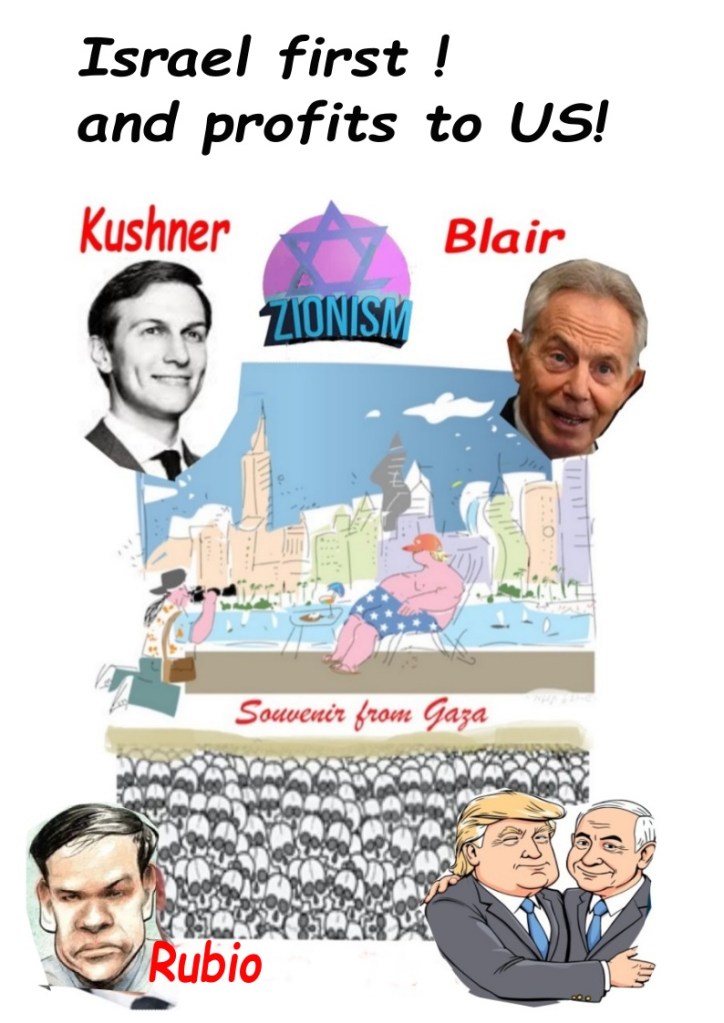
Ideally, for Trump and Jared Kushner, Gaza would be transformed into a giant “company town.” Most of the coastline would be dedicated to tourism. The bulk of Gaza’s eastern border with Israel would be dedicated to industrial zones and huge data centers, doubtless reflecting the massive investments Trump and his Emirati friends are making in AI.
In between would be residential areas separated by parks, agricultural, and sporting sites. In the West Bank, such parks and agricultural areas are frequently declared closed military zones and used for other purposes by the occupying force.
As has been apparent from the beginning, the only role currently envisioned for Palestinians is in the administration of the Executive Board’s decisions. In other words, Palestinian technocrats, laborers, and office workers would be “permitted” to carry out the decisions made for them by others.
The U.S. occupation of Gaza
This resolution provides only a bit more substance to the half-baked ideas Trump has been putting forward since October. And it continues to envision a near-future where Hamas has voluntarily disarmed, Israel has pulled out of Gaza, and the ISF has assumed security control that is welcomed by whatever Palestinians remain in Gaza.
All of that remains fully in the realm of fantasy.
Hamas has repeatedly made it clear that it is willing to discuss decommissioning its weapons, but would not disarm. Given that Israel is, once again, funding rogue Palestinian gangs in Gaza, complete disarmament is suicide for many members of Hamas, Islamic Jihad, and other factions.
The United States is discussing offering amnesty and even a buy-back program for the weapons, but these offers are hardly useful if the lives of Hamas members are put at grave risk by disarmament, even if we assume that the U.S. keeps to its word and that Israel does not itself hunt these fighters down.
Moreover, Israel is bristling at this entire plan. They prefer to bring the hammer down again on Gaza, especially now that there are no hostages, dead or alive, to be concerned with.
Netanyahu is openly stating that Israel will allow no rebuilding in Gaza—where it is killing people, including infants, not only with its weapons but by denying Palestinians the materials to shelter from the winter elements—until Hamas is “disarmed.”
…………………………Israel has already reportedly drawn up a plan for a major military operation, a return to the full-blown genocide of last year, which it plans to launch in March unless the U.S. refuses to allow it to do so.
…………………..What is taking shape in Gaza is a new kind of foreign occupation. This time, the U.S. would be the leading force on the ground unless it allows Israel to renew its aggression, something Trump doesn’t want.
………………………….An American occupation of Gaza on Israel’s behalf will be just as unwelcome by Palestinians as an Israeli one backed by the United States. It may take some time for the people of Gaza to regroup from the past two and a half years to organize impactful resistance, but it will come, as it always has.
The solution is simple: allow Palestinians their freedom and their rights. But that solution is beyond the imagination of Washington and Tel Aviv. So, meet the new occupation. It will be no more pleasant than the old one. https://mondoweiss.net/2026/01/the-u-s-occupation-of-gaza-has-begun/
Without START, everything could end

With a major nuclear exchange there would be many detonations, killing billions of people. As the fallout spreads, billions more would sicken and die a slower death from radiation poisoning. The soot and smoke would block out sunlight, causing a “nuclear winter”, a fall in temperature that would destroy most food-producing agriculture. The electromagnetic field on which the internet and much of modern technology depends would be disrupted
All of these effects would multiply each other in unforeseeable ways. Civilizations would collapse. And radiation hangs around for millions of years. It disrupts DNA, so the long-term biological effects, assuming there are still life forms around, would be devastating.
Ignoring this last nuclear treaty comes at great peril, writes Carol Wolman
A key nuclear treaty, the START (Strategic Arms Reduction Treaty) expires on Feb 4th 2026. This bilateral treaty between the US and Russia caps the number of nuclear weapons each side may legally possess. It also mandates bilateral inspections to ensure the treaty is respected on both sides.
Originally signed in 1991 by then Soviet premier Mikhail Gorbachev and US President H. W. Bush, it successfully reduced the nuclear weapons stockpiles on each side by 80%. This essentially put an end to the nuclear arms race between the US and the Soviet Union, which broke up later that year.
In 2010, a revised New START treaty was negotiated by US President Clinton and Russian President Medvedev. This further reduced stockpiles to about 2000 nuclear warheads apiece. Ratified by both sides in 2011, it had a ten-year term and was renewed for another 5 years in 2021 under President Biden.
Russia’s President Putin has offered to extend the treaty for another year, if the US reciprocates. President Trump said on January 8, 2026: “If it expires, it expires”. Expiration of New START would remove all constraints on expansion of nuclear stockpiles and delivery systems, as well as abolishing bilateral inspections
By way of background: the first nuclear weapons were used on August 6th and 9th 1945, when the US dropped atomic bombs on the Japanese cities of Hiroshima and Nagasaki. Over the next 20 years, Russia, England, France and China also developed these weapons of mass destruction.
The Cuban Missile Crisis of 1962 frightened everyone. Soviet leader Nikita Khrushchev placed nuclear armed missiles on the island of Cuba, 90 miles from Florida, and President Kennedy threatened various sorts of retaliation, including nuclear. For 13 days, we didn’t know if we would wake up the next morning.
This alarm set in motion a series of treaties designed to prevent nuclear war. A hotline was installed between the White House and the Kremlin. Atmospheric nuclear testing was banned in 1963 through the Partial Test Ban Treaty. Some underground tests were banned two years later, but it was not until 1996 when all nuclear explosions, including underground, were finally banned through the Comprehensive Test Ban Treaty (CTBT), although it has never come into force. However, Russia officially withdrew its ratification of the CTBT in November 2023.
The key nuclear Nonproliferation Treaty, which entered into force in 1970, was designed to stop the spread of nuclear weapons to countries that did not have them, although four more countries have since joined the “club” — India, Pakistan, North Korea and Israel, none of which are signatures to the treaty (North Korea originally joined the treaty but withdrew once it developed nuclear weapons).
As of 2026, Russia, China and the US are all increasing their nuclear budgets exponentially. Global tensions are rising because of many factors: global warming, natural disasters, increases in the demand for energy, and scarcity of essential resources like water and rare minerals, to name a few. The risk of all-out nuclear war goes up dramatically without New START.
An all-out nuclear war might well be suicidal for humanity; indeed, for most life forms. Scientists tell us that a number of factors would ensure widespread lethality.
With a major nuclear exchange there would be many detonations, killing billions of people. As the fallout spreads, billions more would sicken and die a slower death from radiation poisoning. The soot and smoke would block out sunlight, causing a “nuclear winter”, a fall in temperature that would destroy most food-producing agriculture. The electromagnetic field on which the internet and much of modern technology depends would be disrupted.
All of these effects would multiply each other in unforeseeable ways. Civilizations would collapse. And radiation hangs around for millions of years. It disrupts DNA, so the long-term biological effects, assuming there are still life forms around, would be devastating.
We have lived with nuclear weapons for 80 years, since the A-bombs were dropped on Hiroshima and Nagasaki. Horrendous as those were, they were small compared to the hydrogen bombs, 5-40 times more powerful, which are now routine in nuclear stockpiles……………………………………………………………………………………………………………..
A new treaty, the UN Treaty on the Prohibition Nuclear Weapons (TPNW), became international law five years ago. Seventy-four nations have ratified it. Most of them are in the Southern Hemisphere; none of them have nuclear weapons.
There is a resolution in the US House of Representatives, HR 77, which supports the tenets of the TPNW. It currently has 44 cosponsors. Is your Representative one of them?
It will take a concerted effort to get rid of nuclear weapons. The International Campaign to Abolish Nuclear Weapons has many tools for individuals and groups to use. A good start would be to write to periodicals and demand that they run articles about the looming demise of the New START treaty.
Abolishing nuclear weapons begins with paying attention. https://beyondnuclearinternational.org/2026/02/01/without-start-everything-could-end/
The only remaining US-Russia nuclear treaty expires this week. Could a new arms race soon accelerate?
Tilman Ruff, Honorary Principal Fellow, School of Population and Global Health, The University of MelbourneFebruary 2, 2026, https://theconversation.com/the-only-remaining-us-russia-nuclear-treaty-expires-this-week-could-a-new-arms-race-soon-accelerate-269508?utm_medium=email&utm_campaign=Latest%20from%20The%20Conversation%20for%20February%202%202026%20-%203661637412&utm_content=Latest%20from%20The%20Conversation%20for%20February%202%202026%20-%203661637412+CID_d509427262fbc0b5c74ed2503dd5f4e9&utm_source=campaign_monitor&utm_term=The%20only%20remaining%20US-Russia%20nuclear%20treaty%20expires%20this%20week%20Could%20a%20new%20arms%20race%20soon%20accelerate
The New START treaty, the last remaining agreement constraining Russian and US nuclear weapons, is due to lapse on February 4.
There are no negotiations to extend the terms of the treaty, either. As US President Donald Trump said dismissively in a recent interview, “if it expires, it expires”.
The importance of the New START treaty is hard to overstate. As other nuclear treaties have been abrogated in recent years, this was the only deal left with notification, inspection, verification and treaty compliance mechanisms between Russia and the US. Between them, they possess 87% of the world’s nuclear weapons.
The demise of the treaty will bring a definitive and alarming end to nuclear restraint between the two powers. It may very well accelerate the global nuclear arms race, too.
What is New START?
The New START or Prague Treaty was signed by then-US President Barack Obama and his Russian counterpart, Dimitri Medvedev, in Prague on April 8, 2010. It entered into force the following year.
It superseded a 2002 treaty that obligated Russia and the United States to reduce their operationally deployed, strategic nuclear warheads to between 1,700 and 2,200 by the end of 2012.
The New START Treaty called for further reductions on long-range nuclear weapons and provided greater specificity about different types of launchers. The new limits were:
- 700 deployed intercontinental and submarine-launched ballistic missiles (together with heavy bombers)
- 1,550 nuclear warheads deployed on those platforms, and
- 800 launchers (both deployed and non-deployed).
These reductions were achieved by February 5, 2018.
The treaty included mechanisms for compliance and verification, which have worked effectively. It provided for twice-yearly exchanges of data and ongoing mutual notification about the movement of strategic nuclear forces, which in practice occurred on a nearly daily basis.
Importantly, the treaty also mandated short-notice, on-site inspections of missiles, warheads and launchers covered by the treaty, providing valuable and stabilising insights into the other’s nuclear deployments.
Lastly, the treaty established a bilateral consultative commission and clear procedures to resolve questions or disputes.
Limitations of the deal
The treaty was criticised at the time for its modest reductions and the limited types of nuclear weapons it covered.
But the most enduring downside was the political price Obama paid to achieve ratification by the US Senate.
To secure sufficient Republican support, he agreed to a long-term program of renewal and modernisation of the entire US nuclear arsenal – in addition to the facilities and programs that produce and maintain nuclear weapons. The overall pricetag was estimated to reach well over US$2 trillion.
This has arguably done more harm by entrenching the United States’ possession of nuclear weapons and thwarting prospects for disarmament.
As the New START treaty was about to expire in 2021, Russia offered to extend it for another five years, as allowed under the terms. US President Donald Trump, however, refused to reciprocate.
After winning the 2020 US presidential election, Joe Biden did agree to extend the treaty on February 3, 2021, just two days before it would have expired. The treaty does not provide for any further extensions.
In February 2023, Russia suspended its implementation of key aspects of the treaty, including stockpile data exchange and on-site inspections. It did not formally withdraw, however, and committed to continue to abide by the treaty’s numerical limits on warheads, missiles and launchers.
What could happen next
With the imminent expiry of the treaty this year, Russian President Vladimir Putin announced in September 2025 that he was prepared to continue observing the numerical limits for one more year if the US acted similarly.
Besides an off-the-cuff comment by Trump – “it sounds like a good idea to me” – the US did not formally respond to the Russian offer.
Trump has further complicated matters by insisting that negotiations on any future nuclear arms control agreements include China. However, China has consistently refused this. There is also no precedent for such trilateral nuclear control or disarmament negotiations, which would no doubt be long and complex. Though growing, China’s arsenal is still less than 12% the size of the US arsenal and less than 11% the size of Russia’s.
Tagreement to continue to observe its limits until a successor treaty is negotiated.
This means Russia and the US could increase their deployed warheads by 60% and 110%, respectively, within a matter of months. This is because both have the capacity to load a larger number of warheads on their missiles and bombers than they currently do. Both countries also have large numbers of warheads in reserve or slated for dismantlement, but still intact.
If they took these steps, both countries could effectively double their deployed strategic nuclear arsenals.
The end of the treaty’s verification, data exchanges, and compliance and notification processes would also lead to increased uncertainty and distrust. This, in turn, could lead to a further build-up of both countries’ already gargantuan military capabilities
Europe in Panic: Trump’s Power Play Shakes the World Order
by Joshua Scheer, February 1, 2026 https://scheerpost.com/2026/02/01/europe-in-panic-trumps-power-play-shakes-the-world-order/
For decades, the Western Alliance has been treated as a permanent fixture of global politics — a transatlantic bond forged in the ashes of World War II and held together through the Cold War by a shared fear of the Soviet Union. But as this video argues, the world that created NATO no longer exists, and the assumptions that once held Europe and the United States together are cracking under the weight of new geopolitical realities.
The rise of China as an economic and technological superpower, Europe’s deepening trade ties with Beijing, and Washington’s escalating pressure campaigns have all exposed the uncomfortable truth: the “alliance” has always been a hierarchy, and the United States has always sat at the top. What’s different today is that the old Cold War glue no longer works — and the Trump administration’s aggressive economic demands, territorial ambitions, and threats toward its own allies have forced Europe to confront a question it has avoided for generations: Is dependence on Washington still sustainable?
Sir Keir Starmer backs a USA strike on Iran

Sir Keir Starmer has signalled British support for a US strike on Iran,
saying he backs President Trump’s goal of preventing Tehran from obtaining
nuclear weapons. Trump warned Iran this week that time was “running
out” to come to the negotiating table over its nuclear weapons programme
as the US continued to build up forces in the region. The prime minister
said from China that he supported Trump’s move to “deal” with the
Iranian regime over its nuclear programme and the recent crackdown on
pro-democracy protesters.
Times 31st Jan 2026, https://www.thetimes.com/uk/politics/article/iran-nuclear-weapons-us-strikes-d7lmbcc37
With Trump silent, last US-Russia nuclear pact set to end

Washington (United States) (AFP) – Come Thursday, barring a last-minute change, the final treaty in the world that restricted nuclear weapon deployment will be over.
France24 1st Feb 2026
New START, the last nuclear treaty between Washington and Moscow after decades of agreements dating to the Cold War, is set to expire, and with it restrictions on the two top nuclear powers.
The expiration comes as President Donald Trump, vowing “America First,” smashes through international agreements that limit the United States, although in the case of New START, the issue may more be inertia than ideology.
Russian President Vladimir Putin in September suggested a one-year extension of New START.
Trump, asked afterward by a reporter for a reaction while he was boarding his helicopter, said an extension “sounds like a good idea to me” — but little has been heard since.
Putin ally Dmitry Medvedev, who as Russia’s president signed New START with counterpart Barack Obama in 2010, said in a recent interview with the Kommersant newspaper that Russia has received no “substantive reaction” on New START but was still giving time to Trump.
Putin ally Dmitry Medvedev, who as Russia’s president signed New START with counterpart Barack Obama in 2010, said in a recent interview with the Kommersant newspaper that Russia has received no “substantive reaction” on New START but was still giving time to Trump.
Trump “seems to have the right instinct on this issue but has thus far failed to follow through with a coherent strategy,” Kimball said.
Jon Wolfsthal, director of global risk at the Federation of American Scientists, said Trump and Putin could pick up the phone and agree immediately at a political level to extend New START.
“This is a piece of low-hanging fruit that the Trump administration should have seized months ago,” he said.
Wolfsthal is among experts involved in the “Doomsday Clock” meant to symbolize how near humanity is to destruction. It was recently moved closer to midnight in part due to New START’s demise……………………………………………………………………………………………….https://www.france24.com/en/live-news/20260201-with-trump-mum-last-us-russia-nuclear-pact-set-to-end
Is it time to replace NATO with EATO?
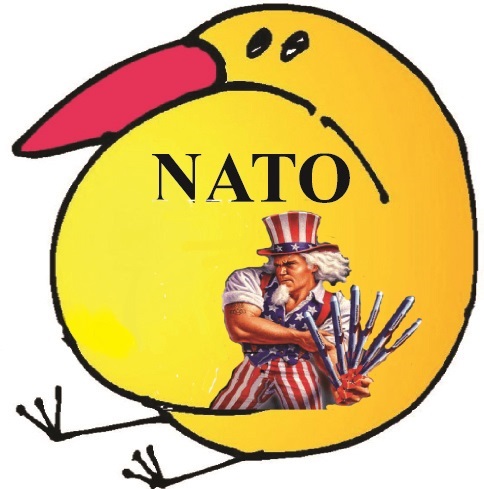
The very worst outcome following the end of the war in Ukraine would be for a new Iron Curtain to be drawn, with Europe and Ukraine continuing to pursue a policy of political and cultural exceptionalism against Russia, while arming themselves to the teeth in anticipation of the next war.Time to think about a Eurasian Treaty to secure peace and security between Russia and Europe
If all that the Treaty included was a version of the Washington Treaty Preamble with Articles 1 and 2, it would help Europe, Ukraine and Russia to take a huge stride towards peaceful coexistence and mutually beneficial economic cooperation across the Eurasian landmass. Perhaps, with war seemingly approaching its final chapter, it’s time to create a new vision for coexistence.
Ian Proud, Jan 31, 2026, https://thepeacemonger.substack.com/p/is-it-time-to-replace-nato-with-eato?utm_source=post-email-title&publication_id=3221990&post_id=186398540&utm_campaign=email-post-title&isFreemail=true&r=1ise1&triedRedirect=true&utm_medium=email
In recent weeks, there has been renewed discussion of the future of NATO as a guarantor of security on the European mainland.
The newly published US National Defense Strategy has made it clear that it is for European States to manage the risk of future military conflict with Russia, to allow America to focus its efforts on competition with China in the Pacific.
America has reintroduced the concept of gunboat diplomacy, threatening to invade Greenland and to attack Iran, while also kidnapping the leader of a sovereign nation in Venezuela. And while only the first has induced genuine horror in European capitals, other developments, most notably the gunning down of two protestors in Minnesota, have made European citizens, if not its leaders, increasingly anxious about ties with the Americans.
Times have changed since the North Atlantic Treaty was signed in Washington DC on 4 April 1949.
Then, America was the nation that had provided enormous military support and troops to Britain and the Commonwealth, to take on Hitler’s Germany on the western front of World War II, as the Soviet Union drove the Nazis out, having halted their advance in Stalingrad.
Wartime allies became adversaries following the war, as Winston Churchill raised the spectre of Communism’s spread across Europe.
Yet the Soviet Union no longer exists as an epochal threat to the freedom and democracy of European States emerging from the devastation of World War II.
European states have largely all achieved a level of prosperity, peace and stability unseen in centuries, on a continent that was historically dominated by war and conquest by the largest powers.
Russia is now a functioning market democracy, albeit one that does not wish to see itself shackled to a normative system of liberal ‘values’ that increasing numbers of citizens across Europe are turning away from, as they press their governments to focus on domestic priorities.
The main outlier to that is Ukraine, which remains an economically failing state and seething hotbed of conflict, caused by the aspirations to expand a NATO military alliance and to inflict a strategic defeat on Russia which, in the future, historians will come to regard as a catastrophic mistake.
If the current trend of the USA turning its gaze across the Pacific continues, loosening the fabric of NATO to the point of disintegration, the primary underlying driver of war in Ukraine would evaporate.
No NATO would radically shift the nature of pan-European security, removing a long-standing and oft-stated Russian fear of external aggression from a military bloc that, even before members lift defence spending to 5% of GDP, accounted for 53% of global military expenditure.
Indeed, no NATO might also allow existing European Members to reappraise whether vast increases in defence spending were, in fact, necessary, or whether a new approach to pan-European security might allow them to re-focus in on the prosperity for which their citizens yearn.
That would only be possible, however, if, after the war in Ukraine ends, there was an effort by European states to re-establish relations with Russia, while at the same time deepening relations with Ukraine, despite the evident suspicion on all sides.
In the immediate post-war period, Ukraine would be the only state in the heart of Europe that did not fit in with the club.
Issues such as Ukraine’s endemic corruption, its war-induced democratic back-sliding, its tolerance of the neo-Nazi extremist fringe, and its efforts to erase all traces of Russianness, would have to be addressed should it pursue its stated aspiration of membership of the European Union.
Yet there is no reason to believe that it could not rebuild, with its sizeable, generally well-educated and industrious population, should it repopulate the country after the war ends.
A normalisation of relations with Russia, beyond the obvious benefits from the reopening of borders and reestablishment of people-to-people links, would help to reindustrialise European economies with the benefit of lower cost energy.
The very worst outcome following the end of the war in Ukraine would be for a new Iron Curtain to be drawn, with Europe and Ukraine continuing to pursue a policy of political and cultural exceptionalism against Russia, while arming themselves to the teeth in anticipation of the next war.
The very big risk is that a Ukraine so bruised and resentful following the cessation of hostilities would seek to shape European policy to remain explicitly anti-Russian, in the manner that Poland and the Baltic States have tried to do for many years.
That should never be allowed to happen.
For the very reason that grievance and distrust may dominate some aspects of European relations for a generation to come, a more stable framework for pan-European security will be needed to prevent another repeat of an avoidable war in Ukraine.
That might require the creation of a Eurasian Treaty (and associated Organisation – EATO) perhaps, based on the North Atlantic Treaty of 1949, but without the commitment to collective defence within Article 5.
If all that the Treaty included was a version of the Washington Treaty Preamble with Articles 1 and 2, it would help Europe, Ukraine and Russia to take a huge stride towards peaceful coexistence and mutually beneficial economic cooperation across the Eurasian landmass. Perhaps, with war seemingly approaching its final chapter, it’s time to create a new vision for coexistence. A draft Eurasian Treaty might begin as follows:
The Parties to this Treaty reaffirm their faith in the purposes and principles of the Charter of the United Nations and their desire to live in peace with all peoples and all governments.
They are determined to safeguard the freedom, common heritage and civilisation of their peoples, founded on the principles of democracy, individual liberty and the rule of law. They seek to promote stability and well-being in the Eurasian area. They are resolved to unite their efforts for the preservation of peace and security. They therefore agree to this Eurasian Treaty :
Article 1
The Parties undertake, as set forth in the Charter of the United Nations, to settle any international dispute in which they may be involved by peaceful means in such a manner that international peace and security and justice are not endangered, and to refrain in their international relations from the threat or use of force in any manner inconsistent with the purposes of the United Nations.
Article 2
The Parties will contribute toward the further development of peaceful and friendly international relations by strengthening their free institutions, by bringing about a better understanding of the principles upon which these institutions are founded, and by promoting conditions of stability and well-being. They will seek to eliminate conflict in their international economic policies and will encourage economic collaboration between any or all of them.
The Rules-Based Order: Where America Gets Away with Murder, and Everyone Else Gets the Bombs
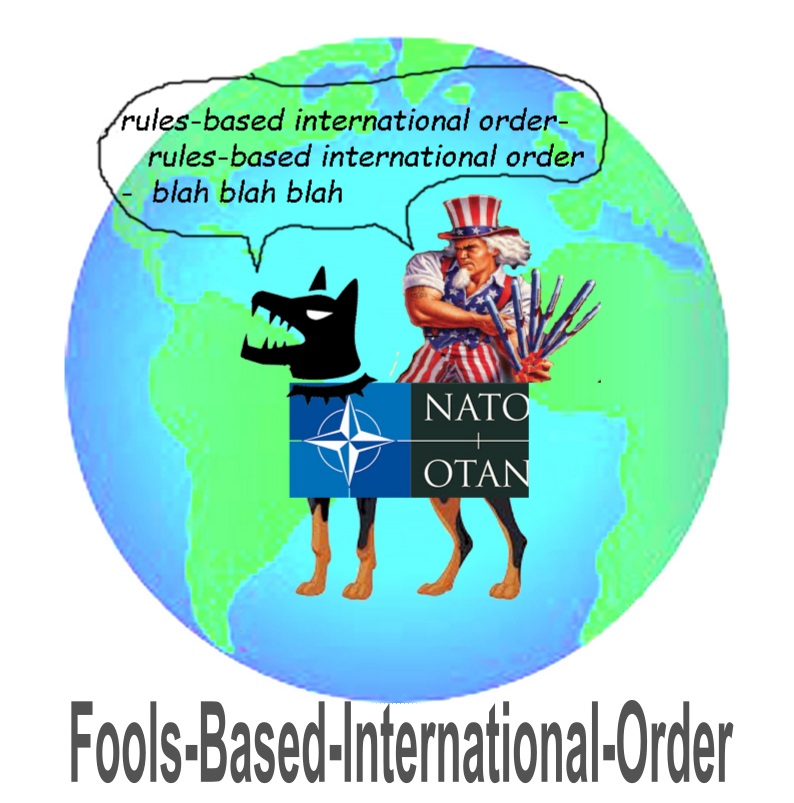
When the US bombs Iranian nuclear sites, it’s a “strike”. When Iran defends itself, it’s “aggression”. When the US funds insurrections, arms rebels and sabotages economies, it’s “promoting democracy”.
31 January 2026 David Tyler , Australian Independent Media
Australia’s Foreign Minister Penny Wong chants “rules based order” like a sacred hymn.
Order? In reality, it’s a squalid, pseudo-legal jargon for a world where might is right. While the US drops depleted uranium on Iraqi children, arms Israeli apartheid and fuels insurrections in Iran, any nation that dares assert its independence is crushed under a tonne of bricks. In Iran’s case, a hail of “precision strikes” designed to wound, maim and cause lifelong agony. Meanwhile, in Gaza, the International Court of Justice has declared Israel’s actions plausible genocide, ordering an immediate halt to atrocities and unimpeded humanitarian access. The US and its allies, including Australia, have ignored every ruling, proving once again that the “rules based order” is nothing more than a mafia protection racket, and we’re collecting the rent.
Depleted Uranium is often said to drop but it’s part of the super new bullets or “rounds” in use. The A-10 Warthog’s GAU-8 Avenger, for example, fires 30mm DU rounds. Tank rounds (e.g., the US M829 series) use DU in their cores to penetrate enemy armour. So kids get a spray of it, rather than a drop.
When these rounds hit a target, they aerosolise into fine, toxic dust, which can be inhaled or contaminate soil and water, leading to long-term health risks (e.g., cancer, birth defects) and environmental damage.
The Rules Based Order A Licence to Kill
Penny Wong stands in Parliament, her voice trembling with moral certainty. To her, Australia stands with the brave people of Iran as they struggle against an “oppressive regime”. She invokes the rules based order like it’s a force field against tyranny, a beacon of justice in a murky, chaotic and mercenary world. Just one snag. The rules apply to everyone else. Only.
When the US bombs Iranian nuclear sites, it’s a “strike”. When Iran defends itself, it’s “aggression”. When the US funds insurrections, arms rebels and sabotages economies, it’s “promoting democracy”.
When anyone else does it, it’s “terrorism”. And as the US sprays depleted uranium, children become cancer statistics? Birth defects are an inter-generational curse, it’s “collateral damage” a euphemism for war crimes.
This isn’t a rules based order. It’s a licence to kill, and Australia through our defence secretary Greg Moriarty, our intelligence agencies and our slavish alignment with US foreign policy is complicit at every step.
And now, as the International Court of Justice declares Israel’s actions in Gaza a plausible genocide, ordering Israel to halt its military operations and allow humanitarian aid, the US and its allies, including Australia, have done what they always do ignored the ruling and doubled down.
Loaded Language “Regime” vs “Government”, “Strikes” vs “Slaughter”
Let’s talk about the language of empire. The US and its press never refer to the “Iranian government”. It’s always the “Iranian regime” a term that strips legitimacy, implies tyranny and justifies intervention. Meanwhile, Saudi Arabia, a brutal monarchy that beheads dissidents and bombs Yemeni school buses, is a “key ally.”
Israel, an apartheid state with nuclear weapons, is a “vibrant democracy”
When the US bombs a Syrian hospital, it’s a “precision strike”. When Iran fires a missile in self defence, it’s “terrorism”. When the US funds, arms and trains insurgents in Iran such as the Network of Iranian Activists for Democracy (NAD), which distribute Molotov cocktails to protesters and boast about “turning Tehran into a warzone” it’s “supporting democracy”. When Iran arrests those same insurgents, it’s “crushing dissent”.
This isn’t reportage. It’s propaganda, and it’s designed to manufacture consent for the next war.
The Dirty Weapons Engineered to Maim, Designed to Terrorise
The US doesn’t just kill. It maims. It terrorises. It leaves behind a legacy of suffering so grotesque that it defies the term “war crime”. What’s happening is worse than death. Generations suffer. The US has used depleted uranium munitions in every major Middle East conflict since the Gulf War. Why? Because DU is dense enough to pierce armour, but its real legacy is cancer, birth defects and environmental poisoning.
In Fallujah, where the US used DU in 2004, doctors reported a 14 fold increase in birth defects; babies born with two heads, missing limbs and organs outside their bodies. The called the city “the new Hiroshima”. In Syria, the Pentagon confirmed using DU in 2015, despite international condemnation. The result? Radioactive dust that lingers for decades, poisoning soil, water and people. In Iraq, the US ignored its own guidelines, firing DU at unarmoured targets, buildings and even troops turning cities into toxic wastelands.
The US knows DU is a war crime in slow motion. It just doesn’t care.
The US military has set out to maximise suffering. From cluster munitions banned by 100 countries, but still used by the US to white phosphorus, which burns through flesh to the bone, the goal isn’t just to win wars it’s to leave populations traumatised, disabled and dependent.
Cluster bombs scatter hundreds of tiny bomblets, many of which fail to explode until a child picks one up years later. White phosphorus doesn’t just burn. It melts flesh and re-ignites when exposed to air, ensuring victims suffer excruciating, prolonged deaths. Drones don’t just kill targets. They terrorise entire communities, turning the sky into a permanent threat and leaving survivors with PTSD for life.
This isn’t warfare. It’s sadism, dressed up in the language of “national security”.
The Australian Connection Greg Moriarty and the Art of Complicity
Australia isn’t just a bystander to this horror-show. We’re in it up to our necks. Greg Moriarty, our defence secretary and soon to be ambassador to the US, cut his teeth in Iran. As Australia’s ambassador to Tehran from 2005 to 2008, he briefed George W. Bush on Iranian politics at the height of US sabotage operations, assassinations and economic warfare against Iran.
Moriarty’s stellar career is a masterclass in how Australia punches above its weight in the US empire from intelligence sharing to military drill, from sanctions enforcement to diplomatic cover for US aggression.
While Ms Penny Wong chants the “rules based order” mantra, Mr Moriarty, gets the gong: he is off to Washington to ensure Australia remains locked in step with the world’s biggest bully. Meanwhile, as the ICJ rules that Israel’s actions in Gaza constitute plausible genocide, and as the US and Australia continue to arm and fund Israel’s apartheid regime, the hypocrisy would knock you over. The “rules based order” isn’t about justice. It’s about power and who gets to wield it without consequences.
Historical Parallels Chile, Guatemala, Iraq, Syria and Now Iran (and Gaza)
This isn’t new. The US has been skittling independence for decades. In Chile in 1973, the CIA sabotaged the economy, funded strikes and backed a coup against Salvador Allende all to protect US corporate interests. The result? Seventeen years of Pinochet’s torture chambers……………………………………………………………………………………………………………………………………………………………………………………………………………………………….. Call tyranny for what it is. While we are still permitted to express dissent.
This article was originally published on URBAN WRONSKI WRITES https://theaimn.net/the-rules-based-order-where-america-gets-away-with-murder-and-everyone-else-gets-the-bombs/
Barring last-minute nuclear deal, US and Russia teeter on brink of new arms race.

Reuters, By Mark Trevelyan and Jonathan Landay. January 30, 2026
- Summary
- New START treaty set to expire on February 5
- Trump hasn’t responded to Putin’s offer to extend missile limits
- End in sight to more than 50 years of mutual constraints
- Chinese build-up leaves US facing two big nuclear rivals
LONDON/WASHINGTON, Jan 30 (Reuters) – The United States and Russia could embark on an unrestrained nuclear arms race for the first time since the Cold War, unless they reach an eleventh-hour deal before their last remaining arms control treaty expires in less than a week.
The New START treaty is set to end on February 5. Without it, there would be no constraints on long-range nuclear arsenals for the first time since Richard Nixon and Soviet leader Leonid Brezhnev signed two historic agreements in 1972 on the first-ever trip by a U.S. president to Moscow.
Russian President Vladimir Putin has proposed the two sides should stick to existing missile and warhead limits for one more year to buy time to work out what comes next, but U.S. President Donald Trump has yet to formally respond.
Trump said this month that “if it expires, it expires”, and that the treaty should be replaced with a better one.
Some U.S. politicians argue Trump should reject Putin’s offer, freeing Washington to grow its arsenal to counter a rapid nuclear build-up by a third power: China.
Trump says he wants to pursue “denuclearisation” with both Russia and China. But Beijing says it is unreasonable to expect it to join disarmament talks with two countries whose arsenals are still far larger than its own.
WHY DO NUCLEAR TREATIES MATTER?
Since the darkest Cold War days when the United States and the Soviet Union threatened each other with “mutually assured destruction” in the event of nuclear war, both have seen arms limitation treaties as a way to prevent either a lethal misunderstanding or an economically ruinous arms race.
The treaties not only set numerical limits on missiles and warheads, they also require the sides to share information – a critical channel to “try to understand where the other side is coming from and what their concerns and drivers are”, said Darya Dolzikova at the RUSI think-tank in London.
With no new treaty, each would be forced to act according to worst-case assumptions about the weapons the other is producing, testing and deploying, said Nikolai Sokov, a former Soviet and Russian arms negotiator.
“It’s a self-sustaining kind of process. And of course, if you’ve got an unregulated arms race, things will get quite destabilising,” he said.
NEW TREATY NO SIMPLE TASK
Since the fall of the Soviet Union, Russia and the United States have repeatedly replaced and updated the Cold War-era treaties that limited the so-called strategic weapons they point at each other’s cities and bases.
The most recent, New START, was signed in 2010 by U.S. President Barack Obama and Dmitry Medvedev, a Putin ally who was then serving as Russian president for four years.
It caps the number of deployed strategic warheads at 1,550 on each side, with no more than 700 systems to deliver them from land, sea or air, by intercontinental ballistic missile, submarine-launched missile or heavy bomber.
Replacing it with a new treaty would be no simple task. Russia has developed new nuclear-capable systems – the Burevestnik cruise missile, the hypersonic Oreshnik and the Poseidon torpedo – that fall outside New START’s framework. And Trump has announced plans for a space-based “Golden Dome” missile defence system that Moscow sees as an attempt to shift the strategic balance……………………………………………………………………………………………………………………………………. https://www.reuters.com/business/aerospace-defense/barring-last-minute-nuclear-deal-us-russia-teeter-brink-new-arms-race-2026-01-30/
The US Is Pushing So Many Regime Change Agendas It’s Hard To Keep Up.
Caitlin Johnstone, 30 Jan 26, https://www.caitlinjohnst.one/p/the-us-is-pushing-so-many-regime?utm_source=post-email-title&publication_id=82124&post_id=186298268&utm_campaign=email-post-title&isFreemail=true&r=1ise1&triedRedirect=true&utm_medium=email
It’s just incredible how quickly and aggressively the US is advancing longstanding agendas of global conquest under the Trump administration. Now they’re racing to take out Cuba.
The US president has signed an executive order to impose new tariffs on countries which supply oil to Cuba, even indirectly, which is expected to dramatically increase the pressure on the already struggling island nation. This comes as Financial Times reports that “Cuba only has enough oil to last 15 to 20 days at current levels of demand and domestic production” after the US cut off the supply from Venezuela and Mexico shelved a planned oil shipment.
Trump’s order itself contains the usual excuses we’ve come to expect from the empire of propaganda and lies, with its authors babbling without evidence about Hamas and Hezbollah and “transnational terrorist groups” receiving support from Havana, thereby making this crushing act of siege warfare a self-defense measure implemented in protection of the American people.
We’re being asked to believe that Cuba is Hamas, so Washington needs to strangle it to death in self-defense. The fact that the US has been pursuing regime change in Cuba for generations, we are told, is merely a coincidence.
The lies get dumber and dumber with each new imperial power grab. It’s just insulting at this point.
Last week The Wall Street Journal published an article titled “The U.S. Is Actively Seeking Regime Change in Cuba by the End of the Year” which cited anonymous senior US officials saying they viewed the operation to remove Maduro from Caracas as a “blueprint” for bringing down Havana.
Here’s an excerpt:
“Emboldened by the U.S. ouster of Venezuelan President Nicolás Maduro, the Trump administration is searching for Cuban government insiders who can help cut a deal to push out the Communist regime by the end of the year, people familiar with the matter said.
“The Trump administration has assessed that Cuba’s economy is close to collapse and that the government has never been this fragile after losing a vital benefactor in Maduro, these people said. Officials don’t have a concrete plan to end the Communist government that has held power on the Caribbean island for almost seven decades, but they see Maduro’s capture and subsequent concessions from his allies left behind as a blueprint and a warning for Cuba, senior U.S. officials said.”
The Wall Street Journal reports that administration officials have been meeting with “Cuban exiles and civic groups in Miami and Washington” with the goal of “identifying somebody inside the current government who will see the writing on the wall and want to cut a deal,” in a way similar to how assets within the Maduro government were recruited to facilitate his removal.
In a new segment on Trump’s frenzied efforts to topple Havana, CNN’s Patrick Oppmann reports from Cuba that he’s “heard from a US embassy source that diplomats there have been advised to quote ‘have their bags packed’ as the Trump administration explores new ways to destabilize the communist-run government.”
The US likes to immiserate the populations of targeted nations using economic strangulation with the goal of fomenting unrest and turning people against their leaders. In 2019 Trump’s previous secretary of state Mike Pompeo openly acknowledged that the goal of Washington’s economic warfare against Iran was to make the population so miserable that they “change the government”, cheerfully citing the “economic distress” the nation had been placed under by US sanctions. Economic distress has been widely cited as a primary factor in the deadly protests that have rocked Iran in recent weeks.
Starvation sanctions are the only form of warfare where it is widely considered both normal and ethical to deliberately target a civilian population with deadly force. Deliberately impoverishing an entire nation so that it erupts in conflict and civil war is one of the most evil things you can possibly imagine, but it’s the go-to Plan A for the US empire when it comes to removing foreign leaders who refuse to kiss the imperial boot.
From Palestine to Lebanon to Yemen to Syria to Venezuela to Cuba to Iran, these last couple of years the US has been in a mad scramble to eliminate governments and resistance groups which attempt to insist on their own sovereignty. There’s a new excuse every time, but the end goal is always the same: the furtherance of planetary domination.
The US empire is the single most tyrannical and murderous power structure on this planet. If any regime is in need of changing, it’s that one.
The U.S. plan for Gaza has nothing in it for Palestinians
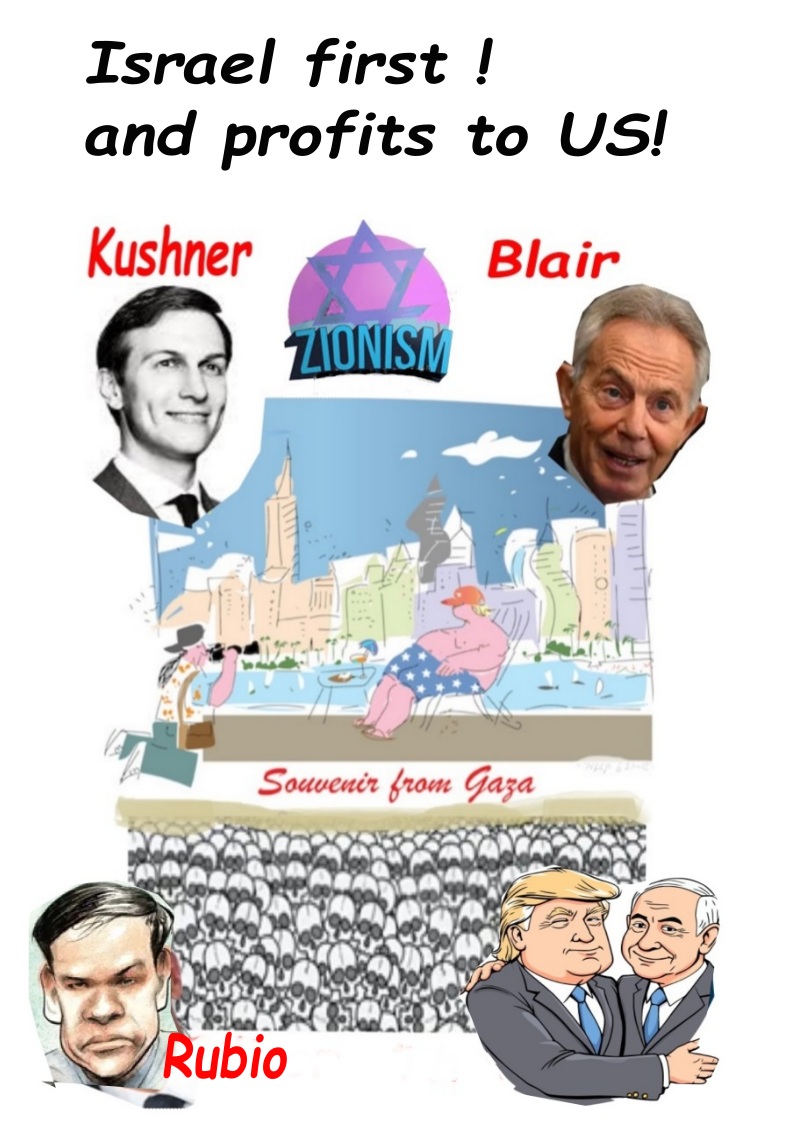
The U.S. plan for Gaza envisions a Gaza for investors, not Palestinians.
By Qassam Muaddi January 28, 2026 , https://mondoweiss.net/2026/01/the-u-s-plan-for-gaza-has-nothing-in-it-for-palestinians/
The latest iteration of the future U.S. plan for Gaza was revealed last week by U.S. President Trump’s son-in-law, Jared Kushner, at the inaugural ceremony of the so-called “Board of Peace,” which is tasked with overseeing the reconstruction and administration of the Strip. Kushner’s presentation included a map of what Gaza would look like after reconstruction, including industrial zones, residential blocks, and tourism beaches. The plan advertises a new Rafah and a new Gaza City, completely separate from one another. Meanwhile, the edges of the Strip — which once served as Gaza’s farmland and bread basket — would now be home to industrial complexes. Kushner’s plan doesn’t foresee any restoration of Palestinian neighborhoods or villages, and offers no place for natural Palestinian life to exist. Only fixed residential blocks, surrounded by investments.
After two years of genocide, the outcome that is being laid out for the people of Gaza — and the Palestinian people as a whole — is the creation of a dystopian reality that sees the building of luxury resorts on top of their destroyed homes and communities.
The only role for Palestinians in this vision is to be managed — controlled, “concentrated” in confined zones, and later possibly expelled. All of this is masked as a “historic” humanitarian effort.
A Gaza without Palestinians
Soon, it will be four months since the ceasefire in Gaza went into effect. On Monday, the first phase of the agreement officially ended after the Israeli government announced that Israeli forces had found the body of the last dead Israeli soldier held captive in Gaza. Israel had refused to move to the second phase of the ceasefire before Hamas handed over the remaining body, which the Israeli army reportedly found on the Israeli-controlled side of the Strip.
Coincidentally, in the past few days, U.S. President Trump announced the formation of the Board of Peace, initially planned to oversee the transition in Gaza during the second phase of the ceasefire. Simultaneously, the Israeli government agreed to reopen the Rafah crossing, a crucial step for the second phase. A week earlier, the Palestinian technocratic committee for the administration of Gaza was also announced.
But what’s actually happening on the ground started well before the technocratic committee was formed. Israel’s longstanding plans for Gaza — to corral its population into concentrated zones ahead of their possible expulsion — have been silently unfolding on the ground. Last week, Drop Site News revealed documents obtained from the U.S.-Israeli military and civil command center in Israel showing preparations for a residential area to be built in Rafah. According to Drop Site, if developed, the “planned community” in Rafah “would contain and control its residents through biometric surveillance, checkpoints, monitoring of purchases, and educational programs promoting normalization with Israel,” comparing it to a panopticon. Rafah was completely leveled by the Israeli army earlier in 2025.
Based on an analysis of satellite imagery conducted by Forensic Architecture, the Drop Site report indicates that the new “community” is being prepared on a 1-square-kilometer plot of land in Rafah at the intersection of two military corridors.
Jonathan Whittall, a senior UN official in Palestine between 2022 and 2025, said that “this is the next phase in the weaponization of aid,” after reviewing the materials obtained by Drop Site
This idea to “concentrate” Palestinians into a highly surveilled area is in line with previous statements made by Israeli Defense Minister, Israel Katz, who said last July that Palestinians who would be allowed into the so-called “humanitarian city” — proposed to be built over Rafah’s ruins — would not be allowed to leave it. The scheme was widely decried by human rights groups as a thinly-disguised plan to build a “concentration camp,” and was seen as a first step toward pushing Palestinians to leave Gaza entirely. Israeli Prime Minister Benjamin Netanyahu explicitly told his cabinet as much in September, under the label of “voluntary emigration.”
Meanwhile, the National Committee for the Administration of Gaza (NCAG), the body of Palestinian technocrats set to oversee day-to-day governance in the Strip, is about to enter Gaza. It has so far garnered the support of all Palestinian factions, yet remains subordinate to Trump’s Board of Peace, with only limited executive powers. The Board of Peace, on the other hand, plays a political role in drafting plans for Gaza.
The NCAG is the first-ever Palestinian governing body in Palestine that is not part of the PLO’s institutional structure, which effectively splits Gaza politically from the rest of Palestine. Instead, its ultimate political reference now lies in a Board of Peace headed by Trump and, among others, Israel. The vision it is advancing for Gaza is one without Palestinians.
In fact, all the unfolding information about the U.S. plan for Gaza shows that it treats the Palestinian question as a purely humanitarian issue shorn of any political content. It completely ignores the centrality of Gaza to the Palestinian cause as a political question and fails to address the basic element of the “conflict” — Palestinian self-determination.
This should not be surprising, given that decision-making is dominated by U.S. business interests, ambitions of regional control and power, and Israel’s ideological drive to push Palestinians out. In the midst of all this, no Palestinian voice is present.
What does the US want from Iran? Tracking one month of Trump’s changing demands.
After saying the US would attack if protesters were harmed, the president appears now to be tying the threat of airstrikes to Iran’s nuclear programme.
Jonathan Yerushalmy, Thu 29 Jan 2026 , https://www.theguardian.com/us-news/2026/jan/29/trump-iran-usa-one-month-demands-protesters-nuclear
Donald Trump has warned that Iran must come to the table to negotiate a deal over its nuclear programme or face the possibility of airstrikes and regime change, capping off a month of bellicose posturing and whiplash inducing u-turns from the US president.
The US president’s demands threaten to open a new chapter in America’s long and tumultuous relationship with Iran, which in just over a decade has seen rapprochement, broken deals, targeted assassinations and unprecedented airstrikes.
Here’s a recap of just the last 31 days:
29 December : ‘We’ll knock the hell out of them’
At the end of December, Trump suggested that Iran was “building up weapons” again, just six months after the US launched unprecedented strikes against the country’s nuclear sites.
Speaking beside Israeli prime minister Benjamin Netanyahu in Florida, Trump said if Iran was working to build up again “we’ll knock the hell out of them. But, hopefully, that’s not happening.” He added that the consequences of such a move would be “more powerful than the last time”.
After Netanyahu suggested that Iran may be attempting to rebuild its nuclear programme, the country’s foreign minister called for renewed talks with the US.
2 January: ‘We are locked and loaded and ready to go’
After Iranians took to the streets in the largest national demonstrations in years, Trump said that if protesters were killed, the US would “come to their rescue”.
“We are locked and loaded, and ready to go,” he said.
The unrest, triggered by an unprecedented decline in the value of the national currency, prompted a renewed escalation in tensions between the US and Iran.
6 January: ‘Make Iran Great Again’
Days after Trump launched strikes on Venezuela and captured the country’s president Nicolás Maduro, Trump was pictured posing with a “Make Iran Great Again” hat.
With protests in Iran spreading and reports of dozens dead, Trump again said that if Tehran “violently kills peaceful protesters” the US would “come to their rescue”.
10 January: ‘The USA stands ready to help!!!’
As the reported death toll in the protests soared into the hundreds, Trump was said to be weighing a response. “Iran is looking at FREEDOM, perhaps like never before. The USA stands ready to help!!!,” the US president said on the Truth Social platform.
The speaker of Iran’s parliament warned that Israeli and US interests in the Middle East would be “legitimate targets” if Washington attacked Iran.
13 January: ‘Help is on its way
Trump announced new 25% tariffs on countries that do business with Iran, but there was no official documentation from the White House and it appears they were never implemented.
Amid reports of a brutal regime crackdown on the protesters, Trump had initially claimed Iran wanted to negotiate, but later went on to say that he had cancelled all meetings with officials.
“Iranian Patriots, keep protesting – take over your institutions!!! … help is on its way,” Trump said in a post on Truth Social on Tuesday.
14 January: ‘The killing in Iran is stopping’
Despite reports that as many as 3,428 Iranians had been killed and that executions as punishment were imminent, Trump said he had been told that “the killing in Iran is stopping … And there’s no plan for executions.”
It was understood he had reviewed the full range of options to strike Iran but was unconvinced by any single action. His administration had also been lobbied by Middle Eastern allies not to go ahead with strikes, with fears that an attack would lead to a major and intractable conflict across the region.
In the days that followed the huge protest movement slowed under the weight of the regime’s brutal crackdown. Mass arrests followed and many Iranians said they felt betrayed and confused by the president’s sudden about turn.
22 January: ‘We have a lot of ships going that direction’
After several days which saw Trump distracted by anti-ICE protests in Minneapolis and a breakdown in relations with European allies over the fate of Greenland, Trump returned to the issue of Iran, saying “We have a lot of ships going that direction, just in case.”
With the death toll from the protests now said to be more than 5,000 – and reports it could be many times higher than that – Trump’s decision to send the aircraft carrier USS Abraham Lincoln and several guided-missile destroyers to the Middle East were thought to be in response to the regime’s brutal crackdown.
28 January: ‘Time is running out’
With US ships now in position in the Middle East, Trump issued an extraordinary threat to Iran, saying of the armada, “like with Venezuela, it is, ready, willing, and able to rapidly fulfill its mission, with speed and violence, if necessary.”
Warning that Iran must “make a deal”, Trump said that the country would have “NO NUCLEAR WEAPONS”.
The statement marked a shift in his administration’s rationale for sending the armada to the region, with no mention of the protesters, their demands or the regime’s brutal crackdown.
1 This Month
10 March A LIVE WEBINAR THE REAL EFFECTS OF NUCLEAR POWER
What the Industry Isn’t Telling Us
1:00 PM Mountain, 2 pm Central, 3 pm Eastern. Live on the Keepers of the Water Facebook page



18 March Webinar @ 1 PM EST: An Assessment of SMR Projects: The Case of Canada
register for the zoom:
https://us02web.zoom.us/webinar/register/WN_o8BIIOUvQ2ONJR1nta65DQ#/registration


of the week – STOP SMALL MODULAR REACTORS IN CANADA
To see nuclear-related stories in greater depth and intensity – go to https://nuclearinformation.wordpress.com
-
Archives
- March 2026 (99)
- February 2026 (268)
- January 2026 (308)
- December 2025 (358)
- November 2025 (359)
- October 2025 (376)
- September 2025 (258)
- August 2025 (319)
- July 2025 (230)
- June 2025 (348)
- May 2025 (261)
- April 2025 (305)
-
Categories
- 1
- 1 NUCLEAR ISSUES
- business and costs
- climate change
- culture and arts
- ENERGY
- environment
- health
- history
- indigenous issues
- Legal
- marketing of nuclear
- media
- opposition to nuclear
- PERSONAL STORIES
- politics
- politics international
- Religion and ethics
- safety
- secrets,lies and civil liberties
- spinbuster
- technology
- Uranium
- wastes
- weapons and war
- Women
- 2 WORLD
- ACTION
- AFRICA
- Atrocities
- AUSTRALIA
- Christina's notes
- Christina's themes
- culture and arts
- Events
- Fuk 2022
- Fuk 2023
- Fukushima 2017
- Fukushima 2018
- fukushima 2019
- Fukushima 2020
- Fukushima 2021
- general
- global warming
- Humour (God we need it)
- Nuclear
- RARE EARTHS
- Reference
- resources – print
- Resources -audiovicual
- Weekly Newsletter
- World
- World Nuclear
- YouTube
-
RSS
Entries RSS
Comments RSS
 nuclear-news