Trump’s Ukraine Plan: Power Play or Exit Strategy?
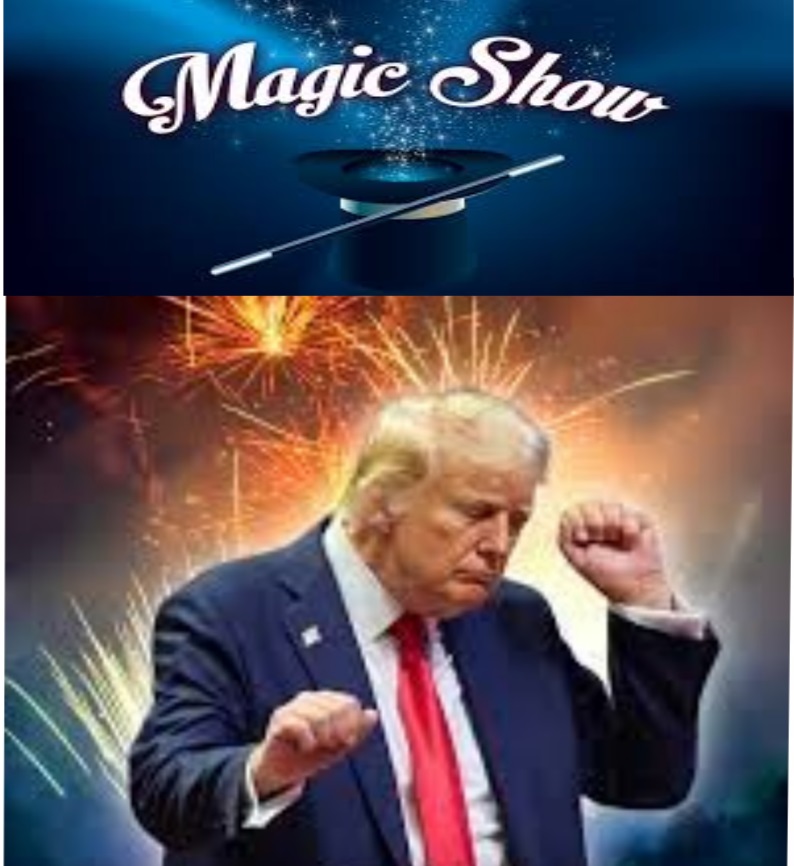
Beneath the rhetoric lies a fundamental truth: America is disengaging. Not with a decisive withdrawal, but through a form of diplomatic sleight-of-hand. By recasting its role from arsenal to arms dealer (insisting NATO nations pay “a hundred percent” for U.S.-made weapons) the United States transforms the principle of collective defense into a commercial transaction.
Beneath the rhetoric lies a fundamental truth: America is disengaging. Not with a decisive withdrawal, but through a form of diplomatic sleight-of-hand. By recasting its role from arsenal to arms dealer (insisting NATO nations pay “a hundred percent” for U.S.-made weapons) the United States transforms the principle of collective defense into a commercial transaction.
Uncover the hidden logic behind Trump’s delayed weapons aid, NATO rifts, and realpolitik tactics reshaping U.S. foreign policy and Ukraine’s fate.
Post-Liberal Dispatch, Jul 24, 2025, This piece was written by guest contributor Sérgio Horta Soares and has been reviewed and edited by Paulo Aguiar, founder of Post-Liberal Dispatch.
In geopolitics, there are no saints, only actors grappling for advantage, cloaking raw interests in the language of freedom, democracy, and humanitarian concern.
The recent choreography surrounding former U.S. President Donald Trump’s ostensible reentry into the Ukraine conflict lays bare the mechanics of power as they actually function: not through moral imperatives, but through calculated ambiguity, resource preservation, and the exploitation of time.
What masquerades as renewed support for Ukraine is, in substance, a meticulously engineered performance, designed not to rescue Kyiv, but to extricate Washington. Trump’s pronouncements of “billions” in arms, and his threats of tariffs against nations buying Russian oil, are not expressions of strategic commitment; they are instruments of political theater, signals issued to multiple audiences with competing agendas, none of whom are meant to receive a clear message.
To understand this gambit, one must first understand the war’s trajectory. Since Russia’s full-scale invasion of Ukraine in February 2022, Western countries (led by the United States) have supplied billions in weapons, economic assistance, and intelligence to Ukraine in an effort to repel Russian advances and prevent the collapse of the post–Cold War European security order.
Initially, this support was framed in terms of values: defending sovereignty, democracy, and international law. But as the war dragged on into its third year, cracks emerged in the Western coalition (rising costs, strained defense stockpiles, and growing domestic opposition to what many now view as an open-ended commitment).
Beneath the rhetoric lies a fundamental truth: America is disengaging. Not with a decisive withdrawal, but through a form of diplomatic sleight-of-hand. By recasting its role from arsenal to arms dealer (insisting NATO nations pay “a hundred percent” for U.S.-made weapons) the United States transforms the principle of collective defense into a commercial transaction.
NATO, once a bastion of mutual obligation, is being refashioned into a procurement agency. The nations of Europe are no longer being asked to fight beside the U.S.; they are being asked to shop.
That this approach incites confusion and resentment among allies is the point. Strategic ambiguity, long a hallmark of Trump’s foreign policy, is not a flaw but a deliberate tactic. By maintaining a posture of conditional engagement, the U.S. preserves its leverage, avoids definitive entanglement, and keeps both adversaries and allies on edge. This calculated vagueness allows for plausible deniability and quick reversals. It ensures that commitments can be revoked, blame can be shifted, and outcomes can be rebranded.
What emerges is not policy, but posture, a stance of strength unmoored from obligation. The imposition of delayed tariffs and the promise of weapons that will not arrive in time to affect the current Russian offensive are not strategic errors; they are expressions of strategic intent. They buy time; not for Ukraine, but for Russia.
Intelligence suggests that Russian commanders believe they can achieve key battlefield objectives within weeks, before weather and logistics slow their operations. Trump’s 50-day deadline for triggering sanctions likely falls outside of that window. This is not coincidence; it is complicity, veiled beneath performative deterrence.
Ukraine, under siege and starved of arms, is left to decipher whether the promised aid is a lifeline or a leash. Meanwhile, Washington hedges its bets, calibrating its involvement to extract maximum geopolitical return with minimum exposure.
The material realities further erode any illusion of robust support. Western arsenals are depleted. Since 2022, the U.S. and its NATO allies have shipped tens of thousands of artillery shells, air defense systems, and armored vehicles to Ukraine. Yet the West’s military-industrial base is still operating on peacetime rhythms, struggling to keep pace with the demands of high-intensity warfare. Arms production in the U.S. and Europe cannot meet short-term demand, and weapons systems, such as Germany’s promised Patriots, are delayed by months.
These constraints reveal a widening gap between political intent and logistical feasibility. Without urgent expansion of industrial capacity, Western efforts risk falling behind Russia’s war economy, rendering even well-publicized support strategies operationally irrelevant
The fragmentation of NATO in response to the Trump plan is less an aberration than a revelation.
France and Italy reject participation outright, prioritizing domestic industry and fiscal restraint. Hungary abstains on ideological grounds, and the Czech Republic prefers alternative aid mechanisms. Even those nations nominally listed as partners (Finland, Denmark, Sweden) were reportedly blindsided by the announcement. This is improvisation, and it exposes the brittle scaffolding of transatlantic unity, where each state calculates its own interests and distances itself from burdens it cannot (or will not) carry.
Within this fractured landscape, Ukraine is not a partner but a bargaining chip, leveraged between competing powers with conflicting priorities. Trump’s ultimate objective is not Ukrainian victory but………………………………………………..(Subscribers only) https://postliberaldispatch.substack.com/p/trumps-ukraine-plan-power-play-or?utm_source=post-email-title&publication_id=4747899&post_id=169097642&utm_campaign=email-post-title&isFreemail=true&r=ln98x&triedRedirect=true&utm_medium=email
Predictably, there was no progress in Istanbul peace talks
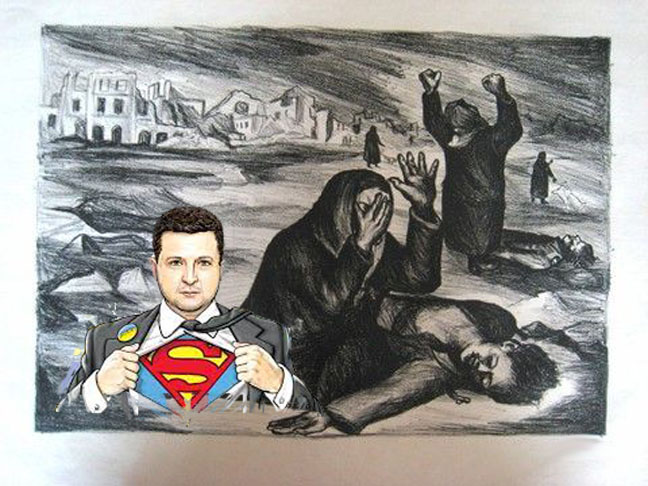
Citizens have been fed a non-stop diet of propaganda about Zelensky our savior from the terrors of the Vlad the terrible. Yet now cracks have appeared and people are asking whether Zelensky is in fact just as corrupt as every Ukrainian leader who came before him
Will war now stretch into 2026 or has Zelensky’s anti-corruption blunder changed the game?
Ian Proud, The Peacemonger, Jul 24, 2025
Below my article of yesterday in Responsible Statecraft. I predicted there would be no progress at the Istanbul peace talks yesterday and there was no progress. The meeting apparently lasted just 40 minutes or so, with little to show except for further agreement on a further round of POW exchanges.
Zelensky didn’t need to cut a deal in Istanbul because he figures that the US will impose harsh secondary sanctions on Russia’s trading partners on 2 September, amounting to a 100% tariff. I have written previously about why I believe that will backfire on the US.
In any case, Zelensky stalling on peace talks in Istanbul may soon be overtaken by events closer to home, in Kyiv and other Ukrainian cities.
It would be easy, I think, to underestimate just how big an impact this will have on public perceptions of Zelensky in western nations that have supported Ukraine to the hilt in the war, and to the impoverishment of their own people. Citizens have been fed a non-stop diet of propaganda about Zelensky our savior from the terrors of the Vlad the terrible. Yet now cracks have appeared and people are asking whether Zelensky is in fact just as corrupt as every Ukrainian leader who came before him. More on that in my next article.
But having started yesterday certain that war would drag into 2026, I am coming round to the idea that it could be over this year. The Ukrainian front line is cracking in various places. European leaders may find it harder than ever before to justify feeding the Zelensky gravy train. One thing I do know, it’s going to be a rocky ride in Kyiv for a while. And more people will die on the front line while the drama unfolds.
Time to end this nonsense now.
President Volodymyr Zelensky of Ukraine has said that a further round of talks between Ukraine and Russia could start as early as this week, and indicated that “everything had to be done to get a ceasefire.” Yet it is far from clear that a ceasefire will be possible. And it’s likely that the war will continue into 2026.
In June, Zelensky was pressing the European Union to go further in its sanctions against Russia, including calling for a $30 per barrel cap on Russian oil shipments. Washington effectively vetoed a lowering of the oil price cap at the recent G7 Summit in Canada. However, on July 18 the European Union agreed its 18th round of Russian sanctions since war began, overcoming a blocking move by Slovakia in the process.
This imposes a cap on Russian oil shipments at 15% below market value ($47.60 at the time the package was agreed) and places further restrictions on Russia’s energy sector. But, there is scepticism that this will dent Russian revenues without the U.S. mirroring the measures, as the prior $60 per barrel G7 cap made no noticeable difference. Zelensky hailed the package as “essential and timely.”
Despite the overtures towards peace talks, economic sanctions against Russia continue to be the preferred approach for both Zelensky and for the EU. And the clock is ticking for the focus to shift back to President Trump’s proposed secondary sanctions. Having given Russia 50 days to agree a peace deal with Ukraine or face tariffs of 100% against its major trading partners, Trump has effectively set a deadline of September 2.
…………………………………………………………………………………………………….this limited agenda will not be enough to satisfy the Kremlin that Ukraine is ready to negotiate and make progress towards an agreement on Russia’s so-called underlying concerns, the key concern being Ukraine’s NATO aspiration. Without the negotiations seriously getting into this and other such substantive issues as the disposition of forces and territory when the fighting stops, don’t expect a leader-level meeting any time soon.
…………………This dynamic of Europe and the U.S. threatening Russia with sanctions unless progress towards peace is made, while no expectations are placed on Ukraine to make concessions, has been locked in since March of 2015. It simply will not work.
Calling on Putin to meet in Istanbul is therefore, like it was in May, an act of political theater by Zelensky. He needs to keep his Western sponsors on side and for the flow of money and arms into Ukraine to continue. He also wants to polish his image as a putative global statesman.
Meanwhile, at the most recent Contact Group of Support for Ukraine meeting, then Ukrainian Prime Minister Denis Shmyhal requested an additional $6 billion to cover this year’s deficit in defense procurement. He also urged “partners to allocate funds for Ukraine in their budget proposals for 2026, right now.”
Anyone who believes that Zelensky is really committed to accelerating moves towards peace in Ukraine may, I fear, be overly optimistic. I am increasingly convinced that war will continue into next year. https://thepeacemonger.substack.com/p/predictably-there-was-no-progress?utm_source=post-email-title&publication_id=3221990&post_id=169121725&utm_campaign=email-post-title&isFreemail=true&r=1ise1&triedRedirect=true&utm_medium=email
US congresswoman labels Zelensky ‘dictator’
23 Jul, 2025 , https://www.rt.com/news/621871-us-congresswoman-zelensky-dictator/
Marjorie Taylor Greene has urged Washington to stop backing the Ukrainian leader, accusing him of refusing peace and clinging to power
US Representative Marjorie Taylor Greene has labeled Ukrainian leader Vladimir Zelensky “a dictator” and called for his removal, citing mass anti-corruption protests across Ukraine and accusing him of blocking peace efforts.
Her comments came after Zelensky signed a controversial bill into law that places the Specialized Anti-Corruption Prosecutor’s Office (SAPO) and the National Anti-Corruption Bureau (NABU) under the authority of the prosecutor general.
Critics argue that the legislation effectively strips the bodies of their independence. The law has sparked protests across Ukraine, with around 2,000 people rallying in Kiev and additional demonstrations reported in Lviv, Odessa, and Poltava.
“Good for the Ukrainian people! Throw him out of office!” Greene wrote Wednesday on X, sharing footage from the protests. “And America must STOP funding and sending weapons!!!”
Greene, a longtime critic of US aid to Kiev, made similar comments last week while introducing an amendment to block further assistance. “Zelensky is a dictator, who, by the way, stopped elections in his country because of this war,” she told the House.
“He’s jailed journalists, he’s canceled his election, controlled state media, and persecuted Christians. The American people should not be forced to continue to pay for another foreign war.”
Her statements come amid mounting speculation over Zelensky’s political future. Journalist Seymour Hersh has reported that US officials are considering replacing him, possibly with former top general Valery Zaluzhny.
Senator Tommy Tuberville also called Zelensky a “dictator” last month, accusing him of trying to drag NATO into the conflict with Russia. Tuberville claimed that Zelensky refuses to hold elections because “he knew if he had an election, he’d get voted out.”
Zelensky’s five-year presidential term expired in 2024, but he has refused to hold a new election, citing martial law, which has been extended every 90 days since 2022.
US President Donald Trump has also questioned Zelensky’s legitimacy, calling him “a dictator without elections” in February.
Russian officials have repeatedly brought up the issue of Zelensky’s legitimacy, arguing that any agreements signed by him or his administration could be legally challenged by future leaders of Ukraine.
Iran holds ‘frank’ nuclear talks with European powers amid sanctions threat
Diplomatic meeting in Istanbul between Tehran and E3 countries is first since Israel and US attacked Iran in mid-June.
25 Jul 2025, https://www.aljazeera.com/news/2025/7/25/iran-is-meeting-european-powers-amid-threats-of-renewed-nuclear-sanctions
Iranian diplomats say they held “frank” nuclear talks with their counterparts from Germany, the United Kingdom and France, as Tehran faces warnings that the three European nations could trigger “snapback” United Nations sanctions against the country.
The meeting in the Turkish capital, Istanbul, on Friday was the first since Israel’s mid-June attack on Iran, which led to an intensive 12-day conflict that saw the United States launch strikes against key Iranian nuclear sites.
Israel’s offensive also derailed US-Iran nuclear talks that began in April.
Since then, the European powers, known as the E3, have threatened to trigger a so-called “snapback mechanism” under a moribund 2015 nuclear deal that would reinstate UN sanctions on Iran by the end of August.
Iran’s Deputy Foreign Minister Kazem Gharibabadi, who attended Friday’s talks alongside senior Iranian diplomat Majid Takht-Ravanchi, said after the meeting that the parties held a “serious, frank and detailed” discussion about sanctions relief and the nuclear issue.
“While seriously criticising their stances regarding the recent war of aggression against our people, we explained our principled positions, including on the so-called snapback mechanism,” Gharibabadi said.
“It was agreed that consultations on this matter will continue.”
The European countries, along with China and Russia, are the remaining parties to the 2015 deal, from which the US unilaterally withdrew in 2018.
Under the pact, known formally as the Joint Comprehensive Plan of Action (JCPOA), Iran had agreed to curb its nuclear programme in exchange for global sanctions relief.
Iranian Ministry of Foreign Affairs spokesperson Esmaeil Baghaei said in an earlier interview with state news agency IRNA that Tehran considers talk of extending the UN resolution governing the deal – Security Council Resolution 2231 – to be doubly “meaningless and baseless”.
The resolution enshrines the major powers’ prerogative to restore UN sanctions. The option to trigger the snapback expires in October, and Tehran has warned of consequences should the E3 opt to activate it.
Separately, International Atomic Energy Agency (IAEA) head Rafael Grossi said on Friday that Iran has indicated it will be ready to restart technical-level discussions on its nuclear programme with the UN nuclear watchdog.
Grossi said in Singapore that Iran must be transparent about its facilities and activities.
He told reporters that the IAEA had proposed that Iran start discussions on “the modalities as to how to restart or begin [inspections] again”.
“So this is what we are planning to do, perhaps starting on technical details and, later on, moving on to high-level consultations. So this will not include inspections yet.”
In late June, after the Israeli and US attacks on the country, Iran took an unequivocal stance against the IAEA, with Foreign Minister Abbas Araghchi summarily dismissing Grossi’s request to visit nuclear facilities that were bombed during the conflict.
“Grossi’s insistence on visiting the bombed sites under the pretext of safeguards is meaningless and possibly even malign in intent,” Araghchi said at the time.
Uranium enrichment
Iranian diplomats have previously warned that Tehran could withdraw from the global nuclear non-proliferation treaty if UN sanctions are reimposed.
Restoring the sanctions would deepen Iran’s international isolation and place further pressure on its already strained economy.
Before the June conflict, Washington and Tehran were divided over uranium enrichment, which Iran has described as a “non-negotiable” right for civilian purposes but the US calls a “red line”.
The IAEA says Iran is enriching uranium to 60 percent purity – far above the 3.67 percent cap under the 2015 deal, but well below the 90 percent needed for weapons-grade levels.
Tehran has said it is open to discussing the rate and level of enrichment, but not the right to enrich uranium.
Iran also says it will not abandon its nuclear programme, which Araghchi has called a source of “national pride”.
Trump has backed himself into a corner on Ukraine
The chances of President Putin backing down without any concessions from Ukraine or from their European sponsors are so low as to be almost non-existent.
the additional military support that the US is now offering to Ukraine, paid for by European NATO allies, won’t be sufficient to tip the military balance in Ukraine’s favour…………….. the military facts on the ground are that Russia continues to gain ground…………………. fifty days favours Russia more than Ukraine, militarily.
He now has fifty days to reach agreement on Ukrainian neutrality
Ian Proud, Jul 17, 2025, https://thepeacemonger.substack.com/p/trump-has-backed-himself-into-a-corner?utm_source=post-email-title&publication_id=3221990&post_id=168542067&utm_campaign=email-post-title&isFreemail=true&r=1ise1&triedRedirect=true&utm_medium=email
One year after he undertook to end the Ukraine war in one day, and just past six months into his Presidency, Donald Trump has kicked the peace can down the road by fifty days. The ultimatum to President Putin to make peace or face sanctions has practically no chance to changing Russian aims in Ukraine. Backed into a corner, Trump may finally be forced to address Russia’s underlying concerns.
In televised remarks on 14 July during his meeting with NATO Secretary General, Mark Rutte, President Trump said, ‘if we don’t have a [peace] deal in fifty days, we’re going to be doing very severe tariffs, tariffs at about a hundred percent, you’d call them secondary tariffs.’
As he was in 2017, Trump also now finds himself hemmed in by beltway politics and unable to deliver a reset in US-Russia relations that he instinctively seems to want.
The Sanctioning Russia Act of 2025 would put in place so-called secondary sanctions on Russia by imposing stiff tariffs of up to 500% against countries such as China and India that inter alia import Russian energy. US lawmakers want to strong arm Trump into forcing President Putin to back down in Ukraine via the back door. But there is a yawn-inducing sense of déjà vu here.
The 2017 Countering American Adversaries Through Sanctions Act, signed into law on 2 August 2017, had no impact on Russian policy towards Ukraine, but led to a huge collapse in US-Russia relations. This was illustrated most clearly by the decision to cut US diplomatic staffing in Russia by 755 personnel, meaning among other things, that today it is practically impossible for a Russian citizen to apply for a US visa inside of Russia itself; the US Embassy simply doesn’t have enough staff.
To avoid a repeat of 2017, Trump now appears to be buying himself fifty days in DC to reach peace in Ukraine before he is forced by the Senate to impose secondary sanctions on Russia. The 14 July announcement was therefore about domestic US politics more than about foreign policy.
But what Trump has in fact done is to set a clear ultimatum on Russia to reach a peace deal with Ukraine, with no clear commitment to meeting Russia’s specific demands, the key demand being Ukraine’s neutrality and revocation of its NATO aspiration.
As an ultimatum, this won’t work, because the additional military support that the US is now offering to Ukraine, paid for by European NATO allies, won’t be sufficient to tip the military balance in Ukraine’s favour.
Additional Patriot missiles and interceptors may well reduce the overall impact of Russian drone and missile strikes on Ukrainian cities. But the military facts on the ground are that Russia continues to gain ground. At several points along the front line, around Pokrovsk, and Kupiansk, towards Konstiantynivka and Siversk, there have been significant recent Russian gains, by the slow attritional standards of this war.
As reported by the Guardian in the UK, even some Ukrainian politicians and bloggers have come out to say that fifty days will simply allow Russia to occupy further Ukrainian land. The most interesting point about that report is the revelation that a British mainstream media outlet is reporting oppositionist views from Ukraine, rather than the narrative from Zelensky’s propaganda machine.
So, fifty days favours Russia more than Ukraine, militarily.
And the so-called secondary tariffs are only secondary to Russia. To countries like China they would be actual tariffs, taxing Chinese goods and those from other affected countries at an additional 100% on top of exist rates.
Yet, when the US last hiked tariffs on China at a rate of 145%, Trump was quickly forced to back down as China simply increased their tariffs against US goods by a proportionate rate. If Trump believes that China would not do so again, then I’m afraid he is deluded.
Even in the (frankly) unlikely event that China did not respond to ‘secondary’ tariffs in kind, it is far from clear how President Xi Jinping would force President Putin to change his war aims in Ukraine, without himself appearing to lose face in China, which would be politically damaging to him.
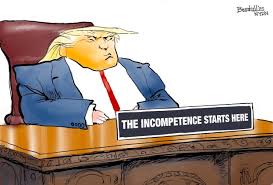
Which brings us back to Trump’s ultimatum. One commentator remarked that he has managed to ‘back himself into a corner in the Oval Office’, which is not an easy thing to do. The chances of President Putin backing down without any concessions from Ukraine or from their European sponsors are so low as to be almost non-existent.
Donald Trump, who appears largely to have sub-contracted resolving the Ukraine war to Marco Rubio and Keith Kellogg (where has Steve Witkoff disappeared to?), may now be forced to invest more personal time to bringing the war to an end.
Yes, he has engaged directly with President Putin in talks which is to be welcomed, in a diplomacy-starved war. But his real problem is his inability to encourage Ukraine and its European sponsors to address Russia’s underlying concerns about the war.
The most significant concern is, and has always been, about the need for Ukraine to adopt neutrality and revoke its aspiration to NATO membership. There has been absolutely no sign of compromise on this key underlying concern in Kyiv, Brussels, Berlin or London.
Offering Ukraine more weapons, however well-intended, will simply encourage Zelensky, Mark Rutte, Ursula von der Leyen, Friedrich Merz and Keir Starmer, in their view that Ukraine’s NATO aspirations remain alive and well. And, unfortunately, Russia will not silence its guns until, at the very least, a deal on Ukrainian neutrality is reached.
That leaves Trump with only one place to go. He must now invest personal time into urging Ukraine and Europe to accept neutrality for Ukraine as part of a ceasefire deal and longer-term peace process. If he doesn’t, the politics of Washington DC may force him to impose tariffs on China in a way which will, more than anyone else, hurt American people, and hurt his reputation.
Iran to hold nuclear talks with European powers on Friday

Iran, Britain, France and Germany will hold nuclear talks in Istanbul on
Friday, an Iranian Foreign Ministry spokesperson said early on Monday,
following warnings by the three European countries that failure to resume
negotiations would lead to international sanctions being reimposed on Iran.
“The meeting between Iran, Britain, France and Germany will take place at
the deputy foreign minister level,” Esmaeil Baghaei was quoted by Iranian
state media as saying.
Reuters 20th July 2025, https://www.reuters.com/world/middle-east/iran-hold-nuclear-talks-with-european-powers-friday-2025-07-20/
Iran says nuclear site attack proved military option is futile
Iran’s foreign minister said last month’s attacks on its nuclear facilities
proved that military pressure cannot stop its atomic program, warning that
only diplomacy can prevent further conflict, in an interview broadcast
Saturday.
Speaking on the sidelines of a Shanghai Cooperation Organization
meeting, Abbas Araghchi said Iran remains open to a negotiated deal but
only if the US “puts aside military ambitions” and compensates for past
actions. “There is no military option to deal with Iran’s nuclear
program,” he told CGTN. “There should be only a diplomatic solution.”
He added that Iran is ready to re-engage in talks, but only “when they
put aside their military ambitions.”
Iran International 19th July 2025, https://www.iranintl.com/en/202507191773
Iran pushes back on EU pressure as clock ticks on nuclear talks
Any new nuclear deal must meet what Iran describes as fair and balanced
terms, Foreign Minister Abbas Araghchi said Friday, after a call with
European ministers who urged Tehran to return to talks before the end of
August or face the possible return of UN sanctions.
“It was the US that
withdrew from a two-year negotiated deal, coordinated by the EU in 2015,
not Iran,” Araghchi wrote on X after a joint teleconference with the
foreign ministers of France, Britain, Germany, and the EU’s top diplomat.
“And it was the US that left the negotiation table in June this year and
chose a military option instead, not Iran.”
“Any new round of talks is
only possible when the other side is ready for a fair, balanced, and
mutually beneficial nuclear deal,” he added. Araghchi warned the EU and
E3 powers to abandon “worn-out policies of threat and pressure,”
referring specifically to the “snapback” mechanism, which he said they
have “absolutely no moral and legal ground” to invoke.
Iran International 18th July 2025,
https://www.iranintl.com/en/202507180912
Trump sprang Ukraine surprise on NATO states – Reuters
Trump noted that the plan is seen by Washington as a business opportunity.
16 July 25, https://www.rt.com/news/621575-trump-ukraine-weapons-surprise/
Several bloc members reportedly only learned they were supposed to fund American weapons for Kiev when it was announced by the US president.
Several NATO member states were not notified in advance that they would be asked to fund new arms deliveries to Ukraine under US President Donald Trump’s latest proposal, Reuters has reported, citing European officials.
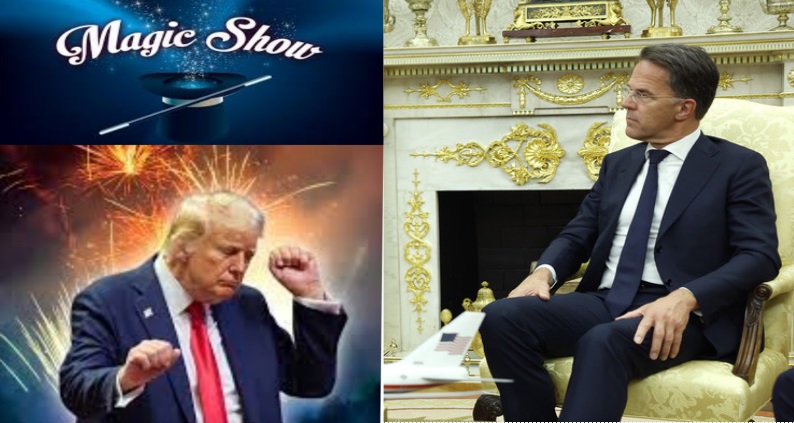
On Monday, Trump pledged to provide more US-made weapons to Kiev through a new scheme funded by European NATO members. “We’re not buying it,” Trump said during an Oval Office meeting with the bloc’s secretary-general, Mark Rutte. “We will manufacture it, and they’re going to be paying for it.”
Trump noted that the plan is seen by Washington as a business opportunity.
Rutte said six countries – Finland, Denmark, Sweden, Norway, the Netherlands, and Canada – were willing to take part in the arms procurement scheme. However, high-ranking sources at the embassies of two of those countries told Reuters they only learned of their supposed participation when the announcement was made.
“It is my clear sense that nobody has been briefed about the exact details in advance,” one European ambassador told Reuters. “And I also suspect that internally in the administration they are only now beginning to sort out what it means in practice.”
Several countries have already distanced themselves from Trump’s plan. According to Politico and La Stampa, France and Italy will not be financially supporting the effort. Hungary and the Czech Republic have also declined to participate, with Czech Prime Minister Petr Fiala saying Prague is focusing on other projects.
EU foreign policy chief Kaja Kallas, on the other hand, has welcomed the proposal but emphasized that Washington should “share the burden,” stating that if European countries pay for the weapons, it should be considered as “European support.”
Since taking office in January, Trump has renewed pressure on NATO members to increase defense spending and warned that the US may not defend allies who do not meet their obligations.
Russia has repeatedly condemned Western arms supplies to Ukraine, arguing that it only prolongs the bloodshed and does not change the course of the conflict. The Kremlin maintains that foreign military aid is being used to escalate the hostilities rather than seek a diplomatic resolution.
Instigating Murder
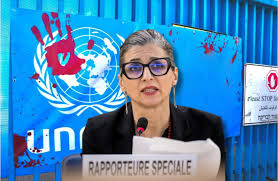
The US Attack on Francesca Albanese is even worse than meets the eye
Tarik Cyril Amar, Jul 10, 2025, https://www.tarikcyrilamar.com/p/instigating-murder
Sometimes – or, actually, very often – the behavior of the West’s ruling “elites” (if that is the word) is so obviously absurd and vicious that it’s, literally, stunning. In the sense that it almost knocks out a sane and morally decent individual’s capacity to fully grasp all aspects of any given new piece of depravity.
Instead, if you are still halfway normal in this West ruled by the clearly criminal and perverse, their frequent peak performances in depravity leave you with a dazed sense of “What just happened, again?” And once you recover from that shock, you can’t entirely shake the eerie feeling that you’ll never quite catch up with “their” constant and, again literally, limitless production of new evils.
None of the above is abstract. On the contrary, concrete examples abound. Recently, for instance, we have witnessed Israeli genocider-in-chief and fugitive under international law Benjamin Netanyahu publicly nominate genocide co-perpetrator Donald Trump for the Nobel Peace Prize.
Together with his gang, the same Donald Trump, also of course serving as president of the still single most powerful (alas!) rogue state on the planet, has attempted to simply wipe out the memory of the Epstein sex abuse (at least) and political blackmail scandal. Most likely – as in, we all know it – because he himself and many of his donors were ensnared in that Israeli operation of controlling the West’s “elites” and depriving the West’s populations of the last, miserable shreds of having a say in their own countries.
Meanwhile, in Britain, those who resist the Gaza Genocide perpetrated by Israel and the West together are brutally suppressed as “terrorists,” while cabinet minister Lisa Nandy literally conspires with Israeli diplomats to make the already outrageously pro-Zionist BBC even more so.
And then, essentially at the same time, there has been America’s massive and unambiguously criminal attack on the UN Special Rapporteur on the Occupied Palestinian Territories, Francesca Albanese. And that is, perhaps, the case displaying with greatest clarity that odd, stunning quality of the West’s atrocities and outrages.
The gist of the matter is that the US has sanctioned Albanese as if she were a criminal or even a terrorist. US secretary of state Marco Rubio has claimed that Albanese, an internationally recognized authority on human rights and international law, is waging a “campaign of political and economic warfare against the United States and Israel.” In particular, Rubio charged her with having supported the prosecution of Israeli leaders – that is, in reality, genocide perpetrators, also guilty of any other crime in every other book, from war crimes, via crimes against humanity, to apartheid and ethnic cleansing – by the International Criminal Court, another body under heavy sanctions fire from the US.
That, according to Rubio’s non-logic which is, of course, identical with that of the Israeli criminals – amounts to “antisemitism.” As a special highlight of absurdity, Rubio added that Albanese’s activities threaten the US’s “sovereignty.”
Let’s not waste time. No, it is neither necessary nor just nor intellectually healthy to treat these American allegations seriously, in the sense of going into any detail about why precisely they are deranged lies. Only so much, if Rubio and the other Trumpists are looking for someone destroying US “sovereignty” then the guy the American president has a habit of seating in his chair like a waiter may be a really good starting-point. And Netanyahu would, obviously, only be a small, nasty part of something much bigger called Israel and its lobby in America.
What is really happening here is clear: Albanese is a prominent critic and opponent of Israeli genocide. The US and its Western vassals are, at best, accomplices or, more realistically, co-perpetrators of that genocide. No Western state, conversely is fulfilling its clear legal obligations under the 1948 UN Genocide Convention and the 1998 Rome Statute (the US, to be fair, has always been vile enough not to even sign the latter; but that makes no difference to the fact that it is a signatory of the Genocide Convention): namely, not only not to commit the crime of genocide but to prevent it and to punish its perpetrators.
The US conclusion from the above, true to form is to persecute Albanese. It’s – literally – the criminals going after the sheriff. Because they can. For the worst and meanest rogue nation of them all, the US, with its trusty mass-murderous sidekick Israel, believes that might makes right. The rest – rules-based this or that, values, etc. – is pure hypocrisy.
None of the above is surprising or, make no mistake, new: No, this is not merely “Trumpism,” it is real-existing Americanism, as it has been for a long, long time. Ask the native Americans who were exterminated not “merely” by bloody violence but also by one broken agreement after another. Ask, more recently, the Iraqis or Libyans, for instance. What the Trumpists have added is merely a special note of in-your-face: Going after Albanese as if she were a terrorist while simultaneously not only sucking up once again to the genocidal führer of Israel but also a died-in-the-wool real terrorist, the head-cutting, pogrom-running puppet now in charge in Syria – that is almost a Gesamtkunstwerk of real-existing Americanism. Or maybe a Gestalt of evil and lies of satanic purity.
Likewise, the assault on Albanese – while a fresh peak performance – stands in a long tradition of harassing her as well as other opponents of Western-Israeli genocide, and not only in the US, of course. In Germany, Albanese was treated like a dangerous extremist who must not be allowed to speak in public. In the US, the attempt to cancel Albanese has a long history. Other critics of Israel and its crimes have been subjected to massive lawfare, on both sides of the Atlantic. Most recently, the German journalist Hüsein Dogru and his pregnant wife, too, have been terrorized by lawless EU sanctions that aim at nothing less than his economic destruction.
The reason: his reporting on protests against German complicity in the Gaza Genocide, which was absurdly re-interpreted as destabilizing Germany and – drum roll – playing into Russian hands. By that “logic” any criticism of any policy in the West can now lead to punitive sanctions (without any legal process, simply by bureaucratic fiat, Kafka-style) designed to destroy an individual’s existence.
All of the above, though, is obvious. Indeed, it is stunningly obvious in the sense mentioned at the beginning of this text: It arrests the mind, as it were. One gets stuck as if meditating on a perverse mandala of the unholy. Yet there seems to be one aspect of the attack on Albanese that receives too little attention, although it is second to none in its viciousness.
Consider that the Israelis have a long history of not “merely” smearing and undermining the UN, its offices, and representatives, but of deliberately mass-murdering them, too. To his eternal shame, UN Secretary-General Antonio Guterres has betrayed his own brave staff by never daring to say what the world knows: The hundreds of UN, in particular UNRWA, personnel killed in Gaza since October 2023 have been the victims of an Israeli campaign to destroy UNRWA as a last lifeline for the Palestinian victims. A campaign that is part of Israel’s use of starvation as yet another weapon of genocide. Its “logical” conclusion has been the replacement of UNRWA with the mercenary death squads, cooperating with the equally murderous IDF, of the so-called Gaza Humanitarian Foundation, funded, of course, by Israel.
If hundreds of UN staff have been mass-murdered as part of Israel’s Gaza Genocide, let’s not forget that Israel has a long tradition of assassinating UN officers, indeed, including the very highest: In 1948, Folke Bernadotte, a mediator and emissary of the UN Security Council was murdered by the Lehi terrorist organization (aka Stern Gang). Its members received a general amnesty in 1949. Later, one of Lehi’s leaders would go on to become Israeli prime minister (another one, of course, had led Irgun, another Zionist terror organization), and a military decoration would be named after it as well.
Israel, in sum, has a proud tradition of murdering UN representatives. It also has a long tradition of impunity in this area – as in all others – of criminality as well. Against this background, it is impossible that Rubio, Trump, and other US officials have missed one simple fact: They have not only assaulted Albanese with criminal lawfare. They have also signaled to Israel that they won’t mind if Israeli criminals go a step further and murder this UN representative, too.
That is the stark reality: Albanese’s punishment for standing up against genocide is not “merely” massive harassment but a very real death threat. Or to be precise, an implicit encouragement for Israel, a murderous state founded by ethnic cleansers and terrorists, to make true on the death threat Albanese lives under already. And Trump and his henchmen know this.
Putin urges Iran to accept ‘zero enrichment’ nuclear deal with US – Axios
Russian President Vladimir Putin has urged Iranian officials to accept a
nuclear agreement that would ban uranium enrichment, a key US demand in any
future talks, Axios reported Saturday citing multiple sources. Putin
conveyed his position to both President Donald Trump and Iranian leaders in
recent weeks, encouraging Tehran to move toward a deal that would help
restart negotiations with Washington.
Iran International 12th July 2025,
https://www.iranintl.com/en/202507120964
Iran tells IAEA to end ‘double standards’ before nuclear talks can resume

Iran links future IAEA cooperation to impartiality, after deadly June conflict with Israel and US.
Iran’s president has warned the International Atomic Energy Agency
(IAEA) to abandon its “double standards” if it hopes to restore
cooperation over the country’s nuclear programme, amid an acute mistrust
following Israel and the United States’ attacks on Iranian nuclear sites
last month, and the UN nuclear watchdog’s refusal to condemn the strikes.
Speaking to European Council President Antonio Costa by phone on Thursday,
President Masoud Pezeshkian said, “The continuation of Iran’s
cooperation with the agency depends on the latter correcting its double
standards regarding the nuclear file,” according to Iranian state media.
Tehran has accused the IAEA of enabling the strikes by issuing a resolution
on June 12 – just one day before the bombing – accusing Iran of
breaching its nuclear obligations. Iran says its nuclear programme is for
peaceful purposes and denies seeking nuclear weapons. However, it has made
clear that it no longer trusts the agency to act impartially. Despite
remaining a signatory to the Treaty on the Non-Proliferation of Nuclear
Weapons (NPT), Iran insists that the IAEA failed to condemn the attacks by
the US and Israel and instead chose to align with Western pressure.
Aljazeera 10th July 2025, https://www.aljazeera.com/news/2025/7/10/iran-tells-iaea-to-end-double-standards-before-nuclear-talks-can-resume
Patrick Lawrence: Trump Dead-Ends Putin
By Patrick Lawrence / Consortium News, https://scheerpost.com/2025/07/08/patrick-lawrence-trump-dead-ends-putin/
Presidents Donald Trump and Vladimir Putin have spoken by telephone numerous times since the former reassumed office seven months ago. Not much appears to have been accomplished by way of these exchanges, some of which have been lengthy, according to the accounts Washington and Moscow have provided afterward.
No progress toward a durable settlement to end the war in Ukraine. Talk and desultory diplomatic contacts with a view to repairing the profligate damage successive American administrations have done to U.S.–Russian relations, but no substantive advances. O.K., it is what it is, as we say. But there was something singularly conclusive about the telephone conversation the U.S. and Russian leaders had last Thursday.
I detect that a dead end has been reached.
Trump was trying once again to get Putin to agree to an “immediate and unconditional ceasefire” in Ukraine — “the quick end to the military action,” as Yuri Ushakov, the Kremlin’s senior foreign policy adviser, put it. Putin was trying once again to explain that the time has come to structure an enduring settlement by addressing — the Kremlin’s favored phrase these days — the “root causes” of the conflict.
Maybe it is the barrage of drones and missiles with which the Russians bombarded Kiev and other Ukrainian cities within a few hours of the Trump–Putin exchange that prompts me to think the two leaders or their diplomats are unlikely ever to get anywhere on the telephone or at the mahogany table.
The Ukrainians, for what their word is worth, counted 539 drones and 11 missiles, including a hard-to-intercept, high-velocity (Mach 10 hypersonic) projectile called the Kinzhal.
This was the largest aerial attack so far in the war, by the Ukrainians’ reckoning, and it left Kiev smoldering last Friday morning. It is hard to avoid concluding the Kremlin had a point to make after the failure of the phone call.
Trump Has Nothing to Propose
Or maybe it is Trump’s remarks after the call that makes me think a diplomatic settlement seems simply beyond reach — this at least until the Ukrainian military is decisively smashed, and very possibly not even then.
“I was very unhappy with my call with President Putin,” Trump told reporters aboard Air Force One afterward. “I didn’t make any progress with him at all. He wants to go all the way, just keep killing people, it’s no good.”
You cannot be surprised at this current state of affairs. Trump made no progress with the Russian leader because he has nothing to propose that would make progress possible. Social media messages demanding a ceasefire, replete with capital letters and exclamation points, do not count and do not work as statecraft; they betoken nothing so much as Trump’s — read, the West’s — un-seriousness.
The fundamental problem here is that Kiev and its sponsors are unable to accept defeat. I concluded more than a year ago that Ukraine and its Western powers had lost the war — “effectively lost,” I thought for a time, but then I dropped “effectively.”
For a good long time now what we’ve watched is nothing more than postwar gore. If you have lost a war but cannot admit you have lost because the West must never lose anything, you are down to the old game of pretend. And so long as the U.S. and its European clients insist that they deserve any consequential say in the terms of negotiation — as if they can assert the authority of a victor — it amounts to the pointlessness of pretending.
It is as if the Germans, if you do not mind the comparison, insisted they set the terms of surrender in May 1945, or had a say in the settlement concluded at Versailles in 1919.
When a settlement is finally reached it will not be termed a surrender — you can count on this — but this is what it will come to. And Russia, to turn this question another way, will have a responsibility to avoid turning a finally achieved peace into another Versailles disaster — where the victors planted the seeds for a renewal of conflict — by asking too much.
I am confident Moscow will hold to its currently expressed demands, which I consider eminently just and not at all excessive: A new security architecture in Europe; no NATO membership for a neutral Ukraine that must be demilitarized and de-Nazified; and recognition of the four oblasts that voted to join Russia.
Ressentiment
But I am not confident Ukraine and the neo–Nazis who control the military and the civilian administration — yes, both — will ever accept any kind of coexistence with the Russian Federation. The hatred is too visceral, too irrational, too atavistic, too pathological. This is why de–Nazification was and remains a Russian objective.
The neo–Nazi beast, never far below the surface in post–1945 Ukraine, was sprung into the open air with the U.S.–cultivated coup in 2014. Washington and its clients in Kiev needed the neo–Nazis, especially but not only the armed militias, because they could be relied upon to fight the Russians with the sort of visceral animus the occasion required.
I do not know what a de–Nazification operation would look like, given the phenomenon’s above-noted characteristics, but something will have to be done to rid the Ukrainian consciousness of this deformity.
What we will see in Ukraine otherwise will prove an horrific case of ressentiment — enduring and poisonous. Ressentiment is a term the Germans, Friedrich Nietzsche among them, borrowed from the French in the 19th century because they had no term for the phenomenon.
It denotes the hostility and anger within a group arising from a shared sense of inferiority in the face of another — this other becoming a kind of scapegoat for a society’s frustrations and complexes.
Max Scheler, the 19th and early 20th century phenomenologist, explored all this in Ressentiment, a brief but pithy book he published in 1912 (in English, Marquette Univ. Press, 1994). As Scheler explained in interesting detail, a socially accepted set of values arises from this complex of feelings.
What we will see in Ukraine otherwise will prove an horrific case of ressentiment — enduring and poisonous. Ressentiment is a term the Germans, Friedrich Nietzsche among them, borrowed from the French in the 19th century because they had no term for the phenomenon.
It denotes the hostility and anger within a group arising from a shared sense of inferiority in the face of another — this other becoming a kind of scapegoat for a society’s frustrations and complexes.
Max Scheler, the 19th and early 20th century phenomenologist, explored all this in Ressentiment, a brief but pithy book he published in 1912 (in English, Marquette Univ. Press, 1994). As Scheler explained in interesting detail, a socially accepted set of values arises from this complex of feelings.
Ressentiment is a potentially dangerous sentiment when it animates a society that feels itself wounded over a sustained period of time. We need look no further than the extreme Russophobia evident today among some segments of the Ukrainian population for a case in point.
Against this historical and social backdrop, I do not see the Ukrainians as capable of reaching a settlement to end the war that has already torn apart the nation and its people. I do not see that they can achieve peace, either with others or among themselves, because they do not know peace and they are not capable of it.
A Rockface of History
But I see another reason peace in Ukraine will prove elusive, if not impossible, even as the Russians achieve it on the battlefield. (And I tend toward the latter probability.) This judgment arises when we put the Ukraine crisis in a larger, global context.
I think of Ukraine as resembling the rock face in a mine, or a front line in a global conflict: It is where the non–West is most urgently chiseling a new world order into being. It is a site of insistence, let us say. And it is where the West proposes to stop this world-historical turn of history’s wheel — a turn that simply cannot be stopped.
Think of Putin’s demands. Apart from de–Nazification — an objective that, to me, reflects considerable insight on Moscow’s part — there are the more encompassing “root causes.” I gather Putin used this phrase yet again in his call with Trump. [See: Rooting Out the Root Causes in Ukraine]
Putin, Sergei Lavrov, his foreign minister, and other senior Russian officials have been clear on this point at least since Moscow sent those two draft treaties Westward in December 2021 as the proposed basis of negotiations that would lead to an encompassing new security structure between Russia and the West.
This framework would relieve the decades of tension along Russia’s western flank and Europe’s east and would be of benefit to both sides. This was and remains Moscow’s intent. Settlements that address the concerns of all sides, as against one side’s at the expense of another, is the very essence of sound statecraft.
But any such settlement would stand as an expression of parity between West and non–West. As I have argued severally over the years, parity between these two spheres is a 21st century imperative. There will be no world order without it — only more of the disorder the Western powers call, altogether absurdly, “the rules-based order.”
But it is precisely even the thought of parity that the United States and its trans–Atlantic allies refuse to accept. It would bring to an end the half-millennium of dominance the West cannot release from its grasp even as it will eventually have to do so.
“It is no good,” Trump said after his latest telephone talk with Putin. No, and I do not see how it can be. Trump has nothing to offer the Russians that would amount to a serious address of what is genuinely at issue between America and Russia — between the West and non–West.
I leave it to readers to conclude where this leaves the Ukraine conflict and the larger question of Russo–American relations. It is, once again, what it is — or what it is at the moment.
In another column I will revisit this question of parity as it applies in West Asia.
The Trumpanyahu Administration
Caitlin Johnstone, Jul 01, 2025, https://www.caitlinjohnst.one/p/the-trumpanyahu-administration?utm_source=post-email-title&publication_id=82124&post_id=167261479&utm_campaign=email-post-title&isFreemail=true&r=1ise1&triedRedirect=true&utm_medium=email
Honestly at this point they should just get Netanyahu his own room in the White House and a desk in the Oval Office.
The prime minister of Israel is taking his third trip to the White House in the five months since Trump has been back in office. I have immediate blood family members who I love with all my heart and visit less often than this.
This comes as the Trump administration revokes the US visas of British punk rap duo Bob Vylan ahead of a US tour for chanting “Death, death to the IDF” at a concert in the UK. Trump’s sycophantic supporters who spent years complaining that their free speech rights were under assault appear fine with their government deciding what words Americans are allowed to hear in their own country.
This also comes as Trump actively intervenes in the Israeli judicial system to prevent Netanyahu’s corruption trial from moving forward.
The president has repeatedly taken to social media to demand that Israel abandon its corruption case against the prime minister, at one point even implying that the US could cut off arms supplies if his trial isn’t canceled.
“The United States of America spends Billions of Dollar a year, far more than on any other Nation, protecting and supporting Israel,” Trump said. “We are not going to stand for this. We just had a Great Victory with Prime Minister Bibi Netanyahu at the helm — And this greatly tarnishes our Victory. LET BIBI GO, HE’S GOT A BIG JOB TO DO!”
It’s so revealing what the US government is and is not willing to threaten conditioning military supplies on, and what it’s willing to interfere in Israel’s affairs to accomplish.
Ever since the Gaza holocaust began we’ve been hearing lines like “Israel is a sovereign country” and “Israel is a sovereign state that makes its own decisions” when reporters ask why the White House doesn’t leverage arms shipments to demand more humanitarian treatment for civilians in the Gaza Strip. But the president of the United States is willing to leverage those same arms shipments to directly interfere in Israeli legal proceedings which have nothing to do with the US government in order to get Netanyahu out of trouble.
And it would appear that the president’s intervention has been successful; Netanyahu’s corruption trial has since been postponed.
When it comes to committing genocide using American weapons funded by American taxpayers, Israel is a sovereign state upon which the US can exert zero leverage or control. When it comes to meddling in the corruption trial of a man who is wanted for war crimes by the International Criminal Court, the White House pulls no punches in protecting its favorite genocide monster.
There is no meaningful separation between the US and Israeli governments. They’re two member states in the undeclared empire that sprawls across the entire western world, and Trump and Netanyahu are two of the most depraved and most consequential managers of this empire today.
They are thick as thieves. They are partners in crime.
Call it the Trumpanyahu administration.
Slippery slope to nuclear proliferation

Letter David Lowry:
In your leader “The war that should have been
avoided” (FT View, June 14), you rightly identify the roots of the
present Israel-Iran crisis as the “flawed decision in 2018 [by President
Donald Trump] to withdraw the US unilaterally” from the so-called JCPOA
agreement that corralled Iran’s atomic ambitions.
Iran has been a signatory to the 191-member Treaty on the Non-Proliferation of Nuclear
Weapons since it was open to signature in 1968. This treaty, applying
international safeguards, controls the nuclear activities of its signatory
states.
Israel, however — which is believed to have as many as 200
nuclear weapons — has always refused to sign the NPT.
Now steps have been
taken in the Iranian parliament to withdraw Iran from membership of the
NPT. Many in power in Iran feel Israel is being rewarded by the
international community for staying outside the NPT regime.
Indeed, the final communiqué of the G7 in Canada on June 17 criticised Iran, which had
been attacked by Israel; while Israel, the G7 asserted, had the right to
defend itself. Iran, which has no nuclear weapons, was warned it cannot
have any. Israel, which has nuclear WMDs, was praised! By taking unilateral
military action against Iran and successfully encouraging the US to do the
same, Israel undermined the credibility of the international community’s
law-based order. This is a very slippery slope.
FT 2nd July 2025, https://www.ft.com/content/23d01c69-68d4-4217-a184-3ae1b5d272f1
1 This Month

26 September – International Day for the Total Elimination of Nuclear Weapons


PLEASE OPPOSE HR 8255 AND S.3639 – bills would accelerate satellite deployment, with no environmental review or safeguards – https://ncstd5li.quorum.us/campaign/169331/
To see nuclear-related stories in greater depth and intensity – go to https://nuclearinformation.wordpress.com
-
Archives
- September 2026 (194)
- August 2026 (330)
- July 2026 (355)
- June 2026 (287)
- May 2026 (306)
- April 2026 (356)
- March 2026 (251)
- February 2026 (267)
- January 2026 (308)
- December 2025 (358)
- November 2025 (359)
- October 2025 (375)
-
Categories
- 1
- 1 NUCLEAR ISSUES
- business and costs
- climate change
- culture and arts
- ENERGY
- environment
- health
- history
- indigenous issues
- Legal
- marketing of nuclear
- media
- opposition to nuclear
- PERSONAL STORIES
- politics
- politics international
- Religion and ethics
- safety
- secrets,lies and civil liberties
- spinbuster
- technology
- Uranium
- wastes
- weapons and war
- Women
- 2 WORLD
- ACTION
- AFRICA
- Atrocities
- AUSTRALIA
- Christina's notes
- Christina's themes
- culture and arts
- Events
- Fuk 2022
- Fuk 2023
- Fukushima 2017
- Fukushima 2018
- fukushima 2019
- Fukushima 2020
- Fukushima 2021
- general
- global warming
- Humour (God we need it)
- Nuclear
- RARE EARTHS
- Reference
- resources – print
- Resources -audiovicual
- Weekly Newsletter
- World
- World Nuclear
- YouTube
-
RSS
Entries RSS
Comments RSS
 nuclear-news