Western leaders’ hypocrisy on uranium investment scandals in Africa
Malawi gov’t and Paladin: Act on Kayelekera uranium raw deal now! By Veronica Maele-Magombe Nyasa Times, By Veronica Maele-Magombe July 30, 2013 “……one cannot underestimate the ‘politicking’
surrounding foreign investment. There is the brainwashing and fear
that African leaders endure in their struggle to appease donors who
are sometimes capable of clamping on aid or trade deals if a poor
country like Malawi is ‘hostile’ to western investors. In the un-coded
diplomatic language of foreign investment it means, treat business
clients from the west well and we will handle your aid and loan
cheques accordingly.
Western leaders have continued to hypocritically talk about fair trade
and dealings with Africa whilst winking an eye to their investors.
And, tightening the shackles of neo-colonialism on their behalf has
been IMF – convincing poor countries to lure foreign investor with a
portfolio of incentives. Just last year, IMF advised poor Gambia to
reform its tax system so that the country avoids discouraging foreign
investors with many taxes. Resident Representative, Meshack Tunee,
noted: Continue reading
UN examines Australian uranium miner Paladin’s Malawi operations
UN rubbishes Malawi’s Paladin uranium deal, fertilizer subsidy By Hudson Mphande, Nyasa Times July 23, 2013 United Nations Special Raportuer on the Right to Food Olivier De Schutter who was in Malawi for an assessment of the food situation in the country has rubbished Kayerekera uranium mine deal between Malawi and Australian Paladin Mining Company saying the Southern African country has had a raw deal that is robbing the poor.
The UN Raportuer said the uranium mining deal was one of the investments in Malawi through which the country is losing resources that could otherwise make a difference in food security and other pro-poor initiatives. He said in the life span of the mine Malawi is expected to lose almost US$281 million…
“Mining companies are exempt from customs duty, excise duty, value added taxes on mining machinery, plant and equipment. They can also sign special deals on the rate of royalty owed to the government. I believe that there are more reasons that investors would come to Malawi without such incentives,” he said.
De Schutter was addressing journalists in the capital Lilongwe at the end of his 11-day tour of the country.
He bemoaned that due to illicit financial flows, tax envasion as well as tax incentives that the country offer to both domestic and foreign companies currently Malawi was failing to get maximum use of its resources.
De Schutter said that revenue losses from special tax incentives to Paladin Africa Mining alone are estimated at almost K67 billion (US$205 milion) since the mine started its operations and could reach almost K92 billion (US$281 million) over its13-year lifespan.
“Paladin alone is costing the budget more than US$20 million (almost K8 billion) a year in taxes,” he said.
He added: “I am convinced that unless combined with a comprehensive enhancement and optimisation of tax revenue, current macro-economic reforms may not have substantive positive impacts. There is need for
Malawi to examine its national tax laws and policies towards preventing illicit capital flight. As mining develops, Malawi can simply not afford business-as-usual.”
The UN Special Raportuer said it is estimated that the country has lost over 10 percent of its growth domestic product (GDP) to illicit outflows and tax evasion over the period 1980 to 2009……..
De Schutter also specifically expressed concerns on the country’s current minimum wage currently at K371 ($1.12) per day, describing it as the lowest in the world…… The UN special rapporteur said he will give a report and his recommendations to both the UN Human Rights Commission and the Malawi Government. http://www.nyasatimes.com/2013/07/23/un-rubbishes-malawis-paladin-uranium-deal-fertilizer-subsidy/
Paladin Energy “screwing” Malawians in uranium mining deal
all a fat lie. Paladin and many other foreign multinational mining countries are least interested to contributing to the Malawi economic growth. They are here to milk the country – exploiting all that it has rich in minerals and dump us when the time is right even poorer.
Killing Malawians through the rotten extractives deals: The case of Paladin’s uranium mining Nyasa Times, by Patrica Masinga, 24 April 13, Malawi has in the few weeks been engaged by a plethora of stakeholders discussing strategies to revive, or more on the ground, reclaim the benefits that Malawians are been milked of by the so-called extractive industry multi-national corporations.
They call themselves investors, and government believes that the Malawi Development Goals (MDGs – who cares if it’s the second phase) will be boosted, particularly that mining alone through Kayerekera of Paladin Energy Limited group of companies (trading as Paladin (Africa) Ltd in Malawi?) could provide a large economic base.
But that is all a fat lie. Paladin and many other foreign multinational mining countries are least interested to contributing to the Malawi economic growth. They are here to milk the country – exploiting all that it has rich in minerals and dump us when the time is right even poorer.
Imagine, to screw Malawians of their rightful economic gains, the company, incorporated in Australia first listed on the Australian Stock Exchange (ASX) on March 29, 1994 under code ‘PDN’, and quickly changed its name from Paladin Resources NL to Paladin Resources Ltd in 2000 and listed under the Toronto Stock Exchnage (TSX) in Canada April 29, 2005, and again changed its name to Paladin Energy Ltd in November 2007 and listed on the Namibian Stock Exchnage on February 2008.
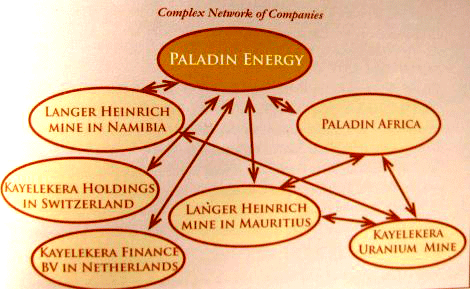
By such trends, one is compelled to question the motive, considering also that in Namibia itself the company owns the Langer Heinrich Uranium Mine where it started production in 2008 and has Kayerekera Uranium Mine as its second largest mining venture in this part of Africa acting also as a good supllment to the Langer Heinrich Uranium Mine.They call themselves investors, and government believes that the Malawi Development Goals (MDGs – who cares if it’s the second phase) will be boosted, particularly that mining alone through Kayerekera of Paladin Energy Limited group of companies (trading as Paladin (Africa) Ltd in Malawi?) could provide a large economic base.
But that is all a fat lie. Paladin and many other foreign multinational mining countries are least interested to contributing to the Malawi economic growth. They are here to milk the country – exploiting all that it has rich in minerals and dump us when the time is right even poorer. Continue reading
Operation Redwing saga: the radioactive pollution of the Marshall Islands
The Fallout from Nuclear Secrecy , Consortium News, July 23, 2013 “……….As the Redwing tests continued, radiation badges were handed out, which Harris described as “small rectangular plastic discs three inches by an inch and a half.” Even with these, Harris wondered about the future impact of the radiation: “Had our genetic code been compromised? Would we get leukemia or some other form of cancer?”
His answer came decades later. Those present at Operations Redwing or Hardtack or for six months afterward who succumb to one of 19 primary cancers are eligible for $75,000 compensation made available by Congress.
At the time of Operation Redwing in 1956, the U.S. government under President Dwight Eisenhower released very little information. This secrecy was politically significant because it kept voters in the dark during the presidential election campaign in which Democratic candidate Adlai Stevenson advocated stopping the H-bomb tests being conducted by the Eisenhower administration.
During the election year, U.S. officials announced only two of the 17 blasts in the Redwing series. This virtual blackout hid from U.S. voters over 77 summertime days during the presidential election campaign Redwing’s 20,820 kilotons of explosive force — or the equivalent of 1,388 Hiroshima-size bombs. That tonnage is the equivalent of 18 Hiroshima-size bombs per day over 77 days.
Seven Redwing tests received no public notice and the remaining eight blasts were disclosed by Japanese scientists in news articles datelined Tokyo. Thus the fastest and most accurate information about U.S. Redwing testing was disclosed from Tokyo by Japanese, an immense irony given that only a decade earlier, U.S. atomic bombs had contributed to Japan’s surrender by destroying two of its cities. Eisenhower handily won re-election.
The more powerful 32 detonations in Operation Hardtack were launched in 1958 as the U.S. and the Soviets raced toward declaring a moratorium on such experiments and the U.S. accelerated testing missile warheads. Washington disclosed only nine of the 32 blasts that produced a total yield of 28,026 kilotons, or the equivalent of 1,868 Hiroshima-size bombs – an average of 35 per week in 1958 or five per day. That was the lowest disclosure rate of any U.S. Pacific testing operation.
Even more ironic than the Japanese disclosures in 1956 were the Soviet ones about the 1958 Hardtack detonations. The Soviets charged that the U.S. had concealed most of the tests being conducted, which even U.S. officials deemed accurate.
In doing so, the Soviets made huge propaganda gains as they announced their initiative of stopping their nuclear testing that year. Surprisingly, New York Times columnist James Reston wrote that “the United States, which pamphleteered its way to independence and elevated advertising and other arts of persuasion into a national cult, should be unable to hold its own in the battle for the headlines of the world.”
Samples made during several Hardtack tests showed that fractions of the radioactive elements of strontium and cesium were dispersed over distances of more than 4,000 miles, according to a report titled “Operation Hardtack: Fallout Measurements by Aircraft and Rocket Sampling” dated 1961 and declassified in 1985. The U.S. gave a newly declassified version of this report to RMI officials.
That 4,000-miles range means the radioactive elements could have descended on San Francisco and other West Coast areas. Both radioactive elements pose serious health problems.
The decades-long delay in receiving a full accounting of these fallout results helps to substantiate the contention of the RMI that its negotiators were denied vital information when they agreed in 1986 with President Ronald Reagan to form an independent nation, thus ending the American administration of the U.N.-sanctioned trust territory established in 1947.
Kept in the dark about the fallout results, the Marshallese agreed to terms so insufficient that a U.S.-financed $150 million nuclear-claims trust fund is now penniless, unable to compensate fully Marshallese for health and property damages presumed to have resulted from the tests. RMI’s appeals to Congress, the U.S. courts and the Bush administration have been turned back and the Obama administration has yet to help them.
Last September, Special Rapporteur Calin Georgescu of the United Nations reported to its Human Rights Council that the U.S. government should:
–Remedy and compensate Marshall Islanders for its nuclear weapons testing that has caused “immediate and lasting effects” on their human rights,
–Open up still-secret information and records regarding the environmental and human health effects of past and current U.S. military use of the islands,
–Grant Marshallese full access to their medical and other records, and
–Consider issuing a presidential acknowledgment and apology to victims adversely affected by the 66 weapons tests it conducted when it administered the Marshall Islands as a U.N. strategic trust territory.
Over the decades, the Marshallese have not been alone in wanting more information about the nuclear tests. In 1954, the Association of State Health Officials voted to ask the federal government to give health officials with security clearances access to classified atomic energy information so as to prevent health hazards.
From 1945 to 1992, the United States carried out 1,054 nuclear tests worldwide. Beverly Deepe Keever is the author of News Zero: The New York Times and The Bomb and the newly released Death Zones and Darling Spies: Seven Years of Vietnam War Reporting. http://consortiumnews.com/2013/07/23/the-fallout-from-nuclear-secrecy/
Germany opposes EU plan to subsidise nuclear industry

 Germany rebuffs European nuclear power subsidy proposal By Charlie Dunmore and Henning Gloystein BRUSSELS/LONDON, July 19 (Reuters) – Germany on Friday rebuffed draft plans by the European Commission to allow European Union member states to directly subsidise nuclear power.
Several European governments, such as Britain and France, plan to build new nuclear power stations, but many companies are shying away from investing in the expensive technology without the safeguard of government support. The Commission’s draft, seen by Reuters and titled “Paper of the Commission Services containing draft guidelines on environmental and energy aid for 2O14-2O20”, proposes to allow governments to provide direct state aid for nuclear power……..
“This document was not endorsed by the Commission, but is a preparation document for a public consultation,” European Commission spokesman for competition policy Antoine Colombani said in Brussels.
“The European Commission does not wish in any way to encourage subsidies to nuclear power… However, it appears that some member states do wish to subsidise nuclear power, and the Commission is in charge of state aid control, so whenever a member state notifies a measure we are obliged to examine it,” he added.http://www.reuters.com/article/2013/07/19/europe-nuclear-energy-idUSL6N0FP2P820130719
Time for a more realistic diplomacy with North Korea

 U.S. Policy Toward a Nuclear North Korea Should Reflect Reality US News, By MICHAEL SHANK, RACHEL KENT July 15, 2013 “……..what politicos have forgotten, or conveniently overlooked, is that in the past few
  weeks, North Korea has twice made offers to talk with the United States about its nuclear program. Clearly, something happened – possibly China condoning sanctions or Dennis Rodman saying he was going to visit North Korea again – that made the reclusive country want to begin discussing its nuclear program. This is a good trend and something we should support.
.. the United States has been neutral, even chilly, in its response to North Korea’s recent overtures. Continue reading
Venezuela to the rescue – asylum offer to Edward Snowden
 Edward Snowden offered asylum by Venezuelan president Reuters in Caracas guardian.co.uk, 6 July 2013 Nicolás Maduro says whistleblower has ‘told the truth in spirit of rebellion’, while Nicaragua also weighs asylum offer Venezuelan president Nicolás Maduro said on Friday he had decided to offer asylum to former US intelligence contractor Edward Snowden, who has petitioned several countries to avoid capture by Washington.
“In the name of America’s dignity … I have decided to offer humanitarian asylum to Edward Snowden,” Maduro told a televised military parade marking Venezuela‘s independence day.
The 30-year-old former National Security Agency contractor is believed to be holed up in the transit area of Moscow’s Sheremetyevo international airport.
WikiLeaks said on Friday that Snowden had applied to six more nations for asylum, bringing to about 20 the number of countries he has asked for protection from US espionage charges.
Maduro said Venezuela was ready to offer him sanctuary, and that the details Snowden had revealed of a US spy program had exposed the nefarious schemes of the US “empire”.
“He has told the truth, in the spirit of rebellion, about the US spying on the whole world,” Maduro said.
“Who is the guilty one? A young man … who denounces war plans, or the US government which launches bombs and arms the terrorist Syrian opposition against the people and legitimate president Bashar al-Assad?”
“Who is the terrorist? Who is the global delinquent?”…….
Earlier on Friday, Nicaragua said it had received an asylum request from Snowden and could accept the bid “if circumstances permit”, president Daniel Ortega said.
“We are an open country, respectful of the right of asylum, and it’s clear that if circumstances permit, we would gladly receive Snowden and give him asylum in Nicaragua,” Ortega said during a speech in the Nicaraguan capital, Managua…….http://www.guardian.co.uk/world/2013/jul/06/edward-snowden-venezuela-asylum
Britain cosying up with France in financing nuclear power research
UK invests £48.7m in nuclear cooperation with France http://eandt.theiet.org/news/2013/jun/nuclear-cooperation-uk-france.cfm 25 June 2013 By Tereza Pultarova A new £21.7m facility at the Atomic Weapons Establishment in Aldermaston is to be built as a further part of the UK’s contribution to the nuclear weapons information project with France.
According to the parliamentary sources, the overall investment in Project Teutates will amount to £48.7m.
The deal to share resources, in order to cut cost of military projects, between the UK and France was signed in 2010 by UK Prime Minister David Cameron and former French President Nicolas Sarkozy. Both countries committed to invest into new centres dedicated to experiments on warhead materials and parts.The facilities will use extremely high power X-rays to test materials at high temperature and pressure, mimicking conditions during nuclear explosions. The data gathered should help to assess performance and safety of warheads and might be used in development of new warhead types.
The facilities involved are the French Valduc Centre for Nuclear Studies and the UK’s Atomic Weapons Establishment at Aldermaston.
Defence Minister Philip Dunne has confirmed the construction of the Technology Development Centre, which is part of the UK’s contribution to Project Teutates, has so far cost £27m and the remaining part will be invested into a new facility within the Atomic Weapons Establishment in Aldermaston.
According to Mr Dunne, wider costs of Project Teutates have been withheld as disclosure would be “likely to prejudice commercial interests and would impact on the formulation of Government policy”.
Iran considers halting 20%uranium enrichment
Russian FM: Iran willing to halt 20% uranium enrichment http://www.jpost.com/Iranian-Threat/News/Russian-foreign-minister-Iran-willing-to-halt-20-percent-uranium-enrichment-316937 Lavrov: International community should react to Iran’s constructive steps by similar measures. By JPOST.COM STAFF 06/18/2013 Iran has expressed readiness to stop uranium enrichment to a fissile concentration of 20 percent in exchange for the easing of sanctions imposed by the P5+1 countries on the Islamic Republic, Russian Foreign Minister Sergei Lavrov told the Kuwait News Agency (KUNA) on Tuesday.
“The international community should react to Iran’s constructive steps by similar measures [such as the] gradual halt of sanctions and scrapping them, including the curbs of unilateral basis or those approved by the Security Council,” Lavrov said. Lavrov added that in light of Iran’s willingness to cooperate with the West, sanctions should not be tightened, but eased.
He urged both Iran and the six world powers (five permanent members of the UN Security Council and Germany) to show flexibility in nuclear talks in order to move forward.On Sunday, the International Atomic Energy Agency (IAEA) said Iran was making “steady progress” in expending its nuclear program despite international sanctions, that do not seem to be slowing it down.
“There is a steady increase of capacity and production” in Iran’s nuclear program, Yukiya Amano said in an interview with Reuters.
He spoke shortly after Iranian President-elect Hassan Rohani pledged, during a news conference in Tehran, to be more transparent about Iran’s nuclear program in order to see sanctions lifted.
But Rohani also said Tehran was not ready to suspend its enrichment of uranium, which the West fears is aimed at producing a nuclear weapons capability – something Iran denies.
Rosatom (builder of Chernobyl reactor) aiming to sell nukes to Britain
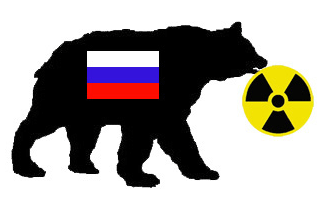 Russians target Britain in nuclear power deal:This is Money, 16 June 13, Builder of reactor at Chernobyl has gained a toehold in UK market Britain has signed a deal with Moscow that could pave the way for Russia’s state-owned nuclear power company Rosatom to build plants in Britain.
Energy Secretary Ed Davey has made an agreement with the deputy primeminister of Russia, Arkady Dvorkovich, to set up a joint working group between Rosatom and the UK on the future of nuclear power.
Rosatom has claimed that the deal could lead to the fulfilment of its longstanding ambition to build nuclear plants in this country.
The agreement, signed last week, comes while Britain is locked in fraught negotiations with French electricity group EDF over the terms to build a new nuclear power station at Hinkley Point in Somerset.
MPs have already warned that the Government is being held to ransom by EDF because it is the only group bidding for the contract.
Sergey Ruchkin, Rosatom’s new representative in the UK, said Rosatom was following the EDF deal closely. ‘We will learn lessons from EDF in this area,’ he said.
‘On the working level, we have been in contact with our colleagues from the UK’s Department of Energy and Climate Change and there is the potential at some time in the future, if the decision has been made,
to enter the British nuclear new-build market.’
Rosatom is essentially the same group that build the reactors at Chernobyl, one of which exploded in 1986. That blast was the worst nuclear power plant disaster in history. It released 400 times more radioactive material into the atmosphere thanthe atomic bomb dropped on Hiroshima during the Second World War….
http://www.thisismoney.co.uk/money/news/article-2342208/Russians-target-Britain-nuclear-power-deal-Builder-reactor-Chernobyl-gained-toehold-UK-market.html#ixzz2WVxeNBXC
Western powers want to sell nukes to India, never mind about the Nuclear Non-Proliferation Treaty (NPT)……
 Western powers have taken a keen interest in the nuclear emergence of India …… making it an attractive
prospect for technology exporters.
If India joined the NSG, it would be the only member of the suppliers group that has not signed up to the 1970 nuclear non-proliferation treaty (NPT)
BRITAIN LOBBIES FOR NUCLEAR EXPORT GROUP TO ADMIT INDIA Yahoo 7 News, Reuters June 15, 2013 By Fredrik Dahl VIENNA – Britain has stepped up efforts to let India join an influential global body controlling nuclear exports, a move that would boost New Delhi’s standing as an atomic power but which has faced resistance from China and other countries. Continue reading
Negotiations going on between the two Koreas
 Koreas meet in border village after tensions marked by nuclear threats Sam Kim,CTV News The Associated Press , June 9, 2013 SEOUL, South Korea — Government delegates from North and South Korea began preparatory talks Sunday at a “truce village” on their heavily armed border aimed at setting ground rules for a higher-level discussion on easing animosity and restoring stalled rapprochement projects.
The meeting at Panmunjom, where the truce ending the 1950-53 Korean War was signed, is the first of its kind on the Korean Peninsula in more than two years. Success will be judged on whether the delegates can pave the way for a summit between the ministers of each country’s department for cross-border affairs, which South Korea has proposed for Wednesday in Seoul. Such ministerial talks haven’t happened since 2007.
The intense media interest in what’s essentially a meeting of bureaucrats to iron out technical details is an indication of how bad ties between the Koreas have been……. If the Koreas can arrive at an agreement for ministerial talks, that meeting will likely focus on reopening the factory park in the North Korean border town of Kaesong that was the last remaining symbol of inter-Korean co-operation, and on other scrapped rapprochement projects and reunions of families separated by the Korean War…..
The talks between the Koreas on Sunday could represent a change in North Korea’s approach, analysts said, or could simply be an effort to ease international demands that it end its development of nuclear weapons, a topic crucial to Washington but initially not a part of the envisioned inter-Korean meetings.
Pyongyang, which is estimated to have a handful of crude nuclear devices, has committed a drumbeat of acts that Washington, Seoul and others deem provocative since Kim Jong Un took over in December 2011 after the death of his father, Kim Jong Il. http://www.ctvnews.ca/politics/koreas-meet-in-border-village-after-tensions-marked-by-nuclear-threats-1.1316934#ixzz2Vqp2UIeV
USA – South Korea nuclear deal and the dangers of an Asian nuclear arms race
Obama’s Nuclear Vietnam National Review Online By Henry Sokolski June 4, 2013 “………..South Korea. The Obama administration has asked Congress to act in the next few weeks on a two-year extension of the existing U.S. nuclear-cooperative agreement with Seoul. The existing deal was supposed to be renegotiated so it could be extended for another 30-year period. Seoul, however, wanted Washington to allow it to make nuclear fuel from U.S. nuclear materials. This caused U.S. negotiators to balk. Publicly, U.S. officials worried that giving South Korea the go-ahead to enrich uranium and reprocess plutonium would sink any prospect of getting North Korea to back off from doing so.
An additional concern, though, was more immediate and credible: Saying yes might lock down Japanese plans to finally open a large, uneconomical fuel-making plant capable of producing 1,000 to 2,000 nuclear bombs’ worth of “civilian” plutonium a year. If Japan should decide to open this plant, located in Rokkasho, it might easily give Beijing yet another reason to turn its own military preparations up an additional notch. It was for these reasons that U.S. negotiators asked South Korea to agree to a short, two-year extension to allow further negotiations to sort these matters out.
Reflecting these worries, congressional staffers from both parties added modest language to the administration’s draft U.S.–South Korea two-year nuclear-agreement-extension bill. The staffers’ amended language clarified the desirability of keeping nuclear-fuel-making at bay on the Korean peninsula and in Asia more generally. Administration officials, however, have privately made it clear that they want this language taken out.
This raises even more questions. Is the administration going to hold the line on Korean fuel-making? If so, how can it do this without doing the same with Vietnam? Or is the plan to cave in both cases? If so, how do we intend to deal with the nuclear-fuel-making aspirations of Japan, Saudi Arabia, South Africa, Jordan, Egypt, and Turkey?
One diplomatic answer is that we will handle these matters country by country (i.e., case by case). If Congress settles for this, though, it will have forgotten what it was trying to make the White House understand when it first complained about Secretary Clinton’s cutting a loose nuclear deal with Vietnam: That a “case by case” policy is no policy at all.http://www.nationalreview.com/article/350043/obamas-nuclear-vietnam-henry-sokolski
Iran is not an irrational actor: rational reasons for it to go nuclear
Think Again: A Nuclear Iran Why it won’t be the end of the world if the mullahs get the bomb. Foreign Policy BY ALIREZA NADER | MAY 28, 2013“Iran is an irrational actor” Wrong. It’s as clear as day that the Islamic Republic pursues goals in the Middle East that put it on a collision course with the United States. Iran is opposed to Israel as a Jewish state, for instance, and competes for regional influence with the conservative Gulf Arab monarchies. But that doesn’t mean it is irrational: On the contrary, its top leadership, including Supreme Leader Ayatollah Ali Khamenei, is deliberative and calculating. President Mahmoud Ahmadinejad’s antics and often wild rhetoric shouldn’t obscure the fact that the Islamic Republic is interested in its own survival above all else. When contemplating the prospect of a nuclear-armed Iran, we should all be grateful that notions of martyrdom and apocalyptic beliefs don’t have a significant pull on Iranian decision-making.
Iran’s possible pursuit of nuclear weapons capability is motivated by deterrence, not some messianic effort to bring about the end times Continue reading
Exploitation in Malawi: Paladin’s Kayelekera Uranium Project
THE CASE OF PALADIN’S KAYELEKERA URANIUM MINE: REPORT RELEASED ON THE REVENUE COSTS AND BENEFITS TO MALAWI, Mining in Malawi, 23 May 13 The Australian mining company Paladin Energy and its subsidiaries along with the Malawi-based Kayelekera Uranium Project, in which it has an 85% stake, were the subject of much discussion this evening in Lilongwe at the launch of the report The Revenue Costs and Benefits of Foreign Direct Investment in the Extractive Industry in Malawi: The Case of Kayelekera Uranium Mine. The report explores what it describes as Malawi’s largest Foreign Direct Investment* and the extent to which Malawi is benefiting. It concludes that ”Malawi is getting a raw deal from the mining and exploitation of uranium by Kayelekera Mine”…….
At the launch of the report, Dalitso Kubalasa and Collins Magalasi, the executive directors of MEJN and AFRODAD respectively, spoke briefly before AFRODAD’s Tafadzwa Chikumbu presented the research findings. This paved the way for a lively question and answer session with questions raised about whether or not parliament is ready to renegotiate the terms of the agreement with Paladin, what has happened to the man who lost his sight due to “kayelekera radiation” and if mining revenue in Malawi therefore “dirty money”.
This discussion was followed by the official launch of the report by the Second Deputy Speaker of Parliament Juliana Mphande who exclaimed that she was “appalled to note that incentives offered to Paladin have severe implication to Government revenue and require attention of parliament”. She outlined the areas requiring parliamentary investigation and debate…..
Below is a summary of the main findings: Continue reading
1 This Month





PLEASE OPPOSE HR 8255 AND S.3639 – bills would accelerate satellite deployment, with no environmental review or safeguards – https://ncstd5li.quorum.us/campaign/169331/
To see nuclear-related stories in greater depth and intensity – go to https://nuclearinformation.wordpress.com
-
Archives
- September 2026 (339)
- August 2026 (330)
- July 2026 (355)
- June 2026 (287)
- May 2026 (306)
- April 2026 (356)
- March 2026 (251)
- February 2026 (267)
- January 2026 (308)
- December 2025 (358)
- November 2025 (359)
- October 2025 (375)
-
Categories
- 1
- 1 NUCLEAR ISSUES
- business and costs
- climate change
- culture and arts
- ENERGY
- environment
- health
- history
- indigenous issues
- Legal
- marketing of nuclear
- media
- opposition to nuclear
- PERSONAL STORIES
- politics
- politics international
- Religion and ethics
- safety
- secrets,lies and civil liberties
- spinbuster
- technology
- Uranium
- wastes
- weapons and war
- Women
- 2 WORLD
- ACTION
- AFRICA
- Atrocities
- AUSTRALIA
- Christina's notes
- Christina's themes
- culture and arts
- Events
- Fuk 2022
- Fuk 2023
- Fukushima 2017
- Fukushima 2018
- fukushima 2019
- Fukushima 2020
- Fukushima 2021
- general
- global warming
- Humour (God we need it)
- Nuclear
- RARE EARTHS
- Reference
- resources – print
- Resources -audiovicual
- Weekly Newsletter
- World
- World Nuclear
- YouTube
-
RSS
Entries RSS
Comments RSS

