Nuclear armed Iran would not be a threat of aggression
 Nuclear Iran Unlikely to Tilt Regional Power Balance – Report By Jim Lobe and Joe HitchonReprint WASHINGTON, May 18 2013 (IPS) – A nuclear-armed Iran would not pose a fundamental threat to the United States and its regional allies like Israel and the Gulf Arab monarchies, according to a new report released here Friday by the Rand Corporation.
Entitled “Iran After the Bomb: How Would a Nuclear-Armed Tehran Behave?“, the report asserts that the acquisition by Tehran of nuclear weapons would above all be intended to deter an attack by hostile powers, presumably including Israel and the United States, rather than for aggressive purposes……..
The report reaches several conclusions all of which generally portray Iran as a rational actor in its international relations.
While Nader calls it a “revisionist state” that tries to undermine what it sees as a U.S.-dominated order in the Middle East, his report stresses that “it does not have territorial ambitions and does not seek to invade, conquer, or occupy other nations.”
Further, the report identifies the Islamic Republic’s military doctrine as defensive in nature. This posture is presumably a result of the volatile and unstable region in which it exists and is exacerbated by its status as a Shi’a and Persian-majority nation in a Sunni and Arab-majority region……. the report concludes that Tehran is unlikely to extend its nuclear deterrent to its allies, including Hezbollah, noting that the interests of those groups do not always – or even often – co-incide with Iran’s. Iran would also be highly unlikely to transfer nuclear weapons to them in any event, according to the report.
*Jim Lobe’s blog on U.S. foreign policy can be read at http://www.lobelog.com. http://www.ip
Iran finds the Wests nuclear proposals lacking in balance
Iran’s chief nuclear negotiator: we’re being asked to make all the sacrifices Saeed Jalili, Iran’s top nuclear negotiator and a contender in the June presidential election, sat down with the Monitor to share his views about an ‘unbalanced’ nuclear offer made by world powers. Christina SCience Monitor, By Scott Peterson, Staff writer / May 16, 2013 ISTANBUL
Saeed Jalili, Iran’s chief nuclear negotiator and a presidential candidate, says that offers from six world powers demand far more short-term sacrifices of his government than the Islamic Republic considers reasonable or reciprocal. The current offer from the so-called P5+1 group (theUS, Russia, China, Britain, France, and Germany) requires Iran to suspend all 20 percent uranium enrichment, disable an impregnable underground enrichment facility at Fordow, and agree to more intrusive inspections, before modest relief from sanctions that have crippled its economy.
“Their proposals are unbalanced,” Mr. Jalili told The Christian Science Monitor in an Istanbul interview today, a day after his inconclusive meeting withCatherine Ashton, the EU foreign policy chief who leads negotiations for the P5+1. “The other party needs to appreciate that they need to table proposals that have the necessary balance,” says Jalili. “If they accept to do so, then we can engage in talks that will hopefully bring about that required balance.”…… http://www.csmonitor.com/World/Middle-East/2013/0516/Iran-s-chief-nuclear-negotiator-we-re-being-asked-to-make-all-the-sacrifices
USA’s dependence on foreign uranium
Not Just Oil: The US is also Dependent on Foreign Uranium Oil Price.com, By MINING.com | , 14 May 2013 What most Americans don’t realize is that dependence on foreign oil isn’t the main obstacle to US energy autonomy. If you think America’s energy supply issues begin and end with the Middle East, think again. One of the most critical sources of foreign energy is due to dry up this year, and the results could mean spiking electricity prices across the country.
In 2011, the US used 4,128 billion kilowatt hours (kWh) of electricity. Nuclear power provided 790.2 billion kWh, or 19% of the total electrical output in the US. Few people know that one in five US households is powered by nuclear energy, and that the price of that nuclear power has been artificially stabilized. Unfortunately for us, the vast majority of the fuel used for powering our homes must be imported……
If this information is news to you, you are not alone. While the mainstream media focus on the US’s “Middle Eastern energy dependence,” the real story remains unnoticed. That’s why Casey Research invited the field’s top experts – including former US Secretary of Energy Spencer Abraham and Chairman Emeritus of the UK Atomic Energy Authority Lady Barbara Judge – for a frank discussion of what we think is America’s greatest energy challenge.
By. Casey Research via Mining.com http://oilprice.com/Alternative-Energy/Nuclear-Power/Not-Just-Oil-The-US-is-also-Dependent-on-Foreign-Uranium.html
Japan refuses to sign international statement against use of nuclear weapons

 Preventing use of nuclear weapons, Japan Times Editorial 10 May 13 Japan recently refused to support an international joint statement which stressed that “It is in the interest of the very survival of humanity that nuclear weapons are never used again, under any circumstances.”
The Japanese government’s failure to sign the statement is regrettable in view of the simple fact that Japan became the first nation in history to suffer from the use of nuclear weapons through the U.S. atomic bombings of Hiroshima and Nagasaki in August 1945. In addition, a nuclear catastrophe happened at Tokyo Electric Power Co.’s Fukushima No. 1 nuclear power plant, causing great hardship to residents of Fukushima Prefecture.
Some 150,000 people from the prefecture are still forced to live away from their homes because the homes are located in areas contaminated by radioactive substances from the plant.
The Japanese are among the few on Earth who have experienced the dread of exposure to radiation whether it is from a nuclear weapon or from a nuclear power plant accident. Many Japanese citizens will not accept the government’s decision not to sign the statement, which was supported on April 24 by 74 countries at the second session of the Preparatory Committee for the 2015 Review Conference of the Parties to the Treaty on the Non-Proliferation of Nuclear Weapons in Geneva.
The joint statement said in part, “It is a shared responsibility of all States to prevent the use of nuclear weapons.” It also said, “The only way to guarantee that nuclear weapons will never be used again is through their total elimination.” It would not be far-fetched to say that by not supporting it, Japan has negated its own hard experience it could use to accelerate moves toward the elimination of nuclear weapons…… http://www.japantimes.co.jp/opinion/2013/05/11/editorials/preventing-use-of-nuclear-weapons/#.UY68JqJwpLs
Egypt’s anger at lack of progress on nuclear free Middle East
Egypt Walks Out Of Nuclear Talks In Geneva, Huffington Post, By JOHN HEILPRIN 04/29/13 GENEVA — Egypt walked out of a round of global
nuclear talks in protest Monday, saying other nations are not acting quickly
enough to establish the Middle East as a zone free of nuclear weapons.
A statement from Egypt’s foreign ministry said the nation ended its
participation in two weeks of Geneva talks out of frustration that the zone
has yet to be created. The talks run through this week.
“We can’t wait forever for the implementation of this decision,” said the
ministry’s statement Monday night, explaining that Egypt’s walkout was meant
to send a message to the world that it can no longer accept what it
considers to be a lack of seriousness on the issue….. At the 1995 review,
nations adopted the goal of a nuclear-free Middle East, in a concession by
the U.S. and others to the Arabs, who wanted Israel to join the treaty and
to give up its unacknowledged arsenal of nuclear weapons. In exchange, the
Arabs backed the treaty’s permanent extension.
But after 15 years of inaction on a nuclear-free zone, Egypt proposed that
the 2010 conference endorse launching negotiations to establish one. With no
talks started, Egypt said Monday that some other members of the treaty – and
non-members – are “obstructing” the goal. Though it did not specify, the
reference to non-members was seen as implying Israel.
Ahead of the Geneva talks to prevent the spread of nuclear arms, the U.N.
Security Council’s five major powers – Britain, China, France, Russia and
the United States – had again called for progress in establishing a
nuclear-free Middle East.
http://www.huffingtonpost.com/2013/04/29/egypt-nuclear-talks_n_3181087.html
Questioning the wisdom of Netanyahu’s nuclear brinkmanship
 Analysis – Israeli credibility on line over Iran nuclear challenge, The West, By Crispian Balmer and Dan Williams, 29 April 13 JERUSALEM (Reuters) – Israel risks a loss of credibility over both its “red line” for Iran’s nuclear programme and its threat of military action, and its room for unilateral manoeuvre is shrinking.
After years of veiled warnings that Israel might strike the Islamic Republic, Prime Minister Benjamin Netanyahu laid out an ultimatum at the United Nations last September.
Iran, he said, must not amass enough uranium at 20 percent fissile purity to fuel one bomb if enriched further. To ram the point home, he drew a red line across a cartoon bomb, guaranteeing him front page headlines around the world.
However, a respected Israeli ex-spymaster says Iran has skilfully circumvented the challenge. Other influential voices say the time has passed when Israel can hit out at Iran alone, leaving it dependent on U.S. decision-makers……
some officials have also questioned the wisdom of Netanyahu’s red line, arguing that such brinkmanship can generate unwelcome ambiguity -….. Tehran denies there is any military component to its nuclear activities, saying it is focused only on civilian energy needs. It charges that Israel, widely believed to have the Middle East’s only nuclear arsenal, is the greater regional threat.
Keeping in step with Netanyahu, Israeli defence and military officials issued clear warnings this month that Israel was still prepared to go it alone against Iran, once more beating the drums of war after months of relative quiet……
But there is increasing scepticism within diplomatic circles about the viability of such an option. Envoys doubt that the Israeli military could now make much of a dent on Iran’s far-flung, well-fortified nuclear installations……. http://au.news.yahoo.com/thewest/a/-/world/16914529/analysis-israeli-credibility-on-line-over-iran-nuclear-challenge/
Problems with USA – South Korea nuclear partnership
Washington, Seoul Seek To Extend Nuclear Partnership, VOA Scott Stearns April 26th, 2013 The United States and South Korea are major partners when it comes to the manufacture and sale of civilian nuclear power equipment. But that partnership, and maybe much more, could come under pressure if the two can’t come up with a broader agreement on licensing nuclear technology.
A big part of the problem, not surprisingly, is North Korea and its already advanced nuclear weapons program…….. http://blogs.voanews.com/state-department-news/2013/04/26/washington-seoul-seek-to-extend-nuclear-partnership/
No agreement between USA and South Korea on enriching uranium
South Korea and U.S. Fail to Reach Deal on Nuclear Energy, NYT, By CHOE SANG-HUN, April 24, 2013 SEOUL, South Korea — South Korea and the Obama administration delayed the deadline for a deal that Seoul had hoped would allow it to begin making its own fuel for its civil nuclear energy program, but that the United States feared would undermine its attempts to curb nuclear proliferation. It had appeared that a deal might be reached this year, but officials in both countries said the deadline would slip until 2016.
The government of President Park Geun-hye has been pushing hard for the United States to lift a ban, part of a treaty signed in 1972, that prevents South Korea from enriching uranium and reprocessing spent nuclear fuel.
But the same technologies are also used to make material for nuclear weapons. American officials have said that lifting the ban would have complicated diplomatic efforts to persuade North Korea to give up its nuclear programs and to stop any attempt by Iran to develop atomic weapons….. http://www.nytimes.com/2013/04/25/world/asia/south-korea-and-us-fail-to-reach-nuclear-energy-deal.html
Australian uranium company Paladin will now have to give Malawi a fair deal
Malawi to renogotiate with Paladin on the Kayerekera uranium deal http://www.malawitoday.com/news/128733-malawi-renogotiate-paladin-kayerekera-uranium-deal 14 April 2013 ZODIAK RADIO Malawi has finally succumbed to pressure from activists to start re-negotiating with Paladin Africa Limited on the Kayerekera Uranium deal in a last ditch attempt to create a win-win situation.
First on the proposal is to remove the confidentiality clause on the agreement such that it be made public before rectifying other strings within the deal.
Minister of Mines Mr John Bande confirmed that discussions are underway with Paladin Africa Limited on the matter.
“We are working out on modalities to discuss in public the agreement between Kayerekera and the Malawi Government,” said Bande.
Bande blamed the previous regime for putting a confidentiality clause on the license. “Now government is working to remove that clause so that the deal can be discussed in public,” said Bande.
Critics have continuously called on government to re-negotiate the license, saying Malawi is getting a raw deal from it.
Issued in 2009 the Kayerekera uranium mine license is for a period of 15 years and is subject to renewal.
The license among others also allowed the miner to open an off-shore account.
According to the deal, Malawi was meant to be collecting a meager US$ 100 million in taxes annually from the deal.
USA and Europe not too worried over North Korea’s nuclear threats
Allies dismiss North Korea’s nuclear war threats Radio Australia, 10 April 2013, By Brendan Trembath, The White House and the European Union dismiss North Korea’s claim war is imminent and call on the rogue state to act sensibly.Both the White House and the European Union have described North Korea’s warnings of “thermo-nuclear war” on the Korean peninsula as “unhelpful rhetoric”.
North Korea has told foreign companies, organisations and tourists in South Korea to consider leaving for their own safety.
Warning that events were “inching closer to thermo-nuclear war”, the North’s official news agency said it did not want foreigners to come to harm if war breaks out.
White House spokesman Jay Carney labelled that statement unhelpful, and said it would only serve to “further isolate North Korea”.
European Union delegates meeting in Brussels have drawn up a response to the North Korean warnings, saying it is wrong to proclaim that war is imminent and Pyongyang should heed international demands regarding its nuclear and ballistic missile programs.
The EU’s note, agreed by the bloc’s 27 member governments on Tuesday, is a response to a warning by North Korea last week that it could not guarantee the safety of diplomats in the country after April 10. An EU diplomat said the note underlined the need for North Korea to act sensibly and rejected “its analysis that full-scale war is imminent”. ….
Japan readies missiles Meanwhile, Japan says it has deployed missile interceptors to the centre of Tokyo and will use them to shoot down any missile heading towards its airspace…..http://www.radioaustralia.net.au/international/2013-04-10/allies-dismiss-north-koreas-nuclear-war-threats/1113858
The North Korean situation – a dangerous game for the West
Kim is simply too new and untested for us to know if he has the self-awareness to avoid inadvertently killing himself. But squeezing him into submission without the costs and casualties of a war will require China’s help
From China’s perspective, even if Kim is losing control of the situation, he has not lost it yet, and so China considers anything short of that to be alarmist. As long as North Korea is not threatening Beijing, this is a prisoners’ dilemma we will be facing on our own
 NORTH KOREA’S NUCLEAR GAME THEORY, New Yorker BY EVAN OSNO, 5 April 13, Foreign diplomats in Pyongyang are facing an absurd choice: Kim Jong-un’s government issued a formal diplomatic warning today that it would be “unable to guarantee the safety of embassies and international organizations in the country in the event of conflict from April 10.”
A few questions come to mind, including but not limited to: Any plans for April 11th that we might want to jot down? And: Is this warning an actual expression of concern, or a way of letting foreign embassies take on the role of ramping up Kim’s threats now that his own propaganda machine is getting diminishing returns? And lastly, and most fundamentally: How realistic is it to imagine a cascade of blunders that lead to a nuclear strike? Continue reading
North Korea: international relations on the brink
The situation is ripe for miscalculation. The new South Korean president, Park Geun-hye, whose mother was killed by a North Korean agent, has made it clear she will not roll over like other South Korean leaders. Moreover, there is a new U.S.-South Korean agreement that could result in the United States more forcefully backing the South militarily short of all-out war. Another North Korean attack could result in the U.S. forces joining South Korea in some form of military retaliation.
Either way, we should not think this is a case of parties on the peninsula crying wolf. North Korea has shown time and time again it will strike with violence. It may well be on the verge of doing so again.
 HOLMES: Decoding North Korea’s nuclear rhetoric Pyongyang’s saber-rattling often precedes attack By Kim R. Holmes The Washington Times. April 3, 2013 North Koreans are famous for belligerent rhetoric. Most recently, they’ve threatened to turn Seoul into a “sea of fire.” The North’s new leader, Kim Jong-un, comes across as a madman strutting around in a 1950s cartoon. Such flamboyance can tempt people to dismiss the North Koreans as either a joke or too crazy to be taken seriously. This is a mistake. They are not crazy, but wily operators who know how to play brinkmanship to their advantage. Continue reading
Mass rally in North Korea against USA
N Korea stages mass rally, vows to hit US http://www.abc.net.au/news/2013-03-29/n-korea-stages-mass-rally2c-vows-to-hit-us/4601790 includes videos Tens of thousands of North Korean soldiers and civilians have held a huge rally and march in Pyongyang, as the hermit nation ratchets up talk of striking the United States.
The rally on Friday in the capital’s giant Kim Il-Sung square was attended by soldiers, veterans, workers and students, all wearing military uniforms.
The North’s young leader, Kim Jong-Un, was not present.
State television said the rally took place to support a decision issued by the Korean People’s Army (KPA) supreme command on Tuesday – and ratified by Kim Jong-Un on Friday – to order missile units to prepare to strike the US mainland and military bases.
The North has no proven ability to strike the US mainland, but Kim Jong-Un has vowed to “settle accounts” after nuclear-capable US stealth B-2 bombers flew over South Korea for a drill on Thursday.
In the event of any “reckless” US provocation, North Korean forces should “mercilessly strike the US mainland … military bases in the Pacific, including Hawaii and Guam, and those in South Korea”, Kim Jong-Un was quoted as saying by the official Korean Central News Agency (KCNA). Continue reading
Influence of USA on Taiwan govt’s nuclear power policy
 NSC denies US role in nuclear energy policy, Taipei Times By Mo Yan-chih 27 Mar 13
The National Security Council (NSC) yesterday denied that it had discussed the recent dispute over the construction of the Fourth Nuclear Power Plant in New Taipei City’s (新北市) Gongliao District (貢寮) with the US, saying that nuclear power issues would not affect US-Taiwan relations.
“The government never discussed nuclear power plant issues with the US and did not receive any response from the US on the matter,” it said in a press release.
Amid mounting opposition to the power plant’s completion, the Chinese-language China Times yesterday said that while Taiwan imports most of its uranium from Australia, the uranium is sent to the US to be refined into fuel for the generation of nuclear power. The Taiwanese government pays billions to the US government every year for uranium refinement and for consultations about the power plant.
Citing anonymous sources from the council, the report said that the fuel refinement business with the US plays a role in the Taiwanese government’s nuclear power policy, such as its insistence on only gradually reducing the use of nuclear energy, or aversion to abruptly suspending construction of the Fourth Nuclear Power Plant, because a policy change could jeopardize bilateral relations…….http://www.taipeitimes.com/News/taiwan/archives/2013/03/28/2003558195
USA, UK, France will not admit the growing radioactive pollution of Iraq, due to depleted uranium weapons
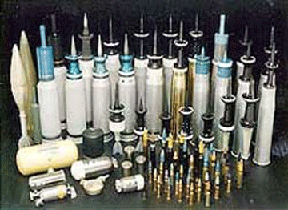 The health effects are disputed by the US and UK governments, who joined with France and Israel to vote against a resolution calling for “a precautionary approach” to the use of DU weapons at the United Nations general assembly in December; 155 countries voted in favour of the resolution.
Iraq’s depleted uranium clean-up to cost $30m as contamination spreads Rob Edwards guardian.co.uk, 6 March 2013 Report says toxic waste is being spread by scrap metal dealers, and describes its ‘alarming’ use in civilian areas during Iraq wars Cleaning up more than 300 sites in Iraq still contaminated by depleted uranium (DU) weapons will cost at least $30m, according to a report by a Dutch peace group to be published on Thursday.
The report, which was funded by the Norwegian Ministry of Foreign Affairs, warns that the contamination is being spread by poorly regulated scrap metal dealers, including children. It also documents evidence that DU munitions were fired at light vehicles, buildings and other civilian infrastructure including the Iraqi Ministry of Planning in Baghdad – casting doubt on official assurances that only armoured vehicles were targeted. “The use of DU in populated areas is alarming,” it says, adding that many more contaminated sites are likely to be discovered.
More than 400 tonnes of DU ammunition are estimated to have been fired by jets and tanks in the two Iraq wars in 1991 and 2003, the vast majority by US forces. The UK government says that British forces fired less than three tonnes.
DU is a chemically toxic and radioactive heavy metal produced as wasteby the nuclear power industry. It is used in weapons because it is an extremely hard material capable of piercing armour. Continue reading
1 This Month





PLEASE OPPOSE HR 8255 AND S.3639 – bills would accelerate satellite deployment, with no environmental review or safeguards – https://ncstd5li.quorum.us/campaign/169331/
To see nuclear-related stories in greater depth and intensity – go to https://nuclearinformation.wordpress.com
-
Archives
- September 2026 (339)
- August 2026 (330)
- July 2026 (355)
- June 2026 (287)
- May 2026 (306)
- April 2026 (356)
- March 2026 (251)
- February 2026 (267)
- January 2026 (308)
- December 2025 (358)
- November 2025 (359)
- October 2025 (375)
-
Categories
- 1
- 1 NUCLEAR ISSUES
- business and costs
- climate change
- culture and arts
- ENERGY
- environment
- health
- history
- indigenous issues
- Legal
- marketing of nuclear
- media
- opposition to nuclear
- PERSONAL STORIES
- politics
- politics international
- Religion and ethics
- safety
- secrets,lies and civil liberties
- spinbuster
- technology
- Uranium
- wastes
- weapons and war
- Women
- 2 WORLD
- ACTION
- AFRICA
- Atrocities
- AUSTRALIA
- Christina's notes
- Christina's themes
- culture and arts
- Events
- Fuk 2022
- Fuk 2023
- Fukushima 2017
- Fukushima 2018
- fukushima 2019
- Fukushima 2020
- Fukushima 2021
- general
- global warming
- Humour (God we need it)
- Nuclear
- RARE EARTHS
- Reference
- resources – print
- Resources -audiovicual
- Weekly Newsletter
- World
- World Nuclear
- YouTube
-
RSS
Entries RSS
Comments RSS

