the Trump administration is definitely conscious that they have the power to reshape the political culture of the organization if they find someone who aligns with their views”.
UNITED NATIONS, Feb 17 2026 (IPS) – As the campaign for the next Secretary-General gathers momentum – at a relatively slow pace – there is widespread speculation that any candidate running for the post of UN chief will have to abide by the dictates of a politically hostile White House or face a veto in the Security Council.
So far, there are only two declared candidates: former Chilean President Michelle Bachelet and former Director-General of the International Atomic Energy Agency (IAEA) Rafael Grossi from Argentina—with more candidates expected to join the race.
The winning candidate, who will take office in January 2027, will be elected by the 15-member Security Council and subsequently ratified by the 193-member General Assembly (UNGA).
Annalena Baerbock, the president of UNGA, said the selection process is already underway, and the interactive dialogues with candidates have been scheduled for the week of 20 April, where they will present their “vision statements”.
Meanwhile, the US has publicly declared its opposition to some of the basic goals in the UN’s socio-economic agenda, including gender empowerment and policies relating to diversity, equity and inclusion (DEI), while dismissing climate change as “a hoax” and a “giant scam.” The Trump administration has also downplayed human rights and adherence to international laws—two concepts ingrained in the UN system.
In an interview with the New York Times last January, President Trump said he does not “need international law” to guide his actions, arguing that only his own “morality” and “mind” will constrain his global powers.
So, what would be the fate of any candidate— male or female—who advocates these UN goals? Will there be a battle of the vetoes – as it happened in a bygone era?
Richard Gowan, Program Director, Global Issues and Institutions, International Crisis Group (ICG), who oversees ICG’s work on geopolitics, global trends in conflict and multilateralism, told IPS nobody knows how this race will end.
Obviously UN-watchers will be tracking the initial candidates’ vision statements and public appearances over the coming months, he pointed out.
“But diplomats in New York have a suspicion that the veto powers in the Security Council may suddenly announce support for a new candidate at the last minute to circumvent the entire public process. There is a strong sense that the U.S., China and Russia don’t want to be boxed in by the General Assembly.”
There is also a scenario, he said, where the veto powers cannot agree on a candidate, and the Council ends up grinding out discussions of a candidate right through to December.
“UN officials have even done some contingency planning for what happens if there is not an agreed candidate on 1 January 2027. It is possible that the Security Council might ask Guterres to hang on for a few months, although I don’t think either diplomats or Guterres want that outcome.”
There are definitely a few senior UN officials and ambassadors in New York who wonder if the Council could call on them at the very last minute, said Gowan.
Thomas G. Weiss, Presidential Professor Emeritus, Political Science, and Director Emeritus, Ralph Bunche Institute for International Studies at the CUNY Graduate Center, told IPS it is hard to imagine anyone running for UNSG who would not run into a veto from Washington in a candidacy necessarily addressing the values of cooperation (multilateralism of any shape) as well as honestly discussing such issues as climate, gender (male or female), nuclear proliferation, Palestine, and sovereignty—all “hoaxes” or “con jobs” according to DJT (President Trump) and his junta.
Both the 1996 and 1981 elections, he said, provide “models.”
“The Chinese vetoes probably are the most relevant precedent for Washington going to the mat indefinitely until an “acceptable” candidate emerges. Let’s hope that person is as competent as the compromise of 1996, Kofi Annan”, he declared.
In 1981, Salim Ahmed Salim of Tanzania, was backed by the Organization of African Unity, the Non-Aligned Movement and China. But his bid was blocked by a US veto.
In 1996, a second five-year term for Boutros Boutros-Ghali of Egypt was vetoed by the US – even though he received the support of 14 of 15 members in the Security Council.
In 1981, China cast a record 16 vetoes against Kurt Waldheim to prevent a third term, leading to his withdrawal and the selection of Javier Pérez de Cuéllar.
Meanwhile, there has been an intense campaign for a female UN chief, the first in the 81-year history of the UN. But the US has remained tight-lipped on the widely supported proposal.
The last 9 secretaries-general, all males, include:
António Guterres (Portugal), who took office in January 2017; Ban Ki-moon (Republic of Korea), from January 2007 to December 2016; Kofi A. Annan (Ghana), January 1997 to December 2006; Boutros Boutros-Ghali (Egypt), January 1992 to December 1996; Javier Pérez de Cuéllar (Peru), January 1982 to December 1991; Kurt Waldheim (Austria), January 1972 to December 1981; U Thant (Burma, now Myanmar), who served from November 1961, when he was appointed acting Secretary-General (he was formally appointed Secretary-General in November 1962), to December 1971; Dag Hammarskjöld (Sweden), from April 1953 until his death in a plane crash in Africa in September 1961; and Trygve Lie (Norway), who held office from February 1946 to his resignation in November 1952.
As for the U.S., said Gowan, “I don’t believe that Washington has settled on a candidate yet. But the Trump administration is definitely conscious that they have the power to reshape the political culture of the organization if they find someone who aligns with their views”.
A lot of UN members assume that the U.S. won’t accept a female Secretary-General but I think that Washington could back a woman if she was a strong social conservative and willing to make large cuts to the UN system, he argued.
Right now, there is not an obvious female candidate meeting those criteria, though. I think some candidates who could never align with the U.S. on things like development and diversity are already stepping out of the race.”
Meanwhile, there is a reason that Mia Mottley has gone from being the putative front runner to refocusing on domestic politics.
“I also think that all candidates recognize that they are going to have to talk a lot more about how they will advance the UN’s work on peace and security, which is a priority not only for the U.S. but a lot of member states.”
“That said, one senior UN diplomat recently told me that they cannot see Global South countries accepting another Western candidate after Guterres, regardless of gender. The non-Western members of the Security Council could create a blocking minority in the Security Council to keep candidates from U.S. allies out,” declared Gowan.
He said U.S. diplomats have told other veto powers that they will hold back on various reform proposals and cuts until they have their own candidate as Secretary-General.
A lot of UN members assume that the U.S. won’t accept a female Secretary-General but I think that Washington could back a woman if she was a strong social conservative and willing to make large cuts to the UN system, he argued.
Rubio’s speech isn’t just another round of transatlantic posturing. It marks a moment when a top U.S. official openly reframes five centuries of Western expansion — conquest, colonization, and domination — as a civilizational triumph that must be revived.
According to journalist Ben Norton, Rubio’s remarks went beyond simple rhetoric — openly lamenting the end of Western imperial expansion and portraying decolonization movements as destructive forces driven by “godless communist revolutions.”
In a striking address at the Munich Security Conference, U.S. Secretary of State Marco Rubio framed Western history not as a legacy of colonial domination, but as a “great civilization” whose decline must be reversed.
Rubio stated:
“For five centuries before the end of the Second World War, the West had been expanding… its missionaries, its pilgrims, its soldiers, its explorers… building vast empires extending out across the globe. But in 1945… it was contracting.”
He described anti-colonial uprisings as accelerating Western decline and rejected what he called “managed decline,” urging Europe and the United States to renew “the greatest civilization in human history.”
As reported in the Guardian this is something along the lines of “Empire is great. Empire is back. Empire is American.” Adding “The US secretary of state delivered what can only be described as a 22-minute ode to empire. A love letter to conquest and colonialism. A proud defense of the west’s territorial expansion.
Why This Matters
Since the post-World War II wave of decolonization across Africa, Asia, and Latin America, formal empires largely collapsed. Yet Rubio’s framing — praising Western expansion while dismissing colonial crimes as “purported sins” — signals a broader ideological shift.
Norton argues that this speech represents:
A defense of Western imperial legacy
A call for renewed transatlantic unity
A strategic push to restructure global supply chains away from China
An ideological justification for reasserting dominance over the Global South
Context: Competing Global Visions
While Rubio emphasized Western civilizational unity and supply chain control, China’s foreign minister presented an opposing vision centered on multilateralism and sovereign equality at the same conference.
The divide reflects a larger geopolitical struggle between:
A U.S.-led Western alliance seeking strategic dominance
A rising multipolar bloc emphasizing sovereignty and UN-centered governance
For more context on Rubio’s speech and the broader geopolitical stakes, here’s Ben Norton and The Geopolitical Economy Report:
When President Trump unilaterally withdrew the United States from the JCPOA, the US reimposed wide-ranging sanctions in direct contradiction of Resolution 2231 and launched a campaign of economic warfare designed to cripple Iran’s economy that continues to this day.
The US assault on the UN Charter has now escalated once again to the brink of war, with US threats of force and acts of economic warfare proceeding daily.
SCHEERPOST, By Jeffrey Sachs / Common Dreams, February 18, 2026
Distinguished Members of the Security Council,
The President of the United States is issuing grave threats of force against the Islamic Republic of Iran if it does not accede to US demands. His actions risk a major regional war that would be devastating. Asked if he wanted regime change, he responded that it “seems like that would be the best thing that could happen.” When asked why a second US aircraft carrier has been sent to the region, President Trump answered “in case we don’t make a deal, we’ll need it … if we need it, we’ll have it ready.”
These threats are in violation of Article 2(4) of the UN Charter, which declares that “All Members shall refrain in their international relations from the threat or use of force against the territorial integrity or political independence of any state, or in any other manner inconsistent with the Purposes of the United Nations.”
These threats come in the context of Iran’s repeated calls for negotiations. Moreover, on February 7, Iran’s Foreign Minister delivered a speech in Doha proposing comprehensive negotiations for regional peace, following a round of talks in Oman supported by the diplomacy of the Arab states and Türkiye. Even as a second round of negotiations has been announced, the US is resorting to escalating threats of force.
The issue facing the UN Security Council in these perilous days is whether any member state, by force or threat of force, may place itself above the United Nations Charter that governs us all. At stake is the integrity of the UN-based international system.
One of the crucial roles of the Security Council is to call on member states to settle disputes by peaceful means such as negotiation, mediation, arbitration, or judicial settlement, without the threat of force or resort to force. Today, the world is in urgent need of a renewed commitment to diplomacy.
The current threat of an attack by the US did not begin with any failure by Iran to negotiate. On the contrary, it began with the United States’ repudiation of negotiations that had already succeeded.
On July 14, 2015, after years of extensive diplomacy, Iran and the P5 countries plus Germany concluded the Joint Comprehensive Plan of Action (JCPOA) to ensure that Iran’s nuclear program would remain exclusively peaceful. In return, economic sanctions on Iran were to be lifted. The JCPOA placed Iran’s nuclear activities under strict and continuous scrutiny by the International Atomic Energy Agency and thereby ended the risk of a nuclear-arms breakout by Iran, a risk that Iran had consistently denied.
On July 20, 2015, the UNSC unanimously adopted Resolution 2231. That resolution “endorses the JCPOA” and calls upon all states to take the steps “necessary to support the implementation.” It terminated previous sanctions resolutions and incorporated the JCPOA into international law. The Security Council explicitly recognized Iran’s “right to develop nuclear energy for peaceful purposes” under the Non-Proliferation Treaty and established a robust verification regime.
Yet on May 8, 2018, three years after the successful UNSC Resolution, the United States unilaterally withdrew from the JCPOA. This withdrawal was actively lobbied for by the Israeli government. Since the late 1990s, Israel’s leadership has repeatedly, falsely, and hypocritically claimed that Iran was on the verge of obtaining a nuclear weapon, even as Israel itself had secretly acquired nuclear weapons outside the Treaty on the Non-Proliferation of Nuclear Weapons and has until today refused to join the treaty and subject itself to its controls.
When President Trump unilaterally withdrew the United States from the JCPOA, the US reimposed wide-ranging sanctions in direct contradiction of Resolution 2231 and launched a campaign of economic warfare designed to cripple Iran’s economy that continues to this day.
The current threats by the US are therefore part of a long-standing pattern of feigning interest in negotiations while in fact pursuing economic warfare and military force. In June 2025, following the renewal of negotiations earlier that year, the United States and Iran entered a sixth round of talks. The US had characterized the negotiations as constructive and positive. The sixth round was set for June 15, 2025. Yet on June 13, 2025, the US supported Israel’s bombing of Iran. A week after that, the US attacked Iran under Operation Midnight Hammer.
President Trump just made one of the most depraved statements about destroying living conditions for a foreign people ever uttered by a US president. “THERE WILL BE NO MORE OIL OR MONEY GOING TO CUBA – ZERO! I strongly suggest they make a deal, BEFORE IT IS TOO LATE.”
Trump doesn’t just talk depravity. He practices depravity. He’s ratcheted up America’s 66 yearlong campaign of economic sanctions and embargo to unprecedented heights. For the 11 million beleaguered Cuban people that means a new low in living standards from Trump’s cruelty.
Trump‘s criminal intervention in Venezuela allows him to cut off Venezuelan oil which suppled one third of Cuba’s oil. Not satisfied with that, Trump is pressuring Mexico to cut off the 44% of Cuban oil it supplies. If successful that would cut Cuba’s oil supplies by 78%. Mexican President Claudia Sheinbaum cancel one oil shipment but says Mexico will still provide Cuba oil based on “humanitarian needs.” Tho reducing oil shipments, Mexico is sending two ships containing 800 tons of desperately needed food, water and hygiene products. Hopefully Trump won’t mistake the Mexican ships for drug boats to be obliterated.
The oil shortage has already created a humanitarian crisis as less than half of Havana’s garbage trucks have fuel to cope with mountains of waste. Russia has ordered all its tourists out of Cuba. The collapsing tourist industry is destroying one of Cuba’s last economic lifelines.
But that is not good enough for Trump who’s considering a total blockade on oil imports to collapse the Cuban economy and depose the communist government. Last month Trump signed an executive order imposing tariffs on any country that sends oil to Cuba. Seeking to out-deprave the depraved Trump when it comes to Cuba, U.S. Charge d Affaires in Havana Mike Hammer told his staff “Now there is going to be a real blockade. Nothing is getting in. No more oil is coming.”
Nine years ago my wife and I visited Cuba for 10 days before newly elected Trump began dismantling Obama’s wonderful détente with Cuba. While his détente reestablished diplomatic relations and increased badly needed US tourism, it did not end the embargo which requires Congressional legislation. It was heartbreaking being there to ponder the madness of US policy inflicting such cruelty on such a beautiful country and its people for the past 57 years.
I’d been studying US Cuban relations since January 1, 1959 when news broke on Castro’s successful takedown of the brutal US supported Batista regime. I welcomed the news that 60 years of US exploitation of Cuba following our takeover of Cuba from Spain in 1898 had ended. Sadly, Ike rescinded his initial outreach to Castro within a year over US obsession in destroying any popular left wing government seeking to uplift its people suffering under colonialism.
My visit greatly expanded all I’d been studying about Cuba since 1959. It inspired me to develop a talk entitled ‘US Cuban Relations 1898 to Present: What They Didn’t Teach Us in School’ which I’ve presented many times. I end the talk imploring attendees to stay informed, support end to America’s cruel, heatless embargo, and visit Cuba to see for yourself its beauty and the need to end senseless US cruelty.
Alas, at next presentation I’ll drop the third request they visit Cuba to see for themselves its beauty and its people. The current depraved US administration is making Cuba unlivable for its 11 million citizens and any tourist who dares visit.
US empire managers have been making some surprisingly honest admissions in recent days, with Senator Lindsey Graham saying the wars of the future are being planned in Israel and Secretary of State Marco Rubio calling for a return to old-school western colonialism.
During a Monday press conference in Tel Aviv after a meeting with Benjamin Netanyahu, Graham said that “I’ve been coming here every two weeks whether I need to or not.”
Why is a South Carolina senator traveling to Israel every two weeks, rain or shine? The bloodthirsty warmonger answers this question in short order.
“The wars of the future are being planned here in Israel,” Graham said. “Because if you’re not one step ahead of the enemy, you suffer. The most clever, creative military forces on the planet are here in Israel.”
Graham salivated about the possibility of a US war with Iran, acknowledging that such a war could absolutely result in American troops in the region being struck by Iranian missiles but saying the US should go to war anyway.
“Could our soldiers be hit in the region? Absolutely, they could. Can Iran respond if we have an all-out attack? Absolutely, they can,” Graham said, arguing that “the risk associated with that is far less than the risk associated with blinking and pulling the plug and not helping the people as you promised.”
During a speech at the Munich Security Conference on Saturday, Secretary of State Marco Rubio took the mask all the way off in an unsettling rant about the need to return to the good old days when western powers dominated the global south without pretense or apology.
“For five centuries, before the end of the second world war, the West had been expanding — its missionaries, its pilgrims, its soldiers, its explorers pouring out from its shores to cross oceans, settle new continents, build vast empires extending out across the globe,” Rubio said. “But in 1945, for the first time since the age of Columbus, it was contracting. Europe was in ruins. Half of it lived behind an Iron Curtain and the rest looked like it would soon follow. The great Western empires had entered into terminal decline, accelerated by godless communist revolutions and by anti-colonial uprisings that would transform the world and drape the red hammer and sickle across vast swaths of the map in the years to come.”
Rubio, a notoriously anti-communist gusano, is here admitting that socialism played a leading role in pushing back against the abusive colonialism and empire-building of the western world in recent decades. A normal person would take this as a strong argument in favor of socialism, but Rubio says it like it’s a bad thing.
Rubio urged Europeans to join their white Christian brethren in the United States in re-conquering the brown-skinned communists and heathens who have been insisting upon their own sovereignty and the advancement of their own interests:
“Under President Trump, the United States of America will once again take on the task of renewal and restoration, driven by a vision of a future as proud, as sovereign, and as vital as our civilization’s past. And while we are prepared, if necessary, to do this alone, it is our preference and it is our hope to do this together with you, our friends here in Europe.
“For the United States and Europe, we belong together. America was founded 250 years ago, but the roots began here on this continent long before. The man who settled and built the nation of my birth arrived on our shores carrying the memories and the traditions and the Christian faith of their ancestors as a sacred inheritance, an unbreakable link between the old world and the new.
“We are part of one civilization — Western civilization. We are bound to one another by the deepest bonds that nations could share, forged by centuries of shared history, Christian faith, culture, heritage, language, ancestry, and the sacrifices our forefathers made together for the common civilization to which we have fallen heir.”
It takes a special kind of psychopath to look back with fondness upon five centuries of unchecked western colonialism and imperialism and then advocate a return to those horrific days. Mass genocides across entire continents. The African slave trade. The violent subjugation and enslavement of entire populations. That is what Rubio is looking back on and sighing with nostalgia.
And this is of course to say nothing of the savagery his beloved “Western civilization” is perpetrating in the present day. This is the civilization of the Gaza holocaust. The civilization that cannot exist without constant war, exploitation and extraction. The civilization that is presently strangling Cuba to death and preparing for war with Iran. The civilization that still to this day violently subjugates and robs the global south. The civilization of ecocide. The civilization of Epstein.
Western civilization is the most depraved and abusive civilization that has ever existed. It doesn’t need a return to its prime, it needs to be stopped in its tracks and made healthy. This is obvious from a glance at the deranged empire managers this civilization has been elevating to positions of leadership.
President Trump recapped his sixth meeting this year with his real boss, Israeli Prime Minister Benjamin Netanyahu, by stating it will be “Very traumatic” for Iran if a nuclear deal isn’t reached soon.
With his vast military armada perched on Iran’s doorstep, Trump’s warning is clear. The US is preparing a massive attack to decapitate the Iranian regime and splinter Iran into a failed state. Of course this has nothing to do with US national security interests. It’s about Israel’s decade’s long demand that its US servants remove Israel’s last hegemonic rival for Middle East supremacy.
When asked about a timeline for Iran to capitulate to every US, Israeli demand that would essentially nullify Iranian sovereignty, Trump said “I guess over the next month. They should agree very quickly.” Netanyahu echoed that delusional assessment stating “The president believes the Iranians now understand who they are dealing with” (and that) “conditions could emerge for achieving a good agreement.”
Trump and Netanyahu know full well Iran will never negotiate away their ballistic missile defense which will devastate both US military forces and Israel itself once Trump launches all out war.
Knowing no deal is possible, Trump and Netanyahu likely spent their 3 hour meeting discussing when and how to destroy Iran militarily. The Israeli news site Ynet, concurred, stating the two leaders discussed military options and that Israeli officials expect the US will eventually attack Iran.
Best we in the peace community can hope for is that someone close to Trump convinces him that the trauma Trump threatens Iran with will boomerang into unfathomable trauma for the US and Israel as well as Iran.
“Now, with increased US military presence in [West Asia], Trump is preparing strikes on Iran — not for American interests, but to appease his Zionist bosses. This isn’t ‘peace’; it’s escalating conflicts to advance Greater Israel fantasies, displacing millions and looting American taxpayers.”
Israeli Prime Minister Benjamin Netanyahu has been deliberately steering the United States toward confrontation with Iran in an escalation that pushes America into a “slave state for Israel’s expansionist dreams,” says an American analyst.
In an interview with the Press TV website, Michael Rectenwald, an author and former professor, pointed to the strong Zionist influence in the US policy-making:
“The Zionist stranglehold on US policyprioritizes Israel’s aggression over American sovereignty.Netanyahu knows thatprovoking Iran draws in US forces and funds, turning our country into a slave state for Israel’s expansionist dreams.”
He noted that Tel Aviv’s push to see an all-out Iran-US war is not “just a willingness” but “a calculated strategy to bleed America dry.”‘Rectenwald, founder of the Anti-Zionist America Political Action Committee (AZAPAC), said Trump’s record stood in stark contrast to his campaign vows to end wars:
“He ran on ending endless wars and putting America first. In practice, his administration had served as Israel’s munitions depot and ATM, bombing countries like Yemen, Iraq, Syria, and others at Israel’s behest while funneling billions in arms and aid to support Israel’s genocidal actions in Gaza and beyond.”
In Rectenwald’s assessment, the expansion of US military assets in the region signaled preparation for direct confrontation with Tehran.
“Now, with increased US military presence in [West Asia], Trump is preparing strikes on Iran — not for American interests, but to appease his Zionist bosses. This isn’t ‘peace’; it’s escalating conflicts to advance Greater Israel fantasies, displacing millions and looting American taxpayers.”
Trump’s rhetoric has sharpened in recent months. Following economic protests in Iran, which were later hijacked and turned into terrorist riots by US and Israeli spy agencies, he had warned that military action remained on the table and said that “help is on its way.”
In late January, he stated that “another beautiful armada” of warships was “floating beautifully toward Iran,” later suggesting the deployment might pressure Tehran back into nuclear negotiations,while Tehran said it had never abandoned talks.
Trump further threatened that failure to reach a deal would bring consequences “far worse” than the previous strike on Iran’s nuclear facilities.
Tehran responded with its own warnings, declaring that any aggression would meet a swift and forceful response.
After an attack on its nuclear facilities in June — which ironically came during indirect Tehran-Washington talks — Iran launched a barrage of missiles at Al Udeid Air Base in Qatar, which hosted US forces and equipment.
Rectenwald argued that the push toward confrontation with Iran could not be understood without examining Israel’s strategic calculus and its influence in Washington. He contended that Netanyahu had been actively seeking a broader war between Washington and Tehran.
Rectenwald noted that Trump himself had been complicit in this pattern:
“Netanyahu and the Zionist regime in Israel are desperate for an all-out war between the US and Iran, as it would eliminate a key regional rival while keeping the US entangled as Israel’s military golem.
“Trump is no anti-war president; he’s a Jewish mobster puppet, dragging the US into more bloodshed for a parasitic state.”
Rectenwald described the president’s foreign policy as subservient to Israeli priorities rather than grounded in American sovereignty.
The risks of confrontation with Iran, he argued, were neither abstract nor hypothetical. Rectenwald said Trump had been fully aware of Iran’s military capabilities, particularly its missile arsenal.
“Trump is fully aware of Iran’s formidable missile capabilities, which have already pierced Israel’s multi-layered defenses and could devastate US assets and troops scattered across the region.”
Despite that awareness, Rectenwald believes the president had been influenced more by hardline voices aligned with Israel than by strategic caution. He described Trump as “more beholden to Zionist hawks like those in his administration and the pro-Israel lobby that dictates US policy.”
In making his case, Rectenwald contrasted Iran’s posture with Israel’s record:
“Iran hasn’t attacked US ships like the USS Liberty (that was Israel), nor does it control our political class or siphon our resources for genocide; that’s Israel’s playbook,.”
He argued that Trump had ignored the strategic dangers while appealing to domestic political instincts. The president, he said, had been “pumping up his base with pre-war rhetoric and aligning with figures who see siding with Israel as ‘good vs. evil.'”
Rectenwald warned:]”Attacking Iran would be another disastrous war for Israel, not fought for America, endangering our troops and economy.”
The latest round of talks between Tehran and Washington took place in Muscat on February 6, mediated by Omani Foreign Minister Badr Al Busaidi. The delegations exchanged their views and approaches through Omani channels.
Iranian Foreign Minister Abbas Araghchi described the process as a “good start” and said that the continuation of talks depended on refraining from threats and pressure.
However, Rectenwald repeated his warning against Israeli influence, which can derail the talks as happened in June.
“Trump isn’t acknowledging Iran’s power; he’s blinded by Zionist influence, risking catastrophe to serve foreign interests,” he said.
For Rectenwald, the stakes extended beyond a single military decision. The broader issue, he argued, concerned sovereignty and governance. “We must end this control and reclaim American governance for Americans.”
Fully terminating START communicates to the entire world that the US and Russia are so diplomatically inept that they cannot be trusted to continue to hold the entire world hostage to annihilation by holding thousands of first-use-ready nuclear weapons over everyone’s heads without adequate reasonable restraint
– When the nuclear Strategic Arms Reduction Treaty (START) between the US and Russia expired last week, it ended a historic era— but triggered widespread speculation about the future.
UN Secretary-General Antonio Guterres said “February 5 was a grave moment for international peace and security”.
For the first time in more than half a century, he pointed out, “we face a world without any binding limits on the strategic nuclear arsenals of the Russian Federation and the United States of America – the two States that possess the overwhelming majority of the global stockpile of nuclear weapons.”
US President Donald Trump dismissed the termination of the treaty rather sarcastically when he told the New York Times last month: “if it expires, it expires”—and denounced the expiring treaty as “a badly negotiated deal”.
“We will do a better agreement”, he promised, adding that China, which has one of the world’s fastest growing nuclear arsenals, “and other parties” should be part of any future treaty.
The Chinese, according to the Times, “have made clear they are not interested”.
Currently, the world’s nine nuclear powers are the US, UK, Russia, France and China—all permanent members of the Security Council—plus India, Pakistan, Israel and North Korea.
Collectively, they possess an estimated 12,100 to 12,500 nuclear warheads, with Russia and the US owning nearly 90% of the total eve while all nine are actively modernizing their arsenals.
Jonathan Granoff, President, Global Security Institute told IPS the START Treaty should be extended at least a year by formal or informal means. Is that as good as obtaining a new treaty that would include China as the US administration wants? No.
“Is it as good as fulfilling legally required steps such as adherence to the International Court of Justice’s (ICJ) unanimous ruling to negotiate the universal elimination of nuclear weapons or the fulfillment of the promise of nuclear disarmament embodied in Article 6 of the Nuclear Nonproliferation Treaty (NPT)? No”.
However, argued Granoff, doing nothing is asserting that a modest threat reducing easily obtained step now should not be taken because there are better ways forward. A modest positive step is no impediment to moving in other desired manners.
Fully terminating START communicates to the entire world that the US and Russia are so diplomatically inept that they cannot be trusted to continue to hold the entire world hostage to annihilation by holding thousands of first-use-ready nuclear weapons over everyone’s heads without adequate reasonable restraint, said Granoff.
The arguments being put forth as to why nothing can be done are inadequate.
First, the US argues that a new arrangement, a new treaty, is needed to bring China into the fold of restraint, he said.
“A modest step of extending START for a year by mutual presidential decrees while new negotiations take place does not negate creating a new treaty that would include China.”
Second, the arguments used to rationalize the new arms race fail to consider the folly of producing more accurate, usable, and powerful nuclear weapons”, declared Granoff.
Guterres pointed out the dissolution of decades of achievement could not come at a worse time – the risk of a nuclear weapon being used is the highest in decades.
“Yet even in this moment of uncertainty, we must search for hope. This is an opportunity to reset and create an arms control regime fit for a rapidly evolving context.”
“I welcome that the Presidents of both States have made clear that they appreciate the destabilizing impact of a nuclear arms race and the need to prevent the return to a world of unchecked nuclear proliferation.
“The world now looks to the Russian Federation and the United States to translate words into action. I urge both States to return to the negotiating table without delay and to agree upon a successor framework that restores verifiable limits, reduces risks, and strengthens our common security’, said Guterres.
In a statement released last week, Parliamentarians for Nuclear Non-Proliferation and Disarmament (PNND), a global network of legislators working to achieve a nuclear weapons-free world, said the importance of the New START treaty is hard to overstate.
“As other nuclear treaties have been abrogated in recent years, this was the only deal left with notification, inspection, verification and treaty compliance mechanisms between Russia and the US. Between them, they possess 87% of the world’s nuclear weapons.”
The demise of the treaty will bring a definitive and alarming end to nuclear restraint between the two powers. It may very well accelerate the global nuclear arms race, PNND warned.
This was one of the key reasons that on January 27, 2026, the Bulletin of Atomic Scientists reset the Doomsday Clock to 85 Seconds to Midnight.
Last year, PNND Co-President Senator Markey introduced draft legislation into the US Senate urging the government to negotiate new post-START agreements with Russia and China. The legislation is supported by a number of other Senators and by a companion bill in the House of Representatives. But this seems to have fallen on deaf ears in the Trump Administration.
Granoff, providing a deeper analysis, told IPS the scientific data makes clear that a full-scale nuclear war between the US and Russia would annihilate humanity and that a limited nuclear exchange of less than 2% of the world’s arsenals would put around 5 million tons of soot into the stratosphere leading billions of deaths and the devastation of modern civilization everywhere.
“Realism reveals that the alleged need to duplicate the arsenals of adversary nations is not needed for deterrence. Realism also reveals that there is actually little to no meaningful difference between a nation having 600 (as China does now) or over 1400 deployed nuclear weapons, mirroring the US and Russia, or 30,000 nuclear weapons as Russia and the US each had at the height of the last arms race”.
“The reality is that devastation globally of a small portion of the world’s nuclear arsenals would be unambiguously unacceptable to any sane person. We could say that realism informs us that we have moved from Mutually Assured Destruction (MAD) to Self-Assured Destruction (SAD). The fact is that if any of the 9 states with the weapons were to use several hundred nuclear weapons that nation itself would also be devastated. MAD today reveals a new acronym, SAD.”
Meanwhile, a posting in the US State Department website reads
Treaty Structure: The Treaty between the United States of America and the Russian Federation on Measures for the Further Reduction and Limitation of Strategic Offensive Arms, also known as the New START Treaty, enhances U.S. national security by placing verifiable limits on all Russian deployed intercontinental-range nuclear weapons. The United States and the Russian Federation had agreed to extend the treaty through February 4, 2026.
Strategic Offensive Limits: The New START Treaty entered into force on February 5, 2011. Under the treaty, the United States and the Russian Federation had seven years to meet the treaty’s central limits on strategic offensive arms (by February 5, 2018) and are then obligated to maintain those limits for as long as the treaty remains in force.
Aggregate Limits
Both the United States and the Russian Federation met the central limits of the New START Treaty by February 5, 2018, and have stayed at or below them ever since. Those limits are:
• 700 deployed intercontinental ballistic missiles (ICBMs), deployed submarine-launched ballistic missiles (SLBMs), and deployed heavy bombers equipped for nuclear armaments; • 1,550 nuclear warheads on deployed ICBMs, deployed SLBMs, and deployed heavy bombers equipped for nuclear armaments (each such heavy bomber is counted as one warhead toward this limit); • 800 deployed and non-deployed ICBM launchers, SLBM launchers, and heavy bombers equipped for nuclear armaments.This article is brought to you by IPS NORAM, in collaboration with INPS Japan and Soka Gakkai International, in consultative status with the UN’s Economic and Social Council (ECOSOC).
An attendee told The Grayzone that oil industry heavyweights were less excited about Trump’s Venezuela policy, privately complaining about the President’s aggressive push to restart their operations.
When the American Petroleum Institute (API) gathered oil industry leaders and lobbyists for a “State of American Energy” summit on January 16, 2026, the geopolitical landscape seemed to be shifting dramatically in their favor. However, an attendee of the resource extraction cartel’s most important annual lobbying conference told The Grayzone that participants privately grumbled about President Donald Trump’s heavy-handed attempts to steer their agenda, particularly in Venezuela, where he has demanded they immediately restart operations.
Two weeks before the API summit, the US military kidnapped Venezuelan President Nicolas Maduro in a violent raid, enabling the Trump administration to commandeer the country’s oil reserves. Meanwhile, foreign-backed riots left thousands dead in oil-rich Iran on January 8 and 9, generating enough instability to excite Western governments about the prospects of regime change.
From the stage at Washington DC’s Anthem theater, veteran industry consultant Bob McNally of the Rapidan Energy Group could not contain his excitement over the prospect of toppling the Islamic Republic of Iran.
“Iran holds the biggest promise as well, though they’re the biggest risk, but the biggest opportunity,” McNally proclaimed. “If you can imagine the United States opening an embassy in Tehran, the regime in Tehran reflecting its people – the most pro American population outside of Israel in the Middle East, culturally, commercially adept – historic. If you can imagine our industry going back there, we would get a lot more oil, a lot sooner than we will out of Venezuela.”
According to McNally, who formerly advised President George W. Bush on energy policy, a US regime change war on Iran would be a “terrible day for Moscow, [a] wonderful day for the Iranians, the United States, the oil industry and world peace.”
However, like many industry titans at the API summit, McNally saw Venezuela as a high-risk, low-return investment, even after the de facto US takeover of its resources. “Since the President’s decision to apprehend Nicolas Maduro, I think we’ve seen, you know, private conversations, the meeting at the White House, the administration has had to learn, you don’t go into Venezuela, turn a tap and 3 million barrels a day flow. It doesn’t happen like that,” he commented.
McNally went on to suggest the oil industry was pushing back on Trump’s demands that it immediately reinvest in Venezuela: “The prize in Venezuela is getting back from below a million barrels a day to between three and four million barrels a day, and that we will measure in many years and many decades. And that’s the truth. And the industry is speaking that truth to the administration.”………………………………………………………………………………………………………………………………………………..
The oil lobby sponsors a TV show to glorify itself
The API “State of American Energy” summit’s program closed with a session which demonstrated the power of America’s oil lobby to influence Hollywood content.
On stage beside actor Andy Garcia, a star of a new Paramount+ show, Landman, API President Mike Sommers boasted about his role in sponsoring a dramatic series which glorifies a heavily maligned industry on a Trump-aligned network.
According to Axios, API provided Landman with “a seven figure ad campaign,” ensuring the show’s viability on Paramount+, a network purchased in 2025 by the pro-Trump, ultra-Zionist billionaire heir David Ellison.
Landman’s plotlines sell viewers on the image of America’s extraction industry as a vital force that is entitled to bend the rules and make crooked deals in order to keep the oil flowing. In one episode, the roguish “landman” protagonist Tommy Norris, played by Billy Bob Thornton, finds himself involved in a turf war with a Mexican narco-cartel which controls a valuable plot of land. To increase his leverage over the cartel, Tommy threatens to trigger Drug Enforcement Agency (DEA) involvement unless they stand down. Ultimately, the cartel agrees to co-exist with Tommy’s company, M-Tex Oil, ensuring secure drilling and lucrative profits.
It’s a plot that could have been ripped from actual headlines about the US oil industry’s secret dealings with Mexican cartels and designated terrorist groups. And just months after the Trump administration initiated a legally dubious anti-drug operation off Venezuela’s coast to increase pressure on Maduro, who now languishes in a federal prison cell as Washington dictates energy policy to Caracas, the API-sponsored Landman feels increasingly like predictive programming. https://thegrayzone.com/2026/02/13/iran-war-opportunity-oil-lobbys/
New START treaty expired, no binding constraints on arsenals
Russia commits to treaty limits as long as US does
Russia wary of costly arms race amid Ukraine conflict
MOSCOW, Feb 11 (Reuters) – Russia will keep observing the missile and warhead limits in the expired New START nuclear treaty with the United States as long as Washington continues to do the same, Foreign Minister Sergei Lavrov said on Wednesday.
The 2010 treaty ran out on February 5, leaving the world’s two biggest nuclear-armed powers with no binding constraints on their strategic arsenals for the first time in more than half a century.
U.S. President Donald Trump rejected an offer from Russian President Vladimir Putin to voluntarily abide by the New START limits for another year, saying he wanted a “new, improved and modernized” treaty rather than an extension of the old one.
“Our position is that this moratorium on our side that was declared by the president is still in place, but only as long as the United States doesn’t exceed the said limits,” Lavrov told the State Duma, Russia’s lower house of parliament.
“We have reason to believe that the United States is in no hurry to deviate from these indicators, and for the foreseeable future these indicators will be observed,” he said, without explaining the basis for that assumption
Lavrov reiterated that Russia wanted to start a “strategic dialogue” with the U.S., saying it was “long overdue”.
US President Donald Trump threatened Iran Thursday with “very traumatic” consequences if it fails to make a nuclear deal – but Israeli Prime Minister Benjamin Netanyahu said he was skeptical about the quality of any such agreement.
Speaking a day after he hosted Netanyahu at the White House, Trump said he hoped for a result “over the next month” from Washington’s negotiations with Tehran over its nuclear program.
“We have to make a deal, otherwise it’s going to be very traumatic, very traumatic. I don’t want that to happen, but we have to make a deal,” Trump told reporters.
“This will be very traumatic for Iran if they don’t make a deal.”
Trump – who is considering sending a second aircraft carrier to the Middle East to pressure Iran – recalled the US military strikes he ordered on Tehran’s nuclear facilities during Israel’s 12-day war with Iran in July last year.
“We’ll see if we can get a deal with them, and if we can’t, we’ll have to go to phase two. Phase two will be very tough for them,” Trump said.
Netanyahu had traveled to Washington to push Trump to take a harder line in the Iran nuclear talks, particularly on including the Islamic Republic’s arsenal of ballistic missiles.
But the Israeli and US leaders apparently remained at odds, with Trump saying after their meeting at the White House on Wednesday that he had insisted the negotiations should continue……………………………………
Despite their differences on Iran, Trump signaled his strong personal support for Netanyahu as he criticized Israeli President Isaac Herzog for rejecting his request to pardon the prime minister on corruption charges.
“You have a president that refuses to give him a pardon. I think that man should be ashamed of himself,” Trump said on Thursday.
Trump has repeatedly hinted at potential US military action against Iran following its deadly crackdown on protests last month, even as Washington and Tehran restarted talks last week with a meeting in Oman.
The last round of talks between the two foes was cut short by Israel’s war with Iran and the US strikes.
No country should have nuclear weapons, but the ones that do should disarm first before telling others they can’t have them, writes Linda Pentz Gunter
The trouble with telling Iran it can’t have nuclear weapons is, look who’s doing the talking. The United States, which, with more than 5,000 nuclear weapons, has the second largest inventory in the world behind Russia. And Israel, an undeclared nuclear weapons nation with anywhere from 80 to 200 bombs. Israel is actually allowed to maintain the disingenuous position of “nuclear opacity” within the UN, neither confirming nor denying its nuclear arsenal.
This is despite the fact that the UN General Assembly adopts a resolution every year calling on Israel to renounce possession of nuclear weapons and to place its nuclear facilities under international supervision, something the Jerusalem Center for Security and Foreign Affairs, equally disingenuously describes as “the annual three-month ‘Israel-bashing’ festival”.
Since we know that US President Trump doesn’t actually care whether or not the Iran government is shooting demonstrators in the streets, especially given he is quite happy for his own Homeland Security to do it here —albeit in not nearly as high numbers, or not yet — we must reckon with the other motivations for continuing to threaten Iran. And one of those is absolutely about stopping Iran from developing the bomb.
There is further irony here, because, unlike nuclear-armed Israel, non-nuclear armed Iran is a signatory to the nuclear Non-Proliferation Treaty (NPT). And unlike the US, Iran so far appears to have abided by its terms. Article IV — one of the major flaws of the treaty as Iran perfectly exemplifies — gives signatories the “inalienable right” to develop nuclear power as long as they don’t transition to nuclear weapons development. Article VI demands that the nuclear-armed nations pursue negotiations in good faith on effective measures relating to cessation of the nuclear arms race at an early date and to nuclear disarmament.
Iran could argue that it is abiding by Article IV. The US clearly cannot make the case that it is abiding in any way by Article VI. On the contrary, with the collapse last week of the New START Treaty, the last surviving nuclear arms reduction treaty between the US and Russia, both countries could now significantly ramp up their respective arsenals.
According to a statement put out last week by International Physicians for the Prevention of Nuclear War, which won the Nobel Peace Prize back in 1985, these increases could happen by uploading additional warheads on each country’s existing long-range missiles. This would mark the first increase in the sizes of their deployed nuclear arsenals in more than 35 years. According to independent estimates, Moscow and Washington could double the number of strategic deployed warheads without New START.
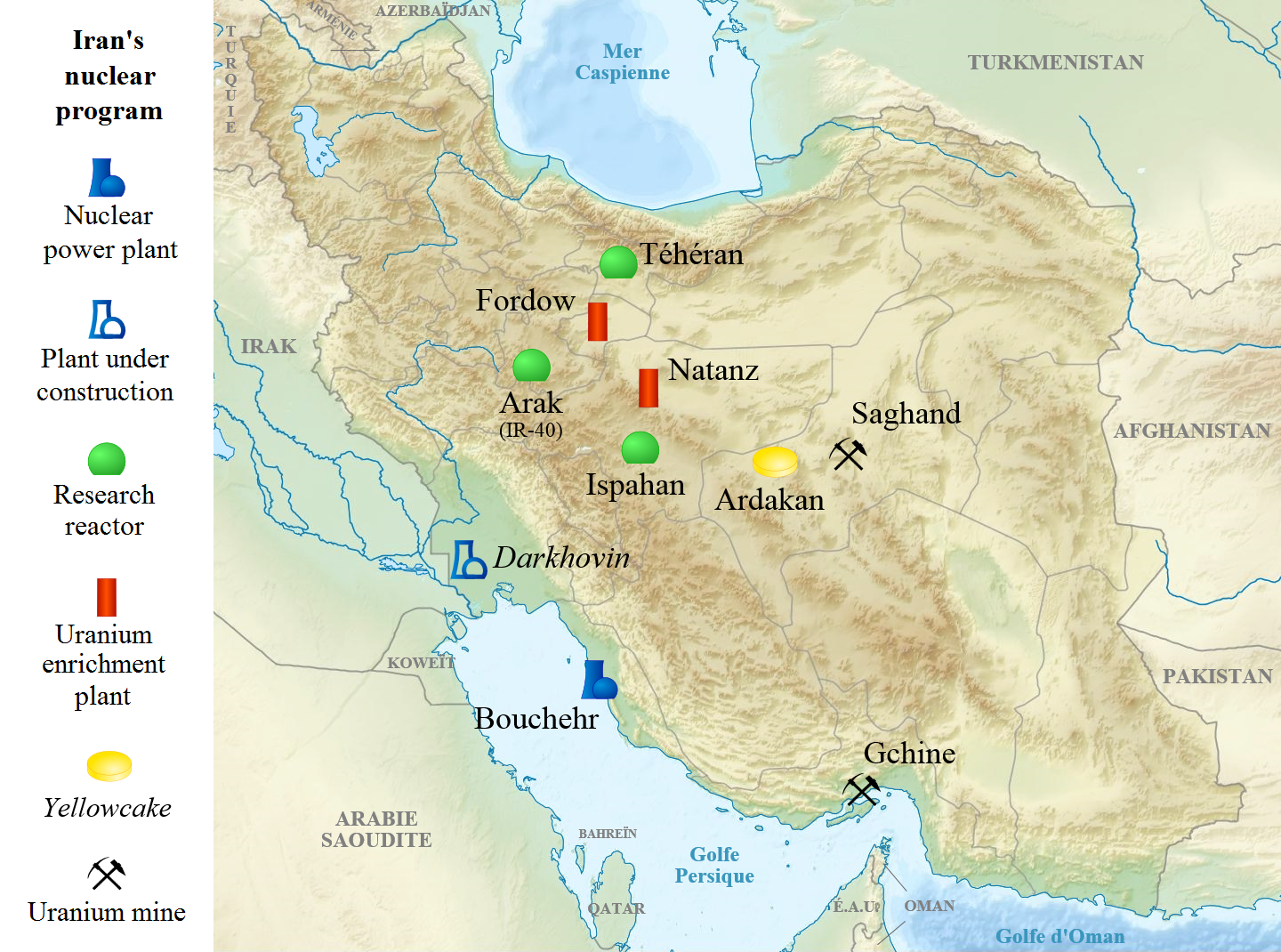
Iran’s nuclear facilities were seemingly pulverized by the provocative bombing raids carried out by Israel and the US last June. But they were no means completely “obliterated”, as Trump claimed. New satellite imagery suggests there is currently considerable activity at the Iranian nuclear sites, but some of these appear to be simple repairs such as the rebuilding of roofs and other structures destroyed in the attacks. There is more activity, according to analysis of the satellite images by the New York Times, at conventional missile sites, presumably in anticipation of another attack by Israel and/or the US.
Iran has and may well continue to insist it is developing its uranium enrichment capabilities for a civil nuclear program. And that could be true. Or not. The level to which it has lately been enriching uranium — to at least 60 percent and possible higher — before first Israel and then the US bombed its nuclear facilities, puts it in that gray area of weapons-usable rather than weapons-grade uranium enrichment. All this points once again the flaw in the NPT that continues to hand back the keys to the nuclear weapons lab by encouraging the development of nuclear power.
A delegation from the White House went to Oman last Friday to negotiate a new nuclear deal with Iran, even though it was Trump’s own regime back in 2018 that destroyed the perfectly workable Iran nuclear deal — known as the Joint Comprehensive Plan of Action — that had been in place up until then.
The negotiating team was led by Steve Witkoff and Jared Kushner. Witkoff is Trump’s Middle East Envoy but Kushner has no official position within the US government and no actual qualifications, other than an unsavory and predatory zeal about beachfront property — Iran has 5,800 km of coastline along the Caspian Sea, the Persian Gulf and Sea of Oman.
Should Iran have nuclear weapons? Of course not. But that also goes for the nine nations who do. And they should be the first to disarm before any demands are made elsewhere.
Linda Pentz Gunter is the founder of Beyond Nuclear and serves as its international specialist. Her book, No To Nuclear. Why Nuclear Power Destroys Lives, Derails Climate Progress and Provokes War, can be pre-ordered now from Pluto Press
In a political moment defined by secrecy, impunity, and the open decay of democratic institutions, few conversations cut as sharply as this one. Chris Hedges — Pulitzer Prize–winning former New York Times Middle East bureau chief — joins George Galloway to dissect the explosive Epstein files and the global elite they expose. What emerges is not a scandal at the margins, but a portrait of a ruling class so insulated, so depraved, and so unaccountable that its corruption has become a structural feature of Western power.
From the redactions shielding Trump and Netanyahu, to the British political meltdown engulfing Starmer’s inner circle, to the bipartisan rot in Washington, Hedges argues that the Epstein revelations are not an aberration but a window into a collapsing order. As he puts it, the files reveal “a depraved corrupt ruling global elite that has created a club that has locked the rest of us out,” one now reaching for authoritarian tools as its legitimacy crumbles.
This is a conversation about the Epstein affair — but also about the death spiral of American democracy, the rise of police‑state tactics, and the dangerous volatility of a declining empire whose leaders are losing their grip on reality. And with the Persian Gulf once again on the brink, Hedges warns that the same unaccountable forces exposed in the Epstein files are steering the world toward catastrophe.
If you want to understand the moment we’re living through — the corruption, the cover‑ups, the authoritarian drift, and the geopolitical brinkmanship — this exchange is essential.
Key Highlights
1. The Epstein Files as a Window Into Elite Rot
Hedges calls the documents “a depraved corrupt ruling global elite that has created a club that has locked the rest of us out.”
He argues the files expose not just individuals but the structure of unaccountable power across the US, UK, Israel, and Europe.
2. Trump’s Deep Exposure in the Files
Mentioned “38,000 times” in emails, according to Hedges.
Hedges says the redactions were designed “to protect Trump and Netanyahu.”
The Republican Party’s resistance to releasing the files “crumbled,” forcing Trump’s hand.
3. UK Political Meltdown
Galloway details cascading scandals around Starmer’s appointments — from Mandelson to a newly exposed associate tied to a convicted pedophile.
British media saturation contrasts sharply with US silence, which Hedges says reflects “the breakdown of democratic institutions.”
4. Bipartisan Complicity in the US
Hedges names Clinton, George Mitchell, and even Noam Chomsky as figures caught in the web.
He stresses that both parties are implicated, making accountability structurally impossible.
5. The Missing Videos & Intelligence Links
Epstein’s mansion contained a “closet‑sized safe” filled with recorded material.
Hedges: “It’s a question to what extent Epstein was working for the Mossad.”
Clear ties to Ehud Barak and Israeli intelligence raise the specter of kompromat.
6. Trump’s Cognitive Decline
Hedges cites Trump claiming he imposed tariffs on Switzerland because of its “prime minister” — a position that doesn’t exist.
He warns that a mentally deteriorating commander‑in‑chief is dangerous amid multiple potential war fronts.
7. The Rise of American Death‑Squad Policing
Hedges describes ICE and federal agents as “death squads… killing with impunity,” ignoring court orders.
He frames this as the defining feature of a police state.
8. Will Trump Attack Iran?
Pentagon opposition remains strong.
Netanyahu’s repeated visits suggest he’s not getting the commitment he wants.
Hedges: Trump is impulsive enough that “he could wake up tomorrow” and reverse course.
9. Epstein as a Global Operator, Not a Lone Predator
Epstein involved in Ukraine, Somaliland, even “a potential coup against Putin.”
Hedges emphasizes his inexplicable rise: “He can barely write English… that is the enigma.”
10. The Authoritarian Turn as Self‑Protection
As elites are exposed, Hedges argues they are “rapidly imposing authoritarian states” to maintain control.
He cites both US and UK crackdowns on dissent as evidence.
Putin was also of the opinion that “a complete renunciation of New START’s legacy would, from many points, be a grave and short-sighted mistake”, having “adverse implications for the objectives of the [Nuclear Non-Proliferation Treaty].
Future of How awful could it get? The New Strategic Arms Reduction Treaty (New START) expired on February 5, terminating an era of arms control and imposed limits on lunatically contrived nuclear weapons programs of the United States and Russia. The New START Treaty entered into force on February 5, 2011 and initially imposed a timeline of seven years for the parties to meet the central limits on strategic offensive arms. Those limits would then be maintained for the duration of the Treaty.
Till its expiry, the countries maintained limits on the following nuclear arms and systems: 700 deployed intercontinental ballistic missiles (ICBMs), deployed submarine-launched ballistic missiles (SLBMs), and deployed heavy bombers capable of using nuclear armaments; 1,550 nuclear warheads on all three deployed platforms; and 800 deployed and non-deployed nuclear capable systems (ICBM launchers, SLBM launchers, and nuclear capable heavy bombers).
Such limits were hardly laudatory, or even exceptional. The cap of 1,550 nuclear warheads is the sort of thing that would only impress the limited crazed circle that passes for arms negotiators in this field, and the various thanocrats who populate such institutes as RAND. Such a show is merely intended for both Moscow and Washington to tell other countries with, or without nuclear weapons, that they could impose restraints on their own gluttonous conduct. Even then, New START, as with all such instruments dealing with limiting nuclear weapons, came with the intended, gaping lacunae. It failed to cover, for instance, tactical nuclear weapons, nor limit the deployment of new strategic weapon systems.
The treaty also fell into neglect with the outbreak of the COVID-19 pandemic. Suspended on-site inspections never resumed after 2022. As François Diaz-Maurin of the Bulletin of the Atomic Scientistspoints out, “Russia has not shared data on its deployed strategic nuclear forces since September 2022, it suspended its treaty participation altogether in February 2023, and the United States has not published any aggregate numbers since May 2023.” New START came to increasingly look like a gentleman’s agreement being sniffed at by truculent adolescents.
In September last year, Russian President Vladimir Putin dangled the prospect of extending the treaty’s core limits for a year. At a September 22, 2025 Russian Security Council Meeting, he promised that Moscow was “prepared to continue observing the … central quantitative restrictions” stipulated in New START for twelve months provided the US acted “in similar spirit.” Following the year’s extension, “a careful assessment of the situation [and] a definite decision on whether to uphold these voluntary self-limitations” would be made. Putin was also of the opinion that “a complete renunciation of New START’s legacy would, from many points, be a grave and short-sighted mistake”, having “adverse implications for the objectives of the [Nuclear Non-Proliferation Treaty].
When word of this reached the White House, Press Secretary Karoline Leavitt expressed the view that the proposal sounded “pretty good.” Two weeks later, President Donald Trump responded to a question posed by a TASS reporter that Putin’s proposal sounded “pretty like a good idea to me.” Little, however, was subsequently done. Indeed, Trump has cut the number of diplomats tasked with nuclear matters in the State Department and made public statements last October that nuclear testing might be resumed. He has also complicated arms control matters by insisting that China be added to the limitation talks, something Beijing has shown little interest in doing. In January this year, the president seemed unfussed that the international document was about to pass into the archives of diplomatic oblivion. “If it expires, it expires. We’ll do a better agreement.”
The US political establishment had been struck by a distinct lack of interest, even lethargy, on the subject. New START seemed to be yet another irritating fetter on an administration more enthused by ignoring international obligations than following them. Only a clutch of Democrats seemed to show concern in reflecting about what would follow the treaty’s expiration in House speeches given on January 14. This month, Massachusetts Democrat Sen. Ed Markey, co-chair of the Senate’s Nuclear Weapons and Arms Control Working Group, held a press conference urging the Trump administration to renew the vows of fidelity to arms control agreements. “Let’s be honest. America needs another nuclear weapon about as much as Donald Trump deserves a Nobel Peace Prize.”………………………………………………………..
The two powers most responsible for keeping nuclear weapons unforgivably attractive to those who would acquire them show promise of blotting their copybook further. There is a serious sentiment in Washington that the nuclear stockpile will and should grow. The Bulletin of Atomic Scientists, in a fit of gloominess, moved its metaphorical Doomsday Clock just that bit closer to “midnight,” the point where biblical calamity will be assured. It now stands at 85 seconds to midnight. Not long to go now. https://theaimn.net/bad-beginnings-the-end-of-new-start/
Iran says it could dilute its 60% uranium stockpile if “all sanctions” end, amid renewed Oman talks and uncertainty over missing nuclear material.
Tehran is prepared to dilute its stockpile of highly enriched uranium if sanctions against Iran are lifted, the head of its atomic energy agency said on Monday following indirect talks with Washington.
Mohammad Eslami, head of the Atomic Energy Organisation of Iran, said the possibility of diluting 60% enriched uranium “depends on whether all sanctions would be lifted in return”, according to the official IRNA news agency.
The statement did not specify whether Eslami was referring to all international sanctions on Iran or only those imposed by the United States.
The offer comes as the whereabouts of more than 400 kilograms of highly enriched uranium Iran possessed before last year’s conflict with Israel and the US remains unknown……………………………………………………………………………………………….
Indirect talks to resume after Oman meeting
Eslami’s statement followed indirect talks between Iranian Foreign Minister Abbas Araghchi and US Middle East envoy Steve Witkoff in Oman last Friday, the first negotiations since the June conflict.
Both sides agreed to continue negotiations. However, Araghchi warned that “the mistrust that has developed is a serious challenge”.
US President Donald Trump has repeatedly called for Iran to accept a total ban on uranium enrichment, a condition unacceptable to Tehran and far less favourable than the 2015 agreement.
Iran maintains it has a right to a civilian nuclear programme under the Nuclear Non-Proliferation Treaty, to which 191 countries are signatories.







 nuclear-news