US Senate passes Bill to give Congress a stake in nuclear deal with Iran
S
 enate Passes Bill to Review Iran Nuclear Deal Maya Rhodan @m_rhodan TIME, 7 May 15 Bill to give Congress oversight of the nuclear plan passes Senate
Republicans and some Democrats in Congress have been pushing for oversight of the pending deal given that current proposals include relief from some of the sanctions placed on Iran by Congress. The bill that passed Thursday requires that Congress be able to review and possibly reject any deal the U.S. and world powers make with Iran regarding nuclear weapons. If Congress approves of the deal — or fails to disapprove within a certain timeframe — the President’s deal can move forward……
While the debate continues, however, some lawmakers have signaled their support for the President’s negotiations with Iran. In a letter first reported on by the Washington Post, 150 Democrats urged Obama to “stay on course” and commended the work of world powers so far in the process.
“The stakes are too great and the alternatives are too dire,” the letter reads. “If the United States were to abandon negotiations or cause their collapse, not only would we fail to peacefully prevent the nuclear-armed Iran, we would make that outcome more likely.”
The Washington Post reports that the letter could mean the President has enough Congressional support to override a veto should lawmakers vote to reject the deal once it is released in June. http://time.com/3850806/congress-iran-nuclear-deal/
USA Republican Senators out to wreck Iran nuclear deal
Congressional review of Iran nuclear deal is threatened by GOP amendments LA Times, By PAUL RICHTER AND LISA MASCARO contact the reporters A bipartisan bill for Congress to review any nuclear agreement with Iran faced new danger Thursday as Republican senators sought to force votes on controversial amendments that leaders had hoped to avoid.
Senate Republican and Democratic leaders have worked all week to shield the bill from politically sensitive changes that are likely to drive away some Democratic supporters and sink its chances for passage.
Presidential campaign politics have complicated the process. One such amendment, from Sen. Marco Rubio (R-Fla.), a presidential candidate, would require Iran to recognize Israel’s right to exist, something all senators would like to see, but that Iran is unlikely to do. The issue was not on the table during more than 10 years of negotiations over Iran’s nuclear program.
But Republican senators pressed hard for their proposals……http://www.latimes.com/nation/la-na-iran-congress-20150501-story.html
Nuclear weapons and the USA’s militarisation of Asia-Pacific
Obama Threatens China with Nuclear Weapons. Militarization of Asia-Pacific By Stephen Lendman Global Research, May 01, 2015 Last Friday, National Security Council senior Asian affairs director Evan Medeiros said John Kerry and Defense Secretary Ashton Carter would meet their Japanese counterparts in New York on Monday.
They’d “announce some historic changes to the way US-Japan alliance operates” ahead of Prime Minister Shinzo Abe’s Washington visit this week. Continue reading
China concerned at the expansion of North Korea’s nuclear arsenal
China warns North Korea’s nuclear arsenal is expanding, report says, Guardian, 23 Apr 15
Chinese experts believe their communist ally may already have an arsenal of 20 warheads and the enrichment capacity to double that figure by next year. Chinese nuclear experts believe North Korea may already have a nuclear arsenal of 20 warheads and the uranium enrichment capacity to double that figure by next year, the Wall Street Journal reported on Thursday.
The estimate, which the Journal said was relayed to US nuclear specialists in a closed-door meeting in February, is significantly higher than any previously known Chinese assessment.
It also exceeds recent estimates by US experts which put the North’s current arsenal at between 10 and 16 nuclear weapons.
A leading expert on North Korea’s nuclear programme, Siegfried Hecker, who attended the February meeting, said a sizeable North Korean stockpile would only compound the challenge the international community faces in persuading Pyongyang to decommission the weapons.
“The more they believe they have a fully functional nuclear arsenal and deterrent, the more difficult it’s going to be to walk them back from that,” Hecker told the Journal.
The Chinese estimate reflects growing concern in Beijing about the nuclear ambitions of its errant ally, and is the latest in a series of expert assessments that suggest Pyongyang is moving faster down the nuclear path than previously thought.
A recent report by US researchers warned that North Korea appeared poised to expand its nuclear program over the next five years and, in a worst case scenario, could possess 100 atomic arms by 2020……http://www.theguardian.com/world/2015/apr/23/china-warns-north-koreas-nuclear-arsenal-is-expanding-report-says
US uranium mine- how Russia gained control
How Putin’s Russia Gained Control of a U.S. Uranium Mine, Bloomberg, 24 Apr 15 by William KennedyAndy Hoffman Since 2013, the nuclear energy arm of the Russian state has controlled 20 percent of America’s uranium production capacity.
Rosatom’s acquisition of Toronto-based miner Uranium One Inc. made the Russian agency, which also builds nuclear weapons, one the world’s top five producers of the radioactive metal and gave it ownership of a mine in Wyoming.
The deal, approved by a committee that included then Secretary of State Hillary Clinton, also followed donations from Uranium One’s Canadian chairman to the Clinton Global Foundation, the New York Times reported on Thursday.
Rosatom gained full control of Uranium One in early 2013.
Rosatom styles itself as Russia’s national nuclear corporation and today Uranium One is its international mining arm. As well as Willow Creek and the Kazakhstan assets, it owns mines in Australia and has exploration assets in Africa and the U.S…….http://www.bloomberg.com/news/articles/2015-04-23/how-putin-s-russia-gained-control-of-a-u-s-uranium-mine
Uranium deal by Canada to India puts South Asian security at risk
Nuclear non-proliferation selectivism Nation.com http://nation.com.pk/columns/22-Apr-2015/nuclear-non-proliferation-selectivism Senator Sehar Kamran April 22, 2015 Canada recently signed a 280 million dollar deal for the supply of 3,000 metric tonnes of uranium over the next five years to India, a nuclear weapon state outside the NPT. This deal comes against the backdrop of experts’ warnings that the agreement will spur proliferation in the region, and if the Indian test of Agni III, mere hours after the signing of the deal, is any indication of things to come, the warnings are not without cause. The deal, if put in perspective of the recent efforts by the West to bring outlier states to abide by the rules of the Nuclear Nonproliferation Treaty (NPT), undermines the efforts for the universalisation of a rules-based nuclear non-proliferation regime.
It is staggering to think that the very same country that forsook all nuclear cooperation some 45 years earlier with India after the latter diverted nuclear fuel from Canadian reactors, supplied for ‘peaceful, civilian’ use, to conduct a nuclear weapons test would now actively sign a 5-year deal that can only further exacerbate the South Asian security dilemma. The deal brushes aside the entire controversy of the Indian episode of proliferation of nuclear fuel for conducting a nuclear test. At the very least, it is not a story any of the major powers are ready to lend an ear to anymore, busy as they are cashing in on the growing market economy of India. Paul Meyer, Canada’s former permanent representative to the Geneva Disarmament Conference expressed his fears in this regard saying that, “All of this flows from decisions where we essentially sold the shop some years back, sacrificing our nuclear non-proliferation principles and objectives for some other considerations, and I think it’s been a very poor deal for us in terms of the risks of nuclear proliferation.”
Following the US-India nuclear agreement and the NSG waiver, several other states have also engaged in nuclear commerce with India, and the Canadian deal is only the most recent example. Thus far, India has secured nuclear cooperation agreements with Russia, France, the US, Australia and Canada. Noticeable here is the fact that Australia despite being a NNWS of NPT that held out for so long against such a deal has in the end, given in for economic benefits over moral ground.
India’s membership of NSG opens the gates for advanced technology in the nuclear field for dual-use items, making India a potential supplier as well. India as a state outside NPT, non-signatory to CTBT and continuing to produce fissile material, does not fulfill the criteria for NSG membership. Moreover, the resultant technological advancements pose an equally great challenge for Pakistan in this field and destabilise deterrence stability in the region.
For Pakistan, the reward for a stringent export control on nuclear technologies and a transparent nuclear command and control structure has not been forthcoming from the international community. The lesson learnt is that it is geopolitics rather than a good non-proliferation record that governs eligibility for nuclear commerce.
Unlike its regional rival and other nuclear weapon states, Pakistan is the only state that has made its nuclear command and control structure explicit and constructively engages with the international community on these issues.
The regional security complex in which Pakistan is situated has left the state with few options. While American strategic compulsions might require building India as a counter weight to China, it will be at the cost of undermining regional non-proliferation and global nuclear non-proliferation norms, and the repercussions will be for Pakistan to bear. Many believe the nuclear competition in Southern Asia to be triangular; however, the nuclear cooperation offered by world powers to India will have direct implications for Pakistan specifically. Being conventionally weaker and constrained by economy, the state has to rely on maintaining a precarious strategic balance vis-à-vis India. India’s increasing fissile material stocks, both Pu and HeU, alongside its introduction of capabilities like BMD systems, canister launch system for missiles, MIRVed technology combined with the confidence to fight a conflict and control escalation, involve dangerous trends for the region. Indian missiles, cruise, hypersonic missiles and long-range ICBM production negate any claim of a minimum credible deterrence.
On the issue of the Nuclear Suppliers Group membership, criteria governing the inclusion of prospective outliers can help lessen the damage done to the non-proliferation regime by exemptions such as the 123 Agreement. It would also ensure that only those states qualify for nuclear commerce that uphold the nuclear non-proliferation norms and promote them. Such a move would also reiterate the nuclear community’s impartiality in mainstreaming nuclear non-proliferation treaty outliers.
Unless the regional concerns relating to development of technologies and impartiality in determining the future of non-proliferation outliers is established, non-proliferation concerns in South Asia will continue to pose a challenge. To convert this challenge into opportunity, the international community should promote indiscriminate policies to establish balanced and criteria-based engagements in the nuclear arena.
The writer is the President of Centre for Pakistan and Gulf Studies (CPGS) and Member Senate Standing Committees on Defence.
Iran nuclear deal a good template for all countries, to reduce nuclear weapons proliferation
Could Iran be the start?Ifpress.com Erika Simpson, Postmedia Network Friday, April 17, 2015 Japan’s prime minister during the Fukushima catastrophe, Naoto Kan, delivered a message at the World Uranium Symposium in Quebec City in mid-April that it is time for the world to put an end to nuclear power. The symposium, held for the first time in Canada, tackled uranium issues, ranging from mining to fuel for nuclear reactors to explosive material for nuclear weapons.
This year will be a key year for debating the future of uranium, nuclear power plants and nuclear weapons. It’s the 70th anniversary of the atomic bombing of Hiroshima and Nagasaki and it’s time again for the UN conference that reviews the nuclear non-proliferation treaty every five years.
But the most high-profile nuclear issue is the interim accord between Iran and six world powers to restrict Iran’s development of nuclear power.
In the nuclear non-proliferation treaty, one fatal flaw is the quid pro quo deal in which the nuclear haves agreed to provide uranium and nuclear energy to the have-nots, which would continue to be non-nuclear, and in exchange the haves promised to get rid of their nuclear arsenals and move toward general disarmament. Fifty years ago, diplomats should have foreseen the problems with such discriminatory arrangements.
Another problem with the treaty stems from oil-rich countries, like Iran, and poor countries, like India and Pakistan, seeking to build nuclear power plants for reasons ranging from abundant energy and technological prestige to their not-so-secret desire to build nuclear weapons.
But by agreeing in the interim accord to enrich uranium to 3.7% only, Iran will forego the possibility of producing weapons-grade and weapons-usable uranium. Iran also promises to take two-thirds of its centrifuges out of service — the most-advanced centrifuges needed to make highly-enriched uranium.
In fact, India, Israel, Pakistan and many other countries will have nuclear programs that are far more extensive and dangerous than Iran’s. Moreover, all countries with nuclear power and nuclear weapons will continue to produce hundreds of thousands of tons of nuclear waste that need human stewardship for many generations into the future.
If the fundamentals of the Iranian deal could be treated as a template for all countries, the international community would be well on its way to choking off the supply of weapons-usable material everywhere.
But the Iran deal will be opposed by Israel, Saudi Arabia, Republicans in the U.S. Congress and the remaining strong supporters of Israel in the Harper cabinet. In a rare bit of bipartisan compromise, the U.S. Congress and the Senate foreign relations committee amended language that threatened to give U.S. hawks a chance to derail the talks and raise the risk of military strikes.
All the proliferators that refuse to sign the non-proliferation treaty and accept the strictest safeguards of the International Atomic Energy Agency — like Israel, India, North Korea and Pakistan — must be sanctioned, not just Iran………
Within the existing framework of international law, the proposed Iranian deal is as good as we can expect.
The entire nuclear regime, especially its cornerstone treaty, needs much stronger debate and qualified support.
The good news is there are many regional nuclear-weapon-free treaties around the world, covering large swaths of Central and Latin America, Southeast Asia, Africa and Central Asia. Each commits the states not to deploy, construct, receive or test nuclear weapons on its territory. Already 113 nations — a majority of UN members — have signed or ratified these treaties, and 50% of the world’s land area is governed by them.
There are even opportunities here in Canada to dismantle the nuclear option……..
Erika Simpson was a speaker at the World Uranium Symposium and will be a speaker at the Nuclear Non-Proliferation Treaty review conference. She is an associate professor of international relations at Western University and the author of the book NATO and the Bomb. http://www.lfpress.com/2015/04/17/could-iran-be-the-start
Austria’s opposition to nuclear power
Why Austria traditionally opposes nuclear power https://www.dailystar.com.lb/Opinion/Commentary/2015/Apr-22/295256-why-austria-traditionally-opposes-nuclear-power.ashx Andreas Molin The Daily Star Last October, the European Union approved a controversial subsidy deal to allow billions of pounds of state aid for Hinkley Point C, a new nuclear reactor planned for the United Kingdom. Austria’s intention to launch a legal challenge against this decision has provoked controversial comments in international media. So, why does Austria care about a nuclear power plant being built in the U.K., and what are the real issues at stake?
Austria has been deeply skeptical about nuclear power for decades. Recall that in a 1978 referendum, the Austrian electorate decided not to start the operation of the nuclear Zwentendorf power plant. After the catastrophic events in Chernobyl in 1986, the opposition to and concerns about nuclear power became deeply rooted in the Austrian population, at all levels of society. (Austria was among those countries in Central Europe that were most affected by the disaster.)
Information regarding the safety of nuclear power plants of Russian design, which became public after 1989, reinforced these apprehensions, leading to explicit government policy in 1990.
A joint publication by the Heads of the European Radiological protection Competent Authorities and the Western European Nuclear Regulators Association released in October 2014 clearly states “that the possibility of severe accidents … cannot be completely ruled out. Such accidents could be as severe as the Fukushima one, affect more than one European country and require rapid protective actions in several of them.”
The transboundary nature of the risks associated with nuclear power dictates that the legitimate interests of Austrian citizens are represented in relation to all nuclear projects and installations.
As a matter of principle, Austria does not consider nuclear power to be compatible with the concept of sustainable development. Therefore, it does not consider reliance on nuclear power to be a viable option to combat the greenhouse effect. Sustainable development, if fully applied to the energy sector, would require substantial increases in energy efficiency and energy saving as well as a switch to renewable sources of energy.
It has been argued that the Austrian government’s long-standing position on this subject, supported by numerous resolutions in parliament, is at the core of the intended legal challenge. But that is not the case. Austria fully respects every country’s sovereign right to decide on its national energy mix.
The Austrian objection stems from concern about the provision of British aid for the project, and the extent to which it would comply with common European state aid and competition rules. The current European Environmental and Energy State Aid Guidelines allow, under strictly defined circumstances, for state aid to renewable energy projects, but there are no such rules for nuclear power projects. Therefore, an assessment has to be made on the basis of general EU competition law.
As a general rule, the Treaty on the Functioning of the European Union prohibits state aid, while it leaves some room for certain policy objectives for which state aid can be considered compatible with the internal market.
European Commission guidelines and decision practice, as well as the European Court of Justice’s jurisdiction, have developed a set of principles that put these exemptions to the general rule into concrete terms. As the planned state aid for Hinkley Point C differs tremendously from all of these principles, it seems inevitable that the European Commission’s decision will be challenged.
The commission seems to be relying heavily on the idea of market failure, for instance, to justify its decision. This cannot be accepted: If the market fails to finance an unsustainable project, it is simply doing its job.
In essence, the arguments raised in order to justify this state aid could apply to any other large-scale power project as well. State aid for the Hinkley Point C nuclear power plant could therefore not only serve as a model for further nuclear new build projects, but also lead to a run on state aid throughout the entire EU energy sector.
Against this background, Austria felt it had no option but to challenge this state aid decision in the courts of the European Union. This action is not aimed at any particular EU member state, but rather seeks to defend a common competition regime, which this decision could render meaningless.
Andreas Molin is the director of the Austrian Federal Ministry of Agriculture, Forestry, Environment and Water Management. He is the Austrian representative in the Steering Committee for Nuclear Energy of the Nuclear Energy Agency of the Organization for Economic Cooperation and Development and has served as vice chairman of the European Nuclear Safety Regulators Group(ENSREG) since 2011. This commentary originally appeared at TheMark News (www.themarknews.com).
Call to Australian and Canadian govts not to sell uranium to India
International call not to sell uranium to India http://www.acfonline.org.au/news-media/media-release/international-call-not-sell-uranium-india April 15, 2015
 Canadian and Australian governments not to further advance controversial plans for uranium sales to India.
The call comes as Australian nuclear free campaigners join Indigenous landowners affected by uranium projects to present at the World Uranium Symposium in Québec.
The conference takes place against the backdrop of Indian Prime Minister Narendra Modi’s visit to Canada and Australian Foreign Minister Julie Bishop’s trip New Delhi to advance planned uranium sales.
“Canada and Australia should show responsibility restraint and prudence, as India has been criticised widely over the safety, security and transparency of its nuclear industry,” ACF’s Dave Sweeney said. “Australia and Canada should not rush into uranium sales agreements with India while serious concerns about safety and security remain unresolved.”
Australia’s controversial uranium deal with India has been widely criticised, including by former safeguards director John Carlson, who was for two decades head of Australia’s safeguards regime and was a keen nuclear promoter. Mr Carlson has raised concernsthat the new treaty’s administrative arrangements could substantially depart from Australia’s usual safeguards conditions, meaning Australia may be unable to keep track of what happens to uranium supplied to India.
Speaking from Québec ACF’s Dave Sweeney called on the Canadian and Australian governments not to further fuel instability in South Asia by selling uranium into the already volatile region.
“Uranium is not like other minerals. It is the fuel for nuclear weapons and creates carcinogenic waste that lasts for thousands of years,” he said. “Fuelling danger and instability in India is not in the interests of Canada or Australia.”
Significant concessions made by Iran in nuclear deal
As Iran pursues a peaceful nuclear programme, Iran’s enrichment capacity, enrichment level and stockpile will be limited for specified durations, and there will be no other enrichment facility than Natanz. Iran’s research and development on centrifuges will be carried out on a scope and schedule that has been mutually agreed.
 The grand bargain: What Iran conceded in the nuclear talks, Brookings, Richard Nephew | April 18, 2015 Since the P5+1 and Iran announced the agreed parameters for a comprehensive settlement of the Iran nuclear issue earlier this month, Washington punditry has obsessed over the fine points of both the joint statement read by EU Foreign Minister Mogherini and Iranian FM Zarif, and the fact sheet released by the Obama administration, to identify concessions made by the United States.
Much attention has centered on centrifuge numbers, the strategic implications of the Iranian nuclear program within the context of the deal and the decision to provide early sanctions relief to Iran in exchange for substantial nuclear steps by Iran.As with everything in Washington as late, the discussion quickly divided into two camps: those convinced that Obama gave up critical advantage over Iran too readily in order to get a nuclear deal that, even if better than what was anticipated, still is not satisfactory; and, those convinced that, given the alternatives, what Obama achieved was worth such concessions.
Next week’s round of talks with Iran on the difficult path to a final nuclear deal
Next Round of Nuclear Talks With Iran Set for Next Week http://www.nytimes.com/2015/04/17/world/middleeast/next-round-of-nuclear-talks-with-iran-set-for-next-week.html?_r=0 By THOMAS ERDBRINK APRIL 16, 2015 TEHRAN — The next round of nuclear talks between world powers andIran is scheduled for next week in Vienna, as the two sides begin to address the issues they left unresolved earlier this month in Lausanne, Switzerland, and try to conclude a comprehensive agreement by the end of June.
The European Union, the host of the talks, said in a statement released on Thursday that its senior negotiator, Helga Schmid, will meet with Iran’s deputy foreign minister, Abbas Araghchi, on Wednesday, to pursue an agreement that would restrict Iran to peaceful research in the nuclear area in exchange for the phased lifting of economic sanctions.
After the parties reached a framework agreement in Lausanne, Iran’s supreme leader, Ayatollah Ali Khamenei, complicated matters by insisting that all sanctions would have to be lifted immediately and that all military sites would be off limits to inspectors.
President Hassan Rouhani on Thursday acknowledged the problems but said he remained optimistic that the negotiators would reach a deal. “There is a difficult path ahead of us towards the final deal,” he said at a news conference during a trip to northern Iran, but the country’s “will and decision is to continue the negotiations until a final deal is reached.”
A nuclear arms race in Middle East must be avoided
The Ultimate Nightmare: A Nuclear Arms Race in the Middle East, The National Interest, John Carlson 14 Apr 15, If the framework announced in Switzerland on April 2 regarding Iran’s nuclear program and detailed in a US State Department Fact Sheet is successfully carried forward to an agreed Plan of Action (due to be concluded by June 30), it will be a major achievement.
But it should not be seen as the end of the process. It is a definitive step, but it will need to be followed by a number of concrete actions before we can consider that the Iranian nuclear problem has been resolved.
If the deal is agreed in June, and if it is faithfully implemented, it will give all parties – Iran, its neighbors, and the wider international community – 15 years of breathing space. It is essential to use this time effectively to ensure the deal doesn’t just kick the can down the road. During this period decisions need to be made by Iran and others to ensure that the Middle East does not end up in a South Asia-style nuclear arms race.
It is by no means a forgone conclusion that Iran wants nuclear weapons, though Iran no doubt believes that having the capability to produce nuclear weapons within a relatively short time – what is termed nuclear hedging – has major strategic value. It is essential to ensure that the consequences for crossing the threshold remain high enough to deter Iran from doing so. This will require the US to keep a high level of engagement in Middle East affairs for the foreseeable future.
But having Iran maintain “just” a hedging posture cannot be considered a good outcome – we have already seen some of Iran’s neighbors wanting to develop nuclear programs that will give them a similar capability. A situation of strategic competition in nuclear capability will be destabilizing for the Middle East……..
Another essential project to pursue during the breathing space is a Middle East WMD-free zone. Iran must be persuaded that the best way of ensuring its long-term national security is not through nuclear capability but through the establishment of such a zone, a point recently made by Saudi Arabia. If Iran pursues nuclear weapons, or a stronger hedging posture, its current advantage will erode over time as others pursue the same. Eventually Iran will find itself with nuclear-armed or nuclear-capable neighbors, and its strategic circumstances will be substantially worse than anything it can imagine today.
The same challenge confronts Israel. If others in the region become nuclear armed or even just nuclear capable, the strategic advantage Israel now enjoys will disappear. It would be very risky to rely on nuclear deterrence in these circumstances. For Israel as well as Iran, a WMD-free zone offers the best long-term future. This means that eventually Israel will have to divest itself of nuclear weapons. This may seem unthinkable today, but a future where others in the region also have nuclear weapons is even more unthinkable. Others in the region must be realistic; Israel cannot be expected to disarm as a pre-condition for a WMD-free zone. But Israel must be prepared to think in terms of a phased approach, disarming in stages as a WMD-free zone is established and is shown to be effective. ……http://nationalinterest.org/blog/the-buzz/the-ultimate-nightmare-nuclear-arms-race-the-middle-east-12627
Danger of nuclear tensions in volatile South Asia
This part of the world, according to analysts, is fast becoming a race for nuclear supremacy between three powers – India, Pakistan and China (while technically not classified as South Asia, the country shares borders with both India and Pakistan). This rivalry in the eyes of many analysts is dangerous in itself but is made even more complex by the mutual suspicions and historical enmities that bedevil the region………
Lethal cocktail?
The fierce nuclear competition in South Asia is seen by many as a recipe for instability in a region already burdened with problems.
Narendra Modi recently confirmed India’s No First Use doctrine
It is a potentially lethal addition to the cocktail of territorial disputes and cross-border terrorism. The capacity of other world powers to influence the situation is hampered by the fact that neither India nor Pakistan belong to the NPT.
Pakistan’s economic and political instability also poses huge and troubling questions. The country is persistently challenged by militant groups and fears persist that these groups could get their hands on nuclear materials, despite strong insistence from Pakistani officials that its nuclear facilities are secure.
America and Russia still possess more than 90% of the world’s nuclear weapons but South Asia, home to three nuclear states, remains a growing worry, perhaps one that will get more attention in the coming months. http://www.bbc.com/news/world-south-asia-32289368
Russia’s Rosatom will fund, and control, Nigeria’s $20bn nuclear power project
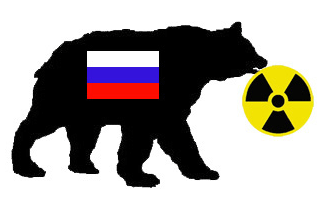 Nigeria in $20bn nuclear power talks with Russia – struggling S. Africa currently has eight times more capacity 14 APR 2015 BLOOMBERG, JOSEPH BURITE “………….South Africa, with a third of Nigeria’s population yet eight times more installed capacity, has also signed an agreement with Rosatom as the nation looks to add 9,600 megawatts of atomic power to its strained grid.
South Africa’s agreement with Rosatom gave the company the right to veto the nation doing business with any other nuclear vendor, Johannesburg-based Mail & Guardian reported in February.
Majority stake
Rosatom and Nigerian officials met last month within the framework of a 2009 intergovernmental agreement to discuss cooperation, Rosatom spokesman Sergei Novikov said by phone from Istanbul. To date, no memorandums have been signed about the development of a nuclear plant, he said.
Rosatom will hold a majority, controlling stake in Nigeria’s nuclear facility while the rest will be owned by the country, with roles to be specified in contracts, Osaisai said. “The government will enter a power-purchasing agreement for the nuclear plant.”
The plants will be financed by Rosatom, which will then build, own, operate and transfer them to the government, he said.
Rosatom is marketing its reactors with generous financing offers as Moscow seeks new markets for its technology amid a looming recession. Over the last year, its international portfolio of orders has grown to more than $100 billion, including deals to build new reactors in Iran, Hungary, India and Jordan.
Africa’s sole nuclear power station is Koeberg in South Africa, which is owned by state-owned Eskom Holdings SOC Ltd. (Bloomberg) http://mgafrica.com/article/2015-04-14-nigeria-in-20bn-nuclear-power-talks-with-russia-struggling-s-africa-currently-has-eight-times-more-capacity
Michigan lawmaker urges Congress to oppose Canada’s waste dump plan near Lake Huron
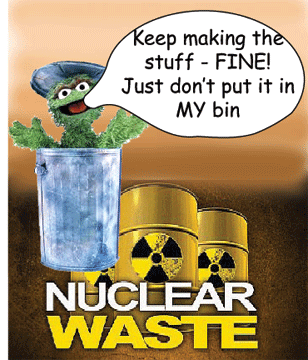 Michigan lawmaker: Congress should oppose Canada’s plan to bury nuclear waste near Lake Huron Star Tribune by: JOHN FLESHER , Associated Press April 10, 2015 – TRAVERSE CITY, Mich. — Michigan Rep. Dan Kildee said Friday he will push Congress to officially oppose Canada’s plans to allow nuclear waste to be stored underground less than a mile from Lake Huron, saying the country should find a site farther away from the Great Lakes, the world’s largest body of surface fresh water.
Kildee offered a similar resolution during the last congressional session, and numerous cities in the Great Lakes region have come out against the storage plan, but it failed to win House approval. Even if successful, it would have no force of law because Canadian officials will make the final decision.
Even so, the Democrat from Flint Township said the effort was worth making. He said the Ontario Power Generation plan to bury radioactive material, including discarded parts from the reactor core and ashes from incinerated floor sweepings and map heads, was “dangerous and an unnecessary risk we shouldn’t take.”
“The Great Lakes aren’t just a source of natural wonder,” said Kildee, whose district includes a section of the western Lake Huron coastline. “As the world’s largest body of fresh water, they’re vital to our way of life.”
Publicly owned Ontario Power Generation wants to bury 7.1 million cubic feet of low- and intermediate-level waste from its nuclear plants about 2,230 feet below the earth’s surface at the Bruce Power generating station near Kincardine, Ontario……..
Critics say there’s no way to guarantee the lake’s safety over the thousands of years that would be required for all the waste to lose its radioactivity.
Kildee’s office said the plan is opposed by 146 cities in the Great Lakes region, from Chicago to Toronto to Rochester, New York.
“My congressional resolution seeks to find an alternative location for this Canadian nuclear waste storage site so it does not endanger our state’s livelihood or economy — now or for future generations,” the congressman said.
A review panel of the Canadian Nuclear Safety Commission has conducted hearings on the project and is expected to issue a report by May 6. The Canadian environment minister would decide whether to approve or deny the project. If the minister endorses it, the review panel will decide whether to issue a construction license. http://www.startribune.com/politics/national/299322701.html
1 This Month




PLEASE OPPOSE HR 8255 AND S.3639 – bills would accelerate satellite deployment, with no environmental review or safeguards – https://ncstd5li.quorum.us/campaign/169331/
To see nuclear-related stories in greater depth and intensity – go to https://nuclearinformation.wordpress.com
-
Archives
- September 2026 (339)
- August 2026 (330)
- July 2026 (355)
- June 2026 (287)
- May 2026 (306)
- April 2026 (356)
- March 2026 (251)
- February 2026 (267)
- January 2026 (308)
- December 2025 (358)
- November 2025 (359)
- October 2025 (375)
-
Categories
- 1
- 1 NUCLEAR ISSUES
- business and costs
- climate change
- culture and arts
- ENERGY
- environment
- health
- history
- indigenous issues
- Legal
- marketing of nuclear
- media
- opposition to nuclear
- PERSONAL STORIES
- politics
- politics international
- Religion and ethics
- safety
- secrets,lies and civil liberties
- spinbuster
- technology
- Uranium
- wastes
- weapons and war
- Women
- 2 WORLD
- ACTION
- AFRICA
- Atrocities
- AUSTRALIA
- Christina's notes
- Christina's themes
- culture and arts
- Events
- Fuk 2022
- Fuk 2023
- Fukushima 2017
- Fukushima 2018
- fukushima 2019
- Fukushima 2020
- Fukushima 2021
- general
- global warming
- Humour (God we need it)
- Nuclear
- RARE EARTHS
- Reference
- resources – print
- Resources -audiovicual
- Weekly Newsletter
- World
- World Nuclear
- YouTube
-
RSS
Entries RSS
Comments RSS

