US Vetoes UN Resolution Calling for a Ceasefire in Gaza
the new Trump administration used its veto power to block a Gaza ceasefire resolution on behalf of Israel.
The US was the only member of the 15-member Security Council that didn’t vote in favor of the resolution
by Dave DeCamp June 4, 2025,https://news.antiwar.com/2025/06/04/us-vetoes-un-resolution-calling-for-a-ceasefire-in-gaza/
The US on Wednesday vetoed a resolution at the UN Security Council that called for an “immediate, unconditional and permanent ceasefire” in Gaza, the release of Israeli captives, and the unrestricted flow of humanitarian aid into the besieged Palestinian territory.
The US was the only member of the 15-member Security Council that didn’t vote in favor of the ceasefire. The resolution was introduced by the 10 non-permanent members of the Council: Algeria, Denmark, Greece, Guyana, Panama, Pakistan, South Korea, Sierra Leone, Somalia, and Slovenia.
“We believe this text reflects the consensus shared by all Council members that the war in Gaza has to come to an immediate halt, all hostages must be immediately and unconditionally released, and civilians in Gaza must not starve and must have full and unimpeded access to aid,” the 10 nations said in a joint statement.
The US and the four other permanent members — Russia, China, the UK, and France — all have veto power on the Security Council. The Biden administration vetoed several Gaza-related resolutions at the Security Council, but Wednesday’s vote marked the first time the new Trump administration used its veto power to block a Gaza ceasefire resolution on behalf of Israel.
Israeli Foreign Minister Gideon Sa’ar said in a post on X after the vote that he wanted to thank President Trump and the “US administration for standing shoulder to shoulder with Israel and vetoing this one-sided resolution in the UN Security Council.”
Dorothy Shea, the acting US ambassador to the UN, said that “any product that undermines our close ally Israel’s security is a nonstarter.” She also claimed the resolution would hurt diplomatic efforts that have failed to make progress due to Israel’s refusal to end its genocidal war by committing to a permanent ceasefire.
“The United States has been clear we would not support any measure that fails to condemn Hamas and does not call for Hamas to disarm and leave Gaza,” Shea said. “This resolution would undermine diplomatic efforts to reach a ceasefire that reflects the realities on the ground, and embolden Hamas.”
RAY McGOVERN: Putin Would Not Rise to the Bait
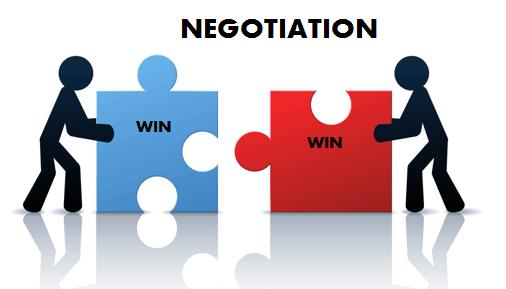
June 4, 2025, https://consortiumnews.com/2025/06/04/ray-mcgovern-putin-would-not-rise-to-the-bait/
The black-eye given Russian security services will eventually heal while the artful destruction of a handful of bombers – like earlier high-profile, but misguided operations – will have zero effect on the war in Ukraine.
By Ray McGovern, Consortium News
Ukraine’s drone attacks on air bases deep inside Russia on Sunday were timed to provoke Russia into shunning the Russia-Ukraine talks set for the next day in Istanbul. Volodymyr Zelensky and his European puppeteers also may have thought they could provoke Vladimir Putin to escalate attacks on Ukraine to such a degree that the U.S. could not “walk away” from Ukraine without appearing cowardly.
The PR benefits of destroying Russian aircraft far from Ukraine was part of Kyiv’s calculus. It was a huge embarrassment and a tactical victory in a short-lived, narrow sense.
But the black-eye given Russian security services will eventually heal. Most important, the artful destruction of a handful of bombers – like earlier high-profile, but misguided operations – will have zero effect on the war in Ukraine.
Doing Diplomacy For Once
Russian Foreign Minister Sergei Lavrov called U.S. Secretary of State Marco Rubio immediately after the drone attacks on the Russian air bases and the sabotage/destruction of two rail bridges in Russia earlier that day.
The Russian readout said that Secretary Rubio “conveyed sincere condolences on the civilian casualties from the rail infrastructure blasts in Russia’s Bryansk and Kursk regions.” This is a sign that Lavrov did not come in with accusatory guns blazing, so to speak.
It does seem certain that Lavrov asked Rubio whether he knew of the drone attacks beforehand. And what did President Trump know?
In my view, it is conceivable that neither had prior knowledge. When the drone operation was planned the geniuses working for Joe Biden were in charge of such things – the ones who destroyed the Nord Stream pipelines.
Most likely the U.S. was kept informed, but the operation itself bears the earmarks of the sabotage the British are so fond of carrying out – with particular lust after bridges.
They did so famously during World War II and they are quite good at it. Then, as now, such sabotage had little-to-no effect on the war – merely a transitory strengthening of their proverbial upper lip.
The Talks Went On, and Will Continue
Putin and Donald Trump wanted the negotiations in Istanbul to proceed, and those were their instructions to Lavrov and Rubio. They did, and with some tangible progress on small, but significant matters like the exchange of bodies. There was a highly important exchange of papers on the terms sought by each side, and a pledge to study them before the next meeting.
Bottom Line
The driving issue is bigger than Ukraine. Both Trump and Putin want improved U.S.-Russia relations. Other matters, including Ukraine, are secondary. As of now, at least, both sides seek a negotiated settlement to the war as the primary option.
And each side will do its best to avoid escalation and show a measured flexibility – and even patience – until such time as Ukraine’s army disintegrates.
It appears that this will happen soon. I believe that, at that point, Putin will be happy to supply as much lipstick as may be needed to conceal the pig of defeat for Ukraine-and-the-West.
Ray McGovern’s first portfolio as a C.I.A. analyst was Sino-Soviet relations. In 1963, their total trade was $220 MILLION; in 2023, $227 BILLION. Do the math.
Ayatollah Rejects US Nuclear Proposal, Vows Iran To Keep Enriching Uranium

by Tyler Durden, Thursday, Jun 05, 2025 –https://www.zerohedge.com/geopolitical/ayatollah-rejects-us-nuclear-proposal-vows-iran-will-keep-enriching-uranium
Iran has finally reacted to the US proposal for a fresh nuclear deal which was submitted Saturday via Omani mediators, and as expected it has dismissed Washington demands to take uranium enrichment down to zero.
Iran’s Supreme Leader Ayatollah Ali Khamenei has made clear in fresh statements Wednesday that abandoning uranium enrichment was “100%” against the Islamic Republic’s interests. This comes on the heels of a Truth Social post issued by President Trump which said in all caps: WE WILL NOT ALLOW ANY ENRICHMENT OF URANIUM.
Khamenei as the Ayatollah, or top Shia religious cleric, has final say over all matters of state policy, but notably he didn’t call for halting the talks altogether, after it’s gone through five rounds, including at Rome.
He said the US proposal “contradicts our nation’s belief in self-reliance and the principle of ‘We Can'”. This is consistent with Iranian officials’ prior position defending enrichment as a matter of national sovereignty that cannot fully be abandoned.
The question that remains is whether the US would allow for limited, lor low-levels of enrichment, instead of the ‘down to zero’ position which is being hotly debated about. “Uranium enrichment is the key to our nuclear program and the enemies have focused on the enrichment,” Khamenei said during a televised speech.
He addressed the nation on the anniversary of the death of the Islamic Republic’s founder, Ayatollah Ruhollah Khomeini. He made it very clear where Tehran stands on the proposal currently offered by the Trump White House:
“The proposal that the Americans have presented is 100% against our interests … The rude and arrogant leaders of America repeatedly demand that we should not have a nuclear programme. Who are you to decide whether Iran should have enrichment?,” he added.
There has been somewhat contradictory messaging coming out of Washington, with the Wall Street Journal having reported Sunday that the White House issued a directive last week telling federal agencies to halt the imposition of any new sanctions on Iran. Does this mark a step back from ‘maximum pressure’ in order to give talks a better chance?
The new policy went out to top officials at the National Security Council and Treasury Department, and then to the State Department,” WSJ said.
“Relevant officials working on the Middle East were looped in, but the directive had to spread much further. Iran sanctions intersect with U.S. policy toward China, where buyers take in more than 90% of Iran’s oil exports, as well as Japan, Europe, India and Southeast Asia.”
US vetoes Gaza ceasefire again, due to concerns it could save Palestinian lives
Thank god for AIPAC…
Laura and Normal Island News, Jun 05, 2025, https://www.normalisland.co.uk/p/us-vetoes-gaza-ceasefire-again-due?utm_source=post-email-title&publication_id=1407757&post_id=165255653&utm_campaign=email-post-title&isFreemail=true&r=ln98x&triedRedirect=true&utm_medium=email
The US has vetoed a draft resolution at the UN Security Council that called for an immediate ceasefire, the release of all hostages, and unrestricted entry of humanitarian aid, basically all the things Netanyahu doesn’t want.
The resolution was co-sponsored by the Hamas-controlled countries of Algeria, Denmark, Greece, Guyana, Pakistan, Panama, the Republic of Korea, Sierra Leone, Slovenia, and Somalia who are collectively called the E-10 (presumably the “E” stand for evil).
Horrifyingly, the resolution received 14 votes in favour, with no abstentions, and only one against. Even the UK and France sided with the Evil 10. History will not be kind to them. Thank god the US representative proudly raised a hand that was dripping with Palestinian blood. One day her grandkids are going to look back at this moment with pride.
The US has now single-handedly vetoed a ceasefire in Gaza for the fifth time to avoid the risk of saving Palestinian lives.
If you didn’t know, the veto power was introduced for the US to protect Israel, no matter how many international laws it breaks. If the entire world objects to Israel’s actions, Israel can simply overrule them through its proxy. Isn’t that nice?
Reassuringly, more than half of the vetoes the US has ever used have been to protect Israel. Just imagine what might have happened if AIPAC had not purchased so many members of congress. It doesn’t bear thinking about…
If the resolution was accepted, it would mean that Hamas could quickly rearm with medicines and baby food. No wonder the US called it a “performative resolution” and made it clear Palestinians will not be spared until Hamas has been removed from Gaza.
Just don’t mention that Hamas offered to release all hostages, disarm and leave Gaza in return for a permanent ceasefire, and Netanyahu said “no” because he wants to do ethnic cleansing. The last thing we need is people noticing the hypocrisy .
Truce or trap? Ukraine makes sure peace talks go nowhere
Any progress towards a settlement will be incremental, slow and painful
Jun 2, 2025 By Tarik Cyril Amar, a historian from Germany working at Koç University, Istanbul, on Russia, Ukraine, and Eastern Europe, the history of World War II, the cultural Cold War, and the politics of memory
On Sunday, in the Russian regions of Bryansk and Kursk, both bordering Ukraine, bridges collapsed on and under trains, killing seven and injuring dozens of civilians. These, however, were no accidents and no extraordinary force of nature was involved either. Instead, it is certain that these catastrophes were acts of sabotage, which is also how Russian authorities are classifying them. Since it is virtually certain that the perpetrators acted on behalf of Kiev, Western media have hardly reported these attacks. Moscow meanwhile rightly considers these attacks terrorism.
On the same day, Ukraine also carried out a wave of drone attacks on important Russian military airfields. That story, trumpeted as a great success by Ukraine’s SBU intelligence service, has been touted in the West. The usual diehard Western bellicists, long starved of good news, have pounced on Ukraine’s probably exaggerated account of these assaults to fantasize once more about how Ukraine has “genius,” while Russia is “vulnerable” and really almost defeated. Despair makes imaginative. In the wrong way.
The reality of Ukraine’s drone strikes on the airfields is not entirely clear yet. What is certain is that Ukraine targeted locations in five regions, including in northern and central Russia as well as Siberia and the Far East. Kiev’s drone swarms were launched not from Ukraine but from inside Russia, using subterfuge and civilian trucks. Under International Humanitarian War (aka the Law of Armed Conflict), this is likely to constitute not a legitimate “ruse of war” but the war crime of perfidy, a rather obvious point somehow never mentioned in Western commentary.
Yet at least, in this instance the targets were military: This was either an act of special-ops sabotage involving a war crime (the most generous possible reading) or plain terrorism or both, depending on your point of view. Three of the attacked airbases, it seems, successfully fended off the Ukrainian first-person-view kamikaze drones. In two locations, enough drones got through to cause what appears to be substantial damage.
Ukrainian officials and, therefore, Western mainstream media claim that more than 40 Russian aircraft were destroyed, including large strategic bombers and an early-warning-and-control aircraft. Official Russian sources have admitted losses but not detailed them. Russian military bloggers, often well-informed, have quoted much lower figures (“in the single digits,” thirteen), while noting that even they still constitute a “tragic loss,” especially as Russia does not make these types of aircraft anymore.
In financial terms, Ukrainian officials claim that they have inflicted the equivalent of “at least 2 billion” dollars in damage. Even if it should turn out that they have been less effective than that, there can be little doubt that, on this occasion, Kiev has achieved a lot of bang for the buck: even if “Operation Spiderweb” took a long time to prepare and involved various resources, including a warehouse, trucks, and the cheap drones themselves, it is certain that Kiev’s expenses must have been much less than Moscow’s losses.
In political terms, Russia’s vibrant social media-based sphere of military-political commentators has revealed a sense of appalled shock and anger, and not only at Kiev but also at Russian officials and officers accused of still not taking seriously the threat of Ukrainian strikes even deep inside Russia. One important Telegram “mil-blogger” let his readers know that he would welcome dismissals among the air force command. But he also felt that the weak spots exploited by Kiev’s sneak drone attack have systemic reasons. Another very popular mil-blogger has written of “criminal negligence.”
Whatever the eventual Russian political fall-out of these Ukrainian attacks, beware Western commentators’ incorrigible tendency to overestimate it. German newspaper Welt, for instance, is hyperventilating about the attack’s “monumental significance.” In reality, with all the frustration inside Russia, this incident will not shake the government or even dent its ability to wage the war.
Probably, its real net effect will be to support the mobilization of Russia. Remember that Wagner revolt that saw exactly the same Western commentators predicting the imminent implosion not merely of the Russian government but the whole country? You don’t? Exactly.
In the case of the terrorist attacks on civilian trains, the consequences are even easier to predict. They will definitely only harden Moscow’s resolve and that of almost all Russians, elite and “ordinary.” With both types of attacks, on the military airfields and on the civilian trains, the same puzzling question arises: What is Kiev even trying to do here?
At this point, we can only speculate. My guess: Kiev’s rather desperate regime was after four things:
First, a propaganda success for domestic consumption. Given that Zelensky’s Ukraine is a de facto authoritarian state with obedient media, this may actually work, for a moment. Until, that is, the tragedy of mobilization, all too often forced, for a losing proxy war on behalf of a fairly demented West, sinks in again, that is, in a day or so.
Second, with its combination of atrocities against civilians and an assault on Russia’s nuclear defenses, this was Kiev’s umpteenth attempt to provoke Russia into a response so harsh that it would escalate the war to a direct clash between NATO (now probably minus the US) and Russia. This is a Ukrainian tactic as old as this war, if not older. Call it the attack’s routine aspect. Equally routinely, that plan went nowhere.
Then there was the attempt to torpedo the second round of the revived Istanbul talks, scheduled for Monday, 2 June, by provoking Russia to cancel or launch such a rapid and fierce retaliation strike that Kiev could have used it as a pretext to do the same. That is, as it were, the tactical dimension, and it also failed.
While the above is devious, it is also run-of-the-mill. States will be states, sigh. The fourth likely purpose of Kiev’s wave of sabotage and terror strikes – the strategic aspect, as it were – however, is much more disturbing: The Zelensky regime – and at least some of its Western backers (my guess: Britain in the lead) – are signaling that they are ready to wage a prolonged campaign of escalating terrorist attacks inside Russia, even if the fighting in Ukraine should end. Think of the Chechen Wars, but much worse again. This, too, would not succeed. One lesson of the Chechen Wars is precisely that Moscow has made up its mind not to bend to terrorism but instead eliminate its source, whatever the cost.
Regarding those Istanbul talks, they have taken place. Ukraine was not able to make Russia abandon them. Otherwise, the results of this second round of the second attempt at peace in Istanbul seem to have been very modest, as many observers predicted. Kiev, while losing, did its usual grimly comedic thing and offered Moscow a chance to surrender. Moscow handed over its terms in turn; and they have not changed and reflect that it is winning the war. Kiev has promised to study them.
Given that the gap between Ukrainian delusions and Russian demands seems unbridgeable at this point, even a large-scale ceasefire is out of reach. And that may be, after all, what both the Zelensky regime and its European backers want. As to Moscow, it has long made clear that it will fight until it reaches its war aims. In that sense, the new talks confirmed what the attacks had signaled already: peace is not in sight.
Russia’s chief negotiator Vladimir Medinsky did, however, offer smaller, local ceasefires of “two to three days” that, he explained, would serve to retrieve the bodies of the fallen for decent burial. In the same spirit, Russia has committed to hand over 6,000 bodies of Ukrainian soldiers and officers.
There was something for the living as well: more prisoner exchanges, for those severely ill or injured as well as for the young, have been agreed. Figures are not clear yet, but the fact that they will take place on an “all-for-all” basis reflects a Russian gesture of good will.
Finally, Medinsky also revealed that the Ukrainian side handed over a list of 339 children that Russia has evacuated from the war zone. He promised that, as in previous cases, Russian officials will trace them and do their best to return the children to Ukraine. Medinsky pointed out that the number of children on Kiev’s list massively contradicts Ukrainian and Western stories – as well as lawfare – about an immense, “genocidal” Russian kidnapping operation.
In that sense, the talks at least helped to deflate an old piece of Western information war. Perhaps that is all that is possible for now: truly incremental humanitarian progress and a very gradual, very slow working toward a more reasonable manner of talking to each other. Better than nothing. But that’s a low bar, admittedly.
A peace deal in Istanbul won’t happen until NATO is off the table
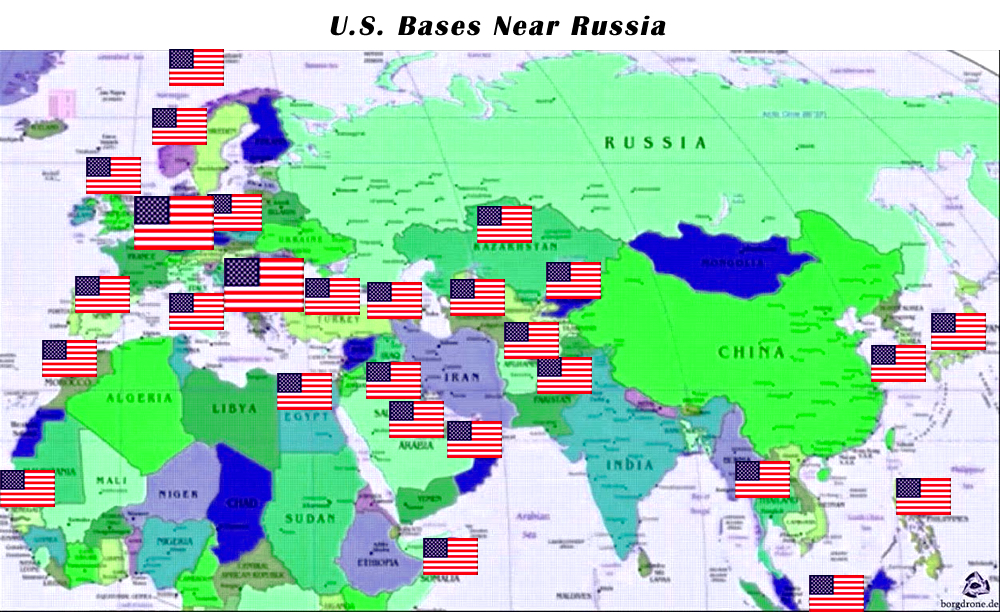
Failure and being seen to fail on NATO will deliver a huge political blow to western leaders who will keep kicking the peace can down the road
Ian Proud, Jun 03, 2025, https://thepeacemonger.substack.com/p/a-peace-deal-in-istanbul-wont-happen?utm_source=post-email-title&publication_id=3221990&post_id=165018630&utm_campaign=email-post-title&isFreemail=true&r=1ise1&triedRedirect=true&utm_medium=email
Russia will not end the war until, at the very least, Ukraine revokes its commitment to join NATO. If and when that happens, European leaders will have to confront their failure, justify it to their voters and explain why they prolonged the war for so long.
The next round of Istanbul peace talks commenced today, with UK media playing down the chances of a breakthrough. Helpful signs emerged of another prisoner exchange. Ukraine will consider Russia’s draft memorandum. There is a more clearly stated intent to continue talks towards a possible future meeting of leaders.
In a war that has long passed the one million mark in numbers of people killed or injured across both sides, no one will emerge from this process completely victorious when the fighting ends if, indeed, it ends this year.
But for President Zelensky and for western leaders, particularly in Europe, it is not victory but rather the fear of failure that presents the biggest stumbling block to a quick peace deal. Lacking sufficient financial and military support from western sponsors, and under pressure from the Trump administration to settle, Ukraine may at some point be forced to revoke its aspiration to join NATO.
NATO is by far the most stubborn ‘root cause’ that Russia is looking to address through negotiations, although the list of issues including on minority language rights, the division and status of territory, and Ukrainian children (raised today in Istanbul) is very long.
And NATO membership for Ukraine is an issue that President Trump and US officials including defence Secretary Pete Hegseth, negotiator Steve Witkoff and Ukraine Envoy Keith Kellogg have all acknowledged as unrealistic.
Undaunted, Zelensky, European leaders and the NATO secretary general still cling to an ever more tenuous line that the path to Ukrainian membership is irreversible.
That is untenable.
Russia has the military and economic means to continue the attritional fight, at a time when its slow but steady rate of progress in the Donbas is accelerating into the summer. There is not a scrap of evidence that Ukraine can recover its position, nor financial or military rabbits that increasingly cash and vote strapped European politicians can pull out of the hat.
Ukraine cannot win the war. It is cynical and self-serving for the hordes of mainstream politicos and pundits to suggest otherwise.
Ukraine will eventually have no choice but to let go of its demand for NATO membership. That will take Ukraine back to March to April 2022, when its negotiators agreed to the inclusion of a clause on neutrality in the draft Istanbul 1 peace treaty, that was derailed by Boris Johnson.
The key substantive difference between Istanbul 1 and a possible Istanbul 2 treaty, will be that Ukraine has since lost hundreds of thousands of troops to death or injury and is a matter of months from losing the whole of the Donbas.
After the first, brief, set of peace talks in Istanbul on 16 May, President Zelensky was quick to assert that there could be no return to the Istanbul 1 draft as a starting point for talks.
But I am afraid that the neutrality issue is not going away.
Ukraine is not going to join NATO.
Not joining NATO is the stinging nettle that Zelensky will sooner or later have to grip. And having clung so long to the NATO aspiration and sent so many Ukrainian troops to their deaths, the political ramifications will be searing
It is therefore this fear of failing and being seen to fail that is acting as the biggest stumbling block to a peace deal, as talks resumed today. That fear of failure is shared by Ukraine’s European sponsors.
Going back to the start of the war, then UK Prime Minister Boris Johnson said that ‘Putin must fail and must be seen to fail.’
Unfortunately for Johnson, when Ukraine is forced to give up its NATO aspiration, he will have failed and be seen to have failed.
Despite its enormous losses of men and materiel, Russia will have seen off the world’s biggest military bloc. The very idea of this is politically terrifying to the likes of Boris Johnson, Liz Truss and Keir Starmer who spent their time in office telling us that victory over Russia would be a doddle.
The UK mainstream media still clings to the victory narrative like a comfort blanket. Even today, the UK state-owned broadcaster, the BBC, reasserted the line that Putin failed in his bid to overrun Kyiv at the start of the war, remove Zelensky, and install a puppet government. And that is a legitimate claim to make.
But this war has never really been about the violent overthrow of a neighbouring Head of State. It is now and has been since 2022 an existential struggle to prevent further NATO expansion up to Russia’s border.
Western pundits argue endlessly that Russia has no right of veto over NATO. But when it boils down to it, governments decide the core strategic interests of their countries, not foreign pundits. NATO and its members should never have forced the issue of membership for Ukraine unless they were willing to fight Russia over it.
And NATO has never been willing to fight Russia for Ukraine’s right to choose.
The warning signs were there at President Putin’s 2007 Munich Security Conference Speech, during Russia’s brief war with Georgia in 2008 and following the overthrow of Ukrainian President Yanukovych in February 2014.
Through endless sanctions and efforts to impose international isolation, Russia’s position on NATO has never changed and will never change.
British and western media continue to promote a host of questionable assertions to keep hopes up that Russia really is losing and has been losing from the start. Russia’s imminent economic collapse, a likely coup d’etat made more real by Prigozhin’s rebellion, overwhelming battlefield losses of the Russian army, compared to the Ukrainian (even though there is a large body of analysis suggesting the picture is the complete opposite). And that just a few more billion dollars should be enough to finish the job.
The western propaganda path to victory has been gaslit like a badly cobbled Victorian street.
Putin must fail and must be seen to have failed.
Yet, when a peace treaty is finally agreed between Russia and Ukraine, it will become clear that western leaders failed. And they will be seen by their voters to have failed, with potentially disastrous domestic political consequences for traditional parties all across a Europe in economic and cultural decline.
Moreover, Europe will have to swallow the bitter pill of being pressured by Trump to accelerate Ukraine’s membership of the EU at a financial cost to ordinary European citizens far greater than the war itself. Little wonder then that indulging Zelensky and maintaining a slowly losing war has cynically been an easier choice for many, rather than striking for peace.
So don’t hold your breath for a quick peace deal out of Istanbul. The queue of European politicians lining up to kick the failure can down the road, from Von der Leyen, Rutte, Merz, Macron, Stubb, Starmer and the whole lot of them, is very long indeed.
Iran says IAEA new report on nuclear activities politically motivated, based on Israel’s fake documents
By IFP Editorial Staff, June 1, 2025, https://ifpnews.com/iran-iaea-new-report-nuclear-activities-politically-motivated-israels-fake-documents/
The Foreign Ministry and the Atomic Energy Organization of Iran (AEOI) have issued a joint statement in response to the latest report by the International Atomic Energy Agency (IAEA), regarding Iran’s nuclear program, denouncing it as “political” and based on forged documents provided by the Israeli regime.
Iran stressed on Saturday that the accusation from the IAEA was “politically motivated and repeats baseless allegation”.
“The repetition of baseless allegations that cannot lend credibility to these claims, coupled with voicing too much concern in this regard, serves merely as a pretext for political propaganda against the Islamic Republic of Iran,” the statement said.
“This is while the fake Israeli regime, without being a signatory to the NPT, possesses a nuclear arsenal and simultaneously threatens the peaceful nuclear facilities of an NPT member nation. Unfortunately, despite his legal duties and repeated requests from the Islamic Republic of Iran to condemn these threats, the IAEA director general has taken no action,” it added.
Iran expressed “deep regret about the director general’s lack of impartiality and his disregard for professional conduct under political pressures in the preparation and publication of the report”.
“Unfortunately, despite such broad cooperation on part of Iran, the comprehensive report prepared, although acknowledging Iran’s cooperation, does not reflect the actual level of such cooperation,” the statement read.
“In the report, the director general, by relying extensively on forged documents provided by the Zionist regime, has reiterated previous biased and unfounded accusations. The allegations leveled in the current report are based on a few claims about undeclared activities and locations from past decades. This is while Iran has repeatedly declared that it has had no undeclared nuclear sites or activities.”
In its latest report, the IAEA claimed that Iran has sharply increased its stockpile of uranium enriched to up to 60 percent, close to the roughly 90 percent level needed for atomic weapons.
In its quarterly report, the agency said that as of May 17, Iran possesses an estimated 408.6 kilograms of uranium enriched up to 60 percent, marking an increase of 133.8 kilograms since the previous report in February.
According to the report, Iran’s total amount of enriched uranium now exceeds 45 times the limit authorized by the 2015 agreement – formally known as the Joint Comprehensive Plan of Action — and is estimated at 9,247.6 kilograms.
Iran rejects IAEA report alleging increased enriched uranium stockpile

Aljazeera, 31 May 2025
The UN nuclear watchdog warns Tehran could be close to weapons-grade enriched uranium, as negotiations with the US continue.
Iran has rejected a report from the United Nations nuclear watchdog that alleges Tehran has increased its stockpile of highly enriched, near weapons-grade uranium by 50 percent in the last three months.
Iran said on Saturday that the accusation from the International Atomic Energy Agency (IAEA) was “politically motivated and repeates baseless accusations”.
It all comes as nuclear deal negotiations are under way between the United States and Iran, with the Iranian Foreign Minister Abbas Araghchi saying that his country would respond to “elements of a US proposal” his Omani counterpart, Badr Al-Busaidi, had presented during a short visit to Tehran on Saturday.
Araghchi said that the proposal would be “responded to in line with the principles, national interests and rights of the people of Iran”.
Tehran insists that its nuclear programme is for peaceful purposes only.
The IAEA said that as of May 17, Iran had amassed 408.6kg (900.8 pounds) of uranium enriched up to 60 percent – the only non-nuclear weapon state to do so, according to the UN agency – and had increased its stockpile by almost 50 percent to 133.8kg since its last report in February.
The wide-ranging, confidential report seen by several news agencies said Iran carried out secret nuclear activities with material not declared to the IAEA at three locations that have long been under investigation, calling it a “serious concern” and warning Tehran to change its course.
The Iranian Foreign Ministry slammed the report, saying the agency had used “forged documents provided by the Zionist regime [Israel]” and reiterated “previous biased and baseless accusations”.
Iran refutes allegations of undeclared nuclear sites or activities, stressing that it has instead cooperated with the agency in providing all necessary access to the alleged sites, it said.
“The Islamic Republic of Iran, while expressing regret over the publication of this report, which was prepared for political purposes through pressure on the agency, expresses its clear objection to its content,” the statement added.
Araghchi reaffirmed the country’s longstanding position, saying Tehran deems nuclear weapons “unacceptable”.
“If the issue is nuclear weapons, yes, we too consider this type of weapon unacceptable,” Araghchi, Iran’s lead negotiator in the nuclear talks with the US, said in a televised speech. “We agree with them on this issue.”
‘Both sides building leverage’
But the report, which was requested by the IAEA’s 35-nation board of governors in November, will allow for a push by the US, Britain, France and Germany to declare Iran in violation of its non-proliferation obligations.
On Friday, US President Donald Trump said Iran “cannot have a nuclear weapon”………………………………………………………… https://www.aljazeera.com/news/2025/5/31/iran-increases-stockpile-of-enriched-uranium-by-50-percent-iaea-says
Putin’s demands for peace include an end to NATO enlargement, sources say.
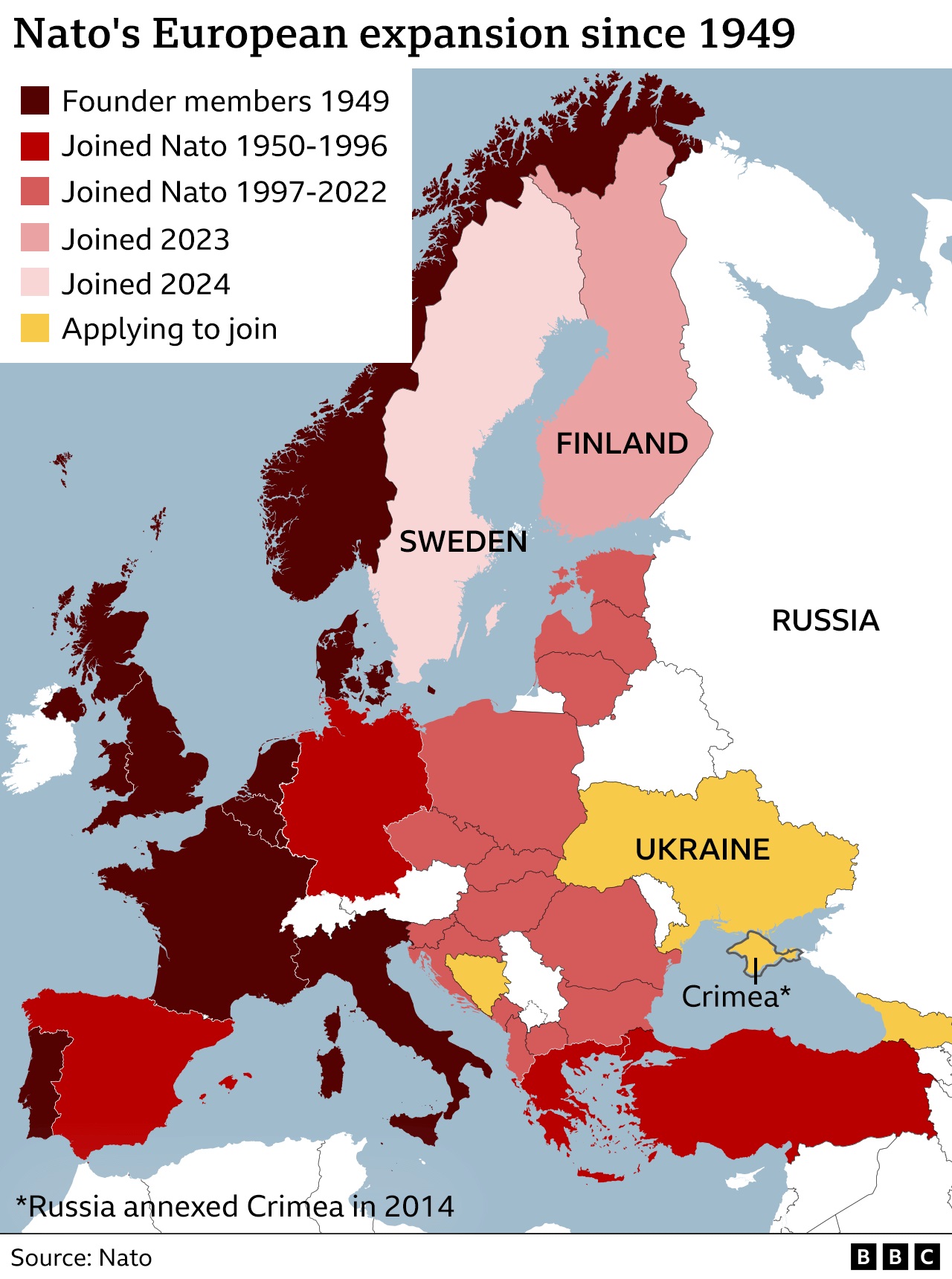
By Guy Faulconbridge, https://www.reuters.com/world/europe/putin-ukraine-peace-wants-pledge-halt-nato-enlargement-sources-say-2025-05-28/
President Vladimir Putin’s conditions for ending the war in Ukraine include a demand that Western leaders pledge in writing to stop enlarging NATO eastwards and lift a chunk of sanctions on Russia, according to three Russian sources with knowledge of the negotiations. U.S. President Donald Trump has repeatedly said he wants to end the deadliest European conflict since World War Two and has shown increasing frustration with Putin in recent days, warning on Tuesday the Russian leader was “playing with fire” by refusing to engage in ceasefire talks with Kyiv as his forces made gains on the battlefield.
After speaking to Trump for more than two hours last week, Putin said that he had agreed to work with Ukraine on a memorandum that would establish the contours of a peace accord, including the timing of a ceasefire. Russia says it is currently drafting its version of the memorandum and cannot estimate how long that will take. Kyiv and European governments have accused Moscow of stalling while its troops advance in eastern Ukraine.
“Putin is ready to make peace but not at any price,” said one senior Russian source with knowledge of top-level Kremlin thinking, who spoke on condition of anonymity. The three Russian sources said Putin wants a “written” pledge by major Western powers not to enlarge the U.S.-led NATO alliance eastwards – shorthand for formally ruling out membership to Ukraine, Georgia and Moldova and other former Soviet republics.
Russia also wants Ukraine to be neutral, some Western sanctions lifted, a resolution of the issue of frozen Russian sovereign assets in the West, and protection for Russian speakers in Ukraine, the three sources said. The first source said that, if Putin realizes he is unable to reach a peace deal on his own terms, he will seek to show the Ukrainians and the Europeans by military victories that “peace tomorrow will be even more painful”. The Kremlin did not respond to a request for comment on Reuters’ reporting.
Putin and Russian officials have repeatedly said any peace deal must address the “root causes” of the conflict – Russian shorthand for the issue of NATO enlargement and Western support for Ukraine. Kyiv has repeatedly said that Russia should not be granted veto power over its aspirations to join the NATO alliance. Ukraine says it needs the West to give it a strong security guarantee with teeth to deter any future Russian attack.
President Volodymyr Zelenskiy’s administration did not respond to a request for comment. NATO has also in the past said that it will not change its “open door” policy just because Moscow demands it. A spokesperson for the 32-member alliance did not respond to Reuters’ questions. Putin ordered tens of thousands of troops into Ukraine in February 2022 after eight years of fighting in eastern Ukraine between Russian-backed separatists and Ukrainian troops. Russia currently controls just under one fifth of the country. Though Russian advances have accelerated over the past year, the war is costing both Russia and Ukraine dearly in terms of casualties and military spending. Reuters reported in January that Putin was growing concerned by the economic distortions in Russia’s wartime economy, amid labour shortages and high interest rates imposed to curb inflation. The price of oil, the bedrock of Russia’s economy, has declined steadily this year.
Trump, who prides himself on having friendly relations with Putin and has expressed his belief the Russian leader wants peace, has warned that Washington could impose further sanctions if Moscow delays efforts to find a settlement. Trump suggesting on social media on Sunday that Putin had “gone absolutely CRAZY” by unleashing a massive aerial attack on Ukraine last week. The first source said that if Putin saw a tactical opportunity on the battlefield, he would push further into Ukraine – and that the Kremlin believed Russia could fight on for years no matter what sanctions and economic pain were imposed by the West.
A second source said that Putin was now less inclined to compromise on territory and was sticking to his public stance that he wanted the entirety of four regions in eastern Ukraine claimed by Russia.
“Putin has toughened his position,” the second source said of the question of territory.
NATO ENLARGEMENT
As Trump and Putin joust in public over the outlook for peace in Ukraine, Reuters could not determine whether the intensification of the war and the toughening of positions heralds determination to reach a deal or the collapse of talks. In June last year, Putin set out his opening terms for an immediate end to the war: Ukraine must drop its NATO ambitions and withdraw all of its troops from the entirety of the territory of four Ukrainian regions claimed and mostly controlled by Russia.
In addition to Crimea, which it annexed in 2014, Russia currently controls almost all of Luhansk, more than 70% of Donetsk, Zaporizhzhia and Kherson regions. It also occupies a sliver of the Kharkiv and Sumy regions, and is threatening Dnipropetrovsk.
Former U.S. President Joe Biden, Western European leaders and Ukraine cast the invasion as an imperial-style land grab and have repeatedly vowed to defeat Russian forces. Putin casts the war as a watershed moment in Moscow’s relations with the West which he says humiliated Russia after the Soviet Union fell in 1991 by enlarging NATO and encroaching on what he considers Moscow’s sphere of influence.
At the 2008 Bucharest summit, NATO leaders agreed that Ukraine and Georgia would one day become members. Ukraine in 2019 amended its constitution committing to the path of full membership of NATO and the European Union.
Trump has said that previousU.S. support for Ukraine’s NATO membershipbid was acause of the war, and has indicated that Ukraine will not get membership. The U.S. State Department did not respond to a request for comment for this story.
Putin, who rose to the top Kremlin job in 1999, has repeatedly returned to the issue of NATO enlargement, including in his most detailed remarks about a possible peace in 2024.
In 2021, just two months before the Russian invasion, Moscow proposed a draft agreement, with NATO members that, under Article 6, would bind NATO to “refrain from any further enlargement of NATO, including the accession of Ukraine as well as other States.” U.S. and NATO diplomats said at the time that Russia could not have a veto on expansion of the alliance. Russia wants a pledge on NATO in writing because Putin thinks Moscow was misled by the United States after the 1989 fall of the Berlin Wall when U.S. Secretary of State James Baker assured Soviet leader Mikhail Gorbachev in 1990 that NATO would not expand eastwards, two of the sources said.
There was such a verbal promise, former Central Intelligence Agency Director Director William J. Burns said in his memoires, but it was never formalised – and it was made at a time when the collapse of the Soviet Union had not occurred.
NATO, founded in 1949 to provide security against the Soviet Union, says it poses no challenge to Russia – though its 2022 assessment of peace and security in the Euro-Atlantic area identified Russia as the most “significant and direct threat”.
Russia’s invasion of Ukraine that year prompted Finland to join NATO in 2023, followed by Sweden in 2024.
Western European leaders have repeatedly said that if Russia wins the Ukraine war, it could one day attack NATO itself – a step that would trigger a world war. Russia dismisses such claims as baseless scaremongering, but has also warned the war in Ukraine could escalate into a broader conflict.
Comment: Putin wants a deal, Trump wants a deal, Zelensky…wants.
How Donald Trump Discovers the Art of Political Negotiation
Donald Trump knew nothing about the history of Russia and Ukraine, but he’s learning quickly. He no longer believes the Western delusions that Moscow wants to invade Ukraine, and then the rest of Europe. Nor does he believe the delusions of Kaja Kallas and the Balts, for whom Russia is a “prison of peoples” that must be dismembered.
by Thierry Meyssan, Voltaire Network | Paris (France) | 27 May 2025 https://www.voltairenet.org/article222331.html
We don’t understand the negotiations in Ukraine and the Middle East because we don’t understand the difference between wars and civil conflicts. We approach peacemaking as if it were a matter of dividing up common property during a divorce, after a few years of living together. But wars are of unparalleled intensity and are rooted in long-standing conflicts, often spanning several generations. Generally speaking, material conditions, suffering, and violence are of secondary importance compared to injustices.
Furthermore, the negotiating method of this business leader turned head of state, like Donald Trump, is dizzying. He strives to evoke incoherent positions and maintain none, simply to shake up his partners in the hope of getting their assets out of their pockets. This method, which has nothing diplomatic about it, ignores the underlying causes of conflicts. It only acknowledges what each side complains about. Ultimately, it can lead to agreements that some signatories might accept at the moment, but later regret.
In any case, we must act quickly. The wars in Ukraine and the Middle East, even though they have diminished in intensity, continue to kill and destroy. The sensational announcements that this or that war could have been resolved in a few days have already run up against harsh realities.
True diplomats and true warriors don’t aim to win over others, but to live with them. They can’t get along with business leaders who want to be the best, but they can solve problems with the help of those who intend to produce what can be useful to others. Donald Trump is of this ilk.
However, the current problems are not Russian, but primarily American. This could also be the case with Palestine and Iran. Making progress on the Ukrainian conflict requires, first and foremost, not changing the Russian point of view, but addressing the unconditional support of some Westerners for the “integral nationalists,” historical allies of the Nazis. It quickly became clear to the Trump team that the Russian claim to “denazify” Ukraine was not a war propaganda invention [1]. There are several hundred monuments to the glory of Reich collaborators in Ukraine, not to mention buildings and avenues bearing their names [2]. Reading the works of Dmytro Dontsov, particularly his book Націоналізм (Nationalism), is now mandatory in the Ukrainian armed forces; a work equivalent to Adolf Hitler’s Mein Kampf (My Struggle) [3]. The most important church in Ukraine was banned because it recognizes the authority of the Patriarch of Moscow.
Several million books were burned because they were written in Russian, that evil language, or because they were written by Russian authors, such as Alexander Pushkin (1799-1837) or Leo Tolstoy (1828-1910). All opposition political parties have been banned, and the current president, Volodymyr Zelensky, has banned new elections by extending the martial law that prohibits them every three months.
To address this issue, Donald Trump must give the Ukrainians something in return. He chose to question the savagery Russia displays when it is certain it is right, which it is. The Western press chose to focus only on the passage where the US president wonders if Vladimir Putin has gone mad. But in the same post, he also denounced Volodymyr Zelensky’s speech. He thus equated the Russian president’s cruelty with the Ukrainian leader’s bad faith. It is important to realize that while emotionally he gives the Ukrainians the upper hand, politically he gives it to the Russians.
It turns out that we belong to a civilization where emotion has replaced reason. We mourn with the fundamental nationalists, believing we share the suffering of the Ukrainians. However, in time, we will recognize the facts and turn against the fundamental nationalists we support today, or even against Ukrainians in general, because we will be ashamed of our current positions. This is the way of history: we always return to positions we can be proud of.
Vladimir Putin has already anticipated our reversal. According to him, the European Union’s unilateral coercive measures will not last. We will eventually return to our former loves, when we celebrated Franco-Russian friendship. This is why he is holding back his army, whose military superiority would have allowed him to capture Odessa long ago and thus complete the reconstruction of the old Russia.
This is what’s at stake now. Territorial boundaries matter little compared to relationships between people. Material issues are always secondary to individual freedom. The people living in Ukraine will have no trouble accepting the partition of their country once they are freed from the pressure exerted on them by the fascists who massacred their great-grandparents.
Donald Trump knew nothing about the history of Russia and Ukraine, but he’s learning quickly. He no longer believes the Western delusions that Moscow wants to invade Ukraine, and then the rest of Europe. Nor does he believe the delusions of Kaja Kallas and the Balts, for whom Russia is a “prison of peoples” that must be dismembered.
Similarly, Donald Trump knew nothing about the history of Israel and Iran, but he learned that the revisionist Zionists of Yitzak Shamir organized SAVAK, the political police of the Shah, Reza Pahlevi, and his Prime Minister, the Nazi General Fazlollah Zahedi, who had just left British jails after the overthrow of Mohammad Mossadegh [4]. It is difficult to admit, but yes, the terrible SAVAK was organized by Israeli Jews, “revisionist Zionists,” in the service of a Nazi general [5], just as it is difficult to admit that the Ukrainian integral nationalists killed many more of their compatriots than foreign enemies. Donald Trump and his negotiator, Steve Witkoff, have understood that what is at stake in the Middle East is not military nuclear power (even if it is Israel and not Iran that has the bomb), but the second round of crimes committed by the Shah’s regime with the discreet support of certain Israelis.
Does Tehran want the bomb?
by beyondnuclearinternational, Linda Pentz Gunter
https://beyondnuclearinternational.org/2025/05/25/does-tehran-want-the-bomb/
Is Iran’s nuclear power program a tactical threat or purely commercial, asks Linda Pentz Gunter
“As a party to the Non-Proliferation Treaty (NPT), the Islamic Republic of Iran, based on its religious and ethical principles, has never sought nuclear weapons and remains committed to the principle of non-production and non-use of weapons of mass destruction.”
That was the reassurance given by Iran’s foreign minister, Seyyed Abbas Araghchi, during the Tehran Dialogue Forum hosted earlier this month by the Center for Political and International Studies of Iran’s Foreign Ministry.
It’s a familiar refrain. Iran has consistently argued that it is exercising its “inalienable right” as a signatory to the NPT “to develop research, production and use of nuclear energy for peaceful purposes” as allowed under Article IV of the treaty.
But is it?
Iran has freely admitted that it has enriched uranium-235 up to 60% — considered at least “weapons usable” (higher than 90% is considered weapons-grade.) Why would it choose to — or need to — do this if it has no intention of seeking nuclear weapons production, as Araghchi and others before him have claimed?
The answer to that question seems obvious and one we have repeated ad infinitum when exposing the flaw in the NPT which, in granting the development of civilian nuclear programs to signatories, ensures the pathway to the bomb is left permanently clear.
Even should Iran never actually develop nuclear weapons, it can use its civil program as a threat to do so. It is no idle threat. The possession of a civilian nuclear program affords Iran the materials, equipment, personnel and know-how to transition to nuclear weapons should it so choose.
What might push Iran to make that choice depends a lot on how the current talks go. Keeping Israel at bay — which wanted to start bombing Iran’s nuclear installations immediately — was one of the few sensible decisions the Trump administration has made.
However, in the view of Mohsen Milani, Executive Director of the Center for Strategic & Diplomatic Studies and Professor of Politics at the University of South Florida, developing nuclear weapons has always been on Iran’s agenda. Milani was speaking during a May 20 webinar on the Iran nuclear talks hosted by the Quincy Institute. You can watch the full webinar below.
“I have always believed and I continue to believe that Iran’s nuclear program was based on turning Iran into a potential nuclear power,” Milani said. “That is a power that has the infrastructure, the expertise, to develop a bomb should they decide to develop a bomb.”
How close Iran might be to that achievement is also much debated. In July 2024, then Secretary of State, Antony Blinken, suggested Iran “is now probably one or two weeks” away from producing enough weapons grade material to make a nuclear weapon. Milani thinks Iran “is much closer than it has ever been,” but doubts the timeline is one or two weeks.
But the key is that “Iran’s nuclear program has never been the central part of Iran’s defense posture, nor has the axis of resistance,” Milani said, referring to the informal coalition of Iranian-supported organizations across the region united to counter the influence of Israel and the US. What Iran is doing is ensuring it can keep the nuclear option, “should there be a need for it,” Milani said. The Trump administration’s approach in these negotiations, in Milani’s view, “is they want to make sure that Iran is incapable of doing what it has tried to do for the past twenty years.”
The whole issue of Iran’s nuclear aspirations is squarely in the news again as the Trump administration continues talks with Tehran about its nuclear program. Confusion and uncertainty has been created by the US side, principally Trump’s Special Envoy to the Middle East, real estate developer Steve Witkoff, who has told Iran it can enrich uranium to commercial grade (below 5%), then changed his tune and insisted Iran can have no nuclear program at all.
After four rounds of largely fruitless talks, the Iranians began to lose patience, laying down their red line. “To say that ‘we will not allow Iran to enrich uranium’ is a huge mistake,” warned Ayatollah Khamenei of the American threat. “No one is waiting for permission from anyone. The Islamic Republic has its own policies, its own methods, and it pursues its own agenda,” he added.
Pushing Iran around on this might lead to another negative outcome. Iran could leave the NPT. “As a founding advocate for a nuclear-weapons-free zone in West Asia and a long-time NPT member, Iran has shown good faith by engaging in indirect talks with the United States,” Araghchi said at the conference. “But the Iranian nation cannot forfeit its legitimate right to peaceful nuclear technology, including enrichment, which is enshrined in the NPT.”
The speakers on the Quincy webinar agreed that this public back-and-forth by both sides was a mistake and that Iran should deal directly with the United States instead of through an intermediary, and behind closed doors.
By last Wednesday, the Iranian parliament had also made its views known, declaring it would not be held to any uranium enrichments level caps.
By Friday, a fifth round of talks had taken place, again with the Omanis as intermediaries at least some of the time. It was unclear what, if any, progress had been made, with both sides sounding cautiously optimistic. However, a red line for Iran remains the prospect of shipping its entire stockpile of enriched uranium to Russia, as the Americans have suggested. Iran still insists it is happy to renounce any future nuclear weapons production, but not uranium enrichment. Further talks are planned.
But at the end of the day a larger question looms, which is whether nuclear nations like the US, which claims might and influence due to the possession of its nuclear weapons, has a right to tell another country it cannot have them?
Rather than perpetually wrestling with the nuclear hydra, the US could lead by a very different example and show the world that all of these extreme threats would be eliminated by disarming from nuclear weapons altogether. And given the template of flaws that Iran has laid out for us regarding our current disarmament treaties, that means abolishing nuclear power as well.
Linda Pentz Gunter is the international specialist at Beyond Nuclear and writes for and edits Beyond Nuclear International. Opinions are her own.
Trump warns Netanyahu off Iran strike as nuclear talks continue
28 May,2025 https://www.aljazeera.com/news/2025/5/28/trump-warns-netanyahu-off-iran-strike-as-nuclear-talks-continue
US president says an Israeli strike ‘would be inappropriate to do right now because we’re very close to a solution.’
United States President Donald Trump has said that he told Israeli Prime Minister Benjamin Netanyahu to hold off on any strike against Iran to give his administration more time to push for a new nuclear deal with Tehran, as several rounds of talks have been held in Oman and Italy.
Trump told reporters on Wednesday at the White House that he relayed to Netanyahu a strike “would be inappropriate to do right now because we’re very close to a solution”
The Israeli leader has been threatening a bombardment of Iranian nuclear facilities. Iran has said it would respond with severity if any such attack were launched.
In the meantime, Iran may pause uranium enrichment if the US releases frozen Iranian funds and recognises its right to refine uranium for civilian use under a “political deal” that could lead to a broader nuclear accord, two Iranian official sources told the Reuters news agency.
The sources, close to the negotiating team, said on Wednesday that a “political understanding with the United States could be reached soon” if Washington accepted Tehran’s conditions. The sources told Reuters that under this arrangement, Tehran would halt uranium enrichment for a year.
The latest developments came as the head of the UN’s atomic watchdog group said that “the jury is still out” on negotiations between Iran and the US over Tehran’s rapidly advancing nuclear programme. But Rafael Mariano Grossi described the ongoing negotiations as a good sign.
“I think that is an indication of a willingness to come to an agreement. And I think that… is something possible.”
The 2015 nuclear deal, formally known as the Joint Comprehensive Plan of Action (JCPOA), placed limits on Iran’s nuclear programme in exchange for sanctions relief.
It collapsed after Trump unilaterally withdrew the US from the agreement in 2018, leading to a sharp escalation in tensions and a breakdown in diplomatic relations.
The key sticking point
US officials have repeatedly said that any new deal must include a firm commitment from Iran to halt uranium enrichment, which they view as a potential pathway to building nuclear weapons.
However, Iran has consistently denied seeking nuclear arms, insisting its programme is solely for civilian purposes. It has rejected Washington’s demand to eliminate enrichment capabilities, calling it an infringement on national sovereignty.
It remains the critical sticking point after negotiators for Tehran and Washington met for a fifth round of Oman-mediated talks in Rome.
Instead, Iran has reportedly proposed that the US publicly recognise Tehran’s right to enrich uranium under the Nuclear Non-Proliferation Treaty (NPT), and approve the release of Iranian oil revenues frozen under US sanctions.
Trump’s role in provoking Russia’s destruction of Ukraine should not be ignored

May 28, 2025 AIMN Editorial By Walt Zlotow, , West Suburban Peace Coalition, Glen Ellyn IL , https://theaimn.net/trumps-role-in-provoking-russias-destruction-of-ukraine-should-not-be-ignored/
Russia invaded Ukraine under President Biden’s presidency, beginning its destruction as a viable state. Biden directly provoked the invasion in several ways.
He refused to promote implementing the Minsk II Accords which would have given the Russian cultured Ukrainians in Donbas independence and security from Kyiv nationalists killing them since 2014. He kept pushing for Ukraine to join NATO, a red line guaranteeing eventual Russian intervention. Seasoned US diplomates were apoplectic about that to no avail. He kept arming the Kyiv neofascists to complete victory over the Donbas separatists and further isolate Russia from Western Europe.
Worst of all Biden essentially told Russia to ‘piss off’ when they begged him to consider Russia’s valid security concerns over NATO expansion and sabotaging Minsk II. For Biden, Russia’s security concerns were simply “not subject for discussion.”
Trump campaigned for re-election charging the Russian invasion was solely Biden’s fault.
Big lie.
Trump spent his entire term keeping alive eventual Ukraine NATO membership. Worse, Trump set the stage for Biden’s duplicity by revering predecessor Obama’s prohibition on arming the Kyiv regime to both destroy the Donbas separatist movement and prepare for possible war with Russia. Trump didn’t interfere with Germany, France and UK using the promise of Minsk II independence to stall for time allowing Ukraine to build up its military capability mainly provided by Trump.
Trump now finds himself bollixed up from his stupid promise to end the war in one day. On day 127 he’s completely outmaneuvered by Russia which holds all the cards for completing their takeover of the eastern fifth of Ukraine, administering a crushing defeat to US plans to weaken/destroy the Russian regime while bringing Ukraine into NATO.
Historians will assign Biden’s unhinged Ukraine policy promoting Ukraine NATO membership, arming Ukraine to finish off Donbas separatists and dismissal of Russia’s security concerns as the primary causes of America’s failed proxy war against Russia in Ukraine.
But they should include Trump’s reckless, duplicitous Ukraine policy preceding Biden’s igniting the invasion in their history of this totally senseless, unnecessary war.
Why the US Won’t Be Able to Help Build Taiwan’s Nuclear Future
Washington itself hasn’t solved the problems that fed into Taiwan’s nuclear phase-out: waste storage and high costs.
By Benjamin Yang and M.V. Ramana, May 26, 2025, https://thediplomat.com/2025/05/why-the-us-wont-be-able-to-help-build-taiwans-nuclear-future/
When the 40-year operating license of Taiwan’s last remaining commercial nuclear reactor expired on May 17, the country realized its nuclear phase-out policy after decades of politicized debates.
If anything, though, the imminent decommissioning of the Maanshan Nuclear Power Plant’s second reactor has only fueled another round of heated discussions on the potential role of nuclear power in Taiwan’s energy future.
On May 13, the Legislative Yuan – Taiwan’s national legislature, where opposition parties currently hold a majority – passed amendments to the Nuclear Reactor Facilities Regulation Act, allowing nuclear power plant operators to apply for a 20-year license renewal beyond the original 40-year cap and easing restrictions on their restarts. In the meantime, it also passed a proposal from the Taiwan People’s Party (TPP) for a referendum on restarting the Maanshan plant, which is now set to take place in August.
Such renewed interest in nuclear energy is a result of a few compounding factors: power shortage concerns amid grid-induced blackouts over the past few years and growing power demands from the semiconductor and AI industries; rising electricity prices that pro-nuclear groups have framed as a result of phasing out nuclear; stalled momentum in renewable energy development; and national security threats of a naval blockade from China.
At the same time, there are several reasons why nuclear power may not really address these questions, most notably the high costs and long construction times of building nuclear plants. Meanwhile, proponents of the nuclear phase-out point to the risks of accidents associated with nuclear reactors and the lack of a demonstrated solution to managing radioactive wastes of different kinds produced by the nuclear fuel chain.
Amid this domestic debate in Taiwan over nuclear power, Director Raymond Greene of the American Institute in Taiwan, the de facto U.S. embassy, added a new twist. In a recent interview, he announced that the United States stands ready to introduce “existing and new technologies such as SMRs (small modular reactors) and to help Taiwan address its nuclear waste storage challenges.” Can U.S. support on SMRs and nuclear waste storage help with the challenges that led Taiwan to phase out nuclear power?
The problem with nuclear waste is two-fold: a shortage of short-term storage capacity at some sites, and the complete absence of a long-term option. Currently, Taiwan has over 21,500 spent fuel rods from almost five decades of operation; all but 112 of these are stored on-site, either in their respective reactor cores or spent fuel pools. Only a portion from the Chinshan Nuclear Power Plant has been moved to a dry storage facility. In July 2021, Taiwan Power Company, the state-owned utility that owns and operates all of Taiwan’s nuclear power plants, had to take unit 1 of the Kuosheng Nuclear Power Plant offline five months before the expiry of its operating license due to the lack of used fuel storage capacity. These are just the problems with short-term storage. In the long term, there is just no plan: the government has yet to create regulations governing the disposal of high-level waste.
With local government concerns over wastewater runoff pollution hampering progress on constructing dry storage facilities and a final disposal repository nowhere in sight, creating more nuclear waste through extensions, restarts, or even building new SMRs will only aggravate this unsolved issue.
The United States has no long-term plan for its nuclear waste, either. Yucca Mountain, the site selected back in 1987 under the 1982 Nuclear Waste Policy Act, proved to be technically problematic, because it had an oxidizing environment and, despite being advertised as a very dry site, proved to allow seepage of lots of water. No alternative site has been seriously considered since Yucca Mountain was picked, although high level committees like the Blue Ribbon Commission set up by President Barack Obama have recommended setting up a process to find a new site. In short, the United States has no successful experience to point to if it intends to help Taiwan with its nuclear waste.
The story is similar with SMRs, the other part of the offer from Greene. Despite much media attention and hype, the United States has so far not constructed a single small modular reactor. In terms of planning, the most advanced SMR project was proposed by the Utah Associated Municipal Power System. Announced in 2015, the UAMPS project was initially expected to start operations “around 2023” at an “overnight cost” of $3 billion. The estimated costs of the project subsequently rose to $6.1 billion, and finally $9.3 billion in 2023. That last figure was for a mere 462 megawatts of electricity capacity. Later that year, the project was canceled because of a lack of demand.
When viewed in terms of the cost per unit of power capacity (i.e., dollars per megawatt), the cost of the UAMPS project was higher than even the most expensive nuclear power plant built in the United States, the Vogle project in Georgia, which cost $36.8 billion. This is to be expected. Small modular nuclear reactors, which produce less than 300 megawatts of power as compared to the roughly 1,000 megawatts for the typical reactors that have been constructed in recent decades, are more expensive per unit of power capacity due to diseconomies of scale.
The underlying reason is that the cost of constructing or operating a nuclear reactor is not directly proportional to the amount of power it is designed to generate. SMRs, therefore, start off with an economic disadvantage and will further undermine the financial viability of nuclear plants.
In the United States, nuclear plants are the most expensive way to supply electricity and building SMRs will make nuclear power even less competitive, especially in comparison to solar and wind energy, with or without electricity storage. No wonder renewables constitute the vast majority of new electricity installations in the United States. Also growing rapidly are energy storage technology, geothermal technologies, and grid resilience innovations such as virtual power plants. If the U.S. is serious about addressing Taiwan’s energy situation, maybe these are the technologies it should be offering.
In the end, the decommissioning of Taiwan’s final nuclear reactor marks a critical crossroads in its energy transition. Every choice Taiwan makes at this juncture would need to tackle the multitude of challenges that come with balancing rising demands, economic development, national security, climate action, and public safety. With the storage solutions for existing nuclear waste yet to appear and the costliness of constructing SMRs both in terms of time and capital, nuclear is unable to serve as a safe, cost-effective, and timely climate solution – even with U.S. support.
Is Trump negotiating the U.S. into war with Iran?

May 26, 2025 AIMN Editorial, By Walt Zlotow , https://theaimn.net/is-trump-negotiating-the-u-s-into-war-with-iran/
Trump administration negotiations with Iran over their imaginary nuclear weapons program are disjointed beyond imagination. Trump swings back and forth between threatening massive bombing if no deal is reached, to claiming a deal can easily be reached. He hints Iran might be able to continue nuclear enrichment for peaceful purposes, then demands zero enrichment because their massive oil resources make enrichment unnecessary and unacceptable.
Iranian diplomats seeking end to US sanctions and recognition Iran is not building nuclear weapons are discombobulated by Trump’s unhinged negotiating style. They are stuck in negotiations with the guy who blew up Obama’s top foreign policy achievement, the 2015 Iran nuclear agreement which had potential to end America’s delusional obsession with Iran’s nonexistent nuclear weapons program.
Iran has good reason to distrust Trump’s negotiating tactics. His team negotiated Hamas’ release of an American Israeli hostage in return for resumption of food, water, medicine aid. Upon release Trump reneged on that promise to keep the genocidal ethnic cleansing on track to speed up his planed Gaza mega real estate project.
Complicating the negotiations is Israel’s decades’ long lust to destroy the Iranian regime and render Iran powerless to oppose Israeli hegemony in the region. Rumours are flying that Israel is prepared to attack Iran if a deal comes close to allowing any Iranian uranium enrichment whatever.
Regarding Iran, Trump has rewritten the rulebook on delicate foreign policy negotiations.
- Start by publicly threatening annihilation
- Claim success is at hand
- Promise nothing in return for everything
- Have negotiators offer contradictory views and statements on the negotiations
- Display duplicity in negotiating promises
- Allow a small country committing genocide to dictate negotiating terms
- Blame inevitable failure on one’s predecessors or the other side
Is Trump negotiating the U.S. into war with Iran? It’s beginning to look like it.
1 This Month
Chernobyl: The Lost Tapes – A good documentary on Chernobyl on SBS available On Demand for the next 3 weeks– https://www.sbs.com.au/ondemand/tv-program/chernobyl-the-lost-tapes/2352741955560

of the week–London Campaign for Nuclear Disarmament

Tell the Ukrainian Government to Drop Prosecution of Peace Activist Yurii Sheliazhenko
To see nuclear-related stories in greater depth and intensity – go to https://nuclearinformation.wordpress.com
-
Archives
- April 2026 (126)
- March 2026 (251)
- February 2026 (268)
- January 2026 (308)
- December 2025 (358)
- November 2025 (359)
- October 2025 (376)
- September 2025 (257)
- August 2025 (319)
- July 2025 (230)
- June 2025 (348)
- May 2025 (261)
-
Categories
- 1
- 1 NUCLEAR ISSUES
- business and costs
- climate change
- culture and arts
- ENERGY
- environment
- health
- history
- indigenous issues
- Legal
- marketing of nuclear
- media
- opposition to nuclear
- PERSONAL STORIES
- politics
- politics international
- Religion and ethics
- safety
- secrets,lies and civil liberties
- spinbuster
- technology
- Uranium
- wastes
- weapons and war
- Women
- 2 WORLD
- ACTION
- AFRICA
- Atrocities
- AUSTRALIA
- Christina's notes
- Christina's themes
- culture and arts
- Events
- Fuk 2022
- Fuk 2023
- Fukushima 2017
- Fukushima 2018
- fukushima 2019
- Fukushima 2020
- Fukushima 2021
- general
- global warming
- Humour (God we need it)
- Nuclear
- RARE EARTHS
- Reference
- resources – print
- Resources -audiovicual
- Weekly Newsletter
- World
- World Nuclear
- YouTube
-
RSS
Entries RSS
Comments RSS
 nuclear-news