Despite the benefits that several countries would receive if the deal fell through, its success would serve the interests of the international community in a greater capacity by improving Iranian relations with the world.
The international community should invest heavily on the proper implementation of the JCPOA as it is the most comprehensive agreement ever reached in the history of nuclear nonproliferation. While Iran has fully complied with its JCPOA commitments, the U.S. must take steps to fill current gaps in implementing its commitments. This could open the door to using the experience of JCPOA to resolving other regional crises through diplomacy.
Ultimately, the cost of the potential downfall of the deal far outweighs the individual gains of a single nation.
Who Benefits Most From a Sabotaged Iran Nuclear Deal, http://www.huffingtonpost.com/seyed-hossein-mousavian/sabotaged-iran-nuclear-deal_b_11897718.html Hesam Rahmani, PhD student at UC Irvine, 8 Sept 16, On July 14, 2016, one year after the historic Joint Comprehensive Plan of Action nuclear deal was struck in Vienna between Iran and the P5+1 nations, respective administrations in Iran and the U.S. released statements asserting their commitment towards ensuring the deal’s success. But despite these commitments, the future of the JCPOA is at risk.
In the U.S., the Republican-controlled Congress largely opposes President Barack Obama’s signature foreign policy achievement and frames his diplomatic efforts for conflict resolution with Iran as a display of weakness. Meanwhile, JCPOA critics in Tehran continue to pessimistically cite the deal as another corroborative chapter of the U.S.’s treacherous and hostile history with the Islamic Republic.
Moreover, Iran’s Supreme Leader Ayatollah Ali Khamenei recently described the JCPOA as an “experience” demonstrating “the futility of negotiations with the Americans.” He and many other Iranian officials believe the U.S. has failed to live up to its JCPOA commitments. While Iran has enjoyed meaningful benefits since the deal’s implementation, such as drastically increasing its oil exports, gainingaccess to $30 billion of its frozen assets abroad and inking investment agreementstotaling $60 billion, the sanctions have nonetheless left a chilling effect in preventing business normalizations between Iran and western countries — particularly in the banking sector — something Iranian officials, among others, continue to point out.
Radical voices on both sides that have sought to undermine the deal will win, and escalation will once again become the name of the game between Iran and the U.S.
Foreign firms understandably fear legal repercussions either from accidentally violating convoluted sanctions laws yet to be abrogated or from having any business agreement sabotaged in case of future sanctions. Additionally, despite President Obama’s promise to veto any congressional attempt to sabotage the deal, hawkish lobby groups have continued efforts to prevent foreign business deals with Iran.
With pressure to break the deal mounting in Washington and pessimism growing in Tehran, it begs the question: who benefits most from a sabotaged deal?
ISRAEL
Israel’s firebrand Prime Minister Benjamin Netanyahu infamously condemned the JCPOA as a “mistake of historic proportions.” Such rhetoric has not abated among Netanyahu allies, with former Israeli National Security Council head Yaakov Amidror recently accusing the U.S. of “forfeiting a historic opportunity to dismantle Iran’s nuclear capability.” In Washington, hardline pro-Israel groups like theFoundation for Defense of Democracies have been leading the lobbying campaign to undo the nuclear deal. It is apparent that the far-right Israeli government views U.S.-Iran détente and an Iran that has returned to the international fold as a threat that can only be alleviated by undermining the nuclear deal. It is important to bear in mind that a failed JCPOA may lead to Iran revamping its nuclear program to pre-deal capabilities — a move that depending on the circumstances could result in renewed pressure against Iran by the West, which plays into the Israeli leadership’s interests.
SAUDI ARABIA
Tensions between Iran and Saudi Arabia have increased dramatically over the past half-decade, with the two sides coming to a head over their opposing policies inSyria, Yemen and Bahrain. Their relations have become further strained by the 2015 Hajj stampede, which left a disproportionate number of Iranians dead and an overall death count the Saudi government has been accused of attempting to cover up, as well as the January 2016 execution of prominent Saudi civil rights activist and Shia cleric Sheikh Nimr al-Nimr and the subsequent storming of the Saudi embassy in Tehran. Recent Saudi support to Iranian terrorist groups like the The People’s Mujahedeen of Iran, or MEK, has also been deeply provocative and lowered the chance for any rapprochement between the two countries in the near future.
The stakes have risen so high that an unlikely Israeli-Saudi alliance based on a mutual antipathy towards Iran is beginning to form. Some have described the Iran-Saudi rivalry as a new age “Middle East Cold War.” Needless to say, a failed JCPOA has the potential to ostracize Iran and strengthen Saudi Arabia’s regional position.
THE EASTERN BLOC
During the period Iran was under nuclear-related sanctions, its trade with Western countries was all but eliminated. Its economic ties with the East, in particular China, however, dramatically increased. The EU used to be Iran’s largest trading partnerless than a decade ago, but after sanctions China quickly assumed this position and bilateral trade between the two countries now stands at an estimated $60 billion. While Iran turned more to China during the sanctions period, largely because it had little other choice, it is in the post-JCPOA era seeking to diversify its trading partners and hoping to increase its economic ties with Europe. In the event of a JCPOA failure, this trend will reverse and Iran will move to further cement its economic relationship with China at the expense of Western countries.
For India, the expanded relationship comes in the form of oil, as it looks to reestablish itself as a top importer of Iranian oil and has pledged to spend $500 million to develop the Chabahar port in southeastern Iran. In the event of a JCPOA failure, it is unlikely these countries will abandon their more entrenched political and economic bonds with Iran.
Despite the benefits that several countries would receive if the deal fell through, its success would serve the interests of the international community in a greater capacity by improving Iranian relations with the world. President Obama declared in a statement following the announcement of the JCPOA in July 2015 that the deal, “offers an opportunity to move in a new direction. We should seize it.” This promise for a better future for not only Iran and the U.S. but the entire world as well still exists, but now more than ever it is critical to maintain the gains of the JCPOA and ensure its self-interested opponents do not achieve their aims.
The international community should invest heavily on the proper implementation of the JCPOA as it is the most comprehensive agreement ever reached in the history of nuclear nonproliferation. While Iran has fully complied with its JCPOA commitments, the U.S. must take steps to fill current gaps in implementing its commitments. This could open the door to using the experience of JCPOA to resolving other regional crises through diplomacy.
Ultimately, the cost of the potential downfall of the deal far outweighs the individual gains of a single nation.
Beyond the personal interests of the states mentioned above, a JCPOA failure will serve to diminish the pragmatic minds in Tehran and Washington that negotiated it and bolster the voices of the more polarized camps on both sides that prefer a hostile U.S.-Iran relationship. The hardline opponents of the JCPOA in the U.S. Congress, Israel and Saudi Arabia will gain legitimacy and boost their respective standings. In Iran, mistrust of the U.S. will be reaffirmed in the once-hopeful masses and opportunities for further dialogue will disappear. Overall, the radical voices onboth sides that have sought to undermine the deal will win, and escalation will once again become the name of the game between Iran and the U.S.. The path to peace will diverge back onto the path to war. Ultimately, the cost of the potential downfall of the deal far outweighs the individual gains of a single nation.
September 9, 2016
Posted by Christina Macpherson |
politics international, secrets,lies and civil liberties |
Leave a comment
East Asia Summit urges NK to abandon nuclear program , Korea Times
By Kang Seung-woo , 8 Sep 16 VIENTIANE, Laos ― The East Asia Summit (EAS) adopted a statement urging North Korea to give up its nuclear and missile programs, Thursday, as President Park Geun-hye called for international unity against the threats from Pyongyang.
This marks the first time the regional strategy forum has adopted a single-issue statement other than the chairman’s statement. The EAS is comprised of 18 countries including the United State, Japan, China and the 10 members of ASEAN.
“We urge North Korea to abandon its nuclear and ballistic missile programs in a complete, verifiable and irreversible manner, and uphold its international legal obligations,” said the statement after the meeting in the Laotian capital of Vientiane, calling for the full implementation of all relevant United Nations (U.N.) resolutions amid growing provocations from Pyongyang.
It also called for the continuation of joint efforts to resume the suspended six-party talks shortly to make substantial progress in the denuclearization of the Korean Peninsula in a peaceful manner……..http://www.koreatimes.co.kr/www/news/nation/2016/09/116_213780.html
|
|
September 9, 2016
Posted by Christina Macpherson |
ASIA, North Korea, politics international |
Leave a comment
US-China Tensions Undermine Cooperation on N. Korean Nuclear Threat SEOUL — VOA NEWS 8 SEP 16 Washington and Beijing’s longstanding agreement on the need to persuade North Korea to give up its nuclear ambitions is, analysts say, splintering over rising tensions in the region and diverging national interests.
American and South Korean officials, as well as analysts from China and Russia, addressed the increasingly complex security situation on the Korean peninsula at the Seoul Defense Dialogue on Thursday, organized by the South Korean Ministry of Defense.
Stay the course
Kim Hong-kyun, the South Korean Special Representative for Korean Peace and Security Affairs, called for continued international support to pressure the Kim Jong Un government to curb its defiant and continued development of nuclear weapons and ballistic missiles……..
The latest round of United Nations sanctions caused economic pain, especially, Kim said, in trade, shipping and finance. However, since the new restrictions were imposed in March, North Korea has conducted 20 tests of short and medium range missiles, including submarine-based launches, advancing its capability to reach the U.S. mainland with a nuclear strike.
Both Kim and U.S. Undersecretary of Defense David Shear noted that diplomatic outreach is at a standstill as both Seoul and Washington demand that Pyongyang first take significant action to dismantle its nuclear program before any talks can occur.
“Unfortunately, today there have been no credible signs that North Korea is ready to move down this path,” Shear said.
China For sanctions to be effective, China’s support remains crucial as it is North Korea’s economic lifeline. Nearly 90 percent of all North Korean trade flows through China.
Shi Yinhong, a professor of international relations at Renmin University in China, said officials in Beijing have doubts that sanctions alone will force Pyongyang to change……..http://www.voanews.com/a/us-china-tensions-north-korea-nuclear-threat/3498672.html
September 9, 2016
Posted by Christina Macpherson |
China, North Korea, politics international, USA |
Leave a comment
Pakistan selling nuclear materials to North Korea – CIA’s explosive revelation; US informs India, Zee News, September 6, 2016 New Delhi: America’s Central Intelligence Agency (CIA) has apprised India’s Research and Analysis Wing (RAW) that Pakistan is supplying nuclear material to North Korea.
According to reports, Pakistan has been sending nuclear materials to North Korea through sea route.
Pakistan Atomic Energy Commission (PAEC) supplied Monel and Enconel (nuclear substances) to Pyongyang in clear violation of United Nations sanctions…….http://zeenews.india.com/news/india/pakistan-selling-nuclear-materials-to-north-korea-cias-explosive-revelation-us-informs-india_1926237.html
September 7, 2016
Posted by Christina Macpherson |
Pakistan, politics international |
Leave a comment
G20 Summit: May confirms Hinkley nuclear power station security being reviewed It comes on the eve of a crucial bilateral meeting with Chinese President Xi Jinping, Independent Joe Watts and Ted Jeory Political Editor
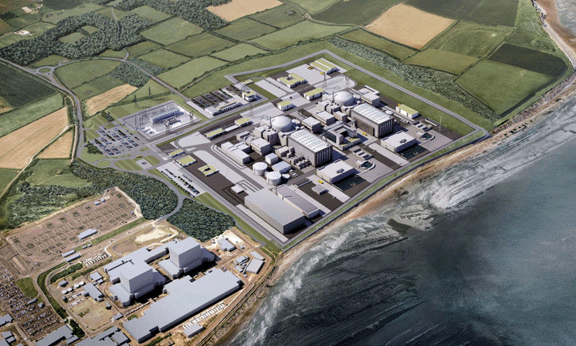
 Theresa May has confirmed that her officials are reviewing security around the Hinkley nuclear project in which the Chinese government is involved.
The Prime Minister signalled while speaking at the G20 Summit in Hangzhou that security would be a component in work to review the Hinkley scheme. It comes as Mrs May prepares for her first meeting with President Xi Jinping of China, and just hours after she failed to answer a direct question on whether she trusted the Chinese government.
A full withdrawal from the project could spark a major diplomatic row, severly damaging the “golden era” relations with China that Mrs May claims she wants.
The Independent has already reported how Mrs May’s officals were said to be looking for a way out of the deal. ……http://www.independent.co.uk/news/uk/politics/g20-theresa-may-xi-jinping-hinkley-nuclear-security-review-a7224786.html
September 5, 2016
Posted by Christina Macpherson |
politics international, UK |
Leave a comment
Ryabkov Says U.S. Sanctions Continue To Hinder Iran After Nuclear Deal, Radio Free Europe September 01, 2016 The United States has carried out its part of the Iranian nuclear deal, but unilateral U.S. sanctions on Iran have remained in place and are a “big hindrance” for Tehran, a top Russian diplomat told TASS.
Russia’s Deputy Foreign Minister Sergei Ryabkov, who is visiting Tehran, told TASS on August 31 that the U.S. administration has implemented “from start to finish” everything envisaged by last year’s agreement, “but it hasn’t moved any further.”
“All the so-called unilateral sanctions that existed before an agreement was reached with Iran have stayed in place,” he said.
“These unilateral sanctions are a big hindrance,” he said. “Any deal serviced in dollars goes through corresponding controlling agencies of the United States and can be suspended.”
Despite the removal of most international sanctions against Iran, Ryabkov said European and Asian businesses continue to be cautious about dealing with Iran and as a result, “deals are fewer than one would want to see.”
September 2, 2016
Posted by Christina Macpherson |
Iran, politics international, USA |
Leave a comment
 U.S., partners allowed ‘secret’ exemptions in nuclear agreement for Iran to meet sanctions deadline, http://www.bignewsnetwork.com/news/247272885/us-partners-allowed-secret-exemptions-in-nuclear-agreement-for-iran-to-meet-sanctions-deadline Big News Network, 1 Sep 16, WASHINGTON, U.S. – Reports reveal that the U.S. and its negotiating partners agreed “in secret” to allow Iran to evade some restrictions from last year’s nuclear agreement so it can meet deadlines for relief on economic sanctions.
According to reports, the U.S. and five negotiating partners agreed to allow Iran to keep more low-enriched uranium (LEU) and other nuclear materials than agreed upon, so that the country could be in compliance with the deal by the January deadline.
Another exemption was also made for an undisclosed amount of 20 per cent enriched uranium, described as “lab contaminant.” President of the think tank Institute for Science and International Security, former UN weapons inspector David Albright said that “the exemptions or loopholes are happening in secret, and it appears that they favour Iran.”
The decision was made by an oversight committee which included representatives from the five permanent United Nations Security Council nations, France, Russia, China, U.K., and U.S., along with Germany and Iran, dubbed collectively as the “P5+1.”
Had the exemptions not been allowed, Iran would have failed to comply with the January deadline, forcing the P5+1 powers to keep the sanctions in place.
Further, the report also makes claims that Iran was secretly permitted to maintain 19 radiation containment chambers, or “hot cells”, which violated the terms of the nuclear deal.
Iran was also relieved from having to sell off its excess heavy water, despite a clause in the agreement that the Islamic country should reduce its stores below 130 tons, and allowed it to store excess abroad.
Meanwhile, Iran is expected to build two new nuclear power stations, with aid from Russia, in Iran’s southern city of Bushehr.
Ali Akbar Salehi, head of the Atomic Energy Organization of Iran said, “Operations to build two new nuclear power plants in Bushehr will start on Sept. 10.”
Ali Akbar Salehi, head of the Atomic Energy Organization of Iran said, “Operations to build two new nuclear power plants in Bushehr will start on Sept. 10.”
He added, “We will save 22 million barrels of oil per year by building these two power plants,” and continued, “In the cooperation contract with the Russians, the emphasis has been laid on making use of technical capabilities of Iran for implementation of the project.”
The cost of the project is estimated at $10 billion.
Russian Deputy Foreign Minister Sergei Ryabkov said that global businesses were still wary of the effect of the remaining U.S. sanctions on Iran and that the commission monitoring the implementation of the joint Comprehensive Plan of Action (JCPOA) should address the issue.
He said, “We agree with the conclusions which our Iranian friends make, namely that some countries who participated very prominently while the talks were ongoing, now at the phase of implementation, I would use the word, (they are) stuck in their position of not removing obstacles which have been created by themselves through their national legislations, through their national decisions which do not allow for an even more active result-oriented and advanced economic and trade cooperation between Iran and the rest of the world.”
September 2, 2016
Posted by Christina Macpherson |
Iran, politics international |
Leave a comment
 G20: China expected to press Theresa May on Hinkley nuclear plant As PM prepares to meet Xi Jinping at summit, officials have reportedly raised issue of delayed power station, Guardian, Rowena Mason, Tom Phillips, 2 Sep 16, Theresa May is expected to come under pressure from China at the G20 summit over her decision to review the proposed Hinkley nuclear plant, after the issue was raised by Beijing in a meeting with the British energy minister.
The new British prime minister will have her first face-to-face meeting with Xi Jinping, the Chinese premier, at the summit on Sunday or Monday, amid continuing tensions over Hinkley Point in Somerset.
May angered Beijing by deciding in July that approval of the French- and Chinese-backed £18bn nuclear plant would be delayed, apparently as a result of security concerns over Chinese involvement.
The Chinese government has been publicly making its clear it wants the project to go ahead, but May and her ministers have stuck to the position that the government is “considering all the component parts of the project before making its decision in the early autumn”.
It is understood Chinese officials raised the issue of Hinkley last week when Baroness Lucy Neville-Rolfe, the new energy and intellectual property minister, made a low-profile trip to China. The Chinese National Energy Administration said on its website that Neville-Rolfe met one of its top officials in Beijing to discuss Hinkley Point……..
anti-nuclear groups urged the prime minister to stand firm against Chinese and French lobbying for the Hinkley Point power station to go ahead.
John Sauven, executive director of Greenpeace UK, said May had a “delicate diplomatic job awaiting her at the G20, and she will no doubt come under renewed pressure to give Hinkley the go-ahead.”
“But the prime minister has shown before that she won’t be bullied into signing up to a deal that doesn’t serve the interests of the British public,” he added…….. https://www.theguardian.com/uk-news/2016/sep/01/g20-china-expected-press-theresa-may-hinkley-nuclear-plant
September 2, 2016
Posted by Christina Macpherson |
China, politics international, UK |
Leave a comment
The great nuclear disarmament divide, “……On the one hand, there are umbrella states that are addicted to their nuclear protection, and on the other, there are umbrella states that clearly feel trapped by it, Livemint, 29 Aug 16 W.P.S. Sidhu, Austria, which remained neutral and nuclear weapon-free during the Cold War, has become the leading anti-nuclear crusader in the post-Cold War era. Last year, Austria, along with a group of non-nuclear countries—mostly from the southern hemisphere and Africa, which is entirely covered by nuclear weapon-free zones—proposed several United Nations General Assembly (UNGA) resolutions including on the humanitarian consequences of nuclear weapons. One of the significant Austrian co-sponsored resolutions proposed an open-ended working group (OEWG) to take forward multilateral disarmament negotiations.
Although this resolution was overwhelmingly supported by 138 countries, the five permanent nuclear weapon states of the UN Security Council plus Israel voted against it. While India and Pakistan abstained, North Korea, curiously, supported the resolution. Significantly, 34 states—mostly members of the North Atlantic Treaty Organization (Nato) and those protected by the US nuclear umbrella—also abstained.
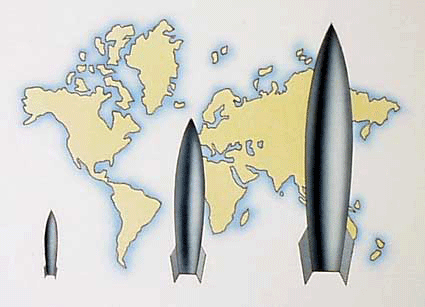
Subsequently, while all nine nuclear-armed states (including India) stayed away from the OEWG deliberations in Geneva, the group made substantial progress. By 19 August, the group’s final report had drafted far-reaching recommendations, including a call to initiate negotiations in 2017 on a legal instrument to prohibit nuclear weapons—unlike biological and chemical weapons, nuclear weapons have never been banned. There were indications that this report would be carried by consensus among the states participating in the OEWG. Clearly, a consensus report recommending a treaty to ban nuclear weapons outright would be anathema not only for the nuclear armed states but also the so-called ‘umbrella states’, which depend on the nuclear protection particularly of the US. Thus, the nuclear-armed states sought to influence the OEWG process by proxy.
Enter Australia. In the past, Australia played a leading role in pushing disarmament initiatives, for instance, when it resurrected the Comprehensive Test Ban Treaty in 1996 and co-sponsored an International Commission on Nuclear Non-proliferation and Disarmament in 2008. However, this is at odds with its dependence on nuclear weapons.
As an umbrella state, it depends on the perceived security of US nuclear weapons. In the OEWG, Australia became a proxy of nuclear weapon states and a disarmament spoiler: it called for a vote on the group’s final report even though it was evident that the majority would support the report’s recommendations.
Australia’s objective was two-fold: first, to break the emerging consensus and, second, to close ranks among all the umbrella states. Australia almost succeeded in its second goal. Although 19 Nato states plus Australia and South Korea voted against the report, several other Nato members plus Japan abstai-ned, indicating that not all umbrella states are willing to sustain nuclear weapons and deterrence in perpetuity.
The OEWG process reflects a great disarmament divide not only among the nuclear haves and have-nots, but also among the umbrella states. On the one hand, there are umbrella states that are addicted to their nuclear protection, even though it is not apparent that such security is omnipotent. On the other hand, there are umbrella states that clearly feel trapped by the protection provided, but are unsure how get out of this situation. This debate will now play out on the floor of the UNGA…..http://www.livemint.com/Opinion/4smGv8MNF3hg63Y1WpRzQL/The-great-nuclear-disarmament-divide.html
August 29, 2016
Posted by Christina Macpherson |
2 WORLD, politics international, weapons and war |
Leave a comment
It is time to turn nuclear common sense into national policy. A declaration that the United States would never use nuclear weapons when conventional weapons could destroy the target could reduce the number of nuclear weapons we need for legitimate deterrence purposes.

 The common-sense fix that American nuclear policy needs, WP, By Jeffrey G.
Lewis and Scott D. Sagan August 24
Jeffrey G. Lewis is director of the East Asian Nonproliferation Program at the Middlebury Institute of International Studies at Monterey. Scott D. Sagan is the Caroline S.G. Munro professor of political science and senior fellow at the Center for International Security and Cooperation at Stanford University. This op-ed was adapted from an article that will appear in the fall issue of Daedalus.
President Obama, in his final months in office, is considering major nuclear policy changes to move toward his oft-stated goal of a world without nuclear weapons. One option reportedly under consideration is a “no first use” pledge, a declaration that the United States would not be the first state to use nuclear weapons in any conflict. While we think that such a pledge would ultimately strengthen U.S. security, we believe it should be adopted only after detailed military planning and after close consultation with key allies, tasks that will fall to the next administration.
There is, however, a simpler change that Obama could make now that could have as important, or even greater, benefits for U.S. security. The president could declare, as a matter of law and policy, that the United States will not use nuclear weapons against any target that could be reliably destroyed by conventional means.
This might seem like common sense, but current U.S. doctrine allows the use of nuclear weapons against any “object” deemed to be a legitimate military target. In 2013, the Obama administration did issue a guidance directing the U.S. military to “apply the principles of distinction and proportionality and seek to minimize collateral damage to civilian populations and civilian objects” and pledged that “the United States will not intentionally target civilian populations or civilian objects.”
This was a good step forward. But Obama’s guidance omitted an important legal concept derived from just-war doctrine — the “principle of necessity,” which suggests that war planners must use only the minimum amount of military force necessary to destroy a target. Ignoring the necessity principle leaves a loophole large enough to fly a nuclear-armed bomber through. To give one egregious example, although the U.S. military does not target civilian populations directly, following the principle of noncombatant immunity, it insists that it can legally target civilian airports in an adversary’s cities because they could be converted to military airports during a war — and there is no restriction in place against using nuclear weapons against such a civilian airport………
It is time to turn nuclear common sense into national policy. A declaration that the United States would never use nuclear weapons when conventional weapons could destroy the target could reduce the number of nuclear weapons we need for legitimate deterrence purposes. Placing conventional weapons at the center of debates about the future of deterrence would also help focus the policy discussion on plausible scenarios with realistic plans for the use of U.S. military power. And it would more faithfully honor the just-war principles of distinction, necessity and proportionality, by placing them at the heart of our deterrence and security policies, where our highest ideals belong. https://www.washingtonpost.com/opinions/the-common-sense-fix-that-american-nuclear-policy-needs/2016/08/24/b9692dd0-6596-11e6-96c0-37533479f3f5_story.html?utm_term=.a6cc17bf50cf
August 27, 2016
Posted by Christina Macpherson |
politics international, Reference, USA, weapons and war |
Leave a comment
The revival of concern about the humanitarian impacts of these weapons is shifting old assumptions.
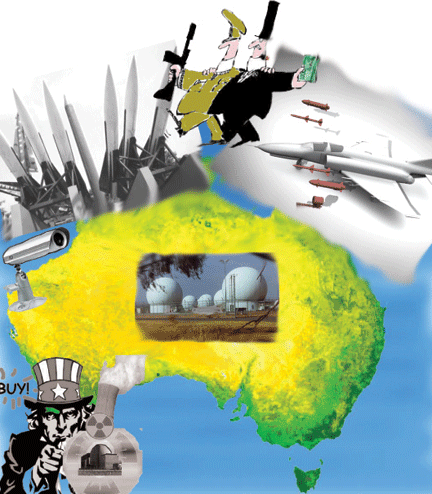
Australia’s reliance on END keeps us on the wrong side of history. And it has led previous governments and the current government to actively oppose the growing calls for a ban on nuclear weapons.
Instead of blindly following US nuclear policies into whatever a future president might envisage, Australia should carefully consider its non-nuclear defence and challenge all claims, surrogate or otherwise, to nuclear weapons.
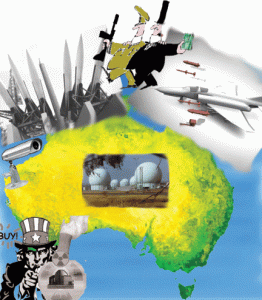 Australia’s stance on nuclear deterrence http://www.swinburne.edu.au/news/latest-news/2016/08/australias-stance-on-nuclear-deterrence-.php 26 August 2016
IN SUMMARY Analysis for The Conversation by Swinburne PhD candidate
Dimity Hawkins and Swinburne senior lecturer Julie Kimber.CONTACT Lea Kivivali +61 3 9214 5428 lkivivali@swin.edu.au
For Australia, the US election should provide an opportunity to rethink defence relationships, especially as they relate to nuclear weapons.
There has been much hand-wringing at the thought of Donald Trump becoming US president. If, by some miracle, Trump succeeds in November, he will have his hand on the nuclear trigger.
But this concern, while great political fodder, is dangerously simplistic. It presupposes there are “safe hands” when it comes to nuclear weapons. There are not.
The US has around 7,000 nuclear weapons. Hundreds of these can be launched within minutes. While the global community has outlawed other indiscriminate weapons of mass destruction, nuclear weapons are yet to be banned.
The Cold War’s MAD (Mutually Assured Destruction) doctrine has morphed over the years into a framework of nuclear deterrence. Many governments globally have played a double game: supporting nuclear disarmament on the one hand, while relying on a nuclear defence on the other.
One such government is Australia’s. Despite consecutive governments insisting they support nuclear disarmament, Australia’s reliance on Extended Nuclear Deterrence (END) means it is frustrating attempts at a total ban.
- When defence conflicts with deterrence END is based on the assumption the US would offer a nuclear response to Australia as a select protégé ally in the event of a nuclear threat or attack. These arrangements are publicly documented between the US and NATO states, Japan and South Korea.
- The first official articulation of the position in Australia is in its 1994 Defence White Paper. This professes a reliance on, and support for, a US nuclear capability to “deter any nuclear threat or attack on Australia”.Importantly, the paper also noted that reliance on END was an “interim” measure until a total ban on nuclear weapons could be achieved. Each subsequent defence white paper has continued to assert this reliance on US nuclear weapons.The 2016 Defence White Paper created more ambiguity about the END arrangement. It claimed:
Only the nuclear and conventional military capabilities of the United States can offer effective deterrence against the possibility of nuclear threats against Australia.
- After 22 years of white paper reliance on END, it is no longer a temporary aberration. The risk is we normalise both the need for and use of nuclear weapons.Australian defence white papers offer no clarification on the conditions under which nuclear weapons would be used on our behalf. Given the known humanitarian, environmental and cultural devastation caused by their use, significant questions remain – including under what circumstances policymakers and defence experts would consider justifying the deployment of nuclear weapons in Australia’s name.The global trend of nuclear renewal Anyone watching US President Barack Obama’s speech in Hiroshima in March 2016 might be mistaken for thinking his pledges to end the nuclear weapon threat were sincere. He said:
Among those nations like my own that hold nuclear stockpiles, we must have the courage to escape the logic of fear and pursue a world without them.This would seem to undermine the utility of nuclear deterrence, but the reality is different.
- The US plans to spend US$348 billion during 2015–24 on maintaining and comprehensively updating its nuclear forces. Other estimates for the modernisation program are as high as $1 trillion over the next 30 years.Despite Trump’s assertion that countries under the US END umbrella should be developing their own nuclear capacity, neither Trump nor his Democratic presidential rival, Hillary Clinton, are likely to discontinue the nuclear renewal programs.For Australia, the change in the US presidency provides an opportunity to rethink defence relationships, especially those relating to nuclear weapons.
An opportunity to re-evaluate our stanceWith some arguing a Trump presidency would undermine alliance relationships, Australia has a chance to strike a new path. The uncomfortable presumption of END in our defence policies is one area we should be actively challenging.
While Australia is a highly militarised middle power in the region, it has few, if any, discernible nuclear threats of its own to counter. It has forsworn such weapons through international law agreements and has at times been a strong voice on efforts to eliminate nuclear weapons.
The revival of concern about the humanitarian impacts of these weapons is shifting old assumptions. Growing impatience with the slow pace of change and continual delays in meeting even the most basic of expectations in relation to nuclear disarmament have meant support for a ban on such weapons has grown internationally to include the majority of UN member countries.
Australia’s reliance on END keeps us on the wrong side of history. And it has led previous governments and the current government to actively oppose the growing calls for a ban on nuclear weapons.
Instead of blindly following US nuclear policies into whatever a future president might envisage, Australia should carefully consider its non-nuclear defence and challenge all claims, surrogate or otherwise, to nuclear weapons.
August 27, 2016
Posted by Christina Macpherson |
AUSTRALIA, politics international, weapons and war |
Leave a comment

Is this because USA wants nuclear disarmament, or because USA wants to sell nuclear materials to the sub continent?
US urges India and Pakistan to sign and ratify nuclear test ban treaty Washington has welcomed Pakistan’s recent proposal to India for a bilateral agreement on nuclear weapons test ban, IBT By Nandini Krishnamoorthy August 24, 2016 The US has asked arch-rivals India and Pakistan to set aside their differences and sign and ratify the Comprehensive Nuclear-Test-Ban Treaty (CTBT). Welcoming Pakistan’s recent proposal to India for a bilateral agreement on nuclear weapons test ban, Washington has urged the two countries to hold talks.
Mark Toner, the State Department deputy spokesperson, said: “We welcome this high-level dialogue between India and Pakistan, encourage both countries to engage in the dialogue and exercise restraint aimed at improving strategic stability.”……..
On Tuesday (23 August), Pakistan announced a fresh move to seek support for its NSGmembership bid. Syed Tariq Fatemi, special assistant to the prime minister on foreign affairs, embarked on a visit to Belarus and Kazakhstan to win their backing, The Hindu reported.
While India was kept out, Pakistan’s membership was not discussed during the plenary meeting of the NSG in Seoul in June. Although it has China on its side, it failed to get the backing of the US.http://www.ibtimes.co.uk/us-urges-india-pakistan-sign-ratify-nuclear-test-ban-treaty-1577733
August 27, 2016
Posted by Christina Macpherson |
India, Pakistan, politics international, USA, weapons and war |
Leave a comment
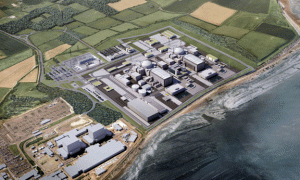
 Hinkley Point nuclear power station: Whitehall officials ‘exploring ways UK could pull out of deal’ Theresa May’s administration called an unexpected halt to the project amid security and viability concerns, Independent Joe Watts Political Editor @JoeWatts_ Thursday 25 August 2016 Whitehall officials reviewing the massive Hinkley Point nuclear project are exploring how the UK might withdraw from the deal while minimising financial risk and damage to international relations, it has been claimed.
Westminster sources told The Independent civil servants are looking to see if there is any loophole, clause or issue in contracts yet to be signed that allow the Government to pull back without huge loss and while also saving face.
Ministers are acutely aware of the potential damage a withdrawal could do to relations with China, which is committed to pouring billions of pounds into the controversial project.
Former Chancellor George Osborne was an enthusiastic supporter of the £18 billion scheme, but since Theresa May’s arrival it is being reviewed by the new administration. A Whitehall source said: “There is a working assumption of people in government that the civil service is looking for a way out, a legal loophole, a clause.
“They are looking for anything that will allow the Government to withdraw and also allow the Chinese to withdraw while also saving face.”
It was expected last month when the board of French energy company EDF voted to go ahead with Hinkley C power station that the British Government would give its approval.
Instead new Business Secretary Greg Clark announced he needed more time to make a decision.
It followed claims that the price promised for Hinkley’s electricity at £92.50 per MWh, more than double the wholesale price, was too expensive……..
EDF may also have problems fulfilling its end of any agreement. The company’s finance director Thomas Piquemal resigned earlier this year, fearing Hinkley could lead to the firm’s insolvency.
title=”24 August 2016 16:26 London”>A senior Government figure said: “The other thing no-one is talking about is what happens after the French election.
“Hollande is not going to be there and it is not clear whether Sarkozy or Juppe are committed to it.”
A spokesperson from the Department for Business, Energy & Industrial Strategy said: “No contract has been signed and it is only right that a new Government considers all component parts carefully before making a final decision.” http://www.independent.co.uk/news/uk/politics/hinkley-point-edf-nuclear-power-station-deal-how-uk-could-pull-out-a7207776.html
August 26, 2016
Posted by Christina Macpherson |
business and costs, politics, politics international, UK |
Leave a comment
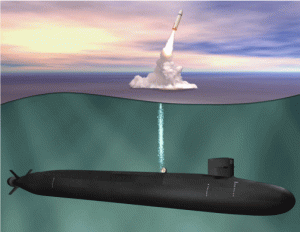
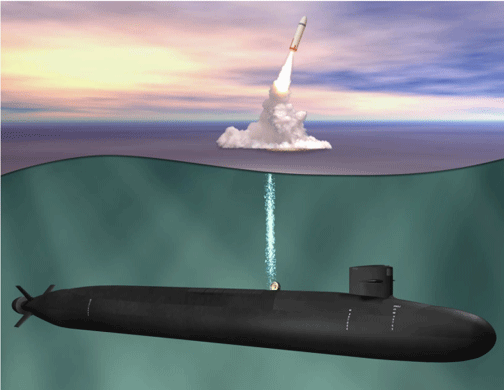
 North Korea fires submarine-launched ballistic missile into Sea of Japan, officials say, ABC News 24 Aug 16, North Korea has fired a submarine-launched ballistic missile off its east coast, South Korea’s military said, the latest in a string of missile launches by the isolated country in defiance of UN Security Council resolutions.
Key points:
- The missile reached Japan’s air defence identification zone
- Japan President Shinzo Abe slams ‘unforgiveable act’
- China, Japan and South Korea’s Foreign Ministers were due to meet in Tokyo today
The missile was fired at around 5:30am (local time) from near the coastal city of Sinpo, where satellite imagery shows a submarine base to be located, and flew about 500 kilometres before splashing into the Sea of Japan, US and South Korean officials said.
The projectile reached Japan’s air defence identification zone (ADIZ), an area of control designated by countries to help maintain air security, according to Japanese and South Korean authorities
“This is the first time a missile from North Korea was launched from a submarine into our country’s air-defence identification zone,” Japanese Prime Minister Shinzo Abe told reporters, adding that Japan had lodged a stern protest………http://www.abc.net.au/news/2016-08-24/north-korea-test-fires-submarine-launched-ballistic-missile/7779612
August 26, 2016
Posted by Christina Macpherson |
North Korea, politics international, weapons and war |
Leave a comment
 The national security case against TPP, By John Adams, BG USA (Ret), The Hill, 17 Aug 16 “……..Our military is now shockingly vulnerable to major disruptions in the supply chain, including from substandard manufacturing practices, natural disasters, and price gouging by foreign nations. Poor manufacturing practices in offshore factories lead to problem-plagued products, and foreign producers—acting on the basis of their own military or economic interests—can sharply raise prices or reduce or stop sales to the United States.
The link between TPP and this kind of offshoring has been well-established. The proposed deal would not only repeat but magnify the mistakes of the North American Free Trade Agreement (NAFTA), offering extraordinary
privileges to companies that move operations overseas. Just this spring, an official U.S. government
study by the International Trade Commission noted that the pact would further gut the U.S. manufacturing sector. This, following the loss of 5 million manufacturing jobs since 2000, is a perilous proposition.
Foreign policy and national security have long been the arguments of last resort for backers of controversial trade deals. A quarter century ago, we were
warned that, unless NAFTA and deals with eight Latin American nations were enacted, China would come to dominate trade in the hemisphere. NAFTA passed, but America’s share of goods imported by Mexico fell, while China’s share rose by a staggering 2,600 percent. Today, following the implementation of several additional major trade deals, we’re still waiting for China to comply with its WTO commitments, and we’re still waiting for progress in dealing with our astronomical trade deficit.
While the TPP’s backers present our choice as one of trade versus protectionism, this couldn’t be further from the truth. We already have free trade agreements with the six TPP countries that account for more than 80 percent of the promised trade. Because all TPP nations are currently members of the World Trade Organization, their tariffs have already been cut to minimal levels.
Of TPP’s 30 chapters, only six deal with traditional trade issues. The rest deal primarily with special privileges for multinational corporations and investors—like establishing the rights of companies to sue governments for cash compensation over the impacts of health and safety regulations. These dominant features of the TPP would vastly expand the rights of multinational firms that do not necessarily represent America’s national interests.
Critics of the TPP come from both parties in Congress—and from the business, labor, environmental, consumer, human rights, and defense communities. These diverse players are not opposed to trade. Rather, most simply want a different trade model that facilitates the worthy goal of global engagement without shortchanging American workers, policymaking prerogatives, and national security capacities.
August 24, 2016
Posted by Christina Macpherson |
politics international, USA |
Leave a comment