Brexit ‘could trigger’ UK departure from nuclear energy treaty https://www.theguardian.com/environment/2016/sep/27/brexit-could-trigger-uk-departure-from-nuclear-energy-treaty
The UK’s withdrawal from the EU could also force it to exit the Euratom treaty on nuclear energy, ENDS has learned, Guardian, José Rojo for ENDS, part of the Guardian Environment Network. The UK’s withdrawal from the EU could also force it to exit the Euratom Treaty on nuclear energy, ENDS has learned.
The Euratom Treaty, which applies to all EU member states, seeks to promote nuclear safety standards, investment and research within the bloc. Although it is governed by EU institutions, it has retained a separate legal identity since its adoption in 1957.
Brian Curtis, a member of the European Economic and Social Committee (EESC), told ENDS that his Committee had recently consulted the European Commission on whether Brexit would automatically lead to a UK exit of Euratom.
Curtis said the Commission had responded affirmatively, arguing that the Treaty of the European Union (TEU) applies to the Euratom Treaty under article 106 of the latter agreement. This would mean, it said, that the reference to ‘Union’ inTEU’s article 50 – which needs to be invoked by member states wishing to quit the bloc – would apply not only to the EU itself but to Euratom membership as well.
According to EESC, a Euratom withdrawal by the UK – which recently approved the controversial £18bn Hinkley C project – could have major strategic implications for the EU nuclear sector. “But anticipating specific outcomes at this stage is problematic,” the Committee added.
The Commission itself would not comment on the exchange, which took place as the EESC examined the EU’s latest nuclear plan.
The draft Nuclear Indicative Programme (PINC), which was unveiled in April, is the first to be published by the Commission since the Fukushima-Daiichi nuclear disaster in 2011.
The EESC is required by the Euratom Treaty to give its opinion on such plans before they are finalised. It released its opinion on the latest PINC last week, after adopting it at a plenary vote.
The document praises the Commission for its analysis of investment needs during the entire nuclear fuel cycle and its emphasis on funding for nuclear decommissioning.
However, the Committee adds that the 2016 PINC is half the length of thepreceding plan from 2007 and fails to address key issues faced by EU nuclear energy.
These, it says, include the competitiveness of nuclear amid changes to construction and capital costs, its investment needs in the context of the EU’s Energy Union goals and the speed at which new technologies may be rolled out.
EESC’s opinion was published two weeks ahead of a meeting of the European Nuclear Energy Forum, which will be attended by EU member states and European institutions in Bratislava on 3-4 October.
September 28, 2016
Posted by Christina Macpherson |
politics international, UK |
Leave a comment
 Pope concerned over North Korea’s nuclear testing, Crux, Inés San Martín
September 27, 2016 VATICAN CORRESPONDENT The United States has flown nuclear-capable supersonic bombers over ally South Korea in a show of force meant to cow North Korea after its fifth nuclear test and also to settle rattled nerves in the South.
“The Holy See supports continued efforts by the international community to revive negotiations over denuclearization and to enable the IAEA to resume its critical role in nuclear verification there,” says Monsignor Antoine Camilleri, Vatican Undersecretary for Relations with States. ROME-Watching the continuing tension on the Korean Peninsula, with North Korea carrying out nuclear tests, a Vatican’s representative has expressed Pope Francis’s concerns to Vienna’s International Atomic Energy Agency.
Vatican spokesman Greg Burke said on Tuesday that he could confirm that, considering the “delicate situation on the Korean Peninsula,” the Vatican’s Undersecretary for Relations with States, Monsignor Antoine Camilleri, had reiterated in Vienna “the concern of the Holy Father and the Holy See about the continuing tensions in the area on account of the nuclear tests carried out by North Korea.”
Last Tuesday, the state-run Korean Central News Agency (KCNA) had reported that North Korea had successfully conducted a ground test of a new type of high-powered rocket engine.
Camillieri was speaking as the Vatican representative in the 60th General Assembly of the International Atomic Energy Agency (IAEG), taking place in Vienna Sept. 26-30.
“We view the situation in the DPRK [Democratic People’s Republic of Korea] with grave concern,” Camillieri said in his remarks. “The Holy See supports continued efforts by the international community to revive negotiations over denuclearization and to enable the IAEA to resume its critical role in nuclear verification there.”
The Vatican representative also said the Church welcomes the IAEA’s participation in the “verification and monitoring of Iran’s nuclear-related commitments under the Joint Comprehensive Plan of Action,” adding that the Holy See sees this agreement positively…….. Talking about disarmament, he again quoted Francis, but this time from the pontiff’s message to the Vienna Conference on the Humanitarian Impact of Nuclear Weapons in 2014, when the Argentine pope said that spending on these weapons squanders a country’s wealth.
“To prioritize such spending is a mistake and a misallocation of resources which would be far better invested in the areas of integral human development, education, health and the fight against extreme poverty. When these resources are squandered, the poor and the weak living on the margins of society pay the price,” the pope had said in the message Camillieri quoted on Tuesday. https://cruxnow.com/vatican/2016/09/27/pope-concerned-north-koreas-nuclear-testing/
September 28, 2016
Posted by Christina Macpherson |
North Korea, politics international, Religion and ethics, South Korea |
Leave a comment
Will North Korea’s Nuclear Test Tempt South Korea and Japan to Go Nuclear?The latest test may strengthen calls South Korea and Japan to develop their own nuclear weapons. The Diplomat, By Pang Zhongying September 27, 2016 North Korea’s latest nuclear test strengthened the sections of public opinion that approve of obtaining nuclear weapons in South Korea and Japan. The test, then, could bring about a chain reaction and accelerate the pace of Japanese and South Korean efforts to possess nuclear weapons. Under these circumstances, China will face not only a threat from the Terminal High Altitude Area Defense (THAAD) system, but also the further deterioration of Northeast Asia’s strategic environment.
In my opinion, the biggest challenge posed to China by this North Korean nuclear test is that South Korea’s domestic support for nuclear weapons may increase. Since Kim Jong-un assumed leadership of North Korea — especially this year — public support for possessing nuclear weapons and turning South Korea into a nuclear state has reached a certain scale. South Korea has been protected by the U.S nuclear umbrella, but now more and more people in South Korea want to build up a domestic nuclear deterrent to balance against North Korea.
On July 1, President Park Geun-hye suddenly decided to deploy the U.S. THAAD system in South Korea. In the following two months, domestic voices advocating for possessing and/or developing nuclear weapons have been constantly coming from South Korea. These voices will get even louder after the latest nuclear test in North Korea. It is said that the tested nuclear warhead was miniaturized, but its blast is estimated to be very large. Readings of the seismic activity in North Korea indicate that the test was very successful. Therefore, South Korea is currently enveloped by the sense of a national security crisis and many now believe that it is not enough to only have United States’ nuclear protection. So North Korea’s nuclear test may further stimulate South Korea to acquire nuclear weapons or develop nuclear weapons, which is also a big challenge for the United States………http://thediplomat.com/2016/09/will-north-koreas-nuclear-test-tempt-south-korea-and-japan-to-go-nuclear/
September 28, 2016
Posted by Christina Macpherson |
Japan, North Korea, politics international, South Korea, weapons and war |
Leave a comment
Iran says some sanctions under nuclear deal still in place WP, By George Jahn | AP September 26 VIENNA — Indirectly warning the United States, the head of Iran’s atomic energy agency said Monday that his country’s landmark nuclear deal with could be jeopardized by foot-dragging on sanctions relief, promised in exchange for Tehran’s commitment to curb key atomic activities. But a senior U.S. official said Washington is delivering on its commitments.
Iran complains that international financial sanctions are not being lifted quickly enough under the agreement with the U.S. and five other world powers that stipulates a removal of these and other penalties imposed over Tehran’s nuclear program. Tehran in turn agreed to limit atomic pursuits that could be used to make a bomb.
Nuclear agency chief Ali Akbar Salehi did not blame particular countries in comments to the International Atomic Energy Agency’s general conference. But other Iranian officials have faulted the United States for perceived delays in lifting financial sanctions, and Salehi warned that the deal’s “durability” depended on the other side’s “reciprocal and full implementation.”
“Comprehensive and expeditious removal of all sanctions” outlined in the agreement “have yet to be met,” even though Iran is honoring all its obligations under the pact, he said…….https://www.washingtonpost.com/world/middle_east/iran-says-some-sanctions-under-nuclear-deal-still-in-place/2016/09/26/10e92782-83d7-11e6-b57d-dd49277af02f_story.html
September 28, 2016
Posted by Christina Macpherson |
Iran, politics international |
Leave a comment
 Russia issues Hinkley nuclear warning, climate news,network September 19, 2016, by Terry Macalister State-owned Russian nuclear corporation says the industry’s credibility is at risk if building the new UK power plant is delayed or runs over budget.
LONDON, 19 September, 2016 – A major nuclear developer has warned the French energy giant EDF that it must deliver the Hinkley Point project in the UK on time and on budget or risk damaging the credibility of the wider industry.
In an exclusive interview with Climate News Network, Kirill Komarov, first deputy chief executive of Russian state-owned corporation Rosatom, expressed fears that problems at other EDF schemes − such as Flamanville in France andOlkiluoto in Finland − could be repeated.
Rosatom believes the decision by the UK prime minister, Theresa May, to give the go-ahead to the first new nuclear reactors in Britain for over 20 years was a major step forward, but knows that the eyes of the world will now be on a good performance at the Hinkley power plant in southwest England.
Komarov said: “It’s a good signal that the government confirmed its commitment to nuclear. At the same time, record-high cost and the risks of possible delays and cost overruns might undermine the reputation of the sector.”
The Russian group, which is constructing nuclear reactors in China, India and the Middle East, believes its own prices are up to 30% lower than EDF’s…………
Rosatom believes the UK should be wary of the potential delays attached to the new European Pressurised Reactor (EPR) designs that are being trialled at Olkiluoto, Flamanville and soon at Hinkley.
The company also reckons that the 1600 megawatt capacities of EPRs may be too large for the needs of the modern world. It believes its own VVER-designed 1000-1200 MW reactors are more suitable, especially in developed countries where power demand is unlikely to grow too much, because of energy efficiency and demand reduction policies.
Rosatom is clearly keen to sell its reactors in the UK, which has relatively tight regulations and is seen by EDF and others as a good shop window for the world http://climatenewsnetwork.net/russia-issues-hinkley-nuclear-warning/
September 22, 2016
Posted by Christina Macpherson |
business and costs, politics international, Russia |
Leave a comment
West failing to deliver nuclear deal promises, says Iran vice-president
Ali Akbar Salehi attacks lack of progress on banking transactions and trade eight months after landmark agreement, Guardian, Saeed Kamali Dehghan, 17 Sept 16, Iran has fully complied with its commitments under last year’s landmark nuclear agreement, but eight months after the official removal of sanctions, the west is failing to deliver on its promises, the country’s vice president has told the Guardian.
Ali Akbar Salehi, the head of the country’s Atomic Energy Organisation, said that if the agreement was to remain intact, both sides had to meet their commitments.
The US-educated scientist, who also served as a former foreign minister of Iran, was the second most senior Iranian negotiator in nearly two years of talks between Tehran and world’s six leading powers that led to the final nuclear accord, known as the joint comprehensive plan of action (JCPOA), in Vienna in July 2015. The deal was implemented in January, and triggered the removal of sanctions.
“As has been stated by the International Atomic Energy Agency (IAEA), Iran has remained committed to its commitments,” Salehi said. “While the other side – it’s very clear now to public opinion and it’s not a secret – has not really delivered on the promises; that the sanctions would be removed and that banking transactions would go back to normal, that trade would speed up and economic relations would be enhanced. These have not been materialised to the extent that we expected.”……..
Although nuclear-related sanctions were lifted in January, big European banks remain reluctant to do business with Iran. European banks are concerned about existing US sanctions relating to terrorism as well as uncertainty in the US before the election of a new president…….
The banking issue has prevented Iran from capitalising on the interest shown by western businesses in returning to the country, or finalising lucrative deals with the west, such as the purchase of planes from Airbus and Boeing. Iran’s central bank chief told the Guardian in May that Tehran was still locked out of global financial system……..
The fate of the nuclear agreement will affect the next presidential elections in Iran, which are scheduled for spring next year. President Hassan Rouhani is seeking re-election and opponents, including former president Mahmoud Ahmadinejad, have indicated their willingness to challenge him. Rouhani would have to show Iranians tangible relief from sanctions if he is to maintain their support.
Relations between Tehran and London have significantly improved since the nuclear agreement, with both sides appointing new ambassadors in their respective capitals this month after nearly a five-year hiatus. https://www.theguardian.com/world/2016/sep/16/west-failing-deliver-nuclear-deal-promises-iran-vice-president-ali-akbar-salehi
September 17, 2016
Posted by Christina Macpherson |
Iran, politics international |
Leave a comment
Hinkley C nuclear go-ahead: May caves in to pressure from France and China,Ecologist Oliver Tickell 15th September 2016
The French and the Chinese may be celebrating the UK’s decision to press ahead with the Hinkley C ‘nuclear white elephant’, writes Oliver Tickell. But the deal is a disaster for the UK, committing us to overpriced power for decades to come, and to a dirty, dangerous, insecure dead end technology. Just one silver lining: major economic, legal and technical hurdles mean it still may never be built.
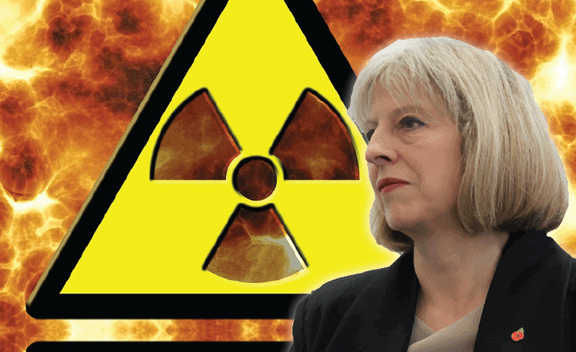
The UK’s energy department, BEIS, today announced the go-ahead for the controversial Hinkley Point C (HPC) nuclear power plant in Somerset.
Only weeks ago Theresa May’s government delayed the signing of the deal with EDF to confirm its subsidy package which is likely to cost UK energy users anywhere from £30 billion to over £100 billion for 35 years after it opens.
The surprise move was widely welcomed due to a broad range of concerns about the HPC project, including:
- its very high cost, more than double the current wholesale power price and far more than the current cost of even high-cost renewable power from offshore wind;
- security concerns over China’s involvement in core UK infrastructure;
- the lack of any single example of a working EPR reactor anywhere in the world;
- the severe delays, cost overuns and technical problems at all EPR construction sites;
- and the low value of HPC’s contribution to UK energy supply in the new decentralised ‘smart grid’ era.
Pre-announcement spin indicated that the HPC deal would be subject to a number of“significant conditions” that would address these problems. But in the event energy secretary Greg Clarke is giving the go-ahead for HPC to almost precisely the same deal that was on the table before.
Ther only difference to be found in the energy department announcement is that arrangements have been put in place to allow the Government to “prevent the sale of EDF’s controlling stake prior to the completion of construction, without the prior notification and agreement of ministers.”
In particular the price remains unchanged……….
And as far as China is concerned, the UK is desperate to reach a trade deal with what is now by some measures the world’s largest economy and a major exporter to the UK. In particular the UK is seeking tariff-free access to the fast-gowing Chinese economy for UK manufactures, and the powerful financial services industry.
We can be sure that both countries leaders and ministers put the frighteners onto Theresa May and her entourage at the recent G20 summit to go ahead with HPC – and that she succumbed to that pressure at enormous cost to the UK, failing to win even the smallest concession on price.http://www.theecologist.org/News/news_analysis/2988131/hinkley_c_nuclear_goahead_may_caves_in_to_pressure_from_france_and_china.html
September 16, 2016
Posted by Christina Macpherson |
politics, politics international, UK |
Leave a comment
Hinkley C nuclear go-ahead: May caves in to pressure from France and China, Ecologist Oliver Tickell 15th September 2016 “………Great for France, China – but what about us? The Brexit effect
Mrs May is known to have come under strong pressure from both French and Chinese governments to give HPC the go-ahead. Both governments have strong interests in seeing the project going ahead.
In the French case, the EPR reactor has cost EDF and Areva – both companies controlled and mostly owned by the French state – uncountable billions of euros. Four EPRs are under construction, in France, Finland and China. All are running very late and billions of euros over budget, while the French reactor at Flamanville may never open due to a faulty reactor vessel.
That means that HPC represents France’s last chance to present the EPR as a viable reactor for the lucrative nuclear export market, re-establish credibility, and regain value for its so far utterly failed investment in the EPR.
The deal also offers EDF a very high return on investment of over 10% based on the expected construction cost of €24 billion, making it (and UK energy consumers) a valuable ‘cash cow’ for the highly indebted company for many decades to come.
China is also intent on capturing its share of the global export market for nuclear power and HPC is its ‘way in’ to it. As part of the deal, Chinese nuclear company CGN is to get preferential treatment to build a new nuclear power station at Bradwell in Essex to its new, untested ‘Hualong’ reactor design that it intends to promote to international buyers.
So, plenty of good reasons for China and France to want to progress the deal. But what’s in it for the UK? Answer: Brexit. By sucking up to France, the government hopes to win over France as an ally in negotiating a better deal for the UK in Brexit negotiations……….http://www.theecologist.org/News/news_analysis/2988131/hinkley_c_nuclear_goahead_may_caves_in_to_pressure_from_france_and_china.html
September 16, 2016
Posted by Christina Macpherson |
politics international, UK |
Leave a comment
Rooting Out the North Korean Nuclear Crisis: the Past and Present U.S. Role, CounterPunch, by CHRISTINE HONG – PAUL LIEM, 15 Sept 16, North Korea’s nuclear test of September 9, 2016, the fifth and largest measuring twice the force of previous blasts, prompted a predictable round of condemnations by the United States and its allies along with calls for China to step up its enforcement of sanctions on North Korea. Yet few “expert” analyses suggest that China will risk destabilizing North Korea or that further United Nations resolutions and international sanctions will succeed in deterring North Korea from pursuing its nuclear weapons and missile programs.
The Obama administration’s reliance on China to rein in North Korea is at odds with its efforts to contain China’s influence in Asia, a quixotic goal in itself. It reflects an unrealistic desire for China to be influential just enough to do the bidding of the United States but not powerful enough to act in its own interests.
North Korea is, after all, China’s strategic ally in the region, and it is in South Korea that the United States plans to deploy THAAD, a defense system with radar capable of tracking incoming missiles from China. It is simply not in China’s interest to risk losing an ally on its border only to have it replaced by a U.S.-backed state hosting missile-tracking systems and other military forces targeting it. And China knows it is not the target of North Korea’s nukes. If the United States cannot punt the problem of North Korea’s nuclear weapons to China it must deal with North Korea directly.
Indeed, in response to U.S. Secretary of Defense Ashton Carter’s recent condemnation of China’s “role” and “responsibility” in failing to restrain North Korea’s nuclear pursuits, the Chinese Foreign Ministry issued a statement calling on the United States to take a long hard look at its own foreign policy:……….
Despite President Barack Obama’s efforts over his two terms in office to “pivot” or “rebalance” U.S. foreign policy to Asia and the Pacific and his repeated identification of the United States as a Pacific power, the memory of nuclear ruin in the region is shadowed by the history of the United States as a first-user of atomic weapons against civilian populations in Japan at the close of World War II and as a tester of devastating nuclear technology, including human radiation experiments, in the Marshall Islands during the Cold War. Moreover, it has not gone unnoticed that President Obama, despite his professed commitment to nuclear de-escalation, has refused to issue an “unequivocal no-first-use pledge.”
In Korea, the one place on the planet where nuclear conflagration is most likely to erupt, given the current state of affairs, President Obama can still end the threat of nuclear warfare. This would require what few in his administration appear to have entertained, namely, the elimination of the demand for North Korea to agree to irreversible denuclearization as a precondition for bilateral talks. This rigid goal makes it virtually impossible for the United States to respond positively to any overture from North Korea short of a fantastic offer by that country to surrender all its nuclear weapons. The premise that the denuclearization of North Korea is necessary to ensure peace and stability on the Korean peninsula needs to be shelved, and all possibilities for finding common ground upon which to negotiate the cessation of hostilities on the Korean peninsula should be explored…….
Let us also recall that North Korea offered to halt testing of its nuclear weapons if the United States agreed to put an end to the annual U.S.-South Korea war games.[6] Combining live artillery drills and virtual exercises, these war games, as of this year, implemented OPLAN 5015, a new operational war plan that puts into motion a preemptive U.S. nuclear strike against North Korea and the “decapitation” of its leadership. Unsurprisingly, North Korea considers this updated operational plan to be a rehearsal for Libya-style regime change……..
President Obama should prioritize any and all possibilities for achieving a halt to North Korea’s nuclear programs by diplomacy, over the goal of achieving an illusory agreement for complete denuclearization. As an achievement, halting North Korea’s nuclear advances is far short of the peace treaty needed to bring an end to the Korean War and a lasting peace to Korea. It is far short of creating international conditions for the Korean people to achieve the peaceful reunification of their country. And it is a far cry from achieving nuclear disarmament on a global scale. Yet, as a redirection of U.S. policy towards engagement with North Korea, it would be the greatest achievement in U.S. Korea policy of the last fifteen years, and a concrete step towards achieving denuclearization in the region, and worldwide… (extensive references) http://www.counterpunch.org/2016/09/15/rooting-out-the-north-korean-nuclear-crisis-the-past-and-present-u-s-role/#_edn3
September 16, 2016
Posted by Christina Macpherson |
North Korea, politics international, USA, weapons and war |
Leave a comment
North Korea’s nuclear program is targeting U.S., Japanese lawmaker says, WP. 4 By Anna Fifield September 13
TOKYO — North Korea’s nuclear program is directed at the United States, a close adviser to Kim Jong Un said after last week’s atomic test, according to a Japanese lawmaker who just returned from Pyongyang.
The warning came as two U.S. military B-1 bombers flew over the southern half of the peninsula in a show of force against North Korea, and top military brass and diplomats alike warned Pyongyang the United States was prepared to take all steps to contain and punish the regime.
North Korea defied United Nations resolutions and international warnings by detonating its fifth and largest nuclear weapon Friday, declaring that it was a warhead that could be used to counter “the American threat.”
Antonio Inoki, a former professional wrestler who now serves in Japan’s parliament, returned Tuesday from a five-day visit to Pyongyang saying that Japan need not worry about the North’s nuclear program.
“This is not directed at Japan. The nuclear development is toward the United States,” Inoki quoted Ri Su Yong, an elder statesman of North Korean foreign affairs who is particularly close to Kim, as saying……..https://www.washingtonpost.com/world/north-koreas-nuclear-program-is-targeting-us-japanese-lawmaker-says/2016/09/13/73faa86a-f52e-4559-9923-7f8e8cf31011_story.html
September 13, 2016
Posted by Christina Macpherson |
Japan, North Korea, politics international |
Leave a comment
Simmering US-China rivalry prompts North Korea nuclear test finger-pointing, CNBC News, Huileng Tan | @huileng_tan, 13 Sept 16 China has lashed out at the U.S. after Washington accused Beijing of not doing enough to arrest North Korean‘s nuclear ambitions, underscoring tensions between the two world powers in the geopolitically sensitive Korean Peninsula.
At the Chinese foreign affairs ministry’s regular press conference on Monday, spokesperson Hua Chunying said U.S. Defense Secretary Ash Carter was being “unnecessarily modest” for thrusting the responsibility of handling Pyongyang solely on China.
“The cause and crux of the Korean nuclear issue rest with the U.S. rather than China,” added Hua in an official transcript from the foreign affairs ministry. “The core of the issue is the conflict between (North Korea) and the U.S. It is the U.S. who should reflect upon how the situation has become what it is today, and search for an effective solution. It is better for the doer to undo what he has done. The U.S. should shoulder its due responsibilities,” she said.
Hua was responding to Carter who singled out the East Asian giant at a news conference in Norway as bearing the responsibility for North Korea’s recalcitrant nuclear testing……..
On Tuesday, two U.S. B-1 bombers flew over South Korea in a show of solidarity with South Korea while Sung Kim, the U.S. envoy on North Korea, said the world’s largest economy remained open to a meaningful dialogue with Pyongyang, Reuters reported……..
The Chinese foreign affairs ministry’s Hua urged for dialogue among all parties to address security concerns. “It has been proven time and again that sanctions alone cannot solve the problem,” she added………
“China is very worried about the North Korean regime but it does not want a collapse of that regime and a unified Korea under the current the South Korea regime which they would regard as a mortal threat to their interest (with) American security forces right alongside their border,” he told CNBC’s “Squawk Box“.
That explained Beijing’s intense opposition to the deployment of the U.S. Thaad defense system on South Korean soil even though Seoul was an ally which had repeatedly explained that the weapon was for self-defense.
“(There is) a larger sense that China feels that they are in a long term rivalry (with the U.S.)… In my view, there is a troubling chill over U.S.-China relations and I don’t see either presidential candidates really offering a sensible way to lower the temperatures in this rivalry. But if China is locked into this rivalry as it sees it, then it is taking measures that we don’t like at all,” Lyle Goldstein, a professor at the China Maritime Studies Institute at the U.S. Naval War College told CNBC. http://www.cnbc.com/2016/09/13/simmering-us-china-rivalry-prompts-north-korea-nuclear-test-finger-pointing.html
September 13, 2016
Posted by Christina Macpherson |
China, politics international, USA |
Leave a comment

 S Korea draws up plan to destroy Pyongyang https://au.news.yahoo.com/thewest/a/32588140/s-korea-draws-up-plan-to-destroy-pyongyang/#page1 AAP on September 11, 2016,
South Korea has devised a plan to destroy North Korea’s capital, Pyongyang, through intensive bombing if the communist regime shows signs of launching a nuclear attack.
“Every Pyongyang district, particularly where the North Korean leadership is possibly hidden, will be completely destroyed by ballistic missiles and high-explosive shells as soon as the North shows any signs of using a nuclear weapon. In other words, the North’s capital city will be reduced to ashes and removed from the map,” reported South Korean news agency Yonhap, citing a military official.
The details of the operation came to light after the South Korean Defence Ministry unveiled the Korea Massive Punishment and Retaliation (KMPR) plan in front of the National Assembly in response to the latest nuclear test by North Korea.
The plan is to carry out pre-emptive strikes against North Korean leader Kim Jong-un and the country’s military leadership if any signs of an imminent use of nuclear weapons is detected or in case of a war, the official explained.
In such a scenario, South Korea will deploy its Hyunmoo 2A and Hyunmoo 2B ballistic missiles, with a range of between 300 and 500 kilometres as well as the Hyunmoo-3 cruise missiles with a range of 1000 kilometres.
In mid-August, Seoul announced its intention to significantly boost its arsenal of missiles to counter the growing military threat from North Korea.
Another source cited by Yonhap said Seoul recently set up a special unit in charge of targeting North Korea’s top military leadership and “launching retaliatory attacks on them.”
North Korea conducted its fifth and largest-ever nuclear test on Friday, claiming it had tested a nuclear warhead that can be fitted onto missiles.
September 12, 2016
Posted by Christina Macpherson |
North Korea, politics international, South Korea, weapons and war |
Leave a comment
 G20 summit: Theresa May says UK-China relations are about more than ‘Hinkley’ as deal teeters on edge The Prime Minister’s comments came as she prepared for a meeting with the Chinese premier at the end of the G20 summit Independent, Joe Watts Political Editor @JoeWatts_ Tuesday 6 September 2016 Theresa May has said the UK’s relations with China are “about more than Hinkley” as speculation mounted that the Prime Minister could pull back from the symbolically important £18bn nuclear scheme.
Ms May made the comments as she prepared for a meeting with Xi Jingpin, in which the Chinese President relieved a little pressure on her by saying he was willing to have “patience” in allowing her time to work out what she plans to do with the scheme his government has committed £6bn to.
The half-hour meeting that took place at the end of the G20 Summit in Hangzhou also saw Mr Xi say China would be “open” to bilateral trade arrangement.
It has already emerged that security around the planned nuclear power initiative at Hinkley is an issue officials are reviewing, and that at least one senior member of Mrs May’s team has serious reservations about the project.
Under the current deal which is yet to be signed, the Chinese would contribute funds towards building two reactors at Hinkley Point in a scheme led by French firm EDF, but it could then in turn lead to a further Chinese-designed power station at Bradwell in Essex.
The delay in finalising the agreement has threatened to overshadow Mrs May’s first major international summit, also her first visit to China. In Hangzhou, she and her team tried to move the story on UK/China relations off the Hinkley Point project and on to other areas. ……..http://www.independent.co.uk/news/uk/politics/g20-summit-theresa-may-uk-china-hinkley-point-xi-jingpin-edf-power-relations-are-about-more-than-a7227046.html
September 9, 2016
Posted by Christina Macpherson |
politics international, UK |
Leave a comment

 Iran Nuclear Deal Likely to Survive Next Administration, Real Clear World, By Barbara Slavin, September 07, 2016 Barbara Slavin is the Acting Director of the Future of Iran Initiative at the South Asia Center of the Atlantic Council and Washington correspondent for Al-Monitor. This article was created in collaboration with the Atlantic Council. The views expressed are solely those of the author.
Like a car that has lost its new car smell and has a few nicks on its bumpers, the nuclear agreement reached last year between Iran and six world powers is showing some wear just nine months after its full implementation.
But the Joint Comprehensive Plan of Action, or JCPOA, as the Iran nuclear deal is known, has survived efforts to wreck it by opponents in both Iran and the United States, and the deal is likely to endure into the next U.S. administration.
The problems with the agreement relate more to underlying hostility between the United States and Iran, which have not had normal diplomatic relations since 1980.
Seeking to prove that the JCPOA does not mean appeasement of the Great Satan, Iranian hardliners have stepped up provocative actions including arresting dual nationals, testing ballistic missiles, and harassing U.S. Navy ships in the Persian Gulf. Iranian Supreme Leader Ayatollah Ali Khamenei has repeatedly warned Iranian government officials not to negotiate with the United States on non-nuclear matters, even as senior diplomats continue to meet to review implementation of the nuclear agreement and to discuss a potential settlement to the war in Syria.
On the American side, Republicans and some Democratic hawks have been quick to pounce on any negative Iranian action as proof that the JCPOA has failed. Critics recently seized on a report by the Wall Street Journal claiming that the Obama administration paid $400 million in cash to Iran after four Iranian-Americans and a fifth American citizen were freed from custody on Implementation Day.
In fact, the payment was not “ransom” for the Americans but reimbursement to Iran for weapons that had been purchased before the revolution and never delivered. The Americans were swapped for seven Iranian nationals held in U.S. prisons for sanctions violations……..
Confronting the Islamic State group, dealing with Russia, the ramifications of British exit from the European Union, and the challenges of climate change are likely to take precedence over Iran for both candidates.
Even Israel’s hawkish Prime Minister Benjamin Netanyahu rarely mentions Iran these days; Israeli security experts privately praise the JCPOA for postponing an Iran nuclear crisis for at least another decade.
Of course, the Middle East has a tendency to insert itself into U.S. foreign policy debates in unpredictable ways. But Iran has been relatively stable in the face of the crises afflicting many of its neighbors. A President Clinton or Trump is more likely to have to deal with political turmoil in Turkey, Saudi Arabia, or Iraq.
As for the future of U.S.-Iran relations, much will depend on Tehran and whether the supreme leader’s successor feels the same need to maintain animosity toward the United States as a prop to regime survival. Both countries’ citizens would benefit from restoring diplomatic relations and working toward common ground. But if real peace is not yet possible, at least the JCPOA has drastically reduced the chances for another Middle East war. http://www.realclearworld.com/articles/2016/09/07/iran_nuclear_deal_likely_to_survive_next_administration.html
September 9, 2016
Posted by Christina Macpherson |
Iran, politics international, USA |
Leave a comment
IAEA: Iran Not Cheating on Nuclear Deal KEVIN DRUM SEP. 8, 2016 Iran has kept to a nuclear deal it agreed with six world powers last year limiting its stockpiles of substances that could be used to make atomic weapons, a report by the U.N. nuclear agency found.
The confidential report by the International Atomic Energy Agency (IAEA) seen by Reuters did not point to any violations in Tehran’s observance of the deal which was opposed by hardliners inside Iran and by skeptics in the West. http://www.motherjones.com/kevin-drum/2016/09/iaea-iran-not-cheating-nuclear-deal
September 9, 2016
Posted by Christina Macpherson |
Iran, politics international |
Leave a comment