US ‘threatens to involve Australia in war with China’

 US ‘threatens to involve Australia in war with China’: Paul Keating condemns US secretary of state nominee’s comments, The Age, Fergus Hunter, 14 Jan 17
In a statement released on Friday, Mr Keating warned the Australian government to reject Rex Tillerson’s declaration this week that a “signal” needed to be sent to Beijing that the construction of artificial islands in the contested region must stop and “access to those islands also is not going to be allowed”. The remarks from the former chief of Exxon Mobil, in which he also called for regional allies “to show backup”, have set the stage for sharply increased tensions between the US and China as the Asian superpower builds up its military presence on the islands to defend against competing territorial claims from neighbouring countries.
According to Mr Keating, Mr Tillerson’s testimony to his US Senate confirmation hearing “threatens to involve Australia in war with China”. And he has urged the Australian people to “take note” and recommended the government tell the Trump administration, which will take over on January 20, “that Australia will not be part of such adventurism, just as we should have done in Iraq 15 years ago”. “That means no naval commitment to joint operations in the South China Sea and no enhanced US military facilitation of such operations,” the former Labor prime minister said.
“Tillerson’s claim that China’s control of access to the waters would be a threat to ‘the entire global economy’ is simply ludicrous. No country would be more badly affected than China if it moved to impede navigation. On the other hand, Australia’s prosperity and the security of the world would be devastated by war.”……… http://www.theage.com.au/federal-politics/political-news/us-threatens-to-involve-australia-in-war-with-china-paul-keating-condemns-us-secretary-of-state-nominees-comments-20170113-gtqy0k.html
Hungary’s nuclear regulator not independent, but European Commission approves its Russian-supplied nuclear reactors anyway

 Brussels unswayed by concerns over Hungarian nuclear project http://www.politico.eu/article/brussels-unswayed-by-concerns-over-hungarian-nuclear-project-paks-ii-tender/ Opponents are continuing to fight, but Budapest insists the reactors will be built. Kalina Oroschakoff and Sara Stefanini 1/13/17,
The European Commission is standing behind its approval of Hungary’s decision to buy two nuclear reactors from Russia for its Paks II power plant without holding a tender.
The Commission dismissed the concerns of environmental groups questioning the lack of a bidding process in a letter, saying the “arguments put forward did not provide new elements that would have led the Commission to reconsider its previous position.”
Hungary had argued that only Rosatom’s VVER-1200 reactors could fulfill all of its requirements for the project.
Under EU rules, competitive tenders can be skipped when “for technical reasons the contract may be executed only by a particular economic operator.” Hungary wouldn’t be the first country to make use of that rule. France’s EDF handed the contract to build a reactor at the Flamanville nuclear power plant to state-owned Areva in 2007, arguing it was the only company that could fulfill the technical requirements.
Critics, including Greenpeace and Hungarian Green MEP Benedek Jávor, complained that the Commission hasn’t given an explanation as to why only Russian technology could fulfill Hungary’s requirements. They also pointed out that Hungary had been thinking of holding a competitive bid for the contract before opting for the Russian reactors.
The letter from the Directorate-General for Internal Market, Industry, Entrepreneurship and SMEs said that although Hungary may have initially thought of holding a competitive process, nothing precluded it from concluding that “only the Russian technology could technically fulfill the final Hungarian requirements.”
The Commission still needs to give its final say on whether financial support for the €12 billion project breaches EU state aid rules; Moscow is financing 80 percent of the costs with a loan. However, Brussels is expected to grant its approval in the coming weeks.
Hungary’s nuclear law raises concerns
Despite the Commission’s refusal to block Paks, opponents of the project are continuing a broader fight over Hungary’s nuclear policies.
The parliament in December passed amendments allowing the government to seize powers from the Hungarian Atomic Energy Agency.
The move has raised worries that the new rules not only compromise the regulator’s independence but also enable the Hungarian government to change the license conditions the agency set for Paks II. Environmental groups worry that this essentially makes the government the funder, owner, operator and regulator of the nuclear power station.
A group of NGOs called on the International Atomic Energy Agency to raise concerns about the developments at its next meeting on nuclear safety in March and April.
Budapest dismissed the claims in a statement to POLITICO, calling them attempts “to provoke international tension related to Hungary’s pro-nuclear stance.”
The government said it has no plans to reverse course on Paks II, saying it “is necessary, and we shall realize it — despite opposition from anti-nuclear green organizations.”
Mutually Assure Destruction – a MAD danger that might be increased by Donald Trump
The “madman theory” of nuclear war has existed for decades. Now, Trump is playing the madman. VOX, by Jan 4, 2017, Is Donald Trump a madman? Or, at least, would he like foreign leaders to think he might be just a little unstable? Such questions are being batted around in papers like the Boston Globe and the Washington Post in response to the president-elect’s foreign policy moves: his provocations toward China, his attacks on NATO and the UN, his warm overtures toward Rodrigo Duterte and Vladimir Putin.
Across the pundit-sphere, analysts are asking, is he crazy, or crazy like a fox?
In no context is the question more pertinent than Trump’s position on nuclear weapons. His comments both as candidate and president-elect show a more cavalier attitude toward their proliferation and use than any president in the past 30 years. “You want to be unpredictable,” Trump said last January on Face the Nation when asked about nuclear weapons. More recently, he tweeted that it was time for the US to start stockpiling nukes again. The comments prompted instant parallels to Richard Nixon’s “madman theory” of foreign relations: the idea that the president couldn’t be controlled — including where America’s nuclear arsenal was concerned — so foreign leaders should do everything in their power to appease him.
The madman question is so important here because madness has been a mainstay of nuclear culture since the atomic age flashed into being in the Jornada del Muerto desert in 1945. The bomb, carefully engineered by some of the 20th century’s most brilliant scientists, able to raze cities and civilizations, has always spanned rationality and irrationality, logic and madness.
The brightest minds created the most destructive force, and then leaders spent years working out rationales for its world-ending use. It was a madness begot by logic. But that madness doesn’t always present in the same way, which is why the history of nuclear madness has to precede our understanding of the Trump-as-madman debate…….
A brief, terrifying history of America’s nuclear mishaps
four years after Hiroshima and Nagasaki, the Soviets tested their own nuclear bomb, and the race was on for more powerful bombs, for better strike capability, for the ability to annihilate the other side before it could return fire. By the mid-1950s, the arms race had reached its illogically logical endpoint: If one side struck, everyone would be wiped out. Mutual assured destruction. MAD.
The acronym stuck, perhaps because of the horrific absurdity of it all. The logical conclusion, the position to which the world had been brought by the combined education and expertise of scientists and strategists, was the verge of obliteration………
As time passed, Mutually Assured Destruction came to seem — MAD……….
World leaders understand that nations with nuclear weapons are treated differently than those without, and so there is a rational reason for pursuing nuclear technology. At the same time, the use of nuclear weapons against an enemy would make a nation-state into a global pariah. It would be insane.
Enter Donald Trump. The president-in-waiting is schooled in none of these particulars, claiming to believe only in strength and the desire to use it. His loose talk about nukes has re-raised the long-dormant question: Is he crazy enough to actually press the button?
Here, the history of nuclear madness may be as much a trap as a guide. Because the questions now shouldn’t be about Trump’s madness but his impulsivity and ignorance. Whatever one thinks of Nixon and Kissinger’s madman theory, it was a calculation. Kissinger was steeped in game theory and Nixon had a deep knowledge of international affairs. Reagan was a foreign policy autodidact with experienced ideological advisors. Their administrations could tell a hawk from a handsaw. (Admittedly, some of these comforting thoughts were only fully evident in hindsight.)
Trump doesn’t share his predecessors’ considered strategic thinking and mastery of geopolitics, but that doesn’t make him a madman. The madness is in the weapons themselves, powerful enough to obliterate entire countries, entire peoples, and in the logics that grew up around them to govern their disuse. The only hope is that, as with Nixon and Reagan before him, Trump’s time in office makes clear how badly things can go in an atomic age, and how important it is to continue the push to contain, if not eliminate, the madness in our midst.
Nicole Hemmer, a Vox columnist, is author of Messengers of the Right: Conservative Media and the Transformation of American Politics. She is an assistant professor at the University of Virginia’s Miller Center and co-host of the Past Present podcast. http://www.vox.com/the-big-idea/2017/1/4/14165670/madman-theory-nuclear-weapons-trump-nixon
China criticises India’s nuclear weaponry, says Pakistan should have the same nuclear “privileges”
Pak should have privileges as India in nuclear development: Chinese state media Hindustan Times, Jan 05, 2017 India has “broken” UN limits on nuclear arms and long-range missiles and Pakistan should also be accorded the same “privilege”, state-run Chinese media said on Thursday as it criticised New Delhi for carrying out Agni-4 and 5 missile tests whose range covers the Chinese mainland.
“India has broken the UN’s limits on its development of nuclear weapons and long-range ballistic missile,” the ruling Communist Party-run tabloid Global Times said in its editorial.
“The US and some Western countries have also bent the rules on its nuclear plans. New Delhi is no longer satisfied with its nuclear capability and is seeking intercontinental ballistic missiles that can target anywhere in the world and then it can land on an equal footing with the UN Security Council’s five permanent members,” it said.
“In general, it is not difficult for India to produce intercontinental ballistic missiles which can cover the whole world. If the UN Security Council has no objection over this, let it be. The range of Pakistan’s nuclear missiles will also see an increase. If the world can adapt to these, China should too,” it said.
The references to violation of UN rules by the daily were significant as the Chinese foreign ministry spokesperson Hua Chunying while reacting to India’s Agni-5 missile test said on December 27 that ”on whether India can develop this ballistic missile that can carry nuclear weapons, I think relevant resolutions of the UNSC have clear rules”. http://www.hindustantimes.com/india-news/pak-should-have-privileges-as-india-in-nuclear-development-chinese-state-media/story-ac8Oad5ab7abln3mfzNlcM.html
IAEA documents show that Iran can not make nuclear weapons

 ‘Unrecoverable’: revealed N-documents show Iran can not make nuclear weapons , The Age, Vienna, 24 Dec 16 : In an unusual move, Iran and six world powers have released previously restricted documents about their nuclear deal to enforce their view that Tehran is not in a position to try to make nuclear weapons.
Some of the documents are dated January 6, 2016, shortly before the pact was implemented. But they were not made public until Friday, when they were posted on the public website of the International Atomic Energy Agency.
The IAEA is monitoring the nuclear deal, which Iran reached with Germany and the five permanent UN Security Council members – the United States, Russia, China, France and Britain.
The agreement stipulates that Iran can possess only low-enriched uranium, which is not suitable for weapons, and it is limited to possessing no more than 300 kilograms at any time. That is far less than would be needed to make a nuclear weapon even if it were further enriched to weapons-grade levels used for the core of nuclear warheads.
When the nuclear deal was agreed on, Iran had more than 100 kilograms of liquid or solid waste containing low-enriched uranium as part of its enrichment activities. Some of the material remains and the documents posted on Friday declare the low-enriched uranium it contains as “unrecoverable” and thereby not part of the 300-kilogram limit.
A letter on behalf of the European Union’s foreign policy chief, Federica Mogherini, authorising publication of the documents was also posted on the IAEA website.
It comes at a time that the incoming US administration has served notice it might seek to pull out of the agreement…….http://www.smh.com.au/world/unrecoverable-revealed-ndocuments-show-iran-can-not-make-nuclear-weapons-20161224-gthmpe.html
“Fake story” prompted Pakistan to issue a nuclear warning to Israel
 Pakistan issues nuclear warning to Israel in response to ‘fake news’ story Israeli Ministry of Defence forced to point out initial story ‘completely fictitious’, The Independent Matt Broomfield @hashtagbroom 25 Dec 16, The Defence Minister of Pakistan has issued a reminder to Israel of his country’s nuclear capability, in apparent response to a false news story.
Khawaja Muhammad Asif said in a tweet: “Israeli [Defence Minister] threatens nuclear retaliation presuming [Pakistani] role in Syria against Daesh. Israel forgets Pakistan is a Nuclear state too.”
Pakistan has remained relatively neutral in the Syrian civil war, though they have placed themselves on the side of the Assad regime, with their Foreign Secretary saying the world’s sixth-largest country is “against foreign military intervention in Syria.”
But a fake story published on the website AWDnews falsely suggested that Pakistan planned to “send ground troops to Syria as part of an international coalition to fight against Islamic State”.
The anonymously-authored story then features an apparently invented quote from former Israeli defence minister Moshe Yaalon, who resigned in May this year, sayig: “If, by misfortune, they arrive in Syria… we will destroy them with a nuclear attack.”
It is this story, which also includes a fabricated quote from the Pakistani Foreign Minister, which seemingly prompted Mr Asif’s tweet. The Israeli Ministry of Defence replied with a tweet of its own, pointing out the story was “completely fictitious”……. http://www.independent.co.uk/news/world/asia/pakistan-israel-nuclear-warning-fake-news-story-response-islamabad-syria-a7494961.html
Trump ready to restart costly and dangerous nuclear arms race
Trump Welcomes Nuclear Arms Race: “We Will Outmatch Them at Every Pass”, Slate 23 Dec 16 By Daniel Politi President-elect Donald Trump is doubling down on a statement that alarmed non-proliferation experts around the globe, essentially saying he’s cool with a nuclear arms race. “Let it be an arms race,” Trump told MSNBC’s Mika Brzezinski when she asked him to clarify comments about expanding the country’s nuclear weapons capabilities. In the off-air conversation with the co-host of Morning Joe, the president-elect expressed confidence that the United States would come out on top anyway so there’s nothing to fear. “We will outmatch them at every pass and outlast them all,” Trump reportedly said.
Trump’s statement came a day after the president-elect shocked the world by writing on Twitter that the United States “must greatly strengthen and expand its nuclear capability until such time as the world comes to its senses regarding nukes.”…….
Donald Trump Says U.S. Should ‘Greatly’ Expand Nuclear Arsenal
The New York Times agrees there seems to be little doubt that at least based off on Trump’s statements, the president-elect seems willing to “restart the costly and dangerous Cold War-era nuclear weapons competition between the United States and the old Soviet Union.”……
The Russian leader said that his country’s military is stronger than any potential aggressor, even if he recognized the United States has a larger military. “Of course the U.S. has more missiles, submarines and aircraft carriers, but what we say is that we are stronger than any aggressor, and this is the case,” he said, adding that Russia has weapons that can penetrate U.S. defense systems.http://www.slate.com/blogs/the_slatest/2016/12/23/trump_welcomes_nuclear_arms_race_confident_we_will_outmatch_them_at_every.html
Iran has shown commitment to the nuclear agreement – UN atomic energy watchdog
Head of U.N. nuclear watchdog says Iran showing commitment to deal http://www.reuters.com/article/us-iran-nuclear-amano-idUSKBN147083?il=0
Iran has shown commitment to the deal on its nuclear program agreed with world powers, the head of the United Nations atomic energy watchdog said on Sunday, following complaints by Tehran over what it calls a U.S. violation of the accord.
The White House said on Thursday that a bill extending U.S. sanctions against Iran for 10 years would become law without President Barack Obama’s signature, adding this would not affect overall implementation of the nuclear agreement.
“We are satisfied with the implementation of the (agreement) and hope that this process will continue,” IAEA director general Yukiya Amano was quoted as telling reporters in Tehran by the IRNA news agency.
In response to the U.S. sanctions extension, Iran ordered its scientists last week to start developing systems for nuclear-powered marine vessels.
That action is expected to worsen tensions with Washington, already heightened by a promise by U.S. President-elect Donald Trump’s to scrap the deal.
Iranian President Hassan Rouhani met Amano on Sunday and “expressed hope Iran and the IAEA will be able to have good technical cooperation on nuclear propulsion for transports”, the semi-official Fars news agency said.
Iran’s nuclear energy chief, Ali Akbar Salehi, said he presented the nuclear propulsion project to Amano during their meeting, adding that Iran would provide details of it in three months, IRNA reported.
Nuclear experts have said that Iran’s move, if carried out, would probably require Tehran to enrich uranium to a fissile purity above the maximum level set in the nuclear deal to allay fears of the country building an atomic bomb.
Salehi said the fuel used for nuclear propulsion could range between 5 and 90 percent in enrichment, but added: “We will certainly act within the framework of the (agreement),” IRNA reported.
Under the 2015 deal, Iran curbed its nuclear fuel production activities in exchange for relief from economic sanctions. Tehran is not allowed to enrich uranium above a 3.67 percent purity for 15 years, a level unlikely to be enough to run such vessels, according to experts.
Iran on Saturday also requested a meeting of a commission comprising representatives of signatories to the accord that is overseeing its implementation.
(Reporting by Dubai newsroom; editing by Sami Aboudi and Raissa Kasolowsky)
Japanese government to provide $8.5 billion) for a UK nuclear power plant project in Wales
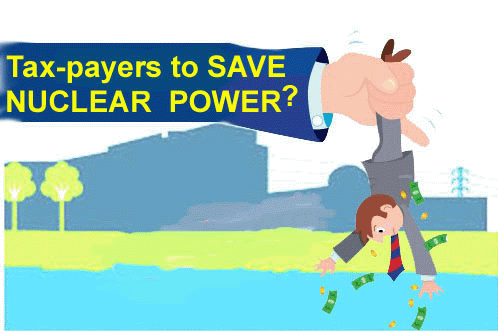 Japan, Hitachi to stump up $8.5 billion for Horizon nuclear project in Wales: source http://www.reuters.com/article/us-britain-nuclear-hitachi-idUSKBN1440BA | TOKYO, 15 Dec 16 The Japanese government and a Hitachi Ltd (6501.T) unit will compile a package worth around 1 trillion yen ($8.5 billion) for a UK nuclear power plant project, a government official involved in the project said on Thursday.
The Japan Bank for International Cooperation and the Development Bank of Japan will provide financing for the project, the official told Reuters.
The funding plans are a boost for the project, one of several new nuclear plants planned in the UK, which is aiming to replacing its ageing fleet of atomic reactors.
Hitachi’s Horizon unit plans to construct at least 5.4 gigawatts of new nuclear capacity across two sites in Britain.
The funds will be provided for the first plant planned at Wylfa Newydd in Wales.
The Nikkei newspaper said Hitachi would invest about 10 percent of the expected 19 billion pounds ($24 billion) cost of the project. A Hitachi official declined to comment, saying the amount has not been announced.
($1 = 117.2600 yen)
($1 = 0.7971 pounds)
Japanese government planning to subsidise Britain’s new nuclear build
Tokyo eyes ¥1 trillion in financial support for Japanese firms pursuing U.K. nuclear plants http://www.japantimes.co.jp/news/2016/12/16/business/tokyo-eyes-%C2%A51-trillion-financial-support-japanese-firms-pursuing-u-k-nuclear-plants/#.WFONt9J97Gg The government is considering offering financial assistance through state-affiliated banks for projects won by Japanese companies for nuclear power plant construction in Britain, sources said Thursday.
Under study is a plan for the Japan Bank for International Cooperation and the Development Bank of Japan to invest in and provide loans to local companies that build and operate nuclear power stations, the sources said.
Visiting British Chancellor of the Exchequer Philip Hammond told reporters in Tokyo on Thursday that Britain is holding talks with the Japanese government, Hitachi Ltd. and Toshiba Corp. on a financial support framework for nuclear power plant construction projects in his country.
On the same day, Hammond met with Chief Cabinet Secretary Yoshihide Suga to exchange opinions about nuclear plant construction.
British Business, Energy and Industrial Strategy Secretary Greg Clark plans to visit Japan as early as next week and hold meetings with officials of Hitachi, Toshiba and the JBIC.
Under the envisaged scheme, the Japanese government expects to offer financial assistance to Horizon Nuclear Power Ltd., a unit of Hitachi, and NuGeneration Ltd., which is under the wing of Toshiba.
Rouhani orders nuclear-fuelled warships, and mounts legal challenge against US trade restrictions
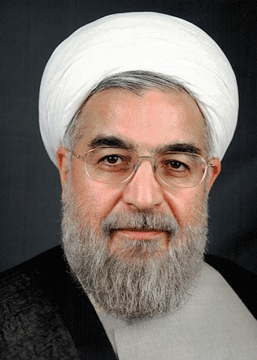 Iran’s President Hassan Rouhani orders nuclear-fuelled warships as he accuses US of ‘violating’ deal http://www.independent.co.uk/news/world/middle-east/iran-nuclear-powered-war-ships-response-us-sanctions-a7471566.html
Leader mounting legal challenge against US trade restrictions Harriet Agerholm @HarrietAgerholm Iran’s President Hassan Rouhani has ordered the head of the country’s Atomic Energy Organisation to start planning the development of nuclear-powered ships in reaction to what he called the United States’ violation of their nuclear deal.
Earlier in December the US Senate voted to extend the Iran Sanctions Act by 10 years, a decision that was criticised by the Iranian foreign minister at the time who said it showed the US government had “a lack of credibility”.
In a letter read out on Tuesday on state television, Mr Rouhani condemned the move as a breach of the 2015 nuclear accord and told the nation’s scientists to begin “planning the design and production of fuel and nuclear power plants for maritime transport”.
The leader also said he had ordered the foreign minister to mount a legal challenge against the US.
The 2015 nuclear accord between Iran and six world powers lifted a variety of sanctions against the nation in exchange for restrictions on the Iranian nuclear programme.
Yet the US keeps its own set of trade restrictions against the country – separate from the agreement – which were set to expire at the end of the year.
Politicians in the Senate said the sanctions were extended not only because of nuclear issues, but also over concerns about ballistic missile-testing and human rights in the country.
President Barack Obama is expected to sign the extension into law in the coming days.
The nuclear marine propulsion technology Iran has vowed to develop uses a nuclear reactor to generate electricity on a ship. Tensions in the Middle East have grown since the US elected Donald Trump as President, Iran’s defence minister said on Sunday.
Iran nuclear deal involves several nations – not just the USA
Nuclear agreement not a deal solely between U.S. and Iran: Daryl Kimball, Tehran Times By Javad Heirannia December 13, 2016 TEHRAN – Daryl Kimball, executive director of the Arms Control Association in Washington, says the nuclear deal is not a bilateral agreement between the United States and Iran that can be unilaterally abrogated by the incoming administration of Donald Trump.
“The nuclear agreement is not a deal solely between the United States and Iran,” Kimball tells the Tehran Times in an exclusive interview.
Kimball says, “If the Trump administration walks away from the nuclear deal, it would also send a dangerous message to our European allies, Russia, and China that the United States cannot be trusted to honor agreements and commitments.”
Following is the full text of the interview:
Q: During presidential campaigns Donald Trump said he would “renegotiate” the terms of the nuclear deal with Iran. What is your prediction?
A: Yes, Mr. Trump did pledge to “dismantle” the 2015 agreement between six world powers and Iran, which has led to verifiable limits on Iran’s capacity to produce material that could be used for nuclear weapons, allowed Iran to continue peaceful nuclear activities, and led to the removal of nuclear-related international sanctions — a win-win scenario for both sides.
It is not clear at this point whether and how Trump would seek to do this or why. Trump’s campaign statements on many issues appear to have been designed to pander to hard-right elements of the Republican Party in order to obtain votes and to criticize the Democratic nominee for president, Hillary Clinton………..
Q: If Trump violates the JCPOA, how will Washington’s European allies and JCPOA parties react?
A: If the Trump administration walks away from the nuclear deal, it would also send a dangerous message to our European allies, Russia, and China that the United States cannot be trusted to honor agreements and commitments.
The nuclear agreement is not a deal solely between the United States and Iran. Washington worked with Russia, China, France, Germany, and the United Kingdom to build an international sanctions regime to pressure Iran to the negotiating table and then reach a deal to block Iran’s pathways to nuclear weapons. None of these countries have any intention of walking away from the agreement, which is working well for them, and the people of Iran.
If the United States administration or Congress takes actions that violate the JCPOA (such as failing to renew waivers of nuclear-related sanctions under the “Iran Sanctions Act”) or measures that are clearly designed to provoke Iran to take actions that would violation the JCPOA, I think it very likely that the United States’ P5+1 partners will resist such actions and seek to insulate the JCPOA as much as possible. Many American foreign policy experts and a significant majority of the American people would also question such a cynical and counterproductive move…….
If the Trump administration walks away from the nuclear deal, it would also send a dangerous message to our European allies, Russia, and China that the United States cannot be trusted to honor agreements and commitments. After sending such a message to the international community, Trump would be hard-pressed to build an international sanctions coalition strong enough to push Iran back to the negotiating table.
On the other hand, if the IAEA finds that Iran has failed to meet its obligations under the deal, however minor the infraction, it is likely that hard-liners in Congress and in the Trump administration will seek to use this as a reason to blame Iran and walk away from the deal and reimpose sanctions. This makes it essential, in my view, for Iran to continue to meet its nuclear-related commitments under the JCPOA. http://www.tehrantimes.com/news/409095/Nuclear-agreement-not-a-deal-solely-between-U-S-and-Iran-Daryl
The main barriers to using nuclear weapons are psychological, not legal
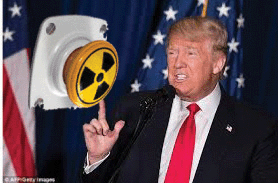 What’s standing between Donald Trump and nuclear war? The main barriers to using nuclear weapons are psychological, not legal, The Verge by Dec 11, 2016 When President-elect Donald Trump officially becomes the president of the United States in January, he will take complete control of America’s nuclear arsenal. Should he decide to start a nuclear war, there are no legal safeguards to stop him. Instead, a much less tangible web of norms, taboos, and fears has reined in US presidents since World War II. But as North Koreaescalates its nuclear weapons tests and the president-elect of the United States openly contemplates using nukes, experts worry that this fragile web could start to tear.
The climate-water conflict – climate change increases risk of nuclear war

Kashmir, climate change, and nuclear war, Bulletin of the Atomic Scientists, Zia Mian , 7 Dec 16 “……..The climate-water conflict. Along with the risks of war triggered by an escalation along the Line of Control in Kashmir or by attacks on Indian cities by Islamist militants backed by Pakistan, a new source of conflict between Pakistan and India has emerged, also centered on Kashmir. It is a struggle over access to and control over the water in the rivers that start as snow and glacial meltwater in the Himalayas and pass through Kashmir on their way to Pakistan as the Indus River Basin, ending in the Arabian Sea.
The Indus River and its tributaries are central to Pakistan’s water supply, food supply, and electricity production, and India relies on some of the same water. Under the 1960 Indus Waters Treaty, Pakistan has control over the Indus, Jhelum, and Chenab Rivers, and India manages the Sutlej, Beas, and Ravi rivers until they cross into Pakistan and all merge into the Indus River. The treaty was established in part because of conflicts over water between the two countries following independence in 1947, including an Indian decision in 1948 to block some of the water flowing into Pakistan during the first India-Pakistan war over Kashmir.
As water demand in both countries has grown to meet the needs of rapidly growing populations and increased agriculture and industrial use, large hydroelectric dams have been constructed, and renewed disputes are testing the Indus Waters Treaty. A 2011 United States Senate Foreign Relations Committee report assessed that “water may prove to be a source of instability in South Asia [as] new demands for the use of the river flows from irrigation and hydroelectric power are fueling tensions between India and Pakistan. A breakdown in the [Indus Water] treaty’s utility in resolving water conflicts could have serious ramifications for regional stability.” The report concluded grimly that “the United States cannot expect this region to continue to avoid ‘water wars’ in perpetuity.”………
Pakistan’s government, nationalist and militant organizations, and right-wing media frequently now present India’s construction of dams in Kashmir as a pressing national security threat and one that may call for extreme responses. An editorial in one leading urdu-language Pakistani newspaper in 2011 declared “Pakistan should convey to India that a war is possible on the issue of water and this time war will be a nuclear one.” ………http://thebulletin.org/kashmir-climate-change-and-nuclear-war10261
Pakistan and India – a dangerous situation that could bring about global nuclear war
Kashmir, climate change, and nuclear war, Bulletin of the Atomic Scientists, Zia Mian , 7 Dec 16 In April 2016, speaking at the conclusion of the Nuclear Security Summit in Washington DC, which had brought together more than 50 government leaders, President Obama described what he saw as the three major nuclear weapons challenges. Along with difficulties in achieving further nuclear arsenal reductions by the United States and Russia and the problem of North Korea, President Obama listed Pakistan and India and the need, as he put it, for “making sure that as they develop military doctrine that they are not continually moving in the wrong direction.” The White House press secretary later explained that underlying the President’s concern about South Asia was “the risk that a conventional conflict between India and Pakistan could escalate to include the use of nuclear weapons.” It is a well-founded fear and one that has become more urgent as tensions between Pakistan and India have escalated.
As part of its efforts to pressure India into giving up Kashmir, Pakistan has backed Kashmiri insurgents and used Islamist militants to launch attacks across the Line of Control. ……
Frustration in the armies on both sides has led to furious, seemingly indiscriminate firing across the Line of Control. The scale of civilian casualties has led hundreds of people to flee their homes on both sides of the line; local villagers say it seems as “if a full-blown war is going on between India and Pakistan.”
Meanwhile many Kashmiris have turned to supporting groups resisting Indian rule and been met with repression from security forces………
It is not just attacks by Pakistan-backed militants on Indian forces in Kashmir and subsequent Indian reprisals that could escalate and tip the two countries into another major war. A related trigger would be an attack on an Indian city by Islamist militant groups, along the lines of the assault on Mumbai in November 2008 that claimed hundreds of casualties and was linked to intelligence agencies in Pakistan. ………
The climate-water conflict……
From tactical weapons to massive retaliation. India anticipates that Pakistan might use nuclear weapons against Indian conventional forces during a war. The Indian Army conducted a massive military exercise in April 2016 in the Rajasthan Desert bordering Pakistan, involving tanks, artillery, armored personnel carriers, and 30,000 soldiers who practiced what they would do if attacked with nuclear weapons on the battlefield. An Indian Army spokesman told the media that “our policy has been always that we will never use nuclear weapons first. But if we are attacked, we need to gather ourselves and fight through it. The simulation is about doing exactly that.” This was not the first such exercise.
Indian nuclear doctrine also calls for massive retaliation directed at Pakistani cities, and Pakistan has threatened to respond in kind. In 2003, India’s cabinet declared nuclear weapons “will only be used in retaliation against a nuclear attack on Indian territory or on Indian forces anywhere… [N]uclear retaliation to a first strike will be massive and designed to inflict unacceptable damage.” According to Admiral Vijay Shankar, a former head of Indian strategic nuclear forces, such retaliation would involve nuclear attacks on Pakistan’s cities.
General Kidwai from Pakistan describes such Indian threats as “bluster and blunder,” since they “are not taking into account the balance of nuclear weapons of Pakistan, which hopefully not, but has the potential to go back and give the same kind of dose to the other side.” This seems an explicit suggestion of Pakistan planning to target Indian cities with nuclear weapons in retaliation of Indian nuclear attacks on Pakistani cities.
From regional war to great power war. Time is not on our side. The failure to settle the Kashmir dispute despite the passage of 70 years has already triggered three wars. While Pakistan clings grimly to its claims on Kashmir, India seems less inclined to compromise as it grows in economic and military power. Adding to this will be the inevitable pressures from climate change over the coming decades on the Himalayan glaciers, the monsoons, and ground water in the Indus Basin, which will lead to reduced and less reliable access to water in an already water-stressed region, at a time of rapidly growing demand. These drivers have already started to overlap, and conflicts over land, people, blood, and water may become one.
Once initiated, possibly even by the actions of a small militant group, a Pakistan-India conflict may well escalate into a larger war and then bring in allied outside powers, as happened in Europe in World War I.
Pakistan is building ever closer military and economic ties to China; India is becoming a strategic partner of the United States. These alliances with great powers may give policy makers in Pakistan and Indian confidence in escalating a conflict and issuing nuclear threats during a crisis. Because of the increasingly tense and militarized nature of the rivalry between China and the United States, a South Asian conflict that draws them in could escalate into a potentially far more destructive war.
Given these risks, forestalling crises and possible war in South Asia should be a priority. The long history of failures to find a path to peace for Kashmir through United Nations resolutions and bilateral Pakistan-India agreements seems to have sapped the will to try to address the dispute directly. Preventing a South Asian war from becoming nuclear war will require progress on banning the bomb. http://thebulletin.org/kashmir-climate-change-and-nuclear-war10261
1 This Month




PLEASE OPPOSE HR 8255 AND S.3639 – bills would accelerate satellite deployment, with no environmental review or safeguards – https://ncstd5li.quorum.us/campaign/169331/
To see nuclear-related stories in greater depth and intensity – go to https://nuclearinformation.wordpress.com
-
Archives
- September 2026 (330)
- August 2026 (330)
- July 2026 (355)
- June 2026 (287)
- May 2026 (306)
- April 2026 (356)
- March 2026 (251)
- February 2026 (267)
- January 2026 (308)
- December 2025 (358)
- November 2025 (359)
- October 2025 (375)
-
Categories
- 1
- 1 NUCLEAR ISSUES
- business and costs
- climate change
- culture and arts
- ENERGY
- environment
- health
- history
- indigenous issues
- Legal
- marketing of nuclear
- media
- opposition to nuclear
- PERSONAL STORIES
- politics
- politics international
- Religion and ethics
- safety
- secrets,lies and civil liberties
- spinbuster
- technology
- Uranium
- wastes
- weapons and war
- Women
- 2 WORLD
- ACTION
- AFRICA
- Atrocities
- AUSTRALIA
- Christina's notes
- Christina's themes
- culture and arts
- Events
- Fuk 2022
- Fuk 2023
- Fukushima 2017
- Fukushima 2018
- fukushima 2019
- Fukushima 2020
- Fukushima 2021
- general
- global warming
- Humour (God we need it)
- Nuclear
- RARE EARTHS
- Reference
- resources – print
- Resources -audiovicual
- Weekly Newsletter
- World
- World Nuclear
- YouTube
-
RSS
Entries RSS
Comments RSS

