Mikhail Gorbachev: It ‘looks as if the world is preparing for war’ as nuclear threat re-emerges, Telegraph Barney Henderson, new york 27 JANUARY 2017 Mikhail Gorbachev has warned that a new arms race means “the nuclear threat once again seems real” as he stated it “looks as if the world is preparing for war”.
The former Soviet leader called on Donald Trump and Vladimir Putin to work together to take steps to reduce the world’s nuclear arsenal.
“Politicians and military leaders sound increasingly belligerent and defence doctrines more dangerous. Commentators and TV personalities are joining the bellicose chorus. It all looks as if the world is preparing for war,” he wrote in an article for Timemagazine.
Mr Gorbachev said the US and Russian presidents should champion a resolution at the UN Security Council to guard against a nuclear conflict.
“I think the initiative to adopt such a resolution should come from Donald Trump and Vladimir Putin – the presidents of two nations that hold over 90% of the world’s nuclear arsenals and therefore bear a special responsibility,” he wrote……
Mr Gorbachev, who detailed his own efforts at denuclearisation during the dying days of the Cold War in the 1980s, issued a stark warning of a world where weapons of mass destruction were becoming cheaper and more readily available.
“Money is easily found for sophisticated weapons whose destructive power is comparable to that of the weapons of mass destruction; for submarines whose single salvo is capable of devastating half a continent; for missile defence systems that undermine strategic stability,” he wrote.
He said his proposed UN Security Council resolution should state “nuclear war is unacceptable and must never be fought”…….http://www.telegraph.co.uk/news/2017/01/27/mikhail-gorbachev-looks-world-preparing-war-nuclear-threat-re/
January 28, 2017
Posted by Christina Macpherson |
politics international, Russia, USA, weapons and war |
Leave a comment

 Decision to leave Euratom ‘bonkers’, say experts Future of UK nuclear research ‘uncertain’ after Brexit bill revelation https://www.timeshighereducation.com/news/decision-leave-euratom-bonkers-say-experts January 27, 2017 By Holly Else The UK is to leave the European Atomic Energy Community as part of Brexit in a move that has been condemned by energy researchers.
The decision to leave the organisation, which funds and coordinates nuclear research, was outlined as part of the government’s Brexit bill published on 26 January.
One nuclear energy researcher called the decision “bonkers”, while another added that it had created a huge amount of “uncertainty” for the field.
The decision has also raised questions about whether the country’s memberships of other European research organisations are at risk.
The community, known as Euratom, is an organisation that provides the basis for research and trade in nuclear power. The government’s desire to leave the organisation is outlined in the explanatory notes published alongside the bill giving it the authority to trigger Article 50 and leave the European Union.
It is not yet clear whether it would seek to rejoin the organisation after Brexit.
Euratom, in conjunction with the Engineering and Physical Sciences Research Council, funds the Culham Centre for Fusion Energy in Oxfordshire, which is the UK’s national laboratory for fusion research. Culham also hosts JET, Europe’s largest nuclear fusion device.
According to its website, the centre collaborates with more than 20 UK universities, and it specifically mentions links with groups at the universities of Warwick and Oxford as well as the Doctoral Training Network in fusion.
Steven Cowley, previously director of the Culham centre and now president of Corpus Christi College, Oxford, said: “It would be bonkers to leave Euratom both for research and for nuclear safeguards.”
James Marrow, professor of energy materials at the University of Oxford, said that the funding available from Euratom was the “glue” that holds together the UK’s national nuclear research.
Euratom is the way that we interacted with the European [nuclear research] programmes. [This move] creates huge uncertainty,” he said.
“Nuclear [research] is a bit different from many other areas in that it only makes progress through big projects, so for a single nation it is extremely difficult for them to develop anything new…[Projects] are very much collaborative, so we would be left out,” he added.
Meanwhile Juan Matthews, visiting professor at the Dalton Nuclear Institute at the University of Manchester, said that he hoped that the inclusion of Euratom in the Brexit bill was a mistake as it “just didn’t make sense”.
“Euratom also controls the nuclear research and development aspects of the [EU’s] Horizon 2020 programme…UK research benefits more than our national contributions to Horizon 2020. A significant part of this is the work at the Culham Centre for Fusion Energy on JET and our contribution to the ITER project,” he said.
ITER is another experimental nuclear fusion project in France. Professor Matthews added that “sorting all this out will produce delays and will hit hard both our economy and our science”.
Reacting to the news, Mark McCaughrean, a senior adviser at the European Space Agency, tweeted: “While #Euratom is specifically linked to EU, how long before the ‘principle’ is extended to other European research organisations?”
A spokeswoman for the UK government said: “Leaving Euratom is a result of the decision to leave the EU as they are uniquely legally joined. The UK supports Euratom and will want to see continuity of cooperation and standards.” holly.else@tesglobal.com
January 28, 2017
Posted by Christina Macpherson |
politics, politics international, UK |
Leave a comment
 http://www.bbc.com/news/science-environment-38762930 By Mark Kinver Environment reporter, BBC News 27 January 2017
A multi-billion dollar global fund is encouraging the construction of fossil fuel projects, at the expense of cleaner options, a study reports.
An NGO said that some World Bank policy loans had the effect of supporting coal, gas and oil developments while undermining renewable schemes.
It added the loans were intended to boost growth in the low carbon sector.
The World Bank disputed the report’s findings, saying it did not reflect the wider work it did with countries.
The report by NGO Bank Information Center (BIC) looks at the Bank’s Development Policy Finance (DPF) operations in four nations – Indonesia, Peru, Egypt and Mozambique.
DPF is one of the main activities of the bank, accounting for about one-third of its funding (more than US $15 billion in 2016), according to the report’s authors.
The scheme provides funding for countries in exchange for the implementation of policy agreed by both the national government and World Bank officials.
The authors say the World Bank’s Climate Action Plan considers DPF as a key instrument in help developing nations become low-carbon economies.
They added that the scheme was also essential in helping these nations meet their national commitments outlined in reducing emissions, which form the backbone of the Paris Climate Agreement.
However, BIC research found that DPF had introduced subsidies for coal in three of the four nations examined in the report (Indonesia, Egypt and Mozambique).
The authors said this had helped Indonesia become one of the world’s top coal exporting nations, while turning Mozambique – considered to be among the most at-risk nations from climate change – into a major player in the global coal sector.
“The findings were really shocking for us because in all of the countries, across the board, the Bank actually created new fossil fuel subsidies, which directly goes against what the Bank wants to achieve,” Nezir Sinani, BIC’s Europe and Central Asia manager, told BBC News.
“The World Bank has pledged to help countries adopt a low-carbon development path specifically by phasing out fossil fuels subsidies and promoting a carbon tax,” he added.
“However, the Bank’s policy lending does the opposite by introducing tax breaks for coal power plants and coal exports infrastructure.”
‘Grossly misrepresent’
A spokesperson for the World Bank told BBC News that the group disputed the picture painted by the report.
“We are deeply disappointed that after close cooperation with BIC on this report, their findings grossly misrepresent the World Bank’s engagement in these countries,” they observed.
“The report does not capture the World Bank’s broader energy work, which involves not only development policy loans, but a mix of interventions – policy reforms, investments, technical assistance – that work together to promote climate smart growth and increased energy access.
“In each of the countries mentioned in the report, the World Bank’s development policy loans do not promote the use of coal, but help support a shift towards a cleaner energy mix and low carbon growth.”
The report was published by BIC, which works with other groups in civil society to hold the World Bank and other financial institutions accountable, in collaboration with other green groups, including Greenpeace Indonesia and Friends of the Earth Mozambique.
January 28, 2017
Posted by Christina Macpherson |
politics international, renewable |
Leave a comment
 http://gbtimes.com/world/china-bans-nuclear-materials-export-north-korea CHINA RADIO INTERNATIONAL
2017/01/26 China has released a new list of restricted goods that cannot be exported to North Korea, many of which are “dual use” items that could be used to build weapons of mass destruction.
The comprehensive list comes amid mounting speculation over an expected test by North Korea of an intercontinental ballistic missile that might be able to reach the west coast of the United States.
The items include materials and equipment to develop nuclear missiles, software related to rockets or drones, high-speed video cameras, submarines, sensors and lasers.
The Ministry of Commerce said the list was meant to comply with the requirements of a round of UN sanctions imposed in November in response to North Korea’s fifth and largest nuclear test in September.
The list was jointly released with the Ministry of Industry and Information Technology, the State Administration of Science, Technology and Industry for National Defense, the China Atomic Energy Authority and the Customs Bureau.
US officials said last week that they had seen indications that North Korea may be preparing for a new missile test-launch.
It’s widely believed a launch could be an early test of the administration of President Donald Trump, who was sworn in last Friday.
January 28, 2017
Posted by Christina Macpherson |
China, North Korea, politics international |
Leave a comment
 Brexit will delay new British nuclear power stations, warn experts
Analysts say exit from EU atomic treaty is ‘lose-lose’ that will raise costs and safety questions at plants such as Hinkley Point C, Guardian, Adam Vaughan, 27 Jan 17, Britain’s first nuclear power station in two decades will be delayed by a government decision to quit Europe’s atomic power treaty, experts have warned.
Ministers revealed on Thursday that Brexit would involve the UK leaving Euratom, which promotes research into nuclear power and uniform safety standards.
The news poses problems for the Hinkley Point C station in Somerset, while raising questions over safety inspection regimes and the UK’s future participation in nuclear fusion research.
Referring to Hinkley and other nuclear projects in the pipeline, he said: “The UK nuclear industry is critically dependent on European goods and services in the nuclear supply chain and their specialist nuclear skills. Leaving Euratom will inevitably increase nuclear costs and will mean further delays.”
EDF, which is building the Hinkley project and hopes to construct other plants, has told MPs that “ideally” the UK would stay in the treaty, as it provided a framework for complying with international standards for handling nuclear material.
Without mentioning Hinkley, the French state-owned company also warned that restrictions on the movement of people because of Brexit could delay delivery of new energy infrastructure.
Antony Froggatt, a research fellow at the Chatham House thinktank, said: “Outside of Euratom and the single market, the movement of nuclear fuel, equipment and trained staff will be more complicated.”
He noted that because the UK was a supporter of nuclear power, Brexit would affect the balance of nuclear policies in the EU, where Germany, Italy and even strongly pro-nuclear France had taken steps in recent years to reduce their reliance on atomic power.
Vince Zabielski, a nuclear energy specialist at the law firm Pillsbury Winthrop Shaw Pittman, said: “If the UK leaves Euratom before new standalone nuclear cooperation treaties are negotiated with France and the US, current new build projects will be placed on hold while those standalone treaties are negotiated.”
Other lawyers questioned why the government had decided to quit Euratom and in the manner it had done so, in the explanatory notes accompany the article 50 bill.
“There doesn’t seem to have been any real explanation as to why, because we are going towards the unknown at great speed. Legally we don’t have to [leave Euratom because the UK is leaving the EU],” said Jonathan Leech, a senior lawyer and nuclear expert at Prospect Law.
“At the moment, the UK standing on the world nuclear stage is predicated on a series of cooperation agreements, and those we have the benefit of from being a member of Euratom, and the few bilateral agreements are based on Euratom, too. Take that away and you have no basis for international nuclear cooperation.”
He said quitting Euratom would create unnecessary uncertainty for new nuclear power and research into fusion power, a cleaner alternative to nuclear fission in which the UK has been a world leader for decades……. https://www.theguardian.com/business/2017/jan/27/uk-exit-eu-atomic-treaty-brexit-euratom-hinkley-point-c
January 28, 2017
Posted by Christina Macpherson |
politics, politics international, UK |
Leave a comment
New power stations in doubt after Brexit change, THE TIMES, Sam Coates, Emily Gosden, 27 Jan 17, The new wave of British nuclear power stations was in jeopardy after the government announced it would pull out of a Europe-wide nuclear co-operation organisation.
Ministers sneaked out the news that the UK would leave the European Atomic Energy Community, known as Euratom, within the notes accompanying the bill published yesterday to trigger Article 50, the process for leaving the European Union.
Euratom was established through a 1957 treaty and plays a crucial role in ensuring compliance with international nuclear safeguards as well as establishing a European market for nuclear goods and services.
The decision to announce Britain’s planned exit from Euratom yesterday caught the nuclear industry by surprise and caused concern in parts of government. Some ministers wanted to delay the announcement because of…http://www.thetimes.co.uk/article/britain-quits-european-nuclear-body-pgmq9m9fc
January 28, 2017
Posted by Christina Macpherson |
politics, politics international, UK |
Leave a comment
Reported by Gao Shan for RFA’s Mandarin Service, and by Goh Fung for the Cantonese Service. Translated and edited by Luisetta Mudie.Ran Bogong, former politics professor at Toledo University, agreed.
“We should judge them by their deeds rather than their words,” Ran said. “The most important thing is what will Trump actually do.”
“I believe there will be some changes in the U.S.-China relationship, but I don’t think there will be war, at least not in the short term,” he said.
Meanwhile, Claude Barfield, an expert on international trade at the American Enterprise Institute (AEI), a former U.S. think-tank adviser to the US Trade Representative’s Office, said in a recent report that China’s tight controls over online content have negatively affected overseas suppliers.
Eight of the world’s top 25 traffic sites are banned in China, including Google, Facebook, Twitter, and YouTube, Barfield wrote, saying the complex system of blocks, filters and human censorship known as the Great Firewall breaks international trade rules on market access.
He said such practices could be seen as discriminatory protectionism under World Trade Organization (WTO) rules.
Sang Young, information security expert at the Hong Kong Internet Society, said the Great Firewall definitely inconveniences foreign businesses operating in China.
“The ‘discrimination’ refers to not allowing people to see overseas content, but allowing people to access content provided by China,” Yeung told RFA.
“The failure to allow suppliers to provide services to the Chinese mainland would seem to contravene WTO rules and the concept of free trade,” he said.
China’s 730 million netizens must currently use virtual private networks (VPNs) to access Facebook, Twitter and most foreign news sites, according to rights activist Jia Pin.
“You see, activists here in China often need to access these foreign sites; any political content is generally prohibited browsing, which means that you must use a VPN to get ‘over the Wall’,” Jia.
But China has said that it will crack down in 2017 on the use of VPNs to get around the Great Firewall with new rules requiring service providers to obtain government approval before they can operate.
Jia said such a comprehensive obstacle to the flow of information in China would be a “major hindrance” to rights activists there.
Continue reading →
January 28, 2017
Posted by Christina Macpherson |
China, politics international |
Leave a comment
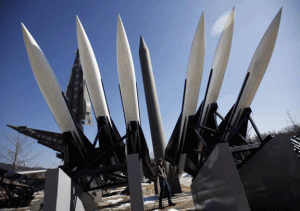 China ‘deploys missiles’ amid calls for more nuclear weapons to deter Donald Trump Neil Connor, Telegraph UK Beijing 25 JANUARY 2017
Beijing is moving advanced ballistic missiles which are capable of hitting the US to its north-eastern frontier with Russia, according to media reports, amid suggestions that the weapons were revealed in response to Donald Trump’s “provocative remarks” towards China……..
The state-run Global Times newspaper, which has close links with China’s Communist leaders, said: “Some media claimed that the Chinese military intentionally revealed the Dongfeng-41 and connected it with the inauguration of US President Donald Trump.
“They think this is Beijing’s response to Trump’s provocative remarks on China,” added the outlet, which is known for taking a strongly nationalist tone and making inflammatory comments.
The newspaper also called for a ramping up of China’s nuclear capabilities, saying: “China’s nuclear arsenal must be able to deter the US.”
“Even Washington feels that its naval forces and nuclear strength are lacking,” it added. “So how can China be content with its current nuclear strength when it is viewed by the US as its biggest potential opponent?”
The reported deployment comes after Mr Trump has angered China with his stance on Taiwan, trade and security – particularly in the South China Sea. http://www.telegraph.co.uk/news/2017/01/25/china-deploys-missiles-amid-calls-nuclear-weapons-deter-donald/
January 27, 2017
Posted by Christina Macpherson |
China, politics international, USA, weapons and war |
Leave a comment
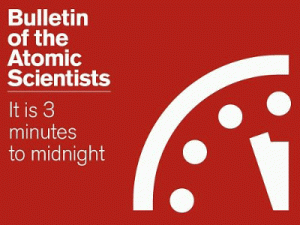 and 1 person is to blame Mary Bowerman , USA TODAY Network Jan. 26, Scientists moved the hands of the Doomsday Clock closer to midnight on Thursday amid increasing worries over nuclear weapons and climate change.
Each year, the Bulletin of the Atomic Scientists, a nonprofit that sets the clock, decides whether the events of the previous year pushed humanity closer or further from destruction. The symbolic clock is now two-and-a-half minutes from midnight, the closest it’s been to midnight since 1953, when the hydrogen bomb was first tested. Scientists blamed a cocktail of threats ranging from dangerous political rhetoric to the potential of nuclear threat as the catalyst for moving the clock closer towards doomsday.
“This year’s Clock deliberations felt more urgent than usual…as trusted sources of information came under attack, fake news was on the rise, and words were used by a President-elect of the United States in cavalier and often reckless ways to address the twin threats of nuclear weapons and climate change,” Rachel Bronson, the executive director and publisher of Bulletin of the Atomic Scientists, said in a statement.
While many threats played into the decision to move the clock 30 seconds forward from where it was in 2016, one person in particular prompted the scientists to act.
“Never before has the Bulletin decided to advance the clock largely because of the statements of a single person. But when that person is the new president of the United States, his words matter,” David Titley and Lawrence M. Krauss of the Bulletin wrote in an New York Times op-ed.
The Bulletin pointed to President Donald Trump’s careless rhetoric on nuclear weapons and other issues as well as his troubling stance on climate change. “Current political situation in the U.S. is of particular concern,” Titley of the Bulletin Science and Security Board said. “The Trump administration needs to state clearly, unequivocally it accepts climate change caused by human activity…There are no alternative facts here.”
Last year, the clock remained at three minutes from midnight. It was moved to three minutes in 2015 where it was previously at five minutes to midnight.
Manhattan Project scientists, concerned about the first atomic weapons, founded the nonprofit Bulletin of the Atomic Scientists in 1945. They created the clock two years later, and update its minute hand each year……..http://www.usatoday.com/story/news/nation-now/2017/01/26/doomsday-clock-end-world-nuclear-weapons-climate-change-donald-trump/97077736/
January 27, 2017
Posted by Christina Macpherson |
2 WORLD, politics international, USA, weapons and war |
Leave a comment
 China Announces Deployment of New Long Range Nuclear Missile, Popular Mechanics. 24 Jan 17
The target—at least of the announcement—is Trump. In a rare move, China has publicly announced the deployment of a new intercontinental ballistic missile (ICBM). The Dong Feng (“East Wind”) -41 missile, or DF-41, can carry up to a dozen nuclear warheads and China claims it has the longest range of any nuclear missile in the world. The announcement of the missiles is likely a warning to U.S. President Donald Trump, who is known for sharply worded anti-Chinese rhetoric and has announced plans for a new ballistic missile system.
According to China’s Global Times newspaper, the People’s Liberation Army has deployed its newest intercontinental ballistic missile to Heilongjiang Province. The article cited eyewitness photos culled from Chinese social media by news media in Taiwan and Hong Kong. The photos showed heavy missile launchers, also known as transporter/erector/launchers (TELs) moving through Daqing City in Heilongjiang.
The DF-41 is described by Global Times as the most advanced ICBM in the world. It reportedly has a range of 8,699 miles, enough to hit any target on Earth with the exception of South America and parts of Antarctica. It can carry up to 12 nuclear warheads, and travels on China’s nationwide network of roads to make it difficult to track down and destroy.
The location of the missiles and the timing of the release are notable. Heilongjiang Province is in Northern China, near the country’s long border with Russia. The DF-41’s long range, if accurate, means it could be based anywhere and still hit any useful target on Earth, but the implication is that China considers Russia a friendly country.
While China tends to be low-key regarding nuclear weapons and nuclear deterrence, this seems like a deliberate move to make a subtle threat. After all, it was probably completely unnecessary to move strategic nuclear weapons through
a city of 2.9 million people, unless you want to get the word out. President Donald Trump, meanwhile, has been talking tough about China as well as enhancing America’s ballistic missile shield. If China wanted to overwhelm the shield with more missiles, the DF-41 would be the way to do it………
http://www.popularmechanics.com/military/weapons/a24893/china-announces-deployment-long-range-nuclear-missile/
January 25, 2017
Posted by Christina Macpherson |
China, politics international, weapons and war |
Leave a comment
Closer nuclear ties with France have been blown by Brexit, Independent, Martin Deighton, 23 Jan 17 “…The UK is planning to pay £30bn to upgrade Trident. The UK will not own the missiles but will lease them under licence controls from the US. UK Submarines will have to report to King George Bay in the state of Georgia in order to be regularly inspected and serviced and armed with the leased missiles. In its latest test, the Trident missile misfired.
We now have Trump on one flank, a President who not only considers Nato to be obsolete but will also have total control of the nuclear armaments and facilities in the US; and we have Putin on the other flank, a President of Russia with apparent and activated plans to expand into Eastern Europe……
France has suggested that the UK and France should join forces in the funding, expansion and deployment of these armaments as a truly European nuclear deterrent………..But of course this cooperation is now unlikely as we have decided to walk away from the EU.
January 25, 2017
Posted by Christina Macpherson |
politics international, UK |
Leave a comment
 The UK now relies on Trump for our nuclear weapons – we need to spend more than ever before to free ourselves Britain’s Trident missiles are in a common pool shared with the US and maintained at Kings Bay, Georgia. Without the cooperation of the Trump administration, Trident wouldn’t last longer than a couple of months, Independent Benedict Spence Tuesday 24 January 2017 The report that a Trident missile test went awry, veering not toward its intended target on the west coast of Africa, but toward Florida – just weeks before parliament voted for its renewal – has forced the question of Britain’s nuclear deterrent firmly back into the public agenda.
Number 10 has confirmed that the Prime Minister, Theresa May, was aware of this malfunction before the vote, raising questions over whether she should have revealed information at the time. Scottish First Minister Nicola Sturgeon, for one, believed there should have been “full disclosure”, whilst the Campaign for Nuclear Disarmament suggested such information “would have impacted the debate in parliament.”
January 25, 2017
Posted by Christina Macpherson |
politics international, UK, USA, weapons and war |
Leave a comment
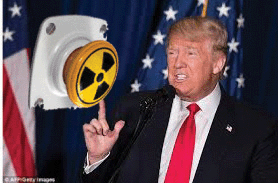 In Nuclear Poker, Don’t Bet on Trump, Bloomberg JAN 19, 2017 BY James McManus Is North Korea’s belligerent young leader, Kim Jong-un, bluffing when he says the “last stage” is underway for testing a ballistic missile capable of hitting the U.S.? What about President-elect Donald Trump, when he tweets, “It won’t happen“?
As Trump’s administration begins, a showdown with North Korea over ICBMs seems all but inevitable. Just yesterday, South Korean media reported possible signs that the North may be preparing a new missile launch. In managing this conflict, few things will be more crucial than understanding the nature of bluffing. Unfortunately, for all his talk of being a good deal maker, Trump is a terrible bluffer — and his lack of skill is likely to destabilize nuclear politics.
A bluff is an untrue but plausible story. In the mindsport of poker, bluffs work when your opponent believes you have a better hand, so he can’t call your bet or raise, conceding you the pot. The savvier player wants to steadily grind away at the stack of his opponent over a large number of small pots, without risking too many of his own chips in any single hand. The weaker player can counter the “small ball” strategy by raising all-in fairly often, forcing all-or-nothing confrontations.
To understand why these dynamics are so crucial in nuclear negotiation, consider the work of John von Neumann, the prodigiously gifted polymath who immigrated to the U.S. from Hungary in 1933 and later contributed to the Manhattan Project. Von Neumann loved poker because its strategy involves guile, probability, luck and budgetary acumen, but is never transparent; it always depends on the counterstrategies deployed by opponents.
Expert players misrepresent the strength of their hands, simulate irrational behavior, and deploy other mind games to confuse their opponents. In a nutshell, they bluff. It was von Neumann’s efforts to express bluffs in mathematical terms that helped him develop game theory, which has numerous real-world applications, nuclear strategy foremost among them……..
Trump bluffs almost constantly. He has spent his entire adult life overstating the value of his real estate holdings and branding endeavors, while bragging relentlessly about his wealth, sex life, length off the tee, and on and on. His bluffs during the campaign — that he had a replacement for Obamacare, a secret plan to defeat Islamic State and so on — were plainly false to anyone paying attention. To Trump, what was true hardly mattered.
Such tendencies would not serve him well in a poker game. Any player who continually misrepresents the size of his hand would cause sharp opponents to give his bets little credit. They’d simply wait for above-average hands and call him. As Daniel Negreanu, the all-time winningest poker tournament player, put it to me, “Trump’s bluffs are very effective against level-one thinkers. His lies are so outlandish that people think they have to be true or he wouldn’t have said it. The constant barrage makes him tougher to read. But sharper players would pick him apart.”
Kim may not be irrational, but he knows how to seem that he is, which gives him leverage. Kim’s contempt for most North Koreans means that he has less to lose by threatening to nuke an American city. The more we know about his pretensions to deity, his labor camps, the food and electricity shortages his policies have prolonged, the easier it is to believe he might sacrifice millions of Koreans in an absurd attempt to save face. Kim isn’t threatening to defeat the U.S., a bluff no one would credit; he’s trying to prove he could grievously injure it before dying himself, a bluff that must be taken seriously. As Negreanu puts it, Kim is “a scary player. Being unpredictable, capable of any move at any time, makes him hard to prepare for.”
In such circumstances, Trump’s long history of empty boasts is destabilizing. Kim may calculate that he has renewed leverage to push for concessions from the U.S. He might engage in riskier behavior, such as firing more test missiles or launching cyberattacks. Almost certainly, he’ll persist in developing missiles that can reach the U.S., calculating all the while that Trump’s Twitter outbursts are simply talk.
That may be true. But what if, for once in his life, Trump means what he says? What if he can’t bear to have his bluff called, and really is tempted to launch a preemptive attack if it looks like North Korea poses a real threat to the U.S. mainland?……..https://www.bloomberg.com/view/articles/2017-01-19/in-nuclear-poker-don-t-bet-on-trump
January 21, 2017
Posted by Christina Macpherson |
North Korea, politics international, USA, weapons and war |
Leave a comment

 Iran, ROSATOM sign roadmap for nuclear cooperation http://www.tehrantimes.com/news/410263/Iran-ROSATOM-sign-roadmap-for-nuclear-cooperation January 20, 2017 TEHRAN – The Atomic Energy Organization of Iran (AEOI) and the Russian ROSATOM signed on Thursday a roadmap for cooperation in peaceful uses of nuclear energy.
The document was signed in Russia by Behrouz Kamalvandi, the AEOI deputy chief, and Nickolay Spasskiy, ROSATOM deputy director general, as a follow-up to a memorandum of understanding in Nov. 11, 2014.
Also, the two sides finalized a pre-project contract for the retrofitting of two gas centrifuge cascades in the Fordo facility.
The documents were approved and prepared for signing as a result of recent negotiations between the AEOI and ROSATOM.
The agreement is in line with a 2015 international nuclear deal between Iran and six world powers, which resulted in removal of sanctions against Iran in exchange for limits on the country’s nuclear program.
Under the deal, Iran has committed to convert the Fordo facility into a nuclear, physics and technology center to benefit from international collaboration including in the form of scientific joint partnerships in agreed areas of research.
Also, by the accord, two of the six centrifuge cascades at the Fordo facility have to spin without uranium and will be transitioned, including through appropriate infrastructure modification, for stable isotope production.
Stable isotopes are used for medical and industrial purposes.
Iran launched a facility to produce raw material for stable isotopes in August 2016.
Also, in an August interview with Azerbaijani state news agency AZERTAC, Russian President Vladimir Putin said, “We will further assist our Iranian partners in implementing the Plan of Action on Iran’s nuclear program, including the processing of enriched uranium and the conversion of facilities to produce stable isotopes.”
January 21, 2017
Posted by Christina Macpherson |
ENERGY, Iran, politics international |
Leave a comment

 Trump’s China policy threatens nuclear war World Socialist Website, James Cogan 13 January 2017
 The confirmation hearings for Donald Trump’s cabinet nominees confirm that his administration intends to vastly intensify US demands for massive economic and strategic concessions from the Chinese regime. In pursuit of the predatory ambitions of a tiny layer of corporate oligarchs, policies are being put forward that could result in a military clash and trigger a nuclear exchange.
On Thursday, Rex Tillerson, Trump’s proposed secretary of state, made unprecedented statements on the attitude the next US government will take toward China’s land reclamation activities and construction of facilities on the islets and reefs Beijing claims as sovereign territory in the South China Sea.
Tillerson declared: “We are going to have to send China a clear signal that, first, the island-building stops and second, your access to those islands also is not going to be allowed.”
The implications of such a policy are immense. The islands referred to by Tillerson are occupied by Chinese military personnel. The waters surrounding them are patrolled by the Chinese Coast Guard and Navy. The airspace above them is patrolled by the Chinese air force. The only conceivable way to deny China access would be through the large-scale deployment of US aircraft carriers and associated military forces into the South China Sea.
Media headlines around the world have reflected the recognition that war would be the most likely outcome of attempting to implement Tillerson’s declaration. For its part, the Chinese state-owned publication Global Times, whose editorial line is believed to come directly from the highest echelons of the Chinese regime, has not hedged its words in response.
Its January 13 editorial states: “Unless Washington plans to wage a large-scale war in the South China Sea, any other approaches to prevent Chinese access to the islands will be foolish. The US has no absolute power to dominate the South China Sea. Tillerson had better bone up on nuclear power strategies if he wants to force a big nuclear power to withdraw from its own territories [emphasis added].”
An analysis of the social forces and economic interests that stand behind Trump leaves no room for doubt that his administration is more than prepared to threaten a full-scale war with China, posing the risk of a nuclear exchange.
Before he is even sworn in, Trump and the cabal of billionaires and ex-generals who will comprise his cabinet have signaled they will provoke conflict with China over a range of issues. In addition to rejecting Chinese territorial claims in the South China Sea, these policies include imposing tariffs on Chinese exports; demanding Beijing force North Korea to shut down its nuclear weapons program; and threatening to repudiate the “One China policy” under which Washington, since 1979, has formally recognised that the island of Taiwan is part of China and not an independent state.
Adding to the possible list of provocations, one of Trump’s chief supporters in the Congress, Arkansas Republican Tom Cotton, joined with Republican presidential aspirant Marco Rubio to introduce the “Hong Kong Human Rights and Democracy Act” in November. The Act would require the US government to take action to ensure Hong Kong remains “sufficiently autonomous” from the mainland regime. Tibetan nationalists have enthusiastically welcomed Trump’s election as a signal that their cause might also be taken up by the incoming administration.
The focus on China flows directly from the interests of a powerful faction of the American corporate elite who view it as their greatest immediate economic, geopolitical and potential military competitor.
Rex Tillerson, the former CEO of oil conglomerate ExxonMobil, personifies this layer. Under Tillerson, ExxonMobil aggressively pursued access to potential oil and gas fields in the South China Sea, in partnership with Vietnam and in defiance of China’s territorial claims. In 2014, one of its fields was occupied by a Chinese oil rig. ExxonMobil’s ambitions for a stake in mainland Chinese energy production and distribution have been hindered also by the dominance of the Chinese state-owned companies that monopolise the domestic industry. Around the world—even in US-occupied Iraq—bids by American energy corporations for contracts have been undercut by their Chinese rivals.
The preoccupation of the Trump oligarchs with shattering Chinese competition is most clearly demonstrated in their willingness to defy the furious demands in the American ruling class for action first against Russia. Trump has thus far largely brushed aside the hysterical calls from the Democratic Party, figures in the Republican Party and the intelligence agencies for an immediate confrontation with Moscow over its alleged interference in the US election and its intervention in Syria to protect the regime of Bashar al-Assad from US-backed Islamist rebels……..ttps://www.wsws.org/en/articles/2017/01/13/pers-j13.html
January 14, 2017
Posted by Christina Macpherson |
politics international, USA, weapons and war |
Leave a comment