Friendship on the rocks? China, North Korea clash over nuclear and chemical weapons
North Korea’s reaction was so strong that some Chinese experts initially thought the commentary was fake By Saša Petricic, CBC News Feb 28, 2017 “…..China’s patience may be wearing thin, as frustrations double up over North Korea’s development of nuclear weapons and apparent willingness to use chemical weapons.
South Korea has accused North Korean leader Kim Jong-un of ordering the assassination of his half-brother, Kim Jong-nam, and Malaysia suspects several North Korean officials may have been involved in a plot that used the banned VX nerve agent.
It’s creating an unprecedented rift between the two neighbours and ideological soulmates. China’s support dates back to the 1950s and the Korean war.
Last week, Beijing imposed a ban on coal imports from North Korea that could deprive it of much needed foreign funds until the end of 2017. Pyongyang has replied with one of the nastiest insults one socialist state can throw at another, accusing China of “dancing to the tune of the U.S.”
“The hostile forces are shouting ‘bravo’ over this,” says a commentary published by North Korea’s state news agency, accusing its neighbour of “mean behaviour.”…….
Pyongyang has defied some of the toughest sanctions imposed by the United Nations Security council, meant to not only deprive North Korea of the parts and expertise it needs to develop a nuclear arsenal, but also to punish the country’s leadership by blocking travel and access to luxury goods.
Officially, China endorses the UN sanctions and condemns Kim Jong-un’s nuclear and missile sabre-rattling.
But it is walking a fine line, trying to avoid weakening the regime so badly that it collapses, causing unrest in North Korea and a possible flood of refugees into China.
Beijing has been accused of turning a blind eye to a network of North Korean shell companies and middlemen who operate just over the land border in China, working to circumvent sanctions……..
while Pyongyang’s ongoing nuclear and missile program worries China, it’s the apparent assassination of Kim Jong-un’s half-brother Kim Jong-nam that has sharpened the divisions between it and North Korea…….
Stockpile of deadly toxins
China is reportedly upset because Jong-nam was under its implicit protection, living in the country’s gambling enclave of Macau for years.
It was also rattled by North Korea’s apparent ready use of such a potent and prohibited chemical weapon beyond its borders. Pyongyang is known to have a large stockpile of various deadly toxins, and it hasn’t signed on to international conventions agreeing not to engage in chemical warfare…….http://www.cbc.ca/news/world/north-korea-china-weapons-petricic-1.4000631
March 1, 2017
Posted by Christina Macpherson |
China, North Korea, politics international, weapons and war |
Leave a comment
Did Putin help elect Trump to restore $500 billion Exxon oil deal killed by sanctions
Follow the money: Will Trump repay Putin by ending Russian sanctions and killing the Paris climate deal? Think Progess, Joe Romm , 28 Feb 17, “……. our democracy and our children have a new axis to worry about: Putin, Trump, and ExxonMobil, whose CEO Rex Tillerson — an extreme Russophile and long-time director of a US-Russian oil company — is Trump’s puzzling choice for Secretary of State.
I say “puzzling” because the long-serving Exxon employee (from age 23!) has no qualifications to be secretary of state — other than a history negotiating major oil deals with countries like Putin’s Russia, which in any sane world would actually disqualify him or at least force a recusal from all State Department dealings with Russia.
But that puzzle disappears if we follow the famous dictum from the Watergate era for uncovering a tangled web of covert campaign acts: “Follow the money.” And perhaps another puzzle is also solved: Why did Putin take such a “fearful risk,” as Frum put it, to “mount a clandestine espionage and disinformation campaign on behalf” of Trump and against Clinton, “when Putin had every reason to expect that he probably would end up facing a President Clinton,” and a tremendous backlash.
You can certainly make a plausible case, as U.S. intelligence agencies do in their bombshell new report, that Putin had plenty of motivation to interfere. He wanted to undermine the legitimacy of U.S. elections and a Clinton Presidency, he blamed Secretary Clinton for “inciting mass protests against his regime,” and he was angry with the U.S. for the Panama Papers leaks.
Those leaks showed a $2 billion trail of offshore accounts and deals that traced back to Putin and his cabal of kleptocrats, who, among other things, were getting rich “trading shares in Rosneft,” Russia’s state-owned (i.e. Putin run) oil monopoly.
But a half trillion dollars to line their pockets and prop up the Russian economy offers a much more tangible motivation for team Putin to get Trump elected. And it was Tillerson who had made the $500 billion oil dealwith Putin that got blocked by sanctions.
Blocking the deal did not just “put Exxon at risk,” as the Wall Street Journal reported in 2014. MSNBC’s Rachel Maddow explained last month the biggest oil deal in history was “expected to change the historical trajectory of Russia.”
The top priority for Putin and the kleptocrats who benefit from his rule is enriching the Kremlin’s coffers and their own, which have been hurt by the sanctions. And Trump’s election already appears to have delivered $11 billion to the Kremlin through sale of a 19.5 percent stake in Rosneft, “confounding expectations that the Kremlin’s standoff with the West would scare off major investors,” as Fortune has reported in a must-read piece.
Kleptocracy — and interfering with our election — pays…….
Indeed, if Trump and Tillerson instead end the sanctions that are blocking the Exxon-Rossneft deal, it is going to look suspiciously like a half trillion dollar quid pro quo for Putin’s help getting elected.
And if Trump and Tillerson work together to kill the Paris climate deal, the last best chance to save Americans from catastrophic climate change—and aridiculously good deal for the U.S.— that will look like they are putting Putin’s interests and Exxon’s profits above America’s national interest and the health and well-being of our children. It bears repeating that ExxonMobil’s future is inextricably tied to their stalled oil deal with Putin — and their future drilling plans would benefit from continued global warming and melting of polar ice…….. https://thinkprogress.org/putin-helped-trump-exxon-oil-deal-sanctions-6f169c4a4cd0#.hxgqiytyu
March 1, 2017
Posted by Christina Macpherson |
politics, politics international, Russia, USA |
Leave a comment
 Trump’s US nuclear stance alarms Russia http://www.skynews.com.au/news/politics/nthamerica/2017/02/25/trump-s-us-nuclear-stance-alarms-russia.html
Published: 10:16 am, Saturday, 25 February 2017 Russian politicians close to the Kremlin say US President Donald Trump’s declared aim of putting the US nuclear arsenal ‘at the top of the pack’ risked triggering a new Cold War-style arms race between Washington and Moscow.
In an interview with Reuters, Trump said the US had fallen behind in its nuclear weapons capacity, a situation he said he would reverse, and he said a treaty limiting Russian and US nuclear arsenals was a bad deal for Washington.
Russian officials issued no reaction, with Friday a public holiday, but pro- Kremlin politicians expressed consternation about the comments from Trump, who Moscow had hoped would usher in new, friendlier relations between the two countries.
‘Trump’s campaign slogan ‘Make America great again’, if that means nuclear supremacy, will return the world to the worst times of the arms race in the ’50s and ’60s,’ said Konstantin Kosachev, chairman of the international affairs committee in the upper house of the Russian parliament.
The president’s remarks in the interview with Reuters were, Kosachev said in a post on his Facebook page, ‘arguably Trump’s most alarming statement on the subject of relations with Russia’.
Over the course of the Cold War, the Soviet Union and the US realised that achieving supremacy was dangerous, and accepted the doctrine of parity as the best way to ensure peace, Kosachev wrote on his Facebook page.
‘Are we entering a new era? In my view we need an answer to that question as soon as possible.’
During the US presidential race, Trump said he would try to end the enmity that broke out between the Kremlin and Washington during Barack Obama’s presidency.
But just over a month into the Trump presidency, that prospect has receded, especially with the sacking of Michael Flynn, a leading proponent of warmer ties with Moscow, from his job as national security adviser.
Another pro-Kremlin lawmaker, Alexei Pushkov, wrote on Twitter that Trump’s comments on increasing US nuclear capacity ‘put in doubt the agreement on limiting strategic arms, returning the world to the 20th century’.
He said a Cold War arms treaty laid the foundation for nuclear stability between Moscow and Washington. ‘That needs to be preserved. And the United States cannot achieve decisive superiority.’
‘Instead of trying to achieve an illusory nuclear supremacy over Russia, the US administration should find a solution to the exceptionally complicated nuclear problem of North Korea,’ wrote Pushkov, a member of the defence and security committee in Russia’s upper house of parliament. – See more at: http://www.skynews.com.au/news/politics/nthamerica/2017/02/25/trump-s-us-nuclear-stance-alarms-russia.html#sthash.fwqZWCfw.dpuf
– See more at: http://www.skynews.com.au/news/politics/nthamerica/2017/02/25/trump-s-us-nuclear-stance-alarms-russia.html#sthash.fwqZWCfw.dpuf
– See more at: http://www.skynews.com.au/news/politics/nthamerica/2017/02/25/trump-s-us-nuclear-stance-alarms-russia.html#sthash.fwqZWCfw.dpuf– See more at: http://www.skynews.com.au/news/politics/nthamerica/2017/02/25/trump-s-us-nuclear-stance-alarms-russia.html#sthash.fwqZWCfw.dpuf
February 27, 2017
Posted by Christina Macpherson |
politics international, Russia, USA, weapons and war |
1 Comment
Donald Trump wants to expand US nuclear arsenal, make it ‘top of the pack’ http://www.smh.com.au/world/donald-trump-wants-to-expand-us-nuclear-arsenal-make-it-top-of-the-pack-20170223-guk6ms.htm, Steve Holland, 23 Feb 17
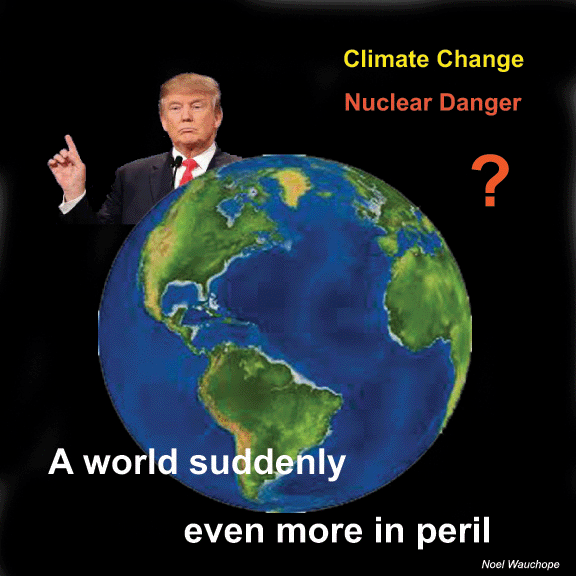
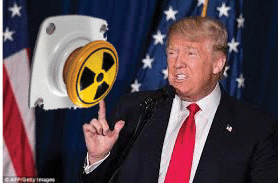
Washington: President Donald Trump has said he wants to build up the US nuclear arsenal to ensure it is at the “top of the pack,” saying the United States has fallen behind in its atomic weapons capacity.
In a Reuters interview, Trump also said China could solve the national security challenge posed by North Korea “very easily if they want to,” ratcheting up pressure on Beijing to exert more influence to rein in Pyongyang’s increasingly bellicose actions.
n his first comments about the US nuclear arsenal since taking office on January 20, Mr Trump said the United States has “fallen behind on nuclear weapon capacity.”
“… We’re never going to fall behind any country even if it’s a friendly country, we’re never going to fall behind on nuclear power.
“It would be wonderful, a dream would be that no country would have nukes, but if countries are going to have nukes, we’re going to be at the top of the pack,” Mr Trump said.
The new strategic arms limitation treaty, known as New START, between the US and Russia requires that by February 5, 2018, both countries must limit their arsenals of strategic nuclear weapons to equal levels for 10 years.
The treaty permits both countries to have no more than 800 deployed and non-deployed land-based intercontinental and submarine-launched ballistic missile launchers and heavy bombers equipped to carry nuclear weapons, and contains equal limits on other nuclear weapons.
Analysts have questioned whether Mr Trump wants to abrogate New START or would begin deploying other warheads.
In the interview, Mr Trump called New START “a one-sided deal”.
“Just another bad deal that the country made, whether it’s START, whether it’s the Iran deal … We’re going to start making good deals,” he said.
The United States is in the midst of a $US1 trillion ($1.3 trillion), 30-year modernisation of its aging ballistic missile submarines, bombers and land-based missiles, a price tag that most experts say the country cannot afford.
Mr Trump also complained that the Russian deployment of a ground-based cruise missile is in violation of a 1987 treaty that bans land-based American and Russian intermediate-range missiles.
“To me it’s a big deal,” he said.
Asked if he would raise the issue with Russian President Vladimir Putin, Mr Trump said he would do so “if and when we meet.” He said he had no meetings scheduled as of yet with Mr Putin.
Speaking from behind his desk in the Oval Office, Mr Trump declared that “we’re very angry” at North Korea’s ballistic missile tests and said accelerating a missile defense system for US allies Japan and South Korea was among many options available.
“There’s talks of a lot more than that,” Mr Trump said, when asked about the missile defense system. “We’ll see what happens. But it’s a very dangerous situation, and China can end it very quickly in my opinion.”
February 24, 2017
Posted by Christina Macpherson |
politics international, USA, weapons and war |
Leave a comment


 Pakistan, India extend nuclear safety agreement, By Our Correspondent, Express Tribune, February 21, 2017 ISLAMABAD: Pakistan and India have agreed to extend their bilateral agreement on reducing the risk from accidents relating to nuclear weapons in a move suggesting the two rivals are still mindful of nuclear dangers despite currently strained ties.
The key agreement was extended for the next five years (2017-2022), said a statement issued by the Foreign Office on Tuesday.
The agreement came into force in 2007. It was subsequently extended for a period of five years in 2012. The accord is part of the nuclear confidence building measures agreed between Pakistan and India. The aimed of the agreement is to promote a stable environment of peace and security between the two countries, reads the official handout.
“It is premised on the recognition that the nuclear dimension of the security environment of the two countries adds to their responsibility for avoidance of conflict,” the statement added.
The agreement provides for immediate exchange of information between the two countries in the event of any accident relating to nuclear weapons, under their respective jurisdiction and control, which could create the risk of radioactive fallout, with adverse consequences for both sides, or create the risk of an outbreak of a nuclear war…….https://tribune.com.pk/story/1334606/pakistan-india-extend-nuclear-safety-agreement/
February 22, 2017
Posted by Christina Macpherson |
India, Pakistan, politics international |
Leave a comment
Germany demands answers after Swiss nuclear reactor is restarted… and then shut down again, The Local, 20 Feb 17, The German environment minister has demanded answers from the Swiss authorities after the Leibstadt nuclear reactor in the canton of Aargau near the German border was switched off on Friday night, just seven hours after being restarted following a six months shutdown.
Shortly after the reactor was brought on line at around 5.30pm on Friday, operator KKL noted a malfunction of the exhaust system responsible for filtering gases from the condenser in a non-nuclear area of the reactor, KKL said in a
statement……
Greenpeace has also criticized the move, while 16,000 people have signed a petition against the reactor led by a Swiss Green Party politician, reported
Swiss news agencies.
February 22, 2017
Posted by Christina Macpherson |
Germany, politics international, Switzerland |
Leave a comment
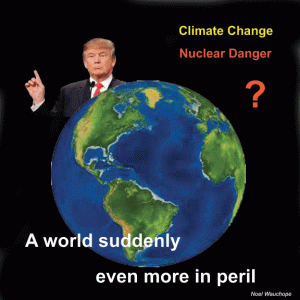 A bad START: Trump tells Putin U.S.-Russia treaty to limit nuclear weapons was a “bad deal”, Salon.com , FEB 10, 2017
The president reportedly didn’t know what the New START treaty was but wanted to get rid of it MATTHEW ROZSA , President Donald Trump has had another embarrassing phone call with a foreign leader — and this time there’s potentially dangerous consequences.
Trump described the New Strategic Arms Reduction Treaty, or START, signed by former president Barack Obama in 2010, as a bad deal for the United States,
according to a Reuters report. The treaty requires America and Russia to cap their deployed strategic nuclear warheads at 1,550 by February 2018, as well as limit their deployed land- and submarine-based missiles and nuclear-capable bombers.
According to the sources who spoke with Reuters, however, Trump seemed unfamiliar with the details of New START when it was brought up by Russian leader Vladimir Putin. After Putin suggested extending New START beyond its original time frame, Trump referred to the treaty as one of many bad deals that Obama had negotiated.
If New START is not mutually extended, neither America nor Russia would be limited in their nuclear production, which could trigger a nuclear arms race.
The sources also say that Trump then turned the conversation toward the subject of his own supposed popularity within the United States. The official White House account of Trump’s Jan. 28 conversation with Putin did not mention a discussion about New START.
Trump’s phone calls with world leaders have not gone well……http://www.salon.com/2017/02/09/a-bad-start-trump-tells-putin-u-s-russia-treaty-to-limit-nuclear-weapons-was-a-bad-deal/
February 10, 2017
Posted by Christina Macpherson |
politics international, USA, weapons and war |
Leave a comment
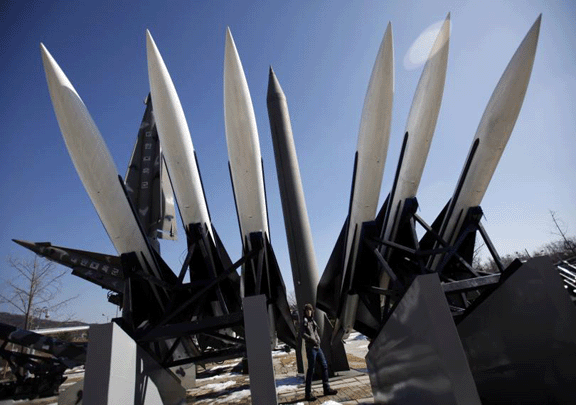
The U.S. Defense Department recently recommended the government develop tactical nuclear weapons with “low yield” results that can be deployed within smaller battlefield areas.
Tong Zhao, an associate in the Carnegie Endowment’s Nuclear Policy Program based in Beijing, told CNBC Wednesday that this more flexible form of weapon would lower the threshold of nuclear use.
“This will be seen by China as evidence of U.S. contemplating first use of nuclear weapons in a future crisis and will encourage China to consider pursuing similar capabilities that may undermine the no-first-use policy,” he said in an email.
China’s “no-first-use policy” means Beijing only demands the capability to ensure the launch of a nuclear missile, after being hit first by an enemy nuclear strike.
U.S. President Donald Trump signed an executive order on January 27, requiring Defense Secretary James Mattis to review America’s nuclear prowess.
Zhao said U.S. plans to pursue a global missile network, initiated by the Obama administration, may be viewed by China as a threat to its own small deterrent and could mean a switch to a “launch-on-warning” policy, whereby China would retaliate before enemy missiles hit land.
“The new U.S. administration seems very much devoted to developing and deploying a massive global and layered missile defense network that protects not only U.S. homeland, U.S. allies, and friends, but also U.S. bases and troops wherever they are located or deployed.
“To make sure that there would be enough Chinese nuclear weapons to survive a U.S. first strike and not be neutralized by U.S. missile defense, China may have an increasing incentive to adopt the launch-on-warning posture,” he said.
February 10, 2017
Posted by Christina Macpherson |
China, politics international, USA, weapons and war |
Leave a comment
Should we really be so afraid of a nuclear North Korea? https://theconversation.com/should-we-really-be-so-afraid-of-a-nuclear-north-korea-71855 The Conversation, Markus Bell, Anthropologist and Lecturer in Korean and Japanese studies, University of Sheffield , Marco Milani, Postdoctoral Scholar, Korean Studies Institute, University of Southern California February 6, 2017 The common thinking is that North Korea’s nuclear programme poses a threat to global peace and diverts economic resources from an impoverished population. North Korean leaders are depicted in the
Western media as a cabal of madmen who won’t be satisfied until
Washington,
Seoul, or some other enemy city is turned into a “sea of fire”.
Successive US governments have used a range of carrots and sticks to entice or pressure the North Korean leadership to give up its nuclear programme. The North’s missile launches and nuclear tests in 2016 make plain that these efforts have failed; in short, the West has to accept that it is now a nuclear power and focus instead on limiting the risks a nuclear North Korea presents.
But it also pays to consider what sounds like a perverse question: could a North Korean bomb actually benefit both the country’s people and the world at large?
First, a reality check: the North Korean nuclear programme is less a madcap scheme than a clear and deliberate strategy. Its leaders have closely watched what’s happened to other countries that have backed away from nuclear arsenals, and two in particular: Ukraine and Libya.
Ukraine gave up its massive Soviet-era nuclear arsenal in 1994 when it signed the Budapest Memorandum with Russia, the US and the UK, on whose terms it traded nuclear weapons for a formal reassurance to respect its sovereignty; 20 years later, Moscow invaded and annexed the Crimean peninsula, and a pro-Russian insurgency in the east is still rumbling. As for Libya, Muammar Gaddafi renounced his weapons of mass destruction programme as part of an opening to the West only to be forcibly removed from power by the same countries some eight years later.
Along with the Iraq War, these spectacles taught the North Korean regime that it’s hard for a relatively small, isolated country to survive without the military hardware to guarantee it. Pyongyang has duly shown great diplomatic skill in drawing out nuclear negotiations, buying itself both time and financial aid as its programme moves forward.
In 2016 alone, it tested two nuclear weapons, sent a satellite into orbit, and made advances in both submarine launched ballistic missiles (SLBM) and intercontinental ballistic missile (ICBM) technology. In his New Year’s address at the start of 2017, Kim Jong-un emphasised that the country’s nuclear forces are central to its self-defence capability: “We will defend peace and security of our state at all costs and by our own efforts, and make a positive contribution to safeguarding global peace and stability.”
The long view
A nuclear North Korea obviously worries the international community for several reasons. Kim might in theory actually use nuclear weapons on his enemies, a threat he periodically makes. His country’s admission into the “nuclear club” might spark a regional arms race. It could share or sell technologies of mass destruction to hostile states. And then there’s the danger of a full-blown nuclear accident with all the attendant regional repercussions.
These risks aren’t trivial, but they should be viewed with some perspective. For starters, a nuclear attack from Pyongyang appears highly unlikely. The government is fully aware that it would incur an overwhelmingly destructive military response from the US and South Korea. It’s also worth remembering that while the programme has been underway for 25 years, there is still no sign of a regional nuclear arms race.
As for proliferation or accidents, these demand not isolation but co-operation and communication. Keeping Pyongyang cut off from the world will not help; if its nuclear facilities are to be kept safe and their products not used to bring in illicit foreign revenue, they must be properly monitored rather than kept hidden.
Meanwhile, a nuclear North Korea might well see fit to downsize its enormous and costly conventional military forces, which are among the world’s largest. As it transitions away from what it calls a “Military First” policy to something more deterrent-centric, it makes sense to encourage it to reduce its conventional military forces. (Better still, if it did, heavily-armed South Korea might follow suit.)
With a smaller conventional military to maintain, Pyongyang might be able to channel scarce state funds away from defence and towards raising the standard of living for ordinary North Koreans. This point is in line with its stated strategy of growing the economy and developing the nuclear deterrent in parallel, a policy known as the Byungjin line, and with Kim’s mooted five-year economic plan. His plans demand dramatic shifts in North Korean state policy, which could destabilise the regime. The calculation is that the security provided by nuclear capabilities would offset the shock of sudden domestic change.
Most paradoxically of all, North Korea’s nuclear “arrival” might make for a positive turn in inter-Korean relations. International efforts to eliminate North Korea’s nuclear programme isolated the country, in turn greatly undermining the chances of a rapprochement with the South, whose efforts to defrost relations have lately come to nothing. The pace of the North’s nuclear development meant that the now-impeached President Park’s policy of reconciliation – “Trustpolitik” – was doomed before it began.
As far as Pyongyang is concerned, its militaristic strategy has worked: It has kept the Kim government internally stable, the population dependent on the government, and the country’s enemies at bay. Accepting the country’s nuclear status, rather than trying to head it off with sanctions and threats, could bring it back to the diplomatic bargaining table.
February 8, 2017
Posted by Christina Macpherson |
North Korea, politics, politics international, weapons and war |
Leave a comment
 Oliver Stone: Reports Russia to blame for Ukraine violence are fake news, Belfast Telegraph 04/02/2017 Oscar-winning director Oliver Stone has branded reports that Russia is responsible for the escalating violence in Ukraine as “fake news”. The American film-maker said claims Russia was “aggravating the situation” in the warzone were untrue and insisted the United States had a “huge responsibility” for the continuing conflict.
Stone, who interviewed Russian President Vladimir Putin for his new documentary, Ukraine On Fire, also backed President Donald Trump’s bid to improve US-Russian relations.
Speaking at a screening of the film in Los Angeles, Stone claimed America had used the Ukrainian conflict to “blackball” Russia and “keep the concept of Nato alive”.
He told the Press Association: “(America) has a huge role, a huge responsibility and has denied it. It’s completely denied the whole truth of the situation.
“It’s a very painful situation for the people who live in that area but at the same time it’s used by the United States to blackball Russia as much as possible and keep the concept of Nato alive.
“It’s a very important film and a very important subject that has been swept under the rug by our country. “Frankly today I’m shocked they published fake news that the Russians are aggravating the situation when all the casualties are in (rebel-held) Donetsk. He added: “It’s a horrible situation and totally fake.”………
Stone, who won best director Oscars for Platoon and Born On The Fourth Of July, produced the documentary Ukraine On Fire which looks at the country’s revolution in 2014.
The film features an interview with ousted Ukrainian leader Viktor Yanukovych and argues he was the victim of a US-inspired coup with the intent of pushing back against Russia. http://www.belfasttelegraph.co.uk/entertainment/film-tv/news/oliver-stone-reports-russia-to-blame-for-ukraine-violence-are-fake-news-35422955.html
February 8, 2017
Posted by Christina Macpherson |
politics international, Russia, Ukraine |
Leave a comment
Source: AAP
US President Donald Trump’s defense secretary has warned North Korea of an “effective and overwhelming” response if Pyongyang chooses to use nuclear weapons.
It came as he reassured Seoul of steadfast US support at the end of a two-day visit.
“Any attack on the United States, or our allies, will be defeated, and any use of nuclear weapons would be met with a response that would be effective and overwhelming,” Defense Secretary Jim Mattis said at South Korea’s defense ministry.
Mattis’ remarks come amid concern that North Korea could be readying to test a new ballistic missile, in what could be an early challenge for Trump’s administration.
North Korea, which regularly threatens to destroy South Korea and its main ally, the United States, conducted more than 20 missile tests last year, as well as two nuclear tests, in defiance of UN resolutions and sanctions.
The North also appears to have also restarted operation of a reactor at its main Yongbyon nuclear facility that produces plutonium that can be used for its nuclear weapons program, according to US think tank 38 North.
“North Korea continues to launch missiles, develop its nuclear weapons program and engage in threatening rhetoric and behaviour,” Mattis said.
North Korea’s actions have prompted the United States and South Korea to respond by bolstering defenses, including the expected deployment of a US missile defense system, known as Terminal High Altitude Area Defense (THAAD), in South Korea later this year. The two sides reconfirmed that commitment on Friday.
February 4, 2017
Posted by Christina Macpherson |
North Korea, politics international, USA, weapons and war |
Leave a comment

 Europe should act fast to preserve the Iran nuclear deal, Bulletin of the Atomic Scientists, Ellie Geranmayeh, 2 FEBRUARY 2017 US President Donald Trump has stirred all kinds of controversy with European allies during his first fortnight in office. Now, his administration’s evolving policy on Iran is becoming another source of concern across the Atlantic. Europe has a crucial but short window to clearly outline its position on the Iran nuclear deal in ways that could influence policymakers in Washington. In doing so, Europe should focus on preserving the agreement under existing terms as enshrined by the United Nations, and charting a course that minimizes confrontation—whether intentional or accidental—between Iran and the United States in an already turbulent Middle East.
On Wednesday, new National Security Advisor Michael Flynn declared that the United States was “putting Iran on notice.” While it is not clear what exactly he meant, he also criticized Iran’s missiles tests and behavior in the region, calling Tehran’s actions “provocative” and staking out a US position distinctly different from those of Europe and Russia. Although Flynn didn’t directly attack the nuclear deal reached between Iran and six world powers in July 2015, a war of words could easily escalate in ways that threaten it.
The Iran nuclear deal, also known as the Joint Comprehensive Plan of Action (JCPOA), scaled back the country’s nuclear activities in exchange for sanctions relief. As a presidential candidate, Trump suggested he would “dismantle the disastrous deal” or renegotiate it. As president-elect he condemned the deal, but has since said he would “rigorously” enforce it. And during a White House briefing the same day as Flynn’s comments, US officials stressed “that they were not linking Iran’s missile and regional actions to the nuclear deal at this point,” as Al-Monitor reported. On Thursday, though, Trump tweeted that Iran “should have been thankful for the terrible deal the U.S. made with them.” Going forward, it seems likely that Trump’s calculations over the nuclear deal and sanctions will be influenced by developments on non-nuclear issues and also events abroad—among Russia, US allies in Europe, the Gulf Arab states, and Israel.
An early test of the US administration’s stance will come this spring, when the president is required to renew sanctions waivers that enable non-US companies to do business with Iran, in accordance with the terms of the nuclear deal. ……
The Iran nuclear deal steered the United States and its allies away from resorting to yet another futile military encounter in the Middle East. It was never intended to solve every problem between the West and Iran, and the two sides continue to take opposing views on a number of critical issues. However, the agreement has proven that Iran and the West have the capacity to resolve complex security challenges through a transactional relationship if there are mutually beneficial outcomes. Instead of watching Tehran and Washington relapse into the rhetoric of war and conflict, Europe should encourage them to build on this winning formula. http://thebulletin.org/europe-should-act-fast-preserve-iran-nuclear-deal10488
February 3, 2017
Posted by Christina Macpherson |
EUROPE, Iran, politics international, USA |
Leave a comment

 Strong response on Nuclear – Eskom , AFRICAN NEWS AGENCY 1 February 2017 Johannesburg – Eskom said on Wednesday that it was receiving positive response from the market to the Request for Information (RFI) issued in relation to the proposed South African Nuclear New Build Programme.
The power utility said some 27 companies had stated that they intended to provide a response to the RFI, including major nuclear vendors from China (SNPTC), France (EdF), Russia (Rosatom Overseas) and South Korea (KEPCO).
Eskom’s interim group chief executive Matshela Koko said: “Eskom is looking forward to the information supplied to confirm our understanding of the key issues that impact the timing and affordability of a nuclear programme.”……
Eskom issued the RFI on its website in December 2016 and asked companies that felt they could provide relevant information to confirm by January 31 that they would be submitting a response to it.
Cabinet in June designated Eskom as the procurer, owner and operator for the multi-million rand nuclear build programme to initially provide 9.6 gigawatts of nuclear energy at least by 2030.
But according to the base case scenario in the Integrated Resource Plan unveiled by Energy Minister Tina Joemat-Pettersson in November, only 1 359 megawatt of nuclear power would be added to the country’s energy mix by 2037 and the volume of renewable energy would rise significantly.
February 3, 2017
Posted by Christina Macpherson |
marketing, politics international, South Africa |
Leave a comment
 Mikhail Gorbachev: It ‘looks as if the world is preparing for war’ as nuclear threat re-emerges, Telegraph Barney Henderson, new york 27 JANUARY 2017 Mikhail Gorbachev has warned that a new arms race means “the nuclear threat once again seems real” as he stated it “looks as if the world is preparing for war”.
The former Soviet leader called on Donald Trump and Vladimir Putin to work together to take steps to reduce the world’s nuclear arsenal.
“Politicians and military leaders sound increasingly belligerent and defence doctrines more dangerous. Commentators and TV personalities are joining the bellicose chorus. It all looks as if the world is preparing for war,” he wrote in an article for Timemagazine.
Mr Gorbachev said the US and Russian presidents should champion a resolution at the UN Security Council to guard against a nuclear conflict.
“I think the initiative to adopt such a resolution should come from Donald Trump and Vladimir Putin – the presidents of two nations that hold over 90% of the world’s nuclear arsenals and therefore bear a special responsibility,” he wrote……
Mr Gorbachev, who detailed his own efforts at denuclearisation during the dying days of the Cold War in the 1980s, issued a stark warning of a world where weapons of mass destruction were becoming cheaper and more readily available.
“Money is easily found for sophisticated weapons whose destructive power is comparable to that of the weapons of mass destruction; for submarines whose single salvo is capable of devastating half a continent; for missile defence systems that undermine strategic stability,” he wrote.
He said his proposed UN Security Council resolution should state “nuclear war is unacceptable and must never be fought”…….http://www.telegraph.co.uk/news/2017/01/27/mikhail-gorbachev-looks-world-preparing-war-nuclear-threat-re/
January 28, 2017
Posted by Christina Macpherson |
politics international, Russia, USA, weapons and war |
Leave a comment