The other Brexit has been forgotten: leaving Europe’s nuclear community is just as fraught with fissile hazard Telegraph 29th May 2017
The other Brexit has been forgotten. This parallel drama faces an equally dramatic cliff-edge in less than two years. It too is fraught with fissile hazard.
We are told almost nothing. The Conservative Party Manifesto does not mention Britain’s exit from European Atomic Energy Community (Euratom), which must automatically take place in conjunction with Brexit.
There is no outline of how the UK will seek to replace this arrangement, or what the emergency plan might be if we crash out of the system with no treaty access to nuclear fuel, services, and research.In such circumstances, Britain will cease to come under the international safeguards regime that makes nuclear business possible. It will struggle to acquire the isotopes used in medical radiation.
In a political sense this sounds implausible. In strict legal terms the UK will have the status of a pariah state under nuclear sanctions until the technicalities are sorted out.
If Britain has not locked in an alternative treaty structure or transition accord by March 2019, it will be cut adrift from the global
nuclear industry. Nobody will be allowed to deal with us. The House Business, Energy and Industrial Strategy Committee muddied the waters in a report earlier this month by suggesting that Downing Street is needlessly pulling out for ideological reasons, in order to escape the jurisdiction of the European Court (ECJ).
It cited testimony from Manchester University professor Grace Burke – an expert on nuclear materials – stating that leaving Euratom is “ill-informed, irresponsible and unnecessary”. The report said the Government had “failed to consider the potentially disastrous ramifications of its Brexit objectives for the nuclear industry. Ministers must act as urgently as possible. The repercussions of failing to do so are huge.”
This is a misunderstanding, typical of all discussions over Brexit. The European Commission’s legal services have concluded that Britain must leave Euratom under the Article 50 process.
Leaked Brexit documents from Brussels state that the EU will wash its hands of all responsibility for the radioactive waste imported from Germany and other EU states that is stored at Sellafield on Euratom’s behalf. This makes our problem yet bigger. The fissile material has a radioactive half-life of tens of thousands of years. It is treated as a liability on Government books. ……
….The Government announced an “ambitious” £250m competition in 2015 to identify the SMR reactors offering best value, but the scheme has stalled. “Every deadline has been missed,” said Dr Scott.
G7 summit ends with split between Donald Trump, other leaders on climate change, ABC News, 28 May 17Under pressure from allies, US President Donald Trump has backed a pledge to fight protectionism, but refused to endorse a global climate change accord, saying he needed more time to decide.
Key points:
German Chancellor says climate talks were “difficult”
Donald Trump says he will decide on Paris Agreement next week
Final communique just six pages, compared to 32 last year
The summit of Group of Seven wealthy nations pitted Mr Trump against the leaders of Germany, France, Britain, Italy, Canada and Japan on several issues, with European diplomats frustrated at having to revisit questions they hoped were long settled.
Mr Trump, who has previously called global warming a hoax, tweeted that he would make a decision next week on whether to back the 2015 Paris Agreement on curbing carbon emissions following lengthy discussions with G7 partners.
“The entire discussion about climate was very difficult, if not to say very dissatisfying,” German Chancellor Angela Merkel told reporters.
“There are no indications whether the United States will stay in the Paris Agreement or not.”………
Security questions dominated initial G7 discussion on Friday and the leaders called on internet service providers and social media firms to “substantially increase” their efforts to rein in extremist content.
US officials said Mr Trump had enjoyed “robust” conversations with his allies in Sicily and had also learnt a lot — especially in the debate on climate change.
What’s Behind Trump’s ‘Baseless Claims’ About Iran’s ‘Nuclear Weapons’, Sputnik, 27 May 17, Commenting on the recent remarks of Donald Trump regarding Iran, which Tehran labelled as ‘Iranophobia’, Iranian political analyst Ali Reza Rezakhah explained to Sputnik Persian what the real purpose behind the comments of the US leader is and who he’s really talking to.
On Monday, US President Donald Trump promised that Tehran will never develop a nuclear weapon.”Iran will never have a nuclear weapon that I can tell you,” Trump told reporters before the meeting with Israeli Prime Minister Benjamin Netanyahu.
Trump’s remarks came the day after the Arab Islamic American Summit was held in the Saudi capital of Riyadh, where the US president said that Iran has been supporting terrorists, militias and extremist groups that spread destruction and chaos across the Middle East.
Tehran was quick to label Trump’s remarks as “Iranophobia,” accusing the US and its leader of “repetitive and baseless claims” about Iran.
“The American president tried to encourage the countries of the region to purchase more arms by spreading Iranophobia,” spokesman for the Iranian Foreign Ministry Bahram Qassemi said a day after the US President finished his trip to Saudi Arabia.
Sputnik Persian sat down with Iranian political analyst and expert in American studies Ali Reza Rezakhah to talk on the war of words between the US administration and the Iranian government.
“Tehran has never voiced its intention to possess any nuclear arms,” Ali Reza Rezakhah reminded Sputnik.
Moreover, he further explained, Iran has announced that the use of any weapons of mass destruction, and nuclear arms in particular, is banned by Islam. A corresponding fatwah (a legal opinion in the Islamic faith) on the ban of stockpiling and use of nuclear weapons has been issued by Iran’s Supreme leader Ayatollah Ali Khamenei.Besides, the peaceful nature of the Iranian nuclear program and the absence of any intentions to possess nuclear arms have been stipulated in the Joint Comprehensive Plan of Action, commonly known as Iran’s nuclear deal.
“Donald Trump’s remarks, therefore, are nothing but pure PR and bait for the mainstream media. The words have been said to please the Israeli Prime Minister,” Ali Reza Rezakhah told Sputnik.
He echoed the words of Bahram Qassemi, saying that Trump’s visit to both Riyadh and Tel Aviv and his rampant remarks are the new wave of “Iranophobia”, which the US leader is trying to spread.
He further noted that regardless his low ratings, Donald Trump might get certain success in his efforts.
The US has permanently stationed 25,000 members of the world’s best organised fighting force right of the North’s borders — and they just finished a massive military exercise.
But even the best systems in the world can’t stop a determined foe with a handful of nukes.
Adm. Dennis Blair, former Director of National Intelligence under Obama, recently told a crowd at the Harvard Club that there’s just no way to safely knock out all of North Korea’s nuclear capabilities in one go. “If I were to run the national intelligence again and the president comes to me and says, ‘Here is General [Jim] Mattis’ strike plan and can you ensure me that this will take out of all the North Korea nuclear capabilities?’ — it won’t be easy to say yes,” said Blair, according to the South China Morning Post.
Blair conceded that before he’d advocate an attack on North Korea, he’d accept it as a nuclear-armed state.
Blair’s statement echo’s Secretary of Defence Jim Mattis’ recent admission that a fight with the North would be “”tragic on an unbelievable scale.”
The US has 2,300 nuclear weapons, any one of which could hit North Korea in a moment’s notice. North Korea may have a dozen or so nuclear weapons, and only the ability to hit a few, close targets within an hour or so of planning.
Experts believe North Korea would probably respond with artillery fire that would light up Seoul and its 10 million residents. Decoy missiles would streak across the sky to overwhelm missile defences. And ground forces would pour in through hidden tunnels.
The US and South Korea would undoubtedly smash North Korean forces in time, but not before a missile touched down, or another catastrophic act of war befell thousands, if not hundreds of thousands, of innocent South Koreans.
According to Bonnie Glaser, director of the China Power Project at the Center for Strategic International Studies, there’s only one military option that even begins to make sense for North Korea.
“If North Korea has a ballistic missile on a launchpad that we think is armed with a nuclear warhead,” then the US would seek to eliminate that, one, single missile,” said Glaser. “But even a strike on a missile on a launchpad could result in retaliation.” After all, how should the North Koreans know that incoming missiles from the US had a limited objective? The risk remains that they’d misinterpret a limited strike for a full-on attack.
And the idea of eliminating a single, consolidated threat from North Korea is simply a dream. North Korea may well be beyond using launch pads, as their recent missile tests have all taken off from mobile launchers, many of which have tank-like treads to allow them to fire from hidden, wilderness locations.
The Pentagon Can’t Believe Trump Told Another President About Nuclear Subs Near North Korea
“We never talk about subs!” three defense officials told BuzzFeed News after a transcript of a call between President Trump and Philippines President Rodrigo Duterte was published. BuzzFeeed News, May 25, 2017,Nancy A. Youssef BuzzFeed News World Reporter Pentagon officials are in shock after the release of a transcript of a call between President Donald Trump and his Philippines counterpart revealed that the US military had moved two nuclear submarines towards North Korea.
“We never talk about subs!” three officials told BuzzFeed News, referring to the military’s belief that keeping submarines’ movements secret is key to their mission.
While the US military will frequently announce the deployment of aircraft carriers, it is far more careful when discussing the movement of nuclear submarines. Carriers are hard to miss, and that, in part, is a reason the US military deploys them. They are a physical show of force. Submarines are, at times, a furtive complement to the carriers, a hard-to-detect means of strategic deterrence.
According to the transcript, released Wednesday, Trump called Philippines President Rodrigo Duterte April 29, in part to discuss the rising threat from North Korea. During that call, while discussing ways to mitigate North Korean leader Kim Jong Un’s nuclear ambitions, Trump said: “We have two submarines — the best in the world. We have two nuclear submarines — not that we want to use them at all. I’ve never seen anything like they are but we don’t have to use this, but [Kim] could be crazy, so we will see what happens.”
During the same call, Trump also called the North Korea leader a “madman with nuclear weapons” and celebrated Duterte for doing an “unbelievable job on the drug problem.” The Filipino leader has supported the alleged extrajudicial killing of 8,000 people since he took office in June, part of his purge to rid his nation of drugs. Duterte has bragged about committing murder himself, called former president Barack Obama a “son of a bitch” and once threatened to suspend the bilateral agreement between his nation and the United States that allows US troops to visit the Philippines.
“Keep up [the] good work, you are doing an amazing job,” Trump told Duterte during the call.
A US official who had previously seen a version of the transcript confirmed to BuzzFeed News that the published version appeared accurate.
By announcing the presence of nuclear submarines, the president, some Pentagon officials privately explained, gives away the element of surprise — an irony given his repeated declarations during the campaign that the US announces far too many of its military plans when it comes to combatting ISIS.
Moreover, some countries in the region, particularly China, seek to develop their anti-sub capability. Knowing that two US submarines are in the region could allow them to test this.
Finally, it is unclear why Duterte would need to know the specific number of subs in the region. The Philippines is not a part of US military efforts to deter North Korea, so why would Duterte need to know such details?
BBC News 24 May 2017 The United Nations has warned that President Donald Trump’s plans to cut contributions to peacekeeping will make such work “impossible”.
The US administration signalled heavy cuts to UN operations, in its budget proposals released on Tuesday. The US foots more than a quarter of the UN’s $7.9bn (£6.1bn) peacekeeping bill.
A spokesman for UN Secretary General Antonio Guterres said the organisation was willing to discuss how peacekeeping could be made more cost-effective.
Mr Trump’s budget proposal declares new “attention on the appropriate US share of international spending at the United Nations”.
The document does not provide a detailed breakdown, but Reuters news agency reports the drop in funding for the operations could amount to $1bn.
The spokesman said the UN was studying Mr Trump’s plan. “The figures presented would simply make it impossible for the UN to continue all of its essential work advancing peace, development, human rights and humanitarian assistance,” he said.
Saudis welcome Trump with gold medal, receive arms package, By JULIE PACE and JONATHAN LEMIRE, RIYADH, Saudi Arabia (AP), 21 May 17 — President Donald Trump basked in Saudi Arabia’s lavish royal welcome Saturday as he left behind, at least temporarily, the snowballing controversies dogging him in Washington. Trump rewarded his hosts with a $110 billion arms package aimed at bolstering Saudi security and a slew of business agreements.
“That was a tremendous day, tremendous investments in the United States,” Trump said during a meeting with Crown Prince Mohammed bin Nayef……..
Trump made no substantial remarks on his first day abroad and spent most of his time shuttling between opulent palace ballrooms with the king. The two were overheard discussing natural resources and arms, and Salman bemoaned the destruction caused by Syria’s civil war.
The most tangible agreement between the two leaders was the $110 billion sale of military equipment to Saudi Arabia that is effective immediately and could expand up to $350 billion over 10 years. The deal includes tanks, combat ships, missile defense systems, radar and communications, and cybersecurity technology. The State Department said the agreement could support “tens of thousands of new jobs in the United States.”
Trump was joined on the trip by the CEOs of several major U.S. companies, which announced their own agreements with the Saudis. Among them was a $15 billion arrangement with GE focused on power, oil and gas, and health care.
The president was trailed on the trip by a large number of advisers, including Tillerson, chief of staff Reince Priebus and chief strategist Steve Bannon. Trump’s son-in law, Jared Kushner, and daughter Ivanka, both senior advisers, were also part of the official delegation………https://www.apnews.com/0f8266623c3548e1952525d93011bd56
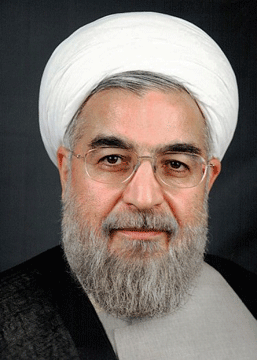
MOSCOW (Sputnik) — The reelection of Hassan Rouhani as Iranian President gives hope for the country’s compliance with the Joint Comprehensive Plan of Action (JCPOA) aimed at settlement of the Iranian nuclear issue, the office of French President Emmanuel Macron said in a statement.
“The reelection of President Rouhani strengthens the hope that his government will abide accurately by the historic agreement of July 14, 2015, which allowed to regulate through the diplomatic means the disagreements on the nuclear issue and to engage in the new stage of the relations between Iran and the international community. France, in turn, will continue to exercise vigilance over the strict implementation of [the agreement’s] elements,” the statement distributed by Macron’s press office read.
In the document, the French president congratulated his Iranian counterpart on the reelection and expressed hope for the improvement of the economic, scientific and cultural ties between Tehran and Paris.
Apart from this, Macron called on Iran to contribute to the settlement of the crises in the Middle East.
“Adhering to the development of the political dialogue with Iran, France reiterates the necessity of the diplomatic regulation of the conflicts in the Middle East and urges Iran to participate in it,” the statement stressed.
Times 21st May 2017 A Chinese state-owned power giant has set its sights on the £15bn nuclear plant planned for the Cumbrian coast. State Nuclear Power Technology Corporation (SNPTC) is considering investing in Toshiba’s troubled NuGen
project at Moorside — risking a collision with Theresa May and her new interventionist approach to foreign takeovers.
Industry sources said a delegation from SNPTC and its parent, State Power Investment Corporation, was due in London. Eight senior officials will meet executives from NuGen and Britain’s atomic power trade body, the Nuclear Industry Association, on Tuesday.
It is unclear whether the election hiatus will hinder meetings with Whitehall officials. The talks underline China’s ambitions in nuclear power after another state-owned giant, China General Nuclear, bankrolled the £18bn Hinkley Point plant in Somerset. CGN took a 33% stake in Hinkley but its ultimate ambition is to build a power station, fuelled
with its own home-grown reactors, at Bradwell in Essex.
North Korea links nuclear advances to ‘hostile’ U.S. policy, Globe and Mail, EDITH M. LEDERER AND MATTHEW PENNINGTON, The Associated Press, May 19, 2017 The U.S. defence chief warned Friday that a military solution to the standoff with North Korea would be “tragic on an unbelievable scale,” while the North vowed to rapidly strengthen its nuclear-strike capability as long as it faces a “hostile” U.S. policy.
North Korea tested a longer-range missile last weekend, which experts say was a significant advance for a weapons program that aims at having a nuclear-tipped missile that can strike America. The test triggered a new U.S.-backed push for a fresh round of U.N. sanctions against the North.
At the United Nations, North Korea’s deputy ambassador, Kim In Ryong, was defiant. He said North Korea would never abandon its “nuclear deterrence for self-defence and pre-emptive strike capability” even if the U.S. ratchets up sanctions and pressure “to the utmost.”
Speaking to reporters, Kim hailed the test launch and said that if the Trump administration wants peace on the divided Korean Peninsula, it should replace the armistice that ended the 1950-53 Korean War with a peace accord and halt its anti-North Korea policy.
At the Pentagon, Defence Secretary Jim Mattis said the missile test showed North Korea isn’t heeding cautions from the international community. However, he stressed the need for a peaceful resolution by working through the U.N. with countries including China, the North’s traditional ally and benefactor.
“If this goes to a military solution it is going to be tragic on an unbelievable scale, and so our effort is to work with the U.N., work with China, work with Japan, work with South Korea to try to find a way out of this situation,” Mattis said at a news conference.
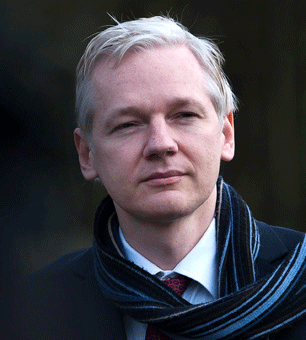
Sweden shuts down Julian Assange rape investigation, TT/The Local news@thelocal.se 19 May 2017, Swedish prosecutors have decided to end the rape investigation into Julian Assange and lift the Europe-wide arrest warrant against him, but UK police say they will still arrest him.In a statement on its website, the Swedish prosecution authority said that the “Director of Public Prosecution, Ms Marianne Ny, has today decided to discontinue the investigation regarding suspected rape (lesser degree) by Julian Assange”.
“With the consideration that all options of moving the investigation forward are now exhausted it appears that – in light of the views expressed by the Supreme Court (Högsta domstolen) on the proportionality of remanding someone in absentia – it is no longer proportional to maintain the decision to remand Julian Assange in his absence and maintain the European arrest warrant,” Ny wrote in her notification to Stockholm District Court.“I have therefore today lifted the decision to remand Julian Assange in his absence,” she added.
No longer Swedish matter’ – Assange’s lawyer on dropping investigation into WikiLeaks founder
In a press conference later in the day, Ny elaborated that it was not possible to formally serve Assange with notice of the suspicions against him, a prerequisite under Swedish law if the investigation was to progress further:
“Ecuador granted legal assistance and made it clear that all measures would be performed with full voluntary participation of Mr. Assange (…) Formal issues are important in a legal system in terms of legal certainty, it is important to be able to serve the suspect with suspicions. The decision to discontinue the investigation is not because we’ve been able to make a full assessment of the evidence, but because we didn’t see possibilities to advance the investigation. So we won’t make any statements on the issue of guilt”………
Assange’s lawyer Per Samuelsson said his client was now considering suing Sweden.
“It’s not about money but redress,” Samuelsson told news agency TT.
He added that he believed Assange would eventually try to move to Ecuador.
The WikiLeaks founder’s lawyer filed a request at Stockholm District Court earlier in May asking for an end to the arrest warrant against his client, arguing it should be dropped now that the US has expressed a desire to charge the 45-year-old.
Assange had been remanded in custody by Sweden ‘in absentia’ over a 2010 rape allegation, and has been taking refuge inside Ecuador’s embassy in London since 2012 in order to escape the warrant, citing fears he may be extradited to the US to be tried over WikiLeaks’ publication of thousands of classified documents.
One of Assange’s lawyers, Melinda Taylor, indicated earlier on Friday that the preliminary investigation into him being closed or the lifting of the European arrest warrant would not necessarily mean the Australian would make a hasty exit for Ecuador.
“The first thing one likely needs to do is seek guarantees from the British authorities that he won’t be seized in some other way,” she told news agency TT.
Both British and American authorities have “consistently refused to confirm or deny” if there is a request for extradition to the US, she said. Assange is also accused of breaching his bail conditions in the UK for fleeing to Ecuador’s embassy, she noted.
And in a statement released on Friday afternoon, the Metropolitan Police confirmed it is obliged to arrest Assange should he leave the embassy…….
When the Swedish announcement was made on Friday, WikiLeaks commented through its Twitter account that the “focus now moves to the UK”……
Stephen Rademaker: North Korea is a nuclear state. We have to live with that, and here’s how Stephen Rademaker, Washington Post | May 19, 2017 Last Sunday, North Korea successfully demonstrated for the first time that it could strike U.S. territory in the Pacific. After more than 25 years of wrestling with the North Korean nuclear threat, it’s time to recognize that North Korea is not merely seeking to gain bargaining leverage against us. Rather, it is determined to possess nuclear weapons, and we need to develop a realistic strategy for containing, defending against and deterring what will be a persistent and growing nuclear threat.
There’s every reason to continue pursuing sanctions and diplomacy, but we should not premise our policy on the expectation that such efforts are going to succeed in persuading North Korea to change course. We must also recognize that there is no acceptable military solution to the problem.
Even before the North produced its first nuclear weapon, the United States calculated that the potential cost for any military strike was too great for America and South Korea. Now that North Korea has nuclear weapons, as well as missiles that can reach Guam and beyond, this logic is even more compelling.
It is indeed true, as the Trump administration has concluded, that China has the wherewithal to compel North Korea to abandon its nuclear weapons. But China is a great power that has had plenty of time to think through its policy. It is concerned, but clearly not panicked. More important, it perceives plenty of downsides to overreacting, including the potential collapse and absorption of its ally, North Korea, into America’s ally, South Korea.
So great is our dependence on China that, like hostages held by a kidnapper, all previous administrations developed a sort of Stockholm syndrome, coming to believe that China was doing everything it could to help solve the problem, when it manifestly could do more. After 25 years, we should not assume that more hectoring, promises or threats will persuade China to act in ways it believes contrary to its interests…….http://news.nationalpost.com/full-comment/stephen-rademaker-north-korea-is-a-nuclear-state-we-have-to-live-with-that-and-heres-how
The service said the crew members of the WC-135 nuclear-sniffing aircraft determined the Chinese pilots of the Su-30 jets were being “unprofessional.” The encounter was still under investigation.
“The issue is being addressed with China through appropriate diplomatic and military channels,” Pacific Air Forces spokeswoman Lt. Col. Lori Hodge said in a released statement.
The WC-135 Constant Phoenix is capable of detecting nuclear weapons activity and was deployed last month to Kadena Air Base on Japan’s far southern island of Okinawa as the North Koreans were ramping up missile testing.
Since then, the Trump administration has been looking to China to pressure the regime of Kim Jong Un to give up its ambitions for a nuclear-tipped intercontinental ballistic missile that could reach the U.S. mainland.
However, there is deep friction between China and the U.S. over that country’s territorial claims in the East China Sea, which includes the Korean peninsula and Japan.
EDF set to win EU approval for Areva nuclear reactor deal – source , Reuters, By Foo Yun Chee| BRUSSELS, 19 May 17, French utility EDF (EDF.PA) is set to gain unconditional approval from the EU competition authorities for its plan to acquire a controlling stake in ailing nuclear power engineering group Areva’s (AREVA.PA) reactor business, a person familiar with the matter said on Friday.
State-controlled EDF wants to acquire 51 to 75 percent of Areva NP, which designs, manufactures and services nuclear reactors and is worth about 2.5 billion euros ($2.8 billion).
The deal is crucial for France, which has Europe’s largest network of nuclear plants, and uses EDF and Areva to spearhead its export efforts against competition from Russia’s Rosatom and Japan’s Hitachi Ltd (6501.T).
New South Korean President Seen Hindering Nuclear Ambitions, Bloomberg by Stephen Stapczynski
May 16, 2017,
Moon Jae-in campaigned to block new reactor construction
Kepco shares fell 5.8% on May 10 following election results
“… South Korea’s Moon Jae-in promised during his successful presidential campaign to scrap or suspend new atomic plants.
Now that Moon is president, that anti-nuclear stance is seen as a threat to South Korea’s ambitions to become a bigger exporter of nuclear equipment and technology — a market valued at as much as $740 billion over the next 10 years.
“If the new government withdraws its support for nuclear development in South Korea, this could send a negative signal to foreign countries looking to purchase reactors,” Kerry-Anne Shanks, a Singapore-based analyst at Wood Mackenzie Ltd., said by email. “An anti-nuclear stance could challenge Korea’s ambitions to export nuclear technology to other countries.”………
Besides the curbs on new nuclear facilities, Moon also campaigned to cancel any lifetime extensions for existing nuclear plants and to develop a roadmap to eventually rid the nation of atomic power altogether. In nuclear’s place, Moon would place greater emphasis on natural gas and renewables. On Monday, the new president ordered the shutdown for the month of June of 10 coal-fired power plants that have been operating for more than 30 years to cut pollution…..
“Exporting nuclear power plants requires substantial up-front financial support from the vendor and its home government,” said Rod Adams, publisher of Atomic Insights, an industry news website. “There is already some evidence suggesting that the anti-nuclear stance of President Moon Jae-in will make it more difficult for South Korea to export nuclear reactors.”…..