The satellite images, however, only reveal what is visible on the surface. Most of the actual warheads are underground.
What now takes place in regard to submarine-launched ballistic missiles’ facilities hasn’t been seen at the naval bases on Kola since the large-scale infrastructure construction to support the Typhoon submarines at the Nerpichya base in Zapadnaya Lista happened in the 1980s.
Norway pays for nuclear safety While nuclear weapons are stored inside the mountain on the east side of the Litsa fjord, huge amounts of nuclear waste are stored just two kilometers away, across the fjord in the infamous Andreeva Bay. Thousands of cubic meters of solid radioactive waste and nearly 22,000 spent nuclear fuel elements from submarine reactors are stored here. Neighbouring Norway, along with other donor countries, have spent hundres of millions kroner (tens of millions euros), on nuclear safety projects aimed at upgrading the infrastructure in Andreeva Bay.


 Satellite images show expansion of nuclear weapons sites on Kola, Barents Observer [excellent pictures] By Thomas Nilsen, May 08, 2017 The reverse gear seems to hang up for continuing disarmament of nuclear weapons in the Arctic. Barents Observer has made a comprehensive review of satellite images from naval base-level storage facilities that confirms heavy construction works.
The New START Treaty says USA and Russia must limit the numbers of deployed strategic nuclear warheads to 1,550 by February 5, 2018. Over the last two years, Russia has increased the number of deployed warheads and is now 215 over the max limit to be reached.
There are extensive construction work at two of the Northern Fleet’s facilities for storage of warheads and ballistic missiles for submarines (SLBM) on the coast of to the Barents Sea. The Barents Observer has studied satellite images of the Kola Peninsula open available via Google Earth, combined with open-source data on numbers of nuclear warheads in Russia. The results are frightening.
Expansion of the two base-level storages in Okolnaya Bay near Severomorsk and Yagelnaya Bay in Gadzhiyevo are clearly visible. At both locations, new reinforced bunkers, auxiliary buildings and infrastructure partly finished and partly still under construction can be seen.
The satellite images, however, only reveal what is visible on the surface. Most of the actual warheads are underground.
What now takes place in regard to submarine-launched ballistic missiles’ facilities hasn’t been seen at the naval bases on Kola since the large-scale infrastructure construction to support the Typhoon submarines at the Nerpichya base in Zapadnaya Lista happened in the 1980s.
There are four storages for nuclear weapons on Kola. From satellite images, these storages are not too difficult to find. All are surrounded by double or triple layer barrier of barbed wire fences with extraordinary security at the single entry-exit checkpoints. Also inside the outer fences, the different sections of the facilities are separated with similar security fence barriers. Comparing satellite images with photos posted on internet by naval officers or their family members makes it possible to get a pretty good impression of the current situation.
Several of the storage locations are visible on photos, although mainly in distance, available by searching Yandex, Russia’s own search engine. Also, Wikimapia, an online editable map where people can mark and describe places, has been a good source to information when writing this article.
Zaozersk is the nuclear weapons storage nearest to Norway in a distance of 65 kilometers to the border in Grense Jakobselv. The Norwegian town of Kirkenes is 94 kilometers away. Distance to Finland is 120 kilometers. All four storage sites on Kola are within a radius of 190 kilometers from Norway and 180 kilometers from the Finnish border………..
Today, Kristian Åtland estimates that around 60 percent of Russia’s more than 700 sea-based strategic nuclear warheads are concentrated on the Kola Peninsula, whereas the remaining 40 percent is based with the Pacific Fleet at Kamchatka.
«The numerical increase in Russia’s strategic nuclear arsenal, including the part of it that is based on submarines operating from the Kola Peninsula, is neither dramatic nor unexpected. The increase is to be understood in the context of Russia’s long-standing and still on-going defense modernization. The modernization of Russia’s strategic nuclear forces has been a key priority in the State Armaments Program for the period up to 2020 (“GPV-2020”), which was launched in 2010. In addition, the general deterioration of Russia’s relationship with the West, particularly since 2014, seems to have led to a renewed focus on the issue of nuclear deterrence, in Russia as well as in the United States,» Åtland elaborates.
Gorbachev called for nuclear-free zone
2017 marks the 30-years anniversary since Michael Gorbachev’s famous Murmansk-speech on October 1st 1987 where he called for a nuclear-free zone in Northern Europe. Since then, the numbers of nuclear warheads based on the Kola Peninsula saw a continuing decrease until 2015, five years after Barack Obama and Dmitry Medvedev signed the New START Treaty in Prague. In July 2015, Russia reportedly had less deployed strategic nuclear warheads than the United States, 1,582 versus 1,597, the Bureau of Arms Control with the U.S. Departement of State reported.
215 over New START Treaty limit
Latest exchange and verification numbers from the same bureau dated April 1, 2017 shows that Russia now has 1,765 versus the United State’s 1,411. In other words; Russia has 215 warheads more than the maximum set to be achieved nine months ahead. The questions is whether Moscow is likely to dismantle over 200 warheads in less than a year.
Katarzyna Zysk, Associate Professor with the Norwegian Defense University College, says to the Barents Observer that Russia has a vested interest in maintaining the New START agreement. «Russia has a vested interest in maintaining the New START given that it keeps the development of the US strategic nuclear capabilities under control, provides Russia transparency measures and valued insight into to the US nuclear forces, thus increasing predictability,» she says, but underscore that the numbers must down.
«In order to meet the New START Treaty limits when it enters into effect in February 2018, Russia will have to decrease the numbers. However, Russia has been moving toward meeting the obligations as the number of Russia’s deployed strategic warheads has been decreasing compared with 2016. The US is now below the treaty limit and is in fact increasing the number of strategic deployed warheads,» Zysk explains.
Åtland agrees and underscores that today’s numbers do not constitute a treaty violation.
«The fact that Russia is now above the maximum warhead limits of the new START Treaty, which entered into force in 2011, does not in itself constitute a treaty violation. The treaty does not mandate any particular schedule for reductions other than that the agreed-upon limits must be met by February 2018, which is in nine months from now. Reductions in the number of deployed warheads are fairly easy to achieve once the political will is there, either by phasing out old delivery platforms or by removing deployed warheads to central storage. Thus, the identified “peak” may be temporary,» Åtland says. He hopes both the United States and Russia will work towards an extension of the Treaty.
«Hopefully, Russia will stand by its commitments under the current START Treaty regime. In any event, it is important that Russia and the U.S. continue to exchange data about the status of their nuclear arsenals and that they provide for mutual inspections and other transparency measures outlined in the START Treaty and other documents. The parties should also work towards an extension or replacement of the Treaty when it expires in February 2021.»…………..
Norway pays for nuclear safety
While nuclear weapons are stored inside the mountain on the east side of the Litsa fjord, huge amounts of nuclear waste are stored just two kilometers away, across the fjord in the infamous Andreeva Bay. Thousands of cubic meters of solid radioactive waste and nearly 22,000 spent nuclear fuel elements from submarine reactors are stored here. Neighbouring Norway, along with other donor countries, have spent hundres of millions kroner (tens of millions euros), on nuclear safety projects aimed at upgrading the infrastructure in Andreeva Bay.
On June 27, Norway’s Minister of Foreign Affairs, Børge Brende, travels to Andreeva Bay to mark the first shipping of spent nuclear fuel out of the area, a job that is likely to continue for more than five years. Meanwhile, Russia continues to spend huge amounts of money on new nuclear weapons in the border areas. ………..
Bolshoye Ramozero – the most secret
The most secret of all secret nuclear weapons storages on the Kola Peninsula is located some 20 kilometers to the northeast of the mining town Olenegorsk, on a side road towards Lovozero. The location, diffcult to find referances to on the internet, has several names; Katalya is one, Bolshoye Ramozero is another (the nearby lake). Like other secret towns in the Soviet Union, also this one had a post-code name; Olenegorsk-2. The nickname is Tsar City, allegedly because of the priviliges the inhabitants had. The town is also simply known as Military Unit 62834 or Object 956.
While it is easy to find selfies and blogposts from most Russian military garrisons and bases, few can be found from this town. Not too strange; the town is under full supervison of the 12th Chief Directorate of the Ministry of Defense. This directorate is responsible for all of Russia’s nuclear weapons, including storages, technical maintenance and transportation.
The 12th Chief Directorate is probably the most secretive organization in the Russian Armed Forces, even more than the foreign military intelligence agency GRU and the strategic missile forces, according to Wikipedia.
Bolshoye Ramozero serves a national-level nuclear weapons facility, one of 12 such storages across Russia, according to a recent report written by Pavel Podvig and Javier Serrat. The report, focusing on non-strategic nuclear weapons in Europe, is published by the United Nations Institute for Disarmament Research (UNIDIR).
It is believed that all non-strategic nuclear warheads possible aimed for naval, air force and army weapons for the Kola area, and maybe even more, are stored at the central national level storage in Bolshaya Ramozero. According to the UNIDIR report, the 12th Chief Directorate is responsible for providing the nuclear warheads to the different military units “when deemed necessary.” If a threatening situation occurs, warheads can be transported by trucks from this site to the different military units on the Kola Peninsula which holds weapons systems that could be armed with tactical nuclear weapons, like naval cruise missiles or torpedoes, or cruise missiles carried by aircrafts.
The nearest airbase to the central storage on Kola is Olenogorsk where Tu-22 bombers are stationed.
Inside the underground storage bunkers in Bolshaya Ramozero are only the warheads stored.
Satellite images show that there are two storage areas just north of the town. The first area has three internal sites, of which only two seems to be actively used. The second area is located another kilometer further north. https://thebarentsobserver.com/en/content/satellite-images-show-expansion-nuclear-weapons-sites-kola
May 13, 2017
Posted by Christina Macpherson |
politics international, Reference, wastes, weapons and war |
Leave a comment

 Russia’s Putin says ready to help resolve North Korea nuclear issue – South Korea, http://in.reuters.com/article/southkorea-russia-idINKBN1881MQ By Christine Kim | SEOUL, 12 May 17
Russia’s President Vladimir Putin told his newly elected South Korean counterpart, Moon Jae-in, in a phone call on Friday that he is ready to play a “constructive role” in resolving North Korea’s nuclear threat, the South’s presidential office said.
Putin made the comment after Moon said the foremost task to boost cooperation between the two countries was to strengthen strategic bilateral communication to find a solution to curb North Korea’s nuclear threat, the Blue House said in a statement.
“We hope for Russia to play a constructive role in order for North Korea to stop with its nuclear provocations and go the way of denuclearisation,” Moon was citing as saying to Putin in the 20-minute conversation.
“I, too, aim to find a way to begin talks quickly between North and South Korea as well as the six-party talks,” Moon said, referring to talks aimed at denuclearising North Korea involving the United States, China, Japan, Russia and the two Koreas.
The talks collapsed in 2008 after North Korea launched a rocket.
Tension has been high for months on the Korean peninsula over North Korea’s nuclear and missile development and fears it will conduct a sixth nuclear test or test another ballistic missile in defiance of U.N. Security Council resolutions.
Moon is a liberal who advocates a more conciliatory approach to North Korea compared with his conservative predecessor.Moon also expressed hopes the two countries would be able to cooperate in developing East Asia, including extending a natural gas pipeline from Siberia to South Korea, the Blue House said. Putin said he was ready to help in all of the matters they discussed and the two leaders invited each other for state visits, the Blue House added.
Moon said he would send a special envoy to Russia soon and Putin said he would welcome the envoy.The two leaders said they looked forward to meeting at the Group of 20 summit meeting in Germany in July.
Earlier in the day, Moon spoke with British Prime Minister Theresa May and German Chancellor Angela Merkel, the Blue House said. He asked them to help in curbing North Korea’s nuclear programme and both promised to.
(Reporting by Christine Kim; Additional reporting by Se Young Lee; Editing by Robert Birsel)
May 13, 2017
Posted by Christina Macpherson |
politics international, Russia, South Korea |
Leave a comment
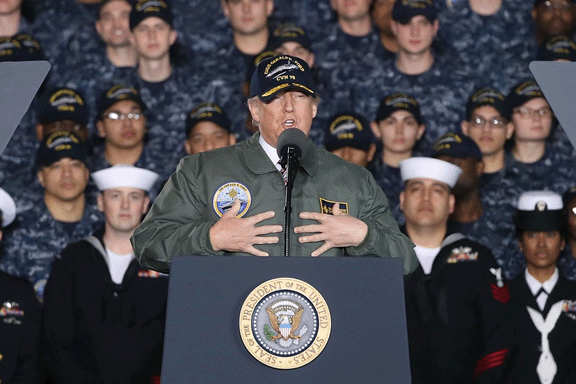
 Tillerson, at Arctic meeting, signs document affirming need for action on climate change, LA Times, William Yardley, 11 May 17, US Secretary of State Rex Tillerson signed his name Thursday to a document that affirms the need for international action against climate change, adding further uncertainty to the direction of climate policy under the Trump administration.
The document, signed by Tillerson and seven foreign ministers from Arctic nations meeting this week in Fairbanks, Alaska, says the participants concluded their meeting “noting the entry into force of the Paris agreement on climate change and its implementation, and reiterating the need for global action to reduce both long-lived greenhouse gases and short-lived climate pollutants.”
Called the Fairbanks Declaration, the document says the leaders signed it “recognizing that activities taking place outside the Arctic region, including activities occurring in Arctic states, are the main contributors to climate change effects and pollution in the Arctic, and underlining the need for action at all levels.”
The Trump administration has been in conflict for months over what to do about U.S. involvement in the landmark 2015 Paris climate accord, which commits nearly 200 nations to establishing goals to reduce emissions that lead to climate change.
Trump has repeatedly questioned climate science, calling climate change a hoax perpetrated by the Chinese and vowing during his campaign to “cancel” the Paris agreement……..
Tillerson, the former chief executive of Exxon, is among those who have argued that the U.S. should keep its commitment.
The Fairbanks Declaration does not affirm that the U.S. will honor the Paris accord. Nor does it explicitly state that human activity is causing climate change.
And Tillerson’s spoken remarks at the meeting made clear that the administration is divided. After vowing that the U.S. would “continue to be vigilant in protecting the fragile environment in the Arctic,” Tillerson said this about current U.S. climate policy:
“In the United States, we are currently reviewing several important policies, including how the Trump administration will approach the issue of climate change. We’re appreciative that each of you has an important point of view and you should know that we are taking the time to understand your concerns. We’re not going to rush to make a decision. ……..
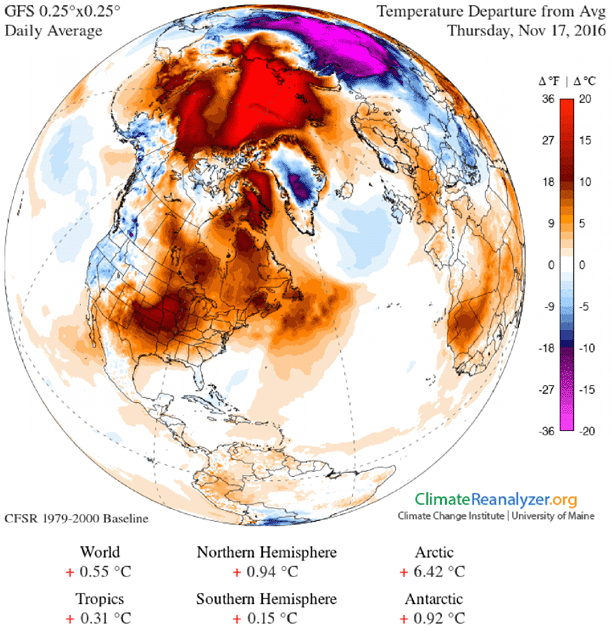
No part of the world is warming faster than the Arctic.
Summer sea ice regularly shrinks to record lows, coastlines are eroding and wildfires are getting worse. Even the frozen tundra, a critical natural storage tank for carbon emissions, is no longer so frozen. Scientists reported this week that it is warming so rapidly that it now is emitting more carbon than it captures.
The Fairbanks Declaration includes several other references to climate change and taking action to mitigate it or adapt to it. It refers to “reiterating the importance of climate science to our understanding of the changing Arctic region and our activities in the Arctic environment.”……http://www.latimes.com/nation/la-na-arctic-council-20170511-story.html
May 13, 2017
Posted by Christina Macpherson |
ARCTIC, climate change, politics international, USA |
1 Comment
 Is Rosatom selling debt and dependence to its overseas customers? http://bellona.org/news/nuclear-issues/2017-05-is-rosatom-selling-debt-and-dependence-to-its-overseas-customers When a court in South Africa torpedoed a $76 billion deal to build 10 nuclear reactors with Russia’s Rosatom because the arrangement reeked of corruption, it seemed like the project was kaput. May 10, 2017 by Charles Digges, charles@bellona.no, When a court in South Africa torpedoed a $76 billion deal to build 10 nuclear reactors with Russia’s Rosatom because the arrangement reeked of corruption, it seemed like the project was kaput.
At issue to the court was the fact that Rosatom was given the lucrative contract behind closed doors without any competing tenders, and that the company had been granted “special favors.” South Africa’s president, Jacob Zuma, even sacked his finance minister for opposing the deal.
The high court demanded that a contract of such breathtaking magnitude – representing a quarter of South Africa’s gross domestic product and $24 billion more than its state utility, Eskom, has in the bank – be approved by parliament.
Hanging over the deal, and numerous others like it, is the degree to which Rosatom seems to be pursing not just energy dominance in a world trying to wean itself coal, but political influence as well by putting its customers in long-term hock to Moscow.
The South Africa deal may yet come off, but it’s also surprising that it got so far in the first place.
It began as one of Rosatom’s handshake “memorandums of understanding” that the company is using to blanket the nuclear construction market and squeeze out competition. The company says it has 27 of these MOUs and other arrangements, amounting to $135 billion in incoming business, a claim that invites skepticism.
Many of the counties Rosatom counts among that number – like Jordan, Algeria, Nigeria and Bolivia – won’t be ready for nuclear for decades. Others where Rosatom builds are already underway – like India’ Kudankulam, Iran’s Bushehr, China’s Tianwan and Belarus’s Ostrovets – are already familiar with Rosatom’s typical cost overruns and delays.
Rosatom’s approach to marketing its VVER-1000 and VVER-1200 reactors is unique because it offers to finance, build and operate its plants. These generous terms come thanks to the enormous state subsidies it receives, and which it can then funnel into loans that boost its profits on paper. With government subsides set to decrease or dry up in 2020, however, Rosatom seems desperate to announce ever more MOUs.
While the terms of the financing for the South Africa deal never got spelled out, it’s clear from Rosatom deals in other countries that the terms are often steep.
To build Hungary’s controversial Paks-2 plant, Rosatom gave Budapest an $11 billion loan spread out over 30 years. Hungary has to start paying that back even if the plant is not completed on time. The interest Moscow could collect from Hungary is unclear, but a similar 30-year, $11.4 billion agreement with Bangladesh inked last year could result in $8 billion in interest. A $25 billion deal Rosatom signed with Egypt could, over 35-year term of the loan, swell to $71 billion.
And that’s if everyone behaves. The plant Rosatom is building in Turkey offers an indication of what happens when they don’t. To build Hungary’s controversial Paks-2 plant, Rosatom gave Budapest an $11 billion loan spread out over 30 years. Hungary has to start paying that back even if the plant is not completed on time. The interest Moscow could collect from Hungary is unclear, but a similar 30-year, $11.4 billion agreement with Bangladesh inked last year could result in $8 billion in interest. A $25 billion deal Rosatom signed with Egypt could, over 35-year term of the loan, swell to $71 billion.
And that’s if everyone behaves. The plant Rosatom is building in Turkey offers an indication of what happens when they don’t.
May 12, 2017
Posted by Christina Macpherson |
marketing, politics international, Russia, secrets,lies and civil liberties |
1 Comment
Chinese expert says North Korea could conduct nuclear test in May, Tass, May 10, 2017 In April, North Korea carried out several missile tests the latest of which took place on April 28, only a few hours after the UN SC held a meeting to discuss the situation on the Korean Peninsula. SHANGHAI, May 10. /TASS/. There is a strong possibility that North Korea will conduct a new nuclear test in May, Executive Director of the Institute of International Relations at Shanghai Academy of Social Sciences Liu Ming said in an interview with TASS.
“In April, North Korea launched several missiles but they all failed,” he said. “There was no nuclear test in April but it does not mean that North Korea will not conduct one in May. I believe there is a strong possibility that the country will hold the next nuclear test this month,” the Chinese expert noted saying that these plans were the main reason for the current tensions on the Korean Peninsula.
“According to my estimates, tensions on the Korean Peninsula will remain in May and June for Pyongyang is highly likely to conduct another nuclear test during this period,” Professor Liu Ming pointed out. He added that “North Korea is playing for time choosing the right moment, because all the preparations for the sixth nuclear test have been completed.”
The Chinese expert also expressed his opinion on the possible consequences of a new nuclear test. “I think, after the sixth nuclear test, the window of possibilities to solve the North Korea issue will almost completely close. Only a few chances will remain to solve the issue using diplomatic methods,” Professor Liu Ming said. He noted that “if Pyongyang conducts another nuclear test, then China will have to reduce its economic aid to North Korea.”
…….“The US and South Korea are not ready to discuss arms controls within the framework of six-nation negotiations, unless their aim is to rid the Korean peninsula of nuclear weapons. And this is the barrier that now impedes the revival of the talks,” the expert stated.
He said one of the main obstacles was because of the US and the DPRK. “Pyongyang is firmly committed to continuing its military nuclear program. The US comes out against it and intends to take concrete measures. The Trump administration is in a serious mood for concrete action. That is why the main contradictions at the moment are those between the US and the DPRK,” Liu Ming said.
“Everything now is revolving around the nuclear issue and the contradictions existing between the US and the DPRK. Restarting the six-party negotiations makes no particular sense under the current conditions,” he resumed. “First of all, direct negotiations are needed between the US and the DPRK,” the Chinese expert noted, adding that only progress at such talks could make the restoration of the six-nation format talks worthwhile. http://tass.com/world/945236
May 12, 2017
Posted by Christina Macpherson |
North Korea, politics international, weapons and war |
Leave a comment
Xi, new South Korean leader talk nuclear, THE AUSTRALIAN, 11 May 17 Chinese President Xi Jinping and new South Korean President Moon Jae-in have discussed nuclear tensions, with the latter addressing the raft of problems posed by the North’s defiance.
Xi told Moon China had always upheld the denuclearisation of the Korean peninsula and that the nuclear issue should be resolved through talks, which were in everyone’s interests, according to a state television report.
China was willing to keep working hard with all parties, including South Korea, for the peace and prosperity of the Korean peninsula, he said.
Despite its anger at North Korea’s repeated nuclear and missile tests, China remains the isolated state’s most important economic and diplomatic backer even with Beijing signing up for tough UN sanctions against Pyongyang.
Beijing also has its own issues with Seoul. China has vigorously opposed the deployment of a US anti-missile system in South Korea, saying it threatens Chinese security and will do nothing to resolve tensions with North Korea……..
Moon said in his first speech as president on Wednesday he would immediately begin efforts to defuse security fears on the Korean peninsula and would negotiate with Washington and Beijing to ease tensions over the deployment of the Terminal High Altitude Area Defense anti-missile system in the South…..http://www.theaustralian.com.au/news/latest-news/xi-new-south-korean-leader-talk-nuclear/news-story/3ba4f6e5585d7cf577d29f2505a1e332
May 12, 2017
Posted by Christina Macpherson |
China, politics international, South Korea |
Leave a comment
 China, South Korea seek to steer North from nuclear path, DW 11 May 17 The presidents of China and South Korea have agreed they want North Korea to move away from its agenda of atomic antagonism. A US missile-defense system deployed on the peninsula was also a topic of conversation. In his first talk with Chinese President Xi Jinping since being sworn in as South Korea’s president, South Korea’s Moon Jae-in sought common ground with China on North Korea’s nuclear program.
“The resolution of the North Korean nuclear issue must be comprehensive and sequential, with pressure and sanctions used in parallel with negotiations,” Moon’s spokesman, Yoon Young-chan, said the president had told Xi. “Sanctions against North Korea are also a means to bring the North to the negotiating table.”
The presidents also discussed the contentious Terminal High Altitude Area Defense (THAAD) anti-missile system the United States installed in South Korea to Beijing’s chagrin…….http://www.dw.com/en/china-south-korea-seek-to-steer-north-from-nuclear-path/a-38794619
May 12, 2017
Posted by Christina Macpherson |
China, politics international, South Korea |
Leave a comment
 Arctic Nations May Confront U.S. on Climate Change Leaders of the Arctic Council could rebuff U.S. position, Scientific American, By Margaret Kriz Hobson, ClimateWire on May 10, 2017, FAIRBANKS, Alaska—Diplomats from eight Arctic nations are facing a standoff today over the Trump administration’s efforts to downplay the importance of climate change in an Arctic Council ministerial statement marking the end of the United States’ two-year council chairmanship.
U.S. Secretary of State Rex Tillerson and the top foreign ministers from the world’s seven other Arctic nations are due to arrive in Fairbanks today for tomorrow’s Arctic Council ministerial meeting.
During that meeting, the top government officials are scheduled to sign a final statement highlighting the accomplishments of the U.S. chairmanship, as well as Finland’s plans for its upcoming term as head of the council.
But foreign policy staff arriving in Fairbanks early this week said they have not yet signed off on the wording of the ministerial statement proposed by the White House in advance of the meeting. They disagree with Trump administration efforts to weaken the references to climate change and the Paris climate accord.
The officials are meeting with U.S. officials this morning to hammer out the final language of the ministerial statement. Like all Arctic Council actions, that statement must be reached on a consensus basis. Along with the United States, the council is made up of Canada, Denmark, Finland, Iceland, Norway, Russia and Sweden.
At issue is the abrupt change in the U.S. position on the Paris Agreement since the November election. Former President Obama made climate change the top issue when the United States took the lead of the Arctic Council in 2015.
President Trump, however, has sidelined Arctic policy issues and largely ignored the Arctic Council climate priorities of his predecessor. Trump has dismissed the science backing climate change and proposed to open the American Arctic to oil and gas drilling. His White House is currently embroiled in debate over whether the United States should continue to participate in the Paris Agreement.
Meanwhile, most of the other members of the Arctic Council have been emphasizing their commitment to reducing greenhouse gases under the Paris agreement.
The five Nordic countries recently issued a statement strongly affirming the Paris accord and vowing to take the lead on climate and energy policies. At the same time, Canadian Prime Minister Justin Trudeau supported the Paris Agreement on the floor of the Parliament in Ottawa, Ontario, and called climate action “particularly important amongst Arctic nations.”…….https://www.scientificamerican.com/article/arctic-nations-may-confront-u-s-on-climate-change/
May 12, 2017
Posted by Christina Macpherson |
ARCTIC, climate change, politics international |
Leave a comment
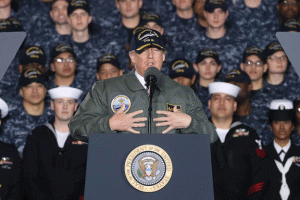 Dahr Jamail | Former US Intelligence Officers Scathingly Critique Trump’s So-Called Foreign Policy, May 08, 2017, By Dahr Jamail, Truthout | News Analysis
“……..As the Trump administration appears poised to become increasingly involved in Syria and the greater Middle East, what is life like under the bombs?………
As that conflict continues with no end in sight, in yet another direct contradiction to his campaign promises to avoid involvement in Middle East conflicts, Trump is now on the brink of plunging the US deeper into the morass of blood, destruction and suffering across the Middle East and beyond.
Several former intelligence officials spoke with Truthout about the Trump administration’s military escalations, and what his mistakes could mean for the world’s future.
Syria as a Distraction The former officials pointed to Trump’s escalation of US attacks on Syria as a distraction from investigations into his administration.
I think it’s clear that Donald Trump found it expedient to fire the 59 Tomahawk missiles at the Syrian air base on April 7 as a way to quell the media frenzy surrounding ‘Russiagate’ that was causing his approval ratings to tank,” Elizabeth Murray, who was formerly the deputy national intelligence officer for the Near East in the National Intelligence Council, told Truthout. Murray retired in 2010 after a 27-year career with the Central Intelligence Agency (CIA), where she served as a media and political analyst on Middle Eastern issues.
Murray believes Trump seized the opportunity to blame the Syrian government for the April 4 chemical weapon incident so that he could use it as a pretext to bomb.
“By giving his generals the green light to launch the missiles, he was able to silence media criticism, appease pro-war neoconservative elements and shore up his flagging image,” Murray explained……….
From Bad to Worse
According to Murray, in terms of the trajectory of developments in Syria and Iraq, it’s very difficult to be optimistic in the near term.
“What’s really disturbing is that US citizens are being prevented from knowing what is really going on with regard to US involvement in those countries,” she said. “The Trump administration has announced that the public will no longer be informed of new troop deployments to Iraq and Syria, while this was routinely disclosed under the previous administration.”
She sees that as an indication that US military activity in both countries is being ramped up in a clandestine manner; and since deploying ground troops to these countries is wildly unpopular, the Trump administration has decided to keep the American people in the dark………
Given that the US military does not report numbers of civilian casualties in Iraq, Syria and Afghanistan, it is impossible for Americans to hold their so-called leaders accountable when they are prevented from knowing what is even occurring.
“These kinds of policies will leave us dependent on journalists and whistleblowers willing to risk their lives and livelihoods to tell the truth,” Murray added. “Meanwhile, weapons manufacturers and Washington, DC-based ‘beltway bandits’ [the cottage industry of think tanks and contractors servicing the Defense Department and intelligence agencies] will continue to thrive under a foreign policy of endless wars.”………
Murray thinks face-to-face talks with North Korean leadership are required to de-escalate tensions, which Trump has gone out of his way to ratchet up. Additionally, she says Washington should scale back the ongoing hostile rhetoric and major military maneuvers it has been conducting in the region.
“If one reads the terrible history of US military intervention in North Korea, it’s easy to understand why Pyongyang is jittery and testing its ballistic missiles,” Murray said. She noted that a similar process of de-escalation should be employed with regard to Syria and Russia, adding that Iran should be included in these negotiations………http://www.truth-out.org/news/item/40490-former-us-intelligence-officers-scathingly-critique-trump-s-so-called-foreign-policy
May 10, 2017
Posted by Christina Macpherson |
politics international, USA |
Leave a comment
 Moorside nuclear plant ‘on hold’ as review announced, BBC News 4 May 2017 A plan to build a nuclear power station in Cumbria has been put on hold while the company behind it carries out a strategic review.
May 8, 2017
Posted by Christina Macpherson |
business and costs, politics international, UK |
Leave a comment
US military: “We are prepared to use nuclear weapons”
Twice in seven days the United States shot nuclear-capable long-range missiles toward the Marshall Islands, but the same government refused in March to join negotiations for a new treaty banning nuclear weapons.
Tests conducted April 26 and May 3 from Vandenberg Air Force Base launched modernized Minuteman-3 ballistic missiles, and the US Air Force said in a statement that such tests ensure “the United States’ ability to maintain a strong, credible nuclear deterrent as a key element of US national security…”
In late March, US Ambassador to the United Nations Nikki Haley explained why the US would boycott the “treaty ban” negotiations that began March 27 at the UN in New York City. Haley said about nuclear weapons, “[W]e can’t honestly say that we can protect our people by allowing the bad actors to have them, and those of us that are good, trying to keep peace and safety not to have them.” North Korean president Kim Jong-un could have said the same thing about his seven nuclear warheads, especially in view of US bombs and missiles currently falling on seven countries — Iraq, Afghanistan, Syria, Pakistan, Yemen, Somalia, and Libya — and engagement in massive war games off the Korean peninsula.
Ambassador Haley managed to avoid being two-faced on one level. Joining the ban treaty talks would have been openly hypocritical while her colleagues in the war department were preparing both new nuclear weapons production and a series of test launches. Another April test, at the Tonopah bombing range in Nevada, dropped a so-called “B61-12” the newest US H-bomb now in development and scheduled to go into production after 2022.
Jackie Cabasso, of the Western States Legal Foundation, explained April 20, “In 1997… President Bill Clinton signed Presidential Directive-60, reaffirming the threatened first use of nuclear weapons as the ‘cornerstone’ of US national security.… President Obama left office with the US poised to spend $1 trillion over the next 30 years to maintain and modernize its nuclear bombs and warheads…. Over the past couple of years, the US has conducted a series of drop tests of the newly modified B61-12 gravity bomb…. Each new bomb will cost more than twice its weight in solid gold.” Of the 480 B61s slated to become B61-12s, about 180 are scheduled to be placed at six NATO bases in Europe.
US military: “We are prepared to use nuclear weapons” As it did Feb. 21 and Feb. 25, 2016, the Air Force regularly tests Minuteman-3s. Deputy Pentagon Chief Robert Work explained before the Feb. 25 launch that the US had tested “at least” 15 since January 2011, “And that is a signal … that we are prepared to use nuclear weapons in defense of our country if necessary.” This is a Big Lie. To “use” nuclear weapons produces only massacres, and massacres are never defensive.
Jason Ditz put the rocket tests in context for Antiwar.com: “Everywhere and (mostly) without exception, the test of an intercontinental ballistic missile (ICBM) would be angrily condemned by the United States as a dangerous provocation, and the firing of a nuclear-capable rocket would be treated as tantamount to an act of war. Not today [April 26], of course, when the missile in question was test-fired from California by the United States flying some 4,000 miles before hitting a test target near the Marshall Islands. The missile was identified as a Minuteman III, a nuclear-capable weapon of which the US has 450 in service.”
The two times Haley flubbed her March 27 “peace and safety” speech were alarming. Haley stumbled once saying, “We would love to have a ban on nuclear treat… nuclear weapons.” A ban on nuclear treaties is clearly what Haley’s bosses do want. So she didn’t correct herself when she said, “One day we will hope that we are standing here saying, ‘We no longer need nuclear weapons.’” Translation: today the US does not even hope to get rid of nuclear weapons.
Instead, the United States is simultaneously bombing and rocketing across the Middle East, hitting civilians with drones, Cruise missiles, depleted uranium, and even a 21,600-pound “Massive Ordnance Air Blast” or MOAB bomb, also tested April 13, destroying caves in Afghanistan. This giant “thermobaric” or “fuel-air” explosive (FAE) has the mass of five Lincoln Continentals, and reportedly killed 95 people including a teacher and his son. Such is the peace and safety delivered by “those of us that are good.”
One Defense Intelligence Agency report uncovered by Human Rights Watch said that because “shock and pressure waves cause minimal damage to brain tissue…it is possible that victims of FAEs are not rendered unconscious by the blast, but instead suffer for several seconds or minutes while they suffocate.”
On March 29, two days after her UN speech Haley spoke to the Council on Foreign Relations and cleared up any confusion the Pentagon’s bombing spree might cause. Haley declared, “The United States is the moral conscience of the world.” Well, “And I,” Dorothy Parker said, “am Marie of Romania.”
May 8, 2017
Posted by Christina Macpherson |
politics international, USA, weapons and war |
Leave a comment
Beijing hits back at North Korea’s rare criticism of China over nuclear program, SMH, Kirsty Needham, 4 May 17, Beijing: Chinese state media has hit back at a rare and detailed attack by North Korea on its neighbour and major economic backer.
China had crossed the “red line” of North Korea and China relations, a scathing commentary published in North Korea’s official Rodong Sinmun newspaper claimed on Thursday.
China was accused of turning three provinces of north east China into an “anti-North Korea frontline”, and allowing South Korean intelligence to conduct “abduction and terror at the Sino-North Korea border under the disguise of religious and business people”.
Chinese analysts were “spouting nonsense” that North Korea’s access to nuclear weapons strains north Asia’s security, it said. It criticised China’s “ignorant politicians and media” for supporting stricter sanctions on North Korea……..http://www.smh.com.au/world/north-korea-makes-rare-criticism-of-china-over-nuclear-program-20170504-gvyqgp.html
May 6, 2017
Posted by Christina Macpherson |
politics international |
Leave a comment

Brussels plans to saddle UK with EU nuclear waste Britain’s impending split from Euratom indicative of complexity of Brexit, Ft.com by: Arthur Beesley in Brussels and Andrew Ward in London, 4 May 17 Britain will be on the hook for large volumes of dangerous radioactive waste — some of it imported from the rest of Europe — under proposals by Brussels to transfer ownership of a range of nuclear materials to the UK after it leaves the EU.
Almost 130 tonnes of plutonium stored at Sellafield in Cumbria is among the nuclear material that would formally shift to UK control, according to draft documents issued by Michel Barnier, the EU’s chief Brexit negotiator. All “special fissile material” — forms of uranium and plutonium used in nuclear fuels and some of the resulting waste — within the EU are technically owned by Euratom, the pan-European regulator of civilian nuclear activity.
Mr Barnier’s provisional negotiating position calls for a Brexit agreement to “ensure, where appropriate, the transfer to the United Kingdom” ownership of “special fissile material” currently controlled by Euratom within the UK. Such an agreement would make the UK legally responsible not only for its own nuclear material but also reprocessed spent fuel imported over several decades from Germany, Sweden and elsewhere for recycling at Sellafield. “What was a joint European legacy now becomes a UK home brew, with potentially dire economic consequences for the UK given the sheer expense and weight of this radiological inventory,” said Paul Dorfman, honorary senior researcher at the Energy Institute at University College London……..
Mr Barnier’s proposal for the UK to assume “all rights and obligations associated with the ownership of [fissile] materials or property transferred” is seen in Brussels as a necessary housekeeping exercise to remove Euratom’s claim on nuclear fuel used in UK power stations as well as uranium isotopes used in radiotherapy. But it highlighted the uncertainty facing Britain’s nuclear industry — responsible for about a fifth of domestic electricity generation — in the run-up to Brexit. Euratom is a separate legal entity to the EU but is governed by EU institutions and the UK government says it has no option but to leave both at the same time. A UK government spokeswoman said: “Leaving Euratom is a result of the decision to leave the EU as they are uniquely legally joined.”
As well as nuclear fuel and reprocessed waste, the UK would also take ownership of Euratom property used to safeguard the material, such as inspection and monitoring equipment, according to the EU proposals. The negotiation directives, which are subject to the agreement of the 27 remaining member states, were published on Wednesday as Mr Barnier set out his hardline opening position for talks with London…….
https://www.ft.com/content/4cd8a146-3039-11e7-9555-23ef563ecf9a
May 5, 2017
Posted by Christina Macpherson |
politics international, UK, wastes |
Leave a comment
GET OUT: North Korea ‘ready’ for new nuclear test, Northern Star, 4th May 2017 CHINA has called for all of its citizens to return from North Korea immediately as a US citizen is detained for allegedly trying to overthrow the country’s regime……https://www.northernstar.com.au/news/get-out-north-korea-ready-new-nuclear-test/3173765/
May 5, 2017
Posted by Christina Macpherson |
China, North Korea, politics international |
Leave a comment
A New Era for Iran: Trade With EU Grows 79 Percent on Nuclear Deal Implementation http://www.albawaba.com/business/new-era-iran-trade-eu-grows-79-percent-nuclear-deal-implementation-970660 May 4th, 2017 Iran’s exports to the European Union have increased by over 300 percent after the implementation of the historic 2015 nuclear agreement between Iran and the P5+1 group of countries, European Climate Action and Energy Commissioner Miguel Arias Canete says.
Speaking at the first-ever Iran-EU Business Forum on Sustainable Energy in Tehran on Saturday, Canete added that trade between Iran and the union showed 79 percent boost following the implementation of the nuclear deal, known as the Joint Comprehensive Plan of Action (JCPOA), IRNA reported.
According to figures released by the European Union’s statistics agency Eurostat in February, Iran’s exports to the EU stood at €5.494 billion in 2016 as compared to €1.235 in 2015 due to the EU resuming oil imports from Iran following the nuclear deal.
Canete expressed the 28-nation bloc’s keenness to cooperate with Iran in the nuclear energy sector and said the JCPOA prepared the ground for the resumption of Iran-EU cooperation.
The commissioner reiterated the EU’s support for the nuclear agreement and said Iran and the union started to cooperate with each other in different sectors in 2016 and managed to sign many agreements.
He urged both sides to continue to upgrade their cooperation and expressed hope that the ongoing forum in Tehran would lay the ground for interaction in clean energy. He noted that he would help European firms make more investment in Iran.
Under the agreement, limits were put on Iran’s nuclear activities in exchange for, among other things, the removal of all nuclear-related bans against the Islamic Republic.
Following the conclusion and implementation of the JCPOA, Iran and EU member states launched cooperation and signed several agreements in various fields.
More than 50 European companies and business associations and some 40 Iranian energy companies are participating at the Tehran forum with the purpose of enabling business relations and partnerships between Iran and the EU and laying the ground for further cooperation and joint partnerships in the energy sector.
It will provide a platform for investors and businesses to look into investment opportunities for clean energy, renewable energy efficiency and energy conservation actions in Iran.
May 5, 2017
Posted by Christina Macpherson |
business and costs, EUROPE, Iran, politics international |
Leave a comment