The Iranian president said the removal of nuclear-related sanctions had already borne fruit. “In regards to sanctions, except for banking restrictions, all sanctions have been removed 100%.” https://www.theguardian.com/world/2016/dec/06/hassan-rouhani-us-iran-nuclear-deal-trump-tear-up-sanctions
Japanese government to provide $8.5 billion) for a UK nuclear power plant project in Wales
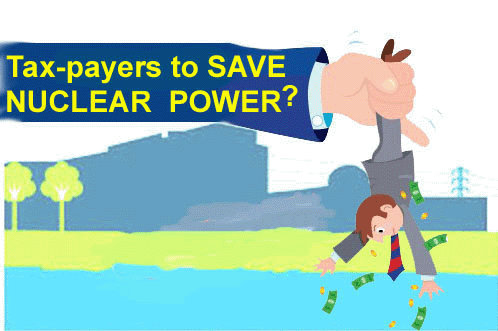 Japan, Hitachi to stump up $8.5 billion for Horizon nuclear project in Wales: source http://www.reuters.com/article/us-britain-nuclear-hitachi-idUSKBN1440BA | TOKYO, 15 Dec 16 The Japanese government and a Hitachi Ltd (6501.T) unit will compile a package worth around 1 trillion yen ($8.5 billion) for a UK nuclear power plant project, a government official involved in the project said on Thursday.
The Japan Bank for International Cooperation and the Development Bank of Japan will provide financing for the project, the official told Reuters.
The funding plans are a boost for the project, one of several new nuclear plants planned in the UK, which is aiming to replacing its ageing fleet of atomic reactors.
Hitachi’s Horizon unit plans to construct at least 5.4 gigawatts of new nuclear capacity across two sites in Britain.
The funds will be provided for the first plant planned at Wylfa Newydd in Wales.
The Nikkei newspaper said Hitachi would invest about 10 percent of the expected 19 billion pounds ($24 billion) cost of the project. A Hitachi official declined to comment, saying the amount has not been announced.
($1 = 117.2600 yen)
($1 = 0.7971 pounds)
Japanese government planning to subsidise Britain’s new nuclear build
Tokyo eyes ¥1 trillion in financial support for Japanese firms pursuing U.K. nuclear plants http://www.japantimes.co.jp/news/2016/12/16/business/tokyo-eyes-%C2%A51-trillion-financial-support-japanese-firms-pursuing-u-k-nuclear-plants/#.WFONt9J97Gg The government is considering offering financial assistance through state-affiliated banks for projects won by Japanese companies for nuclear power plant construction in Britain, sources said Thursday.
Under study is a plan for the Japan Bank for International Cooperation and the Development Bank of Japan to invest in and provide loans to local companies that build and operate nuclear power stations, the sources said.
The Japanese government hopes to establish a framework for financial assistance totaling about ¥1 trillion within 2017 also by asking major Japanese and British private financial institutions to participate in the scheme, according to the sources.
Visiting British Chancellor of the Exchequer Philip Hammond told reporters in Tokyo on Thursday that Britain is holding talks with the Japanese government, Hitachi Ltd. and Toshiba Corp. on a financial support framework for nuclear power plant construction projects in his country.
On the same day, Hammond met with Chief Cabinet Secretary Yoshihide Suga to exchange opinions about nuclear plant construction.
British Business, Energy and Industrial Strategy Secretary Greg Clark plans to visit Japan as early as next week and hold meetings with officials of Hitachi, Toshiba and the JBIC.
Under the envisaged scheme, the Japanese government expects to offer financial assistance to Horizon Nuclear Power Ltd., a unit of Hitachi, and NuGeneration Ltd., which is under the wing of Toshiba.
Rouhani orders nuclear-fuelled warships, and mounts legal challenge against US trade restrictions
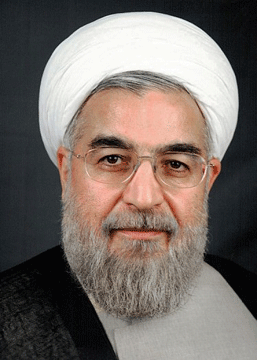 Iran’s President Hassan Rouhani orders nuclear-fuelled warships as he accuses US of ‘violating’ deal http://www.independent.co.uk/news/world/middle-east/iran-nuclear-powered-war-ships-response-us-sanctions-a7471566.html
Leader mounting legal challenge against US trade restrictions Harriet Agerholm @HarrietAgerholm Iran’s President Hassan Rouhani has ordered the head of the country’s Atomic Energy Organisation to start planning the development of nuclear-powered ships in reaction to what he called the United States’ violation of their nuclear deal.
Earlier in December the US Senate voted to extend the Iran Sanctions Act by 10 years, a decision that was criticised by the Iranian foreign minister at the time who said it showed the US government had “a lack of credibility”.
In a letter read out on Tuesday on state television, Mr Rouhani condemned the move as a breach of the 2015 nuclear accord and told the nation’s scientists to begin “planning the design and production of fuel and nuclear power plants for maritime transport”.
The leader also said he had ordered the foreign minister to mount a legal challenge against the US.
The 2015 nuclear accord between Iran and six world powers lifted a variety of sanctions against the nation in exchange for restrictions on the Iranian nuclear programme.
Yet the US keeps its own set of trade restrictions against the country – separate from the agreement – which were set to expire at the end of the year.
Politicians in the Senate said the sanctions were extended not only because of nuclear issues, but also over concerns about ballistic missile-testing and human rights in the country.
President Barack Obama is expected to sign the extension into law in the coming days.
The nuclear marine propulsion technology Iran has vowed to develop uses a nuclear reactor to generate electricity on a ship. Tensions in the Middle East have grown since the US elected Donald Trump as President, Iran’s defence minister said on Sunday.
Iran nuclear deal involves several nations – not just the USA
 Nuclear agreement not a deal solely between U.S. and Iran: Daryl Kimball, Tehran Times By Javad Heirannia December 13, 2016 TEHRAN – Daryl Kimball, executive director of the Arms Control Association in Washington, says the nuclear deal is not a bilateral agreement between the United States and Iran that can be unilaterally abrogated by the incoming administration of Donald Trump.
“The nuclear agreement is not a deal solely between the United States and Iran,” Kimball tells the Tehran Times in an exclusive interview.
Kimball says, “If the Trump administration walks away from the nuclear deal, it would also send a dangerous message to our European allies, Russia, and China that the United States cannot be trusted to honor agreements and commitments.”
Following is the full text of the interview:
Q: During presidential campaigns Donald Trump said he would “renegotiate” the terms of the nuclear deal with Iran. What is your prediction?
A: Yes, Mr. Trump did pledge to “dismantle” the 2015 agreement between six world powers and Iran, which has led to verifiable limits on Iran’s capacity to produce material that could be used for nuclear weapons, allowed Iran to continue peaceful nuclear activities, and led to the removal of nuclear-related international sanctions — a win-win scenario for both sides.
It is not clear at this point whether and how Trump would seek to do this or why. Trump’s campaign statements on many issues appear to have been designed to pander to hard-right elements of the Republican Party in order to obtain votes and to criticize the Democratic nominee for president, Hillary Clinton………..
Q: If Trump violates the JCPOA, how will Washington’s European allies and JCPOA parties react?
A: If the Trump administration walks away from the nuclear deal, it would also send a dangerous message to our European allies, Russia, and China that the United States cannot be trusted to honor agreements and commitments.
The nuclear agreement is not a deal solely between the United States and Iran. Washington worked with Russia, China, France, Germany, and the United Kingdom to build an international sanctions regime to pressure Iran to the negotiating table and then reach a deal to block Iran’s pathways to nuclear weapons. None of these countries have any intention of walking away from the agreement, which is working well for them, and the people of Iran.
If the United States administration or Congress takes actions that violate the JCPOA (such as failing to renew waivers of nuclear-related sanctions under the “Iran Sanctions Act”) or measures that are clearly designed to provoke Iran to take actions that would violation the JCPOA, I think it very likely that the United States’ P5+1 partners will resist such actions and seek to insulate the JCPOA as much as possible. Many American foreign policy experts and a significant majority of the American people would also question such a cynical and counterproductive move…….
If the Trump administration walks away from the nuclear deal, it would also send a dangerous message to our European allies, Russia, and China that the United States cannot be trusted to honor agreements and commitments. After sending such a message to the international community, Trump would be hard-pressed to build an international sanctions coalition strong enough to push Iran back to the negotiating table.
On the other hand, if the IAEA finds that Iran has failed to meet its obligations under the deal, however minor the infraction, it is likely that hard-liners in Congress and in the Trump administration will seek to use this as a reason to blame Iran and walk away from the deal and reimpose sanctions. This makes it essential, in my view, for Iran to continue to meet its nuclear-related commitments under the JCPOA. http://www.tehrantimes.com/news/409095/Nuclear-agreement-not-a-deal-solely-between-U-S-and-Iran-Daryl
The main barriers to using nuclear weapons are psychological, not legal
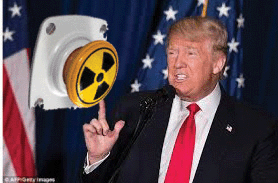 What’s standing between Donald Trump and nuclear war? The main barriers to using nuclear weapons are psychological, not legal, The Verge by Dec 11, 2016 When President-elect Donald Trump officially becomes the president of the United States in January, he will take complete control of America’s nuclear arsenal. Should he decide to start a nuclear war, there are no legal safeguards to stop him. Instead, a much less tangible web of norms, taboos, and fears has reined in US presidents since World War II. But as North Koreaescalates its nuclear weapons tests and the president-elect of the United States openly contemplates using nukes, experts worry that this fragile web could start to tear.
The climate-water conflict – climate change increases risk of nuclear war

Kashmir, climate change, and nuclear war, Bulletin of the Atomic Scientists, Zia Mian , 7 Dec 16 “……..The climate-water conflict. Along with the risks of war triggered by an escalation along the Line of Control in Kashmir or by attacks on Indian cities by Islamist militants backed by Pakistan, a new source of conflict between Pakistan and India has emerged, also centered on Kashmir. It is a struggle over access to and control over the water in the rivers that start as snow and glacial meltwater in the Himalayas and pass through Kashmir on their way to Pakistan as the Indus River Basin, ending in the Arabian Sea.
The Indus River and its tributaries are central to Pakistan’s water supply, food supply, and electricity production, and India relies on some of the same water. Under the 1960 Indus Waters Treaty, Pakistan has control over the Indus, Jhelum, and Chenab Rivers, and India manages the Sutlej, Beas, and Ravi rivers until they cross into Pakistan and all merge into the Indus River. The treaty was established in part because of conflicts over water between the two countries following independence in 1947, including an Indian decision in 1948 to block some of the water flowing into Pakistan during the first India-Pakistan war over Kashmir.
As water demand in both countries has grown to meet the needs of rapidly growing populations and increased agriculture and industrial use, large hydroelectric dams have been constructed, and renewed disputes are testing the Indus Waters Treaty. A 2011 United States Senate Foreign Relations Committee report assessed that “water may prove to be a source of instability in South Asia [as] new demands for the use of the river flows from irrigation and hydroelectric power are fueling tensions between India and Pakistan. A breakdown in the [Indus Water] treaty’s utility in resolving water conflicts could have serious ramifications for regional stability.” The report concluded grimly that “the United States cannot expect this region to continue to avoid ‘water wars’ in perpetuity.”………
Pakistan’s government, nationalist and militant organizations, and right-wing media frequently now present India’s construction of dams in Kashmir as a pressing national security threat and one that may call for extreme responses. An editorial in one leading urdu-language Pakistani newspaper in 2011 declared “Pakistan should convey to India that a war is possible on the issue of water and this time war will be a nuclear one.” ………http://thebulletin.org/kashmir-climate-change-and-nuclear-war10261
Pakistan and India – a dangerous situation that could bring about global nuclear war
Kashmir, climate change, and nuclear war, Bulletin of the Atomic Scientists, Zia Mian , 7 Dec 16 In April 2016, speaking at the conclusion of the Nuclear Security Summit in Washington DC, which had brought together more than 50 government leaders, President Obama described what he saw as the three major nuclear weapons challenges. Along with difficulties in achieving further nuclear arsenal reductions by the United States and Russia and the problem of North Korea, President Obama listed Pakistan and India and the need, as he put it, for “making sure that as they develop military doctrine that they are not continually moving in the wrong direction.” The White House press secretary later explained that underlying the President’s concern about South Asia was “the risk that a conventional conflict between India and Pakistan could escalate to include the use of nuclear weapons.” It is a well-founded fear and one that has become more urgent as tensions between Pakistan and India have escalated.
As part of its efforts to pressure India into giving up Kashmir, Pakistan has backed Kashmiri insurgents and used Islamist militants to launch attacks across the Line of Control. ……
Frustration in the armies on both sides has led to furious, seemingly indiscriminate firing across the Line of Control. The scale of civilian casualties has led hundreds of people to flee their homes on both sides of the line; local villagers say it seems as “if a full-blown war is going on between India and Pakistan.”
Meanwhile many Kashmiris have turned to supporting groups resisting Indian rule and been met with repression from security forces………
It is not just attacks by Pakistan-backed militants on Indian forces in Kashmir and subsequent Indian reprisals that could escalate and tip the two countries into another major war. A related trigger would be an attack on an Indian city by Islamist militant groups, along the lines of the assault on Mumbai in November 2008 that claimed hundreds of casualties and was linked to intelligence agencies in Pakistan. ………
The climate-water conflict……
From tactical weapons to massive retaliation. India anticipates that Pakistan might use nuclear weapons against Indian conventional forces during a war. The Indian Army conducted a massive military exercise in April 2016 in the Rajasthan Desert bordering Pakistan, involving tanks, artillery, armored personnel carriers, and 30,000 soldiers who practiced what they would do if attacked with nuclear weapons on the battlefield. An Indian Army spokesman told the media that “our policy has been always that we will never use nuclear weapons first. But if we are attacked, we need to gather ourselves and fight through it. The simulation is about doing exactly that.” This was not the first such exercise.
Indian nuclear doctrine also calls for massive retaliation directed at Pakistani cities, and Pakistan has threatened to respond in kind. In 2003, India’s cabinet declared nuclear weapons “will only be used in retaliation against a nuclear attack on Indian territory or on Indian forces anywhere… [N]uclear retaliation to a first strike will be massive and designed to inflict unacceptable damage.” According to Admiral Vijay Shankar, a former head of Indian strategic nuclear forces, such retaliation would involve nuclear attacks on Pakistan’s cities.
General Kidwai from Pakistan describes such Indian threats as “bluster and blunder,” since they “are not taking into account the balance of nuclear weapons of Pakistan, which hopefully not, but has the potential to go back and give the same kind of dose to the other side.” This seems an explicit suggestion of Pakistan planning to target Indian cities with nuclear weapons in retaliation of Indian nuclear attacks on Pakistani cities.
From regional war to great power war. Time is not on our side. The failure to settle the Kashmir dispute despite the passage of 70 years has already triggered three wars. While Pakistan clings grimly to its claims on Kashmir, India seems less inclined to compromise as it grows in economic and military power. Adding to this will be the inevitable pressures from climate change over the coming decades on the Himalayan glaciers, the monsoons, and ground water in the Indus Basin, which will lead to reduced and less reliable access to water in an already water-stressed region, at a time of rapidly growing demand. These drivers have already started to overlap, and conflicts over land, people, blood, and water may become one.
Once initiated, possibly even by the actions of a small militant group, a Pakistan-India conflict may well escalate into a larger war and then bring in allied outside powers, as happened in Europe in World War I.
Pakistan is building ever closer military and economic ties to China; India is becoming a strategic partner of the United States. These alliances with great powers may give policy makers in Pakistan and Indian confidence in escalating a conflict and issuing nuclear threats during a crisis. Because of the increasingly tense and militarized nature of the rivalry between China and the United States, a South Asian conflict that draws them in could escalate into a potentially far more destructive war.
Given these risks, forestalling crises and possible war in South Asia should be a priority. The long history of failures to find a path to peace for Kashmir through United Nations resolutions and bilateral Pakistan-India agreements seems to have sapped the will to try to address the dispute directly. Preventing a South Asian war from becoming nuclear war will require progress on banning the bomb. http://thebulletin.org/kashmir-climate-change-and-nuclear-war10261
Mitsubishi Heavy makes huge and risky investment in AREVA nuclear
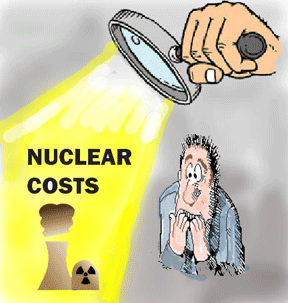
 Mitsubishi Heavy faces tough decisions in nuclear power business Orders dry up at home and abroad after Fukushima disaster, Nikkei Asian Review, 8 Dec 16, TOKYO –– Mitsubishi Heavy Industries and Japan Nuclear Fuel are putting the final touches on a plan to acquire a roughly 10% stake in the troubled French nuclear energy company Areva. But for Mitsubishi Heavy it is an agonizing decision.
The investment would involve spending 40-50 billion yen ($350-438 million), which is an extraordinary amount considering the uncertain future of the nuclear power business. Mitsubishi Heavy has made little headway with exports, highlighted by Vietnam’s recent decision to abandon plans for a pair of nuclear plants. The Japanese company finds itself in a tight spot, pulling with no progress on a rope it cannot release.
In Japan, the Sendai plant operated by Kyushu Electric Power is one of the few domestic nuclear power plants now running. Restarting other plants and making them safer and more quake-resistant are the tasks at hand. But Mitsubishi Heavy has received few hard orders and it is rough going for the manufacturing aspect of its nuclear power business, admitted company President Shunichi Miyanaga.
Facing dim prospects for new domestic orders, both Mitsubishi Heavy and Japan Nuclear Fuel must find other ways to secure enough business to keep their equipment and workforces active.
Back in 2006, Mitsubishi Heavy partnered with Areva to develop a so-called Generation III+ pressurized-water reactor with state-of-the-art technologies. The team has been using the design to compete with the larger, older-generation pressurized-water systems promoted by two other groups: the team of Hitachi and General Electric, and the team of Toshiba and Westinghouse…….
The French government, which owns nearly 90% of Areva, is looking to cut its losses. Unprofitable businesses are being excised from Areva and a new company is being set up that will seek over 30% of its capital from Japan, China, and elsewhere. …
There are lingering worries inside Mitsubishi Heavy about this huge investment in Areva. To alleviate those concerns, Mitsubishi Heavy has voiced confidence that there will be another nuclear renaissance in 20 to 30 years……http://asia.nikkei.com/Business/Deals/Mitsubishi-Heavy-faces-tough-decisions-in-nuclear-power-business
Iranian president won’t let Trump ruin the US–Iran nuclear deal
Rouhani: we won’t let Trump tear up US–Iran nuclear deal
Iranian president says 10-year extension of US sanctions could be violation of the accord signed in July 2015, Guardian, Saeed Kamali Dehghan Iran 7 Dec 16 The Iranian president, Hassan Rouhani, has said his country will not allow Donald Trump to tear up the landmark nuclear agreement with the west as he warned that an extension of sanctions, which passed Congress last week, could be a violation of the deal.
Trump’s victory in the US presidential elections has raised questions about whether the landmark nuclear accord, signed in July 2015, has a future. Its fate could affect Rouhani’s chances of re-election in May.
“Iran is the only country that, as our supreme leader [Ayatollah Ali Khamenei] stated, would neither mourn nor celebrate [Trump’s] coming to power,” Rouhani said on Tuesday at Tehran University. “We would follow our own path.”
Rouhani said the US president-elect “may wish many things, he may wish to weaken or tear up Barjam,” referring to the Persian acronym for the joint comprehensive plan of action (or the nuclear deal), “but will we and our nation allow such a thing? America cannot influence our path of strength and endurance.”……
New sanctions on North Korea in reaction to its latest nuclear and ballistic missile tests.
Coal sanctions newest move to block North Korean nuclear efforts SBS World News Radio: The United Nations Security Council has imposed new sanctions on North Korea in response to its latest round of nuclear and ballistic missile tests.By Gareth Boreham, 1 Dec 16
People power, not Trump, has killed the Trans Pacific Partnership
 The TPP wasn’t killed by Donald Trump – our protests worked https://www.theguardian.com/commentisfree/2016/nov/28/tpp-protests-mass-opposition-worked-trump-presidency We the people can create change by standing together. This is crucial to remember for the next four years, Guardian, Evan Greer, Tom Morello and Evangeline Lilly, 28 Nov 16,
The real story is that an unprecedented, international uprising of people from across the political spectrum took on some of the most powerful institutions in the world, and won.
Sure, Donald Trump – and Bernie Sanders’ – campaign focus on the TPP elevated US awareness about the pact, a wide-reaching international agreement negotiated by the Obama administration. But no single politician killed this deal.
If not for the constant pressure from activists and civil society groups, the TPP would have become law long before the recent US election. But thanks to intense, creative and strategic organizing from the day the text was finalized in 2015, there was never a majority of support for the pact in Congress. That’s why it was never implemented.
The TPP is a massive global deal that was negotiated in secret with hundreds of corporate advisers given special access while the public was locked out. It would have handed multinational corporations like Walmart, AT&T and Monsanto extraordinary new powers over everything from the wages we earn, to the way we use the internet, to the safety of the food we feed our children.
Perhaps most shockingly, the TPP would have allowed corporations to sue governments before tribunals of three corporate lawyers, essentially creating an unaccountable, shadow legal system outside of our traditional courts to punish governments that pass laws that corporations don’t like.
A simple agreement to lower tariffs and other anticompetitive barriers to trade wouldn’t have been so controversial. But big business couldn’t resist the urge to abuse the extreme secrecy surrounding the TPP negotiations to stuff the pact with a wishlist for policies they knew they could never pass through traditional means.
That unchecked greed was the TPP’s demise. What emerged from the closed-door negotiations was more than 5,000 pages of policy so clearly against the public interest that it awakened a firestorm of opposition that swept the globe, and in the end, sent the TPP to its grave.
While negotiations were still under way, tens of thousands of people joined mass protests in Japan, Peru, Australia, New Zealand and other Pacific Rim nations. They pushed back on the TPP’s worst provisions, held their leaders’ feet to the fire and dragged the talks out for years. This early wave of international resistance changed the game: it bought time for activists to organize an effective opposition in the US, which was seen as all-important in the global calculus of the Washington-led deal. If Congress did not ratify the TPP, it would die.
In the meantime, an unlikely alliance was forming. Activists, farmers, labor unions, tech companies, environmentalists, economists, nurses, LGBTQadvocates, libertarians and librarians mounted an intense opposition to the “fast track” legislation that the White House needed to rush the final agreement through Congress. The coalition that formed grew from dozens, to hundreds, to literally thousands of organizations, many working together for the first time, ranging from Black Lives Matter to Doctors Without Borders to the Tea Party.
We marched in the streets. We rallied outside the hotels and resorts that hosted the secret negotiations. Cancer patients protesting about the TPP’s impact on healthcare access engaged in civil disobedience and were arrested. Internet freedom activists mobilized thousands of websites for online protests that bombarded lawmakers with emails and phone calls. Academics picked apart leaked versions of the deal, and coordinated with advocates to launch a campaign to educate the public on its flaws.
Hard-hitting activism and public outcry slowed the TPP down, and as a result, dragged it fully into the spotlight just as the US headed into a contentious election season.
It wasn’t a coincidence that Donald Trump saw the TPP as a useful stump speech talking point. Widespread suffering caused by previous trade deals laid a strong foundation for skepticism, making President Obama’s devotion to the Wall Street-friendly deal, and Hillary Clinton’s previous support for it, a huge liability for the Democratic party. As more and more people learned about what the TPP really meant for them and their families, it became politically toxic, to the point that no major party candidate for president could openly support it.
This was a sign that the TPP was on its deathbed, but with the threat of a last-minute push during the “lame duck” session after the election, we needed to be sure. So we targeted undecided lawmakers with protests and flew inflatable blimps outside their offices. We harnessed the power of music to draw huge crowds across the country to “Rock Against the TPP” concerts and teach-ins, taking our opposition to the TPP into the cultural mainstream. We tuned out the chorus of voices that told us that corporate power would always prevail in the end. And finally, we claimed our victory.
Now more than ever, it’s crucial that Americans understand how the TPP was really defeated. An organized and educated public can take on concentrated wealth and power and win. With four years of new battles ahead of us, this is a story we must commit to memory, and a lesson we must take to heart.
Diplomatic outreach from Trump. Xi and Putin could persuade North Korea to give up nuclear weapons expansion

 Under Trump, America can defuse the Korean nuclear crisis – with help from China and Russia http://www.scmp.com/comment/insight-opinion/article/2048641/under-trump-america-can-defuse-korean-nuclear-crisis-help
Charles K. Armstrong and John Barry Kotch say North Korea may well be willing to give up its nuclear plans if both Xi and Putin can be convinced to add their weight to the diplomatic outreach Charles Armstrong , 24 November, 2016, US Director of National Intelligence James Clapper said recently at a Council on Foreign Relations forum that dissuading North Korea from continuing its nuclear development was “a lost cause”. The remark is itself a cause for alarm. North Korea’s growing nuclear arsenal and increasing delivery capability could render East Asian stability itself a lost cause, substantially raising the risks of regional nuclear proliferation and disarray in America’s alliances with Japan and South Korea – as well as posing a direct threat to the US homeland. It is a principal reason that Japan’s Prime Minister Shinzo Abe sought an early meeting with President-elect Donald Trump last week.
Throughout most of its tenure, the Obama administration has put its stock into increasingly intrusive sanctions based on a strategy of so-called “strategic patience”, but this has not brought a resolution of the North Korean nuclear crisis any closer. On the contrary, Pyongyang has tested nuclear weapons and missiles at an ever-increasing rate.
To end North Korea’s nuclear push, we must first understand its fears
Kim Jong-un’s nuclear trajectory only increases Sino-US friction in northeast Asia
What has been lacking is a diplomatic component as a complement to the pressure of sanctions. Resolving the issue requires not just outreach conducted at the ambassadorial level by a coordinator, but a high-level diplomatic initiative, the only kind that has succeeded in the past.
Had Hillary Clinton been elected president, one could envisage such an initiative led by two former US presidents – Jimmy Carter and Bill Clinton – who have negotiated or held substantive discussions with North Korea’s leader himself or at the top leadership echelon. And while previous agreements reached with Kim Jong-un may have rejected the agreements his father and grandfather made in the 1990s, avowing not to go down the nuclear path via plutonium reprocessing or uranium enrichment, one thing the younger Kim could not have done was spurn the legacy of his father and grandfather in meeting with two former US presidents.
Carter’s negotiations with Kim Il-sung in 1994 led to a shutdown of the nuclear plant at Yongbyon for eight years and the resumption of International Atomic Energy Agency inspections. A bilateral framework established the Korean Peninsula Energy Development Organisation, with the goal of providing light-water reactors to meet Pyongyang’s energy needs. Unfortunately, the agreement fell apart during the first George W. Bush administration.
Towards the end of the Clinton administration, the US moved towards recognising North Korea as a legitimate state actor. The momentum towards diplomatic recognition was symbolised in 2000 by the visit of North Korea’s Marshall Jo Myong-rok to the White House and secretary of state Madeline Albright’s meeting with Kim Jong-il in Pyongyang. The two sides discussed a missile agreement, to be finalised by a presidential visit to North Korea.
Trump now has an opportunity, at the start of a new relationship with Xi Jinping ( 習近平 ) and Vladimir Putin respectively, to work with China and Russia in making clear to Kim Jong-un that a North Korean nuclear capability is incompatible with the stability of Northeast Asia. As Stanford University professor Siegfried Hecker has noted, the North’s strategy has evolved from a nuclear deterrent as a bargaining chip to a strategic force, and a 2020 reality of a fully fledged intercontinental ballistic missile capability.
And what of the argument, according to Clapper, that North Korea will never give up this capability, which it views as the sole guarantor of its survival? In effect, this is a false choice – unless one accepts Pyongyang’s proposition that it is faced with an existential threat from the US, making a nuclear deterrent essential for its security. Just the reverse is true: North Korea’s nuclear capability itself puts the country’s survival at risk, because no American president can tolerate the threat a nuclear-armed North Korea would pose to the US homeland.
Given the above, now is the time for China and Russia, both neighbouring states that would be directly affected by a potential US pre-emptive strike on North Korea, to embrace high-level “pincer” diplomacy vis-à-vis North Korea. To date, Beijing has argued that squeezing too hard would force a North Korean collapse, which is China’s worst-case scenario. But clearly the sanctions that China has enforced have been insufficient to deter North Korea. A non-nuclear North Korea would offer Beijing the best of both worlds: a buffer on its eastern border that is not a rogue nuclear state or a threat to regional stability.
President Xi has said to President-elect Trump that “facts have shown that cooperation is the only correct choice” for the United States and China. To gain Beijing’s acquiescence to a diplomatic approach, the first step would be for the US to delay the deployment of the Terminal High-Altitude Air Defence (THAAD) system in South Korea. THAAD was to be deployed in response to Pyongyang’s testing an intermediate-range missile capable of carrying a nuclear warhead into space, on a trajectory that could reach Guam or the Aleutian Islands. China has been adamantly opposed to THAAD; dropping or delaying the deployment of the system opens the door to a positive diplomatic role for China, to complement sanctions-based coercive diplomacy. Once the North Korean threat was removed, there would be no need or justification for THAAD.
Russia, similarly, has a vested interest in the denuclearisation of North Korea. Engaging Moscow in resolving the nuclear impasse is both logical, given the Soviet role in providing the Yongbyon nuclear reactor, the principal driver of Pyongyang’s nuclear programme, and would take advantage of the political leverage enjoyed by Putin, the only current leader to have successfully engaged with a North Korean leader, in persuading Kim Jong-il to observe a three-year missile moratorium in 1999. He has similarly agreed with Trump to “normalise relations and pursue constructive cooperation on the broadest possible range of issues”. The upside for Putin is an opportunity to bolster his standing in the West by making an important contribution to international peace and security.
Trump will have the opportunity for a fresh diplomatic approach to resolving the North Korean nuclear issue with the cooperation of the most important nuclear powers in the region – an opportunity that should be grasped sooner rather than later. The test for both Putin and Xi will be their willingness, with the full backing of Trump, to intercede directly with the North Korean leader.
Charles K. Armstrong is professor of Korean Studies at Columbia University and John Barry Kotch is a research scholar and Columbia PhD in political science
New sanctions on North Korea, agreed on by China and USA. Russia delays
China, U.S. agree on new sanctions to punish North Korea for nuclear test, but Russia ‘trying to hold it up’, National Post Michelle Nichols, Reuters | November 24, 2016 UNITED NATIONS — The United States and China have agreed on new U.N. sanctions to impose on North Korea over the nuclear test it conducted in September, but Russia is delaying action on a draft resolution, a senior Security Council diplomat said on Wednesday.
The diplomat, who spoke on condition of anonymity, believed China could persuade Russia to agree to the new sanctions and that the 15-member Security Council could vote on the draft resolution as early as next week.
Since North Korea’s fifth and largest nuclear test on Sept. 9, the United States and China, a close ally of North Korea, have been negotiating a new draft Security Council resolution to punish Pyongyang.
That draft text was recently given to the remaining three permanent council veto powers, Britain, France and Russia.
“The (permanent five members) are getting very close to agreement on a draft resolution,” the diplomat said. “The key thing is that China and the U.S., who have led this, have got to a position that they agree on. So the issue now is Russia…….http://news.nationalpost.com/news/world/china-u-s-agree-on-new-sanctions-to-punish-north-korea-for-nuclear-test-but-russia-trying-to-hold-it-up
Obama administration set to strengthen Iran Nuclear Deal
Obama Seeks to Fortify Iran Nuclear Deal New steps weighed include licenses for more American businesses and lifting additional U.S. sanctions, WSJ, By CAROL E. LEE in Lima, Peru, and JAY SOLOMON in Washington Nov. 20, 2016
The Obama administration is considering new measures in its final months in office to strengthen the landmark nuclear agreement with Iran, senior U.S. officials said, with President-elect Donald Trump’s first appointments foreshadowing an increasingly rocky road for the controversial deal.
Action under consideration to buttress the pact includes steps to provide licenses for more American businesses to enter the Iranian market and the lifting of additional U.S. sanctions.
The effort to shore up the agreement was under way before the election and is not aimed at boxing in Mr. Trump, who opposes the deal, the officials said. Officials also acknowledged the proposals are unlikely to make the nuclear agreement more difficult to undo.
Mr. Trump’s first two picks for his national security team—retired Army Gen. Mike Flynn as national security adviser and Rep. Mike Pompeo (R., Kan.) as Central Intelligence Agency director—are hard-liners on Iran who have voiced opposition to the nuclear deal…..
Administration officials said they haven’t yet begun conversations on the Iran deal with the officials Mr. Trump has deployed across the government to facilitate his transition into office. They also are unsure whether those Trump officials are the ones they need to persuade.
The picture they plan to articulate for Mr. Trump’s team is stark: If the agreement falls apart, and the U.S. is blamed for its collapse, Iran would resume its nuclear program more aggressively. In that case, the U.S. risks alienating Europe, as well as China and Russia, and limiting its ability to use sanctions again to contain Iran. Military action against Tehran’s nuclear facilities, these officials argue, could be the only alternative…….http://www.wsj.com/articles/obama-seeks-to-fortify-iran-nuclear-deal-1479692853
Liberals and mainstream conservatives complacent, while in politics, fascism rises
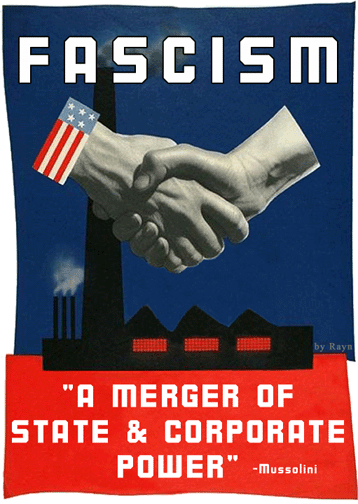 No, this isn’t the 1930s – but yes, this is fascism, The Conversation, Associate Professor of Modern History, University of Oxford, November 16, 2016
The spread of fascism in the 1920s was significantly aided by the fact that liberals and mainstream conservatives failed to take it seriously. Instead, they accommodated and normalised it.
The centre right is doing the same today. Brexit, Trump and the far right ascendant across Europe indicate that talk of a right-wing revolutionary moment is not exaggerated. And the French presidential election could be next on the calendar.
The shock felt by status-quo liberals and the anguish experienced on the left are matched only by the satisfaction of those on the extreme right that finally they are winning. The so-called “mature” liberal democracies have long managed to marginalise them. They have long seen themselves as vilified for speaking the common man’s unpalatable truths to out-of-touch elites. Now their champions are taking the political mainstream by storm.
And amid the disbelief, heartbreak, and protest, centre-right politicians and commentators seek to normalise and reassure. They dismiss “whingers” and “moaners”. They tell us to “get over it” and brush off talk of a new fascism as unfounded scaremongering…..
The point of comparison is not to suggest that we are living though the 1930s redux. It is to recognise the very strong family resemblance in ideas shared by the early 20th century far right and its mimics today……
Fascism brings a masculinist, xenophobic nationalism that claims to “put the people first” while turning them against one another. That is complemented by anti-cosmopolitanism and anti-intellectualism…….
This is a new fascism, or at least near-fascism, and the centre right is dangerously underestimating its potential, exactly as it did 80 years ago. Then, it was conservative anti-communists who believed they could tame and control the extremist fringe. Now, it is mainstream conservatives, facing little electoral challenge from a left in disarray…..
The risk, at least for the West, is not a new world war, but merely a poisoned public life, a democracy reduced to the tyranny of tiny majorities who find emotional satisfaction in a violent, resentful rhetoric while their narrowly-elected leaders strip away their rights and persecute their neighbours… https://theconversation.com/no-this-isnt-the-1930s-but-yes-this-is-fascism-68867
1 This Month

of the week– Nuclear Reactor Information Task Force
14 May – online event From Bombs to Data Centres: the Face of Nuclear Colonialism
To see nuclear-related stories in greater depth and intensity – go to https://nuclearinformation.wordpress.com
-
Archives
- May 2026 (91)
- April 2026 (356)
- March 2026 (251)
- February 2026 (268)
- January 2026 (308)
- December 2025 (358)
- November 2025 (359)
- October 2025 (376)
- September 2025 (257)
- August 2025 (319)
- July 2025 (230)
- June 2025 (348)
-
Categories
- 1
- 1 NUCLEAR ISSUES
- business and costs
- climate change
- culture and arts
- ENERGY
- environment
- health
- history
- indigenous issues
- Legal
- marketing of nuclear
- media
- opposition to nuclear
- PERSONAL STORIES
- politics
- politics international
- Religion and ethics
- safety
- secrets,lies and civil liberties
- spinbuster
- technology
- Uranium
- wastes
- weapons and war
- Women
- 2 WORLD
- ACTION
- AFRICA
- Atrocities
- AUSTRALIA
- Christina's notes
- Christina's themes
- culture and arts
- Events
- Fuk 2022
- Fuk 2023
- Fukushima 2017
- Fukushima 2018
- fukushima 2019
- Fukushima 2020
- Fukushima 2021
- general
- global warming
- Humour (God we need it)
- Nuclear
- RARE EARTHS
- Reference
- resources – print
- Resources -audiovicual
- Weekly Newsletter
- World
- World Nuclear
- YouTube
-
RSS
Entries RSS
Comments RSS
 nuclear-news