EU Observer 3rd July 2017, A meeting of the parties to the UN convention on environmental impact
assessment in a transboundary context (Espoo) took place last week in
Minsk, Belarus. Among other things, it helped to showcase the influence
that politics and the nuclear industry lobby have over decisions that have
potentially severe impacts on European citizens’ health and the
environment.
The meeting – gathering over 200 people, including
government delegates, civil society, EU officials and business – ended in
an unprecedented way, without the endorsement of any decision, despite
worrying evidence of the non-compliance of several governments’ nuclear
energy plans.
With many more decisions coming up in Europe on either the
construction of plants, or the prolongation of old nuclear units, the lack
of a decision following the Espoo meeting leaves no legal precedent for
countries to follow. It also provides the public with even more unclarity
on the participation procedures that ought to be followed.
July 5, 2017
Posted by Christina Macpherson |
EUROPE, politics international |
Leave a comment
 Hit delete on the “right” to nuclear energy in new weapons ban http://thebulletin.org/hit-delete-right-nuclear-energy-new-weapons-ban, Ray Acheson, 2 Jul 17 This week, the UN conference negotiating a nuclear weapons ban released a new draftof the proposed text. The overwhelming majority of participants who reacted spoke favorably of this version, saying it was headed in the right direction and a good basis for further work.
This is welcome news, suggesting that negotiators will reach agreement by July 7 as hoped. However, the introduction of a new paragraph on nuclear energy in the preamble is extremely problematic. This addition affirms the “inalienable right” of states party to develop and use nuclear energy for “peaceful purposes.”
The so-called right to nuclear energy is already enshrined in the existing Nuclear Non-Proliferation Treaty (NPT), and reflects an outdated understanding of the technology’s risks. It is part of an ill-conceived bargain designed to convince countries that don’t already have nuclear weapons not to develop them.
We know that nuclear energy increases proliferation opportunities. All nine nuclear-armed states have used nuclear reactors to create plutonium for their nuclear weapons. In the United Kingdom and France, civilian nuclear energy and military programs overlapped. North Korea and India acquired nuclear weapons through supposedly “peaceful” civilian nuclear programs. Fears about Iran’s nuclear energy program drove a major diplomatic effort to limit its ability to develop nuclear weapons.
We also know that nuclear energy poses grave economic, environmental, humanitarian, safety, and security risks. These are evident in the persistent health impacts of uranium mining and nuclear waste, and in disasters like those that occurred at Chernobyl and Fukushima. The new ban treaty is borne from the urgent need to prevent the catastrophic humanitarian and environmental consequences that would result from a nuclear detonation. It must not, then, reflect a “right” to a technology that can also have devastating radioactive impacts.
The ban treaty may not be able to curb nuclear energy, but it must not give any legitimacy to this failed and destructive technology. Enshrining permission to develop nuclear energy, removed from the context in which this “right” was granted under the NPT, could actually risk establishing a broader right than already exists.
Without the NPT’s conditional framework of IAEA safeguards, which only allows states to develop nuclear energy if they are in compliance with non-proliferation obligations, adding a reference to the “right” to nuclear energy to the new ban treaty suggests that all states have this right, regardless of whether they conform to safeguards or non-proliferation commitments.
To avoid creating this kind of loophole, the focus of the new ban treaty must remain on prohibiting nuclear weapons. Nothing in the other provisions of the new draft precludes peaceful development of nuclear energy. They only prohibit nuclear weapons and nuclear explosive devices. Transplanting language on nuclear energy from the NPT to the new ban treaty only creates legal ambiguities, while being offensive to the victims of nuclear energy accidents. This provision must be deleted.
This post is part of Ban Brief, a series of updates on the historic 2017 negotiations to create a treaty banning nuclear weapons. Ban Brief is written by Tim Wright, Asia-Pacific director of the International Campaign to Abolish Nuclear Weapons, and Ray Acheson, director of Reaching Critical Will.
July 3, 2017
Posted by Christina Macpherson |
2 WORLD, politics international, weapons and war |
Leave a comment
 Treaty Banning Nuclear Weapons Nearing Completion Analysis, http://www.indepthnews.net/index.php/armaments/nuclear-weapons/1223-treaty-banning-nuclear-weapons-nearing-completion by Tariq Rauf*
VIENNA (IDN) – On June 27, the second draft of the “Treaty on the Prohibition of Nuclear Weapons” was released at the United Nations in New York. Delegations from more than 130 States will now work to finalize the treaty text by July 7, 2017.
The United Nations Conference to Negotiate a Legally Binding Instrument to Prohibit Nuclear Weapons, Leading Towards their Total Elimination has been meeting at the UN in New York on March 27–31 and June 15–7 July 7. Ambassador Elayne Whyte Gómez of Costa Rica is the Conference President, who has done a masterful job in navigating through the competing and often contradictory positions of both States and civil society organizations (CSO) to produce a realistic and workable draft Treaty text.
Nuclear-armed and allied States Boycott The Conference is being boycotted by the five nuclear-weapon States (China, France, Russia, United Kingdom and United States), as well as by four other countries possessing nuclear weapons (India, Israel, North Korea and Pakistan); and by all NATO countries except for the Netherlands, and also by Australia,Japan and South Korea – all of whom rely on US nuclear weapons.
Nuclear Weapon Prohibition Treaty
The draft Nuclear Weapon Prohibition Treaty has 21 operational articles and 24 preambular paragraphs. The preambular paragraphs reflect the broad objectives including global concern about the catastrophic humanitarian consequences that would result from any use of nuclear weapons; the unacceptable risks for all humanity posed by the continued existence of nuclear weapons, including from any nuclear weapon detonation by accident, miscalculation or design; the catastrophic consequences of nuclear weapons that transcend national borders, pose grave implications for human survival and for the health of current and future generations, and have a disproportionate impact on women and girls, as well as on indigenous peoples; and any use of nuclear weapons would be contrary to the rules of international law applicable in armed conflict, and in particular of international humanitarian law.
The draft Treaty preamble recognizes that the Treaty on the Non-Proliferation of Nuclear Weapons (NPT) serves as the cornerstone of the nuclear disarmament and nuclear non-proliferation regime. All countries in the world are members of the NPT except for India, Israel, North Korea and Pakistan. It also affirms the vital importance of the Comprehensive Nuclear-Test-Ban Treaty (CTBT) and its verification regime as a core element of the nuclear disarmament and nuclear non-proliferation regime.
The CTBT has been signed by 183 countries, but its entry into force is held up by 8 countries: China, Egypt, India, Iran, Israel, North Korea, Pakistan and United States. And, the draft Treaty recognizes the key role of the five nuclear-weapon-free zone (NWFZ) treaties of Latin America and the Caribbean, South Pacific, Asia, Africa and Central Asia, which all together have some 110 member States.
The draft Treaty also reaffirms the inalienable right of all States to peaceful uses of nuclear energy – in common with the NPT. Prohibition of nuclear weapons is totally different from outlawing peaceful applications of nuclear energy for electricity generation, agriculture, medicine, science and other civilian uses. Nuclear applications are essential for meeting 8 of the 17 sustainable development goals (SDGs) approved by the UN and in limiting global carbon emissions to below 2% growth.
Principal Legal Obligations
The principal legally binding obligations of the draft nuclear weapon prohibition Treaty are contained in its first four articles.
Article 1 contains the basic obligation for signatory States to never under any circumstances: (a) develop, produce, manufacture, otherwise acquire, possess or stockpile nuclear weapons or other nuclear explosive devices; (b) transfer to any recipient whatsoever nuclear weapons or other nuclear explosive devices or control over such weapons or explosive devices directly, or indirectly; (c) receive the transfer or control over nuclear weapons or other nuclear explosive devices directly, or indirectly; (d) use nuclear weapons; (e) carry out any nuclear weapon test explosion or any other nuclear explosion; (f) assist, encourage, or induce, in any way, anyone to engage in any activity prohibited to a State Party under this Treaty; and (g) seek or receive any assistance, in any way, from anyone to engage in any activity prohibited to a State Party under this Treaty.
Also under Article 1, all signatory States undertake to prohibit and prevent in their territory or at any place under their jurisdiction or control: (a) any stationing, installation or deployment of any nuclear weapons or other nuclear explosive devices; and (b) any nuclear weapon test explosion or any other nuclear explosion.
These prohibitions on nuclear weapons and nuclear testing, including hosting or deploying nuclear weapons on a State party’s territory, are comprehensive and exhaustive. As such, nuclear weapons and related activities would be prohibited, including hosting or relying on foreign nuclear weapons by a State party. The Conference President is wise not to fall into the trap of defining the technical characteristics of a “nuclear weapon”, as that would be a contentious and fruitless exercise. For these reasons, neither the NPT nor the CTBT provide definitions of a nuclear weapon or a nuclear test explosion.
Article 2 calls on States parties to submit Declarations to the UN Secretary-General of the United Nations on: (a) whether they owned or possessed nuclear weapons or nuclear explosive devices and eliminated all such weapons or explosive devices prior to the entry into force of the Treaty; (b) whether all source or fissionable (nuclear) materials on their territory or under their jurisdiction or control are in peaceful use and under International Atomic Energy Agency (IAEA) safeguards.
Article 3 requires all States parties to maintain safeguards obligations currently undertaken pursuant to international legally binding instruments such as the NPT and NWFZs, without prejudice to any higher level of standards that may be adopted in the future.
Article 4 on the total elimination of nuclear weapons requires any State party that owns, possesses or controls nuclear weapons or other nuclear explosive devices to immediately remove from operational status its nuclear weapon systems and destroy as soon as possible any nuclear weapons or nuclear explosive devices it owns, possesses or controls.
Such State party shall submit a time-bound plan for the verified and irreversible destruction of its nuclear weapon programme to be negotiated with the States parties or with a competent authority [to be] designated by the States parties. And, each such State party shall submit annually to the UN Secretary-General a report on the progress made.
Upon the dismantlement of its nuclear weapons or other nuclear explosive devices, such State party shall: (a) bring into force an agreement with the IAEA for the purpose of verification of the fulfilment of its obligations assumed under the Treaty with a view to preventing the diversion of nuclear energy from peaceful uses to nuclear weapons or other nuclear explosive devices, request the IAEA to verify the correctness and completeness of its inventory of nuclear materials, and cooperate with the IAEA in this regard. A competent international authority could be designated in the future to verify the irreversible destruction of nuclear weapon programmes.
Again, the Conference President is wise to call upon the IAEA for verification of nuclear material only and not for verification of dismantlement or destruction of nuclear weapons or nuclear warheads as proposed by some. The IAEA has nearly 60 years of experience in verification of nuclear activities and nuclear materials in peaceful uses, but it has neither the expertise nor the experience for the verification of nuclear disarmament as this is not its principal mandate.
While the IAEA has worked on understanding certain nascent nuclear-weapon development related activities in Iran, Iraq and Libya, and verified South Africa’s nuclear material following destruction of its 6 nuclear weapons by South Africa itself; the IAEA has had no experience in nuclear disarmament verification of mature nuclear weapon programmes and deployed arsenals.
In fact, international verification of nuclear warhead disarmament is a bridge too far – even Russia and the US have no such experience; they only verify destruction of missiles and bombers as part of their arms reduction treaties. Efforts to devise a multilateral nuclear disarmament verification regime are unlikely to be successful and would end up as an exercise in vain.
Other articles of the draft Treaty concern assistance to victims of nuclear weapon use and testing programmes, unlimited duration of the treaty, and entry into force after 50 States have ratified – this is 10 more than what was required for the NPT.
The Way Forward
With only seven working days left before the conclusion of the UN Conference on prohibition of nuclear weapons on July 7, it is now up to all participating States and CSOs to reach for practical achievable results, to support the President’s draft Treaty and avoid introducing amendments or additional articles.
Sometimes “less is more” and this certainly is the case for the nuclear weapon prohibition treaty. Credit must be accorded to the Conference President and States such as Austria, Ireland, Sweden andSwitzerland for seeking a practical and realistic treaty. Countries of the Non-Aligned Movement (NAM), CSOs and others should rally behind the President and finalize the draft Treaty pretty much “as is” rather than strive for making the best the enemy of the good!
*Tariq Rauf was Head of Verification and Security Policy Coordination at the International Atomic Energy Agency from 2002-2011. Presently he is a consulting advisor with the Comprehensive Nuclear-Test-Ban Treaty Organization in Vienna. Only personal views are expressed here. [IDN-InDepthNews – 29 June 2017]
July 1, 2017
Posted by Christina Macpherson |
2 WORLD, politics international, weapons and war |
Leave a comment
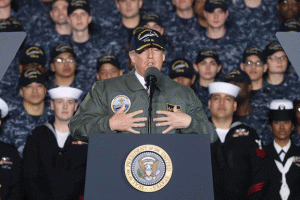 US Talk of Exit From Nuclear Treaty With Russia Could Blow Up in New Arms Race, Sputnik News, 30 June 17, Last week, US media reported that the Trump administration was considering withdrawing from the 1987 Treaty on Intermediate-Range Nuclear Forces, citing alleged non-compliance by Moscow. White House officials have denied that the US is considering withdrawing. Russian experts explain why doing so would be a major lose-lose scenario for both powers.
Last week, Politico reported that leading Republican congressmen were urging the Trump administration to withdraw from the INF Treaty, a document signed by Moscow and Washington in 1987 which prohibits the development, deployment and testing of ground-launched nuclear ballistic and cruise missiles which have a range of between 500-5,500 km.
The Senators claimed that Russia was in “material breach of the treaty,” something Moscow has vehemently denied. Foreign Minister Sergei Lavrov has repeatedly said that Russia is in full compliance with the treaty, adding that Moscow has its own concerns about US compliance. Moscow has also called on Washington to engage in discussions on the points of contention regarding the arms control agreement’s implementation.
Although Trump administration special assistant on counterproliferation Christopher Ford has since clarified to Sputnik that the White House does not want to withdraw from the INF Treaty, continued murmurings about Washington’s possible unilateral disengagement have sparked fears of a new nuclear arms race. The Russian Foreign Ministry has said that it could not rule out a unilateral US withdrawal, while experts have warned that such a step would lead to heightened military tensions in Europe……. https://sputniknews.com/politics/201706301055115593-inf-treaty-russia-us-analysis/
July 1, 2017
Posted by Christina Macpherson |
politics international, USA, weapons and war |
Leave a comment
The Iran nuclear deal faces ‘death by a thousand cuts’, The Iran Project, Bloomberg, Ladane Nasseri, 30 June 17 : President Donald Trump decided against killing off the Iran nuclear deal in a day-one spectacular. It may face a lingering death instead.
Trump’s administration sends out mixed signals on many issues, but on the need for a tougher line against Iran, it speaks with one voice. And words have been accompanied by action. In Syria, the U.S. military is directly clashing with Iranian allies. In Saudi Arabia, Trump performed a sword-dance with Iran’s bitterest foes. In the Senate, new sanctions on the Islamic Republic sailed through with near-unanimous approval.
The 2015 accord reined in Iran’s nuclear program, and offered the Islamic Republic a route back to the mainstream of the world economy. It was the fruit of many years of work by many governments. Its breakdown would likely add to turbulence in the Middle East, and impose new strains on America’s ties with Europe. Yet there’s a serious risk that the deal could unravel, according to one former U.S. official who was intimately involved.
“Death by a thousand cuts” is what former Deputy Secretary of State William J. Burns fears could be the fate in store for the agreement he helped negotiate. Burns, who led the U.S. team involved in secret preliminary talks, says he’s concerned by “the chipping away of trust in the agreement from all sides.’’
“It’s a fragile enough environment as it is,” he said in an interview. “It’s easy to back yourself into a collision of one kind or another.”
Failed Approach’
The U.S. has slapped two additional sets of sanctions on Iran this year, tied to its ballistic missile program and alleged support of terrorism. The lifting of wider international curbs in January 2016, as part of the nuclear deal, has allowed Iran to resume oil sales to Europe, for example. But many American restrictions remain in place, especially on financial flows. Major banks, wary of falling foul of U.S. policy, have stayed clear of Iran. Several Western companies are watching to see what the administration does next.
The prevailing view in Washington seems to be “to let the agreement remain in place, but to press on Iran so it doesn’t get the commercial advantages expected,” said Alireza Nader, a senior analyst at Rand Corp.
The aerospace industry is a good example. …..
Faced with a congressional requirement to report on the nuclear agreement, the Trump administration grudgingly certified in April that Iran is keeping its end of the deal. But Secretary of State Rex Tillerson added that the accord only delayed Iran’s ambitions to gain nuclear weapons — “the same failed approach of the past” — and didn’t curb its role in sponsoring terrorism.
‘Blame the Other’
Iran likewise says the U.S. is violating the agreement’s spirit, if not its letter. “Disregard for Iran’s genuine security concerns, either through deliberate changing of the military-security balance in the region, or by stoking Iranophobia in the region and beyond,” would put the hard-won gains of the deal at risk, Ali Akbar Salehi, who helped negotiate it as head of Iran’s atomic energy agency, wrote in a Guardian op-ed last week. “Engagement is not a one-way street.”
“Each side is now waiting to blame the other for undermining the deal,” Nader said….
The mood in Europe is different……
Trump’s coziness with the new Saudi leadership and lack of interest in engaging with Iran adds to evidence that his administration’s strategy “essentially is to try to kill the deal while appearing to uphold it,’’ said Trita Parsi, author of “Losing an Enemy: Obama, Iran and the Triumph of Diplomacy” and an Iranian-American leader who advocated for the nuclear accord.
“For the long-term durability of the deal you needed to have at least a slightly positive trajectory of U.S.-Iran relations,” Parsi said. “Right now, nothing positive is happening.” http://theiranproject.com/blog/2017/06/30/iran-nuclear-deal-faces-death-thousand-cuts/
July 1, 2017
Posted by Christina Macpherson |
Iran, politics international |
Leave a comment
US military could be smuggling uranium out of Afghanistan, locals say https://www.timesca.com/index.php/news/18272-us-military-could-be-smuggling-uranium-out-of-afghanistan-locals-say, 30 June 2017 KABUL (TCA) — A member of the Afghan parliament from Helmand Province and local residents have told Russia’s Sputnik Afghanistan news agency that the US military could be smuggling uranium, as well as other rare elements and natural resources, out of the village of Khanashin in the country’s southern province of Helmand.
Helmand is one of the most turbulent provinces in Afghanistan, and is a center of the country’s mining industry and the shadowy drug-smuggling industry. There are four deposits of uranium, magnetite, apatite and carbonite in the south of this region, in the southern village of Khanashin, just 160 km from the border with Pakistan.
According to earlier geological exploration works, the province has lucrative uranium and thorium deposits. It also contains vast resources of tantalum and other rare elements.
According to NASA estimates, there are also deposits of copper, iron and other metals worth of $81.2 billion. Until now, there was no industrial uranium mining in Afghanistan. During Taliban rule, the captives did all the mining.
Deputies of the lower chamber of the country’s parliament from the province of Helmand have repeatedly said that much evidence exists that uranium from Khanashin is being smuggled out in US cargo planes, Sputnik Afghanistan quotes local media reports as saying.
The deputies said that the US military have set up their military base near the uranium mines and smuggle uranium through it.
The deputies said that since the US military intervention back in 2001, the Americans and their British allies have concentrated their bases in this particular province as the largest uranium resources are concentrated there. The uranium deposit in Khanashin was previously controlled by the Taliban. However since the foreign troops set up their air bases and air fields, which are working around the clock, in the neighboring settlement of Garmsi, the deposit has been since controlled by them.
Local residents confirmed to Sputnik Afghanistan that at nights, the US military are smuggling out uranium in trucks and then in cargo planes.
July 1, 2017
Posted by Christina Macpherson |
Afghanistan, politics international, secrets,lies and civil liberties, USA |
1 Comment
 By JON GAMBRELL, DUBAI, United Arab Emirates (AP) — Once expunged from its official history, documents outlining the U.S.-backed 1953 coup in Iran have been quietly published by the State Department, offering a new glimpse at an operation that ultimately pushed the country toward its Islamic Revolution and hostility with the West.
The CIA’s role in the coup, which toppled Prime Minister Mohammed Mosaddegh and cemented the control of the shah, was already well-known by the time the State Department offered its first compendium on the era in 1989. But any trace of American involvement in the putsch had been wiped from the report, causing historians to call it a fraud.
The papers released this month show U.S. fears over the spread of communism, as well as the British desire to regain access to Iran’s oil industry, which had been nationalized by Mosaddegh. It also offers a cautionary tale about the limits of American power as a new U.S. president long suspicious of Iran weighs the landmark nuclear deal with Tehran reached under his predecessor……..
The 1,007-page report , comprised of letters and diplomatic cables, shows U.S. officials discussing a coup up to a year before it took place. ……..
The report fills in the large gaps of the initial 1989 historical document outlining the years surrounding the 1953 coup in Iran. The release of that report led to the resignation of the historian in charge of a State Department review board and to Congress passing a law requiring a more reliable historical account be made.
Byrne and others have suggested the release of the latest documents may have been delayed by the nuclear negotiations, as the Obama administration sought to ease tensions with Tehran, and then accelerated under President Donald Trump, who has adopted a much more confrontational stance toward Iran……
Die-hard opponents of Iran’s current government might look to 1953 as a source of inspiration. But the Americans involved in the coup acknowledged at the time they were playing with fire.
Widespread Iranian anger over the heavy-handed Western intervention lingered for decades, and fed into the 1979 revolution, when Iranians seized control of the U.S. Embassy and held those inside captive for 444 days. To this day Iran’s clerical leaders portray the U.S. as a hostile foreign power bent on subverting and overthrowing its government.
As President Dwight Eisenhower wrote in his diary in 1953, if knowledge of the coup became public, “We would not only be embarrassed in that region, but our chances to do anything of like nature in the future would almost totally disappear.” Online:
State Department report: https://history.state.gov/historicaldocuments/frus1951-54Iran https://apnews.com/5111167bcaf84892b01eea93eea4bc01
July 1, 2017
Posted by Christina Macpherson |
history, Iran, politics international, USA |
Leave a comment

 Nuclear experts warn of a march to war with North Korea, Salon,com Ex-nuclear commanders from around the world are urging Trump to engage in talks with North Korea instead, MATTHEW ROZSA, 29 June 17, A group of ex-nuclear commanders issued a strong warning on Wednesday that pointed out the world is at the precipice of a potential nuclear war, and urged America to open up dialogue with North Korea.
Hailing from China, India, Pakistan, Russia and the United States, the Nuclear Crisis Group determined “that the risk of nuclear weapons use, intended or otherwise, is unacceptably high and that all states must take constructive steps to reduce these risks.” They called on the United States and NATO to establish military-to-military talks with Russia and recommended that India and Pakistan set up a nuclear hotline.
The group was created earlier in 2017 with the approval of Global Zero, an arms control group that ultimately wants to abolish nuclear weapons.
The letter came as H. R. McMaster, President Donald Trump’s national security adviser, told reporters during a security conference with Homeland Security Chief John Kelly on Wednesday that “the [North Korean] threat is much more immediate now and so it’s clear that we can’t repeat the same approach – failed approach of the past.”…. http://www.salon.com/2017/06/29/nuclear-experts-warn-of-a-march-to-war-with-north-korea/
June 30, 2017
Posted by Christina Macpherson |
North Korea, politics international, USA |
Leave a comment
 Paris deal ‘non-negotiable’: Merkel, Herald Sun ,Deutsche Presse Agentur, June 29, 2017
The Paris climate agreement is “irreversible and non-negotiable,” Chancellor Angela Merkel says, ahead of the Group of 20 summit in Hamburg.
The European Union’s remaining 27 members have expressed their “unequivocal” commitment to the accord despite the United States’ decision to leave, Merkel told the Bundestag.
President Donald Trump announced earlier this month that the US would cease participation in the 2015 agreement to halt climate change.
In an implicit reference to Trump, Merkel said that those “who believe the problems of this world can be solved though isolationism and protectionism are sorely mistaken – only together will we manage to find the right answers to the central questions of our time.”……
Merkel is hosting the G20 summit on July 7-8, which will bring together leaders including Trump, Russian President Vladimir Putin and Turkish President Recep Tayyip Erdogan. http://www.heraldsun.com.au/news/breaking-news/paris-deal-nonnegotiable-merkel/news-story/3c17b77023b201e41fcc16d9a7c2e1a9
June 30, 2017
Posted by Christina Macpherson |
2 WORLD, climate change, politics international |
Leave a comment
https://www.theguardian.com/world/2017/jun/26/iran-nuclear-deal-must-be-allowed-to-thrive Dr T Douglas Reilly, Los Alamos, New Mexico, USA, 25 June 17 T Douglas Reilly draws on his experience with the International Atomic Energy Agency to praise the Iran nuclear deal, while David Gleeson wonders why Tehran is so often cast as the villain on the world stage
The Joint Comprehensive Plan of Action (JCPOA), also known as the Iran nuclear deal) is excellent; it is far better and more extensive than I ever expected (Don’t upset the balance of power in the Middle East, 23 June). If followed by all parties, it blocks all avenues for Iran to develop nuclear explosives. To be sure, it is vehemently opposed by Israel’s prime minister Netanyahu and Republicans in Congress.
I am a physicist who worked in nuclear safeguards and non-proliferation for 38 years at the Los Alamos national laboratory; the majority of my efforts were for and with the International Atomic Energy Agency (IAEA) that has the responsibility of inspecting the nuclear facilities of states signatory to the nuclear non-proliferation treaty (NPT). Among other things, I developed programmes that have been part of the initial IAEA inspectors’ training since 1980. I’ve trained many of the inspectors who inspect Iran today, and have inspected Iran’s facilities since it signed and ratified the NPT shortly after it came into force in 1970.
There are only three nations that have not signed the NPT: India, Israel, and Pakistan. All three have large nuclear arsenals and effective delivery capabilities. Israel has over 400 nuclear weapons of all types and the ability to deliver them anywhere in the world, including the US. Israel also has a policy known as the Samson Option that implies it will destroy the world if ever it feels in danger of falling.
David Gleeson, London, Ali Akbar Salehi’s piece was a calm, reasoned argument for the JCPOA to be allowed to thrive, despite the expected noises from Trump and his ilk. Why is Iran so often seen as the enemy? The country is stable and calm and – much to the annoyance of its detractors – has regular elections that the Iranian people deem worthwhile participating in. Saudi Arabia, on the other hand…
June 28, 2017
Posted by Christina Macpherson |
Iran, politics international |
Leave a comment
Iran’s Nuclear Chief Warns U.S. Against Tilting Power Balance In Middle East https://www.rferl.org/a/iran-nuclear-chief-wars-us-against-tilting-power-balance-middle-east-saudi-arms-sales-/28576396.html, 24 June 17 Iran’s atomic energy chief Ali Akbar Salehi, who helped forge the 2015 nuclear agreement, warned the United States on June 23 against upsetting the balance of power in the Middle East by siding with arch-rival Saudi Arabia.

Writing in The Guardian newspaper, Salehi said Tehran views a “lavish” deal U.S. President Donald Trump’s administration recently announced to sell Saudi Arabia $110 billion in weapons as “provocative.”
“This is especially the case if the national defense efforts of Iran…are simultaneously opposed and undermined,” he said, alluding to steps the Trump administration has taken to increase U.S. sanctions on Iran for developing ballistic missiles even as it has ramped up arms sales to Riyadh and its allies.
“It would be unrealistic to expect Iran to remain indifferent to the destabilizing impact of such conduct,” said Salehi, an MIT graduate who has also served as Iran’s foreign minister and was a senior negotiator on the nuclear deal.
Salehi stressed that Washington’s strong tilt toward Tehran’s rivals in the Middle East not only risks setting off a regional arms race and “further tension and conflict” in the region, but it imperils the “hard-won” nuclear deal, which took two years to negotiate.
If the nuclear deal is to survive, he said the West must change course. “The moment of truth has arrived.”
Trump and the Saudis frequently blame Iran for wars ranging from Yemen to Syria, as well as for restive minority Shi’ite populations within the borders of the kingdom and other Persian Gulf states ruled by Sunni Muslims.
The Saudis, like Trump, were strongly opposed to the nuclear deal. But while Trump has promised to “dismantle the disastrous deal,” he has not so far taken any concrete steps to do so. His administration has indicated it will adhere to the deal, which requires Iran to curb its nuclear activities in exchange for the lifting of international sanctions, as long as Tehran continues to do so.
But Salehi’s article in the Guardian suggested that — what Iran says is — its so-far strict honoring of the deal may come into doubt in the future if the United States continues to disregard Iran’s “genuine security concerns” and “stokes Iranophobia” in the region.
Salehi urged the United States and its Western partners to “save” the nuclear deal with “reciprocal gestures” showing a commitment to engagement with Iran.
Iranian voters recently showed their preference for engagement with the West by re-electing President Hassan Rohani with his pro-Western platform, but “engagement is simply not a one-way street and we cannot go it alone,” Salehi said.
“Unfortunately, as things stand at the moment in the region, reaching a new state of equilibrium might simply be beyond reach for the foreseeable future,” he said.
June 27, 2017
Posted by Christina Macpherson |
MIDDLE EAST, politics international, USA |
Leave a comment
The Saudi war in Yemen is really directed at…Iran. Donald Trump’s first overseas visit to Saudi Arabia and Israel was specifically targeted at… Iran. The Saudi-led isolation of Qatar is actually about… Iran.
The escalation of U.S. military actions against the Syria government is… well, do I really need to spell this out any further?
Donald Trump has identified several number-one enemies to target. Throughout the campaign, he emphasized the importance of throwing the full weight of the Pentagon against the Islamic State. More recently, his secretary of defense, Jim Mattis, identifiedNorth Korea as “the most urgent and dangerous threat to peace and security.”
Other threats that have appeared at one time or another in the administration’s rotation include China, Cuba, the mainstream media, former FBI director James Comey, and Shakespeare (for writing Julius Caesar and then somehow, from the grave, persuadingthe Public Theater to run a scandalous version of it).
Through it all, however, Iran has loomed as the primary bogeyman of the Trump crowd. Fear of Iranian influence has prompted the administration to all but cancel the 2015 nuclear deal, intensify a number of proxy wars, consider pushing for regime change in Tehran, and even intervene in the mother of all battles between the Shia and Sunni variants of Islam.
You’re worried about Trump and the nuclear football? The prospect of blowback from an all-out U.S. assault on the Islamic State keeps you up at night? A preemptive strike against North Korea, which Mattis acknowledges would be disastrous, has you rethinking that upcoming trip to Seoul?
Sure, those are all dystopian possibilities. But if I had to choose a more likely catastrophe, it would be a direct confrontation between the United States and Iran. After all, everything seems to be pointing in that direction.
The nuclear deal that Iran signed with the five permanent members of the UN Security Council plus Germany and the European Union is hanging by a thread. Trump made no bones about his distaste for this Joint Comprehensive Plan of Action (JCPOA). He promised to tear it up.
He hasn’t done so. It’s not just that he’s gotten pushback from the usual suspects in Washington (diplomats, foreign policy mavens, talking heads, journalists). Even members of his inner circle seem to see value in the agreement. Mattis, who is otherwise hawkish on Iran, has stood by the JCPOA and diplomacy more generally. Secretary of State Rex Tillerson has, albeit reluctantly, acknowledged that Iran has lived up to its side of the agreement. Then there are all the American jobs on the line from the Iranian purchase of Boeing jets.
Even though Trump hasn’t torn up the agreement, he has certainly attempted to give it a good crumple. He has directed the Treasury Department to apply additional sanctions on Iran’s missile program. He’s considering the option of declaring the Revolutionary Guards a terrorist organization. Congress, meanwhile, is pursuing its own complementary set of sanctions against Iran (though, because it’s bundled with sanctions against Russia, the legislation may not meet Trump’s approval).
None of this violates the terms of the JCPOA. But it challenges the spirit of the accord.
Adding insult to injury, Trump damned Iran with faint condolences after the recent terrorist attacks in Tehran. “We grieve and pray for the innocent victims of the terrorist attacks in Iran, and for the Iranian people, who are going through such challenging times,” Trump wrote. “We underscore that states that sponsor terrorism risk falling victim to the evil they promote.”
Talk about bad taste. After September 11, Iranians gathered for candlelight vigils to mourn the mostly American victims of the attacks. The Iranian government didn’t say anything about chickens coming home to roost after U.S. military interventions in the Middle East, for that would have been inappropriate (though accurate).
But Iran might yet have to make a statement that echoes Trump’s tone-deaf remark: States that tear up international agreements risk falling victim to the evil they promote.
The conflict is escalating in Syria, where Iran backs the regime of Bashar al-Assad and the United States supports a shifting set of anti-regime groups.
Both countries could decide to team up against the Islamic State. And indeed, Iran launched a missile attack against ISIS in Syria this last weekend in retaliation for the terrorist attacks in Tehran. As after September 11, when Tehran and Washington briefly worked together, cooperation against Sunni extremists would seem a no-brainer.
But the would-be caliphate, having lost most of Mosul and now teetering on the verge of conceding its capital in Raqqa, is shrinking at a rapid clip. Which may well explain why the United States has been wading deeper into the Syrian conflict. For the first time since the war in Syria began, U.S. forces shot down a Syrian government plane this last weekend. It’s only the latest in a series of attacks on Assad’s forces, according to The Atlantic:
Three times in the last month, the U.S. military has come into direct conflict with the combined forces of the Assad regime, Iran-supported Shiite militias, Hezbollah, and possibly even Iran’s elite Islamic Revolutionary Guards Corps. The clashes have reportedly resulted in the deaths of a small number of pro-regime forces, and are much more strategically important than the much-ballyhooed U.S. air strike on the al-Shayrat airfield back in April in response to the Assad regime’s use of chemical weapons.
Several administration figures, notably Ezra Cohen-Watnick and Derek Harvey in the National Security Council, are eager to confront Assad and his Iranian backers more aggressively. Mattis, however, has reportedly opposed several of their risky propositions. Regardless of the Pentagon chief’s somewhat more risk-averse behavior, both Iran and the United States are maneuvering to control as much territory as possible in the vacuum created by the collapse of ISIS………
Back in 2013, Trump said,
We will end up going to war with Iran because we have people who don’t know what the hell they are doing. Every single thing that this administration and our president does is a failure.
Who knew that Donald Trump could be so prescient? The president has proven himself high-performing in at least this one regard: self-fulfilling prophecies.http://www.huffingtonpost.com/entry/the-coming-war-with-iran_us_594ec1fce4b0f078efd9821c
June 27, 2017
Posted by Christina Macpherson |
Iran, politics international, USA, weapons and war |
1 Comment
 PM Modi-Trump talks: Civil nuclear deal to figure, no pact on reactors,Time of India.| Jun 25, 2017,
 HIGHLIGHTS
June 26, 2017
Posted by Christina Macpherson |
India, politics international, USA |
Leave a comment
Trump to Call for U.S. ‘Dominance’ in Global Energy Production, Bloomberg By Jennifer A Dlouhy, 25 June 2017
Donald Trump will tout surging U.S. exports of oil and natural gas during a week of events aimed at highlighting the country’s growing energy dominance.
The president also plans to emphasize that after decades of relying on foreign energy supplies, the U.S. is on the brink of becoming a net exporter of oi l, gas, coal and other energy resources.
As with previous White House policy-themed weeks, such as a recent one focusing on infrastructure, the framing is designed to draw attention to Trump’s domestic priorities and away from more politically treacherous matters such as multiple investigations into Russian interference in the 2016 election.
With “Energy Week,” Trump is returning to familiar territory — and to the coal, oil, and gas industries on which he’s already lavished attention. Trump’s first major policy speech on the campaign trail, delivered in the oil drilling hotbed of North Dakota in 2016, focused on his plans for unleashing domestic energy production. The issue has also been a major focus during Trump’s first five months in office, as he set in motion the reversal of an array of Obama-era policies that discourage both the production and consumption of fossil fuels.
Plans for the week were described by senior White House officials speaking on condition of anonymity because the details hadn’t yet been formally announced.
Exports Equal Influence
Trump is set to deliver a speech at the Energy Department on Thursday focused almost entirely on energy exports ……
Dominance’ Sought
Trump’s theme of “energy dominance” marks an evolution. For years, the catch phrase of choice has been “energy independence,” as politicians and industry officials sought to highlight how a new era of abundance was helping the U.S. wean itself from foreign sources of oil and natural gas.
That was in turn a dramatic change from the 1970s, when former President Jimmy Carter turned down the White House thermostats and used a televised address in February 1977 to urge consumers to conserve energy …..https://www.bloomberg.com/news/articles/2017-06-25/trump-to-call-for-u-s-dominance-in-global-energy-production
June 26, 2017
Posted by Christina Macpherson |
politics international, USA |
Leave a comment

 Britain’s Brexit plan will plunge its nuclear power plants, cancer
treatment centres and leading research facilities into chaos within two
years, according to a secret government assessment.
Times 26th June 2017, The UK plans to pull out of Euratom, Europe’s nuclear body, at the same time as it leaves the EU
in 2019. A bill to replace European safeguards with a British system of
oversight was published in last week’s Queen’s Speech.
However, experts say that this would not match the regime provided by the EU body, meaning that
plants, research facilities and hospitals may be unable to import
radioactive material after Brexit. Officials from the Department for
Business, Enterprise and Industrial Strategy have warned that it will take
seven years to replace the current set of agreements, The Times has been
told.
The delay would partly be caused by the fact that work on new
international treaties, for example with the US and Japan, cannot start
until new inspections standards are approved. Ministers have suggested
that, as with financial regulations, there could be a transition period
after Brexit to allow a new regime to be put in place, but experts say that
the complexity of the task is still not sufficiently realised.
The Nuclear Industry Association (NIA) will today step up calls for David Davis, the
Brexit secretary, to consider asking for Britain to remain an associate
member of Euratom instead. That option will worry some Tory MPs, because
some lawyers believe that it would require oversight by the European Court
of Justice or even for Britain to continue to take part in elections to the
European parliament. Tom Greatrex, the NIA chief executive, said the plans
did not “come anywhere close” to matching the scale of the problem.
https://www.thetimes.co.uk/edition/news/experts-warn-of-chaotic-fallout-from-post-brexit-nuclear-plan-mh8prkkdv
June 26, 2017
Posted by Christina Macpherson |
politics, politics international, UK |
Leave a comment