UN nuclear disarmament talks: UK Government not attending discussions labelled ‘reckless and irresponsible’ ‘I don’t think it’s taking nuclear disarmament seriously,’ Green Party leader Caroline Lucas tells The Independent Harriet Agerholm @HarrietAgerholm 15 Mar 17 The Government has been called “reckless and irresponsible” after it refused to send a single representative to United Nations (UN) talks about a ban on nuclear weapons.
The Foreign Office revealed that no one from the UK attended a February meeting ahead of the negotiations and no one would go to the discussions when they take place later this month.
It was responding to a parliamentary question by Green Party co-leader Caroline Lucas, who told The Independent that it showed the Government was being “massively hypocritical” and failing in its commitment to working towards a world without nuclear weapons. …..
March 17, 2017
Posted by Christina Macpherson |
politics international, UK, weapons and war |
Leave a comment
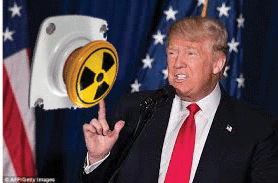 Donald Trump sends B-52 NUCLEAR BOMBERS to South Korea after North fires missiles at Japan and US warns of ‘overwhelming’ response https://www.thesun.co.uk/news/3049573/donald-trump-sends-b-52-nuclear-bombers-to-south-korea-after-north-fires-missiles-at-japan-and-us-warns-of-overwhelming-response/
Secretary of Defence James Mattis said the US “remains steadfast in its commitment” to the defence of its allies By Jon Lockett 9th March 2017
DONALD Trump is sending nuclear bombers to the Korean peninsula as tensions in the region reach breaking point.
North Korea and the US have been teetering on the brink of war for months after Kim Jong-un carried out a series of controversial missile launches.
Earlier this week, trigger-happy Kim pushed his luck once more when he fired off four ballistic missiles into the seas near Japan.
Now US military chiefs are reportedly planning to fly in B-1 and B-52 bombers – built to carry nuclear bombs – to show America has had enough.
South Korea and the US have also started their annual Foal Eagle military exercise sending a strong warning to North Korea over its actions.
A military official said 300,000 South Korean troops and 15,000 US personnel are taking part in the operation.
Secretary of Defence James Mattis said the US “remains steadfast in its commitment” to the defence of the South, according to Pentagon spokesman Navy Capt Jeff Davis.
Capt David said: “He further emphasised that any attack on the United States or its allies will be defeated and any use of nuclear weapons will be met with a response that is effective and overwhelming.”
Washington is also expected to deploy a series of strategic assets from the US as well as from military bases in Guam and Japan, reports the Korea Times
The USS Carl Vinson, a Nimitz-class supercarrier, will join the Foal Eagle exercise after departing from San Diego.
The nuke-powered aircraft carrier will carry dozens of fighter jets, early warning aircraft and anti-sub craft.
It will be accompanied by the guided-missile cruiser USS Lake Champlain (CG-57) and two Arleigh Burke-class guided-missile destroyers.
From the US Marine Corps in Japan, F-35B stealth fighters will be deployed to the peninsula for the first time.
“An F-35B is capable of evading anti-aircraft radar and making preemptive strikes,” a military official said.
North Korea repeatedly protests that both Foal Eagle and Key Resolve are rehearsals for invasion.
Pyongyang’s Korea Central News Agency reported that North Korean leader Kim Jong-un has stressed “a need for preparation for a fight”.
He listed guidelines to strike South Korea and the US “mercilessly”.
March 11, 2017
Posted by Christina Macpherson |
politics international, USA, weapons and war |
Leave a comment
A nuclear weapons ban should first do no harm to the NPT, Bulletin of the Atomic Scientists, Adam Mount Richard Nephew 9 Mar 17 Though substantial progress has been made since the end of the Cold War in the dismantlement of US and Russian-held nuclear weapons, non-nuclear weapon states have become frustrated with the pace of disarmament. Two years ago, several states launched a new process that would delegitimize nuclear weapons by declaring a ban on their possession and use. Despite the objection of the nuclear weapon states and their allies, the UN General Assembly
voted in late 2016 by a wide margin to begin negotiations on the text of a nuclear weapons ban treaty.
Though the movement is the product of laudable motives, the ban treaty is likely to have little influence on the nuclear powers’ strategic force-structure decisions, which are the product of a complex mix of strategic and political considerations. On the other hand, a variety of nonproliferation problems would be unaffected by the ban or even worsened. For example, the creation of an alternative treaty structure governing nuclear weapons could lead to “forum-shopping,” in which a state might hope to dilute international condemnation over its noncompliance with the strict verification requirements
of the existing Nuclear Non-Proliferation Treaty (NPT) by participating in the new nuclear weapons ban treaty.
There is a relatively simple fix: Pro-ban states should insist that the new treaty contain an article reaffirming all participants’ obligations to the NPT. The article should include provisions that automatically rescind standing in the ban treaty should the International Atomic Energy Agency (IAEA) find a signatory to be noncompliant with its NPT obligations.
The ban treaty will remain controversial. It should not be controversial, though, to say that a treaty aspiring to a nuclear-free world should first do no harm to the existing tools we have to prevent the spread of nuclear materials and technology to new states, which are centered around the NPT.
Negotiations on the text. At this early date, with negotiations on the text yet to begin, little is known about the format or content of the nuclear weapons ban treaty. The drafters will have to resolve an underlying tension. A simple and largely rhetorical treaty would maximize the number of signatories, and avoid blowback from states that resist new legal obligations. At the same time, some states will want the treaty to demonstrate substantive progress. This could include any number of steps, ranging from directly strengthening nonproliferation norms and institutions to encouraging the International Court of Justice to reconsider its 1996 decision—which found that nuclear deterrence is legally permissible—on the grounds that the ban movement represents an evolution of international customary law and norms of behavior. The stated aims of the movement and a desire for a greater number of signatures suggest that a simpler text is more likely. In any event, the treaty is unlikely to provide for development of a framework for verifiable disarmament.
Nuclear weapon states have largely declined to participate in the ban process (though the United States, the United Kingdom, India, and Pakistan sent delegations to the ban movement’s final preparatory conference in Vienna in 2014). Concerned that confrontational rhetoric from some ban states signals a desire to achieve a treaty at any cost, the nuclear weapon states have expressed concern that the ban movement “may negatively affect the prospects for consensus at future NPT Review Conferences.” Observers in nuclear weapon states and elsewhere remain concerned that ban treaty negotiations could undermine the authority of NPT obligations, establish conflicting obligations, erode the effectiveness of the existing NPT system to resolve nonproliferation concerns, lead to a destabilizing counterreaction in nuclear weapon states, or distract attention from other critical priorities for nuclear governance and strategic stability.
Forum-shopping under a ban treaty. Treaty proponents have denied that their pursuit of a ban would distract from the broader nonproliferation agenda, noting that many ban states have supported the treaty precisely because they are committed to nonproliferation. However, their good intention is not sufficient to ensure the ban treaty’s complementarity with the existing NPT regime. If negotiators do not include specific provisions in support of the NPT, they could inadvertently do it substantial harm by creating an opportunity for nuclear aspirants to “forum-shop.”……..
The NPT system—and the arsenal of other tools it enables, through the IAEA and other organizations—is irreplaceable. A nuclear weapons ban treaty will have its best chance to promote a world free of nuclear weapons if it strengthens the NPT. http://thebulletin.org/nuclear-weapons-ban-should-first-do-no-harm-npt10599
March 11, 2017
Posted by Christina Macpherson |
2 WORLD, politics international, weapons and war |
Leave a comment
Donald Trump says nuclear threat from North Korea has entered ‘new phase’
US president told Japanese PM he is ‘100%’ with Tokyo as US moves Thaad missile defence system into South Korea following Pyongyang missile launches, Guardian, Justin McCurry The threat posed by North Korea to the US and its allies has entered a “new phase”, Donald Trump said on Tuesday, a day after the regime test-launched four ballistic missiles towards Japan.
In phone talks on Tuesday, Trump told Japan’s prime minister, Shinzo Abe, that the US stood “100%” with Tokyo after three of the intermediate-range missiles landed in the sea off Japan’s north-west coast.
“President Trump told me that the United States was with Japan 100%, and that he wanted his comments to be communicated to the Japanese people,” Abe told reporters at his residence. “He said he wanted us to trust him as well as the United States 100%.
“Japan and the United States confirmed that the latest missile firing by North Korea … is a clear challenge to the region and the international community, and that its threat has entered a new phase.”
The comments came as the US said the “first elements” of its controversial missile defence system had arrived in South Korea on Tuesday. The Terminal High Altitude Area Defense (Thaad) anti-missile system is meant to intercept and destroy short- and medium-range ballistic missiles during the last part of their flights, the US Pacific Command said in a statement.
“Continued provocative actions by North Korea, to include yesterday’s launch of multiple missiles, only confirm the prudence of our alliance decision last year to deploy Thaad to South Korea,” US Pacific Commander Admiral Harry Harris said.
China has denounced Thaad’s deployment, saying its powerful radar would compromise its security.
South Korea’s Yonhap news agency, citing military sources, said the system could be operational as early as April, well ahead of schedule.
Trump and Abe spoke as the North Korean leader, Kim Jong-un, declared the launches a success and warned that they were part of a training exercise for an attack on US military bases in Japan, home to almost 50,000 American troops.
“The four ballistic rockets launched simultaneously are so accurate that they look like acrobatic flying corps in formation,” the state-run Korean Central News Agency quoted Kim as saying. The regime also released images of the missile launches, with a smiling Kim in attendance.
The launches were seen as a protest against the start of joint military exercises involving South Korea and the US that Pyongyang regards as a rehearsal for an invasion of North Korea.
A day after operation Foal Eagle began last Wednesday, North Korea’s army, deploying the same vitriolic language it reserves for the annual drills, warned that it was ready to “immediately launch its merciless military counteractions” if South Korean or US forces fired “even a single shell” into waters near the divided Korean peninsula…….
Trump has yet to state how he intends to address the growing North Korean threat from ballistic missiles, amid evidence that the regime is edging closer to acquiring the ability to marry a miniaturised nuclear warhead with a long-range missile capable of striking the US mainland.
The UN has imposed six rounds of sanctions since the North conducted its first nuclear test in 2006, but they have failed to dent the regime’s quest to build what it claims is a “defensive” nuclear arsenal.
Trump has not publicly commented on Monday’s missile launch, but his ambassador to the UN, Nikki Haley, said on Twitter that the world “won’t allow” North Korea to continue on its “destructive path”.
Choi Kang, an analyst at the Seoul-based Asan Institute for Policy Studies, said the launch was a warning to Tokyo. “North Korea is demonstrating that its target is not just limited to the Korean peninsula any more but can extend to Japan at any time and even the US,” he said. https://www.theguardian.com/world/2017/mar/07/donald-trump-threat-north-korea-new-phase
March 8, 2017
Posted by Christina Macpherson |
North Korea, politics international, South Korea, USA, weapons and war |
Leave a comment
 North Korea warns joint US-South Korea military exercises are pushing region to ‘nuclear disaster’ http://www.abc.net.au/news/2017-03-07/nkorea-us-skorea-exercises-leading-to-nuclear-disaster/8330554 North Korea has warned that US-South Korean military exercises — which it called “the most undisguised nuclear war manoeuvrers” — are driving the Korean Peninsula and north-east Asia towards “nuclear disaster”.
Key points:
- North Korea’s UN ambassador warns that “it may go over to an actual war”
- The White House announces more defence capabilities to be deployed to the region
- The raised tensions follow another series of North Korean ballistic missile tests
- On Monday some 50,000 North Koreans rally in support of mobilisation efforts
North Korea’s UN ambassador, Ja Song-nam, said in a letter to the UN Security Council on Monday the US was using nuclear-propelled aircraft carries, nuclear submarines, nuclear strategic bombers and stealth fighters in the joint exercises that began on March 1.
“It may go over to an actual war,” he warned of the military drills.
“Consequently, the situation on the Korean Peninsula is again inching to the brink of a nuclear war.”
Mr Ja again urged the Security Council to discuss the US-South Korea exercises and warned if it ignored North Korea’s request as it had in the past it would demonstrate the UN’s most powerful body was only a “political tool” of the United States.
The ambassador said the United States sought to convince public opinion that the joint exercise was a response to North Korea’s nuclear weapons, but said the US and South Korea carried out military drills numerous times before Pyongyang possessed its “nuclear deterrent”.
North Korea sent the letter on the manoeuvrers hours after North Korea fired four banned ballistic missiles earlier on Monday, in apparent reaction to the US-South Korean exercises.
Three of them landed in waters Japan claims as its exclusive economic zone, South Korean and Japanese officials said.
US President Donald Trump discussed plans to respond to the recent missile launches with South Korea’s acting president, Hwang Kyo-ahn, an official at Mr Hwang’s office said.
Mr Trump also had a phone call with Japanese Prime Minister Shinzo Abe, reaffirming its alliance with Tokyo and condemning North Korea’s tests as a threat to regional security.
THAAD deployment begins
The US started to deploy the first elements of its advanced Terminal High Altitude Area Defence (THAAD) anti-missile system to South Korea in response to the missile tests, US Pacific Command said.
“Continued provocative actions by North Korea, to include yesterday’s launch of multiple missiles, only confirm the prudence of our alliance decision last year to deploy THAAD to South Korea,” US Pacific Commander Admiral Harry Harris said in a statement.
South Korea’s media cited the nation’s military as saying the THAAD deployment would be complete in one to two months and would be operational as early as April.
The move by the US military is likely to deepen the brewing conflict between South Korea and China, which has angrily opposed the THAAD deployment as destroying regional security balance.
Meanwhile, North Korean authorities gathered more than 50,000 people together on Monday to make a show of support for the country’s latest mobilisation campaign.
Mr Ja said the main reason the Democratic People’s Republic of Korea (DPRK) — the country’s official name — was equipping itself “with nuclear attack capabilities” and strengthening its nuclear deterrent forces was in self-defence against what he called the US “extreme anti-DPRK hostile police and nuclear threats and blackmails as well as manoeuvrers to enforce its nuclear weapons”.
North Korea’s UN Mission also issued a press statement denouncing and rejecting a report by the Security Council’s panel of experts that monitors UN sanctions against the DPRK.
The experts said North Korea was flouting sanctions by trading in prohibited weapons and other goods and using evasion techniques “that are increasing in scale, scope and sophistication”.
The DPRK Mission again insisted the sanctions “have no legal basis at all” and violate the country’s “lawful rights”.
March 8, 2017
Posted by Christina Macpherson |
North Korea, politics international, weapons and war |
Leave a comment
White House Chief Strategist Steve Bannon recently asserted that “deconstruction of the administrative state” was a primary goal of the Trump administration. And he meant it literally, which, when it comes to foreign policy, has potentially dangerous repercussions for the United States and the world.
Immediately after taking office, Donald Trump forced resignations by a number of top level State Department management officials. When Secretary of State Rex Tillerson came on board, he engaged in an abrupt reorganization of remaining management without explanation. And as of yet, the Trump team has put forth nominees for only 7 of the 118 positions within the State Department that require Senate confirmation. The majority of leadership positions remain unfilled, including almost every Ambassadorship.
One mid-level officer at State offered a troubling observation:
They really want to blow this place up. I don’t think this administration thinks the State Department needs to exist. They think Jared [Kushner, Trump’s son-in-law] can do everything. It’s reminiscent of the developing countries where I’ve served. The family rules everything, and the Ministry of Foreign Affairs knows nothing.
During the campaign, Trump was asked who he consults with on foreign policy:
I’m speaking with myself, number one, because I have a very good brain and I’ve said a lot of things. I know what I’m doing and I listen to a lot of people, I talk to a lot of people and at the appropriate time I’ll tell you who the people are. But my primary consultant is myself and I have a good instinct for this stuff.
Trump has also engaged his son-in-law in foreign policy, to the extent that Kushner has been characterized as “a shadow secretary of state, operating outside the boundaries of the State Department or the National Security Council.”
Simultaneous with his gutting of the State Department, Trump has also expressed his intention to seek an additional $54 billion in funding for the Defense Department.
Bruce Bartlett, a historian and economist, and a former aide to Presidents Ronald Reagan and George H.W. Bush, commented on the situation:
Statements about what U.S. foreign policy will look like under the Trump administration have been vague but deeply disconcerting. He has expressed deep-seated nationalism and an intention to change dramatically the role of the U.S. as a world leader. He has expressed doubt about U.S. commitment to long-standing allies, including NATO, and repeatedly asserted a desire to move closer to adversaries like Russia. He has casually discussed the use of nuclear weapons, including saying in one interview, “Somebody hits us within ISIS, you wouldn’t fight back with a nuke?” and reportedly asking three times in a single security briefing “why can’t” the U.S. use nuclear weapons.
Former foreign partners of the U.S. are already “weighing contingency plans and bracing for the worst” with regard to the Trump administration. Regardless of political party, Trump’s affection for military options, including nuclear weapons, and his intentional destruction of the mechanisms of diplomacy are a combination that should send a chill up the spines of all of us.
March 6, 2017
Posted by Christina Macpherson |
politics, politics international, USA |
Leave a comment
White House ‘considers direct military action’ to counter North Korean nuclear threat
North Korea threatens to ‘mercilessly foil the nuclear war racket of the aggressors with its treasured nuclear sword’, Independent, 2 Mar 17 Samuel Osborne @SamuelOsborne93 , An internal White House review of strategy on North Korea reportedly includes the possibility of direct military action or regime change to counter the hermit kingdom’s nuclear threat.
Deputy national security adviser K T McFarland held a meeting with other officials ot discuss the US response to a fresh series of provocations from the North, the Wall Street Journal reports.
March 3, 2017
Posted by Christina Macpherson |
politics international, USA, weapons and war |
Leave a comment
 Friendship on the rocks? China, North Korea clash over nuclear and chemical weapons
North Korea’s reaction was so strong that some Chinese experts initially thought the commentary was fake By Saša Petricic, CBC News Feb 28, 2017 “…..China’s patience may be wearing thin, as frustrations double up over North Korea’s development of nuclear weapons and apparent willingness to use chemical weapons.
South Korea has accused North Korean leader Kim Jong-un of ordering the assassination of his half-brother, Kim Jong-nam, and Malaysia suspects several North Korean officials may have been involved in a plot that used the banned VX nerve agent.
It’s creating an unprecedented rift between the two neighbours and ideological soulmates. China’s support dates back to the 1950s and the Korean war.
Last week, Beijing imposed a ban on coal imports from North Korea that could deprive it of much needed foreign funds until the end of 2017. Pyongyang has replied with one of the nastiest insults one socialist state can throw at another, accusing China of “dancing to the tune of the U.S.”
“The hostile forces are shouting ‘bravo’ over this,” says a commentary published by North Korea’s state news agency, accusing its neighbour of “mean behaviour.”…….
Pyongyang has defied some of the toughest sanctions imposed by the United Nations Security council, meant to not only deprive North Korea of the parts and expertise it needs to develop a nuclear arsenal, but also to punish the country’s leadership by blocking travel and access to luxury goods.
Officially, China endorses the UN sanctions and condemns Kim Jong-un’s nuclear and missile sabre-rattling.
But it is walking a fine line, trying to avoid weakening the regime so badly that it collapses, causing unrest in North Korea and a possible flood of refugees into China.
Beijing has been accused of turning a blind eye to a network of North Korean shell companies and middlemen who operate just over the land border in China, working to circumvent sanctions……..
while Pyongyang’s ongoing nuclear and missile program worries China, it’s the apparent assassination of Kim Jong-un’s half-brother Kim Jong-nam that has sharpened the divisions between it and North Korea…….
Stockpile of deadly toxins
China is reportedly upset because Jong-nam was under its implicit protection, living in the country’s gambling enclave of Macau for years.
It was also rattled by North Korea’s apparent ready use of such a potent and prohibited chemical weapon beyond its borders. Pyongyang is known to have a large stockpile of various deadly toxins, and it hasn’t signed on to international conventions agreeing not to engage in chemical warfare…….http://www.cbc.ca/news/world/north-korea-china-weapons-petricic-1.4000631
March 1, 2017
Posted by Christina Macpherson |
China, North Korea, politics international, weapons and war |
Leave a comment
Did Putin help elect Trump to restore $500 billion Exxon oil deal killed by sanctions
Follow the money: Will Trump repay Putin by ending Russian sanctions and killing the Paris climate deal? Think Progess, Joe Romm , 28 Feb 17, “……. our democracy and our children have a new axis to worry about: Putin, Trump, and ExxonMobil, whose CEO Rex Tillerson — an extreme Russophile and long-time director of a US-Russian oil company — is Trump’s puzzling choice for Secretary of State.
I say “puzzling” because the long-serving Exxon employee (from age 23!) has no qualifications to be secretary of state — other than a history negotiating major oil deals with countries like Putin’s Russia, which in any sane world would actually disqualify him or at least force a recusal from all State Department dealings with Russia.
But that puzzle disappears if we follow the famous dictum from the Watergate era for uncovering a tangled web of covert campaign acts: “Follow the money.” And perhaps another puzzle is also solved: Why did Putin take such a “fearful risk,” as Frum put it, to “mount a clandestine espionage and disinformation campaign on behalf” of Trump and against Clinton, “when Putin had every reason to expect that he probably would end up facing a President Clinton,” and a tremendous backlash.
You can certainly make a plausible case, as U.S. intelligence agencies do in their bombshell new report, that Putin had plenty of motivation to interfere. He wanted to undermine the legitimacy of U.S. elections and a Clinton Presidency, he blamed Secretary Clinton for “inciting mass protests against his regime,” and he was angry with the U.S. for the Panama Papers leaks.
Those leaks showed a $2 billion trail of offshore accounts and deals that traced back to Putin and his cabal of kleptocrats, who, among other things, were getting rich “trading shares in Rosneft,” Russia’s state-owned (i.e. Putin run) oil monopoly.
But a half trillion dollars to line their pockets and prop up the Russian economy offers a much more tangible motivation for team Putin to get Trump elected. And it was Tillerson who had made the $500 billion oil dealwith Putin that got blocked by sanctions.
Blocking the deal did not just “put Exxon at risk,” as the Wall Street Journal reported in 2014. MSNBC’s Rachel Maddow explained last month the biggest oil deal in history was “expected to change the historical trajectory of Russia.”
The top priority for Putin and the kleptocrats who benefit from his rule is enriching the Kremlin’s coffers and their own, which have been hurt by the sanctions. And Trump’s election already appears to have delivered $11 billion to the Kremlin through sale of a 19.5 percent stake in Rosneft, “confounding expectations that the Kremlin’s standoff with the West would scare off major investors,” as Fortune has reported in a must-read piece.
Kleptocracy — and interfering with our election — pays…….
Indeed, if Trump and Tillerson instead end the sanctions that are blocking the Exxon-Rossneft deal, it is going to look suspiciously like a half trillion dollar quid pro quo for Putin’s help getting elected.
And if Trump and Tillerson work together to kill the Paris climate deal, the last best chance to save Americans from catastrophic climate change—and aridiculously good deal for the U.S.— that will look like they are putting Putin’s interests and Exxon’s profits above America’s national interest and the health and well-being of our children. It bears repeating that ExxonMobil’s future is inextricably tied to their stalled oil deal with Putin — and their future drilling plans would benefit from continued global warming and melting of polar ice…….. https://thinkprogress.org/putin-helped-trump-exxon-oil-deal-sanctions-6f169c4a4cd0#.hxgqiytyu
March 1, 2017
Posted by Christina Macpherson |
politics, politics international, Russia, USA |
Leave a comment

 Trump’s US nuclear stance alarms Russia http://www.skynews.com.au/news/politics/nthamerica/2017/02/25/trump-s-us-nuclear-stance-alarms-russia.html
Published: 10:16 am, Saturday, 25 February 2017 Russian politicians close to the Kremlin say US President Donald Trump’s declared aim of putting the US nuclear arsenal ‘at the top of the pack’ risked triggering a new Cold War-style arms race between Washington and Moscow.
In an interview with Reuters, Trump said the US had fallen behind in its nuclear weapons capacity, a situation he said he would reverse, and he said a treaty limiting Russian and US nuclear arsenals was a bad deal for Washington.
Russian officials issued no reaction, with Friday a public holiday, but pro- Kremlin politicians expressed consternation about the comments from Trump, who Moscow had hoped would usher in new, friendlier relations between the two countries.
‘Trump’s campaign slogan ‘Make America great again’, if that means nuclear supremacy, will return the world to the worst times of the arms race in the ’50s and ’60s,’ said Konstantin Kosachev, chairman of the international affairs committee in the upper house of the Russian parliament.
The president’s remarks in the interview with Reuters were, Kosachev said in a post on his Facebook page, ‘arguably Trump’s most alarming statement on the subject of relations with Russia’.
Over the course of the Cold War, the Soviet Union and the US realised that achieving supremacy was dangerous, and accepted the doctrine of parity as the best way to ensure peace, Kosachev wrote on his Facebook page.
‘Are we entering a new era? In my view we need an answer to that question as soon as possible.’
During the US presidential race, Trump said he would try to end the enmity that broke out between the Kremlin and Washington during Barack Obama’s presidency.
But just over a month into the Trump presidency, that prospect has receded, especially with the sacking of Michael Flynn, a leading proponent of warmer ties with Moscow, from his job as national security adviser.
Another pro-Kremlin lawmaker, Alexei Pushkov, wrote on Twitter that Trump’s comments on increasing US nuclear capacity ‘put in doubt the agreement on limiting strategic arms, returning the world to the 20th century’.
He said a Cold War arms treaty laid the foundation for nuclear stability between Moscow and Washington. ‘That needs to be preserved. And the United States cannot achieve decisive superiority.’
‘Instead of trying to achieve an illusory nuclear supremacy over Russia, the US administration should find a solution to the exceptionally complicated nuclear problem of North Korea,’ wrote Pushkov, a member of the defence and security committee in Russia’s upper house of parliament. – See more at: http://www.skynews.com.au/news/politics/nthamerica/2017/02/25/trump-s-us-nuclear-stance-alarms-russia.html#sthash.fwqZWCfw.dpuf
– See more at: http://www.skynews.com.au/news/politics/nthamerica/2017/02/25/trump-s-us-nuclear-stance-alarms-russia.html#sthash.fwqZWCfw.dpuf
– See more at: http://www.skynews.com.au/news/politics/nthamerica/2017/02/25/trump-s-us-nuclear-stance-alarms-russia.html#sthash.fwqZWCfw.dpuf– See more at: http://www.skynews.com.au/news/politics/nthamerica/2017/02/25/trump-s-us-nuclear-stance-alarms-russia.html#sthash.fwqZWCfw.dpuf
February 27, 2017
Posted by Christina Macpherson |
politics international, Russia, USA, weapons and war |
1 Comment
Donald Trump wants to expand US nuclear arsenal, make it ‘top of the pack’ http://www.smh.com.au/world/donald-trump-wants-to-expand-us-nuclear-arsenal-make-it-top-of-the-pack-20170223-guk6ms.htm, Steve Holland, 23 Feb 17
Washington: President Donald Trump has said he wants to build up the US nuclear arsenal to ensure it is at the “top of the pack,” saying the United States has fallen behind in its atomic weapons capacity.
In a Reuters interview, Trump also said China could solve the national security challenge posed by North Korea “very easily if they want to,” ratcheting up pressure on Beijing to exert more influence to rein in Pyongyang’s increasingly bellicose actions.
n his first comments about the US nuclear arsenal since taking office on January 20, Mr Trump said the United States has “fallen behind on nuclear weapon capacity.”
“… We’re never going to fall behind any country even if it’s a friendly country, we’re never going to fall behind on nuclear power.
“It would be wonderful, a dream would be that no country would have nukes, but if countries are going to have nukes, we’re going to be at the top of the pack,” Mr Trump said.
The new strategic arms limitation treaty, known as New START, between the US and Russia requires that by February 5, 2018, both countries must limit their arsenals of strategic nuclear weapons to equal levels for 10 years.
The treaty permits both countries to have no more than 800 deployed and non-deployed land-based intercontinental and submarine-launched ballistic missile launchers and heavy bombers equipped to carry nuclear weapons, and contains equal limits on other nuclear weapons.
Analysts have questioned whether Mr Trump wants to abrogate New START or would begin deploying other warheads.
In the interview, Mr Trump called New START “a one-sided deal”.
“Just another bad deal that the country made, whether it’s START, whether it’s the Iran deal … We’re going to start making good deals,” he said.
The United States is in the midst of a $US1 trillion ($1.3 trillion), 30-year modernisation of its aging ballistic missile submarines, bombers and land-based missiles, a price tag that most experts say the country cannot afford.
Mr Trump also complained that the Russian deployment of a ground-based cruise missile is in violation of a 1987 treaty that bans land-based American and Russian intermediate-range missiles.
“To me it’s a big deal,” he said.
Asked if he would raise the issue with Russian President Vladimir Putin, Mr Trump said he would do so “if and when we meet.” He said he had no meetings scheduled as of yet with Mr Putin.
Speaking from behind his desk in the Oval Office, Mr Trump declared that “we’re very angry” at North Korea’s ballistic missile tests and said accelerating a missile defense system for US allies Japan and South Korea was among many options available.
“There’s talks of a lot more than that,” Mr Trump said, when asked about the missile defense system. “We’ll see what happens. But it’s a very dangerous situation, and China can end it very quickly in my opinion.”
February 24, 2017
Posted by Christina Macpherson |
politics international, USA, weapons and war |
Leave a comment


 Pakistan, India extend nuclear safety agreement, By Our Correspondent, Express Tribune, February 21, 2017 ISLAMABAD: Pakistan and India have agreed to extend their bilateral agreement on reducing the risk from accidents relating to nuclear weapons in a move suggesting the two rivals are still mindful of nuclear dangers despite currently strained ties.
The key agreement was extended for the next five years (2017-2022), said a statement issued by the Foreign Office on Tuesday.
The agreement came into force in 2007. It was subsequently extended for a period of five years in 2012. The accord is part of the nuclear confidence building measures agreed between Pakistan and India. The aimed of the agreement is to promote a stable environment of peace and security between the two countries, reads the official handout.
“It is premised on the recognition that the nuclear dimension of the security environment of the two countries adds to their responsibility for avoidance of conflict,” the statement added.
The agreement provides for immediate exchange of information between the two countries in the event of any accident relating to nuclear weapons, under their respective jurisdiction and control, which could create the risk of radioactive fallout, with adverse consequences for both sides, or create the risk of an outbreak of a nuclear war…….https://tribune.com.pk/story/1334606/pakistan-india-extend-nuclear-safety-agreement/
February 22, 2017
Posted by Christina Macpherson |
India, Pakistan, politics international |
Leave a comment
Germany demands answers after Swiss nuclear reactor is restarted… and then shut down again, The Local, 20 Feb 17, The German environment minister has demanded answers from the Swiss authorities after the Leibstadt nuclear reactor in the canton of Aargau near the German border was switched off on Friday night, just seven hours after being restarted following a six months shutdown.
Shortly after the reactor was brought on line at around 5.30pm on Friday, operator KKL noted a malfunction of the exhaust system responsible for filtering gases from the condenser in a non-nuclear area of the reactor, KKL said in a
statement……
Greenpeace has also criticized the move, while 16,000 people have signed a petition against the reactor led by a Swiss Green Party politician, reported
Swiss news agencies.
February 22, 2017
Posted by Christina Macpherson |
Germany, politics international, Switzerland |
Leave a comment
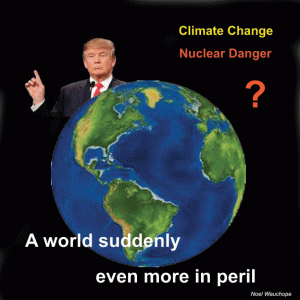 A bad START: Trump tells Putin U.S.-Russia treaty to limit nuclear weapons was a “bad deal”, Salon.com , FEB 10, 2017
The president reportedly didn’t know what the New START treaty was but wanted to get rid of it MATTHEW ROZSA , President Donald Trump has had another embarrassing phone call with a foreign leader — and this time there’s potentially dangerous consequences.
Trump described the New Strategic Arms Reduction Treaty, or START, signed by former president Barack Obama in 2010, as a bad deal for the United States,
according to a Reuters report. The treaty requires America and Russia to cap their deployed strategic nuclear warheads at 1,550 by February 2018, as well as limit their deployed land- and submarine-based missiles and nuclear-capable bombers.
According to the sources who spoke with Reuters, however, Trump seemed unfamiliar with the details of New START when it was brought up by Russian leader Vladimir Putin. After Putin suggested extending New START beyond its original time frame, Trump referred to the treaty as one of many bad deals that Obama had negotiated.
If New START is not mutually extended, neither America nor Russia would be limited in their nuclear production, which could trigger a nuclear arms race.
The sources also say that Trump then turned the conversation toward the subject of his own supposed popularity within the United States. The official White House account of Trump’s Jan. 28 conversation with Putin did not mention a discussion about New START.
Trump’s phone calls with world leaders have not gone well……http://www.salon.com/2017/02/09/a-bad-start-trump-tells-putin-u-s-russia-treaty-to-limit-nuclear-weapons-was-a-bad-deal/
February 10, 2017
Posted by Christina Macpherson |
politics international, USA, weapons and war |
Leave a comment
The U.S. Defense Department recently recommended the government develop tactical nuclear weapons with “low yield” results that can be deployed within smaller battlefield areas.
Tong Zhao, an associate in the Carnegie Endowment’s Nuclear Policy Program based in Beijing, told CNBC Wednesday that this more flexible form of weapon would lower the threshold of nuclear use.
“This will be seen by China as evidence of U.S. contemplating first use of nuclear weapons in a future crisis and will encourage China to consider pursuing similar capabilities that may undermine the no-first-use policy,” he said in an email.
China’s “no-first-use policy” means Beijing only demands the capability to ensure the launch of a nuclear missile, after being hit first by an enemy nuclear strike.
U.S. President Donald Trump signed an executive order on January 27, requiring Defense Secretary James Mattis to review America’s nuclear prowess.
Zhao said U.S. plans to pursue a global missile network, initiated by the Obama administration, may be viewed by China as a threat to its own small deterrent and could mean a switch to a “launch-on-warning” policy, whereby China would retaliate before enemy missiles hit land.
“The new U.S. administration seems very much devoted to developing and deploying a massive global and layered missile defense network that protects not only U.S. homeland, U.S. allies, and friends, but also U.S. bases and troops wherever they are located or deployed.
“To make sure that there would be enough Chinese nuclear weapons to survive a U.S. first strike and not be neutralized by U.S. missile defense, China may have an increasing incentive to adopt the launch-on-warning posture,” he said.
February 10, 2017
Posted by Christina Macpherson |
China, politics international, USA, weapons and war |
Leave a comment



 nuclear-news