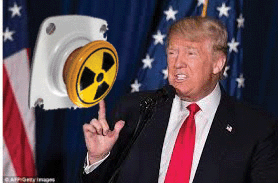
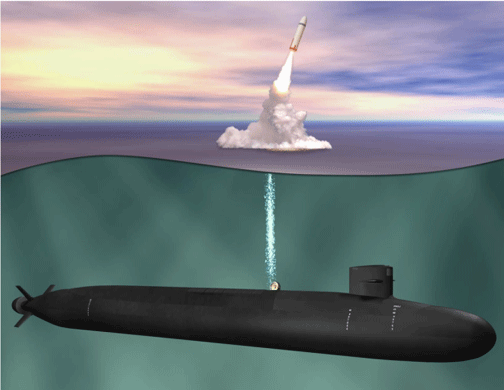
The path to war? US legislation in Congress to unravel the Iran nuclear agreement
Why Give Trump The Keys To War With Iran? https://www.niacouncil.org/give-trump-
keys-war-iran/ When Trump won the elections, many worried that it could lead to war between the United States and Iran, due to his desire to kill the Iran nuclear deal. Now, thanks to the U.S. Senate, we may be one step closer to this nightmare scenario: The Senate is poised to pass legislation that will place President Trump’s trigger-happy finger on the ignition switch of a deadly conflict with Iran.
Introduced to coincide with the annual American Israel Public Affairs Council (AIPAC) conference that concludes today, the Countering Iran’s Destabilizing Activities Act of 2017 (S. 722) would give Trump new tools to violate the Iran nuclear deal. Perhaps most shockingly, a small group of Senate Democrats have joined Republicans to grant Trump some of the most dangerous authorities that would put the U.S. and Iran back on the path to war. The list of sponsors includes many of the usual suspects ― the consummate Iran hawks who worked to block Obama’s diplomacy with Iran and many of whom have sworn to “rip up” the nuclear deal: Robert Menendez (D-NJ), Bob Corker (R-TN), Marco Rubio (R-FL), Tom Cotton (R-AR), and Ted Cruz (R-TX). But the list of sponsors also includes Ben Cardin (D-MD) ― who opposed the nuclear deal but has said the U.S. should still abide by it ― as well as Bob Casey (D-PA), Richard Blumenthal (D-CT), Michael Bennet (D-CO), Chris Coons (D-DE), and Joe Donnelly (D-IN) who supported the deal.
Yet now these senators are signed onto legislation that requires non-nuclear certifications that would block the president from removing sanctions that are set to expire in later stages of the nuclear agreement. Why would Democratic senators who support the nuclear deal sign on to a measure that would violate the agreement? Because, they have argued, the bill gives the president a case-by-case waiver for the deal-killing provisions. That means that these senators are trusting Donald Trump with new deal-killing authorities and abdicating to him whether the U.S. honors the nuclear deal or “rips it to shreds.”
The bill also enables Trump to re-impose sanctions on Iranian entities that were de-listed pursuant to the accord. And it mandates sanctions that would broadly target any person or entity that ― knowingly or unknowingly ― contributes to Iran’s ballistic missile program, including universities that conduct research and banks that process payments for the government. This would amount to a trickle-down reimplementation of sanctions on much of Iran ― and a violation of the nuclear accord. Finally, the bill would designate the Islamic Revolutionary Guard Corps (IRGC), an elite branch of the Iranian military, as a terrorist group ― a major escalation. The IRGC is a highly problematic organization that has benefitted from years of a sanctions economy at the expense of Iran’s people. It is not unusual for individuals within the IRGC to be sanctioned if they are believed to have connections to Iran’s ballistic missile program. However, designating a foreign military branch as a terrorist organization is an extremely dangerous provocation that Pentagon leaders in multiple administrations have advised against. AIPAC has urged for the IRGC designation for the past decade, yet Barack Obama and even George W. Bush resisted. But now, with Donald Trump in the White House, AIPAC is pressing ahead with its proposal.
If this legislation is passed the U.S. can expect a negative response from Tehran that will undermine moderates in Iran’s upcoming May elections and empower anti-U.S. hardliners. The ranking member of Iran’s Parliament, Alaeddin Boroujerdi, has already signaled that Iranian lawmakers will consider designating the U.S. Army as a terrorist organization in retaliation. It is naïve to assume this exchange will be limited to words. U.S. special forces and IRGC units are currently fighting ISIS on the same front in Mosul. Despite some evidence that IRGC units targeted U.S. troops with IEDs during the height of the Iraq War, there have been no such incidents since U.S. soldiers reentered Iraq in the summer of 2014. In effect, the IRGC and the U.S.-backed coalition have agreed to stay out of each other’s way as they fight a mutual enemy in ISIS. This bill could change that reality by removing any incentive for Iran not to attack U.S. troops in Iraq, forbidding any cooperation with IRGC-backed militias against ISIS, and placing our Iraqi allies in a diplomatic catch-22. It is for this very reason that back in 2007, President Bush’s Pentagon opposed an SDGT designation for the IRGC.
With thousands of AIPAC supporters on Capitol Hill to lobby senators on behalf of the bill, there is a strong chance that this bill could obtain filibuster-proof levels of support. If every Republican supports the bill, and just one more Democrat signs on, AIPAC’s bill will hit 60 votes. If that happens, and Congress sends Trump this legislation, our new president will be granted the tools and the greenlight from Congress to unravel the Iran deal and put us back on the path to a war with Iran. Unless Democratic senators stand up against this bill soon, opponents of the Iran nuclear deal may wipe away Obama’s diplomatic legacy with Iran faster than even they thought was possible. This piece originally appeared in The Huffington Post.
On foreign affairs, Trump’s ignorance is cause for concern
Trump has antagonized the leaders of allied countries like Mexico, Australia and Germany, and he has repeatedly demonstrated an extraordinary lack of knowledge about foreign affairs.
This is the president who faces what Warren Christopher, President Clinton’s first secretary of state, called problems from hell. A partial list, compiled by Project Syndicate, includes: intensifying conflicts and dissent within the European Union; the rise of illiberal forces, including welfare chauvinism and exclusionary nationalism; the danger to the continued independence of the buffer states surrounding Russia; a frayed consensus in support of western liberal democratic principles; aggression from a nuclear-armed North Korea and counter threats from the Trump administration of a pre-emptive strike; a foreign policy that The Economist reports has left America’s allies “aghast” — a policy that “seems determined to destroy many of the institutions and alliances created in the past half century.”
When the President Is Ignorant of His Own Ignorance, NYT Thomas B. Edsall MARCH 30, 2017 How prepared is our president for the next great foreign, economic or terrorist crisis?
Disgrace of Canada’s submission to USA, in boycotting UN nuclear ban talks
Canada’s absence betrays its history on nuclear talks, RAMESH THAKUR AND CESAR JARAMILLO, The Globe and Mail, Mar. 27, 2017 Ramesh Thakur is a professor at the Australian National University and co-convenor of the Asia-Pacific Leadership Network for Nuclear Non-Proliferation and Disarmament. Cesar Jaramillo is executive director of Project Ploughshares in Waterloo, Ont.
America and her allies oppose UN talks for a treaty that would ban nuclear weapons
United States and Allies Protest U.N. Talks to Ban Nuclear Weapons, NYT, MARCH 27, 2017, UNITED NATIONS — Saying the time was not right to outlaw nuclear arms, the United States led a group of dozens of
Vague outlook for India-U.S. civil nuclear pact, unlikely to meet June deadline
India-U.S. civil nuclear pact likely to miss June deadline, THE HINDU, Bankruptcy of reactor maker Westinghouse clouds operationalisation of the deal.
More than two years after India and the U.S. announced that the civil nuclear deal was “done,” its actual operationalisation is in doubt over a number of developments that stretch from a “school scandal” in the Japanese parliament to the Cranberry, Pennsylvania headquarters of Westinghouse Electric, which is expected to file for bankruptcy this week.
Six reactors for A.P. According to the agreement over liability issues and the negotiations that followed former U.S. President Barack Obama’s visit to India in January 2015 and Prime Minister Narendra Modi’s visit to Washington in June 2016, the two sides had agreed to “work toward finalising the contractual arrangements by June 2017” for six reactors to be built in Andhra Pradesh by Toshiba-owned Westinghouse and the Nuclear Power Corporation of India Ltd (NPCIL).
When completed, this was to be the first operationalisation of the India-U.S. civil nuclear deal, which was announced in 2008, and proof that both sides had effectively sorted out all their issues, including over the liability that suppliers must accept in the event of an accident.
The reason for the concern is that the nuclear arrangement hinged on two major factors — the completion of the India-Japan Nuclear Cooperation Agreement (NCA), as Toshiba and other suppliers for reactor parts are bound by Japanese laws and by the actual contract to be negotiated by the U.S.-based Westinghouse…….
When contacted, the U.S. Embassy declined to comment on how the bankruptcy issues would affect the deal. Nuclear officials said it was “likely” the June 2017 commercial contract with Westinghouse would be “delayed”, given that other financial companies, insurance companies would require clarity on the company’s future before agreeing to sign on the contract.
“The truth is the picture is very hazy at the moment,” a senior official of NPCIL said, adding that in the absence of land acquisition procedures for the other India-U.S. nuclear venture with GE-Hitachi for six 1594 MW reactors, the future of the India-U.S. nuclear deal is, for the moment, pinned to the future of Westinghouse itself. http://www.thehindu.com/news/national/indo-us-civil-nuclear-pact-likely-to-miss-june-deadline/article17668572.ece
Need for America and China to work together on North Korean situation
![]()
![]()
North Korea: Why America and China need to deal with Kim Jong-un together http://www.abc.net.au/news/2017-03-26/why-america-and-china-need-to-deal-with-kim-jong-un-together/8385362 By North Asia correspondent Matthew Carney, Nearly every week, Kim Jong-un seems to announce a successful test in his nuclear and missile program, edging him ever closer to his aim of striking America with a nuclear warhead.
Taking the North Korean leader out with military action is now being discussed, but that could lead to much bigger problems and plunge the region into years of chaos and instability. Worse still, it could force a confrontation between China and the US.
On the face of it, the North Korean military looks impressive. It has about 1.2 million troops. But the reality is that the weaponry is outdated and obsolete, much of it from the Soviet era. It’s no match for any modern army, so Mr Kim could be removed effectively.
Christopher Hill, probably the most experienced US diplomat in North Korean affairs, says with Mr Kim in power, there is no chance of dialogue. “Frankly, we don’t have a real insight into his thinking — we do know he seems to be totally uninterested in negotiation,” he said.
The real danger, said Mr Hill, is that the Trump administration has little understanding about how to deal with the North Korea threat, and the US State Department is in disarray. “We have a kind of Home Alone situation at the State Department, so we don’t have a lot of people focusing on this issue at this point,” he said.
Military action could prove costly Despite this, while visiting North Asia last week, US Secretary of State Rex Tillerson ruled out negotiation and put military action on the table. It’s action that could prove costly: a humanitarian disaster, with biological and nuclear weapons at play; a contested occupation as China and America battle for control.
Dr Euan Graham from the Lowy Institute says it could prove more destructive and costly than the Iraq war.
“Kicking in the door is the easy part; once you go in and occupy ground, then if that’s contested you can very quickly find even superpowers’ resources can become thinly spread,” he said.
Mr Hill says people like to compare the situation on the Korean Peninsula with the reunification of Germany, but this would actually be much worse. Frankly speaking, the difference between North Korea and East Germany cannot be described,” he said.
“They are just worlds apart in terms of what Germany had to do and what the South Koreans would have to do.”
These immense challenges make policymakers and experts around the world question the value of removing Mr Kim and his nuclear program.
Dr Graham says the US then has a choice: “Is it better to live with this threat and manage it through deterrence and existing sanctions like it did with China and the Soviet Union for decades? Or does it become so unacceptable that it has to accept the high cost of potential economic recession in north-east Asia and military conflict that could take several thousands if not higher numbers of lives?”
China and America are at oddsThe complicating factor is that the powers at play cannot agree on what North Korea should become. They all have competing strategic needs.
China wants a new regime that will serve its interests, and it fears US troops on its border.
Professor Cheng Xiaohe from Beijing Renmin University says China will have to deal with a flood of refugees.
“Millions of North Koreans will seek safe havens in China or across the 38th parallel into the minefields to seek protection in South Korea,” he said.
“Even hundreds of thousands will take to boats to sail boat to other countries to seek refuge.”
It’s doubtful whether America wants to lead another foreign intervention. The Iraq campaign almost bankrupted the country with little to show in return, and it left hundreds of thousands dead.
South Korea too is losing its desire for reunification. It would cost several trillion dollars at least and threaten South Korea’s thriving high tech economy which is 18 times bigger than North Korea’s.
Dr Jiyoung Song from the Carnegie Council for Ethics in International Affairs says the younger generation in the South have very little in common with their brethren in the North.
Most South Koreans are definitely worried about the economic side — the unification costs, but also the unemployment and competition for jobs and universities.
The only way forward…Mr Hill, who led the push for a negotiated solution with the six-party talks that ended in 2009 after North Korea withdrew and resumed its nuclear program, says the only way forward is to engage with China and plan how to deal with the regime and the aftermath.
“We have to have an in-depth dive deep with the Chinese to really figure out how together we can deal with that and I think we need to do it and do it a lot more,” he said.
But Mr Hill says both sides have to get over their mutual distrust.
“Many Chinese see the demise of North Korea as a Chinese defeat and a US victory,” he said.”They worry that the US might take advantage of this and put US troops right up on the Chinese border.”
Dr Cheng agrees that China is afraid of being played by the US.
“All countries need to work together to settle their differences and adopt a joint line to build that country for peace and stability and carry out post-reunification works,” he said.
But while experts may agree in a call for global engagement, the Trump administration seems to be turning inwards towards more isolationist policies.
Britain will struggle with nuclear regulatory system, after leaving European Union
Top nuclear boss advising May on protecting atomic industry from Brexit blow Energy Voice Alan Shields, 26 Mar 17 The German head of one of the UK’s top nuclear companies is counseling Prime Minister Theresa May’s government on what needs to be done to protect a global hub for the industry from Brexit.
With European Union leaders congregating to celebrate the Treaty of Rome’s 60th anniversary, Urenco Ltd.’s Chief Executive Officer Thomas Haeberle said he’s cautiously optimistic that new rules can be negotiated to guarantee the flow of nuclear materials in and out of the U.K. after the nation leaves the bloc.
“We are making the U.K. government, which is also our shareholder, aware of the requirements our business needs to fulfill in the context of Brexit and of leaving Euratom,” said Haeberle, referring to the European Atomic Community, a part of the EU’s bedrock agreement signed on March 25, 1957 – 26/03/20
Just as bankers have made London a global financial hub, nuclear workers have turned Britain into a central cog servicing the world’s flow of atomic materials. Urenco, the world’s second-biggest maker of reactor fuel, runs a factory in Capenhurst and oversees its global distribution network from Stoke Poges outside of London.
Owned by the U.K. and Dutch governments as well as German utilities EON SE and RWE AG, Urenco has set up a working group that “deals with all the risks and the possible mitigations,” Haeberle said. He spoke with Bloomberg a week before the EU celebrates Euratom’s 60th anniversary, his first interview since becoming CEO in January 2016.
Euratom’s main function is to safeguard nuclear fuel, making sure it isn’t diverted to make weapons. The U.K. will lose that service once it departs the EU. Nuclear fuel suppliers and power plants need certification from Euratom or whatever system succeeds it to buy material on the open market.
For Urenco’s business to continue uninterrupted after the U.K. leaves the EU, negotiators will have to seal new agreements with governments around the world setting out the new regulatory system Britain will follow after it leaves Euratom……..
Companies like Urenco face a potentially “high impact” from Brexit, Moody’s Investors Service wrote in a May 22 note saying that the overall credit impact from leaving the EU will be modest. Urenco, which has 2.1 billion pounds ($2.6 billion) of outstanding debt is rated Baa1, two grades above junk by Moody’s…… https://www.energyvoice.com/otherenergy/134874/top-nuclear-boss-advising-may-protecting-atomic-industry-brexit-blow/
.
North Korea nuclear program is ‘imminent’ threat says Rex Tillerson
North Korea’s nuclear program poses an “imminent” threat that nonetheless requires the United States, China, and other countries to respond with a “staged approach” that includes sanctions, Secretary of State Rex Tillerson said in a rare encounter with the media.
Tillerson, speaking to the conservative Independent Journal Review in an interview published Saturday, also said that U.S.-China relations appear to be at a historic inflection point that must be carefully managed.
China’s foreign minister, meanwhile, urged the United States to remain “cool-headed” on the issue of North Korea and to consider going ahead with talks with Pyongyang.
The U.S. secretary of state is in the final stages of a trip to Asia, having made stops in Japan and South Korea and, this weekend, in China. A good chunk of his discussions have focused on how to handle the challenge posed by the government in Pyongyang, whose recent ballistic missile tests have alarmed the international community.
Tillerson repeatedly framed the North Korean threat as “imminent,” and during his trip he has ruled out negotiations with the country while leaving open the possibility of a pre-emptive military strike to eliminate its nuclear program.
But in his interview with IJR, Tillerson did not promise any imminent public response by the U.S. and others, aside from the ongoing diplomatic flurries. Instead, he said there had to be a “staged approach” to North Korea, one that involves enforcing, and possibly enhancing, international sanctions, while persuading Pyongyang that giving up its nuclear weapons would help it on other levels………
Tillerson also downplayed, but did not entirely rule out, suggestions that Japan and South Korea should develop their own nuclear weapons in a bid to stave off the North Korean threat…….
China’s sway over North Korea is perhaps the most urgent issue the two countries must tackle, Tillerson said. The secretary of state indicated that the Trump administration believes China must do more to enforce sanctions on North Korea, which relies on Beijing as an economic lifeline.
It’s the same stance taken by the Obama administration, which toward the end of its tenure also was increasingly alarmed by the threat posed by North Korea. President Barack Obama is reported to have told Trump that North Korea is the top national security priority facing his new administration. http://www.politico.eu/article/tillerson-says-north-korea-nuclear-program-is-imminent-threat-as-china-urges-talks/
Request by UN to Britain: Pause Hinkley Nuclear Plant Work for Environmental Assessment
UN Asks U.K. to Pause Hinkley Nuclear Plant Work for Assessment https://www.bloomberg.com/news/articles/2017-03-18/un-asks-u-k-to-pause-hinkley-nuclear-plant-work-for-assessment by Grant Smith and Alex Morales March 19, 2017
-
UN committee calls for halt to allow environmental studies
-
EDF won approval to build 18 billion-pound plant in September
A United Nations committee asked the U.K. to suspend work on the Hinkley Point nuclear power plant pending assessment of the environmental impact.
The UN Economic Commission for Europe requested the pause, it said in a document on its website. Electricite de France SA, the French state-controlled utility, won approval to build an 18 billion-pound ($22.3 billion) nuclear plant on England’s western coast in September. To help shoulder the construction costs, EDF convinced China General Nuclear Power Corp. to take 33.5 percent of the project.
The UN committee recommended the halt until it established whether “a notification under the Espoo Convention” was useful, according to the statement. The Espoo Convention sets out the obligations of countries to “assess the environmental impact of certain activities,” according to the commission’s website.
Bouygues SA and Areva SA have received contracts for work at the plant.
Disaster looms over North Korea: how could this be stopped?

How to stop a North Korean nuclear trainwreck, The Hill, BY PHILIP W. YUN, – 03/17/17 The assassination of Kim Jong Nam, the older half-brother of North Korean dictator Kim Jong Un, is yet another bizarre episode in a string of reality TV events that is now commonplace in our public discourse.
It’s easy to get sucked into the intrigue, but it distracts from the big picture: The United States is in the middle of a slow-motion trainwreck with North Korea over its nuclear weapons and missile program. North Korea’s missile tests on Monday are just the latest alarm in what could spiral into a full-blown crisis.
We better start listening.
Unless we do something about it now, a “metal on metal” collision could be in the offing, marked by more North Korean tests and calls within Washington for military strikes to stop them.
Kim Jong Nam’s murder and the subsequent media circus obscure more crucial events: China’s decision last month to ban all coal imports from North Korea; the Feb. 11 test launch of a mobile, land-based, solid-fueled missile; and, critically, the annual U.S.-South Korean military exercises happening this month, that almost certainly sparked last weekend’s tests………
we have no choice but to swallow a bitter pill. Using what little leverage and pressure we have, we must talk with the North Koreans at sufficiently high levels, something we haven’t done for some time.
But we must make these hard choices now — or they will be made for us.
Philip W. Yun is executive director of Ploughshares Fund, a San Francisco-based peace and security foundation. He previously served as senior adviser to the assistant secretary of State for East Asian and Pacific Affairs and as a senior adviser to two U.S. coordinators for North Korea Policy: former Secretary of Defense William J. Perry and former Under Secretary of State Wendy Sherman. Yun was a member of a government working group that managed U.S. policy and negotiations with North Korea under President Clinton and was part of the U.S. delegation that traveled to North Korea with then-Secretary of State Madeleine Albright in 2000. http://thehill.com/blogs/pundits-blog/defense/324461-how-to-stop-a-north-korean-nuclear-trainwreck
Tillerson rejects negotiation with North Korea, and keeps journalists out
In Asia, on his first major trip overseas as secretary of state, Mr. Tillerson has been heavily scripted in his few public comments, and he has gone out of his way to make sure he is not subject to questions beyond highly controlled news conferences, at which his staff chooses the questioners. In a breach of past practice, he traveled without the usual State Department press corps, which has flown on the secretary’s plane for roughly half a century.
Rex Tillerson Rejects Talks With North Korea on Nuclear Program, NYT, MARCH 17, 2017 SEOUL, South Korea — Secretary of State Rex W. Tillerson ruled out on Friday opening any negotiation with North Korea to freeze its nuclear and missile programs and said for the first time that the Trump administration might be forced to take pre-emptive action “if they elevate the threat of their weapons program” to an unacceptable level.
For US Secretary of State, Rex Tillerson, a pre-emptive attack on North Korea is an option
Military action against North Korea ‘an option’, warns Rex Tillerson
US secretary of state says policy of strategic patience has ended due to threat posed by Pyongyang’s nuclear weapons programme, Guardian, Justin McCurry , 17 Mar 17 , A pre-emptive US military strike against North Korea may be necessary if the threat posed by its nuclear weapons programme reaches a level that “requires action”, the US secretary of state, Rex Tillerson, has warned.
Speaking in Seoul on the second day of a visit to the Asia-Pacific region, Tillerson said Washington’s policy of “strategic patience” towards the regime in Pyongyang had ended.
In his strongest comments yet on concerns that North Korea is moving closer towards developing a nuclear strike capability that could threaten the US mainland, Tillerson said “all options are on the table”.
“Certainly we do not want to, for things to get to military conflict,” he said at a joint press conference with South Korea’s foreign minister, Yun Byung-se.
“If they elevate the threat of their weapons programme to a level that we believe requires action, then that option’s on the table. “Let me be very clear: the policy of strategic patience has ended. We are exploring a new range of security and diplomatic measures.”
Those words hint at a departure from the North Korea policy pursued by the Obama administration, which sought to use multilateral sanctions to pressure the North Korean leader, Kim Jong-un, into agreeing to denuclearisation in exchange for aid and investment…….
Aside from repeating that Washington’s policy options remain open, Tillerson has not offered details of how the Trump administrationplans to address the rising threat from North Korean nuclear weapons and ballistic missiles…….
Tillerson faces potentially the most difficult leg of his three-country visit when he arrives in Beijing on Saturday…..https://www.theguardian.com/us-news/2017/mar/17/military-action-against-north-korea-an-option-warns-rex-tillerson
G20 will not be mentioning that nasty left-wing phrase “climate change”
G20 drop reference to climate change http://www.heraldsun.com.au/news/breaking-news/g20-drop-reference-to-climate-change/news-story/a5325d34d272030935c7b31033588f5d Reuters March 18, 2017
World financial leaders have dropped a reference to financing climate change from their draft communique, says an official taking part in a meeting of finance ministers and central bankers of the Group of 20 leading economies.
At their last meeting in July 2016 in the Chinese city of Chengdu, the G20 financial leaders said they encouraged all signatories of the Paris Agreement on climate change to bring the deal into force as soon as possible.
“Climate change is out for the time being,” said the official, who asked not to be named.
US President Donald Trump has called global warming a “hoax” concocted by China to hurt US industry and vowed to unpick the Paris climate accord that is supposed to curb rising temperatures.
How to defuse tensions around the issue of North Korea’s nuclear weapons testing?

![]()
Can Tillerson Crack North Korea?, Carnegie Endowment For International Peace, RICHARD SOKOLSKY, JOEL WIT , March 15, 2017, Secretary of State Rex Tillerson’s visit to Northeast Asia this week comes as tensions are running high in the region. North Korea recently conducted a simultaneous test of four ballistic missiles that could be used to attack South Korea and Japan, as well as U.S. forces stationed in those countries with nuclear weapons. The impending American deployment of an anti-ballistic missile system in South Korea to defend against a missile attack has provoked China’s strong opposition. South Korean president Park Geun-hye has just been removed from office for corruption, and a presidential election that could bring the opposition party to power will be held in May. While all this is happening, the Trump administration is doing some serious soul-searching about how to deal with North Korea. In short, Secretary Tillerson will face a diplomatic landscape that is littered with landmines on his first big troubleshooting mission overseas.
The diplomatic hat trick the Trump administration needs to pull off is finding a solution that can stop the growth of the North Korean threat, rebuild cooperation with Beijing and gain support from U.S. allies, particularly a new South Korean government. That’s a very tall order, especially since the overwhelming temptation in Washington will be to double down on sanctions, including measures against Chinese banks and businesses that have ties with North Korea, and to ratchet up rhetoric about military options for eliminating Pyongyang’s WMD threat. If that’s all Secretary Tillerson brings to Asia, his mission will fail. He will only create more running room for Pyongyang to move forward with its nuclear and missile programs by making cooperation between Washington and Beijing even more difficult to achieve.
The smart move would be to defuse tensions while laying the groundwork for a strategy that combines threats with leaving the door open a crack for renewed dialogue with North Korea. The first two stops on his trip—Tokyo and Seoul—will provide him with an opportunity to pledge Washington’s firm commitment to their security. But the real centerpiece of Secretary Tillerson’s trip will be Beijing. China’s public proposal last week that the United States suspend its joint military exercises—a key demand by North Korea—in return for Pyongyang suspending its nuclear and missile tests—a move that would serve Washington’s interests—signals that it is willing to play an active, even positive role in avoiding a “head-on collision,” in the words of Chinese foreign minister Wang Yi. While the Trump administration quickly rejected the proposal, rather than just leaving the matter there, Secretary Tillerson should pick up the diplomatic gauntlet.
Caution, always the watchword when dealing with North Korea, should be reflected in the secretary’s counterproposal. Rather than dive headlong into new negotiations, step one should be “talks about talks”: unconditional preliminary discussions to see if North Korea is willing to put its nuclear weapons program on the table. “Unconditional” is the key word. While the United States has insisted in the past that North Korea agree ahead of time to focus on giving up its nuclear weapons, Pyongyang’s view is that talks should be held without preconditions. There seems to be little if no downside in adopting that approach, since the North Koreans understand that their program will be Washington’s number one topic for discussion. Step two in this process will be a decision by President Trump and Kim Jong-un, based on the results of these preliminary talks, whether formal negotiations should resume. If North Korea proves willing to address Washington’s WMD concerns, formal negotiations can start. If North Korea is not serious, the United States should then move on to putting greater diplomatic pressure on China, enacting new sanctions, and taking further measures to protect Seoul and Tokyo.
Whether the Trump administration adopts this approach or just presses the policy default button—more sanctions and military measures—is the $64,000 question. Consequential secretaries of state solve the thorniest and most important national security problems through patient, skillful diplomacy and negotiations. Fair or not, Secretary Tillerson has been pilloried by the press and pundits as missing in action. This sensitive diplomatic mission offers him an opportunity to show his mettle. The last thing Washington needs, at a time when America’s global leadership and position in Asia is under challenge, is for Secretary Tillerson to leave the region empty-handed, or in worse shape than he found it.
This piece was originally published by the National Interest. http://carnegieendowment.org/2017/03/15/can-tillerson-crack-north-korea-pub-68278
US efforts to ‘denuclearise North Korea’ have failed- US secretary of state Rex Tillerson

Tillerson concedes US efforts to ‘denuclearise North Korea’ have failed
US secretary of state starts four-day Asia-Pacific trip by calling for new approach towards Pyongyang’s weapons programme, Guardian, Justin McCurry , 16 Mar 17 The US secretary of state, Rex Tillerson, has conceded that 20 years of US attempts to “denuclearise” North Korea have failed, and called for a new approach towards the regime’s nuclear weapons programme.
Speaking in Tokyo at the start of a four-day visit to Japan, South Korea and China, Tillerson said on Thursday: “I think it’s important to recognise that the political and diplomatic efforts of the past 20 years to bring North Korea to the point of denuclearisation have failed.
“That includes a period where the United States has provided $1.35bn in assistance to North Korea as an encouragement to take a different pathway.
“In the face of this ever-escalating threat, it is clear that a different approach is required. Part of the purpose of my visit to the region is to exchange views on a new approach.”
Tillerson said he and his Japanese counterpart, Fumio Kishida, had discussed a fresh approach to North Korea’s “dangerous and unlawful” nuclear programme, but neither revealed details.
US administration officials have said that all options are on the table, including military strikes, but Tillerson indicated that Washington would continue to demand the full implementation of UN sanctions and press China to make more effective use of its leverage with the North Korean regime.
Calls for an alternative to the multinational sanctions supported by previous Japanese and US administrations have grown amid worrying evidence that the measures have not prevented North Korea from edging closer to its aim of developing nuclear weapons capable of striking the US mainland.
Japan and South Korea, which host tens of thousands of American troops, are within range of North Korean missiles…….
Chinese cooperation has been further complicated by the forthcoming deployment of a controversial US anti-missile system in South Korea.
China has objected to the Terminal High Altitude Area Defence (Thaad) missile defence system, describing its advanced radar as a threat to its own security. Military officials in the US and South Korea insist that Thaad’s sole purpose is to thwart missile attacks from North Korea……..
Tillerson said making Japan the first stop on his visit “does underscore the importance that the United States places on the Japanese-US relationship, but also the importance of the Asia-Pacific region to the United States. The US-Japan alliance remains the cornerstone of peace and stability in the Asia-Pacific region.”
Tillerson was due to hold talks with Japan’s prime minister, Shinzō Abe, on Thursday evening. On Friday, he will meet South Korea’s acting president, Hwang Kyo-ahn, and visit the demilitarised zone – the heavily armed border separating South and North Korea.
In Beijing at the weekend, Tillerson is expected to attempt to calm Chinese fears over Thaad, play down talk of a possible trade war between the world’s two largest economies, and finalise plans for the Chinese leader, Xi Jinping, to visit Trump in April. https://www.theguardian.com/us-news/2017/mar/16/tillerson-concedes-us-efforts-to-denuclearise-north-korea-have-failed
-
Archives
- May 2026 (82)
- April 2026 (356)
- March 2026 (251)
- February 2026 (268)
- January 2026 (308)
- December 2025 (358)
- November 2025 (359)
- October 2025 (376)
- September 2025 (257)
- August 2025 (319)
- July 2025 (230)
- June 2025 (348)
-
Categories
- 1
- 1 NUCLEAR ISSUES
- business and costs
- climate change
- culture and arts
- ENERGY
- environment
- health
- history
- indigenous issues
- Legal
- marketing of nuclear
- media
- opposition to nuclear
- PERSONAL STORIES
- politics
- politics international
- Religion and ethics
- safety
- secrets,lies and civil liberties
- spinbuster
- technology
- Uranium
- wastes
- weapons and war
- Women
- 2 WORLD
- ACTION
- AFRICA
- Atrocities
- AUSTRALIA
- Christina's notes
- Christina's themes
- culture and arts
- Events
- Fuk 2022
- Fuk 2023
- Fukushima 2017
- Fukushima 2018
- fukushima 2019
- Fukushima 2020
- Fukushima 2021
- general
- global warming
- Humour (God we need it)
- Nuclear
- RARE EARTHS
- Reference
- resources – print
- Resources -audiovicual
- Weekly Newsletter
- World
- World Nuclear
- YouTube
-
RSS
Entries RSS
Comments RSS