U.S. Congress not satisfied with Ontario Power Generation’s latest nuclear waste submission to the Canadian government
Proposed nuclear waste dump draws Congressional ire http://www.voicenews.com/news/proposed-nuclear-waste-dump-draws-congressional-ire/article_743d7c7d-d48f-5d35-bcaa-1ab7c08496c8.html OPG appears to sidestep Canada’s request for more details By Jim Bloch | For The Voice Jun 14, 2017
Ontario Power Generation’s latest submission to the Canadian government about its proposed nuclear waste dump on the shores of Lake Huron continues to be evasive and overly broad, according to critics of the project.
In OPG’s Dec. 28, 2016, response to the Canadian Environmental Assessment Agency, the power company chose two enormous geological formations comprising about 75 percent of the entire province: The crystalline rock of the Canadian Shield, which is about a billion years old, and the sedimentary rock formations of southern Ontario, which are 354 million to 543 million years old.
The CEAA also requested further analysis of the cumulative effects that the dump could have on the environment, especially if a high-level waste dump is built nearby, and an updated list of OPG’s commitments to reduce “each identified adverse impact” of the deep geological repository on the environment.
Congressional delegation responds
U.S. Rep. Debbie Dingell, of Michigan’s 12th District, and Rep. Dave Trott, of Michigan’s 11th District, wrote a letter to Secretary of State Rex Tillerson on June 7, urging him to enter the fray against the dump.
“We write to urge you to do everything in your power – through both diplomatic and legal channels – to protect our Great Lakes and to convince the Canadian government to require OPG to select an alternative site that will not place the health, safety, and economic security of Americans at risk,” said Dingell and Trott in the letter.
Thirty-two bipartisan Congressional representatives from the Great Lakes states co-signed the letter, including Paul Mitchell, the Republican representing the 10th District, covering Michigan’s Thumb – all of St. Clair, Huron, Lapeer and Sanilac counties and most of Macomb County. The only member of Michigan’s Congressional delegation who did not endorse the letter was Justin Amash, the Cascade Township Republican.
The lawmakers said that OPG had “doubled down” on the dump “for two inconvenient facts for the company: that they believe an alternative site would be more expensive and take longer to construct.”
In its report, OPG pegged the baseline cost of a Deep Geological Repository at the proposed site in Kincardine, Ontario, Canada, or the alternative sites in the Canadian Shield or in southern Ontario, Canada, at $2.4 billion. The company said that transporting low and intermediate nuclear waste from the province’s 20 reactors to a location in Southern Ontario would add $381 million to $493 million to cost of the project; transportation of waste to a location in the Canadian Shield would add $452 billion to $1.424 billion. Incidental costs would grow by $832 million in southern Ontario and $2.056 billion in the Canadian Shield. OPG labeled the additional transportation and incidental costs as “unacceptable.”
On April 13, Fred Kuntz, Manager of Corporate Relations and Communications for OPG in Bruce County, told Bruce County stakeholders that a shift to a new location could add 15 years to the construction timeline.
“We cannot let cost be the sole driving factor in this critical decision, as storing nuclear waste in the Great Lakes basin bears far too great a risk that would be fundamentally devastating to an entire region,” said the Congressional reps in their letter to Tillerson.
Turkey to go into big debt to Russia for $20 billion Akkuyu nuclear power plan
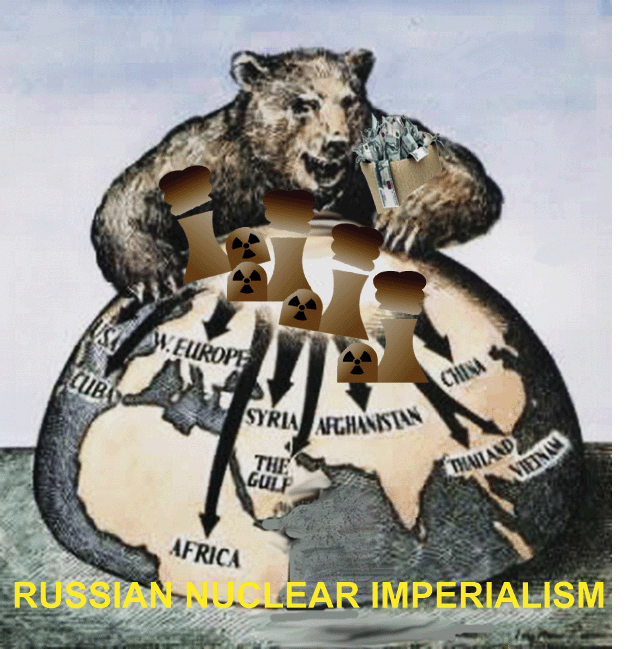 Turkey gives Rosatom go ahead to build nuclear plant, Reuters, 15 June 17,
Russia’s State Atomic Energy Corporation (Rosatom) won approval from Turkey’s energy watchdog on Thursday to go ahead with building its $20 billion Akkuyu nuclear power plant in southern Turkey.
The project to construct four nuclear reactors has repeatedly run into delays, including being briefly halted after Turkey downed a Russian jet near the Syrian border in November 2015. Ties have since normalised between the two countries and work on the plant has resumed……
Rosatom has sold several nuclear reactors to developing countries under a model by which Russia finances, builds and operates the nuclear plant and sells power to its customer – a model that has also raised questions about Russia using energy policy as a means to political ends.
EPDK said it had given Rosatom’s project company Akkuyu Nukleer AS a 49-year production license.
Dependant on imports for almost all of its energy, Turkey has embarked on an ambitious nuclear programme, commissioning Rosatom in 2013 to build the four 1,200 megawatt (MW) reactors…..https://www.reuters.com/article/turkey-energy-nuclear-idUSL8N1JC3FL
No planning in UK’s Brexit for the problem of EURATOM and UK’s trade in nuclear materials.
 Nation Cymru 14th June 2017 When Theresa May triggered Article 50 a couple of months ago, she also
signalled her intention that the UK leave the obscure EURATOM treaty. The
treaty covers nuclear power, an issue which neither the Remain nor Leave
camps even mentioned during the referendum campaign.
How this decision will affect plans for a new nuclear power station at Wylfa on Ynys Môn does not
appear to have been noticed in Wales at all. But what is interesting is
that EURATOM is central in the UK’s trade in nuclear materials.
The nuclear fuel used in our power stations is actually owned by EURATOM and
its safe handling and storage is overseen by that organisation.
When May took over as PM, the core of her Government’s energy strategy was the
commitment to building new nuclear power stations, starting with Hinkley
Point C in Somerset, just 12 miles from the South Wales coast across the
Bristol Channel.
They don’t think that they have a problem, either because the UK will miraculously renegotiate a highly complex set of
regulations with the International Atomic Energy Agency (IAEA) within the two-year deadline, somehow arrange an extension of that deadline or perhaps not leave EURATOM after all. https://nation.cymru/2017/analysis-brexit-and-wylfa-bs-nuclear-fuel/
Call to Canadians to join talks for the Convention on the Prohibition of Nuclear Weapons
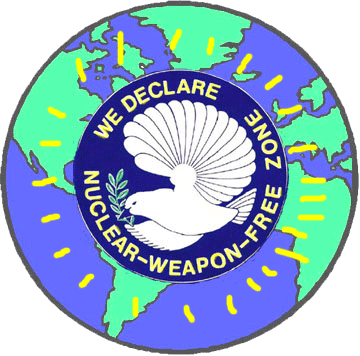
 CANNINGS: We must work tirelessly for a nuclear weapons free world http://infotel.ca/opinion/letters-to-the-editor/cannings-we-must-work-tirelessly-for-a-nuclear-weapons-free-world/it43381 By Richard Cannings, MP South Okanagan-West Kootenay 13 June 17 Last week I listened to Setsuko Thurlow, a Hiroshima survivor, speak eloquently of what it was like to have her family, her neighbourhood, her city, vaporized in an instant of mass destruction. I wish everyone in this country could have heard her moving words. Setsuko has devoted her life to advocating for nuclear disarmament, to ensure that her experience will never be repeated.
Some would say it was that threat of mutually assured destruction through nuclear warfare that kept worldwide conflict at bay through the Cold War. Even now, 25 years after the end of the Cold War, there are more than 15,000 nuclear warheads in the world. The risk to the planet was, and remains, incalculable.
Canadians have long recognized the threat of nuclear proliferation and long called for nuclear disarmament. In 2010, the House of Commons unanimously passed a motion that called on the government to deploy a major diplomatic initiative to increase the rate of nuclear disarmament.
The Liberal Party of Canada, only last year, adopted a resolution at their Winnipeg policy convention that urged the government—their Liberal government—to convene an international conference to commence negotiations for a Nuclear Weapons Convention that would ban nuclear weapons.
And yet the government’s actions in the past year go completely against that resolution.
The international community—over 130 countries are involved—is currently carrying out negotiations on the Convention on the Prohibition of Nuclear Weapons, just as the Liberal Party resolution requested. The problem is, not only is Canada not leading this process, it is boycotting it completely. Canada is not back on the international scene, it is backing away from its traditional leadership role in promoting a more peaceful world.
And Canada is backing away under pressure from the United States. Justin Trudeau said in the House of Commons last week that joining the negotiations would be “useless” as the nuclear powers are not present. Yet Canada led the world in the banning of land mines through a process in which the land mine powers, including the United States, did not, initially, participate.
These UN negotiations for nuclear disarmament are still going on. Canada could join and take a real and meaningful role in this essential project. But as I write this, the government is voting against an NDP motion to join these talks.
Opponents to a nuclear ban treaty say that disarmament must happen step-by-step, and that the time is not right for these negotiations, the world is not secure enough.
We have reached the edge of this cliff step by step over the last 60 years. The world will never be fully secure. We cannot wait for better conditions. We cannot afford to wait at all.
Yes, the nuclear powers will always oppose nuclear disarmament. But we must not bow to their wishes. We need to radically change the worldview of the nuclear powers. It will not be easy. It will not happen overnight. But we must be bold; we must live up to our convictions and our moral duty, and work tirelessly for a nuclear weapons free world.— Richard Cannings is the Member of Parliament for South Okanagan-West Kootenay.
Scottish 6 to join historic global conference to agree nuclear weapons ban treaty
Common Space Michael Gray @GrayInGlasgow, 13 June 17, SCOTTISH CAMPAIGNERS will join the global movement to ban nuclear weapons this week in New York as pressure builds on the rogue nuclear states to ditch weapons that threaten the future of life on earth.
The International Campaign to Abolish Nuclear Weapons (Ican) has made substantial progress in establishing a Nuclear Ban Treaty, with 123 countries backing progress towards a weapons ban last October at the United Nations. The UK was one of 38 nations opposed.
A cross-group civil society delegation of six will represent Scotland at the June-July session on the recently published draft Treaty document. With support from over 40 states, the Treaty will have legal status and, if successful, will enter a process of ratification. ….https://www.commonspace.scot/articles/11159/scottish-6-join-historic-global-conference-agree-nuclear-weapons-ban-treaty
US Senate’s move to impose new sanctions on Iran contradicts the nuclear deal

 Iran says US Senate bill contradicts nuclear deal http://en.trend.az/iran/
 politics/2765348.html, Tehran, Iran, June 11 By Mehdi Sepahvand
Iranian Deputy Foreign Minister Abbas Araqchi has said the US Senate’s move to impose new sanctions on Iran is contradicts the nuclear deal, officially called the Joint Comprehensive Plan of Action (JCPOA).
“We believe such legislation is contradictory to the principle of good will and successful implementation of the JCPOA,” he said, IRIB news agency reported June 11.
Araqchi censured the legislation as “shameful” and said it shows “confusion” and “wrong policies”.
He described the U.S. Senate’s status in condemning Iran for supporting terrorism is “farcical” and “shameful”.
The US Senate on Wednesday voted overwhelmingly to advance a bill that would impose new sanctions on Iran.
A senior Senate aide said the Iran sanctions measure could come up for a vote as soon as next week. The legislation would impose new sanctions on Iran over its defense missile program, support for resistance movements and claims of human rights violations against the country.
To become law, the measure would have to pass the Republican-led House of Representatives and be signed by President Donald Trump. So far, Washington has slapped two rounds of sanctions on Iran under the new US administration in breach of a nuclear accord.
The world on the brink of nuclear war in 1983
In 1983, A NATO Military Exercise Almost Started a Nuclear World War III, The National Interest, Warfare History Network, 11 June 17, On the night of November 20, 1983, Armageddon went prime time. Over 100 million Americans tuned in to the ABC television network to watch the two-hour drama The Day After. This depiction of a hypothetical nuclear attack on the United States attracted a great deal of publicity and controversy. Schools made watching the film a homework assignment, discussion groups were organized in communities across the country, and even the secretary of state at the time, George Schulz, took part in a question-and-answer session hosted by ABC after the film’s broadcast. That a mere made-for-TV movie could garner such attention from a leading figure in the Reagan administration indicates how real the fear of a nuclear apocalypse was at the time. But almost no one watching that Sunday night realized just how close fiction came to reality in the fall of 1983.
The possibility of the world’s two greatest military powers destroying each other and the earth in a full-scale thermonuclear war was a fear shared by many throughout the world. At the time, both the United States and the USSR maintained huge nuclear arsenals of over 20,000 nuclear warheads each. In North America and Western Europe, nuclear freeze movements were gaining new members daily, with mass demonstrations that routinely numbered in the tens of thousands.
World events seemed to only reaffirm people’s fears. It was the third year of the presidency of Ronald Reagan, a man who had built his political career on a virulent hatred for all things communist. His 1980 victory over incumbent President Jimmy Carter had largely been the result of his hard-line stance against the Russians. A former film actor with a natural flair for the dramatic, Reagan both inspired and shocked people with his hardcore rhetoric, such as his statement before the British House of Commons in 1982 that the Marxist ideology would be relegated to the “ash heap of history.” Perhaps his most memorable and antagonistic remarks came on March 8, 1983, when Reagan referred to the Soviet Union as the “focus of evil in the modern world” and an “evil empire.”……
“Star Wars” and Fleetex 83: On the Brink of Nuclear War
On March 23, 1983, Reagan took the superpower rivalry to a new level when he unveiled the Strategic Defense Initiative Program during a live television address. The SDI program, more popularly referred to as “Star Wars,” was to provide an orbital shield that would protect the United States—at least partly—from a nuclear strike…..
To Yuri Andropov, then general secretary of the USSR, Reagan’s intentions spelled trouble…….http://nationalinterest.org/blog/the-buzz/1983-nato-military-exercise-almost-started-nuclear-world-war-21111
Deadly border battles between nuclear rivals India and Pakistan
INDIA AND PAKISTAN CONFLICT ERUPTS IN ‘DEADLY’ BORDER BATTLES BETWEEN NUCLEAR RIVALS, NewsWeek, BY ON 6/3/17 Recent clashes between neighboring rivals India and Pakistan have turned fatal, according to the Pakistani military, which said it has killed a number of Indian soldiers Saturday in a cross-border revenge attack in Kashmir.
In response to the Indian military allegedly opening fire Friday and wounding two Pakistani civilians in the sector of Nezapir, a Pakistani army spokesman, Major General Asif Ghafoor, claimed in a tweet that the force killed up to five Indian soldiers, wounding many more and destroying bunkers. India, however, denied it had suffered any military casualties and instead accused the Pakistani army of injuring a female civilian. It said Pakistan was using 82 mm and 120 mm mortars indiscriminate small arms fire along the Line of Control, which forms the disputed de facto border between the two countries, the Economic Times reported.
“A woman was injured as Pakistani troops violated ceasefire twice in two sectors of Poonch district by firing mortar shells on forward posts and civilian areas along the Line of Control, army to retaliate,” an Indian defense spokesperson said, according to Reuters.
The restive region of Jammu and Kashmir, which both India and Pakistan claim as their own, has long seen violent clashes between the South Asian nations that have gone to war three times since Pakistan declared independence from India as part of a U.K.-backed agreement in 1947…….
In addition to tensions mounting in the border region, both India and Pakistan have taken steps recently to revamp their nuclear weapons policies. India isbelieved by analysts to possess around 120 nuclear warheads and Pakistan around 130. Neither country is a signatory to the 1968 Treaty for the Non-Proliferation of Nuclear Weapons. According to a report released Friday by the International Institute for Strategic Studies, India was preparing to expand its nuclear arsenal. Pakistan, which has also expressed a desire to bolster its nuclear force, celebrated Sunday its Youm-e-Takbir, or “Day of Greatness,” commemorating the nation’s first successful nuclear detonation, in 1998, Russia’s Sputnik News reported. http://www.newsweek.com/india-pakistan-conflict-erupts-deadly-border-nuclear-620295
The high cost of Units 5, 6 at Kudankulam Nuclear power – most of it owed to Russia

 Units 5, 6 at Kudankulam Nuclear power plant to cost Rs 50,000 crore: The New Indian Express, NPCIL 2 June 17 ST. PETERSBURG: The construction of the fifth and sixth units of India’s largest nuclear power plant in Tamil Nadu will cost about Rs 50,000 crore with half of the amount being funded by Russia as loan.
The project will take seven years to start generating electricity, Nuclear Power Corporation of India (NPCIL) Chairman and Managing Director S K Sharma told PTI here.
India and Russia yesterday signed an agreement for the two new reactors for the Kudankulam Nuclear Power Plant (KNPP) on the sidelines of the annual summit between Prime Minister Narendra Modi and Russian President Vladimir Putin.
“The entire project will cost about Rs 50,000 crore. The first unit will be commissioned in 66 months and the second six months thereafter,” Sharma said.
Atomstroyexport, a unit of Russian state nuclear corporation Rosatom, will build the reactors.
“The project will be funded in 70:30 debt-equity ratio (70 per cent debt, 30 per cent equity),” he said.
The Russian government will lend India USD 4.2 billion to help cover the construction cost……http://www.newindianexpress.com/states/tamil-nadu/2017/jun/02/units-5-6-at-kudankulam-nuclear-power-plant-to-cost-rs-50000-crore-npcil-1612150.html
No answer in sight, to North Korea’s march toward nuclear capability
As US military flexes, North Korea marches toward nuclear capability http://edition.cnn.com/2017/06/02/politics/us-north-korea-military-posturing/ By Zachary Cohen and Brad Lendon, CNN June 2, 2017
Story highlights
- North Korea testing missiles at unprecedented rate
- US shows of force just make North Korea more angry
How much damage can North Korea’s weapons do?
At this point, the pattern is familiar.
China’s role
North Korea shows no sign of budging
The countdown is underway
A joint commitment to fight climate change – European Union and China

 Times 2nd June 2017 China and the European Union will announce a new joint commitment to combat global warming today, making a clear break from President Trump after he withdrew the United States from the Paris climate accord.
Critics said that Mr Trump’s promise to revive the coal industry could not be fulfilled. He was surrendering America’s leadership role on the world stage, they added – and China would step in. Nigel Purvis, a US climate negotiator under President Clinton, said: “Trump just handed the 21st century to China. It’s an opportunity for China to rebrand itself as the global leader.”
Mr Trump went against the advice of Rex Tillerson, his secretary of state; Gary Cohn, his chief economic adviser; his daughter, Ivanka; and the Pope. Tim Cook, the chief executive of Apple, had called the White House on Wednesday to urge the president to rethink. Elon Musk, the Silicon Vally billionaire who leads Tesla, the electric car company, said that he would leave the two White House councils on which he served as an adviser. “Climate change is real. Leaving Paris is not good for America or the world,” Mr Musk said.
“If I were a Chinese policymaker I’d be baffled as to why Trump had offered us an open goal,” said John Ashton, who spent years negotiating with China as the Foreign Office’s special envoy for climate change. Other countries may respond by redoubling thei r commitment to the accord, as China and Europe are doing, or by seeking to water down their pledges, as some fear that developing giants such as India and Brazil will do. https://www.thetimes.co.uk/edition/world/eu-and-china-forge-climate-alliance-and-turn-back-on-trump-27pqqzz0s
Nicaruagua wanted a stronger global climate accord
Paris climate agreement: Why aren’t Nicaragua and Syria signatories http://www.abc.net.au/news/2017-06-02/paris-climate-accord-why-arent-nicaragua-and-syria-signatories/8582950 When President Donald Trump announced the US would be withdrawing from the Paris climate accord, he put America in the company of just two other countries that are not signatories to the agreement: Nicaragua and Syria.
Syria has been torn apart by a civil war which has raged since 2011. With thousands dead and accusations of atrocities committed by both sides, the country is under sanctions which make it difficult for its leaders to travel abroad.
But the reason for Nicaragua refusing to sign the deal is less obvious. The small Central American nation refused to sign in 2015 because it did not think the deal went far enough.
Nicaraguan lead envoy Paul Oquist called the Paris agreement “a path to failure” that lets big polluters off the hook when speaking to Climate Home on the sidelines of the 2015 talks.
“We don’t want to be an accomplice to taking the world to 3 to 4 degrees and the death and destruction that represents,” Mr Oquist said.
“It’s a not a matter of being trouble makers, it’s a matter of the developing countries surviving.”
Mr Oquist said the world’s 10 biggest carbon polluters accounted for 72 per cent of historical emissions, while the 100 smallest were responsible for just 3 per cent.
Nicaragua contributes 0.03 per cent of global emissions, according to the European Commission’ Emissions Database for Global Atmospheric Research.
The Central American nation is one of the most vulnerable nations to climate change, ranking fourth in the world most affected by extreme weather events, according to the Global Climate Risk Index 2017.
Between 1996 and 2015 Nicaragua was hit with 44 extreme weather events, including floods, droughts and forest fires.
What’s the real reason behind Trump’s pullout from the Paris climate agreement?
 Why Trump Actually Pulled Out Of Paris It wasn’t because of the climate, or to help American business. He needed to troll the world—and this was his best shot so far. Politico, By MICHAEL GRUNWALD June 01, 2017 Donald Trump’s decision to withdraw from the Paris climate agreement was not really about the climate. And despite his overheated rhetoric about the “tremendous” and “draconian” burdens the deal would impose on the U.S. economy, Trump’s decision wasn’t really about that, either. America’s commitments under the Paris deal, like those of the other 194 cooperating nations, were voluntary. So those burdens were imaginary.
No, Trump’s abrupt withdrawal from this carefully crafted multilateral compromise was a diplomatic and political slap: It was about extending a middle finger to the world, while reminding his base that he shares its resentments of fancy-pants elites and smarty-pants scientists and tree-hugging squishes who look down on real Americans who drill for oil and dig for coal.
He was thrusting the United States into the role of global renegade, rejecting not only the scientific consensus about climate but the international consensus for action, joining only Syria and Nicaragua (which wanted an even greener deal) in refusing to help the community of nations address a planetary problem. Congress doesn’t seem willing to pay for Trump’s border wall—and Mexico certainly isn’t—so rejecting the Paris deal was an easier way to express his Fortress America themes without having to pass legislation.
Trump was keeping a campaign promise, and his Rose Garden announcement was essentially a campaign speech; it was not by accident that he name-dropped the cities of Youngstown, Ohio, Detroit, Michigan, and Pittsburgh, Pennsylvania, factory towns in the three Rust Belt states that carried him to victory. Trump’s move won’t have much impact on emissions in the short term, and probably not even in the long term. His claims that the Paris agreement would force businesses to lay off workers and consumers to pay higher energy prices were transparently bogus, because a nonbinding agreement wouldn’t force anything. But Trump’s move to abandon it will have a huge impact on the global community’s view of America, and of a president who would rather troll the free world than lead it.
Of course, trolling the world is the essence of Trump’s America First political brand, and Thursday’s announcement reinforced his persona as an unapologetic rebel who won’t let foreigners try to tell America what to do, even when major corporations, his secretary of state, and his daughter Ivanka want him to do it. He was also leaning into his political identity as Barack Obama’s photographic negative, dismantling Obama’s progressive legacy, kicking sand in the wimpy cosmopolitan faces of Obama’s froufrou citizen-of-the-world pals.
But it’s important to recall what Obama did and didn’t do when he led the community of nations to a deal in Paris. He didn’t let the world dictate U.S. energy policy, because Paris is only a mechanism for announcing national commitments to cut emissions, not for enforcing those commitments. He didn’t commit America to unrealistically ambitious emissions goals, either, just a 27 percent reduction from 2005 levels by 2025, not that drastic considering that the U.S. led the world in emissions before Obama and led the world in emissions reductions under Obama. Our electricity sector has already achieved that 27 percent goal, thanks to the continuing decline of coal power, and while our transportation sector has a long way to go, Obama’s strict fuel-efficiency standards and the expansion of electric vehicles has it heading in the right direction. The real triumph of Paris wasn’t America’s promises; it was the serious commitments from China, India and other developing nations that had previously insisted on their right to burn unlimited carbon until their economies caught up to the developed world…….http://www.politico.com/magazine/story/2017/06/01/why-trump-actually-pulled-out-of-paris-215218
Leaders of Germany, France and Italy reject Trump’s suggestion of renegotiating Paris climate accord
 Guardian 1st June 2017 European leaders dismissed Donald Trump’s claim that the Paris climate accord can be renegotiated after the US president announced he will pull out of the deal struck in 2015 to seek better terms. Shortly after Trump’s announcement the leaders of France, Germany and Italy released a joint statement rejecting Trump’s assertion that the climate deal can be redrafted. “We deem the momentum generated in Paris in December 2015 irreversible and we firmly believe that the Paris Agreement cannot be renegotiated, since it is a vital instrument for our planet, societies and economies,” said chancellor Angela Merkel, president Emmanuel Macron and prime minister Paolo Gentiloni.
https://www.theguardian.com/environment/2017/jun/01/trump-withdraw-paris-climate-deal-world-leaders-react
Donald Trump excelling himself in policies to ruin not only America, but the world
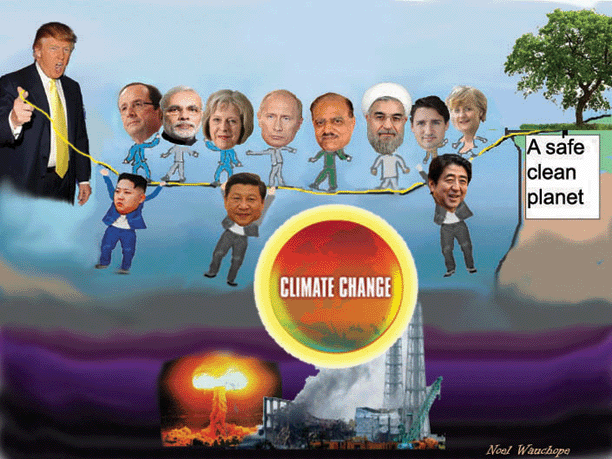 Trump just cemented his legacy as America’s worst-ever president https://www.theguardian.com/environment/climate-consensus-97-per-cent/2017/jun/01/donald-trump-just-cemented-his-legacy-as-americas-worst-ever-president Dana Nuccitelli
Trump is doing his best to ruin the world for our children and grandchildren
In an inexplicable abdication of any semblance of responsibility or leadership, Donald Trump has announced that he will begin the process to withdraw the United States from the Paris climate treaty, joining Nicaragua and Syria as the only world countries rejecting the agreement. It now seems inevitable that the history books will view Trump as America’s worst-ever president.
However, withdrawing from the Paris treaty is an important symbolic move – a middle finger to the rest of the world, and to future generations. America is by far the largest historical contributor to climate change. Ironically, on the heels of Trump’s claim that most NATO members aren’t paying their fair share to the organization, America has announced that we won’t do our fair share to curb the climate change threats that we are the most responsible for.
The Rotting Republican Party
And the GOP has become the Party of Trump. His decision was reinforced by a letter from 22 Republican senators urging withdrawal from the Paris climate treaty. Those senators have coincidentally received over $10m in donations from the fossil fuel industry over the past five years.
Their reasoning was dubious at best, arguing that environmental attorneys will cite the international agreement in their efforts to prevent the Trump administration from eliminating President Obama’s Clean Power Plan. By law, the US government is required to regulate carbon pollution under the Clean Air Act, because it poses a threat to public welfare. The Republican Senators wrote:
As National Resource Defense Council climate and clean air program senior attorney David Doniger explained to me, this argument is nonsense:
They are making things up. EPA did not rely on Paris to justify the Clean Power Plan, and none of the parties defending the Plan has cited Paris as a legal basis. On Clean Air Act Section 115, no one I know has made, or even thought of, this argument.
It’s difficult to discern the Republican Senators’ motivations behind this letter. Even big oil and coal and many of America’s largest companies supported America staying in the Paris agreement. Industries don’t like the uncertainty involved in lurching in and out of international treaties, and experts are concerned about the effect on America’s international influence from tearing up this critically important agreement that we helped broker less than two years ago, that was signed by nearly every world country.
Perhaps the Republican Senators are trying to ride Trump’s nationalist, anti-globalist coattails. Maybe they think that their right-wing base will be excited if they stick it to the rest of the world on Paris. However, majorities of voters in every single county in the US support regulating carbon as a pollutant, and 71% of Americans (including 57% of Republicans) think the US should participate in the Paris agreement.
In short, efforts to pull out of the Paris treaty are woefully misguided, and almost everyone knows it. Everyone except 42% of Senate Republicans including leader Mitch McConnell, James Inhofe, Rand Paul, Ted Cruz, and of course Trump’s senior advisor Steve Bannon and his EPA administrator Scott Pruitt. Additionally, the Koch brothers and Vladimir Putin are not fans of the treaty. Those two factors may best explain this decision by Trump and the Republican senators.
Good luck kids, you’ll need it
Political calculations aside, pulling America out of the Paris agreement is grossly immoral. Human-caused climate change puts the well-being of our children and grandchildren at risk. That’s especially true for poorer countries that lack the resources to adapt to its impacts, and that contributed the least to the problem. However, the move will also hurt the American economy, as Joseph Robertson wrote on these pages earlier this week:
With China, India, and the EU all moving toward record investments in clean energy and high-efficiency construction, transport and industrial production, withdrawal from the Paris Agreement risks making the US into an economic backwater. Withdrawal would effectively deprive American businesses and communities of the most efficient ways to boost investment, hiring, innovation, and return on investment.
Some Republican leaders are struggling to preserve their party’s credibility and viability. Senators John McCain (R-AZ) and Lindsey Graham (R-SC) warned against the withdrawal. 20 House Republicans have now joined the bipartisan Climate Solutions Caucus, whose goal is to craft economically beneficial climate policies that both parties can support. And a group of Republican elder statesmenincluding Secretaries of State and Treasury to Presidents Reagan, George HW Bush, and George W Bush met with the White House seeking support for a revenue-neutral carbon tax plan.
So far, these leaders’ laudable efforts have failed. Trump and the majority of Republicans in Congress are doing everything they can to increase American carbon pollution. They want to repeal all of America’s climate policies with no replacement plan. In short, they’re happy to let the world burn, and for our children and grandchildren suffer the consequences.
2020 election will be a climate referendum
This is the rotten state of today’s GOP. They’re happy to sell out the future of humanity for their own short-term political gain. Noam Chomsky was right – the Republican Party may be the most dangerous organization in human history. This move comes at a time when the need to act on global warming has been clear for decades, but the GOP has blocked all American climate policy efforts, and we’re now running out of time to avoid dangerous climate change.
America’s withdrawal from the Paris treaty will take four years, meaning that the 2020 election (and the 2018 midterms) will be a referendum on Trump’s decision today. American voters must send the world a signal in that election. In the meantime, it will be up to the rest of the world – particularly China and the EU – to take up the mantle of leadership on climate change that America has left behind.
1 This Month

of the week– Nuclear Reactor Information Task Force

14 May – online event From Bombs to Data Centres: the Face of Nuclear Colonialism
To see nuclear-related stories in greater depth and intensity – go to https://nuclearinformation.wordpress.com
-
Archives
- May 2026 (81)
- April 2026 (356)
- March 2026 (251)
- February 2026 (268)
- January 2026 (308)
- December 2025 (358)
- November 2025 (359)
- October 2025 (376)
- September 2025 (257)
- August 2025 (319)
- July 2025 (230)
- June 2025 (348)
-
Categories
- 1
- 1 NUCLEAR ISSUES
- business and costs
- climate change
- culture and arts
- ENERGY
- environment
- health
- history
- indigenous issues
- Legal
- marketing of nuclear
- media
- opposition to nuclear
- PERSONAL STORIES
- politics
- politics international
- Religion and ethics
- safety
- secrets,lies and civil liberties
- spinbuster
- technology
- Uranium
- wastes
- weapons and war
- Women
- 2 WORLD
- ACTION
- AFRICA
- Atrocities
- AUSTRALIA
- Christina's notes
- Christina's themes
- culture and arts
- Events
- Fuk 2022
- Fuk 2023
- Fukushima 2017
- Fukushima 2018
- fukushima 2019
- Fukushima 2020
- Fukushima 2021
- general
- global warming
- Humour (God we need it)
- Nuclear
- RARE EARTHS
- Reference
- resources – print
- Resources -audiovicual
- Weekly Newsletter
- World
- World Nuclear
- YouTube
-
RSS
Entries RSS
Comments RSS
 nuclear-news