
 Nuclear experts warn of a march to war with North Korea, Salon,com Ex-nuclear commanders from around the world are urging Trump to engage in talks with North Korea instead, MATTHEW ROZSA, 29 June 17, A group of ex-nuclear commanders issued a strong warning on Wednesday that pointed out the world is at the precipice of a potential nuclear war, and urged America to open up dialogue with North Korea.
Hailing from China, India, Pakistan, Russia and the United States, the Nuclear Crisis Group determined “that the risk of nuclear weapons use, intended or otherwise, is unacceptably high and that all states must take constructive steps to reduce these risks.” They called on the United States and NATO to establish military-to-military talks with Russia and recommended that India and Pakistan set up a nuclear hotline.
The group was created earlier in 2017 with the approval of Global Zero, an arms control group that ultimately wants to abolish nuclear weapons.
The letter came as H. R. McMaster, President Donald Trump’s national security adviser, told reporters during a security conference with Homeland Security Chief John Kelly on Wednesday that “the [North Korean] threat is much more immediate now and so it’s clear that we can’t repeat the same approach – failed approach of the past.”…. http://www.salon.com/2017/06/29/nuclear-experts-warn-of-a-march-to-war-with-north-korea/
June 30, 2017
Posted by Christina Macpherson |
North Korea, politics international, USA |
Leave a comment
 Paris deal ‘non-negotiable’: Merkel, Herald Sun ,Deutsche Presse Agentur, June 29, 2017
The Paris climate agreement is “irreversible and non-negotiable,” Chancellor Angela Merkel says, ahead of the Group of 20 summit in Hamburg.
The European Union’s remaining 27 members have expressed their “unequivocal” commitment to the accord despite the United States’ decision to leave, Merkel told the Bundestag.
President Donald Trump announced earlier this month that the US would cease participation in the 2015 agreement to halt climate change.
In an implicit reference to Trump, Merkel said that those “who believe the problems of this world can be solved though isolationism and protectionism are sorely mistaken – only together will we manage to find the right answers to the central questions of our time.”……
Merkel is hosting the G20 summit on July 7-8, which will bring together leaders including Trump, Russian President Vladimir Putin and Turkish President Recep Tayyip Erdogan. http://www.heraldsun.com.au/news/breaking-news/paris-deal-nonnegotiable-merkel/news-story/3c17b77023b201e41fcc16d9a7c2e1a9
June 30, 2017
Posted by Christina Macpherson |
2 WORLD, climate change, politics international |
Leave a comment
https://www.theguardian.com/world/2017/jun/26/iran-nuclear-deal-must-be-allowed-to-thrive Dr T Douglas Reilly, Los Alamos, New Mexico, USA, 25 June 17 T Douglas Reilly draws on his experience with the International Atomic Energy Agency to praise the Iran nuclear deal, while David Gleeson wonders why Tehran is so often cast as the villain on the world stage
The Joint Comprehensive Plan of Action (JCPOA), also known as the Iran nuclear deal) is excellent; it is far better and more extensive than I ever expected (Don’t upset the balance of power in the Middle East, 23 June). If followed by all parties, it blocks all avenues for Iran to develop nuclear explosives. To be sure, it is vehemently opposed by Israel’s prime minister Netanyahu and Republicans in Congress.
I am a physicist who worked in nuclear safeguards and non-proliferation for 38 years at the Los Alamos national laboratory; the majority of my efforts were for and with the International Atomic Energy Agency (IAEA) that has the responsibility of inspecting the nuclear facilities of states signatory to the nuclear non-proliferation treaty (NPT). Among other things, I developed programmes that have been part of the initial IAEA inspectors’ training since 1980. I’ve trained many of the inspectors who inspect Iran today, and have inspected Iran’s facilities since it signed and ratified the NPT shortly after it came into force in 1970.
There are only three nations that have not signed the NPT: India, Israel, and Pakistan. All three have large nuclear arsenals and effective delivery capabilities. Israel has over 400 nuclear weapons of all types and the ability to deliver them anywhere in the world, including the US. Israel also has a policy known as the Samson Option that implies it will destroy the world if ever it feels in danger of falling.
David Gleeson, London, Ali Akbar Salehi’s piece was a calm, reasoned argument for the JCPOA to be allowed to thrive, despite the expected noises from Trump and his ilk. Why is Iran so often seen as the enemy? The country is stable and calm and – much to the annoyance of its detractors – has regular elections that the Iranian people deem worthwhile participating in. Saudi Arabia, on the other hand…
June 28, 2017
Posted by Christina Macpherson |
Iran, politics international |
Leave a comment
Iran’s Nuclear Chief Warns U.S. Against Tilting Power Balance In Middle East https://www.rferl.org/a/iran-nuclear-chief-wars-us-against-tilting-power-balance-middle-east-saudi-arms-sales-/28576396.html, 24 June 17 Iran’s atomic energy chief Ali Akbar Salehi, who helped forge the 2015 nuclear agreement, warned the United States on June 23 against upsetting the balance of power in the Middle East by siding with arch-rival Saudi Arabia.

Writing in The Guardian newspaper, Salehi said Tehran views a “lavish” deal U.S. President Donald Trump’s administration recently announced to sell Saudi Arabia $110 billion in weapons as “provocative.”
“This is especially the case if the national defense efforts of Iran…are simultaneously opposed and undermined,” he said, alluding to steps the Trump administration has taken to increase U.S. sanctions on Iran for developing ballistic missiles even as it has ramped up arms sales to Riyadh and its allies.
“It would be unrealistic to expect Iran to remain indifferent to the destabilizing impact of such conduct,” said Salehi, an MIT graduate who has also served as Iran’s foreign minister and was a senior negotiator on the nuclear deal.
Salehi stressed that Washington’s strong tilt toward Tehran’s rivals in the Middle East not only risks setting off a regional arms race and “further tension and conflict” in the region, but it imperils the “hard-won” nuclear deal, which took two years to negotiate.
If the nuclear deal is to survive, he said the West must change course. “The moment of truth has arrived.”
Trump and the Saudis frequently blame Iran for wars ranging from Yemen to Syria, as well as for restive minority Shi’ite populations within the borders of the kingdom and other Persian Gulf states ruled by Sunni Muslims.
The Saudis, like Trump, were strongly opposed to the nuclear deal. But while Trump has promised to “dismantle the disastrous deal,” he has not so far taken any concrete steps to do so. His administration has indicated it will adhere to the deal, which requires Iran to curb its nuclear activities in exchange for the lifting of international sanctions, as long as Tehran continues to do so.
But Salehi’s article in the Guardian suggested that — what Iran says is — its so-far strict honoring of the deal may come into doubt in the future if the United States continues to disregard Iran’s “genuine security concerns” and “stokes Iranophobia” in the region.
Salehi urged the United States and its Western partners to “save” the nuclear deal with “reciprocal gestures” showing a commitment to engagement with Iran.
Iranian voters recently showed their preference for engagement with the West by re-electing President Hassan Rohani with his pro-Western platform, but “engagement is simply not a one-way street and we cannot go it alone,” Salehi said.
“Unfortunately, as things stand at the moment in the region, reaching a new state of equilibrium might simply be beyond reach for the foreseeable future,” he said.
June 27, 2017
Posted by Christina Macpherson |
MIDDLE EAST, politics international, USA |
Leave a comment
The Saudi war in Yemen is really directed at…Iran. Donald Trump’s first overseas visit to Saudi Arabia and Israel was specifically targeted at… Iran. The Saudi-led isolation of Qatar is actually about… Iran.
The escalation of U.S. military actions against the Syria government is… well, do I really need to spell this out any further?
Donald Trump has identified several number-one enemies to target. Throughout the campaign, he emphasized the importance of throwing the full weight of the Pentagon against the Islamic State. More recently, his secretary of defense, Jim Mattis, identifiedNorth Korea as “the most urgent and dangerous threat to peace and security.”
Other threats that have appeared at one time or another in the administration’s rotation include China, Cuba, the mainstream media, former FBI director James Comey, and Shakespeare (for writing Julius Caesar and then somehow, from the grave, persuadingthe Public Theater to run a scandalous version of it).
Through it all, however, Iran has loomed as the primary bogeyman of the Trump crowd. Fear of Iranian influence has prompted the administration to all but cancel the 2015 nuclear deal, intensify a number of proxy wars, consider pushing for regime change in Tehran, and even intervene in the mother of all battles between the Shia and Sunni variants of Islam.
You’re worried about Trump and the nuclear football? The prospect of blowback from an all-out U.S. assault on the Islamic State keeps you up at night? A preemptive strike against North Korea, which Mattis acknowledges would be disastrous, has you rethinking that upcoming trip to Seoul?
Sure, those are all dystopian possibilities. But if I had to choose a more likely catastrophe, it would be a direct confrontation between the United States and Iran. After all, everything seems to be pointing in that direction.
The nuclear deal that Iran signed with the five permanent members of the UN Security Council plus Germany and the European Union is hanging by a thread. Trump made no bones about his distaste for this Joint Comprehensive Plan of Action (JCPOA). He promised to tear it up.
He hasn’t done so. It’s not just that he’s gotten pushback from the usual suspects in Washington (diplomats, foreign policy mavens, talking heads, journalists). Even members of his inner circle seem to see value in the agreement. Mattis, who is otherwise hawkish on Iran, has stood by the JCPOA and diplomacy more generally. Secretary of State Rex Tillerson has, albeit reluctantly, acknowledged that Iran has lived up to its side of the agreement. Then there are all the American jobs on the line from the Iranian purchase of Boeing jets.
Even though Trump hasn’t torn up the agreement, he has certainly attempted to give it a good crumple. He has directed the Treasury Department to apply additional sanctions on Iran’s missile program. He’s considering the option of declaring the Revolutionary Guards a terrorist organization. Congress, meanwhile, is pursuing its own complementary set of sanctions against Iran (though, because it’s bundled with sanctions against Russia, the legislation may not meet Trump’s approval).
None of this violates the terms of the JCPOA. But it challenges the spirit of the accord.
Adding insult to injury, Trump damned Iran with faint condolences after the recent terrorist attacks in Tehran. “We grieve and pray for the innocent victims of the terrorist attacks in Iran, and for the Iranian people, who are going through such challenging times,” Trump wrote. “We underscore that states that sponsor terrorism risk falling victim to the evil they promote.”
Talk about bad taste. After September 11, Iranians gathered for candlelight vigils to mourn the mostly American victims of the attacks. The Iranian government didn’t say anything about chickens coming home to roost after U.S. military interventions in the Middle East, for that would have been inappropriate (though accurate).
But Iran might yet have to make a statement that echoes Trump’s tone-deaf remark: States that tear up international agreements risk falling victim to the evil they promote.
The conflict is escalating in Syria, where Iran backs the regime of Bashar al-Assad and the United States supports a shifting set of anti-regime groups.
Both countries could decide to team up against the Islamic State. And indeed, Iran launched a missile attack against ISIS in Syria this last weekend in retaliation for the terrorist attacks in Tehran. As after September 11, when Tehran and Washington briefly worked together, cooperation against Sunni extremists would seem a no-brainer.
But the would-be caliphate, having lost most of Mosul and now teetering on the verge of conceding its capital in Raqqa, is shrinking at a rapid clip. Which may well explain why the United States has been wading deeper into the Syrian conflict. For the first time since the war in Syria began, U.S. forces shot down a Syrian government plane this last weekend. It’s only the latest in a series of attacks on Assad’s forces, according to The Atlantic:
Three times in the last month, the U.S. military has come into direct conflict with the combined forces of the Assad regime, Iran-supported Shiite militias, Hezbollah, and possibly even Iran’s elite Islamic Revolutionary Guards Corps. The clashes have reportedly resulted in the deaths of a small number of pro-regime forces, and are much more strategically important than the much-ballyhooed U.S. air strike on the al-Shayrat airfield back in April in response to the Assad regime’s use of chemical weapons.
Several administration figures, notably Ezra Cohen-Watnick and Derek Harvey in the National Security Council, are eager to confront Assad and his Iranian backers more aggressively. Mattis, however, has reportedly opposed several of their risky propositions. Regardless of the Pentagon chief’s somewhat more risk-averse behavior, both Iran and the United States are maneuvering to control as much territory as possible in the vacuum created by the collapse of ISIS………
Back in 2013, Trump said,
We will end up going to war with Iran because we have people who don’t know what the hell they are doing. Every single thing that this administration and our president does is a failure.
Who knew that Donald Trump could be so prescient? The president has proven himself high-performing in at least this one regard: self-fulfilling prophecies.http://www.huffingtonpost.com/entry/the-coming-war-with-iran_us_594ec1fce4b0f078efd9821c
June 27, 2017
Posted by Christina Macpherson |
Iran, politics international, USA, weapons and war |
1 Comment
 PM Modi-Trump talks: Civil nuclear deal to figure, no pact on reactors,Time of India.| Jun 25, 2017,
 HIGHLIGHTS
June 26, 2017
Posted by Christina Macpherson |
India, politics international, USA |
Leave a comment
Trump to Call for U.S. ‘Dominance’ in Global Energy Production, Bloomberg By Jennifer A Dlouhy, 25 June 2017
Donald Trump will tout surging U.S. exports of oil and natural gas during a week of events aimed at highlighting the country’s growing energy dominance.
The president also plans to emphasize that after decades of relying on foreign energy supplies, the U.S. is on the brink of becoming a net exporter of oi l, gas, coal and other energy resources.
As with previous White House policy-themed weeks, such as a recent one focusing on infrastructure, the framing is designed to draw attention to Trump’s domestic priorities and away from more politically treacherous matters such as multiple investigations into Russian interference in the 2016 election.
With “Energy Week,” Trump is returning to familiar territory — and to the coal, oil, and gas industries on which he’s already lavished attention. Trump’s first major policy speech on the campaign trail, delivered in the oil drilling hotbed of North Dakota in 2016, focused on his plans for unleashing domestic energy production. The issue has also been a major focus during Trump’s first five months in office, as he set in motion the reversal of an array of Obama-era policies that discourage both the production and consumption of fossil fuels.
Plans for the week were described by senior White House officials speaking on condition of anonymity because the details hadn’t yet been formally announced.
Exports Equal Influence
Trump is set to deliver a speech at the Energy Department on Thursday focused almost entirely on energy exports ……
Dominance’ Sought
Trump’s theme of “energy dominance” marks an evolution. For years, the catch phrase of choice has been “energy independence,” as politicians and industry officials sought to highlight how a new era of abundance was helping the U.S. wean itself from foreign sources of oil and natural gas.
That was in turn a dramatic change from the 1970s, when former President Jimmy Carter turned down the White House thermostats and used a televised address in February 1977 to urge consumers to conserve energy …..https://www.bloomberg.com/news/articles/2017-06-25/trump-to-call-for-u-s-dominance-in-global-energy-production
June 26, 2017
Posted by Christina Macpherson |
politics international, USA |
Leave a comment

 Britain’s Brexit plan will plunge its nuclear power plants, cancer
treatment centres and leading research facilities into chaos within two
years, according to a secret government assessment.
Times 26th June 2017, The UK plans to pull out of Euratom, Europe’s nuclear body, at the same time as it leaves the EU
in 2019. A bill to replace European safeguards with a British system of
oversight was published in last week’s Queen’s Speech.
However, experts say that this would not match the regime provided by the EU body, meaning that
plants, research facilities and hospitals may be unable to import
radioactive material after Brexit. Officials from the Department for
Business, Enterprise and Industrial Strategy have warned that it will take
seven years to replace the current set of agreements, The Times has been
told.
The delay would partly be caused by the fact that work on new
international treaties, for example with the US and Japan, cannot start
until new inspections standards are approved. Ministers have suggested
that, as with financial regulations, there could be a transition period
after Brexit to allow a new regime to be put in place, but experts say that
the complexity of the task is still not sufficiently realised.
The Nuclear Industry Association (NIA) will today step up calls for David Davis, the
Brexit secretary, to consider asking for Britain to remain an associate
member of Euratom instead. That option will worry some Tory MPs, because
some lawyers believe that it would require oversight by the European Court
of Justice or even for Britain to continue to take part in elections to the
European parliament. Tom Greatrex, the NIA chief executive, said the plans
did not “come anywhere close” to matching the scale of the problem.
https://www.thetimes.co.uk/edition/news/experts-warn-of-chaotic-fallout-from-post-brexit-nuclear-plan-mh8prkkdv
June 26, 2017
Posted by Christina Macpherson |
politics, politics international, UK |
Leave a comment
 China hails “positive signals” on Korean Peninsula nuclear issue http://news.xinhuanet.com/english/2017-06/23/c_136389835.htm Editor: Mengjie BEIJING, June 23 (Xinhua) — China on Friday hailed recent “positive signals” on the Korean Peninsula nuclear issue and called for addressing concerns of various parties in a balanced way.
Chinese Foreign Ministry spokesperson Geng Shuang made the comments in response to a question regarding remarks by a number of diplomats concerned about the issue.
The Democratic People’s Republic of Korea (DPRK) ambassador to India Kye Chun Yong said Wednesday the DPRK would not rule out suspending nuclear and missile tests if the United States abandoned the practice of holding large-scale military drills, according to media reports. The ambassador said Pyongyang was ready for negotiations with the United States at any time and without preconditions.
Meanwhile, a special advisor to President Moon Jae-in of the Republic of Korea (ROK) indicated a reduction of joint war games with the United States if the DPRK stopped nuclear and missile activities.
“China believes these positive messages are important for easing tension on the peninsula and for a solution to the issue through dialogue,” Geng said. Geng said the root of the Korean Peninsula nuclear issue was in security. He said the solution required comprehensive measures and addressing both the symptoms and root causes.
China proposed a “dual-track approach” to denuclearization on the Korean Peninsula, establishing a peace mechanism in parallel, and a “suspension for suspension” to defuse the looming crisis.
As a first step, Pyongyang may suspend its nuclear and missile activities in exchange for the suspension of large-scale Washington-Seoul military exercises.
China has also called for strengthening efforts on non-proliferation and promotion of peace talks to bring the nuclear issue on the Korean Peninsula to a peaceful settlement.
“We are glad to see China’s proposals have gained increasing support and responses,” Geng said.
China welcomes and encourages suggestions to help alleviate tension and confrontation, enhance communication and trust, and restart dialogue as soon as possible, Geng said.
He called for the international community to seize all possible opportunities, to promote the settlement of the issue through dialogue and consultations.
June 24, 2017
Posted by Christina Macpherson |
North Korea, politics international |
Leave a comment
Experts have expressed concern that these ambitious development plans are proceeding without adequate plans for disposal of nuclear waste. The Bellona Foundation, an organization that conducts independent research into international nuclear and environmental issues, has been critical of the lack of planning for nuclear waste processing and disposal, and has pointed out that dependency on Russia for nuclear fuel may leave countries particularly vulnerable in the event of a sour political climate.

 Russia and Nuclear Power http://www.eurasianet.org/node/84076,June 21, 2017 , by Emma Claire Foley,
June 23, 2017
Posted by Christina Macpherson |
marketing, politics international, Russia |
Leave a comment
 The Engineer 20th June 2017, Tom Greatrex, chief executive of the Nuclear Industry Association, argues
that any gap in the arrangements by which the UK nuclear industry
co-operates with the world could cause considerable disruption There’s a
common phrase popping up across many articles and interviews about Brexit
– ‘cliff edge’. Whether that’s the Institute of Directors, which
said the two-year timeframe is unlikely to be enough to sever ties and form
new trade deals; or EEF, the manufacturers’ organisation, calling for a
five-year transition period to ease the uncertainty for businesses,
they’ve all had this word in common.
The nuclear industry has also talked of an approaching cliff edge, a scenario backed by the both the Business,
Energy and Industrial Strategy Select Committee and the House of Lords
Science and Technology Committee.
That cliff edge was hidden in the smallprint of the supporting notes to the EU Withdrawal Bill, as it detailed how
the UK will also leave the European Atomic Energy Community – commonly
known as Euratom – at the same time as leaving the EU. Readers might say:
‘So what?’ All industries are under pressure.’ But, Euratom is a fairly unique proposition for the government to contend with and the cliff edge in our scenario could bring nuclear trade to a halt. https://www.theengineer.co.uk/brexit-towards-the-nuclear-cliff-edge/
June 23, 2017
Posted by Christina Macpherson |
politics international, UK |
Leave a comment
UK Boycotts UN Nuclear Disarmament Talks to ‘Maintain Facade’ of Military Power, https://sputniknews.com/military/201706201054811611-uk-trident-nuclear-ban/ 19 June 17 Over 120 countries have gathered at the United Nations to discuss a treaty to ban nuclear weapons. Leading the boycott of the event is the US – perhaps unsurprisingly, given officials’ avowed dedication to maintaining Trident, the UK has also refused to dispatch an official representative to the event.
The event, which began June 15, is attended by a majority of the world’s governments, and is hoped to conclude with the inking of the landmark international agreement by July 7. Setsuko Thurlow, a Hiroshima survivor and disarmament hero, has said he believes the treaty can, and will, change the world.
In a statement, the International Campaign Against Nuclear Weapons said anything less than a categorical ban — requiring nuclear-armed countries to destroy their stockpiles in a time-bound, verifiable manner — would fundamentally fail in its objectives.
Despite the talks’ boycott by the US, UK and others, the treaty’s prospects appear positive. In all, 113 UN member nations voted to convene the talks in December 2016, and some nuclear weapon states appear receptive, or at least not totally opposed, to the prospect, with China, India, and Pakistan all abstaining — and attending the subsequent talks.
The ban of many forms of weaponry has been proven largely effective — numerous chemical and biological weapons, cluster munitions, and landmines have all been banned, precipitating full-scale decommissioning and disarmament, and their virtual disappearance from military arsenals and battlefields.
The UK’s refusal to even attend the talks is puzzling, as a YouGov poll suggests 75 percent of the public is in favor of officials doing so. However, the UK’s determination to maintain Trident at all is arguably puzzling in itself.
A 2014 cross-party parliamentary report on Trident was unambiguous — the UK’s “independent” nuclear deterrent is in no way independent, and a “hostage to American goodwill.”
Moreover, the report’s authors suggested Trident would only ever be effective in cases of “nuclear blackmail” — which they acknowledged, the prospects of which would be slim. Their conclusions were also damning of many key myths used to justify Trident’s maintenance, and called for UK leaders to step up efforts to promote multilateral nuclear disarmament, and consider further steps to reduce Britain’s operational stockpile of nuclear warheads.
“The fact that, in theory, the Prime Minister could give the order to fire Trident missiles without getting prior approval from the White House has allowed the UK to maintain the facade of being a global military power. In practice, it is difficult to conceive of any situation in which a Prime Minister would fire Trident without prior US approval. The USA would see such an act as cutting across its self-declared prerogative as the world’s policeman, and would almost certainly make the UK pay a high price for its presumption,” the report said.
As the UK is completely technically dependent on the US for the maintenance of the Trident system, presumably one way the USA could demonstrate its displeasure would be to cut off the technical support needed for the UK to continue to send Trident to sea, robbing the country of any nuclear deterrent at all.
“In practice, the only way Britain is ever likely to use Trident is to give legitimacy to a US nuclear attack by participating in it. There are precedents for the USA using UK participation in this way for conventional military operations. The principal value of the UK’s participation in the recent Iraq war was to help legitimise the US attack. Likewise the principal value of the firing of UK cruise missiles as part of the larger US cruise missile attack on Baghdad was to help legitimise the use of such weapons against urban targets,” the report concluded.
Despite these findings, Trident continues to be deemed fundamental to the UK’s security, a particularly hot topic over the course of 2017, given the spate of terrorist attacks that have rocked the country North to South on an almost monthly basis since March.
After every atrocity, ministers have issued ringing declarations about the need to modernize the UK’s defenses against the threat of terror, in all its forms. However, Trident has been entirely absent from these discussions — officials have instead typically pushed for greater internet regulation, an end to encryption and enhanced surveillance powers for the intelligence services.
The reason for Trident’s dearth in these matters is obvious — it cannot defend against these attacks, and demonstrably has not done so, whether they are conducted by lone bombers, crazed car and van drivers or knife wielding maniacs. Evidently, such sources of violence pose a far greater threat to the country’s security than nuclear weapons — as do cyberattacks, which again Trident seems fundamentally ill-equipped to combat.
The election of Jeremy Corbyn — former Campaign for Nuclear Disarmament Vice President — as Labour leader likely offered much hope to the UK’s assorted anti-nuclear campaigners, although they were surely bitterly disappointed when a pledge to renew Trident wormed its way into Labour’s election manifesto.
Corbyn’s seeming slippage may be attributable to the unending chorus of Conservative broadsides launched at him on the issue ever since his election in September 2015 — a wave that reached a crescendo when Defense Secretary Michael Fallon suggested Corbyn wasn’t up for the job of Prime Minister due to his refusal to launch a pre-emptive nuclear strike against a “hostile” nation.
Moreover, there are clear suggestions the UK public doesn’t hold Trident in such high affinity as the country’s ruling class — a July 2016 poll demonstrated that while 51 percent backed full renewal of the system, 49 percent opposed maintaining any system. In time, a greater swath of the populace may come round to the view that the UK’s need for a nuclear, as destructive as it is illogical, is non-existent
June 21, 2017
Posted by Christina Macpherson |
politics international, UK, weapons and war |
Leave a comment
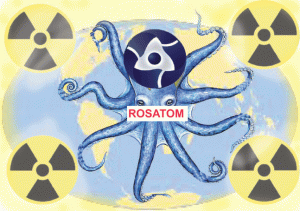 Russia’s Rosatom says no ‘secret deal’ with South Africa http://af.reuters.com/article/energyOilNews/idAFR4N1JC007 Jun 20, 2017, MOSCOW, – Deputy chief executive officer of Russia’s state nuclear firm Rosatom Kirill Komarov told a briefing on Tuesday that there was no “secret deal” between Russia and South Africa over nuclear projects.
He also said the nuclear pact between two countries from 2014 was standard for such circumstances.
Russia and South Africa discussed joint nuclear projects but those plans were disrupted after South Africa’s High Court deemed a nuclear cooperation pact with Russia unlawful earlier this year. (Reporting by Alexander Winning; writing by Maria Tsvetkova; editing by Vladimir Soldatkin)
June 21, 2017
Posted by Christina Macpherson |
politics international, Russia, South Africa |
Leave a comment
Russia’s Rosatom sells 49 percent stake in Akkuyu nuclear project to Turkish companies, Hurriyet Daily News, 19 June 17 MOSCOW, Russia’s state-owned nuclear energy conglomerate Rosatom agreed to sell a 49 percent stake in a giant nuclear project in southern Turkey to Turkish investors in a preliminary agreement on June 19 on the sidelines of a nuclear conference in Moscow.
The stake in the Akkuyu project was sold for an undisclosed sum to the three Turkish companies Cengiz, Kolin and Kalyon, dubbed CKK as a consortium, which are quite active in construction and energy sectors. Each of these companies will have an equal stake.
The shareholders’ agreement will be signed by the end of the year, the consortium said in a follow-up press release. The sum of the deal is then expected to be revealed, according to the press release.
Turkey and Russia signed an intergovernmental agreement to build and operate a nuclear power plant in the southern province of Mersin’s Akkuyu in 2010. According to the agreement, Russian companies would own a minimum of 51 percent of stake in the nuclear power plant, marking a first in Turkey.
The respective parties are planning to start construction this year. ……http://www.hurriyetdailynews.com/russia-sells-stake-in-akkuyu-nuclear-plant-project-in-turkey—–.aspx?pageID=238&nID=114520&NewsCatID=348
June 21, 2017
Posted by Christina Macpherson |
politics international, Russia, Turkey |
Leave a comment
Overcoming Nuclear Crises: North Korea and Beyond http://www.globalresearch.ca/overcoming-nuclear-crises-north-korea-and-beyond/5594878, By Richard Falk and David Krieger Global Research, June 17, 2017
Global Justice in the 21st Century 15 June 2017 Alarmingly, tensions between the United States and North Korea have again reached crisis proportions. The United States wants North Korea to curtail any further development of its nuclear weapons program, as well as to stop testing its missiles. North Korea evidently seeks to bolster its security by acquiring a sufficiently robust deterrent capability to discourage an attack by the United States. The unpredictable leaders of both countries are pursuing extremely provocative and destabilizing patterns of behavior. Where such a dangerous interaction leads no one can now foresee. The risk of this tense situation spiraling out of control should not be minimized.
It is urgent that all governments concerned make a sober reassessment in a timely manner. The following questions need to be addressed: What can be done to defuse this escalating crisis? What should be done to prevent further crises in the future? What could be learned from recurrent crises involving nuclear weapons states?
It is discouraging that the White House continues to rely mainly on threat diplomacy. It has not worked in responding to North Korea’s nuclear ambitions for the past few decades, and it is crucial to try a different approach. Currently, there are mixed signals that such a shift may be underway. President Trump has turned to China, imploring that it use its leverage to induce Kim Jong-un to back down, and has even mentioned the possibility of inviting Kim for crisis-resolving talks. Also relevant and hopeful is the election of Moon Jae-in as the new president of South Korea, and his insistent calls for improved relations with the North.
In the end, no reasonable person would opt for another war on the Korean Peninsula. The only rational alternative is diplomacy. But what kind of diplomacy? American reliance on threat and punitive diplomacy has never succeeded in the past and is almost certain to fail now. We assuredly need diplomacy, but of a different character.
It is time to abandon coercive diplomacy and develop an approach that can be described as restorative diplomacy. Coercive diplomacy relies on a zero/sum calculus consisting of military threats, sanctions, and a variety of punitive measures. Restorative diplomacy adopts a win/win approach that seeks to find mutual benefits for both sides, restructuring the relationship so as to provide security for the weaker side and stability for the stronger side. The challenge to the political imagination is to find the concrete formula for translating this abstract goal into viable policy options.
The basic shift is a mental recognition that in the context of the Korean Peninsula any military encounter, whether nuclear or non-nuclear, is a recipe for catastrophe. It is not a win or lose situation. It is lose/lose in terms of human suffering, devastation, and likely political outcome. If nuclear weapons are used by either or both sides, millions of casualties could occur and the wider consequences an unprecedented disaster.
While there have been suggestions from the Trump administration that the time for talk with North Korea is over, actually the opposite is true. A solution to the present Korean crisis would involve an immediate return to the negotiating table with positive inducements made by the U.S. in exchange for North Korea halting its development of nuclear weapons and missile testing. Such incentives could include, first and foremost, bilateral and regional security guarantees to the North Korean government, ensuring that the country would not be attacked and its sovereignty respected. This could be coupled with confidence-building measures. The U.S. and South Korea should halt their joint annual military exercises in the vicinity of North Korea, as well as forego provocative weapons deployments. In addition, the U.S. and possibly Japan could offer North Korea additional benefits: food, medicine, and clean energy technology. China could play a positive role by hosting the negotiations, including possibly inviting the new leader of South Korea to participate.
Beyond resolving the current crisis is the deeper challenge to prevent recurrent crises that pit nuclear weapons states against one another. There is no way to achieve this result so long as some countries retain, develop, and deploy nuclear weapons, and other countries are prohibited from acquiring such weaponry even if their security is under threat. Iraq and Libya arguably suffered from the consequences of not having nuclear weapons to deter attacks against them.
The only way out of this trap is to recognize that the nuclear nonproliferation regime has failed. The treaty provisions calling for nuclear as well as general and complete disarmament negotiations have been neglected for nearly a half century. Outside the terms of the Nuclear Non-Proliferation Treaty, the United States has acted as an enforcer of a nuclear nonproliferation regime. Such a role motivated the U.S. attack on Iraq in 2003 with its disastrous impacts on the country and the entire Middle East. It also underlies the current crisis pitting Washington’s demands against Pyongyang’s provocations. Hard power approaches to such dangerous developments have a dismal record, and pose unacceptable risks of regional and global havoc.
To prohibit and eliminate nuclear weapons epitomizes prudence in the Nuclear Age. It is the only way to prevent a crisis between nuclear-armed opponents turning into a nuclear catastrophe. Such behavior would constitute an act of sanity for humanity and its future given the extreme dangers of nuclear weapons, the periodic crises that erupt among nuclear-armed countries, and the growing odds of nuclear weapons being used at some point. Yet for smaller, weaker nuclear weapons states to go along with this approach, the United Nations Charter and international law must be respected to the point that regime-changing geopolitical interventions by dominant states are convincingly rejected as a reasonable policy option.
Any use of nuclear weapons would be catastrophic.. Depending upon the extent of the nuclear exchange, cities, countries, civilization, and even all complex life, including the human species, would be at risk. Experts anticipate that a nuclear war between India and Pakistan in which 100 Hiroshima-size nuclear weapons were used against cities would likely cause a nuclear famine taking two billion lives globally. An all-out nuclear war could be an extinction event for complex life, including humanity.
Nine countries currently possess nuclear weapons (United States, Russia, United Kingdom, France, China, Israel, India, Pakistan and North Korea). Nine leaders could initiate nuclear war by mistake, miscalculation or malice. The future rests precariously in the hands of this small number of individuals. Such an unprecedented concentration of power and authority undermines democracy, as well as being extremely reckless.and irresponsible.
It is essential to maintain our focus on the challenges posed by the development of North Korean nuclear capabilities. At the same time, while struggling to defuse this crisis hanging over the Korean Peninsula, we should not lose sight of its connection with the questionable wider structure of reliance on nuclear weapons by the other eight nuclear-armed countries. Until this structure of nuclearism is itself overcome, crises will almost certainly continue to occur in the future. It is foolhardy to suppose that nuclear catastrophes can be indefinitely averted without addressing these deeper challenges that have existed ever since the original atomic attack on Hiroshima.
Richard Falk is Senior Vice President, Nuclear Age Peace Foundation, and Albert G. Milbank Professor of International Law Emeritus, Princeton University.
David Krieger is President, Nuclear Age Peace Foundation.
June 19, 2017
Posted by Christina Macpherson |
North Korea, politics international |
Leave a comment


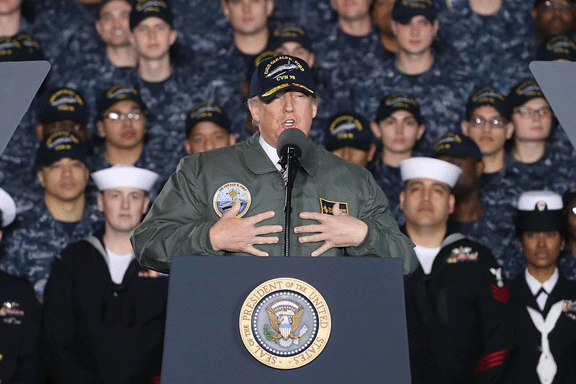
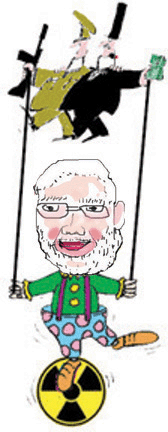
 l, gas, coal and other energy resources.




 nuclear-news