Trump: U.S. will withdraw from Paris climate accord
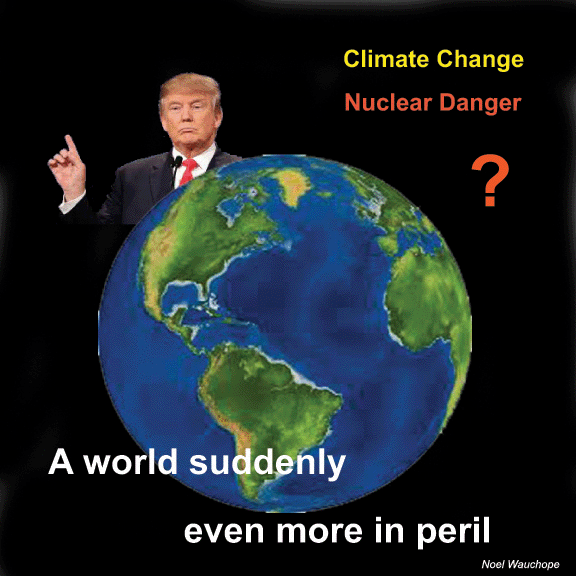
Paris climate deal: Donald Trump withdraws US from the accord, SMH, 2 June 17 Valerie Volcovici and Jeff Mason Washington: President Donald Trump on Thursday said he will withdraw the United States from the landmark 2015 global agreement to fight climate change, spurning pleas from US allies and corporate leaders in an action that fulfilled a major campaign pledge.
“We’re getting out,” Trump said at a ceremony in the White House Rose Garden in which he decried the Paris accord’s “draconian” financial and economic burdens.
“In order to fulfil my solemn duty to protect America and its citizens, the United States will withdraw from the Paris climate accord,” Trump said. But he added that the United States would begin negotiations to re-enter either the Paris accord or “a new transaction on terms that are fair to the United States, its businesses, its workers, its people, its taxpayers.”
With Trump’s action, the United States will walk away from nearly every nation in the world on one of the pressing global issues of the 21st century. The pullout will align the United States with Syria and Nicaragua as the world’s only non-participants in the accord.
The United States was one of 195 nations that agreed to the accord in Paris in December 2015, a deal that former US President Barack Obama was instrumental in brokering.
Supporters of the accord condemned Trump’s move as an abdication of American leadership and an international disgrace.
“At this moment, when climate change is already causing devastating harm around the world, we do not have the moral right to turn our backs on efforts to preserve this planet for future generations,” said US Senator Bernie Sanders, who sought the Democratic presidential nomination last year.
“Ignoring reality and leaving the Paris agreement could go down as one of the worst foreign policy blunders in our nation’s history, isolating the US further after Trump’s shockingly bad European trip,” Democratic Senator Sheldon Whitehouse added.
Former US president Barack Obama, who signed on to the accord, wasted no time in criticising Trump’s move. In a statement, Obama said the Trump administration was rejecting the future by pulling out of the climate pact……..
Under the pact, which was years in the making, nations both rich and poor committed to reducing emissions of so-called greenhouse gases generated by burning fossils fuels and blamed by scientists for warming the planet.
The United States had committed to reduce its emissions by 26 per cent to 28 per cent from 2005 levels by 2025. The United States, exceeded only by China in greenhouse gas emissions, accounts for more than 15 per cent of the worldwide total.
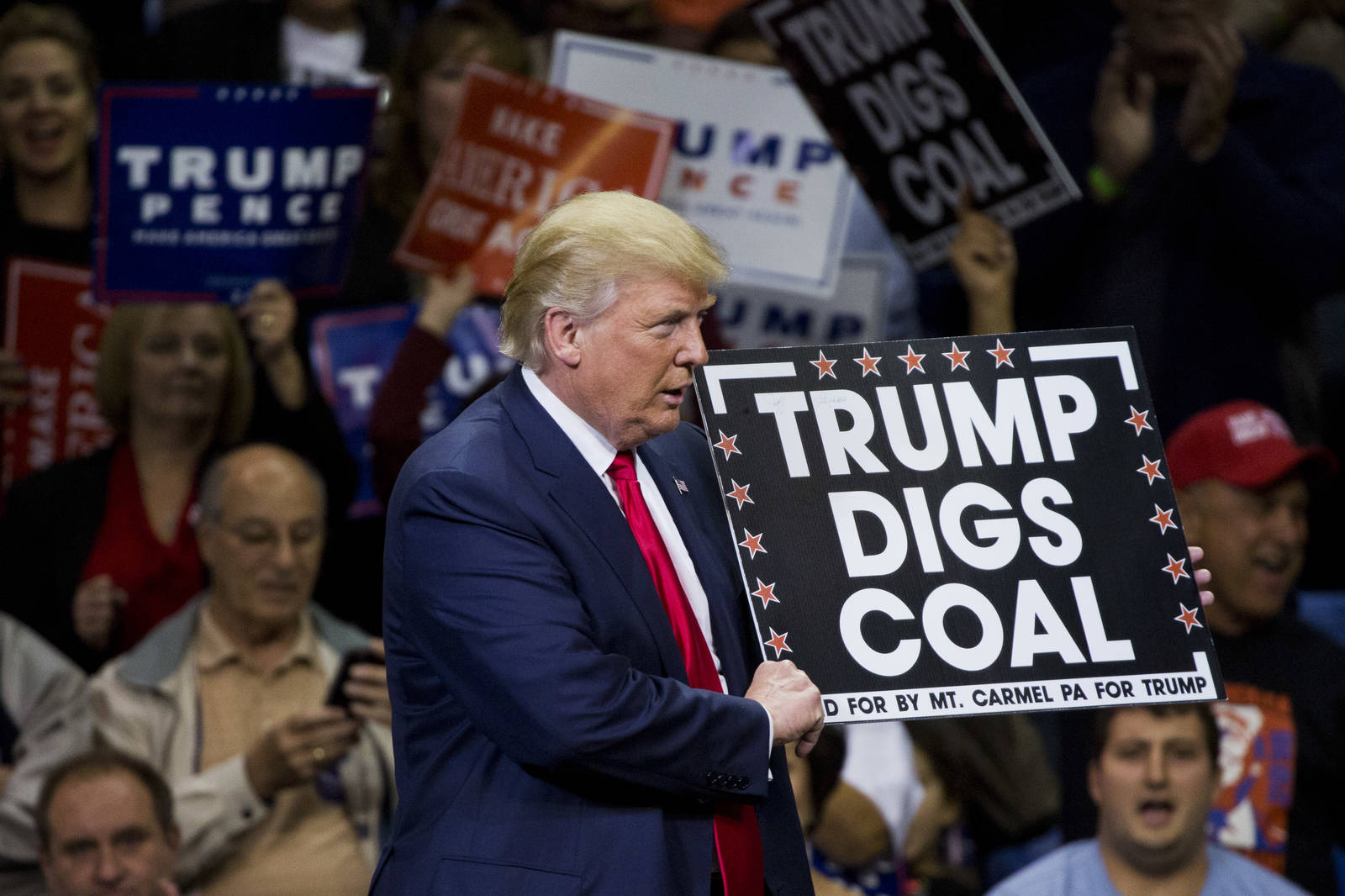
Trump, who campaigned for president last year with an “America First” message, promised voters an American withdrawal.
US supporters of the pact said any pullout by Trump would show that the United States can no longer be trusted to follow through on international commitments……..
In a statement backed by all 28 EU states, the EU and China were poised to commit to full implementation of the agreement, officials said.
Trump has already moved to dismantle Obama-era climate change regulations, including the US Clean Power Plan aimed at reducing emissions from main coal-fired power plants.
Some US states, including California, Washington and New York, have vowed to continue to reduce greenhouse gas emissions and continue engaging in the international climate agreement process.
Oil majors Shell and ExxonMobil Corp supported the Paris pact. Several big coal companies, including Cloud Peak Energy, had publicly urged Trump to stay in the deal as a way to help protect the industry’s mining interests overseas, though others asked Trump to exit the accord to help ease regulatory pressures on domestic miners. Reuters http://www.smh.com.au/world/paris-climate-deal-donald-trump-withdraws-us-from-the-accord-20170601-gwiord.html
While it fulfils Mr Trump’s election promise to pull out of the pact — which he has labelled a job killer — the announcement has caused widespread shock and outrage.
European leaders have condemned the decision and even big business is angry.
Former president Obama called the decision a “rejection of the future”, while former US vice president and ardent climate change campaigner Al Gore blasted Mr Trump’s move as “indefensible”.
“The worst part: There is absolutely no reason for it. Aside, perhaps, from bravado and arrogance,” he writes. Sutter said, in walking away from the agreement, Mr Trump was turning his back on the entire world and on the consensus of climate science. Continue reading →
Veteran Russian MP warns that Moscow could use nuclear weapons if the U.S. makes a move into Crimea, The Independent 1 June 17, Russia could use nuclear weapons to defend its position if forces led by the US or Nato make a move into Crimea, a veteran politician in the country has claimed.
“If US forces, Nato forces, are, were, in the Crimea, in eastern Ukraine, Russia is undefendable militarily in case of conflict, without using nuclear weapons in the early stage of the conflict,” Vyacheslav Alekseyevich Nikonov told a global security forum in Slovakia.
Mr Nikonov, who has served on the staff of Mikhail Gorbachev, Boris Yeltsin and Vladimir Putin, said that he had heard this at some point “from the Russian military”, according to Defense One.
He was speaking the GLOBSEC Bratislava Global Security Forum. The politician added that the west was “not just a force for good”, and said he was concerned about the lack of dialogue between Russia and the US and its allies to find a political solution. ……..
Although President Donald Trump has faced much criticism over his alleged links to Russia, US sanctions against the country remain in place over Crimea.
After Mr Trump’s initial overtures to Mr Putin, relations between Washington and Moscow have become more strained in recent weeks, with the White House reiterating America’s demand that Russia withdraws from Crimea.
Mr Nikonov said is worrying that US officials have been fired for talking to their Russian counterparts as this could cause relations between the superpowers to deteriorate further.
NORTH KOREA CLAIMS ‘MOST POWERFUL NUCLEAR WEAPON’ IN STORE FOR U.S. IF MILITARY DOES NOT BACK OFF, NewsWeek, BY TOM O’CONNORON 6/1/17 North Korea told the U.S. Thursday to withdraw its military assets from the region, warning via state-run media that a military showdown would end in nuclear destruction.
North Korea’s official Korean Central News Agency released an article titled “U.S. Urged Not to Adventure Military Actions,” in which an official tasked with inter-Korean relations criticized the U.S.’s military moves in the region. Japan, an ally of Washington and rival of Pyongyang, began major naval and air force exercises Thursday with the U.S.’s Carl Vinson and Ronald Reagon aircraft carriers, Reutersreported. The U.S. warships were dispatched to the region in response to suggestions that North Korea would conduct a sixth nuclear weapons test, something President Donald Trump has vowed to prevent. In a statement Thursday, a spokesperson for North Korea’s Korea Asia-Pacific Peace Committee said the U.S. military moves proved it was to blame for heightened regional tensions…….
North Korea argues its pursuit of nuclear weapons technology is for deterrence purposes. The nation is believed to possess up to 20 nuclear warheads as well as an extensive ballistic missile arsenal. Analysts do not believe North Korea will be able to produce a viable nuclear-capable intercontinental missile until at least 2020, but the militarized, authoritarian state is thought to be capable of launching nuclear attacks against neighboring nations, including South Korea and Japan, both of which host U.S. military installations and personnel.
The Trump administration announced Thursday additional economic sanctions targeting companies that allegedly play a role in North Korea’s development of nuclear weapons, according to the Los Angeles Times. The White House’s latest efforts to prevent North Korea from carrying out another nuclear weapons test through sanctions come as Trump seeks help from China, a traditional rival and North Korea’s greatest ally, to rein in the North’s nuclear ambitions. The presence of U.S. warships and ongoing military drills, however, could appear as a reminder of Trump’s willingness to use military force quickly and unexpectedly, as he did in Syria in April.
These actions have left North Korea and its young leader, Kim Jong Un, deeply suspicious of any U.S. attempts to establish a dialogue. Since Trump dispatched the naval aircraft carrier strike group in April, North Korea’s government-controlled media has been awash with criticism of U.S. foreign policy and reports of alleged U.S.-backed plots against Kim and his administration. The articles frequently cite North Korea’s weapons of mass destruction as being existentially necessary to the country’s survival, and assert the nation’s right to possess and develop them in the face of U.S. threats of intervention. In Thursday’s piece, the Korean Central News Agency called on Washington to reverse its course of action or face nuclear assault….http://www.newsweek.com/north-korea-us-stop-military-action-powerful-nuclear-weapon-619311
Russia signs deal to expand India’s Kudankulam nuclear plant https://uk.reuters.com/article/russia-economic-forum-india-nuclear-idUKL8N1IY5KRRussia signed an agreement with the Indian government on Thursday to build two new reactors for the Kudankulam nuclear power station in Tamil Nadu and said it would loan India $4.2 billion to help fund construction.
President Vladimir Putin says Russia is ready to build a dozen nuclear reactors in India over the next 20 years to back Prime Minister Narendra Modi’s growth strategy for Asia’s third-largest economy, which continues to suffer chronic power shortages.
The agreement to build reactors 5 and 6 at Kudankulam was signed in St Petersburg during a meeting between Putin and Modi at an economic forum. It should help cement already close ties between the two countries.
Atomstroyexport, a unit of Russian state nuclear corporation Rosatom, will carry out the work, Kremlin documents seen by Reuters showed.
Russian Finance Minister Anton Siluanov told reporters the Russian government was lending India $4.2 billion from next year for a 10-year period to help cover construction costs.
Separately, in a joint declaration, the two countries said they noted the “wider use of natural gas” which they hailed as an economically efficient and environmentally friendly fuel that would help reduce greenhouse gas emissions and help them fulfil the terms of the Paris climate change accord. (Reporting by Denis Pinchuk; Writing by Vladimir Soldatkin/Andrew Osborn; Editing by Alexander Winning)
Over the next three years, 30 nuclear reactors across Europe will reach their retirement age. Making the decision-making process over their future open and transparent is crucial.
One month ago, the Ukrainian government took an unexpected step. It invited neighbouring governments to participate in consultations regarding lifetime extension of nine of its nuclear reactors.
For more than four years Bankwatch and other civil society groups have been calling on Ukraine to recognise its obligations under the Espoo Convention (which provides a framework for environmental impact assessment in a transboundary context) and carry out public consultations. But at a time when public trust in government institutions across Europe is at a record low and given the major inconsistencies in the practice of transboundary consultations on nuclear issues, this is only the start of a test for public participation and transparency in Europe’s nuclear sector.
The upcoming Meeting of Parties (MOP) to the Espoo convention in June will be the battleground for anti-nuclear government to set clearer rules for applying the convention.
Not a box-ticking exercise
Ageing nuclear reactors are fast becoming a serious threat across Europe. In addition, rather than devising energy transition strategies and allocating the financial resources needed for decommissioning of outdated reactors, governments inside and outside the EU, often pushed by the nuclear industry’s lobbyists, choose to extend the lifetime of nuclear reactors beyond the expiration date of their licences.
Of Belgium’s seven nuclear units, three (Doel 1 and 2 and Tihange 1) have been granted 10-year life extensions. This move has sparked harsh reactions from neighbouring Germany over the lack of transboundary consultations, taking the Belgium government to court. Close by, both the Netherlands and the Czech Republic are being investigated by the Implementation Committee of the Espoo convention for the lifetime extension of Borselle and Dukovany nuclear reactors without consulting neighbouring states. On Europe’s eastern flank, Ukraine has already prolonged the operations of six reactors beyond their original lifetimes without conducting any transboundary consultations.
But this is not just about these four countries. No less than 30 nuclear reactors across Europe will reach their retirement age over the next three years. The inconsistent application of the Espoo Convention procedures for decisions on extending their lifetimes is thus a serious concern. In fact, the Convention’s implementation committee already ruled in 2013 that Ukraine extending the lifetime of two reactors (Rivne 1 and 2) was in breach of the international treaty due to the lack of environmental impact assessments and transboundary consultations.
When other governments saw Ukraine subsequently ignoring the ruling, continuing with lifetime extensions for four more nuclear units, they took it as justification for avoiding public scrutiny in decisions on lifetime extensions for their own reactors. This has led to a situation where since the Rivne decision in 2014, five new cases of incompliance have piled on the table of the Espoo implementation Committee, all following complaints from civil society and potentially affected countries.
The irregular application of the Espoo Convention is one of the subjects on the table for next month’s meeting of parties (MOP) to the convention. The situation in Ukraine has garnered particular interest in light of the large number of reactors with licences extended and the very limited progress made on ensuring public participation in lifetime extension decisions since the Rivne decision at the previous meeting. Ukraine’s notification on transboundary consultations received in late April by the governments of Romania, Hungary, Slovakia, Austria, Poland and Belarus, although an important first step, shows just that — the poor quality of environmental documentation and lack of guidance on how to apply the convention to nuclear lifetime extensions. The notification, supported by a handful of documents limited to non-technical summaries of environmental impact assessments (EIAs), is unclear about the purpose and the activity that is subject to transboundary consultations. As such it looks like little more than a lip service, in turn making neighbouring governments and citizens into rubber stamps for Kiev’s reckless nuclear energy enterprise.
Rather than allowing citizens and governments in neighbouring countries to have a say on the final decisions on nuclear units’ lifetime extensions, the Ukrainian notification only invites comments on some vague aspects of electricity production in Ukraine. This effectively renders the whole process meaningless. What’s more, of the nine reactors in question, four have already had their operation licenses extended, thus casting serious doubts over the point of these consultations.
The periodic Safety Reviews of the relevant nuclear units, the reports on safety upgrade measures, full EIAs for each reactor, are only some of the documents that have to be provided to the public for consultation and which are missing from the documents submitted for consultations by Ukraine. Transparency is a key condition to ensuring meaningful public participation as well as the timeliness of consultations, which ought to take place before the decisions on lifetime extension are made.
For civil society groups monitoring the situation as well as neighbouring governments that are currently commenting on the notification, the Ukrainian government still has to bring more clarity on the connection between the outcome of consultations and the decision-making processes on lifetime extensions which have already been granted in Ukraine. More clarity and additions need to be brought as well to the documentation which should be in line with the requirements of the EU directive on environmental impact assessment. Public participation in the decision-making on lifetime extension must not be a box-ticking exercise, but a genuine opportunity to consider alternative strategies, environmental sustainability as well as financial means for decommissioning of the plants, sooner or later.
The parties to the convention, including the representatives from the European Union, will not have the option of undermining the calls for more clarity, as was done at the previous MOP due to political pressure, and will have to endorse clear recommendations for how the convention should be applied to lifetime extensions.
These recommendations should be clear on the obligation to apply the convention to lifetime extension decisions, on the environmental documentation that has to accompany the notifications which needs to be in line with EU EIA directive and on the timeline and forms of consultations with the public, national and European. This is absolutely crucial for setting the grounds for current and future decision-making processes and for governments to not get away with sloppy consultation processes.
FT 28th May 2017 Brussels is expected to approve the takeover by French state-controlled utility EDF of the reactor business of Areva this week, clearing the path for a state-backed rescue deal that will reshape France’s nuclear industry.
Brussels antitrust watchdog is likely to sign off the deal on Monday, according to two people familiar with the situation, a green light that is needed before the French state can carry out the wider restructuring of Areva. Once Areva’s reactor business is acquired by EDF, what is left of Areva, mostly a uranium mining and nuclear fuel business, will then need only a sign-off of its new reactor in Flamanville in France to unlock a €5bn state-backed capital increase scheduled for later this
year.
EDF has agreed to acquire a majority stake in Areva NP, which designs, manufactures and services nuclear reactors, in a deal valuing the business at about €2.5bn. The deal will unite two of the companies responsible for building the UK’s Hinkley Point C nuclear plant, the country’s first new atomic power station for a generation, in a move executives say should help to avoid the kind of costly delays that have beset similar projects.
Nuclear power producer TVO, which owns the Finnish project, is concerned that after the EDF takeover, Areva might neglect Olkiluoto in favour of the EDF-led projects in Flamanville and Hinkley Point. The Finnish company is also facing the awkward balancing act of co-operating with Areva to finish the project while simultaneously pursuing the French company and its former partner, Siemens, for billions of euros in compensation for the delays. https://www.ft.com/content/d44b6476-4068-11e7-9d56-25f963e998b2
The Korean Peninsula: Ground Zero for Armageddon? May 30, 2017 By Simone Chun, Truthout | News Analysis Is the Korean Demilitarized Zone poised to become “ground zero for the end of the world”? Historian Bruce Cumings, the author of The Origins of the Korean War, raised this question in a recent article for the London Review of Books, and judging by a series of exchanges between the United States and North Korea in recent weeks, the possibility may not be as remote as it once seemed.
In April, North Korea warned of the imminence of “a thermonuclear war,” a prospect seemingly acknowledged by President Trump’s declaration that, “We could end up having a major, major conflict with North Korea.” On May 2, a US carrier strike group patrolled the waters off the Korean Peninsula in anticipation of North Korea’s sixth nuclear test, which never happened. Nevertheless, on May 14, Pyongyang test-fired a new class of missile into the waters between the North and neighboring Japan, prompting the US to move a second heavily armed carrier strike group, equipped with Aegis missile defense systems, to the Korean Peninsula. These two strike groups, which jointly field a total of some 160-attack aircraft and are escorted by substantial support fleets, considerably raise the stakes in the region.
According to Cumings, the latest high-stakes exchanges between the United States and North Korea are a continuation of six decades of US foreign policy which, “Since the very beginning … has cycled through a menu of options to try and control the [Democratic People’s Republic of Korea, or North Korea].” According to The New Yorker, in this asymmetric conflict, North Korea uses “belligerent propaganda — not to mention nuclear-tipped ballistic missiles” to counter what it perceives as a persistent existential threat from the United States.
Noam Chomsky has described the current situation as the logical outcome of the propensity of the United States to “play with fire” rather than making genuine efforts to achieve denuclearization: “Over and over again,” he observes, “There are possibilities of diplomacy and negotiation … which are abandoned, dismissed, literally without comment, in favor of increased force and violence.”
Republicans and Democrats have historically shown great unity in this approach toward North Korea, with the notable exception of the Clinton administration, whose direct talks with Pyongyang achieved an eight-year freeze on all North Korean plutonium production (from 1994-2002). However, in 2001, George W. Bush abruptly inducted North Korea into the “axis of evil,” prompting Pyongyang to withdraw from the Nuclear Non-Proliferation Treaty, and return to the reasoning that nuclear weapons alone could prevent an inevitable full-scale attack by the US in the future.
More recently, President Obama’s much-touted “pivot” to Asia — essentially a policy of isolating North Korea while boosting Japanese militarism — has succeeded only in laying the groundwork for a new regional cold war. Under the Trump administration, the pivot to Asia is overtly accelerating the militarization of the entire region, with some $7.5 billion being invested to boost infrastructure, equipment, and new troop and asset deployments. This amount accounts for nearly 14 percent of the total $54 billion increase in military spending requested by the Trump administration.
North Korea experts point out that, “Even with its nuclear program, North Korea is a weak country with an outdated military and a very small population,” incapable of anything but an insignificant military threat to the US. Yet US mainstream media pundits and government officials have tirelessly molded public perception of North Korea, portraying it as a determined, bristling adversary bent on raining destruction upon the US mainland with little or no provocation. Rounding out the propaganda image of the fearsomely irreconcilable foe, North Korean leadership itself is regularly depicted as irrational by the US, and often labeled with pseudo-psychiatric diagnoses. Most recently at the UN, US Ambassador Nikki Haley endeavored to display her psychiatric insight by “get[ting] into Kim Jong-un’s head,” and pronouncing him to be “in a state of paranoia … incredibly concerned about anything and everything around him.”
Such sophomoric appraisals of North Korea, while lacking historical and analytical perspective, play well to public fears. The characterization of North Korea as the unequivocally irrational and constantly threatening “other” have skewed US public opinion over the span of six decades. Pew public opinion polls show that “78% of Americans now have an unfavorable view of the North, with 61% holding a very unfavorable view.”…….
Nevertheless, American voices are increasingly calling for a new dialogue between the US and North Korea, for even though Americans by and large view North Korea as “the enemy,” an Economist/YouGov poll conducted in May 2017 found that 60 percent of Americans supported direct negotiations between the United States and North Korea. This statistic in itself speaks volumes, and shows that even in the worst of times, humans hope for commonality and view interpersonal interaction as a catalyst that has the potential of triggering positive change.
Officials on both sides of the Pacific have also begun renewed calls for dialogue amid heightening tensions. The new South Korean President Moon Jae-in was elected with a strong mandate for engagement with North Korea, and has promised a renewed emphasis on diplomacy and rapprochement. Even Pentagon chief James Mattis, noting the grave risks of open conflict, has reiterated the US commitment to working with allies in order to arrive at a diplomatic resolution to the nuclear stalemate.
As former Secretary of Defense William J. Perry recently noted, opportunities for peace and security in Northeast Asia still exist in the midst of conflict, awaiting only the political will and foresight to actualize them: “We now have the opportunity for a new approach to diplomacy. Will we have the wisdom to seize it?”
An overt shift toward diplomacy would be a welcome development for the many Koreans who still dream of an end to the painful schism imposed on their collective psyche by six decades of hostility and separation. David Kang, a Korean studies scholar at the University of Southern California, dreams of crossing the Korean Demilitarized Zone with his 81-year-old father to visit the site of the elder Kang’s hometown, which was destroyed during the height of the Korean War. “I would love to fly to Seoul with my father” he says, “and drive together to where he was born.”
Dr. Simone Chun has taught at Northeastern University in Boston, and served as an associate in research at Harvard University’s Korea Institute. She is an active member of the Korea Peace Network, and a member of the steering committee of the Alliance of Scholars Concerned about Korea.http://www.truth-out.org/news/item/40737-the-korean-peninsula-ground-zero-for-armageddon
The other Brexit has been forgotten: leaving Europe’s nuclear community is just as fraught with fissile hazard Telegraph 29th May 2017
The other Brexit has been forgotten. This parallel drama faces an equally dramatic cliff-edge in less than two years. It too is fraught with fissile hazard.
We are told almost nothing. The Conservative Party Manifesto does not mention Britain’s exit from European Atomic Energy Community (Euratom), which must automatically take place in conjunction with Brexit.
There is no outline of how the UK will seek to replace this arrangement, or what the emergency plan might be if we crash out of the system with no treaty access to nuclear fuel, services, and research.In such circumstances, Britain will cease to come under the international safeguards regime that makes nuclear business possible. It will struggle to acquire the isotopes used in medical radiation.
In a political sense this sounds implausible. In strict legal terms the UK will have the status of a pariah state under nuclear sanctions until the technicalities are sorted out.
If Britain has not locked in an alternative treaty structure or transition accord by March 2019, it will be cut adrift from the global
nuclear industry. Nobody will be allowed to deal with us. The House Business, Energy and Industrial Strategy Committee muddied the waters in a report earlier this month by suggesting that Downing Street is needlessly pulling out for ideological reasons, in order to escape the jurisdiction of the European Court (ECJ).
It cited testimony from Manchester University professor Grace Burke – an expert on nuclear materials – stating that leaving Euratom is “ill-informed, irresponsible and unnecessary”. The report said the Government had “failed to consider the potentially disastrous ramifications of its Brexit objectives for the nuclear industry. Ministers must act as urgently as possible. The repercussions of failing to do so are huge.”
This is a misunderstanding, typical of all discussions over Brexit. The European Commission’s legal services have concluded that Britain must leave Euratom under the Article 50 process.
Leaked Brexit documents from Brussels state that the EU will wash its hands of all responsibility for the radioactive waste imported from Germany and other EU states that is stored at Sellafield on Euratom’s behalf. This makes our problem yet bigger. The fissile material has a radioactive half-life of tens of thousands of years. It is treated as a liability on Government books. ……
….The Government announced an “ambitious” £250m competition in 2015 to identify the SMR reactors offering best value, but the scheme has stalled. “Every deadline has been missed,” said Dr Scott.
G7 summit ends with split between Donald Trump, other leaders on climate change, ABC News, 28 May 17Under pressure from allies, US President Donald Trump has backed a pledge to fight protectionism, but refused to endorse a global climate change accord, saying he needed more time to decide.
Key points:
German Chancellor says climate talks were “difficult”
Donald Trump says he will decide on Paris Agreement next week
Final communique just six pages, compared to 32 last year
The summit of Group of Seven wealthy nations pitted Mr Trump against the leaders of Germany, France, Britain, Italy, Canada and Japan on several issues, with European diplomats frustrated at having to revisit questions they hoped were long settled.
Mr Trump, who has previously called global warming a hoax, tweeted that he would make a decision next week on whether to back the 2015 Paris Agreement on curbing carbon emissions following lengthy discussions with G7 partners.
“The entire discussion about climate was very difficult, if not to say very dissatisfying,” German Chancellor Angela Merkel told reporters.
“There are no indications whether the United States will stay in the Paris Agreement or not.”………
Security questions dominated initial G7 discussion on Friday and the leaders called on internet service providers and social media firms to “substantially increase” their efforts to rein in extremist content.
US officials said Mr Trump had enjoyed “robust” conversations with his allies in Sicily and had also learnt a lot — especially in the debate on climate change.
What’s Behind Trump’s ‘Baseless Claims’ About Iran’s ‘Nuclear Weapons’, Sputnik, 27 May 17, Commenting on the recent remarks of Donald Trump regarding Iran, which Tehran labelled as ‘Iranophobia’, Iranian political analyst Ali Reza Rezakhah explained to Sputnik Persian what the real purpose behind the comments of the US leader is and who he’s really talking to.
On Monday, US President Donald Trump promised that Tehran will never develop a nuclear weapon.”Iran will never have a nuclear weapon that I can tell you,” Trump told reporters before the meeting with Israeli Prime Minister Benjamin Netanyahu.
Trump’s remarks came the day after the Arab Islamic American Summit was held in the Saudi capital of Riyadh, where the US president said that Iran has been supporting terrorists, militias and extremist groups that spread destruction and chaos across the Middle East.
Tehran was quick to label Trump’s remarks as “Iranophobia,” accusing the US and its leader of “repetitive and baseless claims” about Iran.
“The American president tried to encourage the countries of the region to purchase more arms by spreading Iranophobia,” spokesman for the Iranian Foreign Ministry Bahram Qassemi said a day after the US President finished his trip to Saudi Arabia.
Sputnik Persian sat down with Iranian political analyst and expert in American studies Ali Reza Rezakhah to talk on the war of words between the US administration and the Iranian government.
“Tehran has never voiced its intention to possess any nuclear arms,” Ali Reza Rezakhah reminded Sputnik.
Moreover, he further explained, Iran has announced that the use of any weapons of mass destruction, and nuclear arms in particular, is banned by Islam. A corresponding fatwah (a legal opinion in the Islamic faith) on the ban of stockpiling and use of nuclear weapons has been issued by Iran’s Supreme leader Ayatollah Ali Khamenei.Besides, the peaceful nature of the Iranian nuclear program and the absence of any intentions to possess nuclear arms have been stipulated in the Joint Comprehensive Plan of Action, commonly known as Iran’s nuclear deal.
“Donald Trump’s remarks, therefore, are nothing but pure PR and bait for the mainstream media. The words have been said to please the Israeli Prime Minister,” Ali Reza Rezakhah told Sputnik.
He echoed the words of Bahram Qassemi, saying that Trump’s visit to both Riyadh and Tel Aviv and his rampant remarks are the new wave of “Iranophobia”, which the US leader is trying to spread.
He further noted that regardless his low ratings, Donald Trump might get certain success in his efforts.
The US has permanently stationed 25,000 members of the world’s best organised fighting force right of the North’s borders — and they just finished a massive military exercise.
But even the best systems in the world can’t stop a determined foe with a handful of nukes.
Adm. Dennis Blair, former Director of National Intelligence under Obama, recently told a crowd at the Harvard Club that there’s just no way to safely knock out all of North Korea’s nuclear capabilities in one go. “If I were to run the national intelligence again and the president comes to me and says, ‘Here is General [Jim] Mattis’ strike plan and can you ensure me that this will take out of all the North Korea nuclear capabilities?’ — it won’t be easy to say yes,” said Blair, according to the South China Morning Post.
Blair conceded that before he’d advocate an attack on North Korea, he’d accept it as a nuclear-armed state.
Blair’s statement echo’s Secretary of Defence Jim Mattis’ recent admission that a fight with the North would be “”tragic on an unbelievable scale.”
The US has 2,300 nuclear weapons, any one of which could hit North Korea in a moment’s notice. North Korea may have a dozen or so nuclear weapons, and only the ability to hit a few, close targets within an hour or so of planning.
Experts believe North Korea would probably respond with artillery fire that would light up Seoul and its 10 million residents. Decoy missiles would streak across the sky to overwhelm missile defences. And ground forces would pour in through hidden tunnels.
The US and South Korea would undoubtedly smash North Korean forces in time, but not before a missile touched down, or another catastrophic act of war befell thousands, if not hundreds of thousands, of innocent South Koreans.
According to Bonnie Glaser, director of the China Power Project at the Center for Strategic International Studies, there’s only one military option that even begins to make sense for North Korea.
“If North Korea has a ballistic missile on a launchpad that we think is armed with a nuclear warhead,” then the US would seek to eliminate that, one, single missile,” said Glaser. “But even a strike on a missile on a launchpad could result in retaliation.” After all, how should the North Koreans know that incoming missiles from the US had a limited objective? The risk remains that they’d misinterpret a limited strike for a full-on attack.
And the idea of eliminating a single, consolidated threat from North Korea is simply a dream. North Korea may well be beyond using launch pads, as their recent missile tests have all taken off from mobile launchers, many of which have tank-like treads to allow them to fire from hidden, wilderness locations.
The Pentagon Can’t Believe Trump Told Another President About Nuclear Subs Near North Korea
“We never talk about subs!” three defense officials told BuzzFeed News after a transcript of a call between President Trump and Philippines President Rodrigo Duterte was published. BuzzFeeed News, May 25, 2017,Nancy A. Youssef BuzzFeed News World Reporter Pentagon officials are in shock after the release of a transcript of a call between President Donald Trump and his Philippines counterpart revealed that the US military had moved two nuclear submarines towards North Korea.
“We never talk about subs!” three officials told BuzzFeed News, referring to the military’s belief that keeping submarines’ movements secret is key to their mission.
While the US military will frequently announce the deployment of aircraft carriers, it is far more careful when discussing the movement of nuclear submarines. Carriers are hard to miss, and that, in part, is a reason the US military deploys them. They are a physical show of force. Submarines are, at times, a furtive complement to the carriers, a hard-to-detect means of strategic deterrence.
According to the transcript, released Wednesday, Trump called Philippines President Rodrigo Duterte April 29, in part to discuss the rising threat from North Korea. During that call, while discussing ways to mitigate North Korean leader Kim Jong Un’s nuclear ambitions, Trump said: “We have two submarines — the best in the world. We have two nuclear submarines — not that we want to use them at all. I’ve never seen anything like they are but we don’t have to use this, but [Kim] could be crazy, so we will see what happens.”
During the same call, Trump also called the North Korea leader a “madman with nuclear weapons” and celebrated Duterte for doing an “unbelievable job on the drug problem.” The Filipino leader has supported the alleged extrajudicial killing of 8,000 people since he took office in June, part of his purge to rid his nation of drugs. Duterte has bragged about committing murder himself, called former president Barack Obama a “son of a bitch” and once threatened to suspend the bilateral agreement between his nation and the United States that allows US troops to visit the Philippines.
“Keep up [the] good work, you are doing an amazing job,” Trump told Duterte during the call.
A US official who had previously seen a version of the transcript confirmed to BuzzFeed News that the published version appeared accurate.
By announcing the presence of nuclear submarines, the president, some Pentagon officials privately explained, gives away the element of surprise — an irony given his repeated declarations during the campaign that the US announces far too many of its military plans when it comes to combatting ISIS.
Moreover, some countries in the region, particularly China, seek to develop their anti-sub capability. Knowing that two US submarines are in the region could allow them to test this.
Finally, it is unclear why Duterte would need to know the specific number of subs in the region. The Philippines is not a part of US military efforts to deter North Korea, so why would Duterte need to know such details?
BBC News 24 May 2017 The United Nations has warned that President Donald Trump’s plans to cut contributions to peacekeeping will make such work “impossible”.
The US administration signalled heavy cuts to UN operations, in its budget proposals released on Tuesday. The US foots more than a quarter of the UN’s $7.9bn (£6.1bn) peacekeeping bill.
A spokesman for UN Secretary General Antonio Guterres said the organisation was willing to discuss how peacekeeping could be made more cost-effective.
Mr Trump’s budget proposal declares new “attention on the appropriate US share of international spending at the United Nations”.
The document does not provide a detailed breakdown, but Reuters news agency reports the drop in funding for the operations could amount to $1bn.
The spokesman said the UN was studying Mr Trump’s plan. “The figures presented would simply make it impossible for the UN to continue all of its essential work advancing peace, development, human rights and humanitarian assistance,” he said.
Saudis welcome Trump with gold medal, receive arms package, By JULIE PACE and JONATHAN LEMIRE, RIYADH, Saudi Arabia (AP), 21 May 17 — President Donald Trump basked in Saudi Arabia’s lavish royal welcome Saturday as he left behind, at least temporarily, the snowballing controversies dogging him in Washington. Trump rewarded his hosts with a $110 billion arms package aimed at bolstering Saudi security and a slew of business agreements.
“That was a tremendous day, tremendous investments in the United States,” Trump said during a meeting with Crown Prince Mohammed bin Nayef……..
Trump made no substantial remarks on his first day abroad and spent most of his time shuttling between opulent palace ballrooms with the king. The two were overheard discussing natural resources and arms, and Salman bemoaned the destruction caused by Syria’s civil war.
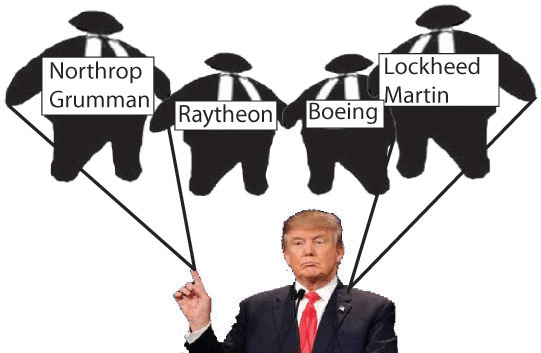
The most tangible agreement between the two leaders was the $110 billion sale of military equipment to Saudi Arabia that is effective immediately and could expand up to $350 billion over 10 years. The deal includes tanks, combat ships, missile defense systems, radar and communications, and cybersecurity technology. The State Department said the agreement could support “tens of thousands of new jobs in the United States.”
Trump was joined on the trip by the CEOs of several major U.S. companies, which announced their own agreements with the Saudis. Among them was a $15 billion arrangement with GE focused on power, oil and gas, and health care.
The president was trailed on the trip by a large number of advisers, including Tillerson, chief of staff Reince Priebus and chief strategist Steve Bannon. Trump’s son-in law, Jared Kushner, and daughter Ivanka, both senior advisers, were also part of the official delegation………https://www.apnews.com/0f8266623c3548e1952525d93011bd56






 nuclear-news