 Nobel peace prize winner rebukes Trump over nuclear standoff https://www.theguardian.com/world/2017/oct/06/anti-nuclear-campaign-group-ican-wins-nobel-peace-prize
As award is announced for anti-nuclear group Ican, its head says US president ‘puts a spotlight’ on the weapons’ dangers, Guardian, Saeed Kamali Dehghan and Jon Henley, 7 Oct 17, The head of the anti-nuclear campaign group awarded the Nobel peace prize has chided Donald Trump for ramping up a nuclear standoff and said the US president has a track record of “not listening to expertise”.
Speaking in the hours after the Norwegian Nobel committee made the International Campaign to Abolish Nuclear Weapons (Ican) its 2017 laureate, Beatrice Fihn, the group’s executive director, said Trump “puts a spotlight” on the dangers of nuclear weapons.
“The election of President Donald Trump has made a lot of people feel very uncomfortable with the fact that he alone can authorise the use of nuclear weapons,” she told reporters in Geneva, adding that “there are no right hands for nuclear weapons”.
Fihn, who called Trump “a moron” in a Twitter post just two days before the peace prize announcement, said the award sent a message to all nuclear-armed states that “we can’t threaten to indiscriminately slaughter hundreds of thousands of civilians in the name of security”.
The chair of the Norwegian Nobel committee, Berit Reiss-Andersen, said the award had been made in recognition of Ican’s work “to draw attention to the catastrophic humanitarian consequences of any use of nuclear weapons and for its groundbreaking efforts to achieve a treaty-based prohibition of such weapons”.
The award underlines the mounting danger of nuclear conflict between the US and North Korea and the increasing vulnerability of the Iran nuclear deal. It also amounts to a reprimand to the world’s nine nuclear-armed powers – the US, Russia, Britain, China, France, India, Pakistan, North Korea and Israel – all of whom boycotted negotiations for a treaty banning nuclear weapons that was approved by 122 non-nuclear nations at the UN in July.
The Nobel committee said “the risk of nuclear weapons being used is greater than it has been for a long time” and there was “a real danger that more countries will try to procure nuclear weapons, as exemplified by North Korea”.
It said the peace prize was also a call to nuclear-armed states “to initiate serious negotiations with a view to the gradual, balanced and carefully monitored elimination of the almost 15,000 nuclear weapons in the world”.
The award is not the first time the peace prize has gone to anti-nuclear campaigners. Philip Noel-Baker received it in 1959 for his work on disarmament, and in 2005 the International Atomic Energy Agency and its former chief Mohamed ElBaradei were joint laureates “for their efforts to prevent nuclear energy from being used for military purposes”.
The Nobel committee’s decision comes just days before as Trump could carry out his threat to unravel the Iran nuclear deal, which could trigger a second nuclear standoff amid the North Korea crisis. The deal, concluded in 2015, settled a decade-long dispute over Tehran’s nuclear programme and averted the risk of another war in the Middle East.
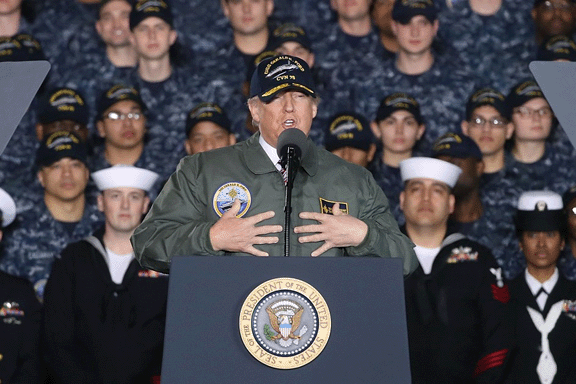
Trump could decertify Iran’s compliance with the nuclear deal next week. He told a meeting of US military leaders on Thursday that Tehran was not living up to the “spirit of the agreement”, and added they were witnessing “the calm before the storm”.
Sir Richard Dalton, a former British ambassador to Iran, said the Nobel award was “a challenge to the international community, led by the UN security council, to protect this historic non-proliferation agreement [the Iran deal], which is vital for regional peace, from its detractors”.
Fihn said in her initial reaction that the group had received a phone call minutes before the official announcement and she had thought it was a prank. She said she did not believe it until she heard the name of the group during the announcement in Oslo.
Ican said in a statement: “This is a time of great global tension, when fiery rhetoric could all too easily lead us, inexorably, to unspeakable horror. The spectre of nuclear conflict looms large once more. If ever there were a moment for nations to declare their unequivocal opposition to nuclear weapons, that moment is now.”
The UN chief, António Guterres, tweeted his congratulations: [on original]
The EU foreign policy chief, Federica Mogherini, who was touted as a possible peace prize winner this year alongside the Iranian foreign minister for their work on the 2015 Iran nuclear deal, tweeted: [on original]
In Japan, survivors of the 1945 US atomic bombings of Hiroshima and Nagasaki during the second world war welcomed this year’s announcement. Sunao Tsuboi, who met with former US president Barack Obama during the latter’s historic visit to Hiroshima last year, congratulated Ican on its win. He endured serious burns and later developed cancer.
“I’m delighted that Ican, which has taken action to abolish nuclear weapons like us, won the Nobel peace prize,” the 92-year-old said, according to Agence France-Presse. “Together with Ican and many other people, we hikabusha will continue to seek a world without nuclear weapons as long as our lives last,” he said.
October 7, 2017
Posted by Christina Macpherson |
politics international, weapons and war |
Leave a comment
Why it matters: Trump has an October 15 deadline to certify Iran’s compliance with the deal, or decline to do so. Trump has slammed the pact as “the worst deal ever”, and has been wrestling with whether to take a step toward ending it. This also puts Mattis directly at odds with Iran hawks like John Bolton who are urging Trump to rip up the deal, and say it’s a disaster for national security.
October 7, 2017
Posted by Christina Macpherson |
politics international, USA |
Leave a comment
Europe’s governments look to bypass Trump to save Iranian nuclear deal
Despite pressure from UK and France, US president expected to declare Tehran in violation of agreement but Senate could yet block reimposition of sanctions, Guardian, Julian Borger, 4 Oct 17, European governments fear a concerted effort to persuade Donald Trump to continue to certify the Iran nuclear deal may have failed and are now looking for other ways to try to salvage the two year-old agreement.
European lobbying efforts are now focused on Congress which will have two months to decide – in the absence of Trump’s endorsement of the 2015 deal – whether to reimpose nuclear-related sanctions.
Fresh sanctions could in turn trigger Iranian withdrawal and a ramping up of its now mostly latent nuclear programme, taking the Middle East back to the brink of another major conflict.
When Trump threatened to withhold certification by a congressional deadline of 15 October, the UN general assembly in mid-September was seen by the European signatories of the agreement – the UK, France and Germany – as the last best chance to convince Trump of the dangers of destroying it……..
When their moment came, the European ministers around the table all observed that Iran was keeping its side of the bargain but expressed willingness to confront Iran separately about its missile programme and its role supporting armed groups around the region. The Russians and Chinese, meanwhile, were adamant there could be no renegotiation……..
https://www.theguardian.com/world/2017/oct/04/iran-nuclear-deal-europe-trump-congress
October 7, 2017
Posted by Christina Macpherson |
EUROPE, politics international |
Leave a comment
 Trump plans to declare that Iran nuclear deal is not in the national interest, WP, By Anne Gearan October 5 President Trump plans to announce next week that he will “decertify” the international nuclear deal with Iran, saying it is not in the national interest of the United States and kicking the issue to a reluctant Congress, people briefed on an emerging White House strategy for Iran said Thursday.
The move would mark the first step in a process that could eventually result in the resumption of U.S. sanctions against Iran, which would blow up a deal limiting Iran’s nuclear activities that the country reached in 2015 with the U.S. and five other nations.
Trump is expected to deliver a speech, tentatively scheduled for Oct. 12, laying out a larger strategy for confronting the nation it blames for terrorism and instability throughout the Middle East.
Under what is described as a tougher and more comprehensive approach, Trump would open the door to modifying the landmark 2015 agreement he has repeatedly bashed as a raw deal for the United States. But for now he would hold off on recommending that Congress reimpose sanctions on Iran that would abrogate the agreement, said four people familiar with aspects of the president’s thinking.
All cautioned that plans are not fully set and could change. The White House would not confirm plans for a speech or its contents. Trump faces an Oct. 15 deadline to report to Congress on whether Iran is complying with the agreement and whether he judges the deal to be in the U.S. national interest……. https://www.washingtonpost.com/politics/trump-plans-to-declare-that-iran-nuclear-deal-is-not-in-the-national-interest/2017/10/05/825c916e-a9e3-11e7-b3aa-c0e2e1d41e38_story.html?utm_term=.310a8797054a
October 6, 2017
Posted by Christina Macpherson |
Iran, politics international, USA |
Leave a comment

 EU’s diplomatic back channel in Pyongyang goes cold, http://www.reuters.com/article/us-northkorea-missiles-eu/eus-diplomatic-back-channel-in-pyongyang-goes-cold-idUSKCN1C81SM Robin Emmott, BRUSSELS (Reuters) 4 Oct 17, – While European powers France and Britain are lobbying Washington to cool tensions since North Korea’s most powerful nuclear test a month ago, EU nations with embassies in Pyongyang are directly pressing the North Koreans.
A group of seven European Union countries – the Czech Republic, Sweden, Poland, Romania and Bulgaria, as well as Britain and Germany – held at least two formal meetings with North Korean officials in Pyongyang in September, three EU diplomats said.
But they felt frustrated because the higher-level access that they had obtained in Pyongyang last year had fallen away, with only medium-ranking foreign ministry officials now attending the meetings, the diplomats said.
“There was a sense that we weren’t really getting anywhere because they sent these department heads,” said a Brussels-based diplomat who had been briefed on the meetings, which were described as “very serious” in atmosphere and tone.
“They want to talk to the United States.”
The White House has ruled out such talks, with President Donald Trump telling Secretary of State Rex Tillerson he would be “wasting his time” negotiating with the North Koreans.
The United States has no embassy in Pyongyang and relies on Sweden, the so-called U.S. protecting power there, to do consular work, especially when Westerners get into trouble.
In contrast to recent meetings, when North Korean officials met EU envoys in the Czech Republic’s embassy in 2016 to discuss issues including cultural programs and regional security, a deputy foreign minister would attend, one EU diplomat said.
For the small club of European Union governments with embassies in North Korea, that reflects Pyongyang’s anger at the EU’s gradually expanding sanctions that go beyond those agreed by the United Nations Security Council.
It could have repercussions for broader EU efforts to help mediate in the nuclear crisis, according to the EU diplomats briefed by their colleagues in Pyongyang, as the bloc prepares more measures against North Korea.
EU foreign policy chief Federica Mogherini, who chaired talks on the historic 2015 nuclear deal with Iran, says the bloc is ready to mediate in any talks aimed at freezing North Korea’s missile and nuclear weapons programs.
But at the same time, the European Union wants an oil embargo on Pyongyang that it hopes other countries will follow.
October 6, 2017
Posted by Christina Macpherson |
EUROPE, North Korea, politics international |
Leave a comment
Romandie 5th Oct 2017, [Machine Translation] Luxembourg on Thursday said it feared “unfair
competition” between nuclear and renewable energies, on the occasion of the
examination by European justice of the complaint lodged by Austria and the
Grand Duchy against the payment of public aid for the Hinkley Point plant.
“We want to avoid this nuclear renaissance because all this public money
will be blocked and will not be able to go into energy efficiency and
renewable,” explained to the press at the end of the hearing the Luxembourg
Minister of the Environment, Carole Dieschburg. The arguments of the
representatives of Austria and the European Commission on the United
Kingdom aid measure at Unit C of the Hinkley Point nuclear power plant were
held before the EU Court in Luxembourg on Thursday.
Support for the Republic of Austria, Luxembourg continued for ten minutes. For the Grand
Duchy, the outcome of the dispute will have an influence on the direction
of the EU’s energy policy. “Subsidizing could set an important precedent
and give the green light to a new model of state nuclear financing in
Europe,” Dieschbourg said.
“For us, the important thing is to avoid a
nuclear revival,” she insisted. At the heart of the dispute is the decision
of the European Commission in October 2014 to validate the price support
mechanism provided by London, which is deemed compatible in Brussels with
EU rules. Backed by Luxembourg, Austria filed an appeal on 6 July 2015
against that decision. This mechanism, also known as the “offset gap
contract”, guarantees stable revenues to the operator of the Hinkley Point
nuclear power plant, in this case EDF, for a period of 35 years.
In addition to the procedure initiated by Austria, Greenpeace Energy also
brought an action for annulment against the same decision of the European
Commission.
In collaboration with Areva and the Chinese companies CGN China
General Nuclear and CNNC China National Nuclear Corporation, EDF is building
a new nuclear power plant with two reactors in Hinkley Point, southwest
England, in March, a controversial an estimated cost of about 21 billion
euros. By 2025, the plant will produce 3.300 MWh of electricity, the
largest single-station power plant in the United Kingdom and 7% of total UK
electricity generation.
https://www.romandie.com/news/850062.rom
October 6, 2017
Posted by Christina Macpherson |
EUROPE, opposition to nuclear, politics international |
Leave a comment
Donald Trump’s demonisation of Iran is dishonest and dangerous, Guardian, Michael Axworthy, 6 Oct 17, The Iran nuclear deal is doing what it was designed to do. It is a force for stability in the unstable Middle East, and to endanger it is irresponsible “…….as we get further into Trumpworld, the more disturbing and dangerous a place it seems to be. And in a strange way, it seems he is not really president at all, but still running for president, still trying to convince people he deserves to be there. He is preoccupied with his predecessor and his policies, and with competing against his record, whether it is the size of the crowd at his inauguration, Obamacare, or now, the Iran nuclear deal that was negotiated while Obama was in office.
With all the difficulties of the world at the moment – a dangerous confrontation with North Korea, the looming threat of trade wars and consequent economic slump, and a Middle East region strewn with failed states, unresolved conflicts and misery, to name just a few – the
Iran nuclear deal is a rare example of a recent diplomatic initiative that has actually enhanced stability.
The Joint Comprehensive Plan of Action (the full title of the agreement) is working. The International Atomic Energy Authority (IAEA), responsible for overseeing its verification and inspection provisions, is satisfied that it is working and that Iran is meeting its JCPOA commitments. The other countries that are party to the agreement, the UK, Germany, France China and Russia, agree with the IAEA and are satisfied too. But Donald Trump is not satisfied.
The JCPOA doesn’t do things it was never framed to do, of course. It doesn’t address missile development – its negotiators judged that to attempt that would be too much, and would make an already difficult negotiation (which many pundits around the world said would never be successful), impossible to bring to a successful outcome………
Trump’s demonisation of Iran is dishonest. The instability of the region is not in any significant measure the consequence of Iranian actions. To blame Iran for terrorism in the region is misleading at best – most terrorism there, and most of the Islamist terrorism worldwide, is inspired by extreme versions of Sunni Islam, not by the Shia Islam of Iran and the Iranian regime.
The Republican right in the US, historically, has disliked arms control agreements, largely because they involve compromise by both sides and therefore fall short of what might appear the ideal from a narrow US perspective. But that is the nature of diplomacy too. Treaties have to be negotiated; only in exceptional circumstances can you dictate terms. Some commentators in the US have called the JCPOA a flawed agreement, but it is only flawed agreement from that skewed and immature perspective.
The JCPOA is doing what it was designed to do: limit Iran’s ability to make a bomb. It is a force for stability in the chronically unstable Middle East, and to endanger it is irresponsible. Not just the IAEA and most of the world, but most of Trump’s own military and civilian advisers, all agree on that. From their near silence on the matter, the deal’s previous enemies in Saudi Arabia now seem to agree too.
If Trump decertifies the deal – which seems to be his intention in the next few days – he weakens it, but gives responsibility for reimposing sanctions, which would wreck the agreement, to the US Congress.
To do that would be an abdication of his responsibility as president. It would be the action of a spoilt child who breaks the toys in the kindergarten because the adults won’t agree to do what he wants them to do. And if Trump abdicates responsibility in this way, the logical next step is that he should have the responsibility taken away from him.
• Michael Axworthy is author of Revolutionary Iran and a senior lecturer at the University of Exeter https://www.theguardian.com/commentisfree/2017/oct/06/trump-demonisation-iran-dishonest-dangerous-nuclear-deal
October 6, 2017
Posted by Christina Macpherson |
Iran, politics international, USA |
Leave a comment
Defense Secretary Mattis suggests sticking with Iran nuclear deal https://www.reuters.com/article/us-iran-nuclear-usa/defense-secretary-mattis-suggests-sticking-with-iran-nuclear-deal-idUSKCN1C821, NIdrees Ali, Phil Stewart, 4 Oct 17, WASHINGTON (Reuters) – U.S. Defense Secretary Jim Mattis said on Tuesday the United States should consider staying in the Iran nuclear deal unless it were proven that Tehran was not abiding by the agreement or that it was not in the U.S. national interest to do so.
Although Mattis said he supported U.S. President Donald Trump’s review of the agreement curbing Iran’s nuclear program, the defense secretary’s view was nonetheless far more positive than that of Trump, who has called the deal agreed between Iran and six world powers in 2015 an “embarrassment”.
Trump is weighing whether the deal serves U.S. security interests as he faces a mid-October deadline for certifying that Iran is complying with the pact, a decision that could sink an agreement strongly supported by the other powers that negotiated it.
“If we can confirm that Iran is living by the agreement, if we can determine that this is in our best interest, then clearly we should stay with it,” Mattis told a Senate hearing. ”I believe …, absent indications to the contrary, it is something that the president should consider staying with,” Mattis added.
Earlier, when Mattis was asked whether he thought staying in the deal was in the U.S. national security interest, he replied: “Yes, senator, I do.”
The White House had no immediate comment on Mattis’ remarks, which once again highlighted the range of views on key policy issues within the Trump administration.
If Trump does not recertify by Oct. 15 that Iran is in compliance, Congress would have 60 days to decide whether to reimpose sanctions on Tehran suspended under the accord.
October 4, 2017
Posted by Christina Macpherson |
politics international, USA |
Leave a comment
 NORTH KOREA BENEFITS FROM NUCLEAR WEAPONS. GET USED TO IT. War on the Rocks, Markl S Bell, 2 Oct 17 It is often said that nuclear weapons offer little beyond the ability to deter. But if nuclear weapons deter, they also necessarily offer benefits to states that go well beyond simply deterring attack. North Korea today is in the process of reaping those benefits, and this will constrain American foreign policy in the region. As much as American policymakers might want to wish this away, it is better to adjust the sails than to hope the wind disappears. War with North Korea should now be off the table and the denuclearization of North Korea is similarly unrealistic. If the United States wants to tamp down the current crisis, it needs to get used to North Korean nuclear weapons and the constraints they impose on U.S. foreign policy.
It is true that nuclear weapons deter. But because they deter attack, they also act as a shield that reduces the risks and costs of pursuing a host of other foreign policy behaviors. My research shows that nuclear weapons can facilitate a range of objectives that states of all stripes may find attractive. Possessing nuclear weapons can allow states to act more independently of allies, engage in aggression, expand their position and influence, reinforce and strengthen alliances, or stand more firmly in defense of the status quo. States with nuclear weapons are aware of these benefits, and use nuclear weapons to pursue them. This applies as much to democratic states committed to the status quo as it does to authoritarian or revisionist states.
Consider the case of Britain. A declining, status quo state when it acquired nuclear weapons in the 1950s, Britain was increasingly dependent on the United States for its security, facing growing challenges to its role as the preeminent power in the Middle East, while its commitments to allies were becoming increasingly uncredible. What did it do when it acquired nuclear weapons? As I show in a 2015 International Security article, Britain used nuclear commitments instead of conventional military commitments (which it could no longer afford) to reassure allies that were increasingly skeptical of Britain’s ability to come to their aid. Similarly, Britain’s nuclear weapons reduced the risks of acting more independently of the United States and of using military force to resist challenges to its position in the Middle East……..
Today, North Korea is taking advantage of its nuclear weapons, just as past nuclear states have done. What’s good for the goose is good for the gander. So, if North Korean nuclear weapons are useful even if they never get used, what might Kim Jong Un’s regime want to use them for?
North Korea faces serious military threats from South Korea and the United States. South Korea is vastly more economically powerful and has the support of the most powerful state the world has ever known. Since the end of the Cold War, the United States —unconstrained by the absence of a peer competitor — has shown a repeated inclination to pursue regime change around the world, labelled North Korea as part of the “Axis of Evil”, imposed punishing sanctions on North Korea, and kept tens of thousands of forces stationed in the region……
North Korea would like to be able to stop the United States from flying military aircraft close to its territory (particularly the B-1B Lancer flights from Guam) and weaken the U.S.-South Korean alliance. It would like to show that Washington’s threats of regime change or military intervention on the Korean peninsula are empty talk, and demonstrate that the United States is unable to shoot down its missiles. And North Korea may want to be able to more credibly threaten military action against South Korea. All of these make good strategic sense for North Korea as it seeks to reduce the threats it faces and strengthen its position on the Korean peninsula in the face of massive U.S. conventional military superiority.
How do North Korean nuclear weapons help it achieve these goals? By raising the dangers of escalation, North Korea seeks to drive wedges between the United States and South Korea and raise fears of “decoupling” as well as to make it riskier for the United States to fly planes close to its airspace or engage militarily on the Korean peninsula. North Korea launches missiles, daring the United States to try (and quite likely fail) to shoot them down; it refuses to back down when challenged; and it raises the possibility of more provocative nuclear tests.
These actions are predictable, because they advance North Korean national interests. But they are also dangerous, raising the risk of escalation. This is a feature, not a bug, of North Korean strategy. Raising escalation risks is exactly how North Korea hopes to convince the United States to back off and, therefore, to improve its position on the Korean peninsula. And in the process of such escalation, North Korea might be entirely rational to use nuclear weapons first if things got bad enough.
What should the United States do?
North Korea would like to be able to stop the United States from flying military aircraft close to its territory (particularly the B-1B Lancer flights from Guam) and weaken the U.S.-South Korean alliance. It would like to show that Washington’s threats of regime change or military intervention on the Korean peninsula are empty talk, and demonstrate that the United States is unable to shoot down its missiles. And North Korea may want to be able to more credibly threaten military action against South Korea. All of these make good strategic sense for North Korea as it seeks to reduce the threats it faces and strengthen its position on the Korean peninsula in the face of massive U.S. conventional military superiority.
How do North Korean nuclear weapons help it achieve these goals? By raising the dangers of escalation, North Korea seeks to drive wedges between the United States and South Korea and raise fears of “decoupling” as well as to make it riskier for the United States to fly planes close to its airspace or engage militarily on the Korean peninsula. North Korea launches missiles, daring the United States to try (and quite likely fail) to shoot them down; it refuses to back down when challenged; and it raises the possibility of more provocative nuclear tests.
These actions are predictable, because they advance North Korean national interests. But they are also dangerous, raising the risk of escalation. This is a feature, not a bug, of North Korean strategy. Raising escalation risks is exactly how North Korea hopes to convince the United States to back off and, therefore, to improve its position on the Korean peninsula. And in the process of such escalation, North Korea might be entirely rational to use nuclear weapons first if things got bad enough.
What should the United States do?
Any serious policy demands a dose of reality. Denuclearization and regime change are no longer achievable without risking tens (and potentially hundreds) of thousands of American lives. North Korea has nuclear weapons, benefits from having them, and has no interest in giving them up. Denying this reality is not only delusional, but encourages North Korea to take more belligerent actions, accelerate its nuclear program further, and exacerbate the spiral of escalation.
A better approach would be to seek limited concessions from North Korea in exchange for limited concessions by the United States. For example, as James Acton has proposed, North Korea might agree to eschew missile tests over the territory of South Korea and Japan, if the United States limited flights of B1-B bombers close to North Korean territory. Such a deal would acknowledge that North Korea’s capabilities impose constraints on U.S. foreign policy and grant North Korea benefits. At the same time, it reduces the risks of miscalculations or accidental escalation, diminishing North Korean fears of a surprise attack by the United States, and lending some stability to U.S.-North Korean relations. And if North Korea violated the deal, the U.S. could easily resume those flights……..
Ultimately, there are no free lunches in international politics. If the United States wants North Korea to constrain its nuclear program, it will need to offer North Korea something in exchange. And if the United States tries to pursue regime change or denuclearize North Korea by force, it must accept that North Korean nuclear capabilities allow it to force the United States to pay a high price for doing so. Mark S. Bell is an assistant professor in the Political Science Department at the University of Minnesota. https://warontherocks.com/2017/10/north-korea-benefits-from-nuclear-weapons-get-used-to-it/
October 4, 2017
Posted by Christina Macpherson |
North Korea, politics international, USA |
Leave a comment
 Are Trump’s tweets undercutting U.S. diplomacy? Beyond apparent policy disagreements between the president and Rex Tillerson, the State Department struggles to absorb mixed signals. The Atlantic, KRISHNADEV CALAMUR 3 OCT 17, President Trump’s tweets Sunday, declaring it a waste of time to try to negotiate with North Korea, appeared to contradict the sentiments of his own chief diplomat, who is at least formally taking the lead on the administration’s North Korea policy. It wasn’t the first time the two men seemed to express different positions on significant foreign-policy issues. But there’s a deeper story beyond whatever temperamental or policy gulf may exist between Trump and Tillerson as individuals—and that is how the contradictions affect the sprawling foreign-policy apparatus Tillerson is supposed to run.
“One can never be sure whether the policies we’re working on will be supported by the president or not,” a State Department official, who was not authorized to speak to the press and asked for anonymity, told me. “It creates a great deal of uncertainty and obviously further harms morale in an environment in which morale is already very low.”……
at the State Department, reports about poor morale have abounded since Tillerson assumed his position in February. The secretary was described as aloof, his plans to reorganize the State Department were criticized, and the Trump administration’s proposal to cut the department’s budget by 30 percent was met with horror. A hiring freeze at the department, combined with the fact that most of the senior positions requiring Senate confirmation are still vacant, have also resulted in multiple news reports about dysfunction.
Added to all this is the perception that Trump doesn’t care about the work the State Department is doing. The president has not only appeared to contradict Tillerson publicly on Qatar, NATO, and Iran—besides North Korea—he has also appeared to suggest that his “America First” message is not simpatico with multilateral cooperation with America’s traditional allies.
At one point, he thanked Russia for its expulsion of U.S. diplomats in retaliation for a similar step by the Obama administration, as well as its seizure of Russian compounds in the U.S., because, in Trump’s words, “we’re trying to cut down our payroll.”…..https://www.theatlantic.com/international/archive/2017/10/trump-tillerson/541671/
October 4, 2017
Posted by Christina Macpherson |
politics international, USA |
Leave a comment
 Brexit Threatens U.K.’s Nuclear Renaissance Dream, Tories Told, Bloomberg, By Jess Shankleman, 3 Oct 17,
Britain’s plan to spend billions of pounds on a fleet of new nuclear reactors could be stopped in their tracks if Prime Minister Theresa May ends the rights of skilled European migrants to work in the nation after it leaves the European Union.
That’s the warning delivered on Monday by Rolls-Royce Holdings Plc and other nuclear energy experts to Conservative Party members at their annual conference in Manchester, northwest England. The company also outlined plans to invest in new modular atomic power plants.
In the coming month, ministers are due to announce the results of a 250 million-pound ($213 million) competition for funding to research and develop small modular nuclear plants, said David Orr, Senior Vice President of Nuclear at the British manufacturing icon. Rolls-Royce is bidding to participate, he said…….
 But the future of both the modular and traditional reactors like the ones being built by Electricite de France SA at Hinkley Point in western England is at risk from the U.K. exiting the EU, he said. That’s because the industry relies on engineers from overseas and because there is still a question mark over whether and how the U.K. could leave Euratom, the European Atomic Energy Community regulator that oversees the industry.
Read More About Why Brexit’s Going Nuclear Over Treaty Withdrawal
About a quarter of people who work in scientific industries like nuclear power come from outside the U.K. and about half of those are from the EU, Sarah Main, director of the Campaign for Science and Engineering, said at the conference…….https://www.bloomberg.com/news/articles/2017-10-02/brexit-threatens-u-k-s-nuclear-renaissance-dream-tories-told
October 4, 2017
Posted by Christina Macpherson |
politics, politics international, UK |
Leave a comment

 Trump says North Korea talks are ‘waste of time’ President contradicts Tillerson’s statement that lines of communication are open Ft.com by Demetri Sevastopulo in Washington, 2 Oct 17 Donald Trump dismissed the prospect of talks with Pyongyang as pointless barely a day after his secretary of state said the US was using new channels of communication to weigh the possibility of negotiations with North Korea about its nuclear programme. “I told Rex Tillerson, our wonderful Secretary of State, that he is wasting his time trying to negotiate with Little Rocket Man,” Mr Trump tweeted on Sunday morning. “Save your energy Rex, we’ll do what has to be done!”.
In a second tweet later in the day, he added: “Being nice to Rocket Man hasn’t worked in 25 years, why would it work now? Clinton failed, Bush failed, and Obama failed. I won’t fail.”
The US president’s interventions came after Mr Tillerson told reporters during a visit to China that Washington had three direct channels of communication with North Korea……..
Richard Haass, president of the US Council on Foreign Relations, slammed Mr Trump for undercutting his secretary of state. “Potus truly misguided here-& SecState should resign,” he tweeted on Sunday. Ian Bremmer, head of Eurasia Group, a risk consultancy, said the president’s comments were the “stupidest tweet on national security I’ve ever seen from a sitting head of state”………
After Mr Trump used a speech at the UN to describe Mr Kim as “Rocket Man . . . on a suicide mission” and threatened to “totally destroy” North Korea, Mr Kim responded by calling the US president a “mentally deranged dotard” while his foreign minister said Pyongyang would consider detonating a hydrogen bomb over the Pacific Ocean…….
To send a strong signal to Mr Kim, the US has been conducting increasingly frequent high-profile exercises around the Korean peninsula, sometimes with Japan and South Korea. Last weekend, US warplanes flew farther north from the demilitarised zone — that separates South and North Korea — than at any point in the 21st century. In combination with the military warnings, Washington is leading a global campaign to ratchet up economic pressure on North Korea in an effort to squeeze the regime, cut off funding for weapons programmes, and force Pyongyang to the negotiating table. The UN has recently imposed two sets of harsh sanctions that — combined with previous measures — embargo 90 per cent of North Korean exports. The US has also imposed unilateral sanctions and has punished Chinese and Russian companies that have been accused of facilitating weapons development in North Korea.
https://www.ft.com/content/cd2087a0-a5f1-11e7-ab55-27219df83c97 Follow Demetri Sevastopulo on Twitter:
@dimi
October 2, 2017
Posted by Christina Macpherson |
North Korea, politics international, USA |
Leave a comment

North Korean leader Kim Jong Un provides guidance on a nuclear weapons program in this undated photo released by North Korea’s Korean Central News Agency (KCNA) in Pyongyang September 3, 2017. KCNA via REUTERS
North Korea vows to become a ‘state nuclear force’, Aljazeera, 1 Oct 17
Pyongyang calls sanctions and pressure ‘futile’ in halting its development of nuclear weapons. North Korea’s state news agency has called the US-led effort to impose sanctions over its weapons programme futile, vowing the country inevitably will become a “state nuclear force”.
The comments on Sunday came from the Korean Central News Agency’s website Uriminzokkiri after US Secretary of State Rex Tillerson met for talks with China’s top diplomats and President Xi Jinping in Beijing on the Korean nuclear crisis.
Tillerson has been a proponent of a campaign of “peaceful pressure”, using US and UNsanctions and working with China to turn the screw on the regime.
But his efforts have been overshadowed by an extraordinary war of words, with US President Donald Trump mocking North Korean leader Kim Jong-un as “little rocket man” and Kim branding Trump a “dotard”……. http://www.aljazeera.com/news/2017/10/north-korea-vows-state-nuclear-force-171001052823971.html
October 2, 2017
Posted by Christina Macpherson |
North Korea, politics international, weapons and war |
Leave a comment
Iran Nuclear Deal Could Win the Nobel Peace Prize, Bloomberg ,By Mikael Holter, October 1, 2017,
-
EU’s Mogherini, Iran’s Zarif seen as best candidates by PRIO
-
Syria’s White Helmets, Pope, UNHCR also among possible winners
-
The main facilitators of the 2015 accord on Iran’s nuclear program, slammedas the worst deal ever by U.S. President Donald Trump, could be among the top contenders for this year’s Nobel Peace Prize, according to researchers who predict potential winners.
October 2, 2017
Posted by Christina Macpherson |
Iran, politics international |
Leave a comment
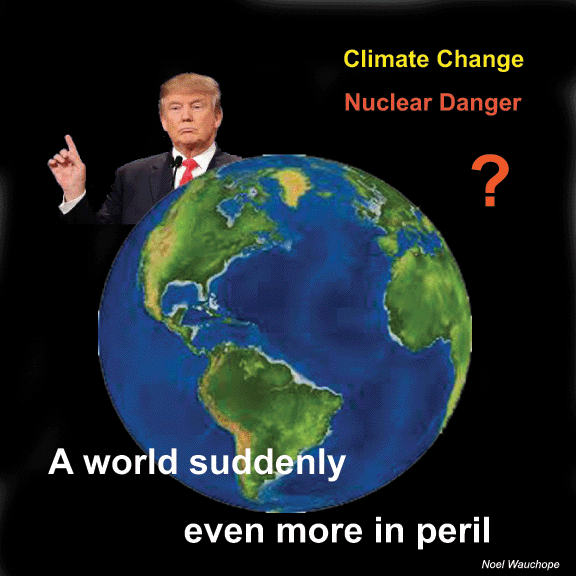
Trump Threatens Genocide, Crimes Against Humanity in North Korea, http://www.truth-out.org/news/item/42101-trump-threatens-genocide-crimes-against-humanity-in-north-korea, September 29, 2017, By Marjorie Cohn, Truthout | News Analysis Donald Trump threatened to “totally destroy North Korea” in his address to the United Nations General Assembly on September 19. That threat violates the UN Charter, and indicates an intent to commit genocide, crimes against humanity, the war crime of collective punishment and international humanitarian law. Moreover, a first-strike use of nuclear weapons would violate international law.
By threatening to attack North Korea, Trump is endangering the lives of countless people. In the past, he has indicated his willingness to use nuclear weapons and Kim Jong-un has threatened to retaliate. The rapidly escalating rhetoric and provocative maneuvers on both sides has taken us to the brink of war.
Trump’s threat prompted North Korean foreign minister Ri Yong-ho to state, “Given the fact that this [threat] came from someone who holds the seat of the US presidency, this is clearly a declaration of war.”
Ri added, “Since the United States declared war on our country, we will have every right to make counter-measures, including the right to shoot down United States strategic bombers even when they are not inside the airspace border of our country.”
Such a move by North Korea would violate international law. But that does not justify US law-breaking. Two wrongs do not make a right. Moreover, the use of military force by either country would prove disastrous.
The UN Charter Requires Peaceful Dispute Resolution
After two world wars claimed millions of lives, the UN Charter was adopted in 1945 “to save succeeding generations from the scourge of war.”
The Charter mandates the peaceful resolution of international disputes and forbids the use of force except in self-defense or with Security Council authorization.
Article 2 requires that UN members “settle their international disputes by peaceful means in such a manner that international peace and security, and justice, are not endangered.” Peaceful means are spelled out in Article 33: Parties to a dispute likely to endanger international peace and security must “first of all, seek a solution by negotiation, enquiry, mediation, conciliation, arbitration, judicial settlement, resort to regional agencies or arrangements, or other peaceful means of their own choice.”
In 1953, after one-third of North Korea’s population was decimated, the United States and North Korea signed an armistice agreement. But the US never allowed a peace treaty to be adopted. North Korea has repeatedly advocated the signing of a peace treaty to formally end the Korean War. To this day, 30,000 US troops continue to occupy South Korea.
The US has also refused to pursue the “freeze-for-freeze” strategy suggested by China and Russia. Under this plan, North Korea would freeze its nuclear and missile testing, and the US and South Korea would end their annual, provocative joint military exercises. Vassily Nebenzya, Russia’s ambassador to the UN, said this path would offer “a way out” of the current situation.
Instead, the US has engineered punitive sanctions against North Korea, which have only strengthened the latter’s resolve to develop usable nuclear weapons. Since 1953, North Koreans have lived in fear of annihilation by the United States.
In his speech to the General Assembly, on top of his threats toward North Korea, Trump also issued a veiled threat to pull out of the Iran nuclear deal. That sends a dangerous message to North Korea that the US cannot be trusted to abide by its agreements.
The UN Charter Prohibits Threats and Preemptive Use of Force
Article 2 of the Charter states that all members “shall refrain in their international relations from the threat or use of force against the territorial integrity or political independence of any state.” Trump’s threat to totally destroy North Korea violates that mandate. In addition, the preemptive use of force violates the Charter.
The only exceptions to the Charter’s prohibition of the use of force are self-defense or approval by the Security Council.
Self-defense, under Article 51 of the Charter, is a narrow exception to the Charter’s prohibition of the use of force. Countries may engage in individual or collective self-defense only in the face of an armed attack. In order to act in lawful self-defense, there must exist “a necessity of self-defense, instant, overwhelming, leaving no choice of means, and no moment for deliberation,” under the well-established Caroline Case.
North Korea has not attacked the United States or another UN member country, nor is such an attack imminent.
Moreover, the Security Council has not authorized any country to use military force against North Korea The council resolutions that establish sanctions against North Korea end by stating the Council “decides to remain seized of the matter.” That means that the Council, and only the Council, has the authority to approve military action.
Both Trump’s threat to use military force against North Korea and the mounting of a preemptive strike would violate the Charter.
The Crime of Genocide
By stating the intention to totally destroy North Korea, Trump has threatened genocide.
The crime of “genocide,” as defined in the Rome Statute for the International Criminal Court, is committed when, with the intent to destroy, in whole or in part, a national, ethnical, racial or religious group, any of the following acts are committed: killing members of the group, causing serious bodily or mental harm to members of the group, or deliberately inflicting on the group conditions of life calculated to bring about its destruction in whole or in part.
Trump’s threat to totally destroy North Korea, if carried out, would destroy, in whole, the national group of North Koreans. That would amount to genocide.
Crimes Against Humanity
Under the Rome Statute, “crimes against humanity” include: the commission of murder as part of a widespread or systematic attack against any civilian population; or persecution against a group or collectivity based on its political, racial, national, ethnic or religious character, as part of a widespread or systematic attack against any civilian population.
Trump’s threat to totally destroy North Korea, if realized, would constitute a widespread and systematic attack against the civilian population of North Korea, which would amount to a crime against humanity.
The War Crime of Collective Punishment
The crime of “collective punishment” is a grave breach of the Fourth Geneva Convention, which is considered a war crime. Collective punishment means punishing a civilian for an offense he or she has not personally committed.
If Trump were to make good on his threat to totally destroy North Korea, he would be punishing the civilian population for offenses committed by the North Korean government. This would constitute the war crime of collective punishment.
Destroying North Korea Would Violate Distinction and Proportionality
The United States has a legal obligation to comply with the requirements of proportionality and distinction, two bedrock principles of international humanitarian law, as delineated in the First Protocol Additional to the Geneva Conventions.
“Proportionality” means an attack cannot be excessive in relation to the anticipated military advantage sought. “Distinction” requires that the attack be directed only at a legitimate military target.
The total destruction of North Korea would violate the principles of proportionality and distinction.
First-Strike Use of Nuclear Weapons Violates International Law
In its 1996 advisory opinion, “Legality of the Threat or Use of Nuclear Weapons,” the International Court of Justice (ICJ) determined that “the threat or use of nuclear weapons would generally be contrary to the rules of international law applicable in armed conflict, and in particular the principles and rules of humanitarian law.”
The ICJ went on to say, “However … the Court cannot conclude definitively whether the threat or use of nuclear weapons would be lawful or unlawful in an extreme circumstance of self-defence, in which the very survival of a State would be at stake.” That means that while the use of nuclear weapons might be lawful when used in self-defense if the survival of the nation were at stake, a first-strike use would not be.
Donald Trump’s apocalyptic threat against North Korea violates international law. It also imperils the lives of untold numbers of people. We must urge Congress to prevent Trump from launching a catastrophic war.
Copyright, Truthout. May not be reprinted without permission.
September 30, 2017
Posted by Christina Macpherson |
2 WORLD, politics international, Reference, weapons and war |
Leave a comment