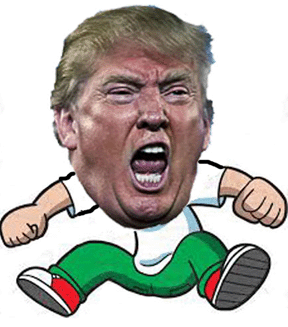
WASHINGTON: White House Chief of Staff John Kelly said on Thursday the Trump administration thinks the threat posed by North Korea’s nuclear weapons capability is currently manageable but Pyongyang cannot be allowed to develop the ability to strike the U.S. homeland.
“A state that has developed a pretty good ICBM (missile) capability and is developing a pretty good nuclear re-entry vehicle, I would believe … that that state simply cannot have the ability to reach the homeland,” Kelly said.
“Right now we think the threat is manageable but over time if it grows beyond where it is today, well, let’s hope that diplomacy works,” said Kelly, a retired Marine Corps general. (Reporting by Steve Holland; Writing by David Alexander; Editing by Chizu Nomiyama)
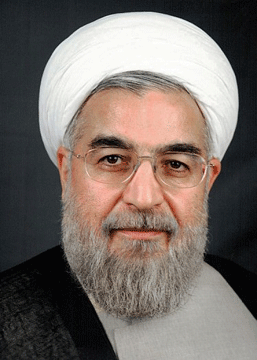
Rouhani says Iran will stay in nuclear deal only if it serves interests – TV, Parisa Hafezi, ANKARA (Reuters) 13 Oct 17, – Iran harshly reacted to President Donald Trump’s decision not to certify its nuclear deal with six major powers, and President Hassan Rouhani said Tehran might walk away if the continuing agreement does not serve the country’s national interests.
Defying Trump, Rouhani said Tehran will double its efforts to expand the country’s defence capabilities, including the country’s ballistic missile programme despite the U.S. pressure to suspend it.
Trump said in an address at the White House that he would not continue to certify the multinational agreement and warned he might ultimately terminate it.
“No president can revoke an international deal … Iran will continue to respect it as long as it serves our interests,” Rouhani said in a live television address, adding that Trump’s speech was full of “insults and fake accusations” against Iranians.
While Trump did not pull the United States out of the agreement, aimed at preventing Iran from developing a nuclear bomb, he gave the U.S. Congress 60 days to decide whether to reimpose economic sanctions on Tehran that were lifted under the pact.
Mr Trump is expected to announce additional economic sanctions against Iran
He has previously called the pact “the worst deal ever negotiated”
The deal saw Iran limit its nuclear program in exchange for fewer economic sanctions
Mr Trump announced the major shift in US policy in a speech that detailed a more confrontational approach to Iran over its nuclear and ballistic missile programs and its support for extremist groups in the Middle East.
Mr Trump said in an address at the White House that his goal was to ensure Iran never obtained a nuclear weapon.
While Mr Trump did not pull the United States out of the agreement, aimed at preventing Iran from developing a nuclear bomb, he gave the US Congress 60 days to decide whether to reimpose economic sanctions on Tehran that were lifted under the pact.
That would increase tension with Iran as well as put Washington at odds with other signatories of the accord such as Britain, France, Germany, Russia, China and the European Union.
Mr Trump warned that if “we are not able to reach a solution working with Congress and our allies, then the agreement will be terminated.”
The US military said it was reviewing the “entire breadth” of its security cooperation activities, force posture and plans to support the new strategy.
“We are identifying new areas where we will work with allies to put pressure on the Iranian regime, neutralise its destabilising influences, and constrain its aggressive power projection, particularly its support for terrorist groups and militants,” Major Adrian Rankine-Galloway, a Pentagon spokesman, told Reuters.
Iran’s President Hassan Rouhani is expected to respond to Mr Trump’s speech on live television in the coming hours.
Mixed responses to policy shift
The European Union’s foreign policy chief Federica Mogherini said the US could not unilaterally cancel the 2015 nuclear deal between Iran and world powers.
Ms Mogherini chaired the final stages of the landmark talks that brought the deal to fruition. She told reporters she spoke to US Secretary of State Rex Tillerson immediately after Mr Trump’s speech.
“We cannot afford, as the international community, to dismantle a nuclear agreement that is working,” she said.
“This deal is not a bilateral agreement … The international community, and the European Union with it, has clearly indicated that the deal is, and will, continue to be in place.”
Mr Trump’s announcement was praised by politicians from countries that have strained relationships with Iran.
Saudi Arabia welcomed the new policy towards Iran and said lifting sanctions had allowed Iran to develop its ballistic missile program and step up its support for militant groups, state news agency SPA reported.
The kingdom said Iran took advantage of additional financial revenues to support for the Lebanese Shi’ite movement Hezbollah and the Houthi group in Yemen.
Israeli Prime Minister Benjamin Netanyahu congratulated Mr Trump for his speech, seeing an opportunity to change the 2015 nuclear deal with Tehran as well as Iranian conduct in the region.
“[Mr Trump] boldly confronted Iran’s terrorist regime [and] created an opportunity to fix this bad deal, to roll back Iran’s aggression and to confront its criminal support of terrorism,” Mr Netanyahu said in a Facebook video.
Israel’s intelligence minister Israel Katz said the speech was “very significant” and could lead to war given threats that preceded it from Tehran.
Israel’s Channel 2 TV asked Mr Katz whether he saw a risk of war after the US leader’s speech.
“Absolutely, yes. I think that the speech was very significant,” he said.
“Iran is the new North Korea. We see where things are goings.” Reuters
UAE severs North Korea ties over nuclear & missile threats – thousands of workers at risk THE UNITED Arab Emirates (UAE) has announced plans to cut ties with North Korea amid international outrage at Pyongyang’s nuclear and missile programmes. By WILL KIRBY, orth Korea’s ambassador in the country has been told to leave and the UAE will terminate its own envoy’s services in Pyongyang, according to a statement from the Foreign Ministry.
The statement also said the UAE will stop issuing new visas or company licenses to North Korean citizens.
Several thousand North Korean workers live in the country, with many working on construction sites.
They earn a significantly better wage than they would for the same job in their own country, but are forced to make so-called “loyalty payments” to Kim Jong-un’s regime…….
The measures taken by the UAE come after President Trump urged United Nations members to ramp up pressure on the hermit state to give up its nuclear weapons.
The UAE foreign ministry statement reads: “The measures… come within the context of its obligation as a responsible member of the international community to strengthen the international will and to stop the proliferation of nuclear weapons and missile programs.”
The withdrawal from Euratom, as part of the Brexit process, threatens to leave British firms without a framework through which to navigate the tightly regulated trade of nuclear materials.
UK ministers presented a Nuclear Safeguards Bill to Parliament this week which sets up a domestic nuclear safeguards regime. Industry insiders told The Daily Telegraph that they are monitoring the Government’s efforts to replicate the Euratom standards in an attempt to maintain access to the global nuclear market, but the slow progress means urgent contingency plans are likely to be required.
The risk of a 2019 cliff edge could paralyse work building the new Hinkley Point C new nuclear project and leave nuclear fuel suppliers without stocks.
“We are facing disruption to absolutely everything,” Tom Greatrex, chief executive of the Nuclear Industries Association, told Sky News. “Fifteen months to two years sounds like a lot of time. It’s not. The clock is ticking and it has been since the referendum and we’ve made very little progress so far.”
Nuclear giant Westinghouse, which runs the Springfields nuclear fuel plant in Cumbria, is working closely with the Government, regulators and its customers to ensure it can still import raw materials and export fuel even after leaving Euratom.
The Springfields facility is the first plant in the world to produce fuel for a commercial nuclear power station and has supplied products and services to customers in 11 countries since 1946. Without a replacement deal the facility, which employs a workforce of 1,200, would be unable to import the uranium needed to make enriched nuclear fuel or be able to export to customers.
“As part of these discussions we will evaluate any contingency arrangements which need to be in place to ensure we continue to successfully deliver to our customers in the UK and overseas,” the spokesman said.
But for the UK’s first new nuclear power plant to be built in a generation a regulatory gap following Brexit could raise major issues securing construction materials and skilled labour.
The NIA estimates that the £20bn Hinkley Point project will source around £5bn of its component parts from European countries.
Typically the UK imports graphite components from Germany using feedstock produced in France. Stainless steel castings are also manufactured in France and stainless strips, used to manufacture certain fuels and stringer components, are imported from Sweden.
The exit will also pose problems recruiting skilled labour.
It is estimated that Hinkley Point will need 1,400 steel fixers at the peak of its construction phase. The NIA has said only 2,700 registered and certified steel fixers are based in the UK and the project will be forced to compete with other major infrastructure projects in the UK for these individuals. Many are nearing retirement with an average age of 57.
“The best outcome for the nuclear industry would be if the UK could remain within the Euratom Treaty,” said a spokesman for EDF Energy, the French state-backed developer backing Hinkley Point.
“If the UK withdraws from the Treaty, it is essential that alternative and transitional arrangements are put in place in a pragmatic fashion, and before the existing arrangements are terminated. We stand ready to assist the development and timely delivery of the appropriate solution,” he added.
The escalating tensions over North Korea have brought the United States closer to war on the Korean peninsula than at any other time in decades. Yet Washington is just as likely as Pyongyang, if not more likely, to initiate the first strike — and would almost certainly use nuclear weapons to do so. Such a strike may be the only way to decisively end the North Korean nuclear program, but its incalculable effects would extend far beyond the devastation and destruction in Korea. Its political, economic, and moral consequences would permanently and disastrously undermine U.S. interests for generations to come — and must be avoided at all costs.
These very real threats would have confronted any president occupying the Oval Office in 2017, but President Donald Trump has chosen to react to this perilous situation in dangerously provocative ways……..
The possibility of a first strike against North Korea has long been discussed as one way to address its growing nuclear threat. Yet very few understand the grim military logic that only an overwhelming surprise nuclear strike provides a decisive option. There is simply no other way to destroy North Korea’s nuclear capabilities while minimizing the risk of massive conventional or nuclear retaliation.
There are two crucial reasons why a conventional first strike cannot be effective. First, the timelines involved are too long. It would require weeks or even months of preparation: building up troops, aircraft, and ships, as well as evacuating tens of thousands of U.S. citizens. Any of these highly visible preparations for war could lead Pyongyang to launch a preemptive strike of its own — including massive artillery and chemical attacks on Seoul, and nuclear strikes across the region, including against U.S. territory. The same logic would hold even if the United States could somehow pull off a surprise conventional attack, since most experts envision such an attack lasting days or weeks. In either case, Kim would have absolutely no incentives to hold back any of his military capabilities, including nuclear weapons. His regime’s survival would be at stake, leading to a classic “use-it-or-lose-it” scenario.
Second, and more important, a conventional first strike simply cannot destroy enough North Korean military capability to prevent a retaliatory second strike. North Korean nuclear weapons have been deliberately dispersed throughout the country, including on mobile launchers and in locations deep underground, to prevent this exact scenario. ……..
A nuclear first strike, then, may seem like an attractive military option to a president who has vowed to end the North Korean nuclear threat once and for all. Yet its political, economic, and moral consequences would be so devastating that it would be hard for any American to imagine, in retrospect, why this ever seemed like a good idea.
First and foremost, the human costs would be catastrophic. Millions of North Koreans would either be killed or grievously wounded from the effects of fires, blasts, and radiation. The radioactive fallout from such a strike could spread contamination thousands of miles, directly affecting South Korea, Japan, and China, as well as countries and populations across the region and beyond. Global or regional weather patterns could also be disrupted, affecting agriculture and the environment for years to come.
Even if those tragic human costs could somehow be set aside, the cascading range of other consequences would be sufficient to avoid such an attack. China could respond militarily, by moving forces into the parts of North Korea less affected by the strike, for example. This could result in a risky confrontation with U.S. forces seeking to confirm the complete destruction of North Korean nuclear capabilities. Chinese troops could also collide with a potential influx of U.S. and South Korean ground troops trying to establish civil order and provide humanitarian relief to the North Korean populace in the aftermath of the strikes. China might also respond to an attack on its ally more forcefully, by striking U.S. bases in the region or possibly even the U.S. homeland, especially since radiation would inevitably blanket some of its territory………
Is nuclear war on the Korean peninsula inevitable? No, but only if the Trump administration recognizes that a nuclear first strike cannot be a viable alternative, because its consequences are simply unfathomable. Deterrence is the vastly preferable option. The United States faced similar challenges after World War II, when the Soviets and then the Chinese developed nuclear weapons and the ability to strike U.S. targets. In both cases, arguments for American first strikes to remove these threats were soundly rejected in favor of long-term policies of deterrence — which have successfully avoided a nuclear conflagration for many decades. Effective deterrence requires only an adversary who is rational enough to seek his own survival — a threshold that even Kim Jong Un meets.
Trump’s most trusted advisors and experienced veteran military men, John Kelly and James Mattis, should repeatedly make this argument to the president while there is still time. There is virtually no likelihood that North Korea can be pressured to give up its nuclear program at this juncture. Given that reality, the best way to advance U.S. national security and protect American lives is to publicly commit to deterring the Korean regime while privately removing threats to its survival. The alternative is a deadly nuclear first strike from which there will be no winners.https://warontherocks.com/2017/10/the-growing-danger-of-a-u-s-nuclear-first-strike-on-north-korea/
Trump breaks with allies as US goes it alone on Iran, Channel News Asia, 13 Oct 17 WASHINGTON: President Donald Trump will unveil a new US Iran strategy on Friday (Oct 13) and is expected to withdraw backing from the Iran nuclear accord, undermining a landmark victory of multilateral diplomacy.White House spokeswoman Sarah Huckabee Sanders said Trump would unveil a broad plan to counter Iran at 12.45pm (1645 GMT).
She did not elaborate, but Trump is expected to declare to Congress that retaining the 2015 Iran nuclear agreement is no longer in the US national interest.
This in itself does not mean the deal will collapse. US lawmakers will have 60 days to decide whether they want to “snap back” the sanctions Washington has suspended.
But it will mark a clear break with America’s allies, who have pleaded with Trump to respect the accord, and a fierce blow to the multilateral international order.
The agreement was signed between Iran and six world powers – Britain, China, France, Germany, Russia and the US – at talks coordinated by the European Union.
UN nuclear inspectors say Iran is meeting the technical requirements of its side of the bargain, dramatically curtailing its nuclear program in exchange for sanctions relief.
So, while US officials still insist that “America First” does not mean “America Alone,” on this issue they are starkly isolated. The other signatories all back the deal.
……… On Tuesday, British Prime Minister Theresa May called the White House to impress upon it her government’s “strong commitment to the deal alongside our European partners.”
In parallel, her foreign minister, Boris Johnson, told his US counterpart Secretary of State Rex Tillerson “that the nuclear deal was an historic achievement.”
“It was the culmination of 13 years of painstaking diplomacy and has increased security, both in the region and in the UK,” he argued.
But the US administration barely acknowledged the calls, and European diplomats in Washington privately complain that their message is not getting through.
………Last week, Secretary of Defense Jim Mattis was asked whether he believes the Iran deal remains in the US national interest.
Can the Iran deal work without the US? http://thebulletin.org/can-iran-deal-work-without-us11184, 12 OCTOBER 2017 Navid HassibiMedia reports say that President Donald Trump may soon inform Congress that Iran is not complying with its end of the nuclear deal, despite numerous IAEA reports to the contrary and his own two previous certifications. The president is reportedly annoyed by the process, which requires him to certify every 90 days that Iran is in compliance with the terms of the agreement, and he appears to be keen to adopt a more confrontational approach toward Tehran.
While Trump’s refusal to re-certify is not the same as completely withdrawing from the deal—formally known as the Joint Comprehensive Plan of Action (JCPOA)—refusing to certify could have a significant impact, kicking the issue over to Congress, which would then have to decide within 60 days whether to re-impose nuclear-related economic sanctions on Iran. While this action is by no means guaranteed, given thediscord between the White House and mainstream Republicans on Capitol Hill on a number of issues, the re-imposition of sanctions on Iran is still a distinct possibility, given previous opposition to the deal by dedicated congressional Iran hawks.
And from the Iranian point of view, if sanctions are re-imposed by the US Congress, the United States would be in material breach of the deal, which would give a pretext for its unravelling—unless the deal can in some way survive without the United States.
What are the chances of this happening? Can Washington withdraw from the deal without facts on the ground to back up this action? Can the dispute resolution mechanism contained in the deal save it? What about the role of the other five countries that negotiated with Iran alongside the United States: France, Germany, China, Russia, and the United Kingdom? (And the European Union, which coordinates the JCPOA.)
Can the deal survive?
Immediate signals from Iran and Europe. Recent statements by Iran seem to indicate that it wishes to try to keep the deal going, despite a putative US withdrawal from the JCPOA. Iran’s Foreign Minister, Mohammad Javad Zarif, said in some of his strongest public language yet that Iran would remain in the deal if Europe and others did too. And that seems to be a strong possibility; in an interview with Politico, Zarif said: “The Europeans have made it very clear to us and to the United States that they intend to do their utmost to ensure survival of the deal.” This interview also illuminated what a striking gap Trump has opened up between the Americans and their closest allies.
With this in mind, it is clear that a United States withdrawal from the deal would isolate Washington, significantly damage its credibility to negotiate future agreements in good faith, and harm its relationship with allies.
And it might potentially expose it to economic and even legal risks. Can Washington even withdraw from the deal? It is unclear whether the Trump administration can simply withdraw from the deal without cause, or as the deal defines it, an issue of non-performance. The deal does not explicitly describe the procedures involved for a party to leave the agreement—likely by design. The United States may consider the deal to be a non-binding political commitment, but the Europeans believe that the JCPOA is binding because it has been codified through a UN Security Council resolution. When viewed through this lens, US re-imposition of unilateral sanctions (including withdrawal from the agreement) could be interpreted as contravening international law and place Washington in legal jeopardy. This course of action would certainly qualify as non-performance under the deal.
To dance around this problem, the Trump administration has repeatedly accused Iran of violating the spirit of the agreement. For example, administration officials have been making references to the JCPOA’s Preamble and its Article 28, both of which state that the parties commit to implement the deal in good faith and refrain from any action inconsistent with the letter, spirit, and intent of the JCPOA. By interpreting these provisions beyond the scope they were originally intended, the Trump Administrations apparently hopes to prop up its possible withdrawal from the deal.
What about the deal’s dispute resolution mechanism? The JCPOA and the corresponding UN Security Council Resolution detail the necessary steps needed to resolve issues of legitimate non-performance. (And it should be noted that this mechanism was developed with the presumption that no party would deliberately sabotage the deal, which seems to be the intent of the Trump Administration’s words and deeds.)
Under this mechanism, both the United States and Iran could raise the issue of non-performance before the Joint Commission, which is charged with overseeing implementation of the deal. The Joint Commission would then have the opportunity to resolve the problem, at both the foreign minister-level and through a three-member advisory panel, each of which could issue a non-binding opinion. In this situation, the three-member panel would consist of Iran, the United States, and a third JCPOA member. (And remember that the Joint Commission consists of the United States, the United Kingdom, France, Russia, China, Germany and Iran.) Seeing as how all the remaining members of the Joint Commission resolutely back continued implementation of the nuclear deal, it’s safe to assume that their judgment would be in favor of Iran and rule that the US was in non-performance—a decision that Washington would disagree with.
But the decision would be a hollow victory for Iran, because the Joint Commission requires full consensus when it comes to the issue of non-performance—effectively meaning unanimous approval—so just the one dissenting vote from the United States would be enough to stop the dispute resolution mechanism from going into effect, and so leave Iran with few options for redress.
But US non-performance might give Iran grounds to cease performing its own commitments in whole or in part. This would see Iran expand its nuclear program to pre-agreement levels and potentially beyond, and remove the transparency and inspection measures that Iran has found so intrusive but which it had agreed to under the deal. As a result, US non-performance could needlessly re-introduce a crisis that had previously been resolved, and increase the risk of military conflict between Iran and the United States (or Israel). Much of the world would likely blame the Trump administration and this would have far-reaching effects; for example, any credible approach to peacefully resolving the situation on the Korean peninsula would be met with skepticism. Or, as EU foreign policy chief Federica Mogherini put it: “We already have one potential nuclear crisis. We definitely [do] not need to go into another one.”
The United States could go even further, by abusing the terms of the JCPOA to re-impose—or “snap back”—UN Security Council sanctions on Iran. The United States would merely have to notify the Security Council of its assessment that Iran is in non-performance, regardless of the facts. The Security Council would then have to vote on a resolution to continue sanctions relief. The Trump administration would likely veto the resolution and the pre-JCPOA UN sanctions against Iran would be back in place.
Ironically, this mechanism was intended to keep Tehran, and not Washington, in check.
To mitigate against a US threat of snapping UN sanctions back, an arcane and mostly symbolic tactic to bypass a veto could be invoked through the so-called “Uniting for Peace” resolutionof the UN General Assembly, which allows it to vote on a matter that lacks unanimity in the UN Security Council with a simple majority. Although this may seem far-fetched, it could be a legitimate option in countering President Trump’s unpredictability.
Blowback from US withdrawal? Should Washington contravene the nuclear deal, the remaining members of the Joint Commission could work to salvage what is left of the JCPOA, which, along with the UN Security Council Resolution, allows it to “adopt or modify, as necessary, procedures to govern its activities” and “consult and provide guidance on other implementation matters that may arise under the JCPOA.” In this vein, the Joint Commission could adopt an approach that would include accepting US non-performance and withdrawal as a fait accompli, and encourage its members to simply ignore UN sanctions—effectively preventing any snap back, and working against any unilateral US nuclear-related sanctions on Iran.
The EU has already indicated that it is considering employing a “Blocking Statute” which would make it illegal for EU companies to comply with US sanctions done in this manner. (And there is a precedent for this action; the EU had previously used a Blocking Statute in the 1990s in response to the Clinton administration’s sanctions against Iran.) At a recent panel discussion, the EU ambassador to the United States notedthat the “European Union will act to protect the legitimate interests of our companies with all the means at our disposal.”
Seeking remedial action against US secondary sanctions through the World Trade Organization could be another option by the EU. (Secondary sanctions are penalties applied to third-parties, such as foreign banks not directly linked to Iranian entities.) Presumably, Russia, China and others could adopt similar hedges against US measures.
Consequently, it can be seen that maintaining the deal in some form, without the United States, could indeed be a real possibility.
But by far, the best path forward would be for Washington to continue to comply with the JCPOA—which, after all, was a deal laboriously negotiated in good faith over several years to peacefully resolve a longstanding security concern. Simply put, the alternative to the JCPOA would be escalating tensions and inevitable conflict. Other US grievances against Iran—such as addressing Iran’s ballistic missile program, or countering Iranian influence in the region, or dealing with the sunset clauses of the JCPOA (which see time limits of varying lengths, including 10 and 15 years, on restrictions on Iran’s nuclear program)—should be discussed through engagement and diplomacy.
Should the president fail to re-certify Iranian compliance by the October 15 deadline called for by the agreement, it will be up to members of Congress to act in the best interests of the United States, by refraining to re-impose sanctions.
Europe’s nuclear trade body pushes for swift ‘Brexatom’ deal with UK, Telegraph, James Rothwell, brexit correspondent, brussels 11 OCTOBER 2017
Europe’s nuclear trade body has said it sees no reason why the UK cannot quickly sign a nuclear deal with the EU after Brexit which mirrors agreements the bloc already holds with the US and Japan.
Foratom, which is based in Brussels and represents nearly 800 nuclear firms across the EU, said it “absolutely” wanted to maintain close links with the British nuclear industry, even after its departure from the European Atomic Energy Community (Euratom).
The government’s announcement that Britain will leave Euratom – a process dubbed “Brexatom” – is controversial, as it would force the country to establish its own nuclear safeguards regime and sign complex nuclear co-operation agreements with trading partners.But Berta Picamal, a member of Foratom’s executive office, said it was eager to set up a partnership that was “as close as possible” to the current regime as it would be mutually beneficial.
“It is in our interests to put in a regime as soon as possible that is as close as possible to the one we have,” she told the Telegraph.
“We are now analysing nuclear cooperation agreements that we have with third countries to see to which extent we can replicate what we have with the US or Japan with the UK.”
She added: “We do not foresee this not being solved, it’s not an option. Theresa May said she would cooperate on continued research and development projects. It’s key.”
Founded in 1957, the Euratom treaty oversees the international movement of nuclear materials, people and services through a framework which governs safety standards and research.
Though technically not part of the EU, Euratom is under the ultimate jurisdiction of the European Court of Justice (ECJ) and requires the free movement of nuclear scientists between EU member states.
Both of these requirements are red lines for the British government, which has vowed to end free movement and direct jurisdiction of the EU over UK laws after Brexit.
President Donald Trump Could Bring About World War III, Senator Bob Corker Charges |
TODAY‘Reckless’ Trump threatens World War III, says US Senator The New Daily, 10 Oct 17,Donald Trump is treating the US presidency like “a reality show” and making reckless threats that could put the world “on the path to World War III”, according to the chairman of the US foreign relations committee.
In an extraordinary condemnation of Mr Trump, Republican Senator Bob Corker said the President acts “like he’s doing The Apprentice or something.”
“He concerns me … he would have to concern anyone who cares about our nation,” Mr Corker told The New York Times in a 25-minute phone interview following a day-long Twitter spat between the two former friends.
At the height of that spat, Mr Corker said Mr Trump had turned the White House into “an adult day care centre”.
But he went much further in the Times interview, alleging senior White House officials spend most of their days trying to rein in Mr Trump’s worst instincts.
“I know for a fact that every single day at the White House, it’s a situation of trying to contain him,” the Times quoted the Senator as saying.
He accused the president of undercutting Secretary of State, Rex Tillerson, and his attempts at finding a diplomatic solution to the North Korea crisis.
“A lot of people think that there is some kind of ‘good cop, bad cop’ act underway, but that’s just not true,” Mr Corker said of the relationship between the president and Mr Tillerson.
The president had undermined diplomatic efforts with his heavy-handed use of Twitter too.
“I know he has hurt, in several instances, he’s hurt us as it relates to negotiations that were underway by tweeting things out,” Mr Corker said.
The Times reported that while Mr Corker wouldn’t directly answer when asked whether he thought Mr. Trump was fit for the presidency, he did say the commander in chief was not fully aware of the power of his office.
“I don’t think he appreciates that when the president of the United States speaks and says the things that he does, the impact that it has around the world, especially in the region that he’s addressing,” he said. “And so, yeah, it’s concerning to me.”
Trump’s plan for the Iran nuclear deal runs straight through a diplomatic minefield
President Donald Trump is expected to tell Congress that the Iran nuclear deal is not in the country’s national security interest.
The Trump administration will try to coerce Iranians and Europeans back to the negotiating table to secure a tougher deal and address other issues.
Some say American financial might will allow Trump to prevail, while others say he has slim odds of getting what he wants and risks inadvertently blowing up the deal.
President Donald Trump has made up his mind about how he will seek to toughen an historic international accord to limit Iran’s nuclear program, according to the White House.
“The president’s reached a decision on an overall Iran strategy. He wants to make sure that we have a broad policy to deal with that, not just one part of it,” White House Press Secretary Sarah Huckabee Sanders told reporters on Tuesday.
Trump will elaborate on details of the plan later this week, Sanders added. The Washington Post previously reported the president will deliver his decision on Thursday.
Diplomacy not bombs, negotiations not sanctions: Those were the findings of a new opinion poll on the North Korean crisis. It was published as the anti-nuclear ICAN group was awarded the Nobel Peace Prize.
“The message to politicians, including those in America, is: Take more time to pursue diplomacy and find a peaceful solution to the crisis in North Korea,” said Kancho Stoychev, chairman of the Zurich-based Gallup International Association (GIA), a global network of opinion polling institutions.
Stoychev says the fact that results from the Gallup snap poll were published on the same day the International Campaign to Abolish Nuclear Weapons (ICAN) was awarded the Nobel Peace Prize was simply a coincidence. “It was not our intention. But perhaps that will help foster a more cautious approach to dealing with the crisis,” said Stoychev in a DW interview.
In all, some 17,107 people from 14 countries — the USA and Russia among them — participated in the Gallup poll, which was carried out between September 20 and October 1. Chinese citizens, however, did not take part. Why? Stoychev says that pollsters are prohibited from conducting snap polls in China for political reasons.
Fear of a nuclear catastrophe
The poll consisted of two questions: How likely do you think it is that North Korea will use nuclear weapons? And: Do you favor continued diplomatic efforts to find a solution, or do you think a military solution is necessary? The poll did not ask whether respondents thought that the White House also posed a threat.
The result of the poll was clear: Despite sustained provocations from Pyongyang, the vast majority of those questioned were in favor of continued diplomatic negotiations (see chart). Johnny Heald, GIA’s scientific director, is convinced that the unpredictable personality of North Korean leader Kim Jong-Un greatly influenced the result. “A military approach to dealing with a leader possessing nuclear warheads and who has tested long-range missiles seems far too risky to most people,” said Heald.
Black box North Korea
Fear of Pyongyang is indeed deep-seated. In the USA, 46 percent of respondents said that they thought the use of nuclear weapons was likely. In Germany that number was 48 percent, and it was 51 percent in Pakistan. The greatest fear of nuclear war was registered in Vietnam, at 54 percent.
Tellingly, those who feared such a scenario least were North Korea’s closest neighbors. Only 35 percent of South Korean respondents said they feared an attack, and only 23 percent of Russians voiced such concerns.
Gallup director Stoychev said: “Russia could definitely be hit by a North Korean missile, but so far Pyongyang has shown no aggression toward Russia.” He also offered an answer to the mystery of South Korean calm, explaining that the country has been living under threat of attack for decades and has simply gotten used to the situation.
Japan wants a tougher approach
In Japan, however, 45 percent of those polled thought that a North Korean nuclear attack was possible. “The Japanese people have been in a state of alarm since a medium-range missile flew over the country in September,” says Stoychev.
That is also the reason that a large number of Japanese citizens support a military solution to the conflict (see chart). Some 49 percent of Japanese and Pakistani respondents say they support military action against North Korea.
Kancho Stoychev says he understands the sentiment, but adds that he does not think such a move would have much chance of success. Instead, he points to the tedious yet eventually successful nuclear deal that was completed with Iran in 2015.
“For me, the Iran nuclear deal is a good example. Negotiations with the international community took a long time, but in the end there was a deal. And ultimately, Iran ended it nuclear weapons program.”
North Korean leader Kim Jong Un says his nuclear weapons are a “powerful deterrent” which guarantee North Korea’s sovereignty, hours after US President Donald Trump said “only one thing will work” in dealing with the isolated country…..
Among serious strategists, “madmen” are not afraid to fail, or blow up the world and themselves. That is not their preferred outcome, but they are prepared to take massive risks for specific purposes.President Donald Trump seems not to know this history, nor do most of his advisers. He appears, however, drawn to the same strategy as Nixon. Trump has many incentives to try and convince foreign adversaries that he is “mad,” in hopes that they will back down from long-standing defiant behaviors without heavy costs to the United States. He wants big victories with small sacrifices—a good “deal”—and nuclear threats call out as the obvious instrument.Kim will continue to defy Trump and make the president look like a “dotard”—a wise word choice. A failed bluff is indeed worse than no bluff at all. Trump will not be willing or able to follow through on his nuclear threats, but he will divert attention with new threats in other places, perhaps in Iran. That is his standard mode of behavior. The president will continue to make empty promises, fail to deliver, and then start again. That is his true madnessDONALD TRUMP AND THE ‘MADMAN’ PLAYBOOK , WIRED 9 Oct 17, JEREMI SURI, AS THE THREATS exchanged between the leaders of the United States and North Korea escalate, President Donald Trump’s rhetoric seems to draw from the “madman” playbook employed by President Richard Nixon during the Vietnam War. Trump should not expect the results to be any better, and they might be much worse. American leaders should be extremely wary of the risks of flagrant nuclear brinksmanship.
The paradox of American nuclear power is that the nation’s overwhelming arsenal is almost unusable. The damage created by a single nuclear strike would be so great, it would undermine most American strategic purposes. The public revulsion, even from Washington’s closest allies, would make the United States a global outcast. And American nuclear action would justify others contemplating the same, tearing apart 50 years of global non-proliferation efforts.
These are the circumstances that motivated Chinese leader Mao Zedong to call the United States a “paper tiger” during the Cold War. Mao never took American nuclear threats against his country seriously, as he proved when he attacked US soldiers on the Korean Peninsula, in Indochina, and in other settings. Mao believed that nuclear weapons constrained the United States more than its adversaries. President John F. Kennedy agreed, and began a process of broadening American conventional capabilities (“flexible response”) to create non-nuclear options for combatting aggressors, like Mao.
President Richard Nixon inherited the unwinnable conventional war in Vietnam that Kennedy’s flexible capabilities facilitated. Nixon recognized that military options below the nuclear level enabled self-destructive quagmires, as the country sent thousands of soldiers to fight communists in distant, inhospitable lands. The “Nixon Doctrine” promised to reduce the use of American conventional forces. The president looked for a way to rely more heavily on nuclear weapons, converting their overwhelming firepower into diplomatic and military leverage, without actually irradiating foreign territories.
The destructive power of nuclear weapons remained out of proportion with American political aims, and foreign leaders continued to doubt American will to use them, but Nixon was determined to make his biggest bombs into better bullying tools. As he told Henry Kissinger and other advisers on numerous occasions, he would convince American adversaries that he had strong “guts,” and personal “will in spades” to get tough where predecessors had backed down
Nixon had to show that the limits on how his predecessors thought about nuclear weapons did not apply to him. He was prepared to think about the unthinkable. He would be less predictable and more experimental. He would act a little “mad,” or at least create uncertainty about whether he still followed the accepted rules of behavior for the leader of the free world.
Among serious strategists, “madmen” are not afraid to fail, or blow up the world and themselves. That is not their preferred outcome, but they are prepared to take massive risks for specific purposes. To be mad is not to be irrational. There is a steely rationality in the willingness to combine extreme force with potential suicide. The madman strategist is ready to press the nuclear button if the adversary doesn’t back down. The adversary will give in, according to the logic, because the potential damage is just too devastating, and he thinks the madman might be serious.
During the Cold War, leading American game theorists modeled this behavior. Noble Prize-winning economist Thomas Schelling called it the “threat that leaves something to chance.” Daniel Ellsberg of Pentagon Papers fame spoke of the “political uses of madness.” Henry Kissinger worked closely with Schelling and Ellsberg during his two decades at Harvard University, and he brought this thinking to the White House.
In the first year of the Nixon administration, Kissinger and the president implemented a madman strategy to scare the Soviets into helping the United States extricate itself victoriously from Vietnam. …..
The Nixon-Kissinger madman strategy failed because Soviet and North Vietnamese leaders, like Mao Zedong in China, recognized that the United States had much more to lose than gain from turning the Vietnam War into a nuclear conflict. Nixon could make Indochina unlivable, but he could not save the South Vietnamese government, or America’s reputation as a bulwark of freedom, by feigning madness. All the major actors saw through Nixon’s bluff.
President Donald Trump seems not to know this history, nor do most of his advisers. He appears, however, drawn to the same strategy as Nixon. Trump has many incentives to try and convince foreign adversaries that he is “mad,” in hopes that they will back down from long-standing defiant behaviors without heavy costs to the United States. He wants big victories with small sacrifices—a good “deal”—and nuclear threats call out as the obvious instrument……..
Like Nixon, Trump wants his adversary to fear he might be mad. He hopes that will prompt Kim to back down. As in the past, however, there is no reason to believe that will happen. …….
Kim will continue to defy Trump and make the president look like a “dotard”—a wise word choice. A failed bluff is indeed worse than no bluff at all. Trump will not be willing or able to follow through on his nuclear threats, but he will divert attention with new threats in other places, perhaps in Iran. That is his standard mode of behavior. The president will continue to make empty promises, fail to deliver, and then start again. That is his true madness. https://www.wired.com/story/donald-trump-madman-strategy-north-korea-nuclear-weapons/
False Assumptions About the Iran Nuclear Deal https://www.nytimes.com/2017/10/08/opinion/false-assumptions-about-the-iran-nuclear-deal.html, By GHOLAMALI KHOSHRO, OOn Oct. 15, the Trump administration will for the third time have to decide whether or not to certify that my country, Iran, is complying with Joint Comprehensive Plan of Action — the nuclear deal that was reached in 2015 between Iran and the five permanent members of the U.N. Security Council plus Germany.
First, some of the agreement’s opponents claim that the J.C.P.O.A. is “the worst agreement the United States has ever entered into with another country.” This ignores an important truth: The nuclear deal is not a bilateral agreement between Tehran and Washington. In fact, it isn’t even a multilateral deal that requires ratification in either Congress or the Iranian Parliament. It is, instead, a United Nations Security Council resolution. (Indeed, this explains why the deal continues to have wide support from the other Security Council members, as well as from Secretary General António Guterres.)
A second false assumption is that the deal is meant to dictate Iran’s policies in matters unrelated to our nuclear program. This has never been the case. It was always clear that the path to reaching a nuclear deal meant setting aside other geopolitical concerns. Anyone involved in the years of talks that led to the J.C.P.O.A. can attest to this. For example, even as Russia and the United States disagreed on many other issues in the Middle East, they were able to work together at the negotiating table.
Reports now indicate the Trump administration wants to tie the nuclear agreement to Iran’s missile program, a move that would go far beyond the J.C.P.O.A.’s intended purpose. Security Council Resolution 2231, which incorporates the nuclear deal, “calls upon” Iran to not work on “ballistic missiles designed to be capable of delivering nuclear weapons.” But my country is not seeking to develop or acquire nuclear weapons and this carefully negotiated language does not restrain us from developing conventional military deterrence technology that so many other countries possess. The fact that Iranian missiles are designed for maximum precision proves that they are not designed for nuclear capability, as such delivery vehicles need not be precise in targeting.
A third false assumption is that there is a “sunset clause” in the deal, suggesting that in a decade Iran will be free of inspections or limits on its nuclear program. While it’s true that some provisions regarding restrictions will expire, crucial aspects of inspections will not. Moreover, the deal establishes that some six years from now — assuming all participants have fulfilled their obligations — Iran should ratify the Additional Protocol on Nuclear Safeguards, part of the Nonproliferation Treaty. This would subject my country to an extensive I.A.E.A. inspection process. Iran will continue its nuclear program for energy and medical purposes as a normal member of the international community and signatory to the Nonproliferation Treaty after the period of years written into the J.C.P.O.A.
We Iranians — like all nations involved in adopting the deal, the international community and nonproliferation experts — recognize that the nuclear agreement was an important diplomatic accomplishment and it remains a credit to the international nonproliferation regime. Among the seven countries that negotiated the nuclear agreement, only America finds the deal’s adoption controversial.
What the president and Congress decide to do about recertification is, ultimately, a domestic matter. But if the United States wants to remain credible in future multilateral negotiations, it cannot go against the international consensus and attempt to scuttle past diplomacy whether as political retaliation against a previous administration, or as part of a constant reassessment of American national interests.
Gholamali Khoshroo is Iran’s ambassador to the United Nations.
First, some of the agreement’s opponents claim that the J.C.P.O.A. is “the worst agreement the United States has ever entered into with another country.” This ignores an important truth: The nuclear deal is not a bilateral agreement between Tehran and Washington. In fact, it isn’t even a multilateral deal that requires ratification in either Congress or the Iranian Parliament. It is, instead, a United Nations Security Council resolution. (Indeed, this explains why the deal continues to have wide support from the other Security Council members, as well as from Secretary General António Guterres.)
A second false assumption is that the deal is meant to dictate Iran’s policies in matters unrelated to our nuclear program. This has never been the case. It was always clear that the path to reaching a nuclear deal meant setting aside other geopolitical concerns. Anyone involved in the years of talks that led to the J.C.P.O.A. can attest to this. For example, even as Russia and the United States disagreed on many other issues in the Middle East, they were able to work together at the negotiating table.
Reports now indicate the Trump administration wants to tie the nuclear agreement to Iran’s missile program, a move that would go far beyond the J.C.P.O.A.’s intended purpose. Security Council Resolution 2231, which incorporates the nuclear deal, “calls upon” Iran to not work on “ballistic missiles designed to be capable of delivering nuclear weapons.” But my country is not seeking to develop or acquire nuclear weapons and this carefully negotiated language does not restrain us from developing conventional military deterrence technology that so many other countries possess. The fact that Iranian missiles are designed for maximum precision proves that they are not designed for nuclear capability, as such delivery vehicles need not be precise in targeting.
A third false assumption is that there is a “sunset clause” in the deal, suggesting that in a decade Iran will be free of inspections or limits on its nuclear program. While it’s true that some provisions regarding restrictions will expire, crucial aspects of inspections will not. Moreover, the deal establishes that some six years from now — assuming all participants have fulfilled their obligations — Iran should ratify the Additional Protocol on Nuclear Safeguards, part of the Nonproliferation Treaty. This would subject my country to an extensive I.A.E.A. inspection process. Iran will continue its nuclear program for energy and medical purposes as a normal member of the international community and signatory to the Nonproliferation Treaty after the period of years written into the J.C.P.O.A.
We Iranians — like all nations involved in adopting the deal, the international community and nonproliferation experts — recognize that the nuclear agreement was an important diplomatic accomplishment and it remains a credit to the international nonproliferation regime. Among the seven countries that negotiated the nuclear agreement, only America finds the deal’s adoption controversial.
What the president and Congress decide to do about recertification is, ultimately, a domestic matter. But if the United States wants to remain credible in future multilateral negotiations, it cannot go against the international consensus and attempt to scuttle past diplomacy whether as political retaliation against a previous administration, or as part of a constant reassessment of American national interests.
Gholamali Khoshroo is Iran’s ambassador to the United Nations.
First, some of the agreement’s opponents claim that the J.C.P.O.A. is “the worst agreement the United States has ever entered into with another country.” This ignores an important truth: The nuclear deal is not a bilateral agreement between Tehran and Washington. In fact, it isn’t even a multilateral deal that requires ratification in either Congress or the Iranian Parliament. It is, instead, a United Nations Security Council resolution. (Indeed, this explains why the deal continues to have wide support from the other Security Council members, as well as from Secretary General António Guterres.)
A second false assumption is that the deal is meant to dictate Iran’s policies in matters unrelated to our nuclear program. This has never been the case. It was always clear that the path to reaching a nuclear deal meant setting aside other geopolitical concerns. Anyone involved in the years of talks that led to the J.C.P.O.A. can attest to this. For example, even as Russia and the United States disagreed on many other issues in the Middle East, they were able to work together at the negotiating table.
Reports now indicate the Trump administration wants to tie the nuclear agreement to Iran’s missile program, a move that would go far beyond the J.C.P.O.A.’s intended purpose. Security Council Resolution 2231, which incorporates the nuclear deal, “calls upon” Iran to not work on “ballistic missiles designed to be capable of delivering nuclear weapons.” But my country is not seeking to develop or acquire nuclear weapons and this carefully negotiated language does not restrain us from developing conventional military deterrence technology that so many other countries possess. The fact that Iranian missiles are designed for maximum precision proves that they are not designed for nuclear capability, as such delivery vehicles need not be precise in targeting.
A third false assumption is that there is a “sunset clause” in the deal, suggesting that in a decade Iran will be free of inspections or limits on its nuclear program. While it’s true that some provisions regarding restrictions will expire, crucial aspects of inspections will not. Moreover, the deal establishes that some six years from now — assuming all participants have fulfilled their obligations — Iran should ratify the Additional Protocol on Nuclear Safeguards, part of the Nonproliferation Treaty. This would subject my country to an extensive I.A.E.A. inspection process. Iran will continue its nuclear program for energy and medical purposes as a normal member of the international community and signatory to the Nonproliferation Treaty after the period of years written into the J.C.P.O.A.
We Iranians — like all nations involved in adopting the deal, the international community and nonproliferation experts — recognize that the nuclear agreement was an important diplomatic accomplishment and it remains a credit to the international nonproliferation regime. Among the seven countries that negotiated the nuclear agreement, only America finds the deal’s adoption controversial.
What the president and Congress decide to do about recertification is, ultimately, a domestic matter. But if the United States wants to remain credible in future multilateral negotiations, it cannot go against the international consensus and attempt to scuttle past diplomacy whether as political retaliation against a previous administration, or as part of a constant reassessment of American national interests.
Gholamali Khoshroo is Iran’s ambassador to the United Nations.
First, some of the agreement’s opponents claim that the J.C.P.O.A. is “the worst agreement the United States has ever entered into with another country.” This ignores an important truth: The nuclear deal is not a bilateral agreement between Tehran and Washington. In fact, it isn’t even a multilateral deal that requires ratification in either Congress or the Iranian Parliament. It is, instead, a United Nations Security Council resolution. (Indeed, this explains why the deal continues to have wide support from the other Security Council members, as well as from Secretary General António Guterres.)
A second false assumption is that the deal is meant to dictate Iran’s policies in matters unrelated to our nuclear program. This has never been the case. It was always clear that the path to reaching a nuclear deal meant setting aside other geopolitical concerns. Anyone involved in the years of talks that led to the J.C.P.O.A. can attest to this. For example, even as Russia and the United States disagreed on many other issues in the Middle East, they were able to work together at the negotiating table.
Reports now indicate the Trump administration wants to tie the nuclear agreement to Iran’s missile program, a move that would go far beyond the J.C.P.O.A.’s intended purpose. Security Council Resolution 2231, which incorporates the nuclear deal, “calls upon” Iran to not work on “ballistic missiles designed to be capable of delivering nuclear weapons.” But my country is not seeking to develop or acquire nuclear weapons and this carefully negotiated language does not restrain us from developing conventional military deterrence technology that so many other countries possess. The fact that Iranian missiles are designed for maximum precision proves that they are not designed for nuclear capability, as such delivery vehicles need not be precise in targeting.
A third false assumption is that there is a “sunset clause” in the deal, suggesting that in a decade Iran will be free of inspections or limits on its nuclear program. While it’s true that some provisions regarding restrictions will expire, crucial aspects of inspections will not. Moreover, the deal establishes that some six years from now — assuming all participants have fulfilled their obligations — Iran should ratify the Additional Protocol on Nuclear Safeguards, part of the Nonproliferation Treaty. This would subject my country to an extensive I.A.E.A. inspection process. Iran will continue its nuclear program for energy and medical purposes as a normal member of the international community and signatory to the Nonproliferation Treaty after the period of years written into the J.C.P.O.A.
We Iranians — like all nations involved in adopting the deal, the international community and nonproliferation experts — recognize that the nuclear agreement was an important diplomatic accomplishment and it remains a credit to the international nonproliferation regime. Among the seven countries that negotiated the nuclear agreement, only America finds the deal’s adoption controversial.
What the president and Congress decide to do about recertification is, ultimately, a domestic matter. But if the United States wants to remain credible in future multilateral negotiations, it cannot go against the international consensus and attempt to scuttle past diplomacy whether as political retaliation against a previous administration, or as part of a constant reassessment of American national interests.
Gholamali Khoshroo is Iran’s ambassador to the United Nations.