North Korea, within months, able to launch nuclear weapon at the US
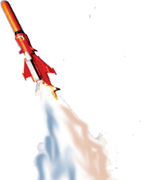
 North Korea could launch nuclear weapon at the US within months, CIA director warns THE CIA director has issued a scary warning on rogue state’s intentions as Russia urges not to back North Korea into a corner. news.com.au 21 Oct 17, Debra Killalea@DebKillalea NORTH Korea is just months away from perfecting its nuclear weapons capabilities and could strike the United States within months.
That is the grim warning given by CIA Director Mike Pompeo who said the secretive state was getting closer to achieving its nuclear ambitions.
Mr Pompeo told a national security forum in Washington that US needed to behave as if “we are on the cusp of them achieving their objective of being able to strike the United States”.
“When you’re now talking about months, our capacity to understand that at the detailed level is in some sense irrelevant,” he said.
“Whether it happens on Tuesday or a month from Tuesday, we are at a time where the president has concluded that we need a global effort to ensure that Kim Jong-un doesn’t have that capacity.”
However he said there’s a difference between having the ability to fire a single nuclear missile and the capability of producing large amounts of material and developing an arsenal of such weapons.
During the same conference, US President Donald Trump’s National Security Adviser HR McMaster said the country was in a race to resolve the crisis.
“We are not out of time,” he told the forum, organised by the Foundation for Defense of Democracies think tank.
“But we are running out of time,” he said.
‘BACKED INTO A CORNER
It comes as Russia called for support for a plan between Moscow and Beijing to end US and South Korean military drills in exchange for North Korea halting its missile testing.
Foreign Minister Sergei Lavrov said a dialogue would prevent a huge humanitarian, economic and ecological catastrophe in the region.
Russian President Vladimir Putin has also repeated his calls for calm.
While condemning Pyongyang’s nuclear ambitions, Putin said the stand-off should be settled through dialogue and without “cornering North Korea, threatening to use force or going down to outright boorishness and swearing.”
….. US WILL ‘MEET MOST MISERABLE DEATH’
Meanwhile North Korea launched new violent threats against the US and South Korea overnight, promising any nations that provoke or invade the country would “meet the most miserable death”.
Speaking via KCNA, the rogue nation said the joint US-South Korean naval drill in the waters off the Korean Peninsula risked nuclear war……. http://www.news.com.au/finance/work/leaders/north-korea-could-launch-nuclear-weapon-at-the-us-within-months-cia-director-warns/news-story/ee8f1873f2938aec5ee45ff126b43832
If Trump attacks North Korea, China would enter the war against USA
 CHINA’S CHILLING MESSAGE TO DONALD TRUMP AND THE WORLD COMMUNITY, InQUISTR, Alan Ewart, 19 Oct 17, “…..The prospect of USA vs, North Korea war is terrifying. According to Global Firepower, the hermit nation has a standing army almost one million strong. North Korea also has a trained military reserve that is 5.5 million strong, and which could engage the U.S. in a Vietnam style guerrilla war for decades.
This leads some to think that a preemptive nuclear strike against North Korea would be the only effective way of waging war against a nation that is building a nuclear arsenal. Therein lies the danger, one which could easily tip the world into a nuclear World War 3. A nuclear attack on North Korean capital Pyongyang would kill millions and would be very likely to draw China into World War 3.
As you can see from the World Time and Date calculator, Pyongyang is just over 100 miles from Dandong, a Chinese city of almost one million people. Dandong would, therefore, be well within the fallout zone that would be caused by a nuclear strike on Pyongyang. Something that Chinese premier Xi Jinping will not tolerate.
As reported by the Daily Star, Xi Jinping has issued a chilling warning to the international community. In a speech at the 19th National Congress of the Communist Party President Xi warned that the Chinese army will be able to “prevail in both conventional and new theatres of operation.” China has the worlds biggest standing army with over 2.5 million regular troops. President Xi is currently pouring billions into new military hardware and boosting troop numbers.
China is North Korea’s main trading partner and only real ally, and there are real fears that Beijing would join any war on the side of Pyongyang. Chinese leaders have repeatedly told Donald Trump to “cool it” over North Korea as they try to find a peaceful resolution to the Korean conflict.
Trump is due to meet President Xi next month when he visits Asia. Let’s hope that the leaders can find a way to resolve the issue without the world being plunged into World War 3. https://www.inquisitr.com/4565345/world-war-3-china-chilling-message-donald-trump-news-world-community/
North Korea’s belligerant response to USA-South Korea military drills
North Korea warns US of ‘unimaginable’ nuclear strike http://thehill.com/policy/defense/356166-north-korea-warns-us-of-unimaginable-nuclear-strike, BY OLIVIA BEAVERS – 10/19/17 North Korea is warning that the United States will face an “unimaginable” nuclear strike for conducting ongoing joint naval drills with the South Korean military on the Korean peninsula.
“The U.S. is running amok by introducing under our nose the targets we have set as primary ones,” the state-controlled news agency KCNA warned Thursday, Newsweek reported. “The U.S. should expect that it would face unimaginable strike at an unimaginable time.”
KCNA also reportedly blamed the U.S. for “creating tension on the eve of war” by participating in civilian evacuation drills in South Korea over the weekend.
The remarks come amid escalating tensions between Washington and Pyongyang.
President Trump has recently stepped up his rhetoric against North Korea and leader Kim Jong Un, whom he’s dubbed “Little Rocket Man.”
During his first address to the United Nations General Assembly last month, Trump threatened to “totally destroy North Korea” if it continued to threaten the U.S. and its allies.
The high-stakes war of words comes after North Korea conducted a series of intercontinental ballistic missile and nuclear tests to display its progress toward developing a nuclear missile capable of striking the U.S.
USA would consider direct talks with North Korea, eventually – Deputy Secretary of State John J Sullivan
US OFFICIAL SAYS NOT RULING OUT EVENTUAL DIRECT TALKS WITH NORTH KOREA, Eye Witness News, 18 Oct 17,
Tension has soared following a series of weapons tests by North Korea and a string of increasingly bellicose exchanges between Donald Trump and Kim Jong Un. Reuters |
TOKYO/UNITED NATIONS – The United States is not ruling out the eventual possibility of direct talks with North Korea, Deputy Secretary of State John J Sullivan said on Tuesday, hours after Pyongyang warned nuclear war might break out at any moment.
Talks between the adversaries have long been urged by China in particular, but Washington and its ally Japan have been reluctant to sit down at the table while Pyongyang continues to pursue a goal of developing a nuclear-tipped missile capable of hitting the United States.
“Eventually, we don’t rule out the possibility of course of direct talks,” Sullivan said in Tokyo after talks with his Japanese counterpart……..http://ewn.co.za/2017/10/17/us-official-says-not-ruling-out-eventual-direct-talks-with-north-korea
Quitting Iran deal would ruin 12yrs’ work, threaten nuclear war – ICAN
 Quitting Iran deal would ruin 12yrs’ work, threaten nuclear war – rep for Nobel Peace Prize-winner Rt.com, 17 Oct, 2017
Washington’s threats to walk out of the Iran nuclear deal is a critical moment for global nuclear non-proliferation, as it risks uprooting over a decade of diplomatic work and bring the world on the verge of a nuclear war, Jean-Marie Collin of ICAN France told RT.
Collin, coordinator of the International Campaign to Abolish Nuclear Weapons (ICAN) for France, which was recently awarded the Nobel Peace Prize, told RT he believes the US is putting the world’s safety in jeopardy by threatening to quit the nuclear deal.
Defending the agreement, Collin argued that no deal could possibly please all sides, as the ability to compromise lies in the nature of every agreement.
“Maybe it’s not the best agreement that we obtained, but you know, an agreement is never the best,” he said, adding that the deal should be considered a success as it reduces the chances of a major nuclear conflict breaking out.
“The important fact is that we arrived [there] after 12 years of diplomatic work, we did not have any war, we did not have any conflict with Iran and the rest of the world,” Collin said.
The deal stuck between Iran and the US, Russia, China, the UK, France and Germany in 2015 should not be a subject to revision, as it would undermine the result of a decades-long negotiation process, Collin said, saying “the deal is the deal.”
You cannot ask to revise the deal,” he stressed, pointing out that it will be possible to renegotiate some of the provisions only after they expire in 2025, but not before.
“Maybe some state will want to add some new paragraphs, some new rules, it’s a possibility we cannot deny just now 10 years before,” he said.
Meanwhile, the statements by US President Donald Trump leave the deal’s fate hanging in the balance, Collin argued, as after Washington withdraws, Tehran will follow suit…….https://www.rt.com/news/406929-iran-deal-revise-ican/
Stalemate continues, as North Korea warns that ‘nuclear war may break out any moment’
North Korea says ‘nuclear war may break out any moment’ — but that’s the last thing it wants, Business Insider, ALEX LOCKIEOCT 18, 2017
European Union statement on the Iran nuclear Joint Comprehensive Plan of Action (JCPOA)

 Iran nuclear deal: EU statement on the Joint Comprehensive Plan of Action http://www.consilium.europa.eu/en/press/press-releases/2017/10/16-iran-nuclear-deal-eu-jcpoa/
2. The EU is committed to the continued full and effective implementation of all parts of the JCPOA. The EU underlines that the lifting of nuclear related sanctions has a positive impact on trade and economic relations with Iran including benefits for the Iranian people. It strengthens cooperation and allows for continuous dialogue with Iran.
3. The European Union considers President Trump’s decision not to certify Iran’s compliance with the Joint Comprehensive plan of action (JCPOA) as being in the context of an internal US process. The EU encourages the US to maintain its commitment to the JCPOA and to consider the implications for the security of the US, its partners and the region before taking further steps.
4. While the EU expresses its concerns related to ballistic missiles and increasing tensions in the region, it reiterates the need to address them outside the JCPOA, in the relevant formats and fora . The EU stands ready to actively promote and support initiatives to ensure a more stable, peaceful and secure regional environment.
5. At a time of acute nuclear threat the EU is determined to preserve the JCPOA as a key pillar of the international non-proliferation architecture.
Russia positions itself as mediator on North Korean nuclear crisis

 Russia steps up as go-between on North Korea
Moscow sees rogue state as key to mending fences with Washington, Nikkei Asian Review, 17 Oct 17
TOMOYO OGAWA, Nikkei staff writer MOSCOW — Russia has been setting up a number of high-profile meetings with North Korean officials, positioning itself as an intermediary for negotiations with the isolated state in a bid to improve Moscow’s strained relations with the U.S.
Valentina Matviyenko, the speaker of Russia’s upper house, met separately with North and South Korean representatives on Monday on the sidelines of an international meeting in St. Petersburg. Matviyenko had called for a direct dialogue between the two Koreas, but Pyongyang rejected the idea in protest of joint U.S.-South Korean military drills.
The vice chair of North Korea’s Supreme People’s Assembly is believed to have given Matviyenko a statement from North Korean leader Kim Jong Un, while arguing that nuclear weapons were the only way for the country to defend itself. Matviyenko’s meeting with the North Korean official lasted about an hour and a half, compared with just 30 minutes or so with the South Korean envoy.
The Russian speaker later called for the resumption of six-party talks on the North Korean issue, and stressed that she will continue making every effort to foster dialogue.
Russia is also hosting an international conference on nuclear nonproliferation starting Thursday, to be attended by Choe Son Hui, director of North American affairs at the North Korean Foreign Ministry, and Wendy Sherman, former U.S. undersecretary of state for political affairs. Some expect the two countries to have some type of contact during the event…….. https://asia.nikkei.com/Politics-Economy/International-Relations/Russia-steps-up-as-go-between-on-North-Korea?utm_source=Sailthru&utm_medium=email&utm_campaign=EBB%2010.17.2017&utm_term=Editorial%20-%20Early%20Bird%20Brief
For the moment, America is staying in the Iran nuclear agreement
US to stay in Iran deal for now: officials, (Reuters) THE AUSTRALIAN, RICHARD COWAN AND DAVID MORGAN, 16 OCT 17, Senior Trump administration officials say the United States is committed to remaining part of the Iran nuclear accord for now, despite President Donald Trump’s criticisms of the deal and his warnings that he might pull out.
Nikki Haley, US ambassador to the United Nations, says Tehran is complying with the 2015 nuclear accord intended to increase Iran’s accountability in return for the lifting of some economic sanctions.
“I think right now, you’re going to see us stay in the deal,” Haley told NBC’s Meet the Press.
In a speech on Friday, Trump laid out an aggressive approach on Iran and said he would not certify it is complying with the nuclear accord, despite a determination by the UN’s nuclear watchdog that Tehran is meeting its terms.
The Republican president threw the issue to the US Congress, which has 60 days to decide whether to reinstate US sanctions. He warned that if “we are not able to reach a solution working with congress and our allies, then the agreement will be terminated”.
So far, none of the other signatories to the deal – Britain, France, Germany, Russia, China, Iran and the European Union – have cited serious concerns, leaving the US isolated…… http://www.theaustralian.com.au/news/latest-news/us-to-stay-in-iran-deal-for-now-officials/news-story/48e6f041c87304d1a8dabd4de8ef27c8
Trump will provoke ‘nuclear arms race’ over North Korea – says Hillary Clinton
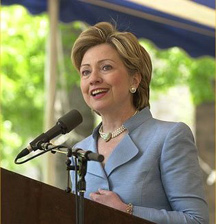 Hillary Clinton: Trump will provoke ‘nuclear arms race’ over North Korea, Guardian, 15 Oct 17,
Former secretary of state refuses to say if successor Tillerson should go, as she decries Trump approach to Iran nuclear deal. Hillary Clinton has denounced Donald Trump’s bellicose language toward North Korea, believing his verbal aggression has rattled American allies and will set off a nuclear arms race in the region.
Clinton, who was secretary of state under Barack Obama from 2009 to 2013, stressed that she preferred a diplomatic solution; suggested Trump’s inflammatory rhetoric played into Kim Jong-un’s hands; and bemoaned Trump’s public undercutting of his secretary of state, Rex Tillerson, regarding his attempts to work with China and establish talks with Pyongyang.
“Diplomacy, preventing war, creating some deterrents is slow, hard-going, difficult work,” said Clinton, who declined to answer when asked if Tillerson should resign. “And you can’t have impulsive people or ideological people who basically say, ‘Well, we’re done with you.”’
On Friday Bob Corker, the Tennessee Republican who chairs the Senate foreign relations committee, continued his war of words with the president when he told the Washington Post Trump had “castrated” Tillerson.
Britain and Germany join in commitment to the Iran nuclear agreement
Britain, Germany committed to Iran nuclear deal, says PM May’s office https://www.cnbc.com/2017/10/15/britain-germany-committed-to-iran-nuclear-deal-theresa-mays-office-says.html
- Britain and Germany agreed on Sunday they remained committed to the nuclear deal with Iran
- The U.S. decided earlier this week that it would decertify the agreement
Britain and Germany agreed on Sunday they remained committed to the nuclear deal with Iran after a U.S. decision to decertify the agreement, a spokeswoman said after a call between Prime Minister Theresa May and German Chancellor Angela Merkel.
“They agreed the UK and Germany both remained firmly committed to the deal,” the spokeswoman said in a statement.
“They also agreed the international community needed to continue to come together to push back against Iran’s destabilizing regional activity, and to explore ways of addressing concerns about Iran’s ballistic missile program.”
Donald Trump’s 3 dysfunctional decisions regarding Iran and North Korea
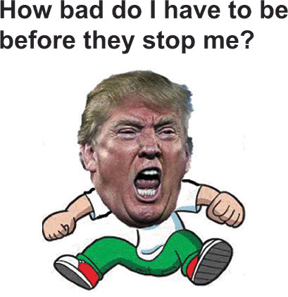 Trump’s trifecta: thoughtless Iran folly strains his partners’ patience http://www.smh.com.au/federal-politics/political-news/trumps-trifecta-thoughtless-iran-folly-strains-his-partners-patience-20171014-gz0zgu.html, Mark Kenny 16 Oct 17,
While there are concerns over Iran’s behaviour (mostly outside the agreement’s purview, but not entirely), its nuclear retreat is a real-time, real-world example of how coordinated international pressure, coupled with a willingness to
While the Obama Administration was the locomotive force behind the 2015 agreement, it was a settlement between Tehran and the five permanent members of the United Nations Security Council – China, France, Britain, Russia and the US – with the European Union tagging along.
Thus, it is a multi-lateral instrument annexed to UN Security Council resolution 2231, the text of which welcomes inter alia diplomatic efforts by the five plus Iran “to reach a comprehensive, long-term and proper solution to the Iranian nuclear issue, culminating in the Joint Comprehensive Plan of Action [JCPOA]”.
It also notes explicitly “Iran’s reaffirmation in the JCPOA that it will under no circumstances ever seek, develop or acquire any nuclear weapons”.
Over the weekend, Trump threw that process into new uncertainty, by demanding that Congress and America’s allies introduce new tests for Iran’s compliance, including by dragging in elements outside the nuclear purview.
In so doing Trump has achieved the dysfunctional trifecta by: (i) putting the JCPOA deal at risk, and thus potentially increasing the prospect of Tehran’s return to a nuclear weapons path, (ii) showing contempt for America’s closest allies by demonstrating that he will act unilaterally against their interests at a whim, and (iii) signalling to North Korea, Iran, and any other adversary that there is little point in negotiating because even after a deal is made and complied with, the US can simply renege.
Tweet that.
For Britain’s nuclear industry, Brexit changes everything – could be the death knell
 Brexit Is a Game Changer for the British Nuclear Industry, Bloomberg, By, Jonathan Stearns and Nikos Chrysoloras,
-
U.K. withdrawal from nuclear treaty mirrors EU-exit challenges
-
Going it alone signals higher costs for companies, taxpayers
To understand the implications of Brexit, it helps to go nuclear.
“Brexit is a complete game changer for the nuclear industry in Britain, altering the regulatory environment, creating major complexity and leading the way to higher costs for businesses, the state and ultimately the British taxpayer,” said Simone Tagliapietra, a research fellow on energy at the Bruegel think tank in Brussels. “It’s a huge, self-inflicted problem.”
The EU’s nuclear framework is a microcosm of the Brexit hurdles because, like Europe’s single market and free-trade deals, it offers the U.K. benefits that the British government is keen to retain after the country withdraws from the 28-nation bloc in March 2019. Yet the act of leaving makes preserving those advantages difficult or even impossible.
With negotiations on the divorce terms stalled, numerous industries in Europe are stepping up calls for transitional arrangements that would maintain the status quo between the time of Brexit and the entry into force of any permanent agreements on future U.K.-EU ties.
While the EU’s national governments retain many of the policy powers associated with nuclear energy, the Euratom treaty creates a federal structure for some key elements. The centralized features include non-proliferation inspections, supply agreements with non-EU nations and research funding, all of which will fall on Britain to arrange for the first time in four decades.
When notifying its plan to withdraw from the EU, the government of British Prime Minister Theresa May also announced its intention to quit Euratom, which is governed by the bloc’s institutions. The move disappointed the U.K. nuclear industry, which had argued that post-Brexit Britain should stay in Euratom.
Risk of Disruption
Britain is a leading European nuclear nation, with 15 reactors accounting for about a fifth of domestic electricity production. The British atomic-energy industry employs more than 65,000 people and features companies ranging from plant operator EDF Energy and developer Horizon Nuclear Power — a unit of Hitachi Ltd. — to fuel producer Westinghouse Electric Co. and uranium enricher Urenco Ltd…….
The U.K., Euratom and the International Atomic Energy Agency are united under a single non-proliferation agreement. Under the three-party accord, Euratom helps carry out IAEA-mandated inspections on civil nuclear facilities in Britain to ensure that no material is diverted for atomic weapons.
In leaving Euratom, the U.K. will have to negotiate an inspection agreement of its own with the Vienna-based IAEA and beef up the national nuclear authority. Britain held an initial discussion with the IAEA on a new accord in September, according to the agency. The country also published draft legislation on Oct. 11 to create a domestic nuclear-safeguards system to replace provisions under Euratom.
Nuclear Accords
Post-Brexit Britain will also no longer be covered by cooperation accords that Euratom has with a range of non-EU countries including Australia, Canada, Japan, Kazakhstan, South Africa and the U.S. As a result, the U.K. will have to negotiate its own such deals, known as Nuclear Cooperation Agreements, or NCAs, including with the EU itself…….
The outlook for nuclear research in the U.K. is also hazy. As a member of the EU and host of a nuclear-fusion project known as Joint European Torus, the country sees 56 million euros ($66 million) a year directed from the Euratom research budget to the JET site in Oxfordshire where around 500 people are employed and about 350 scientists from Europe visit annually.
The funds for JET, which is a prototype for the world’s largest nuclear-fusion project called ITER in France, are part of a 1.6 billion-euro Euratom research budget for 2014-2018. Britain will have to negotiate access as of 2019 to this scientific network with the EU, which requires non-member countries participating in its research programs to make a financial contribution. https://www.bloomberg.com/news/articles/2017-10-15/brexit-takes-bureaucracy-to-the-atomic-level-for-u-k-industry
Trump’s anti-Iran speech, decertifying nuclear agreement, will cause problems with America’s European allies
 Iran nuclear deal: Trump decertifies Obama-era agreement and accuses Tehran of spreading ‘death and chaos’ The President’s more confrontational strategy toward Iran is likely to complicate relations with European allies, Independent UK, Alexandra Wilts Washington DC , 14 Oct 17, Donald Trump has struck a blow against the 2015 Iran nuclear agreement – in defiance of other world powers – by choosing not to certify that Tehran is complying with the deal.
During a speech at the White House, Mr Trump accused the “fanatical regime” in the Iranian capital of spreading “death, destruction and chaos around the globe” as he again called the nuclear pact “one of the worst” agreements the US has ever entered into.
However, he stopped short of scrapping the agreement altogether, saying he wanted his administration to work with Congress and other nations to address the “deal’s many serious flaws”. ……Federica Mogherini, the EU’s foreign policy chief and one of the deal’s chief negotiators, said the agreement will remain valid regardless of Mr Trump’s decision. ……
The move by Mr Trump was part of his “America First” approach to international agreements which has led him to withdraw the United States from the Paris climate accord and the Trans-Pacific Partnership trade talks and renegotiate the North American Free Trade Agreement with Canada and Mexico……
Mr Trump’s more confrontational strategy toward Iran is likely to complicate relations with European allies while strengthening ties with Israel.A vocal opponent of the agreement when it was signed, Israeli Prime Minister Benjamin Netanyahu welcomed Mr Trump’s “courageous” decision.
“I congratulate President Trump for his courageous decision today. He boldly confronted Iran’s terrorist regime,” the prime minister said in a video statement he released in English.
But both UK Prime Minister Theresa May and French President Emmanuel Macron this week had tried to persuade Mr Trump to re-certify the deal. Ms May has called the agreement “vital”, while Mr Macron has said it is “essential for peace”. …….
Russia’s foreign ministry said there was no place in international diplomacy for threatening and aggressive rhetoric such as that displayed by Mr Trump and said such methods were “doomed to fail”, in a statement issued after Mr Trump’s speech……
John McLaughlin, a former acting CIA director under Republican President George W Bush, called the decertification of the Iran deal one of Mr Trump’s “worst decisions”.
The decision “feeds Iran hardliners, splits allies, shreds US credibility, roils congress [and is a] gift to Russia,” he wrote on Twitter. http://www.independent.co.uk/news/world/americas/us-politics/iran-nuclear-deal-donald-trump-decertifies-agreement-2015-policy-obama-a7999451.html
Fact checking Donald Trump’s statements on Iran
 AP FACT CHECK: Trump’s statements on Iran http://www.dailymail.co.uk/wires/ap/article-4978836/AP-FACT-CHECK-Trumps-statements-Iran.html
By Associated Press 14 October 2017, WASHINGTON (AP) – President Donald Trump offered a questionable reading of Iran’s past economic condition Friday when he blamed the Obama administration for lifting sanctions just as Iran’s government was facing “total collapse.”
A look at some of his points in remarks Friday that denounced Iran’s behavior but stopped short of fulfilling his campaign promise to get the U.S. out of the multinational deal that eased sanctions on Iran in return for a suspension of its nuclear program:
THE FACTS: An imminent collapse of Iran’s economy was highly unlikely, according to international economists and U.S. officials.
International penalties on Iran in response to its nuclear program did drive its economy into crisis earlier this decade. But even before the nuclear deal, Iran had cut budget expenditures and fixed its balance of payments. It was still exporting oil and importing products from countries such as Japan and China.
The multinational deal froze Iran’s nuclear program in return for an end to a variety of oil, trade and financial sanctions on Tehran. Iran also regained access to frozen assets held abroad. The deal was conceivably an economic lifeline for the state, but international economists as well as U.S. officials did not foresee an imminent economic collapse at the time.
Among those experts, Patrick Clawson at the Washington Institute for Near East Policy said Iran’s leaders worried about the potential for social unrest at the time, but that the economy was sustainable.
TRUMP: “The Iranian regime has committed multiple violations of the agreement. For example, on two separate occasions, they have exceeded the limit of 130 metric tons of heavy water.”
THE FACTS: Iran is meeting all of its obligations under the deal, according to International Atomic Energy Agency investigators, who noted some minor violations that were quickly corrected.
Trump is right that Iran exceeded the limit on heavy water in its possession on two occasions. Both times, international inspectors were able to see that Iran made arrangements to ship the excess out of the country so that it could come back into compliance.
Deal supporters argue this shows the agreement works. Deal opponents say that because Iran sells the surplus on the open market, Iran is therefore being rewarded for violating the deal.
Trump and other critics of the agreement point in particular to Iran’s continuing missile tests, which may or may not defy the U.N. Security Council resolution that enshrined the deal. But those tests do not violate the deal itself.
TRUMP on the deal: “It also gave the regime an immediate financial boost and over $100 billion its government could use to fund terrorism. The regime also received a massive cash settlement of $1.7 billion from the United States, a large portion of which was physically loaded onto an airplane and flown into Iran.”
THE FACTS: The “financial boost” was from money that was Iran’s to begin with. It was not a payout from the U.S. or others but an unfreezing of Iranian assets held abroad.
The $1.7 billion from the U.S. is a separate matter. That dates to the 1970s, when Iran paid the U.S. $400 million for military equipment that was never delivered because the government was overthrown and diplomatic relations ruptured.
The rupture left people, businesses and governments in each country indebted to partners in the other, and these complex claims took decades to sort out in tribunals and arbitration. For its part, Iran paid settlements of more than $2.5 billion to American people and businesses.
The day after the nuclear deal was implemented, the U.S. and Iran announced they had settled the claim over the 1970s military equipment order, with the U.S. agreeing to pay the $400 million principal along with $1.3 billion in interest. Find AP Fact Checks at http://apne.ws/2kbx8bd
1 This Month
26 September – International Day for the Total Elimination of Nuclear Weapons





PLEASE OPPOSE HR 8255 AND S.3639 – bills would accelerate satellite deployment, with no environmental review or safeguards – https://ncstd5li.quorum.us/campaign/169331/
To see nuclear-related stories in greater depth and intensity – go to https://nuclearinformation.wordpress.com
-
Archives
- September 2026 (313)
- August 2026 (330)
- July 2026 (355)
- June 2026 (287)
- May 2026 (306)
- April 2026 (356)
- March 2026 (251)
- February 2026 (267)
- January 2026 (308)
- December 2025 (358)
- November 2025 (359)
- October 2025 (375)
-
Categories
- 1
- 1 NUCLEAR ISSUES
- business and costs
- climate change
- culture and arts
- ENERGY
- environment
- health
- history
- indigenous issues
- Legal
- marketing of nuclear
- media
- opposition to nuclear
- PERSONAL STORIES
- politics
- politics international
- Religion and ethics
- safety
- secrets,lies and civil liberties
- spinbuster
- technology
- Uranium
- wastes
- weapons and war
- Women
- 2 WORLD
- ACTION
- AFRICA
- Atrocities
- AUSTRALIA
- Christina's notes
- Christina's themes
- culture and arts
- Events
- Fuk 2022
- Fuk 2023
- Fukushima 2017
- Fukushima 2018
- fukushima 2019
- Fukushima 2020
- Fukushima 2021
- general
- global warming
- Humour (God we need it)
- Nuclear
- RARE EARTHS
- Reference
- resources – print
- Resources -audiovicual
- Weekly Newsletter
- World
- World Nuclear
- YouTube
-
RSS
Entries RSS
Comments RSS

