

 The Europeans have 90 days to save the nuclear agreement with Iran .http://thebulletin.org/europeans-have-90-days-save-nuclear-agreement-iran10992, IAN J. STEWART, Ian Stewart heads Project Alpha at King’s College London and directs the European Non-proliferation and Security Initiative at the Vienna Center for Disarmament and Non-proliferation.8 Aug 17
The Trump administration and Iran are risking Europe’s strategic interests. The European states had pursued a peaceful but verifiable agreement on the Iran nuclear issue since the early 2000s and were key to achieving the nuclear agreement with Iran. The European Union and its member states were among the key actors in negotiating the JCPOA and are now centrally involved in ensuring that Iran adheres to (and doesn’t cheat on) the agreement. This European involvement includes chairing the Joint Commission, the mechanism accepted by all parties and endorsed by the United Nations Security Council as responsible for ensuring that the agreement is fully implemented by all sides.
To date, it has also been the Europeans who have adhered most closely to the letter of the agreement. European countries have lifted sanctions as required by the JCPOA and have engaged in civil nuclear cooperation with Iran on issues like nuclear security. European businesses have also begun to re-engage with Iran, including through one particularly large contract between the French oil company Total and the National Iranian Oil Company to develop a phase of the South Pars oil field. At the same time, European States have taken a firm line when Iran has pushed the bounds of the JCPOA, including its technical violation of the heavy water cap and proposals to import large quantities of uranium from Kazakhstan.
For its part, however, Iran has largely adhered to both the letter and the spirit of the JCPOA. Iran has destroyed the core of the Arak reactor and dismantled vast numbers of centrifuges. And its technical violations have been relatively minor to date. Worryingly, there are signs that Iran has also engaged in some higher risk activities, such as a previously underreported case involving the import of carbon fibre for its missile program, a dual‑use material subject to export controls under the Nuclear Suppliers Group guidelines. But to be clear, this case was not considered a violation of the JCPOA by the United States, as the agreement covers only the import of dual-use goods for “Iran’s nuclear programme [as] set out in this JCPOA or other non-nuclear civilian end-use.” Counterintuitively, this language means that imports of nuclear-related dual-use items for a missile-related end use are not considered “civil” and are therefore a violation not of the JCPOA but of UNSCR2231, which prohibits development of missiles capable of carrying nuclear weapons. In this case, Iran is evidently pushing the bounds of what is allowed under the JCPOA.
Despite the Trump administration’s rhetoric, the United States has also largely lived up to its commitments under the JCPOA. In particular, the United States lifted—and doesn’t appear to be planning to reverse—its own nuclear-related sanctions. (Washington has taken additional action in relation to Iran’s ballistic missile program, including through the designation of additional entities to be sanctioned.)
Amid this general adherence to the JCPOA, however, President Trump’s harsh anti-Iran rhetoric and the opposition of Iranian hardliners and Iran’s Islamic Revolutionary Guard Corps risk undermining the nuclear agreement—an agreement that has undoubtedly has set back Iran’s nuclear weapons potential by many years and is in Europe’s strategic interests.
There’s much more that Europe could do.The Iran nuclear agreement belongs as much to Europe as it does to the other countries involved. European states demonstrated that they were willing to take an economic hit from sanctions to bring the agreement about. They have also invested heavily on the diplomatic front to both achieve and maintain the JCPOA. There is now no question that the European states wish to see full, continued implementation of the JCPOA and would only change this view if Iran committed an egregious violation. For these reasons, the European states have embarked upon a diplomatic and public campaign to persuade the United States that it must not withdraw from the agreement.
To sustain the JCPOA, however, the Europeans must urgently undertake three additional actions to demonstrate to both the United States and Iran that Europe will implement the JCPOA for as long as Iran is in compliance.
First, the Europeans should again explore the possibility of creating a safe financial channel for transactions with Iran. This move would have the dual benefit of encouraging trade with Iran, which has hitherto been slow to pick up, while also making clear to hardliners in the United States that it could not, on its own, undermine the JPCOA by leveraging the international financial system. Second, Europe should be prepared to adopt further sanctions on Iran for any violations of Security Council resolution 2231. This should include both missile launches and violations of the procurement restrictions mentioned above. These two actions would make clear that Europe is committed to implementing the JCPOA regardless of the actions of the United States and, at the same time, that the European countries are not willing to accept egregious action by Iran.
The European Union should embark on a third action. Presently the JCPOA is the best mechanism to ensure that Iran’s nuclear program stays peaceful, but the value of the agreement’s restrictions will reduce over time. By the mid-2020s, Iran will again be scaling up its enrichment effort. Therefore, the EU should begin to search for a longer-term solution both to the Iran nuclear issue and to broader regional tensions. This might best be pursued in the short term through the holding of bilateral dialogues and through civil society discourse on relevant security issues, including the nuclear issue and broader regional security issues.
Europe’s interest and President Trump’s interest align. Although President Trump might feel he can do without the Obama-era JCPOA, in reality the agreement is the best mechanism for both the Europeans and the United States to ensure the peaceful nature of Iran’s nuclear program—at least for the next decade. It is also in the interest of Iran and its people. As such, it is appropriate for the Europeans to use its position and influence to ensure the sustainability for the JCPOA for as long as the IAEA confirms Iran’s compliance.
The Trump administration might resist the idea of a safe European financial channel with Iran or European leadership in relation to broader regional issues. It should nonetheless be willing to accept these measures, given that the result would be to ensure the continued peaceful nature of Iran’s nuclear program. The alternative would be for the United States to unilaterally weaken is position vis-à-vis Iran and diminish its control over the global financial system, which would be counter to broader US security interests.
President Trump must ultimately decide within 90 days on whether to recertify Iran in compliance or to jeopardize the security interests of both the United States and its closest allies.
August 9, 2017
Posted by Christina Macpherson |
EUROPE, Iran, politics international |
Leave a comment
 US, South Korea laud new UN sanctions on Pyongyang, Aljazeera, 6 Aug 17 Fresh UN sanctions come amid ASEAN meeting, where Chinese minister is urging North Korean official to abide by measures.
 The
United States, China, Japan and South Korea have all welcomed tough new UN sanctions against
North Korea over its nuclear weapons and ballistic missile programmes…….
Meanwhile, Japan said it was time to exert more “efffective pressure” on Pyongyang rahter than to pursue dialogue.
“Now is not the time for dialogue but the time to increase effective pressure on North Korea so that they will take concrete actions towards de-nuclearisation,” deputy foreign ministry spokesman Toshihide Ando told a news conference in Manila.
The diplomats are meeting in Manila, the Philippine capital, as foreign ministers from across Asia gather for a regional ASEAN summit. …..
China’s vote on new UN sanctions helped clear the way for the 15-0 vote on Saturday.
Al Jazeera’s Rob McBride, reporting from Beijing, said that China is always careful when dealing with North Korea.
“The last thing China wants to see is North Korea being pushed to the point of its own self-destruction,” he said. “That is almost a worst-case scenario.” http://www.aljazeera.com/news/2017/08/south-korea-praise-sanctions-north-korea-170806045555844.html
August 7, 2017
Posted by Christina Macpherson |
North Korea, politics international |
Leave a comment
China Counting on Sanctions to Block North Korea Nuclear Push, Bloomberg , By Keith Zhai and  Kambiz Foroohar August 7, 2017,
China expressed confidence that new United Nations sanctions would help bring North Korea to the negotiating table to end its push for nuclear weapons and ballistic missiles.
Foreign Minister Wang Yi urged North Korean counterpart Ri Yong-ho to calmly react to measures to curb its exports and avoid more provocations when they met on Sunday in Manila, where diplomats from more than 20 countries are attending a security forum. Wang, who also called for the U.S. and South Korea to reduce tensions, said after meeting Secretary of State Rex Tillerson that the sanctions “created the conditions to find a breakthrough.”
“The goal is to effectively block the DPRK’s nuclear development process,” Wang told reporters in Manila. “Sanctions are needed but not the ultimate goal. The purpose is to pull the peninsula nuclear issue back to the negotiating table, and to seek a final solution.”
As North Korea’s main ally and biggest trading partner, China’s role is crucial to pressuring leader Kim Jong Un into halting his push for a nuclear-tipped missile that can hit the U.S. mainland…….
Many analysts see the North Korean program as too advanced for sanctions to make much difference, and doubt the country will ever completely give up nuclear weapons……
Trump isn’t ruling out a “preventive war” to stop North Korea from being able to threaten the U.S., National Security Adviser H.R. McMaster said in an interview with MSNBC done earlier in the week and broadcast Saturday. The danger posed by North Korea was “a grave threat,” he said.
“If they had nuclear weapons that can threaten the United States, it’s intolerable from the president’s perspective,” McMaster told MSNBC’s Hugh Hewitt. Even so, the U.S. would prefer to resolve the threat “short of what would be a very costly war in terms of the suffering of, mainly, the South Korean people,” McMaster said. https://www.bloomberg.com/news/articles/2017-08-06/china-confident-un-sanctions-can-block-north-korea-nuclear-push
August 7, 2017
Posted by Christina Macpherson |
China, politics international, weapons and war |
Leave a comment
The Guardian view on Iran: the nuclear deal is not a disaster – but scrapping it could be, Guardian,
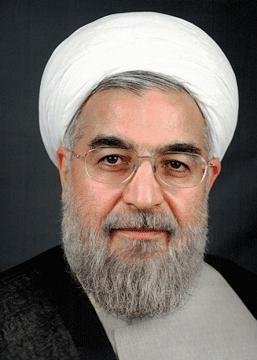
Editorial 5 Aug 17 Hassan Rouhani has a hefty electoral mandate for his second term but faces opposition at home and a US president determined to scrap the landmark nuclear agreement. hen the Iranian president, Hassan Rouhani, is sworn in again on Saturday, the EU’s foreign policy chief Federica Mogherini and ministers from Britain, France and Germany will be in Tehran to watch; an indication of how far relations with the west warmed in his first term. Yet as he embarks upon his second, he may feel the chill. Despite defeating his conservative rival by a landslide in May’s elections, opposition is ranged against him at home and abroad. The great domestic uncertainty he faces – supreme leader Ayatollah Ali Khamenei is 78 and without a clear successor – is for now overshadowed by Donald Trump’s threat to pull out of the landmark nuclear deal signed in 2015.
The International Atomic Energy Agency, which monitors its implementation, says Iran is complying with the requirements to curb its nuclear programme and accept inspections in return for sanctions relief. But Mr Trump has vowed to overturn the Obama administration’s stand-out foreign policy achievement. He has twice signed the sanctions waiver, but with extreme reluctance. He has asked aides to find a way to ditch the deal and says he expects Iran to be declared non-compliant next month. Officials say it has breached the pact “in spirit”………
American hostility can only bolster the isolationist, hardline forces ranged against Mr Rouhani; against the wishes and instincts of the Iranian people; against stability in the region and indeed against the interests of the US. Even defence secretary James Mattis – who has defined the three gravest threats facing the USas “Iran, Iran, Iran” – is among those pressing to maintain the deal. The president he serves calls the agreement a disaster. But Mr Trump is, as usual, wrong. It is scrapping it that could court catastrophe. https://www.theguardian.com/commentisfree/2017/aug/04/the-guardian-view-on-iran-the-nuclear-deal-is-not-a-disaster-but-scrapping-it-could-be
August 5, 2017
Posted by Christina Macpherson |
Iran, politics international |
Leave a comment
Rouhani vowed to continue his efforts to end the country’s isolation as he was sworn in by supreme leader Ayatollah Ali Khamenei following his re-election in May.
But the ceremony came less than 24 hours after US President Donald Trump confirmed fresh sanctions against Iran.
Tehran says the new measures violate its 2015 deal with world powers that eased sanctions in exchange for curbs on its nuclear programme, an agreement which Trump has repeatedly threatened to tear up.
“We believe that the nuclear deal has been violated and we will react appropriately,” Deputy Foreign Minister Abbas Araghchi said on state television. We will certainly not fall into the trap of US policy and Trump, and our reaction will be very carefully considered.”
The mounting crisis creates a difficult position for Rouhani, a 68-year-old moderate who won re-election largely thanks to his efforts to repair relations with the West.
“We will never accept isolation,” Rouhani said as he was sworn in in front of top political and military officials.
“The nuclear deal is a sign of Iran’s goodwill on the international stage,” he added.
Khamenei took a tougher line, saying Iran must not fall for Washington’s “tricks”…… http://borneobulletin.com.bn/iran-says-us-breaching-nuclear-deal-rouhani-starts-new-term/
August 5, 2017
Posted by Christina Macpherson |
Iran, politics international |
Leave a comment
 Guardian 2nd Aug 2017, Until recently, few of us were familiar with the European Atomic Energy Community (Euratom), the international organisation that governs many aspects of nuclear energy activity in member states. Brexit, and the rapidly retracted “leak” that Britain may seek “associate membership” of Euratomhas suddenly brought Euratom to the fore.
The precise legal situation regarding the UK’s continued membership of Euratom is contested, but there is much to learn from the history of this relationship: over the past six decades the UK has attempted to become an associate member or full member of Euratom five times.
Since joining in 1973, any nuclear treaties with other nations (including any signed before that date) were placed under the aegis of Euratom. This means that if Britain leaves Euratom, all its complex nuclear treaties with the United
States, the rest of Europe and many other nations across the world will need to be re-ratified in national legislatures before Britain is no longer a member.
This is a large international legislative task, and requires quick action before the Article 50 process ends in just over a year. If the treaties are not re-ratified by national parliaments, then, depending on the treaty, the UK could be in breach of the Non-Proliferation Treaty, and a worst-case scenario could have a variety of very serious consequences
including: stopping work on Hinkley C, halting the movement of nuclear fuel, and even ending the import of medical isotopes for cancer treatments. https://www.theguardian.com/science/political-science/2017/aug/02/our-60-year-relationship-with-euratom-offers-hard-lessons-for-brexit-negotiators
August 4, 2017
Posted by Christina Macpherson |
politics, politics international, UK |
Leave a comment
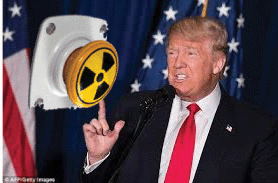 Sen. Lindsey Graham: Trump Says War With North Korea an Option, NBC News 2 Aug 17, by ERIK ORTIZ There will be war between the United States and North Korea over the rogue nation’s missile program if it continues to aim intercontinental ballistic missiles at America, Sen. Lindsey Graham, R-S.C., said President Donald Trump has told him.
“He has told me that. I believe him,” the lawmaker said Tuesday on TODAY. “If I were China, I would believe him, too, and do something about it.”
Graham said that Trump won’t allow the regime of Kim Jong Un to have an ICBM with a nuclear weapon capability to “hit America.”
“If there’s going to be a war to stop [Kim Jong Un], it will be over there. If thousands die, they’re going to die over there. They’re not going to die here. And He has told me that to my face,” Graham said.
“And that may be provocative, but not really. When you’re president of the United States, where does your allegiance lie? To the people of the United States,” the senator said.
Military experts have said there are no good options for peacefully stopping North Korea, although the National Security Council has previously presented Trump with possibilities that could include putting American nukes in South Korea or killing Kim Jong Un.
Graham said military experts are “wrong” that no good options exist.
“There is a military option to destroy North Korea’s program and North Korea itself,” he added. Ultimately, a conflict in the region that would likely ensnare China and South Korea could claim millions of lives……..http://www.nbcnews.com/news/north-korea/sen-lindsey-graham-trump-says-war-north-korea-option-n788396
August 2, 2017
Posted by Christina Macpherson |
politics international, USA, weapons and war |
Leave a comment

 Chinese envoy stresses negotiated solutions to Korean nuclear issue http://news.xinhuanet.com/english/2017-08/01/c_136490946.htm 2017-08-01 UNITED NATIONS, Aug. 1 (Xinhua) — A Chinese envoy to the United Nations Monday called for negotiated solutions to the nuclear issue on the Korean Peninsula.
Liu Jieyi, China’s permanent representative to the UN, made the statement at a press conference on Monday, marking the end of China’s rotating term of the Security Council President for the month of July.
Liu said China is firmly opposed to any violation of the Security Council (UNSC) resolutions, including nuclear tests and ballistic missile tests by the Democratic People’s Republic of Korea (DPRK).
China has been urging the DPRK and other relevant countries not to exacerbate the situation on the Korean Peninsula by avoiding words and actions that could escalate regional tensions, which run counter to the objectives sought by the UNSC.
“Our objective is to achieve denuclearization of the Korean Peninsula, maintain peace and stability on the peninsula and to seek negotiated solutions through dialogues and consultations,” said the ambassador.
China is opposed to conflicts or wars on the peninsula, he said.
“Basically, if you can generalize broadly what relevant resolutions contain, they contain sanctions to address the nuclear ballistic missile programs in the DPRK,” he added. Liu said that normal economic relations should be maintained, and the resolutions are not intended to have adverse humanitarian consequences for the DPRK’s civilians.
“China has been working very hard to try to initiate an negotiated solution of the issues of denuclearization, peace and stability,” he said.
“In doing so, we have proposed a package solution, including ‘freeze for freeze’, ‘suspension for suspension’ and denuclearization for peace or security mechanism on the ground,” he added.
At the meeting, the ambassador also told the media that China has been working with the Russian Federation to put forth a road map for achieving regional peace and the UNSC’s objectives.
August 2, 2017
Posted by Christina Macpherson |
China, North Korea, politics international |
Leave a comment
Iran accuses United States of breaching nuclear deal Bozorgmehr Sharafedin, 1 Aug 17 LONDON (Reuters) – Iran believes new sanctions that the United States has imposed on it breach the nuclear deal it agreed in 2015 and has complained to a body that oversees the pact’s implementation, a senior politician said on Tuesday.
Under the Joint Comprehensive Plan of Action (JCPOA), signed by the United States, Russia, China and three European powers, Iran curbed its nuclear work in return for the lifting of most sanctions.
However, the U.S. Treasury imposed sanctions on six Iranian firms in late July for their role in the development of a ballistic missile program, after Tehran launched a rocket capable of putting a satellite into orbit.
The U.S. Senate voted on the same day to impose new sanctions on Iran, Russia and North Korea. The sanctions in that bill also target Iran’s missile programs as well as human rights abuses.
“Iran’s JCPOA supervisory body assessed the new U.S. sanctions and decided that they contradict parts of the nuclear deal,” Ali Larijani, the speaker of Iran’s parliament, was quoted as saying by the Tasnim news agency. “Iran has complained to the (JCPOA) Commission for the breach of the deal by America,” he added, referring to the joint commission set up by the six world powers, Iran and the European Union to handle any complaints about the deal’s implementation.
If the commission is unable to resolve a dispute, parties can take their grievances to the U.N. Security Council……..https://www.reuters.com/article/us-iran-usa-sanctions-
August 2, 2017
Posted by Christina Macpherson |
Iran, politics international |
Leave a comment
,Japan Times, 1 Aug 17 KYODO KYODO AUG 1, 2017 HIROSHIMA/NAGASAKI – The mayors of Hiroshima and Nagasaki will call on the government to help realize a treaty banning nuclear weapons at upcoming anniversaries marking the 1945 U.S. atomic bombings in their cities.
This year’s declarations follow the adoption in New York last month by 122 U.N. members of the Treaty on the Prohibition of Nuclear Weapons. As a country under the U.S. nuclear umbrella, Japan did not participate, nor did any of the nuclear weapon states.
Hiroshima Mayor Kazumi Matsui announced an outline of his declaration at a news conference on Tuesday, to be read out at a commemoration ceremony on the anniversary of the bombing on Aug. 6.
According to the outline, he will stress that the “hell” Hiroshima saw 72 years ago is not a thing of the past, saying, “As long as nuclear weapons exist and policymakers threaten their use, their horror could leap into our present at any moment.”…..
Nagasaki Mayor Tomihisa Taue is to read his declaration at the city’s ceremony three days later on Aug. 9. In Nagasaki, an estimated 74,000 people died from the bombing by the end of 1945.
“Action by civil society will be crucial in making the nuclear prohibition treaty an international norm,” Taue said at a news conference on Monday announcing the outline of his declaration. “I would like to call for coordination.”
Taue said he will call on the government to change its mind and join the treaty, while Matsui will urge the government to “manifest the pacifism in our Constitution” by “doing everything in its power to bridge the gap between the nuclear weapon and non-nuclear weapon states.”…..
Both the Hiroshima and Nagasaki declarations were drafted after meetings in recent months with hibakusha and experts. http://www.japantimes.co.jp/news/2017/08/01/national/hiroshima-nagasaki-mayors-urge-government-act-nuke-ban-treaty/#.WYD_7xWGPGg
August 2, 2017
Posted by Christina Macpherson |
Japan, politics, politics international, weapons and war |
Leave a comment
 Donald Trump says China does ‘nothing’ to thwart North Korea’s nuclear quest Trump has previously used conciliatory and at times fawning language to refer to China’s President Xi, but the honeymoon appears to be over, Guardian, Tom Phillips 30 July 17, Donald Trump has launched his latest Twitter assault on China, accusing its Communist party leaders of doing “NOTHING” to help the United States thwart North Korea’s quest for nuclear weapons.
“I am very disappointed in China,” Trump wrote. “Our foolish past leaders have allowed them to make hundreds of billions of dollars a year in trade, yet … they do NOTHING for us with North Korea, just talk.
“We will no longer allow this to continue. China could easily solve this problem!” he added.
The comments came after Kim Jong-un celebrated his country’s second intercontinental ballistic missile (ICBM) test late on Friday, in what North Korean state media described as a warning to the “beast-like US imperialists”.
On Saturday, the US secretary of state, Rex Tillerson, accused Russia and China of being North Korea’s “principal economic enablers” and claimed they bore “unique and special responsibility” for its “belligerent” pursuit of nuclear weapons.
Conservative news outlets in the US appeared to relish Trump’s decision to assail Beijing for its alleged role in North Korea’s missile and nuclear programs.
“Trump rips China on Twitter,” ran a Fox News headline……..
There were reports, later, that two US B-1 bombers fly over the Korean peninsula in response to North Korea’s missile test. https://www.theguardian.com/us-news/2017/jul/30/donald-trump-says-china-does-nothing-to-thwart-north-koreas-nuclear-quest
July 31, 2017
Posted by Christina Macpherson |
China, politics international, USA |
Leave a comment
 THE WORLD AWAITS http://soundviewmediapartners.com/the-world-awaits/ It’s a matter of time…A Don Haderlein Film A documentary film on the elimination of nuclear weapons.
Noted philosopher Noam Chomsky, world renowned physician, author and activist Helen Caldicott, MD, and founder of the Nuclear Age Peace Foundation David Krieger come together through interwoven interviews to create a narrative that addresses one of the most urgent needs of our planet:
The modern dangers of nuclear weapons and the threat of nuclear terrorism in the world today.
“The World Awaits” is a documentary feature depicting the effects of nuclear weapons and the urgent need for the nuclear states to reduce and eventually eliminate these highly destructive weapons of mass destruction. The narrative presents the dangers of these weapons, including recent close calls and almost
attacks we’ve had had over the 70 years since the first use of nuclear weapons in August of 1945.
The film also explores the current threat of nuclear terrorism and the dangers of nuclear power plants in our world today. The three core interviews are interwoven with archival footage of presidents Barack Obama, John Kennedy, Dwight Eisenhower and Harry Truman.
“The World Awaits” makes a strong argument for never using these weapons again and how these outdated arms and power sources should be abolished in the best interests of the survival of humanity and our planet.
July 31, 2017
Posted by Christina Macpherson |
politics international, Resources -audiovicual, weapons and war |
Leave a comment
The exact details of the launch are still coming out, and it remains unclear if the missile was capable of reaching the continental United States. However, the launch itself is not a shock. Advancements in North Korea’s weapons program have become a fact of life. The debate about when Pyongyang would theoretically be able to hit the U.S. mainland with a nuclear-tipped ballistic missile has shifted from “if” to “when.”…..
First, North Korea has nuclear weapons — perhaps as many as 30, according to a former U.N. weapons inspector — and it’s not going to willingly give them up. Kim Jong Un knows what happened to leaders such as Libya’s Moammar Gaddafi and Iraq’s Saddam Hussein after they gave up their own weapons programs. The ship for denuclearization has almost certainly sailed.
Meanwhile, North Korea may soon be able to put a nuclear weapon on a missile that could hit the United States. Pyongyang keeps testing missiles, dramatically improving its weapons technology in the process.
Then there’s the catch: Any attempt to use force to destroy North Korea’s weapons systems probably would be catastrophic….. In the event of a military strike on North Korea’s nuclear sites, Seoul could ……it is unclear what the Trump administration’s plan for North Korea is — even whether a military strike is off the table…..
Then there is the president himself, a man who seems to prize his own unpredictability and rashness. …..If Trump is resigned to a North Korea with nuclear weapons, it may not be a bad thing…..
In the past, Trump has suggested he might be open to talks with Kim or other inventive options. Although there’s no guarantee these efforts will work, they seem to be less risky than military actions. ….https://www.washingtonpost.com/news/worldviews/wp/2017/07/28/the-inevitability-of-north-koreas-nuclear-weapons/?utm_term=.db9780d66790
July 29, 2017
Posted by Christina Macpherson |
North Korea, politics international |
Leave a comment
 Trump Seeks Way to Declare Iran in Violation of Nuclear Deal, NYT, By DAVID E. SANGER, JULY 27, 2017 President Trump, frustrated that his national security aides have not given him any options on how the United States can leave the Iran nuclear deal, has instructed them to find a rationale for declaring that the country is violating the terms of the accord.
July 29, 2017
Posted by Christina Macpherson |
Iran, politics international, USA |
Leave a comment
New US sanctions aim to kill Iran nuclear deal – expert https://en.trend.az/iran/nuclearp/2781079.html26 July 2017 Baku, Azerbaijan, By Farhad Daneshvar – Trend:
The US decision to impose fresh sanctions on Iran is a violation of a nuclear deal reached in 2015 between Tehran and the six major powers including the United States, a Norway-based Iranian financial analyst told Trend.
Elaborating on the recent decision by US House of Representatives to slap new sanctions on Iran, Mehrdad Seyed Asgari said that the new sanctions provide the US with a chance to covertly kill or avert the nuclear accord.
In this particular case aborting the deal means that the US will refuse to properly implement the articles of the Joint Comprehensive Plan of Action (JCPOA aka nuclear deal) aimed at placing the administration of President Hassan Rouhani under tremendous pressure.
Sanctions have been imposed on Iran with an aim to divide the country’s economic system in two parts of “white and black”, he mentioned.
Since the American lawmakers believe that sanctions work as a powerful tool, they appear to continue increasing pressure on Iran through introducing new sanctions.
The recent bill passed by the US House of Representatives on introducing new sanctions on Iran is very likely to become a law, he concluded.
The lawmakers voted overwhelmingly on Tuesday to slap new sanctions on Iran, Russia and North Korea.
The legislation in order to become a law still needs to be signed by President Donald Trump
July 28, 2017
Posted by Christina Macpherson |
Iran, politics international, USA |
Leave a comment









 nuclear-news