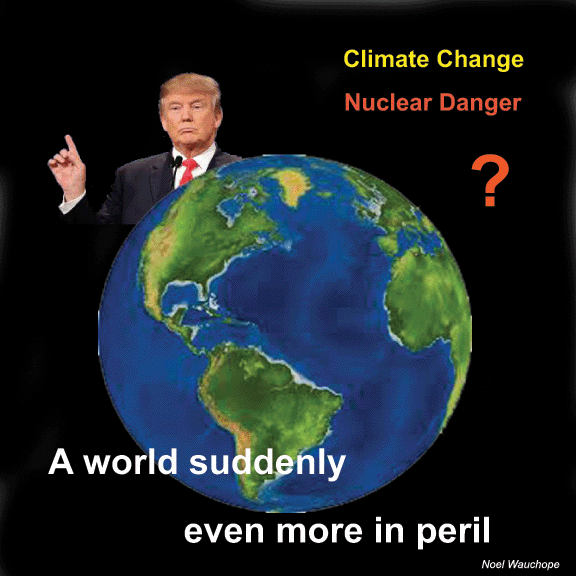
How Cheney and His Allies Created the North Korea Nuclear Missile Crisis, December 28, 2017, By Gareth Porter, Truthout | News Analysis, The Trump administration has been telling people for months that the crisis with North Korea is the result of North Korea’s relentless pursuit of a nuclear threat to the US homeland and past North Korean cheating on diplomatic agreements. However, North Korea reached agreements with both the Clinton and George W. Bush administrations that could have averted that threat, had they been completed.
Instead, a group of Bush administration officials led by then-Vice President Dick Cheney sabotaged both agreements, and Pyongyang went on to make rapid strides on both nuclear and missile development, leading ultimately to the successful late November 2017 North Korean intercontinental ballistic missile (ICBM) test.
The record shows, moreover, that Cheney and his allies derailed diplomatic efforts to curb North Korean nuclear and missile development, not because they opposed “arms control” (after all, the agreements that were negotiated would have limited only North Korean arms), but because those agreements would have been a political obstacle to fielding the group’s main interest: funding and fielding a national missile defense system as quickly as possible. The story of Cheney’s maneuvering to kill two agreements shows how a real US national security interest was sacrificed to a massive military boondoggle that served only the interests of the powerful contractors behind it………http://www.truth-out.org/news/item/43048-how-cheney-and-his-allies-created-the-north-korea-nuclear-missile-crisis
How Trump could kill the Iran nuclear deal in January The president will soon face a series of deadlines during which he could deliver on a campaign promise to rip up the 2015 agreement. Politico eu, By MICHAEL CROWLEY, 12/28/17, President Donald Trump allowed the Iran nuclear deal to survive through 2017, but the new year will offer him another chance to blow up the agreement — and critics and supporters alike believe he may take it.
By mid-January, the president will face new legal deadlines to choose whether to slap U.S. sanctions back on Tehran. Senior lawmakers and some of Trump’s top national security officials are trying to preserve the agreement. But the deal’s backers fear Trump has grown more willing to reject the counsel of his foreign policy team, as he did with his recent decision to recognize Jerusalem as Israel’s capital……..
The deal was negotiated in 2015 by the Obama administration, along with five other nations. It lifted U.S. and European sanctions on Iran in exchange for strict limits on Tehran’s nuclear program. …..
The deadlines for Trump begin on January 11, when the agreement requires him — as it does every 90 days — to certify whether Tehran is meeting its obligations under the deal. International inspectors who visit the country’s nuclear facilities have repeatedly said Iran is doing so. But Trump refused to certify Iranian compliance in mid-October……..
upcoming deadlines for Trump to continue the temporary waiver of U.S. sanctions on Iran, which the deal dictates will not be permanently repealed for several more years. The president must renew the waivers every 120 days. Sources familiar with the law said multiple waiver deadlines arrive between January 12 and January 17, forcing Trump to reassess the deal.
If Trump rejects the waivers and restores biting sanctions, Tehran is certain to claim the U.S. has breached the agreement and — supporters of the deal say — may restart its nuclear program. That could court a military confrontation with the U.S. and Israel. At a minimum, the U.S would find itself isolated abroad given that every other party to the deal — France, the U.K., Germany, China and Russia — all strongly oppose a U.S. withdrawal from the agreement.
Top Trump officials, including National Security Adviser H.R. McMaster, Defense Secretary Jim Mattis and Secretary of State Rex Tillerson, all hope to avoid that outcome, telling others that while they may not love the nuclear deal, the potential fallout from a unilateral U.S. withdrawal would be too great to risk……….https://www.politico.eu/article/iran-how-donald-trump-could-kill-the-iran-nuclear-deal-in-january/
North Korea will not be accepted as a nuclear power by US or Russia, say Rex Tillerson and Sergei Lavrov Both sides agree to pursue a ‘diplomatic solution’ to the crisis, The Independent, Mythili Sampathkumar New York @MythiliSk 28 Dec 17 The US and Russia have insisted they will not accept North Koreaas a “nuclear state”, amid a series of missile tests by the East Asian nation and increased rhetoric from both Kim Jong-un and Donald Trump.
US Secretary of State Rex Tillerson and Russian Foreign Minister Sergei Lavrov spoke by phone on a myriad of issues, but both agreed on their stance regarding Pyongyang’s continued development of nuclear weapons despite United Nations sanctions.
State Department Heather Nauert said in a statement that “both sides agreed that they will continue to work towards a diplomatic solution to achieve a denuclearised Korean peninsula”. However, on the same call on Tuesday, Mr Lavrov criticised President Donald Trump’s “aggressive rhetoric” towards North Korea……..
Late last week, the UN Security Council also unanimously passed – including votes from Russia and China who have closer ties to Pyongyang – more sanctions on North Korea, further limiting its oil supplies and slave labour market. …..
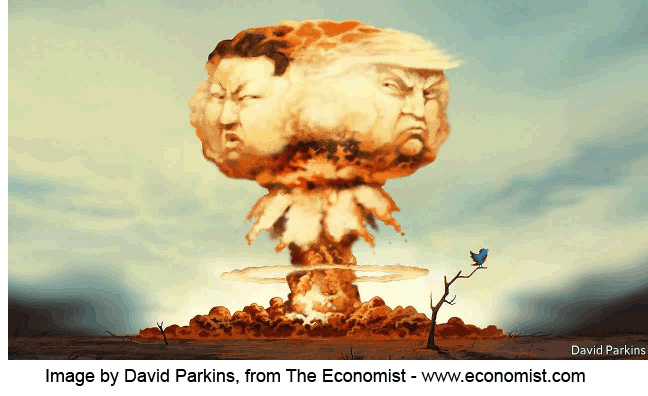
Timeline of Trump’s Path to Nuclear War https://www.globalresearch.ca/timeline-of-trumps-path-to-nuclear-war/5623937 By Walt Gelles Global Research, December 26, 2017 Donald Trump’s reckless policies, belligerence, volatile personality, and rejection of diplomacy have brought the world to the brink of war in Korea. Such a war could rapidly turn nuclear, killing hundreds of thousands or millions of people, spreading deadly radiation across the planet, and likely involving China and Russia. North Korea will never give up its nuclear and ballistic missile program under pressure, as it views the program as an indispensable bulwark against U.S. aggression.
The following timeline reveals how dangerous the situation is—a situation artificially ratcheted up by U.S. President Trump and his fellow warmongers. The world needs to unite against Trump and his war plans, which pose an imminent threat to humanity—just as the world united against Trump’s illegal and counterproductive declaration of Jerusalem as the capital of Israel.
August 8
Trump threatens apocalypse—
“North Korea best not make any more threats to the United States,” Trump told reporters….“They will be met with fire and fury like the world has never seen. He [North Korean leader Kim Jong Un] has been very threatening … and as I said they will be met with fire, fury and frankly power, the likes of which this world has never seen before.”
(Emphasis added throughout)
—“Trump warns North Korea threats ‘will be met with fire and fury’ “. CNBC, Jacob Pramuk.
Trump’s remarks were widely criticized by both Republicans and Democrats as well as the corporate media.
September 27
“On September 26, four days after the Pentagon sent a flight of B-1 bombers and fighter escorts off North Korea in a display of military force, Pyongyang “moved a small number of fighter jets, external fuel tanks and air-to-air missiles to a base on its eastern coast,” according to reports. Trump threatened Pyongyang once again, saying he was prepared for “a military option” to solve the crisis, which would be “devastating.”
…Nobody knows how [Trump] will feel when he wakes up to find that Kim has tested another H-bomb, flung a missile over Japan or needled him with another insult. All we know is that when he wanders out in his bathrobe and opens the nuclear football, he’s got the keys to Armageddon in his hands.”
“Senator Bob Corker, the Republican chairman of the Senate Foreign Relations Committee, charged in an interview that President Trump was treating his office like “a reality show,” with reckless threats toward other countries that could set the nation “on the path to World War III.” In an extraordinary rebuke of a president of his own party, Mr. Corker said he was alarmed about a president who acts “like he’s doing ‘The Apprentice’ or something.” “He concerns me,” Mr. Corker added. “He would have to concern anyone who cares about our nation.”
…When Mr. Trump, posting on Twitter, accused Mr. Corker of deciding not to run for re-election because he “didn’t have the guts.” Mr. Corker shot back in his own tweet: “It’s a shame the White House has become an adult day care center….” Mr. Trump poses such an acute risk, the senator said, that a coterie of senior administration officials must protect him from his own instincts. “I know for a fact that every single day at the White House, it’s a situation of trying to contain him.” ….Mr. Corker said his concerns about Mr. Trump were shared by nearly every Senate Republican.” ”
—“Bob Corker Says Trump’s Recklessness Threatens ‘World War III’”. Jonathan Martin and Mark Landler. New York Times, Oct. 8, 2017
October 13, 2017
Robert Reich, former U.S. Secretary of Labor—
“Corker’s interview [see above] was followed by a report from Gabriel Sherman of Vanity Fair, who wrote that the situation has gotten so out of control that Trump’s chief of staff, John Kelly, and Secretary of Defense Jim Mattis have discussed ways to stop Trump should he order a nuclear attack…. Many of Trump’s advisors believe he is “unstable” and “unravelling” quickly.
“Is Trump really unraveling?….I phoned an old friend, a Republican former member of Congress who keeps up with what’s going on. I scribbled notes as he talked:
Me: So what’s up?….
He: …Others are thinking about doing what Bob did. Sounding the alarm. They think Trump’s nuts. Unfit. Dangerous….[U.S. Secretary of State] Tillerson would leave tomorrow if he wasn’t so worried Trump would go nuclear, literally.
…Me: You think Trump is really thinking nuclear war?
He: Who knows what’s in his head? But I can tell you this. He’s not listening to anyone. Not a soul. He’s got the nuclear codes and, well, it scares the hell out of me. It’s starting to scare all of them.That’s really why Bob [Corker] spoke up.
…Me: So what’s gonna happen?
He: You got me. I’m just glad I’m not there anymore. Trump’s not just a moron. He’s a despicable human being. And he’s getting crazier. Paranoid. Unhinged. Everyone knows it. I mean, we’re in shit up to our eyeballs with this guy.”
“If Trump wants nuclear war, virtually no one can stop him….There is no law that would make a presidential order to launch a preemptive nuclear strike on North Korea illegal…. Congress has the constitutional responsibility for declaring war, but it has not done so since World War II. That has not prevented every president since then from engaging in military conflicts large and small. Even American participation in the Korean War was not authorized by Congress. So, the absence of a formal declaration of war against North Korea is no barrier to a nuclear strike.
….In addition, Trump has taken a step that further removes the possibility of a legal constraint. He has added North Korea once again to the list of state sponsors of terrorism….The list has frequently been used for political purposes that have nothing to do with terrorism. That is demonstrated by the fact that the Bush administration took North Korea off the list in an attempt to salvage a deal regarding its nuclear program….
The bottom line is that a nuclear war won’t be prevented by military officers refusing to obey an order they consider illegal. And such a situation won’t be avoided by congressional action. The legislative branch is paralyzed by partisan politics. Using the bomb is up to the discretion of a president who came to office with no experience in the military, government or foreign affairs beyond real estate deals in other countries. And after ten months of on-the-job training, he seems no better prepared for such a responsibility.”
Senator Lindsey Graham plays golf with Trump and predicts war—
” …Lindsey Graham [Republican, South Carolina] …estimated the odds that the Trump administration deliberately strikes North Korea first, to stop it from acquiring the capability to target the U.S. mainland with a long-range, nuclear-tipped missile. And the senator’s numbers were remarkably high. “I would say there’s a three in 10 chance we use the military option,” Graham predicted….If the North Koreans conduct an additional test of a nuclear bomb—their seventh—“I would say 70 percent.”
Graham said that the issue of North Korea came up during a round of golf he played with the president on Sunday. “It comes up all the time,” he said. “War with North Korea is an all-out war against the regime,” he said. “There is no surgical strike option. Their [nuclear-weapons] program is too redundant, it’s too hardened, and you gotta assume the worst, not the best. So if you ever use the military option, it’s not to just neutralize their nuclear facilities—you gotta be willing to take the regime completely down.”
Earlier, on August 1, “Senator Graham said that President Trump is willing to go to war with North Korea to stop it from being able to hit the American mainland with a nuclear weapon. “There is a military option: to destroy North Korea’s nuclear program and North Korea itself,” Graham told the Today show’s Matt Lauer. “He’s not going to allow—President Trump—the ability of this madman [Kim Jong Un] to have a missile that could hit America. If there’s going to be a war to stop him, it will be over there. If thousands die, they’re going to die over there. They’re not going to die over here—and he’s told me that to my face.”
The North Koreans are not stupid: They know they’re militarily outclassed by the United States and South Korea. So their strategy in the event of an out-and-out war, as far as outside analysts can tell, is to inflict overwhelming pain as quickly as possible: to bombard South Korea, US allies in Japan, and any American forces they can find with missiles and artillery to the point where their stronger enemies lose their appetite for a protracted conflict….
A South Korean simulation conducted in 2004, before the North had developed nuclear weapons, estimated that there could be up to 2 million casualties in the first 24 hours of a conflict. Obviously, the death toll would be exponentially higher if North Korea used any of its nuclear weapons. Those could potentially destroy Tokyo (population 9.3 million), Seoul (population 10 million), or other cities in the two countries. It’s not clear how many working nuclear weapons the North has, though estimates suggest around 10 to 16. We do know that its missiles have enough range to reach Tokyo, and that the country has tested a nuclear weapon designed to fit on precisely such a missile.
“This is madness,” Kingston Reif, the director for disarmament and threat reduction policy at the Arms Control Association, tweeted after seeing Graham’s comments. “Unhinged madness.””
Interviewed by the BBC, US National Security Advisor, General H.R. McMaster said “We have to be prepared, if necessary, to compel the denuclearisation of North Korea without the co-operation of that regime.” His statement was almost tantamount to a unilateral declaration of war. (“HR McMaster: Russian meddling ‘sophisticated subversion’”. BBC News, Dec. 19, 2017 http://www.bbc.com/news/world-us-canada-42409144)
Asked during a PBS interview whether he thought the chance of war was increasing every day, McMaster said: “I think it is still the case. We’re out of time with this problem. Not out of time completely but we have a very short amount of time to be able to address the problem of North Korea.”
McMaster’s reiterating of this ominous warning over the past few months is apparently intended to make a U.S. attack on North Korea sound inevitable.
December 20, 2017
“America is drawing up plans for a ‘bloody nose’ military attack on North Korea to stop its nuclear weapons programme, The [London] Telegraph understands. The White House has ‘dramatically’ stepped up preparation for a military solution in recent months amid fears diplomacy is not working, well-placed sources said.
One option is destroying a launch site before it is used by the regime for a new missile test. Stockpiles of weapons could also be targeted. The hope is that military force would show Kim Jong-un that America is ‘serious’ about stopping further nuclear development and trigger negotiations. Three sources—two former US officials familiar with current thinking and a third figure in the administration—confirmed military options were being worked up.”
—“Exclusive: US making plans for ‘bloody nose’ military attack on North Korea”. London Telegraph
December 22, 2017
John Bolton beats war drums—
“North Korea could be hit by a pre-emptive military strike from the US as it continues to ramp up its missile fears to the globe. The rogue state has accelerated its nuclear and ballistic missile testing over the past year, sparking World War 3 fears. Former US Ambassador to the United Nations, John Bolton, said that the US President Donald Trump is “very close” to making a huge decision on the hermit kingdom. Speaking to Fox Business, Mr Bolton said: “I think the President shouldn’t be waiting around. I think actually we are very close to a binary decision here.
“Either we leave North Korea with this ballistic missile capability and the possibility of putting a nuclear warhead under the nose cone. Or we take military pre-emptive action.” “
Financial Tribune (Iran) 26th Dec 2017 A lawmaker denounced the prospect of a US uranium enrichment deal with Saudi Arabia, predicting a “global catastrophe” should the oil kingdom mix
nuclear technology with its takfiri ideology.
In a recent talk with ICANA, Heshmatollah Falahatpisheh, a member of Majlis National Security and
Foreign Policy Commission, said, “Unfortunately, even human rights and international laws have not stopped the Saudi crimes in Yemen. Now, if Saudi Arabia is allowed the uranium technology, it would certainly use it in its military.” Takfiris are hardliners who accuse anyone, including Muslims, not following their extreme interpretation of Islam as infidels and apostates punishable by death. https://financialtribune.com/articles/national/78650/us-nuclear-deal-with-saudis-could-lead-to-catastrophe
In their first and only meeting, Barack Obama told his successor that North Korea ― a volatile nation hellbent on nuclear proliferation ― would pose the biggest foreign challenge his administration would face.
Trump, who has dedicated much of his presidency to erasingObama’slegacy, seemed to heed this advice, briefly. After rarely mentioning North Korea during his election campaign, he swiftly elevated the issue to his primary foreign policy concern (and later declared an end to Obama’s “era of strategic patience” with the rogue state).
But under Trump’s leadership, the past year has seen brewing tensions between Washington and Pyongyang soar to unprecedented levels with a specter of nuclear war. Economic sanctions in response to a series of North Korean missile launches escalated into a direct exchange of heated insults and threats between Trump and Kim Jong Un, the hermit kingdom’s hostile dictator.
Clashes between Donald Trump and Kim Jong Un dominated headlines this year.
North Korea’s Nuclear Strides
The Pentagon’s efforts to stave off conflict with North Korea have been marred by a string of “decisive failures” this year, according to new analysis published this month from the Brookings Institution, a Washington-based think tank.
“The United States and [North Korea] have engaged in bellicose rhetorical brinksmanship, making war between the two states seem increasingly likely,” wrote Katy Collin, a post-doctoral fellow at the Brookings Foreign Policy program. “Public acceptance of the possibility of conflict within the United States has ballooned. Mechanisms to head off escalation caused by misunderstandings do not exist.”
North Korea made remarkable technological advances to its internationally condemned nuclear program throughout 2017. It conducted its sixth and most powerful nuclear teston Sept. 3, which the regime claimed was a hydrogen bomb loaded onto an intercontinental ballistic missile (ICBM). Subsequent analysis of seismic data revealed the test was approximately 17 times stronger than the blast that decimated the Japanese city of Hiroshima during World War II.
Pyongyang has also expanded the reach of its missiles this year: The entire continental U.S. is now believed to be within ICBM striking range. Experts have expressed concern at North Korea’s alarming progress, and worry that it is on track to outpace America’s abilities to defend itself and its allies in the region.
The regime’s most recent missile launch in late November exceeded 8,100 miles in range. As tested, such a rocket would be able to travel more than enough distance to reach Washington, D.C., or New York City, although it is unclear if it could transport a warhead that far.
“North Korea knows what they’re doing,” David Wright, a physicist and the co-director of the global security program at the Union of Concerned Scientists, told HuffPost at the time. “It’s hard to say if it’s six months or two years before they can deliver a nuclear warhead, but it’s heading in that direction.”
Donald Trump’s Fire And Fury
Yet Trump, undermining diplomatic efforts by his own Secretary of State Rex Tillerson, has repeatedly confronted North Korea’s provocations with aggravations of his own. He infamously vowed in August to meet the defiant country with “fire and fury,” prompting Pyongyang’s threat to launch a missile at the U.S. island territory of Guam.
Months later, Trump said the U.S. would “totally destroy” North Korea, which is home to an estimated 25 million people, if provoked. “Rocketman is on a suicide mission for himself and for his regime,” Trump said in his first speech before the United Nations General Assembly, referring to Kim.
In an extremely rare personal address, Kim responded by pledging to “tame the mentally deranged U.S. dotard with fire.” Soon after, North Korean Foreign Minister Ri Yong-ho said the regime might detonate an H-bomb in the Pacific Ocean.
As hostilities boiled over, experts urged the “America First” leader to “stick to the script” and avoid making incendiary comments about North Korea during his 12-day trip through Asia last month. But Trump couldn’t help himself:
The president’s taunts “create an incentive for the North Koreans to stage provocations to show him up,” Jeffrey Lewis, a nuclear weapons expert at the Middlebury Institute of International Studies, told HuffPost in November.
If the situation deteriorates into an acute crisis, such remarks from Trump could give North Korea the impression a military strike is imminent, Lewis added. “If that happens, my belief is the North Koreans would use their nuclear weapons first, in order to try to repel an invasion.”
A turbulent 2017 has stirred fears and uncertainty for the year ahead.
“Trump has been impatient with multilateral, diplomatic containment of nuclear proliferation,” Collin said. “While diplomacy, sanctions, and targeted engagement have been successful in preventing conflict on the Korean peninsula for decades, 2017 marks decisive failures in terms of North Korea’s nuclear capacities.”
Saudi-US talks on civilian nuclear program to begin within ‘weeks’ Riyadh’s energy minister insists kingdom seeks energy for peaceful purposes, but will not agree to American limitations on uranium enrichment
By TOI STAFF , 21 Dec 17, Saudi Arabia’s energy minister said the US and Riyadh will begin talks within weeks on cooperation over the kingdom’s emergent civilian nuclear program. Falih noted that Saudi Arabia has already “signed agreements with China, Russia, with France, so their technologies will be competing for the Saudi national nuclear project.”
US law forbids cooperation with nations that have not signed a so-called Section 123 Agreement, which limits nuclear work to peaceful uses only. Though Riyadh has said it does not seek a military program, it has said it seeks “self-sufficiency in producing nuclear fuel” and has in the past refused to sign an agreement that would limit its ability to enrich uranium…….https://www.timesofisrael.com/saudi-us-talks-on-civilian-nuclear-program-to-begin-within-weeks/
US preparing ‘bloody nose’ attack on North Korea, New York Post, By Yaron Steinbuch, December 21, 2017 The US is preparing plans to deliver a “bloody nose” attack against North Korea to knock out its nuclear weapons program.
The White House has “dramatically” ramped up its military plans amid fears that diplomacy won’t thwart North Korean despot Kim Jong Un from making good on his threats, sources told the UK’s Telegraph.
One option is destroying a launch site before the rogue regime uses it for a new missile test, while another is targeting weapons stockpiles, according to the news outlet.
The Trump administration hopes that pre-emptive action would show the trigger-happy dictator that the United States is serious about stopping his bellicose pursuits and persuading him to negotiate.
The Telegraph cited three anonymous sources, one inside the administration and two former officials familiar with the White House thinking.
‘North Korea is a time bomb’: government advisers urge China to prepare for war, http://www.scmp.com/news/china/diplomacy-defence/article/2124613/north-korea-time-bomb-government-advisers-urge-chinaThe risk of conflict on the Korean peninsula is the highest its been in decades and Beijing must mobilise resources for fallout, observers say, SCMP, Wendy Wu, China must be ready for a war on the Korean peninsula, with the risk of conflict higher than ever before, Chinese government advisers and a retired senior military officer warned on Saturday.
Beijing, once seen as Pyongyang’s key ally with sway over its neighbour, was losing control of the situation, they warned.
“Conditions on the peninsula now make for the biggest risk of a war in decades,” said Renmin University international relations professor Shi Yinhong, who also advises the State Council, China’s cabinet.
Shi said US President Donald Trump and North Korean leader Kim Jong-un were locked in a vicious cycle of threats and it was already too late for China to avert it. At best, Beijing could stall a full-blown conflict.
“North Korea is a time bomb. We can only delay the explosion, hoping that by delaying it, a time will come to remove the detonator,” Shi said on the sidelines of a Beijing conference on the crisis.
Addressing the conference, Wang Hongguang, former deputy commander of the Nanjing Military Region, warned that war could break out on the Korean peninsula at any time from now on until March when South Korea and the United States held annual military drills.
“It is a highly dangerous period,” Wang said. “Northeast China should mobilise defences for war.”
Yang Xiyu, a senior fellow at the China Institute of International Studies affiliated with China’s foreign ministry, said conditions on the peninsula were at their most perilous in half a century.
“No matter whether there is war or peace, regretfully, China has no control, dominance or even a voice on the issue,” he said.
China might already be preparing for the worst.
Last week, Jilin Daily, the official newspaper of the province bordering North Korea, published a full page of advice for residents on how to respond to a nuclear attack.
A document purportedly from telecom operator China Mobile about plans to set up five refugee camps in Jilin’s Changbai county also surfaced online last week.
Wang said the Jilin Daily article was a “signal to the country to be prepared for a coming war”.
He said China was also worried about the threat North Korea’s frequent nuclear tests were posing to unstable geological structures in the region.
Nanjing University professor Zhu Feng said that no matter how minor the possibility, China should be prepared psychologically and practically for “a catastrophic nuclear conflict, nuclear fallout or a nuclear explosion”.
“Why do we always act like ostriches? Why do we always believe a war won’t occur?” Zhu said.
“What China needs is a sense of urgency about its declining influence in strategy related to the peninsula and the way it brings down China’s status and role in East Asian security issues.”
He also said Kim’s failure to meet Chinese envoy Song Tao during his trip to Pyongyang last month was a “humiliation” for China.
Meanwhile at the United Nations in New York, US Secretary of State Rex Tillerson called on China and Russia to increase their efforts to halt Pyongyang’s nuclear programme.
Tillerson also backtracked on his previous unconditional offer for talks by saying that Washington would not negotiate with Pyongyang until it stopped “threatening behaviours”.
North Korean ambassador to the UN Ja Song-nam accused the United States, Japan and the United Nations Security Council of waging a hostile campaign to stop Pyongyang from gaining nuclear weapons that it saw as necessary to defend itself.
Renmin University professor Shi said hopes for peace could not rest on Kim and Trump, and China and Russia should work together to argue against war.
In a meeting with South Korean President Moon Jae-in in Beijing, Chinese President Xi Jinping said war on the peninsula was not acceptable.
US could broaden its use of nuclear weapons, Trump administration signals
Wider role for weapons to counter ‘non-nuclear strategic attacks’ unveiled as part of Trump’s new security strategy, which also failed to address climate change, Guardian, Julian Borger , 19 Dec 17, The Trump administration signaled that it could broaden the use of nuclear weapons as part of a new security strategy, unveiled by the president on Monday.
The wider role for nuclear weapons against “non-nuclear strategic attacks” was one of several ways in which Trump’s approach differed from his predecessor. The threat of climate change went unmentioned. The word “climate” was used only four times in the National Security Strategy (NSS), and three of those mentions referred to the business environment. Americans were instead urged to “embrace energy dominance”.
Announcing the NSS, Donald Trump depicted his election victory and his presidency as an unprecedented turning point in US history……..
Under the slogan of “peace through strength”, Trump emphasised the military buildup he had ordered, involving what the president described (wrongly) as a record in defence spending, $700bn for 2018.
“We recognise that weakness is the surest path to conflict, and unrivaled power is the most certain means of defence,” he said.
The NSS policy document criticises the downgrading of the role of nuclear weapons in the US security strategy by previous administrations since the cold war, and suggested it had not prevented nuclear-armed adversaries expanding their arsenals and delivery systems.
“While nuclear deterrence strategies cannot prevent all conflict, they are essential to prevent nuclear attack, non-nuclear strategic attacks, and large-scale conventional aggression,” the NSS said.
“Non-nuclear strategic attacks” represents a new category of threat that US nuclear weapons could be used to counter, and points towards likely changes in the Nuclear Posture Review expected in the next few weeks…….
Hans Kristensen, the director of the nuclear information project at the Federation of American Scientists. “It’s a taste of what will come in the Nuclear Posture Review. What is interesting is the broadening of the nuclear weapons mission against non-nuclear attacks. The question is – are we creating more pathways to potential nuclear war?”
DONALD Trump has vowed to take “all necessary steps” to stop North Korea’s nuclear arms race as tyrant Kim Jong-un bids for recognition as a nuclear power. Express UK, By REBECCA PINNINGTON, 20 Dec 17 Vowing America would stand up for itself like never before, the US president vowed to tackle Kim’s hurried arms testing “head on”.
Mr Trump said the US had made an “unprecedented effort” to isolate dictator Kim’s regime in a bid to put a stop to the frenzied nuclear developments.
However, he said: “There is much more work to do. America and its allies will take all necessary steps to ensure denuclearisation and ensure that this regime cannot threaten the world.”
Mr Trump said: “This situation should have been taken care of long before I got into office, when it was much easier to handle. But it will be taken care of. We have no choice.”…….“In addition, many actors have become skilled at operating below the threshold of military conflict—challenging the United States, our allies, and our partners with hostile actions cloaked in deniability.”
Mr Trump also labelled China and Russia “rival powers” in the landmark speech, outlining his administration’s national security strategy……
AP, News Corp Australia Network AMERICA’S top diplomat stepped back from his offer of unconditional talks with North Korea, telling world powers the nuclear-armed nation must earn the right to negotiate with the United States.
Secretary of State Rex Tillerson’s declaration before the UN Security Council marked a stunning reversal after he proposed discussions with Pyongyang without preconditions earlier this week. That overture was almost immediately rebutted by White House officials.
Still, Mr Tillerson had planned to reiterate his call at a special UN ministerial meeting on North Korea at the council.
His prepared remarks suggested only that North Korea would have to undertake a sustained halt in its threatening behaviour before talks could begin. But Mr Tillerson changed the script. “North Korea must earn its way back to the table,” Mr Tillerson told the foreign ministers.
“The pressure campaign must and will continue until denuclearisation is achieved. We will in the meantime keep our channels of communication open.”
The debate over offering North Korea unconditional talks reflects the differences within the Trump administration as it runs out of time to prevent North Korea from perfecting a nuclear-tipped missile that can strike the US mainland. President Donald Trump has vowed to prevent such capability, with military action if necessary.
So far, US-led sanctions on North Korea and diplomatic isolation haven’t compelled Kim Jong Un’s government to stop its nuclear and missile tests, or to seek negotiations.
Asked overnight if he supported unconditional talks, Mr Trump did not answer directly. “Well, we’re going to see what happens with North Korea. We have a lot of support. There are a lot of nations that agree with us — almost everybody,” Mr Trump told reporters. He credited China — which accounts for about 90 per cent of North Korea’s external trade — with helping on pressuring North Korea, while Russia was not.
“We’d like to have Russia’s help — very important,” said Mr Trump. He raised it in a Thursday phone call with Russian President Vladimir Putin.
At the UN Mr Tillerson called on China and Russia to go beyond UN-mandated economic sanctions. He said North Korean labourers were toiling in “slave-like conditions” in Russia for wages used to fund nuclear weapons, while China was still allowing crude oil to flow into North Korean refineries.
North Korea has conducted more than 20 ballistic missile tests during 2017 and its most powerful nuclear explosion to date. Its more recent missile test in late November fired a projectile that experts say could carry a nuclear warhead to the US Eastern Seaboard.
Independent 13th Dec 2017, Britain should retain as a close as possible a relationship with the European civil nuclear regulator after Brexit, a Commons committee has demanded ahead of a crucial vote on the issue. MPs on the committee warn that the impacts of leaving Euratom will be “profound”, putting the UK in a much weaker position to drive regulatory standards at a European level.
“We conclude that the Government should seek to retain as close as possible a relationship with Euratom, and that this should include accepting its delivery of existing safeguards requirements in the UK,” the report from the Business, Energy and Industrial Strategy (BEIS) committee states.
Westinghouse is looking for new markets after bankruptcy
Past deals barred uranium enrichment for overseas projects
The Trump administration is encouraging Saudi Arabia to consider bids by Westinghouse Electric Co. and other U.S. companies to build nuclear reactors in that country and may allow the enrichment of uranium as part of that deal, according to three people familiar with the plans.
Energy Secretary Rick Perry visited Saudi Arabia this month where the projects were discussed, according to two people. The people familiar asked not to be identified discussing the confidential negotiations.
Previous U.S. agreements have prohibited the enrichment and reprocessing of uranium, and that had scuttled negotiations to use U.S. technology in Saudi nuclear projects during the Obama administration. The administration is mulling easing that requirement now as a way to help Westinghouse and other companies win Saudi Arabian contracts, two people said.
A meeting to hammer out details of the nuclear cooperation agreement, known as a 123 Agreement for the section of the U.S. Atomic Energy Act that requires it, will be held at the White House Wednesday, two administration officials said.
A successful U.S. bid would help deliver on President Donald Trump’s promise to revive and revitalize the domestic nuclear industry, helping American companies edge out Russian and Chinese competitors to build new fleets around the world. Saudi Arabia plans to construct 16 nuclear power reactors over the next 20 to 25 years at a cost of more than $80 billion, according to the World Nuclear Association.
Westinghouse, the nuclear technology pioneer that is part of Toshiba Corp., went bankrupt in March, after it hit delays with its AP1000 reactors at two U.S. plants. After it declared bankruptcy, Westinghouse — whose technology is used in more than half the world’s nuclear power plants — said it shifted its focus to expanding outside the U.S.
Winning contracts in Saudi Arabia could provide a new market that Westinghouse needs and provide at least a partial vindication for the investment in the AP1000 technology.
“Westinghouse is pleased that Saudi Arabia has decided to pursue nuclear energy,” Sarah Cassella, a spokeswoman, said in a emailed statement. “We are fully participating in their request for information and are pleased to provide the AP1000 plant, the industry’s most advanced technology.”
Daryl Kimball, executive director of the Washington-based Arms Control Association, said weakening the prohibition against enrichment and reprocessing, often referred to as “the gold standard,” is disturbing given what he said was Saudi Arabia’s “sub-par nuclear nonproliferation record.”
“We shouldn’t compromise our longstanding efforts to stop the spread of nuclear weapons in order to play favorites with certain companies or countries,” he said in an email, calling the idea “disturbing and counterproductive.”
China building network of refugee camps along border with North Korea https://www.theguardian.com/world/2017/dec/12/china-refugee-camps-border-north-korea Document suggests at least five camps are being set up as Beijing prepares for possible influx of refugees should Kim Jong-un’s regime collapse, Guardian, Tom Phillips , 12 Dec 17, China is quietly building a network of refugee camps along its 880-mile (1,416km) border with North Korea as it braces for the human exodus that a conflict or the potentially messy collapse of Kim Jong-un’s regime might unleash.
The existence of plans for the camps, first reported in English by the Financial Times last week, emerged in an apparently leaked internal document from a state-run telecoms giant that appears to have been tasked with providing them with internet services.
The China Mobile document, which has circulated on social media and overseas Chinese websites since last week, reveals plans for at least five refugee camps in Jilin province.
The document, which the Guardian could not independently verify, says: “Due to cross-border tensions … the [Communist] party committee and government of Changbai county has proposed setting up five refugee camps in the county.”
It gives the names and locations of three such facilities: Changbai riverside, Changbai Shibalidaogou and Changbai Jiguanlizi. The New York Times reportedthat centres for refugees were also planned in the cities of Tumen and Hunchun.
A spokesman for China’s foreign ministry declined to confirm the camps’ existence at a regular press briefing on Monday but did not deny they were being built. “I haven’t seen such reports,” Lu Kang told reporters.
North Korea fortifies part of border where defector escaped
The leaked document contains the name and telephone number of a China Mobile employee who drafted it but calls to that number went unanswered on Tuesday. The construction of the camps appears to reflect growing concern in Beijing about the potential for political instability – or even regime collapse – in North Korea.
Cheng Xiaohe, a North Korea specialist from Renmin University in Beijing, said while he could not confirm whether the document was genuine, it would be irresponsible for China not to make such preparations.
“Tensions are high on the Korean peninsula … it is on the brink of war. As a major power and a neighbouring country, China should make plans for all eventualities.”
Jiro Ishimaru, a Japanese documentary maker who runs a network of citizen journalists inside North Korea and on the Chinese side of the border, said a contact in Changbai county had recently told him that while they had not seen signs of camps being built there, they “had heard there are plans to build a facility”.
Tensions on the Korean peninsula have soared this year as the US president, Donald Trump, has stepped up pressure on his North Korean counterpart and Pyongyang has accelerated its nuclear and ballistic missile programmes.
Trump has baited Kim with the nickname “Little Rocket Man” and threats of military action, while Kim has responded with insults of his own, and a succession of nuclear and missile tests that have brought two new rounds of UN sanctions.
Following its latest intercontinental ballistic missile test on 29 November, Pyongyang claimed the ability to strike anywhere on US soil.
‘Quite backwards’: Chinese tourists gawk at impoverished North Koreans
In an interview with the Guardian in Beijing on Monday, Dennis Rodman, the NBA star turned would-be peacemaker, played down fearsof a catastrophic nuclear conflict and denied Kim, whom he calls his friend, was “going to try and bomb or kill anyone in America”.
“We ain’t gonna die, man, come on, no … It’s not like that,” Rodman insisted, urging Trump to use him as an intermediary to engage with Kim. He described the verbal war between Trump and Kim as “a chess game” that should not be taken too seriously.
Beijing seems less certain. Last week one official newspaper in Jilin, the Chinese province closest to North Korea’s nuclear test site, hinted at that nervousness with a full-page article offering tips on how to react to a nuclear incident.
Iodine tablets, masks and soap were useful allies in the event of such a catastrophe, readers of the Jilin Daily learned.
Additional reporting by Wang Zhen and Justin McCurry in Tokyo.