Trump said in an interview with Reuters on Wednesday that Russia was helping North Korea evade international sanctions and was probably helping supply Pyongyang with anything that China had stopped giving it. Reporting by Polina Devitt; Editing by Andrew Osborn
Trump’s not killing the Iran deal — yet But this could be the last time he extends it. Vox, By Zeeshan Aleem@ZeeshanAleemzeeshan.aleem@vox.comPresident Donald Trump has decided to extend the Iran nuclear deal once more — but it may be the last time he does it.
The president announced Friday that he wouldn’t reimpose economic sanctions on Iran over its nuclear program, a move that would have effectively killed the Obama administration’s landmark nuclear deal in Tehran in 2015 and isolated the US from allies around the world.
Trump is legally required to decide every 120 days whether or not he’ll put the sanctions back into effect. In his statement Friday, the president said he’d reimpose the measures next time the deadline comes around unless European allies put stricter limitations on what Iran is allowed to do under the pact.
“Today I am waiving the application of certain nuclear sanctions, but only in order to secure our European allies’ agreement to fix the terrible flaws of the Iran nuclear deal,” Trump said in a statement. “This is a last chance.”
According to senior administration officials, Trump wants to establish new sanctions on Iran tied to the way it handles its ballistic missile program, inspections of its nuclear sites by international monitors, and any expansion of the Iran’s nuclear program that causes the country to come within a year of “nuclear breakout,” the amount of time it would take to produce enough fuel for a single nuclear weapon.
Trump also said he expects Congress to craft new legislation that would “deny Iran all paths to a nuclear weapon — not just for ten years, but forever.”
The Trump administration also announced new sanctions against 14 Iranian nationals and organizations for behavior unrelated to the country’s nuclear program. Those measures are being imposed on Iran for its government’s human rights abuses and censorship, mainly tied to widespread national protests in Iran in recent weeks……
Trump’s decision to extend the deal is in some ways a surprising move — late last year he declared the deal wasn’t in the national security interests of the US. It represents a tentative win for Secretary of Defense James Mattis and other top aides, who have spent months lobbying the president to preserve the deal. And it prevents, at least for now, what could have been a nasty fight with America’s closest allies, who believe the deal is working and have made clear that the US would stand alone if Trump pulled out of it.
Reuters 11th Jan 2018,So close yet so far: China deal elusive for France’s Areva. A deal long
sought by French company Areva to build a $12-billion nuclear waste
reprocessing plant in China looks increasingly unlikely to go ahead despite
a visit to Beijing by President Emmanuel Macron meant to drum up business.
During Macron’s state visit this week, Areva and China National Nuclear
Corp (CNNC) signed a new “protocol agreement” to build the plant but,
not for the first time, no definitive contract was signed.
Since talks began more than a decade ago – when uranium prices UXXc1 were near record
highs – a series of non-committal French-Chinese memorandums of
understanding have been signed for building a reprocessing plant in China
modeled on state-owned Areva’s plant in La Hague, northern France.
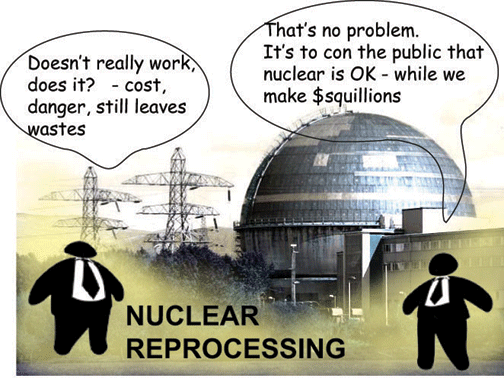
The reprocessing of nuclear fuel waste involves separating plutonium from the
spent uranium and reusing it in “Mixed Oxide” (MOX) fuel at nuclear
power stations.
But the 2011 Fukushima nuclear disaster and competition
from renewable energy are weighing on the nuclear sector, and uranium
prices are down 80 percent from a decade ago, making the expensive and
dangerous recycling process less attractive. Chinese nuclear scientist Li
Ning, dean of Xiamen University’s College of Energy and a member of State
Nuclear Power Technology Corporation’s (SNPTC) expert committee, sees
“a fairly low probability” that China will sign a formal contract for
the project. https://www.reuters.com/article/us-areva-china-nuclearpower-analysis/so-close-yet-so-far-china-deal-elusive-for-frances-areva-idUSKBN1F01RJ
Canada is hosting the Vancouver Foreign Ministers’ Meeting on Security and Stability on the Korean Peninsula from Monday through Wednesday, the department said in a statement.
“The meeting will bring together nations from across the globe to demonstrate international solidarity against North Korea’s dangerous and illegal nuclear and ballistic missile programs,” it said.
U.S. Defense Secretary Jim Mattis will participate in the meeting’s welcome dinner on Monday, the State Department said.
Reporting by Blake Brittain; Editing by Phil Berlowitz
North Korea Wins Olympics Trip, But Discord Remains Over Nuclear Weapons, By David Tweed and Kanga Kong, Bloomberg,
South Korea talks stumble over call for denuclearization
Both sides agree on North Korea participating in Olympics
………as the day wore on, and South Korea proposed talks on ending North Korea’s nuclear weapons program, the mood appeared to sour. Ri issued a “strong complaint” that Seoul dared to even raise the possibility of denuclearization at such an early stage. The subject is likely to arise again Wednesday when South Korean President Moon Jae-in holds a press briefing.
North Korea’s participation in the Winter Games starting Feb. 9 brings potential benefits to the troubled Korean peninsula, which has been divided for more than 70 years. Kim Jong Un gets the opportunity to ease the global pressure on his isolated regime, while Moon can bet on a more peaceful Olympics and claim a victory in his push for dialogue.
But the long-term dilemma remains: North Korea sees its nuclear weapons — and the ability to use them against the U.S. — as the only thing protecting against an American invasion. At the same time, U.S. President Donald Trump views Kim’s rapidly expanding nuclear arsenal as an intolerable threat, one that must be eradicated by war if necessary.
World powers stick to Iran nuclear deal despite protests, US, Kambiz Foroohar, SMH, 7 Dec 18,New York: US Ambassador Nikki Haley called an emergency session of the United Nations Security Council on Friday to focus on deadly protests in Iran, but the hearing didn’t go as planned.While most envoys criticised the violence of the past week and called on the Iranian government to show restraint with protesters, several – including American allies France and the UK – also used the opportunity to defend the 2015 nuclear agreement between Iran and world powers, an accord increasingly seen as under threat by the Trump administration.
After criticiSing Iran’s ballistic missile development and role in supporting Yemeni rebels, UK Ambassador Matthew Rycroft added that “the UK remains fully committed to the JCPOA,” an acronym for the nuclear accord. “We encourage all members states to uphold all their commitments. A prosperous, stable Iran is beneficial to all.”
Ending the nuclear accord “would be a major setback for the entire international community,” French envoy Francois Delattre said, adding that “the agreement is one of the cornerstones of stability in the Middle East as a whole.”
The concerns about the nuclear accord come as US President Donald Trump faces a series of key decisions on Iran starting next week – including whether to honour part of the 2015 agreement that lifted restrictions on Iran’s banking, oil and shipping industries. He could opt to re-impose the sanctions and risk collapse of the accord, a move that Friday’s UN session showed would leave the US isolated……http://www.smh.com.au/world/world-powers-stick-to-iran-nuclear-deal-despite-protests-us-20180106-h0ed20.html
North and South Korean ties linked to resolving nuclear issue: Moon Jae-in, SBS News 2 Jan 18, South Korean President Moon Jae-in says the improvement of inter-Korean relations is linked to resolving North Korea’s nuclear programme, a day after the North offered talks with Seoul but was steadfast on its nuclear ambitions.
“The improvement of relations between North and South Korea cannot go separately with resolving North Korea’s nuclear programme, so the foreign ministry should coordinate closely with allies and the international community regarding this,” Moon said in opening remarks at a cabinet meeting on Tuesday.
Moon’s comments contrasted with those of North Korean leader Kim Jong Un, who said on Monday that Seoul should stop asking foreign countries for help in improving ties between the two Koreas.
“This shows the Moon administration is looking at the situation from a very realistic, rational point of view,” said Jeong Yeung-tae, head of the Institute of North Korea Studies in Seoul.
“It also shows resolving North Korea’s nuclear issue has a bigger priority (than improving inter-Korean relations).”RELATED
‘The nuclear button is always on my table’: North Korea leader Kim Jong-un’s warning
Moon’s comments came after a New Year’s Day speech by Kim who said he was “open to dialogue” with Seoul, and for North Korean athletes to possibly take part in the Winter Games, but steadfastly declared North Korea a nuclear power.
he South Korean president requested the ministries of unification and sports to swiftly create measures to help North Korea participate in the upcoming Pyeongchang Winter Olympics.
Moderation on Iran: Better to improve than scrap nuclear pacthttp://www.post-gazette.com/opinion/editorials/2018/01/02/Moderation-on-Iran-Better-to-improve-than-scrap-nuclear-pact/stories/201712300018 THE EDITORIAL BOARD, Pittsburgh Post-Gazette It shouldn’t seem necessary to make an argument to the American people that the United States should not go to war with a nation of 80 million, located far from our shores, with which America once had a fruitful commercial and political relationship and with which, like other parts of the world, it has entered into a nuclear weapons control agreement.
But here we are, and it is useful to suggest that it would be unwise for America to go to war with Iran, whose regime in recent days has been beset by popular political demonstrations.
The Trump administration has criticized the Iran nuclear agreement repeatedly and could scrap it. However, as far as the agreement having shortcomings, wouldn’t it make more sense to take the agreement — signed not only by Iran and the United States, but also by China, France, Germany, Russia and the United Kingdom — as the basis for negotiating changes, as opposed to threatening to pull out of it and, perhaps, to attack Iran?
The first problem with the current U.S. posture is that the other signatories like the agreement. China, France, Germany, Russia, the United Kingdom and the rest of the world have taken it as a green light to improve trade, including major sales, to Iran. America-based companies have considered the continued U.S. sanctions against Iran, and, particularly the continued political objections to it in the United States, including from Israel and American Christian fundamentalists, as a reason not to put the pedal to the metal in terms of pursuing trade and investment opportunities in Iran.
The second major problem in any thought that the United States might attack Iran militarily is that the results would be catastrophic. Of course, the United States would probably win an all-out war against Iran in the long haul — that is, assuming the American people would be prepared to support such a war. That’s a real question, because it would be hard to persuade them that there was any reason for such a war, and it would cost the Earth.
In the short run, a quick glance at the map is worth the trouble in assessing U.S. vulnerabilities in such a conflict. Iran lies just across the Persian Gulf from Saudi Arabia, Kuwait, the United Arab Emirates, Qatar and Oman, in all of which the U.S. has important military installations, including the headquarters of the U.S. 5th Fleet and the regional headquarters of the U.S. Central Command, a short rocket distance away. Iran also borders on Afghanistan and Iraq, where the U.S. maintains a vulnerable presence as well as long-term investment.
It would be dreamy to imagine that Iran’s first response to a U.S. attack wouldn’t be retaliation against some or all of these key U.S. targets surrounding it. The usual arguments for improving relations with Iran, not worsening them, are otherwise foregone commercial opportunities, the concerns of some of our allies, and regional and world peace in general. Given that President Donald J. Trump’s principal national security affairs advisers are current or retired military officers, it is also worth looking at the military aspects of U.S. relations with Iran with a cold eye, then determining future U.S. policy, in 2018 and beyond.
In a statement Tuesday, Pakistan’s foreign ministry said the 1988 agreement requires each country to hand over the list on Jan. 1 each year, which the representatives of the two countries did on Monday. It has been adhered to every year since 1992, the statement said.
Although neither country is signatory to the Nuclear Non-Proliferation Treaty (NPT), they both became declared nuclear powers after India conducted an underground nuclear weapons test in 1998 and Pakistan followed suit a few weeks later.
Pakistan and India have fought three wars since the 1947 creation of Pakistan from a larger India.
Blunders, catastrophic, delays, even bankruptcy… ANOTHER nuclear power plant is going into financial meltdownhttp://www.thisismoney.co.uk/money/article-5223475/ANOTHER-nuclear-power-plant-enerting-financial-meltdown.html Neil Craven for The Mail on Sunday, 1 January 2018The company behind one of Britain’s biggest nuclear power projects has plunged to a £266 million loss citing ‘uncertainties’ over its future and the viability of crucial technology.
Japanese firm Toshiba said the huge loss incurred by one of its UK subsidiaries was due to writing off hundreds of millions of pounds of investment in the proposed Moorside plant, in west Cumbria.
It is the latest sign of financial strain at the Tokyo-based firm amid wider concerns over the spiralling costs and catastrophic delays that have beset the UK’s nuclear industry.
Britons were last week supposed to be cooking their turkeys with power from EDF’s nuclear plant at Hinkley Point in Somerset, which is now not expected to be in use for another decade. ‘EDF will turn on its first nuclear plant in Britain before Christmas 2017,’ said Vincent de Rivaz in 2007, who stepped down as group chief executive in November. ‘It is the moment of the power crunch. Without it, the lights will go out.’
It was envisaged that new nuclear plants at Moorside, Hinkley Point and Wylfa in Anglesey would between them generate a fifth of the UK’s electricity.
This may still happen. But right now, nuclear firms are struggling with the expense, stringent regulatory hurdles and costly project delays – just as the cost of other forms of electricity fall. Toshiba won the contract to build the nuclear power plant at Moorside, on land next to the Sellafield nuclear fuel reprocessing site.
But it was forced in March to place its US nuclear division Westinghouse into bankruptcy protection. Last month, it said it would sell Westinghouse for £4 billion. Troubled Toshiba is now in talks to sell its interests in the Moorside project to Kepco, majority-owned by the South Korean government.
Toshiba has two UK subsidiaries: Advance Energy UK, which incurred the £266 million loss; and NuGeneration, which is directly responsible for running Moorside.
With a cloud of uncertainty over the project, the Japanese firm has admitted in reports issued by its UK subsidiaries: ‘The directors do not know whether a sale of the shares of [NuGeneration] will be completed nor how any successful bidder will frame the deal.’
Kepco said it hoped to complete a deal to take over the running of the project early next year.
Uncertainties are understood to include the use of Westinghouse’s AP1000 reactor. Approval for use at Moorside was first sought from UK regulators in 2011. It was granted approval by the Office for Nuclear Regulation in March – just days after Westinghouse entered bankruptcy protection.
Should Kepco decide to ditch the design and use its own, the project would likely be delayed for years until a new design is approved. Some estimates say that could put any launch back from 2025 to the late 2020s at the very earliest. ‘The whole thing is a mess,’ said Martin Forwood of campaign group Core, which opposes the Moorside development.
‘Kepco would almost certainly push to use its own reactors so the big question is whether they would have to start afresh on consultation.
‘A lot of people around Moorside believe it will never take off.’
Forwood said the costs of other forms of renewable energy are falling and energy storage systems are being developed. ‘The longer these plans get delayed the less nuclear is needed,’ he added.
And, according to Forwood, the firms involved in the projects at Moorside and Wylfa ‘are not going to get anywhere near what the Government signed up for at Hinkley’.
The House of Commons Public Accounts Select Committee last month said there had been ‘grave strategic errors’ awarding French government-backed EDF the Hinkley Point contract.
It said ‘the economics of nuclear power in the UK have deteriorated’ and a ‘blinkered determination’ to agree the 35-year Hinkley deal, ‘regardless of changing circumstances’ had lumbered consumers with £30 billion payments over market rates for electricity.
The Japanese government wants to show the fake side of Fukushima,”
Large swaths of Fukushima remain uninhabitable, with cleanup at the plant estimated to take up to 40 years and cost almost $200 billion
Would You Play Ball at Fukushima?, NYT, By SETH BERKMANFUKUSHIMA, Japan — A sea of brightly colored banners and advertisements decorated Fukushima train station in early November to celebrate coming road races and Fukushima United, the local soccer club.
Russia And Uzbekistan Sign Nuclear Energy Deal, By RFE/RL staff – Dec 30, 2017, Russia’s Rosatom State Atomic Energy Corporation and Uzbekistan have signed a nuclear-cooperation agreement that Rosatom says will pave the way for bilateral cooperation “in many aspects of civil nuclear energy.”Rosatom said the agreement was signed on December 29 by its Director-General Aleksei Likhachyov and Uzbek Deputy Prime Minister Nodir Otajonov.
“The collaboration could include creation and development of infrastructure in Uzbekistan, training, construction of nuclear power plants and research reactors, as well as operational and maintenance support during their life cycle,” the Rosatom statement said.
“It could also cover exploration and mining of uranium, handling of uranium waste, and the production of radioisotopes for use in medicine, agriculture, and academic research,” the state-owned firm said.
Likhachyov said Rosatom was ready to build a two-unit nuclear power plant in Uzbekistan and has offered to start training Uzbek nuclear experts-to-be at Moscow’s expense beginning in September 2018.
In early November, during a visit to Tashkent by Russian Prime Minister Dmitry Medvedev, a memorandum on cooperation between Rosatom and Uzbekistan’s Academy of Science was signed, along with an agreement on production and provision of nuclear fuel by Uzbekistan for Rosatom.
Cheap renewables undercut nuclear power, The technology advances and plunging costs of cheap renewables make base load nuclear power redundant. Climate News Network, by Paul Brown, LONDON, 29 December, 2017 “………Completion doubts
Even the former UK energy secretary Sir Edward Davey, who signed off on the Hinkley Point deal, said “the economics have clearly gone away.” He doubted that the building would ever be completed, he told Greenpeace in an interview.
All the other UK nuclear projects are still at various stages of planning, and how any of them will be paid for is yet to be worked out. It is already clear that none can be financed without government subsidy.
An important political development in 2017 was that for the first time both the US and the UK admitted that their support for the nuclear industry is linked to the need to maintain their military capability in nuclear submarines and personnel. This is key, because both powers have previously claimed that there is no link between civil and military nuclear industries.
Even before their admission it was already clear that the big economies which have no nuclear weapons, like Germany, can see no point in having a civil nuclear industry.
Export drive
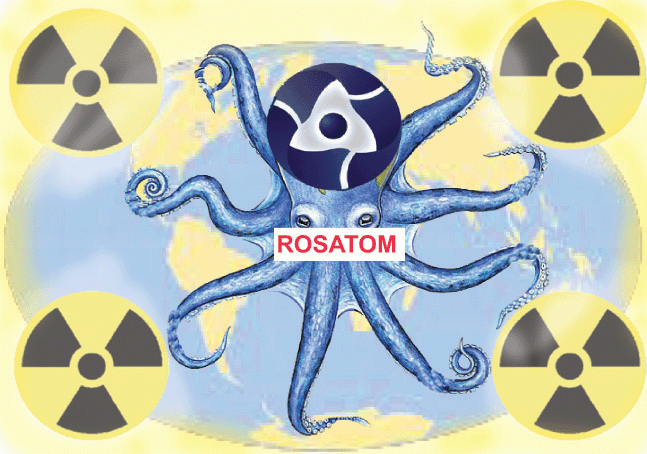
That does not stop smaller countries, some without any nuclear power stations at all at present, signing agreements with the Russian state-owned company Rosatom. In what many see as a Russian policy to extend its international influence, Rosatom already says it is building reactors in Belarus, China, India, Bangladesh, Hungary, Turkey, Finland and Iran, and is seeking to expand, with tenders in for 23 other reactors abroad.
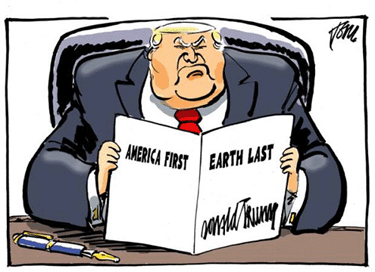
Trump’s plan takes Barack Obama’s policy of “American exceptionalism” to a new level. In his speech accompanying the NSS’s release, Trump stated, “America has been among the greatest forces for peace and justice in the history of the world.”
Yet Trump has not only continued but also escalated the Bush-Obama wars in Afghanistan and Iraq, dropped Tomahawk missiles on Syria, threatened North Korea and Iran, intensified airstrikes against Muslim countries, and fanned the flames of conflict in the Middle East.
Trump’s NSS stresses military might but makes scant reference to diplomacy. His administration is building 10 new aircraft carriers worth $13 billion each as a counterweight to China, and expanding the US nuclear weapons program to the tune of $1 trillion over the next 30 years.
Nuclear weapons are “the foundation of our strategy to preserve peace and stability by deterring aggression against the United States, our allies, and our partners,” according to the NSS. But Trump has dangerously escalated tensions with North Korea, providing that country with increasing incentives to develop nuclear weapons that reach around the world.
And by refusing to recertify Iran’s compliance with the nuclear agreement, in spite of the UN International Atomic Energy Agency’s finding to the contrary, Trump is further imperiling peace.
The NSS’s brief mention of working with international organizations is belied by the Trump administration’s abiding contempt for the United Nations. The UN Charter was created in 1945 by the countries of the world to collectively restore and maintain international peace and security.
As with Trump’s domestic program, the NSS makes no pretense of concern for human rights in other countries. This is evidenced in practice by Trump’s unwavering support for Israel‘s brutal occupation of Palestinian lands, including, most recently, his declaration that Jerusalem is the capital of Israel . The NSS accurately states, “for generations the conflict between Israel and the Palestinians has been understood as the prime irritant preventing peace and prosperity in the region.”
But the NSS minimizes Israel’s central responsibility for the conflict, stating, “the threats from radical jihadist terrorist organizations and the threat from Iran are creating the realization that Israel is not the cause of the region’s problems.”
In defiance of nearly all other nations, Trump’s Jerusalem declaration endangers world peace. Indeed, last week, the UN Security Council voted 14-1, with a US veto, to condemn Trump’s characterization of Jerusalem as the capital of Israel. And in a rarely used procedure called Uniting for Peace (UFP), the UN General Assembly overwhelmingly followed suit. UFP allows the General Assembly to take measures to restore international peace and security when the Security Council is unable or unwilling to act. By utilizing UFP, which requires a two-thirds vote, this resolution has greater force than other General Assembly decisions. The International Court of Justice upheld the legality of UFP in its 1962 advisory opinion.
Richard Falk, former UN Special Rapporteur for Palestinian Human Rights, told Truthout that, “What is already evident on the basis of [Trump’s Jerusalem] decision itself is the severe damage done to the global and regional leadership reputation of the United States.”
While setting forth the goal of being an “energy-dominant nation,” the NSS gives short shrift to “the importance of environmental stewardship.” Obama’s 2015 NSS, on the other hand, correctly stated that climate change was an “urgent and growing threat to our national security.” Yet Trump’s NSS does not recognize the threat of climate change. And in spite of increasingly extreme and unseasonal weather events such as recent hurricanes and wildfires, Trump has alarmingly and irresponsibly pulled out of the Paris climate accord.
The four pillars of the NSS, according to Trump, are protecting the US homeland, promoting US prosperity, achieving peace through strength and advancing US influence in the world.
Pillar I: Protect the Homeland
The NSS singles out unauthorized immigration as a threat to the homeland, but also implicitly attacks authorized immigration as well. It states that residency and citizenship decisions “should be based on individuals’ merits and their ability to positively contribute to US society, rather than chance or extended family connections.” This policy leads to the separation of families and makes us no safer.
Pillar I stresses securing our borders “through the construction of a border wall,” embodying Trump’s campaign mantra. There is no evidence that an expensive border wall will secure US borders or make us safer.
“The United States rejects bigotry and oppression,” according to Pillar I. Yet Trump has instituted three iterations of a Muslim ban, which would exclude from the United States immigrants from six Muslim-majority countries, as well as North Korea and Venezuela.
The Trump administration has also drastically cut back on accepting refugees from Syria, whose people are suffering from a prolonged, tragic civil war.
Pillar I pledges the US government will “help communities recover and rebuild” after natural and other disasters. Yet Trump has failed to meaningfully respond to the devastation wrought by the recent hurricane in Puerto Rico, which is part of the United States.
Pillar II: Promote American Prosperity
One subsection of Pillar II, called “Reduce the Debt Through Fiscal Responsibility,” cites “modernizing our tax system” as a way to “make the existing debt more serviceable.” Ironically, at Trump’s urging, the GOP-controlled Congress passed a radical tax overhaul that will reportedly add $1.5 trillion (or more) to the debt in the next 10 years. This is the height of irresponsibility.
Moreover, the United Nations has just conducted an investigation of extreme poverty in the United States, with disturbing results. It concluded that the prevalence of poverty and inequality “are shockingly at odds with the [US’s] immense wealth and its founding commitment to human rights.” The report documented a rise in poverty that disproportionately affects women and people of color as well as many white Americans. Homelessness, police surveillance, criminalization of poverty and unsafe sanitary practices were also flagged as problems.
Yet documentation of poverty in the United States is conspicuously absent from Trump’s NSS. In fact, Pillar II cites “unnecessary regulations” as problematic. Deregulation serves the interest of the wealthy. Since he took office, Trump has eliminated hundreds of regulations that protect health, safety and workers.
Pillar III: Preserve Peace Through Strength
This pillar identifies China, Russia, Iran, North Korea and jihadist terrorist groups as “actively competing against the United States and our allies and partners.” It stresses diplomacy “short of military involvement” as “indispensable.” Yet Trump castigated Secretary of State Rex Tillerson for pursuing diplomacy with North Korea while escalating the war of words and pushing punishing sanctions against that emerging nuclear power. Although Pillar III pays lip service to the “law of armed conflict,” Trump’s actions have violated those rules.
Pillar IV: Advance American Influence
Pillar IV states, “Around the world, nations and individuals admire what America stands for. We treat people equally and value and uphold the rule of law.” But since taking office, Trump has celebrated white supremacists, pardoned racist Sheriff Joe Arpaio and ended the Deferred Action for Childhood Arrivals program. He has also consistently violated US and international law.
The United States sells weapons and provides military advisers to Saudi Arabia, which enables the Saudis’ illegal bombing and medical/food/fuel blockade of Yemen, the poorest Arab country. This has resulted in famine and an outbreak of cholera affecting millions of Yemenis, particularly children. California Democratic Representatives Ted Lieu and Ro Khanna both warned that such actions expose US officials to criminal liability for aiding and abetting Saudi war crimes in Yemen.
This pillar admits that the UN “can help contribute to solving many of the complex problems in the world.” It emphasizes that the “United States supports the peaceful resolution of disputes under international law.” Yet the administration reacted to the Security Council and General Assembly’s rejections of Trump’s Jerusalem-as-capital-of-Israel declaration by threatening countries that voted against it with loss of foreign aid. Moreover, Trump threatened to cut off funding to the UN itself, the most significant peacekeeping organization in the world.
Resist Trump’s Agenda
Increasing disillusionment with Trump’s policies and, most recently, his unpopular new tax bill, may lead to the loss of a Republican majority in one or both houses of Congress in the 2018 midterm elections. It is incumbent on us all to continue and escalate our resistance to the Trump regime. The future of the United States and indeed, the world, depends on it.
RUSSIA has warned North Korea and the US are on course for an explosive war of a level “never before seen in human history”. US President Donald Trump and Kim Jong-un could stumble into a nuclear war of “unprecedented scale”, warned Vladimir Putin’s top diplomat Oleg Burmistrov.
Russia’s so-called ambassador-at-large predicted the start a war could be “unprovoked” and said the US it is “playing with fire” in goading North Korea.
Moscow has repeatedly called for calm in the region as Trump and Kim’s fiery war of words stoked the conflict to horrifying new heights in recent months.
Burmistrov called on the world to do “everything possible” to prevent the war that would spiral into the first use of nuclear weapons since World War 2.
North Korea is feared to be plotting another missile test before the end of the year – with US “missile sniffer” plane Cobra Ball taking flight yesterday amid Kim’s threats.Burmistrov told Sputnik: “[It could be] the catastrophe of the scale, never before seen in human history.
“We are talking not only about a major military conflict but also about a conflict that potentially has a nuclear component.
“Now we are in the face of a major military conflict, which can become a reality if the military solution plan is implemented.
“And we need to do everything possible to prevent this from happening.” Putin’s top man suggested US war drills in the region may be “testing” North Korea and looking for grounds to impose a total economic blockade on Pyongyang.
He described the region as a “powder keg” as military forces continue to march into the Korean Peninsula.
The ambassador added: “The situation on the Korean Peninsula is characterised by an unprecedented level of tension, there is a growing danger of slipping into an armed conflict, unprovoked, but which may begin due to accidental circumstances.”
Burmistrov has previously visited Pyongyang to discuss the nuclear crisis and has also hosted meetings with North Korean officials in Moscow. This week, Russian foreign minister Sergey Lavrov met with US secretary of state Rex Tillerson to discuss North Korea.
Despite separate tensions between Moscow and Washington, the two came to an agreement that they would “never accept” a nuclear-armed Kim.
North Korea is believed to be gearing up to launch a space rocket, which experts have warned could be a cover for another weapons test. Kim should be expected to carry out at least one more launch before the end of the year, North Korea expert Michael Madden told Daily Star Online.
Pyongyang is believed to have long-term ambitions to launch a nuclear missile into the heart of the Pacific.