Mr Klinger will visit Canberra and Sydney and consult with government intelligence and defence officials about the rapidly escalating North Korea nuclear weapon crisis.
Trump administration announced new sanctions against China and Russia
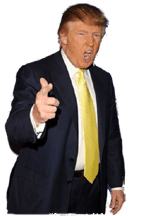 U.S. Imposes Sanctions on China and Russia Over North Korea’s Nuclear Program, NYT, AUG. 22, 2017WASHINGTON — The Trump administration announced new sanctions against China and Russia on Tuesday as part of its campaign to pressure North Korea to stop its development of nuclear weapons and missiles.
South Korean President Moon Jae-in warns USA against military action on North Korea
Moon says even slight conflict on Korean Peninsula may threaten many lives, SEOUL, Aug. 21 (Yonhap) — South Korean President Moon Jae-in again urged the United States Monday to refrain from taking any action against North Korea that could start an armed conflict on the peninsula, saying even the slightest conflict here may cost the lives of many South Koreans and U.S. troops.
“President Moon said he understands why the United States has traditionally said all options were on the table to push North Korea to give up its nuclear ambitions. But he said even the slightest military action will lead to a clash between the South and North, and it will threaten many lives of not only South Koreans but foreigners, including U.S. forces stationed in South Korea,” Park Soo-hyun, a spokesman for Seoul’s presidential office Cheong Wa Dae, said at a press briefing.
Moon made the remarks at a meeting at Cheong Wa Dae with a bipartisan group of U.S. lawmakers including Sens. Edward Markey (D-MA) and Jeff Merkley (D-OR), and two members of the House of Representatives, Carolyn Maloney (D-NY) and Ann Wagner (R-MO).
Moon’s remarks followed a heated war of words between the communist North and the United States.
U.S. President Donald Trump repeatedly hinted at possible military action against the reclusive North after Pyongyang said it may consider launching ballistic missiles toward the U.S.-controlled island of Guam……
“President Moon noted the need to continue sending a clear message to the North that a brighter future will be guaranteed should it choose to come to the negotiations table, while continuously increasing pressure and sanctions on the North,” the Cheong Wa Dae spokesman said.
Moon also stressed the importance of China’s role in bringing the North back to the dialogue table, noting Pyongyang nearly entirely depended on its major ally, Beijing, for its exports. http://english.yonhapnews.co.kr/news/2017/08/21/0200000000AEN20170821011552315.html
According to U.S. Secretary of State Rex Tillerson, North Korea May Soon Be Ready for Talks
Tillerson Suggests North Korea May Soon Be Ready for Talks, NYT, AUG. 22, 2017, WASHINGTON — In some of the most conciliatory remarks to North Koreamade by the Trump administration, Secretary of State Rex W. Tillerson complimented the government in Pyongyang for going more than two weeks without shooting any missiles or blowing up any nuclear bombs.
“I’m pleased to see that the regime in Pyongyang has certainly demonstrated some level of restraint,” Mr. Tillerson said, suggesting that the brief pause in testing may be enough to meet the administration’s preconditions for talks.
“We hope that this is the beginning of the signal we’ve been looking for,” he said, adding that “perhaps we’re seeing our pathway to sometime in the near future of having some dialogue. We need to see more on their part. But I want to acknowledge the steps they’ve taken so far.”
That was the carrot. As for the stick, the Trump administration announced new sanctions against China and Russia on Tuesday as part of its campaign to pressure North Korea to stop its development of nuclear weapons and missiles.
The two moves are part of the Trump administration’s dual-track strategy for taming the nuclear threat from North Korea — ratcheting up economic pressure on the government through sanctions while simultaneously offering a diplomatic pathway to peace…….
Mr. Tillerson’s remarks Tuesday were particularly noteworthy because they were made in a news conference that was otherwise devoted to discussing the Trump administration’s new approach to the war in Afghanistan. ……
Donald Trump ready to use ‘full range of capabilities’ against North Korea, says US ambassador
Robert Wood says tackling Pyongyang threat is US President’s ‘top priority’, Independent 22 Aug 17 , Ben Kentish @BenKentish
US-South Korea War Games increase the tension, and risk of nuclear war – North Korea

 North Korea Warns US-South Korea War Games Driving Toward ‘Uncontrollable Nuclear War‘ https://www.commondreams.org/news/2017/08/20/north-korea-warns-us-south-korea-war-games-driving-toward-uncontrollable-nuclear-war The North called the planned joint military exercises “reckless” and said the U.S. is “lost in a fantasy”, by Jake Johnson, staff writer
With the United States and South Korea set to begin joint military exercises on Monday—and as Trump administration officials attempt to de-escalate tensions after the president threatened to bring “fire and fury” upon North Korea—the regime of Kim Jong-un published an editorial in a state-run newspaper on Sunday calling the planned war games “reckless behavior” that is “driving the situation into the uncontrollable phase of a nuclear war.” The editorial added that the military exercises amount to “pouring gasoline on fire,” and warned that the U.S. would not be able to “dodge the merciless strike” the regime claims it is prepared to launch.
“The Korean People’s Army is keeping a high alert, fully ready to contain the enemies,” the editorial continued. “It will take resolute steps the moment even a slight sign of the preventive war is spotted.”
“If the U.S. is lost in a fantasy that war on the peninsula is at somebody else’s doorstep far away from them across the Pacific, it is far more mistaken than ever,” the editorial concluded.
The U.S.-South Korea military exercises are set to last for ten days, and they will consist of 17,500 American troops and 50,000 South Korean troops. As the Associated Press noted, the drills “hold more potential to provoke than ever,” and some are calling on the U.S. and South Korea “to postpone or drastically modify drills to ease the hostility on the Korean Peninsula.
Tensions between the U.S. and North Korea have been running high of late as the North continues to develop its nuclear capacities and as U.S. President Donald Trump continues to ratchet up tensions by responding erratically. Trump recently suggested that his “fire and fury” remarks were not “tough enough.”
As a result, a growing number of lawmakers are calling for Trump to be stripped of the “nuclear football.” “No U.S. President, certainly not Trump, should have sole authority to initiate an unprovoked nuclear war,” argued Sen. Ed Markey (D-Mass.).
According to a recent CBS News poll, nearly 60 percent of Americans are “uneasy” about Trump’s ability to deal reasonably with North Korea, and the same percentage believes that the U.S. should not be threatening Pyongyang with military action.
As Common Dreams has reported, activists and analysts have issued urgent calls for diplomacy in recent weeks as tensions continue to intensify. The failure to pursue diplomatic avenues could result in a “nuclear nightmare,” some have warned.
“Time has proven that coercion doesn’t work,” CODEPINK co-founder Medea Benjamin recently wrote. “There’s an urgent need to hit the reset button on U.S.-Korean policy.”
Despite Trump, Iran’s President Rouhani is determined to keep the nuclear deal
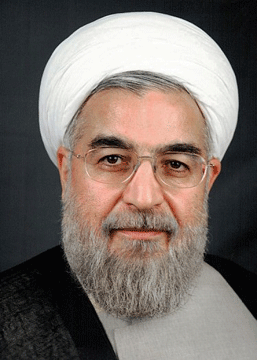 Iran’s top priority to protect nuclear deal from US http://www.sbs.com.au/news/article/2017/08/20/irans-top-priority-protect-nuclear-deal-us-rouhani Rouhani, Iran’s President Hassan Rouhani said Sunday the top foreign policy priority for his new government was to protect the nuclear deal from being torn up by the United States. “The most important job of our foreign minister is first to stand behind the JCPOA, and not to allow the US and other enemies to succeed,” Rouhani told parliament, using the technical name for the 2015 deal that eased sanctions in exchange for curbs to Iran’s nuclear programme.
“Standing up for the JCPOA means standing up to Iran’s enemies,” he said on the last day of debates over his cabinet selections. Rouhani indicated a week ago that Iran was ready to walk out on the nuclear deal if the United States continued to apply fresh sanctions.
US President Donald Trump repeatedly threatened to tear up the deal during his campaign, and it has come under mounting pressure after Tehran carried out missile tests and Washington imposed new sanctions — with each accusing the other of violating the spirit of the agreement.
But Rouhani has insisted it remains Iran’s preferred way forward, not least to help rebuild the struggling economy and create jobs.
“The second responsibility of the foreign ministry… is to get involved in economic activities. It should help attract foreign investment and technology,” Rouhani said, adding that Iran needed $200 billion in investments for the oil and gas sector alone.
Parliament approved 16 of his 17 cabinet picks, rejecting his suggested minister of energy, a reformist named Habibollah Bitaraf. Foreign Minister Mohammad Javad Zarif, who was the charismatic face of Iran’s nuclear negotiations, retained his position.
So did Oil Minister Bijan Namdar Zanganeh, who recently struck a billion-dollar deal with French giant Total.
Rouhani, a political moderate, worked hard behind the scenes to secure support for his choices, including from the supreme leader and the military. He began his second term earlier this month after winning a resounding victory over a hardline challenger in May, vowing to continue his outreach to the world and improve civil liberties at home.
But he has angered reformists by again failing to appoint a single woman minister, and looks no closer to securing the release of jailed opposition leaders — one of whom, Mehdi Karroubi, briefly went on hunger strike this week to demand a trial after six years under house arrest.
Rouhani has yet to appoint a minister of science, research and technology, which conservatives consider to be a sensitive post.
Trump’s very poor decision making on the Iran nuclear deal
Trump may be planning to make a very bad decision on the Iran deal WP, 20 Aug 17 “……According to international inspectors and the U.S. intelligence community, Iran has largely abided by the terms of the 2015 nuclear deal, which greatly reduced its stockpile of enriched unranium and placed strict limits on its nuclear activities. If the regime continues complying, it could be a decade or more before Iran could again threaten to become a nuclear power. Yet perversely, Mr. Trump is matching his passivity toward Iran’s regional meddling with an apparent determination to torpedo the nuclear pact.
After grudgingly certifying in July that Iran was meeting the terms of the deal — a test mandated by Congress every 90 days — Mr. Trump told the Wall Street Journal that he planned to find the regime noncompliant when the next certification is due in October. How to reach such a finding if the intelligence community judges otherwise? According to Foreign Policy, Mr. Trump ordered a group of political aides, including now- fired strategist Stephen K. Bannon, to cook up a rationale — something that presumably will be made easier by their lack of data or expertise.
The real experts puzzle over what Mr. Trump could hope to accomplish by announcing that Iran is noncompliant — other than satisfying what appears to be his compulsive urge to spoil President Barack Obama’s legacies. Without proof of Iranian noncompliance, U.S. partners in the nuclear deal, including the European Union, Russia and China, would surely refuse to support the nullification of the accord or the reimposition of sanctions. Iran might respond to decertification by resuming uranium enrichment, even if Mr. Trump did not reimpose U.S. sanctions. That would present the White House with the ugly old problem of how to stop Iranian progress toward a bomb. Could Mr. Trump credibly threaten Iran with military action even while using the threat of force against North Korea?….https://www.washingtonpost.com/opinions/global-opinions/trump-may-be-planning-to-make-a-very-bad-decision-on-the-iran-deal/2017/08/20/1faf5642-81e2-11e7-b359-15a3617c767b_story.html?utm
Iran fully compliant with its obligations under the nuclear agreement
Russian ambassador: Iran in full compliance with nuclear deal http://www.tehrantimes.com/news/416051/Russian-ambassador-Iran-in-full-compliance-with-nuclear-deal August 19, 2017 TEHRAN – Russian Ambassador to Tehran Levan Dzhagaryan has said that Iran has acted fully in compliance with its commitments under the nuclear agreement, noting that the U.S. should not complain in this regard.
“We will insist on our stance when talking with the Americans,” Dzhagaryan said in an interview with ISNA, stressing that the nuclear agreement must be fully implemented.
He said Russia is deeply concerned about U.S. President Donald Trump’s bashing of the nuclear deal, officially known as the Joint Comprehensive Plan of Action.
“The European countries are also very concerned and oppose [such rhetoric],” the Russian diplomat said, adding, “This is not a deal between Iran and America, but rather a multilateral agreement.”
“As you know, Russia has put a lot of effort into reaching the JCPOA,” the diplomat remarked.
Dzhagaryan also expressed the hope that China, along with U.S. allies including France, Germany, and especially Britain would persuade Washington to soften its tone on the nuclear accord.
On the recent U.S. sanctions that targeted Russia, Iran and North Korea, the diplomat said he regards all of them as “illegal”.
“However, we urge North Korea not to carry out missile tests, as it will be used as a pretext by the Americans to expand their military presence in the region,” he pointed out.
He also pointed to the economic benefits following the nuclear agreement, saying although he is satisfied with the level of Tehran-Moscow political ties, he cannot be content with the level of economic transactions between the two countries.
Russia has long supported the full implementation of the JCPOA and belives the full implementation of the deal would benefit all countries, Russia’s top diplomat in Iran asserted.
On Friday, the Russian Foreign Ministry spokeswoman Maria Zakharova reiterated her country’s stance, saying the Kremlin keeps on supporting the international pact.
Talking to reporters, she invited all the other signatories to the deal to stick to it.
Russian has all the time declared its stance regarding the international deal clearly and Moscow was actively involved in conclusion of the JCPOA, she said.
Zakharova stressed that Russia played an important role in preventing the Iran nuclear issue to be drawn into a military conflict.
In certain tense conditions, she said, the U.S. would say Iran’s nuclear program needed military solution.
But Russia insisted clearly on its stance on solving the nuclear issue through negotiations and it will never change its standing regarding the deal, said Zakharova.
Is Trump aware of that other imminent nuclear war danger – the standoff between India and China ?
The potential conflict between nuclear powers that Trump barely acknowledges, https://www.washingtonpost.com/news/worldviews/wp/2017/08/18/the-potential-conflict-between-nuclear-powers-that-trump-barely-acknowledges/?utm_term=.bdf29c5159e7 The two most populous countries in the world are dangerously close to armed conflict. Both are fast-growing and ambitious nations with something to prove — and they have nuclear weapons. Yet you’ll find surprisingly little discussion of the issue in Washington, where President Trump’s ongoing controversies and the threat of terrorist attacks (more on the horrific attack in Barcelona later in the newsletter) continue to dominate the discussion.The military standoff between India and China over a remote plateau in the Himalayas has been going on for months now. This week, The Post’s Annie Gowen and Simon Denyer took a look at the complicated dispute, which was sparked by China’s move to build a road in territory claimed by Bhutan, a close ally of India that does not have formal diplomatic relations with Beijing.
Territorial disputes between in the area are far from new — India and China briefly went to war over contest territory in 1962. And much of the present dispute dates back to an 1890 border agreement made between British India and China’s Qing Dynasty, one of a number of lingering problems caused by colonial cartographers.
But experts say the current standoff is the worst in decades and has taken on a different tone than previous flare-ups. “It would be very complacent to rule out escalation,” Shashank Joshi, an analyst with the Royal United Services Institute in London, told The Post. “It’s the most serious crisis in India-China relations for 30 years.”
Both India and China are speaking openly and seriously of armed conflict, with Beijing’s state media striking a indigent and at times uncharacteristically vulgar tone. An English-language video posted by the Xinhua news agency Wednesday accused India of “trampling international law” and “inventing various excuses to whitewash its illegal moves” — before showing a Chinese actor in a Sikh turban who spoke in an insulting Indian accent.
If India and China were to go to war, it would be no small matter. Over 2.6 billion people live in the two nations. Between them, they are estimated to have 380 nuclear weapons (though both China and India subscribe to a “no first use” policy, which should — hopefully — mean they wouldn’t be used in such any conflict).
In a briefing last month, the U.S. State Department urged restraint. During a press briefing last week, spokeswoman Heather Nauert said, “It’s a situation that we have certainly followed closely. And as you know, we have relationships with both governments. We continue to encourage both parties to sit down and have conversations about that.”
The dispute centers not only on the territory in question — an obscure, 34-square-mile area known as the Dolam Plateau that is claimed by both Bhutan and China — but a narrow strip of strategically important Indian land called the Siliguri Corridor. This tract, unaffectionately nicknamed the “chicken’s neck,” connects the bulk of the India with its remote east. Delhi has long feared Chinese troops could cut across the corridor if war broke out, effectively cutting the country in half. It’s not an unreasonable fear, given that the region is just 14 miles wide at its thinnest point; Ankit Panda of the Diplomat once dubbed it a “terrifyingly vulnerable artery in India’s geography.”
It is widely assumed that Washington would side with India in the dispute. Trump is a frequent critic of China, and some in his administration have pushed for tough responses to other territorial claims made by Beijing, such as the ongoing disputes in the South China Sea. Trump called Indian Prime Minister Narendra Modi on India’s Independence Day this week, which some media outlets interpreted as a gesture of support for New Delhi.
And yet, there is a nagging sense among some in India that Trump won’t have Modi’s back if push comes to shove. “If ever there was a war with China, America would never come to our rescue,” one government official told Indian journalist Barkha Dutt recently, according to a story Dutt wrote for The Post’s Global Opinion section.
Washington also may be diplomatically limited in the region: A number of key State Department positions that would have responsibility for handling an India-China crisis remain unfilled. Another part of the problem is simply the complexity of the issue, which could prove hard to communicate to a leader with seemingly limited knowledge of the world and a notoriously short attention span.
There is also an argument that perhaps Trump should keep his nose out of this. The Post’s Jackson Diehl wrote he didn’t find much enthusiasm for U.S. involvement in the dispute while in Delhi last week. The U.S. president has gained a reputation there for being hotheaded and impulsive — even the drawdown in tensions with North Korea seems to have happened in spite of his involvement, not because of it.
China calls for stopping U.S.-South Korea joint military exercises

 China calls for end to U.S.-South Korea joint military exercises, https://www.upi.com/Top_News/World-News/2017/08/17/China-calls-for-end-to-US-South-Korea-joint-military-exercises/3911502966370/ By Elizabeth Shim
  | Aug. 17, 2017 Aug. 17 (UPI) — China again called for the “dual suspension” of North Korea‘s nuclear weapons program and U.S.-South Korea joint military exercises on Thursday.
Beijing’s foreign ministry spokeswoman Hua Chunying made the statement before reporters at a regular press briefing, following reports Washington and Seoul are planning to begin drills on the Korean peninsula on Aug. 21, South Korean news agency Yonhap reported.
“Many countries including the United States have expressed their desire to resolve the North Korea nuclear issue peacefully through diplomatic means,” Hua said. “The most feasible and reasonable way to do this in the tense and complex situation at present is a dual suspension” on both sides.
The Chinese spokeswoman added although “the recent situation on the Korean peninsula is showing signs of easing tensions, it is still highly complex and fragile.”
“North Korea, the United States, and other parties directly concerned with the nuclear issue should do more,” Hua said. “The essence of the Korean peninsula issue can be found in the security problem, and the door to resolving the North Korean nuclear issue can really be opened when the concerns of each country are resolved in a balanced way. The most pressing issue now is to stop North Korea’s nuclear and missile development, and end the vicious cycle of increasing tensions on the Korean peninsula.”
Hua also said if the United States has a better plan that “involves the peaceful resolution of the North Korea nuclear issue and the restoration of peaceful dialogue, China will support it with a positive and open attitude.”
Hua added she welcomed an earlier suggestion from United Nations Secretary-General Antonio Guterres to dial down the rhetoric and “dial up diplomacy.”
“This is the same as China’s solution to the North Korea nuclear issue,” Hua said.
South Korean President Moon Jae-in previously defended the joint exercises as legitimate drills of a defensive nature, while condemning North Korea’s nuclear and missile provocations as illegal.
China’s more rational response to the North Korean situation
China and the North Korean nuclear challenge, In Beijing’s eyes, the status quo is preferable to the upheaval that would result from action to topple Kim, Japan Times, BY RAMESH THAKUR, 17 Aug 17 GUANGZHOU, CHINA – .ON A SUPERFICIAL READING, CHINA IS FEELING THE SQUEEZE TO TAKE EFFECTIVE ACTION TO BRING NORTH KOREA TO HEEL OVER ITS ROGUE NUCLEAR PROGRAM. ON A DEEPER READING, CHINA’S GAINS FROM THE CRISIS EXCEED THE COSTS. ON A WIDER READING, WASHINGTON DAILY VINDICATES PYONGYANG’S NUCLEAR CHOICES……..
Stability and conflict-avoidance in its immediate region remains a vital national interest for China’s development and peaceful rise. Heightened tensions over North Korea’s nuclear antics risk an uncontrolled armed conflict, strengthened U.S.-Japan-South Korea alliances and enhanced prospects of nuclear breakouts by Japan, South Korea and Taiwan.
But China’s leverage over Pyongyang, although greater than that of others, is limited. Pyongyang has proven indifferent to what others think and impervious to external pressure. With 80 percent of trade with China, more U.N. sanctions amount to more sanctions on China. It is cost-free for Washington and Western countries to engage in virtue signaling by enacting still tougher international sanctions whose costs have to be borne by China.
If the sanctions succeed in destroying North Korea’s economy and engineer a collapse, millions of desperate refugees will flood into China and a crucial geographical buffer against U.S. forces will disappear.
By what right does Washington tolerate nuclear weapons in the hands of its ally Israel but demand that China force a rollback of North Korea’s? In Beijing’s eyes, the U.S. provokes a crisis but holds China responsible for solving it. U.S. threats also stir memories among elderly Chinese of how they were treated in the early year’s of China’s own nuclear program.
Any further weakening of Pyongyang’s links with Beijing and Moscow will feed North Korea leader Kim Jong Un’s siege paranoia and solidify reliance on nuclear weapons as the only assured guarantee of regime and personal survival. The U.S. record of infidelity to political package deals — the 1954 Geneva accords on Indochina, understandings with Russia on Eastern Europe on ending the Cold War, Libyan leader Moammar Gadhafi’s abandonment of his nuclear program — inspires distrust. Every fresh bellicose threat from Washington deepens Pyongyang’s dependence on and attachment to a nuclear deterrent that can strike the U.S. mainland.
On balance, therefore, in China’s calculation the status quo of a nuclearized North Korea, however unpalatable, is preferable to the upheaval that would result from military strikes or regime collapse. This is consistent with the sober conclusion of The Economist that all options for dealing with North Korea are bad but blundering into a war would be the worst………
Chinese President Xi Jinping is the very model of a circumspect, calm and statesmanlike leader urging restraint in rhetoric and action by both sides and calling for a phased program (freeze-for-freeze) to reduce tensions. Each new step on the escalation ladder does further damage to the U.S. reputation for responsible leadership while boosting China’s profile and prestige. It also obscures China’s own past culpability in enabling North Korea’s nuclear program while underlining the history of U.S. forcible regime change as the main driver of Pyongyang’s nuclear pursuit.
This, in turn, this amplifies the larger narrative of the diminishing U.S. presence in Asia…..
Japan and South Korea have managed to live for years with the reality of vulnerability to North Korea’s nukes. There is no reason why the U.S. cannot learn to do the same. Kim should be left in no doubt that an attack on any of the three allies would bring instant military strikes and elimination of the regime. But there will be no preventive strikes. Instead a policy of containment — which requires credible threats, not bluster — will be instituted along with risk avoidance and crisis stability measures that served all sides well during the Cold War.
The only genuine progress on eliminating nuclear threats will be a universal ban treaty followed by a verifiable and enforceable plan for destroying and dismantling nuclear weapons programs in all countries.
Professor Ramesh Thakur is director of the Center for Nuclear Non-Proliferation and Disarmament in the Crawford School of Public Policy, Australian National University. https://www.japantimes.co.jp/opinion/2017/08/17/commentary/world-commentary/china-north-korean-nuclear-challenge/#.WZYqftIjHGg
In order to defy Trump, Kim Jong-un will probably target waters near Guam
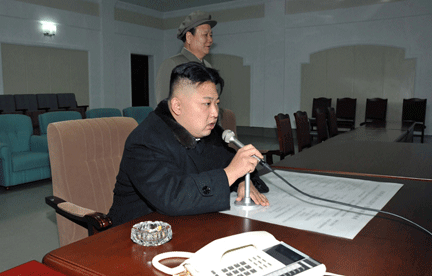 Ex-CIA analyst Bruce Klinger predicts Kim Jong-un will target Guam to defy Trump. Australian Financial Review, by John Kehoe, 13 Aug 17, Kim Jong-un will probably defy Donald Trump and soon try to land missiles in waters near the US Pacific island of Guam to show off strength and test the US President’s resolve, according to one of the world’s top North Korean analysts.
Ahead of a trip this week to Australia to speak to government officials about the North Korean nuclear crisis, former senior US Central Intelligence Agency officer for Korea, Bruce Klinger, said President Trump could hasten or delay war in attempting to shoot down any missile around the US military island.
“Given the specificity of what North Korea is saying they are thinking of doing and about the number of seconds the flight would take I would think they will launch the missiles towards Guam,” Mr Klinger said in an interview with The Australian Financial Review.
“I don’t think it’s an attack. It would be a very, very provocative demonstration…….
Mr Klinger, who led the CIA’s Korea branch in 1994 when president Bill Clinton nearly went to war with Pyongyang to stop its nuclear weapons program, said it was debatable whether or not the US or its allies should unleash missile defence systems if a North Korean demonstration missile were targeted just outside US territory………
He met North Korean officials in Europe earlier this year and recently testified before Congress…….
Unless there was very strong evidence that Mr Kim was about to strike the US, Mr Klinger opposed a preventative US attack and said it could have “catastrophic” consequences for millions of people.
“The President’s trying to demonstrate resolve to our allies and send a signal to North Korea and China,” Mr Klinger said.
“The wording is over the top and distracting.” http://www.afr.com/news/world/asia/excia-analyst-bruce-klinger-predicts-kim-jongun-will-target-guam-to-defy-trump-20170813-gxv3cc
USA does not grasp China’s point of view on the North Korea nuclear situation
 US Talks to China about North Korea, But Does Not Listen, UCS, GREGORY KULACKI, CHINA PROJECT MANAGER AND SENIOR ANALYST | AUGUST 16, 2017, The United States and China both want North Korea to abandon its nuclear weapons program. The North Korean leadership continues to defy them both. The United States says it is willing to risk a war to stop them. China is not.
China’s top priority is preserving the peace, however uneasy that peace might be. A credible North Korean capability to launch a nuclear-armed ICBM may make US officials psychologically uncomfortable. But the Chinese leadership does not feel that increased US anxiety is a sufficient justification for starting a war that could conceivably kill hundreds of thousands of people and collapse Asia’s economy, even if no nuclear weapons were used.
China has made its priorities clear to both the United States and North Korea. An August 10 editorial published in China’s Global Times warned both sides against striking first. The editorial was not an official statement of Chinese government policy but it almost certainly was reviewed and approved at the highest level. It suggested to the leadership in Pyongyang that, “If North Korea launches missiles that threaten US soil first and the US retaliates, China will stay neutral”. It also suggested to Washington that, “If the US and South Korea carry out strikes and try to overthrow the North Korean regime and change the political pattern of the Korean Peninsula, China will prevent them from doing so.”
China has also made it clear that it will not agree to sanctions that strangle North Korea’s economy. China supports economic penalties that punish North Korea for defying the United Nations and continuing its testing programs. And China is willing to work with the United States and the international community to deny North Korea access to critical technologies. But on August 5th, in an official statement made at the time of the vote on the latest round of UN sanctions, China emphasized, as it has many times in the past, that China “did not intend to negatively impact such non-military goods as food and humanitarian aid.”
US Refusal to Listen
Though China’s position on North Korea is clear and consistent, US policy is based on the assumption that China’s position will change. On August 13th, US Secretary of Defense James Mattis and Secretary of State Rex Tillerson penned an editorial in which they repeated the claim, believed by most US policy makers and analysts, that China has “decisive diplomatic and economic leverage over North Korea.” The implication is that China can force the North Korean leadership to abandon its nuclear weapons program. The joint editorial reiterated a US policy announced earlier this year by Secretary Tillerson, who said the Trump administration was engaged in an unprecedented effort to “lean hard into China” in order to pressure its leaders to change their policy.
Presumably this means trying to compel China to take steps to strangle the North Korean economy. The United States reportedly attempted to include a crude oil embargo in the latest round of UN sanctions. But China refused, as it has in the past, to agree to sanctions that would have the kind of suffocating economic impact the United States believes would force North Korea to surrender its nuclear ambitions. In their editorial Tillerson and Mattis told their Chinese counterparts they expect China to “do more” than enforce the current round of UN sanctions. They want China to cut off North Korea’s “economic lifelines.”…..
History may well record that in this particular moment of high tension, China’s president acted with greater patience, skill and prudence than the president of the United States.
On August 14th, as tensions began to subside, an editorial in the overseas edition of China’s People’s Daily chastised both the United States and North Korea for “playing a game of chicken on the Korean peninsula.” That’s not the language of a country that lacks confidence in its current position or is overly concerned about upsetting the United States. http://allthingsnuclear.org/gkulacki/us-talks-to-china-about-north-korea-but-does-not-listen
Iranian President Hassan Rouhani calls on European Union to actively support Joint Comprehensive Plan of Action (JCPOA)
Iran’s Rouhani urges EU’s active role in JCPOA implementation, Trend, 16 August 2017 Iranian President Hassan Rouhani has called on the European Union to play a more active role to help the full implementation of the country’s nuclear deal, known as the Joint Comprehensive Plan of Action (JCPOA), for the benefit of the Middle East and Europe, PressTV reported.
“The full implementation of the JCPOA benefits the EU and the region, so it is essential that the EU step up its efforts and role in this regard,” Rouhani said during a meeting with the new Austrian ambassador to Tehran, Stefan Scholz, on Wednesday.
Rouhani said the post-JCPOA era had offered a good opportunity for the further promotion of ties between Iran and the European countries, including Austria. Hailing Austria’s successful hosting of the Iranian nuclear negotiations, Rouhani said all parties would reap the benefits of the JCPOA.
“The JCPOA is a win-win agreement, which on the one hand, removed false concerns of certain Western countries, and on the other hand, lifted cruel sanctions against the Iranian nation,” the Iranian president said, adding that the agreement had brought about peace and provided a suitable economic condition for investors.
He said Iran was keen to seize the post-JCPOA opportunities for investment and expand economic ties, especially banking transactions.
The Austrian envoy, for his part, lauded the Tehran-Vienna ties as deeply-rooted and based on mutual respect, and said his country supported Iran’s policies at the international arena……https://en.trend.az/iran/politics/2787546.html
China again urging calm dialogue, not angry words and actions, on the Korean peninsula
China urges all sides to put out fire, not add to flames, in North Korea standoff, https://www.reuters.com/article/us-northkorea-missiles-china-idUSKCN1AV0N5?il=0, Reporting by Ben Blanchard; Writing by Philip Wen; Editing by Nick Macfie, BEIJING (Reuters) AUGUST 15, 2017– China on Tuesday reiterated calls for restraint on the Korean peninsula, saying it hoped all sides could put out the flames, not add oil to the fire, with their words and actions.
Speaking at a daily press briefing in Beijing, Foreign Ministry spokeswoman Hua Chunying urged a peaceful resolution of the standoff.
North Korean leader Kim Jong Un has delayed a decision on firing missiles towards Guam while he waits to see what the United States does next, the North’s state media said on Tuesday, as South Korea’s president said Seoul would seek to prevent war by all means.
1 This Month

of the week– Nuclear Reactor Information Task Force
14 May – online event From Bombs to Data Centres: the Face of Nuclear Colonialism
To see nuclear-related stories in greater depth and intensity – go to https://nuclearinformation.wordpress.com
-
Archives
- May 2026 (82)
- April 2026 (356)
- March 2026 (251)
- February 2026 (268)
- January 2026 (308)
- December 2025 (358)
- November 2025 (359)
- October 2025 (376)
- September 2025 (257)
- August 2025 (319)
- July 2025 (230)
- June 2025 (348)
-
Categories
- 1
- 1 NUCLEAR ISSUES
- business and costs
- climate change
- culture and arts
- ENERGY
- environment
- health
- history
- indigenous issues
- Legal
- marketing of nuclear
- media
- opposition to nuclear
- PERSONAL STORIES
- politics
- politics international
- Religion and ethics
- safety
- secrets,lies and civil liberties
- spinbuster
- technology
- Uranium
- wastes
- weapons and war
- Women
- 2 WORLD
- ACTION
- AFRICA
- Atrocities
- AUSTRALIA
- Christina's notes
- Christina's themes
- culture and arts
- Events
- Fuk 2022
- Fuk 2023
- Fukushima 2017
- Fukushima 2018
- fukushima 2019
- Fukushima 2020
- Fukushima 2021
- general
- global warming
- Humour (God we need it)
- Nuclear
- RARE EARTHS
- Reference
- resources – print
- Resources -audiovicual
- Weekly Newsletter
- World
- World Nuclear
- YouTube
-
RSS
Entries RSS
Comments RSS
 nuclear-news