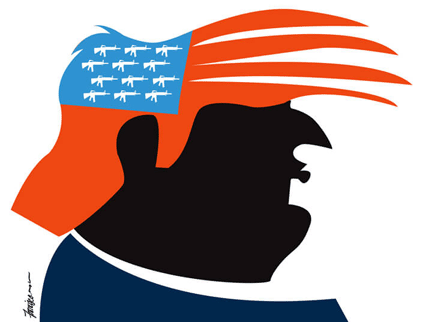
Trump leaves open possibility of bailing on meeting with North Korea leader, Military Times, By: Matthew Pennington, The Associated Press , 19 Apr 18, WASHINGTON — President Donald Trump said that although he’s looking ahead optimistically to a historic summit meeting with North Korean leader Kim Jong Un he could still pull out if he feels it’s “not going to be fruitful.”
Trump said that CIA Director Mike Pompeo and Kim “got along really well” in their recent secret meeting, and he declared, “We’ve never been in a position like this” to address worldwide concerns over North Korea’s nuclear weapons.
But speaking alongside Japanese Prime Minister Shinzo Abe on Wednesday, after the allies met at Trump’s Florida resort, he made clear that he’d still be ready to pull the plug on what is being billed as an extraordinary meeting between the leaders of longtime adversaries.
“If I think that if it’s a meeting that is not going to be fruitful we’re not going to go. If the meeting when I’m there is not fruitful I will respectfully leave the meeting,” Trump told a news conference. He also said that a U.S.-led “maximum pressure” campaign of tough economic sanctions on North Korea would continue until the isolated nation “denuclearizes.”………
Other than the threat posed to by North Korea’s weapons of mass destruction, another issue overhanging the summit plans is the fate of three Americans detained there. Trump said that was under negotiation and there was a “good chance” of winning their release, but he wouldn’t say whether that was a precondition for sitting down with Kim.
Pompeo raised the question of the three Americans in his meeting with Kim, a U.S. official said.
Trump also said he had promised Abe he would work hard for the return of Japanese nationals abducted by North Korea. Tokyo says at least a dozen Japanese said to have been taken in the 1970s and 1980s remain unaccounted for.
Interview A conversation with Helen Caldicott From the forthcoming issue (May 2018)Taylor and Francis online, 17 Apr 18 Dan Drollette Jr For decades, anti-nuclear weapons campaigner Helen Caldicott (helencaldicott.com) has been educating people about the effects of nuclear weaponry and issuing rousing calls to action. A practicing pediatrician from Australia, Caldicott was the subject of an Oscar-winning short film, If You Love This Planet, and is the author of 12 books.In this Skype interview from her home in Sydney, Australia, the 79-year-old Caldicott doesn’t pull punches. For nearly six decades, she has been taking on the powers that be, in joyously feisty terms: She has said that the US Defense Department should be re-named the Killing Department and characterized Barack Obama as an “intelligent, lovely man, who failed the world” when it came to eliminating nuclear weapons. She considers the movie Dr Strangelove more of a documentary than a satire, labeled arms manufacturers “wicked,” and called American politicians “corporate prostitutes.”
And of the current president, Caldicott said: “We’ve got a man in charge who I think has never read a book, and who knows nothing about global politics, or his own country’s politics. Who operates with his own kind of sordid intuition. And he’s putting people in every department committed to destroying that department. He’s absolutely destroying the infrastructure of America.”
Noting that it was International Women’s Month, Caldicott had one thing to say to young women: “We need to take over, because we’re on the short course to annihilation, and we need to say to men ‘Look, stand aside, you need your bottom smacked.’ ”
Yet for someone who has spent a lifetime fighting vigorously against the specter of nuclear annihilation, Caldicott reveals that she is remarkably pessimistic about humanity’s chances. Caldicott said that she wants her tombstone to read: “She tried.”
Editor’s note: This interview has been condensed and edited for clarity.
……..I noticed there seem to be a lot of people in the anti-nuclear weapons movement with medical backgrounds.
Helen Caldicott:
It’s a medical problem. And explaining the medical dangers of nuclear war was a very good way to teach people what the danger is, and to bring it home to their city. That approach was – and is – very powerful. During the 1980s, when I was one of the leaders of the nuclear weapons freeze movement and one of the founding presidents of PSR, we at PSR held symposia on the medical effects of nuclear war at various universities, all around the country. It started at Harvard, where we had George Kistiakowsky, a physicist who had been in the Manhattan Project as an explosives expert (https://www.manhattanprojectvoices.org/oral-histories/george-kistiakowskys-interview). It was quite wonderful.
Although afterwards, some journalists did say: “What are doctors talking about this for, this is a political issue.” And we said no, it’s a medical issue, because it will create the final medical epidemic of the human race……….
…… I think we’re actually in a much more dangerous situation than we were during the height of the Cold War, though no one’s really taking any notice. I mean, Dan Ellsberg went to 14 different publishers before Bloomsbury published his book. And my latest book, Sleepwalking to Armageddon, (https://thenewpress.com/books/sleepwalking-armageddon) is not selling very well at all. It seems like society is practicing psychic numbing and manic denial. We’re into clothes and food, and all sorts of things like that, while life on the planet just hangs in the balance………
Of course. America’s economy is built on killing. It’s the Killing Department, not the Defense Department. There’s no defense from nuclear weapons. It’s all run by voracious, wicked corporations, such as Lockheed-Martin, General Electric, General Dynamics, and the like. And many American politicians are corporate prostitutes. ……
……..Dan Drollette: How would you characterize Trump and his administration?
Helen Caldicott:
Trump is a dolt. He’s an idiot. We’ve got a man in charge who I think has never read a book, and who knows nothing about global politics, or his own county’s politics. Who operates with his own kind of sordid intuition. And he’s putting people in every department committed to destroying that department. He’s absolutely destroying the infrastructure of America.
When you think of all the brave, heroic Americans who worked hard all their lives to set up wonderful laws to protect the environment and protect the people and protect the children and protect the Earth, what’s happening is shameful. It’s all being undone, and I can’t understand why.
……..Dan Drollette:
What about his administration’s doings on the world stage?
Helen Caldicott:
For some reason, Trump likes Putin and the Russians. Well, I think I know why. I think that they and the oligarchs have funded Trump for years and years and years. It’s mostly, I think, about money. Trump wants to get on well with them, which is good because, you know, there’s almost certainly about 40 hydrogen bombs targeted on New York as we speak. So, therefore, it is imperative that America get on well with the Russians and in fact, push for bi-lateral nuclear disarmament. So, from that perspective, it makes me feel a little bit … less anxious.
………I think that enlarging NATO right up to the Russian border was extremely provocative. That policy largely came about because of people like Lockheed-Martin president Norman Augustine, who I’ve previously described elsewhere as “commander-in-chief of the Pentagon.” Because after the Cold War ended, Lockheed-Martin et al had nowhere to make money. They’re going to make money by making bombs, killing people, and then making more bombs.
So, Augustine set off on a journey to all the newly released little countries – Lithuania, Latvia, etcetera – to say “Look, if you want to be a part of NATO and have a democracy, you have to spend about $3 billion on armaments.” (http://www.nytimes.com/1997/06/29/world/arms-makers-see-bonanza-in-selling-nato-expansion.html) And let’s be frank: NATO is in fact America. So that was all well and good for Lockheed-Martin, even though it meant that America went back on its promise to Gorbachev that NATO would not be enlarged. As a consequence, there are NATO missiles right up to the Russian border, on what had been territory that was previously friendly to Russian, which is extremely provocative. Imagine if the situation were reversed, and Canada became part of the Warsaw Pact, and they put Warsaw Pact-missiles on the US border. How do you think America would react? So that’s problem number one………https://www.tandfonline.com/eprint/MBkXvHtz5QyAfikSM8Cv/full
South Korean President Moon Jae-in said North Korea might end its nuclear program while the US keeps its troops in South Korea. We’ve been here before. Vox By Alex Ward@AlexWard Voxalex.ward@vox.com
North Korea may have just announced a major concession ahead of talks with President Donald Trump.
According to South Korean President Moon Jae-in on Thursday, North Korea is ready for “complete denuclearization,” meaning that it would stop improving its nuclear weapons and missiles that can hit America and its allies. What’s more, North Korea would do that — and the US can keep its troops in South Korea.
If North Korea is seriously considering that, it would be a marked shift from its past stance. When Pyongyang usually talks about denuclearization, US troop removal is always a sticking point. Pyongyang fears that US troops are only waiting to invade North Korea, and so it wants to keep its nuclear arsenal to deter that incursion. But now, it’s possible America’s 28,500 troops on the Korean Peninsula can stay as North Korea winds down its program.
Pyongyang’s new stance, if true, could change the tenor of Trump’s potential meeting with North Korean leader Kim Jong Un in late May or early June. Abraham Denmark, a former top Asia security official at the Pentagon, tweeted on Thursday that North Korea’s announcement could mean Trump and Kim may strike an agreement.
“Looks like a deal may actually be coming together,” Denmark said. “Shaping up to be a comprehensive package that involves a peace regime, denuclearization, and eventual normalization of relations.”
Hundreds of lawmakers from Germany, France, and Britain have called on their counterparts in the U.S. Congress to support the 2015 nuclear deal between Iran and six world powers, calling it a “major diplomatic breakthrough.”
The initiative came as U.S. President Donald Trump has set a May 12 deadline to either improve or scrap the deal providing Iran with relief from sanctions in return for curbs on its atomic program.
“We were able to impose unprecedented scrutiny on the Iranian nuclear program, dismantle most of their nuclear enrichment facilities, and drastically diminish the danger of a nuclear arms race,” reads a statement signed by some 500 MPs from the German, British, and French national parliaments and posted online on April 19.
Britain, Germany, and France are signatories to the nuclear accord, along with the United States, China, and Russia.
Trump accuses Tehran of violating the spirit of the agreement and has called on European powers to “fix” what he says are the “terrible flaws” of the agreement. He wants new restrictions to be imposed on Tehran’s nuclear and missile programs.
“It is the U.S.’s and Europe’s interest to prevent nuclear proliferation in a volatile region and to maintain the transatlantic partnership as a reliable and credible driving force of world politics,” the European lawmakers said.
They wrote that abandoning the accord would result “in another source of devastating conflict in the Middle East and beyond,” would “diminish the value of any promises or threats made by our countries,” and would damage “our credibility as international partners in negotiation, and more generally, to diplomacy as a tool to achieve peace and ensure security.”
“We therefore urge you to stand by the coalition we have formed to keep Iran‘s nuclear threat at bay,” they added.
French President Emmanuel Macron and German Chancellor Angela Merkel will both travel to Washington next week on separate official visits, in part to convince Trump not to pull the United States out of the nuclear deal with Iran.
Russian President Vladimir Putin warns of global ‘chaos’ if West strikes Syria again, ABC News 16 Apr 18, Russian President Vladimir Putin has warned that further Western attacks on Syria would bring chaos to world affairs, as Washington prepared to increase pressure on Russia with new economic sanctions.
Key points:
Vladimir Putin said further attacks on Syria will bring “chaos” in world affairs
America accused Russia of blocking attempts to investigate Syria’s chemical weapons capabilities
New sanctions against Russia will target companies linked to Syria
In a telephone conversation with his Iranian counterpart Hassan Rouhani, Mr Putin and Mr Rouhani agreed the Western strikes had damaged the chances of achieving a political resolution in the seven-year Syria conflict, according to a Kremlin statement.
“Vladimir Putin, in particular, stressed that if such actions committed in violation of the UN Charter continue, then it will inevitably lead to chaos in international relations,” the Kremlin statement said.
Syria strikes: The real impact is in Moscow, Analysis by Tim Lister, CNN April 14, 2018 After nearly a week of tension that sometimes verged on the surreal, the US and its allies finally carried out strikes against regime targets in Syria on Friday night. The strikes, more limited than once seemed likely, were designed to deter the Assad regime’s use of chemical weapons once and for all.
Their real impact will be on the plummeting relationship between Moscow and the West.
The arguments over what happened in Douma on April 7 and who was responsible have dragged US-Russian relations to their lowest ebb in decades. On both sides, the
(CNN)After nearly a week of tension that sometimes verged on the surreal, the US and its allies finally carried out strikes against regime targets in Syria on Friday night. The strikes, more limited than once seemed likely, were designed to deter the Assad regime’s use of chemical weapons once and for all.
Their real impact will be on the plummeting relationship between Moscow and the West.
The arguments over what happened in Douma on April 7 and who was responsible have dragged US-Russian relations to their lowest ebb in decades. On both sides, the As the week progressed, Russian officials veered between insisting there had been no attack, that rebel groups had staged it and ultimately that the United Kingdom had planned it in a conspiracy with Syria’s White Helmets volunteer rescue group……..
The deterrent effect
Syria pledged to give up all its chemical weapons in 2013 under a Russian-mediated deal after a horrendous attack on civilians not far from the site of the last week’s incident. The alternative, threatened by President Obama, was military action.
Either Syria didn’t surrender all of its stocks (the view in France and Germany) or it started producing chemical weapons again.
Chemical weapons have killed a tiny fraction of the more than 400,000 Syrians who have died in the civil war. But to the US and much of the international community, the use of these weapons is especially abhorrent.British Prime Minister Theresa May spoke of the “erosion” of the global ban on chemical weapons, while the senior UN official for disarmament, Thomas Markram, told the Security Council on Monday: “The use of chemical weapons cannot become the status quo, nor can we continue to fail the victims of such weapons.”
That was the Trump Administration’s view when it launched cruise missiles against a Syrian airbase a year ago following the sarin attack on civilians at Khan Sheikhoun. Those strikes were meant as a deterrent; as such they failed. As the International Rescue Committee said this week, the response to Khan Sheikhoun “did not change the calculus of the warring parties nor make Syrian civilians safer.”
The choice this time was a larger deterrent — or be seen as a blowhard. But escalation brings with it risks of a wider conflict, risks the Russians have been keen to proclaim……
A nadir for Washington and Moscow
The greatest impact of these strikes is that they will deepen the visceral hostility that characterizes relations between the US and Russia, now at their lowest ebb in decades……..
Syria: US, British and French forces launch air strikes in response to chemical weapons attack,
US, British and French forces have pounded chemical weapons sites in Syria with air strikes in response to an alleged poison gas attack that killed dozens in the rebel-held town of Douma last week.
Key points:
US, UK and France hit three chemical weapons sites in Syria
US Defence Secretary says strikes were a “one-time shot”
Strikes biggest intervention yet by Western powers against Assad regime
In a televised address to the nation, US President Donald Trump said the three nations had “marshalled their righteous power against barbarism and brutality”.
The strikes were the biggest intervention by Western powers against President Bashar al-Assad in the country’s seven-year-old civil war, which has pitted the US and its allies against Russia.
The Pentagon said the strikes targeted a research centre in Damascus, along with a chemical weapons storage facility and command post west of Homs……
British Prime Minister Theresa May said the strikes were not about intervening in a civil war nor were they about a regime change.
“We cannot allow the use of chemical weapons to become normalised within Syria, on the streets of the UK or anywhere else in our world,” Ms May said…….
Donald Trump ‘to tell Kim Jong-un to scrap nuclear arsenal within year in return for US embassy in Pyongyang’ , Julian Ryall, Tokyo, Nicola Smith, Telegraph UK Taipei
President Donald Trump is expected to demand that Pyongyang abolish its nuclear weapons capability within a year when he sits down for talks with Kim Jong-un, the North Korean dictator, but will offer to open an embassy in the North’s capital and provide humanitarian assistance as an incentive.
The details offer a sense of the rapid pace of progress towards talks although analysts suggest the timetable may be overambitious.
SAUDI ARABIA WANTS TO DUMP NUCLEAR WASTE ON THE QATARI BORDER TO MAKE ITS ARCH ENEMY AN ISLAND, NewsWeek , BY DAVID BRENNAN
Saudi Arabia is planning to escalate its isolation of regional rival Qatar by using nuclear waste and a 650-foot wide canal to turn its neighbor into an island.
According to reports in the state-linked al-Riyadh and Sabq newspapers, the project—which would establish a military zone, nuclear waste dump and canal—would separate the two countries along the entire length of the 37.5-mile border.
The two nations have been locked in a crisis since the imposition of a Saudi-led diplomatic blockade on Qatar in June 2017. Saudi Arabia and its allies—including Bahrain, the United Arab Emirates (UAE) and Egypt—accuse Qatar of supporting terrorism in the Middle East, a charge Doha denies.
Apparently, Riyadh is not content with traditional isolation. The so-called “Salwa Marine Canal Project” would establish a military base in one area of the border and a nuclear waste site in another. The waste would come from the nuclear reactors that Saudi Arabia is planning to build. The border would then be clearly demarcated by a wide canal. The UAE would also build a nuclear waste site at its border’s closest point to Qatar.
Sabq reported that the canal would be dug by Egyptian companies using experience gained in the construction of the Suez Canal and would take around a year to complete. Costing around $750 million, the waterway would be roughly 650 feet wide and 66 feet deep. It would be financed by private Saudi and Emirati investors.
Facing reality in the US-Saudi nuclear agreement: South Korea https://thebulletin.org/facing-reality-us-saudi-nuclear-agreement-south-korea11683, Victor Gilinsky, Henry Sokolski, 10 Apr 18 The Trump administrations is on the verge of signing a nuclear agreement with Saudi Arabia that is reportedly “flexible” on Saudi acquisition of centrifuge technology to enrich uranium—the technology that can provide material for nuclear weapons and that was the central concern in regard to Iran’s nuclear program. This flexibility is necessary, the administration argues, to ensure the Saudis choose Westinghouse as their nuclear power reactor supplier. But Westinghouse, which performed abysmally on its last two US projects and is in bankruptcy as a result, is far less likely to win the bid than the South Korean construction firm whose work force is coming off successful completion of a large nuclear project nearby in the United Arab Emirates. This increases the importance of striking a tight US-Saudi agreement to ensure the Saudis don’t get to enrich under their nuclear cooperative agreement with Seoul.
The administration’s pitch that Congress should go along with “flexibility” pulls out all the usual bogeymen. Energy Secretary Rick Perry told the Senate Armed Services Committee on March 22 that, “Either Russia or China is going to be a partner in building civil nuclear capability in the Kingdom of Saudi Arabia, or the United States.” The Saudis, guided by several Washington lobbying firms, have been pushing this line, which much of the Washington establishment has swallowed, adding that allowing Moscow to gain a nuclear foothold in Saudi Arabia would deal a serious blow to US regional influence and prestige.
But the Saudis are not so foolish as to choose Russia or China. Moscow is nuclear supplier to Saudi Arabia’s foe, Iran, and Beijing has yet to bring a power reactor online outside of China. The Saudis already have a significant history of nuclear involvement with South Korea. They signed an agreement for “cooperation in the peaceful uses of nuclear energy” in 2011 and a memorandum of understanding in 2015, with a view to buying two smaller, so-called small modular (SMART) Korean reactors. Dozens of Saudis have gone to South Korea for nuclear training.
In these circumstances, the enrichment provision in the 2011 Saudi-South Korean agreement is of vital concern. It reads as follows: “Uranium transferred pursuant to this Agreement or used in any equipment so transferred shall not be enriched to twenty (20) percent or more in the isotope U-235 unless the Parties otherwise agree.” In other words, the 2011 agreement permits installation of Saudi enrichment facilities generally, and in particular the enrichment to 20 percent of uranium supplied under the agreement. A reason this is worrying—and was worrying in the case of Iran—is that, although it may seem counter intuitive, to further enrich the 20 percent product to a bomb explosive level takes only an additional one-tenth of the work it took to get to 20 percent. It becomes especially worrying when coupled with the Saudi Crown Prince’s hair-trigger promise (see this 60 Minutes interview) that if Iran got a bomb, the Kingdom would, too, “as soon as possible.”
This means that if we intend to bar Saudi Arabia’s path to nuclear weapons, and we absolutely should, we have to insist on a provision in our agreement with Saudi Arabia like that included in the agreement with its UAE neighbor: that the country will not engage in its territory in activities related to enrichment or reprocessing (extracting plutonium from spent nuclear fuel—the other path to a bomb). And we need to make sure South Korea agrees to hold off on moving forward on Saudi reactors until such a provision is in place.
Why would Saudi Arabia agree to such a restrictive provision? And why would South Korea agree to cooperate in ensuring it is in place. The short answer is that both countries depend on our protection. If we can pressure countries on trade terms—something the administrations brags about—surely, we can do so in the interest of security. As US Sen. Jack Reed, ranking member of the Armed Services Committee, said in response to Perry’s testimony, “The proliferation dangers are so great that we should be able to wield all of the influence we have, which goes way beyond just this one transaction, to insist [on the] same standards we applied to the Emirates.” And as President Gerald Ford said many years ago, “nonproliferation objectives must take precedence over economic and energy benefits if a choice must be made.”
This of course assumes the administration adheres to the traditional US policy objective of preventing the spread of nuclear weapons, even among friends. An especially worrying aspect of this entire affair is that there seems to be a sense, born of hostility to Iran, that a Saudi nuclear weapon option might not be such a bad thing—in fact that it might even be useful to frighten Iran. All that can be said about such thinking is: This way lies chaos. We should move in the opposite direction, starting with barring Saudi Arabia from getting nuclear weapons.
Editor’s Note:If President Trump insists on meeting Kim Jong-un, he must be prepared either to agree to a long negotiating process that will play into Kim’s hands, or to walk away from the table, writes Evans Revers. Faced with these options, the prudent choice might be to press the “pause” button. This piece originally appeared on Newsweek.
President Donald J. Trump’s upcoming summit with North Korean leader Kim Jong-un will be an historic encounter between two supremely self-confident, headstrong, and mercurial men, each seeking the other’s surrender.
The irresistible force of Donald Trump, whose administration has declared it will never accept, allow, or tolerate a North Korean nuclear threat to America, will soon meet the immovable object of a North Korean regime that has declared it will never give up its nuclear weapons “even in a dream.” What could possibly go wrong?
President Trump agreed to the summit on a whim, surprising his advisers and the South Korean envoys who conveyed Kim Jong-un’s invitation. Had he discussed the invitation with his advisers first, he would have heard that Kim’s reported interest in a deal on “denuclearization of the whole Korean Peninsula” is nothing of the kind.
Those who have negotiated nuclear matters with Pyongyang know that Kim’s words were a familiar North Korean demand to end the “threat” posed by the U.S.-South Korea alliance, the presence of U.S. troops in Korea, and the nuclear umbrella that defends South Korea and Japan.
A senior North Korean official once explained to a group of American experts, “If you remove those threats, we will feel more secure and in ten or twenty years’ time we may be able to consider denuclearization. In the meantime,” he continued, “we are prepared to meet with you as one nuclear weapon state with another to discuss arms control.”
That is North Korea’s concept of “denuclearization.” It bears no resemblance to the American definition.
Secret, direct talks underway between US and North Korea, By Elise Labott, Kevin Liptak and Jenna McLaughlin, CNN, April 7, 2018 Washington The United States and North Korea have been holding secret, direct talks to prepare for a summit between President Donald Trump and North Korea leader Kim Jong Un, a sign that planning for the highly anticipated meeting is progressing, several administration officials familiar with the discussions tell CNN.
Central Intelligence Agency Director Mike Pompeo and a team at the CIA have been working through intelligence back-channels to make preparations for the summit, the officials said. American and North Korean intelligence officials have spoken several times and have even met in a third country, with a focus on nailing down a location for the talks.
Although the North Korean regime has not publicly declared its invitation by Kim Jong Un to meet with Trump, which was conveyed last month by a South Korean envoy, several officials say North Korea has since acknowledged Trump’s acceptance, and Pyongyang has reaffirmed Kim is willing to discuss the denuclearization of the Korean peninsula……..https://edition.cnn.com/2018/04/07/politics/north-korea-us-talks/index.html
Does Trump Even Know What He Wants From Kim Jong-un?
The president has shown no indication that he has any plan for next month’s all-important North Korea summit. Slate, By FRED KAPLAN , 3 April 18.
The biggest, riskiest diplomatic trip of his presidency—the summit with North Korean leader Kim Jong-un—is set to take place next month, and Donald Trump shows no signs of comprehending the issues or interests at stake.
Two statements from last week should have set off alarm bells that the president is not remotely ready for prime time.
The first came on Thursday, during a rambling, campaign rally–like speech in Ohio. At one point, Trump mentioned his recently reached trade deal with South Korea, saying, “I may hold it up until after a deal is made with North Korea. You know why? Because it’s a very strong card. And I want to make sure everyone is treated fairly.”
Within a few hours, aides to South Korean President Moon Jae-in were seeking clarification on the statement, working through various channels to understand Trump’s “true intentions.”Good luck on that.
I’ve sought some clarification myself, to no avail. The remark was either utterly incoherent or a terrible blunder. The former—yet another instance of Trump’s incoherence—is the likelier explanation. It’s not at all clear why Trump should hold up a trade deal with South Korea, pending the results of nuclear talks with North Korea. The two have little or nothing to do with each other.
But impolitic incompetence should never be dismissed as a source of confusion. Moon will be meeting with Kim—another historic first—on April 27 at Peace House, near the North-South border. It is expected that their meeting will tee up the issues, and to some degree set the agenda, for Kim’s meeting with Trump a few weeks later. Trump’s relations with Moon are rife with tensions. Trump has harshly criticized Seoul for fair-trade violations (and is said to see the new trade deal as an imperfect solution); he often grumbles that the South Koreans should pay more for their own defense and has threatened to withdraw U.S. forces from the region if they don’t—thus arousing fears, in South Korea and Japan, that Trump might do just that in exchange for a promise by North Korea to freeze or cut back its nuclear arsenal.
Trump’s remark in Ohio could be read as a threat to Moon: Push Kim hard on his nuclear weapons, maybe even get him to agree to dismantle them in advance of the U.S. summit—do the heavy lifting for us—or forget about the new trade deal. ……….
Does Trump have any idea what sorts of “phased, synchronized measures” he would like North Korea to take—and what sorts of measures he would permit the United States to take at the same time? For example, as a first step, North Korea could extend its freeze on nuclear testing and open up its production and test sites to international inspection—with the United States simultaneously removing some sanctions. What would be the second, third, and fourth synchronized measures, and what would be the ultimate goal—the finishing line of these steps? These are issues to be discussed by experts, debated in National Security Council meetings, and decided very carefully by the president and his top advisers. If officials at the State Department, the Pentagon, and the NSC aren’t already well into this project, they’re starting way too late.
It’s also worth noting that Trump’s incoming national security adviser, John Bolton, has spoken out against the whole concept of phased, synchronized measures, demanding that Kim dismantle his nuclear arsenal, all at once, and urging the United States to launch a first strike if he refuses. Will he offer Trump the same advice, now that he’s off Fox News and inside the White House? Will Trump listen? And who’s still around to offer countervailing advice?
Kim Jong-un will come to both negotiations—the one with Moon near the DMZ and the one with Trump at a location not yet determined—with a goal, an agenda, and a bag of bargaining tactics. He may also have sought and won consent for his approach (though there’s no way of knowing this) during his meeting in Beijing with Xi. Unless something dramatic happens in the next few weeks, Trump will arrive at the summit with no firm grip on a strategy or tactics—and wavering support from, and for, his allies. He may come instead with the cloak of an unearned self-confidence that he can prevail with a deal through his charisma and instincts. For this kind of deal, that won’t be enough. https://slate.com/news-and-politics/2018/04/does-trump-even-know-what-he-wants-from-kim-jong-un.html
But together, the Kim-Moon meeting serves more as a prelude to the Trump-Kim summit. And if those talks fail, Harry Kazianis, an Asia security expert at the Center for the National Interest think tank, thinks the chances of war might increase.
“We are putting all of our eggs in the summit basket,” he told me. “This is the ultimate Hail Mary.”
The North Korea nuclear standoff: how we went from “fire and fury” to talks in under a yearVox, “North Korea has 100 percent changed its tactics.” By Alex Ward@AlexWardVoxalex.ward@vox.com
Last year, it seemed like war between the United States and North Korea was a real possibility.
“The United States has great strength and patience, but if it is forced to defend itself or its allies, we will have no choice but to totally destroy North Korea,” President Donald Trumpsaid at the United Nations on September 19, 2017. “Rocket Man is on a suicide mission for himself and for his regime,” he continued, using his favored nickname for North Korean leader Kim Jong Un.
Flash-forward to March 29, 2018, when Pyongyang and Seoul announced that Kim and South Korean President Moon Jae-in will meet face to face in April for talks. It’ll be only the third in-person meeting between the heads of both countries, and the first since 2007. But that’s not all: The Kim-Moon summit will lay the groundwork for an even more historic meeting between Kim and Trump sometime in either May or June, although it remains unscheduled.
How did we get here? How did North Korea and the US go from talk of potential nuclear warto actual, well, talks? Here’s one explanation: Experts tell me the war threats may have actually scared leaders like Trump.
“I’d like to believe that while President Trump talks tough,” Leon Panetta, the former defense secretary and CIA director, told me, “deep down, he also is concerned about involving this country in another war that is going to cost thousands of lives.”
But others simply give credit to North Korea. “North Korea has 100 percent changed its tactics,” Sue Mi Terry, a North Korea expert at the Center for Strategic and International Studies think tank, told me. “I think this is all North Korea actually driving this.”
Whatever the reason, top officials want to take advantage of this moment. “We must not let this historic opportunity for diplomacy go to waste,” Sen. Ed Markey (D-MA), a member of the Senate Foreign Relations committee, told me.
What follows is a guide to how the two countries went from a nuclear standoff to a rare moment of cautious optimism.
Kim pivots from bombs to talks………..
The coming Trump-Kim summit made the South Korea meeting possible
On March 8, South Korean envoys who had just met with Kim Jong Un relayed a message to Trump: The North Korean leader wanted to meet with him. Trump reportedly accepted the offer on the spot.
Moon, the South Korean president, seemed relieved by the news. He campaigned in part on easing tensions with North Korea and continually advocated for a diplomatic solution to the US-North Korea standoff. After Trump agreed to meet with Kim, Moon offered three-way talks between him and the other two leaders.
That, however, is not in the works. Instead, Moon and Kim finally set a date for their face-to-face meeting in April. But Terry, the North Korea expert, told me she doesn’t expect much from the Kim-Moon summit. Instead, she said “South Korea’s chief goal is to set up that [the] Trump-Kim meeting goes well.”
As for Kim, he likely wants a greater sense of how badly Moon wants to strike some sort of deal.
Kim is already preparing for both encounters. This week, he took a secret trip to Beijing to meet with Chinese President Xi Jinping. Oriana Skylar Mastro, a China expert at Georgetown University, told me in an interview that Kim wanted to ensure he had China’s support ahead of talks with the US. Having Beijing’s backing could help Kim not concede too much in talks with Moon and Trump.
Kim needs the help. Trump will want Kim to give up his nuclear weapons, but experts are unanimous that Kim won’t agree to do so. Having China’s support allows the North Korean leader to feel more comfortable defying the American president.
“I think the North Korean leader made some very smart moves and has put himself in a good position,” Panetta, the former Obama Cabinet official, told me. “He has given himself greater leverage ahead of these meetings.”
Put together, the Kim-Moon meeting serves more as a prelude to the Trump-Kim summit. And if those talks fail, Harry Kazianis, an Asia security expert at the Center for the National Interest think tank, thinks the chances of war might increase.