By Daryl G. Kimball and Thomas Countryman Daryl G. Kimball is Executive Director, Arms Control Association & Thomas Countryman is Board of Directors, Chairman, and former U.S. Assistant Secretary of State for Nonproliferation WASHINGTON DC, May 16 2018 (IPS) – We are deeply disappointed by the counterproductive response from the Trump administration to the statements from senior Saudi officials threatening to pursue nuclear weapons in violation of their nonproliferation commitments.
We call on the White House to immediately reiterate the longstanding, bipartisan policy of the United States that it will actively work against the spread of nuclear weapons to any country, friend or foe.
President Donald Trump’s reckless decision to violate the Joint Comprehensive Plan of Action (JCPOA), which has blocked Iran’s pathways to nuclear weapons and put in place a robust monitoring system to detect and deter cheating, has not only opened the door to an expansion of Iran’s capability to produce bomb-grade nuclear material, but it has increased the risk of a wider nuclear arms race in the Middle East, which is already home to one nuclear-armed state.
Saudi Arabia’s foreign minister Adel Al-Jubeir told CNN May 9, that his country, which, like Iran, is a party to the 1968 nuclear Nonproliferation Treaty (NPT), stands ready to build nuclear weapons if Iran restarts its nuclear program.
Al-Jubeir also praised Trump’s decision to abandon the Iran nuclear deal and seek to reimpose sanctions on firms and business engaging in legitimate commerce with Iran.
Asked what his country will do if Iran restarts its nuclear program, he told CNN’s Wolf Blitzer that “we will do whatever it takes to protect our people. We have made it very clear that if Iran acquires a nuclear capability, we will do everything we can to do the same.”
Asked to clarify whether that means the kingdom will work to acquire its own nuclear capability, al-Jubeir replied, “That’s what we mean.”
This follows similar comments by Saudi Crown Prince Mohammed bin Salman in a March 15 interview with CBS News that Saudi Arabia will quickly follow suit if Iran acquires nuclear weapons.
“Right now, I don’t know that we have a specific policy announcement on that front, but I can tell you that we are very committed to making sure that Iran does not have nuclear weapons,” she stated.
The administration’s nonresponse to Prince Salman’s threat in March and Sanders’ weak response May 9 amounts to an irresponsible invitation for mischief.
They imply that Trump administration would look the other way if Saudi Arabia breaks its NPT commitments to pursue nuclear weapons.
It is bad enough that the Trump administration, by violating the 2015 Joint Comprehensive Plan of Action, has threatened the NPT regime by opening the door for Iran to expand its nuclear capacity.
President Trump and his advisors must not compound that error by swallowing their tongues when another NPT member state in the region threatens to pursue the bomb.
We call on the White House to immediately clarify that it is the longstanding policy of the United States, as an original party to the NPT:
“…not to in any way to assist, encourage, or induce any non-nuclear-weapon State to manufacture or otherwise acquire nuclear weapons …” and “… to pursue negotiations in good faith on effective measures relating to cessation of the nuclear arms race at an early date and to nuclear disarmament ….”
We also call on the U.S. Congress to reject any proposed agreement with Saudi Arabia that permits U.S. nuclear cooperation if Saudi Arabia seeks to or acquires sensitive uranium enrichment or plutonium separation technology which can be used to produce nuclear weapons.
WASHINGTON — For the White House, these have been dramatic days for nuclear disarmament: First President Trump exited the Iran deal, demanding that Tehran sign a new agreement that forever cuts off its path to making a bomb, then the administration announced a first-ever meeting with the leader of North Korea about ridding his nation of nuclear weapons.
But for the American arsenal, the initiatives are all going in the opposite direction, with a series of little-noticed announcements to spend billions of dollars building the factories needed to rejuvenate and expand America’s nuclear capacity.
The contrast has been striking. On Thursday evening, hours after Mr. Trump announced that his meeting with Kim Jong-un, the North Korean leader, would take place on June 12 in Singapore, the Pentagon and the Energy Department announced plans to begin building critical components for next-generation nuclear weapons at the Savannah River Site in South Carolina.
The idea is to repurpose a half-built, problem-ridden complex that was originally intended to turn old nuclear weapons into reactor fuel to light American cities. Now the facility will be used to revitalize America’s aging nuclear weapons, and to create the capacity to make many hundreds more.
…… While it is possible that the American buildup is part of a negotiating strategy, offering Mr. Trump something he can trade away before it gets started, the White House has made clear, in both statements and strategy, that it envisions the reduction of nuclear weapons as a one-way street.
….. President Barack Obama argued that the United States could not urge other countries to give up nuclear programs while expanding its own. But many of his own aides later said they wished he had done far more to reduce America’s arsenal, arguing that it could safely drop below the number the Russians deployed.
Now Mr. Trump is heading in the other direction. The United States has dramatically stepped up the effort to overhaul the existing arsenal and prepare for the day when it might once again be enlarged. Unless the New Start Treaty is renewed for five years, any limits on the American and Russian arsenals will expire in February 2021, just days after Mr. Trump would enter his second term.
In the meantime, the American government is doing all it can to make clear it is preparing for an era of nuclear buildup.
…….. Los Alamos is to make 30 pits per year, and the South Carolina plant 50. That setup, the Energy and Defense Departments said, will improve “the resiliency, flexibility and redundancy of our nuclear security enterprise by not relying on a single production site.” But it also signals a return to production of new weapons, even as Mr. Trump is withdrawing from the 2015 deal with Iran in part because of “sunset provisions” that he says will eventually allow Tehran to do the same.
The federal rationale for making up to 80 pits a year is hidden in layers of secrecy but turns on stated fears that the plutonium fuel at the heart of American weapons will deteriorate with age, eventually rendering them useless.
Whether that fear is justified is a matter of debate. In 2006, a federal nuclear panel found that the plutonium pits aged far better than expected, with most able to work reliably for a century or more.
That judgment led critics to contend that the federal government was seeking a new generation of nuclear pits for reasons not of national security but of saber-rattling.
“No new pits are needed for any warhead,” Greg Mello, the executive director of the Los Alamos Study Group, a private organization in Albuquerque that monitors the nation’s nuclear complex and opposes expansion, said recently. “There are thousands of pits stockpiled for possible reuse.”
The Pentagon’s Nuclear Posture Review, published in February, called for the new capability to produce plutonium pits. It also called on Congress to approve the new low-yield nuclear weapons.
Last week, the full House Armed Services Committee endorsed the Nuclear Posture Review, but with Democrats overwhelmingly voting against it.
“We have to have a credible deterrence, but I think the Nuclear Posture Review goes way beyond credible nuclear deterrence,” said Representative Adam Smith of Washington, the top Democrat on the committee, warning that “we could stumble into a nuclear war.” https://www.nytimes.com/2018/05/14/world/trump-nuclear-savannah-river.html
The Path of Broke Nuclear Agreements, Yahoo News, Tom Z. Collina, Catherine Killough, Philip Yun The National Interest•May 20, 2018 Unlike North Korea today, Iran does not possess a single nuclear weapon. By trashing the Iran deal, President Trump risks turning Iran into North Korea.
The Path of Broke Nuclear Agreements
President Donald Trump, at the urging of National Security Advisor John Bolton, has withdrawn from the Iran nuclear agreement, putting the future of the deal in jeopardy. Trump did this despite the fact that Iran is in compliance with the deal, that the deal has served to shrink Iran’s nuclear program and keep it away from a bomb, and that it has prevented another costly war in the Middle East.
Just how bad will things get with Iran now that Trump has acted? Hard to say, but we can see the writing on the wall: Tehran could restart its nuclear program and edge closer to building a bomb. This would lead to increased calls from the right to—once again—stop Iran from acquiring nuclear capability, by military force if necessary. Trump is already indicating that things are heading in that direction. Just one day after breaking out of the Iran deal, Trump warned of “very severe consequences” if Iran resumes its nuclear program.
To fully understand the risks of the Trump administration abandoning the Iran deal, one need only recall what happened in North Korea after Bolton, then in the Bush administration as an under secretary of state, did his part to kill another landmark nuclear deal—the Agreed Framework.
In 1994, the North Korean regime threatened to go nuclear for the first time. To prove the point, Pyongyang expelled all international inspectors and made preparations to extract weapons-grade plutonium from its Yongbyon research reactor. The risks of a conventional conflict—even then— were high because the Clinton Administration was seriously considering military intervention in case diplomacy failed. An unprecedented meeting between former president Jimmy Carter and North Korean leader Kim Il-sung eventually led to the first U.S.-North Korea nuclear deal, the Agreed Framework.
Though only four pages long, the Agreed Framework served a similar purpose to the 159-page Iran agreement: to prevent a state from developing nuclear weapons. And, though neither agreement was perfect, the Agreed Framework—like the Iran deal thus far—proved successful, preventing the North from producing dozens more nuclear weapons worth of fissile material. For nearly a decade, the North readmitted international inspectors, stopped producing plutonium and shelved plans to build two large reactors.
……. Instead of working to improve the Agreed Framework by adding additional, stronger measures to what already existed, the Bush administration chose to back out of the agreement in 2002. Since that time, North Korea has consistently shocked the world with the speed, sophistication, and fulfillment of its nuclear ambitions.
……. Now, it is difficult to conceive of North Korea relinquishing a nuclear arsenal it has worked for two decades to achieve. But in 1994, long before North Korea tested its first bomb, the North did not have nuclear weapons to give up. Since then, the chance of convincing North Korea to give up its nuclear program has become less likely and more costly.
That history begs the question: What would North Korea look like today had we kept the Agreed Framework and built on it, rather than throwing it away?
Unlike North Korea today, Iran does not possess a single nuclear weapon, only the theoretical capability to one day produce them. By trashing the Iran deal, President Trump risks turning Iran into North Korea.
John Bolton was a central player in withdrawing U.S. support from the North Korea deal in 2002 and from the Iran deal now. History has shown that abandoning the North Korea deal made the problem worse, not better. Similarly, we can expect that the Iran crisis will now get worse, not better, as Tehran resumes its nuclear program and Trump responds with military threats.
Beware John Bolton, serial killer of nuclear agreements. He is shooting us all in the foot.
Philip Yun is Executive Director of Ploughshares Fund, a San Francisco-based peace and security foundation. He was a member of a government working group that managed U.S. policy and negotiations with North Korea under President Clinton and was part of the U.S. delegation that traveled to North Korea with Secretary of State Madeleine Albright in 2000.
Tom Collina is the Director of Policy at Ploughshares Fund. He has over 25 years of Washington, DC experience in nuclear weapons, missile defense and nonproliferation issues.
Catherine Killough is the Roger L. Hale Fellow at Ploughshares Fund, focusing on North Korea’s nuclear and missile development, inter-Korean relations, the US alliance system in East Asia, and the transnational politics of Asia.
Europe reassures Iran of commitment to nuclear deal without U.S, Alissa de Carbonnel 19 May 18 TEHRAN (Reuters) – The European Union’s energy chief sought to reassure Iran on Saturday that the bloc remained committed to salvaging a nuclear deal with Tehran despite U.S. President Donald Trump’s decision to exit the accord and reimpose sanctions.
Miguel Arias Canete delivered the message on a visit to Tehran and also said the 28-nation EU, once the biggest importer of Iranian oil, hoped to strengthen trade with Iran.
“We have sent a message to our Iranian friends that as long as they are sticking to the (nuclear) agreement the Europeans will… fulfill their commitment. And they said the same thing on the other side,” Arias Canete, European Commissioner for energy and climate, told reporters after talks with Iran’s nuclear chief Ali Akbar Salehi.
Salehi said it would be disastrous if EU efforts fail to preserve the 2015 deal, in which Tehran agreed to curb its nuclear work in return for the lifting of most Western sanctions. “The ball is in their (EU leaders) court,” Salehi said. “We hope their efforts materialize.”
Since Trump’s announcement of the U.S. exit on May 8, EU leaders have pledged to try to keep Iran’s oil trade and investment flowing but admitted that will not be easy to do so.
David Lowry’s Blog 17th May 2018 , Brexit correspondent missed the main issue arising from the UK nuclear
regulator’s report leaked to Sky News. On July 13 last year, the UK
Government position paper on “Nuclear materials and safeguards issues,”
included the key proposal that the UK will: “take responsibility for
meeting the UK’s safeguards obligations, as agree with IAEA
(International Atomic Energy Agency).”
Currently “ safeguards” are applied in the UK under a ‘voluntary ‘trilateral treaty between the UK,
Euratom and the IAEA. It comprises 36 pages in total, opening with the key
element in the treaty stating in A r t i c l e 1(a) “The United Kingdom
shall accept the application of safeguards, in accordance with the terms of
this Agreement, on all source or special fissionable material in facilities
or parts thereof within the United Kingdom, subject to exclusions for
national security reasons only (my emphasis)
The exclusion opt out is explained at Article 14 which reads in part: “If the United Kingdom
intends to make any withdrawals of nuclear material from the scope of this
Agreement for national security reasons …. it shall give the Community
(ie Euratom) and the Agency (IAEA) advance notice of such withdrawal…”
The ONR has been given unprecedented responsibility for policing a
diplomatically contentious new arrangement, which will increase suspicion
among member states of the 1968 nuclear nonproliferation treaty ( for which
the UK , as a co-drafter of the treaty text, is one of three depositary
states) – which ministers pray-in-aid whenever they discuss the rationale
for a UK nuclear safeguards system. However, ministers routinely
cherry-pick those parts of the NPT that suite their purposes: but the NPT
is an integrated diplomatic agreement, with its articles all relevant and
related.
The cloak that hides the dagger – nuclear deals and geopolitics, Daily Maverick , Saliem Fakir • 18 May 2018The nature of nuclear plants make them very prone to sovereign compromise if national governments can no longer pay their debt bills.
Nuclear deals should not be seen as pure commercial arrangements but sometimes an apparatus of geo-politics, especially in state-to-state relations. They are always more than what you can see from the surface. Perhaps, what is true about nuclear may be true about other technologies and large-scale infrastructure or resource extraction deals.
The question arises as to whether South Africa is not long overdue in having a foreign investment review process for private or state foreign firms in matters that of national security and where investments could pose a sovereign risk to the national economy
Large-scale infrastructure projects concentrate capital (usually debt), technical expertise and long-term supply and maintenance arrangements with foreign firms. Unpaid debt can be converted into odious obligations by a foreign power.
There has been some focus on Russia’s nuclear interests, via Rosatom, in South Africa’s bid to secure a nuclear fleet – with somewhat dubious reasons under Jacob Zuma’s presidency.
While, the Russians got the lion’s share of attention the courts in fact ruled, in the case brought by Earthlife Africa (ELA) and the South African Faith Communities Environment Institute (SAFCEI), against all agreements signed by the South Africa government forcing a retreat from early agreements signed with the US, South Korea, China and Russia.
The courts sent the government back to the drawing board with parliament to debate and vet these agreements in future.
This is all now a moot point given that nuclear power is unlikely to be pursued as part of South Africa’s energy mix under President Cyril Ramaphosa. This being said some future insights can be gained on the nexus between large infrastructure programmes and their relation with geo-politics and geo-economics.
This is a topic less of a focus here and hardly debated nor appreciated given how much of the world is now in the throes of multi-polarity and geopolitical rivalry. In this world – state-to-state relations will gain ascendency even if market mechanisms are used. When it comes economic rebooting even ‘non-interfering’ states in liberalised market economies are willing to do the bidding of their flagship firms. Foreign relations easily mesh with geo-economic interests.
This is because liberal economists see the utopia of markets and not the world as it is, and the world as it is, is being slowly shaped by great power rivalries, in a range of geographies vital to sustaining such power.
On the geographical point consider Djibouti: its strategic location at a crucial choke-point and Sea Lane of Communication (SLOC), through which vital shipping passes between Europe and Asia, is home to multiple military bases of rival powers. Djibouti’s economy is highly dependent on revenue from these military bases and its entire economic logic is shaped by security concerns in the Gulf of Aden and Bab-al-Mandeb – the narrowest point going through the Red Sea given the situation of conflict in Somalia and Yemen.
………The irony is that the hand of geopolitics is everywhere to be seen but little examined here on our shores both in theory and as its existence manifests within the sinews of each deal that involves state-to-state relations or even seemingly independent market pursuits by flagship multinationals who are also proud carriers of their national flag.
……….The nature of nuclear plants make them very prone to sovereign compromise if national governments can no longer pay their debt bills.
If one is beholden to a long continuity of dependence (given the long life-span of nuclear plants) for expertise and debt obligations then autonomy will have to soften and give way to compromise and concessions in other arenas of the economy if these obligations cannot be met. A quick scan of the history of sovereign debt and foreign relations will easily make clear the poignancy of the narrative presented above.
…….A geopolitical story is unfolding as Saudi Arabia is seeking to build nuclear plants putting the US in a Catch-22.
The US has to give permission to the Saudi requests for it to go ahead with a nuclear power programme as US companies are also keen to bid and be freed up to supply the necessary technology and materials to the Saudis through the behest of the NSG. Otherwise the Saudis will turn to others.
Naturally, the US is concerned about nuclear arms race in the Middle East in the light of the now collapsing nuclear deal with Iran under the Joint Comprehensive Plan of Action (JCPOA) given that the US has withdrawn from it. Other fronts where national interests confront foreign control over strategic assets are the interest of China Nuclear Gen’s bid to buy a stake in Britain’s NuGen in Moorside. The British desperately want foreign investment but also do not want to have their economy held at ransom to Chinese nuclear plant operators if Britain is still part of the western alliance. China’s bid has not been short of anxious Brits concerned about national security.
The litany of examples need not be given further detail here as the point has been made.
The question of geopolitics and sovereign geo-economic interests will become more the norm than not in the future. A foreign investment review process is long overdue in the light of the fact that South Africa nearly saw itself caught up in a foreign power’s geopolitical games: even when hidden under the cover of commerce there is the fear that behind the silky cloak there is possibly also a dagger. DM https://www.dailymaverick.co.za/opinionista/2018-05-18-the-cloak-that-hides-the-dagger-nuclear-deals-and-geopolitics/#.WwHjPDSFPGg
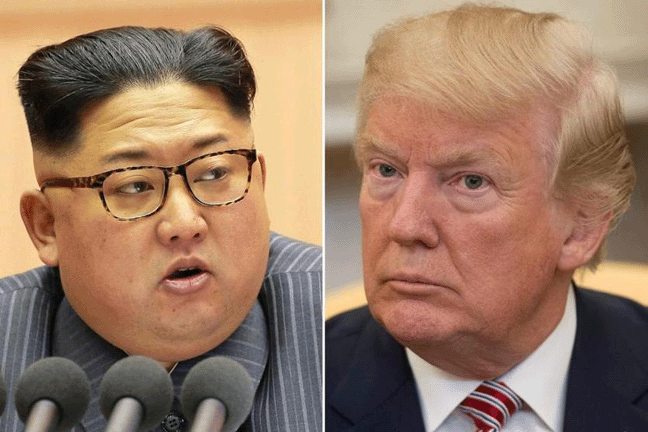
Trump threatens Kim with ‘decimation’ if deal not struck, SMH, 19 May 18 Washington: US President Donald Trump has threatened North Korean leader Kim Jong-un with “decimation”, unless Kim agrees to denuclearise the Korean peninsula.
With the June 12 US-North Korea summit at stake and plenty of statements flying from both sides, Trump gave Kim two options: reach an agreement to denuclearise and remain in power or suffer the fate of Libyan leader Muammar Gaddafi, who was overthrown and murdered by rebels who were supported by a NATO bombing campaign in 2011.
North Korean leader Kim Jong Un provides guidance on a nuclear weapons program in this undated photo released by North Korea’s Korean Central News Agency (KCNA) in Pyongyang September 3, 2017. KCNA via REUTERS
When North Korea suddenly threw a historic summit with the United States into question on Wednesday, it cited – five times – the fate of another country and another leader, half a world away, as an example of why no one should trust American efforts to disarm another nation.
The country was Libya, and the leader was Muammar Gaddafi, who made a bad bet that he could swap his nascent nuclear program for economic integration with the USA.
That deal, executed by the Bush administration nearly 15 years ago, is a footnote to American histories of that era. But it has always loomed large for the North Koreans.
The planned June 12 meeting between US President Donald Trump and North Korean leader Kim Jong-un has been regarded by disarmament advocates as an opportunity to end decades of animosity between North Korea and the US.
But in the mind of Trump’s new national security adviser, John Bolton, who was an architect of the Libya deal, that is the model of how things should play out as the two leaders meet: Complete nuclear disarmament in return for the promise of economic integration. Bolton said as much last weekend.
In issuing its threat to back out of the summit meeting, the North referred to Bolton’s comments, calling them a “Libya mode of nuclear abandonment”.
So why is the Libya model suddenly becoming a sticking point in the meeting between Trump and Kim?
What happened in Libya
In 2003, Gaddafi saw the US invasion of Iraq and the toppling of Saddam Hussein, and may well have concluded he was next. In a lengthy, secret set of negotiations with Britain and the US, he agreed to voluntarily hand over the equipment he had purchased from Abdul Qadeer Khan, a leader of the Pakistani nuclear program. North Korea and Iran had also been customers of Khan, who was later placed under house arrest after his activities were exposed.
The Libya material was flown out of the country, much of it placed at a US weapons laboratory in Oak Ridge, Tennessee. When president George W. Bush announced the deal, he made a clear reference to North Korea and Iran when he said “I hope other leaders will find an example” in Libya’s action.
What happened less than a decade later might be at the heart of what Kim appears to fear.
The US and its European allies began a military action against Libya in 2011 to prevent Gaddafi’s threatened massacre of civilians. US president Barack Obama acceded to arguments from secretary of state Hillary Clinton to join the European-led action.
But no one in the Situation Room debated what message the decision to turn on Gaddafi might send to other countries the US was trying to persuade to relinquish their weapons, according to interviews conducted later with more than half a dozen people engaged in the discussion.
North Korea’s fear of meeting the same fate as Libya – or maybe more specifically its leader meeting the same fate as Gaddafi – has appeared to factor into North Korea’s thinking about its own weapons program for years.
In 2011, after the US and allies launched airstrikes in Libya, North Korea’s foreign minister said the denuclearisation of the North African nation had been an “an invasion tactic to disarm the country”.
After Gaddafi was killed, the narrative in North Korea became clear: Had he not surrendered his nuclear program, North Korean officials said, he might still be alive.
In 2016, shortly after North Korea conducted a nuclear test, its state-run news outlet, the Korean Central News Agency, made direct reference to Libya and Iraq. “History proves that powerful nuclear deterrence serves as the strongest treasured sword for frustrating outsiders’ aggression,” the agency said.
“The Saddam Hussein regime in Iraq and the Gaddafi regime in Libya could not escape the fate of destruction after being deprived of their foundations for nuclear development and giving up nuclear programs of their own accord,” it said.
But North Korea was also clear to draw a line between itself and the two nations. Its statement on Wednesday said it was off base to suggest that the “dignified state” of North Korea could share the same destiny as Libya or Iraq, which “collapsed due to yielding the whole of their countries to big powers”.
“The world knows too well that our country is neither Libya nor Iraq, which have met miserable fates,” the statement said. The North made explicit reference to a homegrown achievement that Gaddafi never neared: It had already become a nuclear-armed country.
Unlike North Korea, Libya was not actually a nuclear weapons state. During inspections in 2003, the Americans discovered Libya had centrifuges that could be used to produce highly enriched uranium – fuel for a bomb.
“It is absolutely absurd to dare compare the DPRK, a nuclear weapon state, to Libya, which had been at the initial state of nuclear development,” the North Korean statement said, using the initials for the country’s official name, the Democratic People’s Republic of Korea.
North Korea has tested six nuclear weapons, and US intelligence agencies believe it has 20 to 60 more, as well as intercontinental ballistic missiles capable of striking the United States.
What is the White House saying about the Libya model?
North Korea’s statement Wednesday also made direct reference to Bolton.
In his first televised interviews after becoming national security adviser last month, Bolton told Face the Nation on CBS and Fox News Sunday that Libya’s denuclearisation was what he envisioned when moving ahead with North Korea talks.
“We have very much in mind the Libya model from 2003, 2004,” he said on Fox. “There are obviously differences. The Libyan program was much smaller, but that was basically the agreement that we made.”
When a reporter asked Sarah Huckabee Sanders, the White House press secretary, specifically about the Libya model and if the administration’s approach to North Korea would be the same, she backed away from Bolton’s comparison.
“I haven’t seen that as part of any discussions, so I am not aware that that’s a model that we are using,” Sanders said Wednesday. “There is not a cookie cutter on how this works.” New York Times
White House chaos is the reason North Korea talks are faltering, not a fickle dictator Quartz, Heather Timmons, 16 May 18
We have been here before. North Korea, a weaponized family-run dictatorship, seems close to an agreement with Western powers to disarm—only for things to fall apart before that happens.
North Korea is reconsidering holding a summit with Donald Trump, a senior diplomat said May 14. Past deals with the West—in 1985, 1995, and 2005—have also fallen apart.
But if Trump and Kim Jong-un fail to get a deal, or even meet, this time around, the Trump administration’s incoherent and rapidly shifting messaging will be as much to blame as the fickleness of North Korean leaders, a Korean peninsula expert says.
…….. The problem is, it’s impossible to tell whether Trump and his administration have any strategic plan on North Korea, or if they’re just “winging it,” he said. Bolton has said he wants a preemptive strike(paywall), while Pompeo, Guase says, is twisting in the wind: “One day he’s offering a compromise, the next day he’s taking the hardline.” Trump, meanwhile, is likely to listen to whoever he spoke to last.
The National Security Council, the White House, and State Department didn’t immediately respond to requests for comment. The White House said Wednesday morning that the turnaround was “fully expected,” despite the fact that Trump last week announced a date for his meeting with Kim, calling it a “special moment for World Peace.”
UK missing deadlines for post-Brexit nuclear safeguards, leak shows
Failure to put safeguards in place could disrupt flow of materials needed to fabricate nuclear fuel after Brexit, Guardian, Lisa O’Carroll, 17 May 18,
Brexit deadlines have put the supply of nuclear raw material for power stations at risk, a leaked government document has suggested.
The document, obtained by Sky News, shows that the UK is already missing critical deadlines to put full safeguards in place to keep the flow of components and raw material needed to fabricate nuclear fuel after Brexit.
The UK does not produce uranium. It must have its own safety measures in place, including a governing body to regulate the safe transport of the raw material, once it leaves the European safeguarding body Euroatom after Brexit.
Five “high-level risks” in setting up this government body have been identified by the UK’s Office for Nuclear Regulation, according to an internal “risk register” paper obtained by Sky.
Work on a new IT system, which should have started by the end of March, is already behind and the deadline has already been “irretrievable lost”, the document says.
The other four areas categorised as “red” on a red, amber, green (RAG) project management ranking including recruitment, lack of training for inspectors and funding.
Failure to arrange the “comprehensive handover” of hardware from Euratom are also cited in the document.
The document was leaked just days after the chief executive of the Nuclear Industry Association, Tom Greatrex, warned that Britain could have a period with no nuclear fuel unless the safeguards were in place in time. ……..
North Korea Threatens to Call Off Summit Meeting With Trump, NYT, By Choe Sang-Hun and Mark Landler, 查看简体中文版查看繁體中文版SEOUL, South Korea — North Korea threw President Trump’s planned summit meeting with its leader, Kim Jong-un, into doubt on Wednesday, threatening to call off the landmark encounter if the United States insisted on “unilateral nuclear abandonment.”
The warning, made by the North’s disarmament negotiator, caught Trump administration officials off guard and set off an internal debate over whether Mr. Kim was merely posturing in advance of the meeting in Singapore next month or was erecting a serious new hurdle.
The abrupt change in tone began early Wednesday, when North Korea indefinitely postponed high-level talks with South Korea over the North’s sudden objection to joint military drills by the South and the United States that began last week. The North also raised the possibility of scrapping the meeting with Mr. Trump.
Then hours later, the North broadened the source of its anger and sharpened the threat to the summit with Mr. Trump.
Kim Kye-kwan, a vice foreign minister, rejected the administration’s demand that it quickly dismantle its nuclear program as Libya had done 15 years ago, singling out John R. Bolton, Mr. Trump’s new national security adviser, for condemnation.
“If the United States is trying to drive us into a corner to force our unilateral nuclear abandonment, we will no longer be interested in such dialogue and cannot but reconsider our proceeding to the D.P.R.K.-U.S. summit,” the statement said, using the abbreviation for the North’s formal name, the Democratic People’s Republic of Korea.
Satellite photo offers clue as N Korea promises ‘total ban’ on nuclear tests , SMH, 16 May 18,Geneva: North Korea will join international efforts to ban nuclear tests, its ambassador to the United Nations in Geneva, Han Tae Song, told the Conference on Disarmament on Tuesday.
North Korea, which is believed to have tested six nuclear weapons, has said it will dismantle its only known nuclear test site this month ahead of a meeting on June 12 between US President Donald Trump and North Korean Leader Kim Jong-un.
It comes as a satellite photo appeared to back up North Korea’s claim, showing that buildings have already been dismantled at the country’s only test site…….
An analysis on Monday by the 38 North website said commercial imagery taken last week showed several operational support buildings had been razed, and rails for mining carts apparently removed.
North Korea said it will dismantle its Punggye-ri test site between May 23 and 25 in the presence of local and international media. The site was used for each of its six underground nuclear test explosions………
The analysis said no tunnel entrances at the test site appeared to have been permanently closed yet.
SBS, 16 May 18North Korea on Wednesday called into question a much-anticipated and unprecedented summit between its leader Kim Jong-un and US President Donald Trump, the South’s Yonhap news agency reported.
Pyongyang also cancelled high-level talks due Wednesday with Seoul over the Max Thunder joint military exercises between the US and the South, Seoul said.
The US will “have to undertake careful deliberations about the fate of the planned North Korea-US summit in light of this provocative military ruckus”, Yonhap quoted the North’s official news agency KCNA as saying.
The drills between the two allies’ air forces were a rehearsal for invasion and a provocation at a time when inter-Korean relations were warming, it cited KCNA as adding.
The language used is a sudden and dramatic return to the rhetoric of the past from Pyongyang, which has long argued that it needs nuclear weapons to defend itself against the US. …….
South Korea’s Yonhap news agency reported that Pyongyang had called the June 12 summit into question over joint military exercises between the US and the South.
Telegraph 14th May 2018,The United States has told North Korea that is must start shipping nuclear
weapons, fissile material and some of its long-range missiles out of the
country within a couple of months of the June summit between Kim Jong-un,
the North Korean leader, and President Donald Trump, according to South
Korean media. https://www.telegraph.co.uk/news/2018/05/14/us-pressures-north-korea-ship-nuclear-weapons-overseas-sanctions/
Express 15th May 2018 , BRITAIN could be left with no fuel to supply power stations after Brexit if it cannot replicate a series of nuclear safeguards currently governed by the European Union, warned Nuclear Industry Association (NIA) Chief Executive Tom Greatrex.
The former Labour minister claimed Britain’s
decision to quit Euratom – the body that governs the transportation of
radioactive materials needed in nuclear energy and research – could
result in no fuel for British power stations after Brexit. Speaking
exclusively to Express.co.uk, Mr Greatrex warned that Britain cannot
produce fuel in the UK without the raw materials from around the world,
which can only be obtained if necessary safety measures are in place –
including a governing body on the transport, trade and regulation of
nuclear matter. https://www.express.co.uk/news/uk/959639/Brexit-news-UK-EU-European-Union-nuclear-industry-referendum-Euratom-power-station