Nature 29th May 2018 , Prime Minister Theresa May conceded on 21 May that a post-Brexit Britain
was willing to pay to “fully associate” with Euratom, Europe’s nuclear agency. The details of the arrangement, similar to many that surround the controversial exit of the United Kingdom from the European Union, still have to be ironed out.
And among those watching the negotiations with mounting concern are scientists at the Joint European Torus (JET) near Oxford, UK, who currently benefit greatly from Britain’s membership of the agency. The hundreds of researchers at JET receive annual funding of around €60 million (US$70 million), because Britain is part of Euratom. As it stands, that funding will cease at the end of this year. https://www.nature.com/articles/d41586-018-05283-x
So are there any models of “rogue” regimes with nuclear programs that might appeal to North Korea? The answer is yes. But, unfortunately, it’s a state that kept its nuclear deterrent intact: Pakistan. If Pyongyang is weighing up two possible futures—Libya vs. Pakistan—it’s not much of a choice.
Pakistan began to seriously pursue nuclear weapons in the 1970s, motivated by a desire to deter its more powerful rival India, as well as match India’s nuclear capability. The Pakistani politician Zulfikar Ali Bhutto, who later became prime minister, claimed, “If India builds the bomb, we will eat grass or leaves—even go hungry—but we will get one of our own.” In 1998, on a clear and bright day in the Chagai district, Pakistan carried out a series of nuclear tests. Pakistan’s chief scientific officer said “All praise be to Allah” and pushed the button, causing the mountain to shake in a vast explosion.
In 2016, the Bulletin of the Atomic Scientistsestimated that Pakistan had 130 to 140 warheads and predicted that it would nearly double its arsenal by 2025. Islamabad could deliver nuclear weapons by medium-range ballistic missiles, cruise missiles, F-16 fighters, and tactical systems for short-range use on the battlefield.
We can be confident that North Korea is paying close attention to Islamabad’s experience. After all, the two countries share important similarities. They both face an enduring rivalry with a far more powerful democratic state that used to be part of the same country (India and South Korea). Furthermore, both North Korea and Pakistan have, at times, flouted international norms. In 2003, North Korea withdrew from the Non-Proliferation Treaty. Pakistan never signed the treaty. For decades, North Korea and Pakistan have been informal allies, trading conventional weapons and supporting Iran in the Iran-Iraq War.
In addition, Pakistan’s nuclear capability led the West to handle the country with kid gloves. The United States provided millions of dollars of material assistance to guard Pakistan’s nuclear stockpile, including helicopters and nuclear detection equipment. Pakistan’s nuclear capability is also one reason why Washington continued to provide billions of dollars in military and economic aid, even though Islamabad supported the Taliban insurgency that battled U.S. troops in Afghanistan.
Meanwhile, Pakistan gained prestige as the only Muslim-majority country with nuclear weapons. The Pakistani Ministry of Foreign Affairs described the nuclear program as “Pakistan’s finest hour.” The nuclear program is also domestically popular. The nuclear tests in 1998 that shook mountains led to jubilant street celebrations.
Of course, all of this came at a cost. The money poured into Pakistan’s nuclear program could have been spent on health or education. The nuclear tests in 1998 were condemned around the world. After refusing to sign the Non-Proliferation Treaty, Pakistan faces restrictions on importing civili
civilian nuclear technology. Nuclear weapons may deter India, but they also risk accidents and even escalation to nuclear war.
But for North Korea, the balance sheet still favors the Pakistan model: a poor country that ate grass to build a nuclear deterrent, seeks to be accepted as a recognized nuclear power, supports denuclearization in principle but only as part of a broader international disarmament effort (that will likely never happen), successfully deters a more powerful rival, and gains domestic prestige and international status.
Saddam and Qaddafi made their choices, and they’re both dead. North Korea wants to follow a different path. Why not become the Pakistan of East Asia?
Korea’s “Season of Summits”https://wordpress.com/read/blogs/39598748/posts/5355-29 May 18The upcoming “will they—won’t they” US-DPRK summit, either by accident or by design, has the potential to re-set the strategic atmosphere on the Korean Peninsula…but only if Washington and Pyongyang can find a convergence of common interest.
There are limitations on American action on the Korean peninsula that constrain its menu of choice vis-à-vis North Korea (DPRK). The absence of a substantive relationship between the US and North Korea limits Washington’s economic and diplomatic leverage. However, as the more powerful party with overwhelming nuclear superiority and clear capacity to deter the DPRK nuclear threat, the US does have capacity to re-set the terms of the relationship by reducing the heat in negotiations. Washington can do this by changing the focus for the negotiations.
The long game
North Korea can be deterred as a nuclear power. A peace treaty to formally end the Korean War represents the best pathway to managing regional security and ensuring the safety of the people who live in the region. Under the umbrella of a formalised peace regime, human security concerns within North Korea are more likely to be constructively addressed. Engagement and interaction is the best vehicle for this, based on an understanding of complex systems and social change processes within the DPRK.
Summits are symbols that act as markers in a much broader process of relationship-building, based on confidence-building measures and clear, achievable implementation steps. Confidence-building measures develop the relationship between negotiating parties and gradually evolve the level of trust necessary to progress to subsequent steps on the negotiation pathway.
Depth of relationships are also a source of leverage; one of the reasons why the United States has struggled to influence the DPRK is that it does not have substantive economic links through which to influence the government in Pyongyang. This lack of leverage is why US officials have argued for China to play a more substantive role in pressuring North Korea, because China has a relationship with the DPRK that it can leverage. Rightly or wrongly, the US has dealt itself out of direct influence over North Korea through its various policies of strategic isolation and maximum pressure.
We should also understand that from a complex systems perspective, relationships—be they economic, governmental, institutional, or people-to-people—create flows of information, wealth and resources in and out of the DPRK. Those flows interact with and turbo-charge social change processes already underway in the DPRK, as we have seen with such flows between the DPRK and China. The result is a change, developing over time, in the relationship between the North Korean state and its people over time through the marketisation and Yuan-isation of the economy, and proliferation of information technologies into the country.
Focusing on the wrong prize
Regardless of whether or not the US-DPRK summit ultimately goes ahead, it is concerning that the Trump administration could blow an opportunity to meaningfully change the strategic goalposts on the Korean Peninsula by focussing on the wrong prize.
The only real trinket of value that Washington has to offer Kim Jong Un is a formal treaty to conclude the Korean War. It is likely that North Korea very much wants to negotiate an agreement with the United States, but under Pyongyang’s terms. It is no revelation to long-term North Korea watchers that those terms do not include “complete, verifiable, irreversible denuclearisation” (CVID).
The problem with Trump’s insistence on CVID is that there is no mutually agreeable starting point for a discussion with North Korea on those terms. There is no outcome in which the regime willingly relinquishes its nuclear weapons program because the Kim regime is so heavily invested in nuclear weapons as the foundation of its security strategy, economic development pathway, and domestic political legitimacy.
The negotiations surrounding the summit need to find a lowest common denominator that both parties can agree on. We saw this in the inter-Korean summit where Moon and Kim settled on easy-win engagement measures and mutually-beneficial security measures as the starting point for a confidence-building pathway.
CVID is a dead-end
The US and the DPRK clearly do not trust each other, and both parties have good reasons to be guarded ahead of a “will they—won’t they” summit. Most media attention coming out of the inter-Korean summit focused on Article 3.4 of the Panmunjom Declaration, which called for “complete denuclearisation” and “a nuclear-free Korean Peninsula,” building on the call in Article 1.1 for both parties to work together on implementing the 2005 Joint Statement on denuclearisation of the Korean Peninsula and the 13 February Agreement of 2007.
However, this clause does not mean North Korea has committed to denuclearisation as that concept is understood by the Trump administration. In the wake of his second meeting with Kim Jong-un, Moon Jae-in insisted that the North Koreans are committed to denuclearisation, clearly hoping to maintain the diplomatic momentum to ensure the US-DPRK summit takes place. However, the North Korean interpretation of a nuclear-free Korea implies the full nuclear weapons relinquishment of the United States and ultimate fulfilment of the spirit of the Nuclear Non-proliferation Treaty.
North Korea’s recent demolition of tunnels at its Punggye-ri nuclear test site are a gesture of goodwill to Washington, offering up a now-obsolete facility with an eye toward the upcoming US-DPRK summit. We have seen this kind of offering before, when the North Koreans demolished the cooling tower at their Yeongbyeon reactor in 2008.
Moon Jae-in’s tactical ego-stroking comments about Trump deserving the Nobel Peace Prize aside, one can argue that South Korea does not have high confidence in the Trump administration. South Korea’s diplomatic efforts in 2018 have been geared to guiding the US into a more conciliatory position with North Korea and make it politically safer for Trump to negotiate for an agreement with Pyongyang, knowing that there are influential American officials in Trump’s ear counselling for war.
Fears of American bellicosity in Seoul are not unwarranted. American hawks view any kind of engagement with North Korea as a “loss,” as “appeasement”—one of the most juvenile and misapplied terms in the international relations lexicon—and are well aware of the difficulty of getting any negotiated deal ratified in a Republican-majority Congress (recalling the fate of the Agreed Framework). National Security Advisor John Bolton’s recent comments comparing North Korea to Libya reinforce this perception. The irony of the present moment is a deal is more likely to stick in the US if it is owned by a Republican president. Such are the ironies and opportunities of Korean Peninsula diplomacy in 2018.
By Jackson Diehl Deputy Editorial Page Editor May 27 When May began, President Trump was presiding over diplomatic negotiations that could have delivered twin triumphs for his administration. Now, on Memorial Day, he’s reaping the wreckage of talks about Iran, and the North Korea process is in limbo. He has badly strained relations with vital U.S. allies and raised the risk of military conflicts in the Middle East and Asia. He has gone from would-be Nobel Prize winner to commander in chief of chaos.
National security adviser John Bolton and Secretary of State Mike Pompeo, the new axis of the president’s national security team, deserve some credit for this mess: Both prefer open confrontation with U.S. adversaries to the more nuanced approaches sold to Trump by their predecessors. But in essence the past month has been a decisive demonstration of Trump’s unwillingness — or, more likely, inability — to grapple with the complexities of international affairs. It’s a deficit that already is being skillfully exploited by U.S. adversaries, such as China — and it could lead to catastrophe before we get through another 2 1 / 2 years.
Trump managed to identify a couple of the most serious foreign policy challenges the country faced when he came to office. In their sole meeting, President Barack Obama warned the incoming president that North Korea and its growing nuclear program could no longer be ignored. It was evident, too, that Obama’s policy for checking Iran’s pursuit of hegemony in the Middle East was failing. Though Tehran was respecting the letter of the 2015 deal limiting its nuclear program, it had doubled down on aggression in Syria, Yemen and elsewhere, while exploiting a loophole in the pact to pursue the development of long-range missiles.
For a while, it looked like Trump’s blunt and blustering approach might produce results. Fearful that the president would shred the Iran deal, European governments worked hard to come up with a package that would answer Trump’s objections. They promised multilateral action to sanction and deter Iran’s missile production and its meddling in the Middle East, along with a mutual effort to prevent Tehran from resuming large-scale uranium enrichment when current restrictions expire in the mid-2020s.
North Korea’s Kim Jong Un, too, seemed impressed by the pressure Trump managed to focus on his regime, with the help of China. In January he launched the first diplomatic initiative of his six-plus years in power; by March he was communicating, through South Korea, the proposal of a summit with Trump, along with a vague promise of denuclearization.
Like virtually all diplomatic openings, the Iran and North Korea talks did not promise decisive victories.
Iran’s regional adventurism and the flaws in the nuclear deal could never be solved in a stroke, and experts on North Korea were virtually unanimous in predicting that Kim was unlikely to surrender his nuclear arsenal in the near term. For Trump, the challenge was to extract the most he could from the negotiations and pocket it. The result could have been partial but significant victories on both fronts: a tougher Western front against Iran, along with a reaffirmation of transatlantic cooperation; and, perhaps, a durable freeze on testing or deployment of nukes and long-range missiles by North Korea, amid negotiations on a long-term peace.
Trump instead blew up both negotiations — and the way he did so was telling. He didn’t plunge into the weeds of the deal with the Europeans and conclude that it would not be strong enough; he never seriously considered it. Senior European officials who lobbied him later said he appeared unfamiliar with its details. His sole focus, it turned out, was to satisfy a campaign promise by repudiating Obama’s principal foreign policy legacy.
Similarly, Trump never seemed to take seriously the reality that Kim was looking not for a quick deal but for a messy multistage process, with denuclearization a distant endpoint.
Trump is now saying the Korea summit may go ahead, even though there is no sign that Kim has changed his position on denuclearization. Still, the past month has taught all sides a lesson about Trump, if they didn’t know it already: He’s not up to serious negotiation. He can’t be expected to seriously weigh costs and benefits, or make complex trade-offs. He’s good at bluster, hype and showy gestures, but little else. In short, he may be the worst presidential deal maker in modern history.
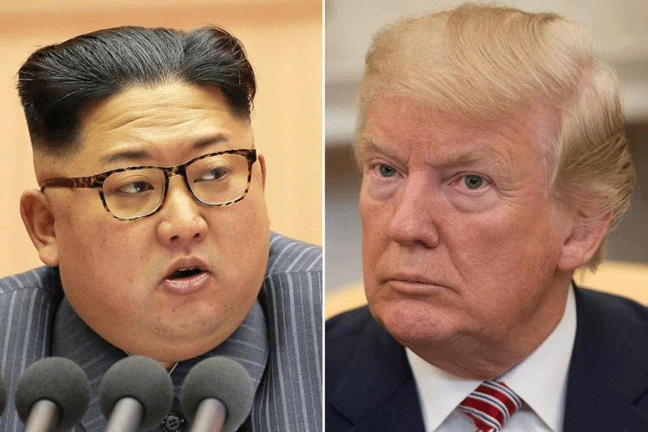
The Korean nuclear roller coaster: Has time run out for a summit? Brookings, Jonathan D. Pollack Tuesday, May 29, 2018 The turbulence and drama on the Korean Peninsula over the past week defies imagination. On May 24, President Trump withdrew from his planned summit with North Korean leader Kim Jong-un, acting almost as impulsively as when he first agreed to the meeting in early March. Following a conciliatory response from Pyongyang’s senior nuclear negotiator Kim Kye-gwan, the president two days later sharply reversed course and said that the summit might still take place.
Not to be outdone, on May 26 Kim Jong-un abruptly convened a second meeting with South Korean President Moon Jae-in on the North Korean side of the truce village of Panmunjom. The next day, American and North Korean officials began to interact on the language of a possible communiqué. Separate consultations between the United States and North Korea in Singapore were expected to begin today, on May 29, with North Korea represented by Kim Jong-un’s de facto chief of staff, Kim Ch’ang-soon. Additional discussions have taken place between Chinese and North Korean officials in Beijing, perhaps connected to a possible stopover by Kim Jong-un while traveling to Singapore, which would be his third visit to China in less than two months. One of Kim Jong-un’s closest aides and a vice chairman of the Korean Workers Party Central Committee, General Kim Yong-chol, is now en route to New York, and is expected to serve as the lead point-of-contact with U.S. officials in deliberations over the Singapore meeting.
These heightened activities all suggest that the summit will indeed go forward, though there has been no formal announcement to this effect.
However, two facts remain incontestable. There is as yet no U.S.-North Korea agreement on the terms of a summit, and time is running out to reach such an understanding. An unspoken but unmistakable anxiety thus pervades these intensified political and diplomatic maneuvers. Only 10 days before President Trump’s presumed departure for Singapore, it is stunning how little remains agreed to, even in broad conceptual terms. Advocates of diplomacy argue that this is the purpose of face-to-face negotiations. But the contrasts in the language and expectations of the two leaderships remain glaring, even after two visits by Mike Pompeo to Pyongyang, first as CIA director and subsequently as secretary of state.
The fundamental issue is what the summit is supposed to be about. ……….
New Delhi only recognizes UN sanctions, foreign minister said
Throughout previous sanctions, India purchased Iranian oil
President Donald Trump may have ordered the re-imposition of sanctions on Iran, but one of Asia’s biggest oil importers — and a strategic partner of the U.S. — plans on ignoring them.
India, a long-time buyer of oil from both Iran and Venezuela, only complies with United Nations-mandated sanctions and not those imposed by one country on another, said foreign minister Sushma Swaraj at a press conference in New Delhi on Monday.
“India will comply with UN sanctions and not any country-specific sanctions,” Swaraj said at an annual briefing, flanked by her two junior foreign ministers and India’s foreign secretary.
Swaraj later met Iranian foreign minister Javad Zarif, where they discussed Trump’s plan to withdraw from the 2015 Iran nuclear deal. Swaraj said “all parties to the agreement should engage constructively for peaceful resolution of the issues,” according to a foreign ministry statement. ……
India’s post-independence history as a leader of the “non-aligned” movement — developing nations not allied with the U.S. or the then-Soviet Union — means New Delhi maintains economic relationships that raise eyebrows in western capitals, including with Iran, Venezuela and North Korea. India also ignored U.S. requests to close its embassy in North Korea, Swaraj said at her briefing.
In February, Iranian president Hassan Rouhani visited India and met with Indian Prime Minister Narendra Modi to discuss energy cooperation and New Delhi’s investments in Iran’s Chabahar port.
Germany to assist Iran in restoring economy while Tehran adheres to JCPOA https://en.mehrnews.com/news/134429/Germany-to-assist-Iran-in-restoring-economy-while-Tehran-adheresTEHRAN, May 29 (MNA) – Germany is ready to support Iran in restoring its economy and also, to continue bilateral trades, as long as Iran adheres to the Joint Comprehensive Plan of Action (JCPOA), said German Foreign Minister Heiko Maas.
“We will continue to make efforts to fulfill Iran’s hopes for economic recovery and good trade relations as long as Iran is ready and able to prove that it adheres to its obligations under the nuclear deal,” Maas said at the Global Solutions Summit held in Berlin, sputnik reported on Tuesday.
In a meeting with US Secretary of State Mike Pompeo, Maas has mentioned that US and Germany are pursuing “two entirely separate paths” regarding Iran’s issue.
US president Donald Trump withdraw from JCPOA on May 8 and reintroduced sanctions against Iran. This is while other signatory states of the deal including Russia, China and European countries don’t support US decision and have repeatedly highlighted their commitment to the agreement and guarding Iran’s interests.
N Korea’s Destroyed Nuke Site Lays Basis for Denuclearization Talks – Expert https://sputniknews.com/analysis/201805261064829259-north-korea-site-destruction-talks-prospect/ WASHINGTON 27 May 18, – North Korea’s dismantling of its nuclear weapons test site should be seen as a positive step towards resolving the crisis on the Korean peninsula, Institute for Science and International Security President David Albright said in a statement on Friday.
“North Korea’s action should not be trivialized but viewed as an important step to reduce tensions and lay the basis for denuclearization negotiations,” Albright said. “It is not fair to portray it as part of an effort to hide or disguise its nuclear weapons capabilities.”
North Korea’s action, he added, is even better than a freeze because it represents a permanent disabling of the site. Three minutes of film footage taken by a journalist makes it clear that major buildings and tunnel entrances were destroyed, according to Albright.
But like many disabling steps, North Korea could likely resume nuclear weapons tests within a few months by digging tunnels in nearby mountains, Albright said. Moreover, the action does not affect North Korea’s existing stockpile of nuclear bombs and its ability to make additional weapons, even if the lack of a test facility could inhibit the nation’s ability to field reliable and deliverable warheads, according to the release.
On Friday, Trump signaled that the meeting with Kim may actually go forward after the US president received a “warm” letter from Pyongyang. In comments published by North Korea’s state-run news agency KCNA, Kim said on Friday that he wanted the United States to know Pyongyang wants to sit down at “any time” to solve problems with Washington.
Before founding the institute, Albright worked with the International Atomic Energy Agency (IAEA) from 1992 to 1997 and was the first non-governmental inspector of the Iraqi nuclear program. He was also a Senior Staff Scientist at the Federation of American Scientists.
White House–watchers feared a move toward the “preventive war” National Security Adviser John Bolton is on the record favoring. And war on the peninsula, with a predicted 300,000 Korean casualties in the opening days alone, even if nuclear weapons were not used — plus the deaths of American soldiers, plus the prospect of a nuclear launch — is decidedly real life, not a movie.
What Happens When You Treat Nuclear Diplomacy Like a Reality-TV Show http://nymag.com/daily/intelligencer/2018/05/trump-nuclear-diplomacy-is-like-a-reality-tv-show.html Recently, a reader asked why my columns often compare Trump administration moves to TV shows. The reason is simple — Trump’s actions often seem inexplicable or counterproductive if viewed through a traditional national security lens. Seeing them as moves to promote a media narrative often makes them easier to understand — and offers a way to predict what comes next. Trump’s reality-TV approach to foreign and domestic policy has served him well — getting him elected and keeping his base closely enough bound to him that members of his own party do little to challenge him. Continue reading →
In just over a year, Donald Trump has managed to nudge the world closer to conflict on both ends of the Asian continent. Aljazeera, by Richard Javad Heydarian 25 May 18
After months of exhilarating anticipation, US President Donald Trump abruptly ditched a scheduled summit with his North Korean counterpart, Kim Jung-un.
The American president vaguely cited North Korea’s “open hostility” and “trail of broken promises” as a pretext for calling off the historic meeting. Not short of bluster, he warned the North Korean regime against committing any “foolish or reckless acts”.
Trump has placed the American military on alert, signalling its readiness to engage in another round of brinkmanship with nuclear-capable North Korea.
And just like that, both protagonists are now back to square one. If anything, the American president may have snuffed the life out of an unprecedented opportunity to end the Korean conflict.
Just weeks earlier, the US unilaterally withdrew from the Iranian nuclear deal – a binding international agreement supported by all major powers, except Trump. To careful observers, both decisions were shocking, yet far from surprising.
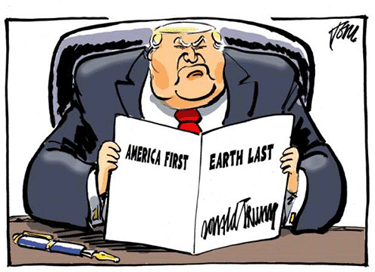
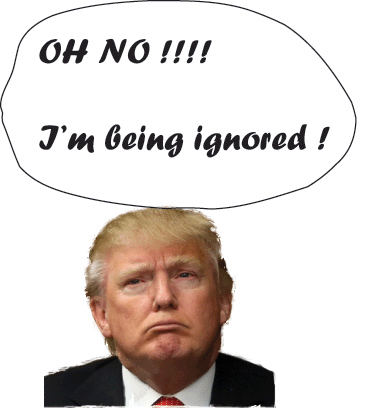
The Trump administration simply lacks the basic strategic understanding and diplomatic finesse to cope with perplexing foreign policy challenges. When confronted with difficult geopolitical realities, Trump seems to prefer turning things into reality show episodes.
An unreliable superpower
Trump’s announcement was met by a melange of puzzlement, outrage and profound anxiety across the world. South Korea responded in total confusion, struggling to find a way out of the latest plot twist in the Trump-Kim saga.
South Korean presidential spokesman Kim Eui-kyeom admitted, “We are attempting to make sense of what, precisely, President Trump means.”
The visibly flustered South Korean President Moon Jae-in, who played an instrumental role in facilitating the summit, was confessedly “perplexed“. He described Trump’s decision as deeply “regrettable”.
……. Moon staked his presidency on unlocking the Korean conflict. In an event of actual war, Seoul, which lies within the range of North Korean artilleries, would likely be the first and biggest victim.
…..frustration is running high among allies. In recent days, German Chancellor Angela Merkel, the de facto leader of the “free world”, went so far as stating that Europe can no longer rely on the US as a source of protection.
One by one, the US’ most important allies have openly questioned the Trump administration’s capacity for global leadership. For them, Washington is an increasingly unreliable superpower, which is beginning to threaten the existing international order with “Trump-style” leadership.
Edging towards conflict
Interestingly, North Korea responded with uncharacteristic restraint, expressing its continued “willingness to sit at any time, in any way to resolve issues”. All of a sudden, Pyongyang looked like the adult in the room.
Yet, it’s hard to imagine that the regime would maintain its equanimity for long………..
The upshot is that both Iran and North Korea now feel betrayed and increasingly outraged. And they will likely up the ante in response to Trump’s perfunctory decisions.
A year into power, the controversial American president has nudged the world closer to two potential conflicts on the opposite ends of the Asian continent.
Seventy Years After Korea’s Division, Women Lead Push for Peace Truthout, May 25, 2018By Jon Letman, When scores of Korean women representing a coalition of some 30 peace groups and NGOs entered South Korea’s National Assembly on the banks of Seoul’s Han River, they weren’t alone. This week, the Korean peace makers were joined by an international delegation of women peace activists for a symposium focused on ending the Korean War. A women’s peace walk along the Korean Demilitarized Zone (DMZ) is scheduled for May 26.
For the fourth time since 2015, these activists gathered to strategize how to most effectively advance peace on the Korean Peninsula and support diplomatic efforts to that end. #WomenPeaceKorea delegates’ efforts include engaging with South Korean government officials, foreign diplomats and US embassy officials.
Most of the international delegates are members of Women Cross DMZ and the Nobel Women’s Initiative who have traveled to Seoul to lend their support and raise awareness of the vital role women play in ending conflict.
Multiple studies have shown that when women participate in negotiations, the likelihood of achieving peace increases substantially and that peace lasts longer.
Ahn Kim Jeong-ae, one of the symposium’s organizers, said the diplomatic thaw between North and South Korea makes this week’s events even more crucial.
Ahn Kim noted that 2018 marks the 70th anniversary of the establishment of separate governments in Seoul and Pyongyang. This spring was also the 70th anniversary of the April 3 incident in which some 30,000 civilians on South Korea’s Jeju Island were massacred over a seven-year period when US military-backed right-wing forces violently purged opponents of a divided and occupied Korea.
“We want to commemorate these historical facts on May 24, International Women’s Day for Disarmament and Peace,” Ahn Kim said, noting that because women suffer disproportionately in war, they have a critical role to play in conflict resolution.
A Change in Tone
Christine Ahn is the international coordinator for Women Cross DMZ, which crossed from North to South Korea in 2015. She said the fact that this year’s symposium was held at the National Assembly (the South Korean equivalent of the US Congress), was “hugely significant.”
Unlike in 2015, when Women Cross DMZ was barely acknowledged by South Korea’s Ministry of Unification, this year’s symposium was financed by the South Korean Ministry of Gender, Equality and Family, Ahn said.
Iran asks Europe what it can offer to keep it in the nuclear deal after U.S. pullout, WP, By Michael BirnbaumMay 25 Email the author
VIENNA — Iran will decide within weeks whether to stay in a faltering deal to restrain its nuclear program and is pressing Europe to compensate for President Trump’s decision to reimpose sanctions, a senior Iranian official said Friday.
The official warned that Tehran could also pull out from a separate treaty that limits the spread of nuclear weapons.
The caution came ahead of the first talks involving all the remaining parties to the landmark 2015 deal since the United States pulled out this month.
An official report Thursday declared that Iran is still in compliance with the stringent controls on its nuclear program.
Iran has long declared that its program is limited to the peaceful generation of nuclear energy and production of medical isotopes. If it were to pull out of the 2015 Joint Comprehensive Plan of Action (JCPOA) and the 1970 Treaty on the Nonproliferation of Nuclear Weapons (NPT) and seek nuclear weapons, it could spark an arms race in the already volatile Middle East.
Donald Trump cancels North Korea nuclear summit, In letter to Kim Jong-un, Trump says talks are ‘inappropriate … based on the open hostility displayed in your recent statement’, Guardian, Julian Borger in Washington and Benjamin Haas in Seoul, 25 May 2018
Donald Trump has cancelled his planned summit with the North Korean leader, Kim Jong-un, blaming his decision on a threatening statement from the Pyongyang regime, and warning that the US military is “ready if necessary”.
n a formal letter to Kim released by the White House, Trump said he had been “very much looking forward” to meeting the North Korean leader.
But he wrote: “Sadly, based on the tremendous anger and open hostility displayed in your most recent statement, I feel it is inappropriate, at this time, to have this long-planned meeting.”
Trump declared that the meeting would not take place “for the good of both parties, but to the detriment of the world”.
In remarks to the press after the letter was released, Trump said it was still possible the summit could go ahead, albeit at a later date, but warned Pyongyang that the US and its allies would respond if it carried out “foolish or reckless acts”.
Asked if cancellation of the summit increased the risk of war, he replied: “We’ll see what happens.”
Meanwhile, the president said his campaign of “maximum pressure” would continue, involving the “strongest sanctions ever imposed”. However, in the wake of Trump’s withdrawal from this summit, soon after abrogating a nuclear deal with Iran that had global support, there are now serious doubts over his ability to galvanise international support for increased sanctions, or even enforce the existing sanctions regime.
Trump’s letter to Kim mixed regretful and conciliatory passages with a reminder of the size of the US nuclear arsenal.
“You talk about your nuclear capabilities, but ours are so massive that I pray to God they will never have to be used,” Trump wrote.
The cancellation came two days after a visit to the White House by the South Korean president, Moon Jae-in, who had sounded hopeful about a historic summit that he portrayed as vital to peace on the Korean peninsula.
Moon held an emergency meeting with top officials just before midnight local time on Thursday night. His office appeared surprised by the announcement, with spokesman Kim Eui-kyeom saying: “We are trying to figure out what President Trump’s intention is and the exact meaning of it.”
Pyongyang also appeared to be taken entirely by surprise.
North Korea claims it has demolished its nuclear testing site North Korea has carried out what it said is the demolition of its nuclear test site, setting off a series of explosions over several hours in the presence of foreign journalists. ABC News, 25 May 18
Key points:
Closing of North Korea’s nuclear test site was announced by Kim Jong-un before planned summit with US President Donald Trump
North Korea brought in a small group of foreign journalists to witness the event
Demolition comes after North Korea labelled US Vice President Mike Pence a “political dummy”
The explosions at the nuclear test site deep in the mountains of the North’s sparsely populated north-east were centred on three tunnels at the underground site and a number of buildings in the surrounding area.
North Korea had completely dismantled its Punggye-ri nuclear test ground “to ensure the transparency of discontinuance of nuclear test,” state news agency KCNA said.
The dismantling of the nuclear test ground “completely closed the tunnel entrances,” it said, adding that two tunnels there had been ready for use in “powerful underground nuclear tests”.
There was no leakage of radioactive material or adverse impact on the surrounding environment from the dismantling, the agency added.
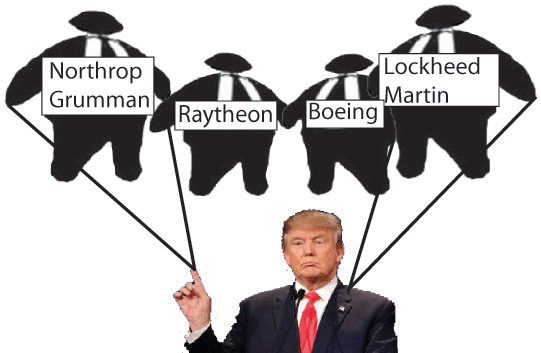
The Pentagon is speeding up US weapons deliveries to allied militaries such as Saudi Arabia, Romania, Japan, and South Korea through new “pilot authorities that change how it can design and execute contracts” according to news reports.
Defense One, quoted Ellen Lord, US defense undersecretary for acquisition and sustainment, as saying, Wednesday “we have a whole variety of specific programs where we are focused on applying these authorities: Patriot Missiles for Romania; Global Hawk for Japan, THAAD [high-altitude air defense missiles] for Saudi Arabia, and TOW [vehicle-launched missiles] for multiple foreign military sales partners.”
These new authorities will allow the Pentagon to shave “years” off the time it takes to deliver weapons to friendly militaries, Lord said at the annual SOFIC event here.
The report added that Saudi Arabia is a frequent target of missile strikes by Houthi rebels. Regional authorities routinely fret about Iran’s growing missile capabilities.
The Trump administration, working to increase exports of US-made weapons, has started the process to execute the sale 120,000 precision-guided munitions to allies Saudi Arabia and the United Arab Emirates.
Reuters said Tuesday that the White House asked the US Congress to review the deal.
Last year, the Trump administration approved the sale of about $7 billion of the precision-guided weapons to Saudi Arabia.
Raytheon Co is the largest maker of the PGMs in the United States.
Administration and congressional sources confirmed that the informal 40-day review period to sell the munitions to the two countries was under way.