Iran seeks ‘clear future design’ for imperilled nuclear deal Aljazeera, 14 May 18 FM says Tehran is ‘ready for all options’ as he embarks on tour with pact’s other signatories in wake of US withdrawal.
Iran’s foreign minister has held talks in China as he began a diplomatic tour with the remaining signatories of a multinational nuclear deal following the recent US withdrawal from the landmark 2015 pact.
Speaking on Sunday in Beijing, Mohammad Javad Zarif underlined Tehran’s readiness “for all options” but expressed optimism that this round of negotiations could save the 2015 deal.
“We hope that with this visit to China and other countries we will be able to construct a clear future design for the comprehensive agreement,” Zarif said, speaking alongside his Chinese counterpart, Wang Yi.
“[But] if the nuclear deal is to continue, the interests of the people of Iran must be assured.”
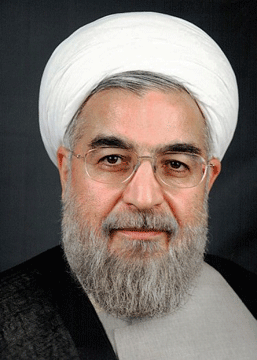
Earlier on Sunday, Iranian President Hassan Rouhani said Iran would remain committed to the deal “if the remaining five countries abide by the agreement”.
Diplomatic tour
After the Chinese capital, Zarif will attend talks in Moscow and Brussels with representatives of the pact’s other signatories.
Under the deal signed in Vienna with six world powers – China, France, Russia, the UK, the US, Germany, and the European Union – Iran scaled back its uranium enrichment programme and promised not to pursue nuclear weapons in exchange for the lifting of economic sanctions.
Trump adviser says US could sanction European allies if they continue nuclear deal with Iran, President Donald Trump’s national security adviser said the U.S. could impose sanctions on its European allies if they continue to deal with Iran under the nuclear deal. By ABC NEWS, May 13, 2018 National Security Adviser John Bolton also commented on “This Week” Sunday on the U.S.’s imminent move of its Israeli embassy, saying that relocating the embassy to Jerusalem will make peace “easier” because it recognizes the “reality” that Jerusalem is the capital of Israel……..https://abcnews.go.com/Politics/iran-shifting-balance-power-middle-east-cover-nuclear/story?id=55110286
French President Emmanuel Macron has called his friend and ally U.S. President Donald Trump to say he’s very worried about tensions in the Middle East, after Trump’s decision to withdraw from the Iran nuclear accord.
Macron’s office said the two leaders spoke Saturday and the French leader expressed his “great concern about stability” in the region. Macron strongly opposes Trump’s pullout from the 2015 global deal curbing Iran’s nuclear activities. Hostilities between Iran and Israel have already escalated in recent days.
Macron and Trump also discussed trade issues. European governments are scrambling to save billions of dollars in trade with Iran that resumed thanks to the 2015 accord.
In addition, France and the EU are pressing Washington for exemption from Trump’s steel and aluminum tariffs.
“No follow up” from Trump over staying in climate pact-UN by Reuters, 9 May 2018The rules of the Paris Agreement mean that Trump cannot formally pull out before November 2020, around the time of the next U.S. presidential election
* UN’s Espinosa asked Washington for conditions for staying
* Says still hopes U.S. may stay in Paris pact
* Nearly 200 nations working on ‘rule book’ for 2015 pact
By Environment Correspondent Alister Doyle BONN, Germany, May 9 (Reuters)– U.S. President Donald Trump has yet to outline what changes he wants in a 2015 global climate agreement as the price for dropping his plan to quit, the United Nations’ climate chief said on Wednesday.
Patricia Espinosa said she had asked Washington for its demands after Trump announced last June that he planned to quit the landmark 2015 Paris Agreement, which aims to end the fossil fuel era this century with a shift to cleaner energies.
“There has not been a follow-up” from Washington, she told Reuters during negotiations in Bonn among almost 200 nations on a “rule book” for the 2015 agreement.
Espinosa, a former Mexican foreign minister who leads the U.N. Climate Change Secretariat, said she had stressed that the pact was flexible, allowing all countries to set their own targets for reducing greenhouse gas emissions.
“I would not like to see the U.S. leaving. I certainly hope there is a reconsideration of this decision,” she said of Trump’s plan to pull out.
Trump doubts the view of mainstream science that man-made greenhouse gases are raising global temperatures.
The rules of the Paris Agreement mean that Trump cannot formally pull out before November 2020, around the time of the next U.S. presidential election.
In announcing the U.S. withdrawal, Trump said Paris was a bad deal that would harm the U.S. economy, but added: “We will see if we can make a deal that’s fair. And if we can, that’s great. And if we can’t, that’s fine.”……..
The Bonn meeting, which ends on Thursday, is working on rules for the Paris Agreement due to be in place by the end of the year, such as how to measure and account for greenhouse gas emissions and climate finance for developing nations that is meant to reach $100 billion a year by 2020.
“A good set of rules … should be a way to give comfort and confidence to the concerns they (the United States) could have,” said Espinosa.
Asked if she would be happy for the United States to stay, while watering down deep cuts in emissions promised by former President Barack Obama, Espinosa said: “I think we should not choose between those two scenarios.” (Reporting By Alister Doyle Editing by Gareth Jones) http://news.trust.org/item/20180509154353-w3u79/
Trump Outsources US Foreign Policy to Riyadh, Tel Aviv Over Iran Deal – Analysts https://sputniknews.com/us/201805101064310160-usa-trump-iran-foreign-policy/ Jonathan Ernst 17 10.05 WASHINGTON (Sputnik) – The United States by exiting the Iran nuclear agreement has now essentially outsourced US foreign policy in the Middle East to both Israel and Saudi Arabia, analysts told Sputnik.
On Wednesday, White House Press Secretary Sarah Sanders told reporters the United States is ready to announce an additional set of sanctions against Iran as early as next week in response to its alleged development of nuclear weapons.
President Donald Trump on Tuesday announced that the United States was withdrawing from the 2015 Joint Comprehensive Plan of Action (JCPOA), signed by the P5+1 and EU, which ensures Iran’s nuclear program remains peaceful in exchange for sanctions relief. In addition, the US Treasury said it would reimpose the highest-level economic sanctions possible on Iran.
In the week prior to Trump’s decision Israeli Prime Minister Benjamin Netanyahu in an internationally-broadcast address presented old intelligence and tried to claim that Tehran was continuing to develop nuclear weapons.
In fact, Iran has remained compliant under the conditions of the JCPOA as verified by the IAEA in 11 reports since January 2016 — a reality US Secretary of State Michael Pompeo even admitted during his confirmation hearings.
Israeli, Saudi Victory
Retired US Army Major and historian Todd Pierce told Sputnik that Trump’s announcement was a triumph for the leaders of Israel and Saudi Arabia, both of whom want the United States to confront Iran.
“Trump has placed US foreign policy in the hands of the coalition of Israel under Netanyahu and Saudi Arabia under [Crown Prince] Mohammad bin Salman, which his son in law Jared Kushner helped bring together to collectively wage war against Iran and Syria,” he said.
Trump’s statement on why he was pulling out of the international nuclear agreement with Iran was expressed in terms that made it sound like Trump was determined to go to war, Pierce observed.”Constructively, in effect, Trump’s talk sounded like a declaration of war against Iran, with the first step being to tighten up the ‘blockade’ of Iran, meaning in the 21st century version of that, US sanctions,” Pierce said.
Trump’s address was also notable for how closely it followed the arguments made eight days earlier by Netanyahu in his efforts to persuade the US government and Congress to scrap the agreement, Pierce pointed out.
Trump, like his ally and friend Netanyahu had shown scant regard for factual accuracy in his presentation.Trump was not an extremist or aberration in setting such policies but was fulfilling goals that had been followed for decades, Pierce pointed out.
Tehran Undaunted
Global peace activist and expert on the medical dangers of nuclear energy, Dr. Helen Caldicott, told Sputnik that she expected Tehran to continue honoring its commitmentsunder the 2015 nuclear accord.
“I think there will not be a nuclear arms race in the Middle East despite the fact that Israel was vehemently opposed to the treaty and surreptitiously lobbied against it with the powers that be in the US,” Caldicott said.
Caldicott, founder of Physicians for Social Responsibility, the organization that was the co-winner of the 1985 Nobel Peace Prize, noted that Iranian President Hassan Rouhani had pledged to remain in the accord.
“Rouhani says that Iran will abide by the JCPOA, a stand which I intuitively had predicted,” she said. “It also seems clear that the European nations will definitely not abide by Trump’s terms of increased sanctions, after begging him to comply.”
The United States still needed to realize that Russia was not an ideological enemy of the West any more the way the Soviet Union had been throughout the Cold War, Caldicott maintained.
“If America could come to its senses and decide that all nuclear weapons are useless symbols of annihilation and have absolutely nothing to do with ‘defense’ it could lead the world to sanity, survival and nuclear disarmament,” she said.
Saudi Foreign Minister Adel Jubeir said on Wednesday that the country may start development of nuclear weapons if Iran continues its nuclear program.
Caldicott is the author of many books, including “The New Nuclear Danger: George W. Bush’s Military Industrial Complex” and “War in Heaven:” The Arms Race in Outer Space.” The Smithsonian Institution has named her one of the most influential women of the 20th century.
Trump’s decision to reimpose sanctions on Iran clearly violates the multilateral Iran nuclear deal, known officially as the Joint Comprehensive Plan of Action (JCPOA). While the move is unsurprising—given Trump’s failure to recognize the nonproliferation value of the deal and frequent threats to walk away—it is dangerous and irresponsible, and it risks manufacturing a nuclear crisis that the international community cannot afford.
There was no legitimate reason for Trump to reimpose sanctions. For the past two years, the nuclear deal has verifiably restricted Iran’s nuclear program and subjected it to intrusive monitoring and verification. Even critics of the deal, such as Secretary of State Mike Pompeo, have admitted that there is no evidence that Iran is in violation of the agreement.
Trump’s main criticism—that the deal paves the way to an Iranian nuclear weapon in 10 years—is based on a flawed analysis that discounts the value that the permanent monitoring mechanisms and prohibitions put in place by the deal possess. They are a bulwark against nuclear weapons development.
By violating the deal, Trump has only isolated the United States and undermined Washington’s credibility. His “plan B” —to negotiate a “better deal” with Iran— is completely unrealistic. After this clear demonstration that the United States cannot be counted on to implement an agreement in good faith, Trump will hard pressed to gain any support for sanctions, let alone new talks. As a result, Trump is inciting a proliferation crisis, rather than working with allies to develop a long-term diplomatic strategy that would build on the agreement in the years ahead and address Iran’s malign activities outside of the accord.
Despite Trump’s reckless decision to reimpose sanctions, it would be premature to declare the nuclear deal dead. The JCPOA is a multilateral agreement endorsed by the UN Security Council and Washington’s P5+1 partners—China, France, Germany, Russia, and the United Kingdom—which have pledged to implement the deal, irrespective of US actions. And these states and the European Union have powerful tools at their disposal to block the secondary effects of US sanctions.
It will be critical that these states move quickly to insulate legitimate business from US sanctions, demonstrating to Iran that there is still an incentive—trade with Europe and other developed economies—to continue abiding by the nuclear commitments made under the accord. Failure to ensure that Iran has international trading opportunities will make it more likely that Tehran will respond to Trump’s violation by breaching the nuclear limits. While Iran is unlikely to dash for a bomb, Iranian officials have left the door open to restart uranium enrichment to 20 percent uranium 235, a level of fissionable material currently prohibited by the deal. If Iran choses this path it would destabilize the region and increase the risks of conflict.
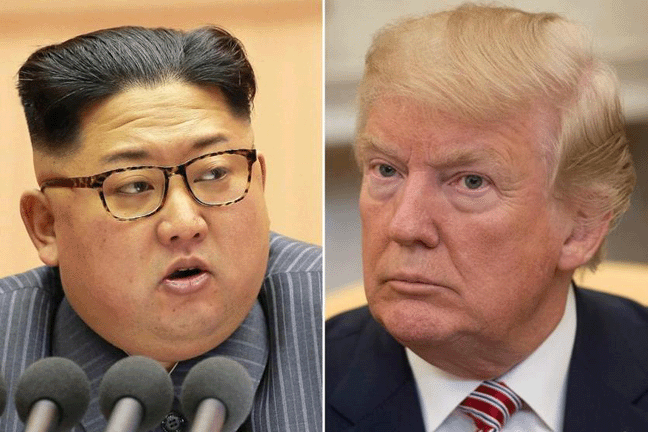
Trump’s decision has nonproliferation consequences beyond Iran. Trump is about to sit down at an important summit with North Korean leader Kim Jong-un to discuss denuclearization of the Korean peninsula. Violating the Iran deal undermines US credibility in those negotiations and sends a message to Kim Jong-un that even if an agreement is reached and North Korea abides by its terms, there’s no guarantee that Washington will fulfill its commitments. This is a dangerous precedent to set and risks this historic opportunity to de-escalate tensions with North Korea.
Singapore will host U.S.-North Korea summit, nuclear issue to dominateSteve Holland, Matt Spetalnick WASHINGTON (Reuters), 11 May 18 Leaders of the United States and North Korea will meet for the first time when President Donald Trump and Kim Jong Un hold a summit on June 12 in Singapore where the U.S. side will try to persuade Pyongyang to give up its nuclear weapons.
…….. “The highly anticipated meeting between Kim Jong Un and myself will take place in Singapore on June 12th. We will both try to make it a very special moment for World Peace!” Trump wrote on Twitter…….
Trump is embarking on this high-stakes meeting with Kim after sending shockwaves through the world on Tuesday when he announced that the United States was pulling out of a 2015 accord imposing international oversight of Iran’s nuclear program.
The move raised questions over whether North Korea might now be less inclined to negotiate its own nuclear deal with Washington.
Trump and Japanese Prime Minister Shinzo Abe spoke by telephone on Wednesday and the White House said the two leaders “affirmed the shared goal of North Korea abandoning its illicit weapons of mass destruction and ballistic missile programs” and remained committed to cooperating with South Korea.
Japan worries that it could be the target of any first-use of nuclear weapons by Pyongyang.
……… Kim recently promised to suspend missile tests and shut a nuclear bomb test site.
North Korea is still technically at war with the United States and its ally South Korea because the 1950-53 Korean War ended in a truce, not a treaty.
The choice of Singapore will put the summit on friendly turf for Trump, as the island nation is a strong U.S. ally and the U.S. Navy frequently visits its port.
The wealthy financial and shipping hub is seen as a gateway between Asia and the West and has been called the “Switzerland of Asia,” in contrast to North Korea’s isolated economy that its leaders now want to modernize.
Trump withdraws from the Iran nuclear deal. What now? Bulletin of the Atomic Scientists, John Mecklin May 18
With his decision today to withdraw the United States from the Iran nuclear deal, US President Donald Trump has put the long-term future of the deal in doubt, at the very least. In a televised announcement from the White House, Trump said the United States would reimpose the “highest level” of economic sanctions against Iran and would hold other nations accountable for violating those sanctions. During his truculent presentation, Trump asserted that the Iran nuclear deal—known officially as the Joint Comprehensive Plan of Action, or JCPOA—was “horrible” and “one-sided.” Even if Iran complied with the terms of the “decaying and rotten structure” of the JCPOA, the president claimed, it could move to the verge of creating nuclear weapons in “a very short time” even as it continued to build nuclear-capable missiles and support terrorism across the Middle East and the world. (The president’s claims run counter to the assessments of the numerous international security experts who note that the JCPOA’s intrusive inspection regime and other components would prevent Iran from acquiring nuclear weapons indefinitely.)
As he announced US withdrawal from the Iran deal, Trump threatened dire consequences for Iran if it resumed work toward nuclear weapons. At the same time, he asserted that his administration would work with allies toward a new deal that he was “ready, willing and able” to negotiate with Iran. Iran has previously insisted it will not renegotiate the JCPOA.
In the immediate aftermath of Trump’s decision, it was unclear how Iran, the other five countries that agreed to the JCPOA—Russia, China, the UK, France, and Germany—and the rest of the world would respond over the long term. The Bulletin invited a wide variety of top international security experts to provide comments on Trump’s decision and its potentially wide-ranging ramifications. Their responses are published below, in hopes they will help the international community find the best possible path forward. ………. https://thebulletin.org/trump-withdraws-iran-nuclear-deal-what-now11791
Britain, France and Germany said they remained committed to the deal despite Tuesday’s decision by President Trump to withdraw.
But Brig. Gen. Hossein Salami said Europe “cannot act independently over the nuclear deal,” the semi-official Fars news agency quoted him as saying.
Iranian President Hassan Rouhani said Tuesday that Tehran would remain in the 2015 agreement, though Europe had only a “limited opportunity” to preserve it.
On Wednesday, Supreme Leader Ayatollah Ali Khamenei cast doubt on the ability of the European signatories to guarantee Tehran’s interests, adding: “I do not trust these countries either.”
Khamenei has the final say on all state matters and commands the loyalty of the IRGC, which has huge political and economic influence domestically.
Salami said Iran’s enemies were not seeking military confrontation. “They want to pressure our country by economic isolation … Resistance is the only way to confront these enemies, not diplomacy,” Fars quoted him as saying.
Trump also said Tuesday he would revive US economic sanctions against Iran, penalizing foreign firms doing business with Tehran and further undermining what he called “a horrible, one-sided deal that should have never, ever been made.”
Europeans fear a collapse of the deal could raise the risk of deepening conflicts in the Middle East.
Early on Thursday, Iranian forces launched their first attack on Israel from inside Syria, firing rockets at army bases in the Golan Heights, Israel said.
That prompted one of the heaviest Israeli barrages against Syria since the conflict there began in 2011.
The pact, the signature foreign policy achievement of Trump’s predecessor, President Barack Obama, was designed to prevent Iran from developing a nuclear bomb in exchange for lifting most sanctions that had crippled its economy. Sanctions were removed in 2016.
Trump complained that the agreement failed to address Iran’s ballistic missile program, its nuclear activities beyond 2025 or its role in conflicts in the Middle East, where Tehran has been involved in a proxy war from Lebanon to Yemen for decades.
In defiance of Western pressure to curb the missile program, Tehran says it is an essential precautionary defense against the United States and other adversaries, primarily Gulf Arab states and Israel.
“Exiting the deal and their concerns over Iran’s missile work are excuses to bring our nation to its knees,” Salami said.
The IRGC’s overseas arm, the Quds force, operates in Iraq, Syria and Yemen, among other places.
Iran-Israel strikes show risk of Middle East war is growing after US exit from nuclear deal, CNBC, 11 May 18
The U.S. exit from the Iran nuclear deal threatens to inflame tensions in the Middle East and heighten the risk of open conflict among regional powers, analysts say.
Israel launched an attack on Iran’s positions in Syria on Thursday, following an earlier strike by Iranian forces on the Golan Heights in retaliation for earlier Israeli strikes.
A long-standing fear is that open military conflict among the Middle East’s dominant players will devolve into a regionwide conflict that drags global powers into war.
A series of rocket exchanges between Iran and Israel along the Syrian border on Thursday may confirm what many feared: The U.S. exit from the Iran nuclear deal will inflame regional rivalries and heighten the risk of open conflict in the Middle East.
Israel launched a deadly attack on Iranian positions in Syria on Thursday, responding to an earlier rocket attack by Iran’s forces on the Golan Heights, a border area Israel captured from Syria in 1967. Iran’s attack itself followed several strikes by Israel on its bases in Syria, where the Iranians are supporting President Bashar Assad in the nation’s long-burning civil war.
The earlier Israeli strikes came both before and after President Donald Trump announced he is withdrawing the United States from the 2015 Iran nuclear deal and restoring wide-ranging sanctions aimed at crippling the Iranian economy. Thursday’s rocket exchange came just two days after Trump’s announcement.
Middle East watchers warn that Trump’s decision to abandon the nuclear deal emboldens Israel andSaudi Arabiato take a more aggressive stance against Iranian forces and proxies in the region. They say it also marginalizes Iran’s political moderates like PresidentHassan Rouhaniand emboldens the nation’s hard-line conservatives and the Iranian Revolutionary Guard Corps, an elite military organization loyal to the supreme leader, Ayatollah Ali Khamenei.
“US withdrawal from the JCPOA could shift the balance of power among the Iranian leadership from those who want to keep the deal operational to hardline elements more willing to risk escalation by strengthening support for regional proxies, and who favour economic self-sufficiency and opposed President Rouhani’s push for greater engagement with the West,” ratings agency Fitch said Thursday, referring to the deal by its official name, the Joint Comprehensive Plan of Action.
For nine days, representatives from governments across the globe have been meeting in Bonn, Germany, to hammer out details of the Paris climate agreement.
But participating at the talks alongside diplomatic representatives and environmental groups are some perhaps unexpected parties — like the U.S. Chamber of Commerce, which has long opposed climate regulations and is a vocal proponent of fossil fuels.
A coalition of developing nations in Africa and Latin America had hoped to draw attention to the influence that the fossil fuel industry maintains over the climate negotiation process with a formal acknowledgement of conflicts of interest at the conclusion of the talks in Bonn this week.
But developed nations — led largely by the United States — succeeded in preventing such a formal acknowledgement from being included in the meeting’s final notes.
Conflicts of interest within the United Nations Framework Convention on Climate Change (UNFCC) — the international treaty that dictates the UN’s annual climate conferences — aren’t a new phenomenon.
In 2015, companies like Engie — a utility company that gets more than 70 percent of its energy output from fossil fuels — were financial sponsors of the Paris climate talks.
But this year, developing nations — alongside environmental groups — have been working to make eliminating conflicts of interest a central part of the climate negotiations moving forward, much to the chagrin of countries like the United States and Australia.
“Every institution, especially of this scale, has some kind of policy to identify and mitigate internal conflict of interests,” Jesse Brag, media director for Corporate Accountability, which has been campaigning to make conflicts of interest within the United Nations climate negotiations a central issue since 2015, told ThinkProgress.
“Right now, there is no acknowledgement [within the UNFCCC] that there could be problems that arise from the financial interests of businesses and NGOs operating here.”
There are a few ways in which fossil fuel companies — or industry groups that represent fossil fuel companies — have already influenced UN climate negotiations.
At the Paris climate negotiations in 2015, for instance, fossil fuel companies that sponsored the talks were given access to “communications and networking” areas in rooms where negotiations were taking place.
The text of the Paris climate agreement, which calls for limiting global warming to “well below 2 degrees Celsius” (3.6 degrees Fahrenheit) doesn’t mention the term “fossil fuels” once, despite the fact that burning fossil fuels is the primary action driving climate change.
And the UNFCCC’s Climate Technology Network, which promotes the adoption of low carbon technology in developing countries, includes a member of the World Coal Association.
Developing nations, alongside NGOs like Corporate Accountability, had hoped to get parties on the record this year acknowledging that conflicts of interest exist within the climate negotiations.
They had also hoped that such acknowledgement would be followed by policy suggestions aimed at helping root out conflicts of interest within the process.
That effort was largely waylaid due to intense opposition from the United States, which refused to allow any mention of conflicts of interest or fossil fuel companies into the meeting’s official notes.
But a coalition of governments representing 70 percent of the world’s population — largely from developing countries in Latin America and Africa — did succeed in getting parties to agree to keep talking about the issue at climate negotiations next year.
That might seem like a small victory, but Bragg argues it’s an important signal that the culture of the talks — as well as general recognition of the issue of conflicts of interest within the negotiations — is starting to change.
“Three years ago, no one wanted to talk about the fossil fuel industry’s role in climate denial in these talks,” Bragg said. “Now, it’s a discussion that is happening in every area of these halls. As the process advances, so does the culture around what needs to be done.”
It is unsurprising that the United States — which is still a party to the UNFCCC even as President Trump has promised to withdraw from the Paris climate agreement — would oppose efforts to draw attention to conflicts of interest between environmental treaties and fossil fuel companies.
Under the Trump administration, several high-profile environmental regulator posts have been filled by people who previously represented the industries that they now oversee.
Environmental Protection Agency (EPA) Deputy Administrator Andrew Wheeler, for instance, came to the EPA after working as a lobbyist for Murray Energy, the largest privately-owned coal firm in the United States.
Nancy Beck, who is currently the highest-ranking political appointee at overseeing regulation of the chemical industry at the EPA, used to work for the American Chemical Council , the chemical industry’s main lobbying organization.
And over at the Department of the Interior, Deputy Secretary David Bernhardt came to the agency after working for years as a lobbyist in the natural resources department of the firm Brownstein Hyatt Farber Schreck.
Nasr al-Hariri, chair of the Syrian Negotiations Committee, says move could help remove ‘malignant influence’ of Iran from country, Guardian, Patrick WintourDiplomatic editor Thu 10 May 2018Donald Trump’s decision to break the Iran nuclear deal has won praise from the official Syrian opposition, which said the move represented a real opportunity to remove Iranian influence from the war-torn country……….. He stopped short of directly praising Israel for attacking Iranian positions in Syria, saying the effort to drive as many as 100,000 Iran-backed militias from Syria needed to be coordinated…… He stopped short of directly praising Israel for attacking Iranian positions in Syria, saying the effort to drive as many as 100,000 Iran-backed militias from Syria needed to be coordinated. more https://www.theguardian.com/world/2018/may/10/syrian-opposition-praises-donald-trumps-iran-nuclear-deal-exit
The U.S. Treasury imposed sanctions against six individuals and three companies it said had funneled millions of dollars to the Iranian Revolutionary Guard’s elite Qods Force.
The sanctions were imposed just days after President Donald Trump withdrew from the Iran nuclear deal.
Saudi Arabia says backs U.S. decision to withdraw from Iran nuclear deal, Reuters Staff RIYADH (Reuters) 9 May 18- Saudi Arabia welcomed President Donald Trump’s decision on Tuesday to withdraw the United States from the international nuclear agreement with Iran and to reimpose economic sanctions on its arch-foe Tehran.
The kingdom, a key U.S. ally, said it would work with the United States and the international community to address Iran’s nuclear program as well as its ballistic missile program and support of militant groups in the region……..
It confirmed “the need to deal with the danger that Iran’s policies pose to international peace and security through a comprehensive view that is not limited to its nuclear program but also includes all hostile activities” in the region……..
Saudi Arabia has called the 2015 nuclear deal a “flawed agreement”, and in March Saudi Crown Prince Mohammed bin Salman told CBS news that his kingdom would “without a doubt” develop nuclear weapons if Iran did so.
The Sunni Muslim kingdom has been at loggerheads with Shi’ite Iran for decades. They have fought a long-running proxy war in the Middle East and beyond, backing opposing sides in armed conflicts and political crises including in Iraq, Syria, Lebanon and Yemen.
President Hassan Rouhani said on Tuesday that Iran would remain committed to a multinational nuclear deal despite U.S. President Donald Trump’s decision to withdraw from the 2015 agreement designed to deny Tehran the ability to build nuclear weapons, Reuters reported.
“If we achieve the deal’s goals in cooperation with other members of the deal, it will remain in place… By exiting the deal, America has officially undermined its commitment to an international treaty,” Rouhani said in a televised speech.
“I have ordered the foreign ministry to negotiate with the European countries, China and Russia in coming weeks. If at the end of this short period we conclude that we can fully benefit from the JCPOA with the cooperation of all countries, the deal would remain,” he added.
The Joint Comprehensive Plan of Action (JCPOA) is the full name for the nuclear deal, struck in 2015 between Iran, the five permanent members of the U.N. Security Council – the United States, Russia, China, Britain and France – and Germany.
Rouhani added that Iran was ready to resume its nuclear activities after consultations with the other world powers which are part of the agreement.